Spiritual Intelligence: A Scoping Review with Concept Analysis on the Key to Spiritual Care



Abstract
1. Introduction
2. Background
3. Data Sources
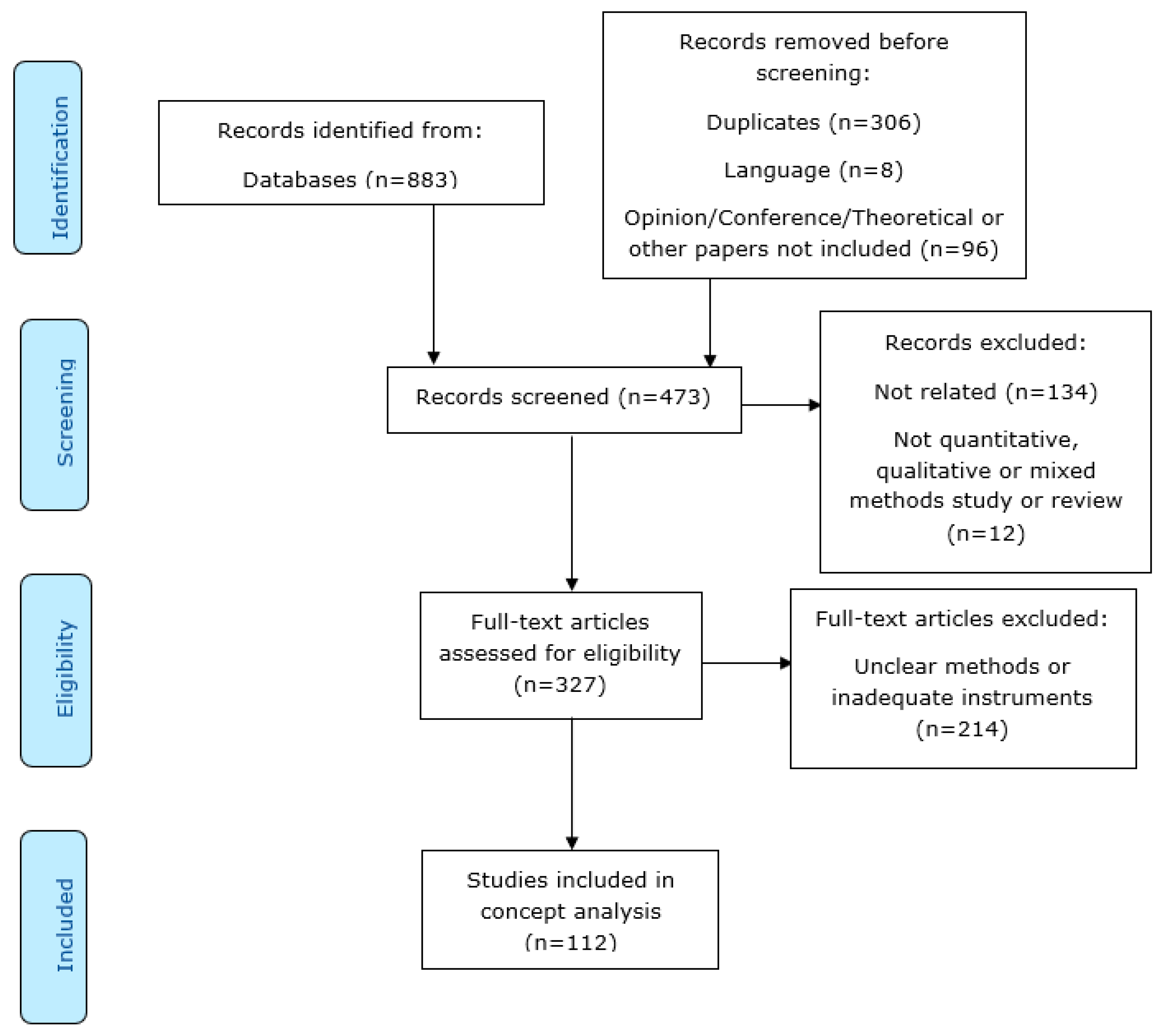
3.1. Search Strategy and Study Selection
3.2. Data Extraction and Analysis
4. Overview of the Concept
4.1. References of the Concept and Areas of Application
4.2. Concept Evolution
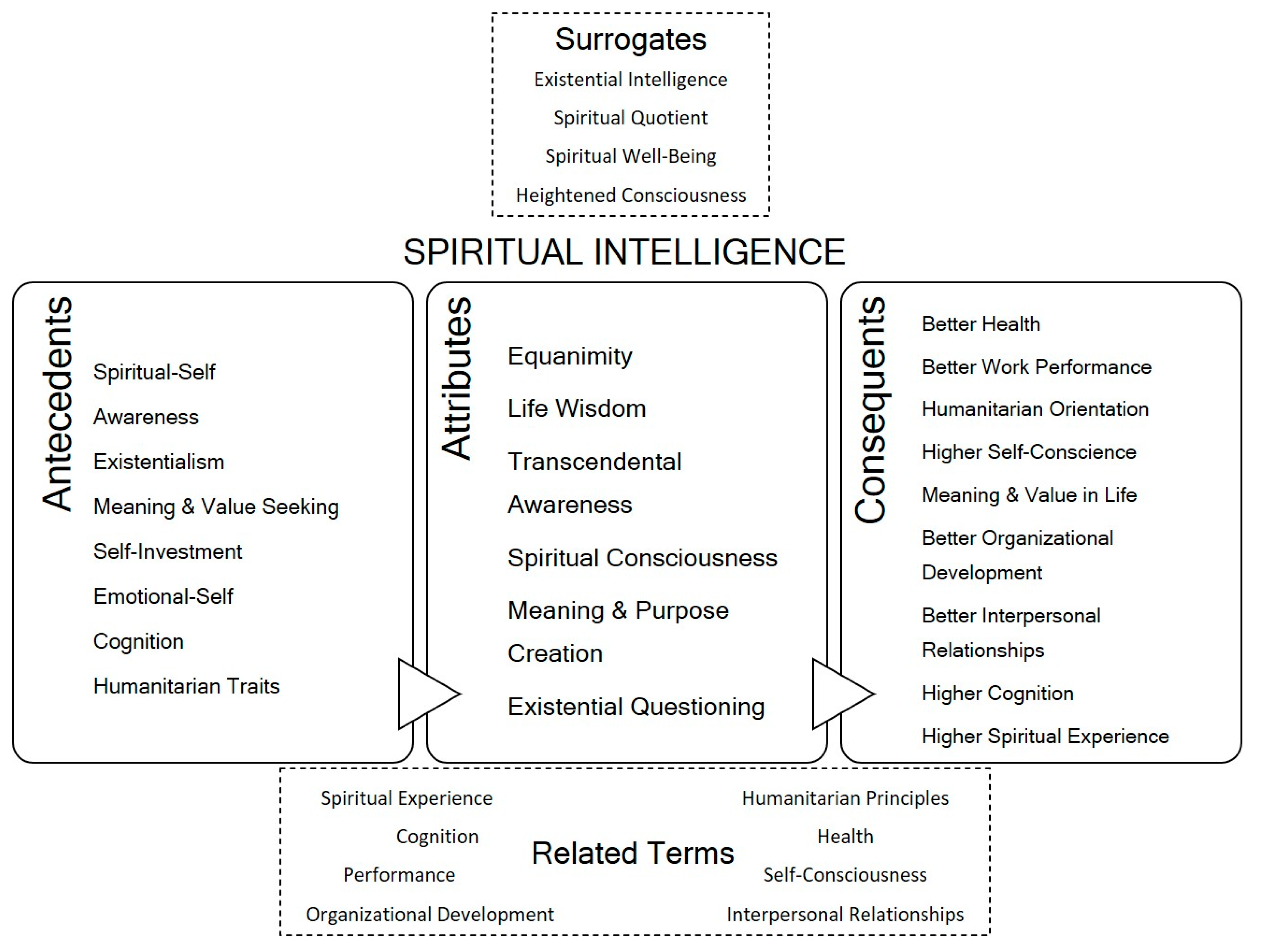
4.3. Surrogate Terms
4.4. Related Concepts
4.5. Antecedents of the Concept
4.6. Consequents of the Concept
4.7. Defining Attributes
4.8. Model Case
4.9. Definition of the Concept
5. Discussion
6. Conclusions
Supplementary Materials
Author Contributions
Funding
Institutional Review Board Statement
Informed Consent Statement
Data Availability Statement
Conflicts of Interest
Abbreviations
| PRISMA-ScR | PRISMA extension for scoping reviews |
| AI | Artificial Intelligence |
References
- Abazari, L., Abazari, A., Emamgholi, M., & Asadi, N. (2025). Effect of pranayama practice on emotional intelligence and spiritual intelligence in nursing students. SAGE Open Nursing, 11, 23779608251371103. [Google Scholar] [CrossRef]
- Abdollahpour, S., & Khosravi, A. (2018). Relationship between spiritual intelligence with happiness and fear of childbirth in Iranian pregnant women. Iranian Journal of Nursing and Midwifery Research, 23(1), 45–50. [Google Scholar] [CrossRef] [PubMed]
- Abdolrezapour, P., & Alipour, J. (2021). Fostering spiritual intelligence and a concomitant development of WTC in EFL learners. Teaching Theology and Religion, 24(3), 136–151. [Google Scholar] [CrossRef]
- Afrashteh, M. Y., Fartash, A., & Aboutorabi, K. (2025). Relationship between death anxiety and spiritual intelligence: The potential mediating role of meaning of life and resilience in Iranian older people. BMC Geriatrics, 25(1), 482. [Google Scholar] [CrossRef]
- Ahmadi, M., Estebsari, F., Poormansouri, S., Jahani, S., & Sedighie, L. (2021). Perceived professional competence in spiritual care and predictive role of spiritual intelligence in Iranian nursing students. Nurse Education in Practice, 57, 103227. [Google Scholar] [CrossRef]
- Ajele, W. K., Oladejo, T. A., Akanni, A. A., & Babalola, O. B. (2021). Spiritual intelligence, mindfulness, emotional dysregulation, depression relationship with mental well-being among persons with diabetes during COVID-19 pandemic. Journal of Diabetes and Metabolic Disorders, 20(2), 1705–1714. [Google Scholar] [CrossRef]
- Alamanda, D. T., Ahmad, I., Putra, H. D., & Hashim, N. A. (2021). The role of spiritual intelligence in citizenship behaviours amongst muslim staff in Malaysia. HTS Teologiese Studies/Theological Studies, 77(1). [Google Scholar] [CrossRef]
- Aliabadi, P. K., Zazoly, A. Z., Sohrab, M., Neyestani, F., Nazari, N., Mousavi, S. H., Fallah, A., Youneszadeh, M., Ghasemiyan, M., & Ferdowsi, M. (2021). The role of spiritual intelligence in predicting the empathy levels of nurses with COVID-19 patients. Archives of Psychiatric Nursing, 35(6), 658–663. [Google Scholar] [CrossRef]
- Amiri, R., Gaeeni, M., & Tehran, H. A. (2023). The mediating role of moral reasoning in spiritual intelligence and caring behaviors in Iranian emergency nurses. Journal of Medical Ethics and History of Medicine, 16, 11. [Google Scholar] [CrossRef] [PubMed]
- Amirian, M.-E., & Fazilat-Pour, M. (2016). Simple and multivariate relationships between spiritual intelligence with general health and happiness. Journal of Religion and Health, 55(4), 1275–1288. [Google Scholar] [CrossRef]
- Amram, Y. (2022). The intelligence of spiritual intelligence: Making the case. Religions, 13, 1140. [Google Scholar] [CrossRef]
- Amram, Y., & Dryer, C. (2008). The Integrated Spiritual Intelligence Scale (ISIS): Development and preliminary validation. In 116th annual conference of the American psychological association. American Psychological Association. [Google Scholar]
- Antunes, R., Silva, A. P., & Oliveira, J. (2018). Spiritual intelligence self-assessment inventory: Psychometric properties of the Portuguese version of SISRI-24. Journal of Religion, Spirituality and Aging, 30(1), 12–24. [Google Scholar] [CrossRef]
- Anwar, A., & Gani, A. M. O. (2015). The effects of spiritual intelligence and its dimensions on organizational citizenship behaviour. Journal of Industrial Engineering and Management, 8(4), 1162–1178. [Google Scholar] [CrossRef]
- Anwar, A., Gani, A. M. O., & Rahman, M. S. (2020). Effects of spiritual intelligence from Islamic perspective on emotional intelligence. Journal of Islamic Accounting and Business Research, 11(1), 216–232. [Google Scholar] [CrossRef]
- Arnout, B. A. (2020). A structural equation model relating unemployment stress, spiritual intelligence, and mental health components: Mediators of coping mechanism. Journal of Public Affairs, 20(2), e2025. [Google Scholar] [CrossRef]
- Arsang-Jang, S., Khoramirad, A., Pourmarzi, D., & Raisi, M. (2020). Relationship between spiritual intelligence and ethical decision making in Iranian nurses. Journal of Humanistic Psychology, 60(3), 330–341. [Google Scholar] [CrossRef]
- Atroszko, P. A., Skrzypińska, K., & Balcerowska, J. M. (2021). Is there a general factor of spiritual intelligence? Factorial validity of the Polish adaptation of spiritual intelligence self-report inventory. Journal of Religion and Health, 60(5), 3591–3605. [Google Scholar] [CrossRef]
- Augusty, P. A., & Mathew, J. (2020). Spiritual intelligence and the knowledge society a systematic review of literature to understand and examine the importance of spiritual intelligence in a knowledge society. Journal of Critical Reviews, 7(19), 585–594. [Google Scholar]
- Azizi, M., & Zamaniyan, M. (2013). The relationship between spiritual intelligence and vocabulary learning strategies in EFL learners. Theory and Practice in Language Studies, 3(5), 852–858. [Google Scholar] [CrossRef]
- Azizollah, A., Maede-Sadat, R., Narges, M., & Shekoofeh-Sadat, R. (2013). Relationship between different types of intelligence and student achievement. Life Science Journal, 10, 128–133. [Google Scholar]
- Babanazari, L., Askari, P., & Honarmand, M. M. (2012). Spiritual intelligence and happiness for adolescents in high school. Life Science Journal, 9(3), 2296–2299. [Google Scholar]
- Badrudin, B., Komariah, A., Wijaya, C., Barowi, A., & Samrin, S. (2021). Effect of spiritual intelligence on spiritual health during the COVID-19 pandemic. HTS Teologiese Studies/Theological Studies, 77(1), a6594. [Google Scholar] [CrossRef]
- Baharodin, N. M. (2025). A Systematic Literature Review on The Importance of Spiritual Intelligence in Marital Satisfaction. Akademika, 95(3), 209. [Google Scholar] [CrossRef]
- Baloochi, A., Abazari, F., & Mirzaee, M. (2018). The relationship between spiritual intelligence and aggression in medical science students in the southeast of Iran. International Journal of Adolescent Medicine and Health, 32(3). [Google Scholar] [CrossRef]
- Bennis, I., & Mouwafaq, S. (2025). Advancing AI-driven thematic analysis in qualitative research: A comparative study of nine generative models on Cutaneous Leishmaniasis data. BMC Medical Informatics and Decision Making, 25(1), 124. [Google Scholar] [CrossRef]
- Bhandari, R. B., Chaudhry, N., & Devi, S. (2023). Relationship between spirituality and distress in ascetics. Psychological Reports, 126(1), 169–180. [Google Scholar] [CrossRef]
- Cai, B., Chen, Y., & Ayub, A. (2023). “Quiet the Mind, and the Soul Will Speak”! Exploring the Boundary Effects of Green Mindfulness and Spiritual Intelligence on University Students’ Green Entrepreneurial Intention–Behavior Link. Sustainability, 15(5), 3895. [Google Scholar] [CrossRef]
- Chan, A. W. Y., & Siu, A. F. Y. (2016). Application of the Spiritual Intelligence Self-Report Inventory (SISRI-24) among Hong Kong university students. International Journal of Transpersonal Studies, 35(1), 1–12. [Google Scholar] [CrossRef]
- Checa, P., & Fernández-Berrocal, P. (2015). The role of intelligence quotient and emotional intelligence in cognitive control processes. Frontiers in Psychology, 6, 1853. [Google Scholar] [CrossRef]
- Dacka, M., & Rydz, E. (2023). Personality traits and the spiritual and moral intelligence of early adulthood in Poland: Research reports. Religions, 14, 78. [Google Scholar] [CrossRef]
- Dami, Z. A., Setiawan, I., Sudarmanto, G., & Lu, Y. (2019). Effectiveness of group counseling on depression, anxiety, stress and components of spiritual intelligence in student. International Journal of Scientific and Technology Research, 8(9), 236–243. [Google Scholar]
- Dargahi, H., & Veysi, F. (2021). The relationship between managers’ ideal intelligence as a hybrid model and employees’ organizational commitment: A case study in Tehran university of medical sciences. Journal of Medical Ethics and History of Medicine, 14, 8. [Google Scholar] [CrossRef]
- Dávila-Valencia, P. K., Gala-Espinoza, B. J., & Morales-García, W. C. (2025). Spiritual intelligence in healthcare practice and servant leadership as predictors of work life quality in Peruvian nurses. Nursing Reports, 15(7), 249. [Google Scholar] [CrossRef]
- Ebrahimi, B., Hosseini, M., Abdi, K., Bakhshi, E., & Shirozhan, S. (2019). The relationship between spiritual intelligence and resiliency of rehabilitation staff. Journal of Pastoral Care & Counseling, 73(4), 205–210. [Google Scholar] [CrossRef]
- Emmons, R. A. (2000). Is spirituality an intelligence? Motivation, cognition, and the psychology of ultimate concern. International Journal of Phytoremediation, 21(1), 3–26. [Google Scholar] [CrossRef]
- Fazlolah, M. (2018). An investigation of the relationship between identity and spiritual intelligence of second-grade high school teachers of the city of Khorramabad. Annals of Tropical Medicine and Public Health, 14, S743. [Google Scholar]
- Feng, M., Xiong, X. Y., & Li, J. J. (2019). Spiritual intelligence scale—Chinese form: Construction and initial validation. Current Psychology, 38(5), 1318–1327. [Google Scholar] [CrossRef]
- Fidelis, A., Moreira, A. C., & Vitória, A. (2024). Multiple perspectives of spiritual intelligence: A systematic literature review. Social Sciences and Humanities Open, 9, 100879. [Google Scholar] [CrossRef]
- Fidelis, A. C. F., Formiga, N. S., & Fernandes, A. J. (2023). A measure of leadership’s spiritual intelligence from the perspectives of Brazilian and Portuguese workers. Revista CES Psicologia, 16(2), 17–30. [Google Scholar] [CrossRef]
- Gardner, H. (1983). Frames of mind: The theory of multiple intelligences. Basic Books. [Google Scholar]
- Gera, N., Vesperi, W., Fatta, D. D., Sahni, A., & Arora, A. (2021). Human resource development and spiritual intelligence: An investigation amongst management students in Delhi NCR. International Journal of Innovation and Learning, 29(1), 45–66. [Google Scholar] [CrossRef]
- Geram, K. (2016). The prediction of social adjustment based on emotional and spiritual intelligence. International Journal of Advanced Biotechnology and Research, 7(4), 19–25. [Google Scholar]
- Ghalaychi, Z., Dolatian, M., Mahmoodi, Z., Boromandnia, N., & Valizadeh, R. (2019). The relationship between spiritual health and spiritual intelligence of midwives and midwifery students and satisfaction of clients with vaginal childbirth. Journal of Pharmaceutical Research International, 28(5), 1–8. [Google Scholar] [CrossRef]
- Ghonchehpour, A., Afshar, P. P., Tirgari, B., Maazallahi, M., & Forouzi, M. A. (2025). Spiritual sensitivity in nursing and midwifery students and its relationship with spiritual intelligence and spiritual growth. BMC Medical Education, 25(1), 1442. [Google Scholar] [CrossRef]
- Grasmane, I., Pipere, A., & Raščevskis, V. (2025). Effectiveness of a psycho-pedagogical Intervention on spiritual intelligence, happiness, and spiritual well-being for primary school children: A Non-randomized controlled trial. Journal of Happiness Studies, 26(1), 5. [Google Scholar] [CrossRef]
- Grasmane, I., Raščevskis, V., & Pipere, A. (2022). Primary validation of Children Spiritual Intelligence Scale in a sample of Latvian elementary school pupils. International Journal of Children’s Spirituality, 27(2), 97–112. [Google Scholar] [CrossRef]
- Hanefar, S. B. M., Benaouda, B., Faizuddin, A., & Ramachandaran, S. D. (2025). Mapping the landscape of spiritual intelligence: A bibliometric analysis of trends, patterns and future directions. Journal of Religion and Health, 64(5), 3419–3447. [Google Scholar] [CrossRef]
- Hassan, S. A., & Shabani, J. (2013). The mediating role of emotional intelligence between spiritual intelligence and mental health problems among Iranian adolescents. Psychological Studies, 58(1), 73–79. [Google Scholar] [CrossRef]
- Hatami, A., Badrani, M. R., Kamboo, M. S., Jahangirimehr, A., & Hemmatipour, A. (2019). An investigation of the relationship of spiritual intelligence and resilience with attitude to fear of childbirth in pregnant women. Journal of Evolution of Medical and Dental Sciences, 8(1), 24–28. [Google Scholar] [CrossRef]
- Hewa, S., & Hetherington, R. (1995). Specialists without spirit: Limitations of the mechanistic biomedical model. Theoretical Medicine, 16(2), 129–139. [Google Scholar] [CrossRef]
- Hojat, M., & Badiyepeymaiejahromi, Z. (2021). Relationship between spiritual intelligence and professional self-concept among Iranian nurses. Investigacion y Educacion En Enfermeria, 39(3), e12. [Google Scholar] [CrossRef]
- Howard, R. W. (1993). On what intelligence is. British Journal of Psychology, 84(1), 27–37. [Google Scholar] [CrossRef]
- Imani, B., Imani, G., & Karampourian, A. (2021). Correlation between spiritual intelligence and clinical competency in students who are children of war victims. Iranian Journal of Psychiatry, 16(3), 329–335. [Google Scholar] [CrossRef] [PubMed]
- Jorge, D. F. O., Esgalhado, G., & Pereira, H. (2016). Inteligência espiritual: Validação preliminar da versão portuguesa da Escala de Inteligência Espiritual Integrada (EIEI). Analise Psicologica, 34(3), 325–337. [Google Scholar] [CrossRef]
- Kadhim, A. J., Kadhim, M. H., Noghabi, E. S., Taher, M., Barzgar, B., Masabi, N. S., Eftekhari, A., Chenari, H. A., & Baumann, S. L. (2025). Exploring the relationship between nurses’ spiritual intelligence, critical thinking, and moral development in the middle east. Nursing Science Quarterly, 8943184251388292. [Google Scholar] [CrossRef] [PubMed]
- Kaur, D., Sambasivan, M., & Kumar, N. (2013). Effect of spiritual intelligence, emotional intelligence, psychological ownership and burnout on caring behaviour of nurses: A cross-sectional study. Journal of Clinical Nursing, 22(21–22), 3192–3202. [Google Scholar] [CrossRef]
- Khastavaneh, M., Dehbanizadeh, A., Hosseini, N., Razmjooei, P., Movaghghar, M., Zabolypour, S., Ahmadi, E., & Hosseini, M. (2018). Comparing spiritual intelligence and emotional intelligence of nurse managers with commitment of nurses of Yasuj University of medical sciences. Amazonia Investiga, 7(13), 101–109. [Google Scholar]
- Khosravi, M. (2023). The impact of openness to experience personality trait on attitudes of medical students toward euthanasia: The moderating role of spiritual intelligence. European Journal of Translational Myology, 33(4), 11845. [Google Scholar] [CrossRef]
- Khosravi, M., & Nikmanesh, Z. (2014). Relationship of spiritual intelligence with resilience and perceived stress. Iranian Journal of Psychiatry and Behavioral Sciences, 8(4), 52–56. [Google Scholar]
- King, D. B., & DeCicco, T. L. (2009). A viable model and self-report measure of spiritual intelligence. International Journal of Transpersonal Studies, 28(1), 68–85. [Google Scholar] [CrossRef]
- King, D. B., Mara, C. A., & De Cicco, T. L. (2012). Connecting the spiritual and emotional intelligences: Confirming an intelligence criterion and assessing the role of empathy. International Journal of Transpersonal Studies, 31(1), 11–20. [Google Scholar] [CrossRef]
- Korkut, S., & Çetin, B. (2025). The relationship between spiritual intelligence and compliance with professional values in nursing students in Türkiye. Journal of Religion and Health, 64(3), 1770–1782. [Google Scholar] [CrossRef]
- Liu, Z., Li, X., Jin, T., Xiao, Q., & Wuyun, T. (2021). Effects of ethnicity and spiritual intelligence in the relationship between awe and life satisfaction among chinese primary school teachers. Frontiers in Psychology, 12, 673832. [Google Scholar] [CrossRef] [PubMed]
- Maghool, A., Bakhshi, M., Rastaghi, S., & Rad, M. (2023). Relationship between spiritual intelligence and intolerance of uncertainty, anxiety and fear of Corona in the elderly. Journal of Education and Health Promotion, 12(1), 399. [Google Scholar] [CrossRef] [PubMed]
- Mahasneh, A. M., Shammout, N. A., Alkhazaleh, Z. M., Al-Alwan, A. F., & Abu-Eita, J. D. (2015). The relationship between spiritual intelligence and personality traits among jordanian university students. Psychology Research and Behavior Management, 8, 89–97. [Google Scholar] [CrossRef] [PubMed]
- Mahmood, A., Arshad, M. A., Ahmed, A., Akhtar, S., & Khan, S. (2018). Spiritual intelligence research within human resource development: A thematic review. Management Research Review, 41(8), 987–1006. [Google Scholar] [CrossRef]
- Malini, S., & Raju, R. (2018). Exploring the moderating effects of gender on the relationship between motivation and spiritual intelligence of higher education students in India. International Journal of Educational Sciences, 21(1–3), 79–90. [Google Scholar] [CrossRef]
- Martin, T. N., & Hafer, J. C. (2009). Models of emotional intelligence, spiritual intelligence, and performance: A test of tischler, biberman, and mckeage. Journal of Management, Spirituality and Religion, 6(3), 247–257. [Google Scholar] [CrossRef]
- Martín-Sánchez, A., Rodríguez-Zafra, M., & Ceniceros-Estévez, J. C. (2020). El estudio de la inteligencia espiritual II: Un instrumento de evaluación de su desempeño competencial. Acción Psicológica, 17(2), 103–122. [Google Scholar] [CrossRef]
- Marzban, A., Fereidooni-Moghadam, M., & Ghezelbash, S. (2022). The relationship between spiritual intelligence and resilience in family caregivers of patients with chronic mental disorders. Perspectives in Psychiatric Care, 58(4), 2846–2853. [Google Scholar] [CrossRef]
- Mehralian, G., Yusefi, A. R., Dastyar, N., & Bordbar, S. (2023). Communication competence, self-efficacy, and spiritual intelligence: Evidence from nurses. BMC Nursing, 22(1), 99. [Google Scholar] [CrossRef]
- Mokhtari, F., Torabi, F., & Pirhadi, M. (2022). Relationship between fertility characteristics with spiritual intelligence and resilience in infertile couples. Journal of Education and Health Promotion, 11(1), 44. [Google Scholar] [CrossRef] [PubMed]
- Moon, A., & Woo, S. (2025). Perceived burdensomeness, spiritual intelligence, and suicidal ideation: Implications for attitudes toward physician-assisted suicide in Korean Older Adults. Journal of Health Psychology, 13591053251369358. [Google Scholar] [CrossRef]
- Mosavinezhad, S. M., Safara, M., Kasir, S., & Khanbabaee, M. (2019). Role of Spiritual intelligence and personal beliefs in social anxiety among university students. Health, Spirituality and Medical Ethics, 6(3), 11–17. [Google Scholar] [CrossRef]
- Moshashaei, S. K. D., Yarahmadi, Y., & Sharifi, H. P. (2024). The causal model of spiritual well-being based on an accompanist of god and spiritual intelligence. Journal of Education and Health Promotion, 13(1), 471. [Google Scholar] [CrossRef]
- Mróz, J., Kaleta, K., & Skrzypińska, K. (2021). The role of spiritual intelligence and dispositional forgiveness in predicting episodic forgiveness. Journal of Beliefs and Values, 42(4), 415–435. [Google Scholar] [CrossRef]
- Mróz, J., Kaleta, K., & Skrzypinska, K. (2023). Spiritual intelligence as a mediator between personality and emotional and decisional forgiveness in Polish adults. Religions, 14, 574. [Google Scholar] [CrossRef]
- Narayanan, A., & Jose, T. P. (2011). Spiritual intelligence and resilience among christian youth in Kerala. Journal of the Indian Academy of Applied Psychology, 37(2), 263–268. [Google Scholar]
- Nekouei, Z. K., Yousefy, A., Doost, H. T. N., Manshaee, G., & Sadeghei, M. (2014). Structural model of psychological risk and protective factors affecting on quality of life in patients with coronary heart disease: A psychocardiology model. Journal of Research in Medical Sciences, 19(2), 90–98. [Google Scholar]
- Noble, K. D. (2001). Riding the windhorse: Spiritual intelligence and the growth of the self. Hampton Press. [Google Scholar]
- Noroozi, M., & Mohebbi-Dehnavi, Z. (2023). Investigating the relationship between religious orientation and spiritual intelligence with general health dimensions in women with breast cancer. Journal of Education and Health Promotion, 12(1), 40. [Google Scholar] [CrossRef]
- Oyewunmi, A. E., Esho, E., & Oyewunmi, O. A. (2021). Spiritual intelligence and employee outcomes in an African sample. Journal of Management, Spirituality & Religion, 18(2), 151–171. [Google Scholar] [CrossRef]
- Özçalık, H. B., & Ataş, A. N. (2025). The effects of prenatal optimism and spiritual intelligence levels on childbirth attitudes. Clinical and Experimental Health Sciences, 15(1), 35–41. [Google Scholar] [CrossRef]
- Özsarı, A., & Ilkim, M. (2021). Investigation of the spiritual intelligence features of physically handicapped badminton players in terms of various variables. International Journal of Life Science and Pharma Research, 14, 29–35. [Google Scholar]
- Page, M. J., McKenzie, J. E., Bossuyt, P. M., Boutron, I., Hoffmann, T. C., Mulrow, C. D., Shamseer, L., Tetzlaff, J. M., Akl, E. A., Brennan, S. E., Chou, R., Glanville, J., Grimshaw, J. M., Hróbjartsson, A., Lalu, M. M., Li, T., Loder, E. W., Mayo-Wilson, E., McDonald, S., … Moher, D. (2021). The PRISMA 2020 statement: An updated guideline for reporting systematic reviews. The BMJ, 372, n71. [Google Scholar] [CrossRef]
- Parattukudi, A., Maxwell, H., Dubois, S., & Bédard, M. (2021). Women’s spiritual intelligence is associated with fewer depression symptoms: Exploratory results from a Canadian sample. Journal of Religion and Health, 61, 433–442. [Google Scholar] [CrossRef]
- Peng-Keller, S., Winiger, F., & Rauch, R. (2022). The spirit of global health: The world health organization and the “spiritual dimension” of health, 1946–2021. Oxford University Press. [Google Scholar]
- Peters, M. D. J., Marnie, C., Tricco, A. C., Pollock, D., Munn, Z., Alexander, L., McInerney, P., Godfrey, C. M., & Khalil, H. (2020). Updated methodological guidance for the conduct of scoping reviews. JBI Evidence Synthesis, 18(10), 2119–2126. [Google Scholar] [CrossRef]
- Pinto, C. T., Guedes, L., Pinto, S., & Nunes, R. (2024). Spiritual intelligence: A scoping review on the gateway to mental health. Global Health Action, 17(1), 2362310. [Google Scholar] [CrossRef]
- Pinto, C. T., & Pinto, S. (2020). From spiritual intelligence to spiritual care: A transformative approach to holistic practice. Nurse Education in Practice, 47, 102823. [Google Scholar] [CrossRef]
- Pinto, C. T., Veiga, F., Guedes, L., Pinto, S., & Nunes, R. (2023). Models of spiritual intelligence interventions: A scoping review. Nurse Education in Practice, 73, 103829. [Google Scholar] [CrossRef]
- Pishghadam, R., Yousofi, N., Amini, A., & Sadat Tabatabayeeyan, M. (2022). Interplay of psychological reactance, burnout, and spiritual intelligence: A case of Iranian EFL teachers. Revista de Psicodidactica, 27(1), 76–85. [Google Scholar] [CrossRef]
- Polemikou, A., & Vantarakis, S. (2019). Death anxiety and spiritual intelligence as predictors of dissociative posttraumatic stress disorder in Greek first responders: A moderation model. Spirituality in Clinical Practice, 6(3), 182–193. [Google Scholar] [CrossRef]
- Polemikou, A., Zartaloudi, E., & Polemikos, N. (2019). Development of the Greek version of the Spiritual Intelligence Self-Report Inventory-24 (KAPN): Factor structure and validation. Mental Health, Religion and Culture, 22(10), 1033–1047. [Google Scholar] [CrossRef]
- Prabhu, C. J., Mehta, M., & Srivastava, A. P. (2020). A new model of practical spiritual intelligence for the leadership development of human capital in Indian universities. Journal of Applied Research in Higher Education, 12(5), 957–973. [Google Scholar] [CrossRef]
- Rafiei, S., Souri, S., Nejatifar, Z., & Amerzadeh, M. (2023). The relationship between spiritual intelligence and self-management in patients with diabetes type 1. BMC Endocrine Disorders, 23(1), 231. [Google Scholar] [CrossRef]
- Rahmanian, M., Hojat, M., Fatemi, N., Mehran, A., & Parvizy, S. (2019). Spiritual intelligence of adolescents with diabetes based on demographic components. Journal of Education and Health Promotion, 8(1), 204. [Google Scholar] [CrossRef]
- Rahmanian, M., Hojat, M., Jahromi, M., & Nabiolahi, A. (2018). The relationship between spiritual intelligence with self-efficacy in adolescents suffering type 1 diabetes. Journal of Education and Health Promotion, 7(1), 100. [Google Scholar] [CrossRef] [PubMed]
- Rahmawaty, A., Rokhman, W., Bawono, A., & Irkhami, N. (2021). Emotional intelligence, spiritual intelligence and employee performance: The mediating role of communication competence. International Journal of Business and Society, 22(2), 734–752. [Google Scholar] [CrossRef]
- Rajabi, R., Aliabadi, H. E., Mahdizadeh, M. J., & Forouzi, M. A. (2023). A comparative study of religious beliefs, spiritual intelligence and spiritual well-being in two therapies based on education (anonymous drug user) and methadone in drug user in Iran. BMC Research Notes, 16(1), 101. [Google Scholar] [CrossRef] [PubMed]
- Rani, A. A., Abidin, I., Rashid, A. H., Rashid, M., & Hamid, A. (2013). The impact of spiritual intelligence on work performance: Case studies in government hospitals of east coast of Malaysia. The Macrotheme Review, 2(3), 46–59. [Google Scholar]
- Riahi, S., Goudarzi, F., Hasanvand, S., Abdollahzadeh, H., Ebrahimzadeh, F., & Dadvari, Z. (2018). Assessing the effect of spiritual intelligence training on spiritual care competency in critical care nurses. Journal of Medicine and Life, 11(4), 346–354. [Google Scholar] [CrossRef]
- Rodgers, B., & Knafl, K. (2000). Concept analysis: An evolutionary view. In Concept development in nursing: Foundations, techniques, and applications (2nd ed., pp. 77–102). Saunders. [Google Scholar] [CrossRef]
- Saeedi, N. R., Yekta, M., & Masoudi, S. (2014). The relation between spiritual intelligence and religion orientation in students. Advances in Environmental Biology, 8(9), 816–820. [Google Scholar]
- Salovey, P., & Mayer, J. D. (1990). Emotional intelligence. Imagination, Cognition and Personality, 9(3), 185–211. [Google Scholar] [CrossRef]
- Senmar, M., Azimian, J., Noorian, S., Aliakbari, M., & Chegini, N. (2023). Relationship between spiritual intelligence and lifestyle with life satisfaction among students of medical sciences. BMC Medical Education, 23(1), 520. [Google Scholar] [CrossRef]
- Shahbakhsh, B., & Moallemi, S. (2013). Spiritual intelligence, resiliency, and withdrawal time in clients of methadone maintenance treatment. International Journal of High Risk Behaviors and Addiction, 2(3), 132–135. [Google Scholar] [CrossRef]
- Shahcheragh, S. H., Fekri, N., & Rad, M. (2024). The relationship between spiritual intelligence and fatigue and moral distress in emergency nurses: A cross-sectional study. Iranian Journal of Nursing and Midwifery Research, 29(6), 737–742. [Google Scholar] [CrossRef]
- Sharif, S., Nia, H., Lehto, R. H., Moradbeigi, M., Naghavi, N., Goudarzian, A. H., Yaghoobzadeh, A., & Nazari, R. (2019). The relationship between spirituality dimensions and death anxiety among Iranian veterans: Partial least squares structural equation modeling approach. Journal of Religion and Health, 60(2), 999–1014. [Google Scholar] [CrossRef]
- Sharifnia, A. M., Fernandez, R., Green, H., & Alananzeh, I. (2022a). Spiritual intelligence and professional nursing practice: A systematic review and meta-analysis. International Journal of Nursing Studies Advances, 4, 100096. [Google Scholar] [CrossRef]
- Sharifnia, A. M., Fernandez, R., Green, H., & Alananzeh, I. (2022b). The effectiveness of spiritual intelligence educational interventions for nurses and nursing students: A systematic review and meta-analysis. Nurse Education in Practice, 63, 103380. [Google Scholar] [CrossRef]
- Sharma, S. (2019). A co-relational study of adjustment among professional and non-professional working women with respect to psychological variables. International Journal of Recent Technology and Engineering, 8(1C2), 230–238. [Google Scholar]
- Singla, H., Mehta, M. D., & Mehta, P. (2021). Modeling spiritual intelligence on quality of work life of college teachers: A mediating role of psychological capital. International Journal of Quality and Service Sciences, 13(3), 341–358. [Google Scholar] [CrossRef]
- Stiliya, J. K., Antony, J. M., & Joseph, J. (2024). Spiritual intelligence and spiritual care in nursing practice: A bibliometric review. Indian Journal of Palliative Care, 30(4), 304–314. [Google Scholar] [CrossRef]
- Tirri, K., Ryhänen, T., & Nokelainen, P. (2005). The intelligence profile of Finnish peacekeepers. Gifted and Talented International, 20(2), 19–30. [Google Scholar] [CrossRef]
- Udin, Handayani, S., Yuniawan, A., & Rahardja, E. (2017). Antecedents and consequences of affective commitment among Indonesian engineers working in automobile sector: An investigation of affecting variables for improvement in engineers role. International Journal of Civil Engineering and Technology, 8(10), 70–79. [Google Scholar]
- Vasconcelos, A. F. (2020). Spiritual intelligence: A theoretical synthesis and work-life potential linkages. International Journal of Organizational Analysis, 28(1), 109–134. [Google Scholar] [CrossRef]
- Vaughan, F. (2002). What is spiritual intelligence? Journal of Humanistic Psychology, 42(2), 16–33. [Google Scholar] [CrossRef]
- Walter, O., Kasler, J., & Routray, S. (2024). Emotional intelligence, spiritual intelligence, depression and anxiety, and satisfaction with life among emerging adults in Israel and India: The impact of gender and individualism/collectivism. BMC Psychology, 12(1), 332. [Google Scholar] [CrossRef]
- Wigglesworth, C. (2012). The twenty one skills of spiritual intelligence. Selectbooks, Inc. [Google Scholar]
- Wolman, R. (2001). Thinking with your soul: Spiritual intelligence and why it matters. In Choice reviews online (Issue 1). Harmony Books. [Google Scholar]
- Yadollahpour, M. H., Nouriani, M., Faramarzi, M., Yaminfirooz, M., Shams, M. A., & Gholinia, H. (2023). Role of spiritual intelligence and demographic factors as predictors of occupational stress, quality of life and coronavirus anxiety among nurses during the COVID-19 pandemic. Nursing Open, 10(3), 1449–1460. [Google Scholar] [CrossRef]
- Yang, K.-P., & Mao, X.-Y. (2007). A study of nurses’ spiritual intelligence: A cross-sectional questionnaire survey. International Journal of Nursing Studies, 44(6), 999–1010. [Google Scholar] [CrossRef]
- Yang, K.-P., & Wu, X.-J. (2009). Spiritual intelligence of nurses in two Chinese social systems: A cross-sectional comparison study. Journal of Nursing Research, 17(3), 189–198. [Google Scholar] [CrossRef]
- Yüksel, O., Addeen Ra’ed Alkafaween, S., Demir, O., Oruç, A., Erdem, N., Shamatava, K., Çakto, P., & Karakullukçu, A. (2024). Investigation of spiritual intelligence levels of active football players. Retos, 58, 796–803. [Google Scholar] [CrossRef]
- Zamani, A., Ghaffari, M., Mohseny, M., & Rakhshanderou, S. (2023). The Effect of spiritual intelligence on occupational stress among medical interns during COVID-19 pandemic: A structural equation model. Iranian Journal of Psychiatry and Behavioral Sciences, 17(3), e131368. [Google Scholar] [CrossRef]
- Zarrinabadi, Z., Isfandyari-Moghaddam, A., Erfani, N., & Tahour Soltani, M. (2018). The codification of spiritual intelligence measurement model in librarianship and medical information science students of medical universities in Iran. Journal of Education and Health Promotion, 7(1), 59. [Google Scholar] [CrossRef] [PubMed]
- Zeladita-Huaman, J. A., Cuba-Sancho, J. M., Martina-Chávez, M. B., Zegarra-Chapoñan, R., & Castillo-Parra, H. (2024). Religion and professional experience: Are they predictors of nurses’ spiritual intelligence? Cross-sectional study. Revista Brasileira de Enfermagem, 77(6), e20240217. [Google Scholar] [CrossRef]
- Zhou, Z., Tavan, H., Kavarizadeh, F., Sarokhani, M., & Sayehmiri, K. (2024). The relationship between emotional intelligence, spiritual intelligence, and student achievement: A systematic review and meta-analysis. BMC Medical Education, 24(1), 217. [Google Scholar] [CrossRef]
- Zohar, D., & Marshall, I. (2000). Spiritual intelligence: The ultimate intelligence. Bloomsbury Publishing. [Google Scholar]
- Zolfaghary, F., Osko, S., Bakouei, F., Pasha, H., & Adib-Rad, H. (2023). Spiritual intelligence as a coping strategy to manage job stress for midwives in northern Iran: A cross-sectional study. Journal of Religion and Health, 62(5), 3301–3312. [Google Scholar] [CrossRef]



| Authors (Year) | Country | Setting | Participants | Study Design | Main Findings (Statistically Significant) |
|---|---|---|---|---|---|
| Abazari et al. (2025) | Iran | Healthcare | Nursing Students | Quantitative | No significant changes were found in SI with intervention (not directed at SI) |
| Afrashteh et al. (2025) | Iran | Community | Older Adults | Quantitative | Negative correlation between SI and death anxiety |
| Dávila-Valencia et al. (2025) | Peru | Healthcare | Nurses | Quantitative | Positive correlation between SI and Work Life Quality and with servant leadership. |
| Ghonchehpour et al. (2025) | Iran | Healthcare | Nursing and Midwifery Students | Quantitative | Positive correlation between SI and spiritual sensitivity |
| Grasmane et al. (2025) | Latvia | Education | Children (Primary School) | Quantitative | SI increased with targeted intervention in experimental group. Experimental group outperformed control group in post-test happiness, and spiritual well-being |
| Hanefar et al. (2025) | Malaysia | Community | Not Applicable | Bibliometric Analysis | Identifies 6 data clusters: mental health, well-being, leadership, workplace dynamics and the integration of SI with artificial intelligence |
| Kadhim et al. (2025) | Iran | Healthcare | Nurses | Quantitative | Positive correlation between SI and nurses’ moral development. |
| Korkut and Çetin (2025) | Turkey | Healthcare | Nursing Students | Quantitative | Positive correlation between SI and nursing professional values |
| Moon & Woo (2025) | Korea | Community | Older Adults | Quantitative | SI negatively mediates the link between perceived burdensomeness and suicidal ideation |
| Baharodin (2025) | India | Community | Not Applicable | Literature Review | Identifies 4 core themes relating SI to marital satisfaction: stability; wisdom; love; and security |
| Özçalık and Ataş (2025) | Turkey | Healthcare | Patients (Pregnant Women) | Quantitative | No correlations established |
| Fidelis et al. (2024) | Portugal | Community | Not Applicable | Literature Review | Approaches SI concept from four different perspectives (Western, Eastern, Islamic, and Hindu). |
| Moshashaei et al. (2024) | Iran | Healthcare | Families of Mental Health Patients | Quantitative | Positive correlation between SI and spiritual well-being based on attachment to God with mediating role of belief in a just-world, persistence in long-term goals, and self-compassion |
| Pinto et al. (2024) | Portugal | Community | Not Applicable | Literature Review | Outlines SI positive correlations with: resilience; general, mental, and spiritual health; emotional intelligence; and favorable social behaviors and communication strategies; and negative correlations with: burnout and stress; depression and anxiety |
| Shahcheragh et al. (2024) | Iran | Healthcare | Nurses | Quantitative | Negative correlation between SI and moral distress and fatigue from caregiving. |
| Stiliya et al. (2024) | India | Healthcare | Not Applicable | Bibliometric Analysis | Identifies increasing interest in SI within nursing research. |
| Walter et al. (2024) | India & Israel | University | University Students | Quantitative | Positive correlation between SI and satisfaction with life |
| Yüksel et al. (2024) | Turkey | Sports | Football Players | Quantitative | SI dimensions vary with marital status, age, occupation, economic income and practicing sports. |
| Zeladita-Huaman et al. (2024) | Peru | Healthcare | Nurses | Quantitative | Positive correlation between SI and religious practices and professional experience. |
| Zhou et al. (2024) | China | Education | Not Applicable | Literature Review with Meta-Analysis | States SI as an independent predictive factors in educational achievement |
| Amiri et al. (2023) | Iran | Healthcare | Nurses | Quantitative | Positive correlation between SI and caring behavior. |
| Bhandari et al. (2023) | India | Sports | Hindu Ascetics | Quantitative | Negative correlation between SI and psychological distress |
| Cai et al. (2023) | Pakistan | University | University Students | Quantitative | SI positively moderates the relationship between green mindfulness and green entrepreneurial intention |
| Dacka and Rydz (2023) | Poland | Community | Young Adults | Quantitative | Positive correlation between SI and moral intelligence |
| Fidelis et al. (2023) | Brasil & Portugal | Healthcare | Healthcare Workers | Quantitative | Scale validation (adapted SISRI to leader’s spiritual intelligence) |
| Khosravi (2023) | Iran | Healthcare | Medical Students | Quantitative | Negative correlation between SI and attitude toward euthanasia. SI negatively moderates the relationship between openness to experience and attitude toward euthanasia |
| Maghool et al. (2023) | Iran | Healthcare | Older Adults | Quantitative | Positive correlation between SI and fear and anxiety of corona. |
| Mehralian et al. (2023) | Iran | Healthcare | Nurses | Quantitative | Positive correlation between SI and competence and communication self-efficacy |
| Noroozi and Mohebbi-Dehnavi (2023) | Iran | Healthcare | Women with Breast Cancer | Quantitative | Positive correlation between SI and general health. |
| Pinto et al. (2023) | Portugal | Community | Not Applicable | Literature Review | Lists covered topics in SI interventions: self-awareness; self-management; self-consciousness; meaning in life; sense of holiness and interpersonal relationships |
| Rafiei et al. (2023) | Iran | Healthcare | Patients (Diabetics | Quantitative | SI predicts 7.2% of change in self-management among diabetes patients |
| Rajabi et al. (2023) | Iran | Healthcare | Drugs Users | Quantitative | SI was higher in the group of narcotics anonymous (counseling only) than that in the methadone group |
| Senmar et al. (2023) | Iran | University | University Students (Medical Sciences) | Quantitative | Positive correlation between SI and life satisfaction. |
| Yadollahpour et al. (2023) | Iran | Healthcare | Nurses | Quantitative | Negative correlation between SI and occupational stress |
| Zamani et al. (2023) | Iran | Healthcare | Medical Students | Quantitative | Negative correlation between SI and occupational stress |
| Zolfaghary et al. (2023) | Iran | Healthcare | Midwives | Quantitative | Negative correlation between SI and stress |
| Grasmane et al. (2022) | Latvia | Education | Children (Primary School) | Quantitative | Children scale validation |
| Marzban et al. (2022) | Iran | Healthcare | Family Caregivers of Mental Health Patients | Quantitative | Positive correlation between SI and resilience |
| Mokhtari et al. (2022) | Iran | Healthcare | Infertile Couples | Quantitative | No correlations established |
| Pishghadam et al. (2022) | Iran | Education | English as a Foreign Language Teachers | Quantitative | Negative correlation between SI and psychological reactance and burnout |
| Sharifnia et al. (2022a) | Iran | Healthcare | Not Applicable | Literature Review with Meta-Analysis | Positive correlation between SI and professional nursing practice components: the art of nursing; competence; attributes of practice; and personal commitment |
| Sharifnia et al. (2022b) | Iran | Healthcare | Not Applicable | Literature Review with Meta-Analysis | Enumerates the following benefits from SI interventions: increased SI; better communication skills; job satisfaction; spiritual care competence; and decrease in overall stress. |
| Abdolrezapour and Alipour (2021) | Iran | Education | English as a Foreign Language Female Students | Mixed-Methods | SI increased with targeted intervention in experimental group. Experimental group outperformed control group in post-test willingness to communicate. |
| Ahmadi et al. (2021) | Iran | University | University Students (Nursing) | Quantitative | Positive correlation between SI and spiritual care competence |
| Ajele et al. (2021) | Nigeria | Healthcare | Patients (Diabetics) | Quantitative | Positive correlation between SI and mental well-being and mindfulness. Negative correlation between SI and emotional dysregulation |
| Alamanda et al. (2021) | Malaysia | Organizations | Employees (Manufacturing & Service) | Quantitative | Positive correlation between SI and organizational citizenship behavior |
| Aliabadi et al. (2021) | Iran | Healthcare | Nurses | Quantitative | Positive correlation between SI and empathy |
| Atroszko et al. (2021) | Poland | Community | General Population | Quantitative | Scale validation (unfit model) |
| Badrudin et al. (2021) | Malaysia | Healthcare | University Students (Healthcare) | Quantitative | Positive correlation between SI and spiritual health |
| Dargahi & Veysi (2021) | Iran | University | Employees (Academic & Administrative) | Quantitative | Positive correlation between SI and employees’ organizational commitment |
| Gera et al. (2021) | India | University | University Students (Finance) | Mixed-Methods | Positive correlation between SI dimensions and academic performance |
| Hojat and Badiyepeymaiejahromi (2021) | Iran | Healthcare | Nurses | Quantitative | Positive correlation between SI and professional self-concept |
| Imani et al. (2021) | Iran | Healthcare | University Students (Healthcare) | Quantitative | Positive correlation between SI and clinical competency |
| Liu et al. (2021) | China | Education | Primary School Teachers | Quantitative | SI varies with professional title, working location and age. Positive correlation between SI and awe. SI positively mediates relationship between awe and life satisfaction |
| Mróz et al. (2021) | Poland | Community | General Population | Quantitative | Positive correlation between SI and forgivingness |
| Oyewunmi et al. (2021) | Nigeria | University | Employees (Academic & Administrative) | Quantitative | Positive correlation between SI and job performance, job commitment and job satisfaction |
| Özsarı and Ilkim (2021) | Turkey | Sports | Physically Handicapped Badminton Players | Quantitative | SI dimensions vary with gender, age, marital status and sports experience |
| Parattukudi et al. (2021) | Canada | Healthcare | Patients (Mental Health) | Quantitative | Negative correlation between SI and depression |
| Rahmawaty et al. (2021) | Indonesia | Organizations | Employees (Microfinance) | Quantitative | Positive correlation between SI and communication competence and employee performance |
| Singla et al. (2021) | England | Education | Teachers | Quantitative | Positive correlation between SI and quality of work life |
| Anwar et al. (2020) | Malaysia | University | University Students (Finance) | Quantitative | Positive correlation between SI and emotional intelligence |
| Arnout (2020) | Egypt | Community | Unemployed People | Quantitative | SI negatively mediates the relationship between unemployed stress and mental health |
| Arsang-Jang et al. (2020) | Iran | Healthcare | Nurses | Quantitative | Positive correlation between SI and higher lever ethical decision making |
| Augusty and Mathew (2020) | India | Community | Not Applicable | Literature Review with Meta-Analysis | Proposes that SI is essential for holistic growth in developing nations |
| Martín-Sánchez et al. (2020) | Spain | Community | General Population | Mixed-Methods | Scale validation. Positive correlation between SI and resilience |
| Prabhu et al. (2020) | India | University | Not Applicable | Literature Review | Defines a new conceptual model of interaction between SI and spiritual leadership |
| Vasconcelos (2020) | Brazil | Community | Not Applicable | Literature Review | Proposes SI as the way to achieve and work on personal spirituality. |
| Dami et al. (2019) | Indonesia | University | University Students | Quantitative | SI increased with targeted intervention in experimental group. Experimental group post-test depression, anxiety and stress decreased significantly more than for control group. |
| Ebrahimi et al. (2019) | Iran | Healthcare | Rehabilitation Experts | Quantitative | Positive correlation between SI and resilience |
| Feng et al. (2019) | China | Community | Students, Employees & General Population | Mixed-Methods | Scale validation |
| Ghalaychi et al. (2019) | Iran | Healthcare | Midwives & Patients | Quantitative | Positive correlation between SI and patients’ satisfaction |
| Hatami et al. (2019) | Iran | Healthcare | Patients (Pregnant Women) | Quantitative | Positive correlation between SI and resilience |
| Mosavinezhad et al. (2019) | Iran | University | University Students (Psychology) | Quantitative | Negative correlation between SI and social anxiety |
| Sharif et al. (2019) | Iran | Organizations (Military) | Disabled Veterans | Quantitative | Positive correlation between SI and death anxiety |
| Polemikou et al. (2019) | Greece | Community | General Population | Quantitative | Scale validation. Positive correlation between SI and resilience and meaning in life |
| Polemikou and Vantarakis (2019) | Greece | Healthcare | Emergency First Responders | Quantitative | Positive correlation between SI and death anxiety and dissociative experiences |
| Rahmanian et al. (2019) | Iran | Healthcare | Patients (Adolescents with Type 1 Diabetes) | Quantitative | No correlations established |
| Sharma (2019) | India | Community | Professional & Non-professional Working Women | Quantitative | Positive correlation between SI and adjustment |
| Abdollahpour and Khosravi (2018) | Iran | Healthcare | Patients (Pregnant Women) | Quantitative | Positive correlation between SI and happiness. Negative correlation between SI and fear of childbirth |
| Antunes et al. (2018) | Portugal | Community | General Population | Quantitative | Scale validation. Positive correlation between SI and meaning and purpose at work |
| Baloochi et al. (2018) | Iran | University | University Students (Healthcare) | Quantitative | SI varies with age, marital status and academic background. Negative correlation between SI and aggression |
| Fazlolah (2018) | Iran | Education | High School Teachers | Quantitative | Positive correlation between SI and informative, normative and commitment identity styles |
| Mahmood et al. (2018) | Malaysia | Organizations/Human Resources | Not Applicable | Literature Review | Suggests that SI is key to organizational development through conceptual connections to human resources and leadership development, holistic mechanisms and sustainability |
| Malini and Raju (2018) | India | University | University Students | Quantitative | Positive correlation between SI and motivation |
| Rahmanian et al. (2018) | Iran | Healthcare | Patients | Quantitative | Positive correlation between SI and self-efficacy |
| Riahi et al. (2018) | Iran | Healthcare | Nurses | Quantitative | SI and spiritual care competence increased with targeted intervention in experimental group. Experimental group outperformed control group in post-test spiritual care competence |
| Zarrinabadi et al. (2018) | Iran | University | Univesity Students (Medical Librarianship) | Quantitative | Confirmed high internal correlation among SI dimensions |
| Udin et al. (2017) | Indonesia | Organizations | Engineers | Quantitative | Positive correlation between SI and affective commitment and job performance |
| Amirian and Fazilat-Pour (2016) | Iran | University | University Students | Quantitative | Positive correlation between SI and general health and happiness |
| Chan and Siu (2016) | China | University | University Students | Quantitative | Scale validation. Positive correlation between SI and meaning in life and metapersonal self-construal |
| Geram (2016) | Iran | Education | Male Teachers | Quantitative | Positive correlation between SI and social adjustment |
| Jorge et al. (2016) | Portugal | Community | General Population | Quantitative | Scale validation |
| Anwar and Gani (2015) | Malaysia | Organizations | Employees (Manufacturing & Service) | Quantitative | Positive correlation between SI and organizational citizenship behavior |
| Mahasneh et al. (2015) | Jordan | University | University Students | Quantitative | Positive correlation between SI dimensions and personality traits |
| Khosravi and Nikmanesh (2014) | Iran | University | University Students | Quantitative | Positive correlation between SI and resilience. Negative correlation between SI and perceived stress |
| Nekouei et al. (2014) | Iran | Healthcare | Patients (Coronary Heart Disease) | Quantitative | SI is the main psychological protective factor for coronary heart disease |
| Saeedi et al. (2014) | Iran | University | Female University Students | Quantitative | Positive correlation between SI and religious orientation |
| Azizi and Zamaniyan (2013) | Iran | University | English as a Foreign Language Students | Quantitative | Positive correlation between SI and metacognitive and social strategies |
| Azizollah et al. (2013) | Iran | University | University Students | Quantitative | Positive correlation between SI and emotional intelligence and academic achievement |
| Hassan and Shabani (2013) | Iran | Education | Adolescents | Quantitative | Negative correlation between SI and mental health problems |
| Kaur et al. (2013) | Malaysia | Healthcare | Nurses and Patients | Quantitative | Positive correlation between SI and emotional intelligence and psychological ownership towards job. The relationship between SI and caring behavior is positively mediated by professional ownership and negatively mediated by burnout |
| Rani et al. (2013) | Malaysia | Healthcare | Nurses | Quantitative | Positive correlation between SI and work performance |
| Shahbakhsh and Moallemi (2013) | Iran | Healthcare | Patients (Addicts) | Quantitative | Positive correlation between SI and drug withdrawal time and resilience |
| Babanazari et al. (2012) | Iran | Education | Adolescents | Quantitative | Positive correlation between SI and happiness |
| King et al. (2012) | Canada | University | University Students & General Population | Quantitative | Positive correlation between SI and emotional intelligence |
| Narayanan and Jose (2011) | India | Education/Religion | Adolescents | Quantitative | Positive correlation between SI dimensions and resilience |
| King and DeCicco (2009) | Canada | University | University Students (Psychology) | Quantitative | Scale validation. Positive correlation between SI and meaning of life, metapersonal self-construal, mysticism, desirable responding and intrinsic-extrinsic religiosity |
| Martin and Hafer (2009) | USA | University | University Students (Finance) | Quantitative | Positive correlation between SI and emotional intelligence |
| Yang and Wu (2009) | China | Healthcare | Nurses | Quantitative | SI varies with academic background, social system and religious upbringing |
| Yang and Mao (2007) | China | Healthcare settings | Nurses | Quantitative | SI varies with religious affiliation and beliefs |
| Tirri et al. (2005) | Kosovo | Organizations (Military) | Peacekeepers | Quantitative | Scale validation |
Disclaimer/Publisher’s Note: The statements, opinions and data contained in all publications are solely those of the individual author(s) and contributor(s) and not of MDPI and/or the editor(s). MDPI and/or the editor(s) disclaim responsibility for any injury to people or property resulting from any ideas, methods, instructions or products referred to in the content. |
© 2026 by the authors. Licensee MDPI, Basel, Switzerland. This article is an open access article distributed under the terms and conditions of the Creative Commons Attribution (CC BY) license.
Share and Cite
Teixeira Pinto, C.; Coelho, Â.; Guedes, L.; Nunes, R.; Pinto, S. Spiritual Intelligence: A Scoping Review with Concept Analysis on the Key to Spiritual Care. J. Intell. 2026, 14, 24. https://doi.org/10.3390/jintelligence14020024
Teixeira Pinto C, Coelho Â, Guedes L, Nunes R, Pinto S. Spiritual Intelligence: A Scoping Review with Concept Analysis on the Key to Spiritual Care. Journal of Intelligence. 2026; 14(2):24. https://doi.org/10.3390/jintelligence14020024
Chicago/Turabian StyleTeixeira Pinto, Cristina, Ângela Coelho, Lúcia Guedes, Rui Nunes, and Sara Pinto. 2026. "Spiritual Intelligence: A Scoping Review with Concept Analysis on the Key to Spiritual Care" Journal of Intelligence 14, no. 2: 24. https://doi.org/10.3390/jintelligence14020024
APA StyleTeixeira Pinto, C., Coelho, Â., Guedes, L., Nunes, R., & Pinto, S. (2026). Spiritual Intelligence: A Scoping Review with Concept Analysis on the Key to Spiritual Care. Journal of Intelligence, 14(2), 24. https://doi.org/10.3390/jintelligence14020024