Digital Natives’ Intentions Toward Informal Digital English Learning: The Roles of Desire, Engagement, and Online Learning Self-Efficacy


Abstract
1. Introduction
2. Literature Review
2.1. IDLE
2.2. Digital Nativity
2.3. Desire, Engagement, and OLSE
2.4. Behavioral Intention Through Desire, Engagement, and OLSE
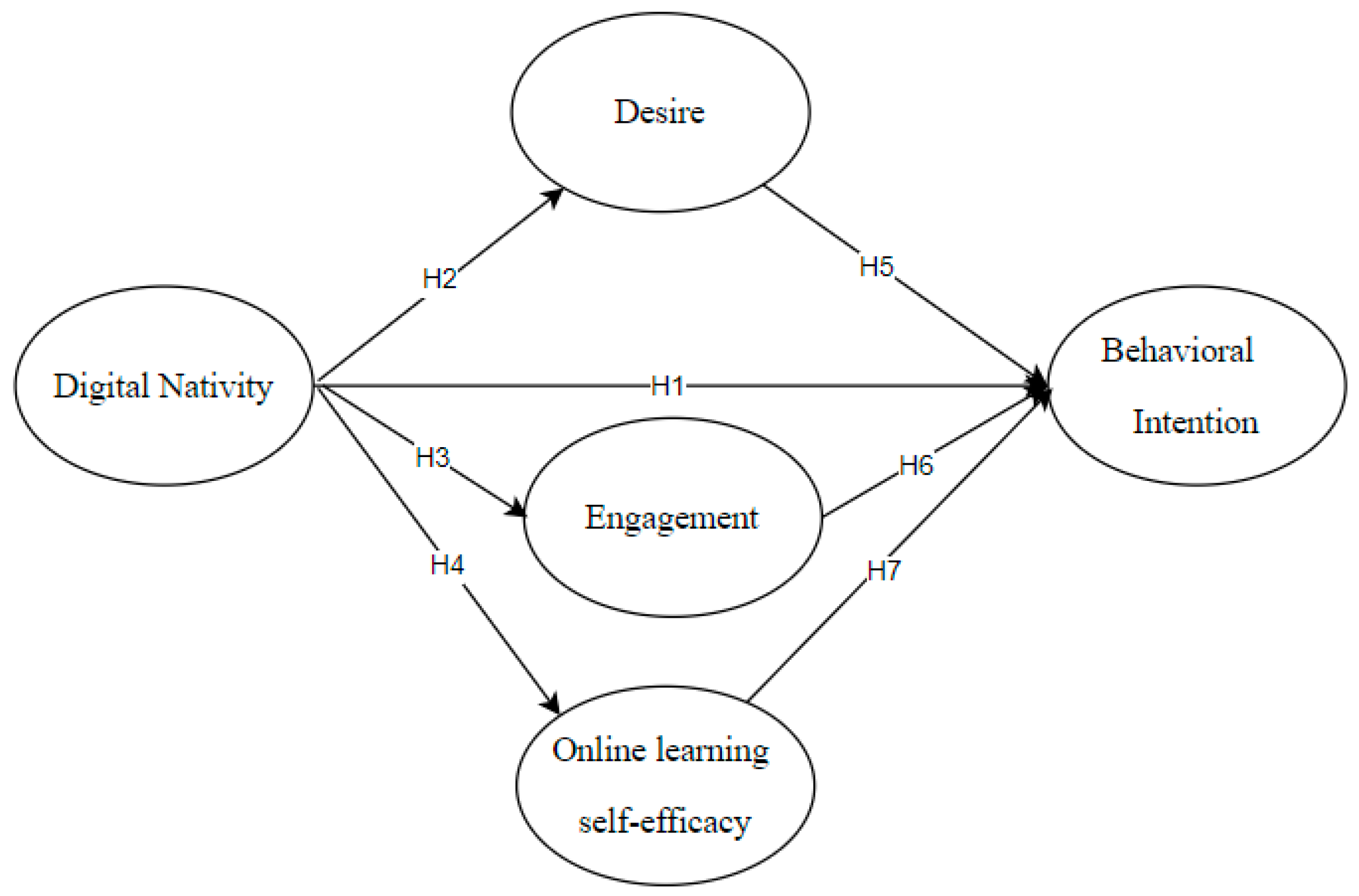
2.5. The Hypothesized Structural Model
2.6. Research Questions
- RQ1: Does desire mediate between digital nativity and behavioral intention toward IDLE, and in what specific ways is this role manifested?
- RQ2: Does engagement mediate between digital nativity and behavioral intention toward IDLE, and in what specific ways is this role manifested?
- RQ3: Does OLSE mediate between digital nativity and behavioral intention toward IDLE, and in what specific ways is this role manifested?
3. Methodology
3.1. Participants
3.2. Research Instrument
3.2.1. Digital Nativity Assessment Scale (DNAS)
3.2.2. Behavioral Intention Scale
3.2.3. Desire to Learn English Scale
3.2.4. Engagement in IDLE Scale
3.2.5. Online Learning Self-Efficacy Scale (OLSE)
3.3. Data Analysis
4. Findings
4.1. Descriptive Statistics
4.2. Assessment of Reliability and Validity
4.3. Structural Model Evaluation and Hypothesis Testing
5. Discussion
5.1. Desire in IDLE: Motivational Amplifier and Commitment Reinforcer
5.2. Engagement in IDLE: Anxiety Reducer and Efficiency Promoter
5.3. Online Learning Self-Efficacy in IDLE: Emotion Regulator and Technology Adapter
5.4. Theoretical and Practical Implications
6. Conclusions
Author Contributions
Funding
Institutional Review Board Statement
Informed Consent Statement
Data Availability Statement
Conflicts of Interest
References
- Abdullah, M. C., Teoh, H. C., Roslan, S., & Uli, J. (2015). Student engagement: Concepts, development and application in Malaysian universities. Journal of Educational and Social Research, 5(2), 275–283. [Google Scholar] [CrossRef] [Scilit]
- Ajzen, I. (1988). Attitudes, personality, and behavior. Open University Press. [Google Scholar]
- Ajzen, I. (1991). The theory of planned behavior. Organizational Behavior and Human Decision Processes, 50(2), 179–211. [Google Scholar] [CrossRef] [Scilit]
- Arndt, H. (2023). Construction and validation of a questionnaire to study engagement in informal second language learning. Studies in Second Language Acquisition, 45(5), 1456–1480. [Google Scholar] [CrossRef] [Scilit]
- Bag, S., Aich, P., & Islam, M. A. (2022). Behavioral intention of “digital natives” toward adapting the online education system in higher education. Journal of Applied Research in Higher Education, 14(1), 16–40. [Google Scholar] [CrossRef] [Scilit]
- Bandura, A. (1997). Self-efficacy: The exercise of control. W. H. Freeman. [Google Scholar]
- Bhatti, M. A., & Aldubaikhi, S. A. (2023). Investigating the influence of informal digital learning of English on attitude towards and motivation to learn English as a second language. Eurasian Journal of Applied Linguistics, 9(2), 45–57. [Google Scholar] [CrossRef]
- Bittman, M., Rutherford, L., Brown, J., & Unsworth, L. (2011). Digital natives? New and old media and children’s outcomes. Australian Journal of Education, 55(2), 139–155. [Google Scholar] [CrossRef] [Scilit]
- Buckingham, D., & Willett, R. (Eds.). (2006). Digital generations: Children, young people, and the new media. Routledge. [Google Scholar]
- Cakrawati, L. M. (2017). Students’ perceptions on the use of online learning platforms in EFL classroom. Journal of English Language Teaching, 1(1), 22–30. [Google Scholar]
- Capone, R., & Lepore, M. (2022). From distance learning to integrated digital learning: A fuzzy cognitive analysis focused on engagement, motivation, and participation during COVID-19 pandemic. Technology, Knowledge and Learning, 27(4), 1259–1289. [Google Scholar] [CrossRef] [Scilit]
- Chao, C.-M. (2019). Factors determining the behavioral intention to use mobile learning: An application and extension of the UTAUT model. Frontiers in Psychology, 10, 1652. [Google Scholar] [CrossRef] [Scilit]
- Choi, N.-J., Qiao, X., & Wang, L. (2020). Effects of multisensory cues, self-enhancing imagery and self-goal achievement emotion on purchase intention. Journal of Asian Finance, Economics and Business, 7(1), 141–151. [Google Scholar] [CrossRef] [Scilit]
- Cladis, A. E. (2020). A shifting paradigm: An evaluation of the pervasive effects of digital technologies on language expression, creativity, critical thinking, political discourse, and interactive processes of human communications. E-Learning and Digital Media, 17(5), 341–364. [Google Scholar] [CrossRef] [Scilit]
- Collier, J. E. (2020). Applied structural equation modeling using AMOS: Basic to advanced techniques. Routledge. [Google Scholar]
- Cui, Y., & Meng, Y. (2023). The relationship between self-efficacy, foreign language pleasure and English proficiency from the perspective of positive psychology. Foreign Languages Research, 40(1), 75–81. [Google Scholar]
- Deleuze, G., & Guattari, F. (1987). A thousand plateaus: Capitalism and schizophrenia. University of Minnesota Press. [Google Scholar]
- Faham, E., & Asghari, H. (2019). Determinants of behavioral intention to use e-textbooks: A study in Iran’s agricultural sector. Computers and Electronics in Agriculture, 165, 104935. [Google Scholar] [CrossRef] [Scilit]
- Fang, F., Meng, Y., Tang, L., & Cui, Y. (2025). The impact of informal digital learning of English (IDLE) on EFL learners’ engagement: Mediating roles of flow, online self-efficacy, and behavioral intention. Behavioral Sciences, 15(7), 851. [Google Scholar] [CrossRef] [Scilit]
- Fredricks, J. A., Blumenfeld, P. C., & Paris, A. H. (2004). School engagement: Potential of the concept, state of the evidence. Review of Educational Research, 74(1), 59–109. [Google Scholar] [CrossRef] [Scilit]
- Gao, Y., & Li, J. (2019). Digital literacy and informal English learning among Chinese college students: The role of self-efficacy. Computer Assisted Language Learning, 32(2), 189–210. [Google Scholar]
- Gao, Y., Wang, X., & Reynolds, B. L. (2025). The mediating roles of resilience and flow in linking basic psychological needs to tertiary EFL learners’ engagement in the informal digital learning of English: A mixed-methods study. Behavioral Sciences, 15(1), 85. [Google Scholar] [CrossRef] [Scilit]
- Getie, A. S. (2020). Factors affecting the attitudes of students towards learning English as a foreign language. Cogent Education, 7(1), 1738184. [Google Scholar] [CrossRef] [Scilit]
- Guan, L., Zhang, E. Y., & Gu, M. (2025). Examining generative AI–mediated informal digital learning of English practices with social cognitive theory: A mixed-methods study. ReCALL, 37(3), 315–331. [Google Scholar] [CrossRef] [Scilit]
- Guo, X., & Lee, J. S. (2023). A systematic review of informal digital learning of English: An ecological systems theory perspective. System, 117, 103097. [Google Scholar] [CrossRef] [Scilit]
- Guo, Y., Goh, D. H.-L., & Luyt, B. (2017). Tertiary students’ acceptance of a game to teach information literacy. Aslib Journal of Information Management, 69(1), 46–63. [Google Scholar] [CrossRef] [Scilit]
- Han, Y., & Reinhardt, J. (2022). Autonomy in the digital wilds: Agency, competence, and self-efficacy in the development of L2 digital identities. TESOL Quarterly, 56(3), 985–1015. [Google Scholar] [CrossRef] [Scilit]
- Hayadi, B. H., & Hariguna, T. (2025). Determinants of student engagement and behavioral intention towards mobile learning platforms. Contemporary Educational Technology, 17(1), ep558. [Google Scholar] [CrossRef] [Scilit]
- Henrie, C. R., Halverson, L. R., & Graham, C. R. (2015). Measuring student engagement in technology-mediated learning: A review. Computers & Education, 90, 36–53. [Google Scholar] [CrossRef] [Scilit]
- Henseler, J., Ringle, C. M., & Sarstedt, M. (2015). A new criterion for assessing discriminant validity in variance-based structural equation modeling. Journal of the Academy of Marketing Science, 43(1), 115–135. [Google Scholar] [CrossRef] [Scilit]
- Hofmann, W., & Van Dillen, L. (2012). Desire: The new hot spot in self-control research. Current Directions in Psychological Science, 21(5), 317–322. [Google Scholar] [CrossRef] [Scilit]
- Hong, J. C., Hwang, M. Y., Tai, K. H., & Lin, P. H. (2017). Intrinsic motivation of Chinese learning in predicting online learning self-efficacy and flow experience relevant to students’ learning progress. Computer Assisted Language Learning, 30(6), 552–574. [Google Scholar] [CrossRef] [Scilit]
- Hsieh, J. S. C., Huang, Y.-M., & Wu, W.-C. V. (2017). Technological acceptance of LINE in flipped EFL oral training. Computers in Human Behavior, 70, 178–190. [Google Scholar] [CrossRef] [Scilit]
- Huang, F. (2024). Examining foreign language teachers’ information literacy: Do digital nativity, technology training, and fatigue matter? The Asia-Pacific Education Researcher, 33(4), 901–912. [Google Scholar] [CrossRef] [Scilit]
- Hui, L., Teng, L. S., & Guo, F. (2023). Modeling the relationship between digital nativity and Smartphone usage in learning English as a foreign language contexts. Frontiers in Psychology, 13, 1053339. [Google Scholar] [CrossRef] [Scilit]
- Joo, Y. J., Lim, K. Y., & Kim, E. K. (2011). Online university students’ satisfaction and persistence: Examining perceived level of presence, usefulness and ease of use as predictors in a structural model. Computers & Education, 57(2), 1654–1664. [Google Scholar] [CrossRef] [Scilit]
- Jurkovič, V. (2019). Online informal learning of English through smartphones in Slovenia. System, 83, 27–37. [Google Scholar] [CrossRef] [Scilit]
- Karimah, A. A., & Muslim, A. B. (2019, May 27–29). Redefining EFL (English as a foreign language) teachers’ roles in technology-integrated instruction. 2019 5th International Conference on Education and Training Technologies (pp. 8–12), Seoul, Republic of Korea. [Google Scholar] [CrossRef] [Scilit]
- Katsarou, E. (2021). The effects of computer anxiety and self-efficacy on L2 learners’ self-perceived digital competence and satisfaction in higher education. Journal of Education and E-Learning Research, 8(2), 158–172. [Google Scholar] [CrossRef] [Scilit]
- Ke, I. C. (2011). NNS-NNS online intercultural communication: A sustainable practice to teach global English and develop intercultural communicative competence. Journal of Applied English, 4, 33–45. [Google Scholar]
- Klassen, R. M., & Chiu, M. M. (2010). Effects on teachers’ self-efficacy and job satisfaction: Teacher gender, years of experience, and job stress. Journal of Educational Psychology, 102(3), 741–756. [Google Scholar] [CrossRef] [Scilit]
- Kline, R. B. (2023). Principles and practice of structural equation modeling (5th ed.). Guilford Publications. [Google Scholar]
- Lai, Y., Saab, N., & Admiraal, W. (2022). University students’ use of mobile technology in self-directed language learning: Using the integrative model of behavior prediction. Computers and Education, 179, 104413. [Google Scholar] [CrossRef] [Scilit]
- Lamb, M., & Arisandy, F. E. (2020). The impact of online use of English on motivation to learn. Computer Assisted Language Learning, 33(1–2), 85–108. [Google Scholar] [CrossRef] [Scilit]
- Lee, J. S. (2019). Informal digital learning of English and second language vocabulary outcomes: Can quantity conquer quality? British Journal of Educational Technology, 50(2), 767–778. [Google Scholar] [CrossRef] [Scilit]
- Lee, J. S. (2020). Willingness to communicate in digital and non-digital EFL contexts: Scale development and psychometric testing. Computer Assisted Language Learning, 33(7–8), 688–707. [Google Scholar] [CrossRef] [Scilit]
- Lee, J. S., & Drajati, N. A. (2019). Affective variables and informal digital learning of English: Keys to willingness to communicate in a second language. Australasian Journal of Educational Technology, 35(5), 168–182. [Google Scholar] [CrossRef] [Scilit]
- Lee, J. S., & Dressman, M. (2018). When IDLE hands make an English workshop: Informal digital learning of English and language proficiency. TESOL Quarterly, 52(2), 435–445. [Google Scholar] [CrossRef] [Scilit]
- Lestari, D. E. (2020). Rethinking the roles of English lecturers in the digital era. The Journal of English Language and Literature, 4(2), 137. [Google Scholar]
- Liu, G. L., & Wang, Y. (2024). Modeling EFL teachers’ intention to integrate informal digital learning of English (IDLE) into the classroom using the theory of planned behavior. System, 120, 103193. [Google Scholar] [CrossRef] [Scilit]
- MacIntyre, P. D., & Blackie, R. A. (2012). Action control, motivated strategies, and integrative motivation as predictors of language learning affect and the intention to continue learning French. System, 40(4), 533–543. [Google Scholar] [CrossRef] [Scilit]
- Mao, Y., Guardado, M., & Meyer, K. R. (2014). Integrating Chinese community into Canadian society: Podcasts, technology apprehension, and language learning. In J. E. Aitken (Ed.), Cases on communication technology for second language acquisition and cultural learning (pp. 459–483). IGI Global. [Google Scholar] [CrossRef] [Scilit]
- Mariqueo-Russell, A. (2023). Desire and motivation in desire theories of well-being. Philosophical Studies, 180(7), 1975–1994. [Google Scholar] [CrossRef] [Scilit]
- Milutinović, V. (2022). Examining the influence of pre-service teachers’ digital native traits on their technology acceptance: A Serbian perspective. Education and Information Technologies, 27(5), 6483–6511. [Google Scholar] [CrossRef] [Scilit]
- Motha, S., & Lin, A. (2014). “Non-coercive rearrangements”: Theorizing desire in TESOL. TESOL Quarterly, 48(2), 331–359. [Google Scholar] [CrossRef] [Scilit]
- Ngo, T. T. A., Phan, T. Y. N., Nguyen, T. K., Le, N. B. T., Nguyen, N. T. A., & Le, T. T. D. (2025). Understanding continuance intention toward the use of AI chatbots in customer service among Generation Z in Vietnam. Acta Psychologica, 259, 105468. [Google Scholar] [CrossRef] [Scilit]
- Norton, B. (2013). Identity and language learning: Extending the conversation (2nd ed., pp. 1–39). Multilingual Matters. [Google Scholar]
- Özhan, Ş. Ç., & Kocadere, S. A. (2020). The effects of flow, emotional engagement, and motivation on success in a gamified online learning environment. Journal of Educational Computing Research, 57(8), 2006–2031. [Google Scholar] [CrossRef] [Scilit]
- Philp, J., & Duchesne, S. (2016). Exploring engagement in tasks in the language classroom. Annual Review of Applied Linguistics, 36, 50–72. [Google Scholar] [CrossRef] [Scilit]
- Pooley, A. W., Midgley, W., & Farley, H. (2019). Informal language learning through mobile instant messaging among university students in Korea. International Journal of Mobile and Blended Learning, 11(2), 33–49. [Google Scholar] [CrossRef] [Scilit]
- Portus-Torres, R. O., Contreras-Soto, Y., Sanhueza-Campos, C., Maluenda-Albornoz, J., Pérez-Villalobos, C., & Quintanilla-Espinoza, A. (2024). Self-regulated learning and engagement through emergency remote teaching in EFL undergraduate students. Frontiers in Education, 9, 1416507. [Google Scholar] [CrossRef] [Scilit]
- Prensky, M. (2001). Digital natives, digital immigrants. Part I. On the Horizon, 9(5), 1–6. [Google Scholar] [CrossRef] [Scilit]
- Quaid, E. D., Pack, A., Barrett, A. J., & Zhou, L. (2020). Students’ intention to use high-immersion virtual reality systems for learning paragraph structure: A PLS-SEM exploratory study. In K.-M. Frederiksen, S. Larsen, L. Bradley, & S. Thouësny (Eds.), CALL for widening participation: Short papers from EUROCALL 2020 (pp. 291–297). Research-publishing.net. [Google Scholar] [CrossRef] [Scilit]
- Rahimi, M., & Katal, M. (2012). The role of metacognitive listening strategies awareness and podcast-use readiness in using podcasting for learning English as a foreign language. Computers in Human Behavior, 28(4), 1153–1161. [Google Scholar] [CrossRef] [Scilit]
- Rahman Nur, D., Widodo, P., & Putro, N. H. P. S. (2023). Digital natives’ generation enjoyment using online resources as virtual learning environment in learning English speaking. International Journal of Language Education, 7(4), 602–614. [Google Scholar] [CrossRef] [Scilit]
- Reinders, H., & Benson, P. (2017). Research agenda: Language learning beyond the classroom. Language Teaching, 50(4), 561–578. [Google Scholar] [CrossRef] [Scilit]
- Rezai, A., Soyoof, A., & Reynolds, B. L. (2024). Informal digital learning of English and EFL teachers’ job engagement: Exploring the mediating role of technological pedagogical content knowledge and digital competence. System, 122, 103276. [Google Scholar] [CrossRef] [Scilit]
- Ryan, R. M., & Deci, E. L. (2017). Self-determination theory: Basic psychological needs in motivation, development, and wellness. Guilford Press. [Google Scholar]
- Shen, D., Cho, M. H., Tsai, C.-L., & Marra, R. M. (2013). Unpacking online learning experiences: Online learning self-efficacy and learning satisfaction. The Internet and Higher Education, 19, 10–17. [Google Scholar] [CrossRef] [Scilit]
- Sockett, G. (2014). The online informal learning of English. Palgrave Macmillan. [Google Scholar] [CrossRef] [Scilit]
- Son, J.-B. (2018). Teacher development in technology-enhanced language teaching. Palgrave Macmillan. [Google Scholar] [CrossRef] [Scilit]
- Song, H. J., Zhang, H., & Cai, L. A. (2012). The effect of environmentally friendly perceptions on behavioral intention: An extended model of goal-directed behavior. Tourism Management, 33(6), 1417–1428. [Google Scholar] [CrossRef] [Scilit]
- Soyoof, A., Reynolds, B. L., Vazquez-Calvo, B., & McLay, K. (2023). Informal digital learning of English (IDLE): A scoping review of what has been done and a look towards what is to come. Computer Assisted Language Learning, 36(4), 608–640. [Google Scholar] [CrossRef] [Scilit]
- Stefani, L. (2008). Engaging our students in the learning process: Some points for consideration. International Journal for the Scholarship of Teaching and Learning, 2(1), 3. [Google Scholar] [CrossRef] [Scilit]
- Šorgo, A., Bartol, T., Dolničar, D., & Boh Podgornik, B. (2017). Attributes of digital natives as predictors of information literacy in higher education. British Journal of Educational Technology, 48(3), 749–767. [Google Scholar] [CrossRef] [Scilit]
- Tang, L., Zhang, C., & Cui, Y. (2024). A multigroup SEM analysis of mediating role of enjoyment, anxiety, and boredom in the relationships between L2 motivational self-system, L2 proficiency, and intercultural communication competence. Language Teaching Research. Advanced online publication. [Google Scholar] [CrossRef] [Scilit]
- Teo, T. (2013). An initial development and validation of a Digital Natives Assessment Scale (DNAS). Computers & Education, 67, 51–57. [Google Scholar] [CrossRef] [Scilit]
- Ursavaş, Ö. F., Kabakçı Yurdakul, İ., Türk, M., & McIlroy, D. (2016). Measurement invariance of the Digital Natives Assessment Scale across gender in a sample of Turkish university students. Journal of Educational Computing Research, 54(4), 513–530. [Google Scholar] [CrossRef] [Scilit]
- Venkatesh, V., & Davis, F. D. (2000). A theoretical extension of the Technology Acceptance Model (TAM): Four longitudinal field studies. Management Science, 46(2), 186–204. [Google Scholar] [CrossRef] [Scilit]
- Wang, Q., Gao, Y., & Wang, X. (2025). Exploring engagement, self-efficacy, and anxiety in large language model EFL learning: A latent profile analysis of Chinese university students. International Journal of Human-Computer Interaction, 41, 7815–7824. [Google Scholar] [CrossRef] [Scilit]
- Wang, Q., & Pan, J. (2023). Mitigating learning helplessness in digital EFL learning: The mediating role of online language self-efficacy. System, 112, 103128. [Google Scholar] [CrossRef] [Scilit]
- Wang, X. Q., Liang, H. H., & Chen, Y. H. (2022). Online English learning engagement among digital natives: The mediating role of self-regulation. Sustainability, 14(23), 15661. [Google Scholar] [CrossRef] [Scilit]
- Wang, Y. L., Wang, Y. X., Pan, Z. W., & Ortega-Martín, J. L. (2023). The predicting role of EFL students’ achievement emotions and technological self-efficacy in their technology acceptance. The Asia-Pacific Education Researcher, 33, 771–782. [Google Scholar] [CrossRef] [Scilit]
- Wouters, P., van Nimwegen, C., van Oostendorp, H., & van der Spek, E. D. (2013). A meta-analysis of the cognitive and motivational effects of serious games. Journal of Educational Psychology, 105(2), 249–265. [Google Scholar] [CrossRef] [Scilit]
- Wu, C. H., Lam, H. Y., Kong, A., & Wong, W. L. H. (2023). The design and evaluation of a digital learning-based English chatbot as an online self-learning method. International Journal of Engineering Business Management, 15, 184797902311763. [Google Scholar] [CrossRef] [Scilit]
- Wu, R. L. (2023). The relationship between online learning self-efficacy, informal digital learning of English, and student engagement in online classes: The mediating role of social presence. Frontiers in Psychology, 14, 1266009. [Google Scholar] [CrossRef] [Scilit] [PubMed]
- Wu, S., & Tu, C.-C. (2019). The impact of learning self-efficacy on social support towards learned helplessness in China. Eurasia Journal of Mathematics, Science and Technology Education, 15(10), em1825. [Google Scholar] [CrossRef] [Scilit]
- Yashima, T., Zenuk-Nishide, L., & Shimizu, K. (2004). The influence of attitudes and affect on willingness to communicate and second language communication. Language Learning, 54(1), 119–152. [Google Scholar] [CrossRef] [Scilit]
- Zadorozhnyy, A., & Lee, J. S. (2023). Informal digital learning of English and willingness to communicate in a second language: Self-efficacy beliefs as a mediator. Computer Assisted Language Learning, 38(4), 669–689. [Google Scholar] [CrossRef] [Scilit]
- Zeng, S., & Zhang, J. (2020). Digital curation of online resources among English learners at Chinese universities. Beijing International Review of Education, 2(3), 403–419. [Google Scholar] [CrossRef] [Scilit]
- Zhang, Y., & Liu, G. (2024). Revisiting informal digital learning of English (IDLE): A structural equation modeling approach in a university EFL context. Computer Assisted Language Learning, 37(7), 1904–1936. [Google Scholar] [CrossRef] [Scilit]
- Zhao, C., & Zhao, L. (2021). Digital nativity, computer self-efficacy, and technology adoption: A study among university faculties in China. Frontiers in Psychology, 12, 746292. [Google Scholar] [CrossRef] [Scilit]
- Zhao, M. (2023). Examining Chinese university students’ digital nativity and its effect on their intentions to use technology in English learning. International Journal of Educational Research Review, 8(1), 1–10. [Google Scholar] [CrossRef] [Scilit]
- Zheng, Y., & Xiao, A. (2023). A structural equation model of online learning: Investigating self-efficacy, informal digital learning, self-regulated learning, and course satisfaction. Frontiers in Psychology, 14, 1276266. [Google Scholar] [CrossRef] [Scilit]
- Zimmerman, W. A., & Kulikowich, J. M. (2016). Online learning self-efficacy in students with and without online learning experience. American Journal of Distance Education, 30(3), 180–191. [Google Scholar] [CrossRef] [Scilit]



| Factors | M | SD | Kurtosis | Skewness | Factor Loading | α (>0.7) | |
|---|---|---|---|---|---|---|---|
| Digital Nativity | GUT | 3.81 | 0.827 | 0.309 | −0.512 | 0.758 | 0.904 |
| CM | 3.52 | 0.803 | 0.106 | −0.240 | 0.657 | ||
| RG | 3.78 | 0.736 | 0.331 | −0.304 | 0.769 | ||
| TD | 3.99 | 0.657 | 0.664 | −0.432 | 0.751 | ||
| Behavioral Intention | BI1 | 3.66 | 0.777 | 0.479 | −0.341 | 0.893 | 0.947 |
| BI2 | 3.67 | 0.769 | 0.574 | −0.426 | 0.919 | ||
| BI3 | 3.68 | 0.763 | 0.508 | −0.352 | 0.924 | ||
| BI4 | 3.66 | 0.787 | 0.586 | −0.399 | 0.883 | ||
| Engagement | EE | 3.82 | 0.700 | 0.631 | −0.252 | 0.828 | 0.926 |
| CE | 3.58 | 0.671 | 0.494 | −0.030 | 0.865 | ||
| LE | 3.53 | 0.668 | 0.705 | −0.093 | 0.832 | ||
| Desire | LD1 | 3.24 | 0.793 | 0.330 | 0.035 | 0.707 | 0.848 |
| LD2 | 3.72 | 0.844 | 0.571 | −0.558 | 0.718 | ||
| LD3 | 3.27 | 0.846 | 0.391 | −0.192 | 0.736 | ||
| Online learning self-efficacy | OLSE1 | 3.51 | 0.734 | 0.104 | 0.033 | 0.868 | 0.908 |
| OLSE2 | 3.51 | 0.750 | 0.193 | −0.057 | 0.913 | ||
| OLSE3 | 3.53 | 0.738 | 0.206 | −0.041 | 0.882 |
| AVE (>0.5) | CR (>0.7) | HTMT (<0.9) | ||||||
|---|---|---|---|---|---|---|---|---|
| Digital Native | Behavioral Intention | Engagement | Desire | OLSE | ||||
| 1 | Digital Nativity | 0.540 | 0.824 | 0.735 | ||||
| 2 | Behavioral Intention | 0.819 | 0.948 | 0.555 | 0.905 | |||
| 3 | Engagement | 0.708 | 0.879 | 0.603 | 0.691 | 0.841 | ||
| 4 | Desire | 0.519 | 0.764 | 0.384 | 0.665 | 0.671 | 0.720 | |
| 5 | OLSE | 0.789 | 0.918 | 0.519 | 0.681 | 0.718 | 0.653 | 0.888 |
| χ2/df | CFI | IFI | TLI | RSMEA | SRMR | |
|---|---|---|---|---|---|---|
| The measurement model | 3.584 | 0.985 | 0.985 | 0.980 | 0.042 | 0.027 |
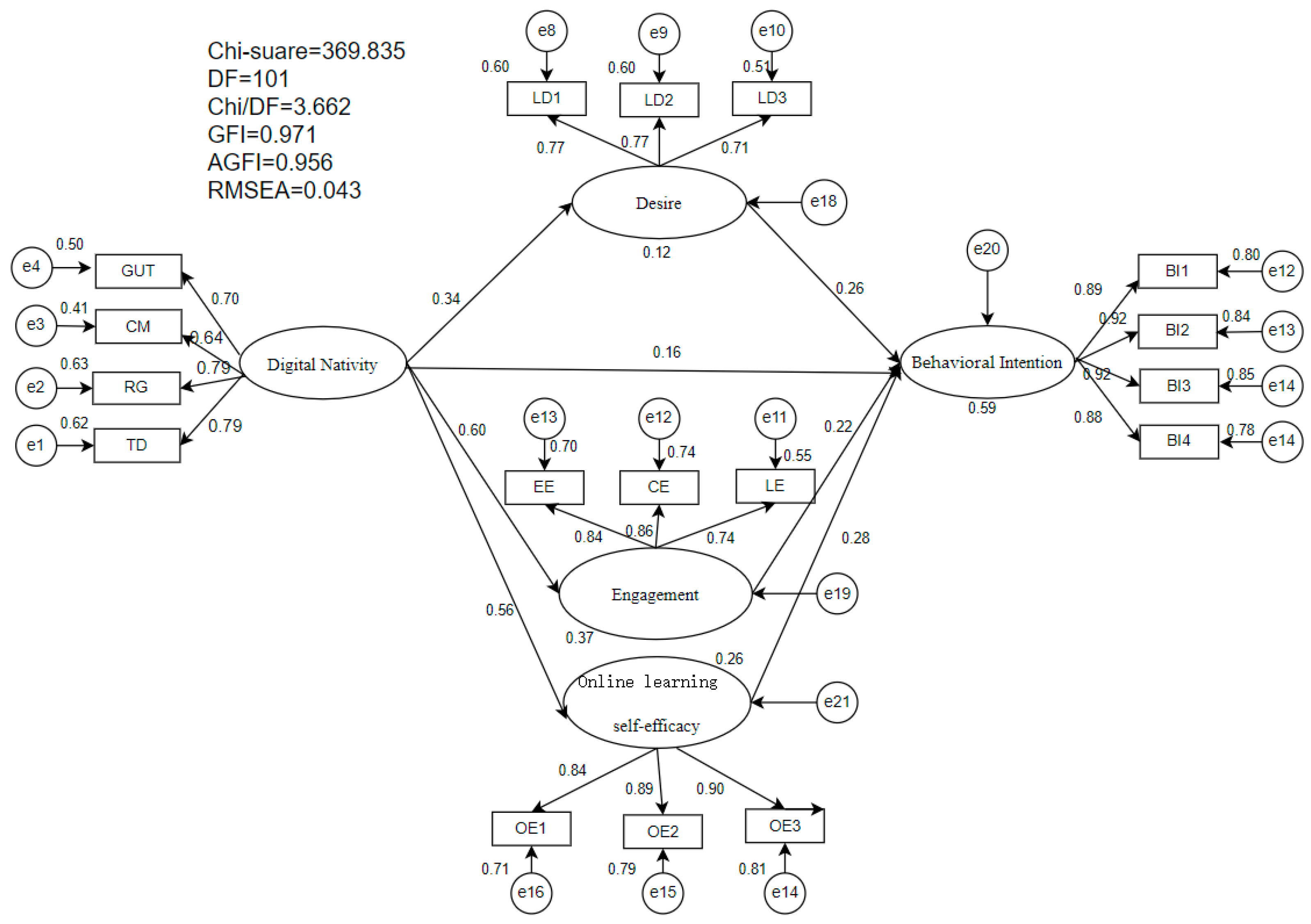
| The structural model | 3.662 | 0.984 | 0.984 | 0.979 | 0.043 | 0.026 |
| Cutoff values (Kline, 2023) | <5 | >0.90 | >0.90 | >0.90 | <0.10 | <0.08 |
| Path | β | p | t-Value | Results |
|---|---|---|---|---|
| Digital Nativity → Behavioral Intention | 0.151 | *** | 5.355 | accepted |
| Digital Nativity → Desire | 0.345 | *** | 10.881 | accepted |
| Digital Nativity → Engagement | 0.604 | *** | 19.055 | accepted |
| Digital Nativity → OLSE | 0.515 | *** | 17.367 | accepted |
| Desire → Behavioral Intention | 0.265 | *** | 8.020 | accepted |
| Engagement → Behavioral Intention | 0.222 | *** | 5.913 | accepted |
| OLSE → Behavioral Intention | 0.277 | *** | 8.397 | accepted |
| Mediation Paths | 95% Confidence Interval | p (Two-Tailed Significance) | Indirect Effect | Results | |
|---|---|---|---|---|---|
| Lower Bound | Upper Bound | ||||
| Digital Nativity → Desire → Behavioral Intention | 0.084 | 0.170 | 0.000 | 0.124 | accepted |
| Digital Nativity → Engagement → Behavioral Intention | 0.115 | 0.257 | 0.000 | 0.182 | accepted |
| Digital Nativity → OLSE → Behavioral Intention | 0.132 | 0.262 | 0.000 | 0.193 | accepted |
Disclaimer/Publisher’s Note: The statements, opinions and data contained in all publications are solely those of the individual author(s) and contributor(s) and not of MDPI and/or the editor(s). MDPI and/or the editor(s) disclaim responsibility for any injury to people or property resulting from any ideas, methods, instructions or products referred to in the content. |
© 2026 by the authors. Licensee MDPI, Basel, Switzerland. This article is an open access article distributed under the terms and conditions of the Creative Commons Attribution (CC BY) license.
Share and Cite
Fang, F.; Meng, Y.; Tang, L.; Cui, Y. Digital Natives’ Intentions Toward Informal Digital English Learning: The Roles of Desire, Engagement, and Online Learning Self-Efficacy. J. Intell. 2026, 14, 13. https://doi.org/10.3390/jintelligence14010013
Fang F, Meng Y, Tang L, Cui Y. Digital Natives’ Intentions Toward Informal Digital English Learning: The Roles of Desire, Engagement, and Online Learning Self-Efficacy. Journal of Intelligence. 2026; 14(1):13. https://doi.org/10.3390/jintelligence14010013
Chicago/Turabian StyleFang, Fang, Yaru Meng, Lingjie Tang, and Yu Cui. 2026. "Digital Natives’ Intentions Toward Informal Digital English Learning: The Roles of Desire, Engagement, and Online Learning Self-Efficacy" Journal of Intelligence 14, no. 1: 13. https://doi.org/10.3390/jintelligence14010013
APA StyleFang, F., Meng, Y., Tang, L., & Cui, Y. (2026). Digital Natives’ Intentions Toward Informal Digital English Learning: The Roles of Desire, Engagement, and Online Learning Self-Efficacy. Journal of Intelligence, 14(1), 13. https://doi.org/10.3390/jintelligence14010013