Figure 1.
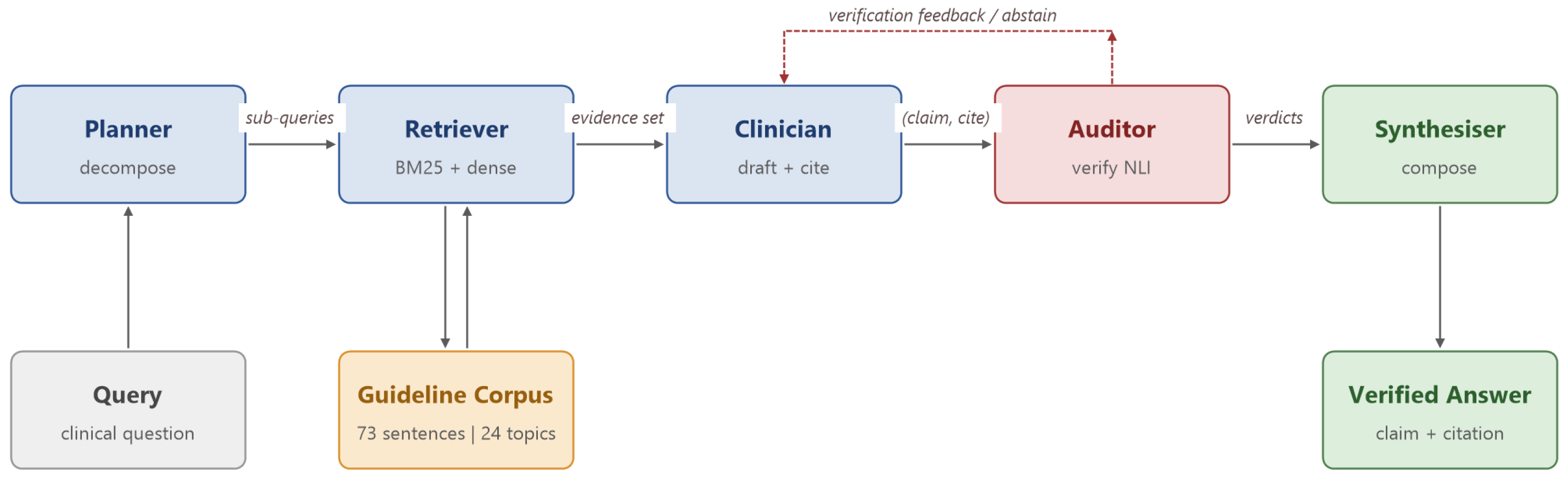
GuidelineGuard architecture. A query is decomposed by the Planner into intent-tagged sub-queries; the Retriever fetches candidate sentences from the open guideline corpus using fused BM25 and dense embeddings; the Clinician drafts claims with mandatory citations; the Auditor independently verifies each (claim, citation) pair as Entails, Partially, or Not; the Synthesizer composes the verified output, falling back to partially supported claims or abstention if no fully entailed claim is available. Solid arrows indicate primary data flow, and the dashed red arrow indicates verification feedback/abstention. Blue boxes denote the Planner/Retriever/Clinician agents, red denotes the Auditor, green denotes synthesis/verified output, orange denotes the guideline corpus, and gray denotes the input query.
Figure 1.
GuidelineGuard architecture. A query is decomposed by the Planner into intent-tagged sub-queries; the Retriever fetches candidate sentences from the open guideline corpus using fused BM25 and dense embeddings; the Clinician drafts claims with mandatory citations; the Auditor independently verifies each (claim, citation) pair as Entails, Partially, or Not; the Synthesizer composes the verified output, falling back to partially supported claims or abstention if no fully entailed claim is available. Solid arrows indicate primary data flow, and the dashed red arrow indicates verification feedback/abstention. Blue boxes denote the Planner/Retriever/Clinician agents, red denotes the Auditor, green denotes synthesis/verified output, orange denotes the guideline corpus, and gray denotes the input query.
Figure 2.
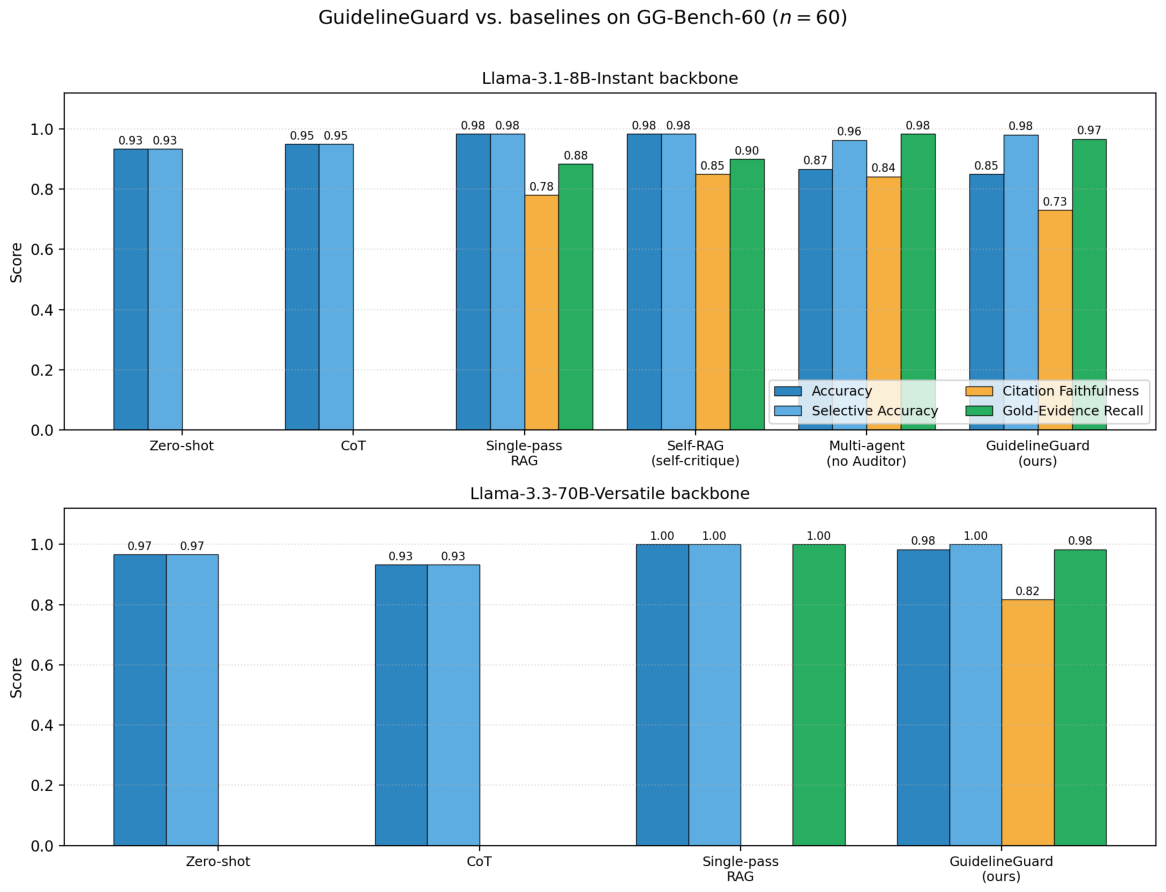
Accuracy, Selective Accuracy, Citation Faithfulness, and Gold-Evidence Recall across all six systems on GG-Bench-60, on both backbones (Llama-3.1-8B-Instant, top; Llama-3.3-70B-Versatile, bottom). On 70B, only the systems for which a complete run was obtained within the same evaluation budget are shown. The qualitative ordering is preserved across backbones: GuidelineGuard ties the strongest baseline on Selective Accuracy and dominates on Gold-Evidence Recall.
Figure 2.
Accuracy, Selective Accuracy, Citation Faithfulness, and Gold-Evidence Recall across all six systems on GG-Bench-60, on both backbones (Llama-3.1-8B-Instant, top; Llama-3.3-70B-Versatile, bottom). On 70B, only the systems for which a complete run was obtained within the same evaluation budget are shown. The qualitative ordering is preserved across backbones: GuidelineGuard ties the strongest baseline on Selective Accuracy and dominates on Gold-Evidence Recall.
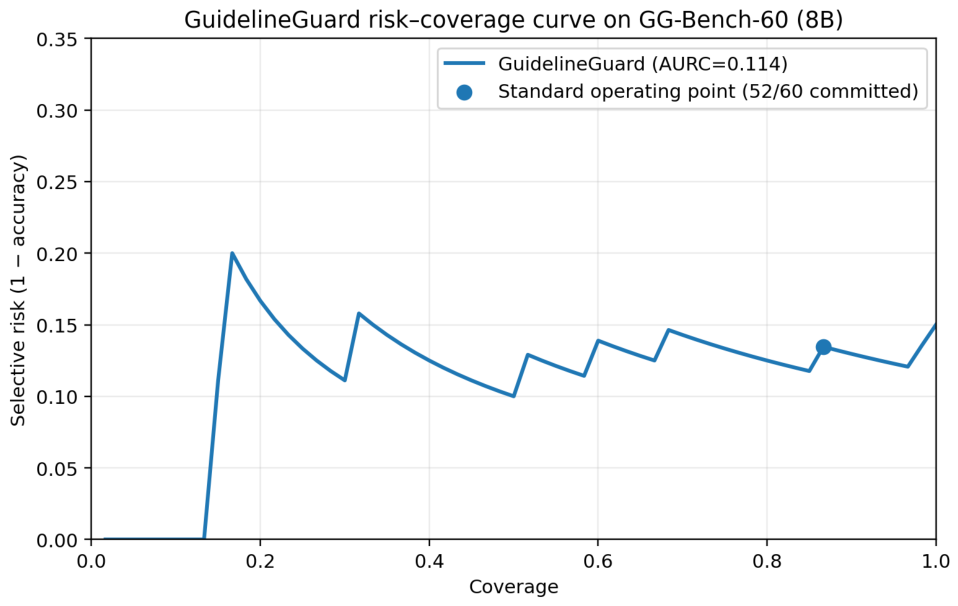
Figure 3.
Risk–coverage analysis for GuidelineGuard on GG-Bench-60. Cases are ranked by maximum Auditor support score (Entails = 1, Partially = 0.5, Not = 0). Selective risk is the error rate among the highest-scoring cases retained at each coverage level. The reported operating point is marked by the system’s standard acceptance rule.
Figure 3.
Risk–coverage analysis for GuidelineGuard on GG-Bench-60. Cases are ranked by maximum Auditor support score (Entails = 1, Partially = 0.5, Not = 0). Selective risk is the error rate among the highest-scoring cases retained at each coverage level. The reported operating point is marked by the system’s standard acceptance rule.
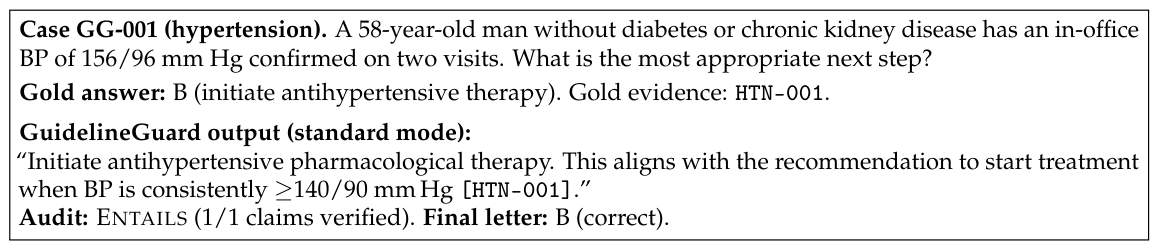
Figure 4.
Representative GuidelineGuard output on a hypertension case. The cited sentence identifier is the gold evidence; the Auditor independently verified the entailment.
Figure 4.
Representative GuidelineGuard output on a hypertension case. The cited sentence identifier is the gold evidence; the Auditor independently verified the entailment.
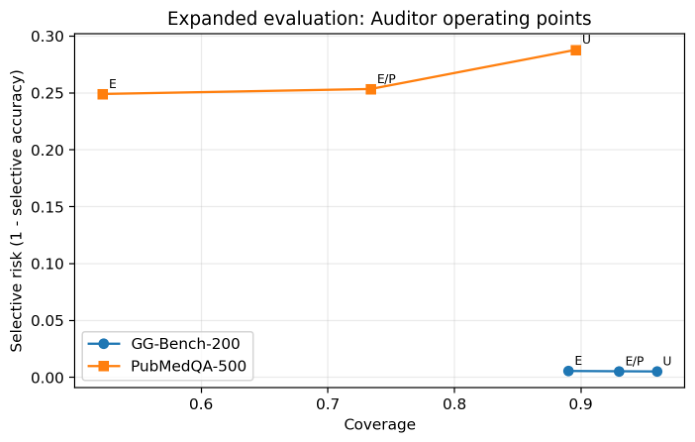
Figure 5.
Risk–coverage operating points for the paired major-revision experiments. E denotes an Entails-only gate, E/P allows Entails or Partially, and U is the ungated paired draft. The figure visualizes the task-dependent cost of stricter verification.
Figure 5.
Risk–coverage operating points for the paired major-revision experiments. E denotes an Entails-only gate, E/P allows Entails or Partially, and U is the ungated paired draft. The figure visualizes the task-dependent cost of stricter verification.
Table 1.
Composition of the GuidelineGuard guideline corpus (73 sentence-level recommendations across 23 topics; selected sources shown).
Table 1.
Composition of the GuidelineGuard guideline corpus (73 sentence-level recommendations across 23 topics; selected sources shown).
| Topic Group | Sources | n |
|---|
| Hypertension and cardiology | ACC/AHA, ESC | 11 |
| Diabetes and metabolic | ADA, KDIGO | 8 |
| Pulmonary (asthma, COPD) | GINA, GOLD | 5 |
| Infectious disease | IDSA/ATS, CDC | 9 |
| Sepsis and critical care | Surviving Sepsis Campaign | 6 |
| Preventive services and screening | USPSTF, CDC | 6 |
| Stroke and neurology | AHA/ASA | 4 |
| Anticoagulation and VTE | CHEST, ASH | 4 |
| Obstetrics/pregnancy | ACOG, WHO | 3 |
| Paediatrics | WHO IMCI, AAP | 4 |
| Renal and electrolyte | KDIGO | 3 |
| Pain and opioid prescribing | CDC | 3 |
| Anaphylaxis and allergy | WAO | 2 |
| Psychiatry and sleep | APA | 3 |
| COVID-19 and respiratory | WHO, NIH | 2 |
Table 2.
The GuidelineGuard pipeline.
Table 2.
The GuidelineGuard pipeline.
| Input: query q, guideline corpus G, retrieval depth , modes . |
| Output: answer string A, claim set R. |
| 1. Q ← Planner(q) | // decompose into intent-tagged sub-queries |
| 2. Retrieve(q′, G, k) | // hybrid BM25 + dense + RRF, dedup, cap 15 |
| 3. D ← Clinician(q, E) | // JSON draft: list of (claim, cited_id) |
| 4. for each : |
| 5. Auditor | // verification-only context |
| 6. |
| 7. if : surface all R |
| 8. else if Entails: surface those; |
| 9. else if mode=standard and Partially: surface those (flagged) |
| 10. else: abstain |
| 11. A ← Synthesize(surfaced R) |
| 12. return |
Table 3.
Evaluation metrics used in this study. We distinguish answer performance, evidence coverage, and verification-gate behavior so that abstention is not conflated with citation faithfulness.
Table 3.
Evaluation metrics used in this study. We distinguish answer performance, evidence coverage, and verification-gate behavior so that abstention is not conflated with citation faithfulness.
| Metric | Definition |
|---|
| Accuracy | Top-1 multiple-choice accuracy on GG-Bench-60. Abstentions count as incorrect. |
| Selective Accuracy (Sel.Acc) | Top-1 accuracy only on committed cases (parseable answer and no explicit abstention). |
| Coverage | Fraction of cases on which the system commits to an answer. Abstention rate is . |
| Citation Faithfulness (CF) | Macro-average across cases of the fraction of audited claims whose cited evidence sentence is judged Entails. A case with no audited claim contributes 0; CF is therefore a joint coverage/faithfulness diagnostic, not a pure conditional precision measure. |
| Conditional Claim Faithfulness (CCF) | Fraction of audited claims judged Entails, restricted to committed cases. This separates evidence quality among surfaced answers from the cost of abstention. |
| Citation Validity (CV) | Fraction of emitted citation identifiers that exist in the applicable evidence corpus; a fabrication check. Cases that emit no citation do not enter the CV denominator and are represented separately by Citation Coverage. |
| Citation Coverage | Fraction of cases emitting at least one citation identifier. |
| Gold-Evidence Recall (GER) | Fraction of cases citing at least one human-annotated gold evidence sentence. |
| Gold-Supported Commitment Rate (GSCR) | Among committed cases, fraction citing at least one gold evidence sentence. We report its complement as an operational false-acceptance rate (FA = 1 − ). |
| Retrievable-Evidence Rejection Rate (RER) | Among cases where at least one gold evidence sentence was retrieved, fraction for which GuidelineGuard abstained. This is an operational false-rejection proxy, not a claim that the Auditor’s decision is clinically incorrect. |
| Risk–coverage/AURC | Selective risk as a function of coverage. For GuidelineGuard, the ranking score is the maximum Auditor support score per case (Entails = 1, Partially = 0.5, Not = 0); AURC is the discrete area under this risk–coverage curve. |
| Mean latency | Mean per-query wall-clock latency in seconds. |
Table 4.
Main results on GG-Bench-60 (, Llama-3.1-8B-Instant backbone). 95% CIs are non-parametric bootstrap intervals (2000 resamples). CF is a joint case-level faithfulness/coverage diagnostic; Self-RAG CF is self-judged, whereas RAG and the multi-agent ablation use an independent LLM judge. UCR is .
Table 4.
Main results on GG-Bench-60 (, Llama-3.1-8B-Instant backbone). 95% CIs are non-parametric bootstrap intervals (2000 resamples). CF is a joint case-level faithfulness/coverage diagnostic; Self-RAG CF is self-judged, whereas RAG and the multi-agent ablation use an independent LLM judge. UCR is .
| System | Acc. [95% CI] | CF [95% CI] | GER [95% CI] | UCR | Cov. | Lat. (s) |
|---|
| Zero-shot | 0.933 [0.867, 0.983] | 0.000 [0.000, 0.000] | 0.000 [0.000, 0.000] | 1.000 | 1.000 | 1.51 |
| Chain-of-thought | 0.950 [0.883, 1.000] | 0.000 [0.000, 0.000] | 0.000 [0.000, 0.000] | 1.000 | 1.000 | 2.98 |
| Single-pass RAG | 0.983 [0.950, 1.000] | 0.781 [0.675, 0.872] | 0.883 [0.800, 0.950] | 0.219 | 1.000 | 5.96 |
| Self-RAG (self-critique) | 0.983 [0.950, 1.000] | 0.850 [0.750, 0.933] † | 0.900 [0.817, 0.967] | 0.150 † | 1.000 | 8.14 |
| Multi-agent (no Auditor) | 0.867 [0.767, 0.950] | 0.842 [0.742, 0.925] | 0.983 [0.950, 1.000] | 0.158 | 0.900 | 13.57 |
| GuidelineGuard (ours) | 0.850 [0.750, 0.933] | 0.731 [0.617, 0.833] | 0.967 [0.917, 1.000] | 0.269 | 0.867 | 12.69 |
Table 5.
Selective Accuracy on GG-Bench-60: accuracy computed only on cases for which the system committed to an answer (i.e., produced a parseable choice and did not explicitly abstain). 95% CIs are non-parametric bootstrap intervals (2000 resamples) over the committed subset. This metric disentangles the precision/coverage trade-off of GuidelineGuard from its underlying reasoning quality.
Table 5.
Selective Accuracy on GG-Bench-60: accuracy computed only on cases for which the system committed to an answer (i.e., produced a parseable choice and did not explicitly abstain). 95% CIs are non-parametric bootstrap intervals (2000 resamples) over the committed subset. This metric disentangles the precision/coverage trade-off of GuidelineGuard from its underlying reasoning quality.
| System | n | Committed | Correct | Sel. Acc. [95% CI] |
|---|
| Zero-shot | 60 | 60 | 56 | 0.933 [0.867, 0.983] |
| Chain-of-thought | 60 | 60 | 57 | 0.950 [0.883, 1.000] |
| Single-pass RAG | 60 | 60 | 59 | 0.983 [0.950, 1.000] |
| Self-RAG (self-critique) | 60 | 60 | 59 | 0.983 [0.950, 1.000] |
| Multi-agent (no Auditor) | 60 | 54 | 52 | 0.963 [0.907, 1.000] |
| GuidelineGuard (ours) | 60 | 52 | 51 | 0.981 [0.942, 1.000] |
Table 6.
Selective-gate diagnostics on GG-Bench-60 with the Llama-3.1-8B-Instant backbone. FA is the complement of Gold-Supported Commitment Rate. RER is defined only for GuidelineGuard because the baselines do not expose an abstention gate tied to the same evidence-verification mechanism. AURC is computed from the GuidelineGuard Auditor support score.
Table 6.
Selective-gate diagnostics on GG-Bench-60 with the Llama-3.1-8B-Instant backbone. FA is the complement of Gold-Supported Commitment Rate. RER is defined only for GuidelineGuard because the baselines do not expose an abstention gate tied to the same evidence-verification mechanism. AURC is computed from the GuidelineGuard Auditor support score.
| System | Committed | GSCR | FA | GER | RER |
|---|
| Single-pass RAG | 60 | 0.883 | 0.117 | 0.883 | – |
| Multi-agent (no Auditor) | 54 | 0.981 | 0.019 | 0.983 | – |
| GuidelineGuard | 52 | 1.000 | 0.000 | 0.967 | 0.102 |
Table 7.
Per-topic accuracy (cases correct/cases) across the 23 represented topics in GG-Bench-60. ZS: zero-shot; CoT: chain-of-thought; RAG: single-pass retrieval-augmented generation; MA: multi-agent without Auditor; GG: GuidelineGuard. Self-RAG is omitted here for space; its aggregate metrics appear in
Table 4 and
Table 5.
Table 7.
Per-topic accuracy (cases correct/cases) across the 23 represented topics in GG-Bench-60. ZS: zero-shot; CoT: chain-of-thought; RAG: single-pass retrieval-augmented generation; MA: multi-agent without Auditor; GG: GuidelineGuard. Self-RAG is omitted here for space; its aggregate metrics appear in
Table 4 and
Table 5.
| Topic | n | ZS | CoT | RAG | MA | GG |
|---|
| acs | 4 | 4/4 | 4/4 | 4/4 | 4/4 | 3/4 |
| afib | 1 | 1/1 | 1/1 | 1/1 | 1/1 | 1/1 |
| anaphylaxis | 2 | 2/2 | 2/2 | 2/2 | 2/2 | 2/2 |
| antibiotics | 3 | 3/3 | 3/3 | 3/3 | 3/3 | 3/3 |
| anticoagulation | 2 | 2/2 | 2/2 | 2/2 | 2/2 | 2/2 |
| asthma | 2 | 2/2 | 2/2 | 2/2 | 0/2 | 0/2 |
| copd | 2 | 2/2 | 2/2 | 2/2 | 2/2 | 2/2 |
| covid | 2 | 2/2 | 2/2 | 2/2 | 2/2 | 2/2 |
| diabetes | 5 | 5/5 | 5/5 | 5/5 | 4/5 | 4/5 |
| hypertension | 4 | 3/4 | 4/4 | 4/4 | 4/4 | 3/4 |
| immunization | 3 | 3/3 | 3/3 | 3/3 | 3/3 | 3/3 |
| pain | 2 | 2/2 | 2/2 | 2/2 | 2/2 | 2/2 |
| pediatrics | 3 | 3/3 | 3/3 | 2/3 | 2/3 | 2/3 |
| pneumonia | 2 | 2/2 | 2/2 | 2/2 | 2/2 | 2/2 |
| pregnancy | 2 | 2/2 | 2/2 | 2/2 | 2/2 | 2/2 |
| psychiatry | 2 | 2/2 | 2/2 | 2/2 | 2/2 | 2/2 |
| renal | 2 | 2/2 | 2/2 | 2/2 | 1/2 | 1/2 |
| screening | 3 | 3/3 | 2/3 | 3/3 | 3/3 | 3/3 |
| sepsis | 5 | 4/5 | 5/5 | 5/5 | 5/5 | 5/5 |
| sti | 3 | 3/3 | 2/3 | 3/3 | 2/3 | 2/3 |
| stroke | 2 | 2/2 | 2/2 | 2/2 | 2/2 | 2/2 |
| uti | 2 | 1/2 | 1/2 | 2/2 | 1/2 | 2/2 |
| vte | 2 | 1/2 | 2/2 | 2/2 | 1/2 | 1/2 |
Table 8.
Cross-backbone replication on GG-Bench-60. All six systems were evaluated on the 8B backbone; four completed on the 70B backbone (Llama-3.3-70B-Versatile, served via Groq) within the same rate-limit budget. Self-RAG is a single-model self-critique baseline that we evaluate on the 8B backbone only, and the 70B multi-agent run did not complete because the provider rate-limited the longer agentic trajectories; both are therefore absent from the 70B block. The qualitative ordering is preserved: GuidelineGuard ties single-pass RAG on Selective Accuracy and dominates on Gold-Evidence Recall, while the abstention rate falls to 1.7% as the underlying model becomes more able to surface a defensible answer.
Table 8.
Cross-backbone replication on GG-Bench-60. All six systems were evaluated on the 8B backbone; four completed on the 70B backbone (Llama-3.3-70B-Versatile, served via Groq) within the same rate-limit budget. Self-RAG is a single-model self-critique baseline that we evaluate on the 8B backbone only, and the 70B multi-agent run did not complete because the provider rate-limited the longer agentic trajectories; both are therefore absent from the 70B block. The qualitative ordering is preserved: GuidelineGuard ties single-pass RAG on Selective Accuracy and dominates on Gold-Evidence Recall, while the abstention rate falls to 1.7% as the underlying model becomes more able to surface a defensible answer.
| Backbone | System | Acc | Sel. Acc. (n com.) | Abst.% | CF | GER |
|---|
| 8B | Zero-shot | 0.933 | 0.933 (60) | 0.0 | – | – |
| 8B | Chain-of-thought | 0.950 | 0.950 (60) | 0.0 | – | – |
| 8B | Single-pass RAG | 0.983 | 0.983 (60) | 0.0 | 0.781 | 0.883 |
| 8B | Self-RAG (self-critique) | 0.983 | 0.983 (60) | 0.0 | 0.850 | 0.900 |
| 8B | Multi-agent (no Auditor) | 0.867 | 0.963 (54) | 10.0 | 0.842 | 0.983 |
| 8B | GuidelineGuard | 0.850 | 0.981 (52) | 13.3 | 0.731 | 0.967 |
| 70B | Zero-shot | 0.967 | 0.967 (60) | 0.0 | – | – |
| 70B | Chain-of-thought | 0.933 | 0.933 (60) | 0.0 | – | – |
| 70B | Single-pass RAG | 1.000 | 1.000 (60) | 0.0 | – | 1.000 |
| 70B | GuidelineGuard | 0.983 | 1.000 (59) | 1.7 | 0.817 | 0.983 |
Table 9.
Cross-family replication on GG-Bench-60 with Qwen3.6-27B (Alibaba), an independent model family, run in deterministic non-reasoning mode. All five systems completed 60/60 with zero error stubs and zero fabricated identifiers. The qualitative ordering established on the Llama backbones is preserved: GuidelineGuard ties the strongest baselines on Selective Accuracy, abstains rather than misclassifying, and guarantees citation validity.
Table 9.
Cross-family replication on GG-Bench-60 with Qwen3.6-27B (Alibaba), an independent model family, run in deterministic non-reasoning mode. All five systems completed 60/60 with zero error stubs and zero fabricated identifiers. The qualitative ordering established on the Llama backbones is preserved: GuidelineGuard ties the strongest baselines on Selective Accuracy, abstains rather than misclassifying, and guarantees citation validity.
| System | Acc. | Sel. Acc. (n com.) | Abst.% | CF | GER |
|---|
| Zero-shot | 1.000 | 1.000 (60) | 0.0 | – | – |
| Chain-of-thought | 0.933 | 0.933 (60) | 0.0 | – | – |
| Single-pass RAG | 1.000 | 1.000 (60) | 0.0 | 0.857 | 1.000 |
| Multi-agent (no Auditor) | 0.967 | 1.000 (58) | 3.3 | 0.892 | 0.967 |
| GuidelineGuard | 0.967 | 1.000 (58) | 3.3 | 0.850 | 0.950 |
Table 10.
Corrected external-benchmark validation on a seeded, label-stratified subset of PubMedQA (PQA-L), Llama-3.1-8B backbone. CV is identifier-level Citation Validity over emitted citations; Cit.Cov is case-level Citation Coverage. All emitted identifiers from the three grounded systems exist in the corresponding per-question abstract corpus, so CV is 1.000 for each. CF is retained as a descriptive metric but is not strictly comparable across systems because the verifier/evaluation unit differs (see text). Brackets after Sel.Acc give the number of committed cases.
Table 10.
Corrected external-benchmark validation on a seeded, label-stratified subset of PubMedQA (PQA-L), Llama-3.1-8B backbone. CV is identifier-level Citation Validity over emitted citations; Cit.Cov is case-level Citation Coverage. All emitted identifiers from the three grounded systems exist in the corresponding per-question abstract corpus, so CV is 1.000 for each. CF is retained as a descriptive metric but is not strictly comparable across systems because the verifier/evaluation unit differs (see text). Brackets after Sel.Acc give the number of committed cases.
| System | Acc. | Sel. Acc. (n com.) | Abst.% | CV | Cit.Cov | CF |
|---|
| Zero-shot | 0.570 | 0.570 (100) | 0.0 | – | – | – |
| Chain-of-thought | 0.610 | 0.610 (100) | 0.0 | – | – | – |
| Single-pass RAG | 0.710 | 0.710 (100) | 0.0 | 1.000 | 0.990 | 0.714 |
| Multi-agent (no Auditor) | 0.710 | 0.710 (100) | 0.0 | 1.000 | 1.000 | 0.415 |
| GuidelineGuard | 0.610 | 0.726 (84) | 16.0 | 1.000 | 0.840 | 0.425 |
Table 11.
Backbone-specific two-sided exact McNemar tests on GG-Bench-60. Each cell is (exact p), with b denoting GuidelineGuard-only successes and c baseline-only successes. “–” denotes a comparison not available for that backbone. The incomplete rate-limited 70B no-Auditor run is not used. No across-backbone pooled significance test is reported.
Table 11.
Backbone-specific two-sided exact McNemar tests on GG-Bench-60. Each cell is (exact p), with b denoting GuidelineGuard-only successes and c baseline-only successes. “–” denotes a comparison not available for that backbone. The incomplete rate-limited 70B no-Auditor run is not used. No across-backbone pooled significance test is reported.
| Metric | Baseline | Llama-3.1-8B | Llama-3.3-70B | Qwen3.6-27B |
|---|
| Accuracy | Zero-shot | 4:9 (0.267) | 2:1 (1.000) | 0:2 (0.500) |
| Accuracy | Chain-of-thought | 3:9 (0.146) | 4:1 (0.375) | 4:2 (0.688) |
| Accuracy | Single-pass RAG | 1:9 (0.021) | 0:1 (1.000) | 0:2 (0.500) |
| Accuracy | Self-RAG | 1:9 (0.021) | – | – |
| Accuracy | Multi-agent, no Auditor | 1:2 (1.000) | – | 0:0 (1.000) |
| GER | Zero-shot | 58:0 (<) | 59:0 (<) | 57:0 (<) |
| GER | Chain-of-thought | 58:0 (<) | 59:0 (<) | 57:0 (<) |
| GER | Single-pass RAG | 7:2 (0.180) | 0:1 (1.000) | 0:3 (0.250) |
| GER | Self-RAG | 6:2 (0.289) | – | – |
| GER | Multi-agent, no Auditor | 0:1 (1.000) | – | 0:1 (1.000) |
Table 12.
Expanded controlled evaluation on GG-Bench-200 using the revision successor models. Operational accuracy counts abstentions and unparseable outputs as incorrect. GSCR is a benchmark-reference alignment proxy among committed cases; RER is the rejection rate among cases where at least one gold evidence identifier was retrieved.
Table 12.
Expanded controlled evaluation on GG-Bench-200 using the revision successor models. Operational accuracy counts abstentions and unparseable outputs as incorrect. GSCR is a benchmark-reference alignment proxy among committed cases; RER is the rejection rate among cases where at least one gold evidence identifier was retrieved.
| System | Commit | Op. Acc. | Coverage | Sel. Acc. | GSCR | RER |
|---|
| Single-pass RAG | 199/200 | 0.970 | 0.995 | 0.975 | 0.879 | 0.005 |
| Multi-agent, no Auditor | 192/200 | 0.955 | 0.960 | 0.995 | 1.000 | 0.015 |
| GuidelineGuard | 186/200 | 0.925 | 0.930 | 0.995 | 1.000 | 0.046 |
Table 13.
Expanded external evaluation on the complete 500-case held-out PubMedQA PQA-L test split. PubMedQA does not provide sentence-level gold rationale identifiers, so GSCR/GER are not reported.
Table 13.
Expanded external evaluation on the complete 500-case held-out PubMedQA PQA-L test split. PubMedQA does not provide sentence-level gold rationale identifiers, so GSCR/GER are not reported.
| System | Correct Commitments | Op. Acc. | Coverage | Sel. Acc. |
|---|
| Single-pass RAG | 322/475 | 0.644 | 0.950 | 0.678 |
| Multi-agent, no Auditor | 319/448 | 0.638 | 0.896 | 0.712 |
| GuidelineGuard | 275/368 | 0.550 | 0.736 | 0.747 |