1. Introduction
Calculating the flow fields around military vehicles under varying wind conditions is crucial for predicting their detectability using infrared (IR) devices, particularly during long-duration missions [
1,
2,
3,
4,
5]. To accurately predict detectability, it is necessary to estimate flow fields across a range of wind conditions. This modeling should account for variations in wind speed and direction, which can change over time. By simulating these conditions, it becomes possible to predict how a vehicle’s visibility to IR sensors might vary throughout a mission. This information is crucial for designing military vehicles with thermal management systems, surface coatings, fabric covers, and exhaust treatments, reducing IR emissions, and enhancing stealth over prolonged periods. Also, it enables engineers to optimize the vehicle’s design and surface materials for better heat management, ensuring that the vehicle signature remains as low as possible even when external conditions fluctuate.
In modern warfare, where stealth and extended operational periods are essential, the ability to remain undetected by enemy sensors is a significant advantage. Wind conditions, which can change over time, play a significant role in vehicle signature and must be carefully analyzed to ensure accurate prediction and mitigation of its detectability. Vehicle signature is influenced by several factors, including the heat generated by the vehicle’s engine, exhaust systems, and onboard electronics, as well as the heat exchange with the surrounding environment. Wind variability, including changes in speed and direction, can significantly affect this heat exchange. In varying wind conditions, the velocity field can change, leading to dynamic shifts in how effectively different parts of the vehicle are cooled. High wind speeds may enhance cooling due to convection, reducing the overall thermal signature, while low wind speeds or variable wind directions might cause uneven heat distribution, resulting in localized hot spots. Therefore, accurately calculating the flow field under varying wind conditions is essential for identifying how these fluctuations impact the vehicle’s IR signature over time, particularly during long missions where environmental conditions can change drastically.
Traditional methods, such as CFD, can be used to predict velocity and temperature fields around ground vehicles. CFD has significantly influenced design and simulation over the years, standing at the forefront of modern engineering and scientific research. It offers powerful tools for analyzing fluid flows, playing a pivotal role in understanding complex fluid patterns and optimizing designs across various fields. Compared to traditional experimental methods like wind tunnels, CFD is cost-effective, provides detailed flow field data, and even generates animations of complex flow phenomena. The growing investment in CFD technology has led to more efficient designs, making it a widely used tool for both internal and external flow analyses. The utilization of CFD has accelerated advancements across many industries, with diverse sectors leveraging this technology to enhance their simulation capabilities [
6,
7,
8,
9,
10,
11,
12]. In the highly competitive and fast-paced automotive industry, for example, CFD addresses challenges related to frequent design changes and complex geometries. By ensuring efficient turnaround times and reducing the need for extensive prototype testing, CFD has become integral in applications ranging from exterior aerodynamics to engine cooling and climate control [
13]. It aids in optimizing vehicle aerodynamics, enhancing fuel efficiency, and minimizing drag.
These simulations play a crucial role in the above optimization process by providing insights into the flow field around the vehicle under various weather conditions, thereby improving predictions of vehicle behavior [
14,
15,
16,
17]. However, despite its effectiveness, CFD can be time-consuming and computationally intensive, especially as the complexity of the geometry increases the demand for more CPU time and memory requirements. It is therefore not practical for real-time applications as it needs days, weeks, or even months to analyze a test model. This research aims to offer faster solutions for flow field predictions by employing ROM to condense high-fidelity CFD data and utilizing various ML approaches to predict flow fields.
ROMs are mathematical representations that capture the essential behavior of a high-fidelity data space in a lower dimensional form, thus representing high ranking models as simpler, low-ranking ones [
18]. This reduces the computational effort required for data analysis. Several ROM techniques are widely used in fluid dynamics research, each serving different purposes. Representative applications include flow field analysis based on Proper Orthogonal Decomposition (POD) integrated with neural networks [
19], identification of transient flow structures using Dynamic Mode Decomposition (DMD) [
20,
21], and flow analysis and control employing Galerkin projection methods [
22]. Holemans et al. [
23] proposed a method to decrease the computational effort required for ROMs of large datasets; using an annular swirling jet as the test case, the authors applied the Snapshot Proper Orthogonal Decomposition (sPOD) technique to identify dominant modes and structures for reconstructing and visualizing the data. Their study showed that within a 5% error margin, modeling the 2D dataset required 22 times less RAM than modeling the the 3D dataset. Other research has shown that it is possible to produce accurate results using different ROM approaches such as constrained reduced order models (C-ROM) [
24]. By constraining the solution within user defined bounds, traditional ROMs are modified and can therefore be applied to non-linear problems. This paper applies the Singular Value Decomposition (SVD) algorithm to reduce the dimensionality of CFD solution data and integrates ML techniques to enhance the process.
The rapidly emerging field of data analysis and ML is redefining engineering practice and research across diverse disciplines [
25,
26,
27,
28]. With the ability to store large swaths of data and the development of tools for data analysis, it is possible to use data to predict and optimize systems in ways that were not possible before. ML algorithms can be used to extract information from complex datasets, and the results can be used to inform decisions about design, operation, and maintenance of complex engineering systems. In the digital age, where data proliferation is constant, ML algorithms provide powerful tools to sift through information and uncover hidden correlations that might otherwise remain undetected. This capability enhances research efficiency and opens new avenues for discovery across a broad range of scientific and engineering fields.
The integration of data science and ML is revolutionizing state-of-the-art practices in engineering across various scientific, technological, and industrial domains. This transformation is driven by several factors: (1) the increasing volume of data; (2) advancements in computational performance; (3) significant industry investment; (4) the development of scalable algorithms based on statistical and applied mathematical principles; and (5) improvements in sensing technologies, data transfer, and storage [
29]. Advances in data quantity and quality have led to numerous breakthroughs in data science and engineering, ushering in an era of data-intensive analysis [
30,
31,
32,
33,
34,
35,
36,
37,
38,
39].
ML offers diverse approaches for addressing analysis problems. The basic steps in a ML workflow include: (1) defining the problem to be modeled; (2) gathering and curating training data to inform the model; (3) selecting an appropriate model architecture; (4) designing a loss function to evaluate model performance; (5) choosing and implementing an optimization algorithm for model training; (6) evaluating the trained model on a test dataset; and (7) using the model to make predictions on new, unseen data [
29]. These steps provide a structured approach to applying ML effectively.
Despite significant advances in ML, challenges remain, such as the substantial processing time and computational resources required for models built on extensive datasets. This can lead to delays or system down times, especially when real-time results are needed. To improve efficiency and reduce computational demands, it is crucial to reduce the size of training data. One study addressed this issue by applying dimensionality reduction techniques, specifically POD and deep autoencoders, to fluid flow data [
19]. CFD simulations of a two-dimensional vehicle model generated data on temperature and flow fields, which were then compressed using the POD method. The reduced dataset served as input for training an artificial neural network (ANN) designed to predict the mode coefficients of the CFD data. The model’s predictions achieved high accuracy, with relative errors below 0.1%. This paper explores various machine learning approaches for predicting fluid flow in three-dimensional ground vehicle geometries, evaluating several ML algorithms in terms of efficiency and accuracy.
The approach used for this study is structured as follows: ANSYS v.R1/2023 [
40], a CFD simulation tool, is employed to create and discretize a computational domain around a military ground vehicle using polyhedral elements. A high-fidelity flow field around the vehicle is generated using this mesh for various wind directions, and the three velocity components at all mesh points are extracted for further analysis. To reduce the dimensionality of this data, POD is applied, extracting the dominant modes in the dataset. The reduced data is then used to train and test different ML models, with the wind angle as the input and the mode coefficients as the output. The testing data is utilized to predict the wind field for a given wind direction, and a comparison is made with the CFD data to assess the accuracy of the predictions. The error between the predicted and original data is used as a metric to compare the performance of the different ML approaches. Contributions of the paper include development of surrogate and ML models, which can predict the flow field around a ground vehicle in less than a second. A machine learning architecture with different output strategies is explored and an architecture sweep is also carried out to find the best model. The key contributions of this work include the application of neural network-based flow field reconstruction to the complex external flow field of the FED-Alpha ground vehicle, a systematic comparison of three output formulations for model development, and the achievement of flow field reconstruction in less than one second.
The content of this paper is organized as follows:
Section 2 outlines the methodology for high-fidelity data generation, dimensionality reduction using POD, and the details of the three ML models employed.
Section 3 presents the results and discussion, including the validation of the numerical model used in the high-fidelity data generation. Finally,
Section 4 concludes the study and suggests directions for future research.
2. Research Approach
2.1. CFD Simulation
The flow field around the test model was numerically simulated using Ansys FLUENT software v.R1/2023 [
40]. The different steps that are involved in the CFD simulation include geometry preparation, mesh generation, and physics setup, and they are described in the following sections.
2.1.1. Geometry Preparation
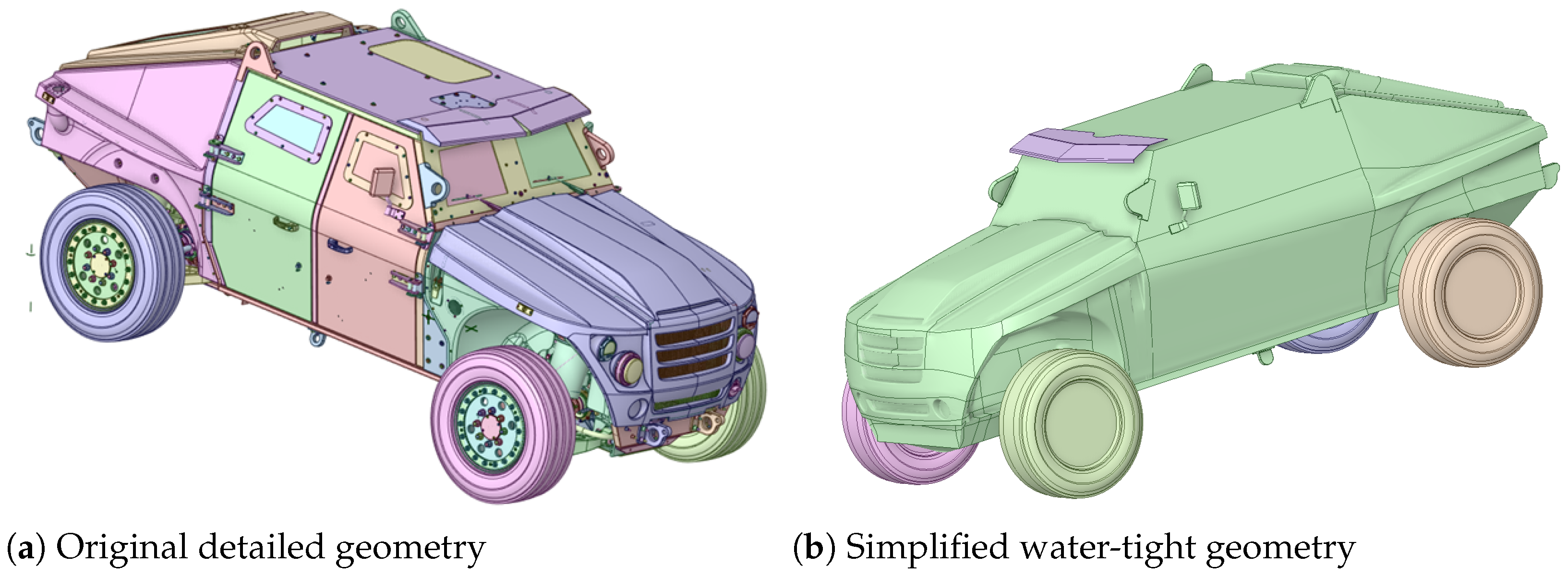
The test model for this study was the Fuel Efficiency Demonstrator Alpha (FED-Alpha) vehicle, designed for the Next Generation NATO Reference Mobility Model [
41]. It is a heavily fortified military vehicle that has greater fuel efficiency compared to conventional vehicles. The original geometry included intricate details, such as protruding nuts and bolts, drive trains, and gears, as shown in
Figure 1. However, these fine details are not necessary for CFD simulation and increase computational resource requirements. Therefore, SpaceClaim [
42] was employed to simplify the geometry by removing these finer features and ensure that the geometry was watertight for effective meshing and CFD analysis. The final simplified geometry is also depicted in
Figure 1.
2.1.2. Mesh Generation
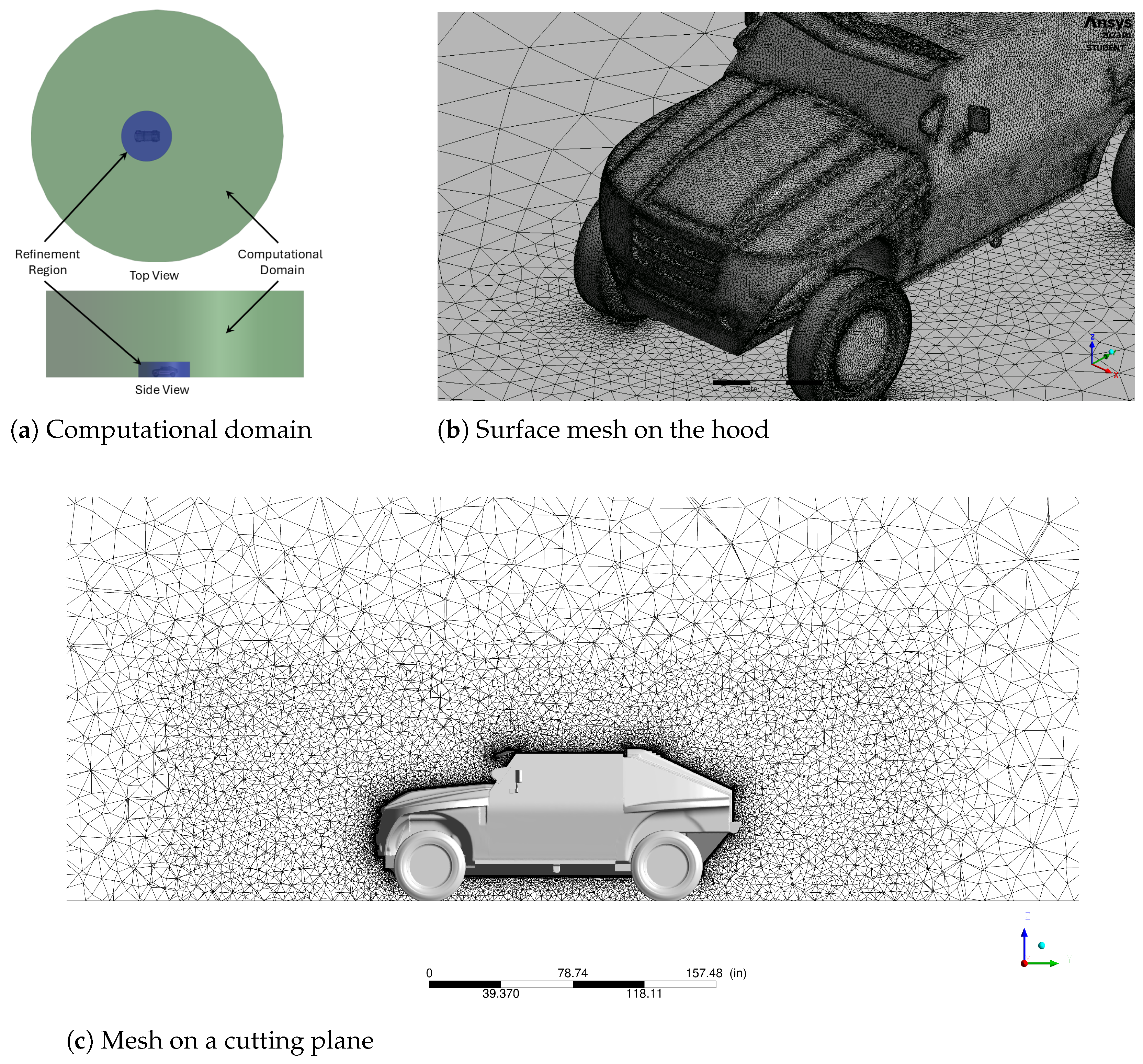
The computational domain for the simulation is defined as a cylindrical region with a radius-to-length ratio of 16:1 relative to the FED-Alpha and a height-to-height ratio of 8:1, relative to the FED-Alpha, as shown in
Figure 2. Additionally, to enhance the accuracy of the simulation and to accurately capture fine features, a cylindrical refinement region is added around the vehicle. The ratio of the radius of the computational domain to the radius of the refinement region is defined as 5:1 and the ratio of the height of the computational domain to the height of the refinement region is defined as 5.5:1. This computational domain is discretized using generalized mesh elements, with the mesh element size set to 15 cm. An inflation layer was employed to resolve the boundary layer on the vehicle’s surface, configured with a transition ratio of 0.272, a maximum of 15 layers, and a growth rate of 1.15. On the vehicle surface, the default mesh element size was set to 25 mm. The resulting mesh comprised over 11 million elements and more than 4 million nodes, with an average y+ value of 9.04.
Figure 2b,c shows the mesh on the vehicle surface and a sectional view, highlighting the refinement region.
2.1.3. Physics Model Selection and Boundary Conditions
The wind flow is modeled using incompressible flow assumptions and the SST k– turbulence model to estimate eddy viscosity. The boundary conditions are defined as follows: the ground and the sky are treated as a slip boundary and the freestream temperature is set at 300 K. The angular velocity of the wheels is accounted for at 39.8 rad/s, corresponding to a vehicle speed of 44.74 mph and a wheel radius of 0.503 m. Consequently, the freestream velocity at the inlet is set to 44.74 mph for each wind direction.
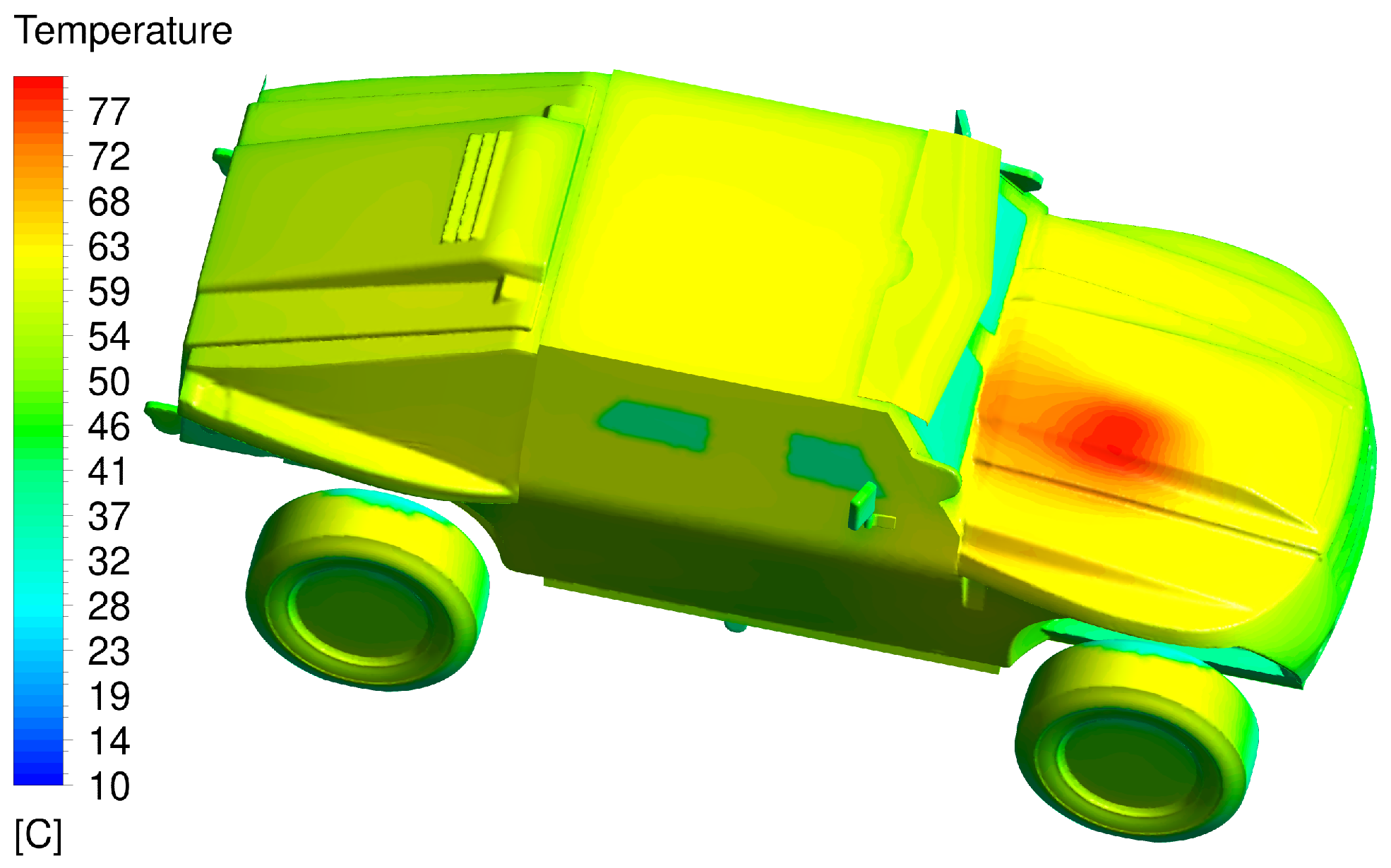
Thermal analysis of the FED-Alpha model was conducted to calculate the temperature distribution on the vehicle’s surface using TAITherm software from ThermoAnalytics [
43]. TAITherm is an advanced tool designed for thermal analysis, focusing on modeling heat distribution patterns across complex system components. For a comprehensive thermal analysis, several components were added to the geometry: a simplified engine model, exhaust passage, and airspaces for the cabin, engine, and trunk. To specify appropriate material properties such as thermal conductivities, convective heat transfer coefficients, and radiation emissivity and absorptivity, the geometry was divided into groups including windows, mirrors, engine, exhaust, and wheel. The simulation assumed a vehicle speed of 44.74 mph, with coolant heat rejection set to 44.74 kW and the exhaust mass flow rate at 5 kg/min. The simulation covered an 8-h period from 6:00 AM to 2:00 PM on 19 July 1984, with a time step of 30 min to ensure detailed analysis. The predicted surface temperature on the vehicle is illustrated in
Figure 3.
The flow field is initialized according to the incoming wind conditions, and simulations are run for 1000 iterations using a steady-state approximation.
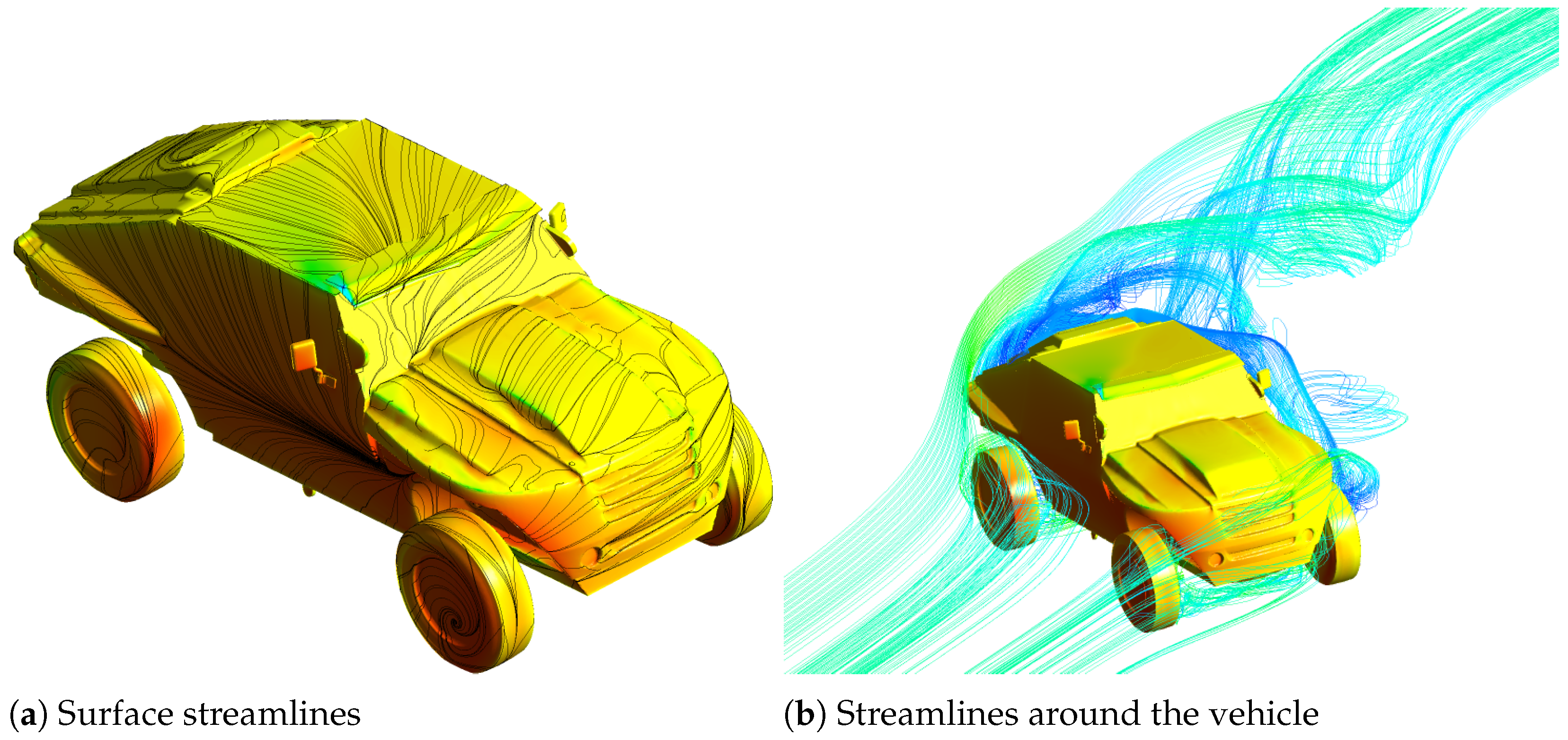
Figure 4 illustrates the surface shear stress pattern and external streamlines, as well as the pressure field on the FED-Alpha vehicle at a wind angle of 55 degrees. These figures highlight the stagnation line on the wind-facing side of the vehicle and the complex flow patterns in the wake behind the vehicle.
2.1.4. Parametric Study
A parametric study was conducted to collect data from various wind directions, ranging from 0 to 180 degrees, with increments of 2 degrees, resulting in simulations for 91 different wind angles. The primary flow variables of interest, namely, the x-, y-, and z-components of velocity are extracted from the simulations at each node in the mesh. This data is used for the Proper Orthogonal Decomposition, which is in turn used to train and test the machine learning models.
2.2. Proper Orthogonal Decomposition Using Singular Value Decomposition
The snapshot matrix used for POD contains the flow variable data at each node for all the specified wind directions. The flow variables analyzed at the nodes include the x-, y-, and z-components of velocity. Consequently, three snapshot matrices with identical dimensions were generated. Each column in a snapshot matrix represents the velocity components at all nodes for a particular wind direction. The mesh used for the simulations comprised of 4,463,607 nodes, and data from 91 wind directions were used, resulting in a snapshot matrix of size . In the snapshot matrix for the x-component of velocity, each column contains the x-component of velocity at each node for a given wind direction, while each row contains the x-components of velocity for each wind direction for a given node.
SVD has been widely applied in various fields, such as image compression, where it retains only the most significant values, thereby reducing storage space without compromising image quality [
44,
45]. In signal processing, SVD is used for denoising data by isolating and removing components associated with noise, which enhances the clarity and quality of the sound [
46]. Additionally, SVD plays a crucial role in data reconstruction, allowing for the recovery of lost or corrupted data [
47].
In this research, POD is employed as a dimensionality reduction technique and SVD is used to perform POD. Given that the data used in CFD analysis pertains to a 3D geometry, reducing the dimensionality of this data is essential for a faster analysis. The data is represented as a snapshot matrix, which is then reduced to mode shapes and mode coefficients. POD is subsequently used to identify the dominant modes, which are then used to train the ML models.
SVD is a numerically robust matrix factorization method that efficiently identifies and extracts dominant patterns from the data [
18]. One common challenge with high-dimensional data is the significant processing time required for analysis. Large datasets in fields such as audio, video, and image processing, as well as fluid flow simulation or experimental data, often exhibit dominant patterns that can be effectively represented in lower-dimensional forms. SVD provides a systematic approach to approximating data at different levels of complexity based on these governing patterns. This data-driven technique relies solely on patterns derived directly from the data.
The SVD is a special matrix decomposition technique for any complex matrix. For a given complex snapshot matrix
X of dimensions
, SVD decomposes it into three unique matrices as
where
U and
V are unitary matrices and
is an
diagonal matrix with non-negative singular values whose diagonal elements represent the eigenvalues in descending order. Columns of
U are the eigenvectors of
, columns of
V are the eigenvectors of
, and
is the conjugate transpose for real matrices. Each column in
U represents the mode shapes, while
represents the mode coefficients, arranged in the order of decreasing significance. This indicates that the first mode contains the most energy in the entire system. Thus, dominant modes can be identified and used to represent the entire dataset using a reduced set of data. The cumulative energies of the modes were utilized to ascertain the necessary number of modes to achieve high accuracy while effectively reducing dimensionality.
2.3. Machine Learning Methods
Recently, machine learning (ML) techniques have been increasingly applied to develop neural network models for fluid flow prediction. Trained on large datasets of flow field information, these models can capture complex relationships between design parameters and flow characteristics. This capability enables the development of highly accurate surrogate models for design optimization and for predicting flow behaviour in previously unseen configurations [
48].
In this study, a Dense Neural Network (DNN) architecture is employed. A DNN consists of multiple hidden layers in which each neuron is fully connected to all neurons in the subsequent layer. Consequently, every neuron receives inputs from all neurons in the preceding layer and propagates information to all neurons in the next layer. This dense connectivity allows the network to effectively capture intricate feature interactions and nonlinear dependencies within the data. As a result, DNNs are well suited for a wide range of tasks, including regression, classification, and generative modeling. The ML models were implemented using the NumPy library (version 1.22.3) and TensorFlow library (version 2.9.0).
2.4. Model Architecture
The DNN is trained by iteratively adjusting its weights and biases to minimize a prescribed loss function through forward propagation, loss evaluation, and backpropagation, guided by an optimization algorithm such as Adam. During forward propagation, the input data pass through successive layers, where each neuron computes a weighted sum of its inputs, applies a nonlinear activation function, and produces an output. The final network output is then compared with the ground truth using a loss function that quantifies the prediction error. Backpropagation is subsequently employed to compute the gradients of the loss function with respect to all trainable parameters, enabling the optimizer to update the weights and biases in a direction that reduces the loss. This iterative process is repeated over multiple epochs, allowing the network to progressively improve its predictive accuracy and converge toward an optimal parameter set.
The DNN architecture used in this study consists of six hidden layers, each containing 32 neurons. A Leaky Rectified Linear Unit (Leaky-ReLU) activation function, with
, is employed, and the model is trained using the mean squared error (MSE) loss function [
49]. The Leaky-ReLU function mitigates the “dying ReLU” issue by allowing a small, non-zero gradient for negative input values. To ensure reproducibility, deterministic operations were enabled in TensorFlow, and a fixed random seed was specified for all training runs. The models were trained for 5000 epochs without employing any early stopping criterion, using the Adam optimizer with a learning rate of 0.001 and a batch size of four. The Adam optimizer is widely used due to its computational efficiency and relatively low memory requirements when handling large datasets [
50]. No additional regularization techniques were applied during training. The input layer consists of a single neuron representing the wind angle, while the number of neurons in the output layer corresponds to the Proper Orthogonal Decomposition (POD) mode coefficients. Prior to training, the input wind-direction angles were normalized to the range of 0 to 1, while the POD mode coefficients were scaled to the range of −1 to 1.
Three different model configurations are investigated, all sharing the same network architecture but differing in the structure of the output layer. In the first approach, multiple independent models are constructed, with the total number of models equal to the number of POD mode coefficients used for the reconstruction of the flow field. Each model is trained to predict a single coefficient, resulting in an output layer with one neuron per model. In the second approach, a single model is used to predict all POD mode coefficients simultaneously, with the output layer containing 91 neurons corresponding to the full set of modes. In the third approach, a single model is again employed, with the output layer including only those mode coefficients retained for flow field reconstruction. The number of output neurons in this case varies based on the cumulative energy threshold selected for the POD modes.
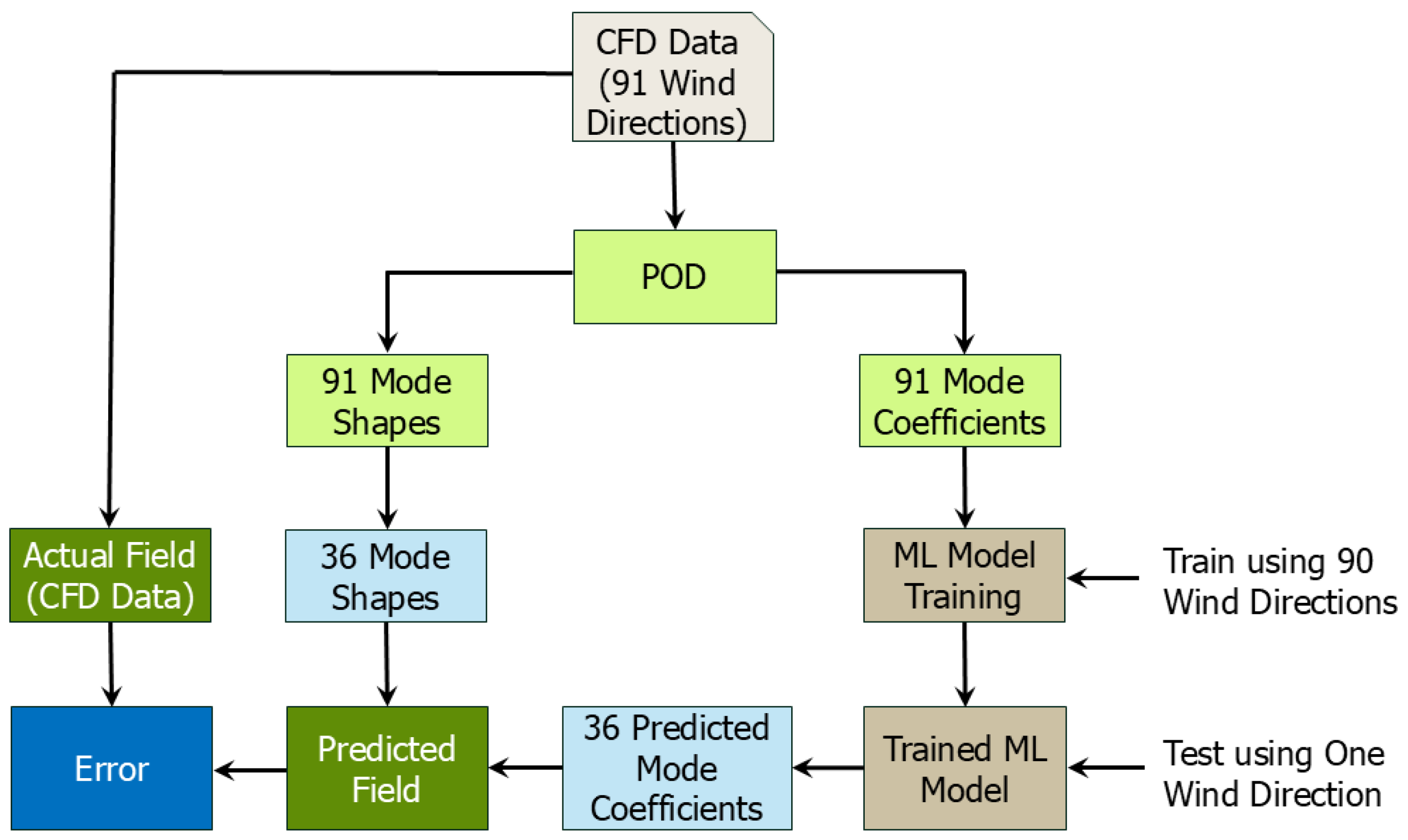
Figure 5 illustrates the overall workflow, including data reduction using Proper Orthogonal Decomposition (POD) via Singular Value Decomposition (SVD), machine learning model training and testing, and reconstruction of the predicted flow field using the predicted mode coefficients. Initially, CFD simulations are performed for 91 distinct wind directions, and the resulting flow field data are assembled into a snapshot matrix. This matrix is then decomposed using SVD to obtain 91 spatial mode shapes and their corresponding mode coefficients, which serve as the target outputs for the machine learning model. The DNN is trained using data from 90 wind directions, while the remaining case is reserved for testing without data leakage. The trained model predicts the mode coefficients for the unseen wind direction. In the example considered here, the first 36 predicted mode coefficients are retained for reconstruction of the flow field. The reconstructed field is obtained by linearly combining the corresponding 36 mode shapes weighted by their predicted coefficients. Finally, the reconstructed field is compared with the CFD solution for the test case, and the prediction error is quantified.
3. Results and Discussion
3.1. CFD Model Validation
Validation of the CFD model is a critical step, particularly for ground vehicle simulations where geometric complexity introduces significant challenges in accurately resolving the flow field. Such simulations typically require substantial computational resources due to the intricate geometry and the need for high-resolution meshes. Therefore, it is essential to establish the reliability of the numerical model by comparing its predictions with available experimental data.
The Ahmed Body is a widely recognized benchmark configuration for validation in automotive aerodynamics, first introduced by Ahmed et al. [
51]. Owing to its simplified geometry, it provides an effective test case for assessing the accuracy of computational models while still capturing key flow features relevant to real vehicles. The Ahmed Body consists of a bluff, rectangular geometry with a slanted rear surface and sharp leading edges. The aerodynamic characteristics are strongly influenced by the wake structure formed behind the body, which varies with the rear slant angle. By modifying this angle, different flow regimes can be reproduced, resulting in variations in drag and lift coefficients. Consequently, the Ahmed Body has been extensively used for validation studies in the literature [
52,
53,
54,
55].
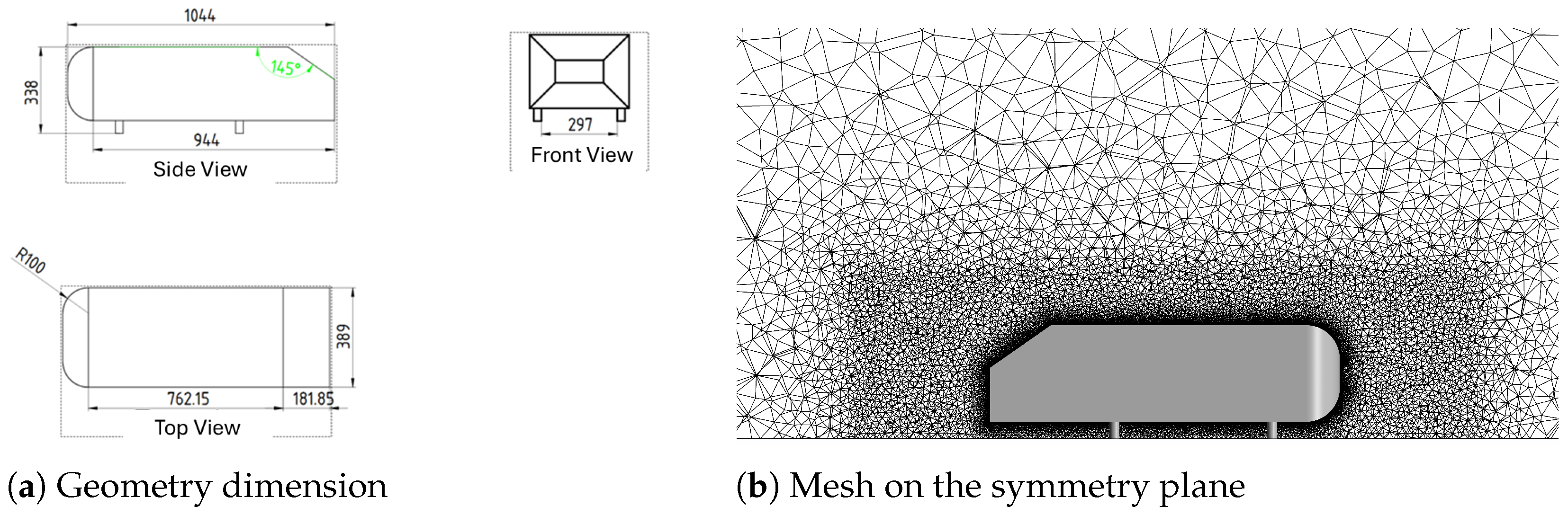
In the present study, the Ahmed Body with a rear slant angle of 35° is used for model validation. The geometry has dimensions of 1044 mm in length, 389 mm in width, and 338 mm in height, as shown in
Figure 6a. The body is placed within a computational domain such that the ratio of the domain radius to the body length is 18:1, and the ratio of the domain height to the body height is 4:1. Consistent with the FED-Alpha simulations, mesh refinement is applied in the vicinity of the body to accurately capture near-wall and wake flow features. The resulting mesh consists of approximately ten million elements, with a base element size of 0.86391 m.
Figure 6b presents the mesh distribution on the symmetry plane, highlighting the refined region near the body.
For the simulation setup, the freestream velocity was specified as 20 m/s, with a corresponding freestream temperature of 300 K. Turbulence effects were modeled using the shear stress transport (SST) k– model to estimate the eddy viscosity. The flow was assumed to be incompressible, with a dynamic viscosity of kg/m·s. Aerodynamic force and moment coefficients were computed using the frontal area of the Ahmed Body as the reference area, which was calculated to be 0.1212798 m2. The characteristic length was taken as 1.044 m, and the reference density was set to 1.225 kg/m3. Based on these parameters, the Reynolds number of the flow was approximately . The simulation was conducted with the Ahmed Body mounted on its supporting stilts. The predicted drag coefficient was 0.258, which is in excellent agreement with the experimentally reported value of 0.26. This close correspondence provides confidence in the accuracy of the numerical model, which is subsequently employed for simulating airflow around the FED-Alpha configuration.
3.2. Data Generation for ML Models
The validated CFD model described in the previous section was subsequently employed to simulate the flow field around the FED-Alpha vehicle and to generate data for further analysis. Following each simulation, velocity components at each node were extracted throughout the computational domain. The solution data were exported from ANSYS Fluent for all 91 wind directions and stored as individual data files. These datasets were then assembled into a snapshot matrix, which served as the basis for computing the POD mode shapes and their corresponding mode coefficients.
3.3. Proper Orthogonal Decomposition Results
Traditionally, the cumulative energies of the modes from POD have been used to decide the number of modes to be considered while reducing data dimensionality for accuracy [
56,
57,
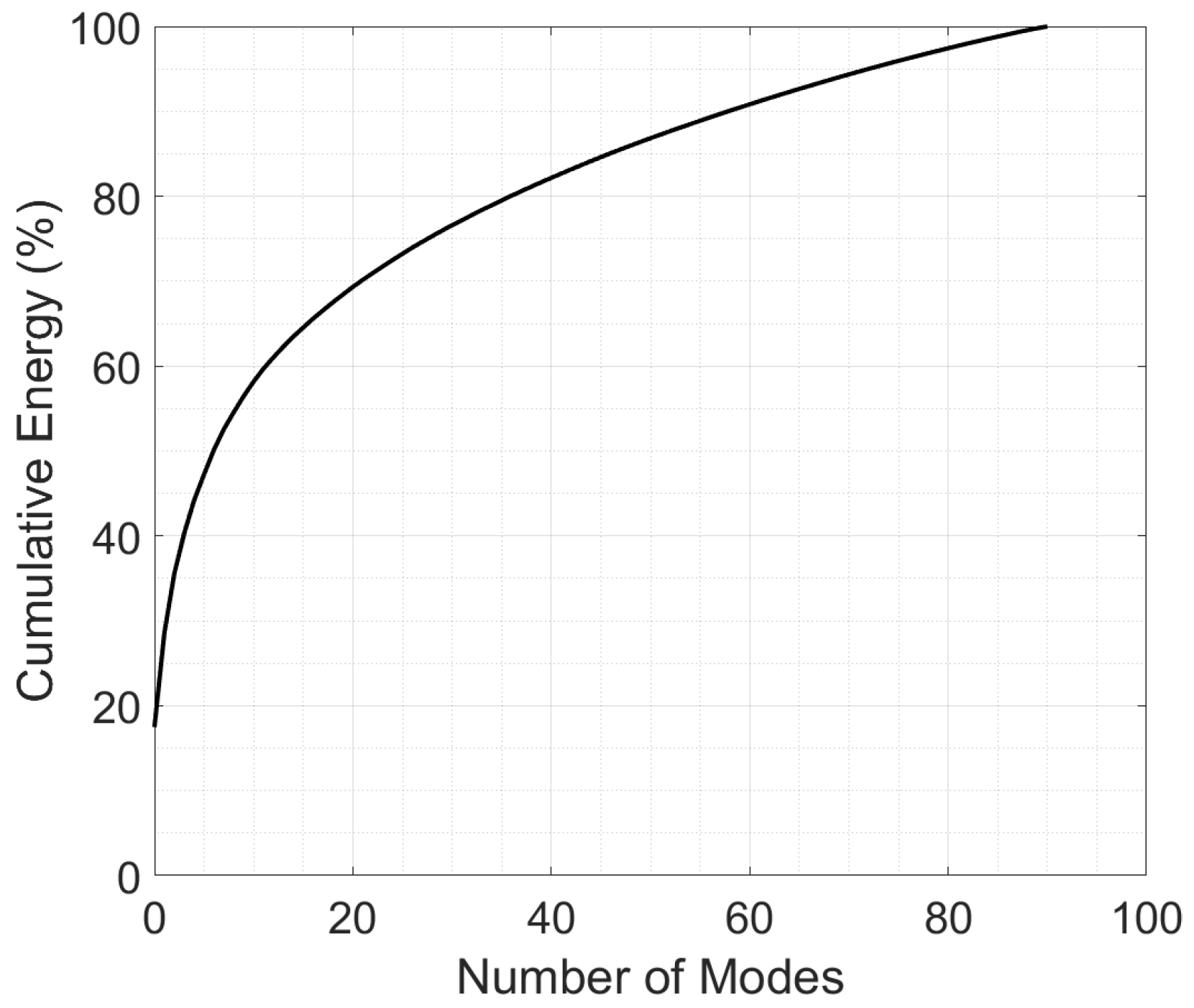
58]. In the context of field reconstruction, the term “energy” quantifies the contribution of each mode to the overall representation of the flow field. Cumulative energy is defined as the ratio of cumulative sum of eigenvalues up to considered mode to the sum of all eigenvalues in the system. The cumulative energy increases as additional modes are included, although the incremental contribution of higher-order modes progressively diminishes. The first mode typically contains the largest share of the energy, followed by subsequent modes with decreasing significance. Accordingly, the modes are ranked based on their energy content, with lower-order modes playing a dominant role in accurately reconstructing the flow field. The cumulative energy distribution of the POD modes for the
x-component of velocity is presented in
Figure 7. The vertical axis represents the cumulative energy as a percentage, while the horizontal axis denotes the number of retained modes. As shown in
Figure 7, the first few modes capture a substantial portion of the total energy, with approximately 80% contained within the first 37 modes.
POD-based reconstruction is performed using the Singular Value Decomposition (SVD) representation of the snapshot matrix, in which the matrix U contains the spatial modes and the product contains the corresponding mode coefficients. Reconstruction using a single mode is achieved by multiplying the corresponding column of U with its associated coefficient in . For example, reconstruction using the first mode involves the product of the first column of U and the first coefficient in . Reconstruction with multiple modes is obtained by summing the contributions from each selected mode. This additive process extends to higher-order reconstructions, where the inclusion of additional modes incrementally improves the accuracy of the reconstructed field. The computational cost scales linearly with the number of modes retained, as each additional mode introduces N multiplications and N additions, where N is the number of spatial points.
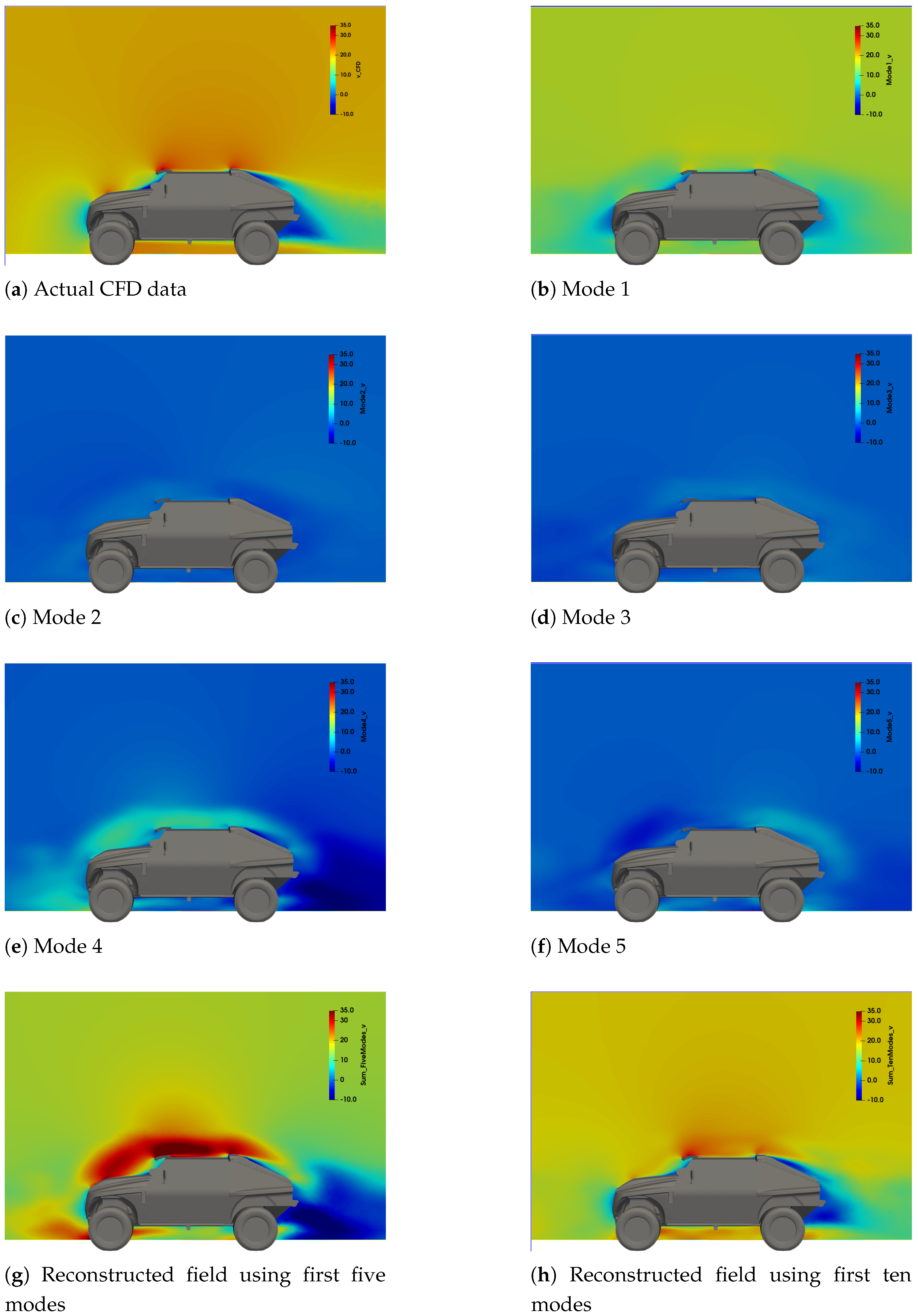
To validate the POD reconstruction, the velocity component in the
y-direction for a wind angle of 0° is reconstructed using varying numbers of dominant modes and compared with the corresponding CFD results, as shown in
Figure 8. The velocity field is visualized on the symmetry plane of the FED-Alpha vehicle, with the geometry overlaid to provide spatial context. The CFD-predicted velocity field for the 0° wind case is presented in
Figure 8a, where the
y-component of velocity ranges from
m/s to 35 m/s. This range is used consistently across all subplots to facilitate direct comparison.
Figure 8b–f illustrate the contributions of the first five individual modes to the reconstructed velocity field. The first mode shown in
Figure 8b captures the most dominant flow structures, which is the mean flow field and exhibits the largest velocity variation, while higher-order modes contribute finer details with reduced magnitude. The lower-order modes capture the dominant global flow response, including large-scale separation and wake behavior, whereas the higher-order modes describe progressively finer spatial variations and localized flow features that contribute less to the overall flow field energy.
Figure 8g,h present the reconstructed flow fields obtained using the first 5 and 10 modes, respectively. These results demonstrate a clear improvement in reconstruction accuracy as more modes are included, with the 10-mode reconstruction showing closer agreement with the CFD solution in
Figure 8a. This behaviour highlights the effectiveness of POD in capturing the dominant flow features with a relatively small number of modes, while additional modes enhance the fidelity of the reconstructed field.
3.4. Machine Learning Model Results
To evaluate the accuracy of the predicted wind field, reconstructions were performed using different numbers of POD modes corresponding to varying levels of cumulative energy. The number of modes retained in the reconstruction was selected to increase the prediction accuracy, with the objective of minimizing the difference between the CFD solutions and the flow fields reconstructed using the trained machine learning model. The optimal number of POD modes need to be retained in the reconstruction corresponds to the smallest error between the reconstructed flow field and the CFD data. The prediction accuracy was quantified using three error metrics: average error, root-mean-square (RMS) error, and maximum absolute error. These errors are defined as
where
N is the total number of nodes in the computational mesh, and
is the prediction error associated with node
i. The error
is defined as the difference between the flow variable value obtained from the CFD simulation and the corresponding value reconstructed by the machine learning model at node
i:
For the velocity components, cumulative energy levels of 10% to 90% in steps of 10%, and 95% were considered. The number of modes required to achieve each cumulative energy level is summarized in
Table 1. As shown, approximately 80% of the total energy for the streamwise (
x), transverse (
y), and vertical (
z) components of velocity are captured by 37, 36, and 41 modes respectively.
Following the training phase, the ML models were evaluated using a test case corresponding to a wind angle of 56°. The predicted wind field for this case was obtained by combining the predicted POD mode coefficients with the corresponding spatial modes. Specifically, the predicted coefficients from the ML models were multiplied by their respective mode shapes, and the contributions from all retained modes were summed to reconstruct the flow field. The reconstructed field was then compared with the CFD solution to quantify the average, root mean square (RMS), and maximum absolute errors. The differences among the three ML model configurations are illustrated using the 80% cumulative energy case for the x-component of velocity.
As indicated in
Table 1, 80% of the total energy for this component is captured by the first 37 POD modes. Accordingly, the output layer configurations for the three approaches were defined based on these 37 modes. In Approach 1, 37 independent ML models were trained, each with a single output neuron corresponding to one of the first 37 mode coefficients. The predicted coefficients from these individual models were then combined to reconstruct the flow field. In Approach 2, a single ML model with 91 output neurons was trained to predict all POD mode coefficients; however, only the first 37 coefficients were retained for reconstruction. In Approach 3, a single ML model was trained with 37 output neurons to directly predict the required set of mode coefficients used for flow field reconstruction.
3.4.1. Model Comparisons
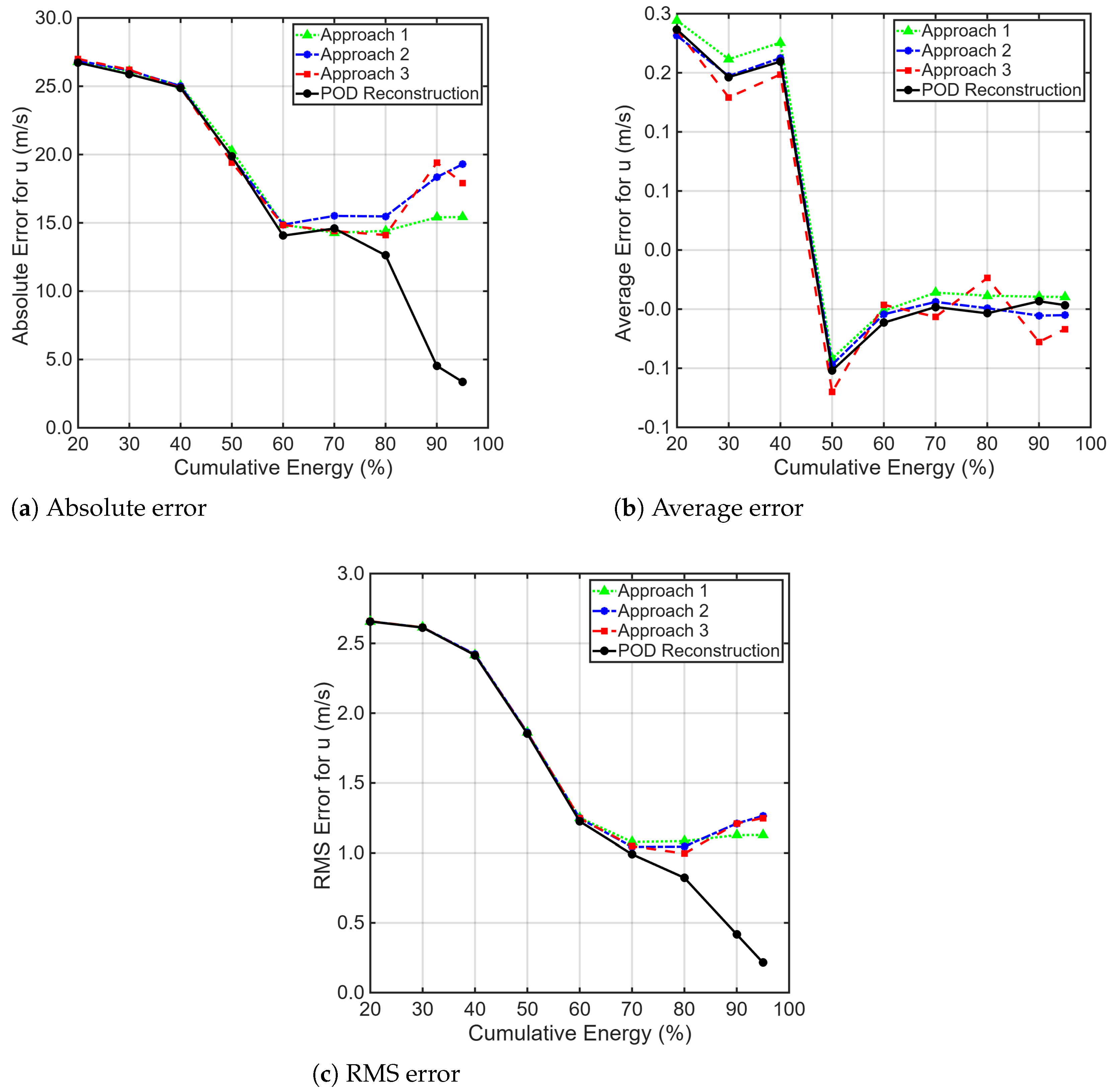
The absolute, average, and root mean square (RMS) errors for flow field reconstruction using the different ML approaches are presented in
Figure 9. This figure provides a comparative analysis of the three ML model configurations, along with the corresponding POD-based reconstructions, for
x-component of velocity. The error metrics are plotted as functions of the cumulative energy retained in the reconstruction, enabling a direct assessment of how reconstruction fidelity varies with the number of modes included.
From these figures, the following inferences can be made:
There is a significant drop in error from 10% to 60% cumulative energy, which can be attributed to the inclusion of more significant modes in the reconstruction. As shown in
Table 1, the large fluctuations in the velocity field require more modes to capture all the variations.
The graphs for absolute and RMS errors are nearly identical across all three approaches.
The lowest error is achieved at 80% cumulative energy for both RMS and absolute errors. Therefore, the number of modes corresponding to 80% cumulative energy is optimal for flow field prediction using the ML models.
While it might be expected that Approach 1 would yield the highest accuracy, as it utilizes multiple ML models to predict each mode coefficient individually, the graphs show no significant difference in error between Approach 1 and the other two approaches. Furthermore, as will be shown later, the training time required for Approach 1 makes it less efficient compared to Approaches 2 and 3.
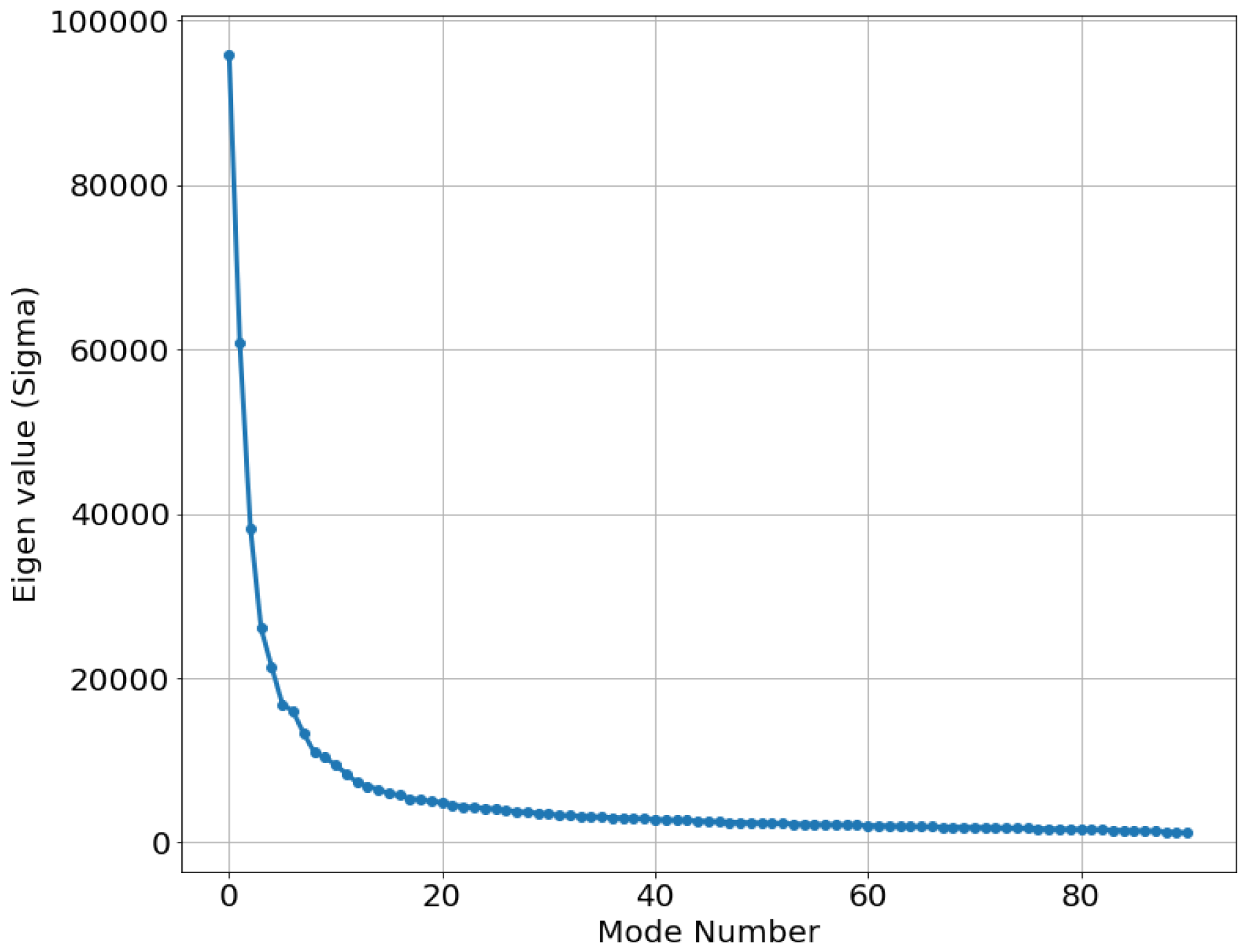
It is notable that for Approaches 2 and 3, the error slightly increases as the cumulative energy shifts from 80% to 100%. This may be because the mode coefficients for higher modes are very close to zero. As shown in
Figure 10, the eigenvalues after 37 modes, corresponding to cumulative energy greater than 80%, are significantly small. Consequently, multiplying the mode coefficients corresponding to these mode shapes contributes little to the reconstruction of the flow variables. However, any inaccuracies in the prediction of these mode coefficients by the ML models may result in non-zero values for the mode coefficients. These non-zero values are then multiplied by the mode shapes and added to the reconstruction, causing errors in the predicted flow field. Approach 1 uses a single output neuron per ML model, whereas Approaches 2 and 3 have multiple output neurons.
The reconstruction plot using POD shows a steady decrease in error across all graphs, with the error reducing to zero as the cumulative energy approaches 100%. Although the other three plots reveal a consistent drop in errors up to around 80% cumulative energy, the errors either increase or plateau from 80% to 100%. The reason for this is explained in point 5 above.
Similar behaviour was observed in the other components of velocities, and for conciseness these figures are omitted here. However, normalized values of maximum, RMS, and average error for all velocity components are listed in
Table 2. The normalization is carried out using the freestream velocity.
Three-dimensional visualization of the prediction error was also performed using ParaView (version 5.11.2) [
59]. The results, presented in
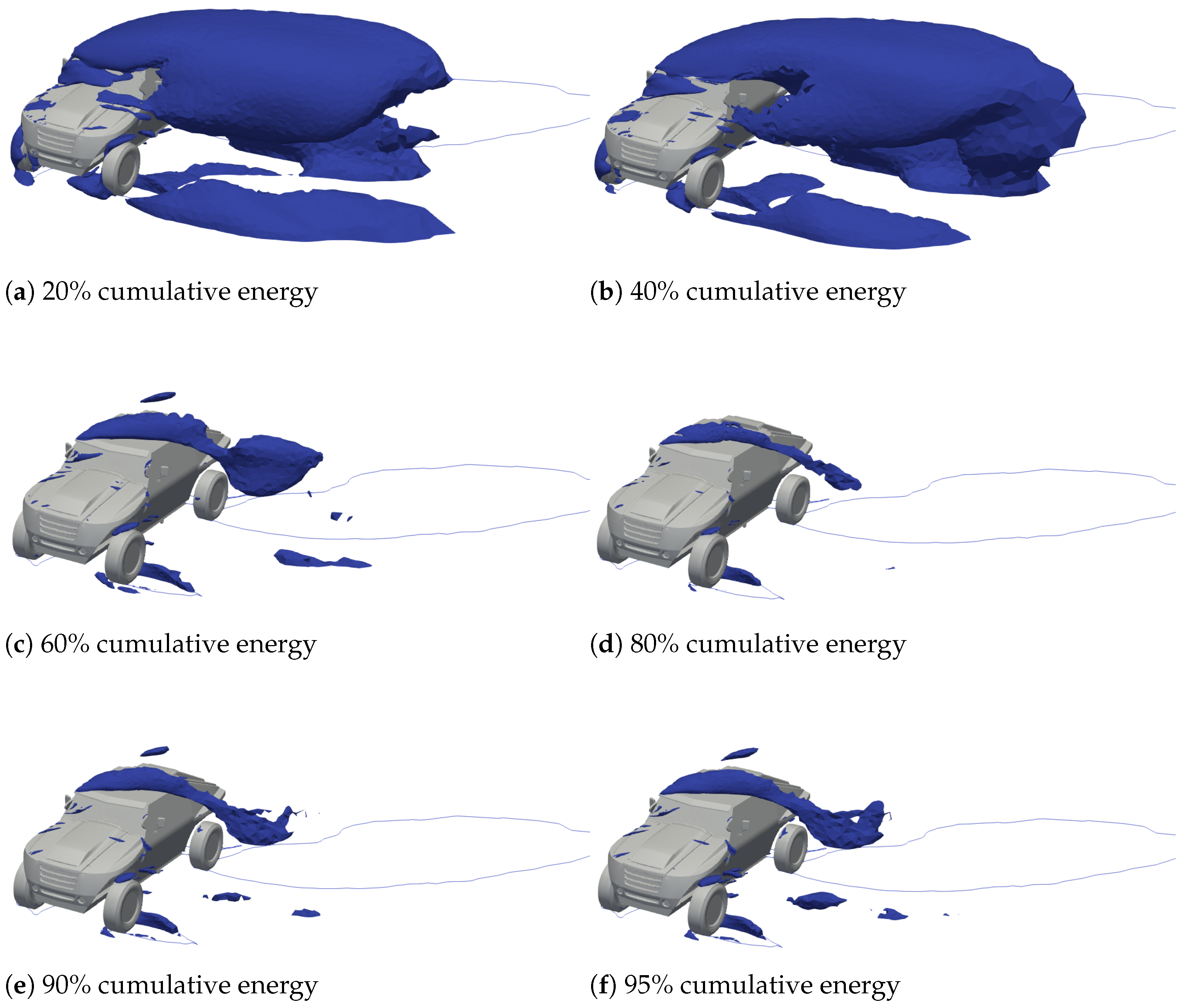
Figure 11, are shown as iso-surfaces corresponding to a specified error threshold for the
x-component of velocity for ML Model Approach 2. Regions enclosed by the blue iso-surface indicate locations where the error exceeds 5 m/s. As illustrated in
Figure 11, the extent of the high-error regions decreases progressively as additional modes are included in the reconstruction. However, a slight increase in the error region is observed beyond 90% cumulative energy, consistent with the trend noted in the error plots in
Figure 9. Furthermore, the regions of elevated error are primarily concentrated in the vicinity of the wake region of the vehicle. This behaviour can be attributed to the complex separated flow structures near the vehicle, which present greater challenges for accurate prediction. The wake region is characterized by strong velocity gradients, flow separation, recirculation zones, and vortical structures, which introduce significant non-linearities into the flow field. Small variations in the predicted mode coefficients by the ML models can produce disproportionately large changes in the wake dynamics, making the flow highly sensitive to perturbations. In addition, the wake contains small-scale eddies that are more difficult to represent accurately using a reduced set of modes and machine learning-based reconstruction techniques. Consequently, prediction errors tend to accumulate in the wake region, whereas the attached flow regions exhibit smoother spatial variations and are reconstructed with higher accuracy.
3.4.2. Computational Resource Requirements
The CPU resources utilized for each component in the ML models for the
x-component of velocity are summarized in
Table 3. The computations were performed using a 2.4 GHz Intel Xeon E5-2680 processor. As shown in
Table 3, Approach 1 takes 11,486 seconds to train due to the presence of multiple ML models. In contrast, Approaches 2 and 3 require significantly less time for training since each utilizes a single ML model. Also, the CPU time for predicting the mode coefficients using the ML models for the reconstruction of the flow field using Approaches 2 and 3 is less than 0.4 s, as compared to close to 11 s when using Approach 1. This is much smaller than 2.6 h required for a single CFD simulation.
3.4.3. Effect of ML Architecture on Accuracy
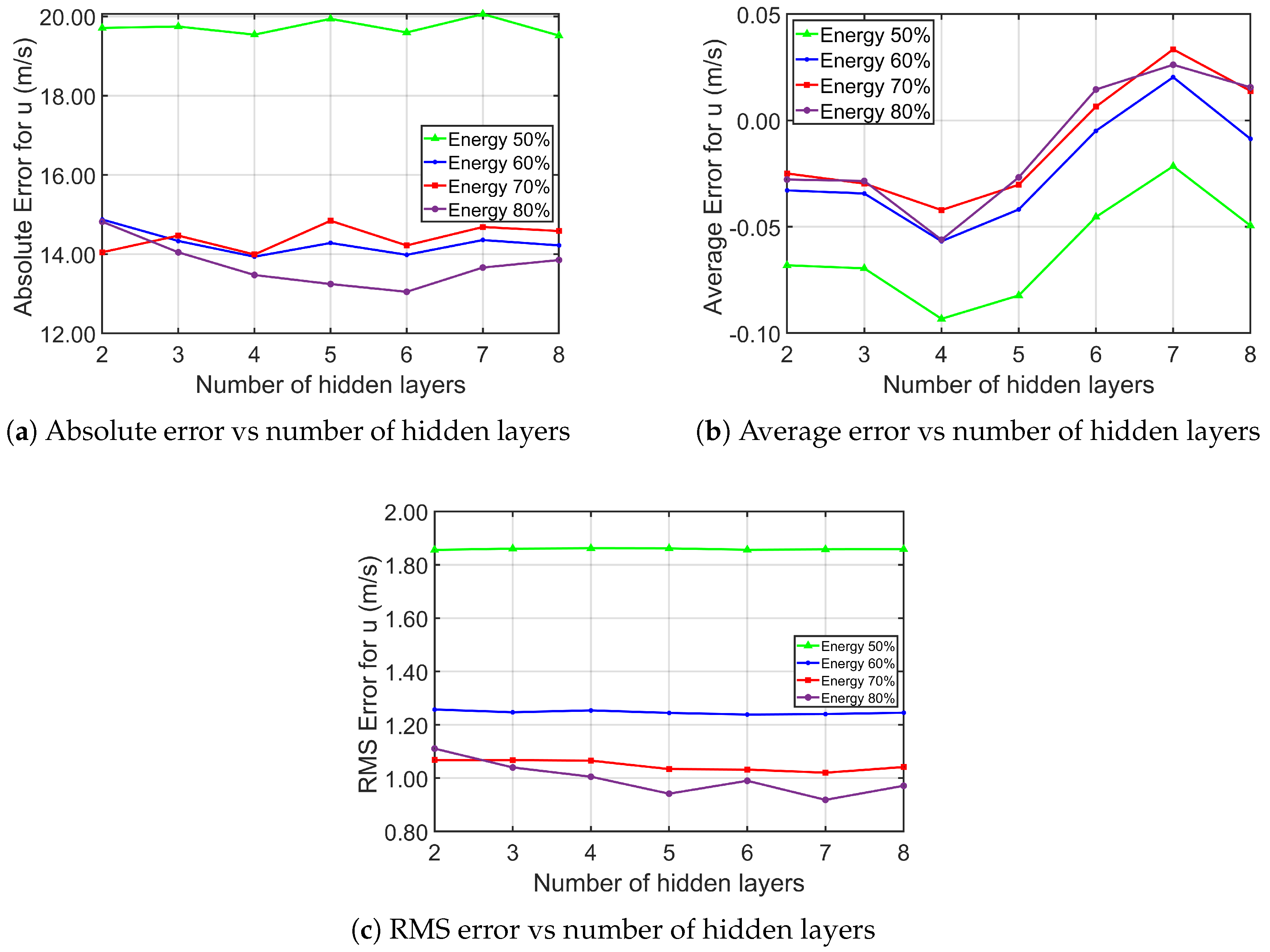
Based on computational complexity and ease of implementation, Approach 2 was chosen to evaluate the impact of different ML architectures on the accuracy of the predicted flow field. Various combinations of hidden layers and the number of neurons within these layers were tested using Approach 2 and the resulting errors in the predicted flow field were calculated. To assess the influence of the number of hidden layers on accuracy, the number of hidden layers was increased uniformly and ML models with two, three, four, five, six, seven, and eight hidden layers, each containing 32 neurons, were analyzed. The ML models were trained for 5000 epochs without early stopping criteria.
Figure 12 compares the accuracy of ML models with varying numbers of hidden layers under Approach 2. The graphs indicate that the number of hidden layers does not significantly affect absolute and RMS errors. However, the graph of average error against cumulative energy shows that using six, seven, or eight hidden layers tends to reduce average errors. This suggests that increasing the number of hidden layers can improve model accuracy, though there is an optimal point; adding too many hidden layers may eventually lead to overfitting, reducing the model’s efficiency when tested on new data.
Figure 12a–c highlight that six hidden layers represent the best configuration.
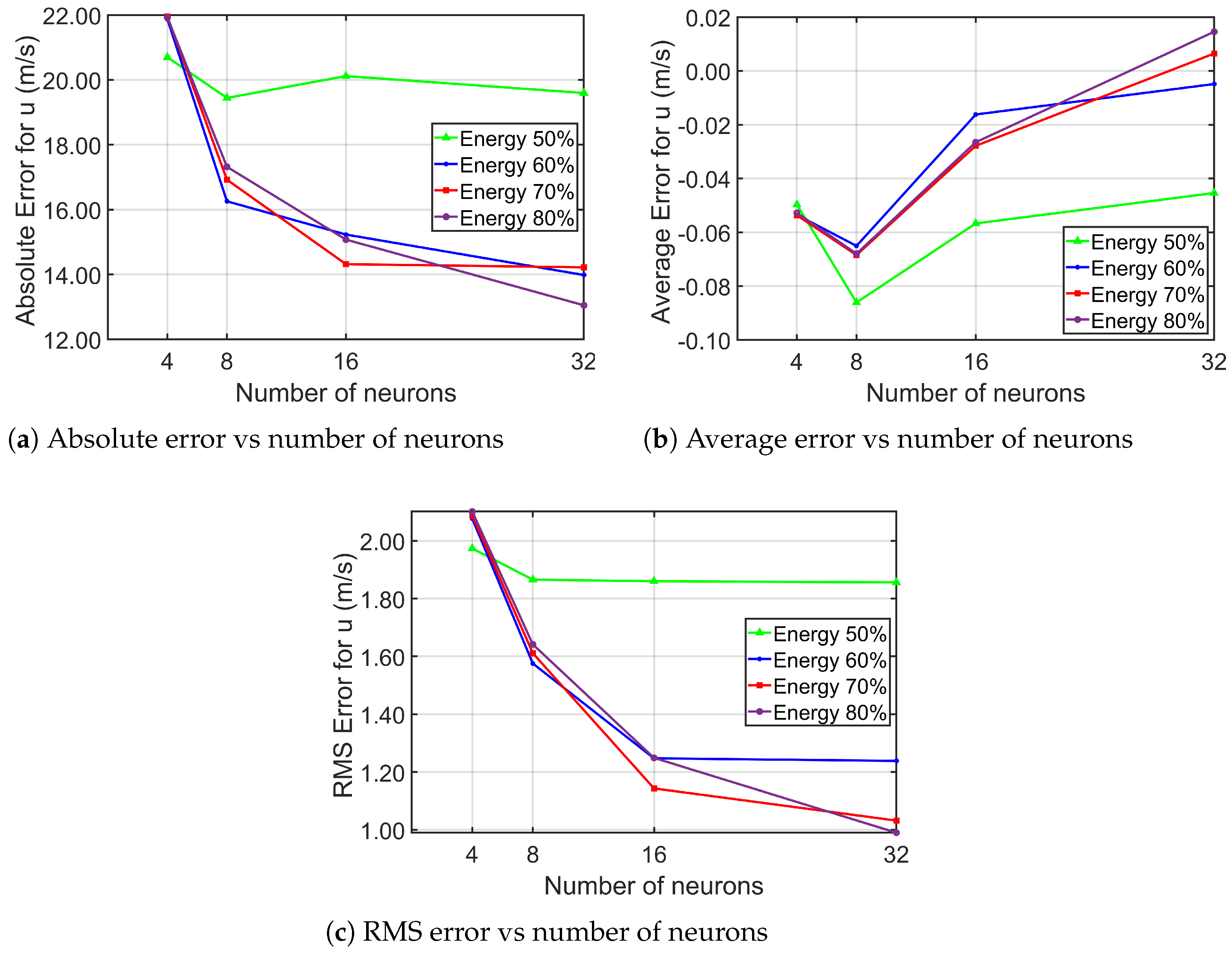
Additionally, to examine the effect of the number of neurons per hidden layer, ML models with 4, 8, 16, and 32 neurons per layer, each with a total of six hidden layers, were explored. Errors in the predicted flow field were calculated and plotted for cumulative energy percentages of 50%, 60%, 70%, and 80%.
Figure 13 presents graphs comparing the accuracy of different numbers of neurons within the ML model for Approach 2. As the number of neurons increases from 4 to 16, both the RMS and absolute errors drop significantly, indicating a corresponding improvement in model accuracy. This improvement is attributed to better function approximation and more effective extraction of input data features. However, it is crucial to note that while an initial increase in the number of neurons in the hidden layers can yield better results, it may eventually lead to overfitting if not properly managed. Overfitting occurs when the model becomes too specialized in the training data, compromising its ability to generalize to unseen data and thus rendering it ineffective. The graphs clearly show that using 32 neurons within each hidden layer yielded the best accuracy.
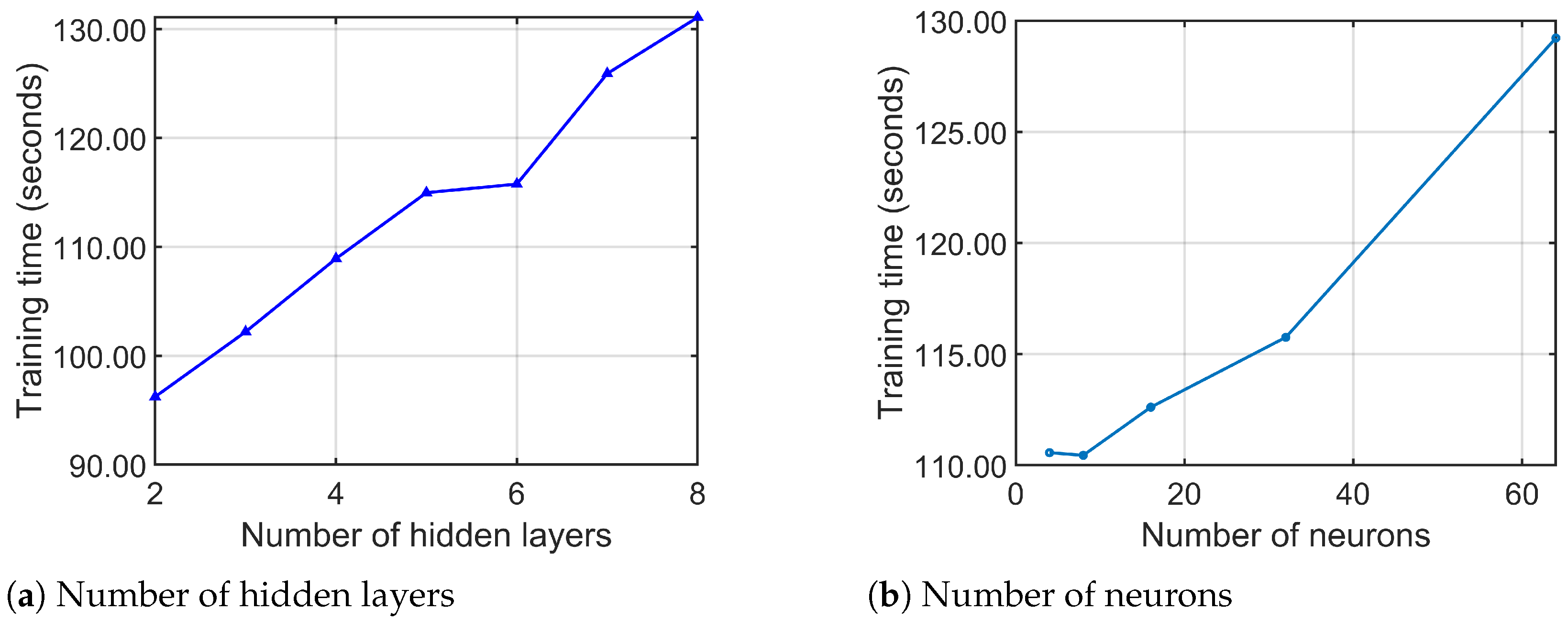
The graphs of training time versus the number of hidden layers and neurons for Approach 2, shown in
Figure 14, reveal that as the complexity of the ML model increases, there is a corresponding gradual increase in training time.
4. Conclusions
A machine learning (ML) model with three different output formulations was developed, trained, and tested to enable faster-than-real-time prediction of the flow field around a military vehicle for unseen wind directions. The models were evaluated based on the errors associated with their predicted flow fields. Training data were generated from Proper Orthogonal Decomposition (POD) of high-dimensional flow field data obtained from computational fluid dynamics (CFD) simulations. The CFD model considered in this study corresponds to the FED-Alpha vehicle, with simulations performed for 91 wind directions. The resulting datasets were decomposed using Singular Value Decomposition (SVD) into spatial mode shapes and corresponding mode coefficients, which served as inputs for training and testing the ML model.
Several key conclusions can be drawn from this study.
First, among the three approaches investigated, Approach 2, where a single ML model is used to predict all mode coefficients used in the reconstruction, demonstrated the best overall performance. This approach required approximately 16 GB of memory and was capable of predicting and reconstructing the flow field in less than one second. In addition, the use of a single model simplifies both training and deployment.
Second, it was observed that retaining modes corresponding to approximately 70–80% cumulative energy is sufficient for accurate flow field reconstruction. Including modes beyond this threshold, up to 100% cumulative energy, provides minimal improvement while significantly increasing computational cost and memory requirements.
Third, a parametric study of the network architecture for Approach 2 indicated that a configuration with six hidden layers and 32 neurons per layer yields the best performance. This architecture resulted in the lowest average, absolute, and root mean square (RMS) errors among the configurations tested.
Finally, a significant reduction in computational time was achieved using the ML-based approach. While a single CFD simulation required approximately 2.6 h per wind direction, the trained ML model was able to predict and reconstruct the corresponding flow field in less than one second. This substantial improvement demonstrates the feasibility of real-time flow field prediction using machine learning techniques.
The models developed in this study were specifically designed for the steady external flow field of the FED-Alpha configuration. Furthermore, the proposed methodology was evaluated for a single wind direction as a proof-of-concept demonstration. Future work will focus on assessing the generalizability and robustness of the approach by applying it to a wider range of vehicle geometries, terrain conditions, wind directions, and operating environments. In addition, more advanced neural network architectures, such as convolutional neural networks (CNNs), will be investigated to improve model scalability, enhance spatial feature extraction, and extend applicability to a broader class of flow configurations. Such developments may also facilitate the reconstruction and analysis of unsteady flow fields. Another promising extension of this work is the integration of the reconstructed flow fields with thermal and infrared (IR) signature prediction methodologies, enabling rapid estimation of vehicle thermal and IR characteristics for signature management applications.





 ,
,