1. Introduction
Offshore wind turbines have become an important component of low-carbon energy infrastructure and are increasingly regarded as critical structural assets in the sustainable built environment. Among fixed-bottom support systems, monopile foundations remain one of the most widely adopted solutions in shallow and intermediate water depths because of their structural simplicity, mature installation technology, and cost-effectiveness. However, monopile offshore wind turbines are slender and flexible structural systems with relatively low fundamental frequencies, making them dynamically sensitive to environmental and operational actions. Under routine service conditions, stochastic wind and irregular wave loads act simultaneously on the coupled rotor-tower-foundation system, leading to sustained vibration, fatigue accumulation, and potential serviceability problems. Therefore, vibration mitigation of monopile offshore wind turbines is not only a marine engineering issue, but also an important problem related to the structural safety, serviceability, and resilience of energy infrastructure.
In addition to routine wind-wave excitation, seismic action may become critical for offshore wind turbines located in coastal and seismically active regions. Because monopile-supported offshore wind turbines exhibit low-frequency global modes and significant sensitivity to foundation flexibility, their seismic response may differ substantially from that of conventional fixed-base civil structures. Previous studies have shown that soil-structure interaction, liquefaction, input-motion characteristics, and foundation modeling assumptions can significantly affect the dynamic response and seismic demand of monopile-supported wind turbines. From the perspective of infrastructure resilience, passive vibration-control strategies for offshore wind turbines should therefore be evaluated not only under ordinary wind-wave loading but also under extreme or accidental seismic disturbances. A multi-hazard assessment framework that considers wind, wave, and seismic actions is essential for understanding the operational safety and long-term robustness of such flexible infrastructure systems.
Recent studies on wind turbine condition monitoring, non-destructive testing (NDT), and structural health monitoring (SHM) have highlighted the importance of inspection, damage identification, and long-term reliability assessment for wind energy structures. For example, Civera and Surace reviewed NDT-based condition and structural health monitoring techniques for wind turbines, including visual inspection, acoustic emission, ultrasonic testing, infrared thermography, radiographic testing, electromagnetic testing, and other monitoring strategies [
1]. For offshore structures, Kuai et al. developed a cointegration-based SHM strategy for offshore platforms under realistic wind and wave forces, demonstrating the importance of accounting for environmental and operational variability in damage assessment [
2]. These studies provide an important reliability and monitoring context for offshore energy infrastructure. However, SHM/NDT methods mainly address detection and condition assessment, whereas the present study focuses on passive vibration mitigation under wind-wave-seismic loading. Thus, the proposed SSVI NES is investigated as a candidate vibration-control device that complements, rather than replaces, monitoring-based approaches.
To suppress excessive vibration, various passive control strategies have been investigated for offshore wind turbines. Among them, tuned mass dampers (TMDs) are the most widely studied because of their simple mechanical configuration, clear design principle, and practical feasibility for nacelle- or tower-mounted installation. Existing studies have demonstrated that single TMDs, multiple TMDs, tuned mass damper inertors, and other modified TMD systems can effectively reduce nacelle fore-aft displacement, nacelle acceleration, and fatigue-related structural responses under wind-wave, seismic, and combined environmental loading. Recent MDPI studies have also reported TMD-based vibration-control applications for offshore wind turbines and related flexible structures, confirming the continued relevance of passive absorbers in renewable-energy infrastructure. However, the effectiveness of a conventional TMD depends strongly on accurate tuning to the dominant structural frequency. In practical offshore environments, structural frequencies may vary because of scour, soil-structure interaction uncertainty, material degradation, changing operational states, and modeling errors. Once frequency detuning occurs, the performance of linear tuned absorbers may deteriorate significantly. For nacelle-integrated applications, this limitation is not only a control-performance issue but also an implementation issue, because excessive absorber stroke demand may conflict with the restricted internal space and operational layout of the nacelle.
To overcome the narrow-band nature of linear absorbers, nonlinear energy sinks (NESs) have attracted increasing attention in structural dynamics and vibration control. Unlike conventional TMDs, NESs rely on essentially nonlinear restoring behavior rather than precise linear resonance tuning, enabling broadband interaction with the primary structure and promoting targeted energy transfer. Foundational studies have shown that resonance capture, energy pumping, and irreversible energy redistribution are central mechanisms underlying NES behavior. Among different NES configurations, vibro-impact NESs have been investigated because intermittent impacts can introduce additional energy dissipation and enhance nonlinear energy transfer. In particular, a single-sided vibro-impact configuration may be relevant to structural-control problems where both energy dissipation and absorber-motion limitation are important. However, its applicability to nacelle-mounted offshore wind turbine control still requires careful assessment, because the nacelle space is limited and the turbine dynamic properties may vary under environmental, operational, and foundation-related uncertainties.
Despite these advances, NES-based passive control for offshore wind turbine structures remains much less explored than TMD-based solutions. Existing studies have not yet fully clarified whether an SSVI NES can simultaneously provide competitive vibration reduction under nominal wind-wave or wind-wave-seismic loading, reduce absorber motion demand under nacelle-space constraints, and retain acceptable performance when the structural frequency deviates from the nominal tuning condition. Therefore, rather than assuming the superiority of the SSVI NES, the present study treats it as a candidate passive absorber and evaluates its performance through a comparative numerical framework against an optimized TMD.
Motivated by these considerations, this study investigates the robust passive vibration control of a 5 MW monopile offshore wind turbine using the SSVI NES under combined wind-wave-seismic loading. A reduced-order blade-tower-foundation dynamic model is developed for repeated time-domain simulations. Turbulent wind fields are generated using TurbSim based on IEC-based wind modeling and the Kaimal spectrum, irregular wave loading is described using the JONSWAP spectrum and Morison equation, and seismic excitation is represented by selected ground-motion records from the PEER database. The proposed SSVI NES is compared with an optimized TMD in terms of nacelle response reduction, absorber motion demand, energy dissipation, and retained control effectiveness under frequency detuning.
The main contributions of this study are threefold. First, a reduced-order dynamic framework is established for comparative assessment of nacelle-mounted passive vibration-control devices under combined wind, wave, and seismic actions. Second, the performance of the proposed SSVI NES is systematically compared with that of an optimized TMD, with particular attention to both structural response reduction and absorber stroke demand. Third, the robustness of the SSVI NES is evaluated under frequency-detuned conditions to clarify its tolerance to off-design structural-frequency variations. Through these contributions, this study provides a computational assessment of the potential of the SSVI NES for improving vibration-serviceability performance and robustness of monopile offshore wind turbines within the scope of the adopted reduced-order model.
2. Numerical Model and Environmental Loading
To evaluate the proposed passive control strategy under realistic multi-hazard conditions, a reduced-order numerical model is established for a monopile offshore wind turbine subjected to combined wind, wave, and seismic excitation. The structural prototype considered in this study is the NREL 5 MW reference offshore wind turbine, which has been widely adopted as a benchmark system for offshore wind turbine dynamics and vibration-control studies [
3]. The model is developed to preserve the dominant blade-tower-foundation dynamics while maintaining sufficient computational efficiency for repeated time-domain simulations, parameter studies, and frequency-detuning analysis [
4,
5,
6,
7,
8].
The external excitations include stochastic turbulent wind, irregular wave loading, and recorded earthquake ground motions. Turbulent wind fields are generated according to IEC-based offshore wind design requirements and the Kaimal spectrum [
9,
10,
11], wave loading is represented using the Morison equation and JONSWAP spectrum [
12,
13], and seismic excitation is described using ground-motion records selected from the PEER NGA-West2 database [
14]. Within this framework, the proposed SSVI NES is assessed against a benchmark tuned mass damper (TMD).
The purpose of the present reduced-order model is not to replace high-fidelity aero-hydro-servo-elastic simulation tools but to provide a computationally efficient and physically interpretable platform for comparative assessment of passive vibration-control devices. This modeling strategy is particularly suitable for the present study because the evaluation involves repeated simulations under multiple stochastic wind-wave conditions, recorded seismic excitations, and structural-frequency detuning scenarios.
2.1. Coupled Dynamic Model of the Monopile Offshore Wind Turbine
The offshore wind turbine considered in this study is based on the NREL 5 MW reference wind turbine [
3]. The structural system consists of a rotor-nacelle assembly mounted on a flexible tower and supported by a monopile foundation embedded in the seabed. To capture the dominant dynamic behavior relevant to vibration-control assessment, a reduced-order ten-degree-of-freedom model is adopted. The retained generalized coordinates include the first flapwise and edgewise modal motions of the three blades, the dominant fore-aft and side-side bending motions of the tower, and the effective translational and rotational motions of the monopile foundation.
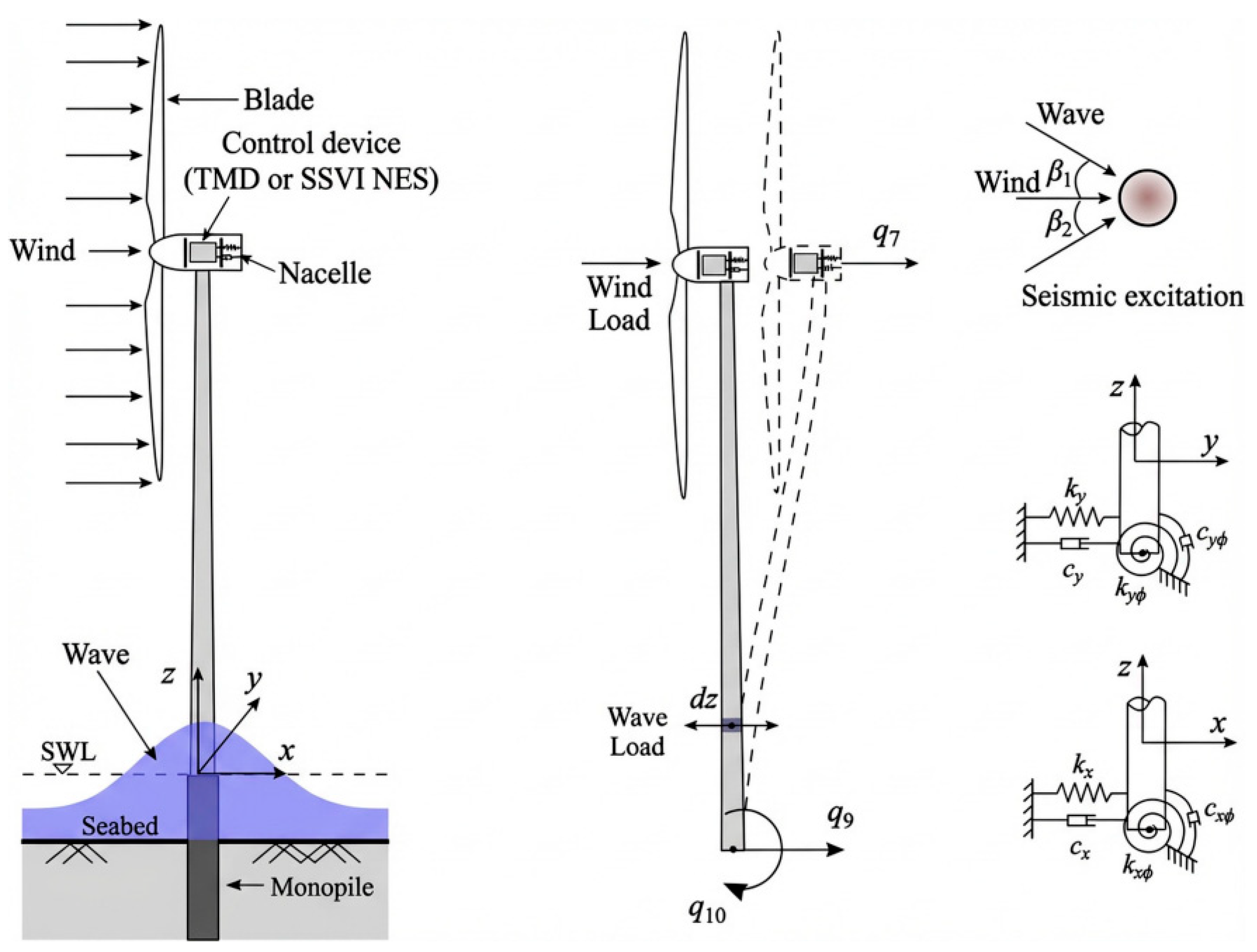
As shown in
Figure 1, the reduced-order model retains the dominant blade, tower, and foundation motions and includes a nacelle-mounted passive control device. This configuration allows the vibration-control performance of the TMD and the proposed SSVI NES to be evaluated within the same structural framework. The passive control device is assumed to be installed inside the nacelle and arranged to suppress the tower fore-aft vibration, which is one of the dominant response components under wind-wave and seismic excitation. The TMD provides a linear reference control system, whereas the SSVI NES introduces nonlinear restoring behavior and unilateral impact interaction.
To clearly define the retained degrees of freedom, the generalized coordinates adopted in the present 10-DOF model are summarized in
Table 1. This reduced-order representation is suitable for repeated time-domain simulations while preserving the dominant blade-tower-foundation dynamics relevant to the assessment of nacelle-mounted passive vibration-control devices.
The generalized displacement vector of the uncontrolled structural system is written as
where
and
denote the first flapwise and edgewise modal coordinates of the three blades, respectively;
and
are the tower fore-aft and side-side generalized coordinates;
and
denote the effective translational and rotational coordinates of the monopile foundation. This generalized-coordinate definition is consistent with the 10-DOF idealization listed in
Table 1.
To clarify the foundation representation, the monopile-soil interaction in the present reduced-order model is represented in a lumped manner through the effective translational and rotational foundation degrees of freedom listed in
Table 1. The purpose of this treatment is to preserve the dominant low-frequency blade-tower-foundation dynamics required for comparative vibration-control assessment, rather than to provide a site-specific geotechnical model. Therefore, no layered soil profile, p–y curve formulation, embedment-dependent stiffness derivation, or separate foundation damping values are resolved in the nominal model. In the nominal simulations, the support structure is treated as a fixed-bottom monopile system with equivalent foundation effects included in the global stiffness and damping matrices. The water depth is taken as 20 m, and the monopile diameter used in the hydrodynamic calculation is 6 m. Scour, foundation degradation, and soil-structure-interaction uncertainty are not simulated by explicitly changing the seabed geometry or soil springs; instead, their possible influence on the global structural frequency is considered parametrically through the frequency-detuning analysis in
Section 4.4.
Using the Euler-Lagrange method, the governing equations of motion of the uncontrolled coupled system can be expressed as
where
,
, and
are the mass, damping, and stiffness matrices, respectively, and
,
, and
are the generalized load vectors corresponding to wind, wave, and seismic excitation. The mass matrix includes the contributions of the blades, rotor-nacelle assembly, tower, and monopile foundation, while the stiffness and damping matrices account for blade flexibility, tower bending stiffness, structural damping, and equivalent foundation effects. This form is consistent with dynamic models commonly used for response analysis of monopile-supported offshore wind turbines under environmental and seismic loading [
6,
7,
8,
15,
16].
When a passive control device is installed inside the nacelle, the structural system is augmented by one additional degree of freedom associated with the absorber motion. The controlled system can then be written as
where
is the augmented generalized displacement vector and
is the interaction force induced by the attached controller. In the present study, the controller acts primarily in the tower fore-aft direction, which is the most critical direction for nacelle response in many passive control studies of offshore wind turbines. For the TMD,
is generated by a linear spring-damper mechanism, whereas for the SSVI NES it arises from nonlinear restoring action together with unilateral impact interaction.
Several simplifying assumptions are adopted in the present model. First, only the dominant low-order structural motions are retained, because these modes govern the nacelle and tower responses that are most relevant to passive control. Second, the rotor-nacelle assembly is treated as a concentrated mass at the tower top. Third, blade and tower deformations are assumed to remain within the small-amplitude range required for modal superposition. Fourth, the monopile-soil interaction is represented by equivalent spring-damper elements rather than a full three-dimensional soil continuum model. Under these assumptions, the reduced-order formulation provides an efficient basis for comparing passive vibration-control strategies for monopile offshore wind turbines subjected to wind-wave-seismic loading. Therefore, the present model should be interpreted as a control-oriented comparative model rather than a high-fidelity aero-hydro-servo-soil interaction model.
2.2. Environmental Loading Modeling
The monopile offshore wind turbine is subjected to aerodynamic, hydrodynamic, and seismic excitation. To represent realistic operating and extreme conditions, wind and wave loading are introduced using established engineering models, while earthquake excitation is represented using recorded ground-motion data. The corresponding loading models are described in the following subsections.
2.2.1. Wind Loading
The turbulent wind field is generated in accordance with IEC design requirements for offshore wind turbines using the Kaimal turbulence model and the TurbSim stochastic inflow simulator [
9,
13,
17]. The stochastic fluctuation of wind speed is represented by the Kaimal spectrum, which is widely used in wind turbine simulations and is directly implemented in TurbSim for the generation of three-dimensional turbulent inflow fields. The wind speed at elevation
and time
is expressed as
where
is the mean wind speed profile and
is the fluctuating turbulence component.
The Kaimal spectrum for the longitudinal turbulence component is given by
where
is the frequency,
is the standard deviation of the longitudinal wind-speed fluctuation,
is the longitudinal turbulence scale, and
is the mean wind speed at hub height [
18]. The mean wind speed follows a power-law profile with a shear exponent of 0.14. In the present simulations, the hub-height mean wind speed is set to
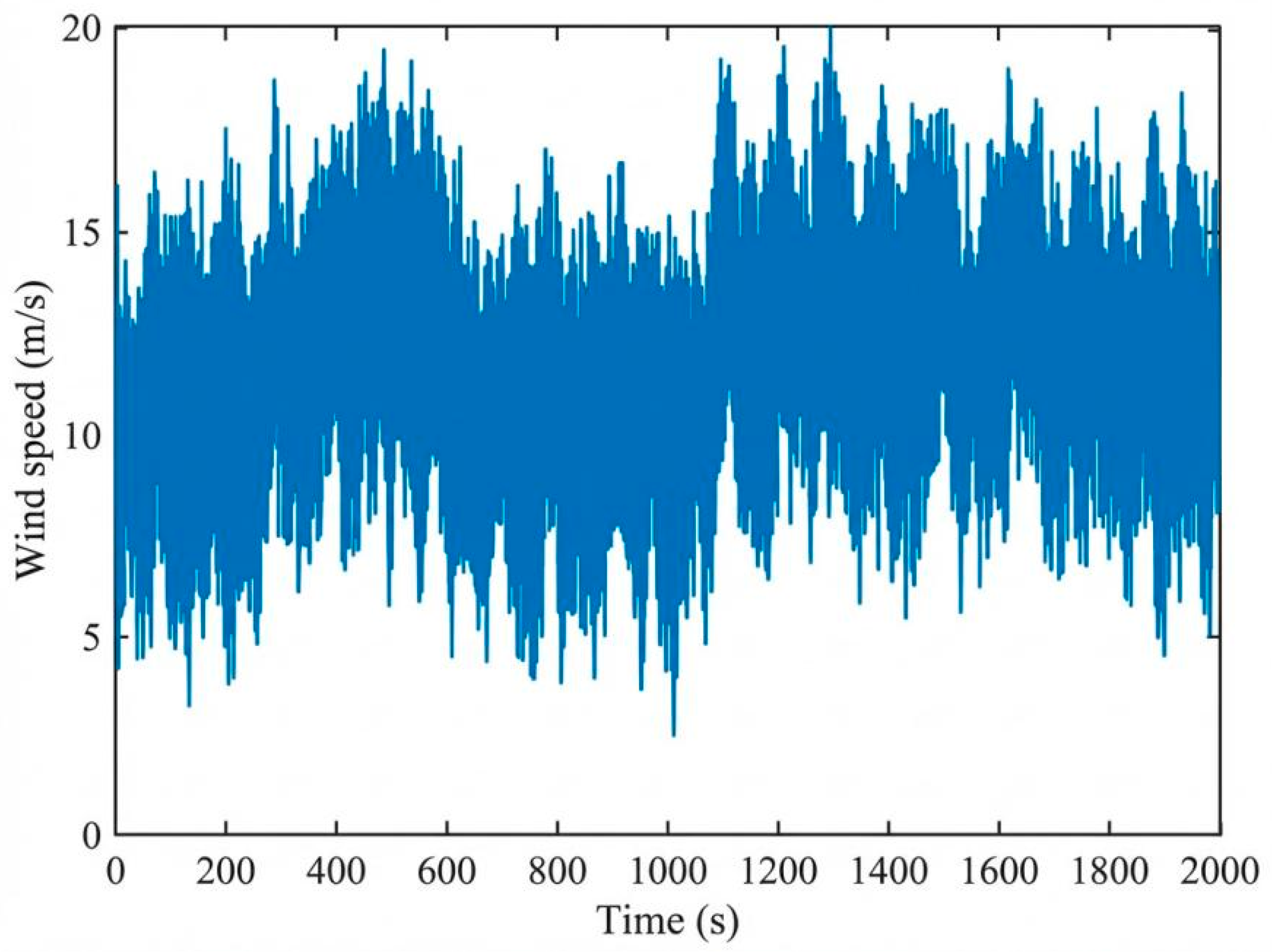
, the hub height is 90 m, and the turbulence intensity is 18%, corresponding to a high-turbulence condition in the IEC normal-turbulence model. The rotor-swept region is discretized using a 31 × 31 TurbSim grid covering the rotor disk. Since the rotor diameter of the NREL 5 MW reference turbine is 126 m, the lateral and vertical grid extents approximately cover the full rotor-swept area. The simulation duration is 2000 s, and the rotor speed is fixed at 12.1 rpm. A representative turbulent wind-speed time history is shown in
Figure 2.
The same turbulent-wind realization and the same time discretization are used for the uncontrolled, TMD-controlled, and SSVI NES-controlled simulations. This treatment ensures that the comparison among different control cases is conducted under identical aerodynamic excitation and numerical discretization. The simulations are performed under a constant operating condition. Active pitch, yaw, and cut-out control are not included because the purpose of the present reduced-order model is to compare the passive vibration-control performance of different absorbers rather than to reproduce full aero-servo-elastic turbine operation. The tower aerodynamic load is neglected, and the dominant aerodynamic excitation is assumed to be transmitted from the rotor blades to the tower-nacelle system.
Using the generated three-dimensional turbulent wind field, the aerodynamic loads acting on the rotating blades are evaluated using blade element momentum theory. The aerodynamic model follows the standard BEM-based framework implemented in AeroDyn-type wind turbine analysis, in which blade element aerodynamics are coupled with momentum theory for efficient prediction of rotor loads [
19,
20]. To improve the aerodynamic prediction under practical operating conditions, the model incorporates the Prandtl tip-loss correction and the high-induction correction commonly associated with the Glauert/Buhl formulation [
19,
21].
The distributed aerodynamic forces obtained from the BEM calculation are projected onto the retained generalized coordinates through the principle of virtual work. For each blade element, the local aerodynamic force components are weighted by the corresponding retained blade mode shapes and integrated along the blade span. The resulting modal force components are assembled into the generalized wind-force vector and then introduced into the reduced-order equation of motion. In this way, the aerodynamic loads acting on the rotating blades are consistently transferred to the retained blade, tower, and nacelle degrees of freedom.
In the reduced-order model adopted here, only the dominant aerodynamic excitation transmitted from the rotor to the tower-nacelle system is retained. Higher-order aeroelastic effects that are not directly related to the global vibration-control problem are not explicitly considered. This treatment is consistent with the control-oriented purpose of the present model.
2.2.2. Wave Loading
The wave-induced hydrodynamic force acting on the monopile foundation is calculated using the Morison equation, which is commonly adopted for slender offshore members whose diameters are small relative to the incident wavelength [
12]. In the present reduced-order model, the hydrodynamic load is evaluated using water-particle kinematics obtained from linear wave theory. The structural motion of the monopile is not explicitly included in the hydrodynamic relative-velocity or relative-acceleration terms. This treatment is adopted because the present model is intended for comparative passive-control assessment rather than for high-fidelity hydroelastic simulation. Therefore, Equation (6) should be interpreted as the Morison force evaluated with respect to a fixed monopile reference in the nominal wave-loading calculation.
For an infinitesimal monopile segment with length
, the differential horizontal wave force is written as
where
is the differential horizontal wave force acting on the monopile segment
,
is the seawater density,
is the monopile diameter,
and
are the drag and inertia coefficients, respectively, and
is the horizontal water-particle velocity, and
is the horizontal water-particle acceleration. In this notation, the terms inside the square brackets have units of force per unit length, and multiplication by
gives the differential force. The distributed hydrodynamic force is subsequently integrated along the submerged monopile length and projected onto the retained structural modes to form the generalized wave-force vector. In the present simulations, the seawater density is taken as
, the water depth is
, and the monopile diameter is
. The drag and inertia coefficients are treated as constant Morison-type hydrodynamic coefficients in the reduced-order model. Marine growth is not explicitly considered; therefore, no additional marine-growth thickness or diameter correction is applied.
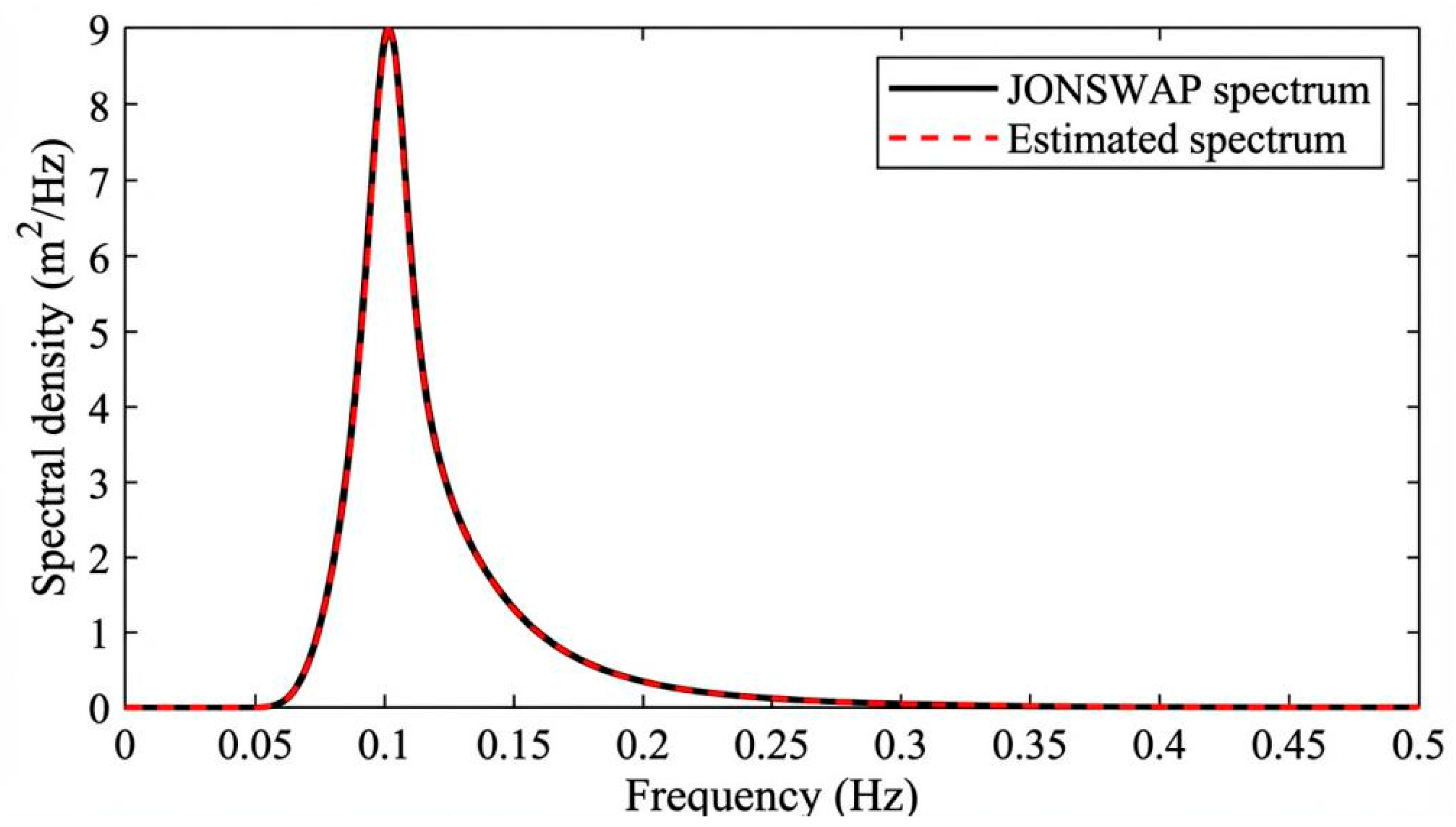
The irregular sea state is described using the JONSWAP spectrum, which is widely used for fetch-limited wind-generated waves in offshore engineering applications [
12]. The corresponding spectral density function is expressed as
where
is the peak frequency,
is the peak enhancement factor,
is the Phillips constant,
is the gravitational acceleration, and
is the spectral width parameter [
13]. The spectral width parameter is taken as
. In this study, the significant wave height and peak period are set to
and
, respectively. The corresponding peak frequency is
. The peak enhancement factor
is determined according to the empirical JONSWAP formulation used to construct the adopted spectrum.
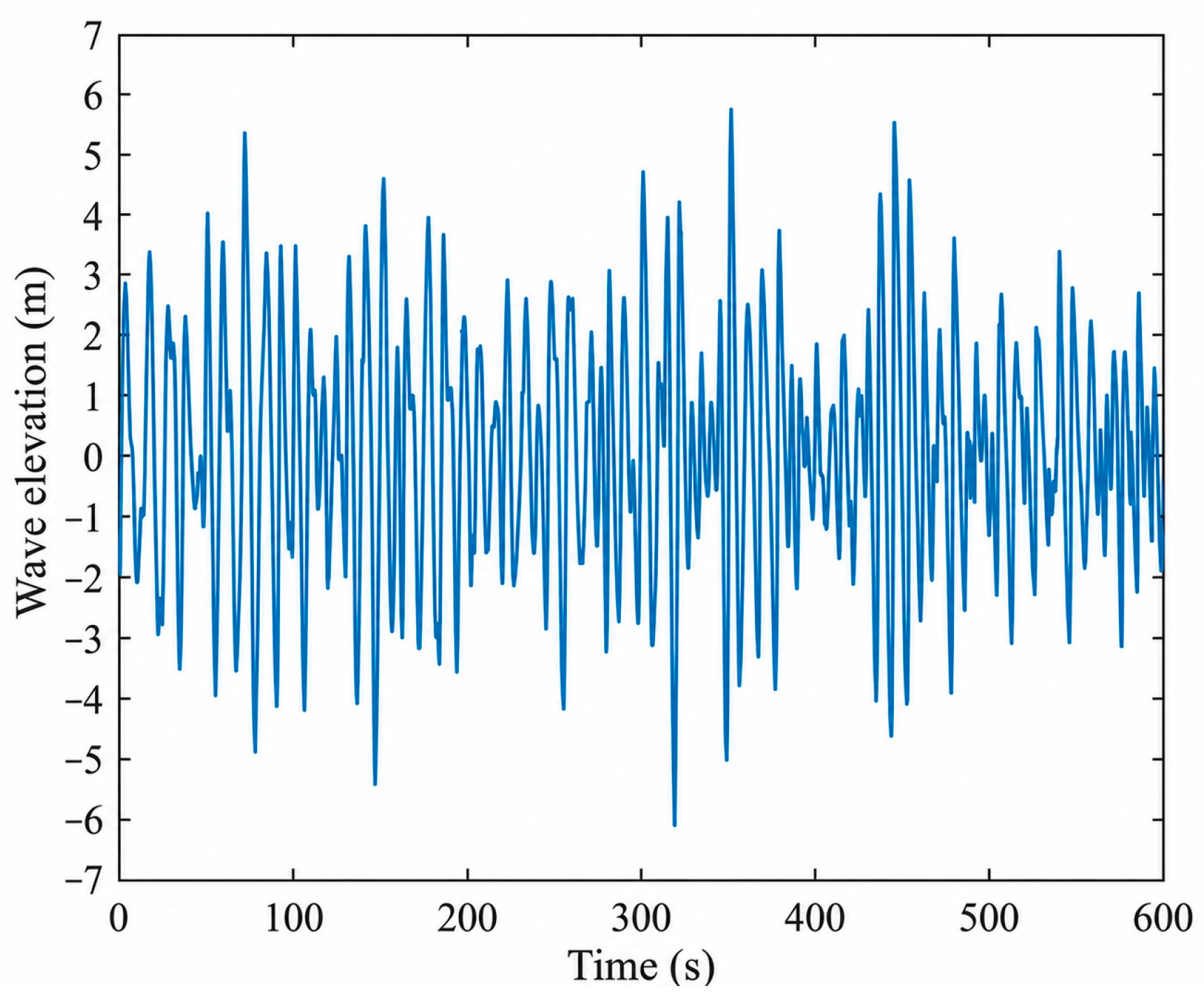
For the time-domain simulation, the irregular wave-elevation history is generated from the JONSWAP spectrum using the spectral representation method. Independent random phases uniformly distributed over
are assigned to the wave components. The wave-elevation time history used in the analysis is generated from the same spectral discretization procedure for all comparative simulations. In the archived simulation setup, the generated wave-elevation record contains 500 wave-height samples, which are used to represent the irregular sea state in the time domain. The adopted JONSWAP spectrum is shown in
Figure 3, and the representative irregular wave-elevation time history is shown in
Figure 4.
Using the generated irregular wave-elevation time history, the corresponding water-particle kinematics are determined based on linear wave theory and substituted into the Morison equation to calculate the distributed hydrodynamic load on the submerged portion of the monopile. The generalized wave-force vector is then obtained by projecting the distributed hydrodynamic load onto the retained structural modes. This treatment provides an efficient representation of wave loading for repeated time-domain simulations of the reduced-order offshore wind turbine model.
2.2.3. Seismic Loading
Although offshore wind turbines are commonly analyzed under wind and wave excitation, seismic action may become important for turbines located in coastal and seismically active regions [
7,
8,
15,
16,
22,
23,
24,
25]. In the present study, earthquake excitation is introduced as horizontal base acceleration applied at the monopile foundation. Under base excitation, the structural dynamic equation can be written as
where
is the ground-acceleration time history and
is the influence vector associated with the base motion.
To represent realistic seismic input, fifteen recorded ground motions are selected from the PEER NGA-West2 database [
14]. The selection is based on the magnitude and spectral-acceleration range relevant to the low-frequency dynamic characteristics of the NREL 5 MW monopile offshore wind turbine. Specifically, records are selected with moment magnitudes approximately in the range of
. The 5%-damped spectral acceleration at the dominant structural period is used as the main intensity measure for selection, with
ranging from 0.03 g to 0.35 g, where the dominant period of the turbine is taken as
. Peak ground acceleration and Arias intensity are additionally reported to characterize the amplitude and energy content of the selected records.
The PEER record sequence numbers (RSNs), earthquake events, station names, horizontal components, site conditions, intensity measures, and source-to-site distances are summarized in
Table 2. In the seismic-response analysis, the two horizontal components of each selected PEER NGA-West2 ground-motion record were considered separately as one-directional fore-aft base-acceleration inputs. Therefore, the seismic dataset used in this study contains 30 horizontal ground-motion components in total. The two components were not applied simultaneously; instead, each component was analyzed individually to preserve both record-to-record and component-to-component variability.
In the seismic-response analysis, the two horizontal components of each selected PEER NGA-West2 ground-motion record were considered. Therefore, the seismic dataset used in this study contains 30 horizontal ground-motion components in total. This treatment was adopted to preserve both record-to-record and component-to-component variability of the earthquake input. The maximum nacelle fore-aft displacement was extracted for each component and was then used for the statistical assessment of the seismic response.
No additional amplitude scaling to a common target spectrum is applied after record selection. Instead, the selected records are used with their PEER-provided amplitudes, and their corresponding
, PGA, and Arias intensity values are reported in
Table 2. The selected records are therefore intended to represent a range of seismic intensities rather than a spectrum-matched suite. The corrected acceleration time histories provided by the PEER NGA-West2 database are used directly in the reduced-order simulations. No additional baseline correction or filtering is applied during the reduced-order model processing. The ground-acceleration records are converted to consistent SI units before being introduced into Equation (8).
By using multiple recorded ground motions rather than a single representative accelerogram, the variability of structural response under seismic excitation can be evaluated more consistently. This treatment is particularly important for monopile offshore wind turbines, whose flexible low-frequency dynamics may lead to record-dependent response amplification under earthquake loading [
8,
14,
15,
16,
22,
23,
24,
25,
26].
For clarity, the loading scenarios considered in the present study are summarized in
Table 3. These load cases are designed to evaluate baseline serviceability response, seismic sensitivity, multi-hazard response, and robustness under structural-frequency detuning.
The four load cases listed in
Table 3 are used to organize the subsequent numerical analyses. LC1 and LC2 are used to establish the baseline environmental response of the uncontrolled offshore wind turbine under wind-only and combined wind-wave loading. LC3 represents the combined wind-wave-seismic condition and is used to examine the multi-hazard response characteristics and the influence of seismic intensity on the nacelle response. LC4 is used for the controlled-response and robustness assessment, where the optimized TMD and the proposed SSVI NES are compared under the nominal design condition and under frequency-detuned conditions. Therefore, the load cases in
Table 3 are not treated as independent, isolated examples, but as a sequential analysis framework linking the baseline response, the multi-hazard response, and the passive-control performance evaluation.
Compared with a single-hazard framework, these loading scenarios provide a more comprehensive basis for evaluating passive vibration-control performance. In particular, LC3 is used to examine the structural response under combined environmental and seismic actions, while LC4 is used to assess whether the controller can retain its effectiveness when the structural frequency deviates from the nominal design value.
To improve the transparency of the numerical setup, the main parameters used in the reduced-order simulations are summarized here. The baseline structure follows the NREL 5-MW reference wind turbine. The rated power is 5 MW, the hub height is 90 m, the rotor diameter is 126 m, and the tower-top height is 87.6 m. The tower mass is 347,460 kg, while the nacelle and hub masses are 240,000 kg and 56,780 kg, respectively. Each blade has a mass of 17,740 kg and a length of 61.5 m. The first tower side-to-side and fore-aft natural frequencies are approximately 0.312 Hz and 0.324 Hz, respectively, and the tower structural damping ratio is taken as 1%.
For the nominal environmental condition, the turbulent wind field was generated using the Kaimal spectrum with a mean hub-height wind speed of 12 m/s and a rotor speed of 12.1 rpm. The irregular wave field was described using the JONSWAP spectrum, and the hydrodynamic force on the monopile was calculated using Morison’s equation. For the seismic input, 15 ground-motion records from the PEER NGA-West2 database were selected, and the two horizontal components of each record were considered, resulting in 30 horizontal ground-motion components in total. The final parameters and notation of the TMD and SSVI NES used in the comparative analysis are specified in
Section 4.1 and
Section 4.3, respectively.
2.3. Performance Metrics
To evaluate the effectiveness and robustness of the proposed SSVI NES, several response- and device-oriented performance metrics are adopted. The RMS nacelle fore-aft displacement is used as the primary indicator under stochastic wind-wave excitation, whereas peak response quantities are used to characterize extreme structural demand, particularly under transient seismic excitation. In addition, absorber stroke demand and accumulated dissipated energy are considered to assess installation feasibility and energy-dissipation behavior. For detuned conditions, a robustness index is introduced to quantify the retained control effectiveness. These metrics provide a consistent basis for comparing the SSVI NES with the benchmark TMD and for assessing passive vibration-control performance under nominal and off-design conditions [
4,
5,
6,
7,
8,
27,
28,
29,
30,
31,
32,
33].
For a generic structural response quantity
, the root-mean-square (RMS) value over a simulation duration
is defined as
The RMS metric reflects the sustained vibration level of the system and is therefore adopted as the primary response index in the present study. The corresponding peak response is defined as
which is used to characterize the maximum instantaneous structural demand, particularly under transient seismic excitation.
To quantify the control effectiveness relative to the uncontrolled structure, the response reduction ratio is defined as
where
and
denote the selected response metric of the uncontrolled and controlled systems, respectively. In the present study,
may represent either the RMS or peak value of nacelle fore-aft displacement or acceleration. A larger value of
indicates better vibration mitigation performance.
Because nacelle space is limited, the absorber stroke demand is also taken as an important engineering metric. It is defined as
where
is the relative displacement of the absorber mass with respect to the nacelle. For the TMD, this quantity corresponds to the required working stroke of the linear absorber. For the SSVI NES, it denotes the effective motion range of the impact oscillator. This metric is particularly important for nacelle-integrated passive control because excessive stroke demand may conflict with practical installation constraints.
As a supplementary indicator for interpreting the vibration-mitigation mechanism, the accumulated dissipated energy of the control device is also evaluated as
where
is the instantaneous dissipated power. For the TMD, the dissipated power is written as
where
is the TMD damping coefficient. For the SSVI NES, the dissipated energy includes both viscous dissipation and impact-induced energy loss. Therefore, this metric is used to interpret the nonlinear energy-transfer and impact-assisted dissipation mechanisms of the SSVI NES [
17,
18,
33,
34,
35].
For a given frequency-detuning ratio
, the RMS-based response reduction ratio is defined as
where
and
are the RMS nacelle fore-aft displacements of the uncontrolled and controlled systems, respectively, under the detuning ratio
.
To evaluate whether the control effectiveness is retained under off-design frequency conditions, the retained effectiveness index is defined as
where
denotes the RMS-based response reduction ratio under the nominal tuning condition, and
denotes the RMS-based response reduction ratio under the detuned condition. Therefore,
means that the controller retains the same reduction effectiveness as in the nominal condition;
indicates a loss of effectiveness; and
indicates that the controlled response is larger than the uncontrolled response.
For seismic loading cases involving multiple ground motions, the corresponding response metrics are summarized using the ensemble mean
where
is the number of ground-motion records and
is the corresponding response metric for the
-th record [
14].
In the following sections, the RMS nacelle fore-aft displacement is taken as the primary performance metric, while peak response, absorber stroke demand, dissipated energy, and robustness index are used as complementary indicators. Together, these metrics allow the proposed SSVI NES to be evaluated not only in terms of nominal response reduction, but also in terms of practical motion demand and robustness under uncertain structural-frequency conditions.
3. Dynamic Characteristics and Baseline Response of the Uncontrolled System
This section investigates the dynamic characteristics and baseline response of the uncontrolled monopile offshore wind turbine. Since monopile offshore wind turbines are flexible low-frequency systems whose responses are strongly affected by coupled blade-tower-foundation dynamics, it is necessary to first examine the modal characteristics of the reduced-order model [
3,
4,
7,
8,
16,
22,
23,
24,
25,
26]. The uncontrolled responses under representative wind-wave and seismic loading conditions are then analyzed to establish the reference response level for controller comparison. Finally, the relationship between seismic intensity measures and structural response is discussed using the selected PEER ground-motion records [
14].
3.1. Modal Characteristics of the Reduced-Order Model
The modal characteristics of the reduced-order model are first examined with reference to benchmark results reported for the NREL 5 MW offshore wind turbine [
3]. For passive vibration-control analysis, the most important modes are the low-order global tower and blade-tower-foundation modes because these modes dominate the nacelle fore-aft displacement, nacelle fore-aft acceleration, and controller-structure interaction [
4,
7,
8,
25,
26].
The benchmark natural frequencies reported for the NREL 5 MW offshore wind turbine using FAST, ADAMS, and a no-soil model are summarized in
Table 4 [
3,
36]. As shown in the table, the first two natural frequencies are concentrated around 0.32–0.34 Hz, indicating the low-frequency and flexible nature of the monopile-supported offshore wind turbine. These low-order modes are particularly important for nacelle-mounted passive control devices because the controller is mainly designed to suppress the dominant fore-aft vibration of the tower-nacelle system [
4,
7,
8].
To further verify the dynamic characteristics of the proposed reduced-order model, a modal-frequency comparison is performed for the uncontrolled baseline system. The natural frequencies of the present reduced-order baseline model were obtained from the undamped free-vibration eigenvalue problem:
where
and
are the mass and stiffness matrices of the reduced-order wind turbine model, respectively,
is the
circular natural frequency, and
is the corresponding mode shape. The natural frequency is calculated as
. The obtained frequencies of the present reduced-order baseline model are compared with the FAST and ADAMS benchmark results, as summarized in
Table 4.
The percentage errors listed in
Table 4 were calculated as the absolute difference between the natural frequency of the present reduced-order baseline model and the corresponding benchmark value, divided by the benchmark value. As shown in
Table 4, the first two natural frequencies predicted by the present reduced-order baseline model agree reasonably well with the FAST and ADAMS benchmark results, with errors of 2.66–6.21% compared with FAST and 4.07–4.78% compared with ADAMS. These two low-order modes are particularly important because they are closely related to the tower-dominated fore-aft and side-side motions that govern the nacelle fore-aft displacement response considered in this study.
For some higher-order modes, larger discrepancies can be observed. This is expected because the present reduced-order model retains only the dominant generalized coordinates required for control-oriented dynamic analysis and does not explicitly include higher-order blade yaw, torsional, or local deformation modes. Therefore, the model is not intended to reproduce all high-frequency aeroelastic modal characteristics with the same fidelity as FAST or ADAMS. Instead, it is used as a computationally efficient reduced-order framework for comparing passive control devices under consistent modeling assumptions.
Accordingly, the frequency comparison does not imply that the reduced-order model is a substitute for high-fidelity aero-hydro-servo-elastic simulation tools. Rather, it shows that the model can reasonably capture the dominant low-frequency structural dynamics relevant to the subsequent TMD and SSVI NES vibration-control analysis within the scope of the adopted modeling assumptions.
3.2. Baseline Dynamic Response Without Control
After examining the modal characteristics, the baseline dynamic response of the uncontrolled monopile offshore wind turbine is evaluated under the representative loading cases defined in
Table 3. This step establishes the reference response level before installing any passive control device. The nacelle fore-aft response is selected as the primary response quantity because it directly reflects the global vibration of the tower-nacelle system and is closely related to the working direction of the nacelle-mounted controller [
4,
7,
8].
Under combined wind-wave loading, the uncontrolled system exhibits sustained low-frequency vibration, which is mainly governed by the global bending response of the flexible tower-foundation system [
4,
5,
6,
7,
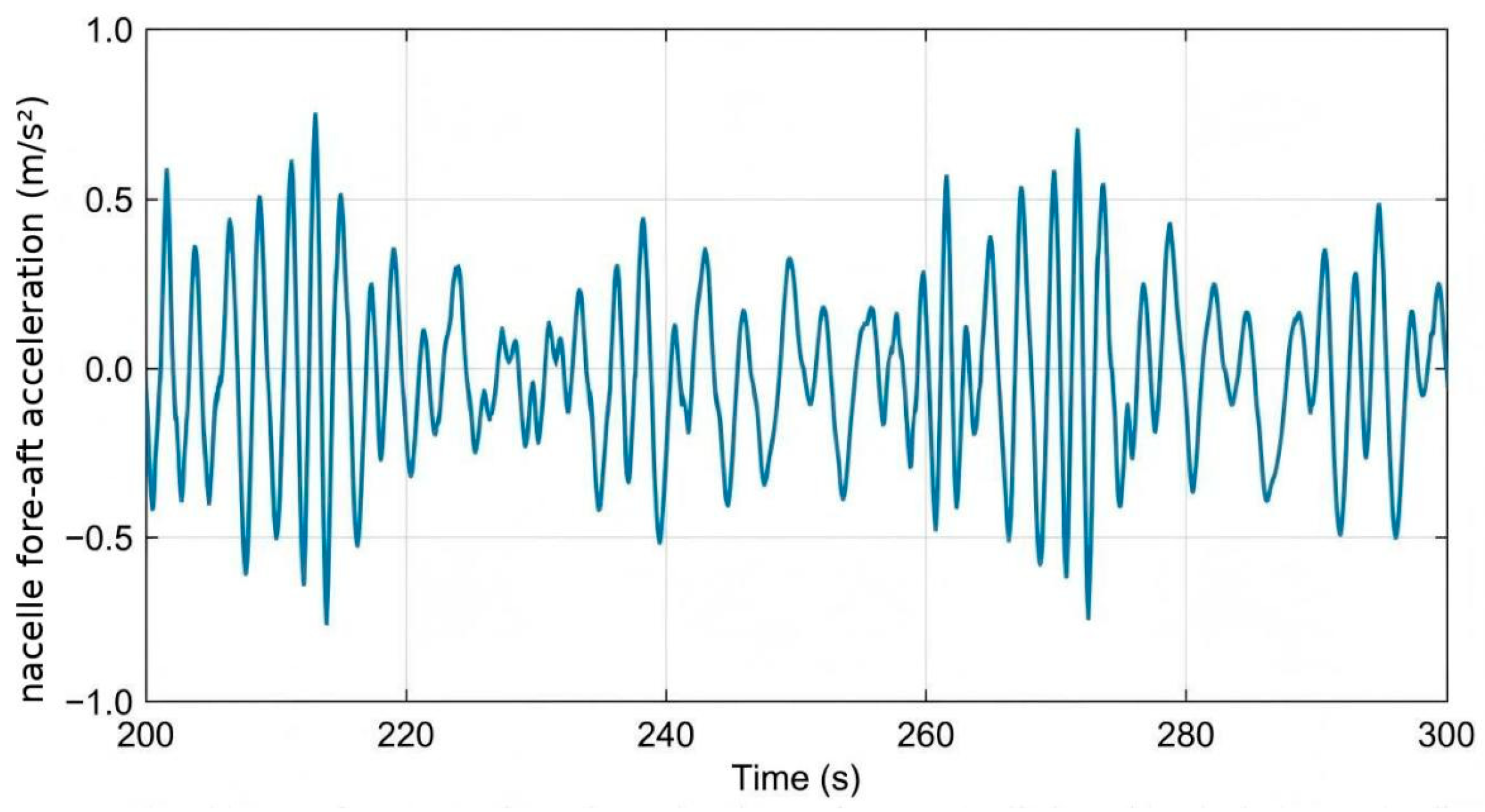
8]. Because both turbulent wind and irregular waves are stochastic excitations, the nacelle and tower-top responses fluctuate continuously with time. A representative uncontrolled response history is shown in
Figure 5.
The response shown in
Figure 5 indicates that wind-wave loading produces continuous dynamic excitation rather than a short-duration impulse. This type of sustained vibration may contribute to fatigue accumulation and serviceability concerns during long-term operation [
4,
5,
6,
7,
8]. Therefore, reducing the RMS response under wind-wave loading is important for evaluating the effectiveness of passive vibration-control devices.
When seismic excitation is introduced, the response characteristics become different from those under wind-wave loading. Earthquake excitation produces transient response amplification, and the response level varies significantly among different ground-motion records [
8,
14,
15,
16,
22,
23,
24,
25,
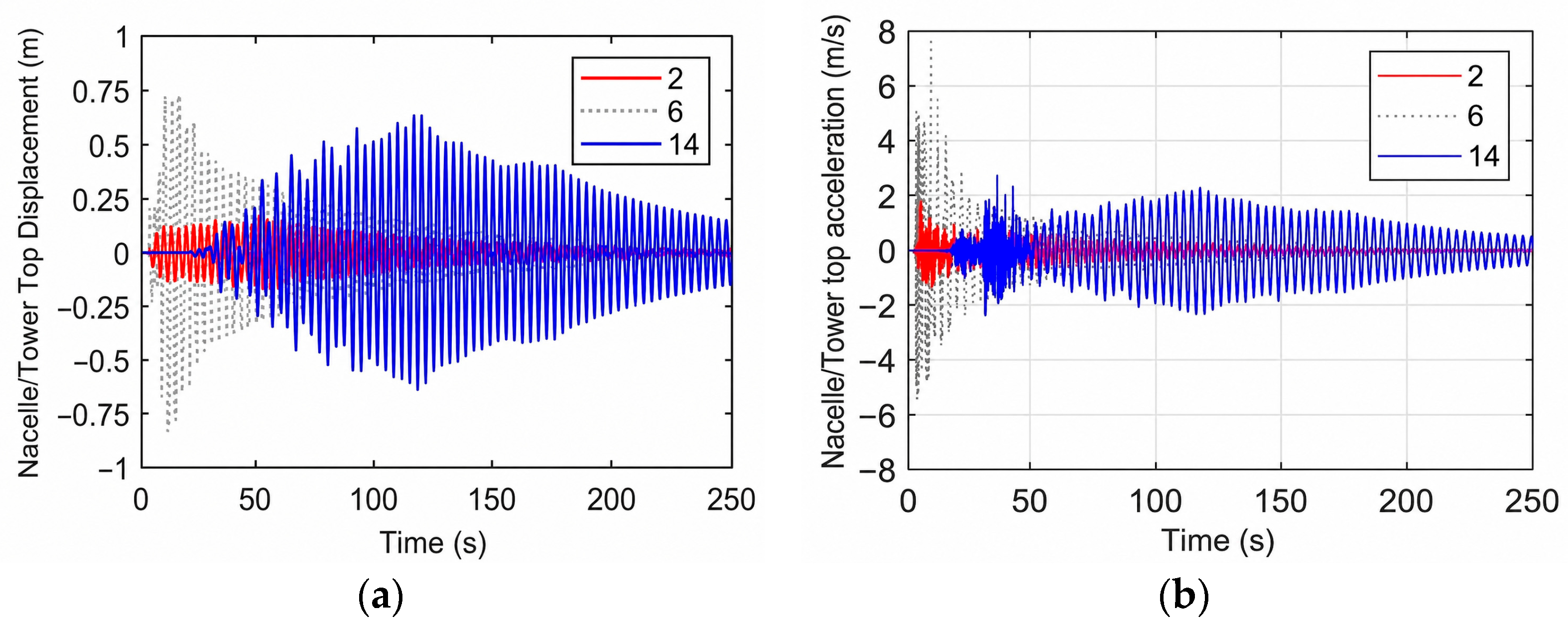
26]. Representative nacelle fore-aft displacement and acceleration responses under selected seismic records are shown in
Figure 6.
As shown in
Figure 6, some earthquake records generate much larger structural responses than others. This record-to-record variability indicates that the seismic response of the monopile offshore wind turbine is not governed only by peak ground acceleration but also by the frequency content and duration of the input motion [
8,
14,
15,
16,
22,
23,
24,
25,
26]. Because the turbine is a low-frequency flexible structure, seismic components close to the dominant structural frequency may lead to significant response amplification.
Overall, the baseline response analysis shows that wind-wave loading mainly causes sustained vibration, whereas seismic loading may induce strong transient amplification. These uncontrolled responses provide the reference basis for the subsequent comparison between the optimized TMD and the proposed SSVI NES.
3.3. Seismic Intensity-Response Relationship
To further clarify the seismic sensitivity of the uncontrolled system, the relationship between seismic intensity measures and structural response is examined using the selected PEER ground-motion records [
14]. The maximum nacelle fore-aft displacement is adopted as the representative response quantity. Spectral acceleration and peak ground acceleration are selected as the seismic intensity measures for comparison because they are commonly used to characterize earthquake excitation amplitude and frequency-dependent seismic demand.
The maximum response is defined as
where
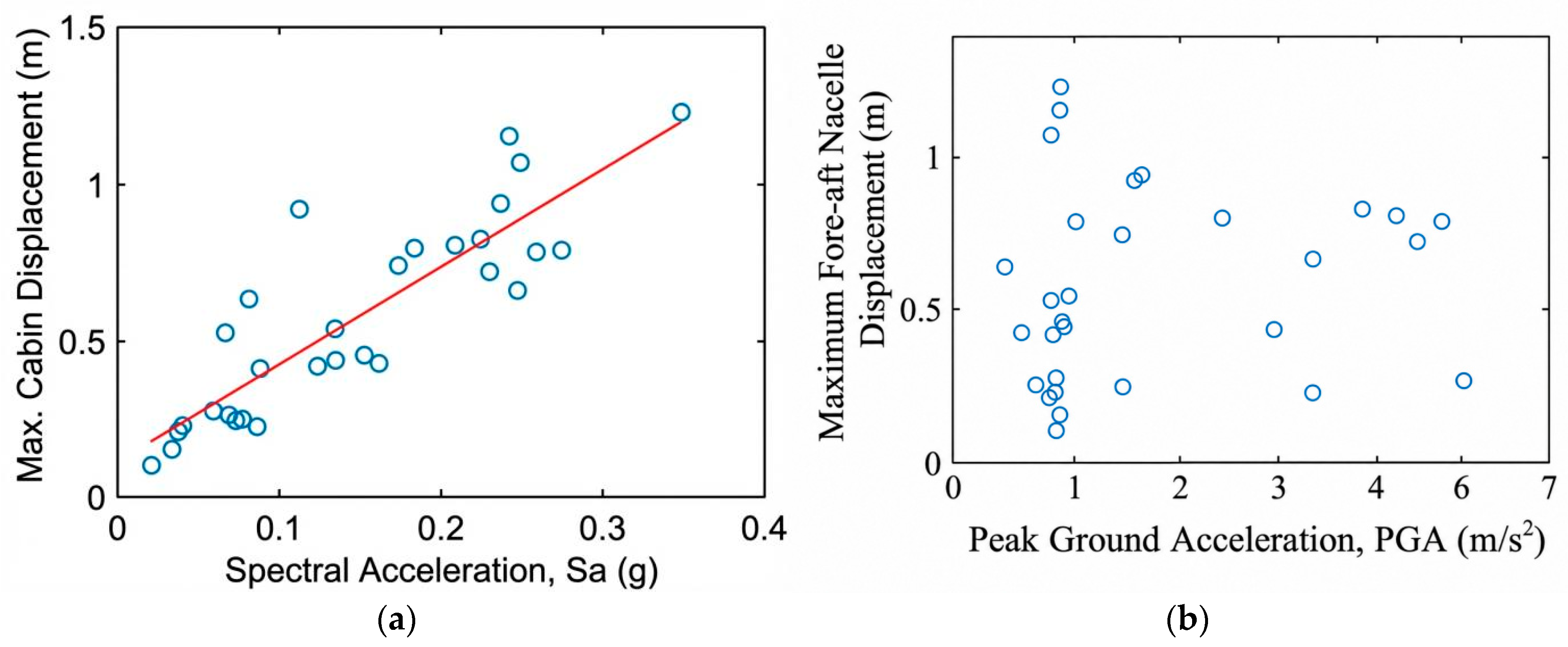
denotes the nacelle fore-aft displacement time history. For each selected ground-motion record, the maximum nacelle response is calculated and compared with the corresponding seismic intensity measures. The results are shown in
Figure 7.
As shown in
Figure 7a, the maximum nacelle fore-aft displacement exhibits a clearer increasing trend with spectral acceleration. In contrast, the relationship between maximum nacelle fore-aft displacement and PGA in
Figure 7b is more scattered. This indicates that spectral acceleration is a more suitable intensity measure for characterizing the seismic demand of the monopile offshore wind turbine, because it reflects the frequency-dependent characteristics of earthquake excitation more directly than PGA [
8,
14,
15,
16,
22,
23,
24,
25,
26].
The statistics are calculated using the 30 horizontal components of the 15 selected PEER NGA-West2 ground-motion records. denotes the 5%-damped spectral acceleration at the first natural period of the offshore wind turbine. COV denotes the coefficient of variation, defined as the ratio of the standard deviation to the mean.
To better characterize the record-to-record variability of the seismic input and structural response, the statistical properties of the selected ground-motion components and the corresponding maximum nacelle fore-aft displacement are summarized in
Table 5. The selected ground motions cover a relatively wide intensity range. The spectral acceleration
varies from 0.021 g to 0.341 g, with a mean value of 0.148 g and a coefficient of variation of 58.8%. The PGA varies from 0.778 m/s
2 to 6.893 m/s
2, with a coefficient of variation of 67.9%. These results indicate considerable variability in the seismic input.
The structural response also exhibits evident record-to-record variability. The maximum nacelle fore-aft displacement ranges from approximately 0.11 m to 1.24 m, with a mean value of approximately 0.61 m and a standard deviation of approximately 0.32 m. The median response is approximately 0.60 m, while the 25th and 75th percentiles are approximately 0.38 m and 0.81 m, respectively. The coefficient of variation reaches approximately 52.6%, confirming that the ensemble mean alone is insufficient to represent the seismic response of the offshore wind turbine. Therefore, both central-tendency and dispersion indicators are reported in this study when evaluating the seismic response under the selected ground motions.
This result is consistent with the dynamic characteristics discussed in
Section 3.1. Since the structural response is dominated by low-frequency global modes, an intensity measure that accounts for frequency-dependent excitation characteristics can better represent the seismic demand than PGA alone [
8,
15,
16,
22,
23,
24,
25,
26]. Therefore, the seismic response of monopile offshore wind turbines should be interpreted not only in terms of excitation amplitude but also in terms of the compatibility between ground-motion frequency content and the dominant structural modes.
The results in this section demonstrate that the uncontrolled monopile offshore wind turbine is sensitive to both sustained environmental loading and transient seismic excitation, which is consistent with previous studies on offshore wind turbine dynamic response under wind-wave and seismic loading [
4,
5,
6,
7,
8,
15,
16,
22,
23,
24,
25,
26]. The baseline response characteristics identified here provide the necessary reference for evaluating the nominal control performance and detuning robustness of the proposed SSVI NES in
Section 4.
4. Vibration-Control Performance and Robustness Assessment
In this section, the vibration-control performance of the proposed SSVI NES is evaluated through comparison with a conventional TMD. Following the baseline response analysis in
Section 3, the comparison is conducted under the load cases defined in
Table 3. The purpose of this section is not only to compare response-reduction efficiency but also to assess the practical suitability of the two passive control devices for nacelle-integrated implementation in monopile offshore wind turbines. Therefore, attention is given to three aspects that are important for structural safety and serviceability: nominal vibration mitigation, absorber motion demand, and robustness under structural-frequency detuning [
4,
5,
6,
7,
8,
25,
26,
33,
37].
4.1. Optimized TMD as a Benchmark Passive Controller
The tuned mass damper is adopted as the benchmark passive control device because it is one of the most widely used vibration absorbers for offshore wind turbine applications [
4,
5,
6,
7,
8,
25,
26,
33]. In the present study, the TMD is installed inside the nacelle and arranged in the tower fore-aft direction, which corresponds to the dominant response direction considered in the baseline analysis. To ensure a fair comparison, the TMD parameters are optimized before being compared with the proposed SSVI NES. This means that the SSVI NES is evaluated against a strong linear passive-control baseline rather than an arbitrarily selected TMD configuration [
4,
7,
8,
25,
26,
33].
For a prescribed mass ratio, the optimal TMD parameters are obtained by minimizing the RMS nacelle fore-aft displacement under the nominal design condition. The optimization problem is expressed in Equations (20) and (21).
where
In this subsection,
denotes the frequency ratio of the TMD to the first tower fore-aft mode,
is the TMD damping ratio, and
is the absorber mass ratio. For notational compactness, the same symbol
is also used later for the effective frequency ratio of the SSVI NES. In each subsection,
refers to the absorber currently being discussed; when the two devices are compared, their selected values are stated explicitly. Here,
and
denote the natural frequencies of the TMD and the dominant structural mode, respectively, while
,
, and
represent the TMD mass, damping coefficient, and effective modal mass of the controlled structure. For each candidate parameter pair (
,
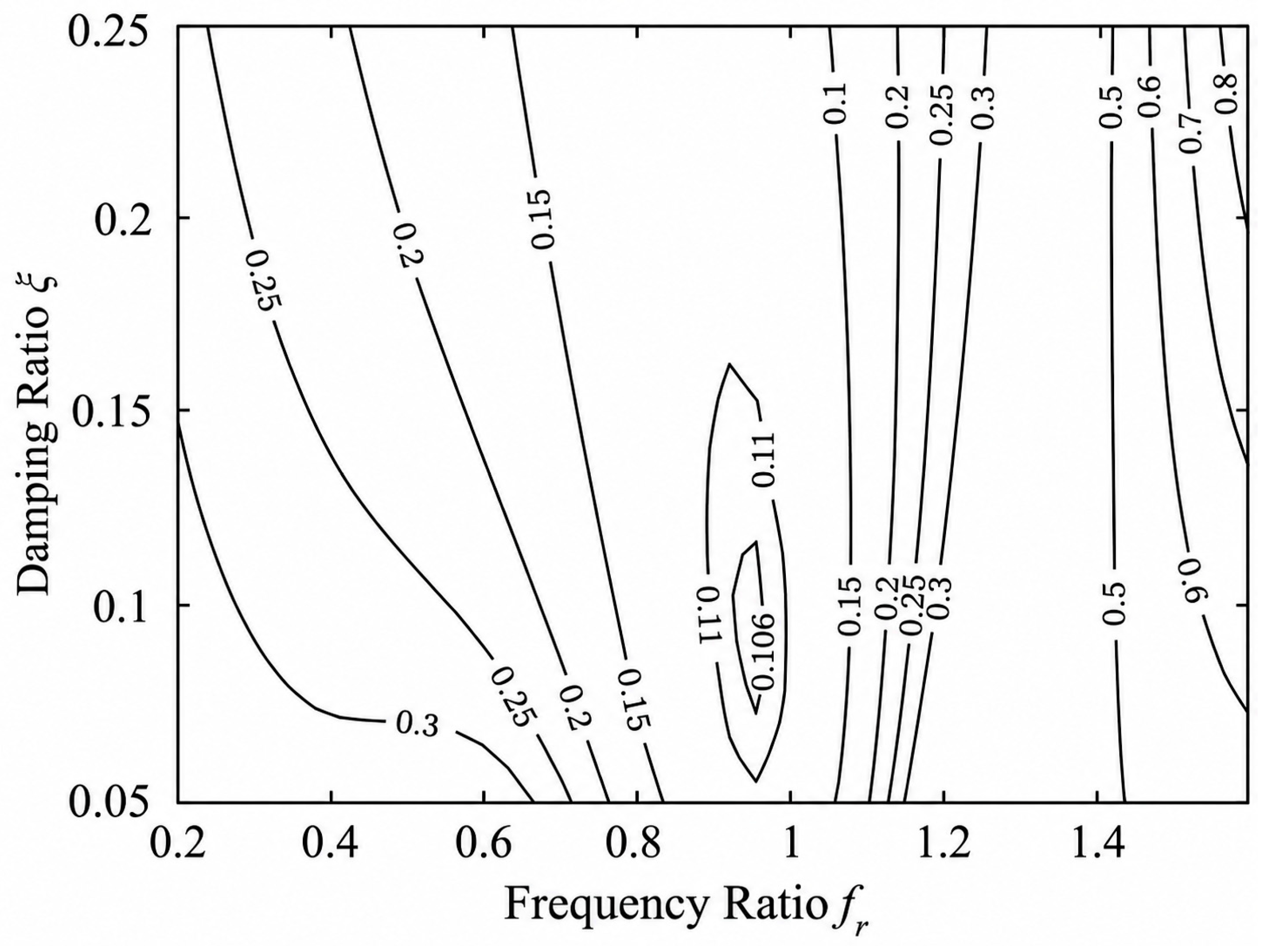
), time-domain simulations are carried out, and the corresponding RMS nacelle fore-aft displacement is evaluated. The corresponding optimization contour is shown in
Figure 8.
As shown in
Figure 8, the vibration-control performance of the TMD is highly dependent on the frequency ratio and damping ratio. A favorable control effect is obtained only within a relatively narrow region around the optimal tuning condition. This confirms the typical narrow-band characteristic of a linear tuned absorber, which has also been reported in previous TMD-based offshore wind turbine studies [
4,
7,
8,
25,
26,
33]. From an engineering perspective, this feature is important because the dynamic characteristics of offshore wind turbines may vary during long-term service due to foundation flexibility, soil-structure interaction, scour, operating-state changes, and modeling uncertainty [
16,
22,
37,
38].
The TMD optimization was formulated as a deterministic parameter search problem. For a prescribed mass ratio
, where
is the TMD mass and
is the effective modal mass associated with the first fore-aft tower mode, the frequency ratio
and the TMD damping ratio
were selected as the optimization variables. Here,
is the circular natural frequency of the TMD, and
is the first fore-aft circular natural frequency of the uncontrolled offshore wind turbine. For each candidate pair
, the TMD stiffness and damping coefficient were calculated as
The optimization objective was to minimize the root-mean-square (RMS) value of the nacelle fore-aft displacement under the selected nominal wind-wave excitation case:
Therefore, the optimal TMD parameters were obtained as
The detailed optimization settings are summarized in
Table 6. The TMD was optimized under the nominal wind-wave excitation case with a mean hub-height wind speed of
, turbulence intensity of
, significant wave height of
, and peak wave period of
. The same wind and wave realizations were used for all candidate TMD parameter sets so that the influence of
and
could be isolated.
An exhaustive deterministic grid search was adopted because the optimization problem involves only two design variables, and , for the prescribed TMD mass ratio. The frequency ratio was searched in the range of 0.2 with a grid interval of 0.01, while the damping ratio was searched in the range of 0.005 with a grid interval of 0.005. For each grid point, the coupled wind-turbine–TMD equations of motion were solved under the same nominal wind-wave excitation case, and the RMS value of the nacelle fore-aft displacement was calculated as the objective function. The grid point producing the minimum RMS displacement was selected as the optimal TMD parameter set. A local refinement around the minimum-response region was further used to confirm that the selected optimum was not affected by the grid resolution.
Under the selected nominal wind-wave excitation case, the optimized TMD parameters were obtained as , kg, , and . Based on the first tower fore-aft natural frequency, the corresponding TMD stiffness and damping coefficient were calculated as N/m and N·s/m, respectively. This parameter set was used as the optimized TMD benchmark in the subsequent comparison with the SSVI NES.
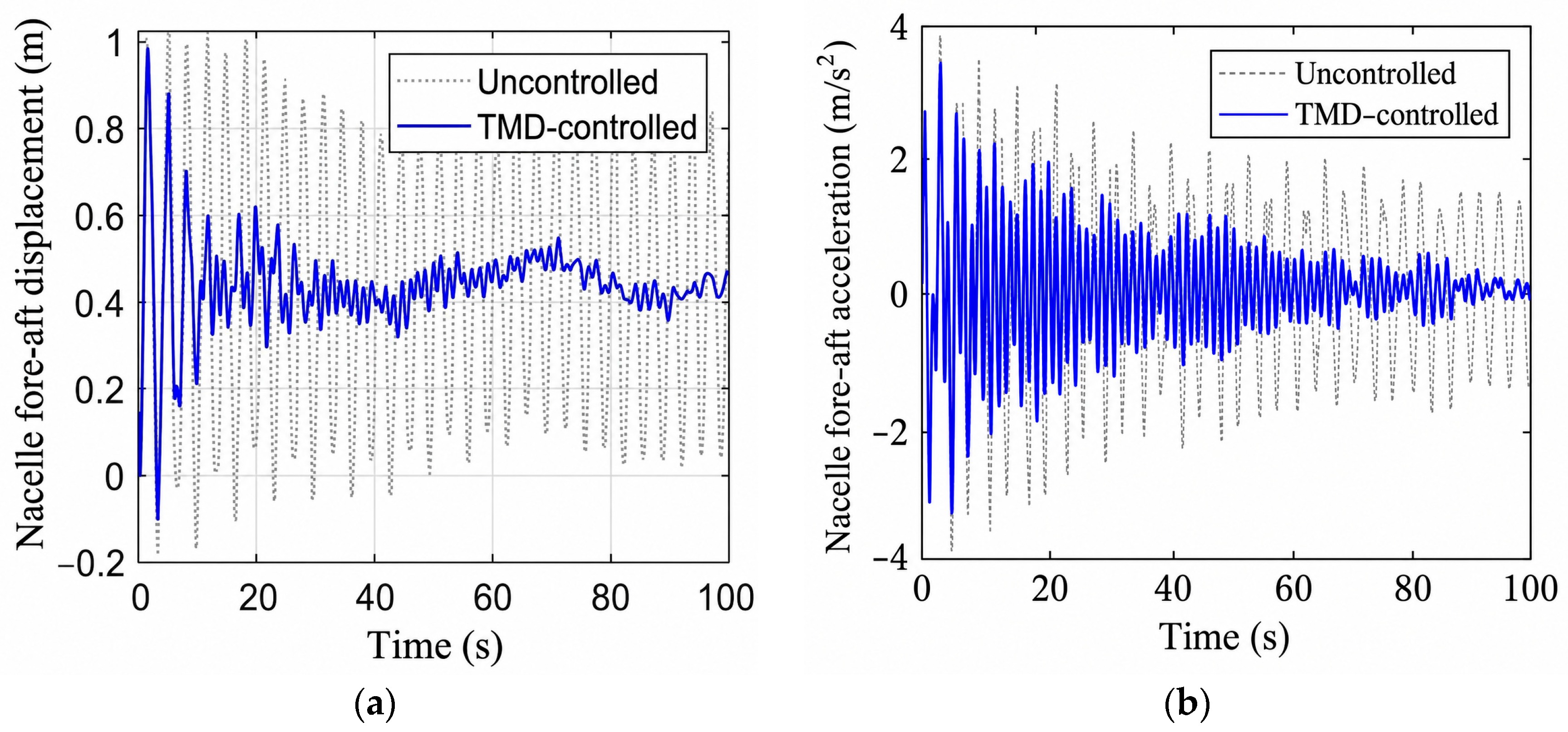
The time-history responses of the offshore wind turbine controlled by the optimized TMD are shown in
Figure 9.
Figure 9 shows that the optimized TMD effectively reduces both nacelle fore-aft displacement and acceleration under the design condition. Therefore, the optimized TMD provides a meaningful benchmark for assessing the proposed SSVI NES. However, because its performance depends on accurate tuning, the TMD may become less reliable when the actual structural frequency deviates from the nominal design value [
4,
7,
8,
25,
26,
33]. This limitation motivates the subsequent comparison with the SSVI NES from the perspectives of motion demand and detuning robustness.
4.2. Parameter Influence of the SSVI NES
Unlike the TMD, the SSVI NES does not rely on a single sharply tuned linear resonance condition. Its control performance is governed by nonlinear energy transfer, unilateral impact interaction, and impact-induced energy dissipation [
27,
28,
29,
30,
31,
32]. Therefore, the main design parameters of the SSVI NES are examined to identify a practical parameter range suitable for nacelle-mounted application.
The dimensionless parameters of the SSVI NES are defined in Equation (20), and the RMS nacelle fore-aft displacement used for evaluating control effectiveness is defined in Equation (26).
where
is the effective frequency ratio of the SSVI NES,
is the nominal circular frequency of the SSVI NES, and
is the first tower fore-aft circular frequency of the uncontrolled wind turbine.
is the contact stiffness ratio,
is the contact stiffness of the single-sided impact surface, and
is the reference stiffness used for normalization. In this study,
is taken as the stiffness of the optimized TMD with the same absorber mass, i.e.,
N/m.
is the gap ratio,
is the initial gap between the SSVI NES mass and the impact surface, and
is the reference absorber displacement used to normalize the gap. Specifically,
is taken as the maximum absorber stroke of the optimized TMD under the nominal wind-wave design condition.
where smaller values of
indicate better vibration mitigation performance.
The first key parameter examined is the gap ratio
. The gap determines when the absorber contacts the single-sided barrier and therefore controls the activation of the impact mechanism [
29,
30,
31,
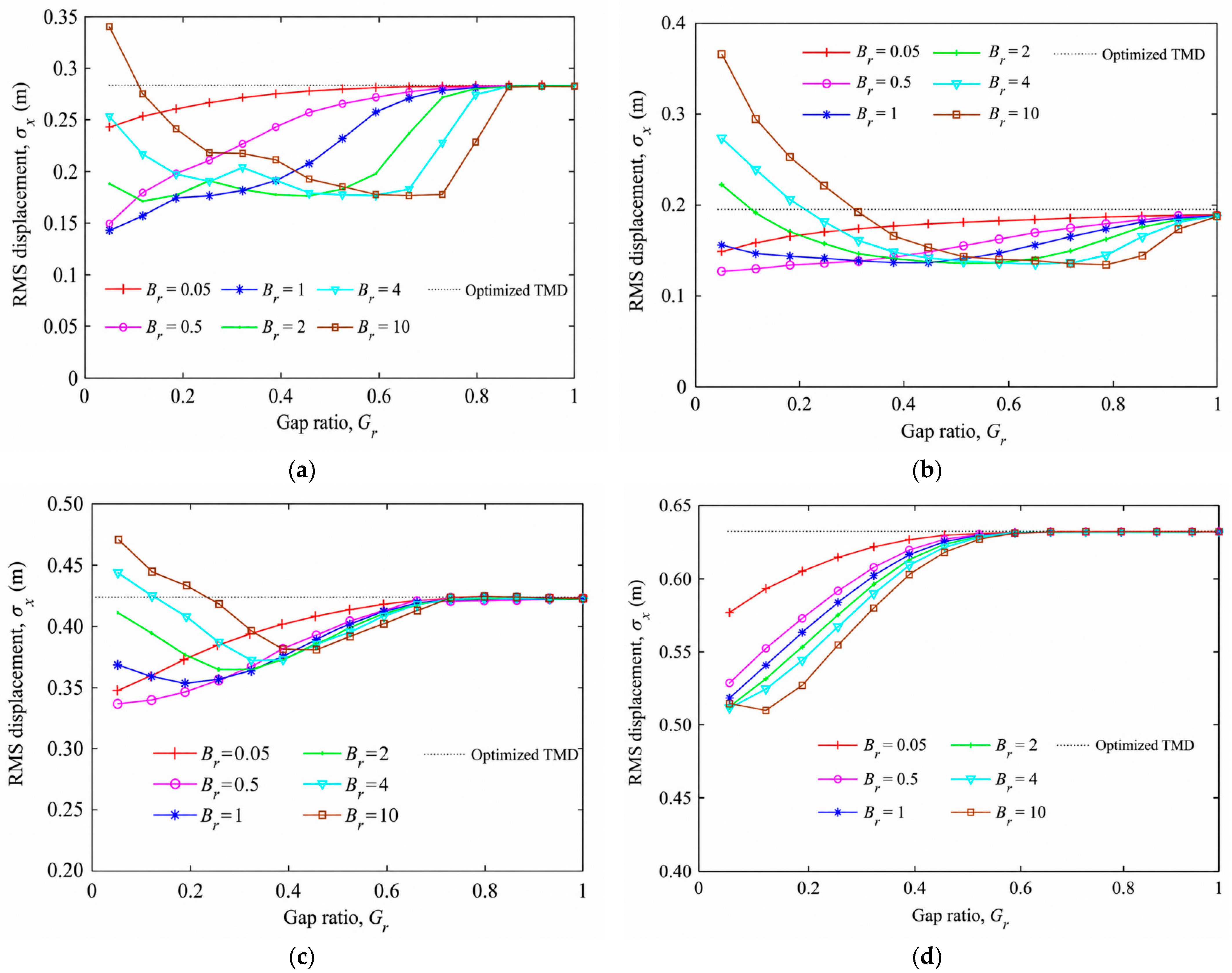
32]. If the gap is too small, impacts may occur too frequently and restrict the development of effective relative motion. If the gap is too large, the impact mechanism may not be sufficiently activated under moderate structural vibration. Therefore, an appropriate intermediate gap is necessary to balance vibration reduction and absorber motion demand. The influence of the gap ratio is shown in
Figure 10.
Figure 10a–d indicate that the control performance of the SSVI NES is sensitive to the gap ratio under different frequency ratios. Nevertheless, the effective region is not limited to a single isolated optimum; instead, a practical interval can be identified in which satisfactory vibration mitigation is maintained together with acceptable absorber motion. This result suggests that the impact gap acts not merely as a geometric parameter but also as a regulator of the onset and intensity of impact-assisted energy dissipation.
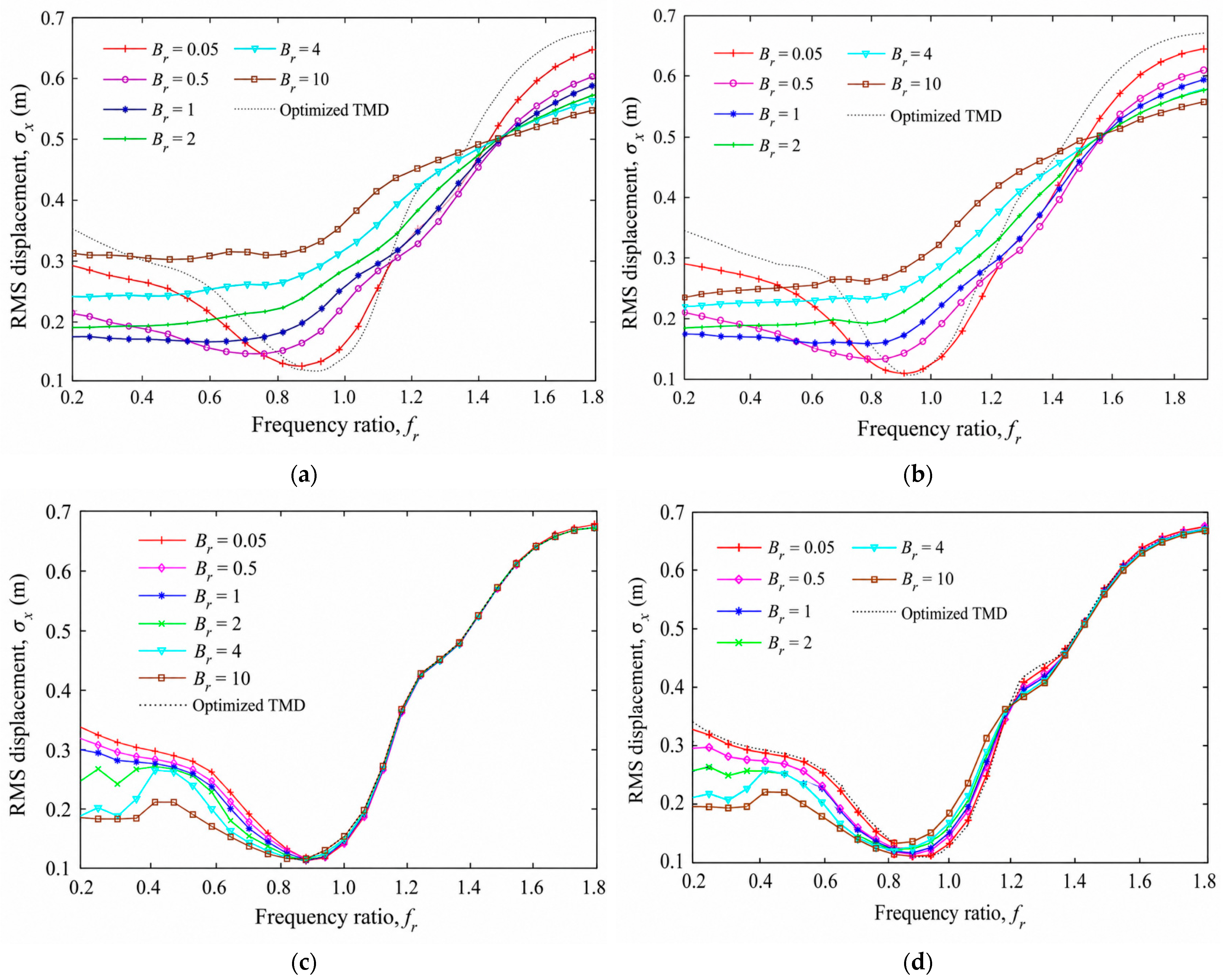
The second parameter Is the contact stiffness ratio , which governs the intensity of the impact event between the oscillator and the single-sided barrier. When the contact stiffness is too low, the impact-induced dissipation is insufficient, and the additional nonlinear mechanism cannot be fully activated. As the contact stiffness increases, the structural response is progressively reduced because the collision process becomes more effective in extracting and dissipating vibration energy. However, once the stiffness exceeds a certain level, the improvement becomes much less pronounced. This saturation trend indicates that excessively large contact stiffness is not necessary from an engineering implementation perspective.
Figure 11a–d indicate that increasing the contact stiffness ratio improves the vibration-mitigation performance of the SSVI NES at low stiffness levels, whereas the benefit gradually diminishes at higher stiffness levels. This suggests that, although a sufficiently stiff contact interface is required to ensure effective impact-assisted dissipation, excessively large stiffness provides limited additional benefit. Therefore, a moderate-to-high contact stiffness is generally preferable from an engineering viewpoint.
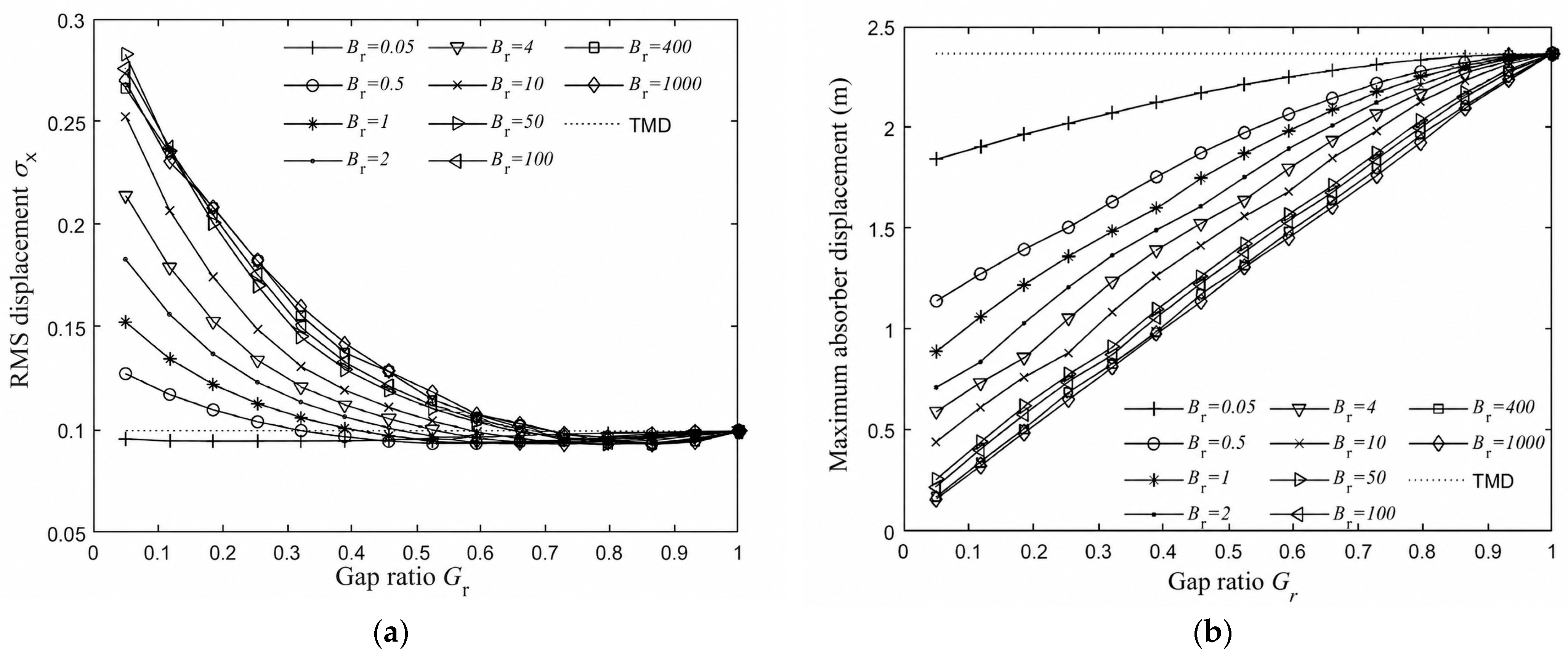
To further evaluate the engineering applicability of the SSVI NES, the combined influence of the gap ratio and contact stiffness ratio on both structural response and absorber motion is examined. In the following analysis, the tuning frequency ratio is fixed at , and the effects of different gap ratios and contact stiffness ratios on the RMS nacelle fore-aft displacement and the maximum absorber displacement are assessed simultaneously.
Figure 12a,b present the effects of the gap ratio and contact stiffness ratio on the vibration mitigation performance and motion demand of the SSVI NES at
. It can be seen from
Figure 12a that, when the contact stiffness ratio becomes sufficiently large, its influence on the RMS nacelle fore-aft displacement gradually diminishes. Moreover, for relatively large gap ratios, the control effectiveness of the SSVI NES becomes comparable to that of the TMD. Meanwhile,
Figure 12b indicates that a larger contact stiffness ratio provides a stronger limitation on the maximum absorber displacement. Therefore, the results confirm that, for nacelle installation under limited available space, a suitable combination of gap ratio and contact stiffness ratio is essential for fully exploiting the performance potential of the SSVI NES.
Based on the parametric results shown in
Figure 10,
Figure 11 and
Figure 12,
Table 7 summarizes the parameter ranges associated with satisfactory vibration mitigation and acceptable absorber motion.
The representative SSVI NES configuration used in the subsequent comparison is selected from these recommended ranges. In this sense,
Table 7 is not intended to prescribe a unique optimum but to provide a practical parameter window within which satisfactory response reduction, reasonable stroke demand, and favorable robustness can be simultaneously achieved. This range-based interpretation is more consistent with the nonlinear and impact-assisted nature of the SSVI NES.
4.3. Nominal Comparison Between the SSVI NES and the TMD
Having established the optimized TMD as the linear benchmark and identified a practical parameter window for the SSVI NES, this section compares the two devices under the nominal design condition. The representative SSVI NES configuration adopted in the following analysis is selected from the recommended parameter ranges summarized in
Table 7, rather than from a single mathematically isolated optimum. In this way, the comparison reflects the practical operating region of the nonlinear impact absorber and provides a fair basis for assessing its nominal performance relative to the optimized TMD [
4,
5,
6,
7,
8,
25,
26,
27,
28,
29,
30,
31,
32].
The comparison focuses on three aspects that are Important for nacelle-mounted passive vibration mitigation: reduction of the nacelle fore-aft response, absorber motion demand, and supplementary interpretation of the associated dynamic behavior. The purpose is not to claim overwhelming superiority of the SSVI NES at the nominal design point, but to determine whether it can achieve vibration mitigation comparable to that of the optimized TMD while remaining more compatible with nacelle installation constraints [
4,
7,
8,
17,
18,
29,
32,
33,
34,
35].
4.3.1. Governing Equations of the SSVI NES
The SSVI NES is mounted inside the nacelle and arranged to act in the tower fore-aft direction. Relative to the TMD-controlled system, the SSVI NES introduces an additional nonlinear interaction force associated with unilateral impact between the oscillator and the single-sided barrier. In the present study, this interaction is described using a nonlinear viscoelastic impact model.
Accordingly, the controlled equation of motion of the primary structure can be written as
where
is the impact force generated by the SSVI NES and
is the location vector through which the force is transmitted to the nacelle degree of freedom.
The corresponding equation of motion of the SSVI NES oscillator is
where
,
, and
are the mass, damping, and nominal restoring stiffness of the SSVI NES, respectively;
is the displacement of the SSVI NES mass; and
is the nacelle fore-aft displacement.
The impact force is activated only when contact occurs. Defining the contact deformation as
where
is the initial gap between the SSVI NES mass and the impact barrier, the impact force is expressed as
in which
is the contact stiffness and
is the impact damping coefficient. In the Jankowski model, the damping term is active during the approach stage of impact, while the restoring contact force remains during the restitution stage. Under this formulation, the SSVI NES combines nonlinear restoring interaction and impact-induced dissipation so that vibration reduction can be achieved through both nonlinear energy transfer and unilateral impact effects [
17,
18,
33,
34,
35].
The impact force in the SSVI NES is described using the nonlinear viscoelastic impact model proposed by Jankowski. In this model, the contact force is activated only when the NES mass reaches the single-sided stop. Let
denote the impact deformation and
denote the relative impact velocity. The nonlinear viscoelastic impact force is expressed as
where
is the impact force,
is the impact stiffness parameter determined by the material and geometric properties of the colliding bodies,
is the impact deformation, and
is the relative impact velocity. The first branch corresponds to the approach stage, in which both the nonlinear elastic contact force and the damping force are included. The second branch corresponds to the restitution stage, in which only the nonlinear elastic contact force is retained.
The impact damping coefficient is deformation-dependent and is calculated as
where
and
are the masses of the two colliding bodies, and
is the damping ratio related to the coefficient of restitution
. The relation between
and
is given by
The coefficient of restitution is defined as the ratio of the relative velocity after impact to that before impact:
where
and
are the relative velocities before and after impact, respectively. Therefore, the impact damping coefficient
is determined by the impact deformation, the masses of the colliding bodies, the impact stiffness parameter, and the restitution coefficient. This clarification explicitly links the impact damping, restitution coefficient, contact deformation, and impact velocity used in Equation (35).
In the SSVI NES equations,
,
and
denote the absorber mass, damping coefficient, and nominal restoring stiffness of the SSVI NES, respectively. These symbols are used only for the SSVI NES, whereas
,
, and
are used for the TMD in
Section 4.1. The additional SSVI NES parameters are the contact stiffness
, impact damping coefficient
, restitution coefficient
, and initial gap
. Therefore, the common absorber frequency-ratio notation
is used together with device-specific mass, damping, stiffness, and impact parameters.
For the subsequent nominal comparison, the representative SSVI NES parameters are selected from the practical parameter ranges identified in
Section 4.2. This treatment ensures that the comparison with the optimized TMD is based on a feasible and physically meaningful SSVI NES configuration rather than on an arbitrarily chosen parameter set.
4.3.2. Representative SSVI NES Configuration
For the nominal-condition comparison, the SSVI NES uses the same absorber mass and nominal damping ratio as the optimized TMD, namely kg and . The representative frequency ratio of the SSVI NES is selected as . The corresponding nominal restoring stiffness and damping coefficient are calculated as N/m and N·s/m, respectively. Therefore, and denote the stiffness and damping coefficient of the optimized TMD, whereas and denote the nominal restoring stiffness and damping coefficient of the SSVI NES.
The purpose of selecting a representative SSVI NES configuration Is not to prescribe a unique optimal design but to provide a feasible and physically meaningful basis for comparison with the optimized TMD under the same nominal loading condition. In particular, the choice of
follows the combined response-and-stroke assessment presented in
Section 4.2, where the engineering trade-off between nacelle response reduction and absorber motion demand is examined directly.
4.3.3. Response Comparison Under the Nominal Condition
Under the nominal loading condition, the vibration-control performance of the representative SSVI NES is compared directly with that of the optimized TMD. The comparison is carried out using the performance metrics defined in
Section 2.3, with particular emphasis on the nacelle fore-aft response and the corresponding absorber motion demand. The purpose of this comparison is to determine whether the SSVI NES can provide vibration mitigation comparable to that of the optimized linear benchmark while remaining more compatible with nacelle-mounted installation constraints.
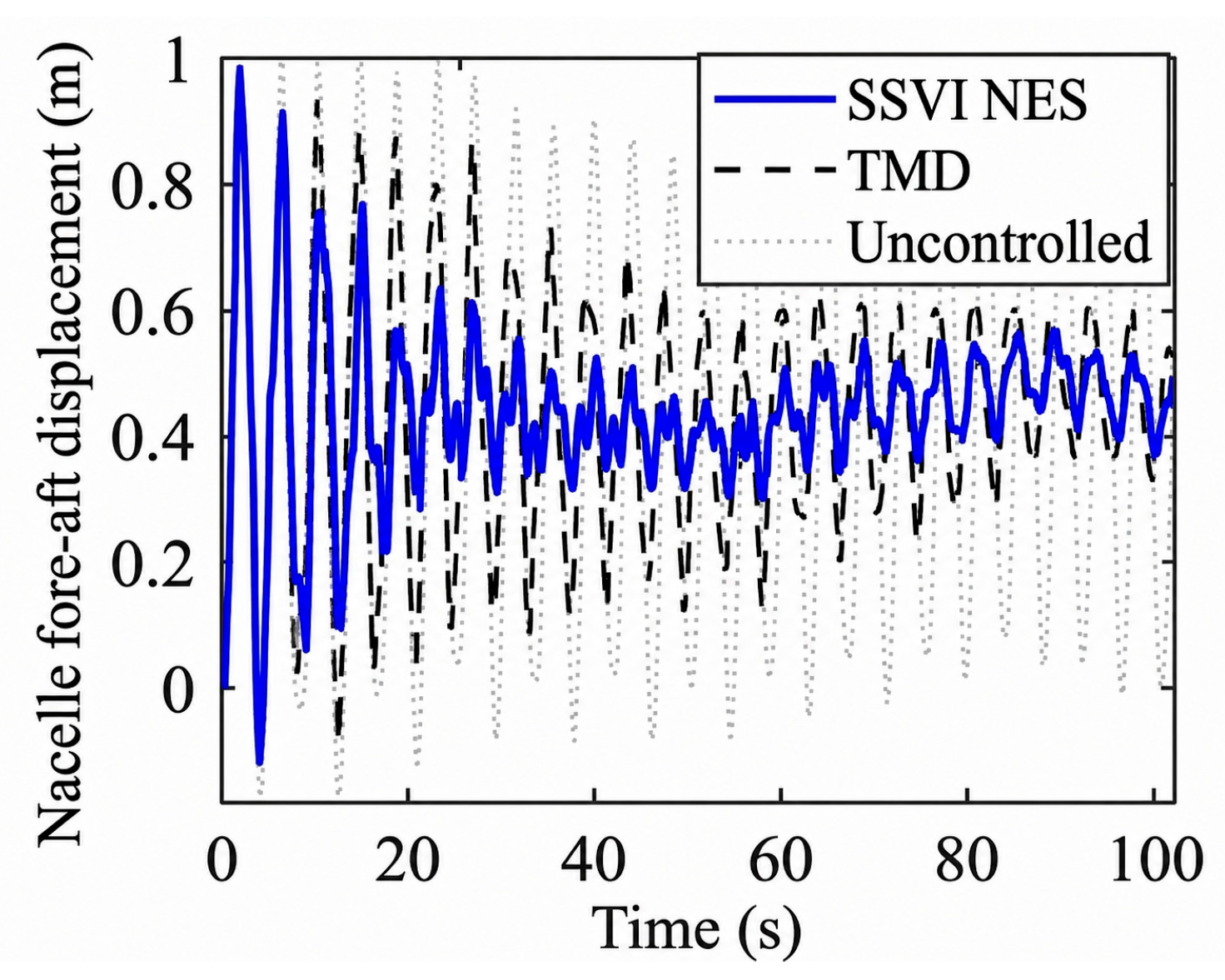
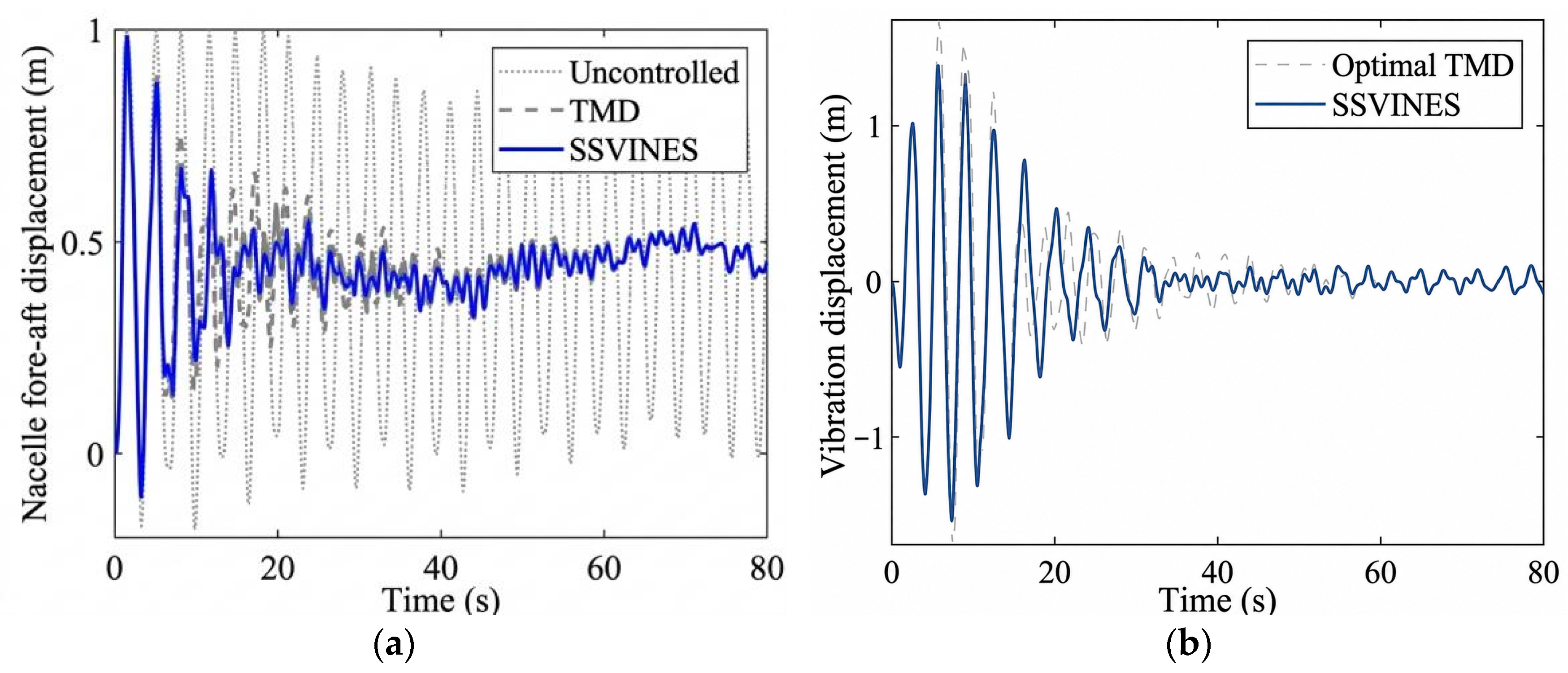
Figure 13 presents the representative time-history responses under the nominal design condition. Compared with the uncontrolled case, both the optimized TMD and the representative SSVI NES reduce the nacelle fore-aft response effectively. At the exact design point, the optimized TMD may still provide slightly stronger local suppression, which is consistent with its parameter optimization under the prescribed objective function. Nevertheless, the response envelopes of the two controlled cases remain close to each other, indicating that the SSVI NES can achieve vibration mitigation comparable to that of the optimized TMD without relying on a sharply tuned linear resonance condition.
Based on the load-case framework defined in
Table 3, the control performance of the optimized TMD and the proposed SSVI NES is evaluated using the same response metrics, including RMS nacelle fore-aft displacement, peak response, absorber stroke, cumulative dissipated energy, and retained effectiveness under frequency detuning. Under the nominal design condition, the optimized TMD reduces the RMS nacelle fore-aft displacement by approximately 55% relative to the uncontrolled case, whereas the representative SSVI NES achieves a reduction of approximately 50%. Thus, the SSVI NES retains about 91% of the RMS-based reduction effectiveness of the optimized TMD. In terms of absorber motion demand, the maximum absorber stroke of the SSVI NES is approximately 40% lower than that of the optimized TMD. These results show that the SSVI NES provides near-benchmark vibration mitigation while substantially reducing absorber displacement demand, which is advantageous for nacelle-integrated implementation.
The motion of the attached absorbers is also compared in
Figure 13b. The TMD response remains relatively regular and tuning-dominated, whereas the SSVI NES response exhibits a more irregular pattern associated with nonlinear interaction and unilateral impact. Under the same nominal condition, the maximum absorber displacement of the SSVI NES is significantly smaller than that of the TMD, while its control effectiveness remains comparable. This result is important for offshore wind turbine applications because it indicates that effective vibration mitigation can be achieved without requiring a large absorber stroke inside the nacelle.
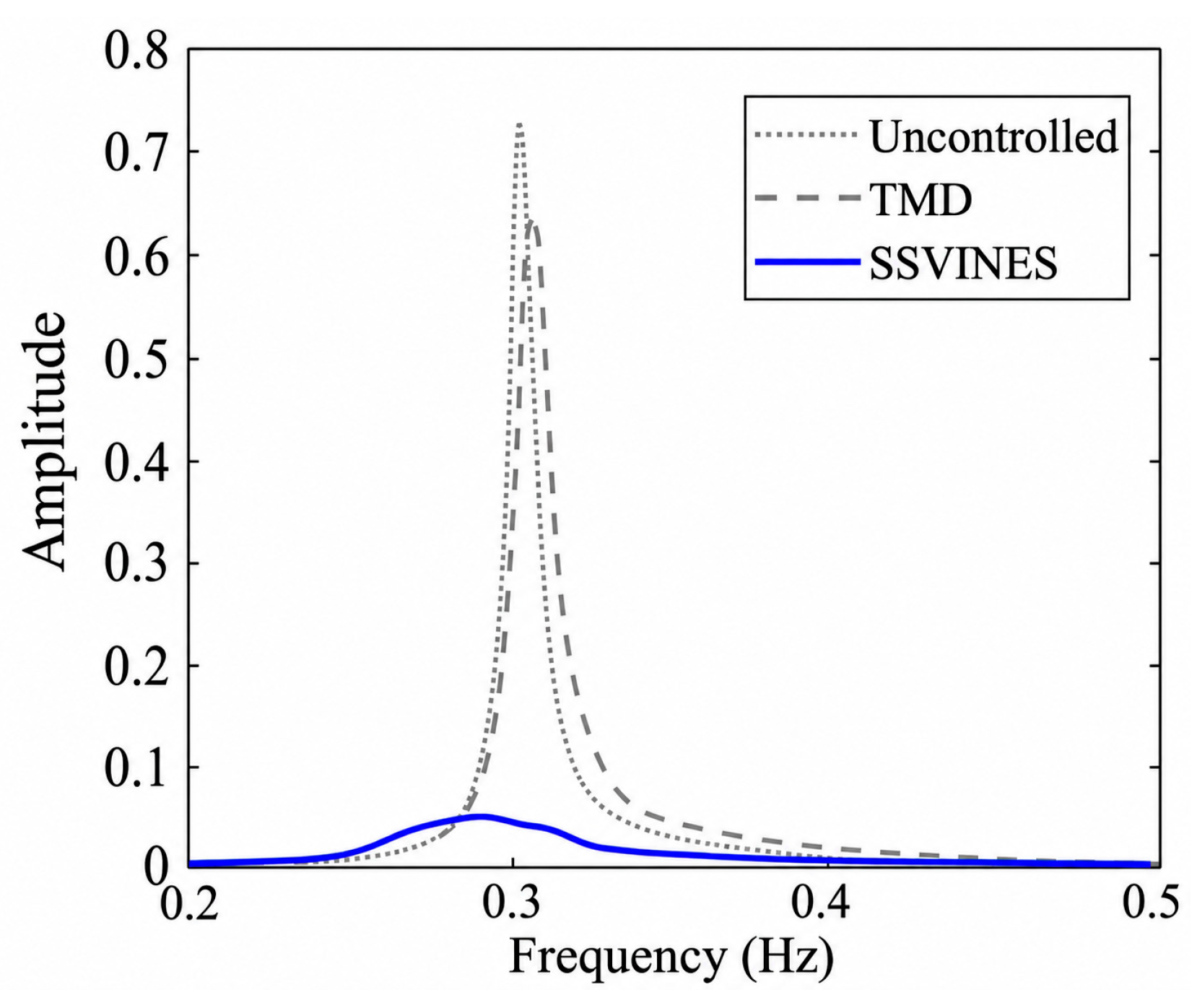
Figure 14 compares the nacelle response in the frequency domain. Both devices suppress the dominant low-frequency response component effectively, confirming that the principal structural vibration mode is mitigated under the nominal condition. The TMD achieves this mainly through precise resonance tuning and viscous dissipation, whereas the SSVI NES relies on nonlinear restoring behavior combined with intermittent impact [
17,
18,
33,
34,
35]. As a result, the SSVI NES does not exhibit overwhelming nominal superiority at the design point, but it does provide a similar level of response reduction through a more flexible nonlinear mitigation mechanism.
Taken together, the nominal-condition comparison shows that the optimized TMD remains a strong linear benchmark passive controller at the design point, while the representative SSVI NES can achieve near-benchmark vibration mitigation with a smaller absorber motion demand. Therefore, under the nominal loading condition, the principal significance of the SSVI NES lies not in overwhelming nominal superiority but in combining competitive control effectiveness with improved spatial compatibility for nacelle-integrated implementation.
4.4. Robustness Under Frequency Detuning
Although the optimized TMD provides strong vibration suppression at the nominal design point, its effectiveness depends strongly on accurate tuning to the dominant structural frequency. In practical offshore wind turbine applications, however, the structural frequency may vary during service because of soil-structure interaction uncertainty, scour development, foundation flexibility, material degradation, changing operating states, and modeling errors [
16,
22,
23,
24,
37,
38]. Therefore, robustness under frequency detuning is an important criterion for assessing the practical applicability of nacelle-mounted passive vibration-control devices. Here, frequency detuning is used as a simplified parametric representation of possible global-frequency shifts induced by foundation flexibility, scour development, long-term degradation, operating-state variation, and modeling uncertainty, rather than as a direct geotechnical simulation of soil or scour evolution. Therefore, the detuning analysis should be interpreted as a robustness assessment of the passive controllers under uncertain global structural frequency, not as a site-specific soil-structure interaction analysis.
The detuning analysis is then introduced to examine whether the proposed SSVI NES can retain a more stable vibration-mitigation performance than the optimized TMD when the nominal tuning condition is no longer satisfied. The TMD represents a linear tuned absorber whose effectiveness is expected to decrease once the structural frequency deviates from the design value [
4,
5,
6,
7,
8,
25,
26,
27,
28,
29,
30,
31,
32]. In contrast, the SSVI NES is expected to be less sensitive to such frequency variation because its control mechanism is governed by nonlinear energy transfer and impact-assisted dissipation rather than exact linear resonance tuning [
17,
18,
33,
34,
35].
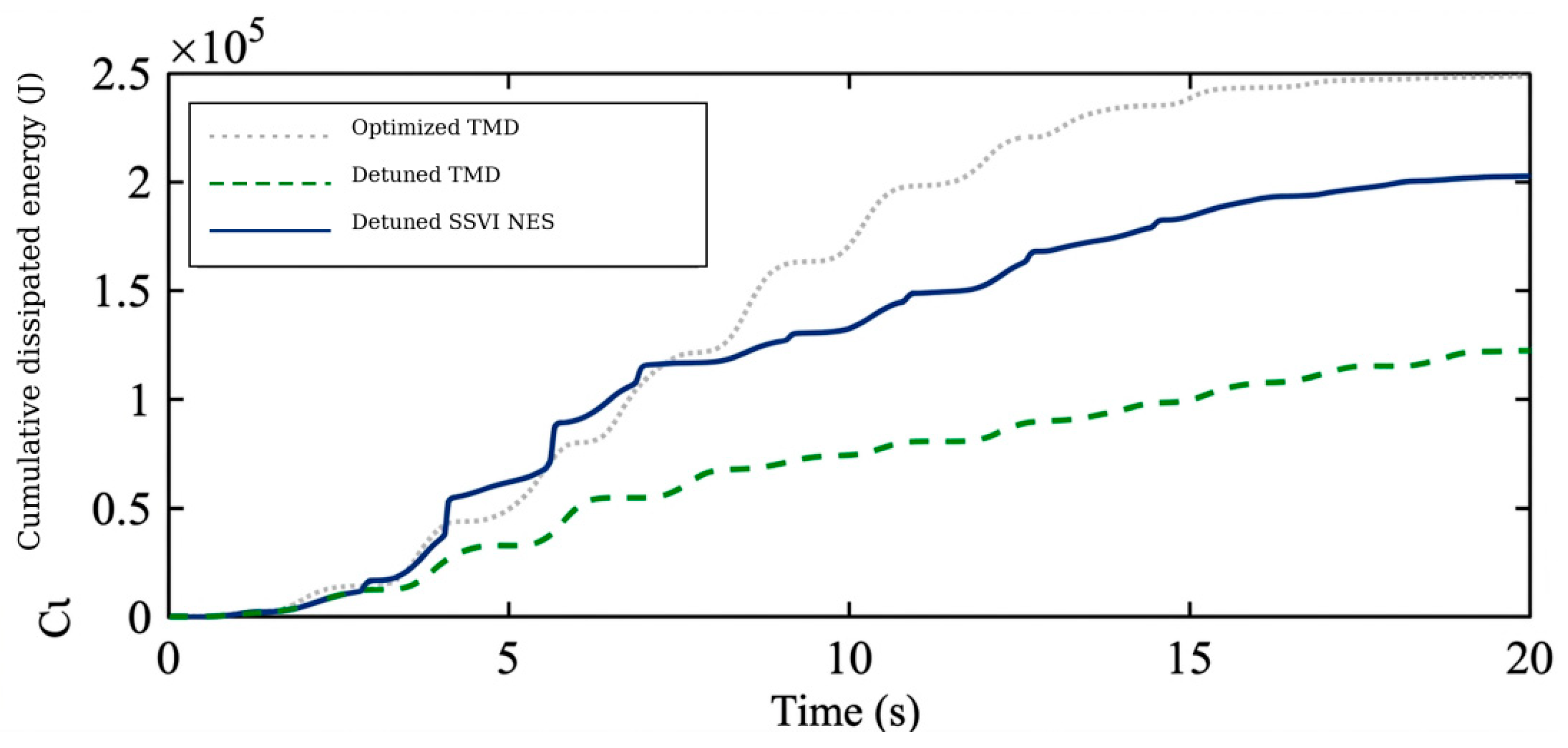
Figure 15 compares the cumulative dissipated energy of the optimized TMD, the detuned TMD, and the detuned SSVI NES.
As shown in
Figure 15, the optimized TMD exhibits the highest cumulative dissipated energy at the exact design point, which is consistent with its strong nominal control performance. However, once frequency detuning is introduced, the dissipated energy of the TMD decreases markedly. By contrast, the detuned SSVI NES retains a higher level of cumulative dissipated energy than the detuned TMD. This result indicates that the SSVI NES is less dependent on exact resonance matching and can continue to extract and dissipate vibration energy under off-design conditions through the combined effects of nonlinear restoring interaction and unilateral impact.
To avoid ambiguity in the interpretation of the original parameter map, the previous
Figure 16 has been removed, and the robustness discussion has been rewritten in text. The original plot involved both the gap ratio and the frequency ratio, which could obscure the intended discussion on frequency-detuning robustness. In the revised manuscript, the discussion is therefore focused on the qualitative comparison between the optimized TMD and the SSVI NES under frequency deviation.
The optimized TMD achieves strong vibration-reduction performance near its nominal tuning condition, but its effectiveness decreases when the structural frequency deviates from the tuned value. This is expected because the TMD relies on a narrow-band resonance mechanism. In contrast, the SSVI NES exhibits a less tuning-sensitive behavior because its vibro-impact nonlinearity enables energy dissipation over a wider frequency range. Therefore, although the optimized TMD may provide better performance near the nominal tuning point, the SSVI NES shows better robustness when frequency detuning is considered.
The detuning analysis further extends the load-case framework by examining whether the control effectiveness obtained under the nominal condition can be retained when the dominant structural frequency deviates from its design value. Under frequency detuning, the response-reduction effectiveness of the optimized TMD decreases from approximately 55% to 20%, whereas the SSVI NES retains approximately 80% of its nominal RMS-based control effectiveness. This result indicates that the SSVI NES is less sensitive to structural-frequency variations than the optimized TMD.
Representative time-history responses under a detuned condition are shown in
Figure 16.
Figure 16 further confirms the different detuning sensitivities of the two control devices. When the TMD is substantially detuned, the nacelle fore-aft displacement increases noticeably, indicating that the advantage of precise linear tuning is largely lost. Under the same detuned condition, the SSVI NES still maintains effective reduction of the nacelle response. This behavior can be attributed to the broader nonlinear interaction mechanism of the SSVI NES. Unlike the TMD, which relies on a fixed tuning relationship between the absorber and the primary structure, the SSVI NES can exchange and dissipate energy through nonlinear interaction and impact activation over a wider frequency range.
Taken together, the detuning analysis shows that the optimized TMD remains highly effective near the nominal tuning point, whereas the SSVI NES retains a more stable level of vibration mitigation when frequency mismatch is introduced. From an engineering perspective, this retained effectiveness is the principal advantage of the SSVI NES for nacelle-mounted control of monopile offshore wind turbines, where exact tuning cannot always be guaranteed throughout the service life. Accordingly, the main value of the SSVI NES lies not in overwhelming superiority at the nominal design point, but in combining competitive nominal performance with improved robustness under off-design structural-frequency conditions.
5. Conclusions
This study investigated the vibration-control performance of the SSVI NES for a monopile offshore wind turbine under representative wind, wave, and seismic loading conditions. A reduced-order coupled dynamic model was established based on the NREL 5 MW reference turbine, and the proposed SSVI NES was evaluated through comparison with an optimized tuned mass damper (TMD). The main conclusions are summarized as follows.
A control-oriented reduced-order model was established for the monopile offshore wind turbine under wind-wave-seismic loading. The model considers the main structural degrees of freedom relevant to the nacelle fore-aft response and provides a computationally efficient framework for comparing passive vibration absorbers under consistent modeling assumptions. In this study, the model is therefore used mainly for a comparative assessment of the optimized TMD and the SSVI NES, rather than as a substitute for a fully validated high-fidelity aero-hydro-servo-elastic model.
The optimized TMD achieves strong vibration suppression under the nominal design condition and serves as a reliable linear benchmark passive controller. However, its effectiveness is concentrated within a relatively narrow tuning region, and its absorber stroke demand may increase depending on the selected mass ratio. This limitation is important for nacelle-mounted applications where installation space is inherently constrained.
The proposed SSVI NES exhibits a broader effective operating region in the nonlinear parameter space. The parametric analysis shows that satisfactory vibration mitigation and acceptable absorber motion demand can be achieved within a practical parameter window, rather than at a single sharply defined optimum. Under the nominal wind-wave design condition, the optimized TMD and the representative SSVI NES reduce the RMS nacelle fore-aft displacement by approximately 55% and 50%, respectively. Although the SSVI NES provides a slightly lower RMS reduction than the optimized TMD, it reduces the maximum absorber stroke by approximately 40%, indicating a more favorable balance between vibration mitigation and absorber motion demand. Moreover, under frequency-detuned conditions, the response-reduction effectiveness of the optimized TMD decreases from approximately 55% under the nominal condition to about 20%, whereas the SSVI NES retains approximately 80% of its nominal RMS-based control effectiveness. These results indicate that the SSVI NES provides near-benchmark nominal vibration mitigation, lower absorber motion demand, and better robustness against off-design structural-frequency variations.
The principal advantage of the SSVI NES is observed under frequency-detuned conditions. While the performance of the TMD deteriorates rapidly once the structural frequency deviates from the nominal tuning point, the SSVI NES retains a more stable level of vibration mitigation through nonlinear interaction and unilateral impact. This reduced sensitivity to tuning uncertainty is particularly relevant for offshore wind turbines, where structural properties may vary over time.
Overall, the results indicate that the SSVI NES is a promising passive vibration-control solution for monopile offshore wind turbines, offering a balanced combination of comparable nominal performance, reduced absorber motion demand, and improved robustness under uncertain operating conditions. These characteristics contribute to enhanced structural serviceability and resilience of offshore energy infrastructure.
The conclusions should be interpreted within the scope of the present reduced-order model and the fore-aft control configuration considered herein. Future work should focus on higher-fidelity aero-hydro-servo-soil coupled modeling, multi-directional control strategies, systematic parameter optimization, and experimental validation.
It should be noted that the present reduced-order model has not been fully validated against benchmark time-domain responses from high-fidelity simulation tools or experimental data. Therefore, the numerical results should be interpreted as comparative control-performance trends within the adopted modeling assumptions. Further validation against benchmark time-domain simulations or experimental measurements is recommended in future work.



 ,
,