Article

Jacobi Elliptic Function Solutions for the Conformable Resonant Nonlinear Schrödinger Equation with Parabolic Nonlinearity


1
Department of Computer Engineering, Faculty of Engineering, Al-Balqa Applied University, Salt 19117, Jordan
2
Department of Mathematics, Faculty of Science, Al al-Bayt University, Mafraq 25113, Jordan
3
Department of Information Systems, Faculty of Information Technology and Computer Science, Yarmouk University, Irbid 21163, Jordan
*
Author to whom correspondence should be addressed.
Computation 2026, 14(6), 135; https://doi.org/10.3390/computation14060135
Submission received: 19 March 2026 / Revised: 12 May 2026 / Accepted: 25 May 2026 / Published: 11 June 2026
(This article belongs to the Section Computational Engineering)

Abstract

In this study, we utilize the ϕ 6 -model expansion method to derive a diverse set of Jacobi elliptic function solutions for the conformable resonant Nonlinear Schrödinger Equation (NLSE) with parabolic law nonlinearity. As the modulus of the Jacobi elliptic functions approaches 1 and 0, the solutions transform into hyperbolic and trigonometric functions, respectively. This methodology yields various exact traveling wave solutions, including kink solitons, singular solitons, periodic solutions, and singular periodic solutions. Notably, this work represents the first investigation into identifying Jacobi elliptic function solutions for the conformable resonant NLSE. These results enhance the understanding of the nonlinear dynamical properties intrinsic to the NLSE. We use graphical illustrations to highlight the dynamical features of the solutions. Moreover, our approach showcases versatility in addressing other nonlinear partial differential equations, offering insights applicable to nonlinear optics, fluid dynamics, and quantum physics.

1. Introduction

The NLSE is a well-explored equation of significant importance in the study of nonlinear phenomena within dispersive and inhomogeneous environments. It finds applications in diverse fields, including the modeling of deep water phenomena [1], Bose–Einstein condensates [2], fluid dynamics [3], plasma physics [4], magnetic spin waves [5,6], and more. In the realm of optics, the NLSE is a fundamental component of the Manakov system [7,8], a model used to describe wave propagation in optical fibers. This equation plays a pivotal role in modeling various nonlinear optical effects in fibers, such as stimulated Raman scattering, optical solitons, second harmonic generation, four-wave mixing, ultrashort pulses, and others. Furthermore, the NLSE is employed to elucidate the evolution of modulated wave groups in the context of water wave dynamics.
A comprehensive investigation of optical solitons entails the examination of a wide array of nonlinearities. The foundational Kerr law serves as a fundamental component, widely employed in various optical fibers for transmitting data across vast transcontinental and transoceanic distances. As time has progressed, numerous alternative nonlinear fiber models have been developed, encompassing a rich diversity of characteristics. These models are typically categorized into several types, including power law, parabolic law, anti-cubic law, log law, among others. These nonlinearities play a crucial role in describing higher-order effects such as self-steepening, nonlinear dispersion, and complex wave interactions.
Among these models, anti-cubic nonlinearities have attracted considerable attention in soliton theory, where analytical methods such as Jacobi elliptic function expansion, mapping techniques, and trial function approaches have been employed to construct exact solutions [9,10,11,12,13]. These studies reveal a variety of nonlinear wave structures, including bright, dark, singular, and periodic solitons. Similarly, parabolic-law nonlinearities have been investigated in resonant and generalized NLSE frameworks, yielding a rich set of localized and periodic wave solutions [14,15,16]. Logarithmic nonlinearities have also been explored within NLSE models, where diverse soliton solutions such as bright, dark, kink-type, and periodic waves have been reported, along with dynamical features analyzed via phase-plane methods [17]. Furthermore, logarithmic nonlinearities have been studied in relativistic and quantum field models, particularly in Klein–Gordon-type systems, where bounded, singular, and periodic wave structures have been reported [18,19].
The dynamical behavior and interaction properties of solitons have been extensively studied. The integrability of the NLSE via the inverse scattering transform has been established, demonstrating the elastic nature of soliton interactions [20]. In non-integrable or perturbed systems, more complex dynamics arise, including inelastic collisions and energy exchange mechanisms [21]. Spatial soliton formation in nonlinear media has also been investigated [22]. Furthermore, higher-order nonlinear effects such as quintic perturbations have been shown to induce asymmetric propagation and instability phenomena [23].
Further developments include resonant and higher-order NLSE models. Various bright, dark, and singular soliton solutions have been constructed in resonant NLSE systems with time-dependent effects [14,24]. In addition, generalized NLSEs with higher-order nonlinearities have been shown to support flat-top solitons as well as instability scenarios such as collapse and decay [25]. Optical soliton solutions in Kerr and parabolic-law media have also been derived using analytical approaches, yielding bright, dark, and periodic wave structures [15,16].
The resonant NLSE with a cubic-quintic law of nonlinearity is represented by:
i u t + a u x x + b | u | 2 + c | u | 4 u + d | u | x x | u | u = 0 ,
where u = u ( x , t ) is the complex-valued wave profile, with i 2 = 1 , a 0 governs group velocity dispersion, d 0 represents the resonant term coefficient, and b and c are the cubic and quintic nonlinearity coefficients, respectively.
Soliton theory is central to nonlinear Schrödinger-type equations, where the balance between dispersion and nonlinearity generates stable localized wave structures. In this context, analytical soliton techniques have also been extended to other nonlinear evolution equations, such as the generalized sine-Gordon equation with variable coefficients, where Hirota’s transformation yields single and multi-soliton solutions in non-uniform media [26]. Various analytical methods have been effectively developed for nonlinear wave models, including the G G , 1 G -expansion technique, applied in particular, to the Boiti–Leon–Pempinelli system, producing hyperbolic, trigonometric, and rational traveling wave solutions [27]. Further developments in nonlinear dispersive equations, including scale-invariant KdV-type models, employ phase-plane analysis and direct methods such as the tanh- and coth-methods to construct solitary, periodic, and singular wave solutions [28]. These results highlight the efficiency and versatility of analytical soliton methods across a broad class of nonlinear evolution equations.
Recently, Equation (1) has been investigated using a variety of analytical techniques. The G G -expansion method, as presented in [29], yielded trigonometric, hyperbolic, rational, and complex traveling wave solutions. A new mapping method introduced in [30] enabled the construction of exact solutions in terms of hyperbolic and trigonometric functions. Furthermore, in [31], both the Kudryashov R-function approach and the generalized Kudryashov method were applied to obtain singular, dark, kink–antikink, and bright soliton solutions. In addition, several generalized auxiliary-function approaches have been employed to enrich the solution structure of Equation (1). In [32,33], extended auxiliary equation methods, including the approach proposed by Sirendaoreji and Kudryashov and its further extension, were used to construct new families of Jacobi elliptic function solutions. Similarly, in [34], the ϕ 6 -model expansion method was applied to derive Jacobi elliptic function solutions, from which bright, dark, and singular soliton solutions were obtained via reductions to the Liénard equation.
Furthermore, higher-order NLSEs with dual power-law nonlinearity have been investigated in the context of ultrashort pulse propagation in optical fibers. In particular, a generalized model of the form:
i u t + a u x x + b | u | 2 n + c | u | 4 n u + d | u | x x | u | u = 0 ,
where n 1 , reduces to Equation (1) in the special case n = 1 . This generalized model was studied in [35], where the G G , 1 G -expansion method was used to obtain exact traveling wave solutions describing optical pulse propagation in fibers. Moreover, in [36], the modified simple equation method was applied to construct analytical soliton solutions, which were subsequently examined via modulation instability analysis to characterize their stability behavior and physical relevance.
However, the classical integer-order formulation is inherently local in time and assumes instantaneous response, and therefore cannot adequately describe complex temporal behaviors observed in dispersive media such as nonlinear optical fibers and plasma systems [37]. To overcome this limitation, we introduce the conformable fractional extension of the model, which provides a flexible framework for incorporating generalized temporal scaling effects while preserving key properties of classical calculus. In particular, the conformable derivative maintains important features such as the product and chain rules, making it more tractable for analytical treatment compared to other fractional operators [37]. The conformable resonant NLSE with parabolic-law nonlinearity is then formulated as:
i u t ( ν ) + a u x x + b | u | 2 + c | u | 4 u + d | u | x x | u | u = 0 , 0 < ν 1 .
Here, the time-fractional derivative is taken in the conformable sense. For a function u ( x , t ) , the conformable derivative of order ν ( 0 , 1 ] is defined by:
u t ( ν ) ( x , t ) = lim h 0 u x , t + h t + 1 Γ ( ν ) 1 ν u ( x , t ) h .
This operator, originally introduced by Atangana [38], preserves many fundamental properties of classical calculus, including the product, quotient, and chain rules. Owing to these advantages, it has become a powerful tool in the analysis of nonlinear evolution equations, notably appearing in models such as the Hunter–Saxton equation and related nonlinear systems. In recent years, a variety of analytical techniques have been developed for constructing exact solutions of conformable nonlinear evolution equations [39,40,41,42,43,44].
Within this framework, conformable versions of the resonant NLSE have been investigated in the literature [45,46,47,48]. In [48], the model with Kerr-law nonlinearity:
i u t ( ν ) + a u x x + c | u | 2 u + d | u | x x | u | u = 0 , 0 < ν 1 ,
was analyzed using the rational sine-Gordon expansion method, yielding explicit traveling wave solutions, including bright and dark solitons. These solutions were further illustrated graphically to describe their physical behavior in optical fiber and quantum physics applications. A related work [46] applied the extended direct algebraic and tanh–coth methods to obtain various optical solitons, including dark–singular, dark–bright, kink, periodic, and rational forms, and investigated the influence of the conformable fractional parameter on the solution dynamics through graphical analysis. Moreover, ref. [45] employed the Exp-function and modified exp( Φ ( η ) )-expansion methods to derive a broad class of solutions, including trigonometric, exponential, periodic, bright, dark, singular, and rational waves, along with a modulation instability analysis.
Subsequently, a more generalized conformable model with dual-power law nonlinearity was investigated in [47]:
i u t ( ν ) + a u x x + b | u | + c | u | 2 u + d | u | x x | u | u = 0 , 0 < ν 1 .
Using the Sardar sub-equation method, a variety of new traveling wave solutions were obtained, expressed in terms of generalized hyperbolic and trigonometric function structures, revealing rich nonlinear dynamical behavior of the model.
The primary objective of this paper is to introduce novel families of solutions utilizing the ϕ 6 -model expansion method applied to the conformable resonant NLSE (2). By investigating Jacobi elliptic functions under specific conditions, this approach aims to uncover diverse solitonic structures. As the modulus of the Jacobi elliptic functions tends towards one or zero, hyperbolic and trigonometric function solutions can be derived, respectively. Notably, previous research has not explored the identification of Jacobi elliptic function solutions for the conformable resonant NLSE (2). Our contribution seeks to broaden the scope of available solutions and promote their applicability within the realm of physics.

2. Overview of the ϕ6-Model Expansion Technique

In this section, we present a brief description of the ϕ 6 -model expansion technique, outlining each step:
1.
Nonlinear PDE Formulation. Consider a nonlinear PDE of the form:
H ( u , u x , u t , u x x , u x t , u t t , ) = 0 ,
where u = u ( x , t ) is the unknown function, and H is a polynomial in u ( x , t ) and its partial derivatives, including the highest order derivatives and nonlinear terms.
2.
Wave Transformation. To reduce the nonlinear PDE into an ODE, we introduce the traveling wave transformation:
u ( x , t ) = U ( ξ ) , ξ = x v ν t + 1 Γ ( ν ) ν ,
where v is the wave speed and ν ( 0 , 1 ] is the fractional order parameter. This transformation combines the spatial and temporal variables into a single wave variable ξ , consistent with the structure of conformable fractional calculus.
The constants 1 / Γ ( ν ) and 1 / ν play essential roles. The shift 1 / Γ ( ν ) ensures consistency with the conformable derivative and avoids singular behavior at t = 0 , while the factor 1 / ν cancels the coefficient arising from differentiation, leading to a constant velocity term. Using the conformable property:
d ν d t ν t + 1 Γ ( ν ) ν = ν ,
it follows that the conformable derivative of ξ is constant, namely ξ t ( ν ) = v . Applying the conformable chain rule yields u t ( ν ) = v U ( ξ ) , while spatial derivatives reduce to ordinary derivatives with respect to ξ . In the limiting case ν 1 , the transformation reduces to the classical traveling wave form ξ = x v t , up to an irrelevant constant shift.
Therefore, Equation (4) is transformed into an ODE of the form:
H ˜ ( U , U , U , ) = 0 ,
where H ˜ denotes a polynomial in U and its derivatives with respect to ξ .
3.
Formal Solution Assumption. Suppose that Equation (6) has a formal solution of the form:
U ( ξ ) = k = 0 N α k ϕ k ( ξ ) ,
where α k ( k = 0 , 1 , , N ) are arbitrary constants to be determined such that ϕ ( ξ ) is a solution to the auxiliary nonlinear ODE:
( ϕ ( ξ ) ) 2 = h 0 + h 2 ϕ 2 ( ξ ) + h 4 ϕ 4 ( ξ ) + h 6 ϕ 6 ( ξ ) , ϕ ( ξ ) = h 2 ϕ ( ξ ) + 2 h 4 ϕ 3 ( ξ ) + 3 h 6 ϕ 5 ( ξ ) ,
where h i ( i = 0 , 2 , 4 , 6 ) are real numbers determined through substitution of the solution ansatz (7) together with (8) into the reduced ODE (6), leading to an algebraic system obtained by equating coefficients of like powers of ϕ ( ξ ) , which determines the admissible parameter sets ensuring the existence of Jacobi elliptic solutions.
Equation (8) is a first-order autonomous ODE of the form ( ϕ ) 2 = F ( ϕ ) with F a polynomial in ϕ . A solution ϕ ( ξ ) is any differentiable function satisfying this relation. For any initial condition with F 0 , local existence and uniqueness (up to sign of ϕ ) follow from standard ODE theory. Such equations are integrable and admit elliptic function solutions.
4.
Determination of N. The positive integer N is found by balancing the highest order derivatives and the nonlinear terms in (6).
5.
Exact Solution of the Auxiliary ODE. The exact solution of (8) can be expressed as:
ϕ ( ξ ) = P ( ξ ) f P 2 ( ξ ) + g ,
where f P 2 ξ + g > 0 , and P ( ξ ) satisfies the Jacobi elliptic equation:
( P ( ξ ) ) 2 = l 0 + l 2 P 2 ( ξ ) + l 4 P 4 ( ξ ) ,
with l j ( j = 0 , 2 , 4 ) being constants to be determined. The constants f and g are defined by:
{ f = h 4 l 2 h 2 l 2 h 2 2 + 3 l 0 l 4 2 l 2 l 2 h 2 , g = 3 l 0 h 4 l 2 h 2 2 + 3 l 0 l 4 2 l 2 l 2 h 2 ,
and subject to the constraint:
3 h 6 3 l 0 l 4 l 2 2 + h 2 2 2 + h 4 2 l 2 h 2 9 l 0 l 4 l 2 h 2 2 l 2 + h 2 = 0 .
To verify that the transformation in Equation (9) satisfies (8), we start by substituting (9) into ( ϕ ) 2 . This gives:
ϕ = g P ( f P 2 + g ) 3 / 2 , ( ϕ ) 2 = g 2 ( P ) 2 ( f P 2 + g ) 3 .
Using ( P ) 2 = l 0 + l 2 P 2 + l 4 P 4 from (10) and the relation P 2 = g ϕ 2 1 f ϕ 2 (obtained from (9)), we rewrite everything in terms of ϕ . Simplifying with the definitions of f, g, the constraint (12) yields exactly:
( ϕ ) 2 = h 0 + h 2 ϕ 2 + h 4 ϕ 4 + h 6 ϕ 6 ,
which confirms that ϕ ( ξ ) satisfies the first equation in (8). The second equation follows by differentiating the first with respect to ξ .
6.
Solutions Using Jacobi Elliptic Functions. For 0 < m < 1 , solutions of (10) using Jacobi elliptic functions are presented in Table 1.
As m approaches 1, the Jacobi elliptic functions sn , cn , dn , and their simple quotients sd , sc , …reduce to hyperbolic functions, as shown:
sn ( ξ , 1 ) = tanh ( ξ ) , cn ( ξ , 1 ) = dn ( ξ , 1 ) = sech ( ξ ) , sc ( ξ , 1 ) = sd ( ξ , 1 ) = sinh ( ξ ) , ns ( ξ , 1 ) = coth ( ξ ) , nc ( ξ , 1 ) = nd ( ξ , 1 ) = cosh ( ξ ) , cs ( ξ , 1 ) = ds ( ξ , 1 ) = csch ( ξ ) ,
Conversely, as m approaches 0, the Jacobi elliptic functions reduce to trigonometric functions:
sn ( ξ , 0 ) = sd ( ξ , 0 ) = sin ( ξ ) , cd ( ξ , 0 ) = cn ( ξ , 0 ) = cos ( ξ ) , sc ( ξ , 0 ) = tan ( ξ ) , ns ( ξ , 0 ) = ds ( ξ , 0 ) = csc ( ξ ) , dc ( ξ , 0 ) = nc ( ξ , 0 ) = sec ( ξ ) , cs ( ξ , 0 ) = cot ( ξ ) ,
7.
Derivation of Solutions. By substituting Equations (9) and (10) into Equation (7), the Jacobi elliptic function solutions for Equation (4) can be derived.

3. Solving the Conformable Resonant NLSE with Parabolic Law Nonlinearity (2)

We begin with the fundamental solution assumption for (2) expressed as follows:
u ( x , t ) = U ( ξ ) e i κ x + ω ν t + 1 Γ ( ν ) ν + θ 0 ,
where the wave variable is defined as:
ξ = x v ν t + 1 Γ ( ν ) ν .
Here, v represents the velocity of the soliton, κ stands for the frequency, ω denotes the wave number, and θ 0 is the phase constant.
Upon substituting Equation (13) into (2), and subsequently separating the equation into its real and imaginary parts, we acquire:
a + d U ( ξ ) a κ 2 + ω U ( ξ ) + b U 2 ( ξ ) + c U 4 ( ξ ) U ( ξ ) = 0 ,
and
2 a κ + v U ( ξ ) = 0 ,
where α + λ 0 . We deduce the soliton velocity from the imaginary part (15), and express it with:
v = 2 a κ .
Now, we equate the highest order derivative U ( ξ ) to the highest nonlinear term U 5 ( ξ ) in (14). This leads us to the equation N + 2 = 5 N , which implies N = 1 2 . As a result, we make the assumption:
U ( ξ ) = V ( ξ ) .
Substituting (17) into (14), multiplying both sides by 4 V ( ξ ) 3 2 , and simplifying, we obtain:
a + d 2 V ( ξ ) V ( ξ ) V ( ξ ) 2 4 a κ 2 + ω V 2 ( ξ ) + 4 b V 3 ( ξ ) + 4 c V 4 ( ξ ) = 0 .
Balancing V ( ξ ) V ( ξ ) with V 4 ( ξ ) leads us to N + N + 2 = 4 N , and result in N = 1 . Consequently, the formal solution of (18) is expressed as:
V ( ξ ) = α 0 + α 1 ϕ ( ξ ) .
Here, α 0 and α 1 represent constants that will be determined later.
Upon substituting (19) along with (8) into (18), and setting the coefficients of all powers of ϕ j ( ξ ) , where j = 0 , 1 , 2 , 3 , 4 , 5 , 6 , equal to zero, we obtain the following system of algebraic equations:
ϕ 6 ( ξ ) : 5 a + d α 1 2 h 6 = 0 , ϕ 5 ( ξ ) : 6 a + d α 0 α 1 h 6 = 0 , ϕ 4 ( ξ ) : 3 a + d α 1 2 h 4 + 4 c α 1 4 = 0 , ϕ 3 ( ξ ) : 4 a + d α 0 α 1 h 4 + 4 b α 1 3 + 16 c α 0 α 1 3 = 0 , ϕ 2 ( ξ ) : a + d α 1 2 h 2 4 a κ 2 + ω α 1 2 + 12 b α 0 α 1 2 + 24 c α 0 2 α 1 2 = 0 , ϕ 1 ( ξ ) : 2 a + d α 0 α 1 h 2 8 a κ 2 + ω α 0 α 1 + 12 b α 0 2 α 1 + 16 c α 0 3 α 1 = 0 , ϕ 0 ( ξ ) : 4 b α 0 3 + 4 c α 0 4 a + d α 1 2 h 0 4 a κ 2 + ω α 0 2 = 0 .
Solving the resulting system with the Maple aid, we get a particular set of solutions, which can be described as follows:
{ α 0 = λ α 1 , b = 2 a + d λ h 4 α 1 , c = 3 a + d h 4 4 α 1 2 , ω = 1 4 4 κ 2 + 5 h 2 a + 5 d h 2 + 6 a + d h 0 λ 2 , h 6 = 0 ,
where λ is a root of the equation with z unknown:
z 4 h 4 + z 2 h 2 + h 0 = 0 ,
and a , d , α 1 , h 0 , h 2 , h 4 , and κ are arbitrary nonzero real numbers. It is essential to note that the parameter λ should belong to one of the following real numbers:
λ 1 = h 4 h 2 + h 2 2 4 h 0 h 4 2 h 4 , λ 2 = h 4 h 2 + h 2 2 4 h 0 h 4 2 h 4 , λ 3 = h 4 h 2 h 2 2 4 h 0 h 4 2 h 4 , λ 4 = h 4 h 2 h 2 2 4 h 0 h 4 2 h 4 .
Furthermore, based on (12), the parameter h 2 should assume one of the following real values:
h 21 = l 2 , h 22 = l 2 2 + 3 2 l 2 2 4 l 0 l 4 , h 23 = l 2 2 3 2 l 2 2 4 l 0 l 4 .
Substituting (20) along with (9) into (19), we successfully derive the exact solution for (18), which is expressed as:
V ( ξ ) = α 1 λ + α 1 P ξ f P 2 ξ + g .
Consequently, (2) introduces new exact traveling wave solutions in the form of Jacobi elliptic functions, and these solutions can be outlined as follows:
(1)
When the parameters take values such that l 0 = 1 , l 2 = ( m 2 + 1 ) , and l 4 = m 2 , the function P ( ξ ) can be either sn ( ξ , m ) or cd ( ξ , m ) . This leads to obtaining solutions in the form of Jacobi elliptic functions from (24):
u 1 ( x , t ) = α 1 λ + α 1 m 4 + h 2 2 + m 2 1 sn x + 2 a κ ν t + 1 Γ ( ν ) ν , m 3 h 4 h 4 m 2 + h 2 + 1 sn 2 x + 2 a κ ν t + 1 Γ ( ν ) ν , m e i κ x + ω ν t + 1 Γ ( ν ) ν + θ 0
and
u 2 ( x , t ) = α 1 λ + α 1 m 4 + h 2 2 + m 2 1 cd x + 2 a κ ν t + 1 Γ ( ν ) ν , m 3 h 4 h 4 m 2 + h 2 + 1 cd 2 x + 2 a κ ν t + 1 Γ ( ν ) ν , m e i κ x + ω ν t + 1 Γ ( ν ) ν + θ 0 .
These solutions are valid for all values of λ = λ 1 , λ 2 , λ 3 , λ 4 , as given in (22), all values of h 2 = h 21 , h 22 , h 23 , as given in (23), and under the condition that b, c, and ω are determined using (20). The parameter h 0 is given by:
h 0 = m 4 + h 2 2 + m 2 1 3 h 4 .
Particularly, these solutions degenerate into hyperbolic and trigonometric solutions as m 1 and m 0 , respectively. The examination of these cases is outlined below:
  • If m 1 , then we have the exact wave solution:
    u ( x , t ) = α 1 λ + α 1 h 2 2 1 tanh x + 2 a κ ν t + 1 Γ ( ν ) ν 3 h 4 h 4 h 2 + 2 tanh 2 x + 2 a κ ν t + 1 Γ ( ν ) ν e i κ x + ω ν t + 1 Γ ( ν ) ν + θ 0 ,
    provided that b , c , and ω are given by (20) and h 0 is given by:
    h 0 = h 2 2 1 3 h 4 .
  • If m 0 , then we have the exact wave solutions:
    u ( x , t ) = α 1 λ + α 1 h 2 2 1 sin x + 2 a κ ν t + 1 Γ ( ν ) ν 3 h 4 h 4 h 2 + 1 sin 2 x + 2 a κ ν t + 1 Γ ( ν ) ν e i κ x + ω ν t + 1 Γ ( ν ) ν + θ 0 ,
    and
    u ( x , t ) = α 1 λ + α 1 h 2 2 1 cos x + 2 a κ ν t + 1 Γ ( ν ) ν 3 h 4 h 4 h 2 + 1 cos 2 x + 2 a κ ν t + 1 Γ ( ν ) ν e i κ x + ω ν t + 1 Γ ( ν ) ν + θ 0 ,
    provided that b , c , and ω are given by (20) and h 0 is given by:
    h 0 = h 2 2 1 3 h 4 .
(2)
If the parameters take on the values l 0 = 1 m 2 , l 2 = 2 m 2 1 , and l 4 = m 2 , then P ( ξ ) = cn ( ξ , m ) . This leads to a solution in the form of Jacobi elliptic functions from (24):
u 3 ( x , t ) = α 1 λ + α 1 m 4 + h 2 2 + m 2 1 cn x + 2 a κ ν t + 1 Γ ( ν ) ν , m 3 h 4 ( 1 m 2 ) + h 4 2 m 2 h 2 1 cn 2 x + 2 a κ ν t + 1 Γ ( ν ) ν , m e i κ x + ω ν t + 1 Γ ( ν ) ν + θ 0 .
This solution is valid for all values of λ = λ 1 , λ 2 , λ 3 , λ 4 , as given in (22), all values of h 2 = h 21 , h 22 , h 23 , as given in (23), and under the condition that b, c, and ω are determined using (20). The parameter h 0 is given by:
h 0 = m 4 + h 2 2 + m 2 1 3 h 4 .
Additionally, it is noteworthy that as m 0 , the exact wave solution (27) can be retrieved under the same aforementioned constraint conditions and parameter settings. However, this Jacobi elliptic function solution does not undergo degeneration into a hyperbolic solution as the modulus m 1 .
(3)
When the parameters are chosen such that l 0 = m 2 1 , l 2 = 2 m 2 , and l 4 = 1 , then P ( ξ ) = dn ( ξ , m ) . This leads to deriving solutions in the form of Jacobi elliptic functions from (24):
u 4 ( x , t ) = α 1 λ + α 1 m 4 + h 2 2 + m 2 1 dn x + 2 a κ ν t + 1 Γ ( ν ) ν , m 3 h 4 ( m 2 1 ) + h 4 m 2 h 2 + 2 dn 2 x + 2 a κ ν t + 1 Γ ( ν ) ν , m e i κ x + ω ν t + 1 Γ ( ν ) ν + θ 0 .
This solution is valid for all values of λ = λ 1 , λ 2 , λ 3 , λ 4 , as given in (22), all values of h 2 = h 21 , h 22 , h 23 , as given in (23), and under the condition that b, c, and ω are determined using (20). The parameter h 0 is given by:
h 0 = m 4 + h 2 2 + m 2 1 3 h 4 .
It should be noted that this solution does not experience degeneration into hyperbolic or trigonometric solutions as the modulus m approaches either 1 or 0.
(4)
When the parameters take values l 0 = m 2 , l 2 = ( m 2 + 1 ) , and l 4 = 1 , the function P ( ξ ) is either ns ( ξ , m ) or dc ( ξ , m ) . This leads to obtaining solutions in the form of Jacobi elliptic functions from (24):
u 5 ( x , t ) = α 1 λ + α 1 m 4 + h 2 2 + m 2 1 ns x + 2 a κ ν t + 1 Γ ( ν ) ν , m 3 m 2 h 4 h 4 m 2 + h 2 + 1 ns 2 x + 2 a κ ν t + 1 Γ ( ν ) ν , m e i κ x + ω ν t + 1 Γ ( ν ) ν + θ 0
and
u 6 ( x , t ) = α 1 λ + α 1 m 4 + h 2 2 + m 2 1 dc x + 2 a κ ν t + 1 Γ ( ν ) ν , m 3 m 2 h 4 h 4 m 2 + h 2 + 1 dc 2 x + 2 a κ ν t + 1 Γ ( ν ) ν , m e i κ x + ω ν t + 1 Γ ( ν ) ν + θ 0 .
These solutions are valid for all values of λ = λ 1 , λ 2 , λ 3 , λ 4 , as given in (22), all values of h 2 = h 21 , h 22 , h 23 , as given in (23), and under the condition that b, c, and ω are determined using (20). The parameter h 0 is given by:
h 0 = m 4 + h 2 2 + m 2 1 3 h 4 .
It should be noted that, as the modulus m 1 , the hyperbolic solution expressed in terms of the coth function can undergo degeneration from the aforementioned solutions. However, these Jacobi elliptic function solutions do not undergo degeneration into a trigonometric solution as the modulus m 0 .
(5)
If the parameters take values l 0 = m 2 , l 2 = 2 m 2 1 , and l 4 = 1 m 2 , then P ( ξ ) = nc ( ξ , m ) . This leads to obtaining solution in the form of Jacobi elliptic functions from (24):
u 7 ( x , t ) = α 1 λ + α 1 m 4 + h 2 2 + m 2 1 nc x + 2 a κ ν t + 1 Γ ( ν ) ν , m h 4 2 m 2 h 2 1 nc 2 x + 2 a κ ν t + 1 Γ ( ν ) ν , m 3 m 2 h 4 e i κ x + ω ν t + 1 Γ ( ν ) ν + θ 0 .
This solution is valid for all values of λ = λ 1 , λ 2 , λ 3 , λ 4 , as given in (22), all values of h 2 = h 21 , h 22 , h 23 , as given in (23), and under the condition that b, c, and ω are determined using (20). The parameter h 0 is given by:
h 0 = m 4 + h 2 2 + m 2 1 3 h 4 .
It can be noticed that, as the modulus m 1 , the hyperbolic solution expressed in terms of the cosh function can undergo degeneration from the aforementioned solutions. However, this Jacobi elliptic function solution does not degenerate into a trigonometric solution as the modulus m 0 .
(6)
If the parameters are chosen such as l 0 = 1 , l 2 = 2 m 2 , and l 4 = m 2 1 , then P ( ξ ) = nd ( ξ , m ) . This leads to deriving solutions in the form of Jacobi elliptic functions from (24):
u 8 ( x , t ) = α 1 λ + α 1 m 4 + h 2 2 + m 2 1 nd x + 2 a κ ν t + 1 Γ ( ν ) ν , m h 4 m 2 h 2 + 2 nd 2 x + 2 a κ ν t + 1 Γ ( ν ) ν , m 3 h 4 e i κ x + ω ν t + 1 Γ ( ν ) ν + θ 0 .
This solution is valid for all values of λ = λ 1 , λ 2 , λ 3 , λ 4 , as given in (22), all values of h 2 = h 21 , h 22 , h 23 , as given in (23), and under the condition that b, c, and ω are determined using (20). The parameter h 0 is given by:
h 0 = m 4 + h 2 2 + m 2 1 3 h 4 .
It can be observed that, as the modulus m 1 , the hyperbolic solution expressed in terms of the cosh function can undergo degeneration from the aforementioned solutions. However, this Jacobi elliptic function solution does not degenerate into a trigonometric solution as the modulus m 0 .
(7)
If the parameters take values l 0 = 1 , l 2 = 2 m 2 , and l 4 = 1 m 2 , then P ( ξ ) = sc ( ξ , m ) . This leads to obtaining solution in the form of Jacobi elliptic functions from (24):
u 9 ( x , t ) = α 1 λ + α 1 m 4 + h 2 2 + m 2 1 sc x + 2 a κ ν t + 1 Γ ( ν ) ν , m 3 h 4 h 4 m 2 + h 2 2 sc 2 x + 2 a κ ν t + 1 Γ ( ν ) ν , m e i κ x + ω ν t + 1 Γ ( ν ) ν + θ 0 .
This solution is valid for all values of λ = λ 1 , λ 2 , λ 3 , λ 4 , as given in (22), all values of h 2 = h 21 , h 22 , h 23 , as given in (23), and under the condition that b, c, and ω are determined using (20). The parameter h 0 is given by:
h 0 = m 4 + h 2 2 + m 2 1 3 h 4 .
Particularly, these solutions degenerate into hyperbolic and trigonometric solutions as m 1 and m 0 , respectively. The examination of these cases is outlined below:
  • If m 1 , then we have the exact wave solution:
    u ( x , t ) = α 1 λ + α 1 h 2 2 1 sinh x + 2 a κ ν t + 1 Γ ( ν ) ν 3 h 4 h 4 h 2 1 sinh 2 x + 2 a κ ν t + 1 Γ ( ν ) ν e i κ x + ω ν t + 1 Γ ( ν ) ν + θ 0 ,
    provided that b , c , and ω are given by (20) and h 0 is given by:
    h 0 = h 2 2 1 3 h 4 .
  • If m 0 , then we have the exact wave solution:
    u ( x , t ) = α 1 λ + α 1 h 2 2 1 tan x + 2 a κ ν t + 1 Γ ( ν ) ν 3 h 4 h 4 h 2 2 tan 2 x + 2 a κ ν t + 1 Γ ( ν ) ν e i κ x + ω ν t + 1 Γ ( ν ) ν + θ 0 ,
    provided that b , c , and ω are given by (20) and h 0 is given by:
    h 0 = h 2 2 1 3 h 4 .
(8)
When specific values are assigned to the parameters, namely l 0 = 1 , l 2 = 2 m 2 1 , and l 4 = m 2 m 2 + 1 , then P ( ξ ) = sd ( ξ , m ) . This leads to obtaining solution in the form of Jacobi elliptic functions from (24):
u 10 ( x , t ) = α 1 λ + α 1 m 4 + h 2 2 + m 2 1 sd x + 2 a κ ν t + 1 Γ ( ν ) ν , m 3 h 4 + h 4 2 m 2 h 2 1 sd 2 x + 2 a κ ν t + 1 Γ ( ν ) ν , m e i κ x + ω ν t + 1 Γ ( ν ) ν + θ 0 .
This solution is valid for all values of λ = λ 1 , λ 2 , λ 3 , λ 4 , as given in (22), all values of h 2 = h 21 , h 22 , h 23 , as given in (23), and under the condition that b, c, and ω are determined using (20). The parameter h 0 is given by:
h 0 = m 4 + h 2 2 + m 2 1 3 h 4 .
Furthermore, it is important to highlight that as m 0 , the exact wave solution (26) can be retrieved, under the same aforementioned constraint conditions and parameter settings. Correspondingly, as m 1 , the exact wave solution (28) can be retrieved within the framework of the previously mentioned constraint conditions and parameter settings.
(9)
If the parameters are chosen such as l 0 = 1 m 2 , l 2 = 2 m 2 , and l 4 = 1 , then P ( ξ ) = cs ( ξ , m ) . This leads to deriving solution in the form of Jacobi elliptic functions from (24):
u 11 ( x , t ) = α 1 λ + α 1 m 4 + h 2 2 + m 2 1 cs x + 2 a κ ν t + 1 Γ ( ν ) ν , m 3 h 4 ( 1 m 2 ) h 4 m 2 + h 2 2 cs 2 x + 2 a κ ν t + 1 Γ ( ν ) ν , m e i κ x + ω ν t + 1 Γ ( ν ) ν + θ 0 .
This solution is valid for all values of λ = λ 1 , λ 2 , λ 3 , λ 4 , as given in (22), all values of h 2 = h 21 , h 22 , h 23 , as given in (23), and under the condition that b, c, and ω are determined using (20). The parameter h 0 is given by:
h 0 = m 4 + h 2 2 + m 2 1 3 h 4 .
It is important to highlight that, as the modulus m 0 , the trigonometric solution expressed in terms of the cot function can undergo degeneration from the aforementioned solutions. However, this Jacobi elliptic function solution does not degenerate into a hyperbolic solution as the modulus m 1 .
(10)
If specific values are assigned to the parameters, such as l 0 = m 2 1 m 2 , l 2 = 2 m 2 1 , and l 4 = 1 , then P ( ξ ) = ds ( ξ , m ) . This leads to obtaining a solution in the form of Jacobi elliptic functions from (24):
u 12 ( x , t ) = α 1 λ + α 1 m 4 + h 2 2 + m 2 1 ds x + 2 a κ ν t + 1 Γ ( ν ) ν , m h 4 2 m 2 h 2 1 ds 2 x + 2 a κ ν t + 1 Γ ( ν ) ν , m 3 m 2 1 m 2 h 4 e i κ x + ω ν t + 1 Γ ( ν ) ν + θ 0 .
This solution is valid for all values of λ = λ 1 , λ 2 , λ 3 , λ 4 , as given in (22), all values of h 2 = h 21 , h 22 , h 23 , as given in (23), and under the condition that b, c, and ω are determined using (20). The parameter h 0 is given by:
h 0 = m 4 + h 2 2 + m 2 1 3 h 4 .
It should be noted that this solution does not undergo degeneration into hyperbolic or trigonometric solutions as the modulus m approaches 1 or 0.
(11)
When the parameters take values such as l 0 = 1 4 ( 1 m 2 ) , l 2 = 1 2 ( 1 + m 2 ) , and l 4 = 1 4 ( 1 m 2 ) , the function P ( ξ ) is either nc ( ξ , m ) ± sc ( ξ , m ) or cn ( ξ , m ) 1 ± sn ( ξ , m ) . This leads to obtaining solutions in the form of Jacobi elliptic functions from (24):
u 13 ( x , t ) = α 1 λ + α 1 1 16 m 4 7 8 m 2 + h 2 2 1 16 nc x + 2 a κ ν t + 1 Γ ( ν ) ν , m ± sc x + 2 a κ ν t + 1 Γ ( ν ) ν , m 3 4 h 4 ( 1 m 2 ) + 1 2 h 4 m 2 2 h 2 + 1 nc x + 2 a κ ν t + 1 Γ ( ν ) ν , m ± sc x + 2 a κ ν t + 1 Γ ( ν ) ν , m 2 e i κ x + ω ν t + 1 Γ ( ν ) ν + θ 0
and
u 14 ( x , t ) = α 1 λ + α 1 1 16 m 4 7 8 m 2 + h 2 2 1 16 cn x + 2 a κ ν t + 1 Γ ( ν ) ν , m 1 ± sn x + 2 a κ ν t + 1 Γ ( ν ) ν , m 3 4 h 4 ( 1 m 2 ) + 1 2 h 4 m 2 2 h 2 + 1 cn x + 2 a κ ν t + 1 Γ ( ν ) ν , m 1 ± sn x + 2 a κ ν t + 1 Γ ( ν ) ν , m 2 e i κ x + ω ν t + 1 Γ ( ν ) ν + θ 0 .
These solutions are valid for all values of λ = λ 1 , λ 2 , λ 3 , λ 4 , as given in (22), all values of h 2 = h 21 , h 22 , h 23 , as given in (23), and under the condition that b, c, and ω are determined using (20). The parameter h 0 is given by:
h 0 = m 4 + 16 h 2 2 14 m 2 1 48 h 4 .
Additionally, it’s important to highlight that these solutions degenerate into trigonometric solutions as m 0 . However, these solutions do not undergo degeneration into a hyperbolic solution as the modulus m 1 .
(12)
When specific values are assigned to the parameters, namely l 0 = 1 4 ( 1 m 2 ) 2 , l 2 = 1 2 ( 1 + m 2 ) , and l 4 = 1 4 , then P ( ξ ) = m cn ( ξ , m ) ± dn ( ξ , m ) . This leads to obtaining a solution in the form of Jacobi elliptic functions from (24):
u 15 ( x , t ) = α 1 λ + 2 α 1 1 16 m 4 7 8 m 2 + h 2 2 1 16 m cn x + 2 a κ ν t + 1 Γ ( ν ) ν , m ± dn x + 2 a κ ν t + 1 Γ ( ν ) ν , m 2 h 4 m 2 2 h 2 + 1 m cn x + 2 a κ ν t + 1 Γ ( ν ) ν , m ± dn x + 2 a κ ν t + 1 Γ ( ν ) ν , m 2 3 h 4 ( 1 m 2 ) 2 e i κ x + ω ν t + 1 Γ ( ν ) ν + θ 0 .
This solution is valid for all values of λ = λ 1 , λ 2 , λ 3 , λ 4 , as given in (22), all values of h 2 = h 21 , h 22 , h 23 , as given in (23), and under the condition that b, c, and ω are determined using (20). The parameter h 0 is given by:
h 0 = m 4 + 16 h 2 2 14 m 2 1 48 h 4 .
It’s important to highlight that this solution does not undergo degeneration into either hyperbolic or trigonometric solutions as the modulus m approaches either 1 or 0.
(13)
When the parameters are assigned specific values, namely l 0 = 1 4 , l 2 = 1 2 ( 1 + m 2 ) , and l 4 = 1 4 ( 1 m 2 ) 2 , then P ( ξ ) = sn ( ξ , m ) cn ( ξ , m ) ± dn ( ξ , m ) . This selection leads to a solution expressed in terms of Jacobi elliptic functions, as outlined in (24):
u 16 ( x , t ) = α 1 λ + 2 α 1 1 16 m 4 7 8 m 2 + h 2 2 1 16 sn x + 2 a κ ν t + 1 Γ ( ν ) ν , m cn x + 2 a κ ν t + 1 Γ ( ν ) ν , m ± dn x + 2 a κ ν t + 1 Γ ( ν ) ν , m 2 h 4 m 2 2 h 2 + 1 sn x + 2 a κ ν t + 1 Γ ( ν ) ν , m cn x + 2 a κ ν t + 1 Γ ( ν ) ν , m ± dn x + 2 a κ ν t + 1 Γ ( ν ) ν , m 2 + 3 h 4 e i κ x + ω ν t + 1 Γ ( ν ) ν + θ 0 .
This solution is valid for all values of λ = λ 1 , λ 2 , λ 3 , λ 4 , as given in (22), all values of h 2 = h 21 , h 22 , h 23 , as given in (23), and under the condition that b, c, and ω are determined using (20). The parameter h 0 is given by:
h 0 = m 4 + 16 h 2 2 14 m 2 1 48 h 4 .
It should be noted that this solution undergoes a degeneration process, evolving into hyperbolic solutions as m 1 , and into trigonometric solutions as m 0 .
(14)
If the parameters are chosen such as l 0 = 1 4 , l 2 = 1 2 ( 1 2 m 2 ) , and l 4 = 1 4 , then P ( ξ ) = sn ( ξ , m ) 1 ± cn ( ξ , m ) . This leads to deriving solutions in the form of Jacobi elliptic functions from (24):
u 17 ( x , t ) = α 1 λ + 2 α 1 m 4 + m 2 + h 2 2 1 16 sn x + 2 a κ ν t + 1 Γ ( ν ) ν , m 1 ± cn x + 2 a κ ν t + 1 Γ ( ν ) ν , m 2 h 4 2 m 2 2 h 2 + 1 sn x + 2 a κ ν t + 1 Γ ( ν ) ν , m 1 ± cn x + 2 a κ ν t + 1 Γ ( ν ) ν , m 2 + 3 h 4 e i κ x + ω ν t + 1 Γ ( ν ) ν + θ 0 .
This solution is valid for all values of λ = λ 1 , λ 2 , λ 3 , λ 4 , as given in (22), all values of h 2 = h 21 , h 22 , h 23 , as given in (23), and under the condition that b, c, and ω are determined using (20). The parameter h 0 is given by:
h 0 = 16 m 4 + 16 h 2 2 + 16 m 2 1 48 h 4 .
It’s crucial to emphasize that this solution undergoes a degeneration process, transitioning into hyperbolic solutions as m 1 , and transforming into trigonometric solutions as m 0 .

4. Graphical Representation

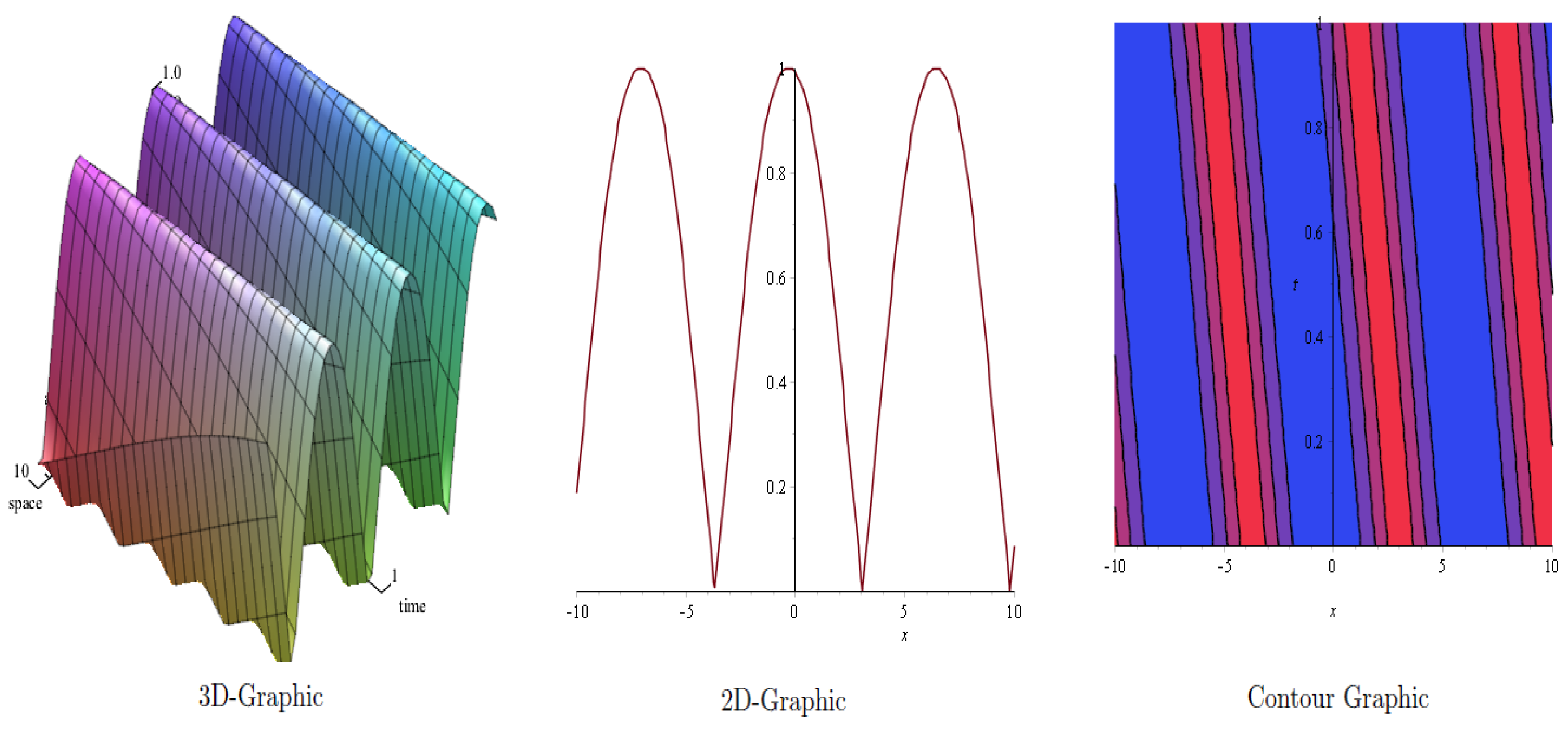
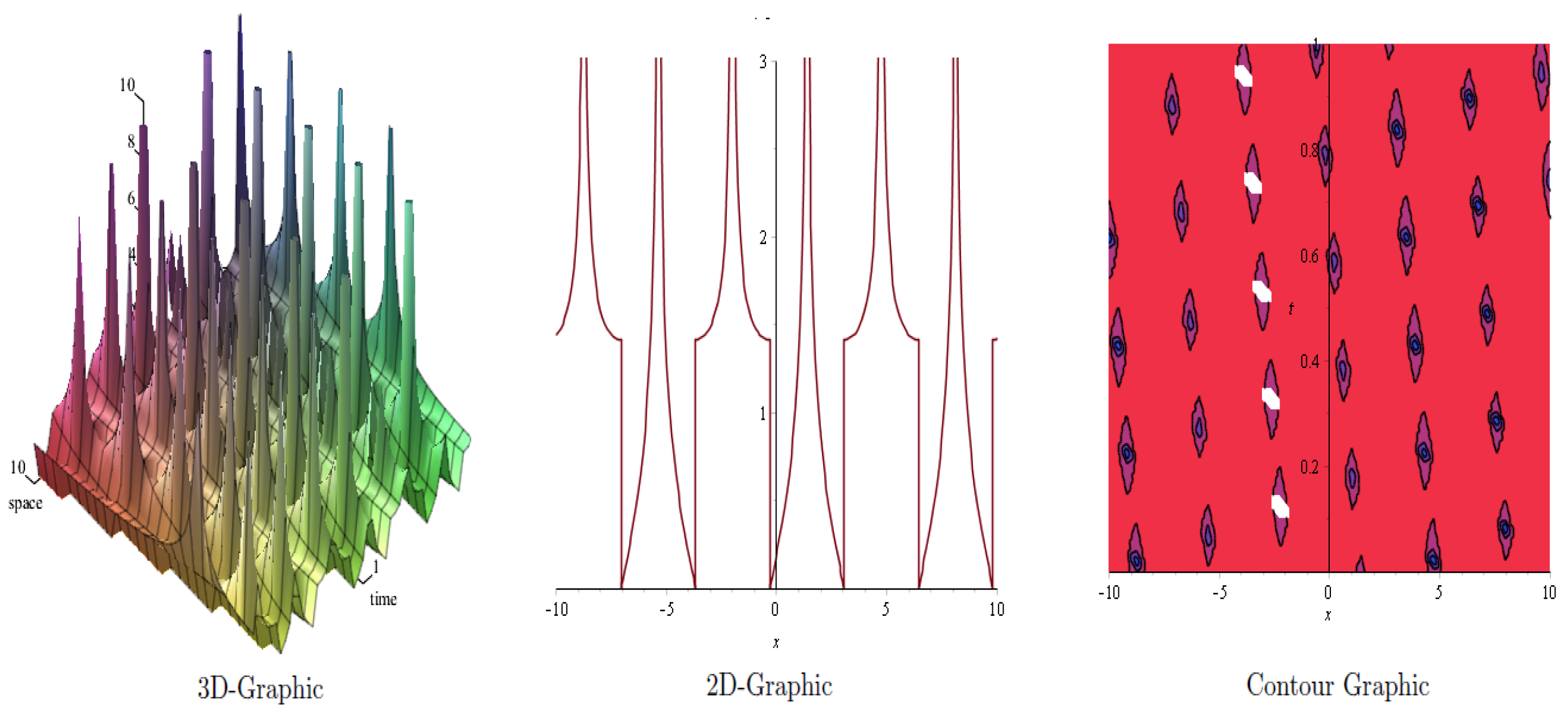
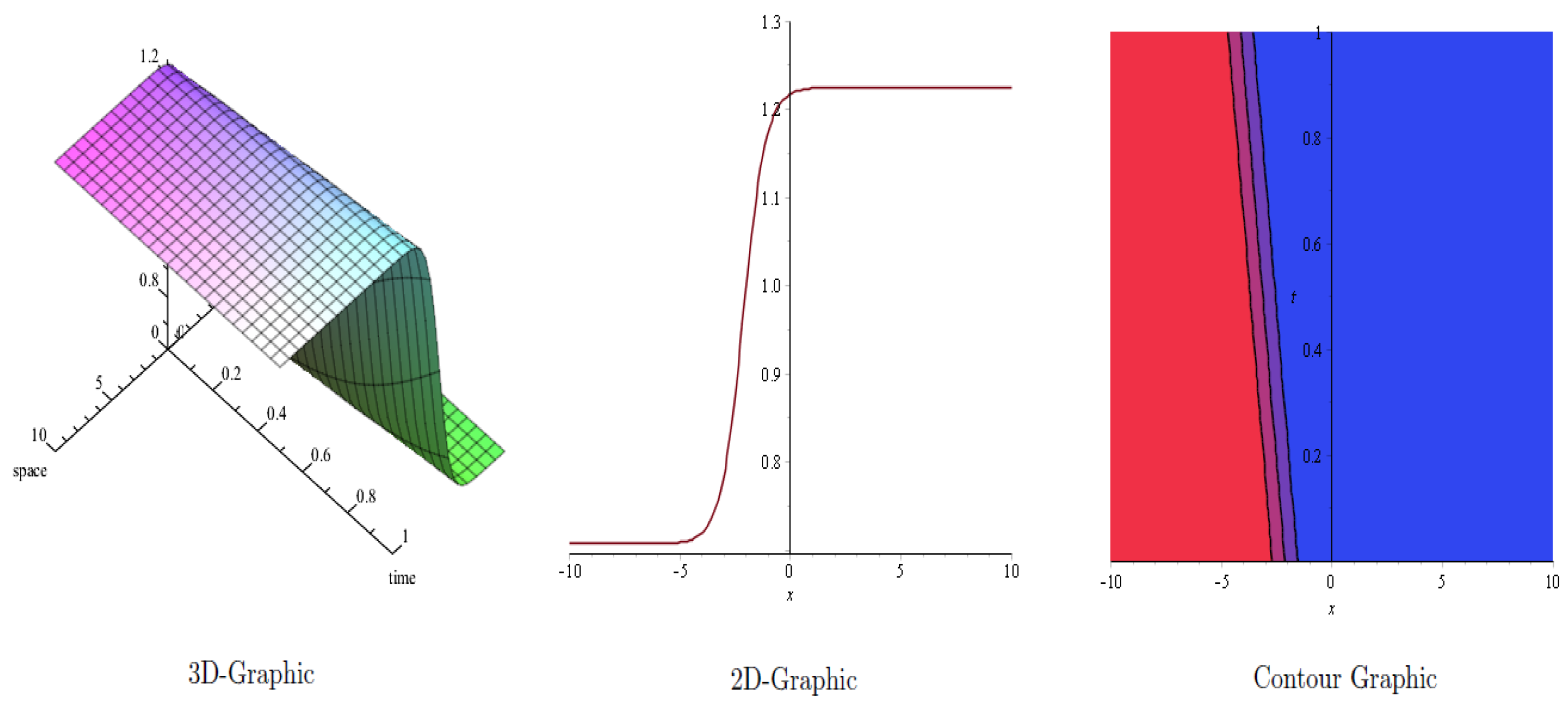
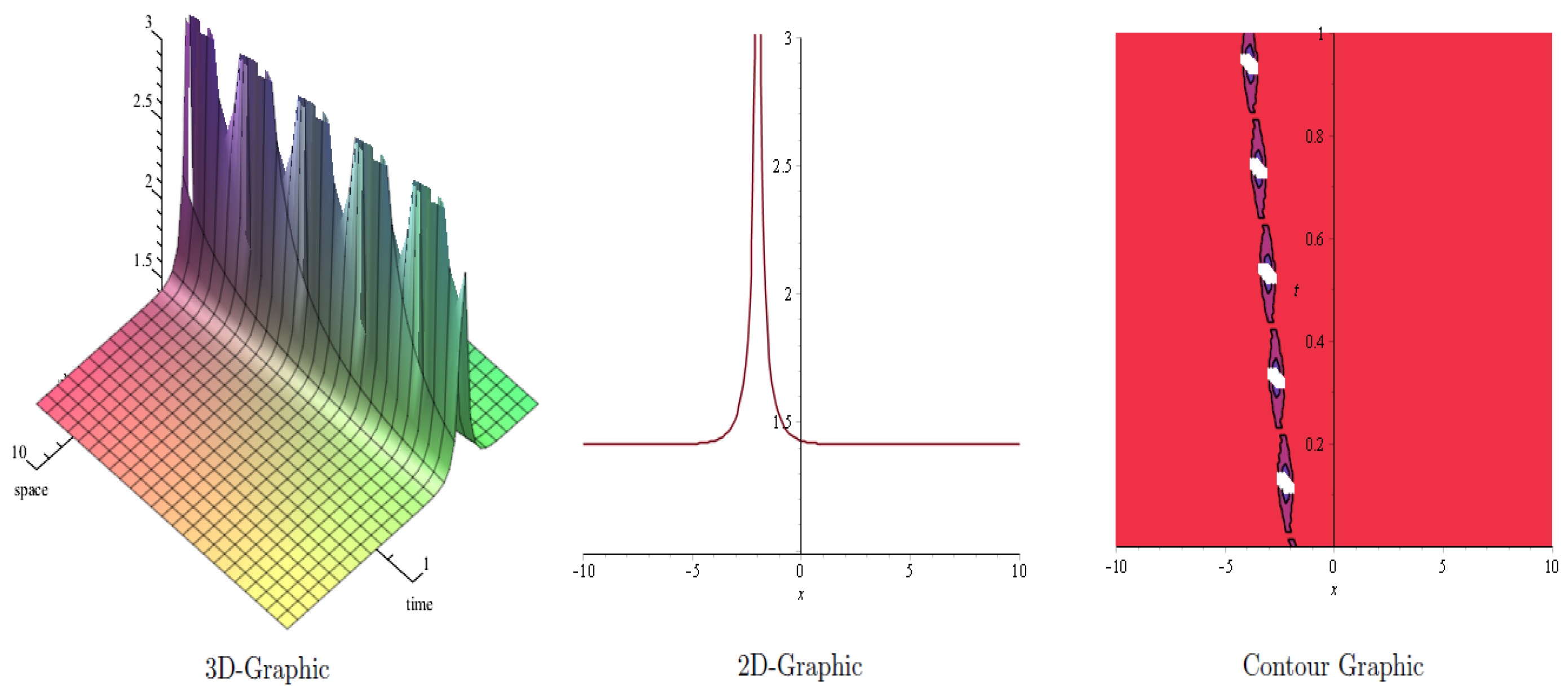
In this paper, we have developed families of solutions for the conformable resonant NLSE with parabolic law nonlinearity by employing Jacobi elliptic functions. These solutions exhibit intriguing characteristics, undergoing transformations into hyperbolic solutions as the modulus m approaches unity, and transitioning into trigonometric solutions as the modulus tends towards zero. To facilitate a deeper understanding of these findings, we have incorporated 3D graphics, 2D graphics, and contour graphics presented in Figure 1, Figure 2, Figure 3, Figure 4, Figure 5 and Figure 6 to illustrate these solutions visually. The parameter values chosen for these graphical representations are as follows: a = 1 , d = 1 , κ = 1 , α 1 = 1 , h 4 = 1 , θ 0 = 0 , and ν = 1 .
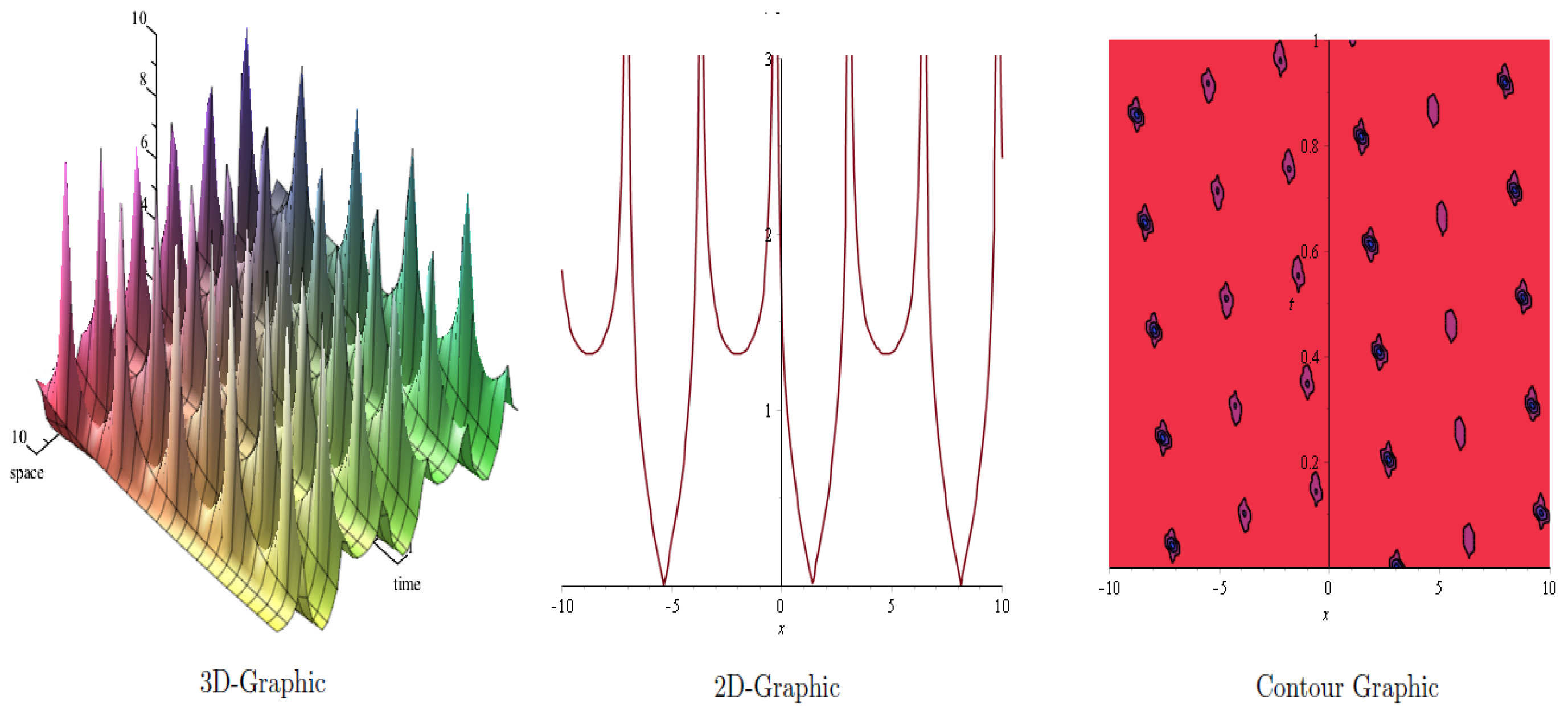
Figure 1 and Figure 2 specifically focus on depicting the periodic solution, denoted as | u 1 ( x , t ) | , under specific conditions where m = 1 2 . In this case, we vary the values of λ , while keeping h 2 = h 21 . These graphical representations effectively illustrate how different values of λ influence the characteristics of the periodic solution | u 1 ( x , t ) | when h 2 = h 21 .
In addition, Figure 3 and Figure 4 are specifically designed to visualize the periodic singular solution, denoted as | u 7 ( x , t ) | , under specific conditions where m = 1 2 . In this case, we vary the values of h 2 , while keeping λ = λ 1 . These graphical representations effectively illustrate how different values of h 2 influence the characteristics of the periodic singular solution | u 7 ( x , t ) | when λ = λ 1 .
Consequently, Figure 5 and Figure 6 are specifically designed to depict both the kink soliton solution, denoted as | u 1 ( x , t ) | , and the singular soliton solution, denoted as | u 7 ( x , t ) | , under specific conditions where m = 1 . The kink soliton arises when h 2 = h 21 and λ = λ 1 , while the singular solution emerges when h 2 = h 23 and λ = λ 1 . These graphical representations effectively showcase the transformation of a periodic solution into a kink soliton and the transformation of a singular periodic solution into a singular soliton solution.

5. Conclusions

In this study, we have utilized the ϕ 6 -model expansion method to derive a diverse set of Jacobi elliptic function solutions for the conformable resonant NLSE with parabolic law nonlinearity, marking a significant advancement in the field of nonlinear dynamics. This innovative approach has uncovered new families of solutions that transform into hyperbolic functions as the elliptic modulus approaches 1 and into trigonometric functions as the modulus approaches 0, thereby showcasing their versatility. Detailed graphical representations, including 3D, 2D, and contour plots, visually illustrate the dynamic features of these solutions, enhancing our understanding of their behaviors and characteristics. All solutions have been rigorously validated through substitution back into the original conformable NLSE, and the computational analysis conducted using Maple software (v18) confirms the method’s effectiveness and precision.
From a methodological standpoint, the main advantage of the proposed approach over other techniques in the literature is that it provides a systematic and efficient framework for constructing Jacobi elliptic function solutions, which are not readily obtained via classical methods such as the G G -expansion method, the tanh–coth method, the Kudryashov R-function approach, or the modified simple equation method. Unlike these conventional techniques, which often yield only limited forms of solitons (e.g., bright, dark, or singular solitons), the ϕ 6 -model expansion method enables a unified treatment of elliptic solutions and their limiting hyperbolic and trigonometric forms within a single coherent framework. This generality allows for a richer classification of traveling wave structures and avoids the need for ad hoc transformations or auxiliary equation manipulations.
The primary motivation for this work is the need to extend the analytical solution space of conformable nonlinear Schrödinger-type equations, particularly in regimes where Jacobi elliptic structures have not yet been explored for this class of models. To the best of our knowledge, this is the first investigation to identify Jacobi elliptic function solutions for the conformable resonant NLSE with parabolic law nonlinearity, thereby addressing a notable gap in the literature. The findings have broad implications for various fields, including nonlinear optics, fluid dynamics, and quantum physics, as the methods and solutions developed can be adapted to other nonlinear partial differential equations.
In conclusion, this study significantly advances our knowledge of the conformable resonant NLSE with parabolic law nonlinearity by introducing new exact solutions and demonstrating their practical applicability. The ϕ 6 -model expansion method proves to be a powerful tool for future explorations in nonlinear dynamics and related fields, offering a systematic pathway for discovering novel wave structures in fractional-order systems.

Author Contributions

Investigation, D.A.-z., L.A. and S.A.; Software, L.A.; Supervision, L.A.; Writing—original draft, D.A.-z. and L.A.; Writing—review & editing, D.A.-z., L.A. and S.A. All authors have read and agreed to the published version of the manuscript.

Funding

This research received no external funding.

Institutional Review Board Statement

Not applicable.

Informed Consent Statement

Not applicable.

Data Availability Statement

Data are contained within the article.

Conflicts of Interest

The authors declare no conflicts of interest.

References

  1. Benjamin, T.B.; Feir, J.E. The disintegration of wave trains on deep water Part 1. Theory. J. Fluid Mech. 1967, 27, 417–430. [Google Scholar] [CrossRef]
  2. Pitaevskii, L.; Stringari, S. Bose-Einstein Condensation; Oxford University Press: Oxford, UK, 2003. [Google Scholar]
  3. Ablowitz, M.J.; Segur, H. Solitons and the Inverse Scattering Transform; Society for Industrial and Applied Mathematics: Philadelphia, PA, USA, 1981. [Google Scholar]
  4. Zakharov, V.E. Collapse of Langmuir waves. Sov. Phys. JETP 1972, 35, 908–914. [Google Scholar]
  5. Chen, M.; Tsankov, M.A.; Nash, J.M.; Patton, C.E. Backward-volume-wave microwave-envelope solitons in yttrium iron garnet films. Phys. Rev. 1994, 49, 12773. [Google Scholar] [CrossRef]
  6. Zvezdin, A.K.; Popkov, A.F. Contribution to the nonlinear theory of magnetostatic spin waves. Sov. Phys. JETP 1983, 2, 150. [Google Scholar]
  7. Gerdjikov, V.S.; Todorov, M.D. Manakov model with gain/loss terms and N-soliton interactions: Effects of periodic potentials. Appl. Numer. Math. 2019, 141, 62–80. [Google Scholar] [CrossRef]
  8. Manakov, S.V. On the theory of two-dimensional stationary self-focusing of electromagnetic waves. Sov. Phys. JETP 1974, 38, 248–253. [Google Scholar]
  9. Alzaleq, L. Jacobi elliptic function solutions for the resonant nonlinear Schrödinger equation with anti-cubic nonlinearity. Optik 2023, 291, 171352. [Google Scholar] [CrossRef]
  10. Aslan, E.C.; Inc, M.; Baleanu, D. Optical solitons and stability analysis of the NLSE with anti-cubic nonlinearity. Superlattices Microstruct. 2017, 109, 784–793. [Google Scholar] [CrossRef]
  11. Awan, A.U.; Rehman, H.U.; Tahir, M.; Ramzan, M. Optical soliton solutions for resonant Schrödinger equation with anti-cubic nonlinearity. Optik 2021, 227, 165496. [Google Scholar] [CrossRef]
  12. Biswas, A.; Ekici, M.; Sonmezoglu, A.; Belic, M. Chirped and chirp-free optical solitons with generalized anti-cubic nonlinearity by extended trial function scheme. Optik 2019, 178, 636–644. [Google Scholar] [CrossRef]
  13. Krishnan, E.V.; Biswas, A.; Zhou, Q.; Babatin, M.M. Optical solitons with anti-cubic nonlinearity by mapping methods. Optik 2018, 170, 520–526. [Google Scholar] [CrossRef]
  14. Triki, H.; Hayat, T.; Aldossary, O.M.; Biswas, A. Bright and dark solitons for the resonant nonlinear Schrödinger’s equation with time-dependent coefficients. Opt. Laser Technol. 2012, 44, 2223–2231. [Google Scholar] [CrossRef]
  15. Zhou, Q.; Xiong, X.; Zhu, Q.; Liu, Y.; Yu, H.; Yao, P.; Biswas, A.; Belicd, M. Optical solitons with nonlinear dispersion in polynomial law medium. J. Optoelectron. Adv. Mater. 2015, 17, 82–86. [Google Scholar]
  16. Zhou, Q.; Yao, D.; Chen, F. Analytical study of optical solitons in media with Kerr and parabolic-law nonlinearities. J. Mod. Opt. 2013, 60, 1652–1657. [Google Scholar] [CrossRef]
  17. Al-zaleq, D.A.; Alzaleq, L. Novel soliton solutions and phase plane analysis in nonlinear Schrödinger equations with logarithmic nonlinearities. Sci. Rep. 2024, 14, 22485. [Google Scholar] [CrossRef]
  18. Alzaleq, L.; Manoranjan, V. Exact traveling waves for the Klein–Gordon Equation with different logarithmic nonlinearities. Eur. Phys. J. Plus 2021, 136, 313. [Google Scholar] [CrossRef]
  19. Bartkowski, K.; Górka, P. One-dimensional Klein–Gordon equation with logarithmic nonlinearities. J. Phys. Math. Theor. 2008, 41, 355201. [Google Scholar] [CrossRef]
  20. Zakharov, V.; Shabat, A. Exact theory of two-dimensional self-focusing and one-dimensional self-modulation of waves in nonlinear media. Sov. Phys. JETP 1972, 34, 62. [Google Scholar]
  21. Buryak, A.V.; Akhmediev, N.N. Internal friction between solitons in near-integrable systems. Phys. Rev. 1994, 50, 3126. [Google Scholar] [CrossRef]
  22. Christodoulides, D.N.; Carvalho, M.I. Bright, dark, and gray spatial soliton states in photorefractive media. J. Opt. Soc. Am. B Opt. Phys. 1995, 12, 1628–1633. [Google Scholar] [CrossRef]
  23. Artigas, D.; Torner, L.; Torres, J.P.; Akhmediev, N.N. Asymmetrical splitting of higher-order optical solitons induced by quintic nonlinearity. Opt. Commun. 1997, 143, 322–328. [Google Scholar] [CrossRef]
  24. Triki, H.; Kara, A.H.; Biswas, A.; Moshokoa, S.P.; Belic, M. Optical solitons and conservation laws with anti-cubic nonlinearity. Optik 2016, 127, 12056–12062. [Google Scholar] [CrossRef]
  25. Tsoy, E.N.; Suyunov, L.A. Solitons of the generalized nonlinear Schrödinger equation. Phys. Nonlinear Phenom. 2020, 414, 132659. [Google Scholar] [CrossRef]
  26. Alzaleq, L.; Manoranjan, V. Analytical solutions for the generalized sine-Gordon equation with variable coefficients. Phys. Scr. 2021, 96, 055218. [Google Scholar] [CrossRef]
  27. Duran, S. Extractions of travelling wave solutions of (2+1)-dimensional Boiti–Leon–Pempinelli system via GG,1G-expansion method. Opt. Quantum Electron. 2021, 53, 299. [Google Scholar] [CrossRef]
  28. Atta, M.; Alzaleq, L. Qualitative analysis and analytical wave solutions for a particular scale-invariant analog of the Korteweg-de Vries equation. Qual. Theory Dyn. Syst. 2025, 24, 201. [Google Scholar] [CrossRef]
  29. Durur, H. Different types analytic solutions of the (1 + 1)-dimensional resonant nonlinear Schrödinger’s equation using GG-expansion method. Mod. Phys. Lett. 2020, 34, 2050036. [Google Scholar] [CrossRef]
  30. Zayed, E.M.E.; Al-Nowehy, A.G. Solitons and other exact solutions for a class of nonlinear Schrödinger-type equations. Optik 2017, 130, 1295–1311. [Google Scholar] [CrossRef]
  31. Das, N.; Saha Ray, S. Investigations of bright, dark, kink-antikink optical and other soliton solutions and modulation instability analysis for the (1 + 1)-dimensional resonant nonlinear Schrödinger equation with dual-power law nonlinearity. Opt. Quantum Electron. 2023, 55, 1071. [Google Scholar] [CrossRef]
  32. Zayed, E.M.E.; Alurrfi, K.A.E. Extended auxiliary equation method and its applications for finding the exact solutions for a class of nonlinear Schrödinger-type equations. Appl. Math. Comput. 2016, 289, 111–131. [Google Scholar] [CrossRef]
  33. Zayed, E.M.E.; Alurrfi, K.A.E. New extended auxiliary equation method and its applications to nonlinear Schrödinger-type equations. Optik 2016, 127, 9131–9151. [Google Scholar] [CrossRef]
  34. Zayed, E.M.; Al-Nowehy, A.G.; Elshater, M.E. New ϕ6-model expansion method and its applications to the resonant nonlinear Schrödinger equation with parabolic law nonlinearity. Eur. Phys. J. Plus 2018, 133, 417. [Google Scholar] [CrossRef]
  35. Zayed, E.M.E.; Alurrfi, K.A.E. On solving two higher-order nonlinear PDEs describing the propagation of optical pulses in optic fibers using the GG,1G-expansion method. Ric. Mat. 2015, 64, 167–194. [Google Scholar] [CrossRef]
  36. Ali, A.; Seadawy, A.R.; Lu, D. Soliton solutions of the nonlinear Schrödinger equation with the dual power law nonlinearity and resonant nonlinear Schrödinger equation and their modulation instability analysis. Optik 2017, 145, 79–88. [Google Scholar] [CrossRef]
  37. Godinho, C.F.D.L.; Vancea, I.V. Fractional Calculus in Physics: A Brief Review of Fundamental Formalisms. Mathematics 2025, 13, 3643. [Google Scholar] [CrossRef]
  38. Atangana, A.; Baleanu, D.; Alsaedi, A. Analysis of time-fractional Hunter-Saxton equation: A model of neumatic liquid crystal. Open Phys. 2016, 14, 145–149. [Google Scholar] [CrossRef]
  39. Ahmad, J.; Hameed, M.; Mustafa, Z.; Rehman, S.U. Soliton patterns in the truncated M-fractional resonant nonlinear Schrödinger equation via modified Sardar sub-equation method. J. Opt. 2024, 54, 1118–1139. [Google Scholar]
  40. Asjad, M.I.; Ullah, N.; Rehman, H.U.; Baleanu, D. Optical solitons for conformable space-time fractional nonlinear model. J. Math. Comput. Sci. 2022, 27, 28. [Google Scholar] [CrossRef]
  41. Das, N.; Saha Ray, S. Novel optical soliton solutions for time-fractional resonant nonlinear Schrödinger equation in optical fiber. Opt. Quantum Electron. 2022, 54, 112. [Google Scholar] [CrossRef]
  42. Ouahid, L.; Abdou, M.A.; Owyed, S.; İnç, M.; Abdel-Baset, A.M.; Yusuf, A. New optical solitons for complex Ginzburg–Landau equation with beta derivatives via two integration algorithms. Indian J. Phys. 2022, 96, 2093–2105. [Google Scholar] [CrossRef]
  43. Seadawy, A.R.; Bilal, M.; Younis, M.; Rizvi, S.T.R. Resonant optical solitons with conformable time-fractional nonlinear Schrödinger equation. Int. J. Mod. Phys. 2021, 35, 2150044. [Google Scholar] [CrossRef]
  44. Yépez-Martínez, H.; Gómez-Aguilar, J.F. Fractional sub-equation method for Hirota–Satsuma-coupled KdV equation and coupled mKdV equation using the Atangana’s conformable derivative. Waves Random Complex Media 2019, 29, 678–693. [Google Scholar] [CrossRef]
  45. Ahmad, J.; Mustafa, Z. Dynamics of exact solutions of nonlinear resonant Schrödinger equation utilizing conformable derivatives and stability analysis. Eur. Phys. J. 2023, 77, 123. [Google Scholar] [CrossRef]
  46. Javid, A.; Ali, S.; Raza, N.; Inc, M. Dark-singular, Dark-bright and other optical solitons for conformable resonant nonlinear Schrödinger’s equation incorporating Kerr law nonlinearity. Opt. Quantum Electron. 2023, 55, 558. [Google Scholar] [CrossRef]
  47. Rezazadeh, H.; Abazari, R.; Khater, M.M.; Inc, M.; Baleanu, D. New optical solitons of conformable resonant nonlinear Schrödinger’s equation. Open Phys. 2020, 18, 761–769. [Google Scholar] [CrossRef]
  48. Yel, G.; Bulut, H. New wave approach to the conformable resonant nonlinear Schrödinger’s equation with Kerr-law nonlinearity. Opt. Quantum Electron. 2022, 54, 252. [Google Scholar] [CrossRef]
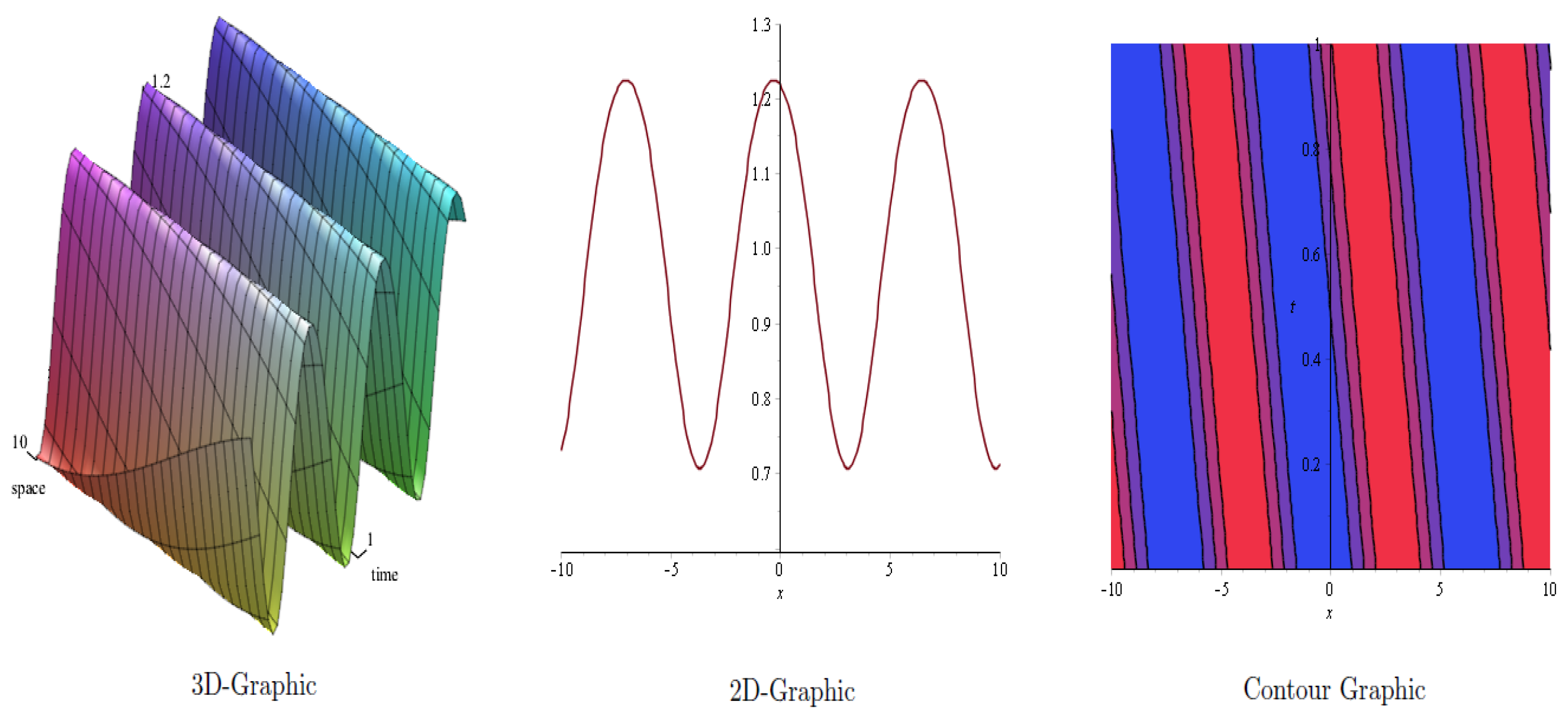
Figure 1. The 3D plot for the norm | u 1 ( x , t ) | within the interval 10 x 10 and 0 t 1 under the conditions λ = λ 1 , h 2 = h 21 , where m = 1 2 . The corresponding 2D plot for the norm | u 1 ( x , t ) | within the interval 10 x 10 at t = 0 . The corresponding contour plot for the norm | u 1 ( x , t ) | within the interval 10 x 10 and 0 t 1 .
Computation 14 00135 g001
Figure 2. The 3D plot for the norm | u 1 ( x , t ) | within the interval 10 x 10 and 0 t 1 under the conditions λ = λ 3 , h 2 = h 21 , where m = 1 2 . The corresponding 2D plot for the norm | u 1 ( x , t ) | within the interval 10 x 10 at t = 0 . The corresponding contour plot for the norm | u 1 ( x , t ) | within the interval 10 x 10 and 0 t 1 .
Computation 14 00135 g002
Figure 3. The 3D plot for the norm | u 7 ( x , t ) | within the interval 10 x 10 and 0 t 1 under the conditions λ = λ 1 , h 2 = h 21 , where m = 1 2 . The corresponding 2D plot for the norm | u 7 ( x , t ) | within the interval 10 x 10 at t = 0 . The corresponding contour plot for the norm | u 7 ( x , t ) | within the interval 10 x 10 and 0 t 1 .
Computation 14 00135 g003
Figure 4. The 3D plot for the norm | u 7 ( x , t ) | within the interval 10 x 10 and 0 t 1 under the conditions λ = λ 1 , h 2 = h 23 , where m = 1 2 . The corresponding 2D plot for the norm | u 7 ( x , t ) | within the interval 10 x 10 at t = 0 . The corresponding contour plot for the norm | u 7 ( x , t ) | within the interval 10 x 10 and 0 t 1 .
Computation 14 00135 g004
Figure 5. The 3D plot for the norm | u 1 ( x , t ) | within the interval 10 x 10 and 0 t 1 under the conditions λ = λ 1 , h 2 = h 21 , where m = 1 . The corresponding 2D plot for the norm | u 1 ( x , t ) | within the interval 10 x 10 at t = 0 . The corresponding contour plot for the norm | u 1 ( x , t ) | within the interval 10 x 10 and 0 t 1 .
Computation 14 00135 g005
Figure 6. The 3D plot for the norm | u 7 ( x , t ) | within the interval 10 x 10 and 0 t 1 under the conditions λ = λ 1 , h 2 = h 23 , where m = 1 . The corresponding 2D plot for the norm | u 7 ( x , t ) | within the interval 10 x 10 at t = 0 . The corresponding contour plot for the norm | u 7 ( x , t ) | within the interval 10 x 10 and 0 t 1 .
Computation 14 00135 g006
Table 1. Jacobi elliptic function solutions to Equation (10) for 0 < m < 1 .
No. l 0 l 2 l 4 P ( ξ )
11 ( 1 + m 2 ) m 2 sn ( ξ ) or cd ( ξ )
2 1 m 2 2 m 2 1 m 2 cn ( ξ )
3 m 2 1 2 m 2 1 dn ( ξ )
4 m 2 ( 1 + m 2 ) 1 ns ( ξ ) or dc ( ξ )
5 m 2 2 m 2 1 1 m 2 nc ( ξ )
6 1 2 m 2 m 2 1 nd ( ξ )
71 2 m 2 1 m 2 sc ( ξ )
81 2 m 2 1 m 2 ( 1 m 2 ) sd ( ξ )
9 1 m 2 2 m 2 1 cs ( ξ )
10 m 2 ( 1 m 2 ) 2 m 2 1 1 ds ( ξ )
11 1 4 ( 1 m 2 ) 1 2 ( 1 + m 2 ) 1 4 ( 1 m 2 ) nc ( ξ ) ± sc ( ξ ) or cn ( ξ ) 1 ± sn ( ξ )
12 1 4 ( 1 m 2 ) 2 1 2 ( 1 + m 2 ) 1 4 m cn ( ξ ) ± dn ( ξ )
13 1 4 1 2 ( 1 + m 2 ) 1 4 ( 1 m 2 ) 2 sn ( ξ ) cn ( ξ ) ± dn ( ξ )
14 1 4 1 2 ( 1 2 m 2 ) 1 4 sn ( ξ ) 1 ± cn ( ξ )
Disclaimer/Publisher’s Note: The statements, opinions and data contained in all publications are solely those of the individual author(s) and contributor(s) and not of MDPI and/or the editor(s). MDPI and/or the editor(s) disclaim responsibility for any injury to people or property resulting from any ideas, methods, instructions or products referred to in the content.