Article

Semi-Empirical Estimation of Aerosol Particle Influence at the Performance of Terrestrial FSO Links over the Sea


by
Argyris N. Stassinakis
1,
Efstratios V. Chatzikontis
2,
Kyle R. Drexler
3,
Andreas D. Tsigopoulos
1,
Gratchia Mkrttchian
4 and
Hector E. Nistazakis
2,*
1
Section of Battle Systems, Naval Operations, Sea Studies, Navigation, Electronics and Telecommunications, Hellenic Naval Academy, Hadjikyriakou Ave., 18539 Piraeus, Greece
2
Section of Electronic Physics and Systems, Department of Physics, National and Kapodistrian University of Athens, 15784 Athens, Greece
3
Naval Information Warfare Center Pacific, San Diego, CA 92152, USA
4
Centre of Excellence for Applied Research & Training—CERT, Higher Colleges of Technology, Abu Dhabi P.O. Box 5464, United Arab Emirates
*
Author to whom correspondence should be addressed.
Computation 2026, 14(2), 39; https://doi.org/10.3390/computation14020039
Submission received: 19 November 2025 / Revised: 6 January 2026 / Accepted: 16 January 2026 / Published: 2 February 2026
(This article belongs to the Section Computational Engineering)

Abstract

Free-space optical (FSO) communication enables high-bandwidth license-free data transmission and is particularly attractive for maritime point-to-point links. However, FSO performance is strongly affected by atmospheric conditions. This work presents a semi-empirical model quantifying the impact of fine particulate matter (PM2.5) on received optical power in a maritime FSO link. The model is derived from long-term experimental measurements collected over a 2.96 km horizontal optical path above the sea surface, combining received signal strength indicator (RSSI) data with co-located PM2.5 observations. Statistical analysis reveals a strong negative correlation between PM2.5 concentration and received optical power (Pearson coefficient −0.748). Using a logarithmic attenuation formulation, the PM2.5-induced attenuation is estimated to increase by approximately 0.0026 dB/km per µg/m3 of PM2.5 concentration. A second-order semi-empirical model captures the observed nonlinear attenuation behavior with a coefficient of determination of R2 = 0.57. The proposed model provides a practical tool for link budgeting, performance forecasting, and adaptive design of maritime FSO systems operating in aerosol-rich environments.

1. Introduction

In recent years, FSO communication systems technology is increasingly becoming an important and essential part of wireless optical communication systems due its ability to provide high-bandwidth, low-latency, and license-free data transmission over line-of-sight (LoS) paths [1,2,3]. FSO links over the sea present a compelling use case for FSO technology due to the wide-open nature inherent to large bodies of water. From a maritime applications perspective, this includes ship-to-ship and ship-to-shore communication, offshore oil and gas platform connectivity, port automation, etc. [4,5,6,7,8,9]. Modern naval fleets rely heavily on secure, high-speed communication links for coordinated operations. Civilian applications include real-time video surveillance for port security, autonomous vessel control, broadband internet delivery to remote coastal or island communities, etc. Point-to-point FSO systems can meet these demands without the need for license, for underwater cables or satellite relays, offering flexibility and rapid deployment in dynamic maritime environments.
One of the main challenges facing FSO systems is the inherent vulnerability to atmospheric and weather conditions [10,11]. Unlike RF signals, optical beams are highly susceptible to scattering, absorption, and turbulence caused by environmental factors including fog, rain, humidity, airborne particulates, etc. Among these, PM2.5 has emerged as a critical yet underexplored factor affecting FSO link reliability. These particles can scatter and absorb light within the operational wavelengths of FSO systems, leading to degradation in signal strength and consequently to link performance [12,13]. Being able to accurately model these effects will enhance network robustness and effectivity.
It is well documented that the influence of weather and atmospheric phenomena, such as turbulence, snow, fog, rain, hail, etc., will impact FSO links. There is less data though documenting scenarios where the atmosphere may be seem clear but has unexpected concentrations of PM2.5. This is particularly true for maritime environments where varying PM2.5 concentrations heavy with salt aerosols in high humidity air interact in complex and dynamic ways. Scenarios that create these conditions include emissions from ship engines, port activities, and nearby coastal urban centers, which contribute significantly to elevated PM2.5 concentrations in marine airspaces. Of particular note are busy shipping lanes and harbor areas [12,13]. These fine particles not only act as independent scattering centers but also undergo physical and chemical transformations influenced by local microclimatic conditions. In particular, high relative humidity plays a critical role in modulating the optical effects of PM2.5 through a process known as hygroscopic growth [12], where hygroscopic particles absorb water vapor and increase in size. This size enlargement alters the particles’ scattering efficiency and shifts their optical cross-section into a regime more accurately described by Mie scattering theory [12], which applies to particles whose sizes are comparable to the wavelength of the optical signal. As a result, both the scattering intensity and angular distribution become highly sensitive to humidity-induced particle growth. This leads to increased forward and backward scattering, thereby enhancing the overall attenuation experienced by the FSO laser beam. Moreover, the coexistence of sea salt aerosols and anthropogenic PM2.5 can result in the formation of mixed-composition aerosols with complex refractive indices, further complicating their scattering behavior under maritime humidity conditions. These interactions underscore the need to incorporate humidity-dependent models and Mie scattering analysis when evaluating FSO link performance in coastal environments, as simplistic assumptions about particle size and composition may underestimate the true extent of optical degradation.
Understanding the impact of PM2.5 in such settings is essential for designing robust and adaptive FSO communication links suitable for emerging and reliable maritime applications. In scenarios such as real-time navigation assistance, autonomous vessel communication, or high-definition video streaming for offshore inspections, even modest levels of signal attenuation can lead to substantial performance degradation or service interruptions [12,13]. These applications often operate with stringent quality-of-service (QoS) requirements, including low latency, high reliability, and minimal packet loss, all of which are highly sensitive to changes in received optical power. Unexpected PM2.5 particle concentrations, especially under conditions of high relative humidity and in the presence of other maritime aerosols, contribute to unpredictable and transient attenuation effects. Resulting in link instability that reduces the effective data throughput, by requiring increased retransmission rates or bit-error correction overhead. In latency-critical operations—such as collision avoidance systems or coordinated control of autonomous surface vessels—these disruptions compromise safety and operational efficiency. In bandwidth-intensive applications such as remote visual inspections of offshore infrastructure, degraded signal quality results in reduced video resolution, increased buffering, and potentially complete link outages. By leveraging data driven channel characterization models the influence of PM2.5 on FSO performance can be more accurately predicted for system designers to implement adaptive modulation schemes, dynamic power control, and redundancy mechanisms (e.g., hybrid RF/FSO switching) for mitigation purposes. This understanding is therefore not only academically significant but also practically vital for ensuring the reliability, resilience, and scalability of next-generation maritime optical communication systems. Several methods have also been studied for reducing the impact of PM2.5 particles [14,15,16].
Specifically, PM2.5 particles due to the magnitude of their size, attenuate optical signals through scattering and absorption mechanisms. Despite the significant influence of PM2.5 on FSO links’ performance, additional data driven models are necessary to describe this connection. This work presents the derivation of an empirical experimental model that quantifies the relationship between PM2.5 concentration and received optical power in a maritime FSO communication link. In this work, the corresponding statistical methods are used, in order to extract a predictive equation for attenuation due to PM2.5. The model serves as a practical tool for link budget estimation, system planning, and performance forecasting in marine FSO applications.
The remainder of this manuscript is organized as follows. Section 2 describes the experimental setup, including the maritime FSO link configuration, atmospheric sensing equipment, and data acquisition methodology. Section 3 presents the experimental results, statistical analysis, and derivation of the proposed semi-empirical attenuation model and discusses the physical interpretation, applicability, and limitations of the obtained results. Finally, Section 4 summarizes the main conclusions and outlines directions for future research.

2. Experimental Setup and Methodology

To properly investigate the impact of PM2.5 concentration on the received optical power in a maritime FSO communication link requires real world data. To achieve this, a 3 km FSO range roughly 3 km long was established across a coastal marine channel. The range was instrumented with synchronized environmental sensing systems and a data collection system. The experimental setup emulated real-world maritime communication scenarios by leveraging an off-the-shelf optical link operating outdoors in a maritime environment. Atmospheric conditions were monitored with weather stations and particle measurement devices. Data was collected for over a year resulting in an extended observation period to capture a broad range of particulate concentrations under varying meteorological conditions. The results of this work aim to provide empirical insights into the degradation of optical signal quality caused by PM2.5, thereby informing the design and reliability assessment of FSO systems deployed in maritime or coastal regions. Meteorological parameters such as temperature, relative humidity, wind speed, and visibility influence attenuation indirectly by modifying aerosol concentration, size distribution, and refractive index fluctuations. In this study, these parameters were constrained by selecting measurement intervals with similar atmospheric conditions and clear-sky operation, thereby reducing their variability. Under these conditions, PM2.5 concentration was treated as the dominant variable affecting attenuation and was explicitly modeled using a linearized Beer–Lambert formulation.

2.1. FSO Link Configuration

The experimental horizontal terrestrial FSO link was deployed between the roof of a building at the Hellenic Naval Academy in the entrance of Piraeus port in Greece, and the lighthouse of Psytalleia Island, spanning a horizontal distance of 2958 m, and 30 m above the sea’s surface. The link overview is depicted using satellite image in Figure 1.
The location was selected due to its strategic relevance to naval communication scenarios and the presence of typical maritime atmospheric conditions, including variable aerosol concentrations, sea spray, and humidity.
The FSO system operated at a wavelength of 830 nm, with transmitted optical power of 150 mW, beam divergence 2 mrad, and receiver sensitivity threshold of −30 dBm. Both transmitter and receiver units were mounted at elevated positions, to maintain line-of-sight and minimize misalignment. All the technical and physical specifications of the experimental setup are presented in Table 1.

2.2. Atmospheric Sensing Equipment

To monitor the environmental conditions affecting signal transmission, two types of sensors were deployed:
  • PM2.5 Concentration Sensors:
    • Optical particle counters capable of detecting and logging PM2.5 were installed near both the transmitter and receiver sites. These sensors provided real-time measurements of aerosol concentration in micrograms per cubic meter (µg/m3), recorded at intervals of 10 min.
  • Weather Station:
    • An accurate meteorological station is installed at the transmitter side and recorded the following three key atmospheric parameters:
    Temperature (in °C).
    Relative humidity (%).
    Wind speed and direction (in m/s and degrees (°), respectively).
The data were isolated to the specific contribution of PM2.5 to optical signal attenuation by accounting for potential confounding environmental effects. This was achieved by selecting measurement intervals corresponding to similar ranges of ambient temperature, relative humidity, and wind speed, thereby minimizing short-term meteorological variability. Furthermore, all measurements were conducted under clear-sky conditions, with no fog, precipitation, or extreme atmospheric events observed during the data acquisition period. Under these constrained conditions, variations in received optical power can be primarily attributed to changes in PM2.5 concentration. Furthermore, the proposed attenuation model implicitly assumes that PM2.5 concentration is approximately homogeneous along the optical path or, equivalently, that the measured concentration represents a path-averaged value. This assumption is common in long-path atmospheric attenuation modeling, where received signal strength reflects the cumulative effect of scattering and absorption integrated over the propagation distance. If particulate matter were spatially localized near one end of the link, the total attenuation could remain comparable for the same path-integrated PM2.5 load; however, localized aerosol layers may introduce additional variability due to enhanced turbulence, beam distortion, or localized scattering. Since the present study relies on RSSI measurements, which provide no spatial resolution along the link, the model captures the aggregate attenuation effect rather than the spatial distribution of particles. Extensions of this work could incorporate spatially resolved aerosol sensing or segmented link measurements to explicitly account for non-uniform PM2.5 distributions.

2.3. RSSI-Based Optical Power Measurement

The received optical power in was indirectly measured using the received signal strength indicator (RSSI) output provided by the FSO communication device. RSSI represents the detected signal level at the photodetector and is internally calibrated by the device to approximate received optical power, in mV [17]. This method offers practical advantages, as it enables continuous, real-time monitoring of signal strength without requiring external optical power meters.
The use of RSSI in this context is deemed appropriate due to its direct correlation with optical power loss and its suitability for capturing real world variations in link performance caused by environmental factors.

2.4. Data Acquisition and Synchronization

Received optical power was continuously monitored using the diagnostics interface of the FSO receiver, which provided RSSI data at synchronized intervals with the environmental sensors. Measurements were collected over an extended observation period covering a wide range of atmospheric conditions, including clear days, and periods of high humidity. This variability was essential to develop a reliable empirical model capturing the relationship between the environment and optical power attenuation [18]. In this work, it is important to note that, PM2.5 concentration is influenced by ambient relative humidity and temperature. Under high humidity conditions, hygroscopic particles absorb moisture and grow in size, which can lead to increased scattering of optical signals and elevated PM2.5 readings from optical sensors. Temperature also affects PM2.5 dynamics by influencing chemical reactions, atmospheric dispersion, and the formation or evaporation of particulate matter.

2.5. Methodology for Model Derivation

The collected data was preprocessed to filter out anomalies and sensor errors, and then statistically analyzed to identify trends and correlations. The following procedure was used to obtain accurate and reliable data:
  • Data alignment:
Time-aligned datasets were merged to create synchronized records of received power RSSI and environmental parameters. Data was aligned with 1 s of each other.
  • Outlier removal:
Spurious or inconsistent readings caused by sensor glitches, extreme weather events, or maintenance activities were excluded.
  • Correlation analysis:
Initial analysis focused on identifying correlations between PM2.5 levels and variations in received optical power with raw power being the correlation metric.
  • Regression modeling:
Several empirical models were tested, including linear, exponential, and logarithmic fits, to determine the best-fit relationship between PM2.5 concentration and signal attenuation.
  • Validation:
We evaluated the performance model using standard statistical metrics including: the coefficient of determination, root mean square error, and residual analysis.
The current (semi-)empirical equation model created is based on both statistical accuracy and physical interpretability, providing a practical tool for estimating FSO performance degradation under varying maritime air quality conditions and is documented in Section 3 where the “Results” appear.

3. Results

The data collected over the year of 2024 experimental period revealed a clear relationship between PM2.5 concentration and RSSI in the FSO link over the sea. The results presented in this section include descriptive statistics, visualizations of the data trends, and the derivation of an empirical model characterizing PM2.5-induced attenuation.

3.1. PM2.5 Concentration and Received Optical Power Trends

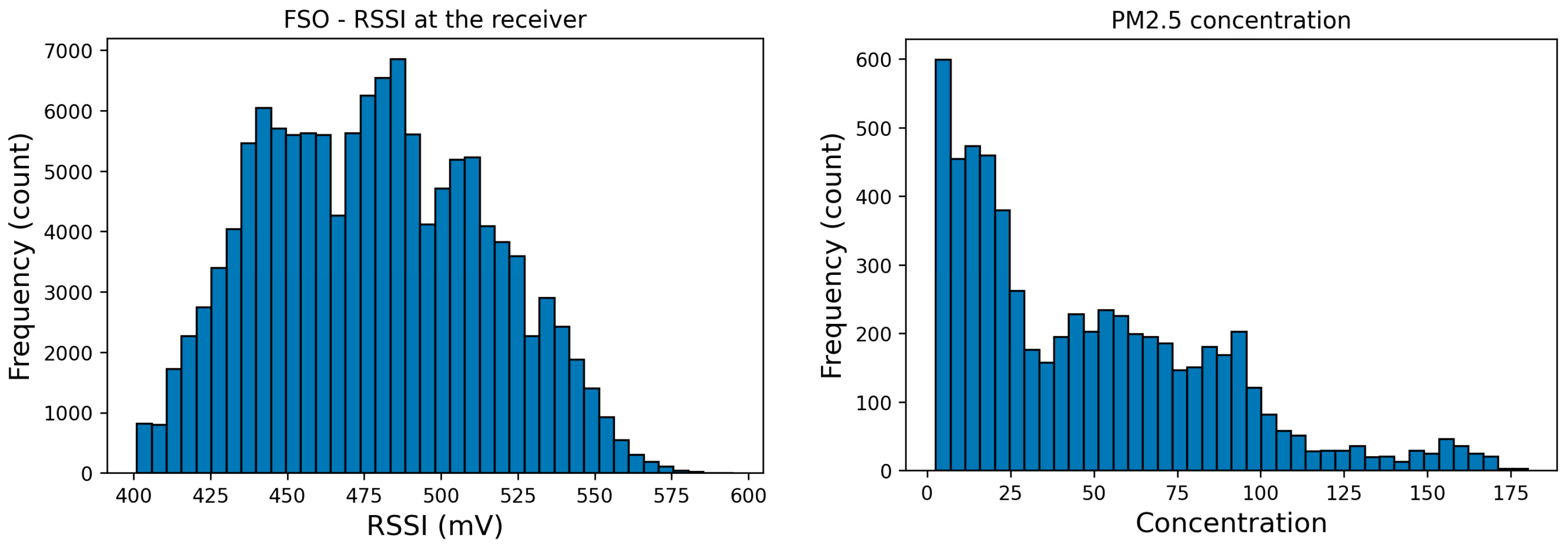
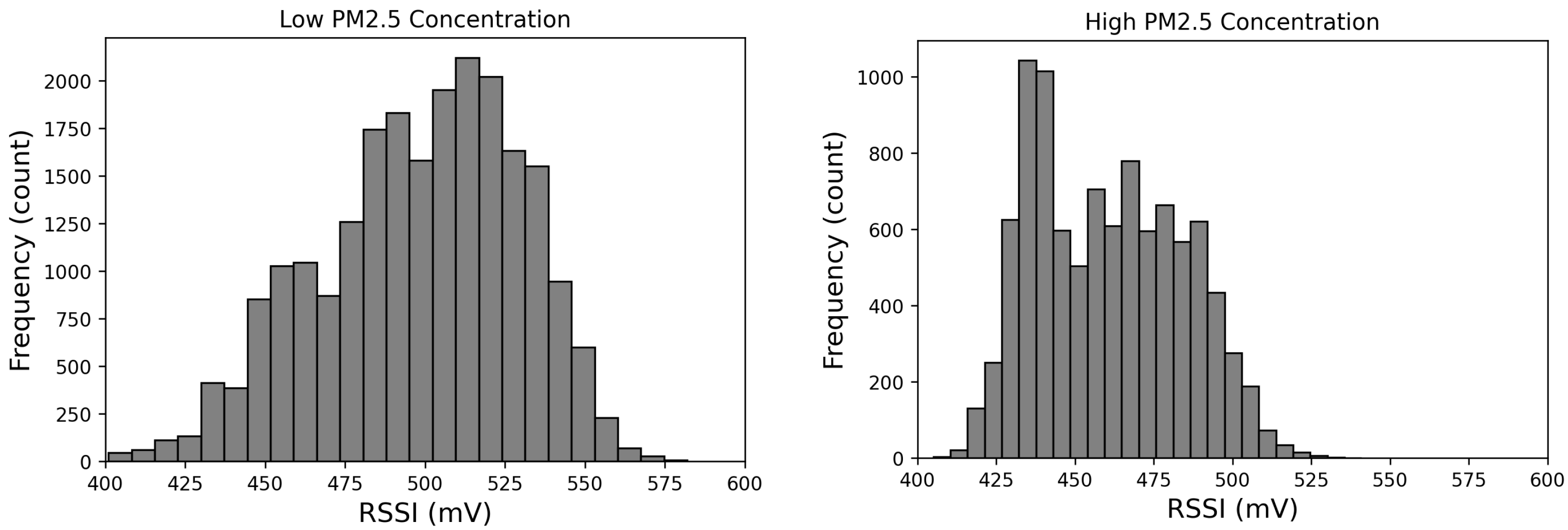
During the measurement campaign, PM2.5 concentration levels and RSSI mean values, range and standard deviation are presented in Figure 2 and Figure 3 and Table 2.
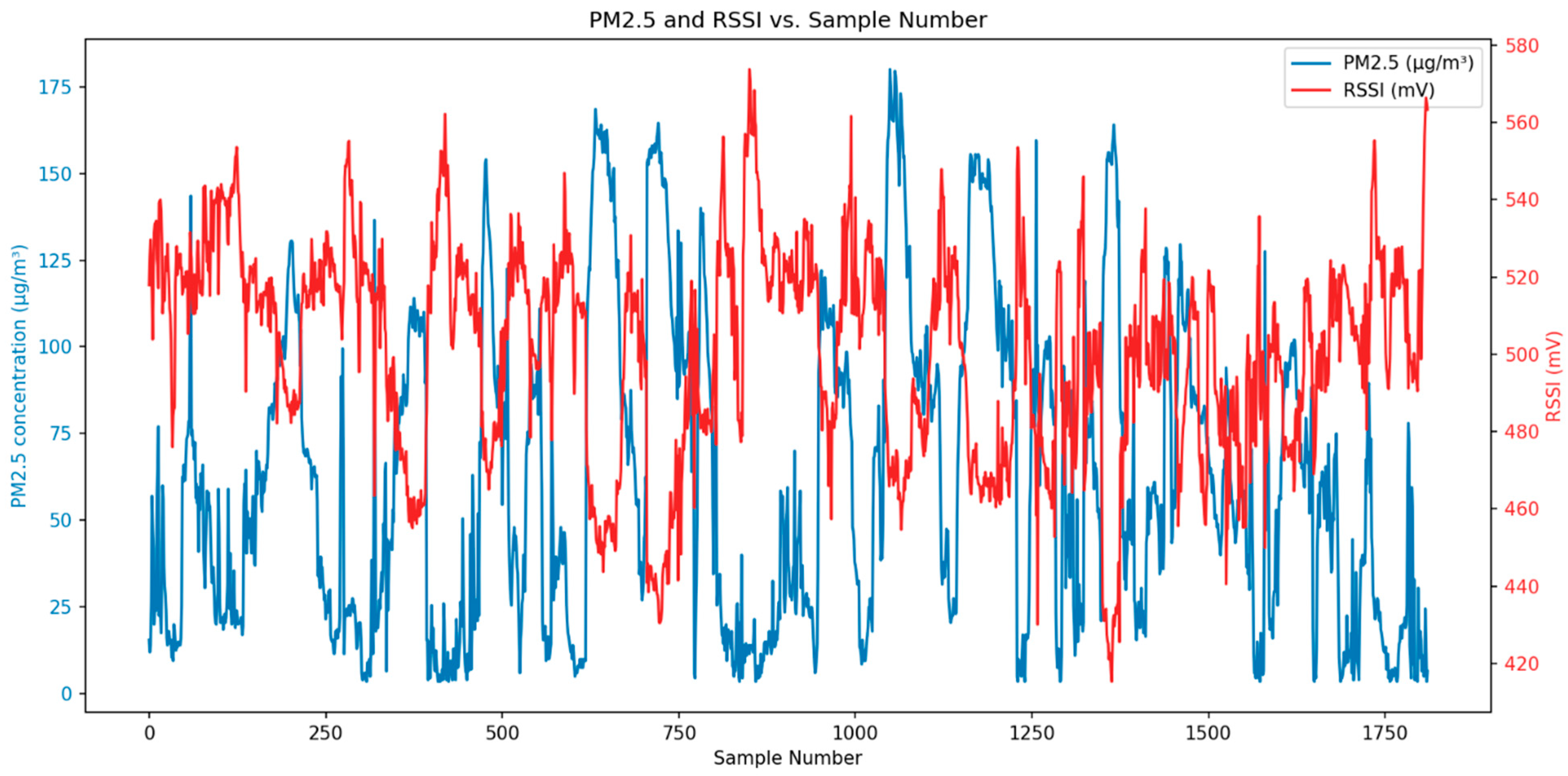
Figure 4 illustrates a snapshot in time of the variation in received optical power alongside PM2.5 concentration. A clear inverse trend was observed: higher PM2.5 concentrations consistently corresponded to lower received signal strength.
The plotted data reveals an apparent inverse correlation between PM2.5 concentration and RSSI values over time. As PM2.5 levels (blue line) rise, there is a noticeable tendency for RSSI (red line) to decrease, and vice versa. This inverse relationship suggests that higher particulate matter concentrations in the environment may be contributing to signal attenuation or interference, possibly due to scattering or absorption effects of airborne particles. The pattern persists throughout the entire sampling window, reinforcing the potential significance of environmental air quality on wireless communication performance. Notably, sharp spikes in PM2.5 concentration often coincide with corresponding dips in RSSI, supporting the hypothesis of interference. The strength and direction of the linear relationship between PM2.5 concentration and RSSI were assessed using the Pearson correlation coefficient using the following mathematical expression [19]:
r = i = 1 n ( x i x ¯ ) ( y i y ¯ ) i = 1 n ( x i x ¯ ) 2 i = 1 n ( y i y ¯ ) 2
where x represents the PM2.5 concentration values and y stands for the corresponding RSSI values. In this work, the number of used samples is n = 12,532.

3.2. Correlation Analysis

A statistical correlation analysis between PM2.5 concentration and received optical power yielded a negative Pearson correlation coefficient of Cr which was calculated as −0.748. This value indicates a strong negative correlation, meaning that as PM2.5 levels increase, RSSI values tend to decrease. In general, correlation coefficients in the range of ±0.7 to ±1.0 are considered strong, ±0.5 to ±0.7 moderate, and below ±0.5 weak [19]. Further statistical analysis would be helpful to quantify the strength of this inverse relationship.
Increased PM2.5 levels were consistently associated with optical power degradation, consistent with expected scattering and absorption effects in the 830 nm wavelength range.

3.3. Estimation of Attenuation Coefficient Using RSSI and PM2.5 Measurements

To investigate the influence of particulate matter on free-space optical signal degradation, we analyzed experimental data consisting of PM2.5 concentration and received signal strength indicator (RSSI) measurements over a horizontal fixed 2958 m optical wireless path. Although RSSI is not a direct measure of received optical power, it is assumed to be proportional to the received power, which allows us to apply a logarithmic attenuation model consistent with the Beer-Lambert law.
The general form of the Beer-Lambert law is given as follows [17]:
P = P 0 e x p ( a L )
where P is the received optical power (in mW), P0 is the initially transmitted optical power (in mW), α is the attenuation coefficient (in m−1), and L is the path length (in m). In the context of RSSI, we assume the sensor reports a value proportional to P, so we model
R S S I = C e x p ( a L )
with C being a sensor-dependent constant which is given through the following mathematical expression:
ln R S S I = ln C a L
Assuming that attenuation is driven primarily by PM2.5 concentration and is linearly related, i.e., a = k · P M 2.5 , where k is the specific attenuation coefficient per unit PM2.5 concentration we obtain
ln R S S I = A B · P M 2.5
where A = ln C is the transmitted signal level, − B = k L is the regression slope combining the effect of particulate sensitivity and path length.
We performed a linear regression using the natural logarithm of RSSI as the dependent variable and PM2.5 concentration (in µg/m3) as the independent variable. The regression yielded a slope of B = −0.0009.
Given the known path length of L = 2960 m, the specific attenuation coefficient per unit PM2.5 concentration is
k = B L = 3 × 10 7   m 1 / μ g / m 3
and
k d B / k m = k · 1000 · 8.686 = 0.0026   d B / k m / μ g / m 3
where kdB/km is the attenuation coefficient expressed in dB/km per unit PM2.5 concentration μg/m3 (i.e., dB/km/μg/m3).
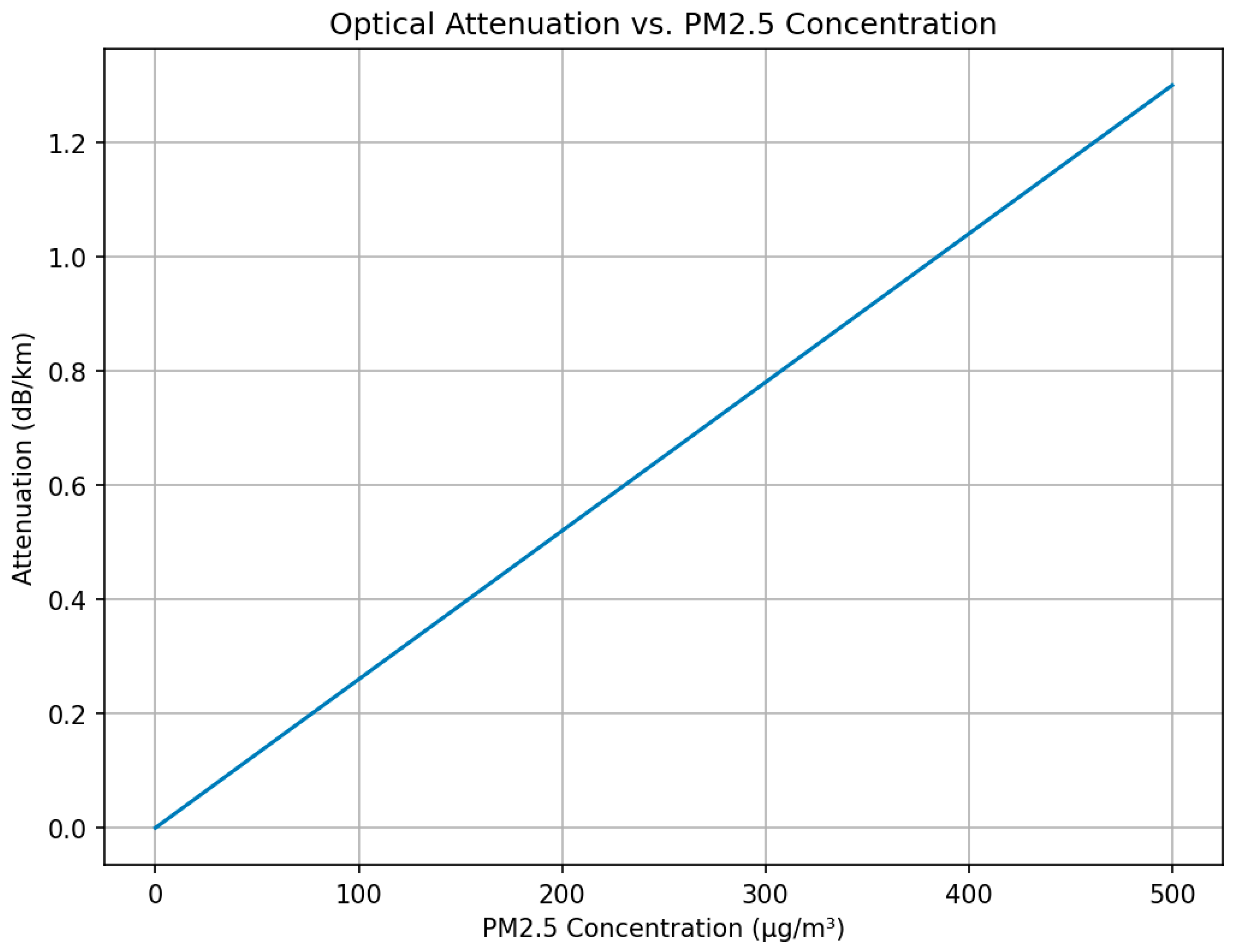
The expressions (6) and (7) imply that for every 1 µg/m3 increase in PM2.5 concentration, the signal attenuation increases by approximately 0.0026 dB/km. While the intercept A reflects a sensor- and system-specific baseline, the slope B directly enables estimation of attenuation per unit concentration, enabling quantification of air quality effects on long-range optical links. The obtained results are depicted in Figure 5.
Figure 5 illustrates a clear linear relationship between PM2.5 concentration (μg/m3) and optical attenuation (dB/km), indicating that as the concentration of fine particulate matter increases, the attenuation of optical signals also rises proportionally. This trend suggests that higher levels of PM2.5 in the atmosphere can significantly degrade the performance of free-space optical communication systems. These results support the hypothesis that PM2.5 particles, due to their small size and strong light-scattering characteristics, play a critical role in limiting the transmission range and signal clarity of optical systems. The linearity of the data also implies a predictable degradation pattern, which can be useful for system calibration and forecasting under varying air quality conditions.

3.4. Empirical Equation Model Derivation

Based on the observed data, several candidate models were fitted to describe the attenuation effect as a function of PM2.5 concentration. In this work, a second-order polynomial fit was selected over a linear model to more accurately capture the nonlinear relationship observed between PM2.5 concentration and received optical power. In addition to the second-order polynomial model, several alternative fitting functions were evaluated, including linear, exponential, and logarithmic models, to assess their ability to capture the relationship between PM2.5 concentration and received optical power. While all models exhibited the expected inverse trend, the second-order polynomial provided the best overall performance in terms of goodness-of-fit metrics, yielding higher R2 values and lower RMSE and MAE compared to first-order and exponential formulations. Moreover, the polynomial model better captured the observed nonlinear attenuation behavior at higher PM2.5 concentrations, which is consistent with physical scattering mechanisms. For these reasons, the second-order polynomial model was selected as the most suitable semi-empirical representation. Empirical analysis of the collected data revealed that attenuation does not increase at a constant rate with rising PM2.5 levels. This nonlinear behavior is consistent with physical scattering principles, such as Mie scattering, which becomes increasingly prominent as particle size approaches or exceeds the wavelength of the transmitted optical signal, especially under conditions of hygroscopic growth. The second-order polynomial model provided a significantly better statistical fit to the experimental data—as evidenced by lower residual errors and improved goodness-of-fit metrics (e.g., R2 and RMSE)—and thus offers a more accurate and physically meaningful representation of the attenuation dynamics in maritime FSO environments.
The proposed empirical equation is
R S S I = a 1 P M 2.5 2 + a 2 P M 2.5 + a 3
where ai, with i = 1, 2, 3, stands for the model’s coefficients to estimate.
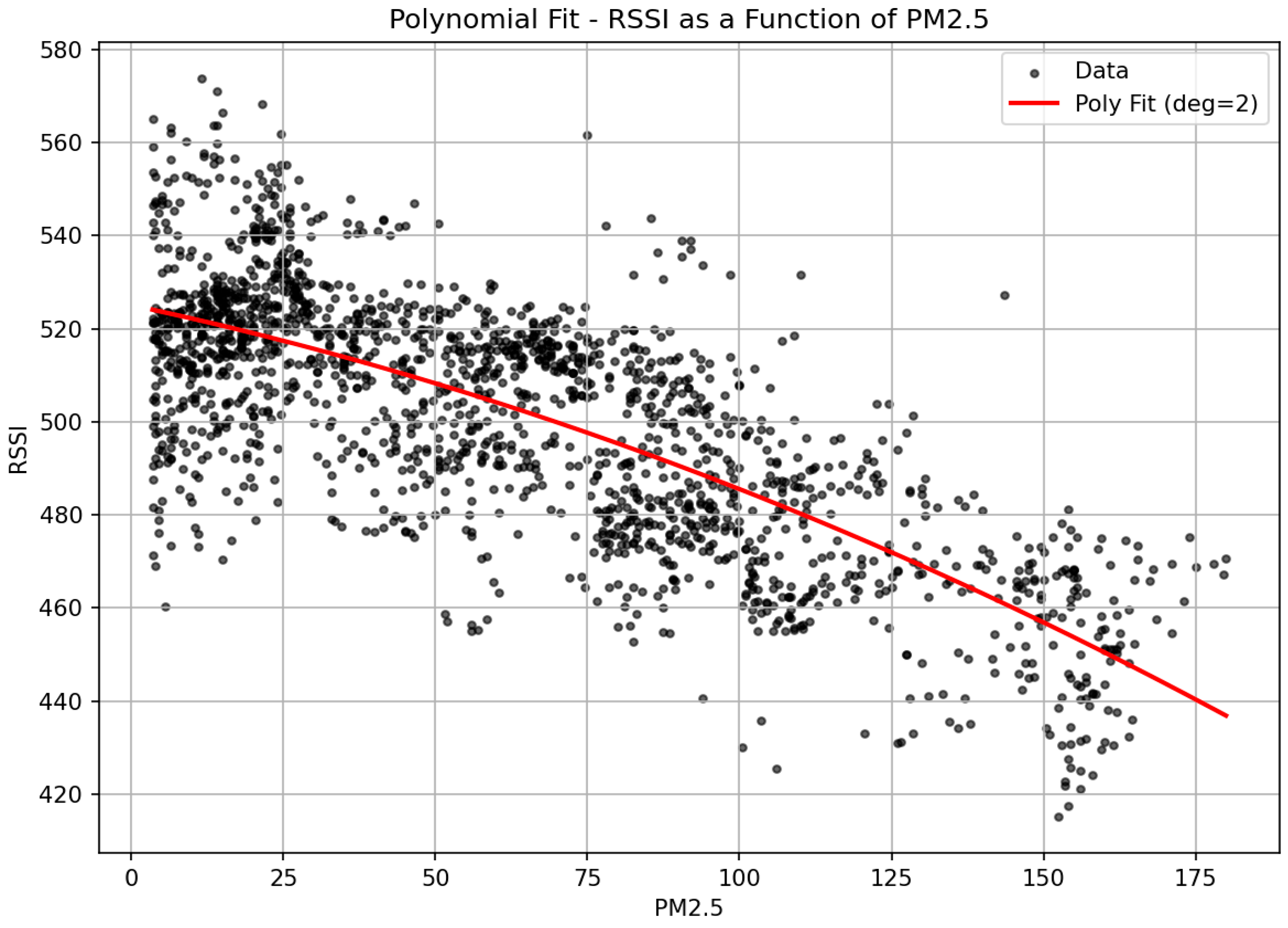
In Figure 6 the scatter diagram and the best 2nd order polynomial fit is presented [20]. The scatter plot with a second-degree polynomial fit provides further evidence supporting the inverse relationship between PM2.5 concentration and RSSI. The fitted curve shows a clear downward trend, indicating that as PM2.5 levels increase, RSSI values tend to decrease. This trend is not strictly linear but exhibits a gentle curvature, suggesting a more complex interaction where the rate of RSSI degradation may increase at higher PM2.5 concentrations. The spread of data points around the fitted line indicates some variability, which may be attributed to other environmental or system-level factors affecting signal strength, such as temperature, humidity, or multipath interference. However, the central tendency captured by the polynomial fit reinforces the notion that PM2.5 acts as a degrading agent for wireless signal propagation, possibly through mechanisms like signal scattering or partial absorption. This insight is significant for the design and deployment of wireless sensor networks in polluted environments. It highlights the potential need for adaptive communication protocols that account for varying air quality, especially in regions with fluctuating PM2.5 levels.
The value of coefficients that best fit the data are presented in Table 3.
Thus, the final semi-empirical equation model that is extracted through the above method will have the following form:
R S S I = 0.0012 P M 2.5 2 0.2766 P M 2.5 + 525.1
In the context of the second-order polynomial model used in this study to describe the relationship between PM2.5 concentration and received optical power, the constant term a3 = 525.1 that represents the baseline received optical power in the absence of PM2.5-induced attenuation. This value corresponds to the expected received power under clear-air atmospheric conditions, where the contribution of PM2.5 particles to signal degradation is negligible. It effectively sets the upper limit of the received power for the given FSO system configuration and serves as a reference point against which attenuation due to varying particulate concentrations is quantified.
To quantitatively evaluate the accuracy of the polynomial regression model, key error metrics such as Root Mean Square Error (RMSE), Mean Absolute Error (MAE), and the coefficient of determination (R2) will be calculated. RMSE provides insight into the model’s prediction error magnitude, penalizing larger deviations more heavily, while MAE offers a more interpretable measure of average absolute error, less sensitive to outliers. R2 will assess how well the variation in RSSI is explained by PM2.5 levels through the fitted curve. The equations of the corresponding metrics are given by the following equations [21,22]:
R 2 = 1 i = 1 n ( x i x i ^ ) 2 i = 1 n ( x i x ¯ ) 2
and
R M S E = 1 n i = 1 n ( x i x i ^ ) 2
and
M A E = 1 n i = 1 n | x i x i ^ | 2
where x is the actual observed value, x ^ is the predicted value and x ¯ is the mean of the observed values and n is the number of samples, (i.e., n = 12,532).
The obtained results appear in Table 4 where the RMSE, MAE and R2 of the RSSI of the model are presented Such parameters were calculated according to the above Equations (10)–(12).
The model yielded an RMSE of 17.8 and an MAE of 14.2, indicating that, on average, the prediction error remains within approximately 3.5% of the total RSSI range (158 units) and about 5.2% relative to the RSSI mean. Ideally, RMSE and MAE should each be below 10–20% of the total RSSI range or below one standard deviation of the data. In this case, the RSSI range is 158 units, so a target RMSE/MAE under 16–32 would be acceptable. These values are within acceptable bounds for environmental data, which often contain substantial variability due to uncontrolled external factors [23].
The R2 value of 0.57 suggests a significant fit, indicating that around 57% of the variability in RSSI can be explained by changes in PM2.5 concentration using the second-degree polynomial model. While this leaves room for unexplained variation, it still supports the hypothesis of an inverse relationship between PM2.5 concentration and signal strength. The unexplained portion may be attributed to other environmental or system factors not included in the model.
The results of this study demonstrate a clear and statistically significant relationship between PM2.5 concentration and signal attenuation in a maritime free-space optical (FSO) communication link, as evidenced by the strong negative correlation (−0.748) and the derived semi-empirical attenuation model. The observed attenuation behavior is consistent with established physical mechanisms governing optical propagation in aerosol-rich atmospheres, where PM2.5 particles, induce scattering and absorption, with effects further amplified under maritime humidity conditions due to hygroscopic particle growth. The nonlinear trend captured by the second-order polynomial model indicates that attenuation intensifies at higher particulate concentrations, reflecting increasingly complex aerosol–optical interactions in polluted marine air. The magnitude of the derived attenuation coefficient is consistent to previously reported experimental studies on aerosol- and atmosphere-induced losses in terrestrial and maritime FSO links, while extending existing work by explicitly isolating the contribution of PM2.5 under otherwise clear-sky conditions. From a practical perspective, the proposed semi-empirical model provides a useful tool for link budgeting, performance forecasting, and adaptive system design in maritime environments, where even moderate increases in particulate concentration can cumulatively degrade received power over kilometer-scale links. Potential applications include adaptive power control, dynamic modulation schemes, and hybrid RF/FSO architectures that leverage real-time air-quality awareness to enhance link reliability. The proposed second-order semi-empirical model is structurally adaptable to other geographical regions and deployment scenarios, provided that appropriate recalibration is performed. While the functional form of the model is expected to remain valid for similar optical wavelengths and horizontal FSO links operating in aerosol-influenced environments, the numerical values of the coefficients are site- and system-dependent. The coefficients a 1 and a 2 , which govern the rate and nonlinearity of attenuation with respect to PM2.5 concentration, are expected to remain within a comparable order of magnitude for regions with similar aerosol composition, humidity regimes, and optical wavelengths, although deviations may arise due to differences in particle size distribution and refractive index. In contrast, the constant term a 3 primarily reflects the baseline received optical power of the specific communication link and is therefore strongly dependent on system parameters such as transmitter power, link geometry, optical alignment, and receiver sensitivity. Consequently, a 3 should be interpreted as a link-specific calibration parameter, whereas a 1 and a 2 characterize the environmental attenuation behavior.

4. Discussion

The results of this study demonstrate a clear and statistically significant impact of PM2.5 concentration on the performance of a maritime free-space optical (FSO) communication link. The strong negative correlation (−0.748) between PM2.5 levels and received optical power confirms that increased aerosol loading leads to measurable signal attenuation. This highlights the importance of particulate-related effects that are not explicitly captured by conventional FSO channel models focused primarily on visibility, fog, or turbulence. The observed attenuation behavior is consistent with established physical mechanisms governing optical propagation in aerosol-rich environments. PM2.5 particles have characteristic sizes comparable to the operating wavelength (830 nm), placing their interaction with the optical beam within the Mie scattering regime. In maritime atmospheres, this effect is further enhanced by hygroscopic growth under elevated relative humidity, which increases particle size and scattering efficiency. The nonlinear trend captured by the second-order polynomial model indicates that attenuation intensifies at higher PM2.5 concentrations, reflecting increasingly complex aerosol–optical interactions rather than a purely linear extinction process. The estimated attenuation coefficient of approximately 0.0026 dB/km per µg/m3 of PM2.5 provides a quantitative measure of the sensitivity of long-range maritime FSO links to fine particulate pollution. Although modest at low concentrations, the cumulative impact can become operationally significant in coastal and port environments characterized by persistent or sudden aerosol emissions. The magnitude of the obtained attenuation is consistent with previously reported experimental studies on aerosol- and atmosphere-induced losses in terrestrial and maritime FSO links, while extending existing work by explicitly isolating the contribution of PM2.5 under otherwise clear atmospheric conditions. The coefficient of determination (R2 = 0.57) indicates that PM2.5 concentration explains a substantial portion of the observed variability in received signal strength, while the remaining variability can reasonably be attributed to unmodeled factors such as residual turbulence, short-term humidity fluctuations, or spatial inhomogeneity of aerosols along the propagation path. While the numerical coefficients of the proposed model are link- and site-specific, the functional form is expected to be transferable to similar maritime FSO deployments following appropriate recalibration. As such, the model offers a practical tool for link budgeting, performance forecasting, and the development of adaptive mitigation strategies in aerosol-influenced maritime environments.
While the experimental dataset used in this study was collected at a single maritime site, the proposed modeling methodology is not site-specific. The semi-empirical framework—based on synchronized RSSI measurements, co-located PM2.5 observations, and regression-based attenuation modeling—can be directly applied to other geographical regions and FSO deployments operating under aerosol-influenced conditions. The numerical values of the model coefficients are expected to vary depending on local aerosol composition, humidity regime, and system configuration; however, the functional form of the model and the observed attenuation trend are governed by the same underlying physical mechanisms. External validation using independent datasets from other maritime or coastal regions is therefore identified as an important direction for future work and will be pursued when suitable long-term experimental data become available.

5. Conclusions

In this work, the impact of PM2.5 concentration on the received optical power in an experimental horizontal maritime FSO communication link, approximately three kilometers in length and positioned almost thirty meters above the sea’s surface at the entrance of Piraeus Port in Greece, is investigated. By employing accurate RSSI-based signal measurements in conjunction with synchronized environmental data, a second-order accurate polynomial model was developed to empirically characterize the attenuation behavior caused by varying PM2.5 concentration levels. The results reveal a strong inverse relationship between PM2.5 concentration and received signal strength, consistent with physical mechanisms such as Mie scattering and hygroscopic particle growth under high relative humidity conditions. The fitted model exhibited a high degree of correlation, e.g., R2 = 0.57, validating its applicability for performance forecasting. Moreover, the model accurately captured nonlinear attenuation trends at elevated PM2.5 concentrations, where signal degradation became significantly more pronounced, e.g., RMSE = 17.8.
This modeling approach provides a valuable tool for predicting FSO link performance in environments affected by airborne particulate pollution. It enables the design of adaptive FSO systems that can dynamically respond to changes in atmospheric conditions, particularly in challenging maritime contexts such as ship-to-shore, vessel-to-vessel, and offshore platform communication scenarios. The proposed model may also contribute to link budgeting strategies, real-time quality-of-service estimation, and environmental awareness in next-generation optical wireless networks. While the present model was derived from data collected at a single maritime site, its structure is intended to be transferable through site-specific recalibration of the model coefficients when applied to other regions. Future research will focus on validating the proposed model under a broader range of meteorological and geographical conditions, including diverse coastal and open-sea environments. Incorporating real-time bit error rate (BER) and throughput measurements into the analysis will further strengthen the practical relevance of the model for communication system design. In addition, expanding the empirical framework to consider other atmospheric variables—such as aerosol composition, wind patterns, temperature gradients, etc.—could enhance model accuracy and generalizability. Finally, the integration of the attenuation model into adaptive modulation schemes and hybrid RF/FSO architecture represents a promising direction for building resilient and high-performance maritime communication networks.

Author Contributions

Conceptualization, A.N.S., A.D.T., H.E.N. and K.R.D.; methodology, A.N.S., E.V.C., K.R.D., H.E.N. and G.M.; software, A.N.S. and E.V.C.; validation K.R.D., A.N.S., A.D.T., E.V.C., G.M. and H.E.N.; formal analysis, A.D.T. and K.R.D.; investigation, A.N.S.; resources, A.N.S., E.V.C., A.D.T., H.E.N. and G.M., writing—original draft preparation, A.N.S.; writing—review and editing, A.D.T., H.E.N. and K.R.D. All authors have read and agreed to the published version of the manuscript.

Funding

This research received no external funding.

Data Availability Statement

All data appear in the manuscript.

Conflicts of Interest

The authors declare no conflict of interest.

References

  1. Ali, K.M.; Uysal, M. Survey on free space optical communication: A communication theory perspective. IEEE Commun. Surv. Tutor. 2014, 16, 2231–2258. [Google Scholar]
  2. Hennes, H.; Wilfert, O. An introduction to free-space optical communications. Radioengineering 2010, 19, 203–212. [Google Scholar]
  3. Nistazakis Hector, E.; Stassinakis, A.N.; Sinanović, S.; Popoola, W.O.; Tombras, G.S. Performance of quadrature amplitude modulation orthogonal frequency division multiplexing-based free space optical links with non-linear clipping effect over gamma–gamma modelled turbulence channels. IET Optoelectron. 2015, 9, 269–274. [Google Scholar] [CrossRef]
  4. Ming, L.; Cvijetic, M. Coherent free space optics communications over the maritime atmosphere with use of adaptive optics for beam wavefront correction. Appl. Opt. 2015, 54, 1453–1462. [Google Scholar] [CrossRef] [PubMed]
  5. Juarez Juan, C.; Sluz, J.E.; Nelson, C.; Airola, M.B.; Fitch, M.J.; Young, D.W.; Terry, D.; Davidson, F.M.; Rottier, J.R.; Sova, R.M. Free-space optical channel characterization in the maritime environment. In Atmospheric Propagation VII; SPIE: Amsterdam, The Netherlands, 2010; Volume 7685. [Google Scholar]
  6. Willitsford, A.; Newell, K.T.; O’Toole, M.; Patel, K. Maritime free space optical communications field test and link budget statistics. Opt. Express 2024, 32, 13769–13782. [Google Scholar] [CrossRef] [PubMed]
  7. Rabinovich, W.S.; Mahon, R.; Ferraro, M.S. Estimating maritime free space optical link performance using models based on experimental measurements. In Laser Communication and Propagation through the Atmosphere and Oceans XII; SPIE: Amsterdam, The Netherlands, 2023; Volume 12691, pp. 66–81. [Google Scholar]
  8. Alqurashi, F.S.; Trichili, A.; Saeed, N.; Ooi, B.S.; Alouini, M.S. Maritime communications: A survey on enabling technologies, opportunities, and challenges. IEEE Internet Things J. 2022, 10, 3525–3547. [Google Scholar] [CrossRef]
  9. Rabinovich, W.S.; Mahon, R.; Ferraro, M.S. Optical scintillation in a maritime environment. Opt. Express 2023, 31, 10217–10236. [Google Scholar] [CrossRef] [PubMed]
  10. Zabih, G.; Popoola, W. Terrestrial free-space optical communications. In Mobile and Wireless Communications Network Layer and Circuit Level Design; IntechOpen: London, UK, 2010; Volume 17, pp. 355–391. [Google Scholar]
  11. Lionis, A.; Chaskakis, G.; Cohn, K.; Blau, J.; Peppas, K.; Nistazakis, H.E.; Tsigopoulos, A. Optical turbulence measurements and modeling over Monterey Bay. Opt. Commun. 2022, 520, 128508. [Google Scholar] [CrossRef]
  12. Gao, R.S.; Telg, H.; McLaughlin, R.J.; Ciciora, S.J.; Watts, L.A.; Richardson, M.S.; Schwarz, J.P.; Perring, A.E.; Thornberry, T.D.; Rollins, A.W.; et al. A light-weight, high-sensitivity particle spectrometer for PM2.5 aerosol measurements. Aerosol Sci. Technol. 2016, 50, 88–99. [Google Scholar] [CrossRef]
  13. Xing, Y.; Shi, W.; Luo, N.; Zhao, W.; Wang, H.; Yu, X. Satellite-based PM2.5 estimation using fine-mode aerosol optical thickness over China. Atmos. Environ. 2017, 170, 290–302. [Google Scholar]
  14. Helsdingen, W.; den Breeje, R.; Saathof, R. Modeling the physical layer of air-to-space optical communication networks using the modified multi-scale method. J. Opt. Commun. Netw. 2025, 17, 178–187. [Google Scholar] [CrossRef]
  15. Galaktionov, I.; Toporovsky, V. Performance Analysis of an Optical System for FSO Communications Utilizing Combined Stochastic Gradient Descent Optimization Algorithm. Appl. Syst. Innov. 2025, 8, 143. [Google Scholar] [CrossRef]
  16. Schiavon, M.; Vanzo, A.; Campaci, K.; Marulanda Acosta, V.; Bonora, S. Multi-Actuator Lens Systems for Turbulence Correction in Free-Space Optical Communications. Photonics 2025, 12, 870. [Google Scholar] [CrossRef]
  17. Stassinakis Argyris, N.; Papavgeris, G.A.; Nistazakis, H.E.; Tsigopoulos, A.D.; Androutsos, N.A.; Tombras, G.S. Experimental model development for the attenuation coefficient estimation of terrestrial optical wireless links over the sea. Telecom 2021, 2, 93–107. [Google Scholar] [CrossRef]
  18. Lin, C.; Labzovskii, L.D.; Mak, H.W.L.; Fung, J.C.H.; Lau, A.K.H.; Kenea, S.T.; Bilal, M.; Hey, J.D.V.; Lu, X.; Ma, J. Observation of PM2.5 using a combination of satellite remote sensing and low-cost sensor network in Siberian urban areas with limited reference monitoring. Atmos. Environ. 2020, 227, 117410. [Google Scholar] [CrossRef]
  19. Garcia, A.A.; Sayago, A.; González, A.G. The correlation coefficient: An overview. Crit. Rev. Anal. Chem. 2006, 36, 41–59. [Google Scholar] [CrossRef]
  20. Marko, S.; Mooi, E. Regression analysis. In A Concise Guide to Market Research: The Process, Data, and Methods Using IBM SPSS Statistics; Springer: Berlin/Heidelberg, Germany, 2019; pp. 209–256. [Google Scholar]
  21. Chicco, D.; Warrens, M.J.; Jurman, G. The coefficient of determination R-squared is more informative than SMAPE, MAE, MAPE, MSE and RMSE in regression analysis evaluation. PeerJ Comput. Sci. 2021, 7, e623. [Google Scholar] [CrossRef] [PubMed]
  22. Willmott, C.J.; Matsuura, K. Advantages of the mean absolute error (MAE) over the root mean square error (RMSE) in assessing average model performance. Clim. Res. 2005, 30, 79–82. [Google Scholar] [CrossRef]
  23. Wang, W.; Lu, Y. Analysis of the mean absolute error (MAE) and the root mean square error (RMSE) in assessing rounding model. In IOP Conference Series: Materials Science and Engineering, Proceedings of the 2017 the 5th International Conference on Mechanical Engineering, Materials Science and Civil Engineering, Kuala Lumpur, Malaysia, 15–16 December 2017; IOP Publishing: Bristol, UK, 2018; Volume 324. [Google Scholar]
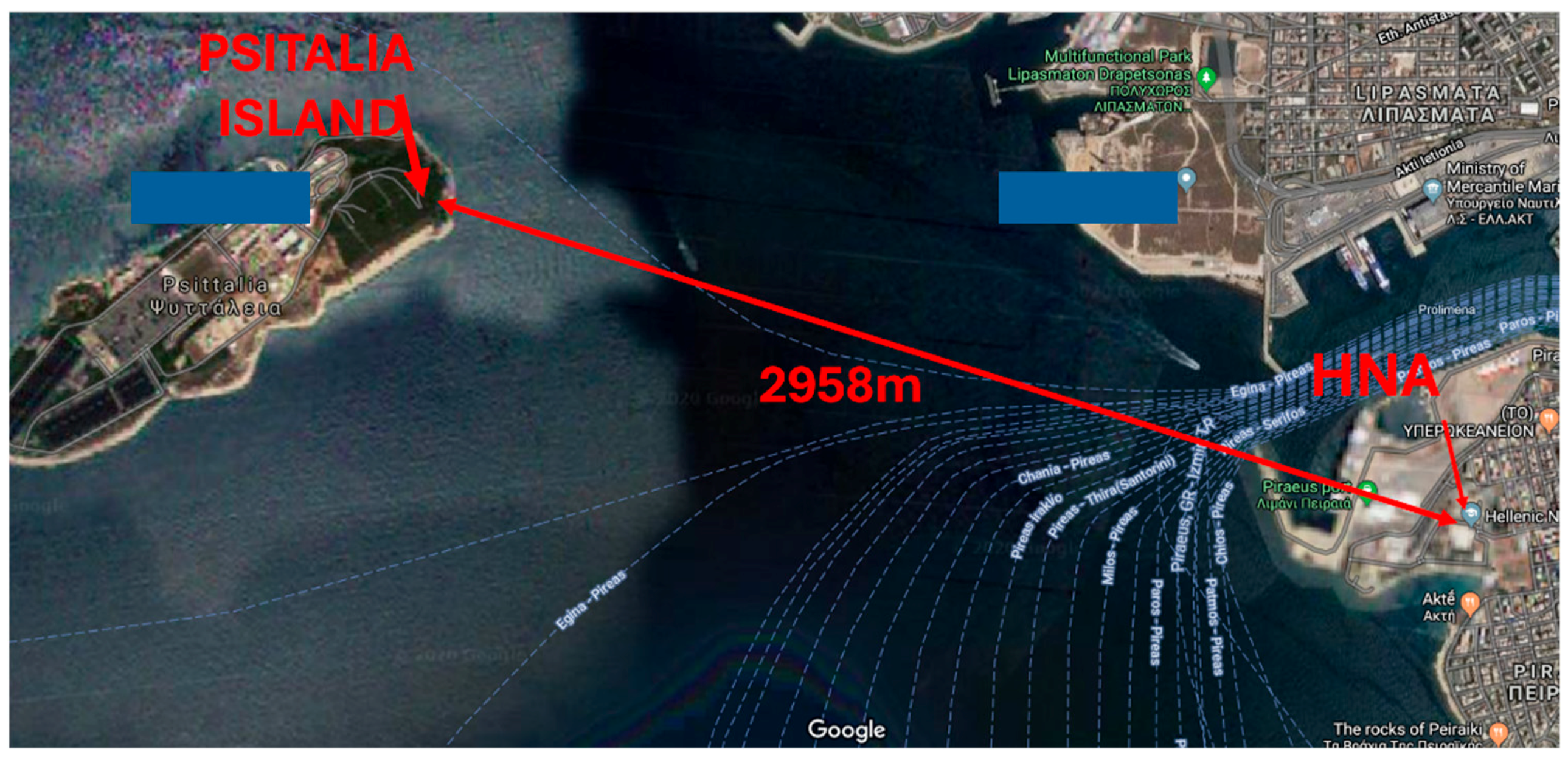
Figure 1. FSO link overview (HNA—Hellenic Naval Academy).
Computation 14 00039 g001
Figure 2. RSSI and PM2.5 concentration frequency.
Computation 14 00039 g002
Figure 3. RSSI distribution for low concentration (PM2.5 < 75 μg/m3) and high concentration (PM2.5 > 75 μg/m3).
Computation 14 00039 g003
Figure 4. Time-series plot of PM2.5 versus Received Optical Power.
Computation 14 00039 g004
Figure 5. Attenuation (dB/km) as a function of PM2.5 concentration.
Computation 14 00039 g005
Figure 6. Scatter plot of PM2.5 versus Received Optical Power with second order polynomial curve fit.
Computation 14 00039 g006
Table 1. Physical and technical specifications of the terrestrial experimental FSO link above the sea’s surface.
ParameterValue
Link Length2958 m
Wavelength830–860 nm
Optical Power150 mW (using 3 laser beams)
Height30 m
Receiver sensitivity−30 dBm
Beam Divergence Angle2 mrad
Modulation SchemeOn-Off Keying
Table 2. PM2.5 concentration and RSSI statistics.
RSSI (mW)PM2.5 (μg/m3)
Range415–5732–180
Average50162.1
Standard Deviation27.0644.57
Table 3. Coefficients of polynomial fitting equation.
a1a2a3
−0.0012−0.2766525.1
Table 4. Model’s Accuracy Metrics.
Statistical ParameterValue
RMSE 17.8 (mV)
MAE14.2 (mV)
R20.57 (mV)
Disclaimer/Publisher’s Note: The statements, opinions and data contained in all publications are solely those of the individual author(s) and contributor(s) and not of MDPI and/or the editor(s). MDPI and/or the editor(s) disclaim responsibility for any injury to people or property resulting from any ideas, methods, instructions or products referred to in the content.