
Solving the Synthesis Problem Self-Organizing Control System in the Class of Elliptical Accidents Optics for Objects with One Input and One Output

 ,
,  , ,
, ,  , and
, and
Abstract
1. Introduction
- a novel synthesis framework for self-organizing control of nonlinear SISO systems based on elliptic catastrophe theory;
- a Lyapunov vector-function gradient–velocity method that guarantees aperiodic robust stability under parametric uncertainty;
- a rigorous application of Morse’s lemma to establish the definiteness of Lyapunov functions in the control-theoretic context;
- a data-driven parameter tuning mechanism based on self-organizing maps (SOM) constrained by Lyapunov stability conditions;
- comparative numerical validation against benchmark adaptive control methods.
2. Related Research
3. Materials and Methods
3.1. Synthesis of a Self-Organizing Control System in the Class of Disasters “Elliptical Dynamics”
3.2. Definitions and Stability Notions
3.3. Methodology of System Synthesis
- -
- Selection and construction of a model with desired transients, with aperiodic robust stability.
- -
- Analysis and determination of the conditions of aperiodic robust stability of a self-organizing control system with one input and one output in the class of disasters “elliptical dynamics”.
- -
- Calculation of the regulator coefficients that ensure the fulfillment of stability conditions for both the model and the real control system.
3.4. Mathematical Model of a Self-Organizing System
- The apperiodic robust stability of the stationary state of the model is investigated (3). From the equation of state of the model (1), the components of the gradient vector from the vector of Lyapunov functions are determined :
- (i)
- The Lyapunov function satisfies V(x) ∈ C2 in a neighborhood of the equilibrium point x*;
- (ii)
- The equilibrium x* is a critical point of V(x), i.e., ∇V(x*) = 0;
- (iii)
- The Hessian matrix ∇2V(x*) is nonsingular, i.e., det(∇2V(x*)) ≠ 0.
- 2.
- The aperiodic robust stability of the stationary state (7) is investigated. For this equation of state, the model (1) is represented in deviations relative to the stationary state (7):
- 2.1.
- Investigation of the Conditions of Aperiodic Robust Stability of a System with One Input and One Output
- 2.2
- The aperiodic robust stability of the stationary state (25) is investigated. The components of the gradient vector from the vector of Lyapunov functions are determined from the equation of state of the control system (23) V(x) = ():
3.5. Calculation of the Regulator Coefficients
| Algorithm 1. An algorithm for the synthesis of a self-organizing control system in the class of disasters “elliptical optics” with one input and one output. |
Input data:
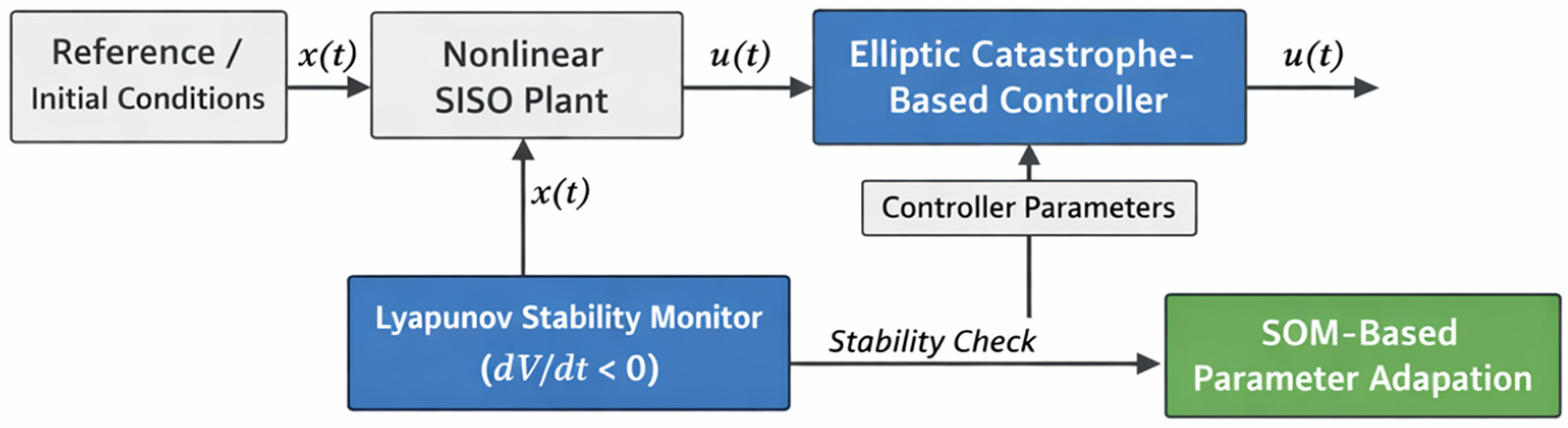
Initialize the weights of Wi randomly Initialize the structure of the Lyapunov function V(x) Set the learning parameters: speed h, attenuation of the neighborhood α Step 2. The main learning cycle Convergence conditions are not met yet: Select the input vector x ∈ ℝⁿ from the training sample Calculation of the control effect Calculate: u(t) = −xi+13 − 3xi+1·xi2 − ki,i+1(xi2 + xi+12) + ki1·xi + ki2·xi+1 Assessment of aperiodic robust stability: Calculate dV(x)/dt using the Lyapunov gradient–velocity method. Accept the current controller parameters if dV(x)/dt < 0, and proceed to the next training sample. Otherwise (dV(x)/dt ≥ 0), perform parameter adaptation using the SOM:
Verify the stability inequalities (23), (30), and (42). Step 3. Completion Criteria If for all training examples dV(x)/dt < 0: Complete the training Save the coefficients of the regulator: ki1, ki2, ki,i+1 End of the algorithm |
4. Experimental Results
4.1. Simulation Setup
- (i)
- Convergence time to a stable equilibrium;
- (ii)
- Maximum overshoot during transients;
- (iii)
- Oscillation index characterizing the presence of transient oscillations;
- (iv)
- The sign of the Lyapunov function derivative dV/dt along system trajectories.
4.2. Benchmark Controllers
- (i)
- A gradient-based adaptive control scheme;
- (ii)
- A classical PID controller tuned using the Ziegler–Nichols method.
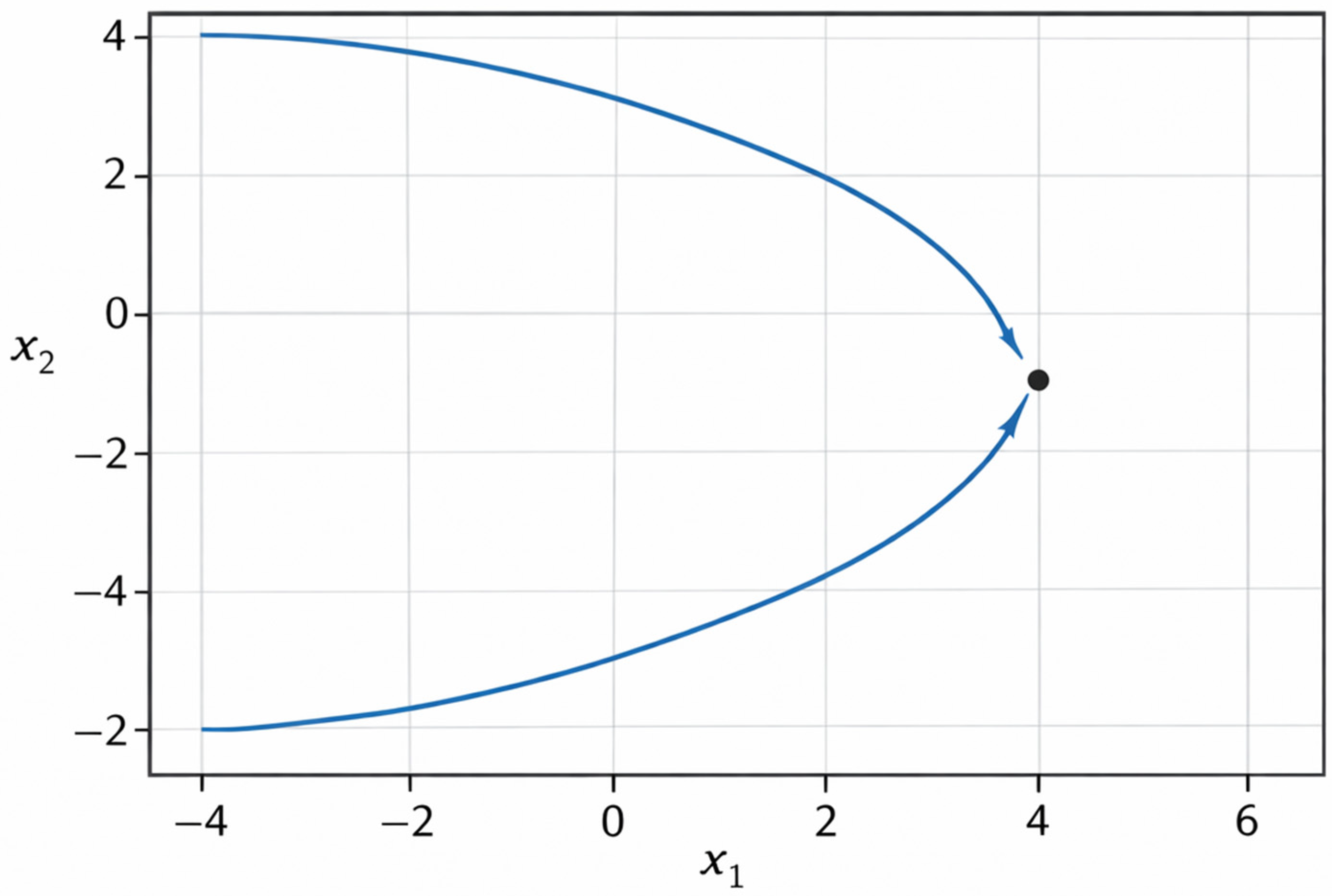
4.3. Results
5. Discussion
6. Conclusions
Author Contributions
Funding
Data Availability Statement
Conflicts of Interest
References
- Ullah, K.; Basit, A.; Ullah, Z.; Aslam, S.; Herodotou, H. Automatic generation control strategies in conventional and modern power systems: A comprehensive overview. Energies 2021, 14, 2376. [Google Scholar] [CrossRef]
- Nijmeijer, H.; Van der Schaft, A. Nonlinear Dynamical Control Systems; Springer: New York, NY, USA, 1990; Volume 175. [Google Scholar]
- Stephanopoulos, G. Synthesis of control systems for chemical plants A challenge for creativity. Comput. Chem. Eng. 1983, 7, 331–365. [Google Scholar] [CrossRef]
- Pashler, H. Dual-task interference in simple tasks: Data and theory. Psychol. Bull. 1994, 116, 220. [Google Scholar] [CrossRef] [PubMed]
- Hemez, F.M.; Doebling, S.W. Review and assessment of model updating for non-linear, transient dynamics. Mech. Syst. Signal Process. 2001, 15, 45–74. [Google Scholar] [CrossRef]
- Michel, A.N. Recent trends in the stability analysis of hybrid dynamical systems. IEEE Trans. Circuits Syst. I Fundam. Theory Appl. 2002, 46, 120–134. [Google Scholar] [CrossRef]
- Ruelle, D. A review of linear response theory for general differentiable dynamical systems. Nonlinearity 2009, 22, 855. [Google Scholar] [CrossRef]
- Jhangeer, A.; Faridi, W.A.; Alshehri, M. The study of phase portraits, multistability visualization, Lyapunov exponents and chaos identification of coupled nonlinear volatility and option pricing model. Eur. Phys. J. Plus 2024, 139, 658. [Google Scholar] [CrossRef]
- Belta, C.; Sadraddini, S. Formal methods for control synthesis: An optimization perspective. Annu. Rev. Control. Robot. Auton. Syst. 2019, 2, 115–140. [Google Scholar] [CrossRef]
- Banzhaf, W. Self-Organizing Systems Encyclopedia of Complexity and Systems Science; Springer: New York, NY, USA, 2009; pp. 8040–8050. [Google Scholar]
- Kurdyumov, S.P. Evolution and self-organization laws in complex systems. Adv. Theor. Phys. 1990, 1, 299–327. [Google Scholar] [CrossRef]
- Lian, J.; Lee, Y.; Sudhoff, S.D.; Zak, S.H. Self-organizing radial basis function network for real-time approximation of continuous-time dynamical systems. IEEE Trans. Neural Netw. 2008, 19, 460–474. [Google Scholar] [CrossRef] [PubMed]
- Zulpykhar, Z.; Kariyeva, K.; Sadvakassova, A.; Zhilmagambetova, R.; Nariman, S. Assessing the effectiveness of personalized adaptive learning in teaching mathematics at the college level. Int. J. Eng. Pedagog. 2025, 15, 4–22. [Google Scholar] [CrossRef]
- Nurbekova, G.; Orazbayeva, B.; Dildabek, A.; Zhilmagambetova, R. The Use of Information Technology in Preparation for International Educational Research. Int. J. Inf. Educ. Technol. 2025, 15, 1743–1751. [Google Scholar] [CrossRef]
- Zulpykhar, Z.; Ongarbayeva, M.; Tungatarova, A.; Altynbekova, Z. On-line examinations with proctoring: Features, students’ preferences and related factors, academic honesty. World Trans. Eng. Technol. Educ. 2023, 21, 287–292. [Google Scholar]
- Zulpykhar, Z.; Serikbayeva, A.; Spirina, Y.; Janabayev, D.; Sirojiddinova, I. Practical approaches to network technology education: A study within secondary institutions in Kazakhstan. Front. Educ. 2025, 10, 1557946. [Google Scholar] [CrossRef]
- Zhusupkalieva, G.; Kuanbayeva, B.; Rakhmetov, M.; Saltanova, G.; Kuzmicheva, A.; Tumysheva, A. The effectiveness of STEAM technologies on improving the professional competence of natural science students. Front. Educ. 2025, 10, 1659717. [Google Scholar] [CrossRef]
- Rakhmetov, M.; Sadvakassova, A.; Saltanova, G.; Kuanbayeva, B.; Zhusupkalieva, G. Evaluation of an AI-Based Feedback System for Enhancing Self-Regulated Learning in Digital Education Platforms. Electron. J. e-Learn. 2025, 23, 126–141. [Google Scholar] [CrossRef]
- Orazbayev, B.; Urazgaliyeva, M.; Gabdulova, A.; Moldasheva, Z.; Amanbayeva, Z. Methods of multi-criteria selection in petroleum geology under conditions of fuzzy initial data. News Natl. Acad. Sci. Repub. Kazakhstan Ser. Geol. Tech. Sci. 2023, 3, 206–221. [Google Scholar] [CrossRef]
- Orazbayev, B.; Assanova, B.; Shangitova, Z.; Moldasheva, Z. Heuristic approach to multi-criteria optimisation of a model based delayed coking process in fuzzy environment. News Natl. Acad. Sci. Repub. Kazakhstan Ser. Geol. Tech. Sci. 2025, 3, 155–168. [Google Scholar] [CrossRef]



| Method | Handles Bifurcations | Structural Stability | Aperiodic Transients | External Switching |
|---|---|---|---|---|
| PID | ✗ | ✗ | ✗ | ✗ |
| Adaptive Control | ✗ | ✗ | ± | ✗ |
| Sliding Mode | ± | ✗ | ✗ | ✗ |
| Proposed Method | ✓ | ✓ | ✓ | ✗ |
Disclaimer/Publisher’s Note: The statements, opinions and data contained in all publications are solely those of the individual author(s) and contributor(s) and not of MDPI and/or the editor(s). MDPI and/or the editor(s) disclaim responsibility for any injury to people or property resulting from any ideas, methods, instructions or products referred to in the content. |
© 2026 by the authors. Licensee MDPI, Basel, Switzerland. This article is an open access article distributed under the terms and conditions of the Creative Commons Attribution (CC BY) license.
Share and Cite
Rakhmetov, M.; Adiyeva, A.; Orazbayeva, B.; Yelezhanova, S.; Tuleuova, R.; Moldasheva, R. Solving the Synthesis Problem Self-Organizing Control System in the Class of Elliptical Accidents Optics for Objects with One Input and One Output. Computation 2026, 14, 21. https://doi.org/10.3390/computation14010021
Rakhmetov M, Adiyeva A, Orazbayeva B, Yelezhanova S, Tuleuova R, Moldasheva R. Solving the Synthesis Problem Self-Organizing Control System in the Class of Elliptical Accidents Optics for Objects with One Input and One Output. Computation. 2026; 14(1):21. https://doi.org/10.3390/computation14010021
Chicago/Turabian StyleRakhmetov, Maxot, Ainagul Adiyeva, Balaussa Orazbayeva, Shynar Yelezhanova, Raigul Tuleuova, and Raushan Moldasheva. 2026. "Solving the Synthesis Problem Self-Organizing Control System in the Class of Elliptical Accidents Optics for Objects with One Input and One Output" Computation 14, no. 1: 21. https://doi.org/10.3390/computation14010021
APA StyleRakhmetov, M., Adiyeva, A., Orazbayeva, B., Yelezhanova, S., Tuleuova, R., & Moldasheva, R. (2026). Solving the Synthesis Problem Self-Organizing Control System in the Class of Elliptical Accidents Optics for Objects with One Input and One Output. Computation, 14(1), 21. https://doi.org/10.3390/computation14010021