
Abstract
Flow quality at the engine face, especially total pressure recovery and swirl, is central to the performance and stability of external compression supersonic inlets. Steady-state RANS-based numerical computations are performed to quantify bleed/swirl trade-offs in a single-ramp intake. The CFD simulations were performed first without a bleed system over M∞ = 1.4–1.9 to locate the practical onset of a bleed requirement. The deterioration in pressure recovery and swirl beyond M∞ ≈ 1.6, which is consistent with a pre-shock strength near the turbulent separation threshold, motivated the use of a bleed system. The comparisons with and without the bleed system were performed next at M∞ = 1.6, 1.8, and 1.9 across the operation map parameterized by the flow ratio. The CFD simulations were performed using ANSYS Fluent, with a pressure-based coupled solver with a realizable k-ε turbulence model and enhanced wall treatment. The results provide engine-face distortion metrics using a standardized ring to sector swirl ratio alongside pressure recovery. The results show that bleed removes low-momentum near-wall fluid and stabilizes the terminal–shock interaction, raising pressure recovery and lowering peak swirl and swirl intensity across the map, while extending the stable operating range to a lower flow ratio at a fixed M∞. The analysis delivers a design-oriented linkage between shock/boundary-layer interaction control and swirl: when bleed is applied at and above M∞ = 1.6, the separation footprints shrink and the organized swirl sectors weaken, yielding improved operability with modest bleed fractions.
1. Introduction
The advancement of high-speed air-breathing propulsion systems is a cornerstone for the future of aerospace transportation, with applications ranging from supersonic transport to hypersonic cruise vehicles [1]. Central to the performance of these systems is the supersonic inlet, a critical component tasked with capturing freestream air and efficiently decelerating it to subsonic conditions suitable for the engine compressor [2]. The historical context of these systems reveals the persistent design challenges that motivate ongoing research [3]. This deceleration process is achieved through a carefully managed system of shock waves; however, the interaction of these strong shocks with the boundary layers developing on the intake surfaces presents one of the most significant challenges in high-speed flight. This phenomenon, known as shock/boundary-layer interaction (SBLI), subjects the low-momentum fluid near the wall to a severe adverse pressure gradient, which can provoke a range of detrimental effects [4]. These consequences include a rapid thickening of the boundary layer, increased total pressure losses, and, in severe cases, large-scale flow separation [5,6]. The resulting non-uniform flow delivered to the engine, formally quantified as flow distortion, is a primary driver of reduced engine performance and stability, as outlined by industry guidelines. At its most extreme, SBLI can lead to a catastrophic event known as “inlet unstart,” where the shock system is violently expelled, causing an abrupt loss of thrust and posing a significant risk to the vehicle. Therefore, the effective management and control of SBLI are paramount for robust and reliable inlet operation [7].
Over several decades, various flow control strategies have been developed to mitigate SBLI, with boundary-layer bleed being one of the most mature and widely implemented techniques [8]. This method involves the removal of the low-energy, near-wall fluid through porous surfaces, slots, or discrete holes located in the interaction region, a concept proven effective in both fundamental studies and practical applications [9,10]. By removing this fluid, the boundary layer becomes more resilient to the adverse pressure gradient, which can effectively suppress flow separation, stabilize the terminal shock position, and improve pressure recovery (PR), forming an integral part of high-speed design philosophies [11].
Despite its benefits for SBLI control, the implementation of a bleed system introduces its own set of complex fluid dynamics consequences. The act of suction through discrete geometries can induce powerful secondary flows and tangential velocity components within the main duct flow. This generates a rotational, non-axial flow field at the engine face, a condition known as swirl [12]. The criticality of this issue is underscored by the aerospace industry’s development of standardized methodologies, such as SAE AIR5686, for the explicit purpose of quantifying swirl distortion as a key performance metric [13]. It is well-established that such rotational flow can negatively impact engine stability by altering the incidence angles on compressor blades, potentially leading to reduced efficiency, increased structural loads, and a diminished stall margin [14]. Indeed, the practical characterization of swirl in high-speed inlets has been the focus of dedicated experimental and numerical efforts [15]. While previous work has identified bleed as a source of vorticity, a systematic and parametric investigation that quantitatively links the bleed rate required for SBLI control to the resulting swirl intensity (SI) across a range of flight conditions has not been fully explored.
This study aims to address this gap through a parametric numerical investigation of a bleed-enabled external compression supersonic intake. The primary objective is to establish a quantitative relationship between the freestream Mach number, the applied bleed rate for effective SBLI control, and the consequential swirl and pressure distortion metrics at the aerodynamic interface plane (AIP). Comprehensive three-dimensional, steady-state Reynolds-Averaged Navier–Stokes (RANS)-based Computational Fluid Dynamics (CFD) simulations for a single-ramp supersonic intake model are performed for a range of freestream Mach numbers (M∞ = 1.4–1.9), and the results are discussed in terms of the relationships of the SBLI, pressure recovery, and swirl characteristics of the intake flow field with and without a bleed system.
2. Methodology and Model Geometry
The results are obtained from three-dimensional, steady-state RANS simulations of a single-ramp, external compression supersonic inlet, evaluated in a system with bleed (WB) and without bleed (WOB). The computational model, model geometry, computational grid, test matrix and boundary conditions, and post-processing methodology are described below.
2.1. Governing Equations and Turbulence Modeling
In conservative form, the steady-state 3-D Reynolds-Averaged Navier–Stokes (RANS) equations can be written as
where ρ is the mean density, ui denotes the mean velocity components, p is the mean static pressure, and e = h + 1/2 ukuk is the total energy per unit mass with h denoting the static enthalpy. The total stress tensor τij and heat flux vector qj are written as
and also using the ideal gas equation of state with a specific gas constant for air (R), and temperature-dependent properties (Sutherland law for viscosity and temperature-dependent thermal conductivity).
Continuity: ∂(ρui)/∂xi = 0
Momentum: ∂(ρuiuj)/∂xj = −∂p/∂xi + ∂τij/∂xj
Total energy: ∂(ρeuj)/∂xj = ∂(uiτij − qj)/∂xj
Momentum: ∂(ρuiuj)/∂xj = −∂p/∂xi + ∂τij/∂xj
Total energy: ∂(ρeuj)/∂xj = ∂(uiτij − qj)/∂xj
τij = μ (∂ui/∂xj + ∂uj/∂xi − 2/3 δij ∂uk/∂xk) − ρui′uj′
qj = −k ∂T/∂xj − ρuj′h′
The closure of the RANS equations is provided by the realizable k-ε turbulence model with enhanced wall treatment (EWT) as implemented in ANSYS Fluent. The transport equations are solved for the turbulent kinetic energy k and its dissipation rate ε. The Reynolds stresses are modeled using the Boussinesq hypothesis as
where the eddy viscosity μt is given by
with a coefficient of Cμ and the remaining model coefficients taken from the standard realizable k-ε formulation [16]. The turbulent heat flux is modeled using the gradient diffusion approximation as
where Prt is the turbulent Prandtl number.
−ρui′uj′ = μt(∂ui/∂xj + ∂uj/∂xi − 2/3 δij ∂uk/∂xk) − 2/3 ρkδij
μt = ρCμk2/ε
−ρuj′h′ = (μt/Prt) (∂h/∂xj)
2.2. Computational Methodology
The CFD simulations were performed using ANSYS Fluent 2017 CFD software by solving the 3-D, steady-state, compressible RANS equations with the total energy equation. Air is treated as an ideal gas with temperature-dependent properties (Sutherland-law viscosity; temperature-dependent thermal conductivity). Turbulence is modeled with the realizable k-ε model and enhanced wall treatment (EWT), which is appropriate for adverse pressure gradient flow with shock/boundary-layer interaction and local separation. A pressure-based coupled solver is used in double precision. Gradients are computed with a least squares cell-based method; a second-order method is used for pressure interpolation; a second-order upwind method is used for production iterations for momentum, energy, k, and ε. A short first-order pass is used only to stabilize initial shock formation before switching to the second order. The Courant number is ramped from ≈1 to ≈30 as residuals settle; the pseudo-transient option is not used. Under-relaxation factors are staged from start-up (pressure = 0.5, k = 0.2, ε = 0.2, momentum = 0.5, energy = 0.5) to production (pressure = 0.8–0.9, k = 0.7, ε = 0.7, momentum = 0.9, energy = 0.9). An algebraic multigrid is employed with default cycling; temperature and pressure-coupled smoothing are set to 0.1/0.7. Full multigrid (FMG) initialization is performed from the pressure far-field. Convergence is declared when all scaled residuals fall below 1 × 10⁻⁵ and the global mass imbalance is ≤0.1% [17].
2.3. Model Geometry and Computational Domain
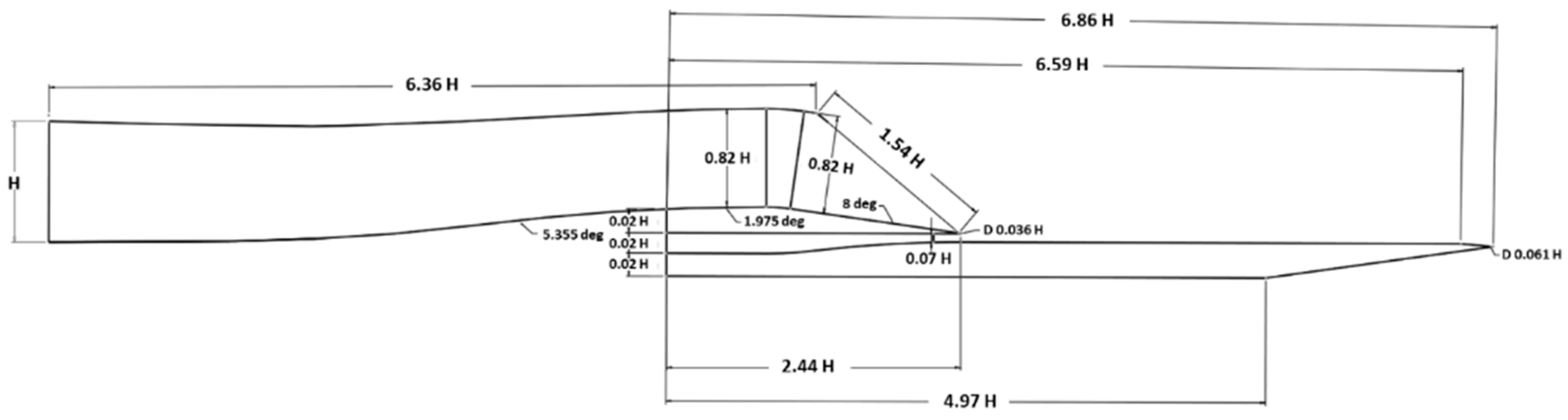
The model is a single-ramp external compression supersonic inlet geometry with a ramp angle of 8°, followed by a short diffuser and an aerodynamic interface plane (AIP), as shown in Figure 1. At the cowl lip, the capture area is approximately rectangular and spans the full width of the inlet. Downstream of the ramp shoulder, the internal cross-section contracts toward a geometric throat and then gradually evolves from a quasi-rectangular/trapezoidal shape into a circular duct. The centerline of the internal duct follows a gentle arc, so that the flow experiences both area change and curvature before entering the final straight circular section. The diameter of the circular duct is denoted by H and is used as the reference length scale in this study. In the physical configuration, the duct nominally ends at the diffuser exit. In the CFD model, this circular duct is extended by an additional straight section of length 1H, and the downstream outlet boundary condition is applied at the end of this extension. The aerodynamic interface plane (AIP) is defined as the circular cross-section located one duct diameter (1H) upstream of the outlet boundary, i.e., at the end of the original physical duct. All engine-face flow metrics presented in this paper, including the pressure recovery, circumferential swirl angle distributions and swirl intensity maps, are evaluated on this AIP in order to avoid any direct contamination from the outlet boundary condition.
Figure 1.
Geometry of the single-ramp external supersonic compression intake model [18].
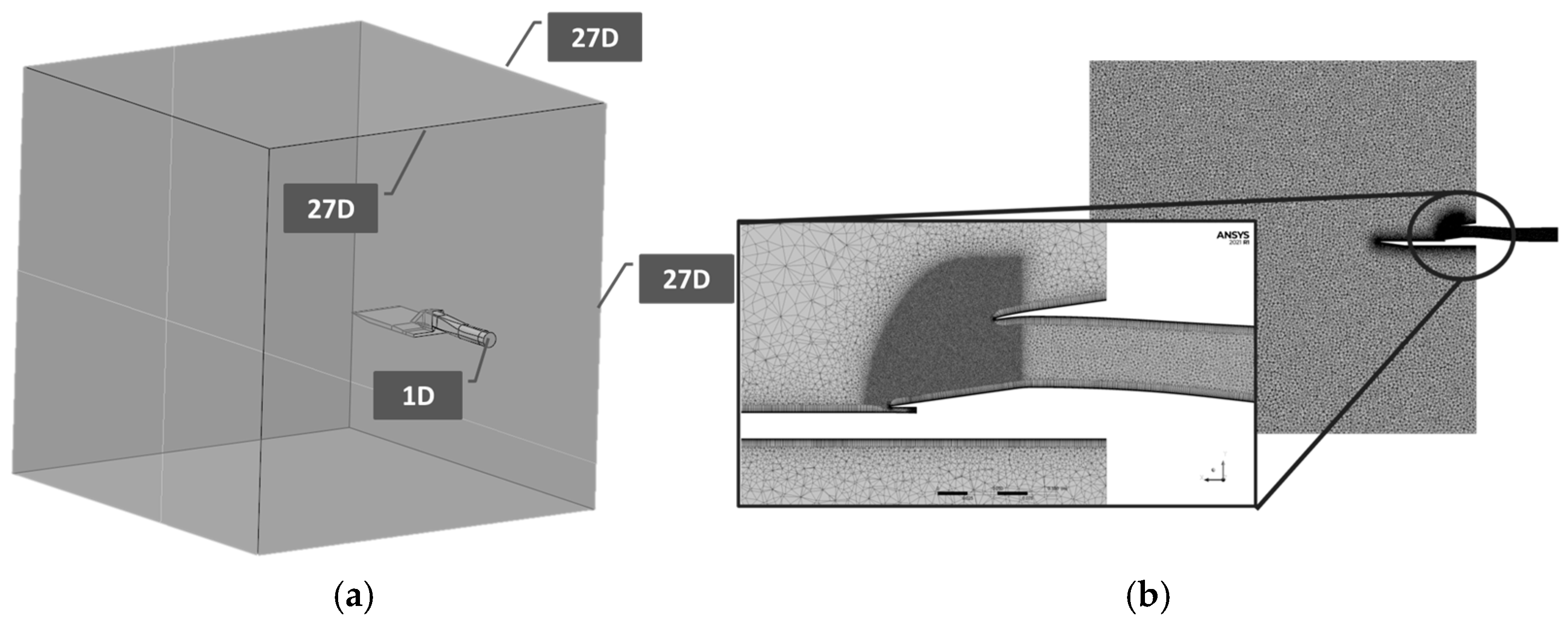
The external-flow rectangular computational domain, as shown in Figure 2a, is a Cartesian box with a size of 27 D × 27 D × 27 D to avoid boundary interference with the upstream, downstream, and all lateral boundaries placed away from the inlet duct with reference diameter D (=H). This provides sufficient clearance to minimize reflections from the far-field boundaries. The intake, bleed region, and surrounding external flow are discretized using an unstructured grid (Figure 2b) with local refinement in the shock/boundary-layer interaction region and around the bleed entrance. The additional body-of-influence regions are defined around the compression surface and within the internal duct in order to enforce a finer mesh in these areas. The inflation layers are generated on all solid walls to resolve near-wall gradients, with the first-cell height selected to yield y+ ≈ 1 along the compression surface and duct walls, which is compatible with the requirements of the enhanced wall treatment (EWT) used with the realizable k-ε turbulence model.
Figure 2.
(a) Rectangular computational domain around the supersonic inlet and (b) detailed views of the unstructured computational grid with refinement near the inlet surfaces.
2.4. Grid Independence Study
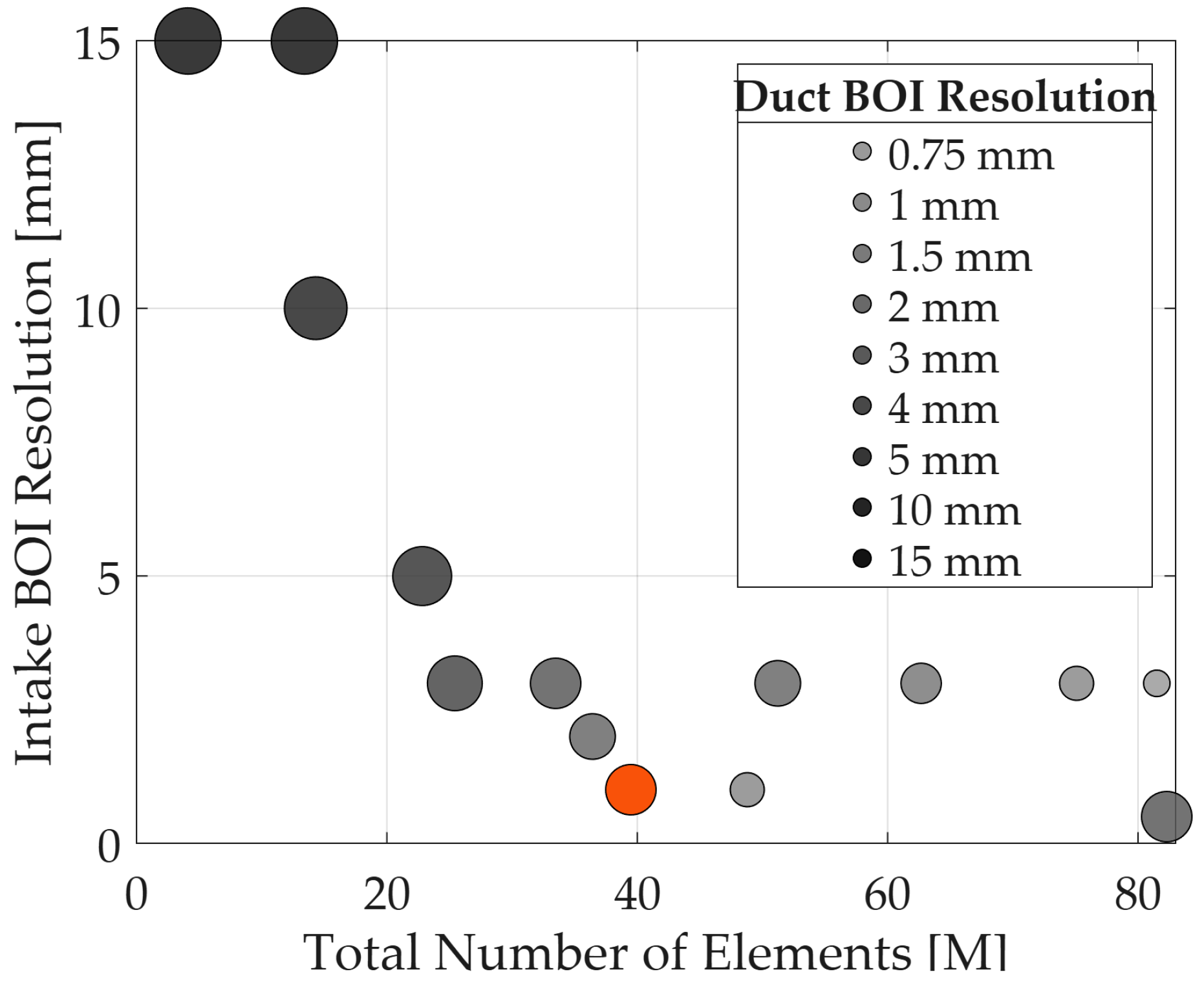
To ensure that the numerical results are independent of the spatial discretization and to quantify the numerical uncertainty, a comprehensive grid independence study was conducted. The primary objective of this study was to identify a grid configuration that provides a sufficient level of accuracy for capturing the key flow phenomena, such as shock waves, shock–boundary-layer interactions, and flow separation, while maintaining a manageable computational cost. A systematic approach was adopted in which several key meshing parameters are varied to generate a series of grids with a wide range of element counts, from approximately 1.5 million to nearly 83 million cells.
The parameters investigated included: the resolution of local refinement regions using bodies of influence (BOIs) in the intake and duct sections, the inflation layer properties (first cell thickness, number of layers, and growth rate), and the general surface and body sizing of the computational domain. The independence of the solution was assessed by comparing the static pressure ratio (ps/pt,∞) distributions along the compression surface and the splitter plate for each grid configuration against the experimental wind tunnel data.
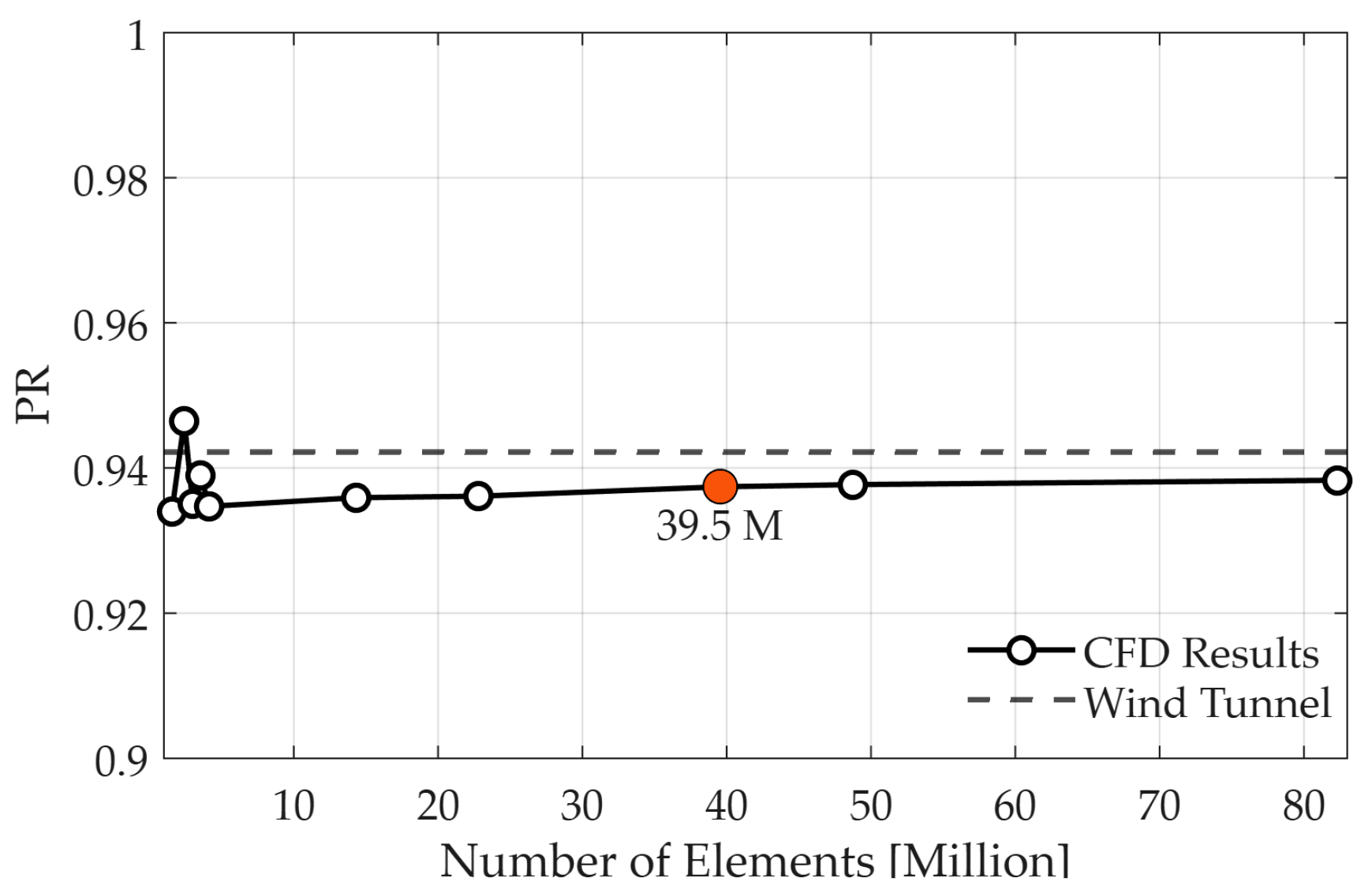
The effect of the various meshing parameters investigated as part of the grid independence study on the total number of elements (computational cost) is visualized in the grid parameter map in Figure 3. In this chart, the x-axis represents the total number of elements, while the y-axis shows the intake BOI resolution, which is critical for capturing shock structures. The color of the bubbles encodes the duct BOI resolution, and their size represents the surface (intake surface) mesh sizing. The chart quantitatively demonstrates that refining the resolution in the BOI regions (a smaller mm value) significantly increases the total number of elements. The reference grid, highlighted in orange with approximately 39 million elements, was selected based on the observation of the pressure ratio shown in Figure 4.
Figure 3.
Grid parameter map for the grid independence study.
Figure 4.
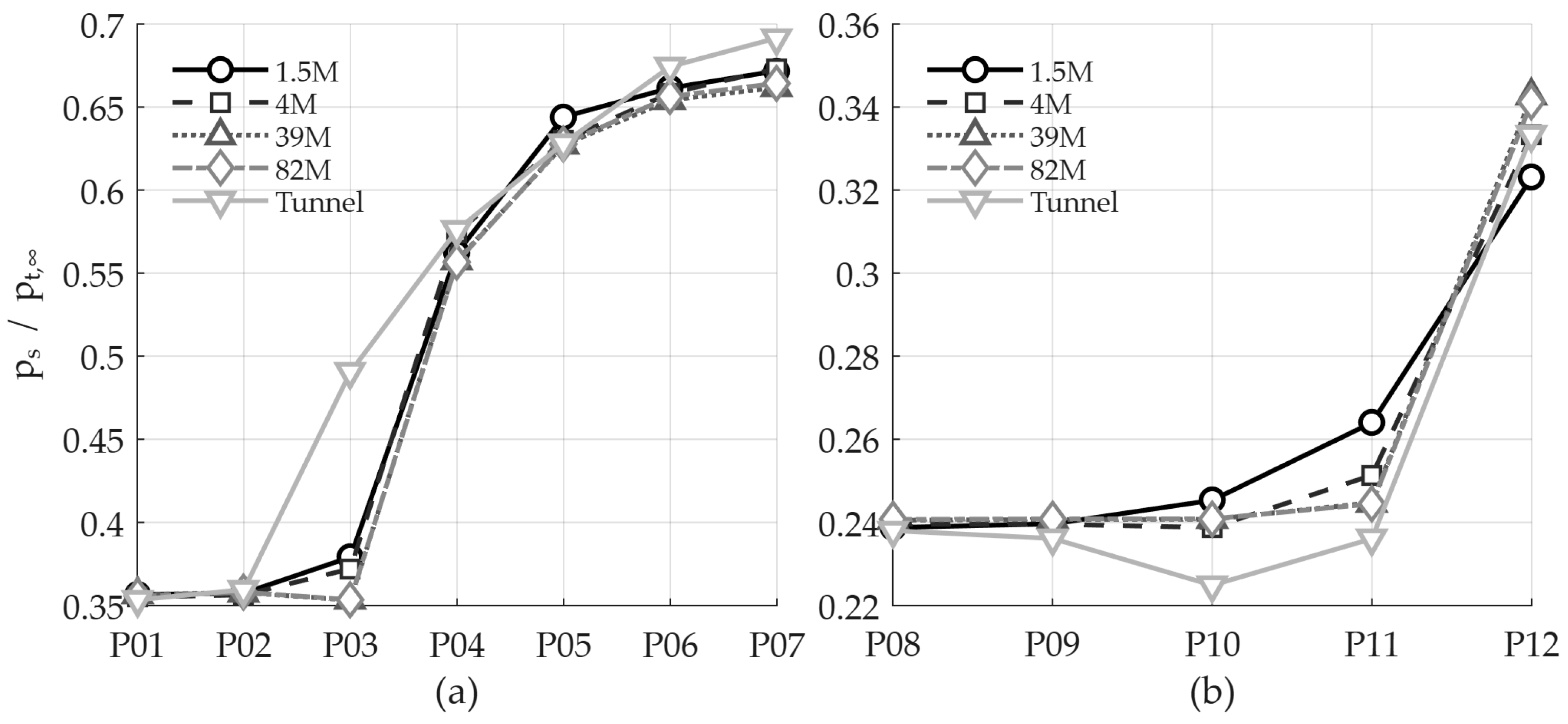
Comparisons of the results for four different grid resolutions (1.5 M, 4 M, 39 M, and 82 M cells) with the experimental (tunnel) data: (a) pressure distribution along the compression surface (P01–P07); (b) pressure distribution along the splitter plate (P08–P12).
Figure 4 shows that the pressure distributions converge with grid refinement and that the 39 M and 82 M solutions are essentially indistinguishable across both surfaces. On the compression surface (P01–P07, panel a), all grids reproduce the gradual rise from P01–P02 and the sharp increase through P03–P05 associated with the ramp SBLI, with the fine grids capturing the post-ramp plateau beyond P05. On the splitter plate (P08–P12, panel b), the fine grids also collapse, recovering the local minimum around P10 and the subsequent rise toward P12. The differences to the tunnel data appear mainly near P03–P04, P10, and P12 stations. On the compression surface, these discrepancies are partly due to a slight mismatch in the terminal–shock location: in the wind tunnel measurements, the normal shock stands just upstream of tap P03, whereas in the CFD solutions, it is predicted just downstream of this station, so the steep pressure rise across the shock is shifted by roughly one tap location. On the splitter plate, the remaining differences are attributed to the high sensitivity of the corner region to the incoming boundary-layer state and local SBLI/corner interactions, whereas the remainder of the taps show good agreement. Taken together, these results indicate that further refinement beyond ~39 M cells brings negligible improvement to the local pressure field, supporting the selection of the 39 M grid for production runs.
In addition to the local static pressure comparisons, the grid independence of a key global performance metric, the PR at the AIP, is assessed in Figure 5. This analysis is performed at the reference operating condition at M∞ = 1.8 and λ = 0.97. The figure plots the calculated PR value as a function of the total number of mesh elements for ten different grid configurations. The corresponding experimental value from the wind tunnel test is also shown as a dashed line for reference. The results show a clear trend of convergence as the mesh is refined. For coarser grids with fewer than 10 million elements, the calculated PR is highly sensitive to the mesh resolution. As the element count increases, the PR value asymptotically approaches a stable value. The curve visibly flattens for meshes beyond approximately 40 million elements, with the difference in PR between the 40 M and 82 M grids being negligible.
Figure 5.
Grid independence study: pressure recovery change with grid size at the operating condition at M∞ = 1.8 and λ = 0.97.
2.5. Test Matrix and Boundary Conditions
The operating condition (operating-map) is parameterized by the flow ratio, λ:
where Ac is the geometric cowl capture area, and A0 is the equivalent capture area associated with the mass flow ingested by the inlet. The geometric capture area Ac is obtained by projecting the inlet lip onto the y-z plane, whereas A0 is computed from the captured mass flow rate using one-dimensional isentropic relations at the freestream Mach number M∞.
λ = A0/Ac
In the numerical model, the flow ratio λ is imposed indirectly through the boundary condition at the downstream end of the extended circular duct. For fixed freestream Mach number M∞ and total pressure pt,∞, the magnitude of the axial velocity prescribed at this boundary is adjusted such that the area-averaged Mach number at the end of the physical duct (i.e., at the AIP located one duct diameter upstream of the boundary) attains the desired value. This area-averaged Mach number at the AIP uniquely determines the captured mass flow rate, from which A0 and hence λ are obtained via Equation (1). As a result, for a given M∞ and pt,∞, the flow ratio λ, the captured mass flow rate, and the area-averaged Mach number at the AIP are in one-to-one correspondence; specifying any one of these quantities uniquely determines the others.
For each freestream Mach number, the traverse is carried out under supercritical, critical, and subcritical conditions until the last stable point (buzz onset) is reached. At every operating point, the following performance parameters are evaluated and reported: pressure recovery (PR), swirl angle (α), swirl intensity (SI) (ring-wise) at the AIP, and the mass-averaged total-pressure loss factor (ϵloss).
This study was designed to systematically investigate the effects of the freestream Mach number and bleed rate on the SBLI phenomena and the resulting engine-face flow quality metrics, including PR and swirl. To achieve this, a comprehensive case matrix was established, encompassing a range of operating conditions. The two primary parameters varied in this study were the M∞ and the bleed configurations: WB and WOB. The analyses werer conducted at three distinct Mach numbers: M∞ = 1.6, 1.8, and 1.9. For each Mach number, a baseline WOB configuration was simulated to serve as a reference against a WB configuration. The WB configuration was implemented using a porous jump boundary condition fitted to hole-resolved 3-D RANS [19]. The viscous (F1) and inertial (F2) resistances are expressed as a quadratic of the pressure drop (∆p) versus exit-plane superficial velocity (V), parameterized by the porosity, length-to-diameter ratio (L/D), and hole diameter (D) [19]. This model utilizes the optimized geometric parameters determined in a preceding study: For bleed entry, an L/D ratio of 1.0 was selected and the porosity level was set to 0.2. For bleed exit, an L/D of 0.25 was selected and a porosity of 0.50 was chosen. For all configurations, the back pressure was swept from supercritical to critical to subcritical (unstart) conditions. The complete test matrix, summarizing all simulated conditions, is presented in Table 1.
Table 1.
Test matrix for the inlet operation map study.
The boundary conditions for the computational domain are the inlet (outer domain as freestream), the outlet (duct exit), and the solid walls (model geometry), as described below.
At the outer boundaries of the 3-D rectangular computational domain, the total pressure and total temperature corresponding to the desired freestream Mach number were defined together with the flow direction and turbulence quantities. The incoming flow was aligned with the inlet centerline, and the incidence in pitch and yaw was set to zero. The freestream turbulence at the inflow was specified using a turbulence intensity of 5%, a representative of a low-disturbance wind tunnel environment.
All solid surfaces (ramp, cowl, splitter, sidewalls, and duct walls) were treated as adiabatic, no-slip walls. In the WOB configuration, the bleed panel was modeled as a solid wall, and no boundary-layer removal took place. In the WB configuration, the bleed path was modeled using two porous jump interfaces. The first porous jump was placed at the bleed panel beneath the main shock/boundary-layer interaction and represents the perforated plate resistance to the sucked-off boundary layer. The second porous jump was applied at the plenum exit and represents the discharge of the bleed flow to the external environment. In both locations, the viscous (F1) and inertial (F2) resistance coefficients were obtained from hole-resolved three-dimensional RANS data and expressed through a quadratic Δp-V relation in terms of the local superficial velocity, parameterized by porosity, L/D, and hole diameter [19]. Between these two porous jumps, the bleed flow was resolved inside a simplified plenum volume.
At the downstream end of the extended circular duct, a velocity-inlet-type boundary condition was applied. The prescribed velocity was purely axial; its magnitude was adjusted to achieve the desired operating condition.
2.6. Data Post-Processing and Metric Calculations
This section describes how the AIP data were extracted and how each performance metric was computed. All quantities were evaluated at converged solutions using the same sampling layout and averaging operators to ensure a consistent basis for comparison across the entire case matrix.
The primary metric for intake performance is the total pressure recovery, PR, which quantifies the efficiency of the pressure-rise process. It is defined as the area-averaged total pressure at the AIP normalized by the freestream total pressure [2]:
PR = pt,AIP/pt,∞
The total pressure loss factor, ϵloss, is defined as the difference between the freestream total pressure and the total pressure at the aerodynamic interface plane, normalized by the dynamic pressure at the AIP [20] as
where γ is the ratio of specific heats, MAIP is the area average Mach number at the AIP, ps is the static pressure at the AIP, and pt,AIP is the total pressure at the AIP.
ϵloss = (pt,∞ − pt,AIP)/(1/2 γ (MAIP)2 ps)
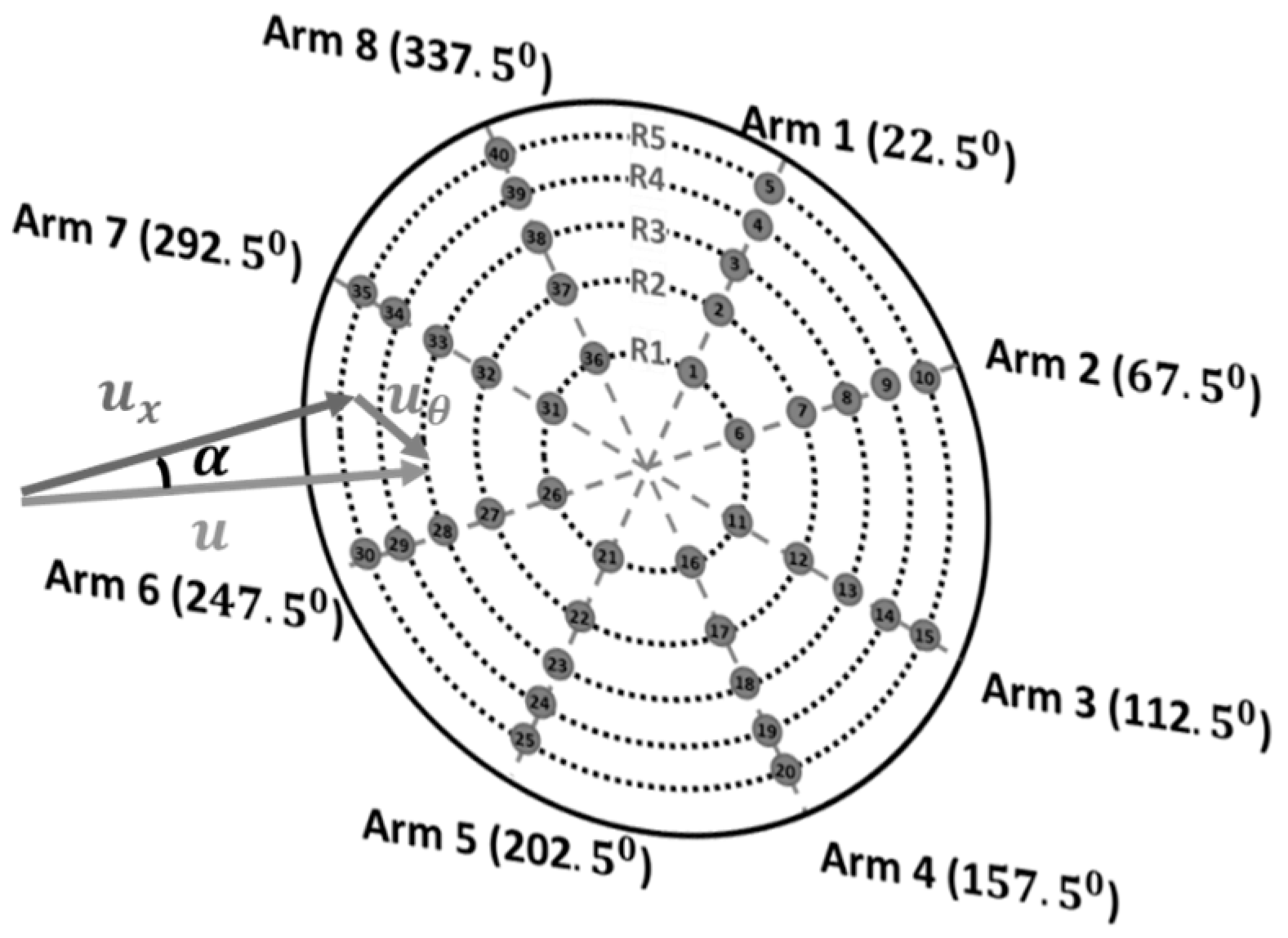
The swirl, or the rotational component of the flow at the engine face, is a critical form of distortion that can significantly affect engine stability. To quantify swirl, the detailed methodology outlined in SAE AIR5686 [13] is employed. The fundamental metric is the local swirl angle, αswirl, defined at each point on the AIP, as shown in Figure 6. It is calculated from the tangential (uθ) and axial (ux) velocity components as
αswirl (r,θ) = arctan(uθ (r,θ)/ux (r,θ))
Figure 6.
The 8 × 5 rake model for total pressure measurement at the AIP.
From this local angle, two key SI descriptors are derived to characterize the magnitude and spatial nature of the swirl. The sector swirl intensity (SISA) identifies the maximum absolute mass-flow-averaged swirl angle within any predefined 60-degree sector of the AIP. Similarly, the ring swirl intensity (SIRA) identifies the maximum absolute mass-flow-averaged swirl angle within any of the concentric rings defined at the AIP. These standardized metrics capture the magnitude and spatial nature of the swirl, providing a comprehensive assessment of the rotational distortion delivered to the engine face.
A rake designed to assess the overall pressure at the AIP is depicted in Figure 6. Eight “arms,” each supporting five evenly spaced pressure ports, are arranged in an 8 × 5 arrangement, providing 40 measurement locations distributed around the AIP cross-section. Any radial or circumferential changes in total pressure that can result from inlet distortions or non-uniformities are captured by this arrangement, which guarantees thorough mapping of the flow field [21,22].
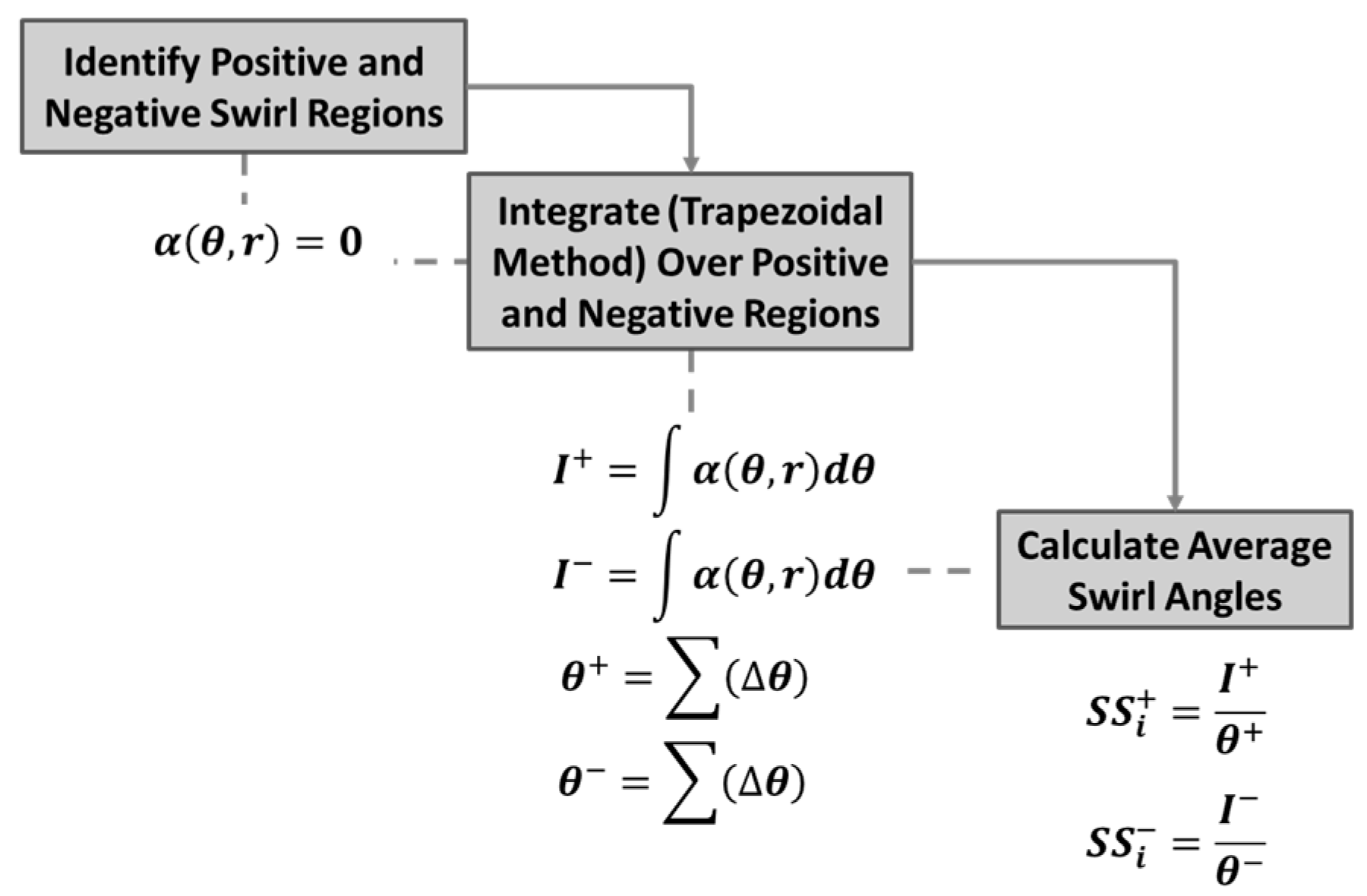
Aside from experimental measurements, the velocity components at the AIP can be recovered using CFD simulations (Figure 7). The velocity data, specifically the axial, ux, and tangential, uθ, components, allow for the determination of swirl parameters including swirl angle, α(θ,r), and swirl intensity, SI at a point i on the AIP as
SIi = [(SSi+) (θ+) + (SSi−) (θ−)]/360°
This formula computes a weighted average of the positive and negative swirl sectors, scaled over the full 360° of the ring [13,23]. The result is a net SI for that ring, taking into account both the strength (average angle) and the size (angular extent) of the swirl regions. A high absolute value of SIi indicates strong swirl distortion, which can affect compressor stability.
Figure 7.
Flowchart for swirl angle classification and integration [24].
3. Results
The results of the CFD simulations are presented and discussed below without and with a bleed system for different conditions.
3.1. Intake Characteristic Without Bleed System
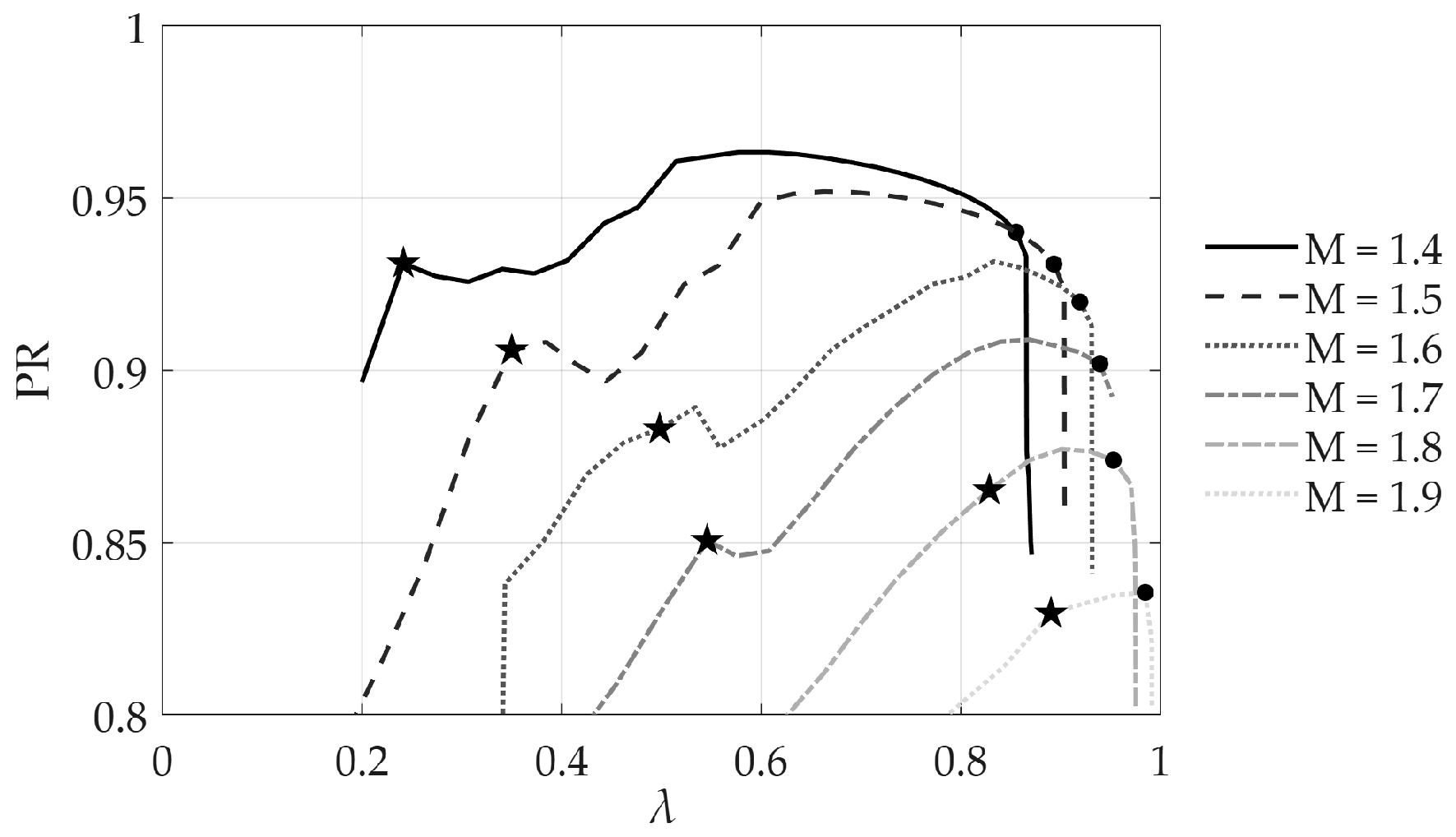
The operational performance map of the inlet is presented for M∞ ranging from 1.4 to 1.9. In Figure 8, PR is plotted against the flow parameter λ with each line style corresponding to a specific Mach number. This map is crucial for stability assessment, as two critical performance boundaries are explicitly marked on each curve: the star (★) marker indicates the ‘buzz onset’ (the last stable operating point), while the dot (●) marker signifies the ‘throat choking’ condition (the maximum flow or unstart limit). A key trend observed is that as the Mach number increases, the overall peak PR achieved by the inlet tends to decrease.
Figure 8.
Pressure recovery versus flow ratio for different Mach numbers, M∞ = 1.4–1.9.
3.2. Wall Shear on Compression Surface
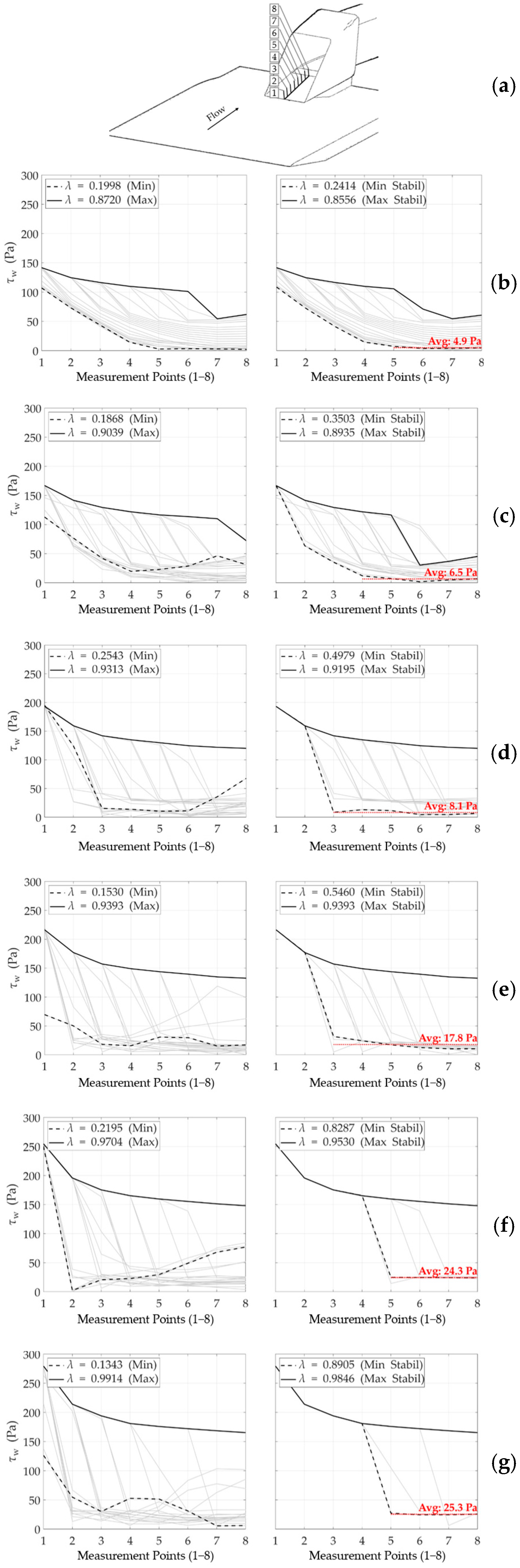
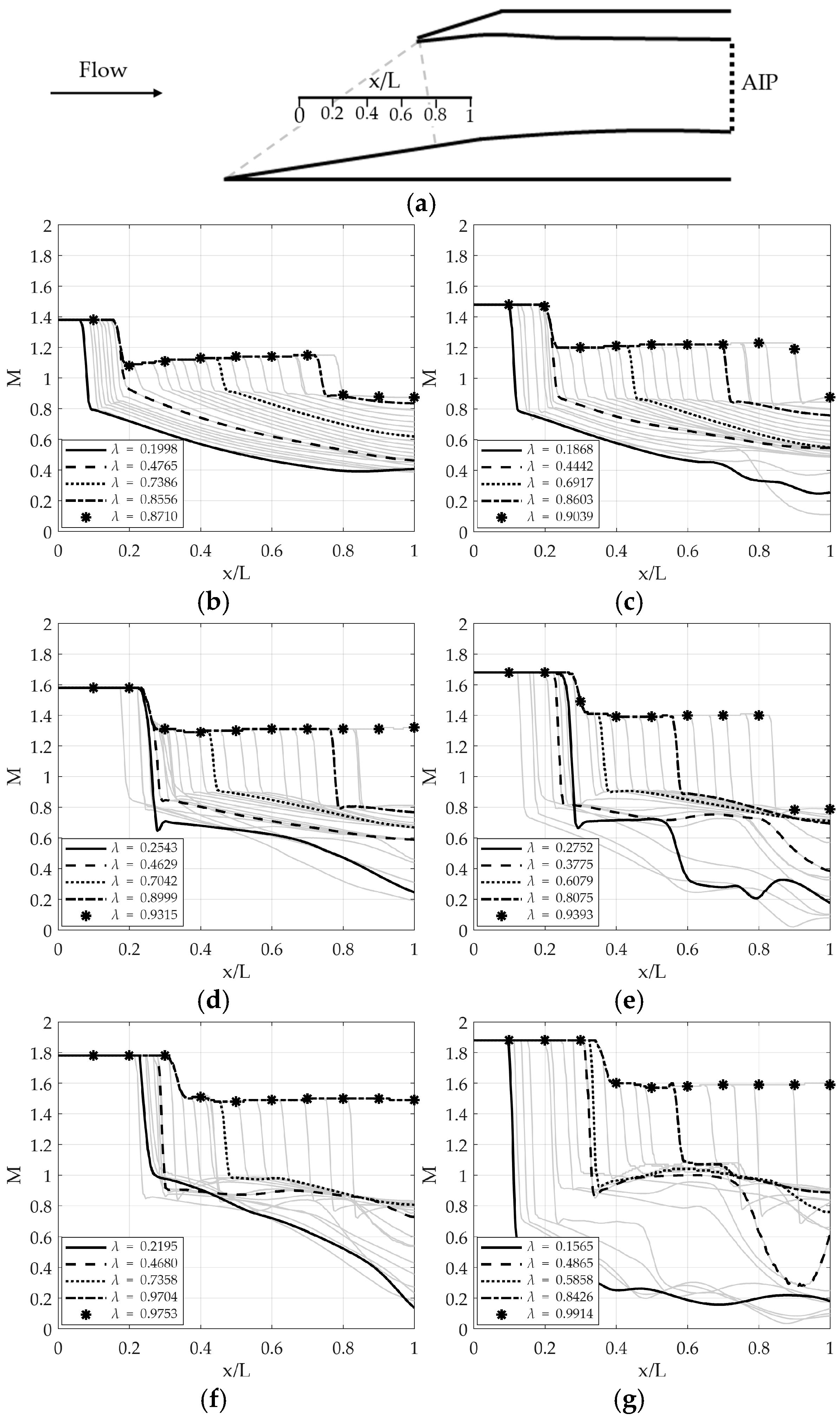
To quantify the onset and severity of separation, the wall shear stress τw is analyzed for the WOB configuration. First, the τw distributions are observed across the entire range of λ, as is shown by the gray lines in Figure 9 (left side). This analysis is linked to the upstream movement of the terminal shock, which is observed in the Mach distributions (Figure 10). A strong adverse pressure gradient is created by this movement, by which the boundary layer is caused to separate from the wall (the direct cause of ‘buzz’ instability). The analysis is then constrained to the stable operating limits, where the maximum stable condition (solid black line) is compared with the minimum stable “buzz onset” condition (dashed black line). To establish a clear metric for instability, the average wall shear stress is calculated over the post-shock region of the minimum τw at this minimum stable condition. This resulting average value is determined for each freestream Mach number, so that the proximity of the boundary layer to separation is assessed quantitatively at the edge of its stable operability. (Figure 10)
Figure 9.
Comparison of wall shear stress (a) at 8 discrete data points along a line on the compression surface; at different freestream Mach numbers for different flow ratios: (b) M∞ = 1.4, (c) M∞ = 1.5, and (d) M∞ = 1.6, (e) M∞ = 1.7, (f) M∞ = 1.8, and (g) M∞ = 1.9.
Figure 10.
Comparisons of streamwise Mach number distributions for different flow ratios (λ) (a) along a line on the compression surface; at different freestream Mach numbers: (b) M∞ = 1.4, (c) M∞ = 1.5, (d) M∞ = 1.6, (e) M∞ = 1.7, (f) M∞ = 1.8, and (g) M∞ = 1.9.
3.3. Mach Distribution Along Compression Surface
Figure 10 provides detailed flow-field evidence to explain the wall shear stress trends observed in Figure 9. Figure 10 illustrates the streamwise Mach number distributions sampled along the measurement line indicated by the x/L axis in Figure 10a. This line follows the core flow region above the compression surface and is used to track the streamwise evolution of the terminal shock system for each M∞ at several different λ values. The plots clearly visualize the upstream movement of the terminal shock system as λ is reduced (i.e., as back pressure increases) toward the ‘buzz onset’ limit.
3.4. Boundary-Layer Control Mechanism Requirement
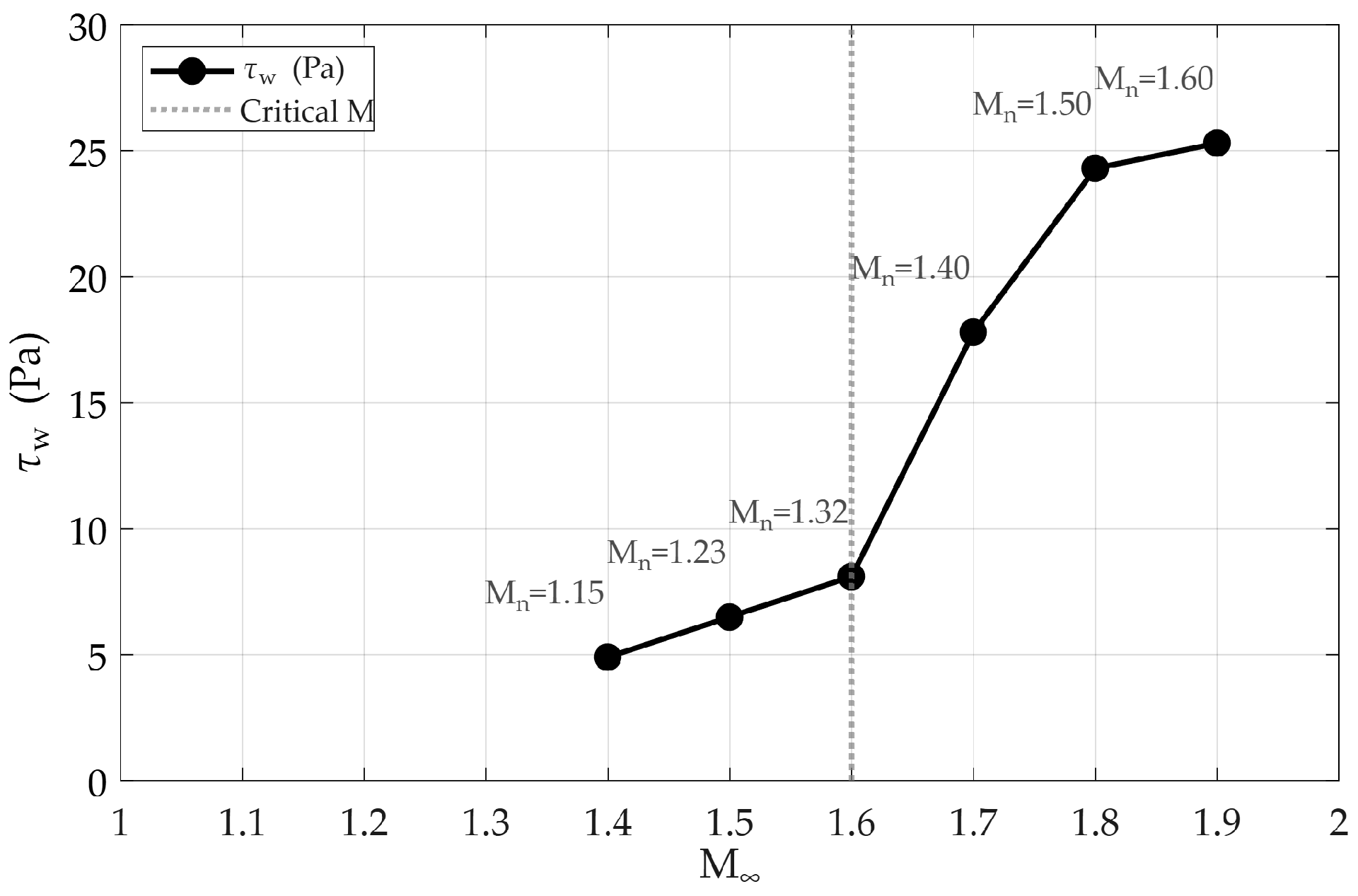
The wall shear stress distributions in Figure 9 show that, for each freestream Mach number, the post-shock region on the compression surface approaches a nearly separated state at the last stable operating point. As illustrated in Figure 9a, eight discrete “measurement points” (1–8) are defined along a line over the compression surface that passes through the SBLI region. For each operating condition (given M∞ and λ), the local wall shear stress values τw are extracted at these eight points. The left-hand panels in Figure 9 present the τw distributions at the minimum and maximum flow ratios for a given M∞, together with the intermediate cases plotted in gray. The right-hand panels focus on the neighborhood of the last stable operating point: the dashed black curve corresponds to the minimum-stable flow ratio, and the red dashed segment highlights the subset of measurement points at which τw drops to very low levels. The average of τw over this red segment is reported in the figure as “Avg”. These data are condensed in Figure 11. For each freestream Mach number, the averaged wall shear stress value taken over the red segment at the last stable operating point is plotted against the Mach number immediately upstream of the terminal normal shock, Mn. Here, Mn denotes the Mach number just ahead of the terminal normal shock, i.e., the Mach number that results downstream of the oblique shock.
Figure 11.
Wall shear stress versus freestream Mach number. Each data point is with the corresponding Mach number upstream of the normal shock. The vertical dotted line indicates the ‘Critical Mach’ at Mn = 1.32 (corresponding to M∞ = 1.6).
The crucial insight is that the strength of this terminal shock (specifically it being upstream of the normal shock Mach number, Mn) is the decisive parameter. A well-established criterion in aerodynamics states that a shock with Mn = 1.32 is typically strong enough to induce turbulent boundary-layer separation [2].
The data presented in Figure 11 provides the definitive justification for the necessity of boundary-layer control. The plot clearly shows the Mn of the terminal shock relative to the M∞. At M∞ = 1.4 and 1.5, the shock strength remains subcritical Mn < 1.3. However, at M∞ = 1.6, the shock strength Mn = 1.32 explicitly crosses the ‘Critical Mach’ threshold, which is the established criterion for shock-induced turbulent boundary-layer separation.
At all higher Mach numbers from M∞ = 1.7 to 1.9, the Mn value continues to increase, guaranteeing the formation of extensive flow separation. Given that this unavoidable separation is the root cause of both performance loss (as identified in the τw analysis) and critical instability (buzz), it is concluded that a boundary-layer bleed (WB) system is an essential design requirement for achieving stable and efficient operation of the inlet for all M∞ > 1.6.
3.5. Bleed System Effect on Intake Stability
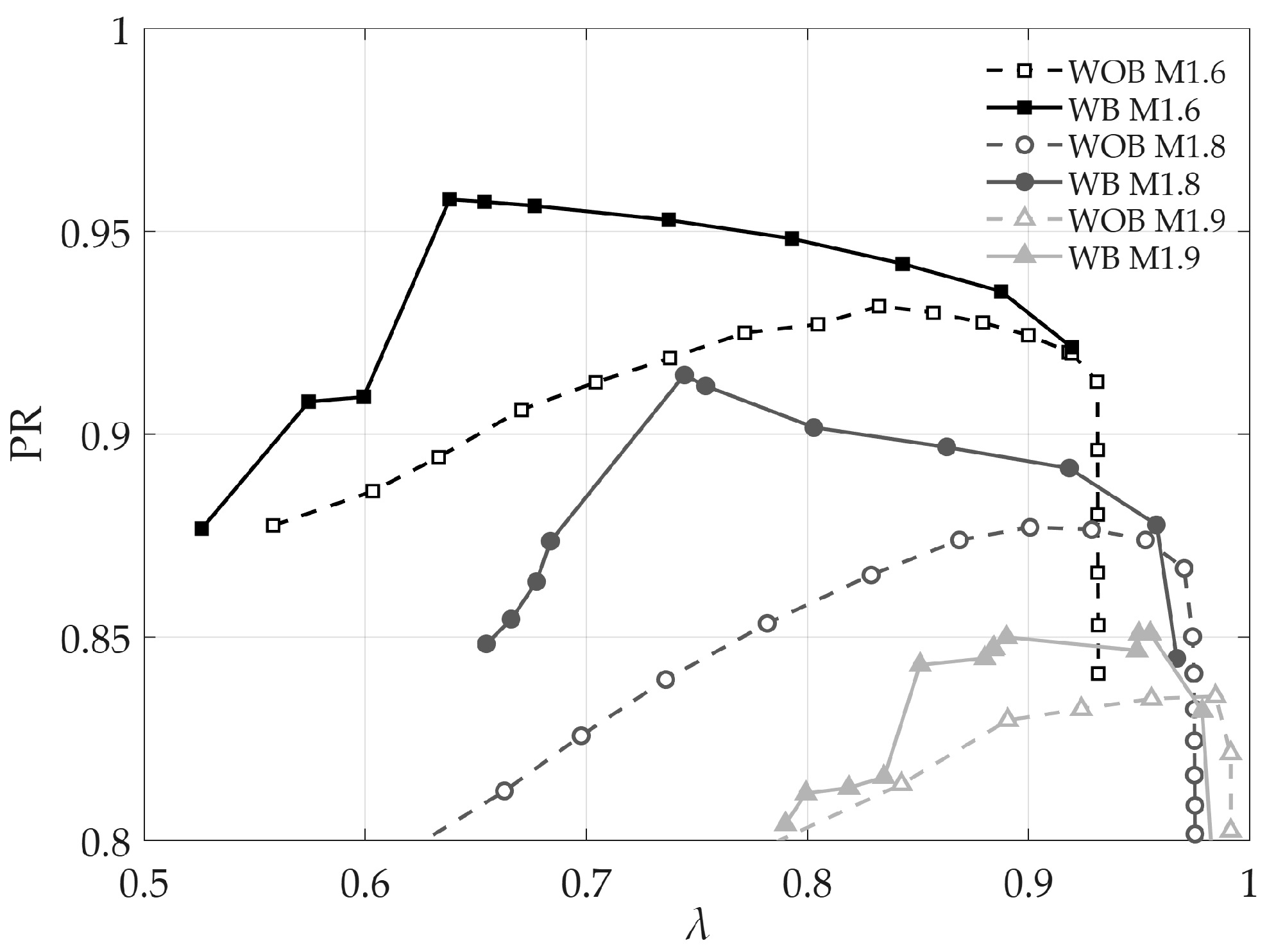
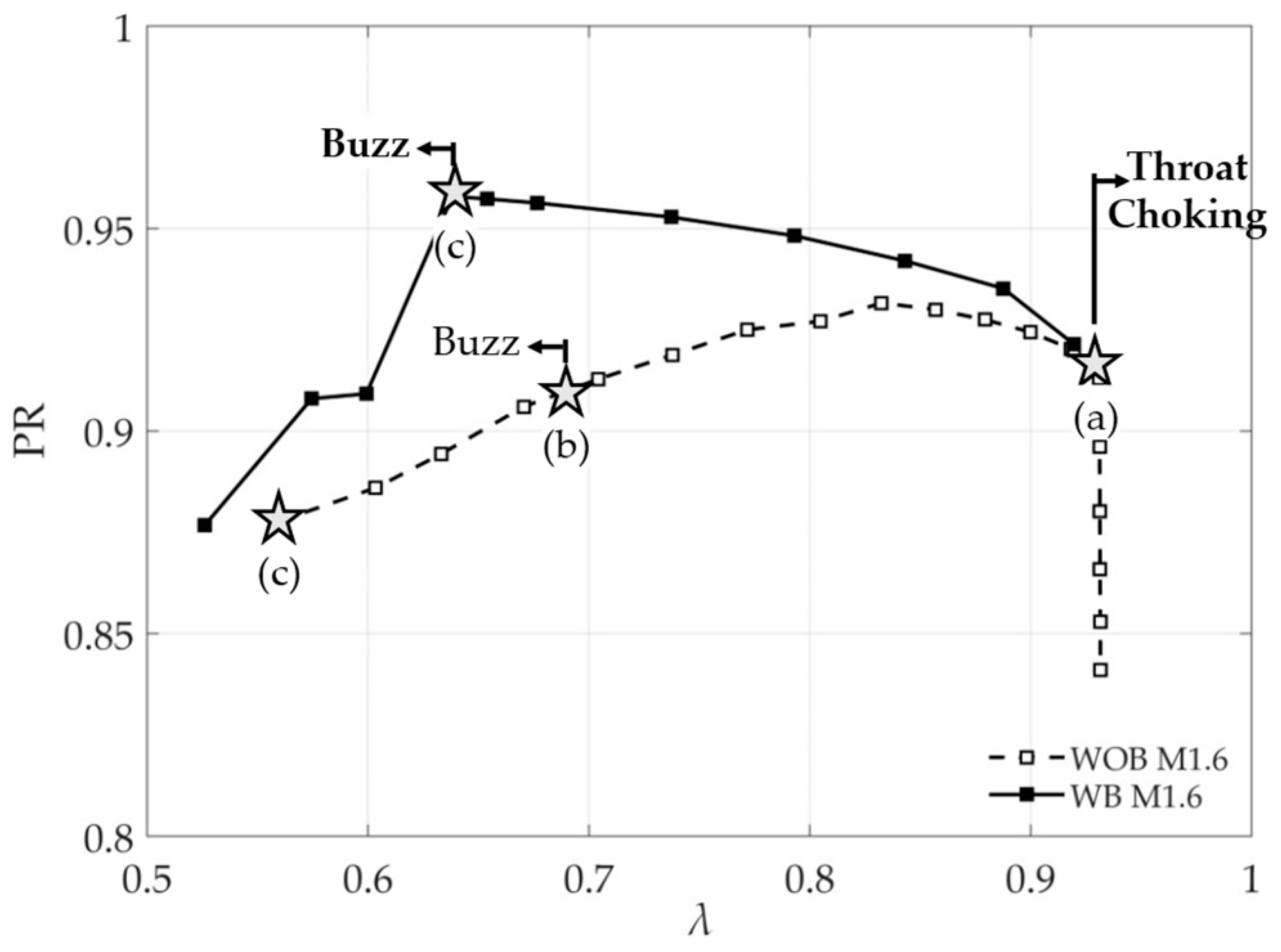
Figure 12 shows that implementing a boundary-layer bleed system considerably improves the stability margin of the supersonic inlet, principally by delaying the onset of aerodynamic instabilities such as buzz. As seen in the PR versus λ characteristics, the bleed system enables the inlet to work stably down to lower λ values compared to the non-bleed arrangement. As a result, the bleed system effectively expands the stable operational envelope towards lower mass flow conditions, increasing the inlet’s tolerance to downstream disturbances or backpressure fluctuations before instability occurs, and thus improving the overall stability margin across the tested freestream Mach numbers.
Figure 12.
Pressure recovery versus flow ratio, with bleed (WB, solid line) and without bleed (WOB, dashed line), for three different Mach numbers M∞ = 1.6, 1.8, and 1.9.
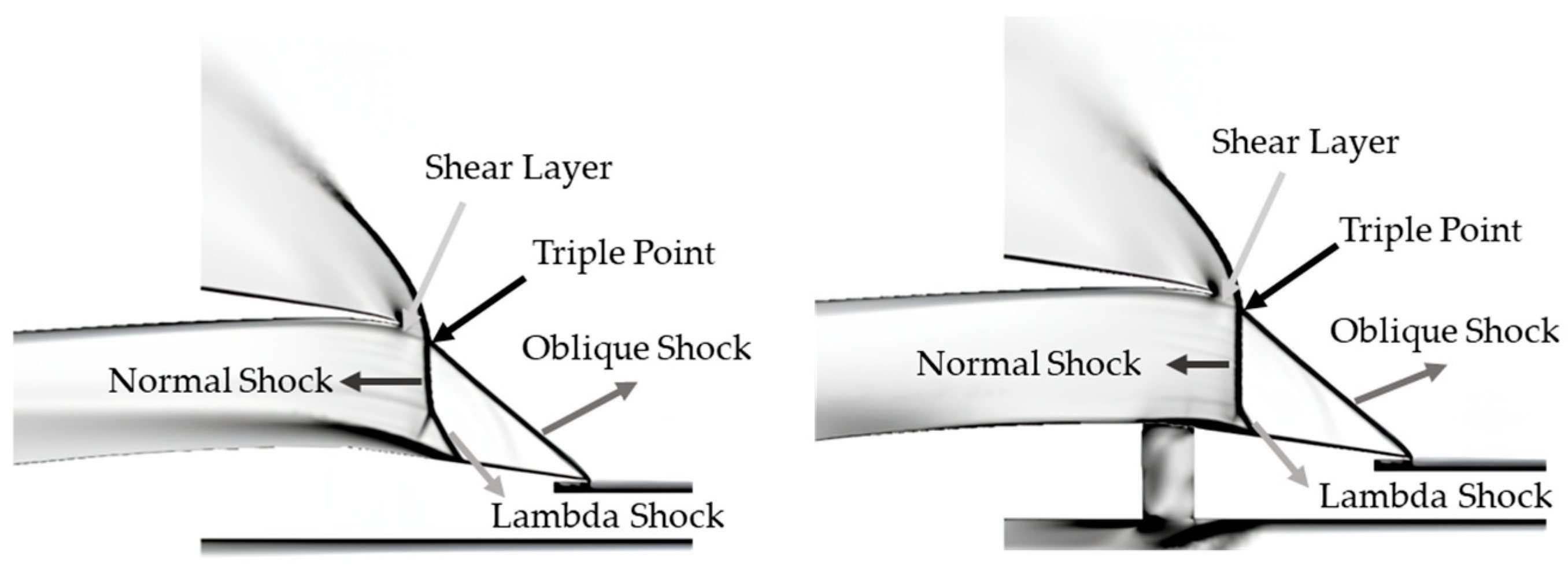
Figure 13 depicts the operational parameters of the supersonic inlet at Mach 1.6, comparing performance WB (solid line) and WOB (dashed line) by graphing PR against the λ. The curves distinguish three key operating regimes. The first is (a) supercritical operation, which terminates at the ‘Throat Choking’ limit. This point (a) represents the maximum mass flow rate capacity of the inlet; any further increase in λ cannot pass additional mass flow as the throat is choked. As λ is reduced, the inlet enters (b) critical operation, defined here as the onset of low-frequency buzz. This instability (b) is understood to begin when the shear layer, originating from the triple point of the shock interaction, starts to be ingested into the duct. Further reductions in λ lead to (c) subcritical operation, which is initiated by the onset of high-frequency buzz (c). This final regime is characterized by significant boundary-layer separation and is observed on the graph as a region of sudden, sharp drops in PR. The activation of the bleed system results in significant benefits; it enhances the maximum possible PR, raises PR levels across the subcritical range, and crucially improves inlet stability by delaying the onset of both buzz instabilities (points b and c) to much lower λ values, thereby expanding the stable operating range.
Figure 13.
Pressure recovery versus flow ratio for the Mach 1.6 inlet (M∞ = 1.6) with bleed (WB, solid line with squares) and without bleed (WOB, dashed line with squares).
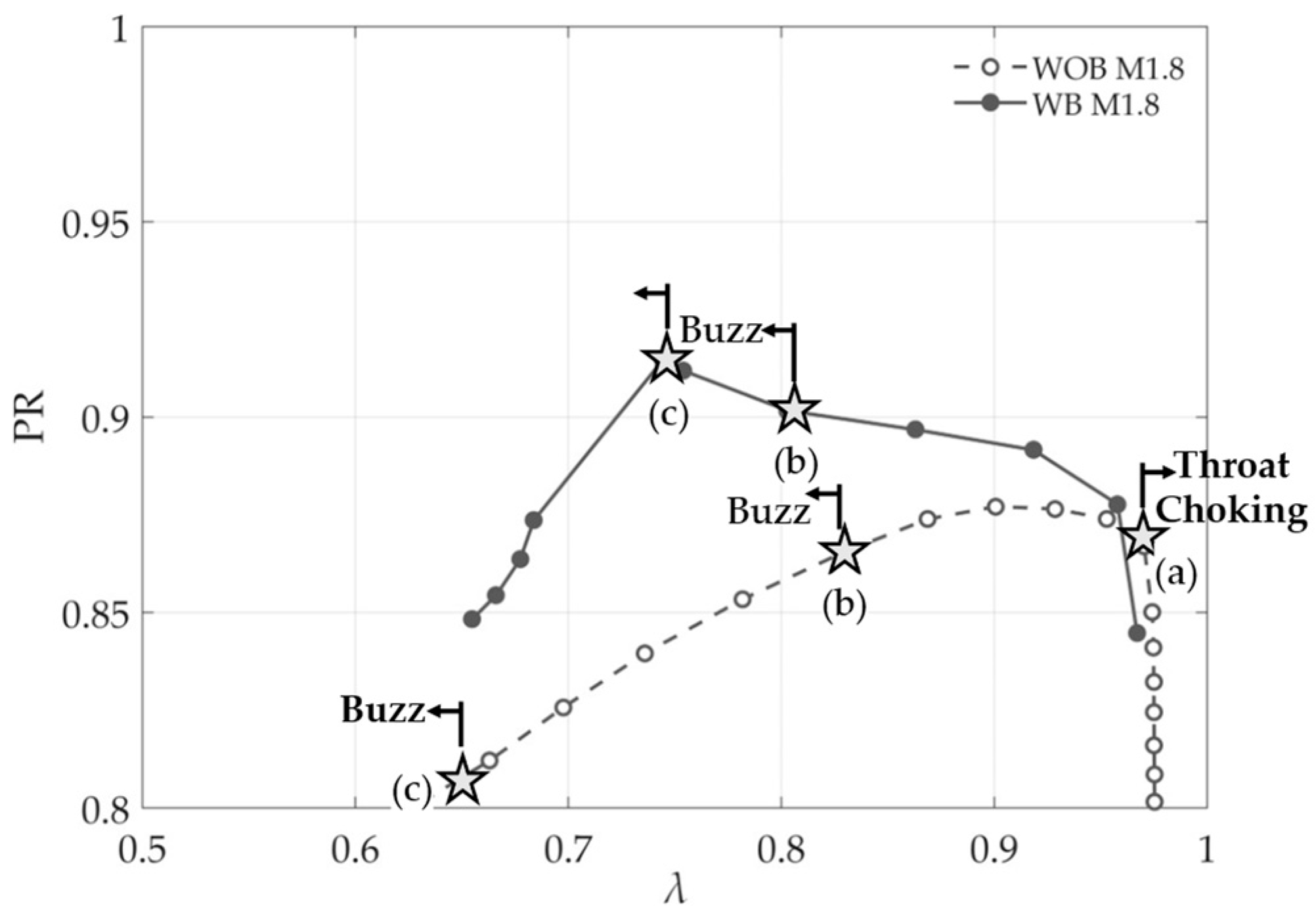
Figure 14 presents the performance characteristics of the inlet at M∞ = 1.8, comparing the WB (solid line) and WOB (dashed line) configurations. The plot of PR versus the λ clearly shows that the WB case achieves a significantly higher peak PR than the WOB case. Critical operating points are also marked, including the ‘Throat Choking’ limit (a) and the ‘Buzz’ instability onsets (b and c), illustrating the differences in stability.
Figure 14.
Pressure recovery versus flow ratio for the Mach 1.8 inlet (M∞ = 1.8) with bleed (WB, solid line with squares) and without bleed (WOB, dashed line with squares).
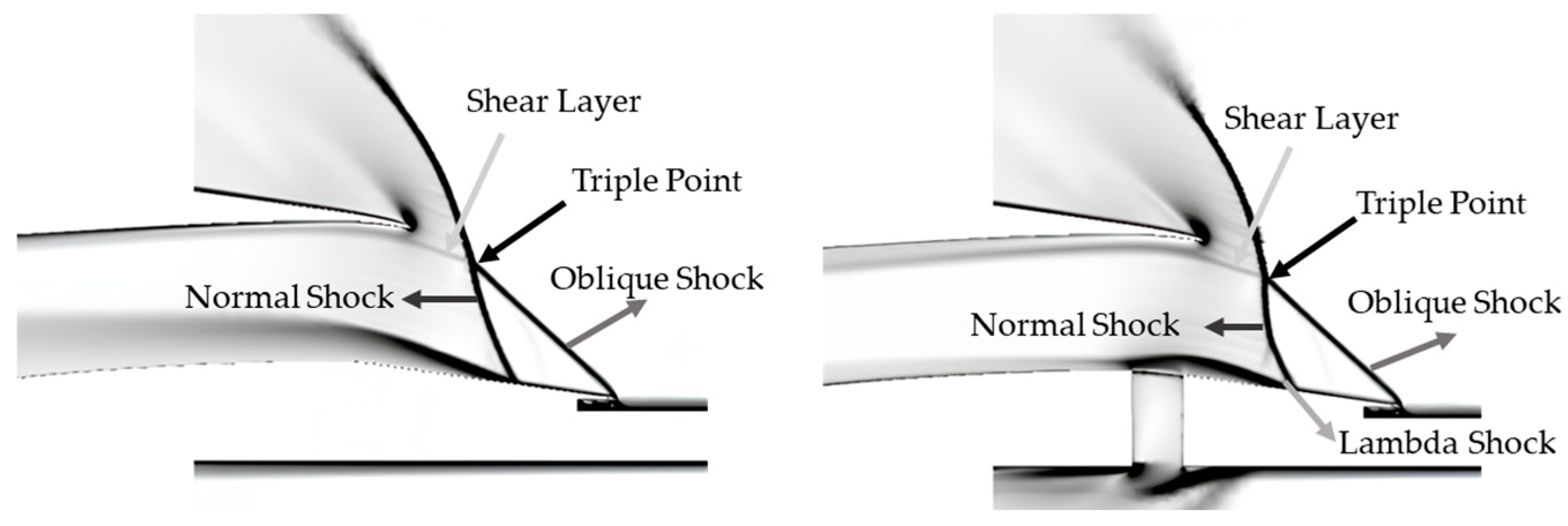
Figure 15 provides the physical explanation for this performance difference by visualizing the flow structure at two specific operating points near the “Buzz (b)” stability limit. The WOB condition λ = 0.8287 shows a strong SBLI. A normal shock interacts with the wall’s boundary layer, creating a triple point and a large shear layer, which indicates flow separation. This separation is inefficient and contributes to the lower PR and instability seen in the WOB curve. The WB condition λ = 0.8057 demonstrates the effect of bleed. The bleed actively removes the low-energy boundary layer. This suction alters the SBLI, causing the shock to bifurcate (split) at its base, forming a characteristic Lambda Shock structure. This control of the boundary layer prevents large-scale separation, stabilizes the shock system, and is the direct cause of the superior PR and stability documented for the WB configuration in Figure 14.
Figure 15.
Comparison of inlet shock structures and shear-layer visualization at M∞ = 1.8 for WOB condition at λ = 0.8287 (left) and WB condition at λ = 0.8057 (right).
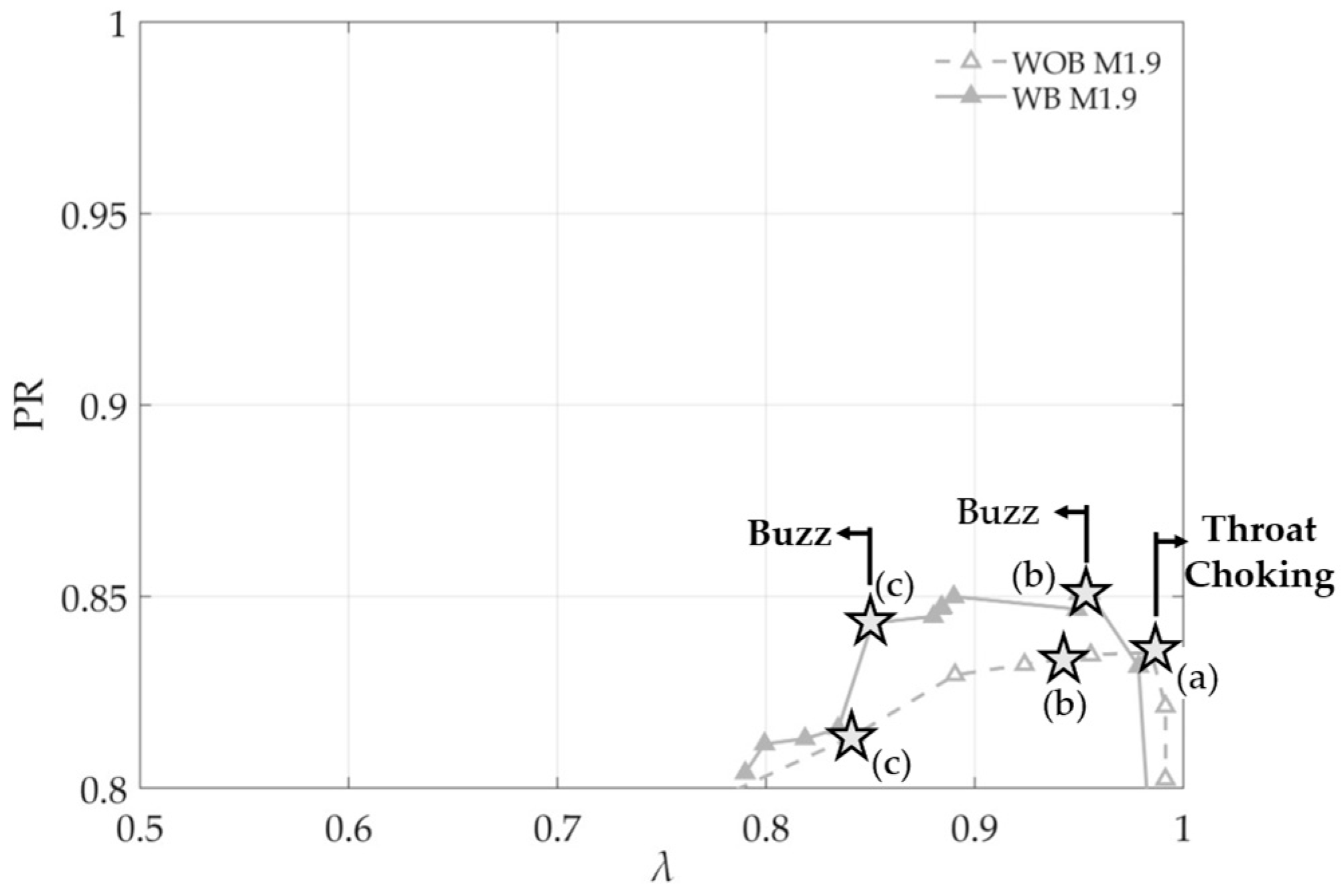
Figure 16 displays the performance characteristics for the inlet at M∞ = 1.9, comparing the WB (solid line) and WOB (dashed line) configurations. Figure 17 provides the physical explanation for the performance difference observed at Mach 1.9, visualizing the flow structure at specific operating points for both configurations. The WOB condition (left, at λ = 0.942) visualizes the baseline SBLI. A primary normal shock interacts with the boundary layer, leading to the formation of a triple point, an oblique shock, and a subsequent shear layer. A small Lambda Shock structure is also visible at the foot, indicating the presence of flow separation. This separation is the source of the pressure losses and instability documented for the WOB case in Figure 16. The WB condition (right, at λ = 0.951) demonstrates the effect of bleed. The bleed, positioned directly under the interaction, actively removes the low-energy boundary layer. This suction modifies the SBLI, promoting a more stable and pronounced Lambda Shock structure at the foot. By controlling the boundary layer in this manner, the bleed system prevents large-scale separation, anchors the terminal shock, and is the direct cause of the enhanced PR and stability documented for the WB configuration in Figure 16.
Figure 16.
Pressure recovery versus flow ratio for the Mach 1.9 inlet (M∞ = 1.9) with bleed (WB, solid line with squares) and without bleed (WOB, dashed line with squares).
Figure 17.
Comparison of inlet shock structures and shear-layer visualization at Mach 1.9 for WOB condition at λ = 0.942 (left) and WB condition at λ = 0.951 (right).
3.6. Circumferential Swirl Angle Distributions
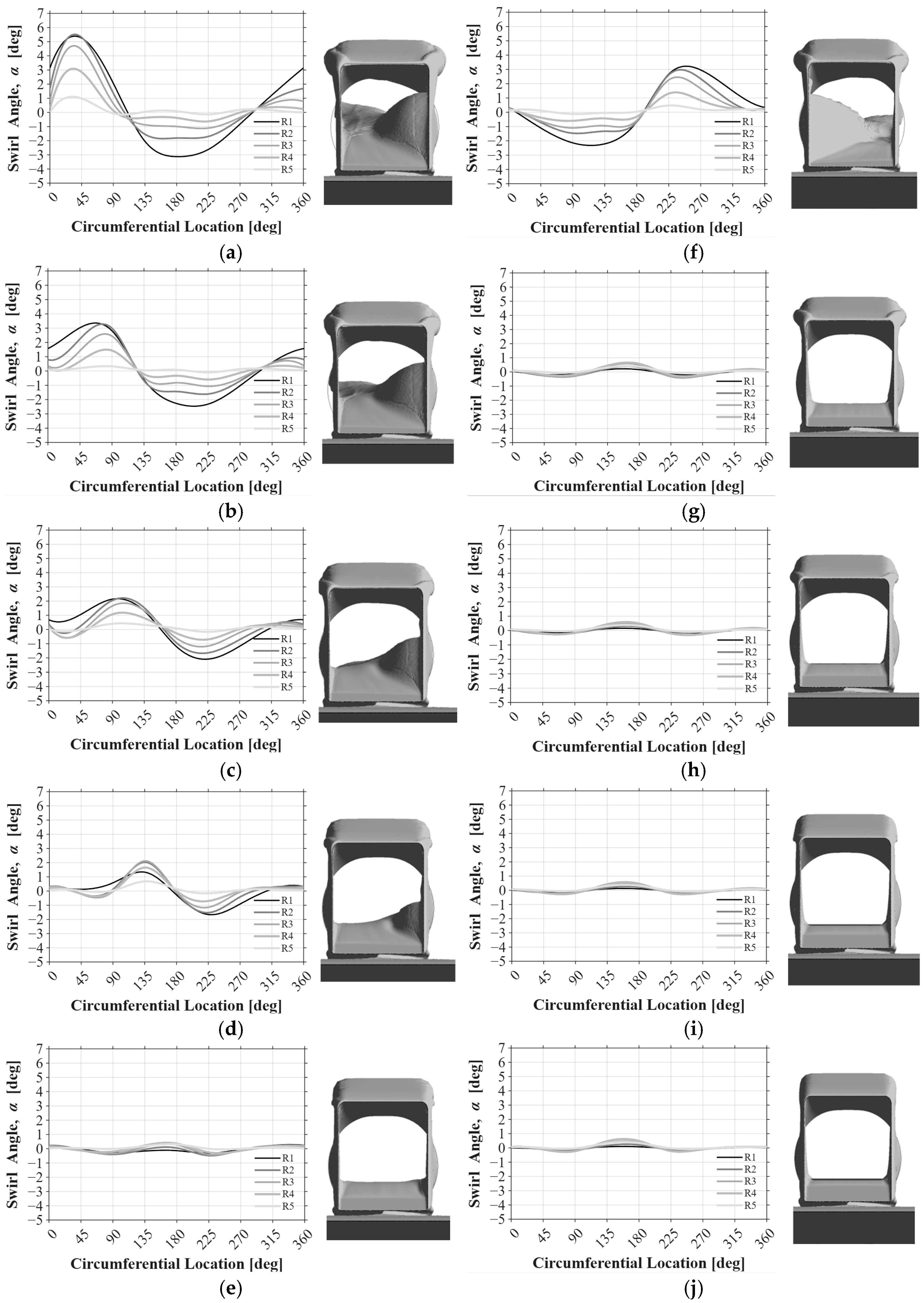
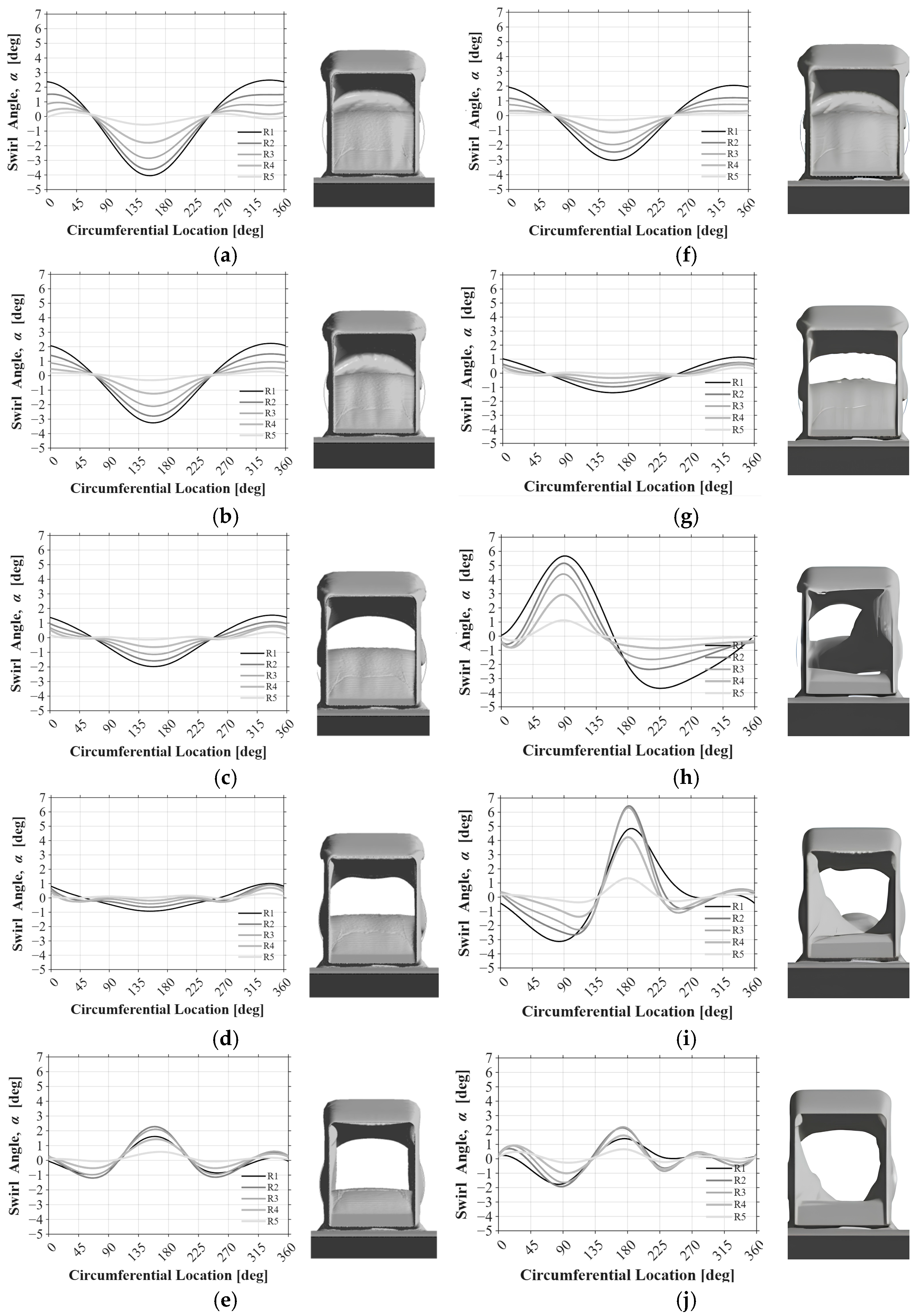
Figure 18 shows the swirl angle (α) distribution at the AIP over five radial rings (R1 to R5) at M∞ = 1.6. The results are presented for λ values ranging from 0.57 to 0.84. Each subfigure depicts both the swirl angle variation and the ϵloss iso-surface at the AIP. The left column shows the baseline (no bleed, WOB) case, whereas the right column shows the bleed-enabled cases.
Figure 18.
Swirl angle distribution at the AIP for the supersonic intake at the freestream Mach 1.6, showing five rings (R1 to R5) across λ = 0.57 (a,f), 0.67 (b,g), 0.73 (c,h), 0.79 (d,i), and 0.84 (e,j), for WOB (left) and WB (right). The x-axis represents circumferential location (0° to 360°), and the y-axis shows swirl angle (degrees).
In the absence of bleed, the swirl angle profiles show significant circumferential asymmetry and increased amplitude, especially at lower λ values. At λ = 0.57, the swirl angle ranges from ±6°, with the inner rings (R1–R3) showing the most significant variances. This phenomenon is strongly related to sidewall separation and the subsequent SBLI, which causes concentrated swirling motion at the separated region. Visual confirmation for these swirl patterns comes from the accompanying ϵloss iso-surfaces, which show a thick pressure loss structure skewed toward the separated side. As λ increases, the amplitude and asymmetry of the swirl angle profiles gradually diminish, indicating a return to flow symmetry as the boundary layer reattaches and the separation bubble weakens. Nonetheless, even at λ = 0.79, residual swirl asymmetry is discernible in both the angular plots and the ϵloss contours.
In contrast, bleed-enabled situations exhibit a significant reduction in SI and distortion across all λ values. At λ = 0.57, swirl profiles flatten dramatically, reducing peak values to ±2° and suppressing radial variance between rings. This homogeneity is further represented in the ϵloss contours, which have smooth and symmetric pressure loss distributions, with the high-loss zones significantly reduced. The bleed action appears to reduce SBLI-induced separation along the sidewall, resulting in a more symmetrical and stable inlet flow field. As λ increases, the swirl profiles remain flat and relatively uniform, while the ϵloss distributions show little further change, indicating that the incoming flow has entered a highly stable state.
Taken together, these findings show that applying bleed flow efficiently decreases swirl production by reducing separation-driven vorticity and restoring circumferential symmetry at the AIP. The ϵloss iso-surfaces provide a valuable qualitative correlation to swirl angle trends, supporting the fact that when bleed is activated, inlet symmetry and aerodynamic performance improve dramatically across the entire λ working range.
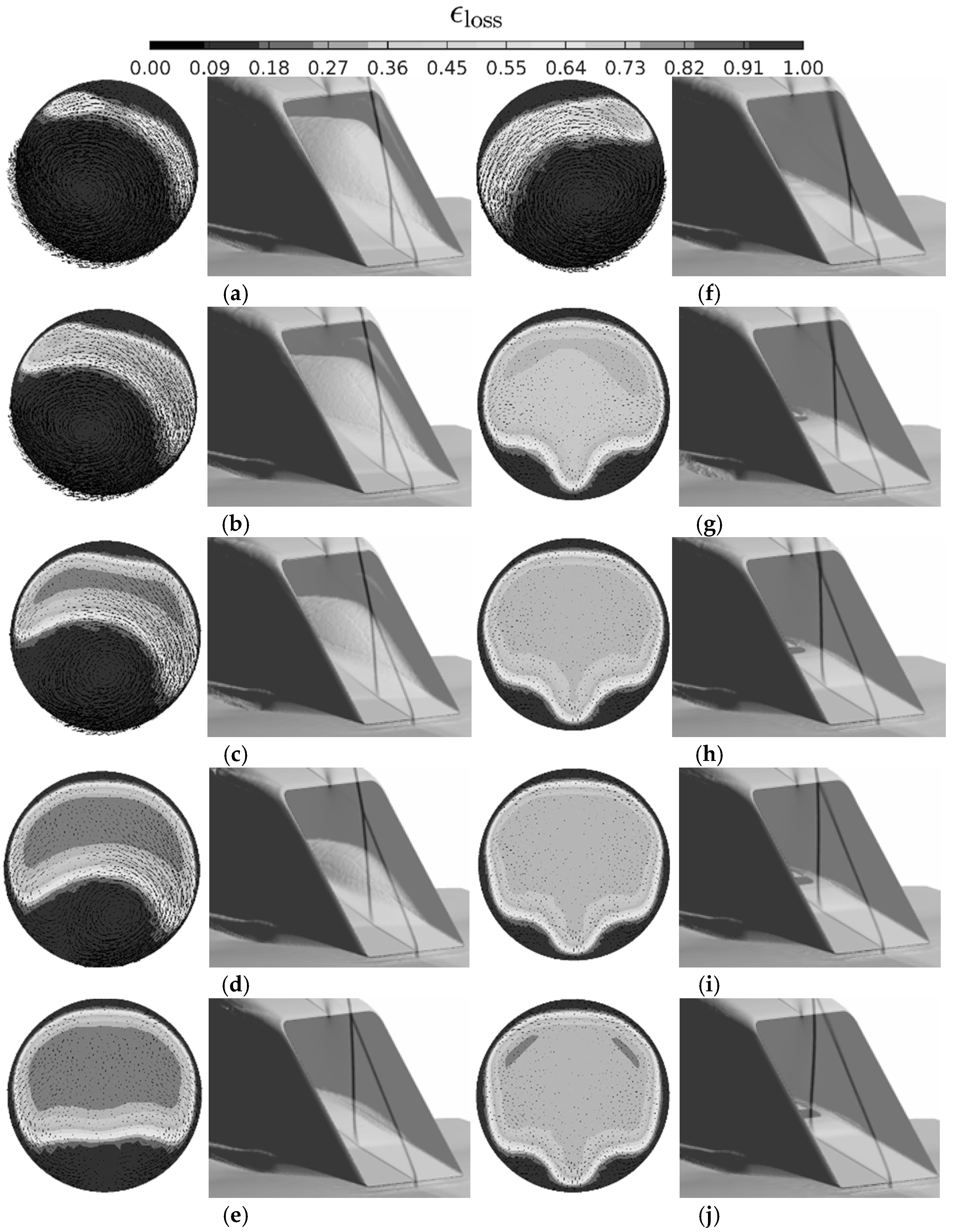
Figure 19 depicts iso-surfaces of the ϵloss and accompanying swirl vector fields at the AIP spanning five λ values for both WOB (left) and WB (right) configurations. For the baseline (no bleed) cases, there is a clear evolution of the separation pattern and swirl asymmetry: at λ = 0.57, a strong sidewall-originating vortex dominates the flow structure, producing high swirl angle magnitudes and elevated ϵloss values concentrated along the left side of the AIP. As λ increases, the intensity and footprint of this divided zone gradually decrease, although traces of the asymmetry continue until λ = 0.79. In contrast, the bleed-enabled setup results in a significant reduction in both swirl strength and ϵloss intensity, beginning with the lowest λ case. Circumferential symmetry has been restored in the flow vectors, and high-loss zones are either greatly limited or missing.
Figure 19.
Loss factor (ϵloss) contours and iso-surfaces at the AIP for M∞ = 1.6, without bleed (WOB) (a–e) and with bleed (WB) (f–j) configurations, at the same λ values of 0.57 (a,f), 0.67 (b,g), 0.73 (c,h), 0.79 (d,i), and 0.84 (e,j).
Figure 20 shows a detailed investigation of the swirl angle (α) distribution over the AIP for a supersonic intake with M∞ = 1.8. The WOB data (a–e) show significant swirl distortion, defined by organized patterns with distinct positive and negative swirl zones, notably at lower λ values (a, b), reaching magnitudes of up to approximately ±4 degrees. These patterns, which indicate organized vortical structures, correspond to the asymmetric flow features shown in the corresponding schematic views and gradually decrease in intensity as λ increases. However, engaging the bleed system (WB, plots f–j) results in a significant improvement in flow quality. Swirl angle magnitudes are reduced to below ±2 degrees, resulting in more consistent circumferential profiles across all radial sites. This enhanced homogeneity is reflected in the more symmetric patterns seen in the accompanying AIP diagrams. While certain low-amplitude wavy variations persist in the WB cases at intermediate λ (h, i), overall swirl distortion is much reduced, proving the bleed system’s ability to manage flow angularity at Mach 1.8.
Figure 20.
Swirl angle distribution at the AIP for the supersonic intake at the freestream Mach 1.8, showing five rings (R1 to R5) across λ = 0.65 (a,f), 0.74 (b,g), 0.80 (c,h), 0.86 (d,i), and 0.91 (e,j), for WOB (left) and WB (right). The x-axis represents circumferential location (0° to 360°), and the y-axis shows swirl angle (degrees).
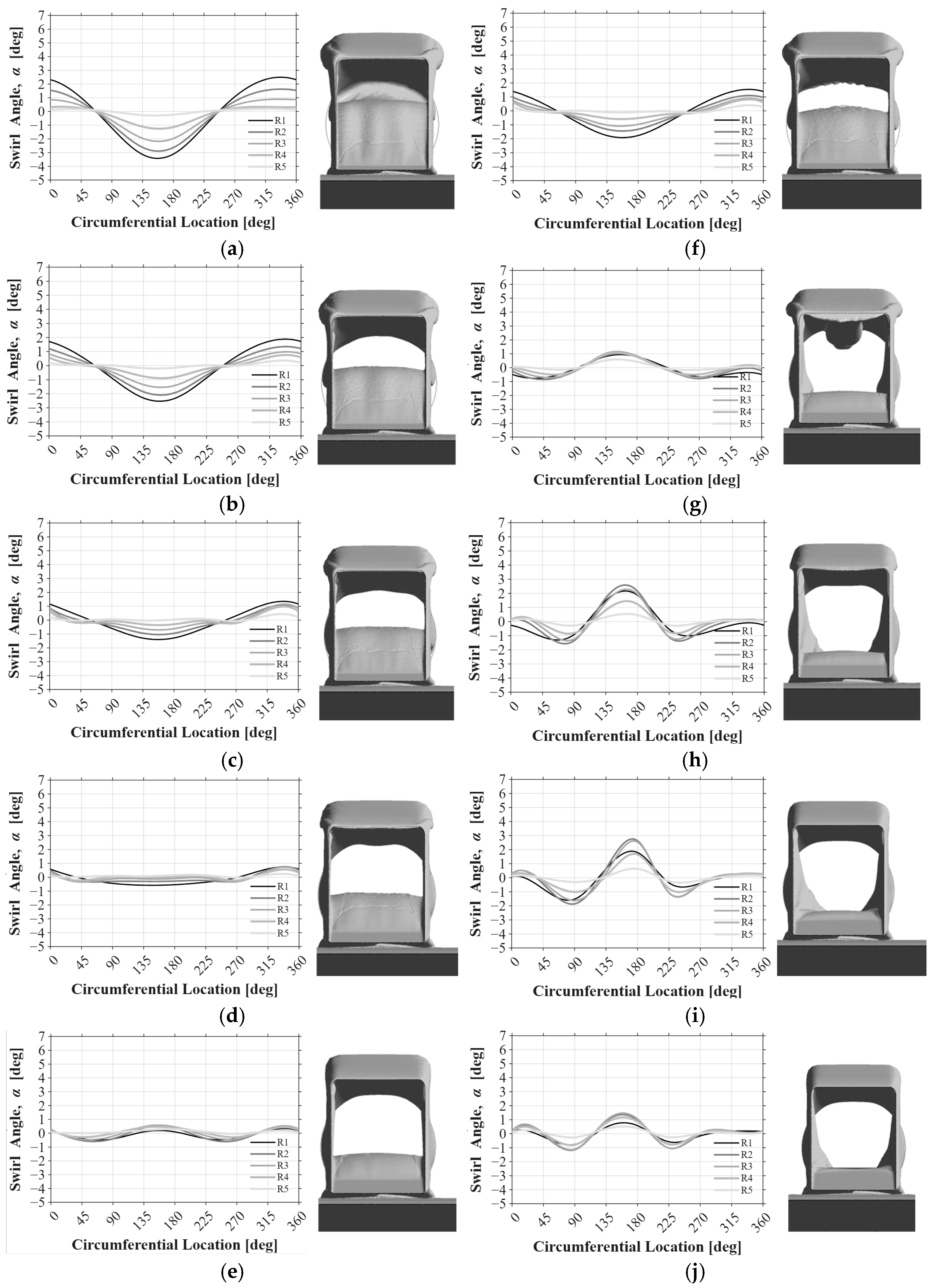
In Figure 21, the swirl angle (α) distribution at the AIP for a supersonic intake operating at M∞ = 1.9 is compared between the baseline WOB, left column, a–e, and the WB, right column, f–j, across λ from 0.68 to 0.95. At high Mach numbers, swirl angle magnitudes in the WOB configuration (a–e) remain considerable, but generally smaller than at M = 1.6, with peaks reaching roughly ±3–4 degrees. The patterns show a clear structure, with a dominant negative swirl near the 180° circumferential location, especially at lower λ (a, b, c), indicating organized vortical flow caused by flow separation phenomena within the inlet duct, as supported by the asymmetric AIP flow patterns in the accompanying schematics. As λ grows (from a to e), the swirl magnitude decreases. The WB arrangement (f–j) reduces swirl angles to ±2 degrees, leading to more uniform flow patterns over AIP rings and circumference. Although the bleed cases have much flatter profiles overall, some residual low-amplitude swirl structure can still be seen (e.g., plot i, λ = 0.87), but the large-scale distortion seen in the WOB cases has been effectively suppressed, indicating successful mitigation of the primary swirl-inducing mechanisms.
Figure 21.
Swirl angle distribution at the AIP for a supersonic intake at the freestream Mach 1.9, showing five rings (R1 to R5) across λ = 0.68 (a,f), 0.73 (b,g), 0.80 (c,h), 0.87 (d,i), and 0.95 (e,j), for WOB (left) and WB (right). The x-axis represents circumferential location (0° to 360°), and the y-axis shows swirl angle (degrees).
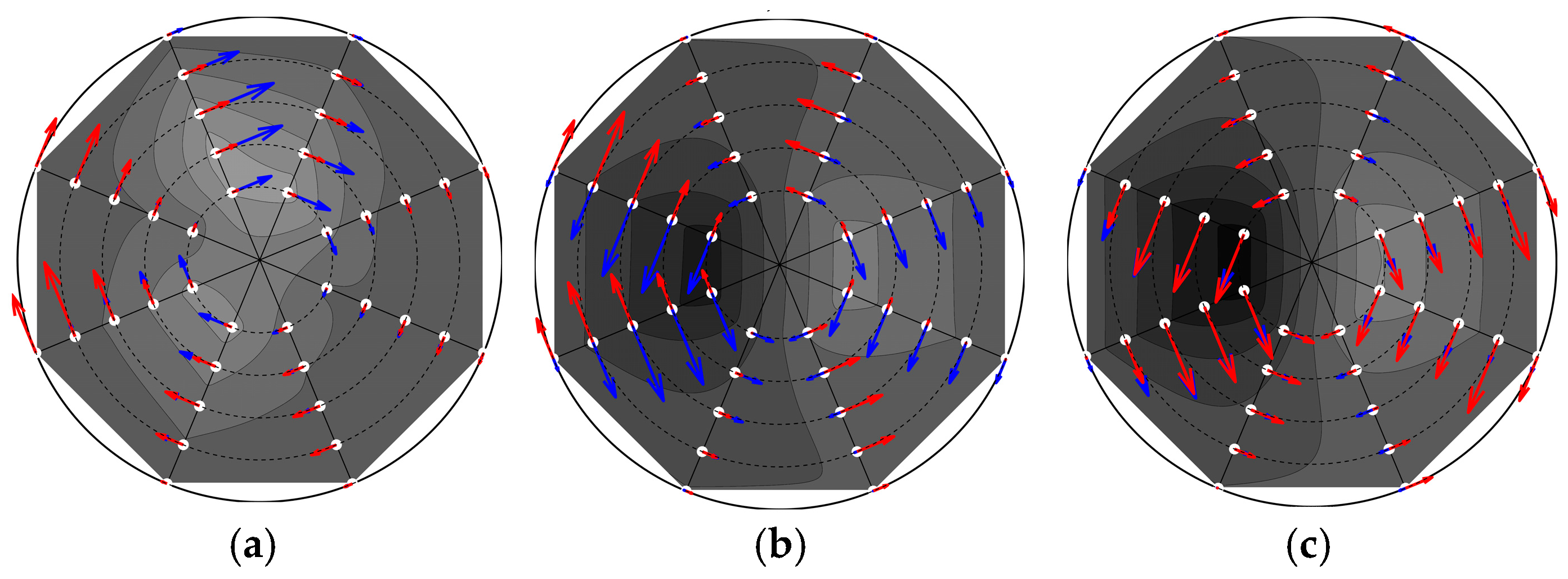
Figure 22 summarizes the effect of Mach number on the AIP swirl topology at a fixed operating point. For all three cases, the WOB flow (gray contours and blue vectors) exhibits an SBLI-driven pair of counter-rotating vortices, with organized sectors of positive and negative swirl that are strongest near the sidewall and inner rings. As M∞ increases from 1.6 to 1.9, the footprint of this separated structure becomes more compact and shifts circumferentially, but its peak swirl angles remain of an order of several degrees. When bleed is activated, the corresponding WB vectors (red) collapse into a much weaker and more axisymmetric pattern: the dominant vortex pair is strongly attenuated, local swirl angles are generally confined within about ±2°, and the swirl sectors lose much of their circumferential coherence. This comparison confirms, at a common λ, that the bleed system simultaneously shrinks the separation bubble and de-organizes the swirl field across all three Mach numbers, consistent with the ring-wise SI trends reported in Figure 23, Figure 24 and Figure 25.
Figure 22.
Comparison of AIP swirl angle distributions for (a) M∞ = 1.6, (b) M∞ = 1.8, and (c) M∞ = 1.9 at a fixed flow ratio (λ = 0.36). Each subplot presents the WOB swirl angle distribution via grayscale contours and illustrates the swirl magnitude and direction via overlaid vectors. The vector comparison highlights the bleed system’s control authority: blue vectors indicate the WOB swirl field, while red vectors indicate the WB swirl field.
Figure 23.
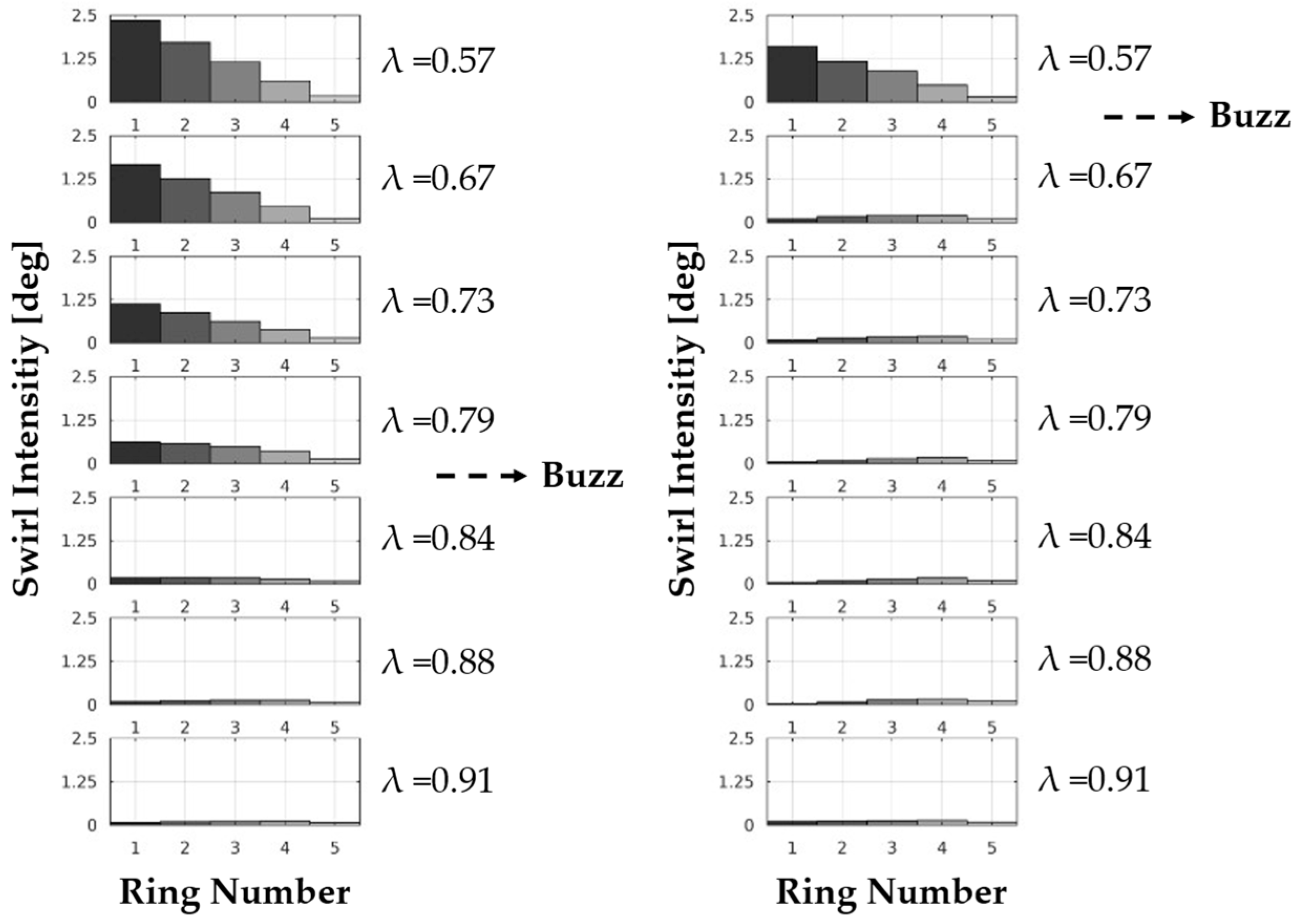
Comparison of SI [deg] distribution across AIP rings (R1–R5) at M∞ = 1.6 for WOB (left) and WB (right) configurations at λ from 0.57 to 0.91.
Figure 24.
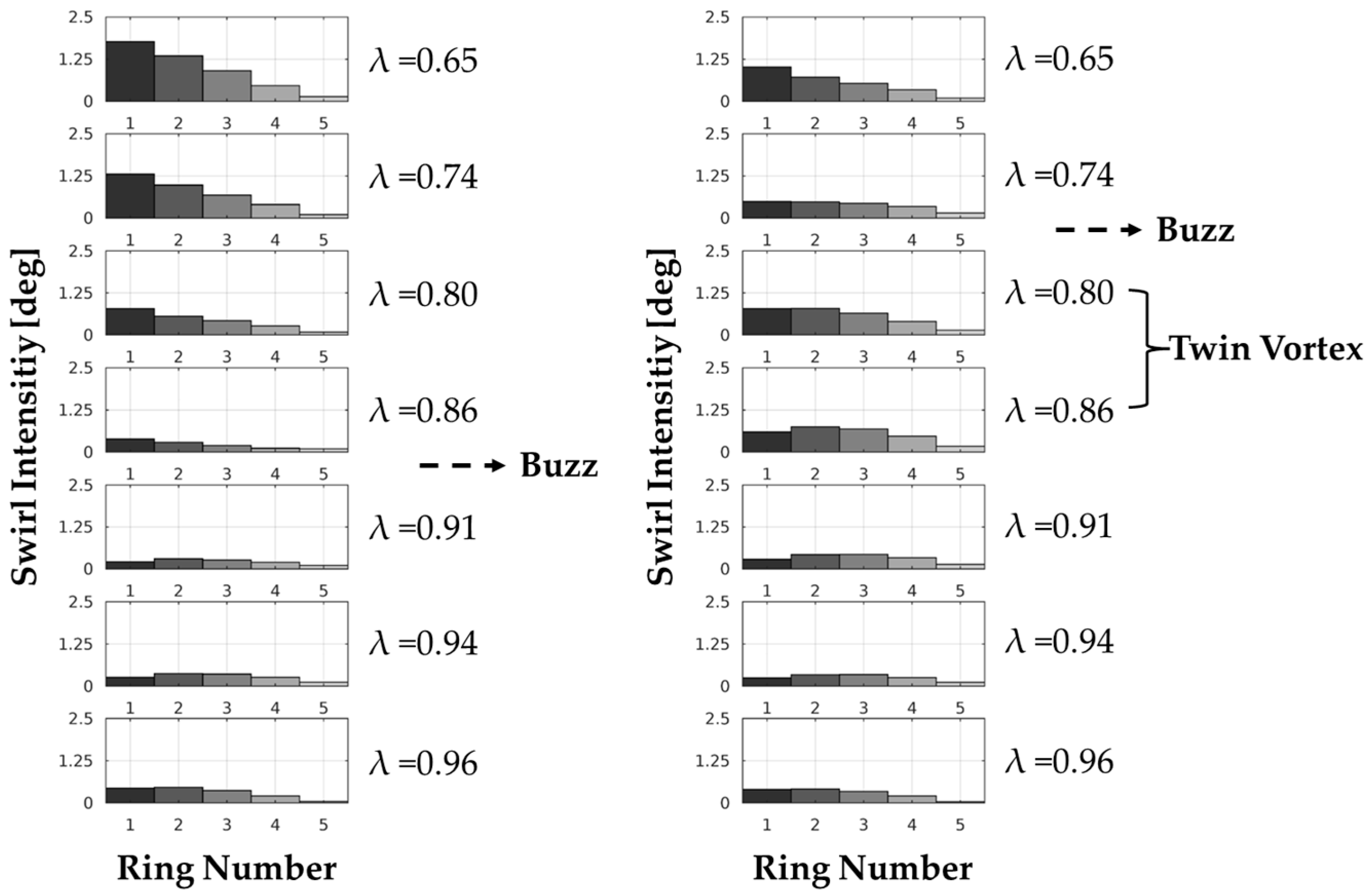
Comparison of SI [deg] distribution across AIP rings (R1–R5) at M∞ = 1.8 for WOB (left) and WB (right) configurations at λ from 0.65 to 0.96.
Figure 25.
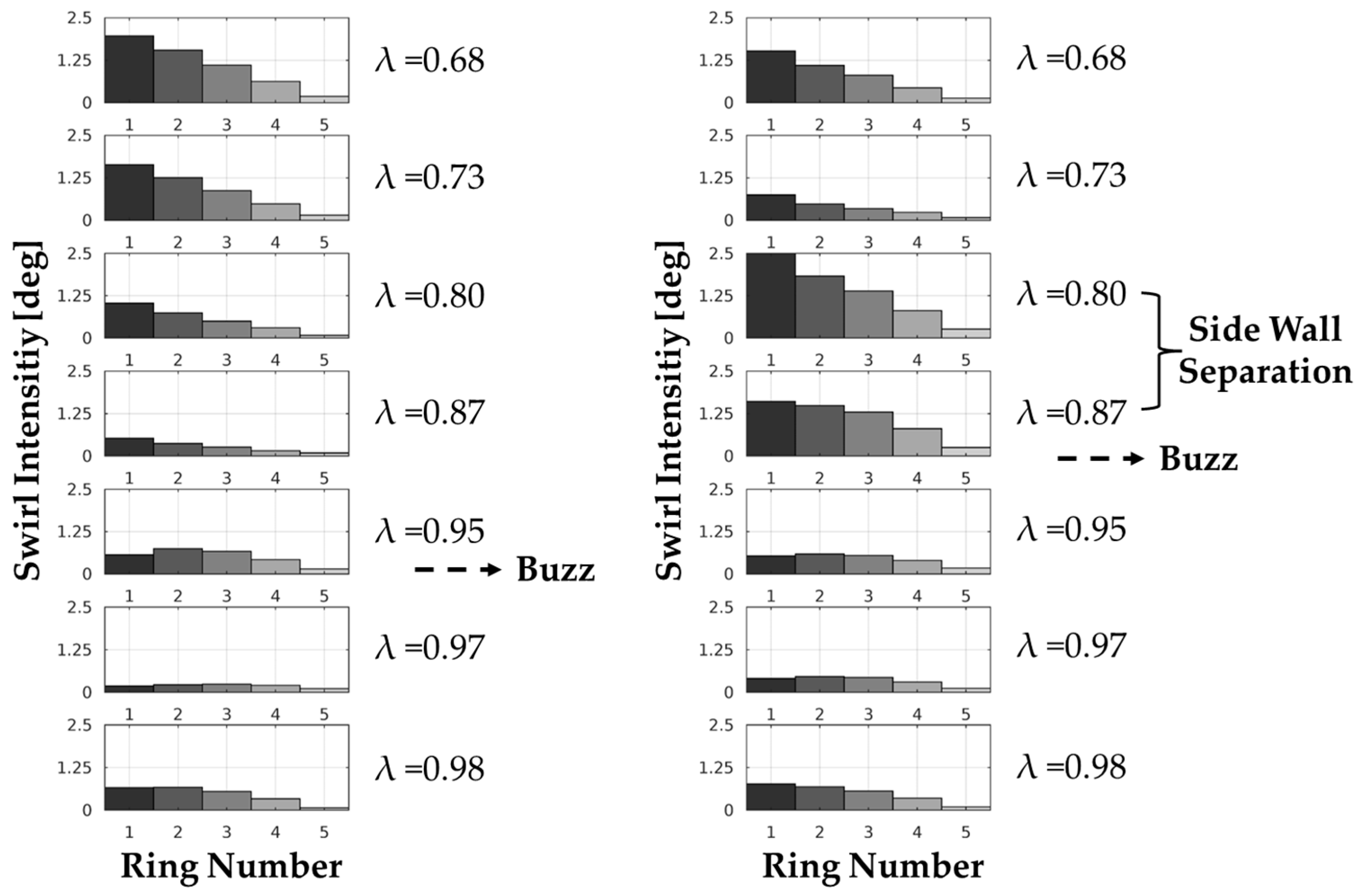
Comparison of SI [deg] distribution across AIP rings (R1–R5) at M∞ = 1.9 for WOB (left) and WB (right) configurations at λ from 0.68 to 0.98.
3.7. Circumferential Swirl Intensity Distributions
Figure 23 shows a quantitative assessment of SI, resolved radially, for an intake operating at M∞ = 1.6. In the WOB scenario, significant SI is found at lower λ values (0.57 to 0.91), mainly focused in the inner rings (R1, R2), with peak values reaching around 2.5 degrees in Ring 1 at λ = 0.57. The intensity diminishes radially outward towards Ring 5. SI decreases sharply across all rings as λ increases beyond the specified buzz onset threshold about λ = 0.79, with values becoming negligible at λ = 0.84 and higher. In contrast, activating the bleed system has a significant influence on reducing SI. Across the entire λ range, the SI values are significantly lower than in the WOB scenario, typically remaining far below 1 degree and frequently close to 0 for all rings. The consistently low SI levels in the WB configuration, even at low λ before buzz onset (lower than WOB’s), demonstrate the bleed system’s effectiveness in mitigating the development of strong vortical structures responsible for swirl across all measured radial locations and operating conditions at M∞ = 1.6.
Figure 24 depicts the radially resolved SI features at 1.8, over a λ range of 0.65 to 0.96. In the WOB arrangement, the SI is moderately high at lower λ values (0.65 to 0.86), peaking at 1.5 degrees in the inner rings (R1, R2) and decreasing radially outwards. Similarly to the Mach 1.6 scenario, as the λ increases beyond the buzz initiation point (shown near λ = 0.86), there is a noticeable decline in intensity throughout all rings. In contrast, the bleed system produces a significant reduction in SI throughout all rings and λ, with values typically remaining below 1 degree. The radial distribution is likewise much more uniform than in the WOB example. Surprisingly, despite the overall low intensity levels, there is a “Twin Vortex” structure matching λ = 0.80 and 0.86 in the WB data. This shows that, while the bleed system effectively reduces the overall amplitude of the swirl, residual structured flow structures, maybe corresponding with modest wavy patterns in swirl angle distributions, may exist under certain operating conditions even when the bleed system is functioning.
Figure 25 depicts the radially resolved SI features at the AIP at M∞ = 1.9, throughout a λ range of 0.68 to 0.98. In the WOB arrangement, the SI is quite high at lower λ values (0.68 to 0.95), peaking at 1.5 degrees in the inner rings (R1, R2) and decreasing radially outwards. Similarly to the Mach 1.6 case, a significant decline in intensity happens throughout all rings when the λ rises over the buzz initiation point. The radial distribution is likewise much more uniform than in the WOB example. Surprisingly, despite the overall low intensity levels, there is a “sidewall separation” structure in the WB data with λ values of 0.80 and 0.87. This shows that, while the bleed system effectively reduces the overall amplitude of the swirl, residual structured flow structures, maybe corresponding to modest wavy patterns in swirl angle distributions, may exist under certain operating conditions even when the bleed system is functioning.
3.8. Map-Level Trends and Physical Mechanism
Across M∞ = {1.6, 1.8, 1.9}, WOB cases exhibit SBLI-driven separation that elevates swirl at low λ and weakens toward buzz onset, whereas WB consistently yields lower SI at matched λ. At M∞ = 1.6, strong corner vortices dominate the swirl signature near λ of 0.57; as λ increases, corner-vortex strength decays and SI drops, becoming negligible beyond λ = 0.84. At M∞ = 1.8, the separation peak is observed near λ = 0.65, producing the highest WOB SI; under WB at the same λ, separation persists but SI remains markedly lower. Between λ = 0.80 and 0.86, WB may show “twin corner-vortex” traces that wane with increasing λ. At M∞ = 1.9, trends mirror the M∞ = 1.8 case; under WB, sidewall separation signatures can appear around λ = 0.80, yet SI stays unusually low, indicating that bleed alters the separation footprint and de-organizes swirl sectors.
3.9. Bleed-Onset Threshold and Operability Implications
Once the pre-shock normal Mach number exceeds Mn = 1.32, separation is triggered without bleed, setting the practical bleed-onset threshold for M∞ > 1.6. With WB, near-wall low-momentum fluid is overboarded, the terminal shock footprint is stabilized into a Λ-type pattern, and PR increases and SI decreases across the operating map. Consequently, the last stable point shifts to lower λ at fixed M∞, extending the stable operating range while keeping SIRA/SISA within guideline levels.
3.10. Modeling Considerations and Limitations
The WB configuration was implemented using a porous jump surrogate fitted to hole-resolved 3-D RANS data. The viscous (F1) and inertial (F2) resistances are expressed through a quadratic ∆p-V relation at the exit-plane superficial velocity, parameterized by porosity, L/D, and hole diameter. The flow solution was obtained with steady-state 3-D RANS CFD simulations using a realizable k-ε turbulence model with an enhanced wall treatment model. High-frequency buzz dynamics, plenum–structure coupling, and unsteady bleed–shock interactions are therefore not resolved explicitly.
From a modeling standpoint, the present results are limited by the use of a steady-state eddy–viscosity RANS closure for a flow that is inherently three-dimensional and unsteady. While this approach is appropriate for constructing intake operating maps at acceptable computational cost, it cannot fully capture the low-frequency motion of the terminal shock system, the detailed structure of corner vortices, or the full spectrum of unsteady turbulent scales in the shock–boundary-layer interaction. Consequently, local quantities such as instantaneous separation extent or peak swirl fluctuations are subject to modeling uncertainty, and the predictions reported here should be interpreted as time-averaged, map-level trends for bleed–swirl trade-offs rather than fully resolved unsteady dynamics.
Higher-fidelity approaches such as unsteady RANS, hybrid RANS/LES, or Implicit Large-Eddy Simulation (ILES) with high-order finite volume schemes offer the potential to represent supersonic turbulence and SBLI more accurately. In particular, the recently developed ROUND schemes [25] and their open source implementation provide a promising ILES framework for shock-dominated compressible flows. These methods are not employed in the present study because the primary objective is to construct a broad operating map in (M∞, λ) space, for which fully unsteady simulations at each operating point would be computationally prohibitive. Future work will therefore focus on complementing the current map-level RANS analysis with selected high-fidelity simulations, using URANS/LES or ILES, in order to examine unsteady buzz margins, bleed–plenum coupling, and three-dimensional turbulence in more detail.
4. Conclusions
This study presents the 3-D RANS CFD simulations for an operating-map assessment of a single-ramp external supersonic compression inlet. The computations at M∞ = 1.4–1.9 without bleed were performed first to identify the bleed-onset threshold, and then comparisons with and without bleed were performed at M∞ = 1.6, 1.8, and 1.9 over back-pressure traverses parameterized by flow ratio λ. Several observations were performed for separation, pressure recovery, and swirl characteristics. Without bleed, SBLI-induced separation was observed once Mn ≥ 1.32, and bleed is required to maintain intake stability for M∞ ≥ 1.6. With bleed, the terminal shock footprint was stabilized, and corner/sidewall separation was weakened, resulting in higher PR and lower SI across the map. With bleed, the circumferential swirl angles were confined to a narrow band (≈±2o) and the ring-wise SI remained low, even when weak twin-vortex traces persisted. In terms of operability gain, the last stable point was shifted to lower λ at fixed M∞, extending the stable operating range toward subcritical (unstart) conditions. Thus, there is a critical design trade-off inherent to bleed systems: while essential for maintaining attached flow and high PR, boundary-layer bleed systematically generates swirl that intensifies with the bleed mass flow rate. The quadratic ∆p-V porous jump surrogate model is shown to capture bleed pressure drop trends from bleed hole-resolved 3-D RANS simulations while enabling map-level studies at a practical cost. The findings are expected to be applicable to wedge-type external compression inlets with comparable bleed layouts and provide crucial insights for the integrated design and optimization of high-performance supersonic inlets. Unsteady RANS/LES simulations and experiments are needed to assess unsteady buzz margins and plenum-coupled effects.
Author Contributions
Conceptualization, M.E.O. and N.S.U.; formal analysis, M.E.O.; writing—original draft preparation, M.E.O.; writing—review and editing, M.E.O. and N.S.U. All authors have read and agreed to the published version of the manuscript.
Funding
This research has been partially supported by The Scientific and Technological Research Council of Turkey (TÜBİTAK), grant number 118C087 (2244—Industrial PhD Fellowship Program).
Data Availability Statement
Data are available to share only by requesting from the corresponding author because of ethical and privacy issues.
Acknowledgments
The authors thank Turkish Aerospace Industries (TUSAŞ) for access to Computational Fluid Dynamics (CFD) Software and High-Performance Computing (HPC) resources.
Conflicts of Interest
Author Muhammed Enes Ozcan was employed by the company Turkish Aerospace Industries. The remaining authors declare that the research was conducted in the absence of any commercial or financial relationships that could be construed as a potential conflict of interest.
References
- Van Wie, D.M. Scramjet Inlets. In Scramjet Propulsion; Progress in Astronautics and Aeronautics; Murthy, S.N.B., Curran, E.T., Eds.; American Institute of Aeronautics and Astronautics: Washington, DC, USA, 2001; Volume 189, pp. 447–511. [Google Scholar]
- Seddon, J.; Goldsmith, E.L. Intake Aerodynamics, 2nd ed.; AIAA Education Series; American Institute of Aeronautics and Astronautics (AIAA): Reston, VA, USA, 1999. [Google Scholar]
- Curran, E.T. Scramjet Engines: The First Forty Years. J. Propuls. Power 2001, 17, 1138–1148. [Google Scholar] [CrossRef]
- Dolling, D.S. Fifty Years of Shock-Wave/Boundary-Layer Interaction Research: What Next? AIAA J. 2001, 39, 1517–1531. [Google Scholar] [CrossRef]
- Gaitonde, D.V. Progress in shock wave/boundary layer interactions. Prog. Aerosp. Sci. 2015, 72, 80–99. [Google Scholar] [CrossRef]
- Green, J.E. Interactions between shock waves and turbulent boundary layers. Prog. Aerosp. Sci. 1970, 11, 235–340. [Google Scholar] [CrossRef]
- SAE Committee S-16. Gas Turbine Engine Inlet Flow Distortion Guidelines, SAE ARP1420; SAE International: Warrendale, PA, USA, 1999. [Google Scholar]
- Chyu, W.J.; Rimlinger, M.J.; Shih, T.I.P. Control of shock-wave/boundary-layer interactions by bleed. AIAA J. 1995, 33, 1239–1247. [Google Scholar] [CrossRef]
- Harloff, G.J.; Smith, G.E. Numerical Simulation of Supersonic Flow Using a New Analytical Bleed Boundary Condition; NASA-CR-198368; NASA Lewis Research Center: Cleveland, OH, USA, 1995. Available online: https://ntrs.nasa.gov/citations/19950026787 (accessed on 1 December 2025).
- Tindell, R.H. Highly Compact Inlet Diffuser Technology. In Proceedings of the AIAA/SAE/ASME/ASEE 23rd Joint Propulsion Conference, San Diego, CA, USA, 29 June–2 July 1987. [Google Scholar]
- Hermann, R. Supersonic Inlet Diffusers and Introduction to Internal Aerodynamics; Minneapolis-Honeywell Regulator Co.: Minneapolis, MN, USA, 1956. [Google Scholar]
- Willis, B.P.; Davis, D.O.; Slater, J.W. Numerical Investigation of Bleed-Induced Vorticity in a Supersonic Inlet. In Proceedings of the 42nd AIAA/ASME/SAE/ASEE Joint Propulsion Conference & Exhibit, Sacramento, CA, USA, 9–12 July 2006. [Google Scholar]
- SAE Committee S-16. A Methodology for Assessing Inlet Swirl Distortion, SAE AIR5686; SAE International: Warrendale, PA, USA, 2010. [Google Scholar]
- Greitzer, E.M. Surge and Rotating Stall in Axial Flow Compressors—Part I: Theoretical Compression System Model. J. Eng. Power 1976, 98, 190–198. [Google Scholar] [CrossRef]
- Bouldin, B.; Sheoran, Y. Inlet Flow Angularity Descriptors Proposed for Use with Gas Turbine Engines. SAE Technical Paper 2002-01-2919. 2002. Available online: https://www.sae.org/papers/inlet-flow-angularity-descriptors-proposed-use-gas-turbine-engines-2002-01-2919 (accessed on 1 December 2025).
- Shih, T.-H.; Liou, W.W.; Shabbir, A.; Yang, Z.; Zhu, J. A new k-ε eddy viscosity model for high Reynolds number turbulent flows. Comput. Fluids 1995, 24, 227–238. [Google Scholar] [CrossRef]
- Özcan, M.E.; Yılmaz, M.H.; Sezer-Uzol, N. Sesüstü Harici Sıkıştırma Rampalı Hava Alığı Modelinin Farklı Türbülans Modelleri ile Sayısal İncelenmesi. In Proceedings of the 10. Ulusal Havacılık ve Uzay Konferansı (UHUK 2024), Ankara, Türkiye, 18–20 September 2024. [Google Scholar]
- Özcan, M.E.; Sezer-Uzol, N. Impact of Shock Boundary Layer Interaction on Swirl Characteristics in Supersonic Intakes with Bleed System. In Proceedings of the 15th International Conference on Computational Heat & Mass Transfer (ICCHMT’25), Antalya, Türkiye, 19–23 May 2025. [Google Scholar]
- Ozcan, M.E.; Sezer Uzol, N. Numerical Analysis and Optimization of Bleed Systems for External Supersonic Compression Inlets. In Proceedings of the AIAA AVIATION Forum, Las Vegas, NV, USA, 21–25 July 2025. [Google Scholar] [CrossRef]
- Vijayaraghavan, S.B.; Kavanagh, P. Effect of Free-Stream Turbulence. Reynolds Number. and Incidence on Axial Turbine Cascade Performance. In Proceedings of the ASME Gas Turbine and Aero-Engine Congress and Exposition, Amsterdam, The Netherlands, 6–9 June 1988. [Google Scholar]
- S-16 Turbine Engine Inlet Flow Distortion Committee. Gas Turbine Engine Inlet Flow Distortion Guidelines; ARP1420B; SAE International: Warrendale, PA, USA, 2011; p. 24. [Google Scholar]
- S-16 Turbine Engine Inlet Flow Distortion Committee. AIR5867 Assessment of the Inlet/Engine Total Temperature Distortion Problem; SAE International: Warrendale, PA, USA, 2017; p. 57. [Google Scholar]
- Turbine Engine Inlet Flow Distortion Committee. AIR1419C; Inlet Total-Pressure-Distortion Considerations for Gas-Turbine Engines; Technical Report; SAE International: Warrendale, PA, USA, 2017. [Google Scholar]
- Fang, Y.; Sun, D.; Dong, X.; Sun, X. Effects of Inlet Swirl Distortion on a Multi-Stage Compressor with Inlet Guide Vanes and Stall Margin Enhancement Method. Aerospace 2023, 10, 141. [Google Scholar] [CrossRef]
- Deng, X. A Unified Framework for Non-linear Reconstruction Schemes in a Compact Stencil. Part 1: Beyond Second Order. J. Comput. Phys. 2023, 481, 112052. [Google Scholar] [CrossRef]
Disclaimer/Publisher’s Note: The statements, opinions and data contained in all publications are solely those of the individual author(s) and contributor(s) and not of MDPI and/or the editor(s). MDPI and/or the editor(s) disclaim responsibility for any injury to people or property resulting from any ideas, methods, instructions or products referred to in the content. |
© 2025 by the authors. Licensee MDPI, Basel, Switzerland. This article is an open access article distributed under the terms and conditions of the Creative Commons Attribution (CC BY) license (https://creativecommons.org/licenses/by/4.0/).