


Abstract
Droplet-based microfluidics offers a promising approach for enhancing heat transfer in microchannels, which is critical for the thermal management of microsystems. This study presents a two-dimensional numerical investigation of flow and heat transfer characteristics of liquid–liquid two-phase droplet flow in a rectangular flow-focusing microchannel. The phase-field method was employed to capture the interface dynamics between the dispersed (water) and continuous (oil) phases. The effects of total velocity and droplet size on pressure drop and heat transfer performance are systematically analyzed. The results indicate that the heat transfer of two-phase droplet flow was significantly enhanced compared to single-phase oil flow, with its maximum heat transfer coefficient being approximately three times that of single-phase oil flow. The average heat transfer coefficient increases with total velocity and exhibits a non-monotonic dependence on droplet size. These findings provide valuable insights into the design and optimization of rectangular flow-focusing droplet-based microfluidic cooling systems.
1. Introduction
Droplet-based microfluidics is an emerging field focusing on the production and application of droplets with dimensions ranging from a few to hundreds of micrometers [1]. Due to the high surface-to-volume ratio, the heat and mass transfer between the droplet and continuous phases through the droplet interface is enhanced. Two-phase droplet flow can significantly enhance heat transfer in microchannels [2,3,4], which brings a new solution to the thermal management for overheated electronic components. Therefore, it is of great significance to study the heat transfer enhancement of two-phase droplet flow.
Numerous numerical and experimental studies have focused on the heat transfer of liquid–liquid two-phase flow in microchannels. When conducting research on simulations, Ubrant et al. [5] simulated the heat transfer of water droplets in oil in a circular microchannel. They found that compared with single-phase Poiseuille flow, two-phase droplet flow significantly enhances the heat transfer. Fischer et al. [6] conducted a numerical study on the effect of liquid–liquid two-phase flow on heat transfer in a co-flowing microchannel. It was found that compared with single-phase, two-phase droplet flow can enhance the heat transfer while ensuring a small pressure loss. Che et al. [7] numerically studied the heat transfer in plug flow in cylindrical microchannels. The findings indicate that in the design of microchannel heat exchangers with constant heat flux boundary conditions, the plug length should be optimized by considering both the maximum fluid temperature and the flow resistance. Bandara et al. [8] conducted a 2D numerical study on the heat transfer of liquid–liquid two-phase flow. The results show that the Nu number of liquid–liquid two-phase flow increased by up to 200% compared with single-phase flow. Wang [9] conducted simulations on the heat transfer of droplet flow in a circular microchannel. It was found that droplet shape and size affect the thermal performance. Furthermore, the heat transfer of elongated droplet flow is superior to that of spherical droplets. Li et al. [10] numerically studied the heat transfer enhancement of two-phase droplet flow in a cylindrical microchannel. The results show that the local Nu at the droplet location is about doubled, while the average Nu at the entrance and fully developed flow increase by more than 40% and 50%, respectively. Teixeira et al. [11] conducted a numerical simulation on the heat transfer enhancement of two-phase droplet flow in a circular co-flowing device. The results show a significant heat transfer enhancement in the position of the droplets. Mehboodi et al. [12] numerically studied the flow and heat transfer in two-phase droplet flow in a circular microchannel. The findings indicate that the most significant heat transfer enhancement happens with droplets whose volume closely matches that of a sphere filling the microchannel. Cao et al. [13] investigated simulations on the heat transfer of liquid–liquid two-phase flow in a circular microchannel. The results indicate that increasing the droplet size within a certain range and reducing the slug size contribute to promoting heat transfer. In terms of experimental studies, Asthana et al. [14] conducted an experimental study on the heat transfer of segmented liquid–liquid flow in a serpentine microchannel. The temperature and velocity were measured using the laser-induced fluorescence (LIF) technique and the microparticle image velocimetry (micro-PIV) technique, respectively. The results indicate that the Nu number for segmented flow reached values as high as four times that of pure water. Giolla Eain et al. [15] investigated the heat transfer of liquid–liquid flow in a circular T-junction microchannel. The experimental results show that reducing the length of continuous phase slugs and increasing the length of dispersed phase droplets are beneficial to the heat transfer.
Previous studies on droplet dynamics and heat transfer have concentrated on circular or cylindrical microchannels, as well as co-flowing and T-junction configurations. However, relatively few studies have been conducted on rectangular flow-focusing microchannels. In this work, the study was performed to investigate the flow and heat transfer of liquid–liquid two-phase droplet flow with a focus on the effects of total velocity and droplet size on pressure drop and heat transfer in microchannels with rectangular flow-focusing geometry. This type of geometry is more realistic for microfluidics fabrication using standard microlithography techniques than cylindrical microchannels, which are made for bigger sizes, i.e., microfluidics technology cannot produce cylindrical microchannels.
2. Numerical Methods
In this work, the phase-field method is used to model the two-phase flow in a microchannel.
2.1. Governing Equation
The phase-field method is used based on the Cahn–Hilliard equation to capture the interface between the dispersed phase droplet and the continuous phase. The Navier–Stokes and continuity equations are solved to simulate the flow field [11]. Thus, the governing equations are as follows:
Continuity equation:
Momentum equation:
Energy equation:
Phase-field equation:
In the above equations, the variables , , , , and cp represent fluid velocity, static pressure, a body force (such as gravity or surface tension), specific heat capacity, thermal conductivity, and fluid temperature, respectively.
The surface tension forces are evaluated using the localized continuous surface force method. Specifically, the interfacial forces are computed as follows [16]:
where represents the surface tension and represents the interface curvature, which is defined as follows:
where n is the unit normal vector.
2.2. Fluid Properties
The fluids are treated as incompressible, Newtonian, and viscous with constant properties. The thermophysical properties are shown in Table 1.
Table 1.
Physical properties of the two phases.
In the phase-field method, the order parameter is introduced to characterize the two phases and the interface [17]:
where is the order parameter, and are the local densities of phase 1 and phase 2, and and are the corresponding local concentrations with + = 1.
When the fluid is in the phase domain, the value of the order parameter is −1 or +1; when the fluid is in the interface, the value of the order parameter is between −1 and +1. Therefore,
The density, viscosity, specific heat capacity, and thermal conductivity of the two-phase flow are defined using the following relations:
where represents the possible different average properties (, , , and ).
In comparison with single-phase flow, the droplet interface in a two-phase flow system enhances the heat transfer within microchannels. The fluid density, dynamic viscosity, constant-pressure heat capacity, and thermal conductivity are maintained consistently with single-phase flow within the fluid flow and heat transfer modules in the simulations.
2.3. Computational Domain and Boundary Conditions
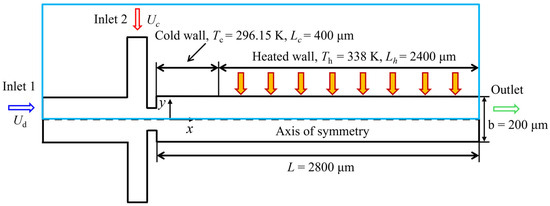
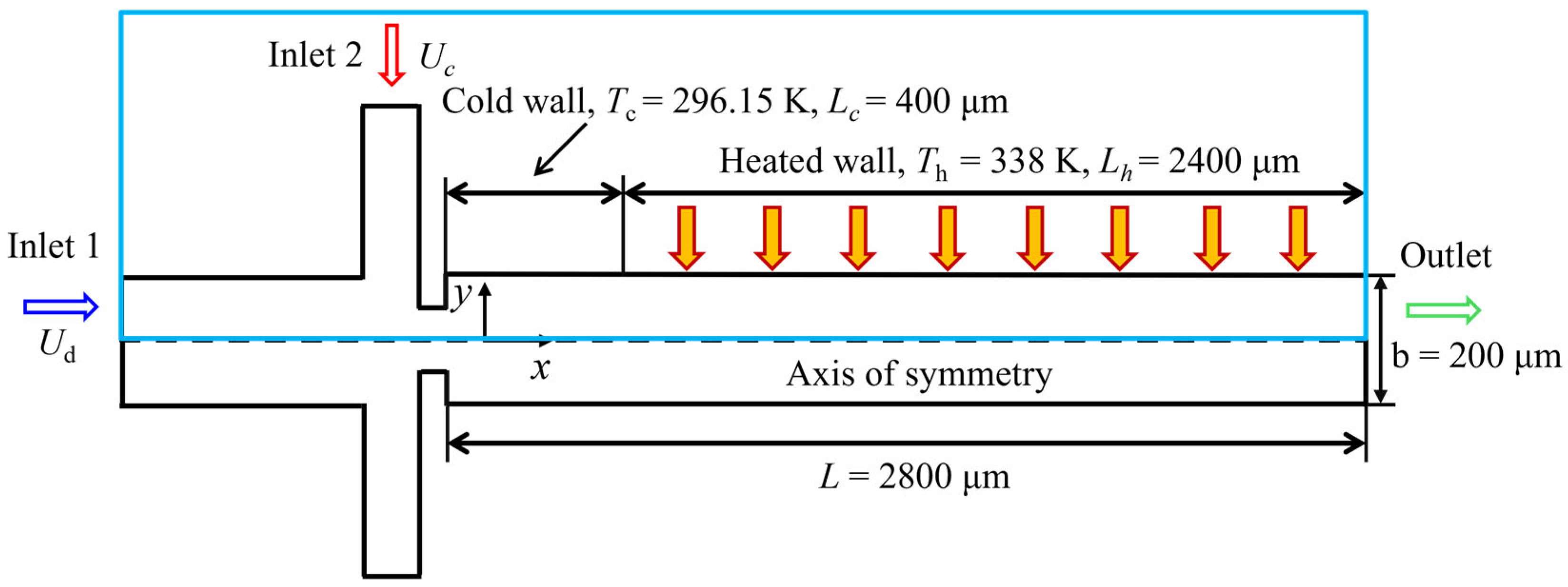
The microchannel studied in this study is a two-dimensional rectangular flow-focusing microchannel. Three-dimensional simulation is time-consuming and complex. Although some errors are inevitable in 2D simulation, the simulation can be performed without a considerable computational cost. Due to channel geometry, inlet conditions, and thermal boundary conditions all being symmetric about the channel centerline, and to reduce the computational load and run time, only half of the microchannel has been considered in the simulations. Figure 1 shows the schematic of the computational domain. The main channel for droplet generation and flow, with a total length of = 2800 μm, consists of a droplet generation section with a length of = 400 μm and a heated section with a length of = 2400 μm. The channel width is = 200 μm. In this study, a 2D, incompressible, laminar, liquid–liquid two-phase droplet flow has been considered. Water and oil are used as the dispersed phase and continuous phase, respectively. For boundary conditions, a uniform velocity and temperature are applied on the inlet, and the pressure outlet boundary condition is applied on the outlet. There is no slip on the channel walls. The thermal boundary condition is constant wall temperature, with two parts: and . The cold temperature, = 296.15 K, is applied to the droplet generation section, while the hot temperature, = 338 K, is applied to the heated wall to study the heat transfer process. The simulation is performed for an incompressible, two-phase water and oil system. To maintain the stability of the oil layer between the channel wall and the droplet interface, we assume that the wetted walls of the main channel are non-wettable with the contact angle .
Figure 1.
Schematic of the computational domain; only half of the upper section in the blue box has been considered in the simulations; the dotted line represents the axis of symmetry.
2.4. Mesh Independence and Model Verification
The two-dimensional non-uniform linear triangular mesh was adopted to discretize the computational domain. The simulation time step is set to 0.001 s. Mesh independence was evaluated using four grids with cell numbers of 14,854, 20,628, 27,927, and 34,009 at = 0.012 m/s and = 0.4. The minimum layer thickness, , the average pressure drop, , the average heat transfer coefficient, , and the relative errors of the indicators obtained from the simulations are shown in Table 2. It can be seen that the relative errors of , , and consistently decrease as the number of meshes increases. For mesh Nos. 3 and 4, the relative errors of the three indicators are 8.31%, 2.34%, and 1%, respectively, which are the smallest compared to simulations with other mesh numbers. Therefore, the mesh with 27,927 is a suitable choice for the simulations.
Table 2.
Mesh independence test.
To verify the numerical model, this work compares the simulation results of single-phase heat transfer with the analytical results. The heat transfer coefficient at the fully developed flow of single-phase can be obtained from analytically derived values of the Nusselt number. When the thermal boundary condition is the constant wall temperature, the Nusselt number at the fully developed flow in the 2D rectangular microchannel takes the value of 7.541 [18,19].
Here, is the hydraulic diameter (twice the channel width), μm, and is the thermal conductivity of the fluid, W/(m∙K).
The local heat transfer coefficient can be defined using Equation (11). The bulk temperature Tb (x) can be evaluated using Equation (12).
Here, is the heat flux on the walls, W/m2; is the constant wall temperature, K; is the bulk temperature, K; and is the horizontal velocity component, m/s.
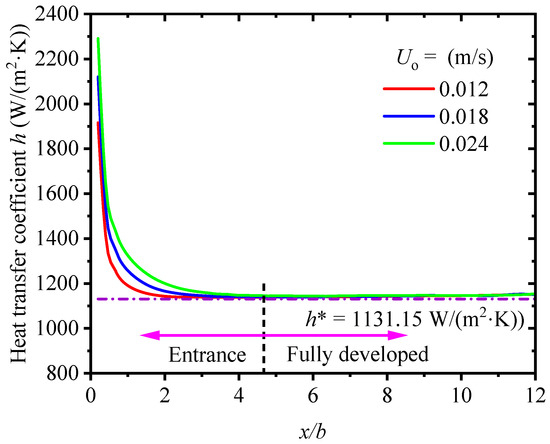
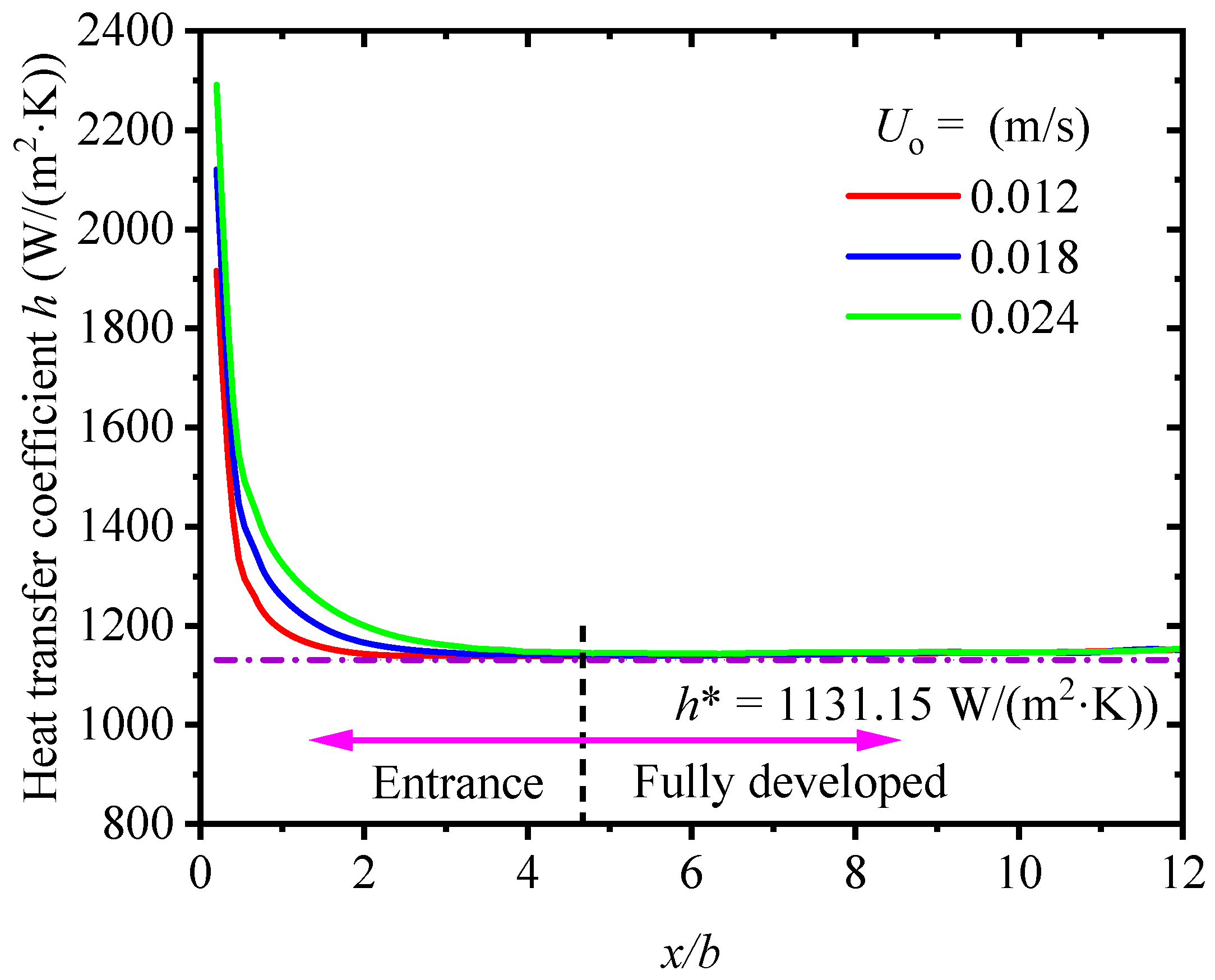
Figure 2 shows the comparison in the heat transfer coefficients of single-phase oil flow obtained from the simulations at different oil velocities with the analytical result. The relative error is calculated using the following expression:
where represents the maximum heat transfer coefficient obtained from the simulations; represents the analytical heat transfer coefficient at the fully developed flow. In these three cases with different oil velocities, the relative error between them is 1.74%, indicating that the simulation results are in good agreement with the analytical result. Therefore, the comparison proves that the present numerical model can accurately solve single-phase heat transfer in the microchannel.
Figure 2.
Comparison in the heat transfer coefficients of single-phase oil flow obtained from the simulations at different oil velocities with the analytical result represented by the dotted line.
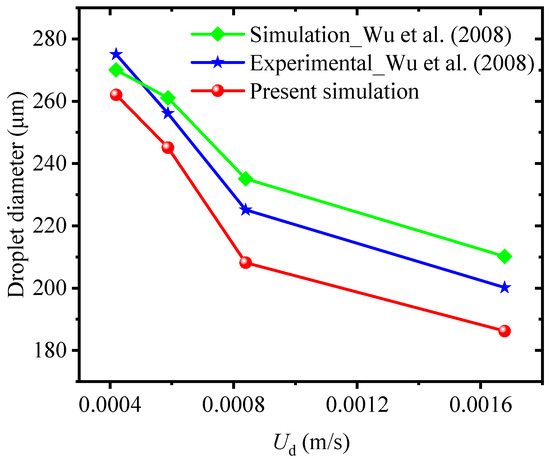
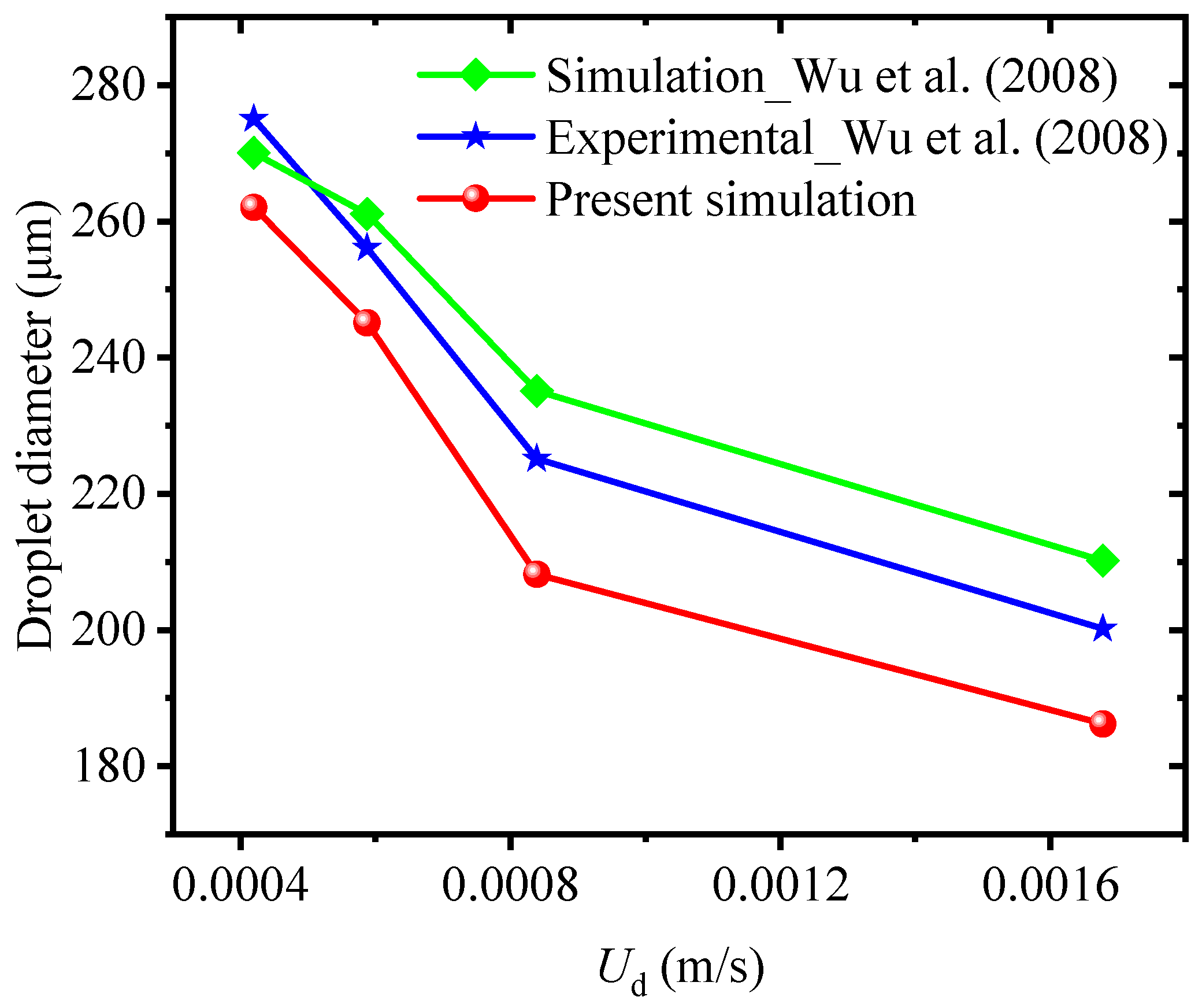
However, the single-phase verification described above is insufficient to verify the two-phase droplet flow heat transfer process. To further verify the reliability of this present numerical model, Figure 3 shows the comparison in the droplet diameter obtained from the present simulations with the experimental and simulation findings of [20] in a rectangular flow-focusing microchannel. This present numerical model was verified with the experimental and simulation findings of Wu et al. [20] for the droplet diameters generated in a constant flow velocity ratio = 6 and varied water velocities. In the verification, the oil viscosity and density are set to 0.02441 and 930 , respectively, and the water viscosity and density are set to 0.01074 and 1030 , respectively. The water velocities are set to 0.00042, 0.000588, 0.00084, and 0.00168 m/s in four cases. It can be observed that although the relative error between the simulation results of this present model and the experimental results is between 5% and 8%, the maximum relative error between the simulation results of Wu et al. and the experimental results is also 5%. For the 2D model currently being studied, this relative error percentage is acceptable. Therefore, using the present numerical model to study the flow and heat transfer of two-phase droplets is reliable.
Figure 3.
Comparison in the droplet diameter obtained from the present simulations with the experimental and simulation findings of Wu et al. (2008) [20].
3. Results and Discussion
3.1. Pressure Drop
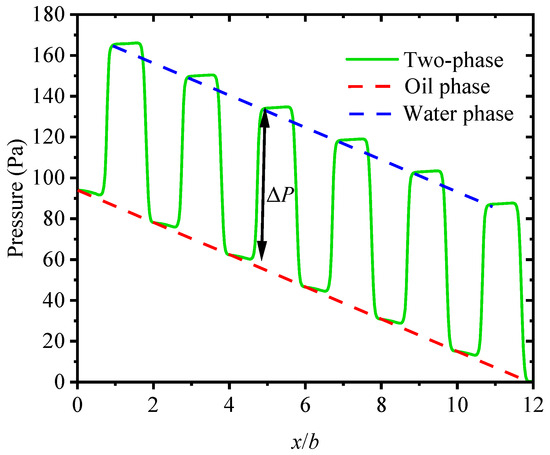
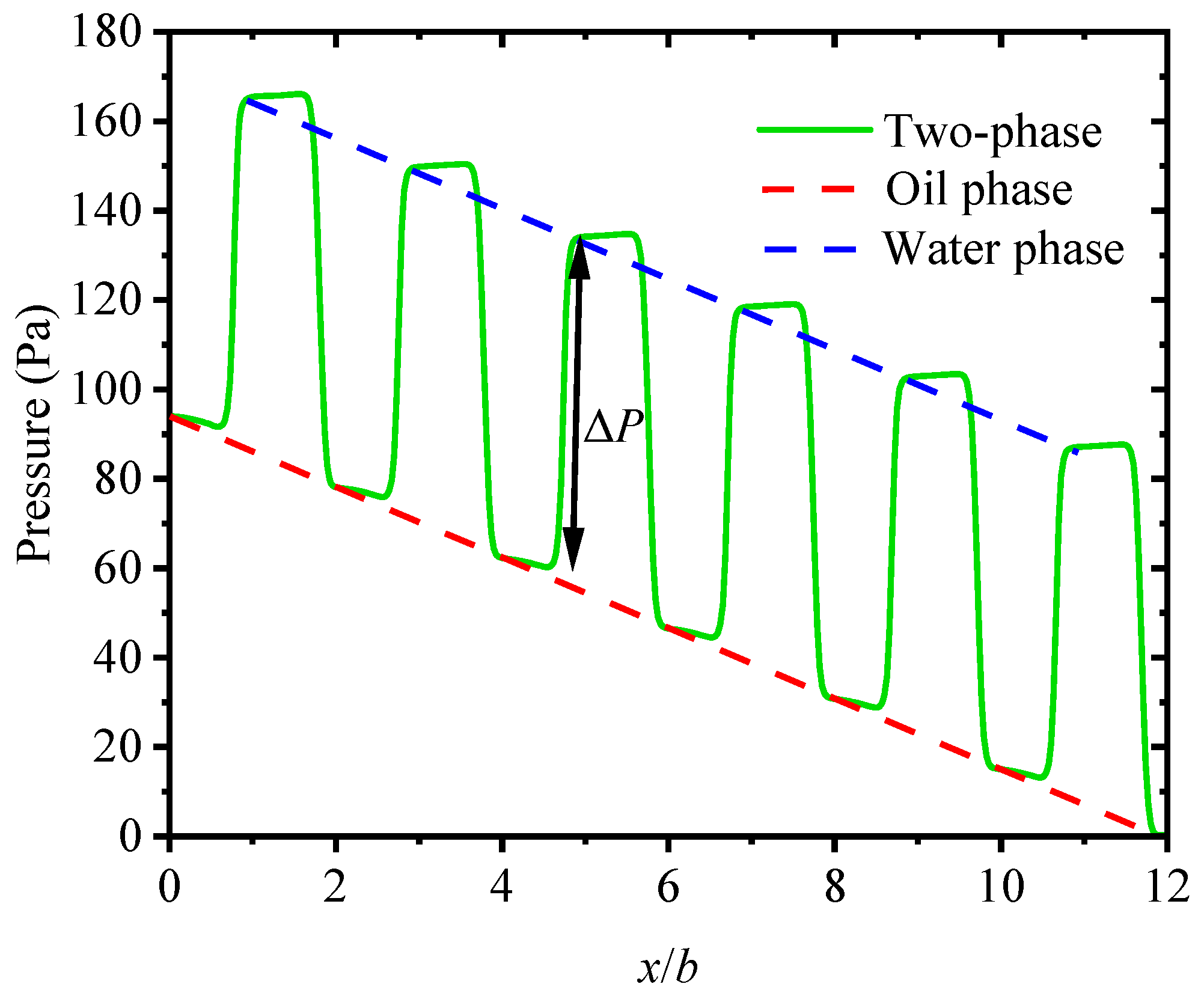
Figure 4 shows the changes in pressure for two-phase droplet flow at = 320 ms in the microchannel. Local rises and falls are observed at the locations of the droplets. The pressure abruptly increases behind the droplet and then rapidly decreases in front of the droplet. The pressure primarily increases as the droplet blocks the flow passage, and the pressure increases to balance the surface tension at the droplet interface. The pressure for the dispersed water phase decreases linearly, and the pressure for the continuous oil phase flow between the droplets also decreases linearly along the axial direction. This pressure difference at the droplet interface varies in proportion to the Laplace term , in which is surface tension and is the radius of curvature.
Figure 4.
Changes in pressure for two-phase droplet flow along the axial direction in the microchannel, with = 0.012 m/s, = 193 μm, = 0.4, and = 320 ms.
3.1.1. Effect of Total Velocity on Pressure Drop
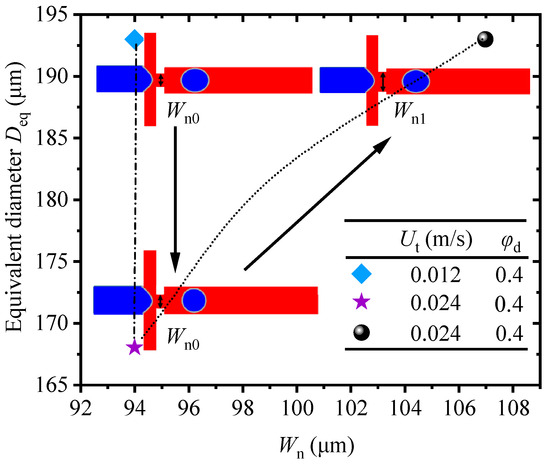
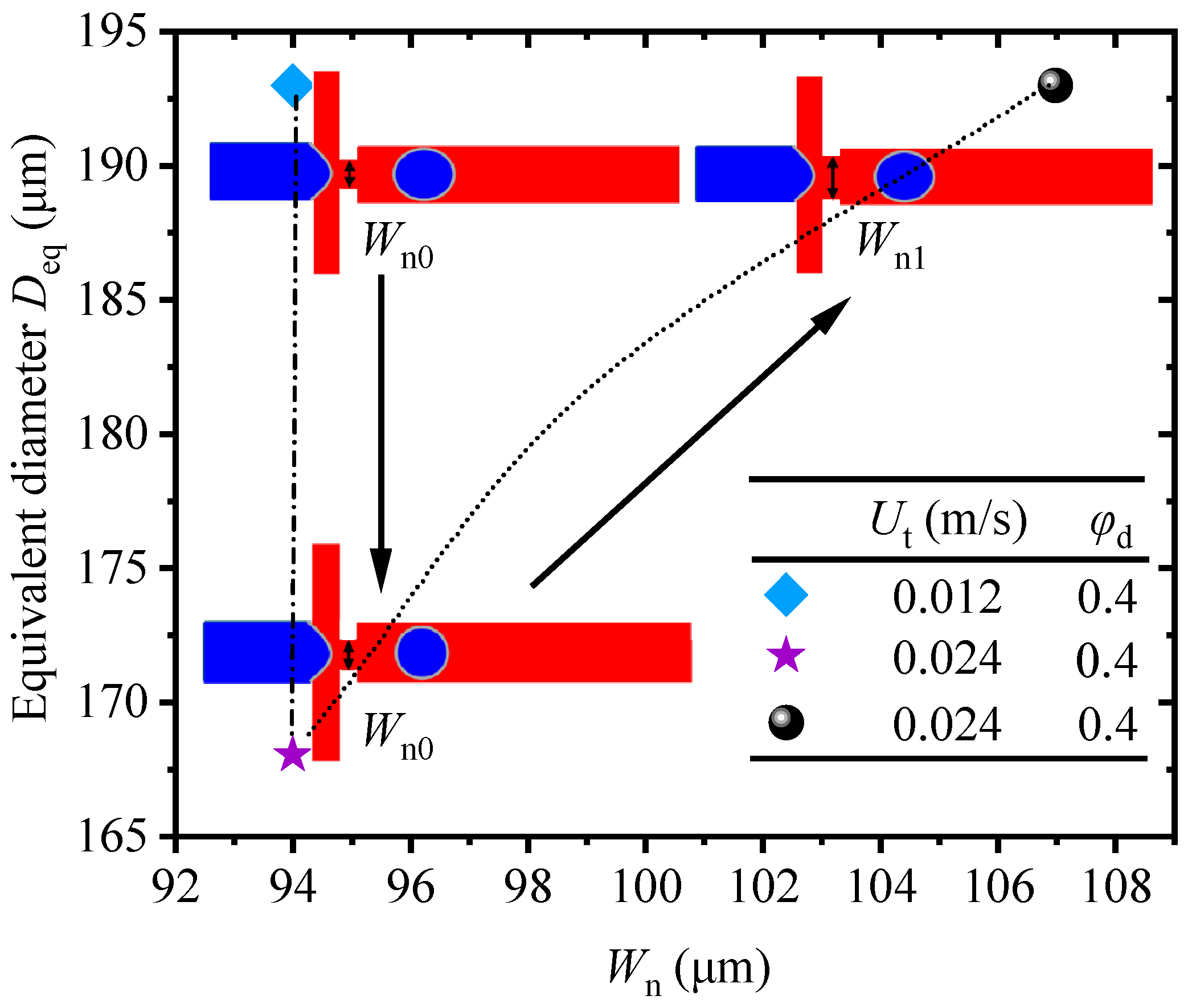
The total velocity is the sum of oil and water velocities. To study the effect of total velocity on pressure drop, seven different total velocities were studied. In this study, the droplet size, which is quantified by the equivalent diameter , was fixed at = 193 µm, the volume fraction of dispersed phase was fixed at = 0.4, and only the total velocity was changed. However, increasing the total velocity will reduce the droplet size. This is because the shear forces exerted on the droplet interfaces increase as the total velocity increases. When the total velocity is = 0.012 m/s, the droplet with = 193 µm is generated in the channel with the nozzle width, = 94 μm. When the total velocity increases to = 0.024 m/s, the size of the droplet generated in the same channel with = 94 μm becomes smaller. To keep the droplet size constant, the nozzle width was adjusted to = 107 µm to restore the droplet to = 193 µm, as shown in Figure 5.
Figure 5.
Recovery in droplet size by adjusting the nozzle width as the total velocity increases; blue represents water droplet, and red represents oil phase.
The pressure drop of two-phase droplet flow in the microchannel changes periodically due to the periodic movement of droplets; therefore, the time average was performed on it using the following expression:
where f represents the frequency, and N represents the number of periods.
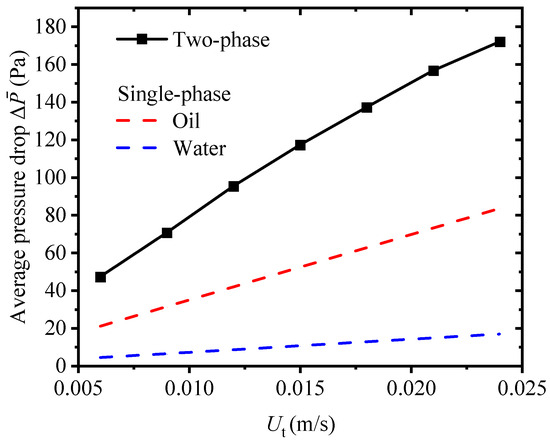
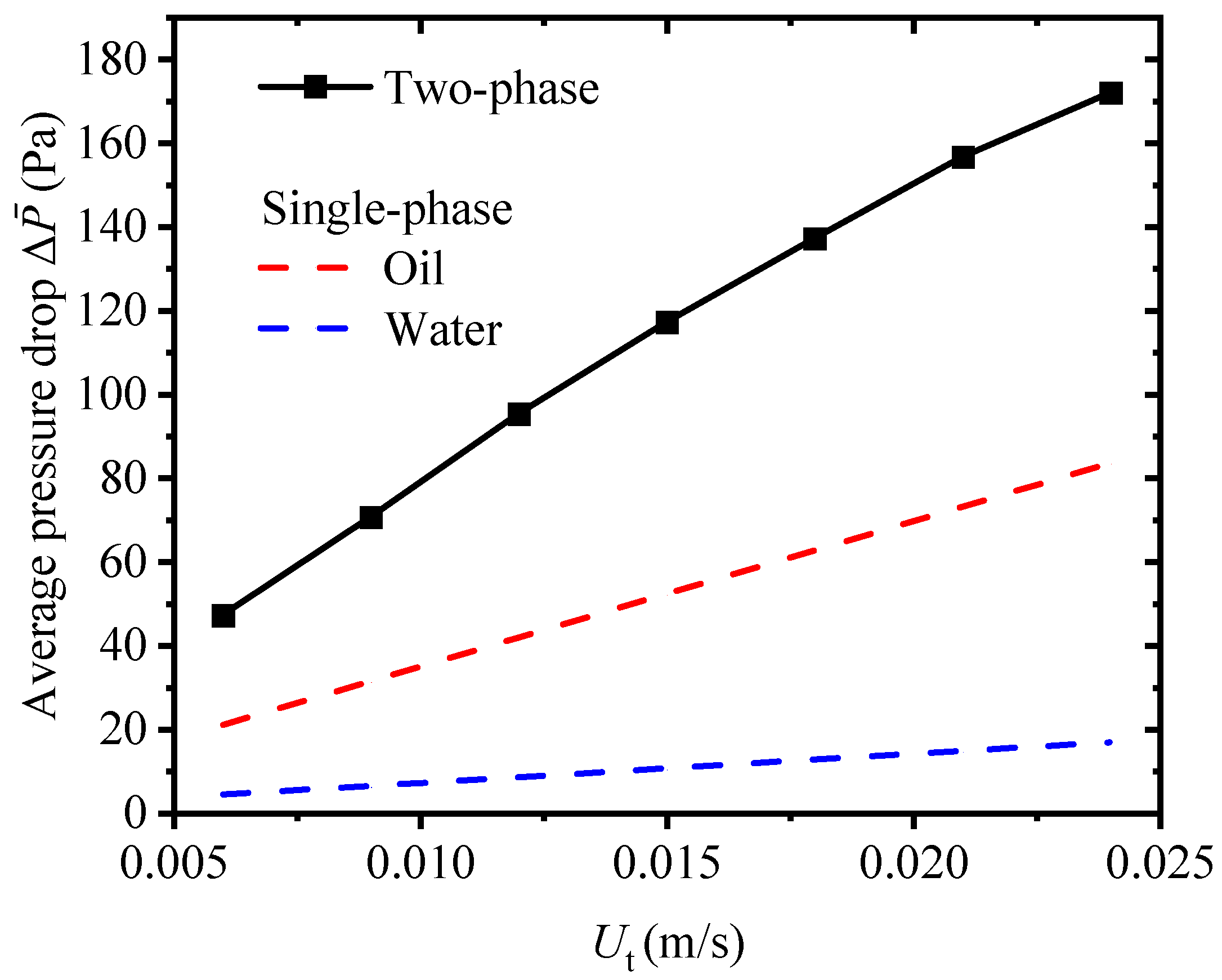
Figure 6 shows the changes in the (time) average pressure drops of two-phase droplet flow with total velocity and its comparison with the pressure drop of single-phase flow. It clearly indicates that as the total velocity increases, the average pressure drop of two-phase droplet flow increases. As the total velocity increases, the wall shear increases linearly; therefore, the fractional resistance will increase, resulting in higher pressure drops. For single-phase flow, as the flow velocity increases, the pressure drop increases linearly. This is because the pressure drop of single-phase flow is a direct function of the fluid velocity and is proportional to the fluid velocity. In addition, the average pressure drop of two-phase droplet flow is obviously larger than that of single-phase flow. This conclusion can be attributed to two factors: (1) the interfacial tension required to maintain the droplet shape, and (2) the interfacial drag from the relative velocity difference between the two phases. Comparison in the average pressure drop of two-phase droplet flow at different total velocities with that of single-phase flow is shown in Table 3. When the total velocity is = 0.0012 m/s, compared with single-phase oil flow, the average pressure drop of two-phase droplet flow increased by 128%.
Figure 6.
Changes in the average pressure drops of two-phase flow with total velocity, with = 193 μm and = 0.4 (single-phase oil and water indicated).
Table 3.
Comparison in the average pressure drop of two-phase droplet flow at different total velocities with that of single-phase oil flow.
3.1.2. Effect of Droplet Size on Pressure Drop
To study the effect of droplet size on pressure drop, the equivalent diameter is used to present the size of droplets with various shapes for comparison. The area of an individual droplet was computed directly from simulations. Specifically, the dispersed phase droplet where ϕ > 0.5 was identified using the phase-field indicator, and the equivalent diameter was obtained by integrating the indicator over the computational domain:
where ϕ is the volume fraction of the dispersed phase.
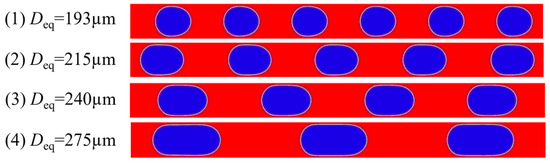
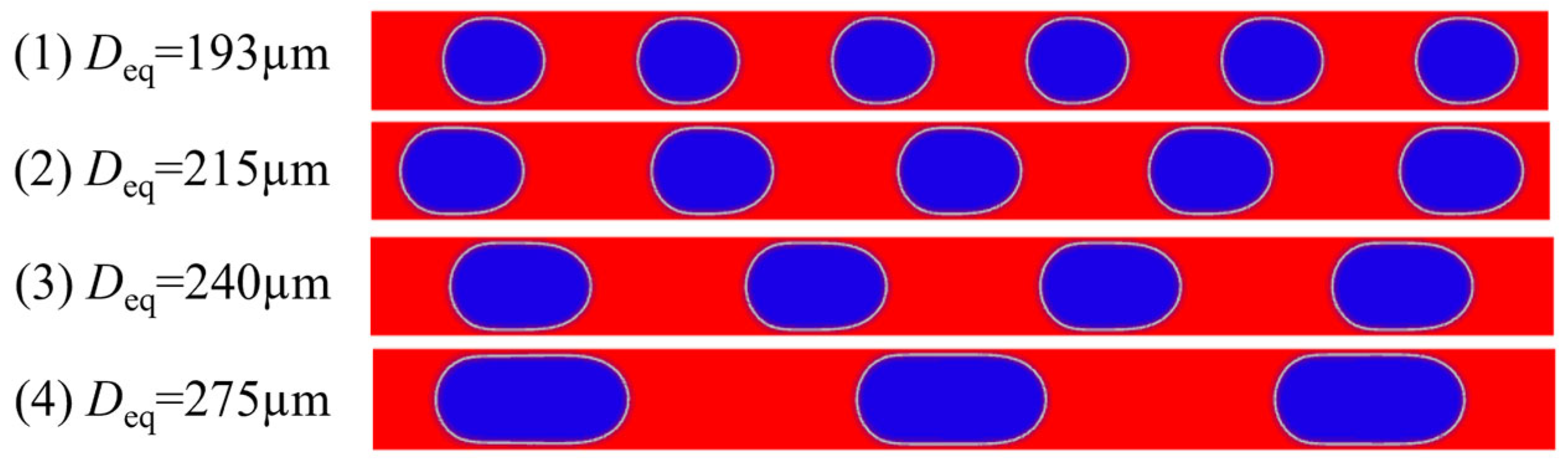
In this study, four different droplet sizes at = 193, 215, 240, and 275 µm were studied. Meanwhile, the total velocity was fixed at = 0.012 m/s, the volume fraction of the dispersed phase was fixed at = 0.4, and only the droplet size was changed.
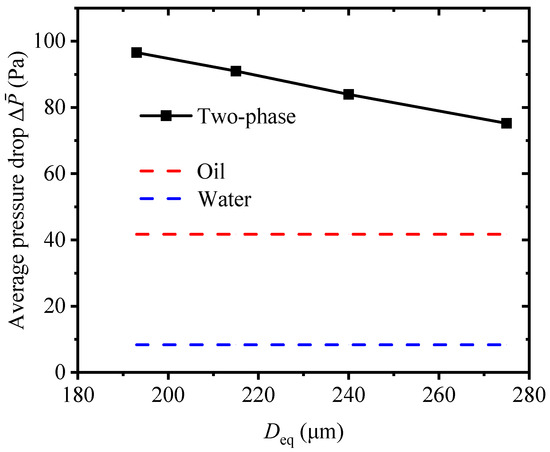
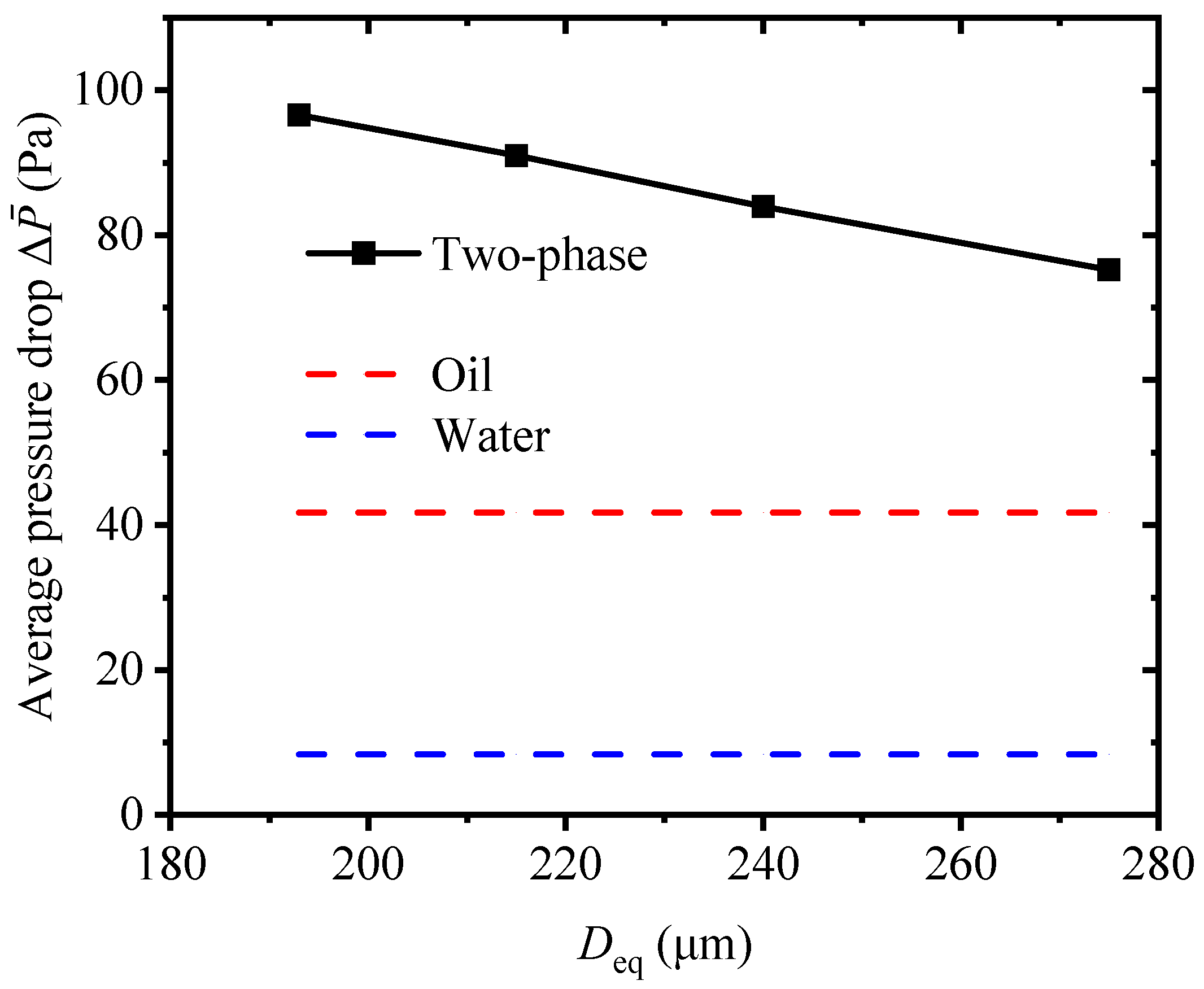
Figure 7 shows the volume fraction of the two-phase fluids in the microchannel at different droplet sizes. Obviously, as the droplet size increases, the length of oil slug between two adjacent droplets increases, but the number of droplets decreases. Figure 8 shows the changes in the average pressure drop of two-phase droplet flow with droplet size and its comparison with single-phase flow. The results clearly indicate that as the droplet size increases, the average pressure drop of two-phase droplet flow decreases. This primarily originates from the decrease in the number of droplets in the microchannel. Specifically, in cases (1)–(4), the number of droplets decreased one by one. Although the size of the individual droplet increased, the total interfacial area decreased, reducing the overall contribution of interfacial tension and interfacial drag to the pressure drop. In the plug-shaped droplet regime, the upper and lower interfaces of the droplets are parallel to the channel walls, and the minimum layer thickness between them remains constant. The stable layer thickness indicates that the flow resistance caused by the individual droplet remains constant. Furthermore, the reduction in the number of droplets increases the length of the oil slug, making oil flow more stable and reducing the viscous stress. Therefore, the average pressure drops in the four cases decreased. In addition, the average pressure drop of two-phase droplet flow is obviously larger than that of single-phase flow. Comparison in the average pressure drop of two-phase droplet flow at different droplet sizes with that of single-phase oil flow is shown in Table 4. When the droplet size is = 193 μm, compared with single-phase oil flow, the average pressure drop of two-phase droplet flow increased by 132%.
Figure 7.
Volume fraction of the two-phase fluids at different droplet sizes; blue represents water droplet, and red represents oil phase, with = 0.012 m/s and = 0.4.
Figure 8.
Changes in the average pressure drops of two-phase flow with droplet size, with = 0.012 m/s and = 0.4 (single-phase oil and water indicated).
Table 4.
Comparison in the average pressure drop of two-phase droplet flow at different droplet sizes with that of single-phase oil flow.
3.2. Heat Transfer
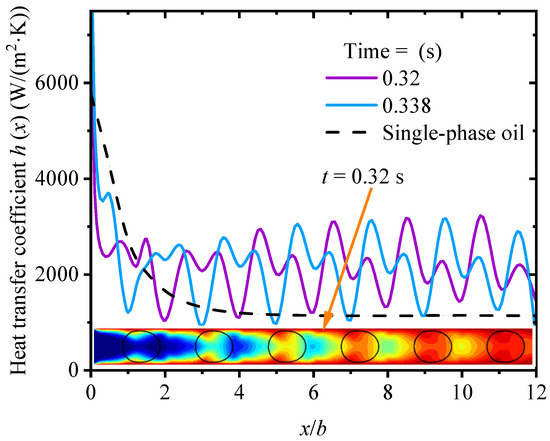
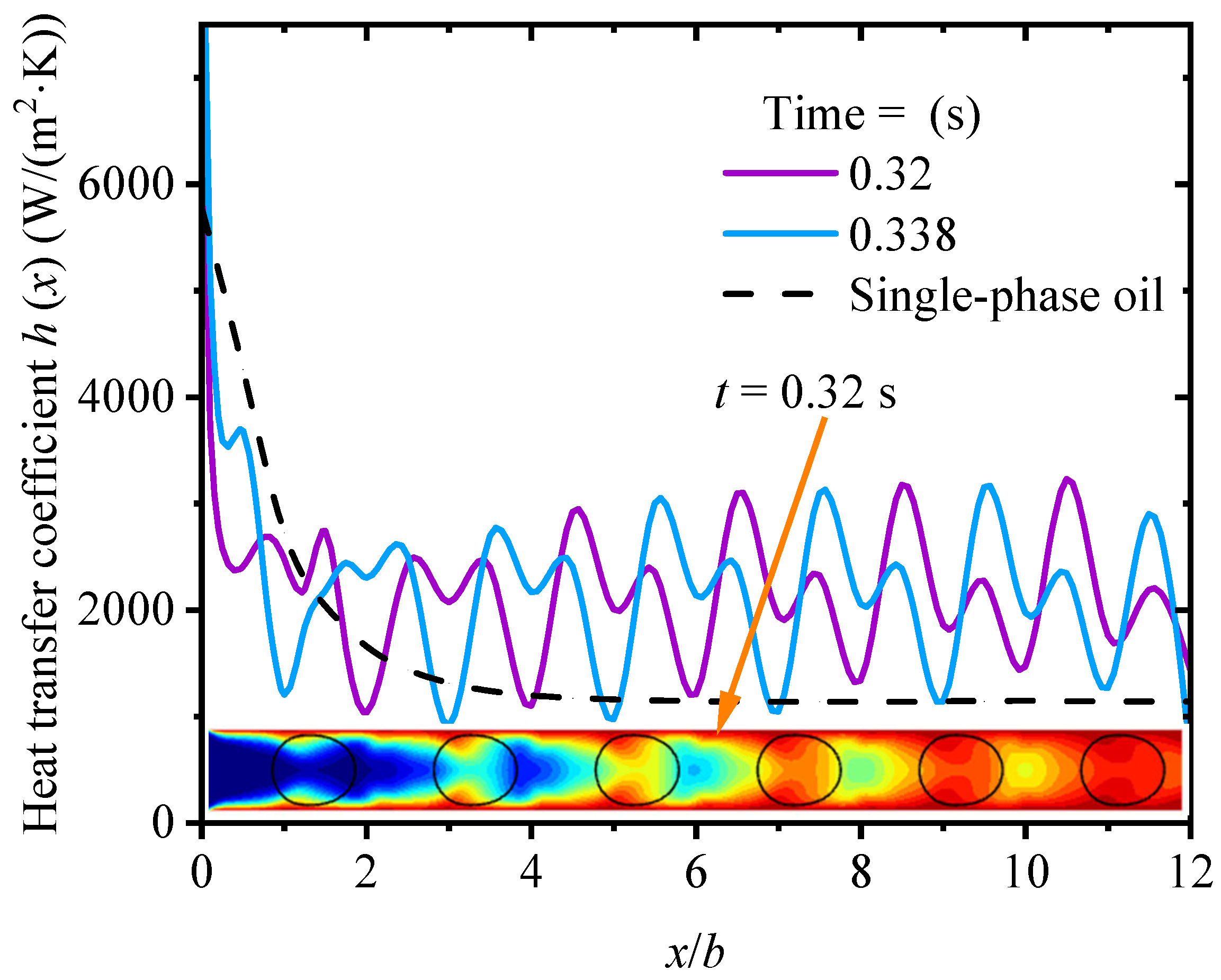
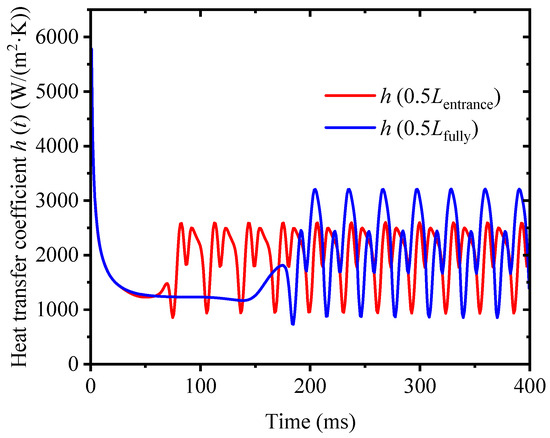
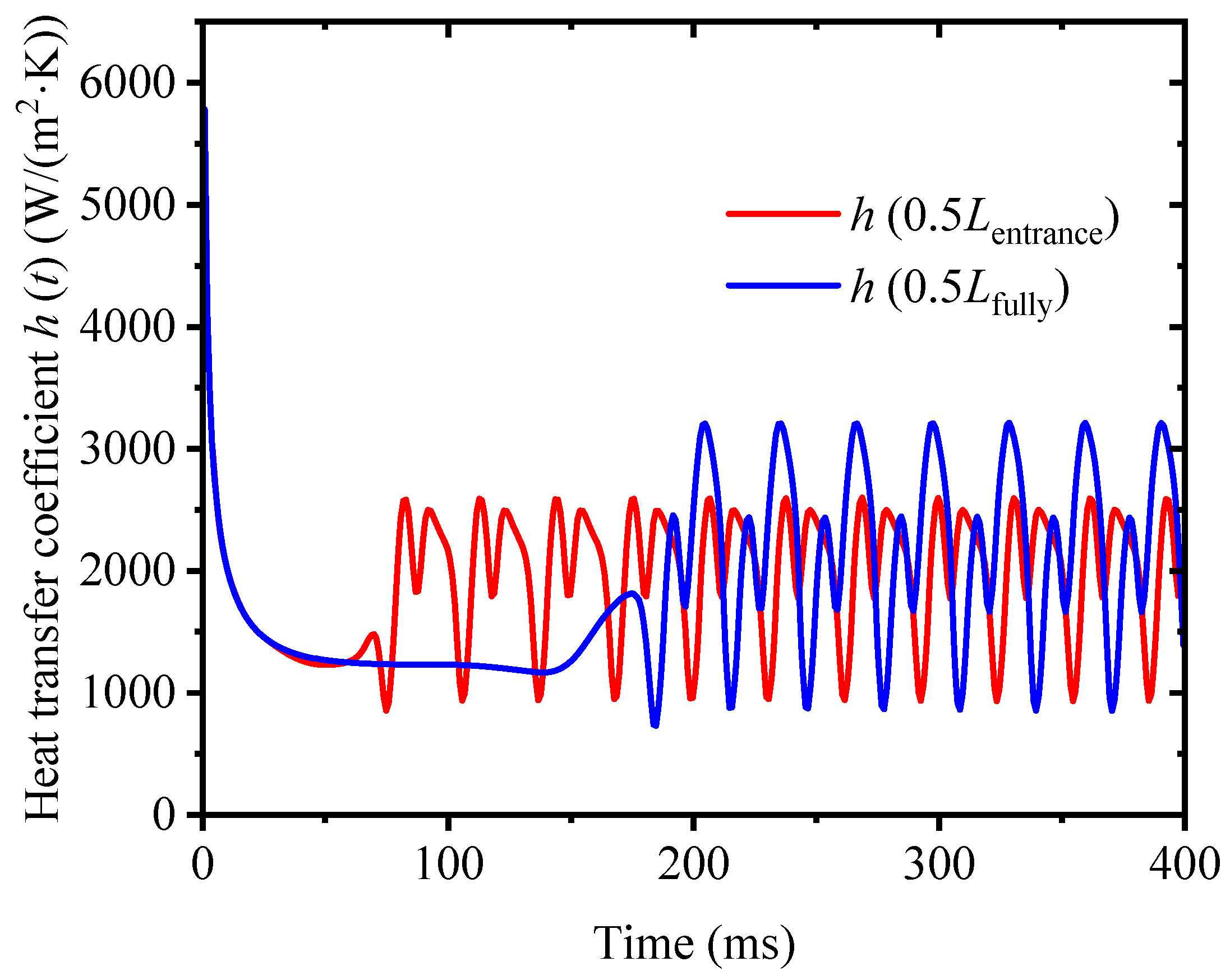
Figure 9 shows the local heat transfer coefficient of two-phase droplet flow at two moments, which were arbitrarily chosen when the number of droplets in the microchannel was an integer. It clearly demonstrates that compared with single-phase oil flow, the heat transfer coefficient of two-phase droplet flow increases significantly, especially at the locations of droplets. The temperature field of two-phase droplet flows at = 0.32 s is also shown in Figure 9. Figure 10 shows the changes in the heat transfer coefficient with time at the center of the entrance and fully developed flow. It was found that the oscillation of heat transfer coefficient at the center of the entrance appears first and then happens at the center of the fully developed flow. The oscillation period of the heat transfer coefficient coincides with that of an individual droplet, indicating that the oscillation arises from the periodic passage of droplets through the microchannel. The maximum heat transfer coefficient at the fully developed flow is almost three times as much as that of single-phase oil flow, which significantly promotes the heat transfer performance.
Figure 9.
Local heat transfer coefficients at = 0.32 and 0.338 s along the axial direction, with = 0.012 m/s, = 193 μm, and = 0.4; the temperature field at = 0.32 s changing from blue to red indicates an increase in temperature (single-phase oil flow indicated).
Figure 10.
Changes in the heat transfer coefficients with time at the center of the entrance and fully developed flow, with = 0.012 m/s, = 193 μm, and = 0.4.
3.2.1. Effect of Total Velocity on Heat Transfer
In two-phase droplet flow, the heat transfer varies with space and time. Therefore, the heat transfer coefficient was averaged over space and time. Specifically, the time average heat transfer coefficient was calculated using the same method as the time average pressure drop in Equation (15), and then the space average heat transfer coefficient was obtained using Equation (16) as follows:
where L represents the length of the selected fully developed region.
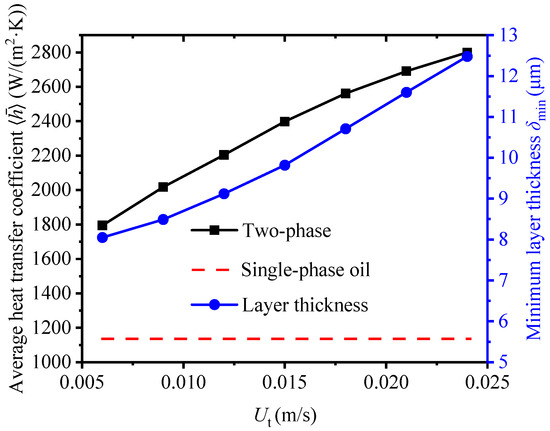
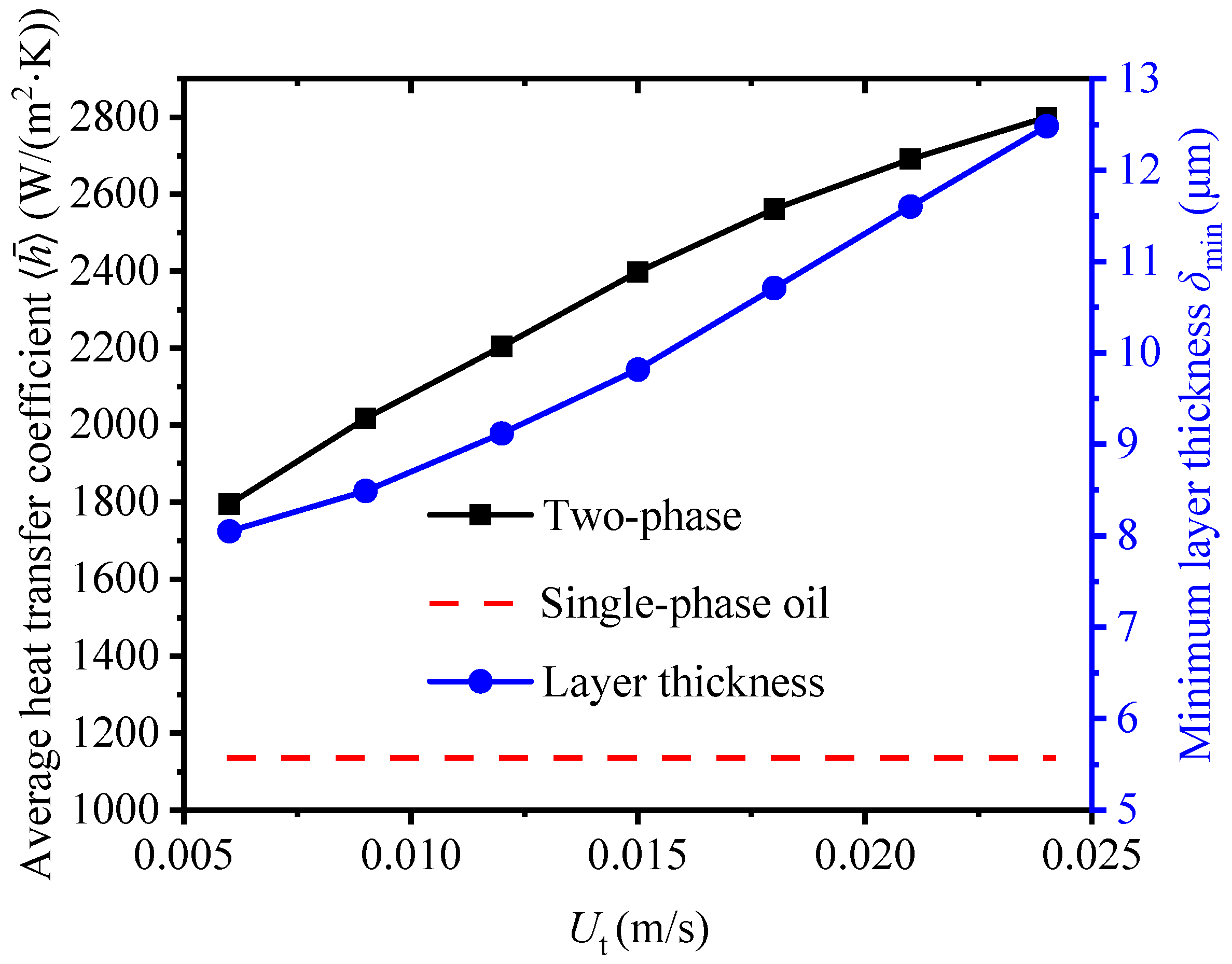
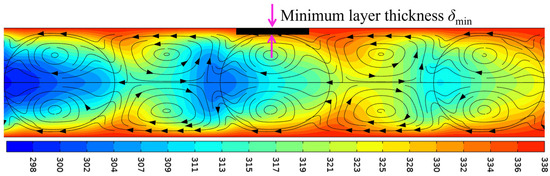
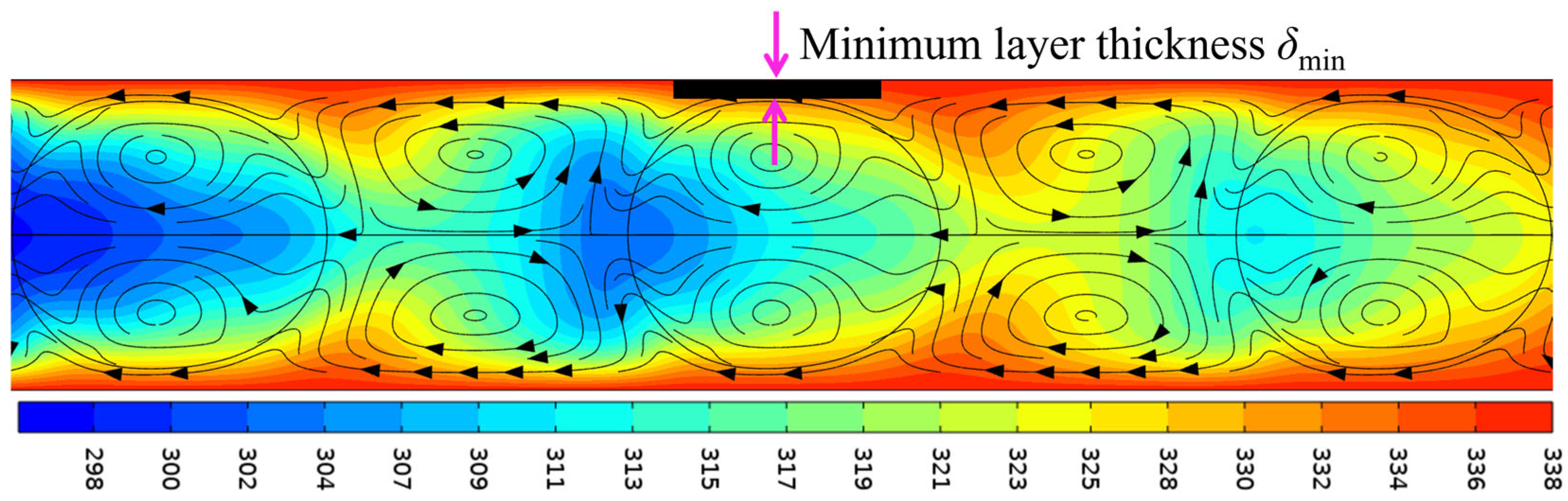
Figure 11 shows the changes in the (time-space) average heat transfer coefficients of a two-phase droplet at the fully developed flow with total velocity, its comparison with the heat transfer coefficient of single-phase oil at the fully developed flow, and changes in the minimum layer thickness between the channel walls and the droplet interface with total velocity. In this study, the droplet size was fixed at = 193 μm, and the volume fraction of dispersed phase was fixed at = 0.4. As increases, the average heat transfer coefficient of two-phase droplet flow increases. Two aspects contribute to the increase in the average heat transfer coefficient, beginning with (1) the increase in vorticity. The recirculation inside droplets and between two subsequent droplets, as shown in Figure 12, promotes the heat exchange of hot and cold fluids, which is characterized by the average vorticity. However, (2) the increase in minimum layer thickness, as shown in Figure 11 and Figure 12, will prevent the recirculation. The heat transfer enhancement from the increased vorticity more than offsets the increase associated with the layer thickness. Figure 11 also clearly shows that the average heat transfer coefficient of two-phase droplet flow is much greater than that of single-phase oil flow. Comparison in the average heat transfer coefficient of a two-phase droplet at the fully developed flow at different total velocities with that of single-phase oil flow is shown in Table 5. When the total velocity is = 0.0024 m/s, the maximum average heat transfer coefficient of two-phase droplet flow increased by 148% compared with single-phase oil flow.
Figure 11.
Changes in the average heat transfer coefficients of a two-phase droplet at the fully developed flow and minimum layer thickness with total velocity, with = 193 µm and = 0.4 (single-phase oil flow indicated).
Figure 12.
Streamlines in the reference frame moving with the droplet with the minimum layer thickness at = 0.012 m/s, = 193 μm, and = 0.4.
Table 5.
Comparison in the average heat transfer coefficient of a two-phase droplet at the fully developed flow at different total velocities compared with that of single-phase oil flow.
3.2.2. Effect of Droplet Size on Heat Transfer
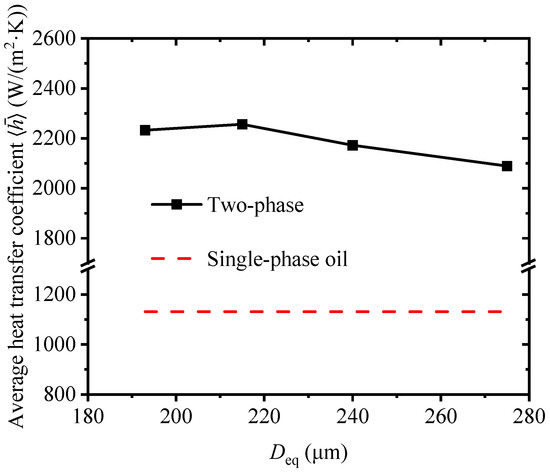
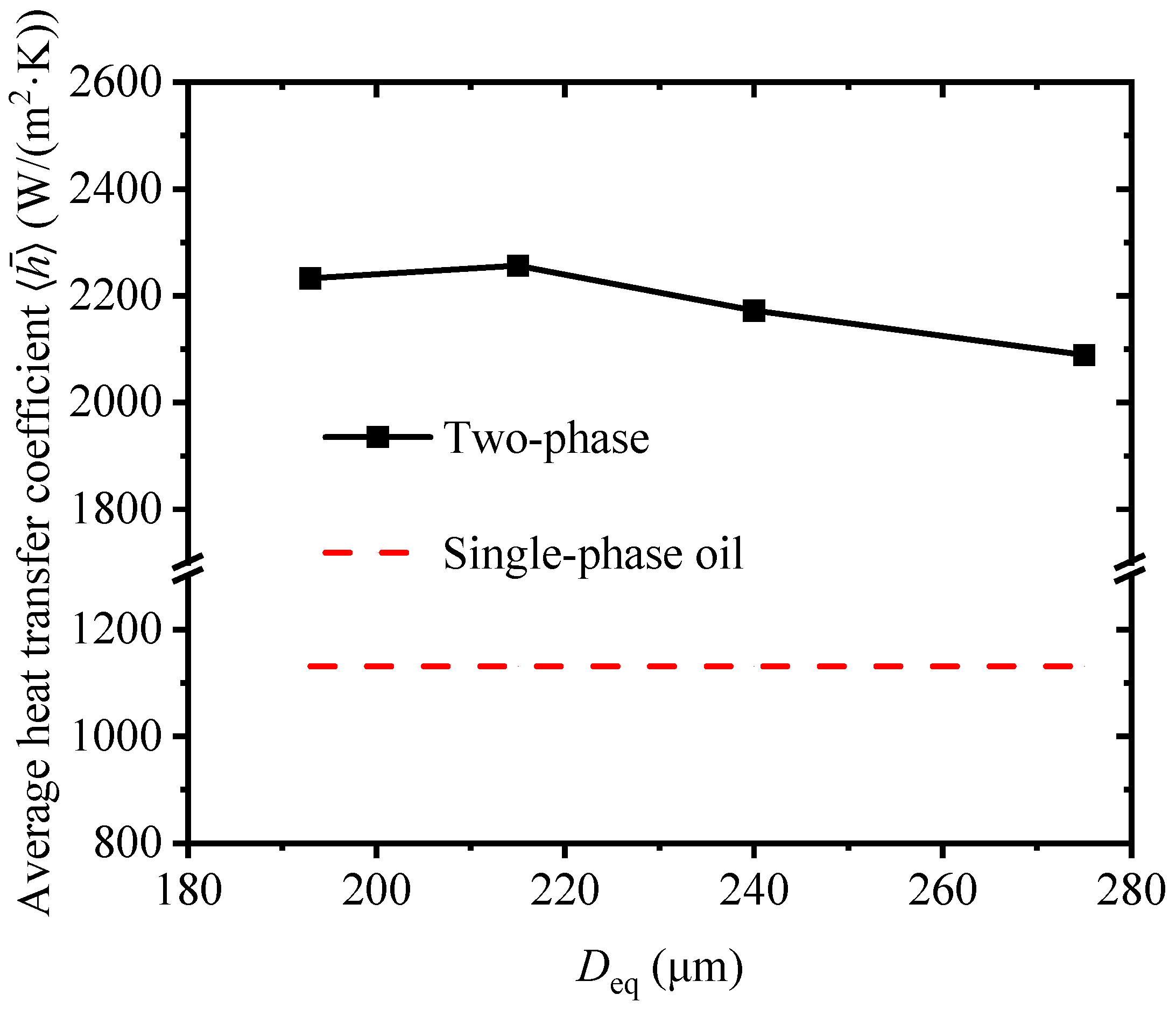
Figure 13 shows the changes in the average heat transfer coefficients of a two-phase droplet at the fully developed flow with droplet size and its comparison with the heat transfer coefficient of single-phase oil at the fully developed flow. In this study, the total velocity was fixed at = 0.012 m/s, and the volume fraction of the dispersed phase was fixed at = 0.4. When the droplet size is smaller than the channel width = 200 μm, the average heat transfer coefficient increases as the droplet size increases. This is due to the decrease in layer thickness. When the droplet size is larger than the channel width, the droplet is elongated only along the axial direction, thus becoming plug-like. As increases, although the droplet size increases, the average heat transfer coefficient decreases. This is due to the decrease in vorticity. Furthermore, in the plug-shaped droplet regime, the majority of the droplet interface remains parallel to the channel walls, and the flow on both sides is laminar. As a result, no heat transfer enhancement occurs in these regions. Figure 13 also clearly demonstrates that the heat transfer of two-phase droplet flow is enhanced compared with single-phase oil flow. Comparison in the average heat transfer coefficient of a two-phase droplet at the fully developed flow at different droplet sizes with that of single-phase oil flow is shown in Table 6. When = 215 μm, the average heat transfer coefficient of a two-phase droplet at the fully developed flow is almost twice that of single-phase oil flow.
Figure 13.
Changes in the average heat transfer coefficients of a two-phase droplet at the fully developed flow with droplet size, with = 0.012 m/s and = 0.4 (single-phase oil flow indicated).
Table 6.
Comparison in the average heat transfer coefficient of a two-phase droplet at the fully developed flow at different droplet sizes compared with that of single-phase oil flow.
4. Conclusions
In this study, a 2D numerical model based on the phase-field method was developed to investigate the flow and heat transfer characteristics of liquid–liquid two-phase droplet flow in a rectangular flow-focusing microchannel. The following conclusions are drawn:
- Two-phase droplet flow significantly enhances heat transfer compared with single-phase oil flow, with the local heat transfer coefficient markedly increasing at droplet locations. Heat transfer oscillations are synchronized with droplet passage, confirming the role of droplets in disrupting the thermal boundary layer.
- The pressure drop in two-phase flow is higher than in single-phase flow and increases approximately linearly with total velocity, due to increased wall shear and interfacial drag. In contrast, pressure drop decreases with increasing droplet size, owing to a reduction in the number of droplets.
- The average heat transfer coefficient increases with total velocity, as the intensity of internal recirculation within droplets outweighs the effect of increased film thickness.
- The effect of droplet size on heat transfer is non-linear: as the droplet size increases up to the channel width, the heat transfer coefficient rises due to a thinner liquid film. Beyond a point, further increases in droplet size reduce heat transfer performance due to weakened vorticity.
This work provides a systematic analysis of key parameters affecting the thermofluidic performance of two-phase droplet flow, offering guidance for designing and optimizing efficient rectangular flow-focusing microfluidic cooling devices. Future work will extend to three-dimensional simulations and experimental validation under a wider range of flow conditions and channel geometries.
Author Contributions
Conceptualization, R.B.; Methodology, W.L., A.I.E.A., R.B. and X.M.; Formal analysis, W.L.; Investigation, A.I.E.A.; Writing—original draft, W.L. and A.I.E.A.; Writing—review & editing, R.B. and X.M. All authors have read and agreed to the published version of the manuscript.
Funding
This work is supported by the French National Centre for Scientific Research (CNRS), the D’Alembert Institute (IDA), and the Farman Institute. This work is also supported by the China Scholarship Council (CSC) for the scholarship support (No. 202206440065).
Data Availability Statement
The original contributions presented in this study are included in the article. Further inquiries can be directed to the corresponding authors.
Conflicts of Interest
The authors declare no conflicts of interest.
References
- Dangharalou, F.F.; Goharkhah, M. Effect of fluid properties on intensification of heat transfer process in oil-water droplet flow in a T-shaped microchannel. Chem. Eng. Process.—Process Intensif. 2024, 200, 109799. [Google Scholar] [CrossRef] [Scilit]
- Wang, K.; Lu, Y.; Shao, H.; Luo, G. Heat-transfer performance of a liquid-liquid microdispersed system. Ind. Eng. Chem. Res. 2008, 47, 9754–9758. [Google Scholar] [CrossRef] [Scilit]
- Talimi, V.; Muzychka, Y.S.; Kocabiyik, S. A review on numerical studies of slug flow hydrodynamics and heat transfer in microtubes and microchannels. Int. J. Multiph. Flow 2012, 39, 88–104. [Google Scholar] [CrossRef] [Scilit]
- Abdollahi, A.; Norris, S.E.; Sharma, R.N. Fluid flow and heat transfer of liquid-liquid Taylor flow in square microchannels. Appl. Therm. Eng. 2020, 172, 115123. [Google Scholar] [CrossRef] [Scilit]
- Urbant, P.; Leshansky, A.; Halupovich, Y. On the forced convective heat transport in a droplet-laden flow in microchannels. Microfluid. Nanofluidics 2007, 4, 533–542. [Google Scholar] [CrossRef] [Scilit]
- Fischer, M.; Juric, D.; Poulikakos, D. Large convective heat transfer enhancement in microchannels with a train of coflowing immiscible or colloidal droplets. J. Heat Transfer 2010, 132, 112402. [Google Scholar] [CrossRef] [Scilit]
- Che, Z.; Wong, T.N.; Nguyen, N. Heat transfer in plug flow in cylindrical microcapillaries with constant surface heat flux. Int. J. Therm. Sci. 2013, 64, 204–212. [Google Scholar] [CrossRef] [Scilit]
- Bandara, T.; Chandrashekar, M.; Rosengarten, G. CFD modelling of liquid-liquid slug flow heat transfer in microchannels. In Proceedings of the 28th International Symposium on Transport Phenomena, Kandy, Sri Lanka, 22–24 September 2017. [Google Scholar]
- Wang, R. Numerical investigation on the heat transfer of a droplet-laden flow in a microfluidic system. Int. J. Numer. Methods Heat Fluid Flow 2017, 27, 444–453. [Google Scholar] [CrossRef] [Scilit]
- Li, X.; He, L.; Qian, P.; Huang, Z.; Luo, C.; Liu, M. Heat transfer enhancement of droplet two-phase flow in cylindrical microchannel. Appl. Therm. Eng. 2021, 186, 116474. [Google Scholar] [CrossRef] [Scilit]
- Teixeira, V.C.; Forte Neto, F.S.; Guerra, G.M.; da Cruz, A.G.B. Heat transfer enhancement of two-phase droplet flow in microtube: A phase-field simulation study. J. Braz. Soc. Mech. Sci. Eng. 2022, 44, 113. [Google Scholar] [CrossRef] [Scilit]
- Mehboodi, D.; Kamali, R.; Ronizi, S.K.; Akbarabadi, S.A. Flow and Heat Transfer in Two-Phase Flow Immiscible Droplets in Microchannels. Nanoscale Microscale Thermophys. Eng. 2024, 28, 1–27. [Google Scholar] [CrossRef] [Scilit]
- Cao, W.; Yang, Q.; Tong, Y.; Li, S. Numerical simulation of liquid-liquid two-phase flow heat transfer in circular microchannels. Int. J. Heat Mass Transf. 2025, 238, 126483. [Google Scholar] [CrossRef] [Scilit]
- Asthana, A.; Zinovik, I.; Weinmueller, C.; Poulikakos, D. Significant Nusselt number increase in microchannels with a segmented flow of two immiscible liquids: An experimental study. Int. J. Heat Mass Transf. 2011, 54, 1456–1464. [Google Scholar] [CrossRef] [Scilit]
- Mac Giolla Eain, M.; Egan, V.; Punch, J. Local Nusselt number enhancements in liquid–liquid Taylor flows. Int. J. Heat Mass Transf. 2015, 80, 85–97. [Google Scholar] [CrossRef] [Scilit]
- Roccon, A. Boiling heat transfer by phase-field method. Acta Mech. 2024, 236, 5623–5638. [Google Scholar] [CrossRef] [Scilit]
- Li, J.; Zheng, D.; Zhang, W. Advances of Phase-Field Model in the Numerical Simulation of Multiphase Flows: A Review. Atmosphere 2023, 14, 1311. [Google Scholar] [CrossRef] [Scilit]
- Shah, R.K. Laminar flow friction and forced convection heat transfer in ducts of arbitrary geometry. Int. J. Heat Mass Transf. 1975, 18, 849–862. [Google Scholar] [CrossRef] [Scilit]
- Lienhard, J.H., IV; Lienhard, J.H., V. A Heat Transfer Textbook; Phlogiston Press: Cambridge, UK, 2006. [Google Scholar]
- Wu, L.; Tsutahara, M.; Kim, L.S.; Ha, M. Three-dimensional lattice boltzmann simulations of droplet formation in a cross-junction microchannel. Int. J. Multiph. Flow 2008, 34, 852–864. [Google Scholar] [CrossRef] [Scilit]

Disclaimer/Publisher’s Note: The statements, opinions and data contained in all publications are solely those of the individual author(s) and contributor(s) and not of MDPI and/or the editor(s). MDPI and/or the editor(s) disclaim responsibility for any injury to people or property resulting from any ideas, methods, instructions or products referred to in the content. |
© 2025 by the authors. Licensee MDPI, Basel, Switzerland. This article is an open access article distributed under the terms and conditions of the Creative Commons Attribution (CC BY) license (https://creativecommons.org/licenses/by/4.0/).