Article

From Digital Tools to Digital Treatment Ecosystems: A Closed-Loop Information Architecture for Precision Addiction Psychiatry


by
Vincenzo Maria Romeo
1,2,3,4,*,
Bruna Caridi
3,5,
Agnese Tedeschi
3 and
Elisabetta Ratti
3
1
Department of Cultures and Societies, University of Palermo, 90128 Palermo, Italy
2
School of Psychoanalytic and Group-Analytic Psychotherapy (SPPG), 89131 Reggio Calabria, Italy
3
STAND UP® Method, Via del Casale Solaro 119, 00143 Rome, Italy
4
Neurosinc, 95125 Catania, Italy
5
Gastroenterology and Endoscopy Unit, Fondazione IRCCS Ca’ Granda Ospedale Maggiore Policlinico, 20122 Milan, Italy
*
Author to whom correspondence should be addressed.
Information 2026, 17(9), 916; https://doi.org/10.3390/info17090916 (registering DOI)
Submission received: 31 July 2026 / Revised: 6 September 2026 / Accepted: 15 September 2026 / Published: 18 September 2026
(This article belongs to the Special Issue Information Technology for Smart Healthcare)

Abstract

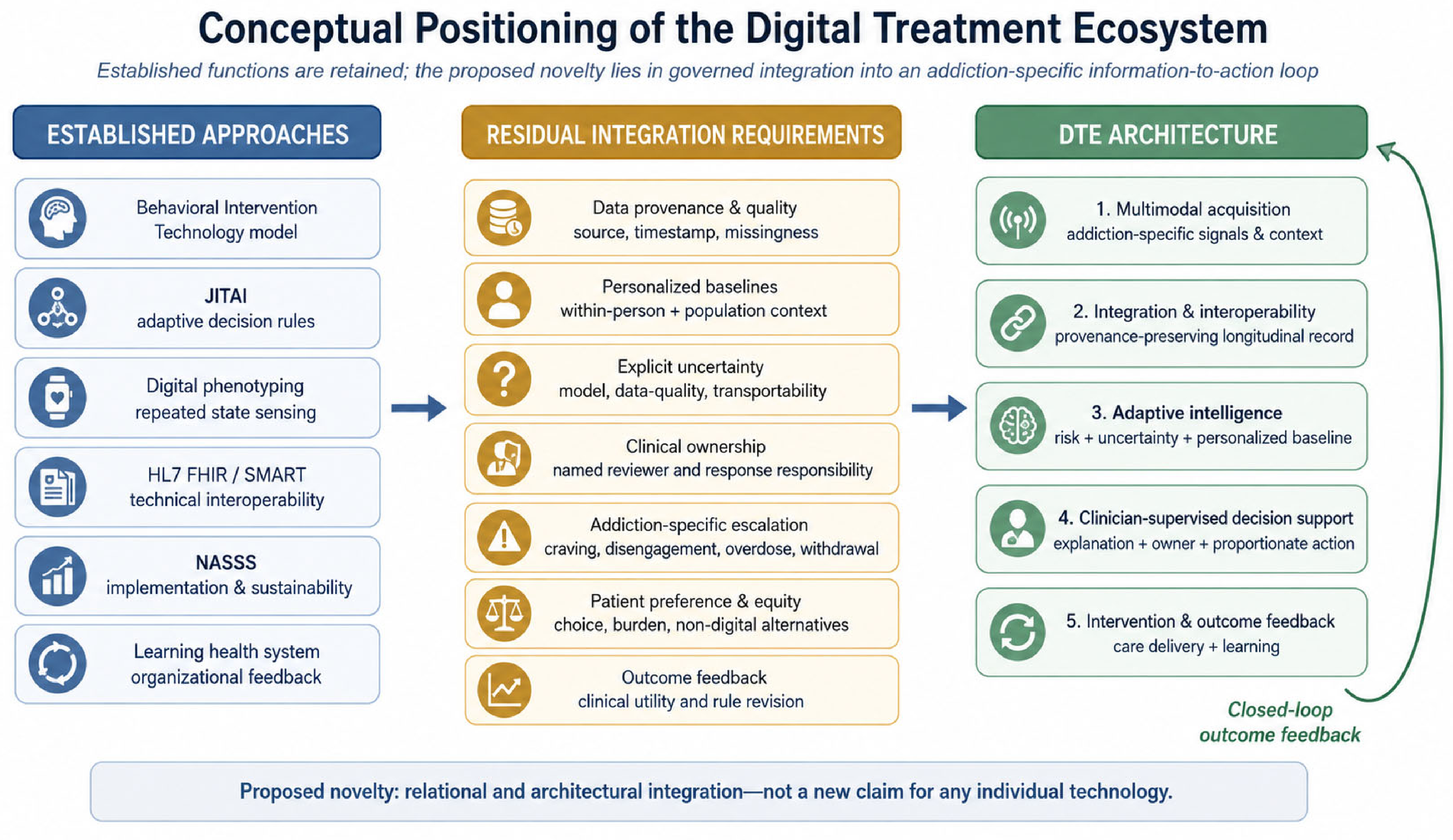
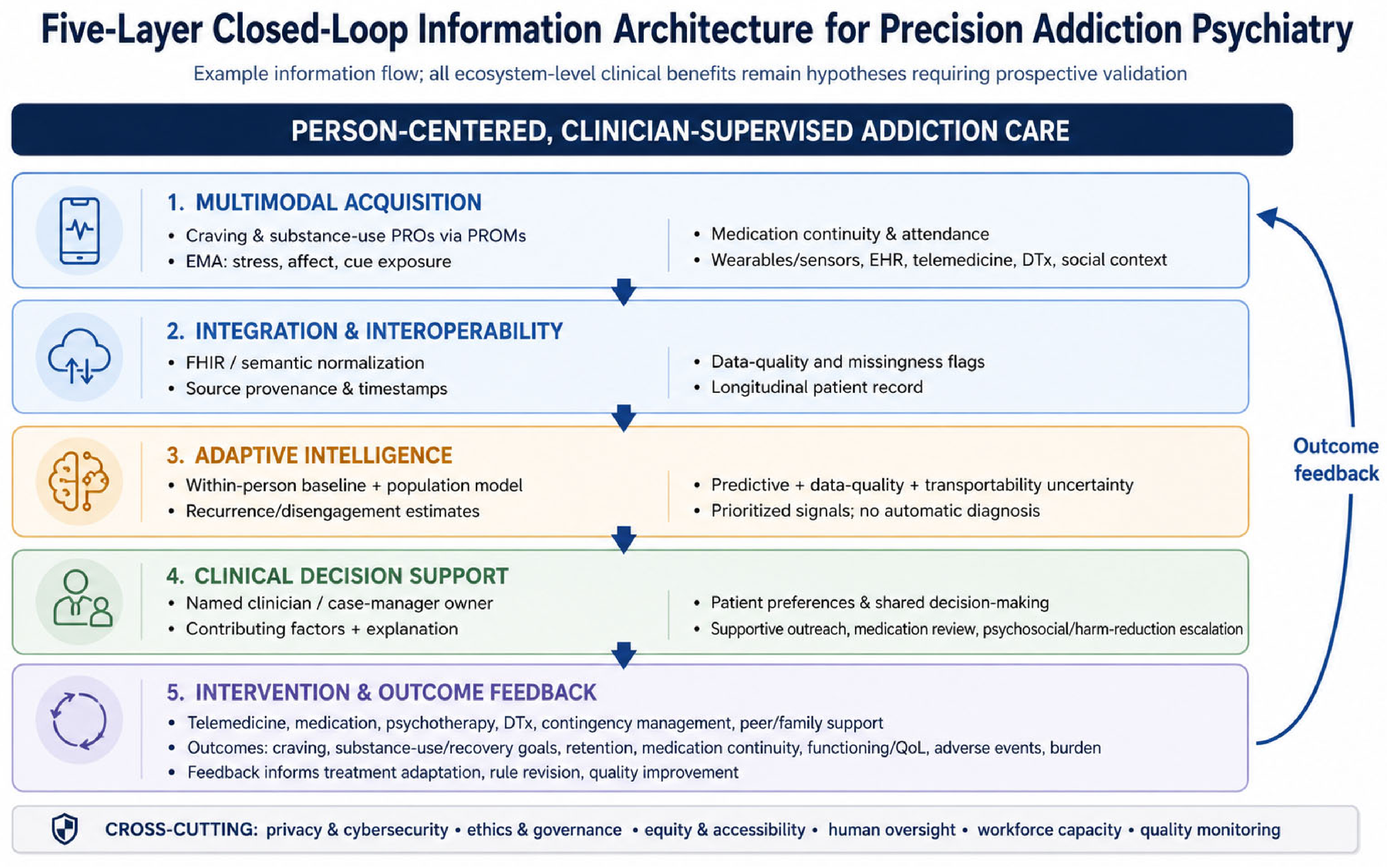
Digital technologies are increasingly used in addiction care, yet telemedicine, ecological momentary assessment, mobile applications, wearables, electronic health records, digital therapeutics, and artificial intelligence commonly remain fragmented across separate platforms and clinical workflows. This Concept Paper addresses this information–integration gap by proposing the Digital Treatment Ecosystem (DTE), a person-centered, closed-loop information architecture for precision addiction psychiatry. The framework was developed through an integrative narrative synthesis of addiction, digital-health, health-informatics, artificial-intelligence, implementation, and regulatory literature. Its originality lies not in any individual technology, but in specifying a governed information-to-action cycle in which heterogeneous longitudinal data are integrated with provenance and uncertainty, interpreted against population-level and within-person baselines, translated into explicitly owned clinician-supervised actions, and returned as outcome feedback for treatment adaptation and organizational learning. Five functional layers are proposed: multimodal data acquisition; integration and interoperability; adaptive intelligence; clinical decision support; and intervention delivery with outcome feedback. Addiction-specific requirements include dynamic craving and recurrence risk, treatment disengagement, polysubstance use, medication continuity, overdose and withdrawal risk, stigma, confidentiality, and fragmented service pathways. Six operationalized propositions define how the DTE can be prospectively tested. The DTE is therefore proposed as a falsifiable socio-technical architecture rather than an established or clinically validated treatment system.
Keywords: digital treatment ecosystem; precision addiction psychiatry; substance use disorders; artificial intelligence; digital phenotyping; ecological momentary assessment; interoperability; clinical decision support; digital therapeutics; learning health system digital treatment ecosystem; precision addiction psychiatry; substance use disorders; artificial intelligence; digital phenotyping; ecological momentary assessment; interoperability; clinical decision support; digital therapeutics; learning health system