Article

From Digital Tools to Digital Treatment Ecosystems: A Closed-Loop Information Architecture for Precision Addiction Psychiatry


by
Vincenzo Maria Romeo
1,2,3,4,*,
Bruna Caridi
3,5,
Agnese Tedeschi
3 and
Elisabetta Ratti
3
1
Department of Cultures and Societies, University of Palermo, 90128 Palermo, Italy
2
School of Psychoanalytic and Group-Analytic Psychotherapy (SPPG), 89131 Reggio Calabria, Italy
3
STAND UP® Method, Via del Casale Solaro 119, 00143 Rome, Italy
4
Neurosinc, 95125 Catania, Italy
5
Gastroenterology and Endoscopy Unit, Fondazione IRCCS Ca’ Granda Ospedale Maggiore Policlinico, 20122 Milan, Italy
*
Author to whom correspondence should be addressed.
Information 2026, 17(9), 916; https://doi.org/10.3390/info17090916 (registering DOI)
Submission received: 31 July 2026 / Revised: 6 September 2026 / Accepted: 15 September 2026 / Published: 18 September 2026
(This article belongs to the Special Issue Information Technology for Smart Healthcare)

Abstract

Digital technologies are increasingly used in addiction care, yet telemedicine, ecological momentary assessment, mobile applications, wearables, electronic health records, digital therapeutics, and artificial intelligence commonly remain fragmented across separate platforms and clinical workflows. This Concept Paper addresses this information–integration gap by proposing the Digital Treatment Ecosystem (DTE), a person-centered, closed-loop information architecture for precision addiction psychiatry. The framework was developed through an integrative narrative synthesis of addiction, digital-health, health-informatics, artificial-intelligence, implementation, and regulatory literature. Its originality lies not in any individual technology, but in specifying a governed information-to-action cycle in which heterogeneous longitudinal data are integrated with provenance and uncertainty, interpreted against population-level and within-person baselines, translated into explicitly owned clinician-supervised actions, and returned as outcome feedback for treatment adaptation and organizational learning. Five functional layers are proposed: multimodal data acquisition; integration and interoperability; adaptive intelligence; clinical decision support; and intervention delivery with outcome feedback. Addiction-specific requirements include dynamic craving and recurrence risk, treatment disengagement, polysubstance use, medication continuity, overdose and withdrawal risk, stigma, confidentiality, and fragmented service pathways. Six operationalized propositions define how the DTE can be prospectively tested. The DTE is therefore proposed as a falsifiable socio-technical architecture rather than an established or clinically validated treatment system.

1. Introduction

Digital health has substantially expanded the capacity to assess, monitor, and intervene in mental health conditions beyond conventional face-to-face encounters. Telemedicine, mobile applications, ecological momentary assessment (EMA), wearable sensors, electronic health records (EHRs), digital therapeutics (DTx), and artificial intelligence (AI) can each support specific components of longitudinal care. However, their deployment frequently remains fragmented across separate platforms, data structures, professional workflows, and organizational responsibilities. The resulting problem is therefore no longer simply one of technological availability, but of how heterogeneous information can be transformed into coherent, traceable, clinically actionable, and continuously learning care pathways.
This problem is particularly consequential in addiction psychiatry. Substance use disorders (SUDs) remain major contributors to preventable morbidity, mortality, disability, social disruption, and health-system expenditure, while global evidence continues to document treatment gaps and substantial burden attributable to alcohol and other psychoactive substances [1,2,3]. Clinically, addiction is characterized by fluctuating vulnerability rather than stable risk: craving, cue exposure, stress, withdrawal, sleep disruption, affective dysregulation, medication adherence, access to substances, social context, and engagement with treatment may change substantially between scheduled encounters. Recurrent substance use may also occur within trajectories involving polysubstance exposure, psychiatric and medical comorbidity, overdose vulnerability, stigma, and discontinuity across specialist addiction, psychiatric, primary care, emergency, pharmacy, and community services.
Contemporary psychological and neuropsychiatric theories support this dynamic perspective. Neurocircuitry models describe interacting processes involving reward and incentive salience, negative emotionality and stress, learning and habit formation, and impaired executive control [4,5]. Incentive-sensitization theory further emphasizes the possibility that substance-related cues acquire persistent motivational salience, producing amplified “wanting” that can become partly dissociated from hedonic “liking” [6]. Contemporary stress models describe dysregulated adaptive stress responses as contributors to craving, compulsive substance use, treatment failure, and recurrence [7]. These perspectives complement the chronic medical illness model, which emphasizes longitudinal management and continuing care rather than episodic detoxification alone [8]. Collectively, they imply that clinically relevant vulnerability is multidimensional, temporally variable, and context dependent rather than adequately represented by a single static diagnostic or risk variable.
Digital technologies provide complementary methods for observing and responding to such variation. Telemedicine can support access and relational continuity [9], mobile health interventions can facilitate self-management and repeated measurement [10], and digital mental health services can maintain contact when conventional care is disrupted [11]. Mobile applications may also support symptom tracking, psychoeducation, reminders, and self-management [12]. The Behavioral Intervention Technology model formalized relationships among intervention aims, behavioral strategies, technological elements, and delivery characteristics [13]. These capabilities are clinically relevant, but their coexistence does not itself constitute an integrated treatment ecosystem.
AI and machine learning (ML) add a further layer of opportunity and risk. Precision psychiatry seeks to move beyond average treatment effects through stratification, trajectory prediction, and individualized decision support [14], while cross-trial studies illustrate the potential of ML to identify treatment-response signatures [15] and broader reviews document rapid expansion of ML applications across mental health [16]. In medicine, AI may support diagnosis, prognosis, workflow prioritization, signal interpretation, and longitudinal risk estimation [17,18]. In addiction psychiatry, however, predictive performance alone is insufficient: models must be interpretable in a clinical context, prospectively validated, equitable, actionable, and embedded in pathways that specify who is responsible for reviewing and acting on outputs.
Interoperability is the infrastructure required to connect these functions. EHRs, patient-reported outcomes (PROs), mobile applications, wearables, laboratory systems, telemedicine platforms, and DTx often use different data structures and vocabularies. Without standardized exchange, digital information remains siloed and may increase rather than reduce workload [19]. Health Level Seven Fast Healthcare Interoperability Resources (HL7 FHIR) provides a modular approach to health-data exchange [20], while mobile health design must account for clinical context, usability, privacy, and the practical realities of care delivery [21]. Interoperability, however, is necessary but not sufficient: exchanged data must retain provenance, quality information, clinical meaning, and explicit responsibility for downstream action.
Time-sensitive intervention provides a further conceptual foundation. Micro-randomized and just-in-time adaptive intervention approaches offer methods for determining when, for whom, and under what conditions a digital prompt or therapeutic action may be beneficial [22], while digital phenotyping uses active and passive data to characterize behavioral and physiological patterns in everyday life [23]. Precision psychiatry and participatory medicine emphasize individualized decision-making and patient participation [24,25,26]; learning health systems require outcomes generated during routine care to inform iterative improvement [27,28]; and implementation science is required to understand how complex systems are adopted, adapted, and sustained across heterogeneous clinical contexts [29]. The residual challenge is to connect these partially complementary functions within one accountable information-to-action pathway.
Against this background, the present Concept Paper proposes the Digital Treatment Ecosystem (DTE) as a person-centered, closed-loop information architecture for precision addiction psychiatry. The novelty of the DTE does not reside in telemedicine, EMA, wearables, AI, interoperability, DTx, or any other individual component. Its proposed contribution is relational and architectural: heterogeneous addiction-related data are integrated with provenance and uncertainty, interpreted against population-derived and within-person baselines, translated into explicitly owned clinician-supervised actions, and returned as outcome feedback for treatment adaptation and organizational learning. The framework is intentionally technology-agnostic and hypothesis-generating. Its purpose is to specify the functional, clinical, organizational, ethical, and evaluative requirements that would need to be demonstrated before an integrated digital ecosystem could claim incremental value over simpler digital or conventional addiction-care pathways.

2. Methodology and Framework Development

2.1. Problem Definition and Objectives

The framework-development process began from a predefined clinical and information-science problem: digital addiction care increasingly generates clinically relevant information through multiple technological channels, yet these information streams are frequently disconnected from one another and from accountable clinical response pathways. The purpose of the present work was therefore not to estimate the pooled efficacy of digital interventions, but to develop a conceptual architecture capable of specifying how heterogeneous digital and clinical functions could be integrated into longitudinal addiction care.
Four objectives guided framework development: (1) to identify the functional requirements necessary to connect multimodal addiction-related data with clinical action; (2) to distinguish these requirements from functions already addressed by established digital-health, information, and implementation frameworks; (3) to organize the identified requirements into a closed-loop information architecture with explicit clinical ownership and governance; and (4) to formulate empirically testable propositions and evaluation domains through which the incremental value of the DTE could subsequently be supported, modified, or rejected.

2.2. Literature Identification and Selection

During framework development and revision (July–August 2026), PubMed/MEDLINE was used as the principal biomedical bibliographic database, supplemented by targeted searches of IEEE Xplore and relevant scholarly publisher platforms, backward and forward citation tracing, and consultation of authoritative technical, regulatory, and policy sources. No lower publication-date limit was imposed; literature available from database inception through 25 August 2026 was eligible for consideration, although recent evidence was prioritized when it updated or superseded earlier work. Search concepts combined terms related to substance use disorders and addiction with digital health, telemedicine, mobile health, ecological momentary assessment, digital phenotyping, wearable sensing, digital therapeutics, artificial intelligence, machine learning, clinical decision support, interoperability, FHIR, learning health systems, implementation, regulation, and digital health equity. The literature-identification strategy was purposive rather than systematic because the objective was framework development across heterogeneous clinical, technological, implementation, and regulatory domains rather than exhaustive estimation of an intervention effect [30,31,32,33,34].
Priority was given to systematic or scoping reviews, consensus and reporting guidance, technical standards, seminal conceptual frameworks, recent empirical studies directly relevant to addiction whenever available, and authoritative institutional or regulatory documents. Sources were retained when they informed at least one predefined functional domain: longitudinal data acquisition; semantic or technical interoperability; adaptive analytics; clinical decision support; digital or hybrid intervention delivery; outcome feedback; implementation; ethics; regulation; or equity. No meta-analysis, formal risk-of-bias assessment, evidence grading, or PRISMA-based systematic-review claim was undertaken. The resulting framework should therefore be interpreted as an integrative, theory-informed conceptual synthesis rather than an exhaustive review of the digital-addiction literature.

2.3. Framework Construction

Framework construction proceeded through four conceptual stages. First, recurrent functional requirements were extracted from the selected clinical, digital-health, informatics, implementation, and regulatory studies. Second, these requirements were grouped according to their position within an information–decision–intervention cycle, distinguishing data acquisition, information integration, adaptive interpretation, clinical decision support, and intervention/outcome functions. Third, the resulting functional groups were mapped onto clinical accountability requirements, including provenance, uncertainty, ownership of analytic outputs, escalation, patient preferences, and outcome feedback. Fourth, the architecture was examined against adjacent frameworks to distinguish inherited components from the proposed integrative relationships of the DTE.
The resulting architecture was translated into conceptual boundaries, addiction-specific design requirements, and six propositions intended for prospective empirical evaluation. The DTE was not developed through Delphi consensus, formal expert elicitation, patient co-design, or empirical optimization; these processes are therefore proposed as subsequent stages of validation rather than implied characteristics of the present framework.

Use of Artificial Intelligence Tools in Figure and Table Preparation

Artificial intelligence tools were used during manuscript preparation to support the definition, refinement, and graphical optimization of selected tables and Figure 1 and Figure 2. These tools were employed exclusively as author-supervised aids for improving visual organization, clarity, consistency, and presentation. No artificial intelligence tool was used to generate, fabricate, or analyze empirical data, nor to independently formulate scientific conclusions. All scientific content, conceptual relationships, terminology, data representations, and final graphical and tabular outputs were critically reviewed, verified, and approved by the authors, who retain full responsibility for their accuracy, scientific integrity, and interpretation.

2.4. Conceptual Boundaries and Positioning Against Existing Frameworks

The DTE is not synonymous with a digital health platform, an EHR extension, a prescription DTx, a learning health system, or an AI prediction model. It is defined by the coordinated relationship among these components. Its distinctive requirements are integration of active, passive, clinical, therapeutic, and contextual data; preservation of provenance and uncertainty; use of personalized baselines alongside population-derived models; explicit assignment of clinical ownership for analytic outputs; proportionate escalation rules; bidirectional outcome feedback; and governance that treats engagement, burden, equity, and trust as properties of the system rather than solely of the individual user. The DTE is consequently technology-agnostic and may be implemented through different local infrastructures, provided that the functional and governance requirements remain demonstrable.
A further boundary concerns autonomy. The adaptive intelligence layer may summarize patterns, estimate probabilities, identify deviations, and prioritize review, but it does not independently diagnose substance use recurrence, alter medication, initiate coercive action, or replace shared decision-making. The framework also does not assume that greater data volume necessarily produces better care. Data acquisition is justified only when the information has a defined clinical purpose, acceptable burden, proportionate privacy risk, and a specified pathway from observation to accountable action. Table 1 positions the DTE against closely related frameworks and infrastructures to clarify what is inherited and what constitutes the proposed integrative contribution.

2.5. Operationalized Testable Propositions

Proposition 1. 
Interoperable integration of multimodal data is hypothesized to produce greater clinical actionability than parallel access to disconnected digital data streams.
Proposition 2. 
Within-person deviations from personalized baselines are hypothesized to provide greater short-term clinical relevance than population-derived thresholds alone.
Proposition 3. 
Clinician-supervised adaptive decision support is hypothesized to improve response timeliness without increasing inappropriate automated escalation.
Proposition 4. 
Closed-loop outcome feedback is hypothesized to improve treatment adaptation and organizational learning relative to open-loop digital monitoring.
Proposition 5. 
Human-centered design, meaningful patient participation, and equity safeguards are hypothesized to moderate adoption, engagement, and effectiveness across heterogeneous populations.
Proposition 6. 
A DTE is hypothesized to produce incremental benefit only when information integration is accompanied by explicit clinical ownership, response capacity, and workflow redesign.
These propositions concern incremental ecosystem-level effects and should not be conflated with evidence supporting individual components. For example, evidence that EMA can measure craving or that telemedicine can deliver addiction treatment does not establish that integrating EMA and telemedicine within a DTE improves outcomes. Each proposition therefore requires a comparator capable of isolating the value added by integration, adaptation, clinical ownership, or feedback. Table 2 provides candidate operational definitions, designs, and failure criteria.

3. Positioning the DTE Within Existing Digital Health and Information Frameworks

Digital health has evolved from early e-health and telepsychiatry toward increasingly connected models of remote assessment, intervention, and service redesign [35,36,37,38,39,40]. Ecological momentary interventions and EMA extended support and measurement into everyday life, while addiction-specific mobile applications demonstrated that structured recovery support can be delivered beyond the clinic and just-in-time approaches formalized time-sensitive tailoring [41,42,43,44]. These developments established important component functions but did not by themselves define an accountable pathway linking heterogeneous data to longitudinal clinical action.
Wearables, passive sensing, engagement science, EHRs, and ML expanded the digital information environment and the capacity to characterize behavioral and physiological trajectories [45,46,47,48,49,50,51,52,53,54,55,56,57]. Their growth also exposed recurrent limitations: measurement validity, device adherence, proprietary algorithms, missingness, weak interoperability, and the risk of equating technical engagement or predictive performance with clinical benefit. For the DTE, these technologies are therefore treated as bounded functional components whose value depends on inference quality, contextual interpretation, and linkage to an actionable workflow.
The transition from tools to an ecosystem is consequently organizational as well as technological. Digital innovation succeeds when technical components are aligned with clinical roles, incentives, workflows, and patient needs [58]. NASSS explains how nonadoption, abandonment, scale-up, spread, and sustainability emerge from interactions among the condition, technology, value proposition, adopters, organization, wider system, and adaptation over time [59]. SMART on FHIR illustrates modular interoperability around EHRs [60], while digital-transformation scholarship emphasizes that introducing software without redesigning organizational capability and value creation is insufficient [61,62,63].
Participatory medicine and human-factors approaches further require that patients be treated as active contributors rather than passive data sources, and that technologies be evaluated within the practical work of patients and clinicians [64,65]. The World Health Organization frames digital transformation as a means of strengthening equitable, person-centered health systems [66], while learning-health-system models require routine-care data to support feedback, knowledge generation, and iterative improvement [67,68,69]. The DTE builds on these established contributions by specifying the clinical information relationships that must connect them in addiction care.
Figure 1 summarizes the conceptual transition from fragmented digital modalities toward an adaptive DTE. The figure should be read together with Table 1: individual technologies and frameworks retain their established functions, whereas ecosystem-level effects remain hypotheses that require comparative prospective evaluation.

4. Digital Technologies as Functional Components

Within the DTE, technologies are defined by the clinical functions they perform rather than by novelty or commercial category. The evidence summarized in this section concerns individual technologies or bounded digital interventions and should not be interpreted as evidence that the integrated DTE as a whole improves clinical outcomes. Component-level efficacy, feasibility, or predictive performance and ecosystem-level effectiveness are distinct empirical questions. Telemedicine provides relational and organizational continuity; mobile health supports self-management and repeated measurement; EMA captures time-varying experience; wearables and sensors add passive physiological or behavioral information; EHRs provide clinical history; DTx deliver structured interventions; AI supports adaptive interpretation; and online communities may extend recovery-oriented social support. Evidence for telemedicine-delivered SUD interventions and mobile health approaches indicates meaningful potential but substantial heterogeneity in design, engagement, outcomes, and implementation [70,71,72]. The principal components are summarized in Table 3.

4.1. Telemedicine and Relational Continuity

Telemedicine can reduce geographic, mobility, scheduling, and stigma-related barriers to addiction care. A systematic review of telemedicine-delivered SUD interventions found evidence across counseling, pharmacotherapy support, monitoring, and continuing care, although methodological heterogeneity limited strong comparative conclusions [70]. More specifically, an observational evaluation of the telemedicine-based STANDUP® method in 98 individuals with cocaine use disorder reported substantial reductions in craving after three months of treatment followed by partial resurgence at six months [71]. These findings do not establish the effectiveness of an integrated DTE, but they provide an addiction-specific example of repeated digital assessment, structured remote intervention, and longitudinal follow-up within a continuing-care pathway. Within a DTE, telemedicine should therefore be treated as a relational interface through which measurement, interpretation, shared decision-making, medication review, psychotherapy, family involvement, and care coordination may be connected rather than as a substitute video appointment.

4.2. Mobile Health, EMA, and Patient-Reported Outcomes

Mobile health interventions can deliver psychoeducation, coping exercises, medication reminders, self-monitoring, contingency-management elements, and links to professional or peer support. Their principal ecosystem value lies in combining intervention delivery with repeated measurement [72]. EMA is particularly relevant because craving and substance use are embedded within dynamic interactions among affect, stress, social context, cue exposure, and opportunity. A systematic review of EMA in substance use research demonstrated its capacity to capture craving and consumption in daily life with reduced retrospective distortion [73]. Ecological data have also been used to predict recurrence after treatment [74] and to characterize proximal relationships among affect, craving, and recurrence risk [75]. Patient-reported outcomes (PROs) are the outcomes reported directly by patients, whereas patient-reported outcome measures (PROMs) are the instruments used to collect them; this distinction is retained throughout the DTE architecture.
In the DTE, active data collection should be parsimonious. The objective is not maximal questionnaire frequency but the smallest clinically meaningful set of observations needed to detect change. Individualized schedules may reduce response burden, while adaptive sampling can increase measurement during periods of elevated risk and decrease it during stable recovery. Patient control over notification timing, data visibility, and pause functions is essential to preserve autonomy and prevent monitoring from becoming intrusive.

4.3. Wearables, Passive Sensing, and Multimodal Trajectories

Wearables and smartphone sensors may contribute information on sleep, activity, heart rate, heart-rate variability, geolocation, mobility regularity, and communication patterns. The D-TECT program illustrates the methodological potential of combining digital health data with clinical trajectories during medication treatment for opioid use disorder [76]. Emerging work also investigates wearable and phone-derived biomarkers of drug-use recurrence [77]. These signals should be interpreted as probabilistic and contextual rather than diagnostic. Sleep disruption, reduced mobility, or autonomic change can reflect craving, withdrawal, depression, physical illness, work schedules, device nonwear, or ordinary variation. A DTE therefore requires personalized baselines, uncertainty estimates, and confirmatory human assessment before escalation.

4.4. Digital Therapeutics and Adaptive Intervention Delivery

Digital therapeutics translate evidence-based behavioral content into structured software-mediated interventions. Reviews of SUD mHealth reporting reveal persistent inconsistency in usability measures, engagement definitions, and impact evaluation [78]. Meta-analytic evidence among young people suggests that digital health interventions can reduce substance use, although effects vary by modality, population, and outcome [79]. Secondary analyses of prescription digital therapeutics indicate favorable safety and efficacy signals [80], and engagement patterns have been associated with abstinence outcomes [81]. Real-world evaluations further suggest that prescription digital therapeutics may produce clinically meaningful outcomes outside tightly controlled trials, but selection effects, reimbursement, onboarding, and differential engagement require careful study [82].
In the DTE, digital therapeutics should be prescribed as part of a care plan rather than offered as an unconnected content library. Completion data, skill use, self-reported benefit, and nonresponse should inform clinical review. The ecosystem should also support stepped intensity: automated psychoeducation or coping support may be appropriate for lower-risk moments, whereas sustained deterioration, overdose risk, severe withdrawal, suicidality, or complex comorbidity requires direct professional assessment and established emergency procedures.

Evaluation of Digital Therapeutics Within the DTE

Evaluation of DTx within a DTE should distinguish the performance of the therapeutic software itself from the incremental value of integrating it into a broader clinical ecosystem. At the intervention level, efficacy should be examined using an appropriate comparator and clinically meaningful substance use, craving, retention, functioning, or quality-of-life outcomes. Effectiveness should subsequently be evaluated under routine-care conditions, including heterogeneous populations and realistic levels of adherence. Engagement should not be reduced to log-in frequency but should incorporate exposure to therapeutic content, completion of clinically meaningful activities, skill use, persistence, and reasons for nonuse.
Additional domains include safety and unintended effects; durability after active treatment; acceptability and usability; adoption, appropriateness, feasibility, fidelity, penetration, and sustainability; differential uptake and effectiveness across demographic and socially marginalized groups; clinician workload; and health-economic value. At ecosystem level, a particularly informative comparison is DTx delivered as an isolated intervention versus the same DTx embedded within a DTE in which engagement, nonresponse, clinical deterioration, and treatment outcomes are returned to clinicians and used to inform subsequent care. Such designs would allow the incremental contribution of ecosystem integration to be tested rather than assumed.

4.5. Online Recovery Communities and Contextual Support

Online recovery support can extend social connection, mutual aid, identity reconstruction, and continuity beyond formal treatment. Reviews have described the scientific basis and potential reach of digital recovery support services [83]. However, moderation, misinformation, privacy, commercial influence, and variable community norms may affect safety. The DTE should therefore distinguish between clinically governed peer-support functions and open social-media environments, while respecting that many individuals value anonymous or nonclinical recovery communities.
Context is especially important in low- and middle-income settings, where telehealth may widen reach but can also reproduce infrastructure and workforce inequalities. A scoping review identified both opportunities and substantial evidence gaps in telehealth interventions for SUDs in low- and middle-income countries [84]. Ecosystem design should allow low-bandwidth communication, asynchronous options, shared devices where appropriate, accessible language, and non-digital alternatives.

4.6. Primary Care and Service-Level Integration

Primary care is a critical setting for identifying unhealthy substance use, initiating or coordinating treatment, and managing comorbid medical conditions. A mixed-methods pilot of prescription digital therapeutics in primary care illustrates the implementation work required around referral, activation, clinician awareness, workflow ownership, and follow-up [85]. Within a DTE, primary care, specialist addiction services, emergency care, mental health services, pharmacies, and community organizations should be linked through explicit information-sharing and escalation rules, rather than assuming that technology itself will create coordination.

5. Artificial Intelligence as the Adaptive Intelligence Layer

AI is conceptualized within the DTE as an adaptive intelligence layer that transforms longitudinal, multimodal information into clinically reviewable patterns. ML methods are increasingly embedded within biomedical engineering and clinical analytics [86], and addiction research now has a growing methodological literature describing supervised learning, unsupervised learning, feature selection, validation, and performance assessment [87]. The appropriate question is therefore not whether AI should be added to addiction care, but which tasks can be supported safely, which outcomes matter clinically, and what governance is required when predictions influence care.

5.1. Digital Phenotyping and Dynamic State Estimation

Digital phenotyping may enhance SUD treatment by characterizing changes in behavior, context, and physiology between visits [88]. Passive GPS features have been used to predict stress and drug craving approximately ninety minutes in advance [89], illustrating the possibility of near-term risk estimation. Such findings remain exploratory and should not be interpreted as deterministic prediction. The clinically useful output is not a label of inevitable relapse, but an uncertainty-calibrated indication that the patient’s current pattern differs from their own stable baseline and may warrant a check-in, coping intervention, or review.

Risk and Uncertainty

Risk and uncertainty should be treated as distinct outputs within the DTE. Predictive or model uncertainty refers to the confidence associated with an estimated probability or predicted trajectory. Data-quality uncertainty arises when inputs are missing, noisy, inconsistently sampled, affected by device nonwear, or otherwise unreliable. Distributional or transportability uncertainty occurs when an individual or clinical context differs materially from the data on which a model was developed or validated. These forms of uncertainty should be represented separately whenever technically feasible.
Importantly, a high estimated risk does not necessarily imply high confidence, and a low estimated risk may also be unreliable when input quality is poor or the patient lies outside the model’s validated distribution. Uncertainty should therefore influence the degree of automation and the required level of human verification. In the proposed DTE, uncertain outputs should generally prompt contextual review or additional information gathering rather than stronger automated intervention.

5.2. Prediction of Engagement, Retention, and Recurrence

Treatment retention is a particularly relevant target because disengagement often precedes preventable deterioration. Multisite EHR and ML analyses have investigated the predictability of retention during buprenorphine–naloxone treatment [90]. A DTE could combine appointment history, medication continuity, EMA completion, treatment milestones, social determinants, and patient preferences to identify modifiable barriers. However, a model should not penalize patients whose missingness reflects unstable housing, limited connectivity, caregiving responsibilities, incarceration, hospitalization, or distrust. Predictive outputs should trigger supportive outreach rather than coercive surveillance or reduced access.

5.3. AI in Opioid Use Disorder and Population-Level Risk

AI applications in opioid use disorder span risk stratification, overdose surveillance, treatment matching, retention prediction, natural-language processing, and clinical decision support. A review of the gray literature identified substantial innovation but limited transparent evidence and evaluation [91]. Big-data and predictive-modeling approaches may contribute to understanding and responding to the opioid crisis, but their value depends on data quality, transportability, and alignment with public-health and clinical decisions [92]. Population-level prediction should not be conflated with individual diagnosis, and high-risk classification must not become a basis for stigma, denial of analgesia, or punitive action.

5.4. Explainability, Bias, and Clinical Meaning

Explainability is frequently proposed as the solution to AI opacity, yet current explainable-AI approaches can create false reassurance when explanations are unstable, technically plausible but clinically misleading, or detached from causal mechanisms [93]. Bias is equally consequential. A widely used population-health algorithm demonstrated racial bias because health-care cost was used as a proxy for health need [94]. Addiction datasets may encode similarly problematic proxies through arrest history, emergency utilization, insurance status, or treatment attendance. Responsible models require explicit definition of the target, assessment of proxy variables, subgroup performance analysis, and evaluation of downstream clinical consequences.

5.5. Privacy-Preserving and Responsible Machine Learning

Federated learning offers one approach to collaborative model development without centralizing all raw data, although it does not eliminate privacy, bias, governance, or security risks [95]. More broadly, responsible ML requires attention to data provenance, missingness, clinical workflow, prospective evaluation, human factors, failure modes, and monitoring after deployment [96]. Critical questions concerning transparency, replicability, ethics, and effectiveness should be answered before claims of patient benefit are accepted [97]. The DTE therefore treats AI models as versioned clinical components subject to audit, recalibration, and withdrawal when performance deteriorates.

5.6. Reporting, Validation, and Human Oversight

Clinical evaluation of AI-enabled interventions requires reporting standards that extend beyond conventional trial descriptions. CONSORT-AI specifies additional reporting requirements for clinical trials involving AI interventions [98], while SPIRIT-AI addresses trial protocols [99]. These guidelines reinforce the need to describe input data, handling of poor-quality inputs, interaction between users and systems, error analysis, and the role of human judgment. Treatment services may not yet possess the data infrastructure, workforce capability, governance, or implementation readiness required for large-scale AI use in opioid treatment [100]. Consequently, the DTE positions AI as decision support: clinicians retain responsibility for interpreting outputs in relation to the patient’s narrative, goals, comorbidities, social context, and preferences.

6. Digital Treatment Ecosystem Framework

6.1. Design Principles

The proposed DTE is organized around six design principles: person-centeredness, longitudinality, interoperability, clinical actionability, human supervision, and continuous learning. FHIR has become a central standard for digital health exchange and modular health applications [101], but interoperability also requires semantic alignment, governance, provenance, identity management, and reconciliation across heterogeneous systems [102]. Person-generated data should enter routine care through standardized workflows that define data quality, responsibility, and clinical response [103]. FHIR-based clinical information systems may further support ML-enabled services when technical architecture and clinical objectives are jointly designed [104].
Actionability is equally important. Clinical decision-support alerts may be ignored when they are poorly timed, non-specific, repetitive, or disconnected from workflow [105]. Human-centered design can improve relevance and equity by involving patients, families, clinicians, and underserved groups in the development process [106]. The User-Centered Framework for Implementation of Technology links tool design with tailored implementation strategies [107], while operational studies of remote patient monitoring demonstrate the importance of staffing, enrollment, escalation, and integration within existing ambulatory systems [108].

6.2. Addiction-Specific Design Requirements

Although several architectural principles of the DTE may be transferable to other chronic conditions, its instantiation in addiction psychiatry is defined by a distinctive combination of temporal, clinical, ethical, and organizational requirements. Clinically relevant states such as craving, cue exposure, withdrawal, stress, affective dysregulation, and opportunities for substance use may fluctuate over hours or days; treatment disengagement may itself be a clinically meaningful signal; and medication continuity, polysubstance exposure, overdose vulnerability, and interactions between psychiatric and medical comorbidity may require rapid contextual review. Addiction-related information also carries exceptional stigma and confidentiality implications and may affect employment, family relationships, insurance, criminal legal involvement, and willingness to seek care.
Addiction care commonly spans specialist services, psychiatry, primary care, emergency medicine, pharmacies, social services, peer-recovery organizations, and, in some settings, criminal legal systems. This creates a strong requirement for explicit information-sharing rules and clinical ownership. The meaning of digital nonengagement is also inherently ambiguous: missed EMA entries, reduced mobility, or device nonuse may indicate deterioration, but may equally reflect poverty, unstable housing, hospitalization, incarceration, work demands, device loss, privacy concerns, or a deliberate preference not to engage digitally. The DTE architecture may therefore be structurally generalizable but is clinically addiction-specific through the signals monitored, temporal risk horizons, escalation rules, confidentiality safeguards, treatment modalities, service interfaces, and outcomes that populate the architecture.

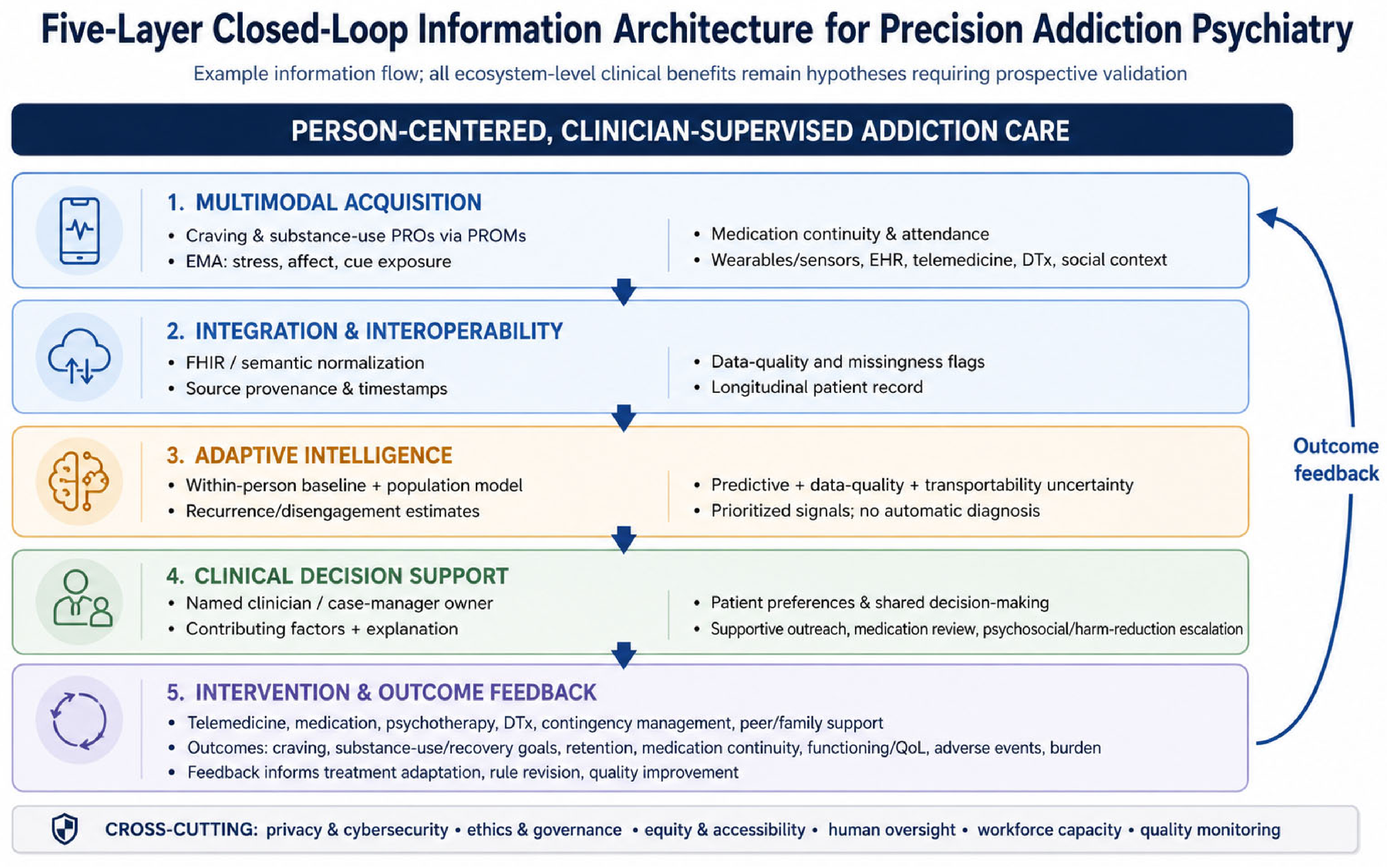
6.3. Five-Layer Architecture and Closed-Loop Workflow

The DTE comprises five functional layers connected through a closed-loop workflow: (1) multimodal data acquisition; (2) integration and interoperability; (3) adaptive intelligence; (4) clinical decision support; and (5) intervention delivery and outcome feedback. Figure 2 presents their relationship with the person-centered clinical loop and cross-cutting enablers. The operational characteristics of the five layers, including inputs, processes, outputs, responsible actors, and hypothesized clinical contributions, are summarized in Table 4.

6.3.1. Layer 1: Multimodal Data Acquisition

The acquisition layer receives structured and unstructured information from clinical encounters, EHRs, laboratory and medication systems, EMA, standardized scales, wearables, mobile sensors, telemedicine, digital therapeutics, and patient or family communication. Its first responsibility is data quality rather than volume. Each observation should be timestamped, associated with provenance, contextualized, and assessed for reliability. A mobile intervention protocol using a micro-randomized design illustrates how repeated data collection and intervention delivery can be coordinated in emerging adults who use cannabis [109]. Such designs are useful because they connect momentary context to immediate intervention opportunities.

6.3.2. Layer 2: Integration and Interoperability

The integration layer converts heterogeneous data into a longitudinal record that can be interpreted across systems. This requires FHIR resources, standard terminologies, application programming interfaces, identity matching, consent metadata, and rules for resolving conflicting or duplicated observations. Integration should preserve raw data, derived features, model outputs, and clinician interpretation as distinct objects. The objective is traceability: a clinician should be able to determine which data contributed to an alert, when they were collected, and how uncertainty was handled.

6.3.3. Layer 3: Adaptive Intelligence

The adaptive intelligence layer estimates trends and deviations from personalized baselines and may identify rising craving, deteriorating sleep, reduced engagement, medication interruption, social instability, or combinations associated with recurrence vulnerability. Micro-randomized trials comparing momentary mindfulness and distraction messages provide an example of how proximal responses can inform optimization of intervention content [110]. The layer should combine population-level models with within-person learning because clinically relevant change may be visible only relative to the individual’s own trajectory. Risk estimates should be accompanied by data-quality and model-uncertainty information rather than presented as deterministic labels.

6.3.4. Layer 4: Clinical Decision Support

The decision-support layer translates analytic outputs into prioritized, contextualized, and reviewable tasks. It should distinguish informational summaries from time-sensitive alerts and emergency signals. Recommendations must specify the evidence source, uncertainty, relevant patient preferences, and required response. Large-scale digital research platforms demonstrate how recruitment, consent, data collection, and follow-up can be integrated across diverse populations [111], but clinical decision support adds the requirement that responsibility for action be explicit. A risk score without ownership or response capacity is not a clinical intervention.

6.3.5. Layer 5: Intervention Delivery and Outcome Feedback

Interventions may include telemedicine contact, medication review, psychotherapy, contingency management, digital CBT, psychoeducation, craving-management exercises, peer support, family engagement, social-service referral, or emergency escalation. Patient-generated data should be incorporated into clinical decision-making through negotiated workflows rather than simply displayed [112]. Outcomes—including symptom change, abstinence or reduction goals, retention, functioning, quality of life, adverse events, and patient-reported burden—return to the ecosystem. Software architecture must support this cycle over time and across evolving telemedicine components [113].

6.4. Addiction-Specific Operational Use Case: Early Detection of Disengagement During OUD Treatment

The following hypothetical use case illustrates the operational logic of the DTE and does not represent a validated algorithm, an identifiable patient, or an empirical prediction rule. Any thresholds used in a future implementation would require prospective calibration and clinical validation.
Consider an individual receiving medication and psychotherapy for opioid use disorder who has established a sufficiently stable prespecified personal baseline over the preceding weeks for treatment attendance, medication continuity, craving, sleep regularity, and EMA participation. Over several days, the acquisition layer detects a cluster of deviations: increased self-reported craving, reduced sleep regularity relative to the individual’s baseline, two missed EMAs, interruption of a prescribed DTx, and postponement of an addiction-care appointment. The integration layer verifies timestamps and source provenance and identifies incomplete passive-sensing data during part of the observation window. The adaptive intelligence layer therefore generates an elevated short-term disengagement-risk estimate accompanied by explicit data-quality uncertainty; it does not infer opioid use or diagnose recurrence. The clinical decision-support layer creates a moderate-priority task assigned to the patient’s case manager, displays the contributing signals and missing-data warning, and presents the patient’s previously recorded preference for text-based contact before telephone communication. During contact, the patient reports a new evening work schedule and transportation difficulties, denies opioid use, confirms continued medication use, and requests an evening telemedicine appointment. The clinician and patient agree to preserve medication continuity, reschedule psychotherapy, temporarily increase brief craving assessments, and review whether the DTx remains acceptable and useful. The outcome-feedback stage records appointment completion, medication continuity, craving trajectory, monitoring burden, and restoration of engagement. If similar alerts repeatedly prove nonactionable, poorly calibrated, burdensome, or inequitable, the corresponding decision rule would require modification or withdrawal.
The operational mapping of this hypothetical workflow onto the DTE architecture is summarized in Table 5.

6.5. Evaluation Framework

The evaluation of a DTE should be staged and multidimensional because satisfactory performance at one level does not establish effectiveness at another. Technical verification should precede clinical impact evaluation, and predictive performance should not be conflated with clinical utility. Technical performance should include data completeness, exchange success, system uptime, latency, provenance preservation, and interoperability failures. Analytic performance should include discrimination where appropriate, calibration, Brier score or other proper scoring rules, sensitivity to distribution shift, uncertainty calibration, subgroup performance, and model drift. Clinical-process performance should include alert-to-review time, proportion of outputs judged actionable, completed clinical responses, inappropriate or unnecessary escalation, and unresolved alerts.
Clinical effectiveness should be assessed using addiction-relevant outcomes such as substance use frequency or individualized recovery goals, craving trajectories, treatment retention, medication continuity, recurrence, overdose outcomes where relevant, psychiatric symptoms, functioning, and quality of life. Human-factor outcomes should include usability, patient burden, clinician burden, alert fatigue, trust, therapeutic alliance, and perceived autonomy. Implementation outcomes should include acceptability, adoption, appropriateness, feasibility, fidelity, penetration, cost, and sustainability. Equity and economic evaluation should examine differential access, missingness, model performance, clinical response, retention, and outcomes across relevant subgroups, together with clinician time, resource utilization, cost-effectiveness, and opportunity costs.
A staged validation pathway could progress from technical verification and usability testing to retrospective analytic development, temporal and external validation, prospective silent deployment, clinician-supervised impact evaluation, pragmatic or cluster-randomized comparison, and hybrid effectiveness–implementation studies. Ecosystem-level benefit should be claimed only when the integrated DTE demonstrates incremental value over a clearly specified simpler comparator.

7. Implementation Challenges, Ethical Governance, and Future Research Directions

The transition from a conceptual architecture to routine clinical infrastructure is constrained by organizational capacity, workflow, regulation, trust, and equity. Digital psychiatry evidence has expanded across applications, social media, chatbots, and virtual reality, but implementation quality remains uneven [114]. Implementation outcomes—including acceptability, adoption, appropriateness, feasibility, fidelity, cost, penetration, and sustainability—must be distinguished from clinical effectiveness [115]. NASSS-informed reviews of computerized clinical decision support identify barriers across technology, adopters, organizations, and wider systems [116]. Addiction services also require implementation frameworks that account for the distinctive characteristics of SUD treatment, including stigma, fragmented funding, regulatory complexity, workforce shortages, and variable integration with general medical and mental health care [117].
The principal implementation, ethical, organizational, regulatory, and technological challenges associated with the proposed DTE, together with mitigation strategies and future research priorities, are summarized in Table 6.

7.1. Organizational Readiness and Workforce Capability

Implementation should begin with a clearly defined clinical problem, not with procurement of a technology. Services must determine which patients will be enrolled, what data will be collected, which professionals will review them, expected response times, escalation pathways, documentation requirements, and coverage outside working hours. Digital navigators may assist with onboarding and technical barriers, but clinical responsibility cannot be delegated to unregulated roles. Training should include data interpretation, limitations of AI, privacy, bias, communication of uncertainty, alert management, and the preservation of therapeutic alliance.
Phased implementation is preferable to system-wide deployment. Early stages can focus on a limited population, small number of measures, and explicit response rules. Process evaluation should examine not only adoption but unintended consequences: duplication of documentation, increased workload, alert fatigue, inequitable exclusion, or shifts in responsibility without adequate staffing. Hybrid effectiveness–implementation designs can evaluate clinical outcomes and implementation processes simultaneously.

7.2. Regulation, Privacy, and Cybersecurity

Digital therapeutics and AI-enabled clinical functions may fall under different regulatory categories depending on intended use, level of autonomy, and risk. Regulation of mental health digital therapeutics requires clarity regarding evidence standards, professional roles, software updates, accountability, and post-market monitoring [118]. In the European Union, the applicable pathway may involve the risk-based requirements of the Artificial Intelligence Act and, when software has an intended medical purpose, the Medical Device Regulation [119,120]. In the United States, lifecycle governance includes FDA expectations for predetermined change control plans for AI-enabled device software functions, while confidentiality of federally assisted SUD-treatment records remains subject to 42 CFR Part 2 alongside applicable HIPAA requirements [121,122]. A DTE is not a single product; it is a changing configuration of data sources, algorithms, interfaces, and care processes. Governance must therefore track versions and dependencies so that changes in one component do not silently alter clinical performance.
Addiction data are exceptionally sensitive because unauthorized disclosure can affect employment, insurance, family relationships, legal proceedings, and willingness to seek care. Privacy in medical big data requires attention to secondary use, re-identification, consent, and asymmetries of power [123]. Cybersecurity threats can compromise confidentiality, integrity, availability, and patient safety [124]. Minimum safeguards include encryption in transit and at rest, role-based access, multifactor authentication, audit trails, secure update processes, data minimization, incident-response plans, and regular penetration and resilience testing. Patients should receive understandable information on what is collected, why it is collected, who can access it, and how long it will be retained.

7.3. Digital Equity, Accessibility, and Trust in Addiction Care

Digital inequity in addiction care should be treated as a potential source of clinical harm rather than solely as an implementation inconvenience. Device ownership, broadband access, digital literacy, language, disability, housing stability, rurality, age, privacy, and economic resources influence who can use digital care [125,126]. Recent evidence specific to opioid use disorder identifies technology access and digital literacy as recurrent challenges in virtual primary care, while limited broadband can constrain telemedicine-based access to medication treatment, particularly in rural settings [127,128]. The DTE should therefore provide low-bandwidth and asynchronous options, accessible interfaces, multilingual content, assisted onboarding, device or connectivity support where feasible, transparent pause or opt-out functions, and clinically equivalent non-digital pathways. Continuous monitoring should not become a prerequisite for receiving high-quality addiction treatment.
Digital exclusion may also generate informational bias. Individuals with unstable connectivity or device turnover may contribute more missing data, and an analytic system could incorrectly interpret missingness as treatment disengagement or clinical deterioration. Geolocation, communication patterns, treatment attendance, insurance status, or criminal legal information may also encode structural disadvantages and become harmful proxy variables if used uncritically. Equity should therefore be measured through subgroup comparisons of enrollment, data completeness, dropout, usability, alert generation, false-positive rates, calibration, clinical-response time, retention, and treatment outcomes. A DTE that improves average performance while systematically worsening access, burden, or outcomes in marginalized populations should not be regarded as successful. Trustworthiness further depends on transparent communication, demonstrable reliability, fairness, accountability, professional oversight, and clearly bounded purposes for clinical monitoring [123,125,129]. A clear separation between supportive clinical monitoring and coercive surveillance should be treated as an additional addiction-specific governance requirement. Patient refusal of a particular digital modality should not itself be interpreted as nonadherence or increased clinical risk.

7.4. Implementation Strategies and Sustainability

Implementation strategies should be selected in relation to identified barriers. Compilations of strategies for clinical innovation include stakeholder engagement, local adaptation, educational meetings, facilitation, audit and feedback, reminders, leadership involvement, and changes in infrastructure or incentives [130]. For a DTE, these strategies should be paired with technical monitoring, including data completeness, alert volume, response time, model calibration, subgroup performance, and system downtime. Sustainable reimbursement must recognize clinical review and coordination rather than paying only for software access.

7.5. Future Research Directions

The next stage of research should move from proof-of-concept tools toward comparative and ecosystem-level evaluation. Randomized evidence for digital cognitive behavioral therapy in alcohol use disorder demonstrates that digital interventions can be assessed with rigorous clinical outcomes [131]. Future trials should compare isolated digital components with coordinated DTE pathways, identify which combinations provide incremental benefit, and measure burden and adverse effects alongside efficacy.
The rapid convergence of addiction research and AI also requires critical self-reflection. Bibliometric mapping indicates growing intersection among AI, substance use, and mental health [132], but publication volume should not be confused with clinical readiness. Research agendas should prioritize external validation, calibration, fairness, prospective impact, and reproducibility. Patients, families, and people with lived experience should participate in governance and design, as illustrated by learning-health-system initiatives that integrate patient and family voices into digital databanks [133].
Learning health systems provide a methodological bridge between research and care. Evidence-based learning-health-system frameworks show how routinely generated data can support iterative improvement when governance, stakeholder participation, and feedback are explicit [134]. In addiction psychiatry, future DTE studies should incorporate pragmatic trials, adaptive designs, micro-randomized trials, interrupted time-series analyses, and qualitative research on meaning, trust, and workload. Digital therapies for SUDs continue to evolve, with engagement strategies remaining a central determinant of benefit [135]. Clinical decision-support systems across addiction and mental health should be evaluated for actionability, safety, and integration rather than only technical accuracy [136].
Future research should prioritize direct comparative tests of integration rather than continuing to demonstrate only that individual digital components can function in addiction care. The key scientific question is whether an integrated, uncertainty-aware, clinician-supervised information-to-action pathway produces incremental benefit over simpler digital or conventional configurations when patient outcomes, workload, monitoring burden, equity, and cost are considered simultaneously. Claims should remain proportional to the level of validation achieved, and the framework should be revised or rejected if integration adds complexity without meaningful benefit.

8. Limitations

This Concept Paper has several limitations. First, the framework was derived from an integrative narrative synthesis rather than a systematic review, and the literature was not subjected to formal risk-of-bias assessment or evidence grading. The selection of sources was purposive and conceptually driven; consequently, relevant publications may have been omitted and the relative weight assigned to different evidence domains reflects authorial judgment. Second, the DTE has not been validated through a Delphi process, formal expert consensus, participatory co-design study, or empirical comparison with existing care pathways. Although lived-experience participation is specified as a requirement for future development, patients, family members, peer workers, and community organizations were not directly involved in constructing the present version of the framework.
Third, much of the available digital-health evidence originates from high-income health systems with comparatively developed technical infrastructures. The architecture may therefore be less transferable to settings characterized by limited connectivity, workforce shortages, fragmented records, restrictive regulation, or unstable funding. Fourth, SUDs encompass heterogeneous substances, severities, treatment goals, comorbidities, and service settings; a single ecosystem configuration is unlikely to be appropriate across all populations. Fifth, the framework depends on data quality, representativeness, interoperability, and sustained organizational response capacity. Integration may increase workload, alert burden, surveillance concerns, or inequity without improving outcomes if data are incomplete, analytic outputs are poorly calibrated, or services lack the resources to act.
A further boundary concerns transdiagnostic generalizability. Several DTE principles—longitudinal monitoring, interoperability, adaptive decision support, and outcome feedback—are not unique to addiction and may be applicable to other chronic psychiatric or medical conditions. This generalizability does not invalidate the addiction-specific formulation because the clinical content of an ecosystem is determined by the signals monitored, temporal risk horizons, intervention options, confidentiality requirements, escalation pathways, and outcomes. Application outside addiction psychiatry would nevertheless require condition-specific re-specification and independent validation rather than direct transfer of the present architecture.
Finally, the proposed architecture may be more complex and costly than necessary for some clinical problems. Simpler digital interventions or conventional care pathways may prove equally effective, more acceptable, or more sustainable. The DTE should therefore be evaluated against parsimonious alternatives, and its components should be retained only when they provide demonstrable incremental clinical, organizational, or equity-related value. These limitations reinforce the need to treat the framework as a falsifiable research program rather than as an established standard of care.

9. Conclusions

Digital addiction care is increasingly constrained not by the absence of technological tools but by fragmentation among measurement, information exchange, prediction, clinical decision-making, intervention delivery, and outcome evaluation. Telemedicine, EMA, wearables, EHRs, DTx, digital recovery support, and AI each have established or emerging functions, but evidence for these individual components should not be interpreted as evidence for the effectiveness of an integrated ecosystem.
The DTE proposed in this Concept Paper addresses this gap as a closed-loop information architecture rather than as a new standalone technology. Its proposed contribution lies in requiring heterogeneous addiction-related information to be provenance-preserving, uncertainty-aware, interpretable against both population and within-person baselines, linked to explicitly assigned clinical responsibility, and returned through outcome feedback. These relationships distinguish the proposed architecture from the simple co-deployment of multiple digital tools.
The framework is specifically instantiated for addiction psychiatry through dynamic craving and recurrence vulnerability, treatment disengagement, medication continuity, polysubstance exposure, overdose and withdrawal risks, stigma, exceptional confidentiality concerns, and fragmented cross-sector care. Nevertheless, several architectural principles are potentially transdiagnostic and require condition-specific validation before transfer to other areas of health care.
The DTE is not a validated treatment system and should not be presented as one. Its scientific utility depends on whether the operational propositions advanced here survive prospective testing and whether integration demonstrates incremental clinical, organizational, equity-related, and economic value over simpler alternatives. A DTE that increases monitoring, workload, or inequity without improving meaningful patient outcomes should be simplified, redesigned, or rejected.
Precision addiction psychiatry therefore requires more than increasingly accurate prediction. It requires an accountable information-to-action system capable of converting dynamic information into timely, proportionate, preference-sensitive, and clinically responsible care while preserving the primacy of therapeutic relationships and professional judgment.

Author Contributions

Conceptualization, methodology, investigation, resources, writing—original draft preparation, and visualization, V.M.R.; writing—review and editing, V.M.R., B.C., A.T. and E.R.; critical revision of the manuscript and assistance with manuscript corrections, B.C., A.T. and E.R. All authors have read and agreed to the published version of the manuscript.

Funding

This research received no external funding.

Institutional Review Board Statement

Not applicable. This article is a conceptual synthesis and did not involve human participants or animals.

Informed Consent Statement

Not applicable.

Data Availability Statement

No new datasets were generated or analyzed for this Concept Paper. All empirical findings and examples discussed in the manuscript derive from previously published sources that are cited accordingly; therefore, no additional data are available for sharing.

Acknowledgments

Artificial intelligence tools were used to support the definition, refinement, and graphical optimization of selected tables and Figure 1 and Figure 2. All scientific content, conceptual relationships, terminology, data representations, and final graphical and tabular outputs were critically reviewed, verified, and approved by the authors, who take full responsibility for the content of the publication.

Conflicts of Interest

B.C., A.T. and E.R. declare no conflicts of interest. V.M.R. is a co-founder of Neurosinc, Catania, Italy. Neurosinc had no role in the conceptualization, methodology, literature selection, preparation, writing, interpretation, visualization, or decision to submit this manuscript. No financial support, honorarium, grant, consultancy fee, or other compensation was received from Neurosinc for this work. The Digital Treatment Ecosystem described in this article is not a commercial product, registered trademark, patent, or proprietary software of Neurosinc or the authors. The authors declare no other conflicts of interest related to this manuscript.

Abbreviations

The following abbreviations are used in this manuscript:
AIartificial intelligence
CBTcognitive behavioral therapy
DTEDigital Treatment Ecosystem
DTxdigital therapeutics
EHRelectronic health record
EMAecological momentary assessment
FHIRFast Healthcare Interoperability Resources
JITAIjust-in-time adaptive intervention
mHealthmobile health
MLmachine learning
OUDopioid use disorder
PROpatient-reported outcome
PROMpatient-reported outcome measure
SUDsubstance use disorder

References

  1. United Nations Office on Drugs and Crime. World Drug Report 2025; United Nations: Vienna, Austria, 2025. [Google Scholar]
  2. World Health Organization. Global Status Report on Alcohol and Health and Treatment of Substance Use Disorders; World Health Organization: Geneva, Switzerland, 2024. [Google Scholar]
  3. Degenhardt, L.; Whiteford, H.A.; Ferrari, A.J.; Baxter, A.J.; Charlson, F.J.; Hall, W.D.; Freedman, G.; Burstein, R.; Johns, N.; Engell, R.E.; et al. Global burden of disease attributable to illicit drug use and dependence: Findings from the Global Burden of Disease Study 2010. Lancet 2013, 382, 1564–1574. [Google Scholar] [CrossRef] [PubMed]
  4. Volkow, N.D.; Koob, G.F.; McLellan, A.T. Neurobiologic advances from the brain disease model of addiction. N. Engl. J. Med. 2016, 374, 363–371. [Google Scholar] [CrossRef] [PubMed]
  5. Koob, G.F.; Volkow, N.D. Neurobiology of addiction: A neurocircuitry analysis. Lancet Psychiatry 2016, 3, 760–773. [Google Scholar] [CrossRef] [PubMed]
  6. Robinson, T.E.; Berridge, K.C. The Incentive-Sensitization Theory of Addiction 30 Years On. Annu. Rev. Psychol. 2025, 76, 29–58. [Google Scholar] [CrossRef] [PubMed]
  7. Sinha, R. Stress and substance use disorders: Risk, relapse, and treatment outcomes. J. Clin. Investig. 2024, 134, e172883. [Google Scholar] [CrossRef] [PubMed]
  8. McLellan, A.T.; Lewis, D.C.; O’Brien, C.P.; Kleber, H.D. Drug dependence, a chronic medical illness: Implications for treatment, insurance, and outcomes evaluation. JAMA 2000, 284, 1689–1695. [Google Scholar] [CrossRef]
  9. Bashshur, R.L.; Shannon, G.W.; Bashshur, N.; Yellowlees, P.M. The empirical evidence for telemedicine interventions in mental disorders. Telemed. J. E Health 2016, 22, 87–113. [Google Scholar] [CrossRef] [PubMed]
  10. Marcolino, M.S.; Oliveira, J.A.Q.; D’Agostino, M.; Ribeiro, A.L.; Alkmim, M.B.M.; Novillo-Ortiz, D. The impact of mHealth interventions: Systematic review of systematic reviews. JMIR Mhealth Uhealth 2018, 6, e23. [Google Scholar] [CrossRef] [PubMed]
  11. Torous, J.; Jän Myrick, K.; Rauseo-Ricupero, N.; Firth, J. Digital mental health and COVID-19: Using technology today to accelerate the curve on access and quality tomorrow. JMIR Ment. Health 2020, 7, e18848. [Google Scholar] [CrossRef] [PubMed]
  12. Nicholas, J.; Boydell, K.; Christensen, H. Beyond symptom monitoring: Consumer needs for bipolar disorder self-management using smartphones. Eur. Psychiatry 2017, 44, 210–216. [Google Scholar] [CrossRef] [PubMed]
  13. Mohr, D.C.; Schueller, S.M.; Montague, E.; Burns, M.N.; Rashidi, P. The behavioral intervention technology model: An integrated conceptual and technological framework for eHealth and mHealth interventions. J. Med. Internet Res. 2014, 16, e146. [Google Scholar] [CrossRef] [PubMed]
  14. Bzdok, D.; Meyer-Lindenberg, A. Machine learning for precision psychiatry: Opportunities and challenges. Biol. Psychiatry Cogn. Neurosci. Neuroimaging 2018, 3, 223–230. [Google Scholar] [CrossRef] [PubMed]
  15. Chekroud, A.M.; Zotti, R.J.; Shehzad, Z.; Gueorguieva, R.; Johnson, M.K.; Trivedi, M.H.; Cannon, T.D.; Krystal, J.H.; Corlett, P.R. Cross-trial prediction of treatment outcome in depression: A machine learning approach. Lancet Psychiatry 2016, 3, 243–250. [Google Scholar] [CrossRef] [PubMed]
  16. Shatte, A.B.R.; Hutchinson, D.M.; Teague, S.J. Machine learning in mental health: A scoping review of methods and applications. Psychol. Med. 2019, 49, 1426–1448. [Google Scholar] [CrossRef] [PubMed]
  17. Rajpurkar, P.; Chen, E.; Banerjee, O.; Topol, E.J. AI in health and medicine. Nat. Med. 2022, 28, 31–38. [Google Scholar] [CrossRef] [PubMed]
  18. Yu, K.H.; Beam, A.L.; Kohane, I.S. Artificial intelligence in healthcare. Nat. Biomed. Eng. 2018, 2, 719–731. [Google Scholar] [CrossRef] [PubMed]
  19. Adler-Milstein, J.; DesRoches, C.M.; Kralovec, P.; Foster, G.; Worzala, C.; Charles, D.; Searcy, T.; Jha, A.K. Electronic health record adoption in US hospitals: Progress continues, but challenges persist. Health Aff. 2015, 34, 2174–2180. [Google Scholar] [CrossRef] [PubMed]
  20. Bender, D.; Sartipi, K. HL7 FHIR: An agile and RESTful approach to healthcare information exchange. In Proceedings of the 26th IEEE International Symposium on Computer-Based Medical Systems, Porto, Portugal, 20–22 June 2013; pp. 326–331. [Google Scholar] [CrossRef]
  21. Klasnja, P.; Pratt, W. Healthcare in the pocket: Mapping the space of mobile-phone health interventions. J. Biomed. Inform. 2012, 45, 184–198. [Google Scholar] [CrossRef] [PubMed]
  22. Klasnja, P.; Hekler, E.B.; Shiffman, S.; Boruvka, A.; Almirall, D.; Tewari, A.; Murphy, S.A. Microrandomized trials: An experimental design for developing just-in-time adaptive interventions. Health Psychol. 2015, 34, 1220–1228. [Google Scholar] [CrossRef] [PubMed]
  23. Insel, T.R. Digital phenotyping: Technology for a new science of behavior. JAMA 2017, 318, 1215–1216. [Google Scholar] [CrossRef] [PubMed]
  24. Fernandes, B.S.; Williams, L.M.; Steiner, J.; Leboyer, M.; Carvalho, A.F.; Berk, M. The new field of precision psychiatry. BMC Med. 2017, 15, 80. [Google Scholar] [CrossRef] [PubMed]
  25. Hood, L.; Friend, S.H. Predictive, personalized, preventive, participatory (P4) cancer medicine. Nat. Rev. Clin. Oncol. 2011, 8, 184–187. [Google Scholar] [CrossRef] [PubMed]
  26. Collins, F.S.; Varmus, H. A new initiative on precision medicine. N. Engl. J. Med. 2015, 372, 793–795. [Google Scholar] [CrossRef] [PubMed]
  27. Friedman, C.P.; Wong, A.K.; Blumenthal, D. Achieving a nationwide learning health system. Sci. Transl. Med. 2010, 2, 57cm29. [Google Scholar] [CrossRef] [PubMed]
  28. Menear, M.; Blanchette, M.A.; Demers-Payette, O.; Roy, D. A framework for value-creating learning health systems. Health Res. Policy Syst. 2019, 17, 79. [Google Scholar] [CrossRef] [PubMed]
  29. Damschroder, L.J.; Aron, D.C.; Keith, R.E.; Kirsh, S.R.; Alexander, J.A.; Lowery, J.C. Fostering implementation of health services research findings into practice: A consolidated framework for advancing implementation science. Implement. Sci. 2009, 4, 50. [Google Scholar] [CrossRef] [PubMed]
  30. Grant, M.J.; Booth, A. A typology of reviews: An analysis of 14 review types and associated methodologies. Health Inf. Libr. J. 2009, 26, 91–108. [Google Scholar] [CrossRef] [PubMed]
  31. Snyder, H. Literature review as a research methodology: An overview and guidelines. J. Bus. Res. 2019, 104, 333–339. [Google Scholar] [CrossRef]
  32. Torraco, R.J. Writing integrative literature reviews: Guidelines and examples. Hum. Resour. Dev. Rev. 2005, 4, 356–367. [Google Scholar] [CrossRef]
  33. Jaakkola, E. Designing conceptual articles: Four approaches. AMS Rev. 2020, 10, 18–26. [Google Scholar] [CrossRef]
  34. Jabareen, Y. Building a conceptual framework: Philosophy, definitions, and procedure. Int. J. Qual. Methods 2009, 8, 49–62. [Google Scholar] [CrossRef]
  35. Eysenbach, G. What is e-health? J. Med. Internet Res. 2001, 3, e20. [Google Scholar] [CrossRef] [PubMed]
  36. Topol, E.J. High-performance medicine: The convergence of human and artificial intelligence. Nat. Med. 2019, 25, 44–56. [Google Scholar] [CrossRef] [PubMed]
  37. Fatehi, F.; Menon, A.; Bird, D. Diabetes care in the digital era: A synoptic overview. Curr. Diab. Rep. 2018, 18, 38. [Google Scholar] [CrossRef] [PubMed]
  38. Hilty, D.M.; Ferrer, D.C.; Parish, M.B.; Johnston, B.; Callahan, E.J.; Yellowlees, P.M. The effectiveness of telemental health: A 2013 review. Telemed. J. E Health 2013, 19, 444–454. [Google Scholar] [CrossRef] [PubMed]
  39. Yellowlees, P.; Shore, J.; Roberts, L. Practice guidelines for videoconferencing-based telemental health. Telemed. J. E Health 2010, 16, 1074–1089. [Google Scholar] [CrossRef] [PubMed]
  40. Hubley, S.; Lynch, S.B.; Schneck, C.; Thomas, M.; Shore, J. Review of key telepsychiatry outcomes. World J. Psychiatry 2016, 6, 269–282. [Google Scholar] [CrossRef] [PubMed]
  41. Heron, K.E.; Smyth, J.M. Ecological momentary interventions: Incorporating mobile technology into psychosocial and health behaviour treatments. Br. J. Health Psychol. 2010, 15, 1–39. [Google Scholar] [CrossRef] [PubMed]
  42. Shiffman, S.; Stone, A.A.; Hufford, M.R. Ecological momentary assessment. Annu. Rev. Clin. Psychol. 2008, 4, 1–32. [Google Scholar] [CrossRef] [PubMed]
  43. Gustafson, D.H.; McTavish, F.M.; Chih, M.Y.; Atwood, A.K.; Johnson, R.A.; Boyle, M.G.; Levy, M.S.; Driscoll, H.; Chisholm, S.M.; Dillenburg, L.; et al. A smartphone application to support recovery from alcoholism: A randomized clinical trial. JAMA Psychiatry 2014, 71, 566–572. [Google Scholar] [CrossRef] [PubMed]
  44. Nahum-Shani, I.; Smith, S.N.; Spring, B.J.; Collins, L.M.; Witkiewitz, K.; Tewari, A.; Murphy, S.A. Just-in-Time Adaptive Interventions (JITAIs) in Mobile Health: Key Components and Design Principles for Ongoing Health Behavior Support. Ann. Behav. Med. 2018, 52, 446–462. [Google Scholar] [CrossRef] [PubMed]
  45. Piwek, L.; Ellis, D.A.; Andrews, S.; Joinson, A. The rise of consumer health wearables: Promises and barriers. PLoS Med. 2016, 13, e1001953. [Google Scholar] [CrossRef] [PubMed]
  46. Smuck, M.; Odonkor, C.A.; Wilt, J.K.; Schmidt, N.; Swiernik, M.A. The emerging clinical role of wearables: Factors for successful implementation in healthcare. npj Digit. Med. 2021, 4, 45. [Google Scholar] [CrossRef] [PubMed]
  47. Dobkin, B.H.; Dorsch, A. The promise of mHealth: Daily activity monitoring and outcome assessments by wearable sensors. Neurorehabil. Neural Repair 2011, 25, 788–798. [Google Scholar] [CrossRef] [PubMed]
  48. U.S. Food and Drug Administration. Digital Health Technologies for Remote Data Acquisition in Clinical Investigations: Guidance for Industry, Investigators, and Other Stakeholders; U.S. Food and Drug Administration: Silver Spring, MD, USA, 2023.
  49. Firth, J.; Torous, J.; Nicholas, J.; Carney, R.; Rosenbaum, S.; Sarris, J. Can smartphone mental health interventions reduce symptoms of anxiety? A meta-analysis of randomized controlled trials. J. Affect. Disord. 2017, 218, 15–22. [Google Scholar] [CrossRef] [PubMed]
  50. Perski, O.; Blandford, A.; West, R.; Michie, S. Conceptualising engagement with digital behaviour change interventions: A systematic review using principles from critical interpretive synthesis. Transl. Behav. Med. 2017, 7, 254–267. [Google Scholar] [CrossRef] [PubMed]
  51. Evans, R.S. Electronic health records: Then, now, and in the future. Yearb. Med. Inform. 2016, 25, S48–S61. [Google Scholar] [CrossRef] [PubMed]
  52. Jensen, P.B.; Jensen, L.J.; Brunak, S. Mining electronic health records: Towards better research applications and clinical care. Nat. Rev. Genet. 2012, 13, 395–405. [Google Scholar] [CrossRef] [PubMed]
  53. Adler-Milstein, J.; Pfeifer, E. Information blocking: Is it occurring and what policy strategies can address it? Milbank Q. 2017, 95, 117–135. [Google Scholar] [CrossRef] [PubMed]
  54. Rajkomar, A.; Dean, J.; Kohane, I. Machine learning in medicine. N. Engl. J. Med. 2019, 380, 1347–1358. [Google Scholar] [CrossRef] [PubMed]
  55. Beam, A.L.; Kohane, I.S. Big data and machine learning in health care. JAMA 2018, 319, 1317–1318. [Google Scholar] [CrossRef] [PubMed]
  56. Esteva, A.; Robicquet, A.; Ramsundar, B.; Kuleshov, V.; DePristo, M.; Chou, K.; Cui, C.; Corrado, G.; Thrun, S.; Dean, J. A guide to deep learning in healthcare. Nat. Med. 2019, 25, 24–29. [Google Scholar] [CrossRef] [PubMed]
  57. Topol, E.J. Welcoming new guidelines for AI clinical research. Nat. Med. 2020, 26, 1318–1320. [Google Scholar] [CrossRef] [PubMed]
  58. Bates, D.W.; Sheikh, A.; Asch, D.A. Innovative environments in health care: Where and how new approaches to care are succeeding. Health Aff. 2017, 36, 400–407. [Google Scholar] [CrossRef] [PubMed]
  59. Greenhalgh, T.; Wherton, J.; Papoutsi, C.; Lynch, J.; Hughes, G.; A’Court, C.; Hinder, S.; Fahy, N.; Procter, R.; Shaw, S. Beyond adoption: A new framework for theorizing and evaluating nonadoption, abandonment, and challenges to the scale-up, spread, and sustainability of health and care technologies. J. Med. Internet Res. 2017, 19, e367. [Google Scholar] [CrossRef] [PubMed]
  60. Mandel, J.C.; Kreda, D.A.; Mandl, K.D.; Kohane, I.S.; Ramoni, R.B. SMART on FHIR: A standards-based, interoperable apps platform for electronic health records. J. Am. Med. Inform. Assoc. 2016, 23, 899–908. [Google Scholar] [CrossRef] [PubMed]
  61. Vial, G. Understanding digital transformation: A review and a research agenda. J. Strateg. Inf. Syst. 2019, 28, 118–144. [Google Scholar] [CrossRef]
  62. Verhoef, P.C.; Broekhuizen, T.; Bart, Y.; Bhattacharya, A.; Dong, J.Q.; Fabian, N.; Haenlein, M. Digital transformation: A multidisciplinary reflection and research agenda. J. Bus. Res. 2021, 122, 889–901. [Google Scholar] [CrossRef]
  63. Kraus, S.; Jones, P.; Kailer, N.; Weinmann, A.; Chaparro-Banegas, N.; Roig-Tierno, N. Digital transformation: An overview of the current state of the art of research. SAGE Open 2021, 11, 21582440211047576. [Google Scholar] [CrossRef]
  64. Hood, L.; Auffray, C. Participatory medicine: A driving force for revolutionizing healthcare. Genome Med. 2013, 5, 110. [Google Scholar] [CrossRef] [PubMed]
  65. Valdez, R.S.; Holden, R.J.; Novak, L.L.; Veinot, T.C. Transforming consumer health informatics through a patient work framework: Connecting patients to context. J. Am. Med. Inform. Assoc. 2015, 22, 2–10. [Google Scholar] [CrossRef] [PubMed]
  66. World Health Organization. Global Strategy on Digital Health 2020–2025; World Health Organization: Geneva, Switzerland, 2021. [Google Scholar]
  67. Friedman, C.P.; Rubin, J.C.; Sullivan, K.J. Toward an information infrastructure for global health improvement. Yearb. Med. Inform. 2017, 26, 16–23. [Google Scholar] [CrossRef] [PubMed]
  68. Etheredge, L.M. A rapid-learning health system. Health Aff. 2007, 26, w107–w118. [Google Scholar] [CrossRef] [PubMed]
  69. Institute of Medicine. Best Care at Lower Cost: The Path to Continuously Learning Health Care in America; The National Academies Press: Washington, DC, USA, 2013. [Google Scholar] [CrossRef] [PubMed]
  70. Lin, L.A.; Casteel, D.; Shigekawa, E.; Weyrich, M.S.; Roby, D.H.; McMenamin, S.B. Telemedicine-delivered treatment interventions for substance use disorders: A systematic review. J. Subst. Abuse Treat. 2019, 101, 38–49. [Google Scholar] [CrossRef] [PubMed]
  71. Caridi, B.; Ratti, E.; Vitacolonna, G.; Caravelli, A.; Romeo, V.M. Cocaine Craving in Substance Abuse: The Standup® Method as On-Line Treatment for Substance Use Disorders. J. Integr. Health 2025, 4, 359–372. [Google Scholar] [CrossRef]
  72. Businelle, M.S.; Perski, O.; Hébert, E.T.; Kendzor, D.E. Mobile health interventions for substance use disorders. Annu. Rev. Clin. Psychol. 2024, 20, 49–76. [Google Scholar] [CrossRef] [PubMed]
  73. Serre, F.; Fatseas, M.; Swendsen, J.; Auriacombe, M. Ecological momentary assessment in the investigation of craving and substance use in daily life: A systematic review. Drug Alcohol Depend. 2015, 148, 1–20. [Google Scholar] [CrossRef] [PubMed]
  74. Scott, C.K.; Dennis, M.L.; Gustafson, D.H. Using ecological momentary assessments to predict relapse after adult substance use treatment. Addict. Behav. 2018, 82, 72–78. [Google Scholar] [CrossRef] [PubMed]
  75. Moore, T.M.; Seavey, A.; Ritter, K.; McNulty, J.K.; Gordon, K.C.; Stuart, G.L. Ecological momentary assessment of the effects of craving and affect on risk for relapse during substance abuse treatment. Psychol. Addict. Behav. 2014, 28, 619–624. [Google Scholar] [CrossRef] [PubMed]
  76. Marsch, L.A.; Chen, C.H.; Adams, S.R.; Asyyed, A.; Does, M.B.; Hassanpour, S.; Hichborn, E.; Jackson-Morris, M.; Jacobson, N.C.; Jones, H.K.; et al. The feasibility and utility of harnessing digital health to understand clinical trajectories in medication treatment for opioid use disorder: D-TECT study design and methodological considerations. Front. Psychiatry 2022, 13, 871916. [Google Scholar] [CrossRef] [PubMed]
  77. Mahoney, J.J., III; Finomore, V.S.; Marton, J.L.; Ramadan, J.; Hodder, S.L.; Thompson-Lake, D.G.Y.; Marsh, C.B.; Koch-Gallup, N.; Ranjan, M.; Rezai, A.R. Identifying biomarkers of drug use recurrence using wearable device technologies and phone applications. Drug Alcohol Depend. 2023, 249, 110817. [Google Scholar] [CrossRef] [PubMed]
  78. Carreiro, S.; Newcomb, M.; Leach, R.; Ostrowski, S.; Boudreaux, E.D.; Amante, D. Current reporting of usability and impact of mHealth interventions for substance use disorder: A systematic review. Drug Alcohol Depend. 2020, 215, 108201. [Google Scholar] [CrossRef] [PubMed]
  79. O’Logbon, J.; Wickersham, A.; Williamson, C.; Leightley, D. The effectiveness of digital health technologies for reducing substance use among young people: A systematic review and meta-analysis. J. Ment. Health 2024, 33, 645–673. [Google Scholar] [CrossRef] [PubMed]
  80. Maricich, Y.A.; Nunes, E.V.; Campbell, A.N.C.; Botbyl, J.D.; Luderer, H.F. Safety and efficacy of a digital therapeutic for substance use disorder: Secondary analysis of data from a NIDA Clinical Trials Network study. Subst. Abuse 2022, 43, 937–942. [Google Scholar] [CrossRef] [PubMed]
  81. Luderer, H.F.; Campbell, A.N.C.; Nunes, E.V.; Botbyl, J.D.; Maricich, Y.A. Engagement patterns with a digital therapeutic for substance use disorders: Correlations with abstinence outcomes. J. Subst. Abuse Treat. 2022, 132, 108585. [Google Scholar] [CrossRef] [PubMed]
  82. Xiong, X.; Braun, S.; Stitzer, M.; Luderer, H.; Shafai, G.; Hare, B.; Stevenson, M.; Maricich, Y.A. Evaluation of real-world outcomes associated with use of a prescription digital therapeutic to treat substance use disorders. Am. J. Addict. 2023, 32, 24–31. [Google Scholar] [CrossRef] [PubMed]
  83. Bergman, B.G.; Kelly, J.F. Online digital recovery support services: An overview of the science and their potential to help individuals with substance use disorder during COVID-19 and beyond. J. Subst. Abuse Treat. 2021, 120, 108152. [Google Scholar] [CrossRef] [PubMed]
  84. Ojeahere, M.I.; Kiburi, S.K.; Agbo, P.; Kumar, R.; Jaguga, F. Telehealth interventions for substance use disorders in low- and middle-income countries: A scoping review. PLoS Digit. Health 2022, 1, e0000125. [Google Scholar] [CrossRef] [PubMed]
  85. Mogk, J.; Idu, A.E.; Bobb, J.F.; Key, D.; Wong, E.S.; Palazzo, L.; Stefanik-Guizlo, K.; King, D.; Beatty, T.; Dorsey, C.N.; et al. Prescription digital therapeutics for substance use disorder in primary care: Mixed methods evaluation of a pilot implementation study. JMIR Form. Res. 2024, 8, e59088. [Google Scholar] [CrossRef] [PubMed]
  86. Park, C.; Took, C.C.; Seong, J.K. Machine learning in biomedical engineering. Biomed. Eng. Lett. 2018, 8, 1–3. [Google Scholar] [CrossRef] [PubMed]
  87. Morgado, P.C.; Carusso, M.; Alonso Alemany, L.; Acion, L. Practical foundations of machine learning for addiction research. Part I. Methods and techniques. Am. J. Drug Alcohol Abuse 2022, 48, 260–271. [Google Scholar] [CrossRef] [PubMed]
  88. Hsu, M.; Ahern, D.K.; Suzuki, J. Digital phenotyping to enhance substance use treatment during the COVID-19 pandemic. JMIR Ment. Health 2020, 7, e21814. [Google Scholar] [CrossRef] [PubMed]
  89. Epstein, D.H.; Tyburski, M.; Kowalczyk, W.J.; Burgess-Hull, A.J.; Phillips, K.A.; Curtis, B.L.; Preston, K.L. Prediction of stress and drug craving ninety minutes in the future with passively collected GPS data. npj Digit. Med. 2020, 3, 26. [Google Scholar] [CrossRef] [PubMed]
  90. Nateghi Haredasht, F.; Fouladvand, S.; Tate, S.; Chan, M.M.; Yeow, J.J.L.; Griffiths, K.; Lopez, I.; Bertz, J.W.; Miner, A.S.; Hernandez-Boussard, T.; et al. Predictability of buprenorphine–naloxone treatment retention: A multisite analysis combining electronic health records and machine learning. Addiction 2024, 119, 1792–1802. [Google Scholar] [CrossRef] [PubMed]
  91. Beaulieu, T.; Knight, R.; Nolan, S.; Quick, O.; Ti, L. Artificial intelligence interventions focused on opioid use disorders: A review of the gray literature. Am. J. Drug Alcohol Abuse 2021, 47, 26–42. [Google Scholar] [CrossRef] [PubMed]
  92. Bharat, C.; Hickman, M.; Barbieri, S.; Degenhardt, L. Big data and predictive modelling for the opioid crisis: Existing research and future potential. Lancet Digit. Health 2021, 3, e397–e407. [Google Scholar] [CrossRef] [PubMed]
  93. Ghassemi, M.; Oakden-Rayner, L.; Beam, A.L. The false hope of current approaches to explainable artificial intelligence in health care. Lancet Digit. Health 2021, 3, e745–e750. [Google Scholar] [CrossRef] [PubMed]
  94. Obermeyer, Z.; Powers, B.; Vogeli, C.; Mullainathan, S. Dissecting racial bias in an algorithm used to manage the health of populations. Science 2019, 366, 447–453. [Google Scholar] [CrossRef] [PubMed]
  95. Rieke, N.; Hancox, J.; Li, W.; Milletarì, F.; Roth, H.R.; Albarqouni, S.; Bakas, S.; Galtier, M.N.; Landman, B.A.; Maier-Hein, K.; et al. The future of digital health with federated learning. npj Digit. Med. 2020, 3, 119. [Google Scholar] [CrossRef] [PubMed]
  96. Wiens, J.; Saria, S.; Sendak, M.; Ghassemi, M.; Liu, V.X.; Doshi-Velez, F.; Jung, K.; Heller, K.; Kale, D.; Saeed, M.; et al. Do no harm: A roadmap for responsible machine learning for health care. Nat. Med. 2019, 25, 1337–1340. [Google Scholar] [CrossRef] [PubMed]
  97. Vollmer, S.; Mateen, B.A.; Bohner, G.; Király, F.J.; Ghani, R.; Jonsson, P.; Cumbers, S.; Jonas, A.; McAllister, K.S.L.; Myles, P.; et al. Machine learning and artificial intelligence research for patient benefit: 20 critical questions on transparency, replicability, ethics, and effectiveness. BMJ 2020, 368, l6927. [Google Scholar] [CrossRef] [PubMed]
  98. Liu, X.; Cruz Rivera, S.; Moher, D.; Calvert, M.J.; Denniston, A.K.; CONSORT-AI Extension Group. Reporting guidelines for clinical trial reports for interventions involving artificial intelligence: The CONSORT-AI extension. Nat. Med. 2020, 26, 1364–1374. [Google Scholar] [CrossRef] [PubMed]
  99. Cruz Rivera, S.; Liu, X.; Chan, A.W.; Denniston, A.K.; Calvert, M.J.; SPIRIT-AI and CONSORT-AI Working Group. Guidelines for clinical trial protocols for interventions involving artificial intelligence: The SPIRIT-AI extension. Nat. Med. 2020, 26, 1351–1363. [Google Scholar] [CrossRef] [PubMed]
  100. Amer, M.J.; Gittins, R.E.; Martinez-Millana, A.; Scheibein, F.; Ferri, M.; Tofighi, B.; Sullivan, F.; Handley, M.; Busse, A.; Ghosh, S.M.; et al. Are treatment services ready for the use of big data analytics and artificial intelligence in managing opioid use disorder? J. Med. Internet Res. 2025, 27, e58723. [Google Scholar] [CrossRef] [PubMed]
  101. Lehne, M.; Luijten, S.; Vom Felde Genannt Imbusch, P.; Thun, S. The use of FHIR in digital health—A review of the scientific literature. Stud. Health Technol. Inform. 2019, 267, 52–58. [Google Scholar] [CrossRef] [PubMed]
  102. Torab-Miandoab, A.; Samad-Soltani, T.; Jodati, A.; Rezaei-Hachesu, P. Interoperability of heterogeneous health information systems: A systematic literature review. BMC Med. Inform. Decis. Mak. 2023, 23, 18. [Google Scholar] [CrossRef] [PubMed]
  103. Zeng, B.; Bove, R.; Carini, S.; Lee, J.S.J.; Pollak, J.; Schleimer, E.; Sim, I. Standardized integration of person-generated data into routine clinical care. JMIR Mhealth Uhealth 2022, 10, e31048. [Google Scholar] [CrossRef] [PubMed]
  104. Balch, J.A.; Ruppert, M.M.; Loftus, T.J.; Guan, Z.; Ren, Y.; Upchurch, G.R.; Ozrazgat-Baslanti, T.; Rashidi, P.; Bihorac, A. Machine learning-enabled clinical information systems using Fast Healthcare Interoperability Resources data standards: Scoping review. JMIR Med. Inform. 2023, 11, e48297. [Google Scholar] [CrossRef] [PubMed]
  105. Olakotan, O.O.; Mohd Yusof, M. The appropriateness of clinical decision support systems alerts in supporting clinical workflows: A systematic review. Health Inform. J. 2021, 27, 14604582211007536. [Google Scholar] [CrossRef] [PubMed]
  106. Levander, X.A.; VanDerSchaaf, H.; Barragán, V.G.; Hoffman, A.; Morgan, E.; Wong, E.; Wusirika, R.; Cheng, A. The role of human-centered design in healthcare innovation: A digital health equity case study. J. Gen. Intern. Med. 2024, 39, 690–695. [Google Scholar] [CrossRef] [PubMed]
  107. Ray, J.; Finn, E.B.; Tyrrell, H.; Aloe, C.F.; Perrin, E.M.; Wood, C.T.; Miner, D.S.; Grout, R.; Michel, J.J.; Damschroder, L.J.; et al. User-Centered Framework for Implementation of Technology (UFIT): Development of an integrated framework for designing clinical decision support tools packaged with tailored implementation strategies. J. Med. Internet Res. 2024, 26, e51952. [Google Scholar] [CrossRef] [PubMed]
  108. Lawrence, K.; Singh, N.; Jonassen, Z.; Groom, L.L.; Alfaro Arias, V.; Mandal, S.; Schoenthaler, A.; Mann, D.; Nov, O.; Dove, G. Operational implementation of remote patient monitoring within a large ambulatory health system: Multimethod qualitative case study. JMIR Hum. Factors 2023, 10, e45166. [Google Scholar] [CrossRef] [PubMed]
  109. Coughlin, L.N.; Campbell, M.; Wheeler, T.; Rodriguez, C.; Florimbio, A.R.; Ghosh, S.; Guo, Y.; Hung, P.-Y.; Newman, M.W.; Pan, H.; et al. A mobile health intervention for emerging adults with regular cannabis use: A micro-randomized pilot trial design protocol. Contemp. Clin. Trials 2024, 145, 107667. [Google Scholar] [CrossRef] [PubMed]
  110. Stanger, C.; Anderson, M.A.B.; Xie, H.; Nnaka, T.; Budney, A.J.; Qian, T.; Yap, J.R.T.; Nahum-Shani, I. Momentary mindfulness versus distraction coping messages to reduce cannabis craving among young adults: A microrandomized trial. Psychol. Addict. Behav. 2025, 39, 200–211. [Google Scholar] [CrossRef] [PubMed]
  111. Klein, D.; Montgomery, A.; Begale, M.; Sutherland, S.; Sawyer, S.; McCauley, J.L.; Husbands, L.; Joshi, D.; Ashbeck, A.; Palmer, M.; et al. Building a digital health research platform to enable recruitment, enrollment, data collection, and follow-up for a highly diverse longitudinal US cohort of 1 million people in the All of Us Research Program: Design and implementation study. J. Med. Internet Res. 2025, 27, e60189. [Google Scholar] [CrossRef] [PubMed]
  112. Cohen, D.J.; Keller, S.R.; Hayes, G.R.; Dorr, D.A.; Ash, J.S.; Sittig, D.F. Integrating patient-generated health data into clinical care settings or clinical decision-making: Lessons learned from Project HealthDesign. JMIR Hum. Factors 2016, 3, e26. [Google Scholar] [CrossRef] [PubMed]
  113. Jat, A.S.; Grønli, T.M.; Ghinea, G.; Assres, G. Evolving software architecture design in telemedicine: A PRISMA-based systematic review. Healthc. Inform. Res. 2024, 30, 184–193. [Google Scholar] [CrossRef] [PubMed]
  114. Torous, J.; Bucci, S.; Bell, I.H.; Kessing, L.V.; Faurholt-Jepsen, M.; Whelan, P.; Carvalho, A.F.; Keshavan, M.; Linardon, J.; Firth, J. The growing field of digital psychiatry: Current evidence and the future of apps, social media, chatbots, and virtual reality. World Psychiatry 2021, 20, 318–335. [Google Scholar] [CrossRef] [PubMed]
  115. Proctor, E.; Silmere, H.; Raghavan, R.; Hovmand, P.; Aarons, G.; Bunger, A.; Griffey, R.; Hensley, M. Outcomes for implementation research: Conceptual distinctions, measurement challenges, and research agenda. Adm. Policy Ment. Health 2011, 38, 65–76. [Google Scholar] [CrossRef] [PubMed]
  116. Abell, B.; Naicker, S.; Rodwell, D.; Donovan, T.; Tariq, A.; Baysari, M.; Blythe, R.; Parsons, R.; McPhail, S.M. Identifying barriers and facilitators to successful implementation of computerized clinical decision support systems in hospitals: A NASSS framework-informed scoping review. Implement. Sci. 2023, 18, 32. [Google Scholar] [CrossRef] [PubMed]
  117. Damschroder, L.J.; Hagedorn, H.J. A guiding framework and approach for implementation research in substance use disorders treatment. Psychol. Addict. Behav. 2011, 25, 194–205. [Google Scholar] [CrossRef] [PubMed]
  118. Carl, J.R.; Jones, D.J.; Lindhiem, O.; Doss, B.D.; Weingardt, K.R.; Timmons, A.C.; Comer, J.S. Regulating digital therapeutics for mental health: Opportunities, challenges, and the essential role of psychologists. Br. J. Clin. Psychol. 2022, 61, 130–135. [Google Scholar] [CrossRef] [PubMed]
  119. European Parliament and Council of the European Union. Regulation (EU) 2024/1689 of the European Parliament and of the Council of 13 June 2024 laying down harmonised rules on artificial intelligence and amending Regulations (EC) No 300/2008, (EU) No 167/2013, (EU) No 168/2013, (EU) 2018/858, (EU) 2018/1139 and (EU) 2019/2144 and Directives 2014/90/EU, (EU) 2016/797 and (EU) 2020/1828 (Artificial Intelligence Act). Available online: https://eur-lex.europa.eu/eli/reg/2024/1689/oj (accessed on 30 July 2026).
  120. European Parliament and Council of the European Union. Regulation (EU) 2017/745 of the European Parliament and of the Council of 5 April 2017 on medical devices, amending Directive 2001/83/EC, Regulation (EC) No 178/2002 and Regulation (EC) No 1223/2009 and repealing Council Directives 90/385/EEC and 93/42/EEC. Available online: http://data.europa.eu/eli/reg/2017/745/oj (accessed on 30 July 2026).
  121. U.S. Food and Drug Administration. Marketing Submission Recommendations for a Predetermined Change Control Plan for Artificial Intelligence-Enabled Device Software Functions: Guidance for Industry and Food and Drug Administration Staff; U.S. Food and Drug Administration: Silver Spring, MD, USA, 2024.
  122. U.S. Department of Health and Human Services. Confidentiality of Substance Use Disorder (SUD) Patient Records: Final Rule, 42 CFR Part 2; U.S. Department of Health and Human Services: Washington, DC, USA, 2024.
  123. Price, W.N., II; Cohen, I.G. Privacy in the age of medical big data. Nat. Med. 2019, 25, 37–43. [Google Scholar] [CrossRef] [PubMed]
  124. Coventry, L.; Branley, D. Cybersecurity in healthcare: A narrative review of trends, threats and ways forward. Maturitas 2018, 113, 48–52. [Google Scholar] [CrossRef] [PubMed]
  125. Richardson, S.; Lawrence, K.; Schoenthaler, A.M.; Mann, D. A framework for digital health equity. npj Digit. Med. 2022, 5, 119. [Google Scholar] [CrossRef] [PubMed]
  126. Crawford, A.; Serhal, E. Digital health equity and COVID-19: The innovation curve cannot reinforce the social gradient of health. J. Med. Internet Res. 2020, 22, e19361. [Google Scholar] [CrossRef] [PubMed]
  127. Narayan, S.; Gooderham, E.; Spencer, S.; McCracken, R.K.; Hedden, L. Virtual Primary Care for People With Opioid Use Disorder: Scoping Review of Current Strategies, Benefits, and Challenges. J. Med. Internet Res. 2024, 26, e54015. [Google Scholar] [CrossRef] [PubMed]
  128. Ali, M.M.; Ghertner, R. Broadband access and telemedicine adoption for opioid use disorder treatment in the United States. J. Rural Health 2023, 39, 233–239. [Google Scholar] [CrossRef] [PubMed]
  129. Starke, G.; Gille, F.; Termine, A.; Aquino, Y.S.J.; Chavarriaga, R.; Ferrario, A.; Hastings, J.; Jongsma, K.; Kellmeyer, P.; Kulynych, B.; et al. Finding Consensus on Trust in AI in Health Care: Recommendations From a Panel of International Experts. J. Med. Internet Res. 2025, 27, e56306. [Google Scholar] [CrossRef] [PubMed]
  130. Powell, B.J.; McMillen, J.C.; Proctor, E.K.; Carpenter, C.R.; Griffey, R.T.; Bunger, A.C.; Glass, J.E.; York, J.L. A compilation of strategies for implementing clinical innovations in health and mental health. Med. Care Res. Rev. 2012, 69, 123–157. [Google Scholar] [CrossRef] [PubMed]
  131. Kiluk, B.D.; Benitez, B.; DeVito, E.E.; Frankforter, T.L.; LaPaglia, D.M.; O’Malley, S.S.; Nich, C. A digital cognitive behavioral therapy program for adults with alcohol use disorder: A randomized clinical trial. JAMA Netw. Open 2024, 7, e2435205. [Google Scholar] [CrossRef] [PubMed]
  132. Vanhée, L.; Scarpa, S. Is addiction research addicted to artificial intelligence? Mapping the intersection of artificial intelligence, substance use and mental health through a bibliometric analysis. Drug Alcohol Rev. 2026, 45, e70057. [Google Scholar] [CrossRef] [PubMed]
  133. Yu, J.; Shen, N.; Conway, S.; Hiebert, M.; Lai-Zhao, B.; McCann, M.; Mehta, R.R.; Miranda, M.; Putterman, C.; Santisteban, J.A.; et al. A holistic approach to integrating patient, family, and lived experience voices in the development of the BrainHealth Databank: A digital learning health system to enable artificial intelligence in the clinic. Front. Health Serv. 2023, 3, 1198195. [Google Scholar] [CrossRef] [PubMed]
  134. Teede, H.; Cadilhac, D.A.; Purvis, T.; Kilkenny, M.F.; Campbell, B.C.V.; English, C.; Johnson, A.; Callander, E.; Grimley, R.S.; Levi, C.; et al. Learning together for better health using an evidence-based Learning Health System framework: A case study in stroke. BMC Med. 2024, 22, 198. [Google Scholar] [CrossRef] [PubMed]
  135. Oesterle, T.S.; Bormann, N.L. Digital therapies for substance use disorders: Recent advances and engagement strategies. Subst. Abuse Rehabil. 2026, 17, 560350. [Google Scholar] [CrossRef] [PubMed]
  136. Tai, A.M.Y.; Kim, J.J.; Schmeckenbecher, J.; Kitchin, V.; Wang, J.; Kazemi, A.; Masoudi, R.; Fadakar, H.; Iorfino, F.; Krausz, R.M. Clinical decision support systems in addiction and concurrent disorders: A systematic review and meta-analysis. J. Eval. Clin. Pract. 2024, 30, 1664–1683. [Google Scholar] [CrossRef] [PubMed]
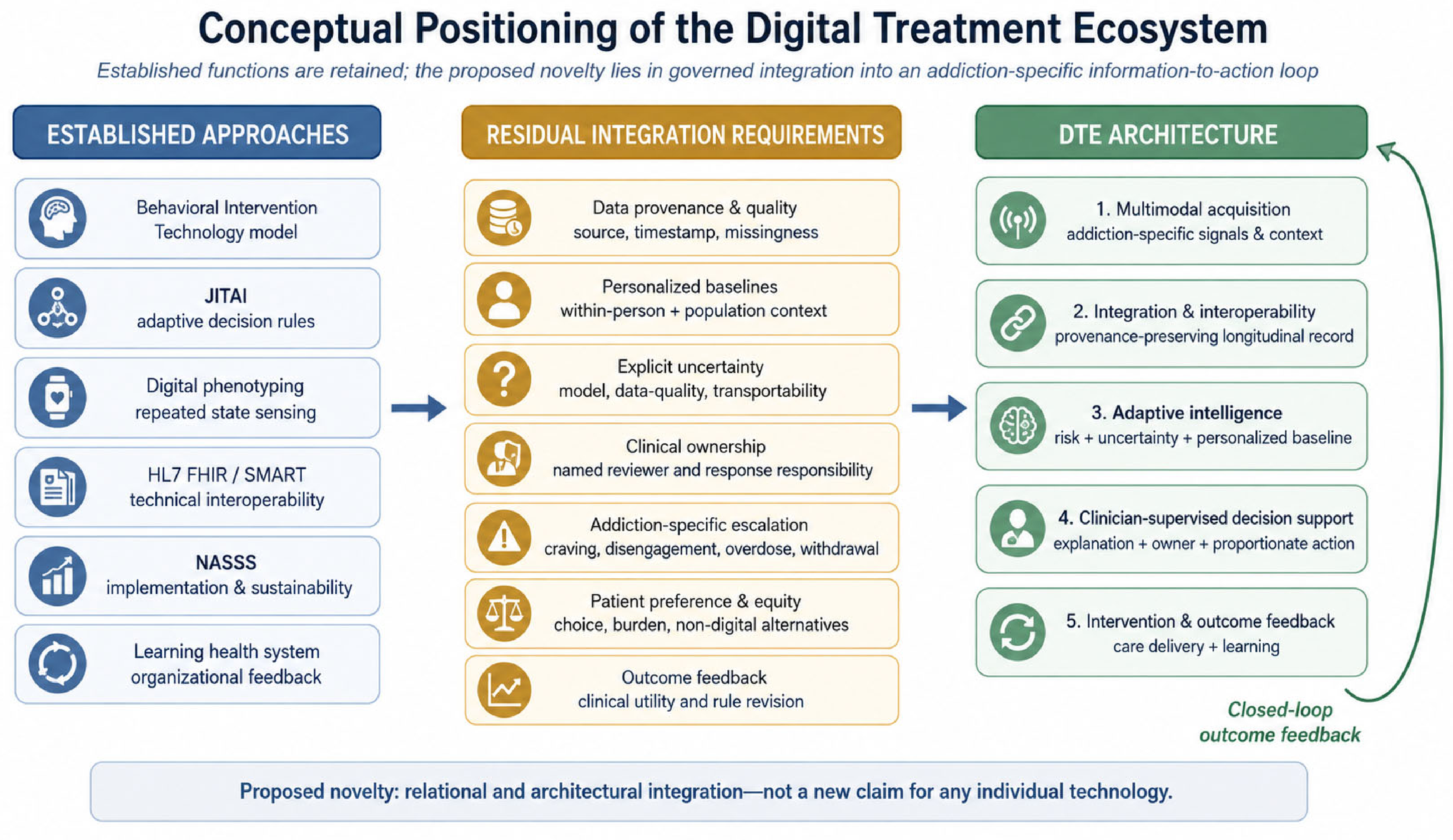
Figure 1. Conceptual positioning of the digital treatment ecosystem in relation to existing digital health and information frameworks. Established approaches provide complementary functions in behavioral-intervention design, time-sensitive adaptation, digital phenotyping, interoperability, implementation, and organizational learning. The proposed DTE does not replace these approaches; it specifies the residual integration requirements needed to connect heterogeneous addiction-related data with provenance, personalized baselines, explicit uncertainty, clinical ownership, patient preference and equity safeguards, addiction-specific escalation, and outcome feedback. The proposed novelty is relational and architectural rather than component-level, and any ecosystem-level clinical benefit remains a hypothesis requiring prospective comparative evaluation. DTE, Digital Treatment Ecosystem; FHIR, Fast Healthcare Interoperability Resources; JITAI, just-in-time adaptive intervention; NASSS, nonadoption, abandonment, scale-up, spread, and sustainability; SMART, Substitutable Medical Applications and Reusable Technologies.
Information 17 00916 g001
Figure 2. Five-layer closed-loop information architecture of the digital treatment ecosystem for precision addiction psychiatry. Addiction-specific multimodal information enters the acquisition layer and is standardized with provenance and data-quality metadata in the integration layer. The adaptive-intelligence layer combines within-person and population information to generate risk estimates, deviations, and explicit uncertainty without independently diagnosing recurrence. Clinician-supervised decision support translates these outputs into reviewable, explicitly owned tasks that incorporate explanation and patient preferences. Digital, pharmacological, psychological, social, and harm-reduction interventions are linked to outcomes that return as feedback. Privacy and cybersecurity, ethics and governance, equity and accessibility, human oversight, workforce capacity, and quality monitoring operate across all layers. Ecosystem-level benefits are hypothesized and require prospective validation. DTE, Digital Treatment Ecosystem; DTx, digital therapeutics; EHR, electronic health record; EMA, ecological momentary assessment; FHIR, Fast Healthcare Interoperability Resources; PRO, patient-reported outcome; PROM, patient-reported outcome measure; QoL, quality of life.
Information 17 00916 g002
Table 1. Positioning the digital treatment ecosystem in relation to existing digital health and information frameworks.
Existing ApproachPrimary ContributionFunction Already EstablishedResidual Integration Requirement Addressed by the DTE
Behavioral Intervention Technology ModelMaps intervention aims, behavioral strategies, technological elements, and delivery characteristicsFormal design of technology-mediated behavioral interventionsEnd-to-end clinical information architecture linking multimodal longitudinal data, uncertainty, clinical ownership, and organizational outcome feedback
Just-in-Time Adaptive Intervention approachesDefines tailoring variables, decision points, intervention options, and proximal outcomesTime-sensitive adaptive interventionEmbedding adaptation within longitudinal records, governance, clinician oversight, cross-service interoperability, and longer-term outcomes
Digital phenotypingDerives behavioral and physiological information from digital tracesRepeated or continuous state characterizationA defined pathway from probabilistic signals to accountable, contextually verified clinical actions
HL7 FHIR/SMART on FHIRStandardizes exchange and modular application interfacesTechnical interoperabilityClinical meaning, risk interpretation, escalation, intervention ownership, and feedback are not specified by interoperability alone
NASSSExplains nonadoption, abandonment, scale-up, spread, and sustainabilityImplementation and complexity analysisAn addiction-treatment information architecture linking information flow to clinical action
Learning Health SystemReturns routine-care data to knowledge generation and system improvementOrganizational learning and feedbackMoment-to-moment multimodal state estimation and clinician-supervised adaptive addiction intervention
Digital Treatment EcosystemIntegrates complementary functions within an addiction-specific closed information-to-action loopMultimodal acquisition → provenance-preserving integration → uncertainty-aware inference → accountable action → intervention → outcome feedbackRequires prospective demonstration of incremental clinical, organizational, equity-related, and economic value
Legend. The comparison distinguishes the established contribution of adjacent frameworks from the proposed integrative role of the DTE. The DTE does not claim novelty for its individual technological components; its proposed novelty is relational and architectural, and its incremental value remains an empirical question.
Table 2. Proposed operationalization and empirical testing of the six DTE propositions.
PropositionComparatorPrimary Operational MeasuresCandidate Study DesignFinding That Would Fail to Support the Proposition
P1. Integrated multimodal information increases actionabilityIntegrated DTE view vs. parallel disconnected streamsProportion of clinically relevant signals producing appropriate documented action; time-to-action; reconciliation workloadCrossover, cluster trial, or simulation studyNo improvement in actionability, or increased workload without compensating benefit
P2. Personalized deviations improve near-term relevanceWithin-person model vs. population thresholdsDiscrimination; calibration; Brier score; clinically useful lead timeProspective prediction cohortNo incremental predictive or clinical utility
P3. Supervised adaptive CDS improves timelinessAdaptive clinician-supervised CDS vs. usual monitoringAlert-to-review time; appropriate escalation; false/inappropriate escalation; clinician burdenCluster randomized or stepped-wedge designFaster responses accompanied by unacceptable false escalation or burden
P4. Closed-loop feedback improves adaptationClosed-loop vs. open-loop monitoringFrequency and appropriateness of treatment adaptations; retention; treatment-response trajectoriesPragmatic comparative trialNo meaningful increase in adaptive care or patient-relevant outcomes
P5. Human-centered/equity safeguards improve implementationCo-designed/equity-supported vs. standard deploymentAcceptability; adoption; usability; retention; digital burden; subgroup disparitiesFactorial or hybrid implementation studyPersistent or widened access, burden, or outcome disparities
P6. Integration requires ownership and response capacityTechnical integration alone vs. integration plus defined clinical workflowOutputs with documented owner; completed actions; unresolved alerts; response time; staff workloadHybrid effectiveness–implementation studyNo incremental benefit when workflow resources and ownership are added
Legend. The proposed measures are illustrative rather than prescriptive. Specific thresholds, outcomes, and comparators require prospective pre-specification and validation in the target addiction-care setting. CDS, clinical decision support; DTE, Digital Treatment Ecosystem.
Table 3. Functional components of digital technologies within the digital treatment ecosystem (DTE).
TechnologyPrimary Ecosystem FunctionMain Data GeneratedClinical ApplicationsStrengthsMain Limitations
TelemedicineClinical communication and continuityVisits, clinical notes, follow-upAssessment, psychotherapy, medication reviewAccessibility; continuityConnectivity requirements; reduced physical examination
Mobile health (mHealth)Self-management and engagementPROs collected through PROMs; adherence reports; symptom reportsMonitoring, reminders, psychoeducationHigh scalabilityVariable long-term engagement
Ecological momentary assessmentReal-time symptom captureCraving, mood, stress, contextRelapse-risk monitoringHigh ecological validityResponse burden
Wearables and biosensorsPassive physiological monitoringHeart rate, HRV, sleep, activityStress, withdrawal, recovery monitoringContinuous acquisitionDevice adherence; signal variability
Electronic health recordsClinical integrationDiagnoses, medications, laboratory dataLongitudinal care coordinationStructured clinical historyInteroperability limitations
Digital therapeuticsEvidence-based intervention deliveryModule completion, exercisesCBT, relapse preventionStandardized treatmentRequires sustained adherence
Artificial intelligenceAdaptive analyticsRisk scores, predictionsClinical decision supportPotential for individualized analyticsBias; limited explainability; validation and drift requirements
Online recovery communitiesSocial supportParticipation and engagement metricsPeer recovery supportCommunity participationVariable content quality
Legend. The table summarizes the principal digital technologies discussed in Section 3, Section 4 and Section 5 and their component-level role within the proposed DTE. It does not imply that combining these technologies has established ecosystem-level effectiveness. Abbreviations: CBT, cognitive behavioral therapy; EMA, ecological momentary assessment; EHR, electronic health record; HRV, heart-rate variability; PRO, patient-reported outcome; PROM, patient-reported outcome measure.
Table 4. Operational architecture of the digital treatment ecosystem (DTE): five-layer framework and clinical workflow.
DTE LayerPrimary Objective and Key InputsCore Process, Outputs, and Responsible Actors/AccountabilityHypothesized Clinical Contribution
1. Multimodal data acquisitionObjective: Capture longitudinal patient information
Inputs: EHR data; substance use and craving PROs collected through PROMs; EMA of craving, stress, affect and cue exposure; medication continuity; engagement data; wearables/sensors; telemedicine; DTx; contextual and social information
Process: Continuous collection, validation, timestamping
Outputs: Time-stamped multimodal data with source and quality metadata
Responsible actors/accountability: Data originators and custodians include patients, clinicians, and digital systems; no device or software component has autonomous clinical decision authority
May provide a longitudinal multimodal representation of clinically relevant state and context
2. Integration and interoperabilityObjective: Harmonize heterogeneous information
Inputs: Clinical and digital datasets
Process: FHIR mapping, semantic normalization, quality control
Outputs: Standardized record with provenance, quality, and consent metadata
Responsible actors/accountability: Health-IT and interoperability services are technically accountable for data exchange; clinical accountability remains with the designated care team
May improve semantic continuity and traceability across sources
3. Adaptive intelligenceObjective: Transform data into actionable knowledge
Inputs: Integrated longitudinal record
Process: Within-person and population-level modeling; trend/deviation detection; uncertainty estimation
Outputs: Recurrence/disengagement risk estimates; deviation-from-baseline indicators; uncertainty estimates; contributing features; prioritized review signals
Responsible actors/accountability: Validated analytic services operate under designated clinical governance and have no autonomous clinical authority
Hypothesized earlier identification of clinically relevant deviation or recurrence vulnerability
4. Clinical decision supportObjective: Support coordinated clinical decisions
Inputs: Predictions, guidelines, patient history
Process: Prioritization; contextual explanation; workflow orchestration; multidisciplinary review; preference-sensitive response planning
Outputs: Clinician-owned review tasks; supportive outreach; medication review; psychosocial escalation; harm-reduction actions; emergency referral when predefined safety criteria are met
Responsible actors/accountability: A designated clinician or care team is responsible for review, interpretation, and action
Hypothesized improvement in timeliness and proportionality of clinician response
5. Intervention delivery and outcome feedbackObjective: Deliver and evaluate personalized care
Inputs: Clinical decisions and care plans
Process: DTx, telemedicine, pharmacotherapy, psychosocial care, monitoring
Outputs: Substance use/recovery outcomes; craving; retention; medication continuity; overdose outcomes where relevant; psychiatric symptoms; functioning; quality of life; adverse events; patient burden
Responsible actors/accountability: The multidisciplinary care team and patient share treatment decisions, with professional accountability remaining with the responsible clinicians
Enables evaluation of whether outcome feedback supports treatment adaptation and organizational learning
Legend. This table summarizes the proposed operational architecture described in Section 6. Each layer performs a distinct function within the continuous information–decision–intervention cycle. The rightmost column presents hypothesized contributions rather than established DTE-level effects. Abbreviations: AI, artificial intelligence; DTx, digital therapeutics; EHR, electronic health record; EMA, ecological momentary assessment; FHIR, Fast Healthcare Interoperability Resources; ML, machine learning; PRO, patient-reported outcome; PROM, patient-reported outcome measure.
Table 5. Operational mapping of the OUD use case onto the DTE architecture.
StageInformation/ProcessClinical SafeguardEvaluative Measure
BaselineCraving, sleep, treatment attendance, medication continuityPatient agrees to monitored domainsBaseline completeness and stability
Signal acquisitionCraving increase, sleep deviation, missed EMA, DTx interruptionNo isolated signal treated as diagnosisData completeness and missingness
IntegrationProvenance, timestamping, source reconciliationDevice/nonwear uncertainty identifiedReconciliation accuracy
Adaptive intelligenceDisengagement-risk estimate plus uncertaintyNo automatic diagnosis of recurrenceCalibration, Brier score, clinically useful lead time
Decision supportClinician-owned taskMandatory human reviewAlert-to-review time; actionable-alert proportion
Clinical verificationWork schedule and transportation context identifiedContextual interpretation before escalationUnnecessary escalation rate
Shared interventionTelemedicine, medication continuity, monitoring adjustmentPatient preference and shared decision-makingUptake, burden, retention
FeedbackSubsequent engagement and craving trajectoryRule can be revised or withdrawnClinical utility and false-alert rate
Legend. The use case is hypothetical and intended to demonstrate testability and workflow logic. It does not prescribe validated thresholds or automated actions. DTx, digital therapeutics; EMA, ecological momentary assessment; OUD, opioid use disorder.
Table 6. Implementation, ethical, regulatory, and organizational challenges for the digital treatment ecosystem.
DomainPrincipal ChallengePotential Clinical ConsequencesRecommended Mitigation StrategiesFuture Research Priorities
Technical interoperabilityFragmented systems and incompatible standardsIncomplete longitudinal records; duplicated workflowsFHIR-based interoperability; semantic standards; API integrationEvaluation of scalable interoperable architectures
ImplementationPoor workflow integration and low adoptionReduced clinician engagement; implementation failureCo-design; implementation-science frameworks; phased rolloutHybrid effectiveness–implementation trials
Clinical workforceLimited digital literacy and AI competenceMisinterpretation of outputs; alert fatigueTargeted training; digital navigators; multidisciplinary governanceCompetency frameworks and educational interventions
Ethics and privacyContinuous monitoring of sensitive addiction dataReduced trust; disengagement; confidentiality risks; surveillance-related distressPrivacy-by-design; dynamic consent; data minimization; contestability and patient-accessible audit trailsPerson-centered governance models
CybersecurityUnauthorized access or ransomwareService disruption; data breaches; patient harmEncryption; multifactor authentication; auditing; incident responseResilience testing in integrated ecosystems
Artificial intelligenceAlgorithmic bias and poor explainabilityUnequal care; inappropriate recommendationsSubgroup validation; uncertainty display; human oversightProspective validation across diverse populations
RegulationHeterogeneous regulatory requirementsDelayed adoption; unclear accountabilityRisk-based pathways; post-market surveillanceAdaptive regulation for AI-enabled systems
Health equityDigital exclusion, unstable device/connectivity access, and unequal digital literacyExclusion; informative missingness; misclassification of nonengagement; widening treatment disparitiesAccessible and low-bandwidth design; non-digital alternatives; device/connectivity support; subgroup auditing; nonpunitive interpretation of missingnessEquity-focused implementation and subgroup performance studies
Economic sustainabilityHigh implementation and maintenance costsLimited scale and discontinuityCost-effectiveness analyses; sustainable reimbursementLong-term health-economic evaluation
Continuous learningInsufficient outcome feedbackStatic systems; undetected performance driftLearning-health-system governance; continuous monitoringAdaptive learning models and real-world evidence
Legend. The table synthesizes the principal implementation domains discussed in Section 7. For each challenge, the corresponding clinical implications, mitigation strategies, and research priorities are summarized to provide an operational roadmap for responsible DTE deployment in addiction psychiatry. Abbreviations: AI, artificial intelligence; API, application programming interface; FHIR, Fast Healthcare Interoperability Resources.
Disclaimer/Publisher’s Note: The statements, opinions and data contained in all publications are solely those of the individual author(s) and contributor(s) and not of MDPI and/or the editor(s). MDPI and/or the editor(s) disclaim responsibility for any injury to people or property resulting from any ideas, methods, instructions or products referred to in the content.