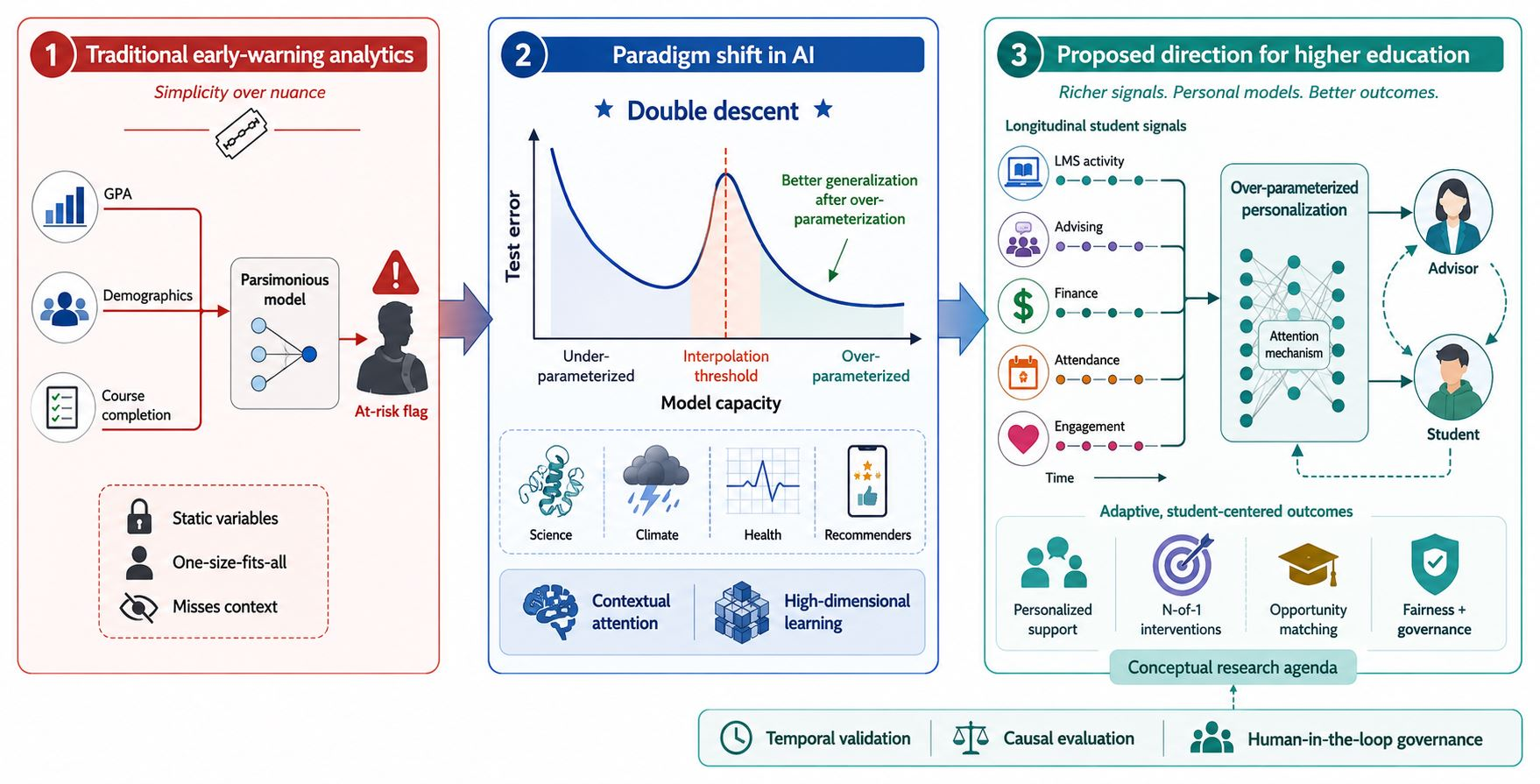


Beyond Occam’s Razor: Double Descent and the Potential Paradigm Shift Toward Over-Parameterized Personalization in Higher Education


Abstract
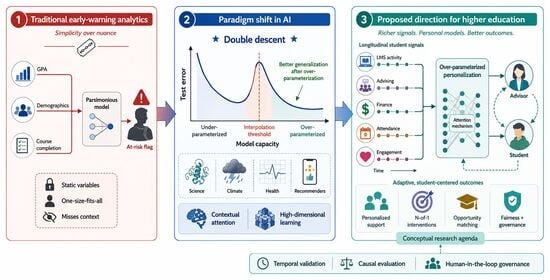
1. Introduction
2. From Parsimony to Complexity
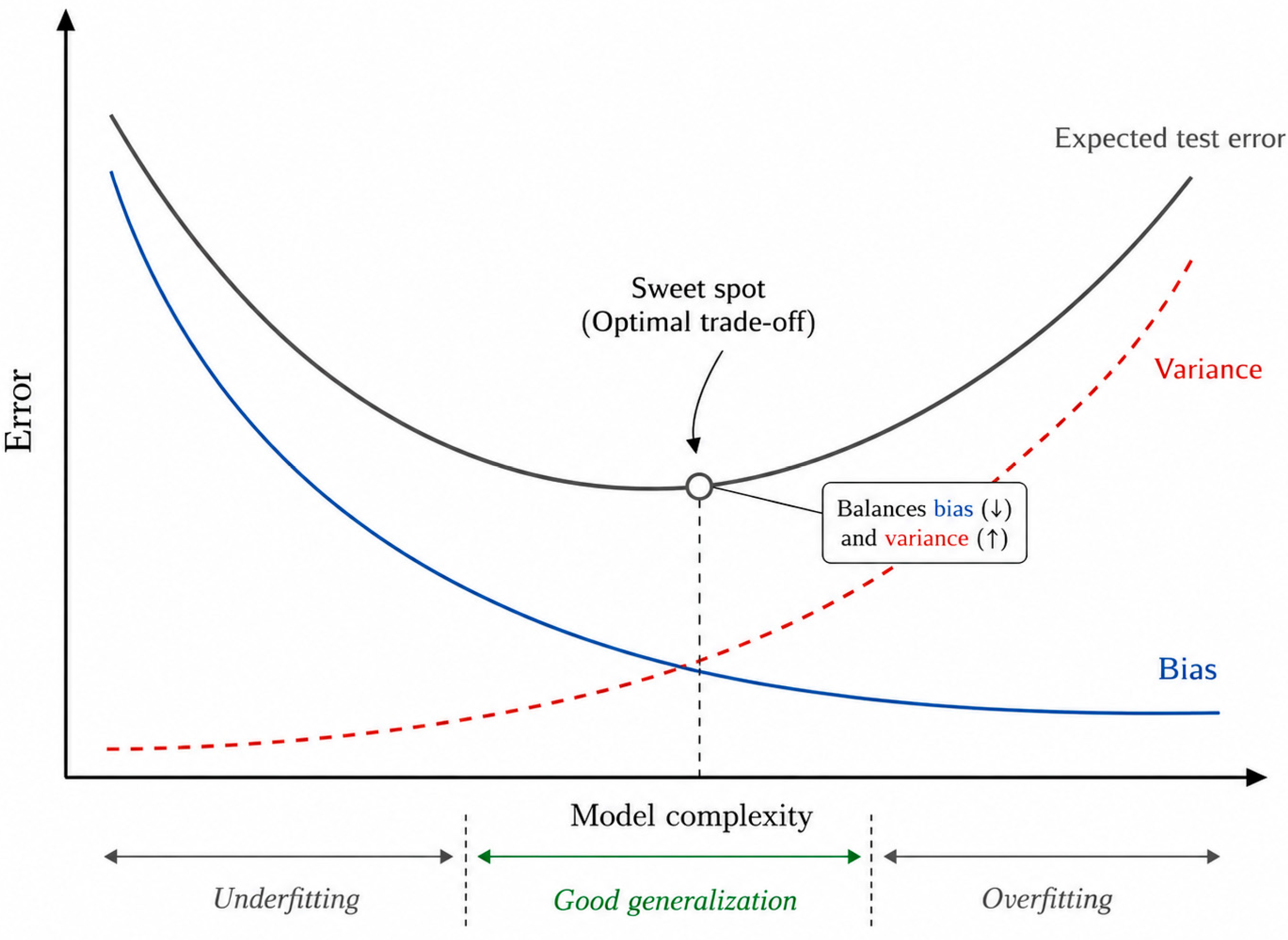
2.1. Classical Dilemma of Parsimony vs. Fitness
2.2. Early Endeavor to Counter the Problem of Too Many Variables
2.3. Advancement of AI/Machine Learning
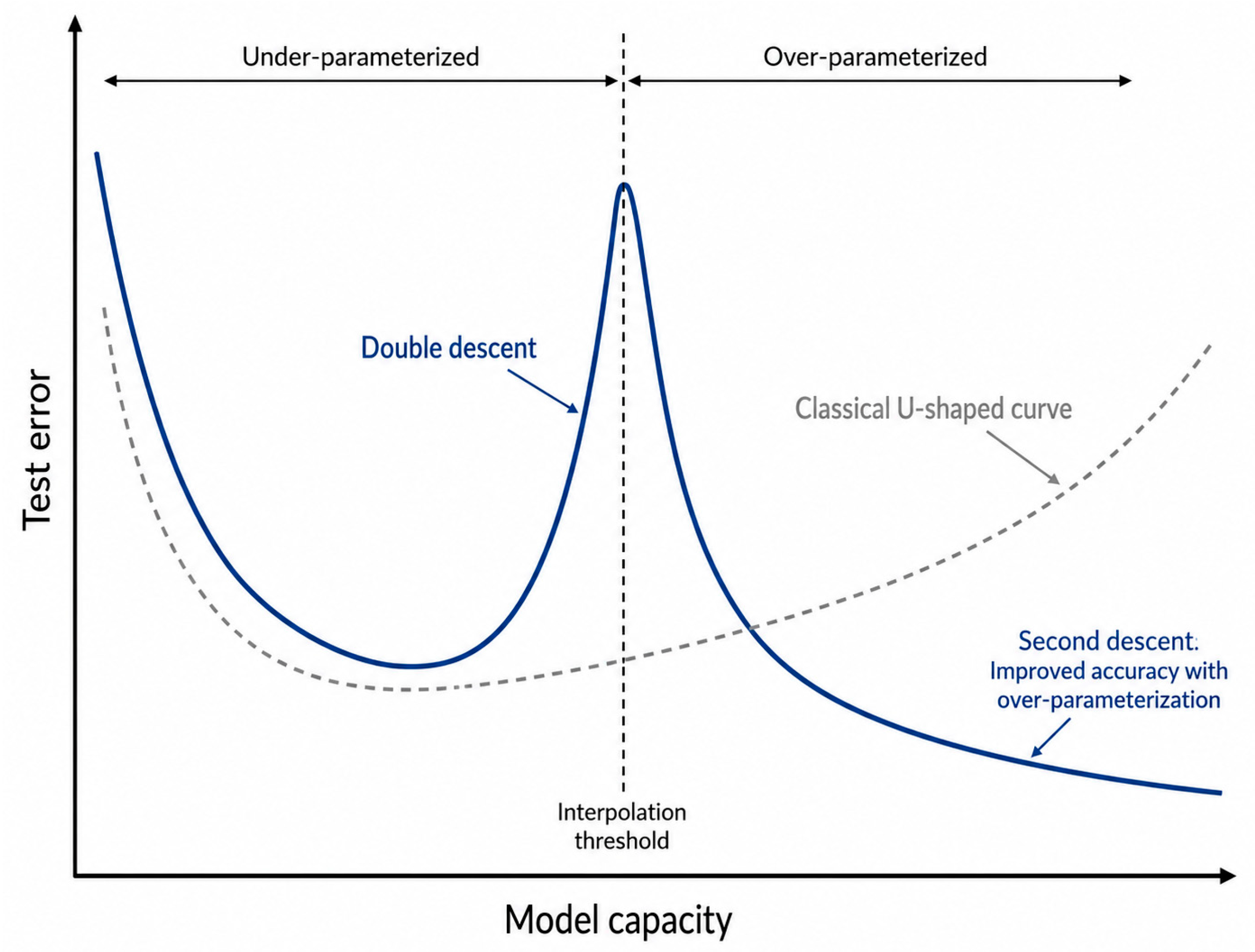
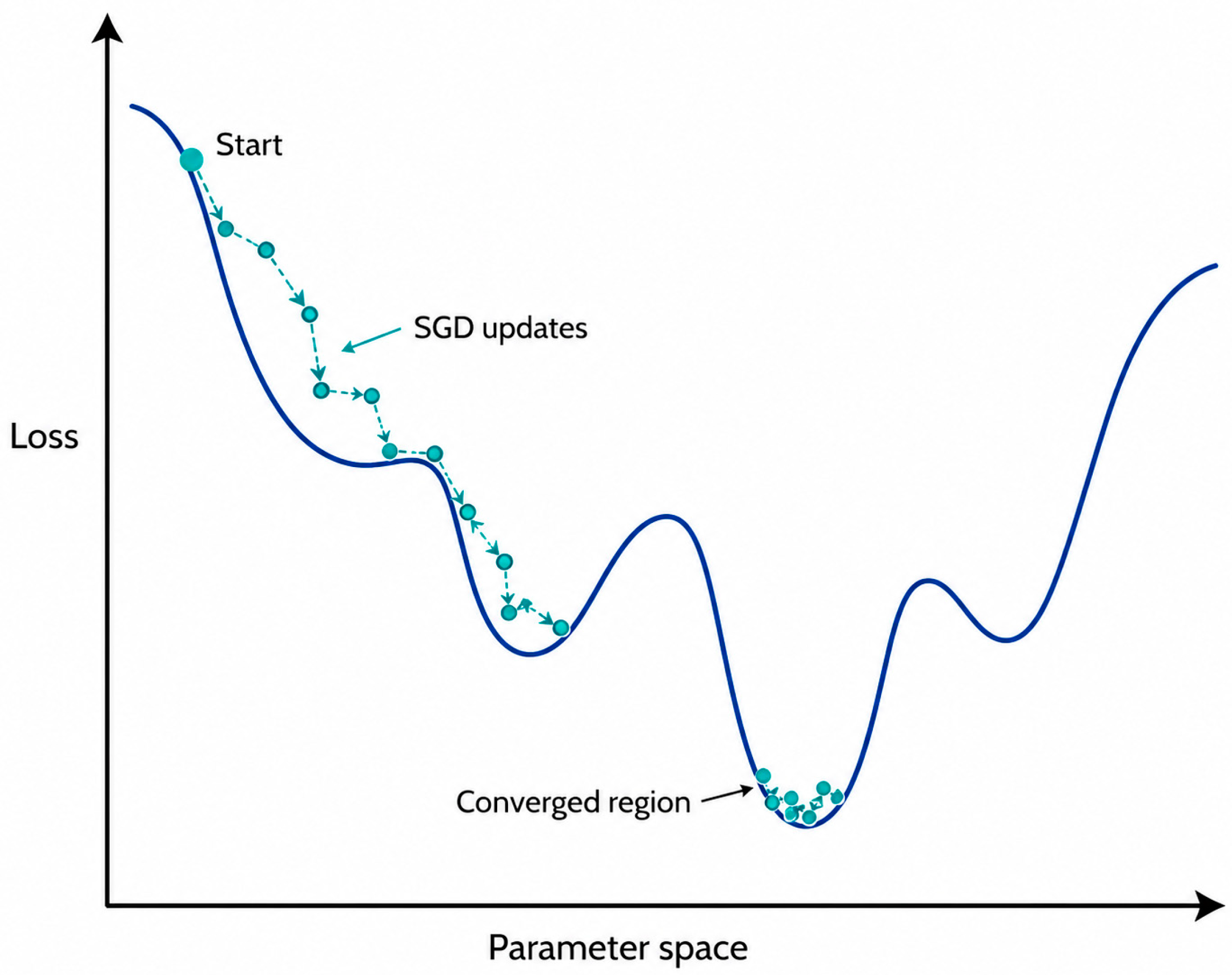
2.4. The Phenomenon of Double Descent
2.5. The Technical Shift Toward Contextual Attention
2.6. Global Feature Selection vs. Context-Aware Selection
3. Examples of Over-Parameterized Models: AlphaFold, Aurora, Delphi-2M, and Commercial Applications
3.1. AlphaFold and Protein Structure Prediction
3.2. Aurora and Atmospheric Forecasting
3.3. Delphi-2M and Longitudinal Health Trajectories
3.4. Commercial Recommendation Systems
4. Implications for High Education
4.1. Cynefin Framework
4.2. The Limitations of Traditional Early Warning Systems
4.3. Demographic Bias and the “Sense of Belonging”
4.4. The Need for a “Multimorbidity” Framework in Education
4.5. Operationalizing the Predictive Task
4.6. Toward Over-Parameterized Personalization in Student Care
4.7. High-Dimensional Sequence Modeling for Student Success
4.8. The “N-of-1” Intervention Framework
4.9. Advising Workflows in an Over-Parameterized Environment
4.10. Beyond Risk Detection: Talent Development and Opportunity Matching
4.11. Structural Barriers: Data Silos as a Hurdle to AI Adoption
4.12. Ethical and Effective AI Deployment
4.13. Bias Mitigation Through Dimensionality
- Systematic Audits: Institutions must conduct regular audits for functional bias and disparate impact [33].
- Transparency and Interpretability: While over-parameterized models are complex, local interpretability methods like SHAP can explain the specific features that triggered a “n-of-1” intervention [12].
4.14. The Future: Data Gardening
5. Conclusions
Author Contributions
Funding
Institutional Review Board Statement
Informed Consent Statement
Data Availability Statement
Acknowledgments
Conflicts of Interest
Abbreviations
| SGD | Stochastic Gradient Descent |
| GD | Gradient Descent |
| AI | Artificial intelligence |
| HITL | Human in the loop |
References
- Belkin, M.; Hsu, D.; Ma, S.; Mandal, S. Reconciling modern machine-learning practice and the classical bias–variance trade-off. Proc. Natl. Acad. Sci. USA 2019, 116, 15849–15854. [Google Scholar] [CrossRef] [PubMed]
- Hastie, T.; Tibshirani, R.; Friedman, J. The Elements of Statistical Learning: Data Mining, Inference, and Prediction; Springer Science and Business Media: Luxemborug, 2009. [Google Scholar]
- Alyahyan, E.; Düştegör, D. Predicting academic success in higher education: Literature review and best practices. Int. J. Educ. Technol. High Educ. 2020, 17, 3. [Google Scholar] [CrossRef]
- Morgan, G. Early Alerts and Unintended Consequences: A Tale of Two Studies. Educational Technology. 2025. Available online: https://onedtech.philhillaa.com/p/early-alerts-and-unintended-consequences (accessed on 2 May 2026).
- Vaarma, M.; Li, H. Predicting student dropouts with machine learning: An empirical study in Finnish higher education. Technol. Soc. 2024, 76, 102474. [Google Scholar] [CrossRef]
- Yu, C.H. Multi-Collinearity, Variance Inflation and Orthogonalization in Regression. Creative-Wisdom. 2022. Available online: https://creative-wisdom.com/computer/sas/collinear.html (accessed on 1 May 2026).
- Nakkiran, P.; Kaplun, G.; Bansal, Y.; Yang, T.; Barak, B.; Sutskever, I. Deep double descent: Where bigger models and more data hurt. J. Stat. Mech. Theory Exp. 2021, 2021, 124003. [Google Scholar] [CrossRef]
- Yu, C.H. Data Mining and Exploration: From Traditional Statistics to Modern Data Science; CRC Press: Boca Raton, FL, USA, 2022. [Google Scholar]
- Smith, G. Step away from stepwise. J. Big Data 2018, 5, 32. [Google Scholar] [CrossRef]
- Breiman, L. Random forests. Mach. Learn. 2001, 45, 5–32. [Google Scholar] [CrossRef]
- Díaz-Uriarte, R.; Alvarez de Andrés, S. Gene selection and classification of microarray data using random forest. BMC Bioinform. 2006, 7, 3. [Google Scholar] [CrossRef] [PubMed]
- Lundberg, S.M.; Lee, S.I. A unified approach to interpreting model predictions. In Proceedings of the 31st International Conference on Neural Information Processing Systems, Long Beach, CA, USA, 4–9 December 2017; pp. 4768–4777. [Google Scholar]
- Oyedotun, S.A.; Ejenarhome, O.P.; Oise, G.P. Learning analytics and predictive modeling: Enhancing student success through data-driven insights. J. Sci. Res. Rev. 2025, 2, 42–51. [Google Scholar] [CrossRef]
- Soudry, D.; Hoffer, E.; Nacson, M.S.; Gunasekar, S.; Srebro, N. The implicit bias of gradient descent on separable data. J. Mach. Learn. Res. 2018, 19, 2822–2878. [Google Scholar]
- Grinsztajn, L.; Oyallon, E.; Varoquaux, G. Why do tree-based models still outperform deep learning on typical tabular data? In Proceedings of the 36th International Conference on Neural Information Processing Systems, New Orleans, LA, USA, 28 November–9 December 2022; Volume 35, pp. 507–520. [Google Scholar] [CrossRef]
- Vaswani, A.; Shazeer, N.; Parmar, N.; Uszkoreit, J.; Jones, L.; Gomez, A.N.; Kaiser, L.; Polosukhin, I. Attention is all you need. In Proceedings of the 31st International Conference on Neural Information Processing Systems, Long Beach, CA, USA, 4–9 December 2017; pp. 6000–6010. [Google Scholar]
- Shmatko, A.; Jung, A.W.; Gaurav, K.; Brunak, S.; Mortensen, L.H.; Birney, E.; Fitzgerald, T.; Gerstung, M. Learning the natural history of human disease with generative transformers. Nature 2025, 647, 248–256. [Google Scholar] [CrossRef] [PubMed]
- Bodnar, C.; Bruinsma, W.P.; Lucic, A.; Stanley, M.; Allen, A.; Brandstetter, J.; Garvan, P.; Riechert, M.; Weyn, J.A.; Dong, H. A foundation model of the atmosphere. Nature 2025, 641, 1180–1187. [Google Scholar] [CrossRef] [PubMed]
- Jumper, J.; Evans, R.; Pritzel, A.; Green, T.; Figurnov, M.; Ronneberger, O.; Tunyasuvunakool, K.; Bates, R.; Žídek, A.; Potapenko, A.; et al. Highly accurate protein structure prediction with AlphaFold. Nature 2021, 596, 583–589. [Google Scholar] [CrossRef] [PubMed]
- Jumper, J.; Evans, R.; Pritzel, A.; Green, T.; Figurnov, M.; Ronneberger, O.; Tunyasuvunakool, K.; Bates, R.; Žídek, A.; Potapenko, A.; et al. Applying and improving AlphaFold at CASP14. Proteins 2021, 89, 1711–1721. [Google Scholar] [CrossRef] [PubMed]
- Lupas, A.N.; Pereira, J.; Alva, V.; Merino, F.; Coles, M.; Hartmann, M.D. The breakthrough in protein structure prediction. Biochem. J. 2021, 478, 1885–1890. [Google Scholar] [CrossRef] [PubMed]
- NobelPrize.org. The Nobel Prize in Chemistry. 2024. Available online: https://www.nobelprize.org/prizes/chemistry/2024/summary/ (accessed on 5 May 2026).
- Bodnar, C.; Bruinsma, W.P.; Lucic, A.; Stanley, M.; Brandstetter, J.; Garvan, P.; Riechert, M.; Weyn, J.; Dong, H.; Vaughan, A.; et al. Aurora: A Foundation Model of the Atmosphere. Microsoft. 2024. Available online: https://www.microsoft.com/en-us/research/wp-content/uploads/2024/05/Aurora__A_Foundation_Model_of_the_Atmosphere.pdf (accessed on 7 May 2026).
- Shafei, A.; Cioffi, F. High-resolution early warning systems using DL: Part II—Combining FourCastNet and E-TEPS for high-resolution climate forecasting. Preprints 2024. [Google Scholar] [CrossRef]
- Sahu, P.L.; Sandeep, S.; Kodamana, H. Evaluating global machine learning models for tropical cyclone dynamics and thermodynamics. J. Geophys. Res. Mach. Learn. Comput. 2025, 2, e2025JH000594. [Google Scholar] [CrossRef]
- Stahl, B.C. Artificial Intelligence for a Better Future; Springer: Berlin/Heidelberg, Germany, 2021. [Google Scholar] [CrossRef]
- Covington, P.; Adams, J.; Sargin, E. Deep neural networks for YouTube recommendations. In Proceedings of the 10th ACM Conference on Recommender Systems; ACM: New York, NY, USA, 2016; pp. 191–198. [Google Scholar] [CrossRef]
- Gomez-Uribe, C.A.; Hunt, N. The Netflix recommender system: Algorithms, business value, and innovation. ACM Trans. Manag. Inf. Syst. 2015, 6, 1–19. [Google Scholar] [CrossRef]
- Hsiao, K.-J.; Bhattacharya, M.; Patel, D.; Gadde, D. Integrating Netflix’s Foundation Model into Personalization Applications. Netflix Research. 2026. Available online: https://research.netflix.com/publication/integrating-netflixs-foundation-model-into-personalization-applications (accessed on 5 May 2026).
- Zielnicki, K.; Aridor, G.; Bibaut, A.; Tran, A.; Chou, W.; Kallus, N. The Value of Personalized Recommendations: Evidence from Netflix. arXiv 2025. [Google Scholar] [CrossRef]
- Snowden, D.J.; Boone, M.E. A leader’s framework for decision making. Harv. Bus. Rev. 2007, 85, 68–149. [Google Scholar] [PubMed]
- Gamby, T.; Kil, D.; Koblic, R.; LeBlanc, P.; Moldoveanu, M.; Siemens, G. From Personalized to Precision Learning: Unlocking the Next Transformation in Higher Education. Educause Review. 2025. Available online: https://er.educause.edu/articles/2025/11/from-personalized-to-precision-learning-unlocking-the-next-transformation-in-higher-education (accessed on 10 May 2026).
- Evelyn Learning. The Student Mental Health Crisis: How AI early Warning Systems are Preventing 65% More Academic Withdrawals. Evelyn Learning Blog. 2026. Available online: https://www.evelynlearning.com/blog/the-student-mental-health-crisis-how-ai-early-warning-systems-are-preventing-65-more-academic-withdrawals (accessed on 5 May 2026).
- Duan, N.; Norman, D.; Schmid, C.; Sim, I.; Kravitz, R.L. Personalized data science and personalized (N-of-1) trials: Promising paradigms for individualized health care. Harv. Data. Sci. Rev. 2022, 4, 10-1162. [Google Scholar] [CrossRef] [PubMed]
- Guyatt, G.H.; Sackett, D.L.; Taylor, D.W.; Ghong, J.; Roberts, R.; Pugsley, S. Determining Optimal Therapy—Randomized Trials in Individual Patients. N. Engl. J. Med. 1986, 314, 889–892. [Google Scholar] [CrossRef] [PubMed]
- N-of-1 Hub. What are Adaptive N-of-1 Trials? N-of-1 Hub Blog. 2025. Available online: https://www.n-of-1hub.com/post/what-are-adaptive-n-of-1-trials (accessed on 6 May 2026).
- Webber, K.L.; Zheng, H. Data Analytics and the Imperatives for Data-Informed Decision-Making in Higher Education. Institute of Higher Education, University of Georgia. 2019. Available online: https://books.google.co.uk/books?hl=en&lr=&id=dtkGEAAAQBAJ&oi=fnd&pg=PA3&dq=Webber,+K.L.%3B+Zheng,+H.+Data+Analytics+and+the+Imperatives+for+Data-Informed+Decision-Making+in+Higher+Education.+Institute+of+Higher+Education,+University+of+Georgia.+2019.+Available+online:+https://ihe.uga.edu/sites/default/files/inline-files/Webber_2019004_paper_2.pdf+(accessed+on+6+May+2026).&ots=bi5Y9PEp4f&sig=wXtz50ivPxxTHXRx82xN0VxriL0#v=onepage&q&f=false (accessed on 6 May 2026).
- Webber, K.L.; Zheng, H.Y. Big Data on Campus: Data Analytics and Decision Making in Higher Education; Johns Hopkins University Press: Baltimore, MD, USA, 2020. [Google Scholar]
- Saqr, M.; López-Pernas, S.; Tikka, S.; Spitzer, M.W.H. Early warning signals appear long before dropping out. arXiv 2026. [Google Scholar] [CrossRef]
- Verschelden, C. Bandwidth Recovery: Helping Students Reclaim Cognitive Resources Lost to Poverty, Racism, and Social Marginalization; Routledge: Abington, UK, 2024. [Google Scholar] [CrossRef]
- Jayaprakash, S.M.; Moody, E.W.; Lauría, E.J.M.; Regan, J.R.; Baron, J.D. Early alert of academically at-risk students: An open source analytics initiative. J. Learn. Anal. 2014, 1, 6–47. [Google Scholar] [CrossRef]
- Glandorf, D.; Lee, H.R.; Orona, G.A.; Pumptow, M.; Yu, R.; Fischer, C. Temporal and between-group variability in college dropout prediction. In Proceedings of the 14th Learning Analytics and Knowledge Conference (LAK ’24); ACM: New York, NY, USA, 2024. [Google Scholar] [CrossRef]
- Aulck, L.; Nambi, D.; Velagapudi, N.; Blumenstock, J.; West, J.D. Mining university registrar records to predict first-year undergraduate attrition. In Proceedings of the 12th International Conference on Educational Data Mining (EDM 2019), Palermo, Italy, 2–5 July 2019. [Google Scholar]
- Civitas Learning. Is Your Early Alert System Doing More Harm Than Good? Civitas Learning Blog. 2026. Available online: https://www.civitaslearning.com/blog/effective-early-alert-system-in-higher-education/ (accessed on 10 May 2026).
- Cuschieri, A.; Ryan, B.L.; Cuschieri, S. Integrating multimorbidity education into undergraduate medical curriculum: A systematic review. Future Healthc. J. 2025, 12, 100252. [Google Scholar] [CrossRef] [PubMed]
- Spyropoulos, K. An Investigation of the Interrelationships Between Multibehaviours and Multimorbidity. Doctoral Thesis, Staffordshire University, Stoke-on-Trent, UK, 2025. [Google Scholar]
- Tinto, V. Leaving College: Rethinking the Causes and Cures of Student Attrition, 2nd ed.; University of Chicago Press: Chicago, IL, USA, 1994. [Google Scholar] [CrossRef]
- van Houwelingen, H.; Putter, H. Dynamic Prediction in Clinical Survival Analysis; CRC Press: Boca Raton, FL, USA, 2011. [Google Scholar]
- Bergmeir, C.; Benítez, J.M. On the use of cross-validation for time series predictor evaluation. Inf. Sci. 2012, 191, 192–213. [Google Scholar] [CrossRef]
- Gama, J.; Žliobaitė, I.; Bifet, A.; Pechenizkiy, M.; Bouchachia, A. A survey on concept drift adaptation. ACM Comput. Surv. 2014, 46, 44. [Google Scholar] [CrossRef] [PubMed]
- Kaufman, S.; Rosset, S.; Perlich, C.; Stitelman, O. Leakage in data mining: Formulation, detection, and avoidance. ACM Trans. Knowl. Discov. Data 2012, 6, 1–21. [Google Scholar] [CrossRef]
- Paz, H.R. A leakage-aware data layer for student analytics: The CAPIRE framework for multilevel trajectory modeling. arXiv 2025, arXiv:2511.11866. [Google Scholar]
- Perdomo, J.; Zrnic, T.; Mendler-Dünner, C.; Hardt, M. Performative prediction. In Proceedings of the 37th International Conference on Machine Learning, Vienna, Austria, 12–18 July 2020; Volume 119, pp. 7599–7609. Available online: https://proceedings.mlr.press/v119/perdomo20a.html (accessed on 11 May 2026).
- Klasnja, P.; Hekler, E.B.; Shiffman, S.; Boruvka, A.; Almirall, D.; Tewari, A.; Murphy, S.A. Microrandomized trials: An experimental design for developing just-in-time adaptive interventions. Health Psychol. 2015, 34, 1220–1228. [Google Scholar] [CrossRef] [PubMed]
- Murphy, S.A. An experimental design for the development of adaptive treatment strategies. Stat. Med. 2005, 24, 1455–1481. [Google Scholar] [CrossRef] [PubMed]
- Moreno-Torres, J.G.; Raeder, T.; Alaiz-Rodríguez, R.; Chawla, N.V.; Herrera, F. A unifying view on dataset shift in classification. Pattern Recognit. 2012, 45, 521–530. [Google Scholar] [CrossRef]
- Geirhos, R.; Jacobsen, J.H.; Michaelis, C.; Zemel, R.; Brendel, W.; Bethge, M.; Wichmann, F.A. Shortcut learning in deep neural networks. Nat. Mach. Intell. 2020, 2, 665–673. [Google Scholar] [CrossRef]
- Bird, K.A.; Castleman, B.L.; Mabel, Z.; Song, Y. Bringing transparency to predictive analytics: A systematic comparison of predictive modeling methods in higher education. AERA Open 2021, 7, 23328584211037630. [Google Scholar] [CrossRef]
- Kemper, L.; Vorhoff, G.; Wigger, B.U. Predicting student dropout: A machine learning approach. Eur. J. High. Educ. 2020, 10, 28–47. [Google Scholar] [CrossRef]
- Bird, K.A.; Castleman, B.L.; Song, Y.; Yu, R. Is big data better? LMS data and prediction accuracy in postsecondary education. J. Res. Educ. Eff. 2025, 18, 769–796. [Google Scholar] [CrossRef]
- Yu, R.; Li, Q.; Fischer, C.; Doroudi, S.; Xu, D. Towards accurate and fair prediction of college success: Evaluating different sources of student data. In Proceedings of the 13th International Conference on Educational Data Mining (EDM 2020), Palermo, Italy, 10–13 July 2020. [Google Scholar]
- Chen, F.; Cui, Y. Utilizing student time series behaviour in learning management systems for early prediction of course performance. J. Learn. Anal. 2020, 7, 1–17. [Google Scholar] [CrossRef]
- Kravitz, R.L.; Duan, N. Design and Implementation of N-of-1 Trials: A User’s Guide. Agency for Healthcare Research and Quality (AHRQ). 2014. Available online: https://effectivehealthcare.ahrq.gov/sites/default/files/pdf/n-1-trials_research-2014-5.pdf (accessed on 6 May 2026).
- Meier, N.; Ensari, I.; Konigorski, S. Designing and Evaluating an Online Reinforcement Learning Agent for Physical Exercise Recommendations in N-of-1 trials. Proc. Mach. Learn. Res. 2023, 225, 340–352. [Google Scholar]
- Sturgill, A. The Human in the Loop: Considerations for Generative AI in Academia. Center for Engaged Learning. 2026. Available online: https://www.centerforengagedlearning.org/the-human-in-the-loop-considerations-for-generative-ai-in-academia/ (accessed on 10 May 2026).
- US Department of Education. FERPA. 2026. Available online: https://studentprivacy.ed.gov/ferpa (accessed on 15 May 2026).
- European Union. Complete Guide to GDPR Compliance. 2026. Available online: https://gdpr.eu/ (accessed on 15 May 2026).
- Cole, S. University Professors Disturbed to Find Their Lectures Chopped Up and Turned Into AI Slop. 404 Media. 2026. Available online: https://www.404media.co/asu-atomic-ai-modules-arizona-state-university/ (accessed on 6 May 2026).
- Whitford, E. Faculty Concerned About ASU’s “Frankensteinian” AI Course Builder. Inside Higher Ed. Available online: https://www.insidehighered.com/news/tech-innovation/artificial-intelligence/2026/04/29/faculty-concerned-about-asus-new-ai-course (accessed on 11 May 2026).
- Kim, B.S. How AI is Transforming Education in 2026: Beyond the Hype to Real Impact. TutorFlow. 2026. Available online: https://tutorflow.io/blog/how-ai-is-transforming-education-2026 (accessed on 5 May 2026).
- Baker, R.S.; Hawn, A. Algorithmic bias in education. Int. J. Artif. Intell. Educ. 2022, 32, 1052–1092. [Google Scholar] [CrossRef]
- Gándara, D.; Anahideh, H.; Ison, M.P.; Picchiarini, L. Inside the black box: Detecting and mitigating algorithmic bias across racialized groups in college student-success prediction. AERA Open 2024, 10, 1–15. [Google Scholar] [CrossRef]
- Yu, R.; Lee, H.; Kizilcec, R.F. Should college dropout prediction models include protected attributes? In Proceedings of the Eighth ACM Conference on Learning @ Scale (L@S ’21); ACM: New York, NY, USA, 2021. [Google Scholar] [CrossRef]
- Kizilcec, R.F.; Lee, H. Algorithmic fairness in education. In The Ethics of Artificial Intelligence in Education; Holmes, W., Porayska-Pomsta, K., Eds.; Routledge: New York, NY, USA, 2022; pp. 174–202. [Google Scholar]
- Shetty, S. How AI Improves Student Counselor Performance & Outcomes. LeadSquared. 2026. Available online: https://www.leadsquared.com/industries/education/how-ai-improves-student-counselor-performance/ (accessed on 10 May 2026).
- Van Busum, K.; Fang, S. Interactive mitigation of biases in machine learning models for undergraduate student admissions. AI 2025, 6, 152. [Google Scholar] [CrossRef]




| Regime | Model Complexity | Training Error | Test Error (Risk) |
|---|---|---|---|
| Under-parameterized | Low | High | High |
| Optimal Parsimony | Moderate | Low | Low (Minimum) |
| Overfitting Zone | High | Near Zero | High |
| Method | Feature Scope | Weighting Logic |
|---|---|---|
| Global Selection | Population-level | Fixed based on aggregate data |
| Contextual Attention | Instance-level | Dynamic based on input sequence |
| Feature Type | Examples | Limitations in Higher Education |
|---|---|---|
| Academic | Cumulative GPA, Credit Completion | Reactive; markers of past failure rather than current risk [5]. |
| Demographic | Race, Gender, Socio-economic status | Fixed; can perpetuate systemic bias and ignore individual agency [4,33,40]. |
| Behavioral (Static) | Attendance, LMS login counts | Lacks nuance; doesn’t capture shifts in engagement or quality of work [4]. |
| Analytics Paradigm | Data Structure | Temporal Focus |
|---|---|---|
| Reductionist | Static Vector (GPA, SAT, etc.) | Post Hoc (Semester-end) |
| Over-Parameterized | High-Dimensional Sequence | Real-time/Longitudinal |
Disclaimer/Publisher’s Note: The statements, opinions and data contained in all publications are solely those of the individual author(s) and contributor(s) and not of MDPI and/or the editor(s). MDPI and/or the editor(s) disclaim responsibility for any injury to people or property resulting from any ideas, methods, instructions or products referred to in the content. |
© 2026 by the authors. Licensee MDPI, Basel, Switzerland. This article is an open access article distributed under the terms and conditions of the Creative Commons Attribution (CC BY) license.
Share and Cite
Yu, C.H.; Chong, H.N. Beyond Occam’s Razor: Double Descent and the Potential Paradigm Shift Toward Over-Parameterized Personalization in Higher Education. Information 2026, 17, 696. https://doi.org/10.3390/info17070696
Yu CH, Chong HN. Beyond Occam’s Razor: Double Descent and the Potential Paradigm Shift Toward Over-Parameterized Personalization in Higher Education. Information. 2026; 17(7):696. https://doi.org/10.3390/info17070696
Chicago/Turabian StyleYu, Chong Ho, and Han Nee Chong. 2026. "Beyond Occam’s Razor: Double Descent and the Potential Paradigm Shift Toward Over-Parameterized Personalization in Higher Education" Information 17, no. 7: 696. https://doi.org/10.3390/info17070696
APA StyleYu, C. H., & Chong, H. N. (2026). Beyond Occam’s Razor: Double Descent and the Potential Paradigm Shift Toward Over-Parameterized Personalization in Higher Education. Information, 17(7), 696. https://doi.org/10.3390/info17070696