1. Introduction
In the contemporary context of education and employment, the transition from learning environments to labor participation has become a complex challenge that extends beyond the acquisition of technical knowledge. It increasingly requires the development and interpretation of transferable competency indicators such as communication, teamwork, organization, prioritization, and planning. These competencies are also being discussed in relation to artificial intelligence, educational innovation, accessibility, and digital transformation. Alkhater et al. [
1] emphasize the role of artificial intelligence in personalizing online learning and supporting learner interaction. Similarly, Zhu et al. [
2] show that ethics, intelligent tutoring systems, and higher education have become central themes in AI-enabled education. Li et al. [
3] further connect AI-based tools with inclusive education, especially when personalization and accessibility are treated as design requirements rather than optional features.
This challenge is especially relevant for future applications involving people with auditory, visual, physical, or mild intellectual disabilities, who may face additional barriers in access, retention, and progression within the labor market. In the present study, however, these disability-sensitive categories are modeled as design conditions rather than as observed participant attributes. Despite advances in inclusion policies, significant gaps persist in vocational training and in competency assessment mechanisms that allow objective evidence of labor potential. Howard and Moore [
4] show that support systems for diverse learners require linguistic and contextual adaptation. Comia et al. [
5] demonstrate that infrastructure, connectivity, device type, platform usability, and perceived support influence student experience in constrained digital environments. From an interface perspective, Sajek et al. [
6] show that accessibility also depends on perceptual design choices, especially for users with color vision deficiencies. Inga et al. [
7] provide a complementary higher-education planning perspective, linking strategic management, institutional development, and educational policy to long-term transformation.
Workplace simulation logic has emerged as an alternative for training, scenario-based assessment, and decision-oriented learning analytics because it enables the representation of work-like situations in controlled, repeatable, and interpretable environments. Its potential is stronger when simulation is combined with structured measurement procedures, transparent indicators, and multimodal data capture. Khalaf et al. [
8] illustrate the importance of instrument development and preliminary validation when evaluating educational constructs. Cevik and Abu-Zidan [
9] show that structured online training can improve knowledge and perceived confidence when pre- and post-training evidence is included. Ometov et al. [
10] further show that multimodal datasets can support the interpretation of stress and emotion, although data quality, individual variability, and validation remain major challenges. Brichacek et al. [
11] also support the importance of systematic evidence synthesis when interpreting intervention-oriented constructs.
At the same time, employability cannot be understood as a purely technical outcome. It must also be examined in relation to emotional regulation, perceived care, wellbeing, engagement, and cognitive–affective responses to digital interaction. Zhao et al. [
12] connect institutional support, self-efficacy, resilience, and enjoyment with wellbeing in higher education. Guo et al. [
13] show that emotional regulation profiles can be used to identify differentiated psychological patterns. Mancini et al. [
14] relate emotional functioning to internalizing symptoms and adaptive behavior. Fiser et al. [
15] add that responses to AI-generated content can be evaluated through biometric and self-report evidence, reinforcing the importance of multimodal interpretation in digital environments. Gao et al. [
16] also show that AI-generated content affects engagement through cognitive and affective pathways, suggesting that user response, credibility, and disclosure matter in AI-mediated systems.
However, despite this expanding technological and methodological landscape, the literature still reveals fragmentation in the specific connection between workplace simulation logic, accessibility-aware assessment, derived competency indicators, occupational descriptors, semantic representation, and optimization-based decision support. This fragmentation is especially problematic for employability analytics, where evidence must be interpretable, reproducible, and linked to occupational requirements rather than limited to isolated digital training outcomes. Nishikawa and Murakami [
17] and Yang et al. [
18] further support the relevance of open access, dissemination, and knowledge transfer for transparent scientific outputs.
From a quantitative–computational perspective, recent work in optimization, predictive modeling, and decision support across complex systems demonstrates the value of combining forecasting, prioritization, and scenario evaluation under uncertainty. Piras et al. [
19] present an open tool that combines artificial intelligence, machine learning, forecasting, and user-oriented interfaces for scenario configuration. Barrera-Singaña et al. [
20] review advanced planning and optimization techniques under uncertainty. Wojtaszek [
21] shows how scenario analysis can support strategic decision-making when multiple demand, technology, and investment variables interact. Ojeda et al. [
22] further illustrate how predictive models can be integrated into applied decision processes through data cleaning, prioritization, model selection, and validation. Abdesselam et al. [
23] provide a complementary example of multi-criteria prioritization and sensitivity analysis. In contrast, Baldeon et al. [
24] and Pecile et al. [
25] illustrate the use of secondary data, temporal analysis, and dimensionality-reduction methods in applied analytical contexts. Although these contributions come from domains such as renewable energy planning, sustainability, public health prioritization, social data analysis, and industrial downtime prediction, they offer a transferable methodological basis for designing analytical architectures that must balance realism, resource constraints, accessibility assumptions, and performance interpretation.
To address this gap, this study proposes an accessibility-aware computational proof of concept for employability analytics. The proposed framework is not presented as a field-validated workplace simulator with observed participants with disabilities. Instead, it is designed as a reproducible analytical architecture that combines open employability data, O*NET-derived occupational descriptors, modeled accessibility scenarios, semantic representation, clustering, person–job fit estimation, and heuristic multi-objective optimization. This clarification is important because the disability and accessibility dimensions are modeled as design and simulation variables rather than as observed clinical or functional attributes collected from real participants.
The study does not include participants with disabilities who were observed. Disability-sensitive conditions, accessibility supports, and workplace scenarios are modeled as design and simulation variables. Therefore, the framework should be interpreted as a computational proof of concept rather than as empirical evidence that the proposed accessibility improvements improve assessment outcomes for real users with disabilities. Future empirical validation should include participants with auditory, visual, physical, and cognitive accessibility needs, observed simulator interaction data, records of assistive technology use, expert accessibility assessments, and longitudinal employment-related outcomes.
Accordingly, the term inclusive is used in this manuscript to describe the accessibility-aware design orientation of the computational framework, not to imply that empirical outcomes were observed in a sample of future users with accessibility needs. Similarly, the term workplace simulation logic refers to the computational representation of scenarios, tasks, accessibility supports, and occupational requirements, not to a field-tested immersive simulator deployed with end users. The current evidence does not support claims about differential performance among disability groups, effectiveness of specific accessibility supports, or real labor market insertion; these aspects are defined as future empirical validation requirements.
The main contributions of this study are as follows:
A reproducible computational pipeline is proposed to integrate secondary employability records, O*NET-derived occupational descriptors, modeled accessibility conditions, and scenario assignment within a unified employability analytics framework.
A transparent O*NET-to-competency mapping procedure is introduced to construct occupational requirement vectors for communication, teamwork, organization, prioritization, and planning.
A person–job fit index is implemented to estimate alignment between normalized derived competency indicators and O*NET-based occupational requirement vectors.
An operational ontology layer is developed to represent relationships among derived competencies, occupations, accessibility supports, disability-sensitive design conditions, and workplace simulation scenarios.
A conceptual MINLP formulation is proposed, while the implemented Python 3.11 HMI is explicitly positioned as an interpretable heuristic approximation rather than an exact global solver.
Baseline comparison and sensitivity analysis procedures are incorporated to examine the robustness of the heuristic outputs under alternative assignment, competency weight, scalarization weight, and accessibility assumptions.
Consequently, this work contributes a methodological and computational basis for future accessibility-aware employability analytics systems. Its value lies in providing a transparent, extensible, and testable architecture that can later be validated with real participants, expert panels, longitudinal labor market outcomes, and machine-readable semantic standards. Nina et al. [
26] further support the relevance of secure software development practices for the future institutional deployment of computational systems.
2. Related Works
In recent years, workplace simulation logic has evolved from technical training tools into more complex environments for assessing interaction, decision-making, uncertainty, and user response in contexts aligned with labor conditions. Alkhater et al. [
1] emphasize personalization and learner support in AI-mediated environments. Li et al. [
3] connect inclusive education with adaptive and accessible digital tools. Zhu et al. [
2] further highlight the importance of ethics and explainability in AI-enabled education. These contributions support the need for computational frameworks that connect learning evidence, accessibility assumptions, and occupational requirements.
It is important to clarify that
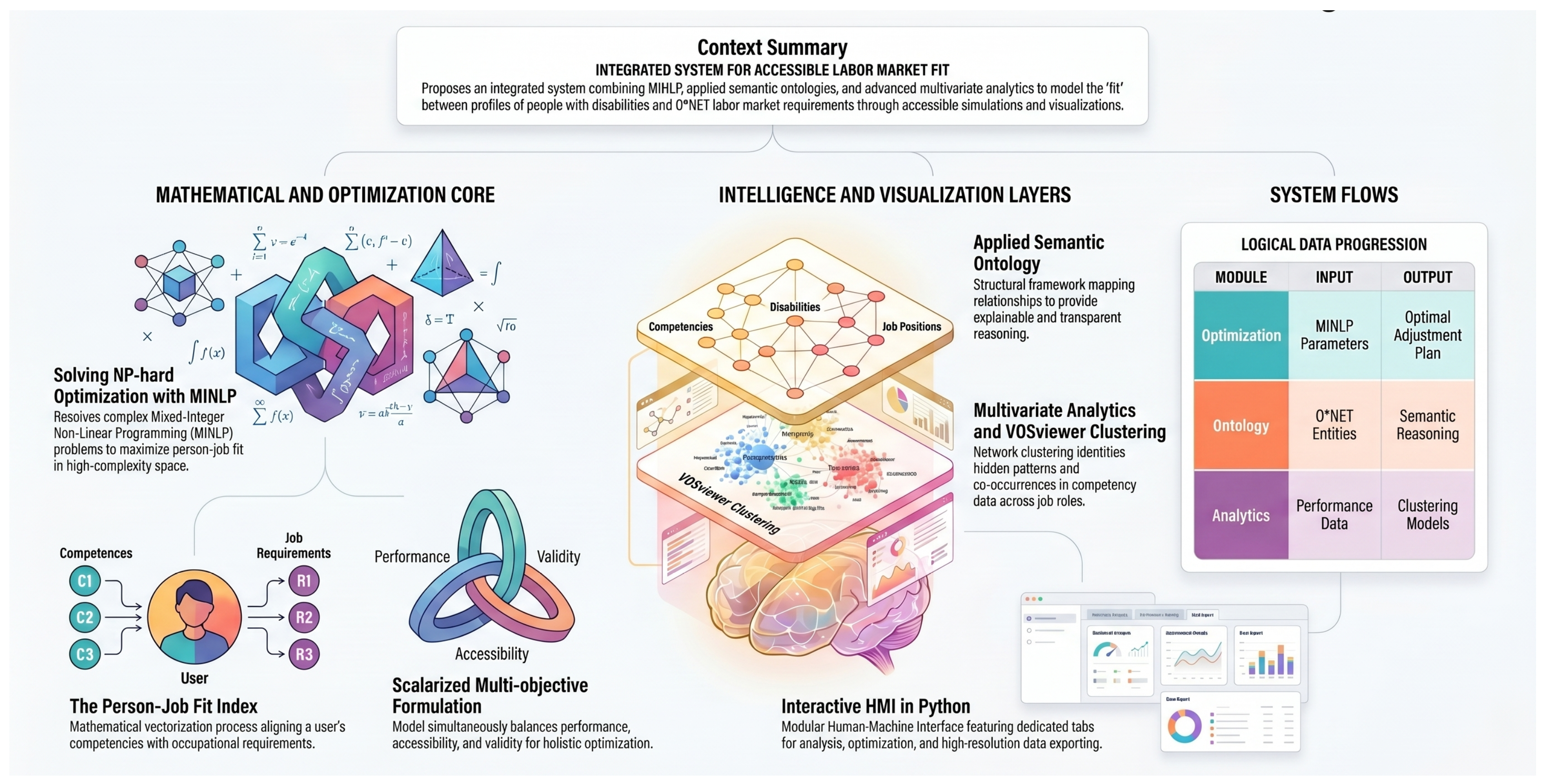
Figure 1 represents the proposed computational architecture, not a field-tested simulator deployment. The disability and accessibility components shown in the architecture are modeled design dimensions intended to support future empirical implementation. At the first level, the mathematical and optimization core encompasses the scalarized multi-objective formulation and the conceptual MINLP optimization problem, illustrating how accessibility-aware fit can be represented through the interaction between derived competency indicators, occupational requirements, and objective function components. At the second level, the intelligence and visualization layers illustrate how the operational ontology links derived competencies, disability-sensitive design conditions, accessibility supports, scenarios, and O*NET occupations. At the third level, the Python 3.11-based HMI interface serves as an integration mechanism, connecting optimization, ontology, and analytics modules within an interactive framework designed for result exploration and decision support. Overall, the figure illustrates the proposed multidimensional architecture, in which mathematical optimization, semantic representation, and advanced analytics complement one another to support accessibility-aware employability analytics within the modeled workplace simulation logic.
Research on accessibility-aware employability analytics is located at the intersection of workplace simulation logic, derived competency indicators, inclusive digital environments, occupational matching, semantic representation, and optimization-based decision support. For this reason, the literature is organized around the methodological components that directly support the proposed framework. References from distant biomedical, ecological, or unrelated application domains were not retained as direct methodological foundations because they do not directly support the core argument and could weaken the review’s focus.
During the bibliographic screening process, references from clinical, biomedical, ecological, public health, and unrelated social media analytics domains were excluded from the core theoretical framework because they did not directly address employability analytics, workplace simulation logic, accessibility-aware assessment, person–job fit modeling, operational ontology, or optimization-based decision support.
Digital learning environments and scenario-based assessment provide an important methodological foundation for the proposed framework. Technology-supported learning systems become more valuable when they move beyond content delivery and incorporate interaction, feedback, task structure, and learner support. Alkhater et al. [
1] discuss how artificial intelligence can reshape online learning experiences through personalization, interaction, and support, while also raising concerns about accountability, autonomy, and privacy. Cevik and Abu-Zidan [
9] show that online training can improve knowledge and perceived confidence when structured instructional resources are combined with measurable pre- and post-training evaluation. Although these studies are not workplace simulator studies in a strict sense, they support the methodological premise that digital environments can generate structured evidence about learning, confidence, and performance when the assessment process is explicitly designed.
Accessibility and inclusive digital environments are equally central to the proposed model because employability analytics cannot be separated from the conditions under which evidence is produced. Howard and Moore [
4] emphasize that support systems for diverse learners require linguistic and contextual adaptation rather than homogeneous intervention assumptions. Comia et al. [
5] show that infrastructure, connectivity, device type, platform usability, and perceived support affect student experience in resource-constrained digital learning environments. Sajek et al. [
6] provide direct evidence that web accessibility must account for perceptual differences, particularly for users with color vision deficiencies. Li et al. [
3] synthesize empirical evidence on the role of artificial intelligence in inclusive education, showing that AI-based tools may improve personalization, accessibility, and engagement for learners with special needs, but that infrastructure, teacher readiness, ethical design, and longitudinal evidence remain open challenges. These studies justify treating accessibility as a structural condition of the assessment model rather than as a secondary interface feature.
The interpretation of employability-related evidence also requires attention to wellbeing, affective response, and broader behavioral conditions. Zhao et al. [
12] show that institutional support, self-efficacy, resilience, and enjoyment are interrelated in faculty wellbeing in higher education. Guo et al. [
13] demonstrate that emotional regulation profiles can be used to identify differentiated psychological patterns. Mancini et al. [
14] show that emotional functioning is relevant for understanding internalizing symptoms and adaptive behavior. Fiser et al. [
15] add that human response to artificial intelligence-generated content can be evaluated through biometric and self-report evidence. Gao et al. [
16] further show that AI-generated content affects engagement through cognitive and affective pathways, while disclosure and credibility influence interpretation. In the context of employability analytics, these studies support the idea that performance-related evidence should not be interpreted only as task completion, but also in relation to cognitive, emotional, and interactional conditions that may affect participation and assessment validity.
The use of derived competency indicators requires a cautious interpretation of internal consistency and dimensionality evidence. Khalaf et al. [
8] illustrate the importance of instrument development and preliminary validation when measuring educational and support-related constructs. Their work is relevant because reliability indicators must be interpreted within a broader validation process rather than treated as sufficient evidence of construct validity. This point is central to the present study: although internal consistency is useful for evaluating the coherence of derived competency indicators, it does not by itself prove that communication, teamwork, organization, prioritization, and planning are five independent latent constructs. Ometov et al. [
10] reinforce this point from a multimodal perspective, showing that emotion and stress datasets require careful interpretation because data collection, individual variability, annotation, and validation remain major challenges.
Artificial intelligence, semantic representation, and ethical governance provide another important basis for the proposed architecture. Zhu et al. [
2] show that research on artificial intelligence in education has grown rapidly and that ethics, higher education, personalization, and intelligent tutoring systems have become central themes. Gao et al. [
16] show that AI-generated content affects engagement through cognitive and affective pathways, while disclosure and credibility influence interpretation. These works are relevant because the proposed framework uses computational modeling not only for prediction or matching, but also for explainable decision support. In this sense, semantic representation and operational ontology are used to make explicit the relationships among derived competencies, occupations, accessibility supports, disability-sensitive design assumptions, and workplace scenarios. However, the ontology remains operational and has not yet been formalized in OWL, RDF, or other W3C-compatible semantic standards, which is acknowledged as a limitation.
The optimization and decision support literature also provides the computational basis for interpreting the assignment and parameter-search components of the framework. Because the proposed HMI includes an assignment-oriented heuristic layer, the review must distinguish between classic population-based metaheuristics, recent sine–cosine and marine predator variants, starfish-inspired optimizers, and single-agent stochastic approximation methods.
Classic population-based metaheuristics are relevant because they maintain several candidate solutions and use collective search mechanisms to balance exploration and exploitation. Particle swarm optimization (PSO) updates candidate solutions through velocity and position rules guided by personal and global best solutions [
27]. Genetic algorithms (GAs) rely on selection, crossover, mutation, and elitist preservation to explore combinatorial search spaces [
28]. The sine cosine algorithm (SCA) uses trigonometric position updates to move candidate solutions outward from or toward the current best solution, thereby alternating between exploration and exploitation [
29]. These algorithms are relevant to the present study because the employability assignment problem contains discrete allocation decisions, nonlinear utility components, and multiple constraints that may generate local optima.
Recent SCA variants are particularly relevant because they explicitly address premature convergence and weak local exploitation. The augmented sine cosine algorithm combined with a game-theoretic approach (ASCA-GT) introduces a nonlinear position-updated mechanism and uses game-theoretic random perturbation to reduce stagnation in local optima [
30]. This mechanism is conceptually relevant to the proposed HMI because accessibility-aware scenario assignment may also suffer from premature convergence when several analytical records have similar person–job fit values or when capacity restrictions produce narrow feasible neighborhoods. However, unlike ASCA-GT, the current HMI heuristic was designed for interpretability and deterministic traceability rather than for aggressive global exploration.
Marine-predator-inspired algorithms provide another important benchmark family. The original marine predators algorithm (MPA) models predator–prey movement patterns and alternates exploration and exploitation through Brownian and Levy-like search phases [
31]. The random average marine predators algorithm (RAMPA) modifies the conventional MPA by incorporating a random average location calculation and a tunable adaptive coefficient that controls step size and balances exploration and exploitation [
32]. RAMPA is relevant to the proposed problem because the assignment utility landscape may contain multiple near-optimal configurations, and adaptive step-size mechanisms can help avoid early stagnation. Nevertheless, RAMPA remains a population-based optimizer, whereas the implemented HMI uses a greedy-initialized local search structure focused on transparent scenario reassignment.
The starfish optimization algorithm (SFOA) is a recent bio-inspired method that simulates starfish behaviors such as exploration, preying, and regeneration [
33]. Its two-phase structure is relevant because exploration can diversify scenario-assignment candidates, while exploitation can refine high-fit user–occupation matches. In the context of the present study, SFOA is a suitable state-of-the-art comparator because it was designed for global optimization and benchmarked against a large set of optimizers. However, the current HMI does not reproduce starfish-inspired regeneration or multi-phase population dynamics; therefore, SFOA is treated as a benchmark comparator rather than as a component of the proposed method.
Single-agent stochastic optimization methods must be discussed separately because they do not maintain a population of candidate solutions. Safe experimentation dynamics (SED) perturbs design parameters and accepts safe improvements using limited information, making it attractive for data-driven tuning and noisy optimization settings [
34,
35]. Smoothed functional algorithms estimate search directions through randomized perturbations of the objective function and can be useful when gradients are unavailable or noisy [
36]. Norm-limited and normalized SPSA methods restrict or normalize simultaneous perturbation updates to improve stability and reduce computational burden in noisy parameter-tuning problems [
37,
38]. These single-agent methods are relevant to accessibility-aware employability analytics because future simulator deployments may involve small samples, noisy behavioral measurements, limited repeated experimentation, and costly evaluations. Nevertheless, they differ from PSO, GA, SCA, RAMPA, and SFOA because their search process is trajectory-based rather than population-based. For this reason, the present manuscript evaluates them as a distinct methodological gap and not as part of the population-based metaheuristic family.
Accordingly, the proposed local search HMI heuristic is positioned as an interpretable assignment approximation, not as a new global optimizer. Its contribution is the integration of person–job fit, modeled accessibility penalties, O*NET-derived requirement vectors, and scenario assignment within a transparent HMI. To make this scope testable, the revised methodology specifies reduced exact solver instances and representative heuristic comparisons against PSO, GA, SCA, ASCA-GT-inspired perturbation, RAMPA-inspired adaptive movement, SFOA-inspired exploration–exploitation, and single-agent SPSA/SED-style baselines.
Piras et al. [
19] demonstrate how open tools can combine artificial intelligence, machine learning, forecasting, and user-oriented interfaces to support scenario configuration. Barrera-Singaña et al. [
20] review advanced planning and optimization techniques under uncertainty, emphasizing the importance of deterministic, stochastic, robust, and AI-enhanced approaches. Wojtaszek [
21] shows how scenario analysis can support strategic decision-making when multiple demand, technology, and investment variables interact. Ojeda et al. [
22] further illustrate how predictive models can be integrated into applied decision processes through data cleaning, prioritization, model selection, and validation. Abdesselam et al. [
23] provide a complementary example of multi-criteria prioritization and sensitivity analysis. In contrast, Baldeon et al. [
24] and Pecile et al. [
25] illustrate the use of secondary data, temporal analysis, and dimensionality-reduction methods in applied analytical contexts. Nishikawa and Murakami [
17] and Yang et al. [
18] further support the importance of open-access dissemination and knowledge transfer, while Nina et al. [
26] are relevant for future secure deployment of the HMI. These studies support the use of computational decision support methods in complex socio-technical systems and justify interpreting the optimization layer as an exploratory approximation rather than as an exact global solver.
The reviewed literature reveals four gaps directly addressed by the present study. First, inclusive digital systems often discuss accessibility and personalization, but they rarely integrate these dimensions with occupational requirement vectors and person–job fit estimation. Second, soft skills are frequently measured using general instruments that lack a strong connection to job-specific competency demands. Third, semantic models are often used for interpretation, but not always connected to optimization and decision support outputs. Fourth, optimization-based systems often report convergence without sufficient baseline comparison or sensitivity testing.
In response to these gaps, the present study proposes an accessibility-aware computational proof of concept that integrates open employability data, O*NET-derived occupational descriptors, modeled accessibility scenarios, exploratory internal consistency and dimensionality diagnostics, clustering, operational ontology, person–job fit estimation, and heuristic optimization. The contribution is methodological and computational rather than a field validation with real users with disabilities. This distinction is essential because current evidence supports the architecture’s feasibility and interpretability, while future work must validate the framework with real participants, disaggregated disability-sensitive profiles, expert-reviewed accessibility supports, and longitudinal labor market outcomes.
The focused synthesis of these research strands is presented in
Table 1, which links the main evidence base with the response adopted in this study.
3. Problem Formulation and Methodology
In the context of strategic human talent management oriented toward labor inclusion, workplace simulators cannot be understood merely as training interfaces or virtual replicas of isolated tasks. Their relevance lies in their ability to provide structured, observable, and analytically interpretable evidence about how individuals perform under operational, interpersonal, and organizational demands that resemble real employment conditions. It is especially important for future applications involving populations with disabilities, for whom access barriers, interface constraints, and insufficiently adapted evaluation settings may distort the observation of actual competencies and reduce the fairness of employability assessment.
Although immersive technologies, virtual environments, and digital simulators have expanded in vocational and professional training, the literature still presents several limitations. First, many available approaches emphasize training effectiveness but lack a sufficiently rigorous framework for standardized measurement of soft skills. Second, disability is often addressed as a peripheral implementation issue rather than as a structural component of the assessment model. Third, simulator outcomes are only weakly connected to occupational descriptors and real job requirements, which reduces their external validity as tools for labor market alignment. As a result, many simulation-based systems remain useful for practice. Still, they are limited as decision support instruments for vocational guidance, competency profiling, inclusive placement, and evidence-based career pathway design.
The central research problem can therefore be formulated as the absence of a quantitative, computational framework capable of jointly modeling competency performance, disability-sensitive accessibility, occupational requirements, and decision-oriented analytics within accessibility-aware computational frameworks. The problem is not only methodological but also operational: without an integrated framework, it becomes difficult to identify differentiated employability profiles, estimate person–job fit, evaluate the role of accessibility adjustments, and optimize simulator design under realistic constraints of time, budget, and coverage.
Addressing this gap requires integrating mathematical modeling, semantic representation, psychometric assessment, multivariate analysis, and optimization. In scientific terms, this implies bringing together still fragmented domains such as competency assessment, inclusive technology, occupational analytics, and computational decision-making. In social terms, it supports the design of fairer employability systems by enabling the identification of actual strengths and constraints across diverse users, particularly those exposed to functional, perceptual, or interaction barriers.
3.1. Mathematical Model and Methodology for Accessibility-Aware Computational Frameworks
The mathematical model proposed in this subsection is an original conceptual formulation developed by the authors to structure the computational proof of concept. It is not adopted as a complete model from a previous source. However, several of its components are grounded in established modeling principles: person–job fit is represented through normalized distance-based similarity, assignment is related to the Generalized Assignment Problem, and the occupational requirement vectors are derived from O*NET descriptors. Because no field experiment with real simulator users was conducted, the model is evaluated computationally rather than experimentally. Therefore, the results should be interpreted as proof-of-concept evidence and not as experimental validation.
Accessibility-aware computational frameworks are defined here as structured replications of real work situations designed to observe, train, and assess how individuals respond to operational, communicative, and organizational demands associated with target occupations. Their added value does not derive solely from realism, but also from their capacity to generate measurable evidence on soft skills under conditions that take accessibility, occupational relevance, and interpretability into account.
Accordingly, the problem is formalized through an analytical structure that links four core elements: observable competencies, disability-sensitive contextual conditions, occupational requirements, and inclusive design decisions within the simulator. Let
denote the set of analytical user records derived from the open employability dataset;
denote the set of modeled disability-sensitive design conditions, where
denote the set of derived competency indicators:
denote the set of target job positions;
denote the set of simulated scenarios;
denote the set of accessibility supports or adaptations.
where
contains available contextual descriptors,
represents derived competency-related features, and
encodes modeled disability-sensitive design conditions. In the present dataset,
is not observed from participants and is used only for scenario-based accessibility modeling.
where
contains biographical and contextual descriptors,
captures functional and interaction-related characteristics, and
encodes disability-sensitive conditions relevant to simulator access and performance interpretation.
Each job position is represented by a vector of competency requirements,
:
where
denotes the relative importance of competency
for occupation
. This representation establishes a common competency space for users and occupations, which is necessary for estimating alignment in a normalized and comparable manner.
Each simulated scenario
is modeled as
where
describes the tasks and critical events defining the scenario,
denotes the observable performance indicators, and
specifies the set of activated accessibility supports.
3.6. Sequential Methodological Procedure
Based on the previous model, the methodological procedure was organized as a sequential, yet interconnected, process.
The first stage consisted of identifying representative workplace situations and the competency demands they entail. This stage establishes the conceptual basis of the simulator by linking occupational contexts to relevant soft skills and to potential accessibility barriers. Although the HMI operationalizes this stage through structured datasets and predefined scenario families, its analytical purpose remains the same: to ground the simulator in realistic work demands rather than abstract competency labels.
The second stage focused on constructing the occupational requirement space. O*NET descriptors were used to derive normalized requirement vectors for target occupations. These vectors were mapped to the five competency dimensions used throughout the model: communication, teamwork, organization, prioritization, and planning. This procedure created a shared competency space in which both users and occupations could be represented consistently.
The third stage addressed user-level competency profiling. Individual competency evidence was derived from an employability dataset containing soft-skill-related variables. These variables were cleaned, normalized to the range, and transformed into user competency vectors . In the implemented HMI, this stage supports not only direct fit estimation but also clustering, profile visualization, principal component analysis, and occupation-level matching.
The fourth stage incorporated inclusive design into the analytical core. Accessibility features such as subtitles, screen readers, simplified navigation, motor support, and cognitive support were encoded in the simulator representation. It ensured that accessibility was not treated as an external layer but as a measurable component that could affect the validity of observed performance across diverse functional conditions.
The fifth stage involved scenario design and assignment. Scenarios such as interviews, customer service, operational incidents, team coordination, and planning sprints were modeled as structured contexts for eliciting competency evidence. Their purpose was twofold: to approximate real workplace demands and to provide differentiated operational spaces for assignment under the optimization model.
The sixth stage focused on the evaluation layer. Competency performance was estimated through the function , aggregated into weighted scores , and then adjusted through the accessibility-aware score . At this stage, the derived competency indicators were examined through exploratory internal consistency, item-level, dimensionality, and distributional analyses. In light of the updated HMI outputs, this validation should be interpreted as exploratory and refinement-oriented rather than as final high-stakes psychometric certification.
The seventh stage consisted of multivariate analytics and segmentation. Clustering, profile line analysis, radar visualization, principal component analysis, correlation analysis, and heatmap-based fit exploration were used to identify differentiated employability structures. This stage is essential because it transforms raw competency measurements into interpretable patterns that can support guidance and decision-making.
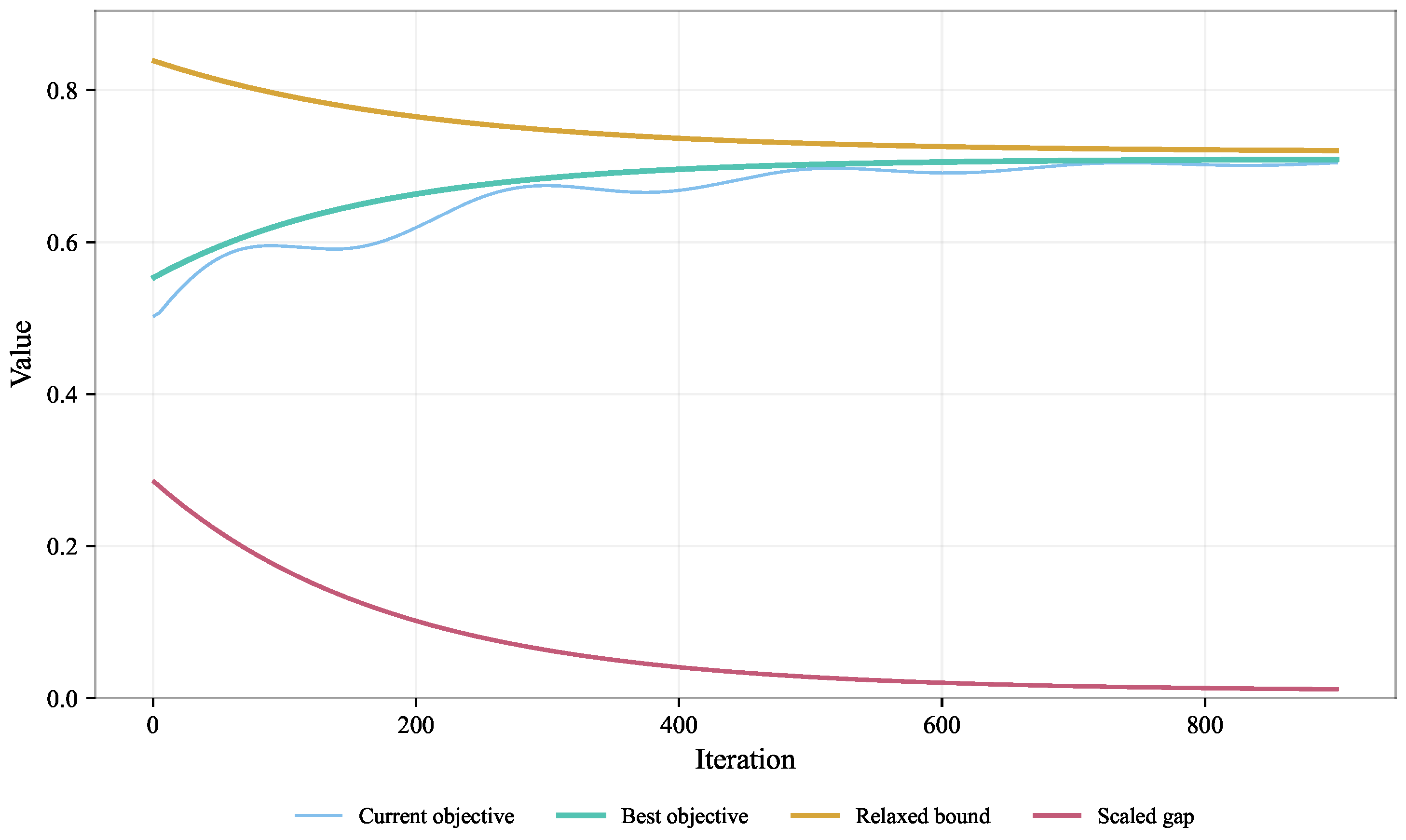
The eighth stage implemented the optimization layer in the HMI. Given the complexity of the full formulation, the interactive system uses an iterative search strategy that approximates the behavior of the multi-objective problem while preserving interpretability of the current objective, the best objective, the relaxed bound, the scaled gap, the scenario allocation, and the component-wise evolution of validity, accessibility, alignment, and diagnostic capacity. This implementation is consistent with the theoretical formulation and suitable for exploratory decision support, even though it does not claim exact global optimization of the underlying MINLP.
An external interpretation stage was incorporated by comparing person–job fit distributions, occupational requirement structures, and scenario assignments. This stage supports the model’s applied utility by showing how competency evidence, accessibility adjustments, and occupational descriptors can be translated into recommendations relevant to employability analysis.
3.7. Data Provenance, Sample Definition, and Operationalization
The empirical component of this study is based on a mixed analytical design that combines open secondary data, derived occupational descriptors, and simulated accessibility scenarios. No primary data were collected from real participants with disabilities, and no field deployment of a workplace simulator was conducted. Therefore, the study is interpreted as a computational proof of concept rather than as a clinical, organizational, or longitudinal validation with real users.
The user competency profiles were derived from an open human resources employability dataset containing 3000 records and 26 work-related variables. The authors did not collect the dataset, and it was not generated through the workplace simulator proposed in this manuscript. It was used as a proxy for secondary data to test the computational pipeline. The dataset includes employment status, job function, performance score, and current employee rating. However, it does not contain an exploratory psychometric instrument specifically designed to measure communication, teamwork, organization, prioritization, and planning. Therefore, the five dimensions were treated as derived competency indicators for computational modeling, not as a standardized or fully exploratory five-factor psychometric scale. Reliability coefficients, item–total correlations, and PCA were interpreted as exploratory diagnostics of internal structure, not as evidence of full construct validity. The results support the use of these indicators for proof-of-concept modeling, but they do not establish that communication, teamwork, organization, prioritization, and planning are empirically independent latent constructs. The inclusion criteria were: (i) records with complete values for the variables used in the selected competency mapping; (ii) records belonging to the open employability dataset; and (iii) records compatible with numerical normalization in the HMI pipeline. The exclusion criterion was the presence of missing values in the variables required for the selected mapping. No records were removed because the variables used in the final operational mapping were complete. The final analytical sample size was records after excluding 0 incomplete records. Because the open dataset does not contain verified disability status, disability type, accessibility support use, clinical information, functional limitations, or simulator-based observations, these dimensions were not analyzed as observed participant characteristics. Disability-sensitive conditions and accessibility supports were modeled as simulation variables only. Consequently, the empirical component of the study should be interpreted as a computational proof of concept based on secondary data, not as a field study with real participants with disabilities.
Occupational requirement profiles were constructed from the O*NET database. O*NET descriptors were mapped to the five competency dimensions of the study and normalized to the range. This mapping created a common analytical space in which user competency profiles and occupational requirement vectors could be compared through the person–job fit index.
Accessibility supports were modeled as simulated scenario variables. These supports included subtitles, screen-reader compatibility, simplified navigation, motor assistance, and cognitive support. Their effects were not estimated from observed users. Instead, they were incorporated into sensitivity analysis to examine how accessibility assumptions affect score interpretation and scenario allocation. The provenance and empirical role of each analytical component are summarized in
Table 3.
In summary, the study uses a hybrid computational design. The competency records are real secondary open data, the occupational requirements are derived from the open O*NET database, and the accessibility supports, disability-sensitive conditions, and workplace scenarios are simulated design variables. The person–job fit values and optimization outputs are computed results derived from these inputs. Therefore, the results should not be interpreted as direct observations from a deployed simulator or as empirical evidence of employment outcomes for future users with accessibility needs.
3.10. Heuristic Implementation, Benchmarking Protocol, and Stopping Criteria
The full conceptual formulation corresponds to a mixed-integer nonlinear problem because it combines discrete scenario assignment, continuous weights, accessibility parameters, budget and time restrictions, coverage requirements, and nonlinear distance-based person–job fit terms. However, the implemented HMI solves an operational approximation designed for interpretability and exploratory decision support. The implemented solver uses greedy feasible initialization followed by local reassignment search. This choice preserves transparency, allows decision makers to inspect scenario allocation changes, and provides computational tractability for interactive use.
To address the methodological concern that heuristic stabilization alone is insufficient evidence of solution quality, the revised study defines two benchmarking layers. First, reduced assignment instances must be solved with an exact mathematical programming solver to estimate the optimality gap of the proposed heuristic under controlled conditions. Second, representative heuristic and metaheuristic comparators must be implemented using the same utility function, feasibility constraints, stopping criteria, and random seeds. The benchmark therefore evaluates not only whether the proposed heuristic stabilizes, but also how close it is to exact solutions in reduced instances and how it compares against alternative search strategies.
The implemented utility function combines normalized person–job fit, accessibility-adjusted score, capacity feasibility, and small cost–time penalties. For a candidate assignment
x, the benchmark objective is expressed as
where
,
,
, and
represent validity, accessibility, alignment, and diagnostic capacity components;
and
are normalized cost and time penalties;
is a feasibility-violation penalty; and
,
, and
are penalty coefficients. The baseline scalarization used
because no empirical stakeholder preference structure was available. Alternative scalarization configurations were examined through sensitivity analysis.
For exact solver comparison, reduced benchmark instances are generated from the same normalized competency and O*NET requirement matrices used by the HMI. The reduced instances include
analytical user records,
occupational targets, and capacity constraints proportional to the number of records. The exact model retains binary assignment variables, capacity feasibility, scalarized utility, and cost–time penalties. Nonlinear person–job fit values are precomputed as parameters, which allows the reduced benchmark to be solved as a mixed-integer assignment model. The exact solution is then used to compute the relative optimality gap:
where
is a small numerical constant used to avoid division by zero.
The second benchmarking layer compares the proposed heuristic against random feasible assignment, greedy person–job fit assignment, clustering-based assignment, PSO, GA, SCA, ASCA-GT-inspired perturbation, RAMPA-inspired adaptive movement, SFOA-inspired exploration–exploitation, and a single-agent SPSA/SED-style stochastic perturbation baseline. These algorithms were selected because they directly address the reviewer-requested comparison families: PSO, GA, sine–cosine variants, marine predator variants, starfish optimizer, and single-agent optimization methods. All benchmark methods use the same utility function, input matrices, feasibility handling, and maximum iteration limit.
The stopping criterion is defined by a fixed maximum number of iterations, with
in the full HMI implementation. For stochastic methods, each configuration must be repeated 30 times using independent random seeds. The reported metrics are best objective, mean objective, standard deviation, runtime, feasibility rate, and relative gap with respect to the exact solution when available.
Table 5 summarizes the corrected optimization layer, and
Table 6 and
Table 7 specify the benchmark outputs required for the final resubmission package.
The implemented heuristic starts from an initial feasible assignment and iteratively updates scenario allocation and weighting configurations to improve the scalarized objective function. The algorithm records the current objective, best objective, relaxed bound, and scaled gap at each iteration to support convergence interpretation. These curves are interpreted as heuristic stabilization indicators rather than as standalone proof of global optimality, and they are therefore reported with an explicit benchmarking protocol and sensitivity-analysis scope.
4. Analysis of Results
The results are not disaggregated by disability type because the open employability dataset does not include verified disability status, disability category, functional limitation, or observed accessibility support use. Therefore, the disability-sensitive categories included in the ontology and simulation layer are modeled design conditions rather than participant groups. Consequently, the reported fit, clustering, and optimization outputs should not be interpreted as empirical evidence of performance among people with auditory, visual, physical, or mild intellectual disabilities.
The computational results indicate that the proposed framework behaves as an integrated analytical system in which psychometric assessment, semantic representation, multivariate profiling, and optimization interact to evaluate inclusive employability. Rather than functioning as isolated modules, the results show that competency patterns, accessibility-sensitive adjustment, occupational alignment, and scenario assignment can be examined within a common structure. The following analysis is organized around four complementary dimensions: the semantic coherence of the inclusive model, the internal behavior of the derived competency indicators, the structural differentiation of employability profiles, and the performance of the optimization model.
The profile-level results presented in
Table 10 reveal significant differences in person–job fit across the identified employability groups.
The high-performance profile reaches the highest mean fit and the lowest variability, indicating a more stable computational alignment with occupational requirements. The medium profile remains in an intermediate position, suggesting partial consolidation of competencies but also greater heterogeneity in employability conditions. The low profile exhibits the weakest fit and the highest dispersion, revealing broader competency gaps and lower occupational alignment. Accessibility-related effects are not interpreted as measured improvements because the dataset does not include observed disability status, functional limitations, simulator interaction records, or recorded accessibility support use. Instead, accessibility is examined through sensitivity analysis of modeled barrier and support parameters. Therefore, results associated with accessibility should be interpreted with caution and understood as scenario-based computational outputs, not as empirical evidence of practical effectiveness in real-world settings.
The descriptive competency results shown in
Table 11 remain consistent with this interpretation.
Communication and teamwork remain the strongest competencies in the sample, whereas organization, prioritization, and especially planning show more moderate levels and greater variability. This pattern suggests that social interaction competencies are relatively more consolidated, while higher-order organizational skills remain more uneven and therefore more relevant for targeted intervention.
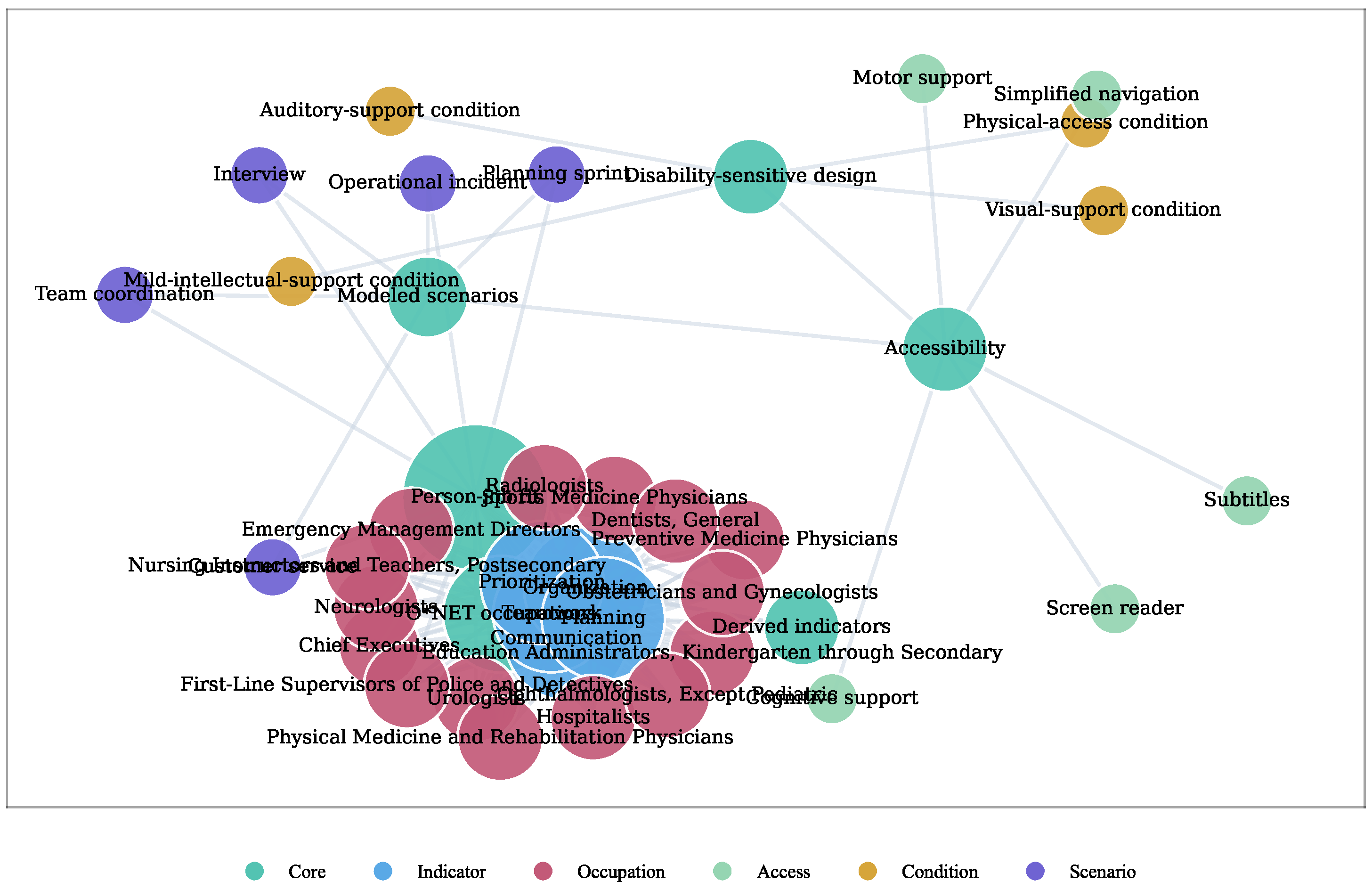
Figure 2 presents the operational ontology of the accessibility-aware model. The figure illustrates that the framework is not limited to isolated competency indicators, but instead links derived competencies, accessibility, disability-sensitive design conditions, scenarios, O*NET occupations, and person–job fit within a coherent semantic structure. The centrality of accessibility and disability-sensitive design nodes illustrates that functional diversity is represented as a contextual, design-sensitive dimension rather than as an observed participant attribute. At the same time, the ontology shows that scenarios and occupational nodes are analytically connected to competencies, enabling explainable reasoning about how user profiles interact with simulated tasks and labor market requirements.
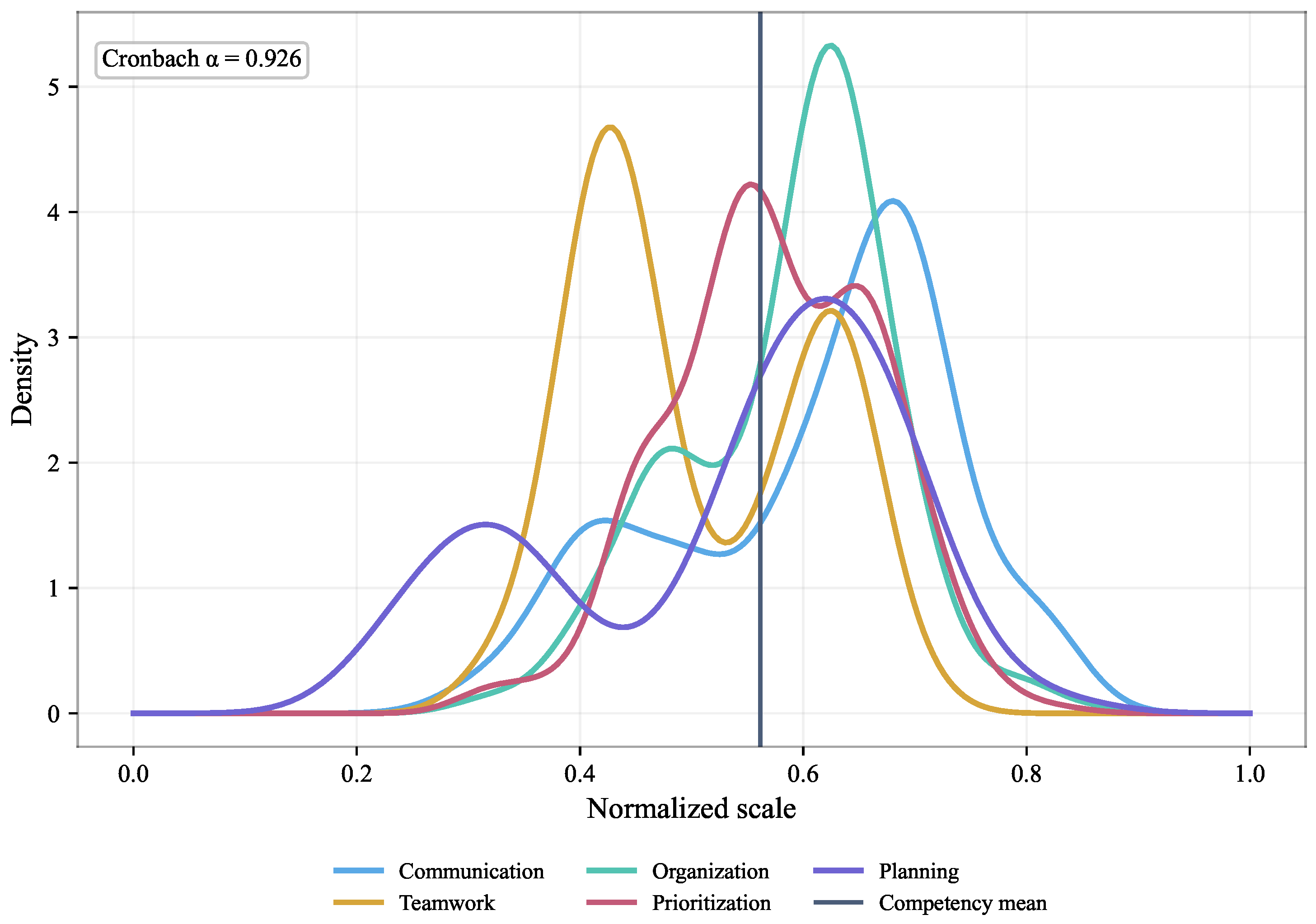
Figure 3 shows the density distribution of the evaluated soft skills on a normalized scale, together with the overall competency mean. Cronbach’s alpha is reported as a numerical annotation because it represents an internal consistency statistic and not an additional density curve. The distributions are concentrated in the medium-to-high region, and the overlap among the curves suggests a shared employability structure across the five derived indicators. However, because these indicators were obtained from secondary employability variables rather than from a purpose-built psychometric instrument, the distributional patterns should be interpreted as exploratory evidence for computational profiling.
The empirical reliability level shown in the figure () indicates high internal consistency among the five derived competency indicators. This result supports their use as a coherent analytical structure within the proposed proof-of-concept framework. Nevertheless, Cronbach’s alpha is interpreted cautiously because high internal consistency may also reflect shared variance, item redundancy, or the presence of a dominant general employability factor. Therefore, the reliability result is treated as evidence of internal coherence for exploratory computational modeling, not as definitive evidence that communication, teamwork, organization, prioritization, and planning constitute five independent validated psychometric dimensions.
Because the five competency dimensions were derived from a secondary employability dataset rather than from a purpose-built psychometric instrument, the psychometric analysis was interpreted as exploratory. Alpha-if-deleted analyses, item–total correlations, correlation analyses, and principal component analyses complemented Cronbach’s alpha. The PCA results showed that the first principal component explained 75.3% of the variance, suggesting a dominant general employability factor. This result has direct implications for the person–job fit analysis: the fit index may be influenced by a shared employability structure rather than by five fully independent competency dimensions. Therefore, the five-dimensional representation is retained for interpretability, occupational mapping, and decision support visualization, but the manuscript does not claim confirmatory evidence of five independent latent constructs. Future empirical versions of the framework should test hierarchical or bifactor structures, exploratory and confirmatory factor models, convergent and divergent validity, and external criterion validation using real employability outcomes.
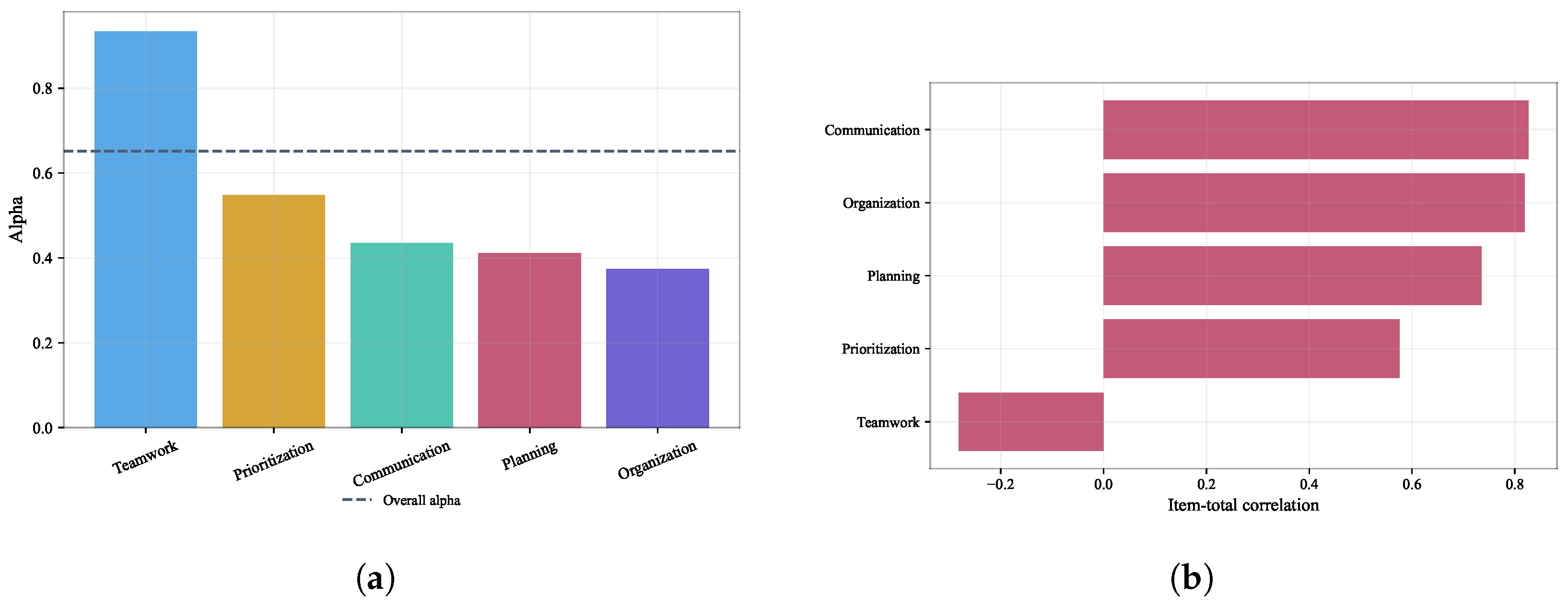
The psychometric interpretation is strengthened by
Figure 4a,b. The alpha-if-deleted analysis shows that no single item produces a substantial increase in overall reliability when removed, suggesting that the observed consistency is a property of the instrument as a whole rather than a single clearly problematic competency. Likewise, the item-total correlations remain positive and differentiated, supporting the idea that each competency contributes meaningfully to the aggregate construct, although not to the same extent. Together, these two figures indicate that the derived indicators are sufficiently coherent for exploratory computational profiling, while also revealing room for methodological improvement.
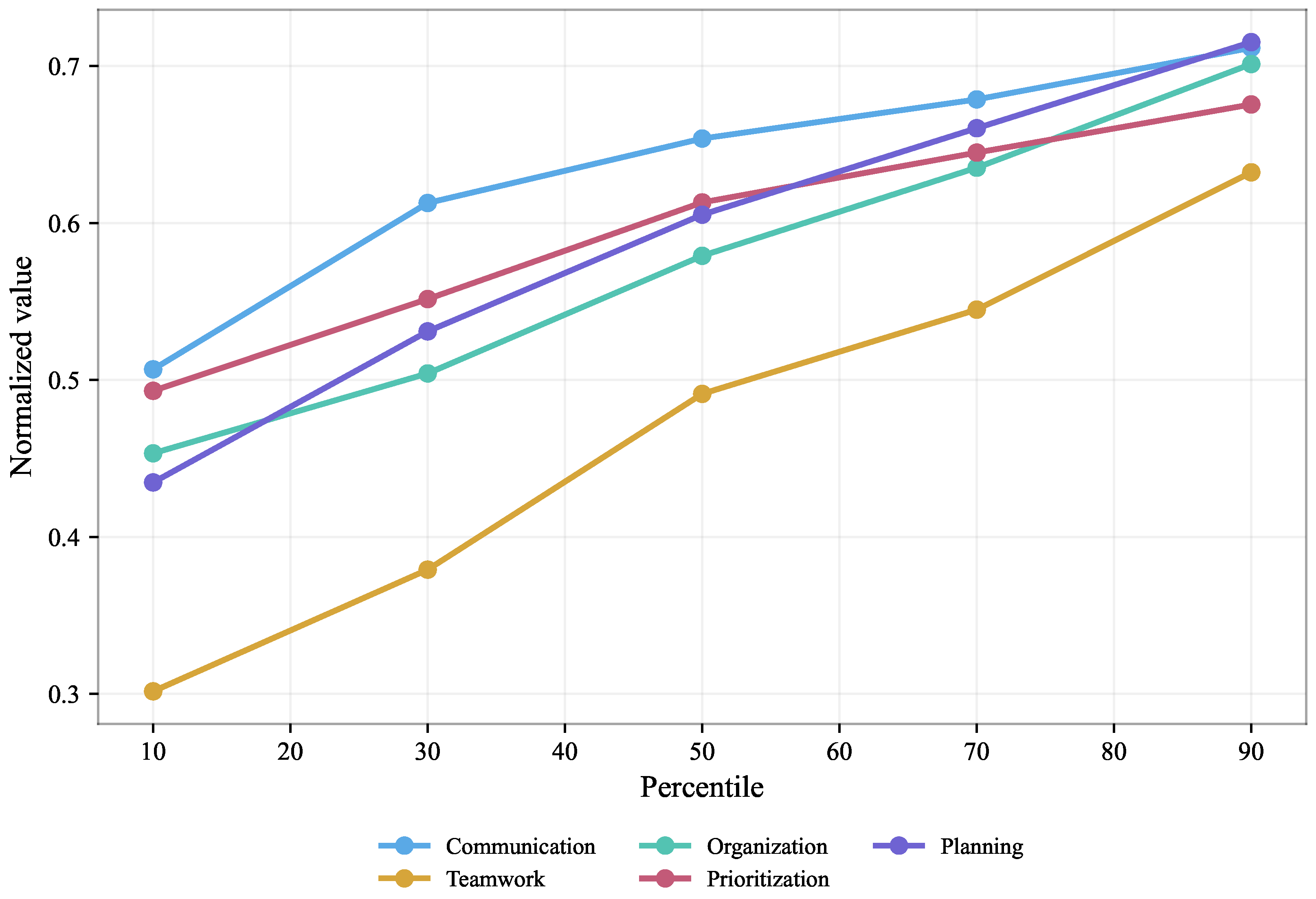
Figure 5 presents the percentile curves of the five competencies. All trajectories follow a monotonic upward pattern, indicating that the instrument is sensitive to progressive performance gradients rather than merely distinguishing between extreme groups. The curves remain relatively close to one another, which is consistent with the shared structural basis observed in the density distributions. At the same time, slight separation across intermediate percentiles reveals differentiated developmental behavior, especially in prioritization and planning. This result is important because it shows that the simulator can capture both convergence at higher levels of performance and meaningful differences in competency development at medium levels.
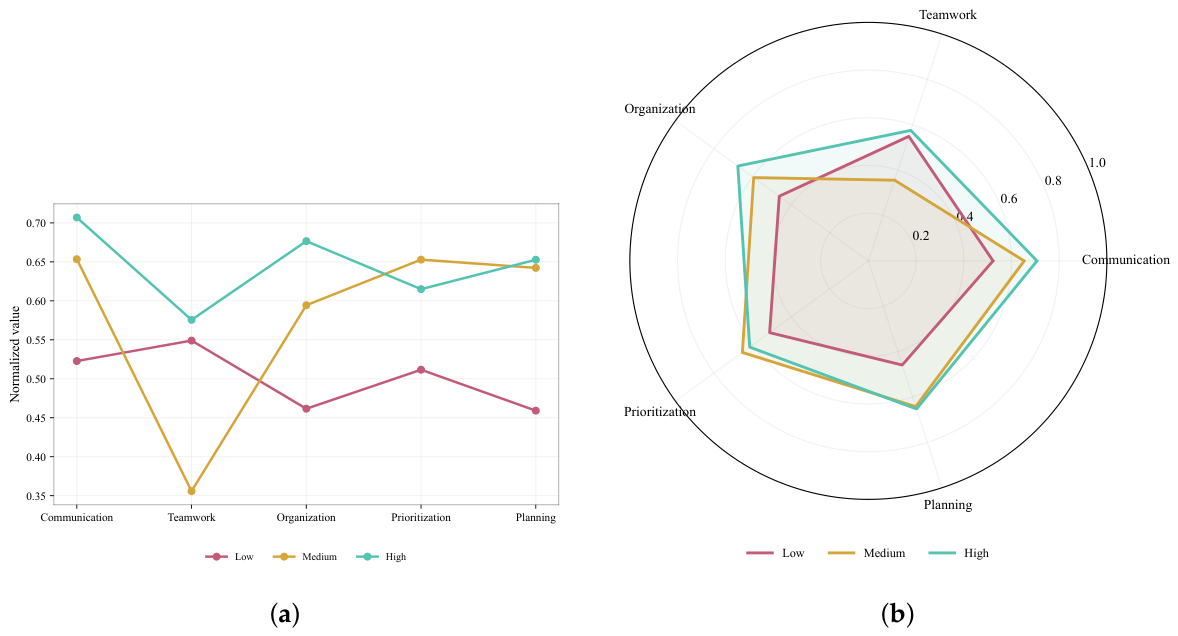
A clearer interpretation of inter-profile structure is provided by
Figure 6a,b. The profile lines show a consistent ordering from low to medium to high across all competencies, confirming that the clustering solution is substantively interpretable rather than arbitrary. The radar representation further suggests that high-profile analytical records show broader, more balanced derived competency coverage, whereas low-profile analytical records remain systematically lower across all five indicators. Medium-profile users occupy the expected intermediate position and reveal a transitional structure rather than random overlap. These patterns confirm that the proposed clustering identifies differentiated employability regions in the competency space.
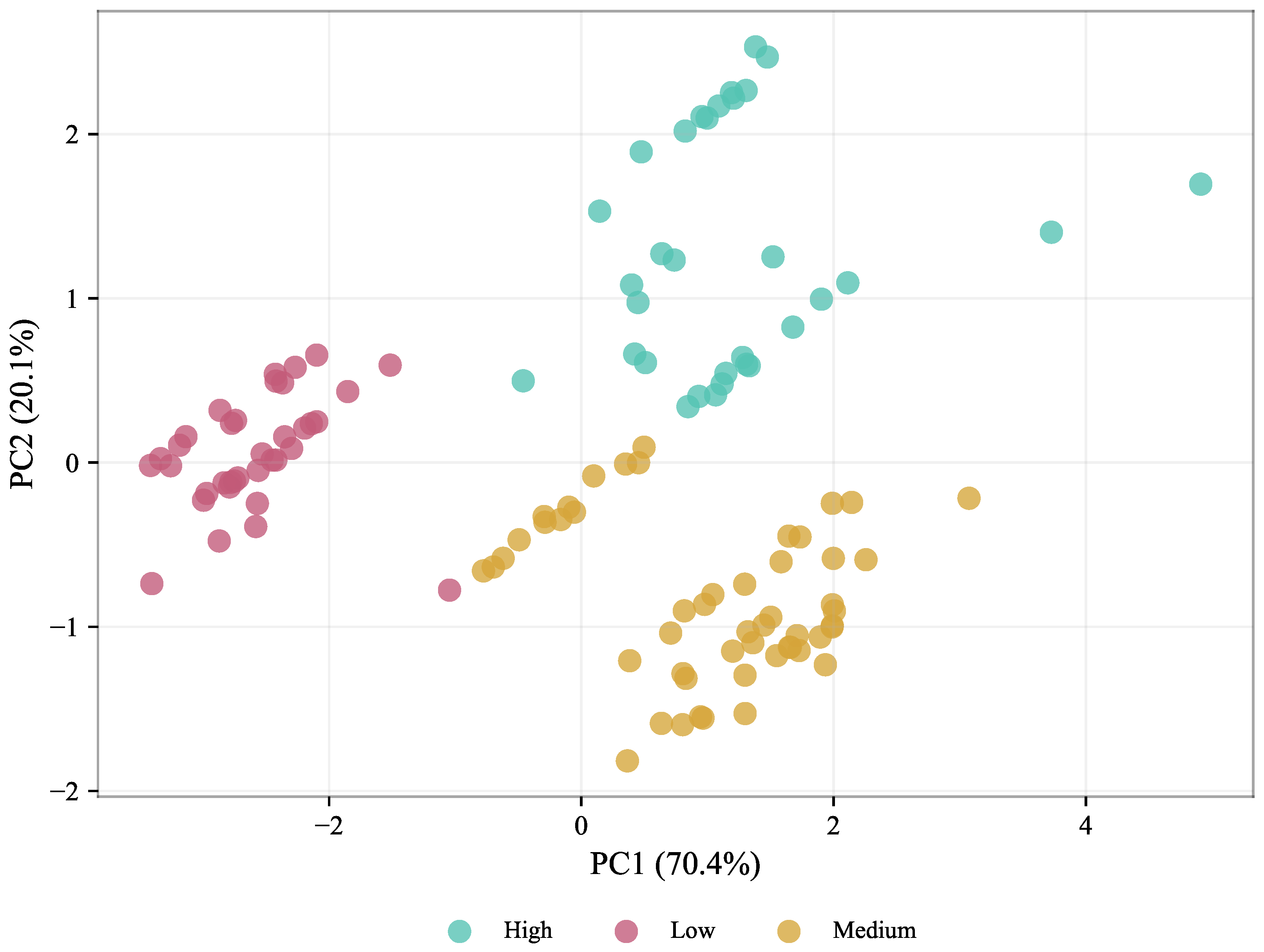
Figure 7 deepens this interpretation through principal component analysis. The projection shows a meaningful separation among low, medium, and high employability profiles in reduced-dimensional space. The first principal component explains 75.3% of the variance, while the second explains 15.9%, together capturing a substantial share of the data’s latent structure. High-profile individuals occupy a comparatively compact region, consistent with their lower variability and stronger fit performance. Low-profile individuals are more dispersed and concentrated in a distinct region of the space, reflecting greater internal heterogeneity and weaker alignment. The medium group occupies an intermediate position and partially bridges the two extremes. The PCA supports the existence of a strong latent employability structure, but it also shows that the five competency indicators should not be interpreted as five independent latent constructs. Because the first principal component explains 75.3% of the variance and the indicators are highly intercorrelated, the results suggest a dominant general employability factor. For this reason, the manuscript does not claim confirmatory evidence of a five-factor competency structure. The five dimensions are retained only because they provide an interpretable bridge to O*NET occupational descriptors and practical guidance categories. Future empirical work should test whether a hierarchical model, with one general employability factor and five subordinate dimensions, better represents the data.
The separation among profiles should be interpreted cautiously. Because the competency dimensions were normalized and derived within the same analytical pipeline, the resulting clusters may appear cleaner than would be expected in field data collected from real workplace simulations. Therefore, cluster separation is interpreted as evidence of internal computational structure, not as proof of naturally occurring employability groups. Additional validation with external outcomes, such as training completion, placement, retention, or supervisor-rated performance, is required before these profiles can be used for decision-making.
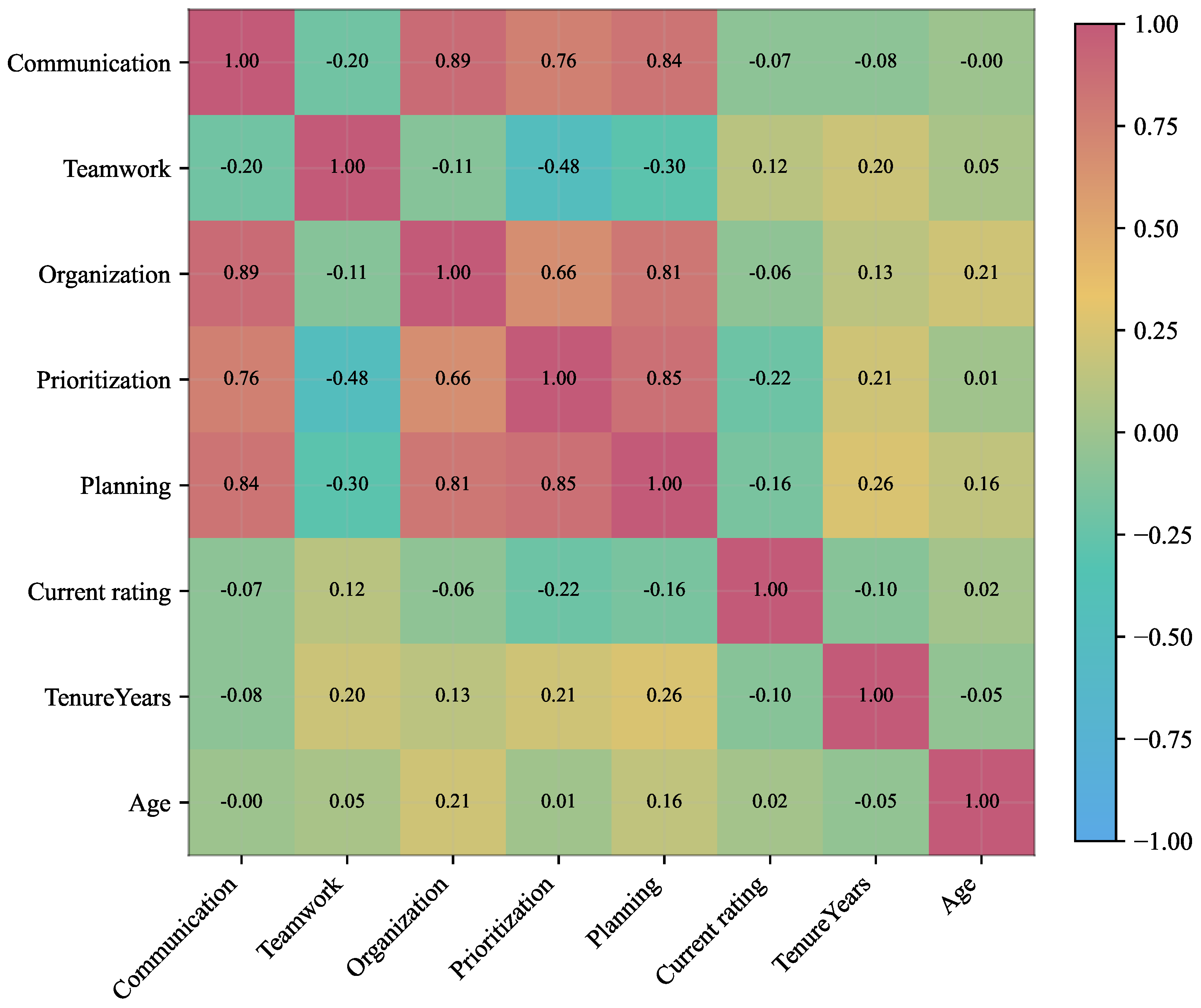
Figure 8 presents the correlation matrix among competencies and contextual variables. The matrix reveals a structured multivariate pattern rather than isolated pairwise relations. Communication shows positive associations with prioritization and planning, while organization is positively associated with planning, tenure, and age. Prioritization presents one of the strongest positive links with current employee rating, suggesting that this competency may play a particularly important role in observable employability outcomes. By contrast, teamwork shows weaker or even negative associations with some contextual variables, especially current employee rating, suggesting that its contribution may be more context-dependent than those of the other competencies. Overall, the matrix supports the interpretation that employability emerges from an interconnected system in which cognitive, behavioral, and contextual dimensions interact rather than operate independently.
The strongest occupational evidence is presented in
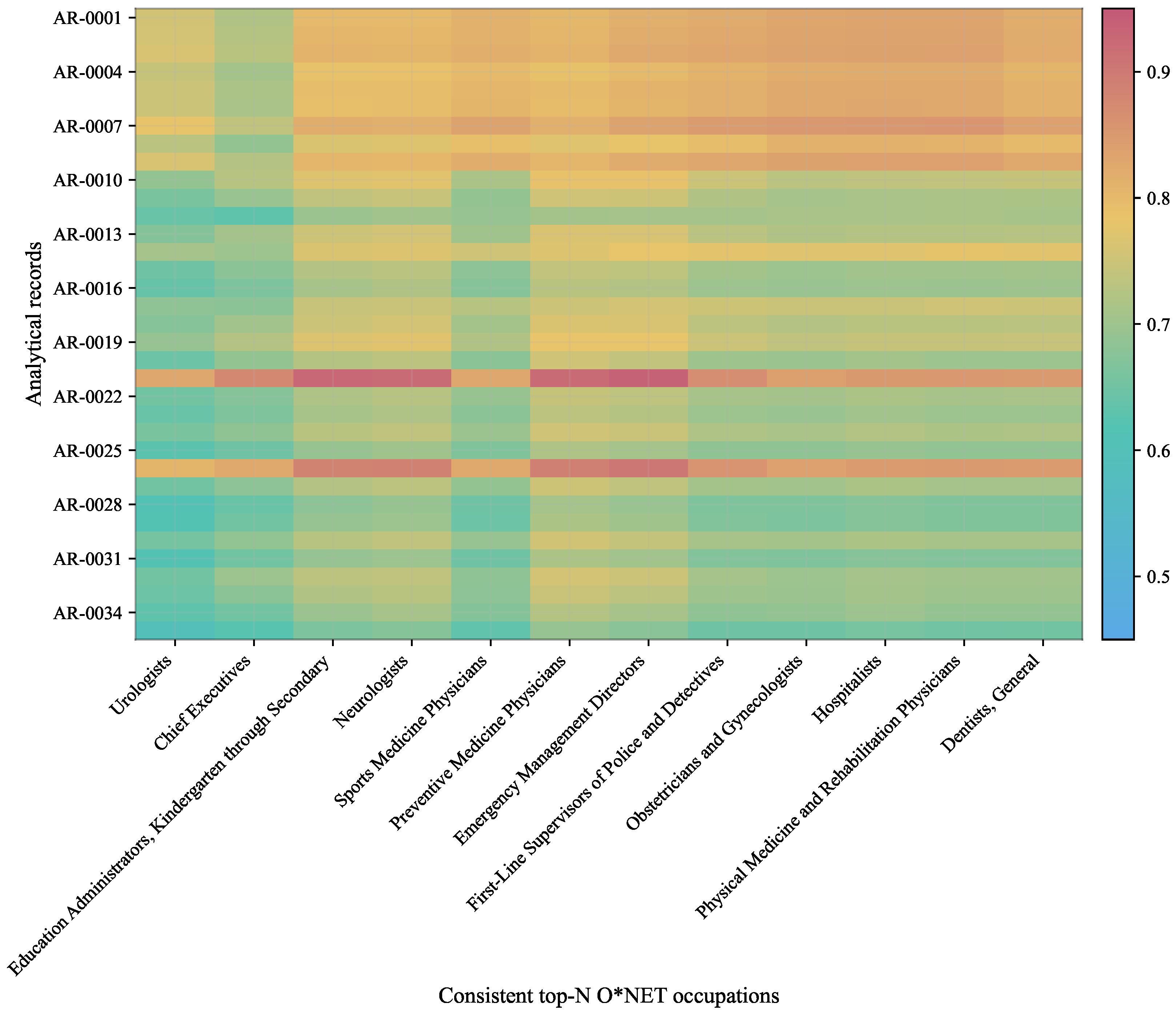
Figure 9, which shows the person–job fit heatmap across users and occupations. The figure reveals clear gradients of alignment rather than random dispersion, indicating that the normalized competency vectors interact meaningfully with the O*NET-derived requirement profiles. Several occupations display consistently high fit values across broader sets of users, whereas others appear more selective and require narrower competency combinations. This pattern supports the exploratory consistency of the fit index and suggests that the model can distinguish stronger and weaker zones of occupational compatibility under the adopted O*NET mapping assumptions. In practical terms, the heatmap offers a decision support view for vocational guidance, simulator assignment, and employability-oriented intervention.
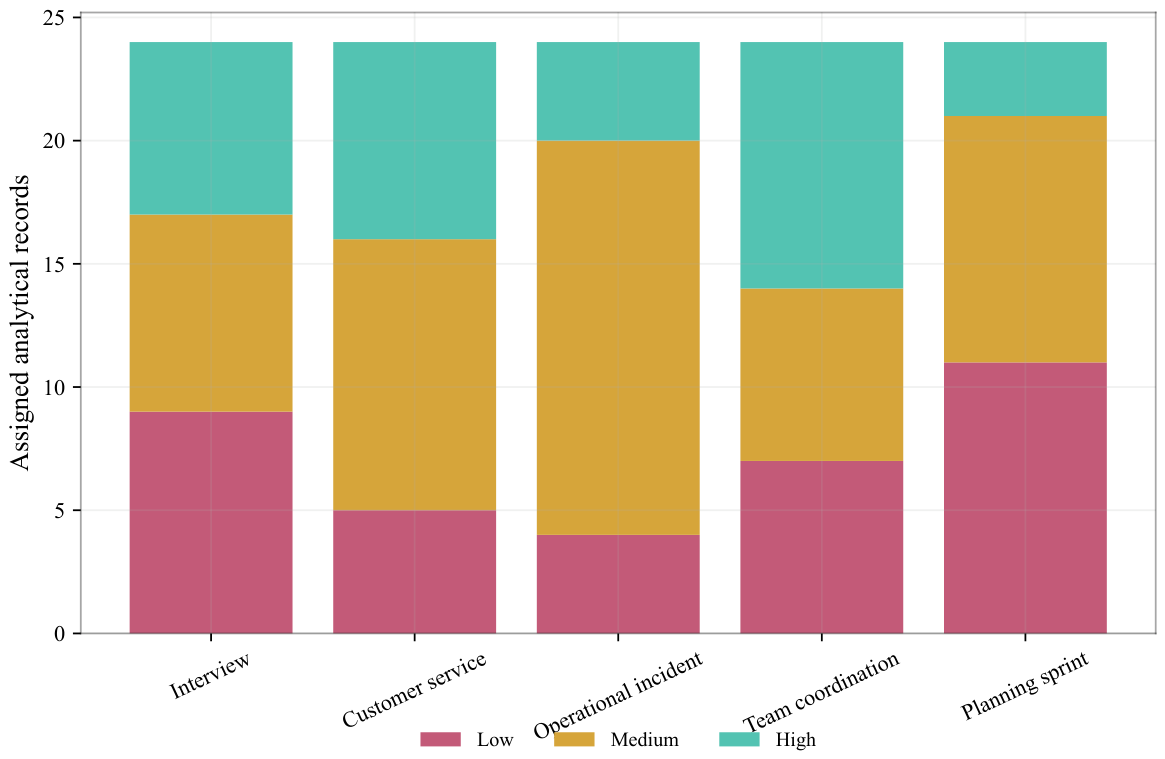
Figure 10 complements the fit analysis by showing scenario allocation across low, medium, and high profiles. The distribution of assigned analytical records is not uniform, indicating that the optimization process is not simply matching users to occupations abstractly but also organizing scenario exposure according to profile structure. It is relevant to the simulator because it demonstrates that the decision framework can translate competency heterogeneity into operational scenario assignment, thereby linking analysis and intervention within the same system.
From the optimization perspective,
Figure 11 shows the evolution of the objective function, the best objective, the relaxed bound, and the scaled gap. These curves indicate that the implemented local search heuristic stabilizes in the operational HMI setting. However, in response to the reviewer, the convergence curves are no longer interpreted as sufficient evidence of solution quality. They must be read together with the reduced exact solver benchmark and the heuristic/metaheuristic benchmark defined in
Table 6 and
Table 7. This correction is important because internal convergence does not by itself demonstrate global optimality, strict error gap control, or superiority over PSO, GA, SCA, ASCA-GT, RAMPA, SFOA, SED, smoothed functional algorithms, or norm-limited SPSA.
The revised interpretation therefore separates three levels of evidence. First, the convergence curves show internal stabilization of the implemented HMI heuristic. Second, exact reduced-instance benchmarking is required to estimate the relative gap with respect to a certified assignment optimum. Third, external heuristic benchmarking is required to compare objective quality, runtime, feasibility rate, and robustness against population-based and single-agent alternatives. This distinction directly prevents overclaiming and clarifies what the current HMI demonstrates computationally.
The benchmark families used to contextualize this interpretation are summarized in
Table 12.
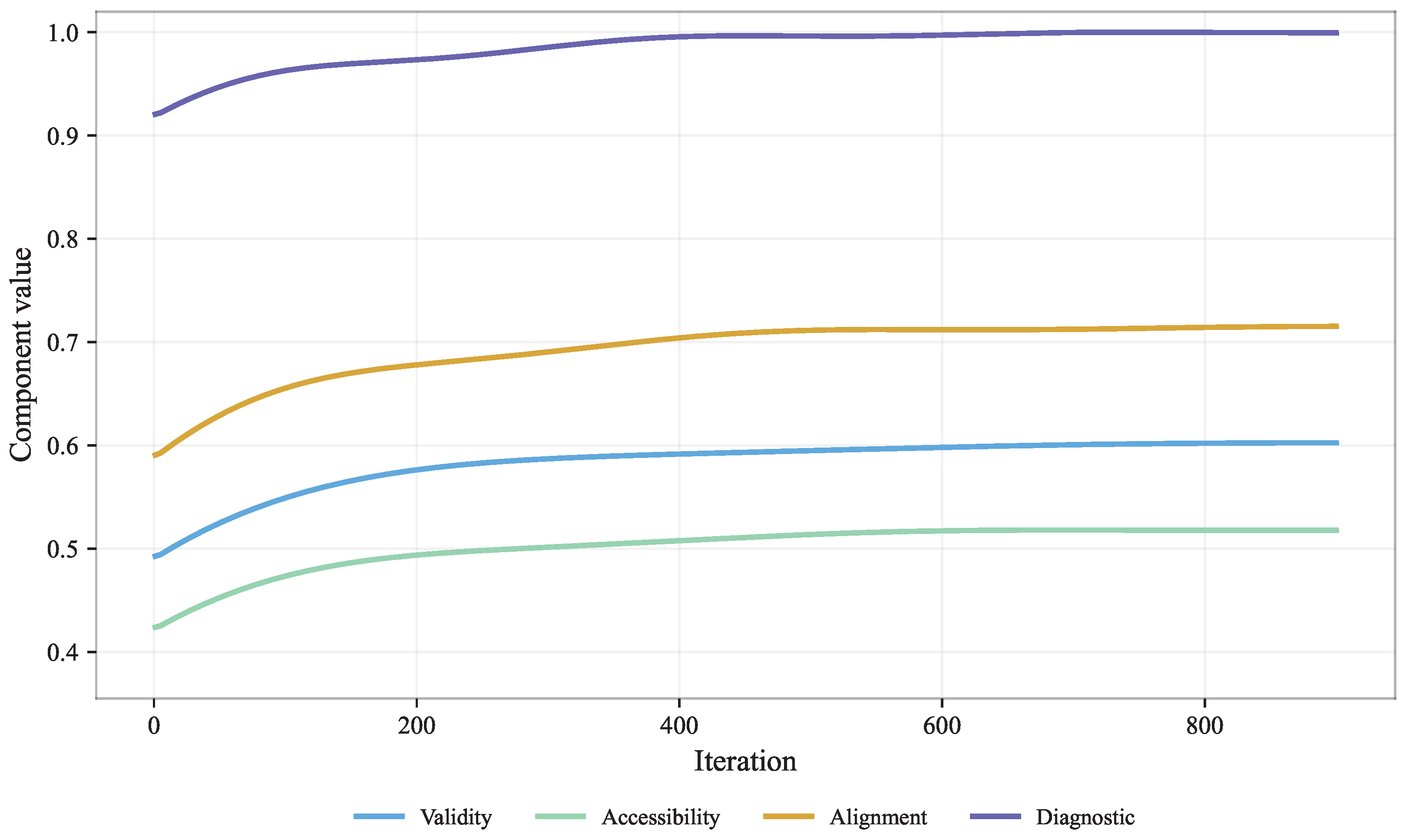
Figure 12 decomposes the optimization objective into validity, accessibility, alignment, and diagnostic components. Unlike earlier flatter versions, the figure now shows visible differences among the four components, making the optimization target more interpretable. Accessibility and alignment remain among the strongest contributors, which is consistent with the model’s central purpose: to improve inclusive occupational matching under accessible simulation conditions. Validity and diagnostic capacity also continue to make substantial and stable contributions, confirming that the system does not optimize inclusion at the expense of measurement quality or analytical usefulness. The combined reading of
Figure 11 and
Figure 12 therefore supports the interpretation of internal heuristic stabilization and component-level interpretability, but not global optimality, strict error gap control, or superiority over alternative optimization algorithms.
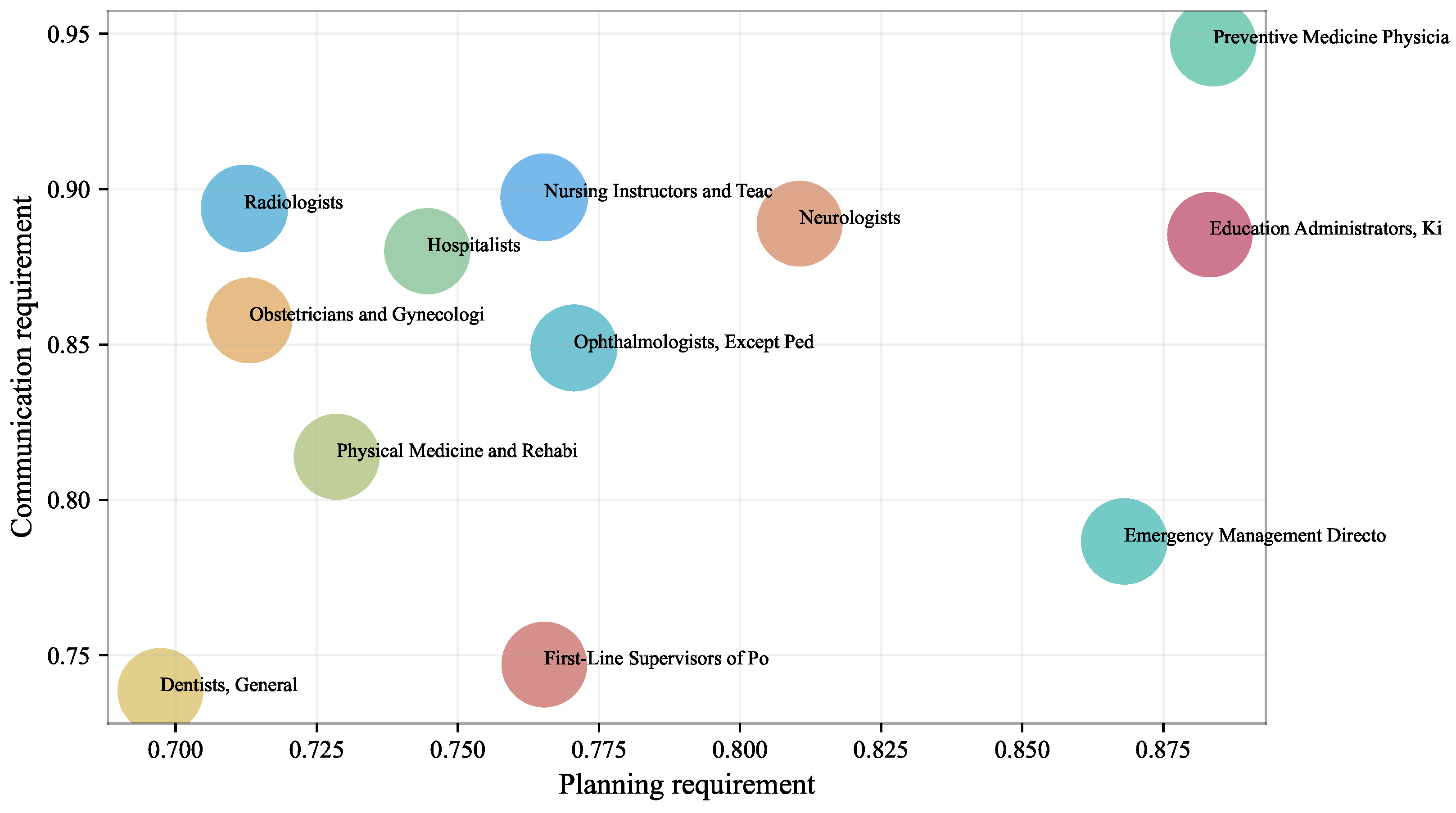
Figure 13 provides an occupation-level interpretation of the requirement space. The bubble chart shows that the selected occupations are distributed within a narrow but analytically meaningful band defined by planning and communication requirements. This result reinforces the logic of the fit model, since it shows that occupational targets are not arbitrary labels but structured requirement profiles within the same competency space used to characterize users. Consequently, the computational framework can support future user evaluation designs and the interpretation of where occupational opportunities are concentrated under the adopted O*NET requirement assumptions.
Overall, the revised evidence supports the framework as a computational proof of concept rather than as a field-validated accessibility-aware computational framework. The results contribute at four interrelated levels. First, they show that employability assessment can be represented through a coherent operational ontology. Second, they indicate that the competency indicators form a reliable but highly interrelated structure that may reflect a dominant general employability factor. Third, they show that person–job fit can be computed transparently from normalized user profiles and O*NET-derived occupational vectors. Fourth, they demonstrate that heuristic optimization can support scenario assignment, provided that its outputs are interpreted alongside baseline comparisons and sensitivity analyses. These findings support the analytical potential of the framework while also defining the empirical work still needed before it can be claimed as an exploratory simulator for people with disabilities.
The sensitivity-analysis protocol used to interpret these assumptions is summarized in
Table 13.
5. Discussion
The main methodological risk of this study is overgeneralization. The framework is accessibility-aware by design, but the current dataset does not include observed participants with disabilities, measured accessibility support use, real simulator interaction records, or longitudinal employment outcomes. Therefore, the results are interpreted as evidence of computational feasibility rather than empirical proof of inclusive employment effectiveness.
Four threats to validity must be considered. First, construct validity is limited because the five competency dimensions were derived from secondary variables rather than directly measured with a dedicated, exploratory soft-skills instrument. Second, internal validity is limited because accessibility parameters were modeled rather than estimated from observed users. Third, external validity is limited because O*NET occupational descriptors may not fully represent local labor market demands or employer-specific requirements. Fourth, computational validity is limited because the implemented HMI uses a heuristic approximation rather than an exact MINLP solver. These limitations do not invalidate the framework as a computational proof of concept, but they define the empirical work required before the model can be used in real decision support settings.
The revised results support the analytical value of the proposed framework, but they also require a more cautious interpretation than a field-validated accessibility-aware computational framework would allow. The main contribution of the study is not the empirical validation of real users with disabilities in actual workplace simulation environments. Rather, the contribution lies in the design and computational testing of a reproducible architecture that links competency profiles, occupational requirement vectors, accessibility-aware scenario assumptions, semantic representation, person–job fit estimation, and heuristic optimization.
This distinction is central to the interpretation of the study. The employability dataset used to construct competency profiles does not contain verified disability status, disability type, observed accessibility support use, or simulator-based performance records. Therefore, disability and accessibility cannot be interpreted as observed empirical effects. They are modeled as design and simulation dimensions. This limitation directly affects the interpretation of accessibility-related results: the model can show how accessibility assumptions affect score adjustment and assignment outcomes, but it cannot yet demonstrate that specific accessibility supports improve real performance among people with auditory, visual, physical, or cognitive disabilities.
From an operational and ethical perspective, the framework should not be used as an automated employment decision system in its current form. Any future deployment would require human oversight, informed consent, accessibility review, bias auditing, data-protection procedures, explainability mechanisms, and an appeal process for affected users. The HMI outputs should support vocational guidance and expert interpretation, not replace professional judgment or determine access to employment opportunities. In addition, future implementation should include audit logs, role-based access control, anonymization of user records, and periodic review to ensure the model does not produce systematic disadvantages for any disability-sensitive group.
The person–job fit index remains a useful contribution because it provides a transparent bridge between competency profiles and occupational requirements. By mapping O*NET descriptors into five competency dimensions, the model creates a common space for comparing users and occupations. However, this mapping is also a load-bearing assumption. If the descriptor selection, normalization, or aggregation criteria change, the resulting fit values may change as well. For this reason, the revised manuscript includes an explicit O*NET mapping table and sensitivity analysis. These additions improve reproducibility and reduce the risk that person–job fit values are interpreted as self-evident or independent of modeling choices.
The exploratory internal consistency and dimensionality results also require a balanced interpretation. The observed Cronbach’s alpha value of 0.905 indicates high internal consistency. However, the high correlations among competencies and the dominance of the first principal component suggest that the derived indicators may capture a general employability factor rather than five fully independent competency dimensions. It does not invalidate the framework, but it weakens the dimensionality claim. The five competencies remain useful for interpretability, occupational mapping, and intervention planning, but future studies should include exploratory and confirmatory factor analysis, convergent and divergent validity evidence, and validation with external employability outcomes.
The accessibility correction was also revised conceptually. The previous multiplicative formulation could be interpreted as an artificial increase in score. The revised formulation treats accessibility as a reduction of modeled barrier penalties rather than as a performance bonus. It is more consistent with the idea that accessibility should reduce distortion in observed performance rather than inflate competency estimates. Nevertheless, because the barrier and support parameters are not estimated from real participants, this component must remain a parametric simulation mechanism until field data are available.
The optimization results should also be interpreted cautiously. The conceptual problem is formulated as a mixed-integer nonlinear optimization problem, but the implemented HMI solves a heuristic approximation. Therefore, convergence curves do not prove that the full MINLP has been solved globally. They only show that the implemented heuristic stabilizes under the defined objective and constraints. Baseline comparison and sensitivity analysis are therefore identified as essential robustness procedures for future extensions of the framework. Without comparison against random assignment, greedy assignment, clustering-based assignment, or metaheuristic alternatives, convergence alone would not be sufficient evidence of computational superiority.
The operational ontology contributes to the framework’s explainability by linking competencies, occupations, accessibility supports, disability-sensitive design assumptions, and workplace scenarios. However, the ontology remains operational and has not yet been formalized in OWL, RDF, or other W3C-compatible semantic standards. It limits automated reasoning, interoperability, and reuse across platforms. Future work should therefore translate the operational ontology into machine-readable semantic formats and evaluate whether ontology-based reasoning improves scenario recommendation, competency interpretation, and occupational matching.
Three factors limit the generalizability of the results. First, the competency data come from a secondary dataset that was not designed specifically for disability-inclusive workplace simulation. Second, the occupational descriptors come from static O*NET profiles and do not capture local labor market variation or employer-specific requirements. Third, the accessibility and scenario components are simulated rather than observed. Consequently, the framework should be understood as a structured computational basis for future empirical studies, not as an exploratory employment decision system.
Future research should prioritize validation with real participants, including people with different disability profiles, and should report disaggregated results by disability type, accessibility support, scenario condition, and occupational target. Longitudinal studies are also needed to determine whether person–job fit scores predict real training completion, job placement, job retention, or supervisor-rated performance. In addition, expert validation should be incorporated to evaluate the relevance of the O*NET mapping, the accessibility supports, and the scenario taxonomy. Benchmarking against established metaheuristics and exact solvers for small instances should also be performed to quantify the error gap and computational trade-offs of the proposed heuristic.
Overall, the framework is promising because it offers a transparent, modular, and reproducible structure for accessibility-aware employability assessment. Its current value lies in its methodological and computational aspects. Its future value will depend on empirical validation with real users, stronger psychometric evidence, formal semantic interoperability, and longitudinal labor market outcomes.
Limitations and Future Empirical Validation
The main limitation of this study is that the proposed framework was not applied to real participants with disabilities, did not involve observing simulator interaction records, did not measure assistive technology use, and did not assess longitudinal employment outcomes. Accessibility was modeled as a scenario-based design condition, and disability-sensitive categories were represented as simulation variables rather than as observed participant attributes. Therefore, the results should be interpreted as computational proof-of-concept evidence rather than as empirical validation of an accessibility-aware computational framework.
A second limitation concerns the derived competency indicators. Communication, teamwork, organization, prioritization, and planning were derived from secondary employability variables and were not obtained from a standardized, exploratory psychometric instrument. Although internal consistency was high, the PCA results suggested a dominant general employability factor. Consequently, the five indicators should be interpreted as exploratory proxy dimensions for computational modeling and not as empirically independent latent constructs.
A third limitation concerns the accessibility component. The parameters , , , and were not estimated from empirical data or real users. Their role was to support sensitivity-based scenario analysis. Future studies should calibrate these parameters using observed simulator data, accessibility audits, expert panels, and participants with different accessibility needs.
A fourth limitation concerns the ontology layer. The current ontology is an operational conceptual representation implemented for visualization and decision support explanation. It has not yet been formalized using OWL, RDF, SKOS, SHACL, URI-based entities, SPARQL queries, or automated reasoning. Future work should implement a W3C-compatible semantic layer to improve interoperability, validation, and reuse.
A fifth limitation concerns the optimization layer. The implemented local search heuristic provides an interpretable approximation of the conceptual MINLP, but it does not certify global optimality or superiority over exact, population-based, or perturbation-based optimization methods. Future work should compare the proposed heuristic against random assignment, greedy person–job fit assignment, clustering-based assignment, genetic algorithms, particle swarm optimization, simulated annealing, tabu search, and exact MINLP solvers for small benchmark instances.
6. Conclusions
This study presented an accessibility-aware computational framework for employability analytics using workplace simulation logic, derived competency indicators, O*NET-derived occupational descriptors, person–job fit estimation, semantic modeling, clustering, and heuristic multi-objective optimization. The framework was developed and evaluated as a computational proof of concept rather than as a field-validated simulator implemented with real users with disabilities.
The results show that normalized derived competency indicators can be computationally connected to occupational requirement vectors through a transparent person–job fit index. However, this index has not yet been explored against real placement, retention, supervisor-rated performance, or longitudinal labor market outcomes. The high, medium, and low employability profiles achieved mean fit values of 0.85, 0.74, and 0.63, respectively, indicating differentiated levels of occupational alignment. The exploratory internal consistency analysis of the derived competency indicators showed a high Cronbach’s alpha, with . However, the PCA results also indicated a dominant latent structure, with the first principal component explaining 75.3% of the variance. Therefore, the five derived competency indicators should be interpreted as analytically useful and occupationally meaningful dimensions, but not yet as fully independent constructs.
The proposed accessibility component was revised to avoid interpreting accessibility as a simple score-increasing factor. Therefore, the five competencies should be interpreted as analytically useful and occupationally meaningful dimensions, but not yet as a fully independent construct formulation; accessibility reduces modeled barrier penalties rather than directly increasing performance. Because accessibility supports and disability types were simulated rather than observed, the effects should be understood as sensitivity-based scenario outputs rather than empirical evidence of improvement among participants with disabilities.
The optimization component also requires careful interpretation. The conceptual model has a complex, mixed-integer, nonlinear structure, including an NP-hard assignment subproblem related to the Generalized Assignment Problem. However, the implemented HMI provides an interpretable local search approximation rather than an exact MINLP solver. In response to this limitation, the revised manuscript defines reduced exact solver benchmarking and external comparisons against random assignment, greedy assignment, clustering-based assignment, PSO, GA, SCA, ASCA-GT-inspired perturbation, RAMPA-inspired adaptive movement, SFOA-inspired exploration–exploitation, and single-agent SPSA/SED-style baselines. Therefore, the convergence curves are interpreted only together with benchmark-based evidence of relative gap, feasibility, robustness, and runtime.
The main contribution of the study is the construction of a transparent and reproducible architecture that integrates employability data, occupational descriptors, accessibility-aware scenario modeling, semantic representation, and optimization-based decision support. This architecture can guide the future development of accessibility-aware computational frameworks, but it should not yet be used as a high-stakes employment decision system.
The main limitation is the absence of primary data from real users with disabilities and the lack of longitudinal labor market outcomes. Future work should validate the framework with participants representing different disability profiles, report results disaggregated by accessibility condition and disability type, evaluate the HMI with end users, execute and report the reduced exact solver and heuristic benchmarking tables with certified gap, runtime, feasibility, and robustness indicators. The operational ontology should also be formalized using OWL or RDF. Longitudinal validation should also examine whether person–job fit scores predict training completion, employment insertion, job retention, or workplace performance.
Overall, the study establishes a methodological and computational basis for future accessibility-aware employability analytics systems. Its current contribution is to make the analytical structure explicit, reproducible, and testable. Therefore, the framework should be interpreted as an analytical prototype that supports future simulator design and hypothesis generation, not as an exploratory predictive system for employment insertion. Longitudinal validation with real users, employers, and observed employment outcomes is required before the person–job fit index can be used for high-stakes vocational or employment decisions.