Task-Offloading Optimization in Mobile Edge Computing for Smart Library Services



Abstract
1. Introduction
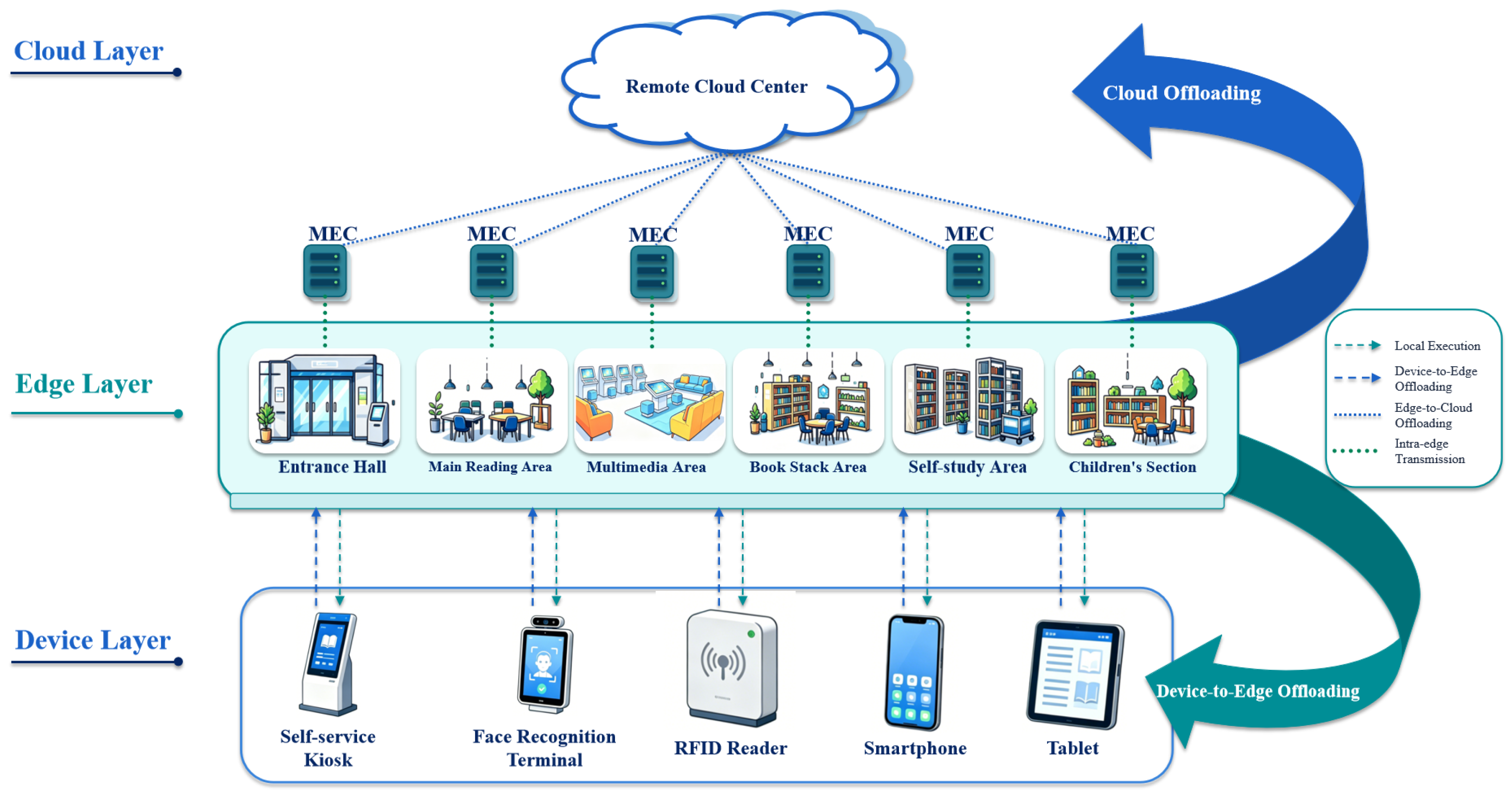
- A smart library-oriented cloud–edge–device collaborative computing framework is developed. A three-tier mobile edge computing architecture is constructed for smart library services, consisting of heterogeneous user devices, indoor MEC servers, and a remote cloud center. In addition, typical library service tasks are characterized according to their computational workloads and latency requirements, providing practical task settings for the simulation experiments and task-offloading optimization in smart library scenarios.
- A multi-objective task-offloading optimization model is formulated for MEC-enabled smart libraries. By jointly considering task-completion delay, user-side energy consumption, latency constraints, edge-server resource limitations, and indoor coverage conditions, the task-offloading problem is modeled as a mixed-integer nonlinear programming problem. This formulation enables a systematic trade-off between service responsiveness and energy efficiency.
- A preference-adaptive reinforcement learning-based offloading algorithm is proposed. To address the dynamic and multi-objective nature of the problem a preference-adaptive dueling double deep Q-network algorithm, termed PA-DDQN, is designed. The proposed method integrates preference conditioning, multi-head attention, a dueling network architecture, and double Q-learning, allowing a single trained model to adaptively generate offloading decisions under different delay–energy preference settings.
2. Related Work
2.1. Smart Library Services and Edge-Enabled Intelligent Infrastructure
2.2. Task Offloading in Mobile Edge Computing
2.3. Intelligent Optimization Algorithms for MEC Offloading
3. System Model and Problem Formulation
3.1. System Architecture
3.2. Task Model
3.3. Communication and Computation Model
3.4. Problem Formulation
4. Multi-Objective Reinforcement Learning-Based Task-Offloading Algorithm
4.1. Multi-Objective Optimization Preliminaries
4.2. Formulation of the Multi-Objective Markov Decision Process
4.3. Preference-Adaptive Dueling Deep Q-Network for Library-Oriented Offloading
5. Simulation and Performance Evaluation
5.1. Simulation Setup
5.2. Compared Algorithms
5.3. Evaluation Metrics
5.3.1. Average Task-Completion Delay
5.3.2. Average Energy Consumption
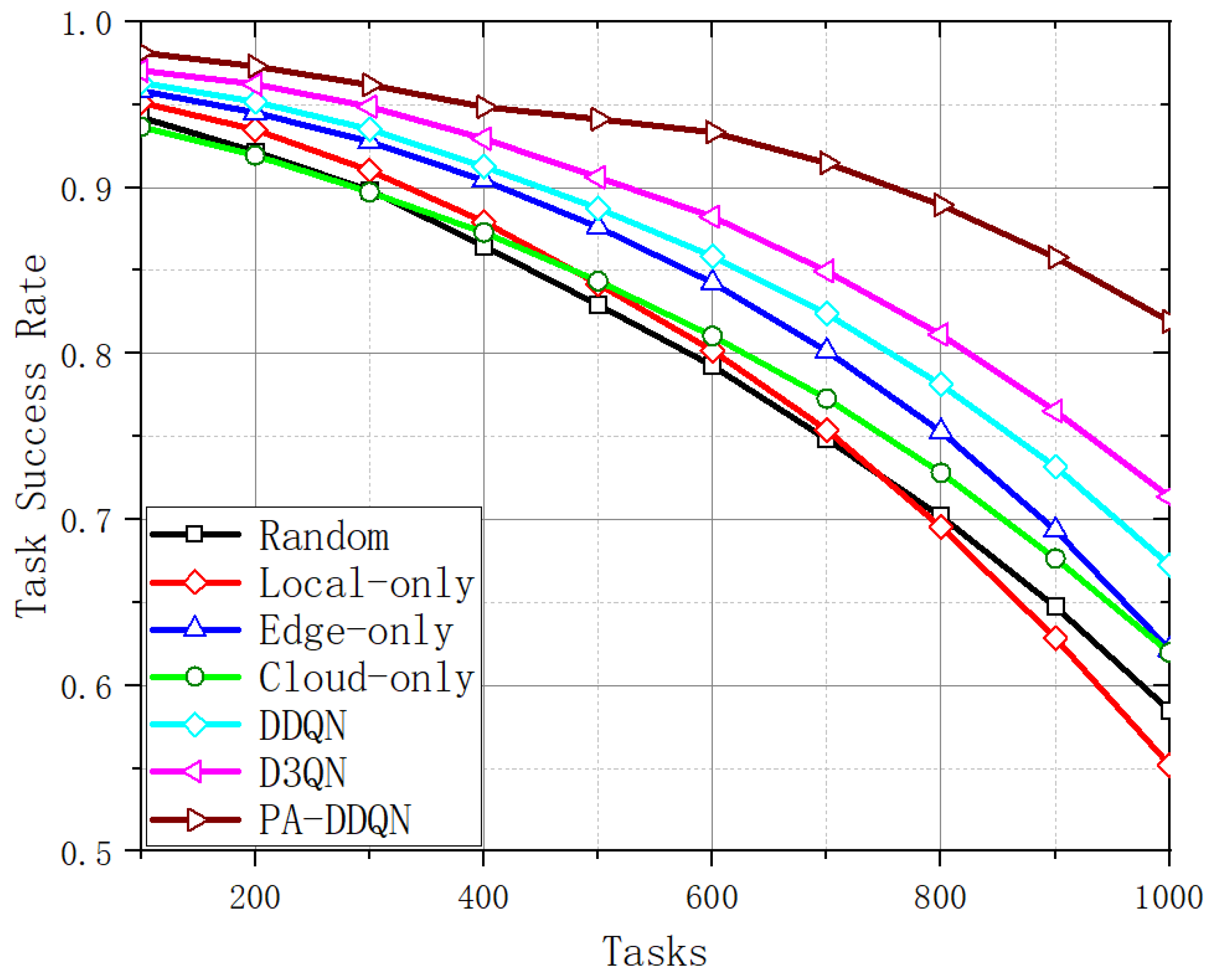
5.3.3. Task Success Rate
5.3.4. Average Reward
5.4. Analysis of Experimental Results
5.4.1. Training Performance Analysis
5.4.2. Delay Performance Analysis
5.4.3. Energy Consumption Analysis
5.4.4. Task Success-Rate Analysis
5.5. Ablation Study
5.6. Summary
6. Conclusions and Future Work
Author Contributions
Funding
Institutional Review Board Statement
Informed Consent Statement
Data Availability Statement
Conflicts of Interest
References
- Stepanov, V.K. A User-Centered Model of a Science Library. Sci. Tech. Inf. Process. 2023, 50, 69–73. [Google Scholar] [CrossRef]
- Bi, S.; Wang, C.; Zhang, J.; Huang, W.; Wu, B.; Gong, Y.; Ni, W. A Survey on Artificial Intelligence Aided Internet-of-Things Technologies in Emerging Smart Libraries. Sensors 2022, 22, 2991. [Google Scholar] [CrossRef] [PubMed]
- Su, X.; Chen, N. Intelligent Information Service System of Smart Library Based on Virtual Reality and Eye Movement Technology. Sci. Program. 2022, 2022, 917476. [Google Scholar] [CrossRef]
- Xu, H.; Liu, W.D.; Li, L. An IoT-based low-cost architecture for smart libraries using SDN. Sci. Rep. 2024, 14, 7022. [Google Scholar] [CrossRef] [PubMed]
- Mammadov, S.; Kucukkulahli, E. A User-Centric Smart Library System: IoT-Driven Environmental Monitoring and ML-Based Optimization with Future Fog–Cloud Architecture. Appl. Sci. 2025, 15, 3792. [Google Scholar] [CrossRef]
- Younis, A.; Maheshwari, S.; Pompili, D. Energy-Latency Computation Offloading and Approximate Computing in Mobile-Edge Computing Networks. IEEE Trans. Netw. Serv. Manag. 2024, 21, 3401–3415. [Google Scholar] [CrossRef]
- Zhou, J.; Hou, X.; Zeng, Y.; Cong, P.; Jiang, W.; Guo, S. Quality of Experience and Reliability-Aware Task Offloading and Scheduling for Multi-User Mobile-Edge Computing Systems. IEEE Trans. Serv. Comput. 2025, 18, 1683–1696. [Google Scholar] [CrossRef]
- Bai, Y. Construction of a Smart Library Subject Precise Service Platform Based on User Needs. Math. Probl. Eng. 2022, 2022, 5675291. [Google Scholar] [CrossRef]
- Zhou, Q. Smart library architecture based on internet of things (IoT) and software defined networking (SDN). Heliyon 2024, 10, e25375. [Google Scholar] [CrossRef] [PubMed]
- Tang, C.; Ding, Y.; Xiao, S.; Huang, Z.; Wu, H. Collaborative Service Caching, Task Offloading, and Resource Allocation in Caching-Assisted Mobile Edge Computing. IEEE Trans. Serv. Comput. 2025, 18, 1966–1981. [Google Scholar] [CrossRef]
- Wang, D.; Zhu, H.; Qiu, C.; Zhou, Y.; Lu, J. Distributed Task Offloading in Cooperative Mobile Edge Computing Networks. IEEE Trans. Veh. Technol. 2024, 73, 10487–10501. [Google Scholar] [CrossRef]
- Chai, F.; Zhang, Q.; Yao, H.; Xin, X.; Gao, R.; Guizani, M. Joint Multi-Task Offloading and Resource Allocation for Mobile Edge Computing Systems in Satellite IoT. IEEE Trans. Veh. Technol. 2023, 72, 7783–7795. [Google Scholar] [CrossRef]
- Li, S.; Li, W.; Zheng, W. Multi-user joint task offloading and resource allocation based on mobile edge computing in mining scenarios. Sci. Rep. 2025, 15, 16170. [Google Scholar] [CrossRef] [PubMed]
- Zhang, Y.; Zhu, T.; Fang, X.; Xu, T.; Liu, Y.; Luo, J. Task Offloading Scheduling for Mobile Edge Computing Networks with Incomplete Edge Information. IEEE Internet Things J. 2026, 13, 25354–25366. [Google Scholar] [CrossRef]
- Chen, X.; Bi, Y.; Zhang, J.; Yuan, X.; Niyato, D.; Zhao, L.; Wang, X. Task Offloading and Resource Optimization Based on Dependency-Aware Graph and Collaborative Deep Reinforcement Learning in Mobile Edge Computing. IEEE Trans. Mob. Comput. 2026, 25, 10998–11015. [Google Scholar] [CrossRef]
- Jiang, T.; Chen, Z.; Zhao, Z.; Feng, M.; Zhou, J. Deep-Reinforcement-Learning-Based Task Offloading and Resource Allocation in Mobile Edge Computing Network with Heterogeneous Tasks. IEEE Internet Things J. 2024, 12, 10899–10906. [Google Scholar] [CrossRef]
- Yang, W.; Liu, Z.; Liu, X.; Ma, Y. Deep Reinforcement Learning-Based Low-Latency Task Offloading for Mobile-Edge Computing Networks. Appl. Soft Comput. 2024, 166, 112164. [Google Scholar] [CrossRef]
- Zhao, L.H.; Zhang, J.; Bah, M.J. Energy-Efficient Task Offloading in Multi-server Mobile Edge Computing Networks: A Deep Reinforcement Learning Approach. Arab. J. Sci. Eng. 2025, 50, 16221–16242. [Google Scholar] [CrossRef]
- Sun, H.; Wang, Z.; Yu, Y.; Sha, K.; Wu, Y. EdgeBrain: A Game Based Collaborative Computational Task Offloading Framework for Edge Video Analytics. IEEE Trans. Serv. Comput. 2024, 17, 2287–2303. [Google Scholar] [CrossRef]
- Panda, S.K.; Lin, M.; Zhou, T. Energy-Efficient Computation Offloading with DVFS Using Deep Reinforcement Learning for Time-Critical IoT Applications in Edge Computing. IEEE Internet Things J. 2023, 10, 6611–6621. [Google Scholar] [CrossRef]
- Hayes, C.F.; Rădulescu, R.; Bargiacchi, E.; Källström, J.; Macfarlane, M.; Reymond, M.; Verstraeten, T.; Zintgraf, L.M.; Dazeley, R.; Heintz, F.; et al. A practical guide to multi-objective reinforcement learning and planning: CF Hayes et al. Auton. Agents Multi Agent Syst. 2022, 36, 26. [Google Scholar] [CrossRef]
- Liu, E.; Wu, Y.-C.; Huang, X.; Gao, C.; Wang, R.-J.; Xue, K.; Qian, C. Pareto set learning for multi-objective reinforcement learning. Proc. AAAI Conf. Artif. Intell. 2025, 39, 18789–18797. [Google Scholar] [CrossRef]
- Guerreiro, A.P.; Fonseca, C.M.; Paquete, L. The hypervolume indicator: Computational problems and algorithms. ACM Comput. Surv. 2021, 54, 119. [Google Scholar] [CrossRef]
- Peng, N.; Tian, M.; Fain, B. Multi-objective reinforcement learning with nonlinear preferences: Provable approximation for maximizing expected scalarized return. arXiv 2023, arXiv:2311.02544. [Google Scholar] [CrossRef]
- Qin, Y.; Chen, J.; Jin, L.; Yao, R.; Gong, Z. Task offloading optimization in mobile edge computing based on a deep reinforcement learning algorithm using density clustering and ensemble learning. Sci. Rep. 2025, 15, 211. [Google Scholar] [CrossRef] [PubMed]
- Anand, J.; Karthikeyan, B. Adaptive and intelligent customized deep Q-network for energy-efficient task offloading in mobile edge computing environments. Sci. Rep. 2026, 16, 5456. [Google Scholar] [CrossRef] [PubMed]
- Tang, X.; Tang, T.; Shen, Z.; Zheng, H.; Ding, W. Double deep Q-network-based dynamic offloading decision-making for mobile edge computing with regular hexagonal deployment structure of servers. Appl. Soft Comput. 2025, 169, 112594. [Google Scholar] [CrossRef]
- Kumari, S.; Gupta, D. Task offloading based on deep reinforcement learning in edge computing network. J. Supercomput. 2025, 81, 1479. [Google Scholar] [CrossRef]
- Mustafa, E.; Shuja, J.; Rehman, F.; Namoun, A.; Bilal, M.; Bilal, K. Deep Reinforcement Learning and SQP-driven task offloading decisions in vehicular edge computing networks. Comput. Netw. 2025, 262, 111180. [Google Scholar] [CrossRef]



| Parameter | Value |
|---|---|
| Number of library zones | 6 |
| Number of MEC servers | 6 |
| Number of user devices | 30 |
| Task-load range | 100–1000 tasks |
| Wireless bandwidth | 20 MHz |
| Transmission power | 0.5 W |
| Edge-server coverage radius | 30 m |
| Episode length | 100 time slots |
| Discount factor () | 0.99 |
| Learning rate | |
| Training episodes | 1000 |
| Algorithm | Description |
|---|---|
| Random [25] | Randomly selects a feasible execution node for each task. |
| Local-only [26] | Executes all tasks locally on user devices. |
| Edge-only [27] | Offloads each task to the nearest available MEC server. |
| Cloud-only [5] | Offloads all tasks to the remote cloud server. |
| DDQN [28] | Uses double Q-learning to reduce Q-value overestimation. |
| D3QN [29] | Uses a dueling double deep Q-network for offloading decisions. |
| PA-DDQN | The proposed preference-adaptive dueling double DQN algorithm. |
| Variant | Description |
|---|---|
| PA-DDQN | Complete proposed model. |
| PA-DDQN w/o Preference | Removes preference conditioning. |
| PA-DDQN w/o Dueling | Replaces the dueling head with a standard Q-value head. |
| PA-DDQN w/o Attention | Removes the attention module. |
| DDQN | Removes preference conditioning, the dueling architecture, and the attention module. |
| Variant | Delay | Energy | Task Success Rate | Reward |
|---|---|---|---|---|
| PA-DDQN | 5.28 | 315.5 | 0.924 | 0.538 |
| PA-DDQN w/o Preference | 5.66 | 324.9 | 0.906 | 0.509 |
| PA-DDQN w/o Dueling | 5.84 | 331.8 | 0.894 | 0.494 |
| PA-DDQN w/o Attention | 5.97 | 336.4 | 0.886 | 0.483 |
| DDQN | 6.39 | 340.7 | 0.852 | 0.468 |
Disclaimer/Publisher’s Note: The statements, opinions and data contained in all publications are solely those of the individual author(s) and contributor(s) and not of MDPI and/or the editor(s). MDPI and/or the editor(s) disclaim responsibility for any injury to people or property resulting from any ideas, methods, instructions or products referred to in the content. |
© 2026 by the authors. Licensee MDPI, Basel, Switzerland. This article is an open access article distributed under the terms and conditions of the Creative Commons Attribution (CC BY) license.
Share and Cite
Qu, J.; Zhang, P.; Wang, R.; Zheng, X.; Chen, L. Task-Offloading Optimization in Mobile Edge Computing for Smart Library Services. Information 2026, 17, 661. https://doi.org/10.3390/info17070661
Qu J, Zhang P, Wang R, Zheng X, Chen L. Task-Offloading Optimization in Mobile Edge Computing for Smart Library Services. Information. 2026; 17(7):661. https://doi.org/10.3390/info17070661
Chicago/Turabian StyleQu, Jingjing, Peiying Zhang, Ruixin Wang, Xiangguo Zheng, and Lijuan Chen. 2026. "Task-Offloading Optimization in Mobile Edge Computing for Smart Library Services" Information 17, no. 7: 661. https://doi.org/10.3390/info17070661
APA StyleQu, J., Zhang, P., Wang, R., Zheng, X., & Chen, L. (2026). Task-Offloading Optimization in Mobile Edge Computing for Smart Library Services. Information, 17(7), 661. https://doi.org/10.3390/info17070661