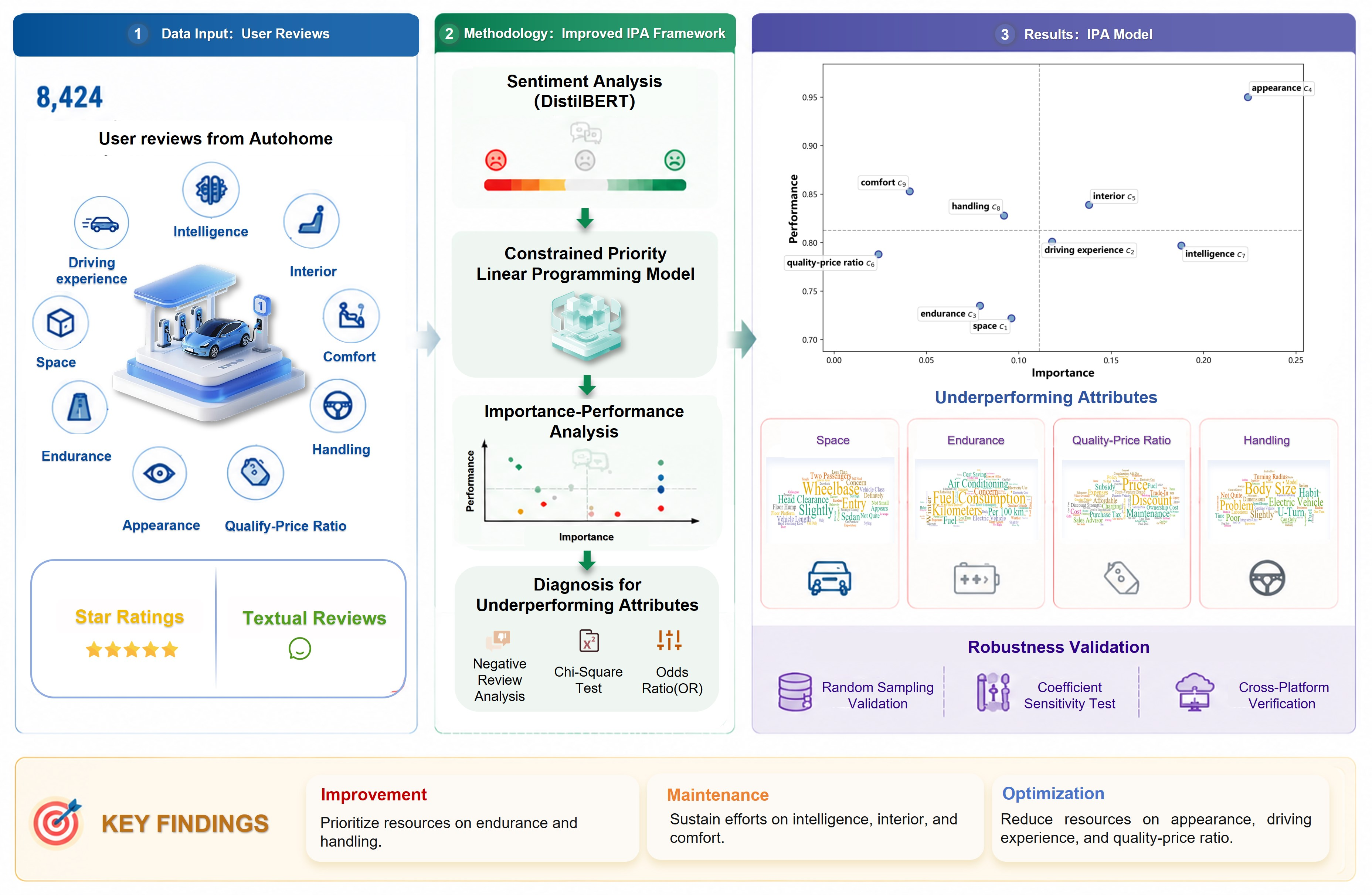

Fine-Grained Attribute Analysis of User Satisfaction for NEVs: An Interpretable Importance–Performance Analysis Based on Online Reviews

Abstract
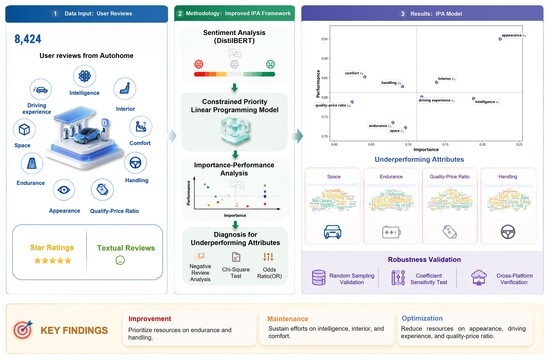
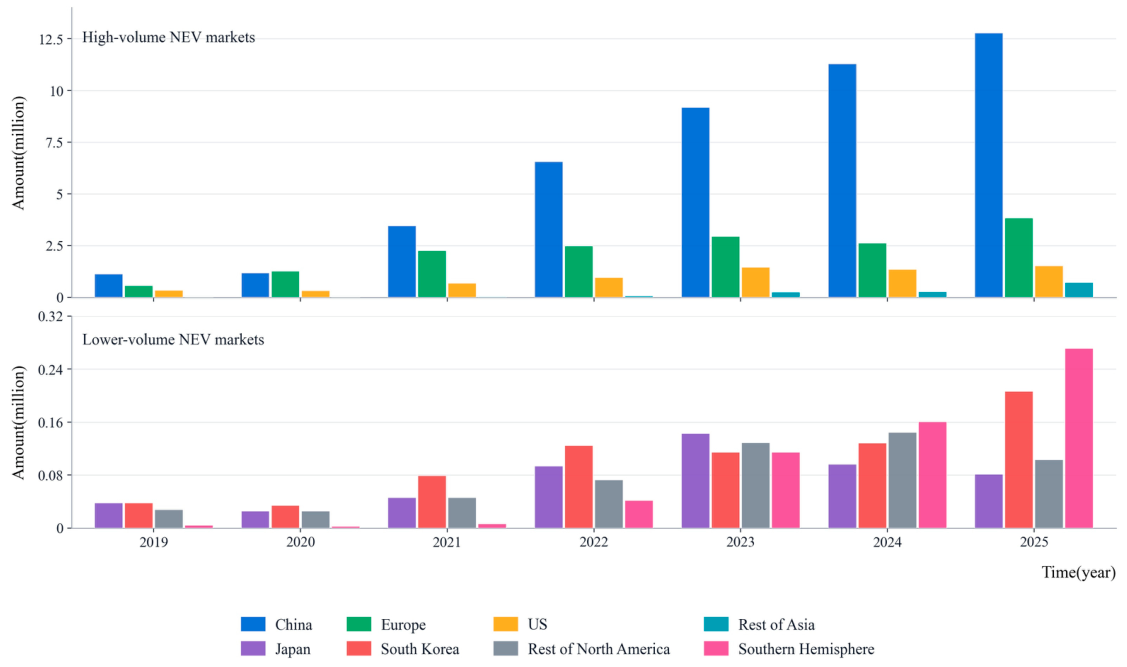
1. Introduction
2. Literature Review
2.1. Consumer Satisfaction Research in the NEV Industry
2.2. Importance-Performance Analysis Model
3. Materials and Methods
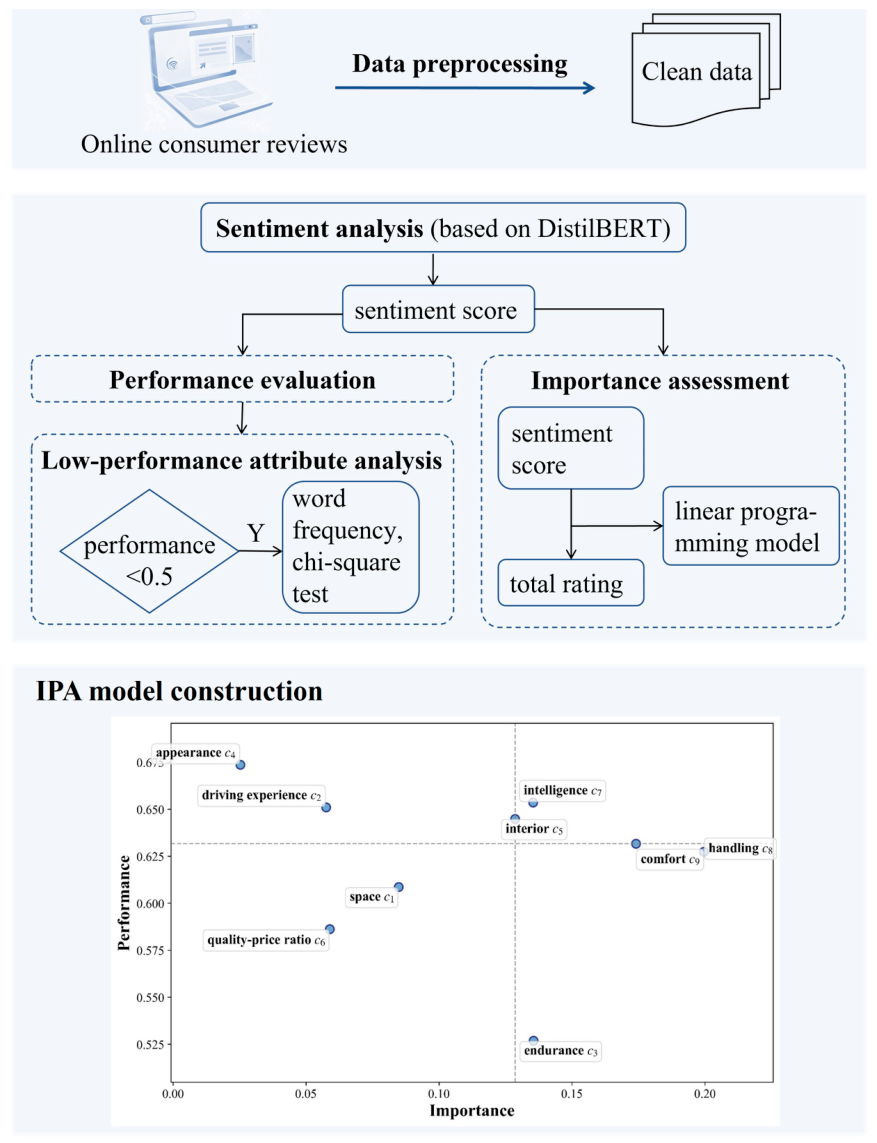
3.1. Outline
3.2. Performance Evaluation
3.3. Importance Assessment
3.4. Low-Performance Attribute Analysis
3.5. IPA Model Construction
4. Results
4.1. Data Collection and Preprocessing
4.2. Estimation of Attribute Performance
4.3. Determination of Attribute Importance
4.4. Further Analysis of Underperforming Attributes
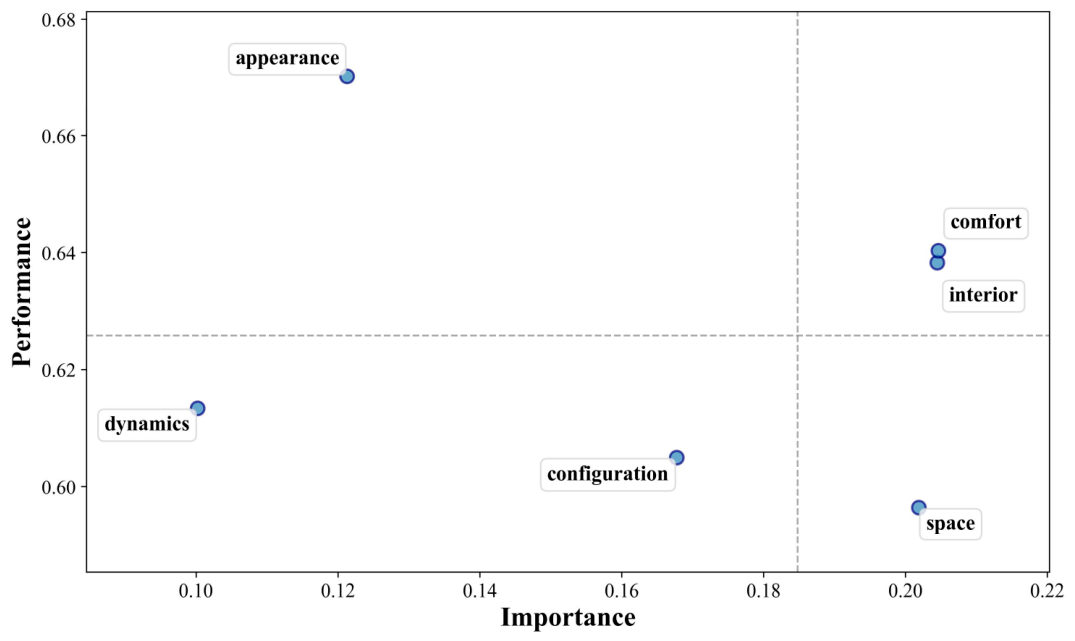
4.5. Construction of the IPA Model
5. Cross-Platform Verification
6. Discussion
- (1)
- Priority improvement suggestions
- (2)
- Advantage maintenance suggestions
- (3)
- Resource reduction suggestions
7. Conclusions
Author Contributions
Funding
Institutional Review Board Statement
Informed Consent Statement
Data Availability Statement
Conflicts of Interest
Appendix A
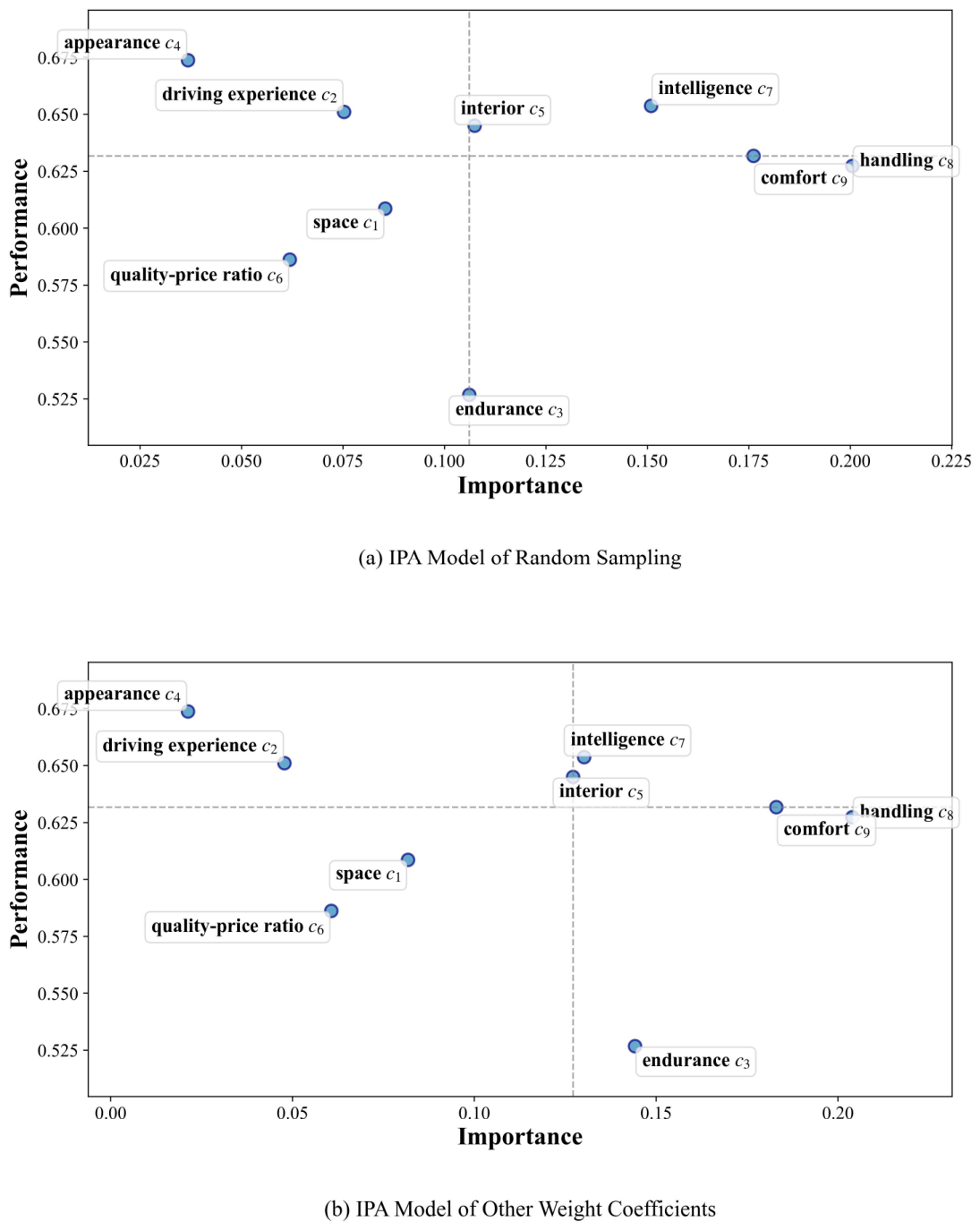
Random Sampling Validation

| Attribute | |||||||||
|---|---|---|---|---|---|---|---|---|---|
| Importance of case 1 | 0.074 | 0.039 | 0.147 | 0.023 | 0.126 | 0.067 | 0.141 | 0.199 | 0.184 |
| ranking | 6 | 8 | 3 | 9 | 5 | 7 | 4 | 1 | 2 |
| Importance of case 2 | 0.087 | 0.057 | 0.137 | 0.017 | 0.135 | 0.053 | 0.114 | 0.202 | 0.198 |
| ranking | 6 | 7 | 2 | 9 | 3 | 8 | 5 | 1 | 4 |
| Importance of case 3 | 0.085 | 0.048 | 0.149 | 0.024 | 0.120 | 0.061 | 0.136 | 0.210 | 0.167 |
| ranking | 6 | 8 | 2 | 9 | 5 | 7 | 4 | 1 | 3 |
Appendix B
Coefficient Sensitivity Test
| Weight Coefficient | M1 | M2 | M3 | M4 |
|---|---|---|---|---|
| Group 1 | 15 | 10 | 5 | 1 |
| Group 2 | 30 | 20 | 10 | 1 |
| Group 3 | 150 | 100 | 50 | 1 |
| Attribute | |||||||||
|---|---|---|---|---|---|---|---|---|---|
| Importance of group 1 | 0.083 | 0.081 | 0.107 | 0.058 | 0.098 | 0.060 | 0.160 | 0.188 | 0.162 |
| ranking | 6 | 7 | 4 | 9 | 5 | 8 | 3 | 1 | 2 |
| Importance of group 2 | 0.085 | 0.076 | 0.106 | 0.043 | 0.106 | 0.061 | 0.153 | 0.198 | 0.172 |
| ranking | 6 | 7 | 4 | 9 | 5 | 8 | 3 | 1 | 2 |
| Importance of group 3 | 0.087 | 0.068 | 0.105 | 0.009 | 0.118 | 0.064 | 0.140 | 0.215 | 0.194 |
| ranking | 6 | 7 | 5 | 9 | 4 | 8 | 3 | 1 | 2 |
Appendix C
Location Robustness Testing
References
- Su, D.; Gu, Y.; Du, Q.; Zhou, W.; Huang, Y. Factors affecting user satisfaction with new energy vehicles: A field survey in Shanghai and Nanjing. J. Environ. Manag. 2020, 270, 110857. [Google Scholar] [CrossRef]
- Yang, T.; Dang, Y.; Wu, J. Dynamic perceived quality analysis using social media data at macro-and micro-levels. Ind. Manag. Data Syst. 2023, 123, 1465–1495. [Google Scholar]
- Hasan, S. Assessment of electric vehicle repurchase intention: A survey-based study on the Norwegian EV market. Transp. Res. Interdiscip. Perspect. 2021, 11, 100439. [Google Scholar] [CrossRef]
- Bian, Y.; Shan, D.; Yan, X.; Zhang, J. New energy vehicle demand forecasting via an improved Bass model with perceived quality identified from online reviews. Ann. Oper. Res. 2024, 1–26. [Google Scholar] [CrossRef]
- Martilla, J.A.; James, J.C. Importance-Performance Analysis. J. Mark. 1977, 41, 77–79. [Google Scholar] [CrossRef]
- Oliver, R.L. A cognitive model of the antecedents and consequences of satisfaction decisions. J. Mark. Res. 1980, 17, 460–469. [Google Scholar] [CrossRef]
- Stigler, G.J.; Becker, G.S. De gustibus non est disputandum. Am. Econ. Rev. 1977, 67, 76–90. [Google Scholar]
- Sun, S.; Fang, D.; Cao, J. Exploring the asymmetric influences of stop attributes on rider satisfaction with bus stops. Travel Behav. Soc. 2020, 19, 162–169. [Google Scholar] [CrossRef]
- Aicher, T.J.; Heere, B.; Odio, M.A.; Ferguson, J.M. Looking beyond performance: Understanding service quality through the importance-performance analysis. Sport Manag. Rev. 2023, 26, 448–470. [Google Scholar]
- Brochado, A.; Veríssimo, J.M.C.; Lupu, C. Airport experience assessment based on Skytrax online ratings and importance-performance analysis: A segmentation approach. J. Mark. Anal. 2024, 1–15. [Google Scholar] [CrossRef]
- Wu, X.; Liao, H. Determining investment allocation strategies to improve consumer satisfaction based on a preference learning model. J. Retail. Consum. Serv. 2025, 82, 104140. [Google Scholar]
- Shi, L.; Wang, X.; He, Y.; He, Z. Beyond Noise: A BERT-Enhanced framework for Intelligent product optimization via online review Analytics. Expert Syst. Appl. 2026, 296, 128812. [Google Scholar]
- Huang, X.; Lin, Y.; Lim, M.K.; Tseng, M.-L.; Zhou, F. The influence of knowledge management on adoption intention of electric vehicles: Perspective on technological knowledge. Ind. Manag. Data Syst. 2021, 121, 1481–1495. [Google Scholar] [CrossRef]
- Liu, Y.; Ou, C.; Zhang, G.; Liang, X. Research on the effect evaluation of protected space driving new technologies industrialization from the perspective of ST. J. Syst. Sci. Complex. 2020, 33, 475–509. [Google Scholar] [CrossRef]
- Wang, L.; Fu, Z.L.; Guo, W.; Liang, R.-Y.; Shao, H.-Y. What influences sales market of new energy vehicles in China? Empirical study based on survey of consumers’ purchase reasons. Energy Policy 2020, 142, 111484. [Google Scholar] [CrossRef]
- Lin, B.; Shi, L. Do environmental quality and policy changes affect the evolution of consumers’ intentions to buy new energy vehicles. Appl. Energy 2022, 310, 118582. [Google Scholar] [CrossRef]
- Wang, D.; Xu, H.; Liu, P. Optimal pricing strategy for new energy vehicle manufacturers by introducing battery leasing mode under subsidies. Ind. Manag. Data Syst. 2025, 1–24. [Google Scholar] [CrossRef]
- Almaghrabi, H.; Soh, B.; Li, A. Using ML to predict user satisfaction with ICT technology for educational institution administration. Information 2024, 15, 218. [Google Scholar] [CrossRef]
- Llopis-Albert, C.; Rubio, F.; Valero, F. Impact of digital transformation on the automotive industry. Technol. Forecast. Soc. Change 2021, 162, 120343. [Google Scholar] [CrossRef] [PubMed]
- Bai, S.; Sun, T.; He, H. Exploring the emotional mechanism of consumer satisfaction in new energy vehicles: A dual-path model of intelligent and eco-friendly experiences. Front. Psychol. 2024, 15, 1436494. [Google Scholar] [CrossRef] [PubMed]
- Ding, J.; Zhang, C.; Li, D.; Li, W.; Zhan, J. A three-way large-scale group decision-making method integrating sentiment analysis and quantum interference-based prospect theory for the selection of new energy vehicles. Expert Syst. Appl. 2025, 275, 126940. [Google Scholar]
- Lee, S.; Park, S.; Kwak, M. Revealing the dual importance and Kano type of attributes through customer review analytics. Adv. Eng. Inf. 2022, 51, 101533. [Google Scholar] [CrossRef]
- Wang, J.; Sun, K.; Liu, P.; Zhang, K.; Feng, L.; Wu, X.; Zhang, Z. Dynamic elicitation and forecasting innovation requirement of smart product-service system via user-manufacturer value co-creation perspective using multi-source data. Comput. Ind. Eng. 2024, 197, 110511. [Google Scholar]
- Tanwar, R.; Agarwal, P.K. Analysis of the determinants of service quality in the multimodal public transport system of Bhopal city using structural equation modelling (SEM) and factor analysis. Expert Syst. Appl. 2024, 256, 124931. [Google Scholar] [CrossRef]
- Yang, Y.; Li, Q.; Li, C.; Qin, Q. User requirements analysis of new energy vehicles based on improved Kano model. Energy 2024, 309, 133134. [Google Scholar] [CrossRef]
- Zhang, Y.; Guo, W.; Chang, Z.; Ma, J.; Fu, Z.; Wang, L.; Shao, H. User requirement modeling and evolutionary analysis based on review data: Supporting the design upgrade of product attributes. Adv. Eng. Inform. 2024, 62, 102861. [Google Scholar] [CrossRef]
- Joung, J.; Kim, H. Interpretable machine learning-based approach for customer segmentation for new product development from online product reviews. Int. J. Inf. Manag. 2023, 70, 102641. [Google Scholar] [CrossRef]
- Wu, X.; Liao, H.; Zhang, C. Importance-performance analysis to develop product/service improvement strategies through online reviews with reliability. Ann. Oper. Res. 2024, 342, 1905–1924. [Google Scholar]
- Lai, I.K.W.; Wong, J.W.C. Comparing crisis management practices in the hotel industry between initial and pandemic stages of COVID-19. Int. J. Contemp. Hosp. Manag. 2020, 32, 3135–3156. [Google Scholar] [CrossRef]
- Lu, L.; Xu, P.; Wang, Y.Y.; Wang, Y. Measuring service quality with text analytics: Considering both importance and performance of consumer opinions on social and non-social online platforms. J. Bus. Res. 2023, 169, 114298. [Google Scholar] [CrossRef]
- Quan, L.; Han, H. Consumer behavior toward cultured meat in the foodservice industry: Insights from IPA and fsQCA analysis on shifting trends. J. Retail. Consum. Serv. 2025, 85, 104307. [Google Scholar] [CrossRef]
- Chen, K.S.; Lin, K.P.; Lin, L.J. Evaluating the environmental protection strategy of a printed circuit board manufacturer using a Tw fuzzy importance performance analysis with Google Trends. Expert Syst. Appl. 2020, 156, 113483. [Google Scholar]
- Chen, J.; Becken, S.; Stantic, B. Assessing destination satisfaction by social media: An innovative approach using Importance-Performance Analysis. Ann. Tour. Res. 2022, 93, 103371. [Google Scholar] [CrossRef]
- Liu, P.; Shi, X.; Xu, Y.; Dang, R.; Wu, Y. Integration of machine learning with comprehensive IVIF-QFD-MCDM framework for enhancing online hotel operations. Inf. Sci. 2025, 720, 122493. [Google Scholar] [CrossRef]
- Miah, M.S.U.; Kabir, M.M.; Sarwar, T.B.; Safran, M.; Alfarhood, S.; Mridha, M.F. A multimodal approach to cross-lingual sentiment analysis with ensemble of transformer and LLM. Sci. Rep. 2024, 14, 9603. [Google Scholar] [CrossRef] [PubMed]
- Ma, B.; Wong, Y.D.; Teo, C.C.; Wang, Z. Enhance understandings of Online Food Delivery’s service quality with online reviews. J. Retail. Consum. Serv. 2024, 76, 103588. [Google Scholar]
- Hauff, S.; Richter, N.F.; Sarstedt, M.; Ringle, C.M. Importance and performance in PLS-SEM and NCA: Introducing the combined importance-performance map analysis (cIPMA). J. Retail. Consum. Serv. 2024, 78, 103723. [Google Scholar]
- Joung, J.; Kim, H.M. Approach for importance–performance analysis of product attributes from online reviews. J. Mech. Des. 2021, 143, 081705. [Google Scholar] [CrossRef]
- Ranjbari, M.; Shams Esfandabadi, Z.; Scagnelli, S.D. A big data approach to map the service quality of short-stay accommodation sharing. Int. J. Contemp. Hosp. Manag. 2020, 32, 2575–2592. [Google Scholar] [CrossRef]
- Kim, S.A.; Park, S.; Kwak, M.; Kang, C. Examining product quality and competitiveness via online reviews: An integrated approach of importance performance competitor analysis and Kano model. J. Retail. Consum. Serv. 2025, 82, 104135. [Google Scholar] [CrossRef]
- Ban, O.I.; Droj, L.; Tușe, D.A.; Botezat, E. Operationalization of importance-performance analysis with nine categories and tested for green practices and financial evaluation. Technol. Econ. Dev. Econ. 2022, 28, 1711–1738. [Google Scholar] [CrossRef]
- Băban, M.; Băban, C.F. Addressing antecedents’ importance of open innovation between industry and universities: A neural network-based importance-performance analysis with a fuzzy approach. Alex. Eng. J. 2024, 104, 515–528. [Google Scholar] [CrossRef]
- Wang, Z.; Hu, S.; Niu, S.; Li, S.-Y.; Liu, W.-D.; Huang, L.-Y. Research on product design improvement method based on online review and improvement importance performance competitor analysis. Expert Syst. Appl. 2025, 279, 127400. [Google Scholar] [CrossRef]
- Chou, C.C. Applying a new Importance-Unsatisfaction-Improvement theory to prioritizing improvement alternatives for a sustainable port. Res. Transp. Bus. Manag. 2024, 54, 101127. [Google Scholar] [CrossRef]
- Qin, J.; Zheng, P.; Wang, X. Product redesign and innovation based on online reviews: A multistage combined search method. INFORMS J. Comput. 2024, 36, 742–765. [Google Scholar] [CrossRef]
- Nawawi, I.; Ilmawan, K.F.; Maarif, M.R.; Syafrudin, M. Exploring tourist experience through online reviews using aspect-based sentiment analysis with zero-shot learning for hospitality service enhancement. Information 2024, 15, 499. [Google Scholar] [CrossRef]
- Liang, Q.; Zhang, Z.; Su, Y. Constructive preference elicitation for multi-criteria decision analysis using an estimate-then-select strategy. Inf. Fusion 2025, 118, 102926. [Google Scholar]


| Methods | Performance Evaluation | Importance Assessment | Improvement of the Classical IPA | Advantages | Disadvantages |
|---|---|---|---|---|---|
| Chen et al. [32] | Fuzzy questionnaire | Fuzzy questionnaire, Google search frequency | / | Combining Google search frequency to generate assessment results that better reflect social dynamics. | The accuracy of Google search data depends on keyword selection. |
| Lai and Wong [29] | Questionnaire, Interview | Questionnaire, Interview | / | Employing the correlation between attribute usage and perceived performance as an indirect performance measure to improve data reliability and validity. | Questionnaire samples may be subject to self-selection bias. |
| Ranjbari et al. [39] | Questionnaire, Likert scale | Questionnaire, Linear regression | / | Extracting and clustering attributes from online reviews to design questionnaires. | Questionnaire surveys are inherently subjective. |
| Sun et al. [8] | Questionnaire, Likert scale | Questionnaire, Linear regression | / | Calculating attribute importance by incorporating three-factor theory. | Questionnaire surveys are inherently subjective. |
| Joung and Kim [38] | IBM Watson | SHAP | / | Conducting IPA for different product segments. | Importance evaluation using deep neural networks and genetic algorithms requires substantial computational resources and time. |
| Chen et al. [33] | Sentiment dictionary | Association rule mining | / | Utilising association rule mining to assess importance values across multiple destinations. | Data collection relies on geographic coordinates and keywords, which may be one-sided. |
| Lu et al. [30] | TextBlob | Frequency of feature words | / | Aggregating results monthly to reflect trends in service quality changes. | Word frequency-based importance lacks scientific rigour. |
| Brochado et al. [10] | Star ratings | ANN | / | Applying a multidimensional segmentation approach. | ANN-based results exhibit limited interpretability. |
| Joung and Kim [27] | VADER | SHAP | / | Effectively explaining non-linear relationships. | Reliance on machine learning interpretability may still result in limited transparency. |
| Qin et al. [45] | Stanford CoreNLP | SHAP | Added the third dimension | Integrating multiple data sources and analytical techniques. | Potential computational efficiency issues with complex data. |
| Tanwar and Agarwal [24] | Questionnaire, Likert scale | Questionnaire, Likert scale | / | Simple calculation with low resource requirements. | Data collection requires substantial human intervention and is highly subjective. |
| Wang et al. [23] | SnowNLP | Frequency of text | / | Combining satisfaction and importance with time windows to construct a dynamic IPA matrix. | Word frequency-based importance lacks scientific rigour. |
| Wu et al. [28] | Stanford CoreNLP | Linear programming model | / | Introducing review credibility to improve importance and performance evaluation accuracy. | The definition of review credibility requires contextual adjustment. |
| Wang et al. [43] | GRU-CAP | Frequency of feature words | Added the third dimension | Introducing a third dimension improves result accuracy. | Word frequency-based importance lacks scientific rigour. |
| Wu and Liao [11] | Stanford CoreNLP | Preference Learning Model | Added asymmetric IPA | Extending traditional IPA to asymmetric IPA. | Reducing attribute importance to binary reward or penalty weights fails to capture continuous consumer perception. |
| our paper | DistilBERT-based multilingual sentiment model | Linear programming model with constraint priorities | Improved performance dimension | Proposing a more interpretable attribute importance calculation method and optimising the performance dimension. | Review reliability is not considered because the platform pre-screens reviews; no additional qualitative dimension is added to the traditional IPA framework. |
| Negative Reviews | Positive Reviews | Total | |
|---|---|---|---|
| Negative Vocabulary Present | |||
| Negative Vocabulary Absent | |||
| Total |
| Attribute | |||||||||
|---|---|---|---|---|---|---|---|---|---|
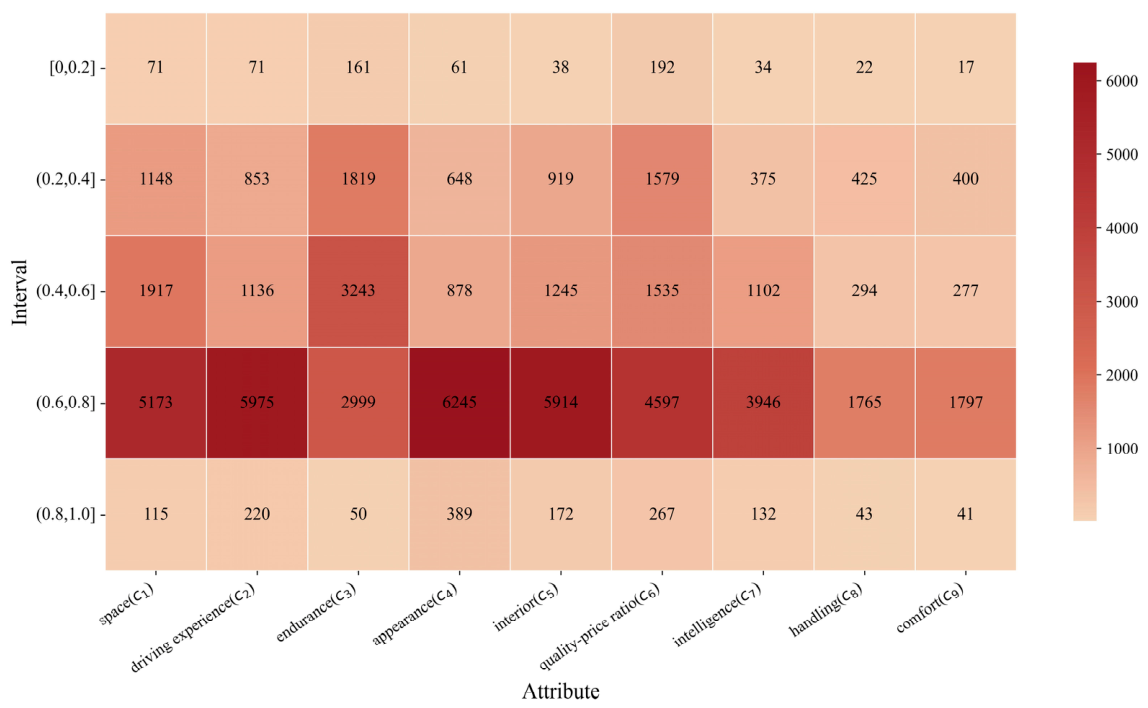
| Frequency | 1 | 0.980 | 0.982 | 0.976 | 0.984 | 0.970 | 0.677 | 0.303 | 0.301 |
| Index | |||||||||
|---|---|---|---|---|---|---|---|---|---|
| R1 | 0.871 | 0.852 | 0.836 | 0.448 | 0.742 | 0.225 | 0.811 | / | / |
| R2 | 0.922 | 0.618 | 0.501 | 0.866 | 0.587 | 0.551 | / | / | / |
| … | … | … | … | … | … | … | … | … | … |
| R8424 | 0.733 | 0.461 | 0.498 | 0.400 | / | 0.274 | 0.513 | / | / |
| Attribute | |||||||||
|---|---|---|---|---|---|---|---|---|---|
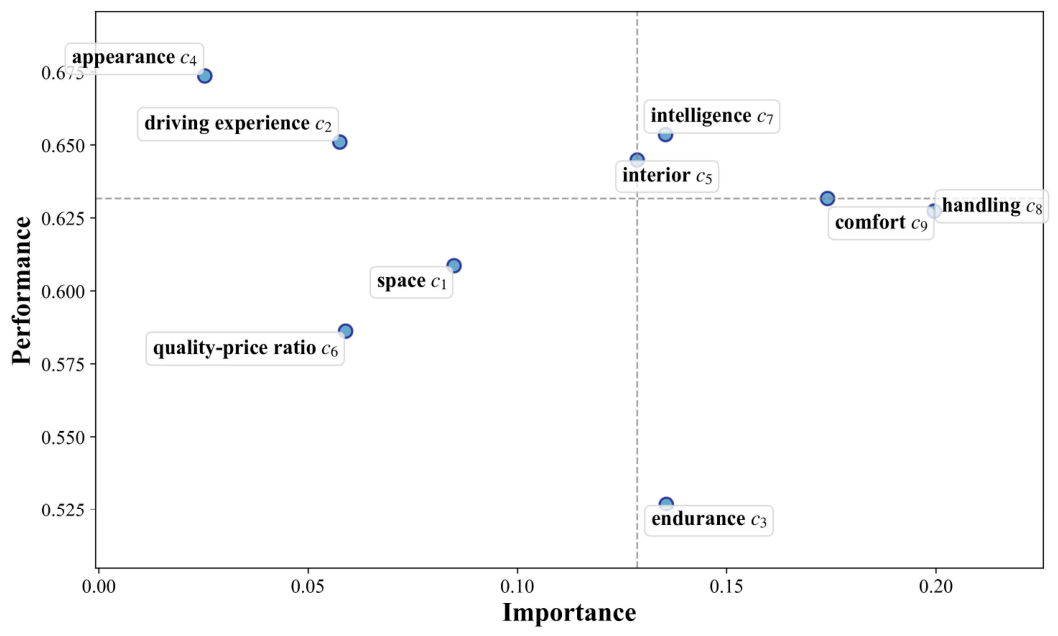
| Performance | 0.609 | 0.651 | 0.527 | 0.674 | 0.645 | 0.586 | 0.654 | 0.627 | 0.632 |
| Rating (x) | 4.5 < x ≤ 5 | 3.8 < x ≤ 4.5 | 2.8 < x ≤ 3.8 | 1.5 < x ≤ 2.8 | 0 < x ≤ 1.5 |
|---|---|---|---|---|---|
| Categorisation | 5 | 4 | 3 | 2 | 1 |
| Attribute | |||||||||
|---|---|---|---|---|---|---|---|---|---|
| Importance | 0.085 | 0.058 | 0.136 | 0.025 | 0.129 | 0.059 | 0.135 | 0.200 | 0.174 |
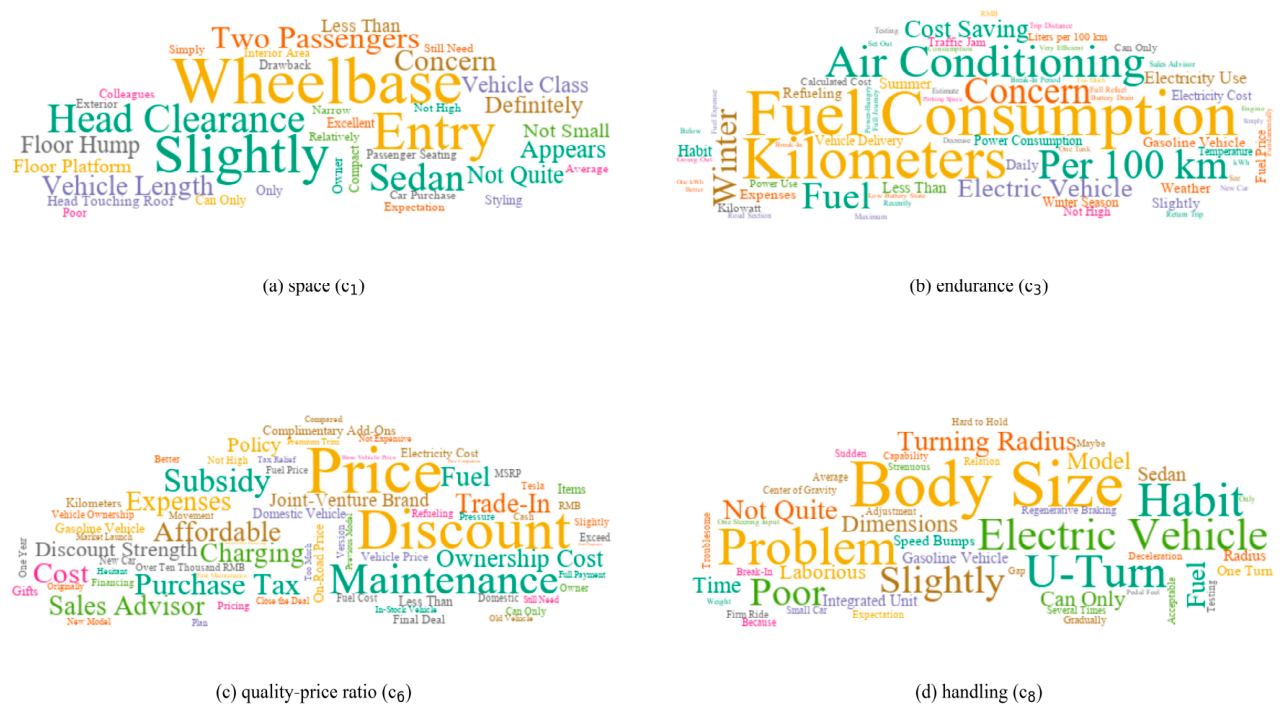
| Attribute | Negative Vocabulary | df | Chi-Square Value | OR |
|---|---|---|---|---|
| Space (c1) | Wheelbase | 1 | 4.818 | 1.202 |
| Head Clearance | 1 | 12.328 | 1.446 | |
| Sedan | 1 | 5.705 | 1.306 | |
| Vehicle Length | 1 | 16.719 | 1.699 | |
| Vehicle Class | 1 | 13.199 | 1.671 | |
| Endurance (c3) | Fuel Consumption | 1 | 6.981 | 1.151 |
| Kilometres | 1 | 23.276 | 1.253 | |
| Air Conditioning | 1 | 23.484 | 1.386 | |
| Fuel | 1 | 21.716 | 1.438 | |
| Winter | 1 | 71.725 | 2.228 | |
| Quality-Price Ratio (c6) | Price | 1 | 4.687 | 1.112 |
| Discount | 1 | 273.061 | 2.564 | |
| Maintenance | 1 | 20.703 | 1.387 | |
| Subsidy | 1 | 43.595 | 1.922 | |
| Purchase Tax | 1 | 30.365 | 1.690 | |
| Handling (c8) | Body Size | 1 | 14.683 | 1.627 |
| U-Turn | 1 | 50.194 | 4.187 | |
| Electric Vehicle | 1 | 15.922 | 2.353 | |
| Turning Radius | 1 | 12.035 | 2.086 | |
| Fuel | 1 | 11.328 | 2.415 |
Disclaimer/Publisher’s Note: The statements, opinions and data contained in all publications are solely those of the individual author(s) and contributor(s) and not of MDPI and/or the editor(s). MDPI and/or the editor(s) disclaim responsibility for any injury to people or property resulting from any ideas, methods, instructions or products referred to in the content. |
© 2026 by the authors. Licensee MDPI, Basel, Switzerland. This article is an open access article distributed under the terms and conditions of the Creative Commons Attribution (CC BY) license.
Share and Cite
Li, Y.; Yang, N. Fine-Grained Attribute Analysis of User Satisfaction for NEVs: An Interpretable Importance–Performance Analysis Based on Online Reviews. Information 2026, 17, 636. https://doi.org/10.3390/info17070636
Li Y, Yang N. Fine-Grained Attribute Analysis of User Satisfaction for NEVs: An Interpretable Importance–Performance Analysis Based on Online Reviews. Information. 2026; 17(7):636. https://doi.org/10.3390/info17070636
Chicago/Turabian StyleLi, Yajie, and Na Yang. 2026. "Fine-Grained Attribute Analysis of User Satisfaction for NEVs: An Interpretable Importance–Performance Analysis Based on Online Reviews" Information 17, no. 7: 636. https://doi.org/10.3390/info17070636
APA StyleLi, Y., & Yang, N. (2026). Fine-Grained Attribute Analysis of User Satisfaction for NEVs: An Interpretable Importance–Performance Analysis Based on Online Reviews. Information, 17(7), 636. https://doi.org/10.3390/info17070636