1. Introduction
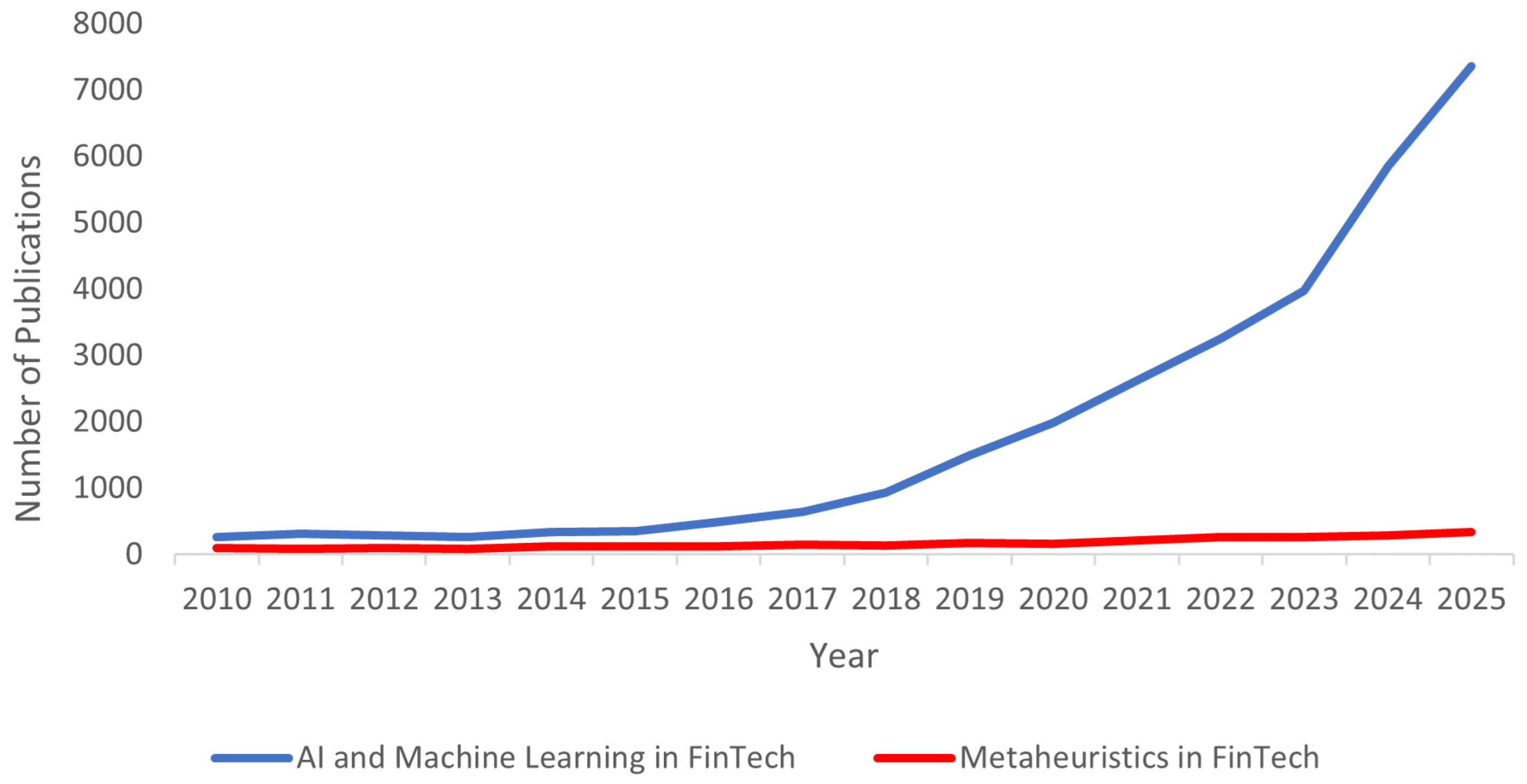
In the modern financial sector, where complex data flows are continuously generated and volatility is increasing, accurate forecasting has become an essential component of strategic decision-making and effective risk management. Financial forecasting refers to the estimation of future financial patterns and behavior using historical data, market information, and other predictive factors. The accuracy of these estimates is critical, as they directly influence investment decisions, financial management, and corporate strategy [
1]. As noted by some authors [
2], financial data, especially for big data analysis, has become increasingly large-scale, heterogeneous, and unstructured, posing significant challenges for traditional econometric models that depend on clean, structured data with limited volume. Consequently, such data are often high-dimensional, where the number of variables (features) can exceed the number of observations [
3]. In the current dynamic financial environment, enterprises and organizations face increasing complexity in managing financial risks [
4]. Globalized markets, the development of new financial instruments, and stricter regulatory requirements have intensified the challenges of risk assessment and decision-making. Traditional financial risk management strategies, which are often based on historical data and qualitative assessments, are insufficient under rapidly changing financial conditions. Predictive analytics can support decision-making under uncertainty by enabling data-driven financial risk management. This improves the reliability of financial models and the ability of institutions to respond to market uncertainty [
5].
For decades, financial analysis has relied on classical statistical techniques to identify patterns in data. In this context, artificial intelligence and, in particular, machine learning provide new opportunities by enabling the modeling of complex, nonlinear, and high-dimensional financial relationships. ML is closely associated with big data, which refers to datasets characterized by large volume, high dimensionality, or both [
6]. From a technical perspective, ML can be viewed as a core subset of AI focused on learning from data. In contrast, AI systems may also include broader capabilities beyond learning, such as reasoning and autonomous decision-making. Some authors describe full AI systems as those capable of automating data identification, testing, and decision-making based on data-driven evidence [
7]. The financial sector generates a continuously growing volume of data, including transactional records and market indicators. This data-rich environment provides a suitable setting for AI applications, particularly for developing predictive and analytical models [
8]. AI-based systems can assist financial institutions in handling complex and uncertain market conditions by identifying patterns in historical and real-time data [
9]. Within this context, ML enables systems to detect patterns and derive insights from data without explicit programming. This adaptability supports a wide range of financial forecasting and decision-support applications [
10]. Moreover, regulatory pressures and evolving customer expectations are pushing financial institutions to adopt intelligent systems that are both transparent and compliant. With the development of cloud infrastructure and edge computing, low-latency data processing enables real-time decision support, allowing AI models to be integrated directly into financial workflows [
11]. These developments are not limited to large multinational banks.
Several managerial problems in finance and insurance can be formulated as combinatorial optimization problems. Traditionally, exact methods have been used to obtain optimal solutions. One well-known example is the classical Markowitz model [
12], which minimizes portfolio risk subject to a minimum return constraint. However, exact methods face limitations when applied to large-scale optimization problems with realistic constraints, many of which are NP-hard. In such cases, solutions are often limited by simplifying assumptions or high computational cost [
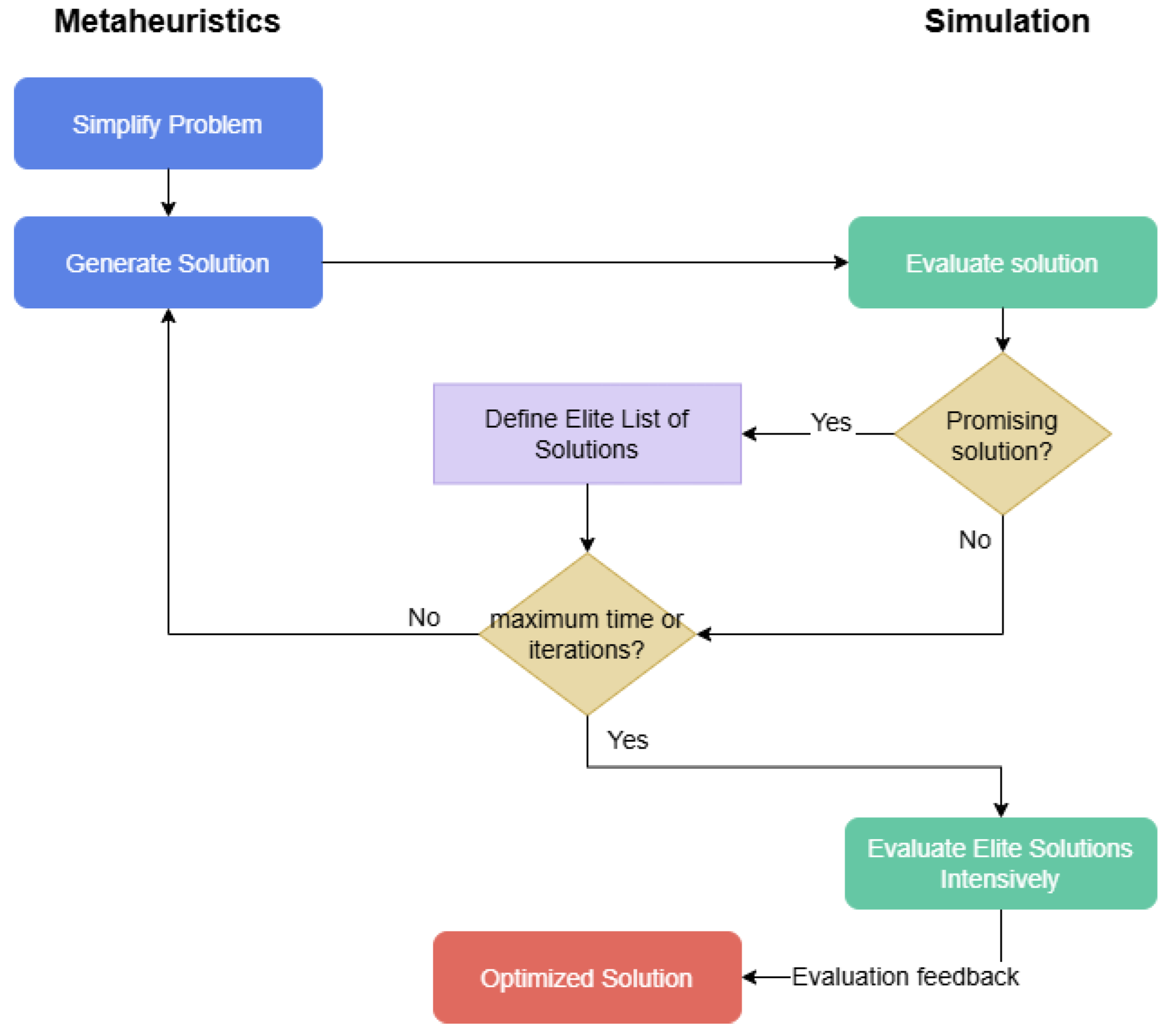
13]. In contemporary financial applications, advances in operations research and computer science have introduced new solution approaches. Exact methods based on mathematical and constraint programming techniques are now often complemented by approximate algorithms, such as heuristics and metaheuristics, to obtain near-optimal solutions for complex combinatorial optimization problems [
14]. The rapid dynamics and increasing internationalization of financial markets have made decision-making more complex, while stricter regulation has imposed additional constraints. This has increased the need for methods capable of modeling and solving complex optimization problems in banks, central banks, institutional investors, and insurance companies [
13]. Metaheuristics are widely recognized as effective solvers for combinatorial optimization problems, including hard optimization cases [
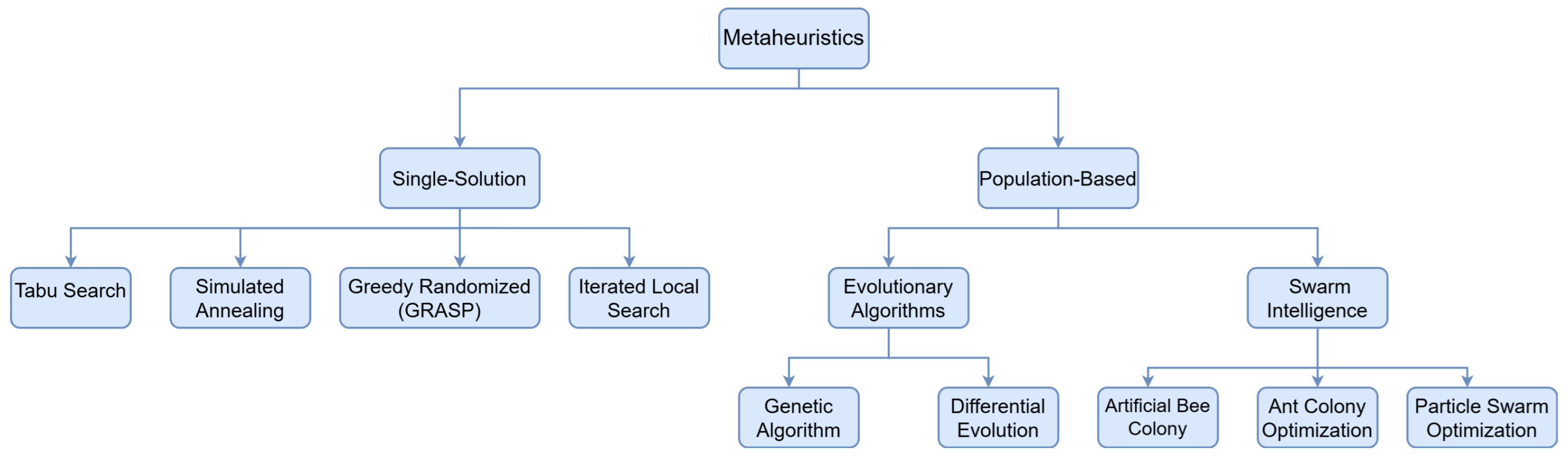
15]. A metaheuristic is a high-level heuristic framework designed to solve a broad class of problems without requiring major modifications to its structure. These methods iteratively improve candidate solutions using general search strategies. Their main strength lies in their flexibility and ability to produce good-quality solutions across diverse problem structures [
16]. Still, several challenges remain in the rapid integration of AI into FinTech. Ethical concerns, particularly algorithmic bias and data privacy, are critical issues that must be addressed to ensure responsible deployment [
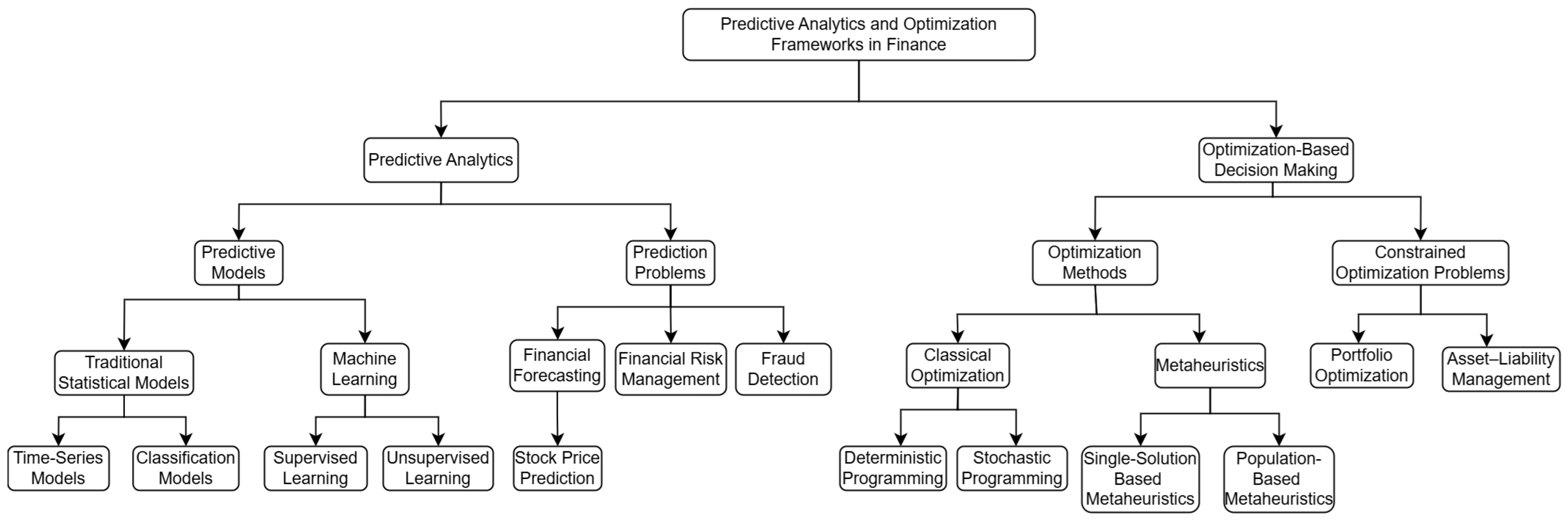
17]. Balancing innovation with ethical and regulatory requirements is therefore essential for sustainable development in the financial sector. Given the diversity of AI, statistical learning, optimization methods, and financial applications, a systematic classification is needed to structure the literature. Based on this survey, studies are grouped into two main categories according to the role of data-driven methods (
Figure 1): predictive analytics and optimization-based decision-making (prescriptive analytics). Predictive analytics focuses on identifying patterns in historical data to support forecasting tasks, while optimization-based decision-making focuses on identifying optimal financial strategies under constraints.
In this paper, the following research questions are considered: (i) what are the critical applications of AI and ML in predictive analytics for the FinTech and financial services sectors, and what have been the most common methodological trends reported in the literature?; (ii) how have optimization-based approaches, including metaheuristic and simheuristic methods, been applied to financial decision-making problems in FinTech?; and (iii) how can predictive AI/ML models be integrated into optimization-based decision-making systems in financial applications in the presence of uncertainty? The paper analyzes the literature on predictive AI/ML methods and optimization-based decision-making approaches within a unified FinTech framework. It examines both streams of research (predictive analytics and optimization) jointly and highlights their complementary roles in financial and FinTech applications. Moreover, it highlights opportunities for their integration and discusses how hybrid approaches can enhance financial decision-making. The remaining of the paper is organized as follows.
Section 2 describes the review strategy used to collect and analyze the relevant literature.
Section 3 provides an overview of traditional econometric models applied in financial prediction.
Section 4 examines ML approaches for predictive analytics in FinTech applications.
Section 5 discusses the use of metaheuristic and simheuristic methods for optimization-based financial decision-making.
Section 6 discusses the research gaps and future directions, while
Section 7 concludes the paper.
4. Machine Learning for Predictive Analytics
Financial markets generate large volumes of data on a daily basis. This data provides both opportunities and challenges: it enables data-driven decision-making while also requiring efficient methods for processing and analyzing large-scale datasets. ML algorithms are well suited for this setting, as they can identify patterns in data and improve predictive performance over time without being explicitly programmed [
33]. ML methods are commonly categorized into three main types based on the learning paradigm: supervised, unsupervised, and RL. Supervised learning relies on labeled datasets, where input-output pairs
are provided during training. The target variable
y is used to guide the optimization of model parameters through iterative updates [
34]. These models are widely used in classification and regression tasks, where the goal is to predict discrete or continuous outcomes from historical financial data. Such approaches are extensively applied in financial predictive analytics and are often embedded in decision-support systems to improve forecasting performance and support data-driven decision-making [
5].
Unsupervised learning, in contrast, identifies patterns in data without labeled outputs. It includes clustering, association analysis, and dimensionality reduction. These methods aim to capture the underlying structure of the data and can also be used to detect anomalies as observations that deviate significantly from learned patterns [
35]. In finance, unsupervised techniques are commonly applied in anomaly detection, fraud detection, and customer segmentation, particularly when labeled data are limited and patterns must be inferred directly from the data. RL is a learning paradigm in which an agent interacts with an environment to learn optimal behavioral strategies. The objective is to learn a policy that maps states to actions in order to maximize cumulative expected reward. Rewards may be assigned at intermediate and final steps, providing feedback on the effectiveness of actions with respect to long-term objectives [
36].
In predictive FinTech applications, supervised learning methods dominate empirical studies due to the availability of labeled financial data. They are widely used in stock price prediction, credit risk assessment, and fraud detection. Unsupervised methods are less frequently applied and are mainly used for clustering and anomaly detection tasks [
37,
38]. More generally, ML can be defined as a computational approach that improves performance on a task or generates predictions based on past data [
34]. These methods typically rely on the optimization of a loss or reward function. ML models capture complex relationships in data by minimizing prediction error or maximizing performance criteria, leading to flexible representations of underlying data structures [
38].
The ML approach to data analysis differs fundamentally from traditional statistical modeling and hypothesis testing. Classical inference tools such as
,
t-values,
p-values, and statistical significance are less central, while greater emphasis is placed on out-of-sample prediction and the bias-variance trade-off. Regularization techniques are commonly used to control model complexity and improve generalization [
39]. Thus, the choice of ML methods in predictive FinTech applications depends on the data structure and the nature of the prediction task. This empirical, loss-based perspective aligns with recent FinTech literature, which treats predictive analytics as a data-driven forecasting problem in noisy and non-stationary environments, where model performance is primarily evaluated using out-of-sample accuracy rather than structural interpretability [
40]. Model evaluation is a relevant component of predictive ML, as it determines the generalization ability and accuracy of learned models. Common error-based evaluation metrics in financial forecasting include mean absolute percentage error, mean squared error (MSE), mean absolute error, and root mean squared error, which are widely used in empirical studies [
41,
42].
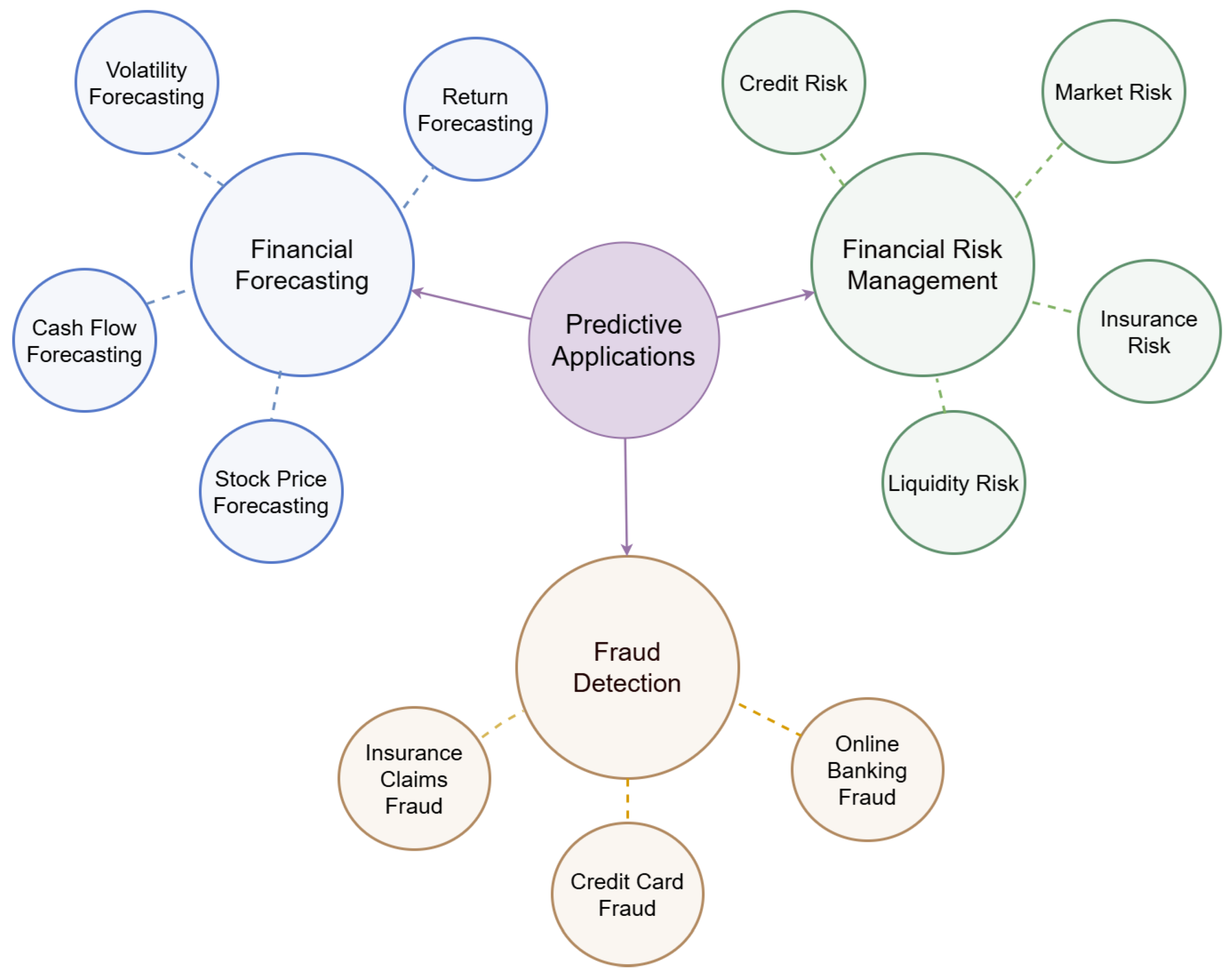
Figure 4 displays a taxonomy of the most recurrent predictive analytics applications identified in the literature review. These applications can be classified into three broad categories: financial forecasting, financial risk management and fraud detection. The taxonomy shows the use of AI and ML techniques in different contexts of financial decision making and reveals the wide spectrum of predictive analytics applications discussed in this review.
4.3. Machine Learning for Fraud Detection
Financial fraud detection is a complex and data-intensive process that involves identifying suspicious patterns, anomalies, and irregular transactions within large financial datasets [
76]. In practice, it is not feasible for humans to monitor and detect all fraudulent cases manually. However, timely detection and prevention of fraud are essential for maintaining and protecting customer trust. As a result, automated fraud detection systems are often used as a first line of defense, flagging potentially illegitimate transactions for further investigation [
77]. A key challenge in this context is that fraudulent cases are typically highly underrepresented in datasets, which significantly reduces the performance of standard binary classifiers [
78]. This class imbalance makes the learning task particularly difficult for conventional models. ML has significantly improved the ability to detect fraud. For example, some authors study credit card fraud detection using ensemble learning methods such as AdaBoost and majority voting [
79]. Their work evaluates several ML models, including naive Bayes, RF, and GB trees, and highlights the effectiveness of ensemble techniques in improving detection performance. In particular, their results indicate that AdaBoost is sensitive to anomalies and outliers, making it suitable for detecting rare fraudulent transactions. In general, AI techniques such as neural networks and anomaly detection methods can analyze customer behavior, detect suspicious activity, and support the development of institutional fraud prevention policies [
80].
Traditional fraud detection in the insurance sector relied heavily on manual auditing and inspection processes [
81]. However, with the increase in data volume and operational complexity, such approaches have become impractical [
82]. In addition, fraudsters continuously adapt their strategies, making it difficult to detect fraudulent behavior using fixed rule-based systems [
83]. Ensemble learning methods combine multiple models to improve predictive performance compared to individual learners [
84]. These techniques have been widely applied in insurance-related tasks, including claims prediction and fraud detection, demonstrating strong practical effectiveness across different settings [
85]. The use of ML in the insurance sector has further expanded with the development of deep learning. For example, convolutional neural networks and recurrent neural networks, including LSTM networks, have been applied to image and sequential data analysis [
86]. These models allow insurers to evaluate claims more accurately by processing unstructured data such as vehicle damage images. In addition, natural language processing (NLP) techniques combined with ML models have shown strong performance in extracting information from textual data such as customer communications, policy documents, and claim descriptions [
87]. Despite their advantages, ML-based fraud detection systems face several limitations, including severe class imbalance [
88], evolving fraud patterns, and limited model interpretability [
89], which can affect their robustness and reliability in real-world applications. A primary concern related to ML-based fraud detection is explainability and interpretability. Most traditional machine learning architectures operate in a “black box” manner to an extent, limiting easy interpretation of their decision-making processes by financial analysts and regulatory authorities [
90]. As a result, explainable artificial intelligence (XAI) has become a growing focus in the financial sector for enhancing transparency, trust, and accountability in AI-based decision-making and fraud detection processes [
91]. XAI enables financial institutions to support decision-making in domains such as fraud detection by identifying potential biases and ensuring fairness in automated decision-making processes [
92]. The application of XAI enhances transparency in decision-making, essential for regulatory compliance and operational efficiency [
93]. It is common the use of different ML techniques, including ANN, ensemble learning methods, NLP and anomaly detection algorithms, to detect fraudulent activities in financial systems [
76,
79,
81].
Table 2 summarizes representative ML-based studies across key FinTech application areas.
The analysed studies indicate that the effectiveness of ML techniques depends on the application domain and the nature of the underlying datasets. High-frequency market data, macroeconomic data, transactional data, and historical stock data have also been used for financial forecasting and stock price prediction, including SVM, ANN, RF, and LSTM models that capture data patterns. Comparative evidence indicates that there are differences in performance between models and datasets. For instance, RF was observed to outperform ANN, SVM, and naive Bayes for stock price prediction, and RF and XGBoost were observed to be superior for motor insurance claims forecasting [
97,
99]. In financial risk management, decision-tree-based and neural-network approaches have been adapted to structured financial data, with the advent of Adaboosted decision trees demonstrating improved predictive performance than the classical decision trees in financial distress prediction [
103,
105]. Ensemble and neural network techniques have shown strong effectiveness in fraud detection for highly imbalanced transaction and insurance claim datasets. In contrast, clustering techniques are useful in discovering hidden fraud patterns and customer segments [
106,
107,
108].
Table 3 summarizes the distribution of ML techniques across the reviewed studies. It presents the frequency of different models in financial forecasting, stock price prediction, financial risk management, and fraud detection. The table is based on the full set of studies analyzed in this review.
The results indicate that the choice of ML models varies across application domains. LSTM, ANN, and SVM are widely used in financial forecasting due to their ability to capture nonlinear and temporal dependencies in time-series data. In stock price prediction, similar models are frequently applied, particularly neural network-based approaches, SVM, and RF, for both classification and regression tasks such as price direction and trend prediction. For financial risk management, decision trees, ANN, RF, and regression models are commonly used, particularly for classification problems such as credit risk and financial distress prediction. In fraud detection, clustering and classification methods such as K-Means, RF, ANN are often applied to identify anomalous and fraudulent patterns, especially in credit card transaction and insurance claim datasets.
During the last years, large language models (LLMs) and generative AI have gained considerable attention for financial question answering, sentiment analysis, understanding financial documents, predicting market trends, automated financial reporting, and decision support systems, among other applications. Thus, some authors provide a comprehensive review of financial LLMs, highlighting their growing adoption across a wide range of financial NLP tasks and applications [
109]. Finance includes decision-making in a setting of uncertainty. Data achieve financial importance when they support a decision: to lend, trade, hedge, rebalance, authorize, examine, disclose, intervene, or regulate. The growth of AI in finance represents a change in the architecture of financial decision-making. AI systems currently obtain information from both structured and unstructured data, transform noisy observations into detectable signals, produce suggestions, trigger alerts, proactively perform actions, and derive insights from outcomes [
110]. Traditional ML techniques usually require training on manually labeled datasets. In contrast, the major advantage of advanced LLMs is the reduction or elimination of labeling costs. The integration of LLMs with automated sentiment analysis techniques is a promising direction to improve the efficiency and reliability of financial sentiment analysis so as to facilitate more informed investment decisions [
111].
6. Discussion and Research Gaps
The analysis presented in the preceding sections shows the growing importance of ML models in enhancing predictive analytics across a wide range of FinTech applications. At the same time, an expanding body of literature emphasizes the role of decision-oriented models that utilize predictive information to support complex financial decisions under uncertainty and operational constraints. ML enables financial institutions to extract insights from large volumes of data, thereby improving forecasting accuracy and reducing reliance on judgment-based decision-making. Applications such as market forecasting, portfolio management, and financial risk assessment have shown the ability of ML algorithms to capture nonlinear relationships and complex patterns that are difficult to identify using traditional statistical methods. In addition, deep learning models have improved credit assessment processes by incorporating large-scale and heterogeneous data sources, thereby supporting more inclusive financial services. This transformation is also reflected in the growth of algorithmic trading systems, where AI-driven models continuously adapt to changing market conditions and support automated decision-making. Despite these advances, several challenges remain associated with the integration of ML into financial decision-making. Key concerns include model interpretability, robustness, governance, and regulatory compliance. These challenges become particularly significant when ML-based predictions are incorporated into financial decisions that must be made under market uncertainty and subject to complex operational and regulatory constraints.
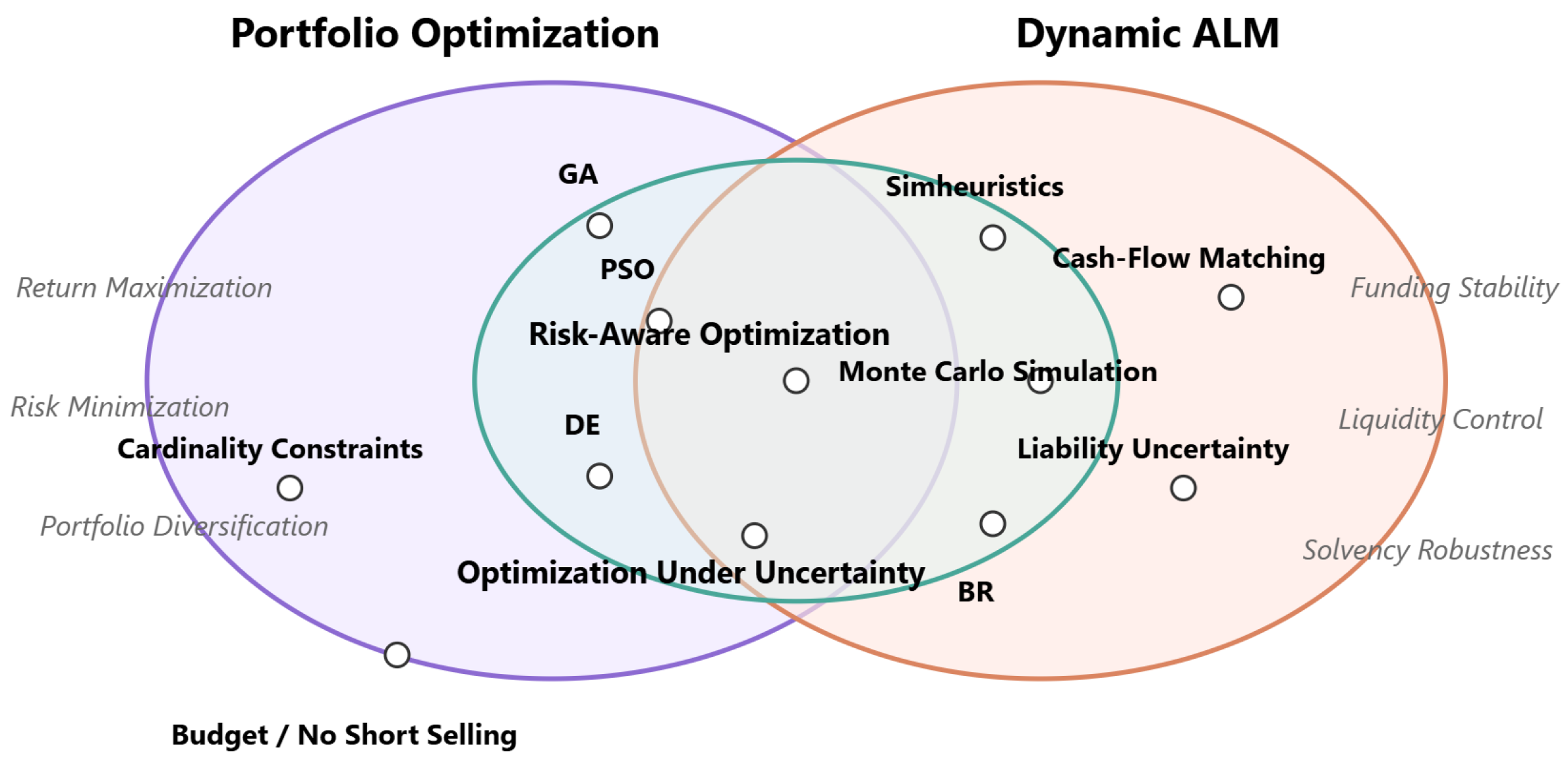
The presence of multiple interacting constraints substantially increases the difficulty of identifying optimal or near-optimal financial decisions, especially in large-scale applications. In this context, metaheuristic methods have emerged as effective optimization tools due to their flexibility in handling complex objective functions, diverse constraint structures, and high-dimensional search spaces. As approximate optimization methods, metaheuristics can generate high-quality solutions with reasonable computational effort for a broad range of combinatorial optimization problems. They are particularly valuable when exact optimization methods become computationally prohibitive or require unrealistic simplifying assumptions. Nevertheless, a gap remains between the needs of practitioners and the current capabilities of optimization methodologies, particularly with respect to scalability, interpretability, and real-time implementation.
A major source of this gap is the separation between predictive modeling and optimization-based decision-making. Most ML studies focus on maximizing predictive performance using out-of-sample evaluation criteria. In contrast, optimization models typically assume that key inputs, such as expected returns, volatilities, or default probabilities, are externally provided and remain fixed throughout the decision process. In real-world financial environments, however, prediction errors directly affect decision variables, including portfolio allocations, risk exposures, and liability-matching strategies. Consequently, model uncertainty and estimation risk become embedded within the optimization process itself. Although recent research has explored hybrid predictive-optimization frameworks, limited attention has been given to integrating predictive uncertainty into constraint-sensitive and multi-period financial decision models. Although research on predictive analytics and optimization-based decision making under uncertainty is abundant in distinct research areas, the integration of both within a single financial decision support framework has received limited attention. Several methods have been suggested to assist financial decisions in the presence of uncertainty, but they have not yet been widely adopted, and are not widely integrated into financial decision support systems. This leaves a methodological gap between predictive analytics and optimization-based decision-making. Therefore, further research is needed on how to develop integrated frameworks that incorporate ML-based predictive models and optimization procedures explicitly considering uncertainty and risk. One promising research direction is the development of more comprehensive systems for financial decision-making that incorporate the ML models for forecasting important financial indicators, including stock prices, asset returns, volatility, default probabilities, and fraud risks. Such predictions and the corresponding uncertainty estimates can then serve as inputs to optimization models for financial decision-making applications.
Furthermore, many combinatorial optimization problems in finance and banking continue to be formulated using static and deterministic models. Such formulations fail to capture the uncertainty and dynamic behavior that characterize real-world financial systems, including stochastic asset returns, evolving market conditions, and uncertain liability streams. A primary reason for this simplification is the additional computational complexity introduced by stochastic components [
115]. In this context, the integration of simulations, ML, and metaheuristic optimization offers a promising direction for future research, as it enables uncertainty to be explicitly modeled while evaluating the robustness and reliability of candidate solutions under realistic operating conditions.