Review

IoT-Enabled Smart Street Lighting: A Bibliometric-Driven Review of Energy-Efficient Architectures and Environmental Integration


by
Amany Fahmi Mohamed
1,2,
Abdelmgeid Amin Ali
3,
Amel Benmouna
4,5,*,
Haitham S. Ramadan
6,7 and
Nahla F. Omran
8
1
Computer Science Department, Faculty of Science, Qena University, Qena 83523, Egypt
2
Business Information System Department, Sadat Academy for Administrative Sciences, Minya Branch, Minia 61111, Egypt
3
Artificial Intelligence Program, Faculty of Computers and Artificial Intelligence, Minia National University, Minya 61519, Egypt
4
Institut FEMTO-ST, CNRS, Université Marie et Louis Pasteur, 90000 Belfort, France
5
School of Business and Engineering, ESTA, Université Marie et Louis Pasteur, 90000 Belfort, France
6
Electrical Power and Machines Department, Zagazig University, Zagazig 44519, Egypt
7
Pôle Universitaire d’Innovation Bourgogne-Franche-Comté (PUI-BFC), Université Marie et Louis Pasteur, 90000 Belfort, France
8
Department of Computer Science, Faculty of Computers and Information, Qena University, Qena 83523, Egypt
*
Author to whom correspondence should be addressed.
Information 2026, 17(6), 596; https://doi.org/10.3390/info17060596
Submission received: 24 April 2026 / Revised: 23 May 2026 / Accepted: 25 May 2026 / Published: 15 June 2026
(This article belongs to the Section Internet of Things (IoT))

Abstract

Urban street lighting remains a significant source of energy consumption in cities, largely due to static operation and limited responsiveness to real-time conditions. This inefficiency increases operational costs and environmental impact, especially in rapidly urbanizing regions. To address this issue, this study investigates IoT-enabled smart street lighting as an adaptive and data-driven solution within smart city frameworks. The work focuses on the growing body of research in this domain and examines its evolution, technical structure, and emerging environmental role. The study aims to provide a structured synthesis that connects research trends with system-level design, while highlighting the transition from energy-focused systems to multifunctional urban platforms. A bibliometric-driven and thematic review approach is adopted. A dataset of 151 publications was analyzed using Bibliometrix and Biblioshiny tools to extract trends, collaboration patterns, and research themes. This analysis is complemented by a qualitative evaluation of system architectures, sensing technologies, communication models, and control strategies. The findings indicate a sustained annual growth rate of 14.87% and a highly collaborative research landscape, with an average of 3.97 authors per study. The results also reveal that energy efficiency remains the dominant focus, while environmental integration is emerging but still underrepresented. The study further identifies key gaps related to scalability, sensor reliability, and the lack of standardized evaluation metrics. The outcomes provide a comprehensive roadmap for future research and support the development of scalable, intelligent, and sustainable lighting systems. The proposed insights are applicable to urban environments globally, particularly in regions seeking cost-effective and energy-efficient infrastructure solutions.

1. Introduction

Urbanization is accelerating across both developed and developing regions. This rapid growth places increasing pressure on energy systems and urban infrastructure [1]. Public services such as street lighting contribute significantly to urban electricity consumption [2]. In many cities, street lighting accounts for a considerable portion of municipal energy use [3]. Traditional lighting systems operate based on fixed schedules and constant illumination levels [4]. They do not respond to real-time conditions such as traffic flow, pedestrian activity, or environmental visibility [5]. As a result, these systems often provide unnecessary lighting during low-demand periods. This leads to energy waste, higher operational costs, and increased environmental impact [6,7]. The inefficiency of conventional street lighting has therefore become a critical issue in the context of sustainable urban development [8,9]. Cities are now seeking intelligent solutions that can reduce energy consumption while maintaining safety and service quality [10,11].
The Internet of Things (IoT) offers a practical pathway for transforming conventional lighting systems into adaptive and intelligent networks [12,13]. IoT enables real-time data collection, communication, and automated decision-making through interconnected devices [14,15,16]. In smart street lighting systems, sensors play a central role in capturing environmental and operational conditions. Motion sensors detect the presence of pedestrians and vehicles [17,18]. Ambient light sensors measure surrounding illumination levels. These inputs allow lighting systems to adjust intensity dynamically instead of operating at fixed levels [19,20]. Microcontrollers process the sensor data locally or transmit it to centralized platforms for further analysis [21]. Communication technologies enable coordination between distributed lighting units and control systems [22]. This integration supports real-time monitoring and remote management. It also improves system reliability and reduces maintenance costs [23]. As a result, IoT-based lighting systems are widely recognized as a key component of smart city infrastructure. They provide both energy savings and operational flexibility [24,25,26,27].
Recent developments indicate that the role of smart street lighting is expanding beyond energy optimization [28,29]. Modern systems are increasingly designed as multi-functional platforms that integrate environmental sensing capabilities [30]. Sensors such as DHT11 and MQ135 are used to monitor temperature, humidity, and air quality [31]. This integration allows street lighting infrastructure to function as a distributed sensing network [32,33]. Each lighting unit becomes a node that contributes to environmental data collection. This approach enhances the value of existing infrastructure without requiring additional installations [34,35]. It supports continuous monitoring of urban conditions and enables data-driven decision-making. Such systems can provide insights into environmental quality, weather conditions, and pollution levels [36,37]. This shift reflects a broader transformation in smart city design, where infrastructure systems are expected to serve multiple functions simultaneously [38,39]. However, the current literature shows that energy efficiency remains the dominant focus. Environmental integration is often treated as a secondary feature rather than a core system component [40,41,42]. In addition, many studies address individual technical aspects in isolation. Some focus on sensor technologies, while others emphasize communication protocols or control algorithms [43]. This fragmented approach limits the understanding of how different system components interact and affect overall performance.
Despite the growing number of studies, several research gaps remain. There is a lack of comprehensive reviews that combine quantitative bibliometric analysis with detailed technical synthesis. Existing review papers often focus on either technology classification or application scenarios [10,30,33]. Few studies provide a unified framework that connects research trends with system-level design. In addition, the evolution of smart street lighting systems is not clearly structured. The transition from static systems to adaptive and context-aware solutions is often discussed without a consistent classification. This makes it difficult to identify technological progress and emerging research directions. Furthermore, the integration of environmental sensing into lighting systems is not systematically analyzed. While some studies demonstrate its feasibility, its role in improving system intelligence and sustainability is not fully explored [44,45]. To address these limitations, this study presents a bibliometric-driven and thematic review of IoT-enabled smart street lighting systems. The review integrates quantitative analysis of research activity with qualitative evaluation of system architectures and environmental integration. It aims to (i) analyze research trends and collaboration patterns using bibliometric indicators, (ii) examine energy-efficient architectures and their key components, (iii) evaluate the evolution of environmental integration in smart lighting systems, and (iv) identify critical gaps and propose a strategic roadmap for future research. The novelty of this work lies in linking bibliometric evidence with system-level analysis, while explicitly highlighting the transition from energy-focused lighting systems to multifunctional, environmentally aware urban infrastructure.

2. Materials and Methods

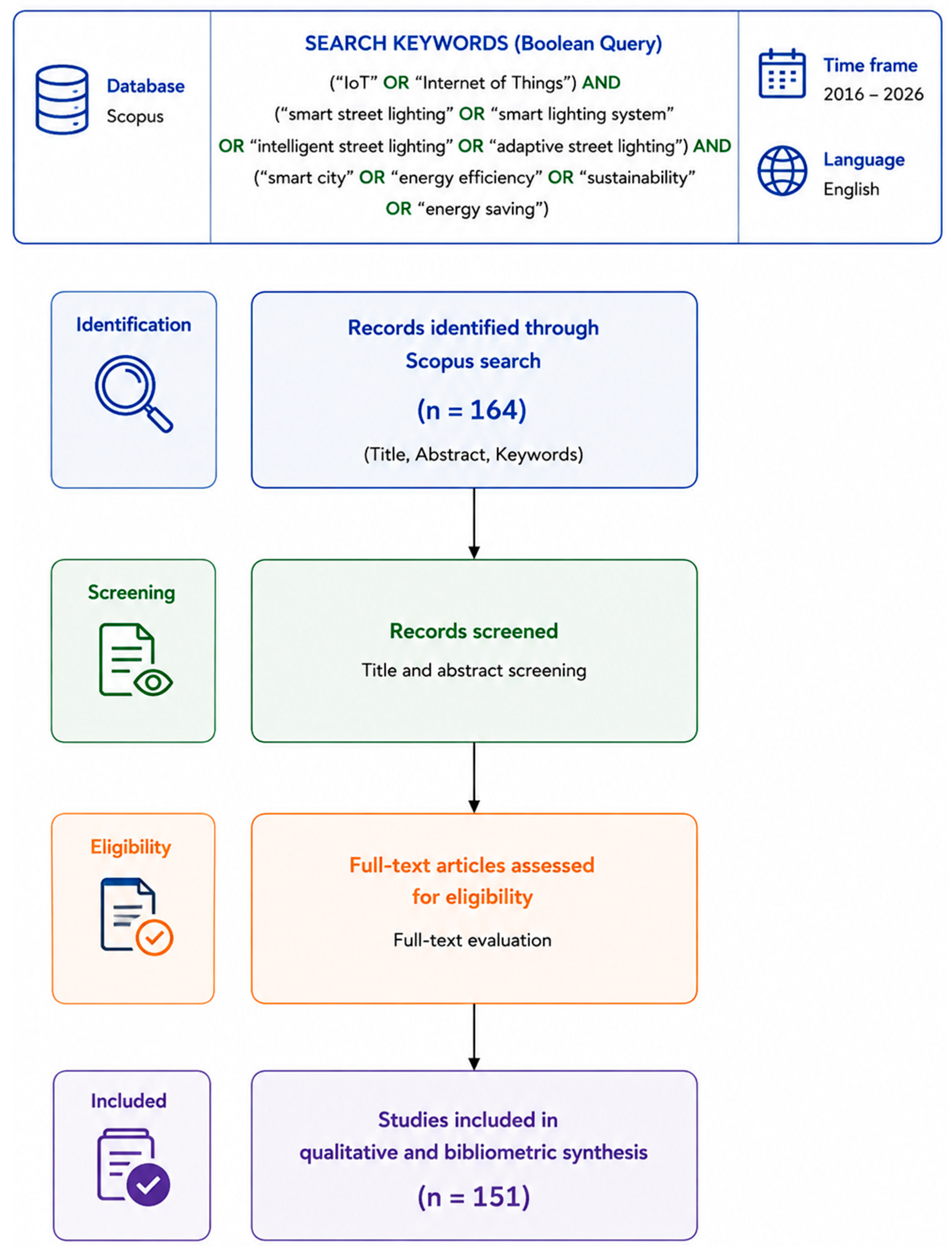
This review follows a structured approach that combines bibliometric analysis with thematic synthesis. The process includes three main stages: data collection, data visualization, and analytical classification of the selected studies (Figure 1).

2.1. Data Collection

The dataset was collected from the Scopus database to ensure consistent coverage of peer-reviewed journal articles and conference papers related to IoT-based smart street lighting and energy-efficient urban systems [46,47]. Scopus was selected as the only database because it provides broad multidisciplinary coverage across engineering, computer science, energy, and smart-city research. It also offers standardized bibliographic metadata that can be exported directly for Bibliometrix/Biblioshiny analysis, including authorship, citations, keywords, sources, affiliations, and abstracts. Using a single database also reduced the risk of duplicate records and metadata inconsistency that can occur when merging Scopus with other databases, such as Web of Science. However, this choice may introduce database-selection bias, and this limitation is acknowledged in the study. A Boolean search query was defined as follows: (“IoT” OR “Internet of Things”) AND (“smart street lighting” OR “smart lighting system” OR “intelligent street lighting” OR “adaptive street lighting”) AND (“smart city” OR “energy efficiency” OR “sustainability” OR “energy saving”). The search was limited to English-language journal articles and conference papers published between 2016 and 2026, and the final search was completed on 1 April 2026. After retrieval, duplicate and ineligible records were removed. The remaining studies were screened by title and abstract. Articles were excluded when they were not related to IoT-enabled street lighting, lacked technical contribution, or did not provide system design, implementation, or evaluation details. The final dataset included 151 publications, as summarized in the PRISMA-style workflow shown in Figure 2.

2.2. Data Visualization

The bibliometric analysis was performed using the Bibliometrix package and its graphical interface, Biblioshiny [48]. The collected Scopus dataset was imported into Biblioshiny to calculate descriptive indicators, citation indicators, collaboration patterns, source productivity, keyword co-occurrence, and thematic evolution. To improve transparency, the main calculated indicators were defined mathematically. The annual growth rate (AGR) was calculated as (Equation (1)):
A G R = [ ( N f N i ) 1 t 1 ] × 100
where N f is the number of publications in the final year, N i is the number of publications in the initial year, and t is the number of years between them. The average citations per document were calculated as:
A C D = T C T D
where TC is the total number of citations, and TD is the total number of documents. The average number of co-authors per document was calculated as:
A C D o = T A T D
where TA is the total number of author appearances. Keyword co-occurrence was calculated by counting the frequency with which two keywords appeared together in the same document. Collaboration links were generated from co-authorship relations between authors, institutions, or countries. These indicators were then used to produce bibliometric maps. The visual outputs included a bibliometric overview, citation impact plots, core source analysis, co-citation networks, country collaboration maps, keyword co-occurrence networks, and thematic evolution diagrams. These outputs provide a quantitative basis for identifying research growth, influential documents, collaboration structures, dominant themes, and underexplored areas in IoT-enabled smart street lighting research [48].

2.3. Analytical Overview of the Studies

Following the bibliometric analysis, the selected studies were examined through a qualitative synthesis. The objective was to identify common design patterns, technological choices, and research trends. The studies were classified into two main domains. The first domain focuses on energy-efficient architectures. It includes system design, sensing technologies, microcontroller platforms, communication protocols, and control algorithms. The second domain focuses on environmental integration [49]. It includes environmental sensing, context-aware control, and sustainability considerations. Within each domain, studies were grouped based on their technical characteristics. For example, energy-related studies were analyzed in terms of sensing mechanisms and control strategies. Environmental studies were examined based on the type of sensors used and their integration with lighting systems [50]. This classification supports a structured discussion of the literature. It allows for comparison between different approaches and highlights the evolution of system design. It also provides the foundation for identifying research gaps and future directions.

3. Bibliometric Analysis

3.1. Descriptive Bibliometric Overview

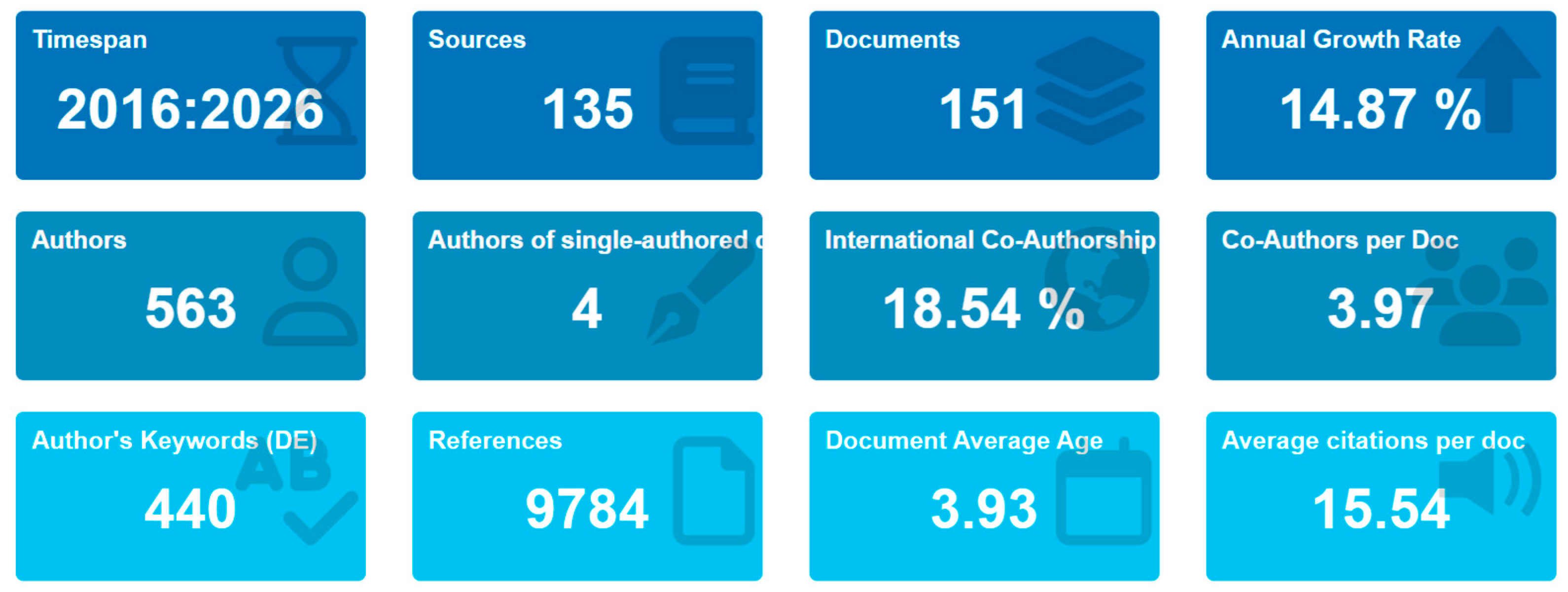
The bibliometric results reveal a clear expansion of research activity in IoT-enabled smart street lighting over the period 2016–2026. As shown in Figure 3, the dataset includes 151 documents distributed across 135 sources, with a total of 563 contributing authors. The annual growth rate reaches 14.87%, which indicates a sustained and accelerating research interest in this field. The relatively low number of single-authored documents (4) and the average of 3.97 co-authors per document suggest that this research area is highly collaborative. This trend aligns with the multidisciplinary nature of smart street lighting systems, which require expertise in embedded systems, communication networks, and energy management [51]. The average citation rate of 15.54 per document reflects a moderate but consistent academic impact. At the same time, the average document age of 3.93 years confirms that the field is still evolving, with most contributions being recent. These observations indicate that IoT-based street lighting is transitioning from an emerging topic to a structured research domain with growing maturity [33].

3.2. Local Citation Structure

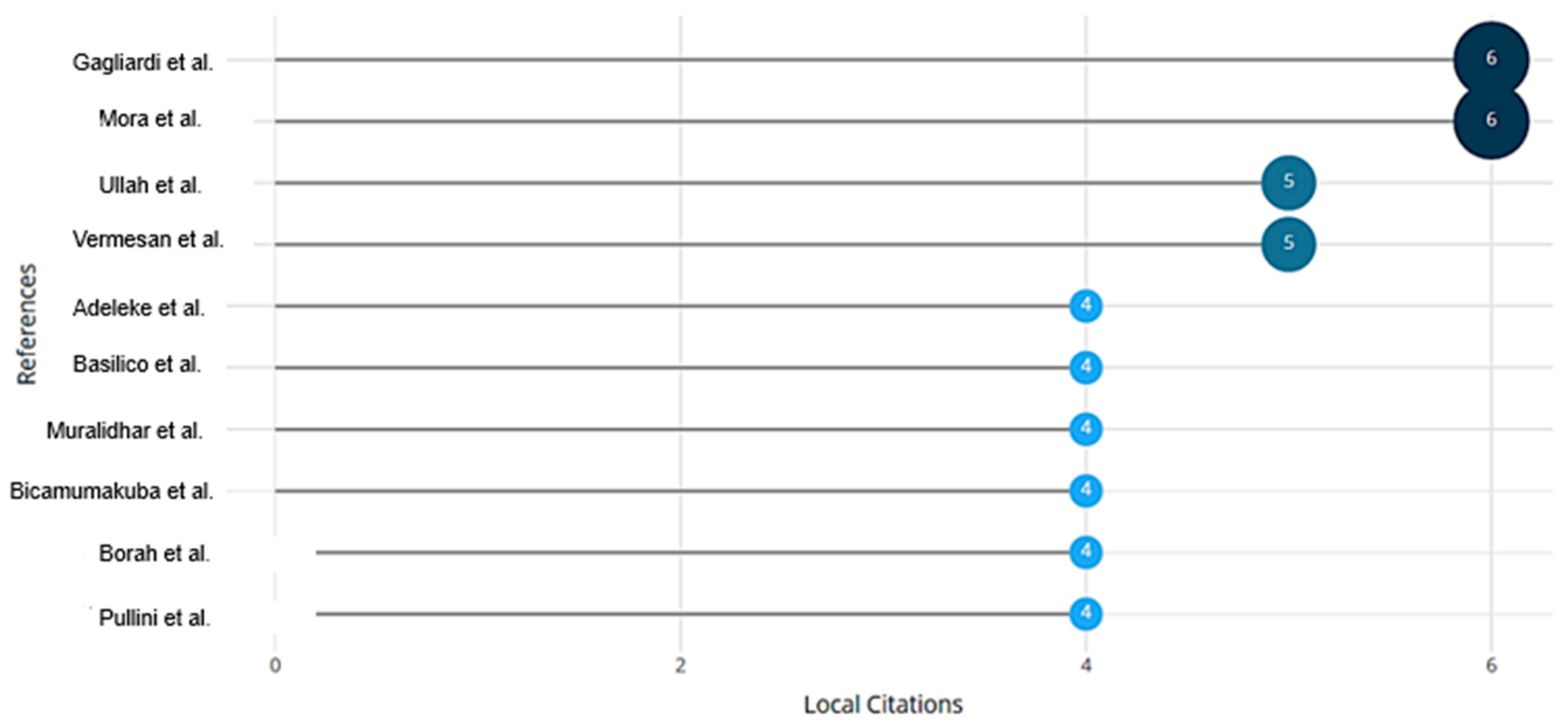
Figure 4 identifies the most locally cited references within the reviewed corpus, which means that these works were repeatedly cited by the documents included in this study rather than by the wider literature. The distribution is concentrated at the top. The Mora et al. [52] and Ullah et al. [53] recorded the highest local citation count, with six citations each, followed by Vermesan and Adeleke [54,55], with five citations each. The remaining six references each received four local citations. This narrow citation range, from four to six citations, indicates that the field does not depend on a single dominant foundational paper. Instead, it is shaped by several closely connected studies. This pattern is consistent with IoT-enabled smart infrastructure research, where system design usually combines sensing, communication, control, and application-layer perspectives rather than relying on one disciplinary source. It also supports the need for a more integrated review approach, because locally influential studies appear to contribute different parts of the smart street lighting knowledge base, including networking, adaptive control, and urban IoT implementation [56].

3.3. Global Citation Impact

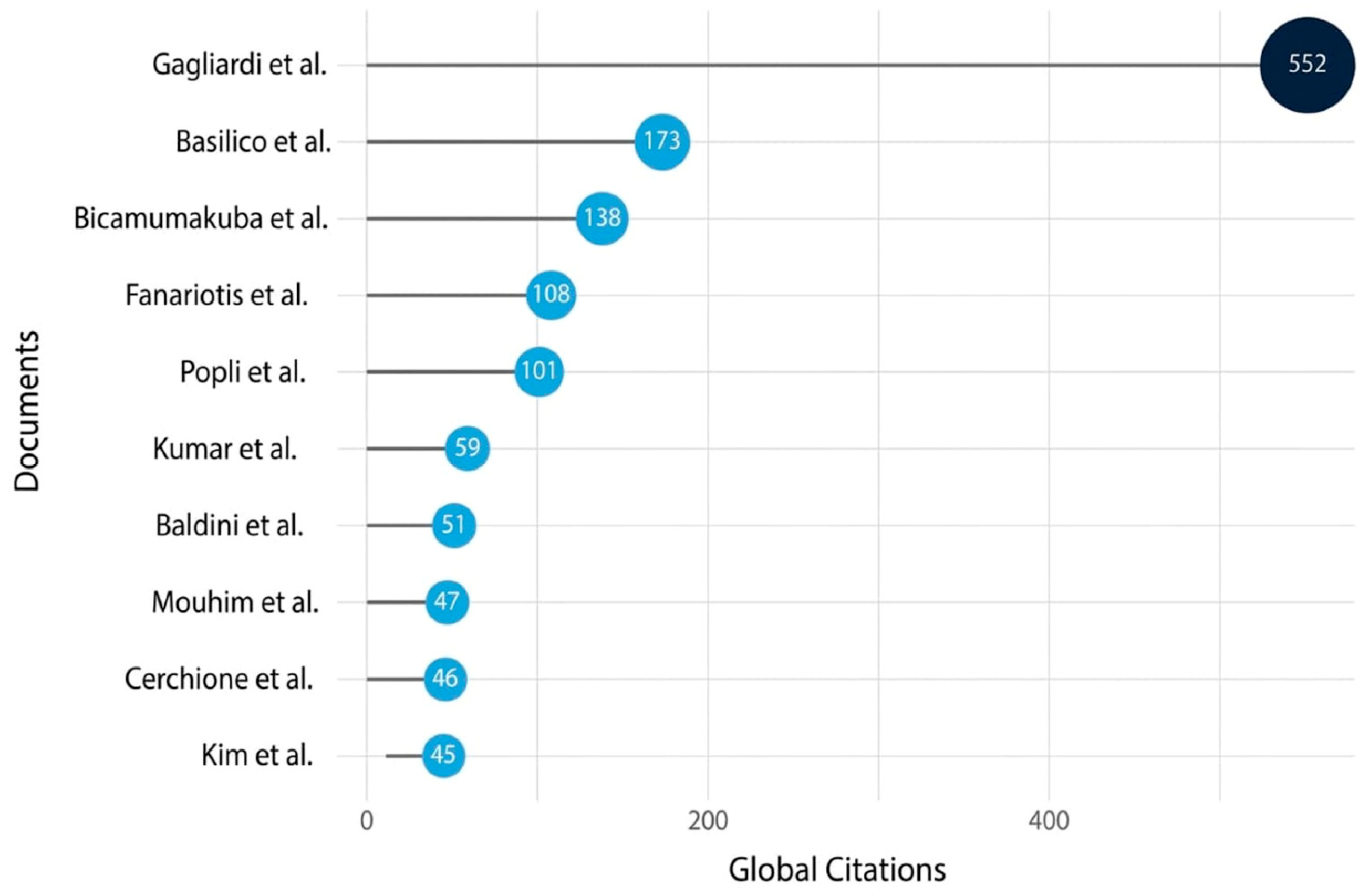
Figure 5 presents the most globally cited documents and shows a much stronger concentration than the local citation pattern. Fanariotis [62] is the dominant document, with 552 global citations, which is more than three times the citation count of Bicamuakuba [59], ranked second with 173 citations. Popli [63] follows with 138 citations, while Gagliardi [51] and Kumar [64] received 108 and 101 citations, respectively. The remaining documents range from 45 to 59 citations. This distribution suggests that a small number of publications have shaped the broader international discussion on smart lighting, smart buildings, smart cities, and energy-efficient IoT. The dominance of highly cited reviews and applied smart-city studies is aligned with recent literature showing that IoT sustainability research is increasingly organized around digital transformation, smart urban systems, energy management, and environmental monitoring [28]. The difference between local and global citations is also important. Local citations reveal influence inside the selected corpus, while global citations show wider visibility across related research areas.

3.4. Core Publication Sources

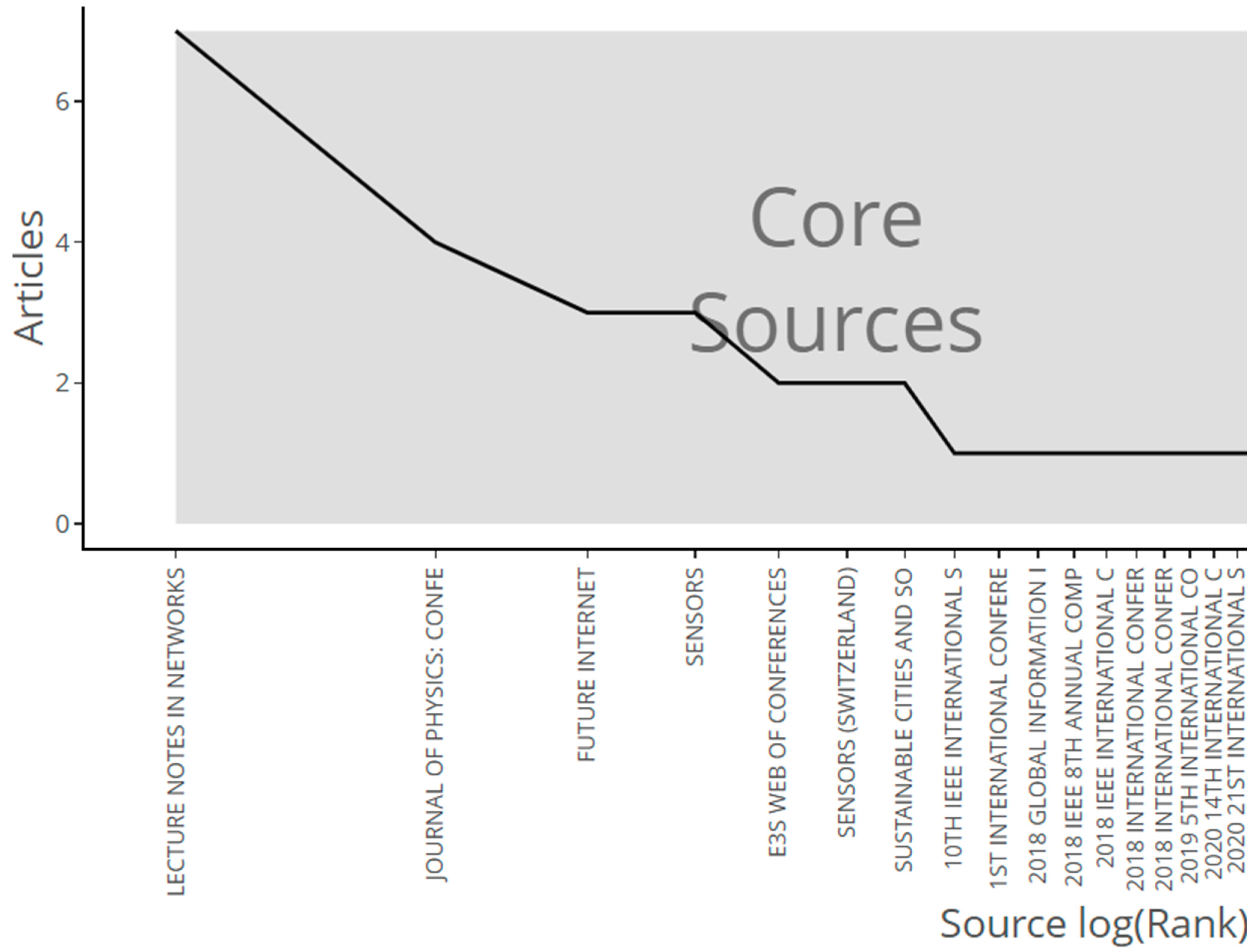
Figure 6 applies Bradford’s Law to identify the core publication sources in the reviewed dataset. Figure 6 shows that Lecture Notes in Networks is the most productive source, with about seven articles, followed by Journal of Physics: Conference Series with about four articles. Future Internet and Sensors each contribute about three articles, while E3S Web of Conferences, Sensors (Switzerland), and Sustainable Cities and Society contribute about two articles each. The remaining sources contribute about one article each. This confirms that the field is distributed across journals and conference venues rather than concentrated in one specialized outlet. The presence of sources such as Sensors, Future Internet, and Sustainable Cities and Society reflects the interdisciplinary nature of IoT-enabled smart lighting, where embedded sensing, communication networks, energy efficiency, and urban sustainability overlap. This pattern agrees with broader smart-city literature, which treats IoT as a cross-domain technology supporting urban monitoring, energy management, and environmental sustainability [69].

3.5. Co-Citation Network and Intellectual Clusters

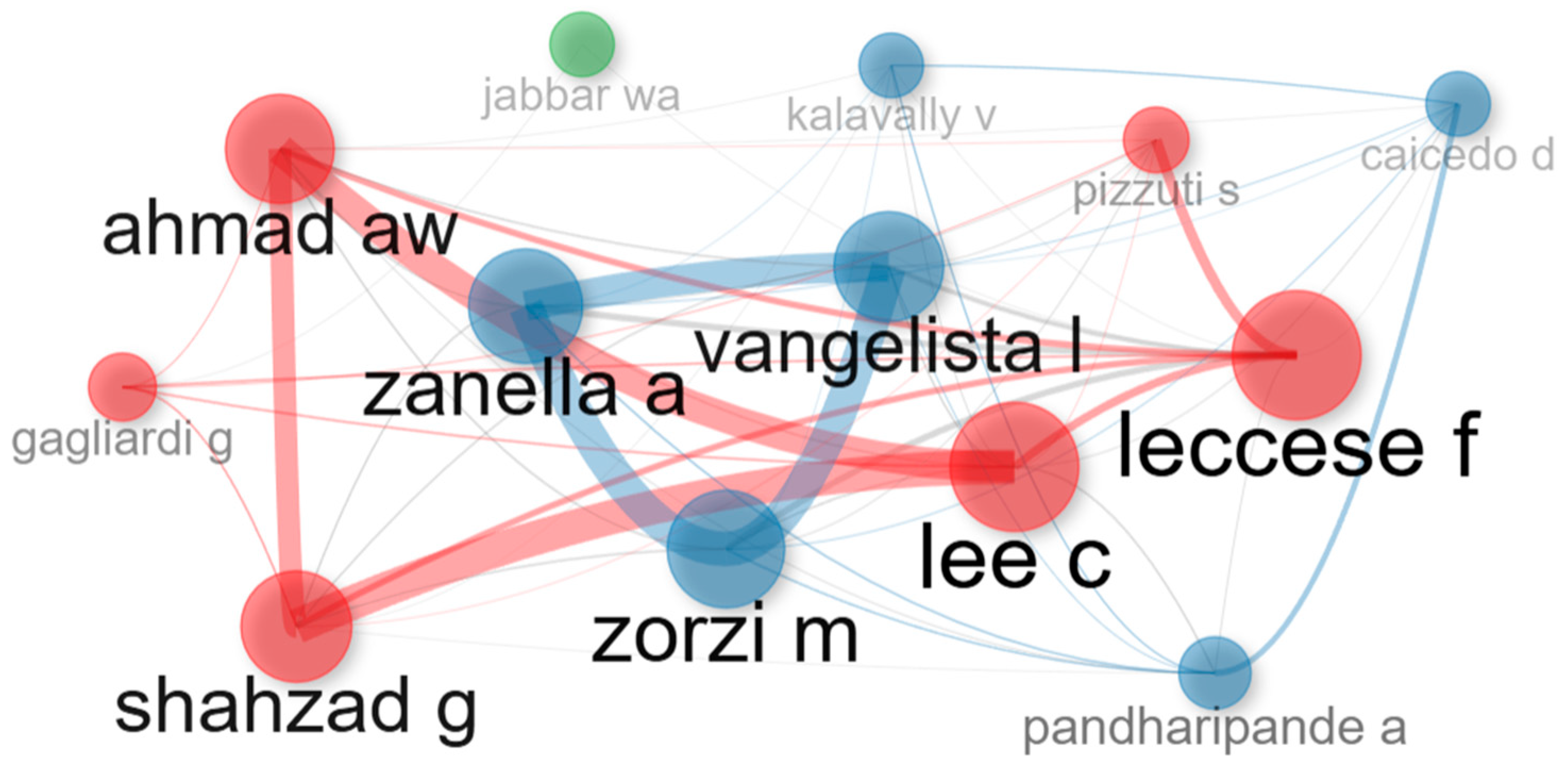
Figure 7 shows the co-citation network and reveals the intellectual structure of the reviewed literature. The largest and most central nodes include Zanella, Zorzi, Lee, Leccese, Vangelista, Ahmad and Shahzad, indicating that these authors are frequently cited together within the corpus. The network also shows at least two visible clusters. The red cluster links authors such as Ahmad, Shahzad, Lee, Leccese, and Pizzuti, while the blue cluster connects Zanella, Zorzi, Vangelista, Pandharipande, and Caicedo. The thick links between Zanella, Zorzi, Vangelista, Lee, and Leccese suggest strong conceptual overlap between IoT communication, smart-city networking, and lighting-control research. This co-citation structure supports the argument that smart street lighting is not only an energy-saving topic. It is also connected to urban IoT architecture, wireless communication, sensing, and data-driven infrastructure. This agrees with recent IoT sustainability studies, which emphasize that IoT applications gain value when they integrate sensing, connectivity, analytics, and environmental objectives rather than operating as isolated technical systems [70].

3.6. International Collaboration Patterns

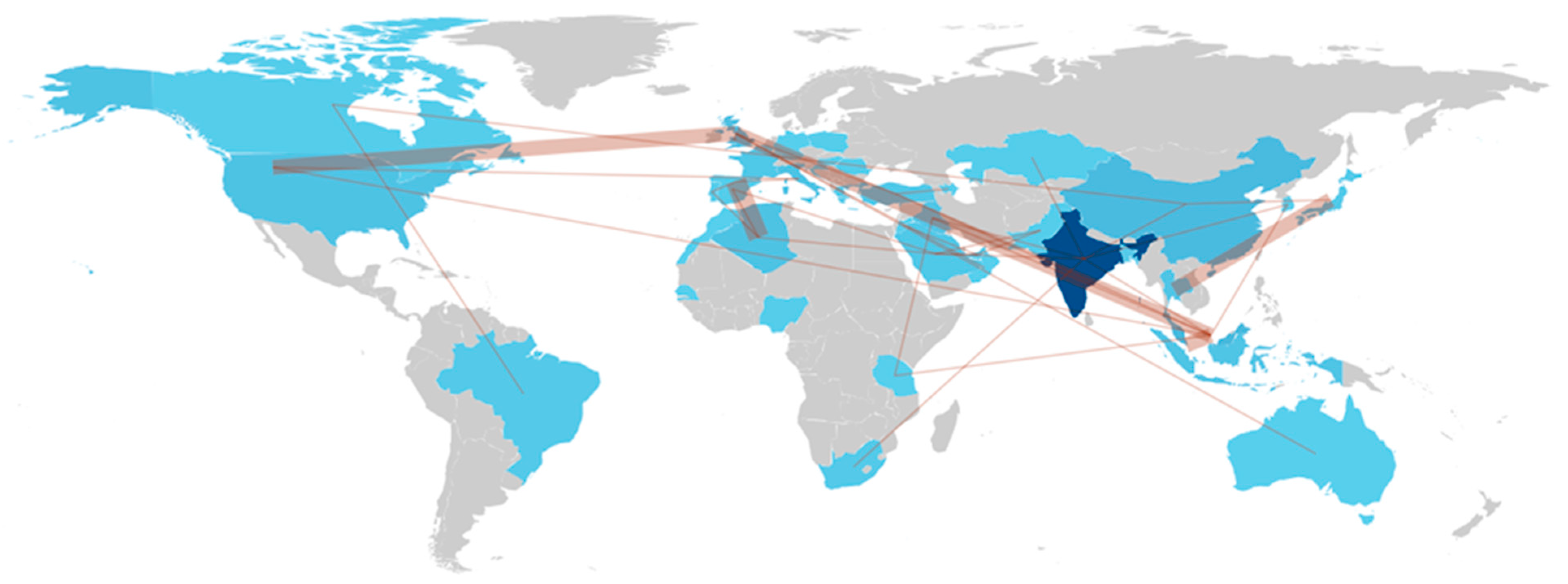
The global collaboration network presented in Figure 8 provides further insight into how this field is developing geographically. The map shows that research activity is not limited to a single region but is distributed across multiple continents. However, the intensity of collaboration varies. A noticeable concentration appears in regions such as South Asia and parts of Europe, where stronger collaboration links are visible. In contrast, other regions show weaker or more isolated participation. The presence of international collaboration links indicates that knowledge exchange is active, but it is not yet uniformly distributed. This uneven distribution suggests that some countries play a more central role in shaping research directions, while others contribute at a more localized level. The collaborative structure reflects the global relevance of energy-efficient lighting and smart city applications. It also highlights the need for broader international integration to ensure balanced technological development [71]. Compared with other IoT domains, where collaboration networks are often denser, the observed structure suggests that smart street lighting research is still consolidating its global research community.

3.7. Keyword Co-Occurrence and Research Themes

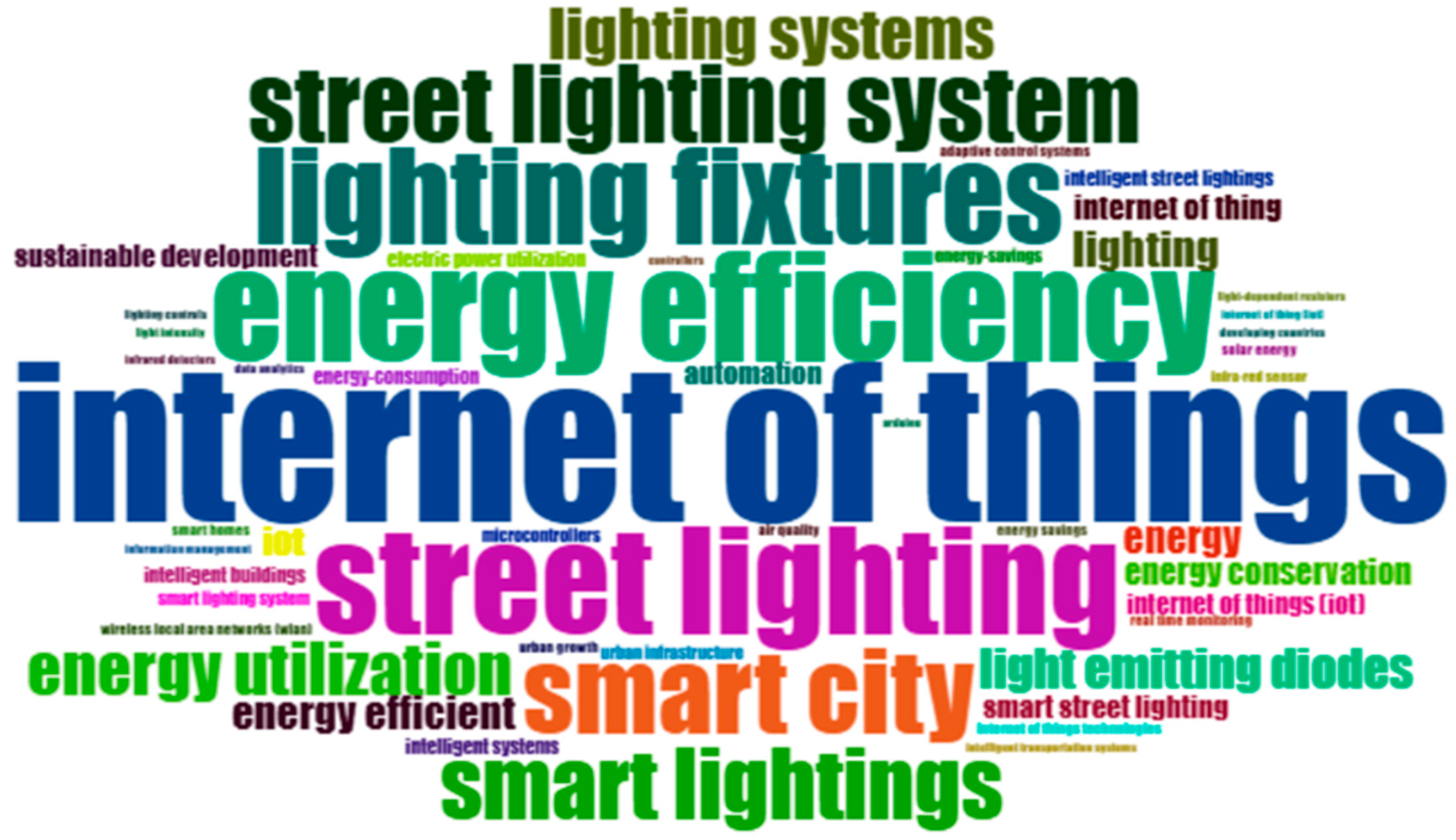
The keyword co-occurrence analysis in Figure 9 offers a clear representation of the dominant research themes within the field. The most prominent terms include “internet of things,” “energy efficiency,” “street lighting,” and “smart city.” This confirms that the research focus is strongly centered on energy optimization within urban infrastructure. The frequent appearance of terms such as “lighting fixtures,” “lighting systems,” and “light emitting diodes” indicates that hardware-level efficiency remains a key concern. At the same time, the presence of terms like “automation,” “energy utilization,” and “energy conservation” reflects an increasing interest in intelligent control strategies rather than static lighting solutions. Notably, environmental-related terms such as “air quality” appear with lower prominence. This suggests that environmental integration is still a secondary focus compared with energy efficiency. However, its presence within the keyword network indicates a growing research direction [72]. These findings support the observation that the field is evolving from basic lighting control toward more integrated smart city applications. The keyword structure also shows a strong overlap between IoT technologies and energy management concepts, which confirms that smart street lighting research is positioned at the intersection of digital infrastructure and sustainability [73].

3.8. Thematic Evolution over Time

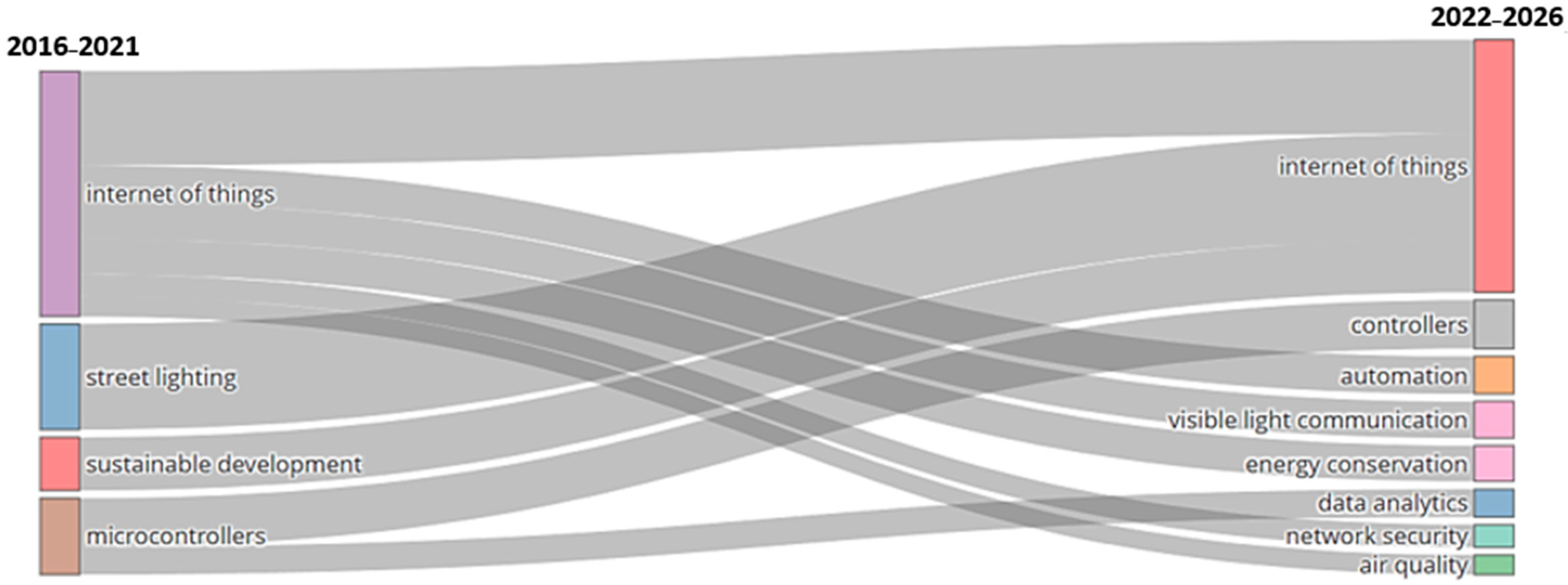
Figure 10 illustrates the thematic evolution of the research field between 2016–2021 and 2022–2026. During the first period, the dominant themes were Internet of Things, street lighting, sustainable development, and microcontrollers. In the second period, Internet of Things remains the central theme, but the research agenda expands toward controllers, automation, visible light communication, energy conservation, data analytics, network security, and air quality. This shift shows that the field has moved from basic IoT-enabled lighting and hardware implementation toward more advanced and multifunctional systems. The appearance of data analytics and network security indicates growing attention to intelligence, reliability, and cyber-physical integration. The emergence of air quality also confirms that smart lighting infrastructure is increasingly being considered as an environmental sensing platform. This trend is consistent with environmental sensing literature, which shows that IoT sensor networks are now used for continuous monitoring of air quality, environmental conditions, and smart-city services, although calibration, interoperability, and communication reliability remain key challenges [71].

4. Energy-Efficient Architectures

The synthesis of the reviewed studies shows that energy efficiency in IoT-based smart street lighting is achieved through coordinated system design rather than isolated components. Table 1 presents the dominant architectural patterns, linking technical choices with their functional roles and reported impact on energy optimization.

4.1. IoT Reference Architectures

The reviewed studies mainly use layered IoT architectures to organize sensing, communication, processing, and application functions. The three-layer and five-layer models are common because they clarify data flow and simplify integration between field sensors, gateways, edge devices, and cloud platforms. However, their contribution should be assessed through structured benchmarking criteria, not only through architectural description. Relevant criteria include energy savings, response latency, communication overhead, scalability, deployment complexity, interoperability, sensing accuracy, maintenance cost, and life-cycle burden. Recent energy-efficiency research stresses that system performance depends on cross-layer design, modeling, implementation, and benchmarking rather than on a single architectural layer alone [74]. In smart street lighting, layered architectures reduce energy only when they enable local processing, efficient data filtering, reduced transmission, and adaptive control. They also support later integration of environmental sensors, but this benefit depends on calibration, data quality, fault handling, and interoperability, which remain major issues in multi-sensor IoT systems. Therefore, architecture should be considered an enabling framework for measurable energy and environmental performance, not a direct energy-saving mechanism [75].

4.2. Sensor Technology Ecosystem

The sensor layer is dominated by motion and ambient-light sensing because these inputs are directly linked to dimming decisions. PIR sensors detect pedestrian or vehicle presence, while LDR sensors measure surrounding illumination and prevent unnecessary operation under sufficient daylight. These sensors usually provide the most immediate energy benefit because they allow lamps to shift from continuous operation to demand-based control. However, sensor performance should be compared using measurable criteria, including detection accuracy, false-trigger rate, response time, calibration need, energy overhead, outdoor robustness, and maintenance cost. Environmental sensors such as DHT11 and MQ135 add a different function. They measure temperature, humidity, and air-quality conditions, but they do not automatically reduce lighting energy. Their value appears when their data are used for context-aware control, environmental monitoring, or multi-functional smart-city services. Recent environmental sensing reviews show that low-cost sensor networks improve spatial and temporal monitoring, but they remain limited by calibration drift, interoperability, communication reliability, and long-term durability [76]. Multi-sensor studies also confirm that integrated sensing improves system awareness, but it increases noise, missing-data risk, processing cost, and maintenance requirements [75]. Therefore, sensors should be evaluated as operational and contextual components within one benchmarked system, not as isolated devices.

4.3. Microcontroller and Edge Platforms

The reviewed studies show that low-cost microcontrollers remain the preferred processing platforms for IoT-based smart street lighting because they offer a practical balance between cost, power demand, and deployment simplicity. Platforms such as Arduino, ESP8266, and NodeMCU are suitable for basic sensing, switching, and rule-based dimming tasks. However, their performance should be assessed using clear metrics, including energy per control decision, response latency, memory use, communication load, reliability, and maintenance cost. Local processing can reduce unnecessary data transmission and improve reaction time, especially when lighting decisions depend on motion or ambient-light inputs. This agrees with near-sensor computing studies, which show that processing data close to the sensor can reduce wireless transmission to compact events or decisions instead of raw data streams [77]. Edge intelligence also supports privacy and autonomy, but it increases computational demand on constrained devices. Recent edge-ML studies confirm that embedded processing requires model compression and hardware-aware optimization because IoT nodes have limited memory, computation capacity, and power autonomy [78]. Therefore, lightweight microcontrollers are appropriate for simple adaptive lighting, while higher-capacity boards such as Raspberry Pi should be reserved for image processing, predictive control, or multi-sensor analytics where the added energy cost is justified by measurable performance gains.

4.4. Communication Protocol Landscape

Communication design strongly affects the practical efficiency of IoT-based smart street lighting. The reviewed studies use Wi-Fi, ZigBee, LoRaWAN, NB-IoT, and MQTT-based messaging, but each option has different trade-offs. Wi-Fi is easy to deploy and compatible with existing infrastructure, yet it is less suitable for battery-powered or large-area nodes because of its higher power demand. ZigBee supports low-power mesh networking, which is useful for dense pole-to-pole communication, but its range is limited. LoRaWAN and NB-IoT are more suitable for wide-area deployments because they support low-data-rate communication over long distances with lower device power requirements. However, they introduce trade-offs in latency, bandwidth, subscription cost, and gateway or cellular-network dependency. The NB-IoT survey confirms that LPWAN technologies are designed for massive low-power IoT applications with wide coverage, while short-range technologies such as Wi-Fi, BLE, and ZigBee remain constrained by coverage and repeated deployment cost [79]. MQTT and CoAP reduce application-layer overhead, but their suitability depends on message frequency, reliability needs, and security requirements. A smart-building IoT study shows that lightweight protocols can reduce energy consumption, but protocol choice must still consider security and implementation constraints [80]. Therefore, communication protocols should be compared using range, latency, packet loss, energy per message, scalability, maintenance cost, and deployment complexity, rather than by availability alone.

4.5. Three Generations of Energy Efficiency

The reviewed literature shows a gradual shift from fixed lighting to sensor-based and adaptive lighting control. Static systems represent the first stage. They operate at fixed intensity according to predefined schedules, which often causes unnecessary energy use during low-traffic periods. The second stage uses motion and ambient-light sensors to activate or dim lamps according to real demand. This stage produces direct energy savings because illumination becomes linked to occupancy and daylight conditions. The third stage uses adaptive control. It combines several inputs, such as motion, ambient light, weather, traffic flow, and environmental data, to adjust lighting levels dynamically. However, this progression should be evaluated through measurable criteria, not only through conceptual classification. Relevant metrics include energy savings, response latency, dimming accuracy, sensing reliability, communication stability, deployment complexity, maintenance cost, and user safety. Adaptive systems can improve performance, but they also increase dependence on calibrated sensors, robust datasets, local processing, and stable communication. Multi-sensor monitoring studies confirm that integrated sensing improves environmental awareness, but it also introduces noise, missing data, interoperability issues, and higher computational cost [75]. Edge-intelligence studies also show that local decision-making reduces cloud dependence, but it requires hardware-aware optimization because IoT nodes have limited memory, computation capacity, and power autonomy [78]. Therefore, the transition from static to adaptive lighting should be treated as a trade-off between energy reduction, system complexity, and operational reliability.

4.6. Adaptive Dimming Algorithms

Adaptive dimming is the main control mechanism used to convert sensor data into energy savings. Most reviewed systems rely on rule-based or threshold-based logic because these methods are simple, low-cost, and suitable for low-power microcontrollers. In these systems, light intensity increases when motion is detected and decreases during inactivity. More advanced implementations use multi-level dimming instead of binary switching. This improves visual comfort and avoids abrupt illumination changes. However, dimming algorithms should be compared through measurable criteria, including energy saving, response latency, dimming accuracy, false-trigger rate, sensor calibration need, user safety, and computational cost. Simple rules can reduce energy demand, but they may fail under complex conditions such as fog, dense traffic, sensor noise, or irregular pedestrian movement. Predictive and learning-based algorithms can address some of these limits, but they require reliable datasets, embedded processing capacity, and validation under real outdoor conditions. Edge-ML studies confirm that intelligent local processing must be optimized for memory, power, and latency constraints before it can be practical on IoT nodes [78].
Overall, energy-efficient smart street lighting should be treated as a system-level outcome. It depends on coordinated interaction between architecture, sensing, processing, communication, and control. Sensors and dimming algorithms have the most direct effect on lamp operation. Architecture and communication determine whether the system can scale, exchange data reliably, and support maintenance. Multi-sensor monitoring studies show that integrated sensing can improve decision quality, but it also increases noise, missing-data risk, calibration effort, interoperability problems, and processing cost [75]. Therefore, future studies should not report energy saving alone. They should use a structured benchmark that includes energy reduction, latency, communication overhead, sensing accuracy, scalability, deployment complexity, maintenance cost, and life-cycle impact. This would make performance claims more comparable and more useful for real smart-city deployment.

5. Environmental Integration

The reviewed studies show a clear transition from energy-focused lighting systems toward environmentally aware urban infrastructure. Environmental integration is no longer treated as an optional extension. It is becoming a defining feature of modern smart street lighting systems. Table 2 summarizes how environmental functions are incorporated into lighting systems and how they influence system performance and sustainability outcomes.

5.1. From Single-Purpose to Multi-Functional Nodes

The reviewed literature shows a shift from lighting-only infrastructure to multi-functional smart nodes. Early systems mainly replaced conventional lamps with LED units and basic control. This improved operational energy efficiency, but the system function remained limited to illumination. Recent designs integrate sensing, communication, local processing, and data services within the same pole. This allows each lighting unit to operate as a distributed urban node for lighting control, traffic awareness, air-quality monitoring, and weather-related observation. This transition can reduce the need for separate monitoring infrastructure, but its value should be assessed through clear criteria, including added sensing accuracy, data completeness, communication reliability, deployment cost, maintenance burden, interoperability, and energy overhead. Environmental sensing studies confirm that automated sensor networks can improve spatial and temporal monitoring, but they also face calibration, interoperability, communication, and longevity challenges [76]. Green IoT research also shows that adding hardware to outdoor IoT systems increases life-cycle impacts through device production, batteries, solar panels, maintenance, and disposal waste [81]. Therefore, multi-functional lighting poles should not be described only as scalable smart-city assets. They should be evaluated as integrated systems whose benefits depend on reliable sensing, efficient communication, maintainable design, and justified life-cycle cost.

5.2. Environmental Sensing Technologies

Environmental sensing technologies provide the technical basis for turning smart lighting poles into urban monitoring nodes. The reviewed studies frequently use low-cost sensors such as DHT11 for temperature and humidity and MQ135 for air-quality estimation. Their main advantage is practical deployment at low cost. However, their performance should not be assessed by availability alone. Relevant benchmarking criteria include measurement accuracy, calibration frequency, drift under outdoor conditions, response time, data completeness, energy overhead, maintenance cost, and communication reliability. Low-cost sensors can support broad spatial coverage, but they often provide approximate readings rather than reference-grade measurements. Recent reviews of environmental sensing systems confirm that automated sensor networks improve temporal and spatial monitoring, yet they remain constrained by calibration, interoperability, communication stability, and device longevity [76]. Multi-sensor monitoring studies also show that integrated sensing improves environmental awareness, but it increases noise, missing-data risk, calibration effort, and processing cost [75]. Therefore, environmental sensing in smart lighting should be framed as a trend-detection and context-support function unless proper calibration and validation are reported. Its value lies in adding environmental intelligence to lighting infrastructure, but its reliability depends on sensor quality, maintenance planning, and transparent data-quality metrics.

5.3. Context-Aware Lighting Control

The integration of environmental sensing allows lighting control to move from simple sensor-triggered operation to context-aware decision-making. In this setting, “context” refers to the operational and environmental conditions that influence a lighting decision, such as motion, ambient light, humidity, fog, traffic flow, visibility, and user safety requirements. Context-aware systems therefore do not only react to one input. They combine several inputs to determine the suitable illumination level. This can improve performance under complex outdoor conditions where motion-based control alone may be insufficient. For example, dimming should be more conservative during fog, rainfall, low visibility, or dense pedestrian movement. However, context-aware control should be evaluated through measurable criteria, including response latency, sensing accuracy, data completeness, false-trigger rate, communication reliability, computational cost, and safety compliance. Recent context-awareness research confirms that such systems require formal context modelling, real-time data processing, and scalable architectures to respond accurately to changing conditions [82]. Multi-sensor monitoring studies also show that combining heterogeneous sensor inputs improves system awareness, but it increases calibration needs, noise, missing-data risk, interoperability problems, and processing cost [75]. Therefore, context-aware lighting should be presented as a higher-level control strategy whose benefit depends on validated sensor data, robust communication, and transparent benchmarking, not merely on adding more sensors.

5.4. Global Deployment Case Studies

The reviewed deployment cases show that environmental integration is moving beyond laboratory prototypes, but the evidence remains uneven across contexts. Reported implementations include urban streets, campuses, transport corridors, and monitored public spaces. These cases confirm technical feasibility, but they also show that deployment priorities differ by location. Dense urban areas usually emphasize air-quality monitoring, pollution exposure, and traffic-related sensing. Lower-density sites often prioritize energy saving, traffic-responsive lighting, and maintenance reduction. This variation means that deployment success should not be judged by functionality alone. It should be assessed using comparable criteria, including energy savings, sensing accuracy, data completeness, communication reliability, scalability, maintenance cost, and environmental usefulness. IoT sustainability research shows that real-world adoption is often limited by interoperability gaps, weak standardization, security concerns, and insufficient field validation [28]. Environmental sensing studies also confirm that automated monitoring can improve spatial and temporal coverage, but outdoor systems still face calibration, communication, durability, and longevity constraints [76]. Therefore, environmental integration should be described as an emerging practical direction, not as a fully mature smart-city solution. Its value depends on local needs, validated data quality, maintainable hardware, and transparent reporting of deployment performance.

5.5. Sustainability Impact Quantification

Sustainability remains the main reason for integrating environmental functions into smart street lighting systems. Most reviewed studies still measure sustainability through operational energy savings. This is useful, but it gives a narrow assessment. Adaptive lighting can reduce electricity consumption, yet environmental integration should also be evaluated through air-quality data usefulness, sensing accuracy, data completeness, maintenance requirements, life-cycle burden, and social value. Recent sustainability assessment studies emphasize that environmental evaluation becomes stronger when life-cycle methods are combined with quantitative indicators, because this improves consistency and reduces subjective interpretation [83]. Green IoT research also shows that IoT deployments create environmental impacts beyond operation, including device manufacturing, battery use, solar-panel sizing, maintenance, and end-of-life waste [81]. Therefore, smart lighting studies should not report energy savings alone. They should also quantify environmental data quality, hardware lifetime, replacement frequency, waste generation, and contribution to pollution monitoring or urban management. This would make sustainability claims more comparable and more relevant for city-scale decisions.
Overall, environmental integration is changing smart street lighting from a single-purpose energy-saving system into a distributed urban sensing platform. Multi-functional poles, environmental sensors, and context-aware control add value when they support validated monitoring and better operational decisions. However, this transition also increases system complexity. Sensor calibration, communication reliability, cybersecurity, interoperability, maintenance cost, and standardized evaluation remain unresolved issues. IoT sustainability literature confirms that weak standardization, fragmented implementation, and limited field validation still restrict large-scale adoption [28]. Thus, environmental integration should be presented as a complementary function to energy efficiency, not as a replacement for it. The next stage of IoT-based smart street lighting should combine energy reduction, reliable environmental monitoring, life-cycle assessment, and transparent benchmarking within one evaluation framework.

6. Discussion, Critical Gaps, and Strategic Roadmap

The bibliometric and thematic results show that IoT-enabled smart street lighting has moved from a simple energy-saving topic toward a broader smart-city infrastructure domain. The thematic evolution analysis confirms this shift. Earlier studies focused mainly on “Internet of Things,” “street lighting,” “sustainable development,” and “microcontrollers.” Recent studies expanded toward “automation,” “data analytics,” “network security,” “energy conservation,” and “air quality.” This bibliometric pattern is important because it explains why the technical discussion can no longer focus only on lighting control. The field now requires an engineering evaluation that includes communication reliability, sensing accuracy, scalability, cybersecurity, environmental monitoring, and life-cycle impact. In this sense, the bibliometric findings and the technical synthesis are connected. The keyword evolution provides evidence that the research agenda is becoming more complex, while the reviewed system designs show that many implementations are still evaluated using narrow energy-saving metrics [84].
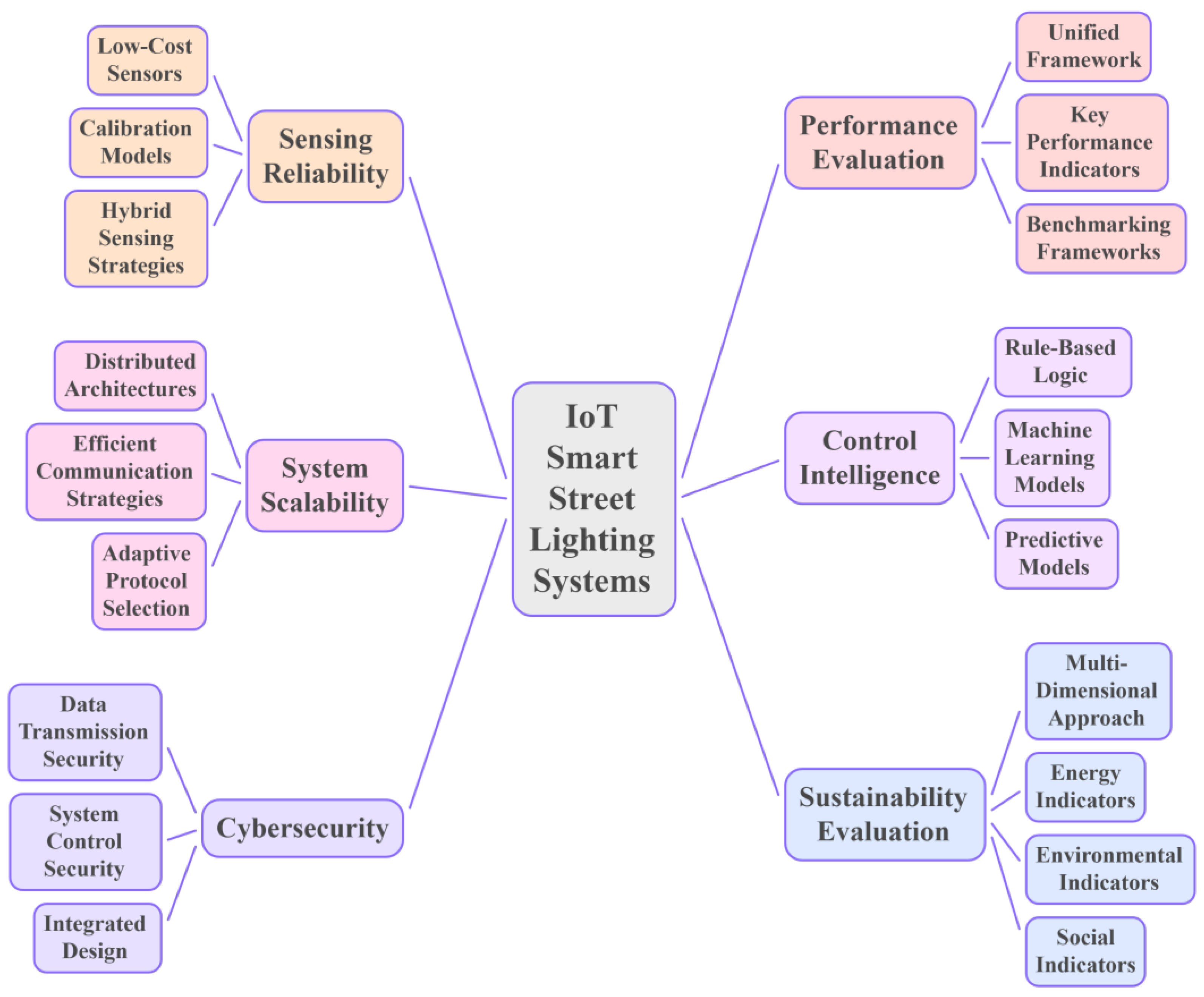
A major gap concerns the absence of structured benchmarking across technologies (Figure 11). Many reviewed studies report energy reductions, but they use different assumptions, duty cycles, baseline systems, and calculation methods. This weakens cross-study comparison [85]. Future evaluations should therefore use a common set of indicators. These should include energy saving, response latency, communication overhead, packet loss, sensing accuracy, calibration frequency, scalability, deployment complexity, maintenance cost, cybersecurity readiness, and life-cycle burden. Such criteria would allow for fairer comparison between systems using Wi-Fi, ZigBee, LoRaWAN, NB-IoT, MQTT, ESP8266, Raspberry Pi, PIR, DHT11, and MQ135 [86]. This need is consistent with energy-efficient computing research, which emphasizes that energy performance depends on cross-layer design, modelling, implementation, and benchmarking rather than on one component alone [87].
The engineering trade-offs are clearest in the communication layer. Wi-Fi is attractive because it is available, low-cost, and compatible with existing infrastructure. However, it has higher power demand and limited suitability for battery-powered or large-area lighting nodes. ZigBee offers low-power mesh communication and is useful for dense pole-to-pole networks, but its range and bandwidth remain limited [88]. LoRaWAN and NB-IoT are stronger options for wide-area deployments because they support long-range and low-data-rate communication [89]. Their limitations are different. They may introduce higher latency, lower bandwidth, gateway dependence, subscription cost, or network-operator dependence. MQTT and CoAP reduce application-layer overhead, but they must be evaluated with message frequency, reliability, and security requirements [90]. Therefore, the statement that “no single protocol is optimal for all scenarios” should be supported by explicit comparison. Protocol selection should depend on deployment scale, power budget, required latency, data volume, reliability target, and maintenance capacity. LPWAN research confirms that wide-area IoT technologies are suitable for massive low-power applications, while short-range options remain constrained by range and repeated deployment cost [91].
Sensing reliability is another critical limitation. The reviewed studies frequently use low-cost sensors such as PIR, LDR, DHT11, and MQ135 because they are inexpensive and easy to deploy [92]. PIR and LDR sensors are directly linked to energy control because they trigger dimming or switching decisions. In contrast, DHT11 and MQ135 add environmental awareness but do not directly reduce lighting energy. Their value depends on data quality and how the system uses their readings [35]. Low-cost environmental sensors can support broad spatial coverage, but they are vulnerable to calibration drift, humidity effects, dust, temperature variation, sensor ageing, and placement bias. This is a serious issue in outdoor street lighting because poles are exposed to weather, vibration, pollution, and inconsistent maintenance intervals. Environmental sensing reviews confirm that automated sensing networks improve spatial and temporal monitoring, but calibration, interoperability, communication stability, and device longevity remain major barriers [93]. Multi-sensor studies also show that integrating several sensors improves awareness, but it increases noise, missing-data risk, processing cost, and maintenance requirements [94].
The processing layer shows a similar trade-off. ESP8266, Arduino, and NodeMCU are suitable for simple adaptive control because they offer low cost, low energy demand, and sufficient performance for rule-based decisions [95]. Their limitations appear when systems require image processing, predictive models, multi-sensor fusion, or cybersecurity functions. Raspberry Pi and similar boards provide higher processing capacity, but they increase power consumption, cost, thermal load, and maintenance requirements. Edge computing can reduce cloud traffic and improve response time, but it does not automatically improve energy efficiency [96]. Its benefit depends on whether the saved communication energy is greater than the added local computation cost. Near-sensor computing studies show that local processing can reduce wireless transmission by converting raw data into compact events or decisions [97]. Edge-ML studies also confirm that intelligent local processing requires model compression and hardware-aware optimization because IoT nodes have limited memory, computation capacity, and power autonomy.
Scalability remains weakly demonstrated in the reviewed literature. Many systems are tested in controlled environments, campuses, short street segments, or pilot zones [98]. These deployments confirm feasibility, but they do not fully represent city-scale conditions. Large deployments introduce network congestion, heterogeneous infrastructure, multi-vendor interoperability, firmware updates, sensor replacement cycles, and long-term data management [99]. They also require maintenance planning. A system that performs well in a pilot installation may fail at scale if it depends on manual calibration, frequent battery replacement, unstable communication, or non-standard data formats. The deployment challenge is therefore not limited to hardware availability. It also involves operation, governance, security, and life-cycle cost. IoT sustainability research shows that interoperability gaps, weak standardization, and limited field validation remain major barriers to the transition from isolated IoT experiments to scalable smart-city systems [100].
Cybersecurity also requires stronger attention. The bibliometric results show the recent emergence of “network security” as a theme, but many technical implementations still prioritize energy saving and functionality over security. This creates a mismatch between research trends and practical system design. Smart street lighting systems transmit operational and sometimes environmental data [33]. They may also allow for remote control of lighting infrastructure. Weak authentication, insecure communication, or unprotected firmware updates can expose the system to manipulation, data leakage, or service disruption. Security, therefore, should not be added after deployment. It should be part of the architecture from the design stage. Future studies should report encryption method, authentication model, access control, update mechanism, and resilience against communication failure or malicious interference [101].
Sustainability evaluation is also incomplete. Most reviewed systems define success through electricity reduction. This is necessary, but it is not enough. A smart lighting node includes sensors, microcontrollers, communication modules, batteries, solar panels, housings, and maintenance operations [28]. These components create environmental impacts during manufacturing, replacement, and disposal. Green IoT research shows that outdoor IoT deployments should be assessed across their life cycle, including production energy, battery use, solar-panel sizing, maintenance, and waste generation [102]. Therefore, environmental integration should not be justified only by adding air-quality or weather sensors. It should be evaluated through data usefulness, measurement reliability, maintenance burden, hardware lifetime, replacement frequency, and end-of-life waste [103]. Sustainability assessment studies also stress the need to combine life-cycle methods with quantitative indicators to improve consistency and reduce subjective interpretation [104].
Based on these findings, the strategic roadmap should follow four directions. First, future systems should adopt standardized benchmarking. Energy saving should be reported together with latency, communication reliability, packet loss, sensing accuracy, calibration frequency, scalability, maintenance cost, and life-cycle impact [105]. Second, environmental sensing should be validated under real outdoor conditions. Low-cost sensors should be calibrated against reference data, and studies should report drift, missing data, and maintenance intervals [106]. Third, communication and processing architectures should be selected according to deployment scale. Wi-Fi and ESP8266-based designs may be suitable for small or connected sites, while LoRaWAN, NB-IoT, and edge-optimized platforms are more relevant for wider deployments [107]. Fourth, cybersecurity and interoperability should become core design requirements. This roadmap can help move the field from functional prototypes toward reliable, scalable, and environmentally meaningful smart-city infrastructure.

7. Conclusions

This study presented a bibliometric-driven and thematic review of IoT-enabled smart street lighting systems, with a focus on energy-efficient architectures and environmental integration. The analysis combined quantitative bibliometric evaluation with qualitative synthesis of system components and design approaches. The findings confirm that research in this field is expanding steadily and is characterized by strong collaboration and multidisciplinary contributions. The review shows that energy efficiency remains the primary driver of system design, supported by adaptive control, sensing technologies, and edge-based processing. At the same time, environmental integration is emerging as a complementary function, where lighting infrastructure evolves into multi-functional sensing platforms. However, this integration is still limited by sensor accuracy and the lack of standardized evaluation methods. The study also highlights that most systems remain at small-scale deployment stages, with scalability, communication efficiency, and system intelligence identified as key challenges.
The impact of this research lies in providing a structured understanding of how smart street lighting systems are evolving from isolated technical solutions into integrated urban infrastructure. It clarifies the interaction between architectural design, sensing, and control mechanisms. It also highlights the importance of combining energy and environmental perspectives within a unified framework. These insights support decision-makers and researchers in designing more efficient and scalable systems. For future work, several directions are recommended. Sensor calibration and hybrid sensing models should be developed to improve data reliability. Advanced data-driven and predictive control methods should be integrated to enhance system intelligence. In addition, standardized performance metrics are required to enable fair comparison across studies.
Finally, future studies should adopt a multi-dimensional research agenda that integrates methodological, technical, operational, and sustainability aspects. First, bibliometric reviews should test broader keyword combinations, include multiple databases such as Scopus, Web of Science, and IEEE Xplore, and apply query-sensitivity analysis to improve reproducibility. Second, technical studies should use standardized benchmarking criteria, including energy savings, response latency, communication overhead, packet loss, sensing accuracy, scalability, deployment complexity, maintenance cost, cybersecurity readiness, and life-cycle burden. Third, low-cost sensors should be validated under real outdoor conditions, with clear reporting of calibration drift, missing data, environmental robustness, sensor lifetime, and maintenance intervals. Fourth, future systems should compare communication protocols and edge platforms according to deployment scale, power budget, bandwidth needs, reliability, and long-term operational cost. Fifth, predictive and learning-based control models should be tested on embedded devices using hardware-aware optimization. Finally, sustainability assessment should combine energy, environmental, social, operational, and life-cycle indicators, including waste generation, hardware replacement frequency, public-safety benefits, interoperability, and cybersecurity. These directions would provide stronger evidence for scalable, reliable, and long-term smart-city deployment.

Author Contributions

Conceptualization, A.F.M., A.A.A., N.F.O. and A.B.; methodology, A.F.M. and H.S.R.; software, A.F.M. and A.B.; validation, A.F.M., A.A.A., N.F.O. and H.S.R.; formal analysis, A.F.M. and H.S.R.; investigation, A.F.M., A.A.A., N.F.O. and A.B.; resources, A.F.M., A.A.A., N.F.O. and A.B.; data curation, A.F.M., A.B. and H.S.R.; writing—original draft preparation, A.F.M., A.A.A. and N.F.O.; writing—review and editing, A.B. and H.S.R.; visualization, A.F.M., A.A.A., N.F.O. and H.S.R.; supervision, A.A.A., N.F.O. and H.S.R. All authors have read and agreed to the published version of the manuscript.

Funding

This research received no external funding.

Data Availability Statement

This research creates new databases by detail inspection. The data sets are included in the paper.

Acknowledgments

Sincere acknowledgement for the support of the Ministry of Foreign and European Affairs and Campus France for PHC IMHOTEP2026.

Conflicts of Interest

The authors declare that they have no known competing financial interests or personal relationships that could have appeared to influence the work reported in this paper.

References

  1. Raihan, A.; Rashid, M.; Voumik, L.C.; Akter, S.; Esquivias, M.A. The Dynamic Impacts of Economic Growth, Financial Globalization, Fossil Fuel, Renewable Energy, and Urbanization on Load Capacity Factor in Mexico. Sustainability 2023, 15, 13462. [Google Scholar] [CrossRef] [Scilit]
  2. Nadweh, S.; Mohammed, N.; Konstantinou, C.; Ahmed, S. Operational Performance Assessment of PV-Powered Street Lighting: A Comparative Study of Different Machine Learning Prediction Models. IEEE Access 2025, 13, 135232–135253. [Google Scholar] [CrossRef] [Scilit]
  3. Bachanek, K.H.; Tundys, B.; Wiśniewski, T.; Puzio, E.; Maroušková, A. Intelligent Street Lighting in a Smart City Concepts—A Direction to Energy Saving in Cities: An Overview and Case Study. Energies 2021, 14, 3018. [Google Scholar] [CrossRef] [Scilit]
  4. Zhuang, Y.; Hua, L.; Qi, L.; Yang, J.; Cao, P.; Cao, Y.; Wu, Y.; Thompson, J.; Haas, H. A Survey of Positioning Systems Using Visible LED Lights. IEEE Commun. Surv. Tutor. 2018, 20, 1963–1988. [Google Scholar] [CrossRef] [Scilit]
  5. Hwang, S.; Lee, Z.; Kim, J. Real-Time Pedestrian Flow Analysis Using Networked Sensors for a Smart Subway System. Sustainability 2019, 11, 6560. [Google Scholar] [CrossRef] [Scilit]
  6. Achar, T.E.; Rekha, C.; Shreyas, J. Smart Automated Highway Lighting System Using IoT: A Survey. Energy Inform. 2024, 7, 76. [Google Scholar] [CrossRef] [Scilit]
  7. Sholanke, A.; Fadesere, O.; Elendu, D. The Role of Artificial Lighting in Architectural Design: A Literature Review. IOP Conf. Ser. Earth Environ. Sci. 2021, 665, 012008. [Google Scholar] [CrossRef] [Scilit]
  8. Zielinska-Dabkowska, K.M.; Bobkowska, K. Rethinking Sustainable Cities at Night: Paradigm Shifts in Urban Design and City Lighting. Sustainability 2022, 14, 6062. [Google Scholar] [CrossRef] [Scilit]
  9. Pardo-Bosch, F.; Blanco, A.; Sesé, E.; Ezcurra, F.; Pujadas, P. Sustainable Strategy for the Implementation of Energy Efficient Smart Public Lighting in Urban Areas: Case Study in San Sebastian. Sustain. Cities Soc. 2022, 76, 103454. [Google Scholar] [CrossRef] [Scilit]
  10. Mishra, P.; Singh, G. Energy Management Systems in Sustainable Smart Cities Based on the Internet of Energy: A Technical Review. Energies 2023, 16, 6903. [Google Scholar] [CrossRef] [Scilit]
  11. Chen, Y.; Ardila-Gomez, A.; Frame, G. Achieving Energy Savings by Intelligent Transportation Systems Investments in the Context of Smart Cities. Transp. Res. Part D Transp. Environ. 2016, 54, 381–396. [Google Scholar] [CrossRef] [Scilit]
  12. Chui, K.T.; Lytras, M.D.; Visvizi, A. Energy Sustainability in Smart Cities: Artificial Intelligence, Smart Monitoring, and Optimization of Energy Consumption. Energies 2018, 11, 2869. [Google Scholar] [CrossRef] [Scilit]
  13. Almihat, M.G.M.; Kahn, M.T.E.; Aboalez, K.; Almaktoof, A.M. Energy and Sustainable Development in Smart Cities: An Overview. Smart Cities 2022, 5, 1389–1408. [Google Scholar] [CrossRef] [Scilit]
  14. Louis, J.; Dunston, P.S. Integrating IoT into Operational Workflows for Real-Time and Automated Decision-Making in Repetitive Construction Operations. Autom. Constr. 2018, 94, 317–327. [Google Scholar] [CrossRef] [Scilit]
  15. Kang, K.D. A Review of Efficient Real-Time Decision Making in the Internet of Things. Technologies 2022, 10, 12. [Google Scholar] [CrossRef] [Scilit]
  16. Al-Atawi, A.A. Enhancing Data Management and Real-Time Decision Making with IoT, Cloud, and Fog Computing. IET Wirel. Sens. Syst. 2024, 14, 539–562. [Google Scholar] [CrossRef] [Scilit]
  17. Haque, T.S.; Rahman, M.H.; Islam, M.R.; Razzak, M.A.; Badal, F.R.; Ahamed, M.H.; Moyeen, S.I.; Das, S.K.; Ali, M.F.; Tasneem, Z.; et al. A Review on Driving Control Issues for Smart Electric Vehicles. IEEE Access 2021, 9, 135440–135472. [Google Scholar] [CrossRef] [Scilit]
  18. Kiraz, M.; Sivrikaya, F.; Albayrak, S. A Survey on Sensor Selection and Placement for Connected and Automated Mobility. IEEE Open J. Intell. Transp. Syst. 2024, 5, 692–710. [Google Scholar] [CrossRef] [Scilit]
  19. Pandharipande, A.; Newsham, G.R. Lighting Controls: Evolution and Revolution. Light. Res. Technol. 2018, 50, 115–128. [Google Scholar] [CrossRef] [Scilit]
  20. Madias, E.N.D.; Doulos, L.T.; Kontaxis, P.A.; Topalis, F.V. Multicriteria Decision Aid Analysis for the Optimum Performance of an Ambient Light Sensor: Methodology and Case Study. Oper. Res. 2022, 22, 1333–1361. [Google Scholar] [CrossRef] [Scilit]
  21. Khalifeh, A.; Mazunga, F.; Nechibvute, A.; Nyambo, B.M. Microcontroller Unit-Based Wireless Sensor Network Nodes: A Review. Sensors 2022, 22, 8937. [Google Scholar] [CrossRef] [Scilit]
  22. Rehman, S.U.; Ullah, S.; Chong, P.H.J.; Yongchareon, S.; Komosny, D. Visible Light Communication: A System Perspective—Overview and Challenges. Sensors 2019, 19, 1153. [Google Scholar] [CrossRef] [Scilit]
  23. Jayawardane, V.; Induwara, M.S.; Gunathilaka, H.H.C.; Fernando, M.M.N.; Weerasinghe, W.M.K.N.B.; Wijewardhana, U.L. Overview on Data Handling, Task Management and Communication Optimization Strategies in Internet of Medical Things (IoMT). IEEE Internet Things J. 2025, 13, 20254–20274. [Google Scholar] [CrossRef] [Scilit]
  24. Kantaros, A.; Zacharia, P.; Drosos, C.; Papoutsidakis, M.; Pallis, E.; Ganetsos, T. Smart Infrastructure and Additive Manufacturing: Synergies, Advantages, and Limitations. Appl. Sci. 2025, 15, 3719. [Google Scholar] [CrossRef] [Scilit]
  25. Kuru, K.; Ansell, D. TCitySmartF: A Comprehensive Systematic Framework for Transforming Cities into Smart Cities. IEEE Access 2020, 8, 18615–18644. [Google Scholar] [CrossRef] [Scilit]
  26. Majhi, A.A.K.; Mohanty, S. A Comprehensive Review on Internet of Things Applications in Power Systems. IEEE Internet Things J. 2024, 11, 34896–34923. [Google Scholar] [CrossRef] [Scilit]
  27. Mohammad, N.; Muhammad, S.; Bashar, A.; Khan, M.A. Formal Analysis of Human-Assisted Smart City Emergency Services. IEEE Access 2019, 7, 60376–60388. [Google Scholar] [CrossRef] [Scilit]
  28. Lanfranchi, G.; Crupi, A.; Cesaroni, F. Internet of Things (IoT) and the Environmental Sustainability: A Literature Review and Recommendations for Future Research. Corp. Soc. Responsib. Environ. Manag. 2025, 32, 7648–7670. [Google Scholar] [CrossRef] [Scilit]
  29. Mehrabi, A.; Nunna, H.S.V.S.K.; Dadlani, A.; Moon, S.; Kim, K. Decentralized Greedy-Based Algorithm for Smart Energy Management in Plug-in Electric Vehicle Energy Distribution Systems. IEEE Access 2020, 8, 75666–75681. [Google Scholar] [CrossRef] [Scilit]
  30. Abdulhussain, S.H.; Mahmmod, B.M.; Alwhelat, A.; Shehada, D.; Shihab, Z.I.; Mohammed, H.J.; Abdulameer, T.H.; Alsabah, M.; Fadel, M.H.; Ali, S.K.; et al. A Comprehensive Review of Sensor Technologies in IoT: Technical Aspects, Challenges, and Future Directions. Computers 2025, 14, 342. [Google Scholar] [CrossRef] [Scilit]
  31. Easterline, L.M.; Putri, A.A.Z.R.; Atmaja, P.S.; Dewi, A.L.; Prasetyo, A. Smart Air Monitoring with IoT-Based MQ-2, MQ-7, MQ-8, and MQ-135 Sensors Using NodeMCU ESP32. Procedia Comput. Sci. 2024, 245, 815–824. [Google Scholar] [CrossRef] [Scilit]
  32. Jabbar, W.A.; Keat, T.K.; Dael, F.A.; Hong, L.C.; Yussof, Y.F.M.; Nasir, A. Optimising Urban Lighting Efficiency with IoT and LoRaWAN Integration in Smart Street Lighting Systems. Discov. Internet Things 2025, 5, 64. [Google Scholar] [CrossRef] [Scilit]
  33. Khemakhem, S.; Krichen, L. A Comprehensive Survey on an IoT-Based Smart Public Street Lighting System Application for Smart Cities. Frankl. Open 2024, 8, 100142. [Google Scholar] [CrossRef] [Scilit]
  34. Kouah, S.; Saighi, A.; Ammi, M.; Naït Si Mohand, A.; Kouah, M.I.; Megías, D. Internet of Things-Based Multi-Agent System for the Control of Smart Street Lighting. Electronics 2024, 13, 3673. [Google Scholar] [CrossRef] [Scilit]
  35. Alsamrai, O.; Redel-Macias, M.D.; Dorado, M.P. Real-Time Intelligent Monitoring of Outdoor Air Quality in an Urban Environment Using IoT and Machine Learning Algorithms. Appl. Sci. 2025, 15, 9088. [Google Scholar] [CrossRef] [Scilit]
  36. Dinmohammadi, F.; Farook, A.M.; Shafiee, M. Improving Energy Efficiency in Buildings with an IoT-Based Smart Monitoring System. Energies 2025, 18, 1269. [Google Scholar] [CrossRef] [Scilit]
  37. Anik, S.M.H.; Gao, X.; Meng, N.; Agee, P.R.; McCoy, A.P. A Cost-Effective, Scalable, and Portable IoT Data Infrastructure for Indoor Environment Sensing. J. Build. Eng. 2022, 49, 104027. [Google Scholar] [CrossRef] [Scilit]
  38. Kumar Das, D. Exploring the Symbiotic Relationship between Digital Transformation, Infrastructure, Service Delivery, and Governance for Smart Sustainable Cities. Smart Cities 2024, 7, 806–835. [Google Scholar] [CrossRef] [Scilit]
  39. Serrano, W. Digital Systems in Smart City and Infrastructure: Digital as a Service. Smart Cities 2018, 1, 134–154. [Google Scholar] [CrossRef] [Scilit]
  40. Cambini, C.; Congiu, R.; Jamasb, T.; Llorca, M.; Soroush, G. Energy Systems Integration: Implications for Public Policy. Energy Policy 2020, 143, 111609. [Google Scholar] [CrossRef] [Scilit]
  41. Ness, D.A.; Xing, K. Toward a Resource-Efficient Built Environment: A Literature Review and Conceptual Model. J. Ind. Ecol. 2017, 21, 572–592. [Google Scholar] [CrossRef] [Scilit]
  42. Zhu, J.; Fan, C.; Shi, H.; Shi, L. Efforts for a Circular Economy in China: A Comprehensive Review of Policies. J. Ind. Ecol. 2019, 23, 110–118. [Google Scholar] [CrossRef] [Scilit]
  43. De Lima, C.; Belot, D.; Berkvens, R.; Bourdoux, A.; Dardari, D.; Guillaud, M.; Isomursu, M.; Lohan, E.S.; Miao, Y.; Barreto, A.N.; et al. Convergent Communication, Sensing and Localization in 6g Systems: An Overview of Technologies, Opportunities and Challenges. IEEE Access 2021, 9, 26902–26925. [Google Scholar] [CrossRef] [Scilit]
  44. Ahmad, S.; Miskon, S.; Alabdan, R.; Tlili, I. Towards Sustainable Textile and Apparel Industry: Exploring the Role of Business Intelligence Systems in the Era of Industry 4.0. Sustainability 2020, 12, 2632. [Google Scholar] [CrossRef] [Scilit]
  45. Magableh, A.A.; Audeh, A.Y.; Ghraibeh, L.L.; Akour, M.; Albahri, A.S. Sustainability and Information Systems in the Context of Smart Business: A Systematic Review. Systems 2024, 12, 427. [Google Scholar] [CrossRef] [Scilit]
  46. Snousy, M.G.; Abouelmagd, A.R.; Alexakis, D.E.; Helmy, H.M.; Moustafa, Y.M.; Negm, A.; Weiss, E.; Weiss, R.; Ismail, E.; Sakr, S.M.; et al. Dark Fermentative Biohydrogen Production: Bibliometric Trends, Techno-Economic Insights, Emerging Challenges, and Sustainable Pathways. Int. J. Hydrogen Energy 2025, 186, 152042. [Google Scholar] [CrossRef] [Scilit]
  47. Saqr, A.M.; Pant, R.R.; Alitane, A.; Thakur, R.R.; Alao, J.O.; Chaurasia, P.K.; Nasr, M. Two Decades of Groundwater Vulnerability Research: Global Trends, Emerging Techniques, Sustainability Implications, and Future Directions. In A Global Perspective on Contaminants in Groundwater; Ali, S., Negm, A., Eds.; Springer Water; Springer: Cham, Switzerland, 2026. [Google Scholar] [CrossRef] [Scilit]
  48. Aria, M.; Cuccurullo, C. Bibliometrix: An R-Tool for Comprehensive Science Mapping Analysis. J. Informetr. 2017, 11, 959–975. [Google Scholar] [CrossRef] [Scilit]
  49. Muneer, B.; Palazzi, V.; Alimenti, F.; Mezzanotte, P.; Roselli, L. A Way Towards Energy Autonomous Wireless Sensing for EV Battery Management System. IEEE J. Microw. 2025, 5, 555–571. [Google Scholar] [CrossRef] [Scilit]
  50. Li, T.; Liu, Q.; Zhou, X. Practical Human Sensing in the Light. GetMobile Mob. Comput. Commun. 2017, 20, 28–33. [Google Scholar] [CrossRef] [Scilit]
  51. Gagliardi, G.; Lupia, M.; Cario, G.; Tedesco, F.; Gaccio, F.C.; Lo Scudo, F.; Casavola, A. Advanced Adaptive Street Lighting Systems for Smart Cities. Smart Cities 2020, 3, 1495–1512. [Google Scholar] [CrossRef] [Scilit]
  52. Mora, H.; Peral, J.; Ferrandez, A.; Gil, D.; Szymanski, J. Distributed Architectures for Intensive Urban Computing: A Case Study on Smart Lighting for Sustainable Cities. IEEE Access 2019, 7, 58449–58465. [Google Scholar] [CrossRef] [Scilit]
  53. Ullah, I.; Bilal, H.; Sharafian, A.; Betalo, M.L.; Samy, S.A.; Bai, X. The Internet of Nature Things (IoNT): Pioneering a New Frontier in Environmental Monitoring and Sustainable Ecosystem Management. IEEE Internet Things J. 2025, 13, 4018–4045. [Google Scholar] [CrossRef] [Scilit]
  54. Vermesan, O.; Friess, P.; Guillemin, P.; Serrano, M.; Bouraoui, M.; Freire, L.P.; Kallstenius, T.; Lam, K.; Eisenhauer, M.; Moessner, K.; et al. IoT Digital Value Chain Connecting Research, Innovation and Deployment. In Digitising the Industry Internet of Things Connecting the Physical, Digital and VirtualWorlds; River Publishers: Gistrup, Denmark, 2016; pp. 15–128. [Google Scholar] [CrossRef] [Scilit]
  55. Adeleke, O.J.; Jovanovich, K.D.; Ogunbunmi, S.; Samuel, O.; Kehinde, T.O. Comprehensive Exploration of Smart Cities: A Systematic Review of Benefits, Challenges, and Future Directions in Telecommunications and Urban Development. IEEE Sens. Rev. 2025, 2, 228–245. [Google Scholar] [CrossRef] [Scilit]
  56. Centobelli, P.; Cerchione, R.; Esposito, E. Environmental Sustainability and Energy-Efficient Supply Chain Management: A Review of Research Trends and Proposed Guidelines. Energies 2018, 11, 275. [Google Scholar] [CrossRef] [Scilit]
  57. Basilico, P.; D’Adamo, I.; Del Giudice, M.; Di Santo, F.; Gastaldi, M.; Passarelli, F.; Uricchio, A.F. Sustainable Schools and Knowledge Management: Driving Urban and Social Transitions for Sustainable Development. Sustain. Dev. 2026, 34, 915–935. [Google Scholar] [CrossRef] [Scilit]
  58. Muralidhar, R.; Borovica-Gajic, R.; Buyya, R. Energy Efficient Computing Systems: Architectures, Abstractions and Modeling to Techniques and Standards. ACM Comput. Surv. 2022, 54, 236. [Google Scholar] [CrossRef] [Scilit]
  59. Bicamumakuba, E.; Reza, M.N.; Jin, H.; Samsuzzaman; Lee, K.H.; Chung, S.O. Multi-Sensor Monitoring, Intelligent Control, and Data Processing for Smart Greenhouse Environment Management. Sensors 2025, 25, 6134. [Google Scholar] [CrossRef] [Scilit]
  60. Borah, S.S.; Khanal, A.; Sundaravadivel, P. Emerging Technologies for Automation in Environmental Sensing: Review. Appl. Sci. 2024, 14, 3531. [Google Scholar] [CrossRef] [Scilit]
  61. Pullini, A. Design of Energy Efficient Microcontrollers. Doctoral Dissertation, ETH Zurich, Zürich, Switzerland, 2019. [Google Scholar]
  62. Fanariotis, A.; Keramidas, G.; Orphanoudakis, T.; Kotrotsios, K.; Keramidas, G.; Panagiotis, K. Power Efficient Machine Learning Models Deployment on Edge IoT Devices. Sensors 2026, 12, 1595. [Google Scholar] [CrossRef] [Scilit]
  63. Popli, S.; Jha, R.K.; Jain, S. A Survey on Energy Efficient Narrowband Internet of Things (NBIoT): Architecture, Application and Challenges. IEEE Access 2019, 7, 16739–16776. [Google Scholar] [CrossRef] [Scilit]
  64. Kumar, A.; Sharma, S.; Goyal, N.; Singh, A.; Cheng, X.; Singh, P. Secure and Energy-Efficient Smart Building Architecture with Emerging Technology IoT. Comput. Commun. 2021, 176, 207–217. [Google Scholar] [CrossRef] [Scilit]
  65. Baldini, E.; Chessa, S.; Brogi, A. Estimating the Environmental Impact of Green IoT Deployments. Sensors 2023, 23, 1537. [Google Scholar] [CrossRef] [Scilit] [PubMed]
  66. Mouhim, S.; Lachhab, F. Towards a Context Awareness System Using IoT, AI, and Big Data Technologies. IEEE Access 2025, 13, 40302–40315. [Google Scholar] [CrossRef] [Scilit]
  67. Cerchione, R.; Morelli, M.; Passaro, R.; Quinto, I. A Critical Analysis of the Integration of Life Cycle Methods and Quantitative Methods for Sustainability Assessment. Corp. Soc. Responsib. Environ. Manag. 2025, 32, 1508–1544. [Google Scholar] [CrossRef] [Scilit]
  68. Kim, D.; Yoon, Y.; Lee, J.; Mago, P.J.; Lee, K.; Cho, H. Design and Implementation of Smart Buildings: A Review of Current Research Trend. Energies 2022, 15, 4278. [Google Scholar] [CrossRef] [Scilit]
  69. Bacheva, T.S.; Raposo Grau, J.F. Embodied Impacts in Buildings: A Systematic Review of Life Cycle Gaps and Sectoral Integration Strategies. Buildings 2025, 15, 1661. [Google Scholar] [CrossRef] [Scilit]
  70. Mousavi, S.M.; Khademzadeh, A.; Rahmani, A.M. The Role of Low-Power Wide-Area Network Technologies in Internet of Things: A Systematic and Comprehensive Review. Int. J. Commun. Syst. 2022, 35, e5036. [Google Scholar] [CrossRef] [Scilit]
  71. Mustafa, R.; Sarkar, N.I.; Mohaghegh, M.; Pervez, S. A Cross-Layer Secure and Energy-Efficient Framework for the Internet of Things: A Comprehensive Survey. Sensors 2024, 24, 7209. [Google Scholar] [CrossRef] [Scilit]
  72. Devidas, A.R.; Ramesh, M.V.; Rangan, V.P. High Performance Communication Architecture for Smart Distribution Power Grid in Developing Nations. Wirel. Netw. 2018, 24, 1621–1638. [Google Scholar] [CrossRef] [Scilit]
  73. Ugwuanyi, S.; Paul, G.; Irvine, J. Survey of Iot for Developing Countries: Performance Analysis of Lorawan and Cellular Nb-Iot Networks. Electronics 2021, 10, 2224. [Google Scholar] [CrossRef] [Scilit]
  74. Petrescu, I.; Niculae, E.; Vulturescu, V.; Dimitrescu, A.; Ungureanu, L.M. Transport and Application Layer Protocols for IoT: Comprehensive Review. Technologies 2025, 13, 583. [Google Scholar] [CrossRef] [Scilit]
  75. Chilamkurthy, N.S.; Pandey, O.J.; Ghosh, A.; Cenkeramaddi, L.R.; Dai, H.N. Low-Power Wide-Area Networks: A Broad Overview of Its Different Aspects. IEEE Access 2022, 10, 81926–81959. [Google Scholar] [CrossRef] [Scilit]
  76. Silva, G.; Duarte, J.; Baptista, J.S.; Rufo, J.C. Low-Cost Sensors for Indoor Air Quality Monitoring: A Systematic Review of Accuracy, Applications, and Limitations. J. Air Waste Manag. Assoc. 2026, 76, 315–341. [Google Scholar] [CrossRef] [Scilit]
  77. Aranzazu-Suescun, C.; Cardei, M. Data Gathering in Wireless Sensor Networks. In Encyclopedia of Wireless Networks; Springer International Publishing: Cham, Switzerland, 2020; pp. 276–280. [Google Scholar] [CrossRef] [Scilit]
  78. Li, X.; Yu, Q.; Alzahrani, B.; Barnawi, A.; Alhindi, A.; Alghazzawi, D.; Miao, Y. Data Fusion for Intelligent Crowd Monitoring and Management Systems: A Survey. IEEE Access 2021, 9, 47069–47083. [Google Scholar] [CrossRef] [Scilit]
  79. Mishra, A.; Reichherzer, T.; Kalaimannan, E.; Wilde, N.; Ramirez, R. Trade-Offs Involved in the Choice of Cloud Service Configurations When Building Secure, Scalable, and Efficient Internet-of-Things Networks. Int. J. Distrib. Sens. Netw. 2020, 16, 1550147720908199. [Google Scholar] [CrossRef] [Scilit]
  80. Guo, M.; Li, L.; Guan, Q. Energy-Efficient and Delay-Guaranteed Workload Allocation in Iot-Edge-Cloud Computing Systems. IEEE Access 2019, 7, 78685–78697. [Google Scholar] [CrossRef] [Scilit]
  81. Fabre, W.; Haroun, K.; Lorrain, V.; Lepecq, M.; Sicard, G. From Near-Sensor to In-Sensor: A State-of-the-Art Review of Embedded AI Vision Systems. Sensors 2024, 24, 5446. [Google Scholar] [CrossRef] [Scilit]
  82. Anagnostopoulos, T. IoT-Enabled Unobtrusive Surveillance Systems for Smart Campus Safety; John Wiley & Sons: Hoboken, NJ, USA, 2022; pp. 1–146. [Google Scholar] [CrossRef] [Scilit]
  83. Aldea, C.L.; Bocu, R.; Solca, R.N. Real-Time Monitoring and Management of Hardware and Software Resources in Heterogeneous Computer Networks through an Integrated System Architecture. Symmetry 2023, 15, 1134. [Google Scholar] [CrossRef] [Scilit]
  84. Omrany, H.; Al-Obaidi, K.M.; Hossain, M.; Alduais, N.A.M.; Al-Duais, H.S.; Ghaffarianhoseini, A. IoT-Enabled Smart Cities: A Hybrid Systematic Analysis of Key Research Areas, Challenges, and Recommendations for Future Direction. Discov. Cities 2024, 1, 2. [Google Scholar] [CrossRef] [Scilit]
  85. Pradhan, A.; Das, S.; Piran, M.J.; Han, Z. A Survey on Physical Layer Security of Ultra/Hyper Reliable Low Latency Communication in 5G and 6G Networks: Recent Advancements, Challenges, and Future Directions. IEEE Access 2024, 12, 112320–112353. [Google Scholar] [CrossRef] [Scilit]
  86. Španer, M.; Truntič, M.; Hercog, D. IoT-Based Off-Grid Solar Power Supply: Design, Implementation, and Case Study of Energy Consumption Control Using Forecasted Solar Irradiation. Appl. Sci. 2025, 15, 12018. [Google Scholar] [CrossRef] [Scilit]
  87. Fakhabi, M.M.; Hamidian, S.M.; Aliehyaei, M. Exploring the Role of the Internet of Things in Green Buildings. Energy Sci. Eng. 2024, 12, 3779–3822. [Google Scholar] [CrossRef] [Scilit]
  88. Dulman, M.; Gupta, S. Evaluation of Maintenance and EOL Operation Performance of Sensor-Embedded Laptops. Logistics 2018, 2, 3. [Google Scholar] [CrossRef] [Scilit]
  89. Pan, N.H.; Chang, H.C.; Chen, K.Y. A Hybrid AI-Fuzzy Decision Support Framework for UAV-Based Durability Assessment of Civil Infrastructure. IEEE Access 2025, 13, 186408–186423. [Google Scholar] [CrossRef] [Scilit]
  90. Darabkh, K.A.; Al-Akhras, M. Evolutionary Cost Analysis and Computational Intelligence for Energy Efficiency in Internet of Things-Enabled Smart Cities: Multi-Sensor Data Fusion and Resilience to Link and Device Failures. Smart Cities 2025, 8, 64. [Google Scholar] [CrossRef] [Scilit]
  91. Concas, F.; Mineraud, J.; Lagerspetz, E.; Varjonen, S.; Liu, X.; Puolamäki, K.; Nurmi, P.; Tarkoma, S. Low-Cost Outdoor Air Quality Monitoring and Sensor Calibration: A Survey and Critical Analysis. ACM Trans. Sens. Netw. 2021, 17, 20. [Google Scholar] [CrossRef] [Scilit]
  92. Srivastava, P.; Bajaj, M.; Rana, A.S. Overview of ESP8266 Wi-Fi Module Based Smart Irrigation System Using IOT. In Proceedings of the 2018 Fourth International Conference on Advances in Electrical, Electronics, Information, Communication and Bio-Informatics (AEEICB), Chennai, India, 27–28 February 2018. [Google Scholar] [CrossRef] [Scilit]
  93. Akyildiz, I.F.; Su, W.; Sankarasubramaniam, Y.; Cayirci, E. Wireless Sensor Networks: A Survey. Comput. Netw. 2002, 38, 393–422. [Google Scholar] [CrossRef] [Scilit]
  94. Hall, D.L.; Llinas, J. An Introduction to Multisensor Data Fusion. Proc. IEEE 1997, 85, 6–23. [Google Scholar] [CrossRef] [Scilit]
  95. Shirali, M.; Bayo-Monton, J.-L.; Fernandez-Llatas, C.; Ghassemian, M.; Traver Salcedo, V. Design and Evaluation of a Solo-Resident Smart Home Testbed for Mobility Pattern Monitoring and Behavioural Assessment. Sensors 2020, 20, 7167. [Google Scholar] [CrossRef] [Scilit]
  96. Shi, W.; Cao, J.; Zhang, Q.; Li, Y.; Xu, L. Edge Computing: Vision and Challenges. IEEE Internet Things J. 2016, 3, 637–646. [Google Scholar] [CrossRef] [Scilit]
  97. Satyanarayanan, M. The Emergence of Edge Computing. Computer 2017, 50, 30–39. [Google Scholar] [CrossRef] [Scilit]
  98. Zanella, A.; Bui, N.; Castellani, A.; Vangelista, L.; Zorzi, M. Internet of Things for Smart Cities. IEEE Internet Things J. 2014, 1, 22–32. [Google Scholar] [CrossRef] [Scilit]
  99. Cirani, S.; Ferrari, G.; Veltri, L.; Fazio, M.; Tropea, M.; De Rango, A. IoT-OAS: An OAuth-Based Authorization Service Architecture for Secure Services in IoT Scenarios. IEEE Sens. J. 2015, 15, 1224–1234. [Google Scholar] [CrossRef] [Scilit]
  100. Anthopoulos, L. Smart City Emergence: Cases from Around the World; Elsevier: Amsterdam, The Netherlands, 2017. [Google Scholar]
  101. Roman, R.; Lopez, J.; Mambo, M. Mobile Edge Computing, Fog Computing and the Internet of Things: A Survey and Analysis of Security Threats and Challenges. Future Gener. Comput. Syst. 2018, 78, 680–698. [Google Scholar] [CrossRef] [Scilit]
  102. Mocnej, J.; Miškuf, M.; Papcun, P.; Zolotová, I. Impact of Edge Computing Paradigm on Energy Consumption in IoT. IFAC-PapersOnLine 2018, 51, 162–167. [Google Scholar] [CrossRef] [Scilit]
  103. Bacco, M.; Delmastro, F.; Ferro, E.; Gotta, A. Environmental Monitoring for Smart Cities. IEEE Sens. J. 2017, 17, 7767–7774. [Google Scholar] [CrossRef] [Scilit]
  104. Santarius, T.; Pohl, J.; Lange, S. Digitalization and the Decoupling Debate: Can ICT Help to Reduce Environmental Impacts While the Economy Keeps Growing? Sustainability 2020, 12, 7496. [Google Scholar] [CrossRef] [Scilit]
  105. Bellavista, P.; Berrocal, J.; Corradi, A.; Das, S.K. A Survey on Fog Computing for the Internet of Things. Pervasive Mob. Comput. 2019, 52, 71–99. [Google Scholar] [CrossRef] [Scilit]
  106. Spinelle, L.; Gerboles, M.; Kok, G.; Persijn, S.; Sauerwald, T. Review of Portable and Low-Cost Sensors for the Ambient Air Monitoring of Benzene and Other Volatile Organic Compounds. Sensors 2017, 17, 1520. [Google Scholar] [CrossRef] [Scilit]
  107. Centenaro, M.; Vangelista, L.; Zanella, A.; Zorzi, M. Long-Range Communications in Unlicensed Bands: The Rising Stars in the IoT and Smart City Scenarios. IEEE Wirel. Commun. 2016, 23, 60–67. [Google Scholar] [CrossRef] [Scilit]
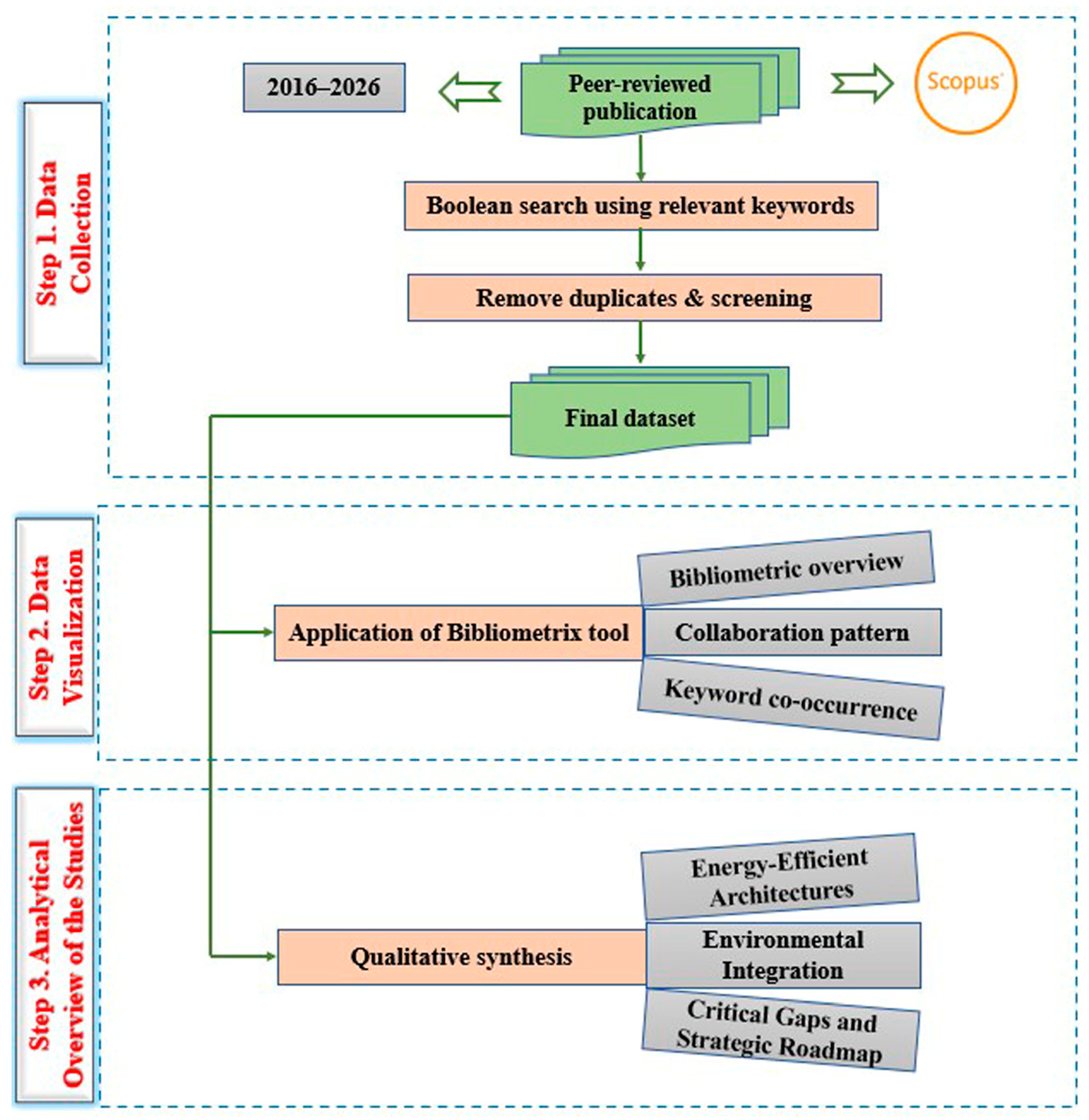
Figure 1. A schematic drawing of the research methodology.
Information 17 00596 g001
Figure 2. PRISMA-style study selection workflow diagram.
Information 17 00596 g002
Figure 3. Bibliometric overview of IoT smart street lighting research (2016–2026).
Information 17 00596 g003
Figure 4. Most cited references in the reviewed dataset, showing the key studies most frequently cited within the selected corpus and their relative influence on IoT-enabled smart street lighting research [51,52,53,54,55,57,58,59,60,61].
Information 17 00596 g004
Figure 5. Most cited documents in the reviewed dataset, highlighting the publications with the highest citation impact in the wider literature and their influence on smart lighting, smart cities, and energy-efficient IoT research [51,57,59,62,63,64,65,66,67,68].
Information 17 00596 g005
Figure 6. Core sources identified using Bradford’s Law, showing the journals and conference venues that concentrate the highest number of publications in the reviewed IoT-enabled smart street lighting dataset.
Information 17 00596 g006
Figure 7. Co-citation network of the reviewed dataset, showing the intellectual links among frequently co-cited authors and the main knowledge clusters shaping IoT-enabled smart street lighting research.
Information 17 00596 g007
Figure 8. Global research collaboration network in IoT smart street lighting (2016–2026).
Information 17 00596 g008
Figure 9. The research keyword co-occurrence associated with IoT research (2016–2026).
Information 17 00596 g009
Figure 10. Thematic evolution of keywords between 2016–2021 and 2022–2026, showing the shift from core themes such as Internet of Things, street lighting, and microcontrollers toward automation, data analytics, energy conservation, network security, and air-quality monitoring.
Information 17 00596 g010
Figure 11. Critical gaps and a strategic roadmap for IoT smart street lighting.
Information 17 00596 g011
Table 1. Dominant architectural components, technologies, and representative studies in IoT-based smart street lighting [74,75,76,77,78,79,80].
Layer/ComponentCommon TechnologiesFunctional RoleEnergy Impact
IoT Architecture3-layer, 5-layer modelsStructured data flow and system coordinationIndirect
SensorsPIR, LDR, DHT11, MQ135Motion, light, environmental sensingDirect
Microcontrollers/EdgeESP8266, Arduino, Raspberry PiLocal processing and controlDirect
Communication ProtocolsWi-Fi, ZigBee, LoRaWAN, MQTTData transmission and system connectivityConditional
Energy StrategiesStatic → Sensor-based → AdaptiveEvolution of lighting controlHigh
Control AlgorithmsRule-based, threshold, adaptive logicDynamic dimming and decision-makingHigh
Table 2. Environmental integration patterns, sensing technologies, and sustainability roles in IoT-based smart street lighting [28,75,76,81,82,83].
Integration LevelTechnologies UsedFunctional RoleSystem Impact
Lighting-only systemsLED + basic controlIllumination control onlyLow
Lighting + motion sensingPIR, LDRAdaptive lighting based on activityMedium
Lighting + environmental sensingDHT11, MQ135, gas sensorsAir quality and weather monitoringMedium–High
Multi-functional smart nodesHybrid sensor networks + IoT cloudIntegrated lighting, sensing, and analyticsHigh
Context-aware systemsMulti-sensor + control algorithmsEnvironment-driven lighting decisionsHigh
Disclaimer/Publisher’s Note: The statements, opinions and data contained in all publications are solely those of the individual author(s) and contributor(s) and not of MDPI and/or the editor(s). MDPI and/or the editor(s) disclaim responsibility for any injury to people or property resulting from any ideas, methods, instructions or products referred to in the content.