
Artificial Intelligence Acceptance in Higher Education: Perceptions from Mexico, Spain, and Finland

 ,
, 
 and
and
Abstract
1. Introduction
Acceptance of AI in Educational Processes
2. Materials and Methods
2.1. Research Design and Data Analysis
2.2. Participants
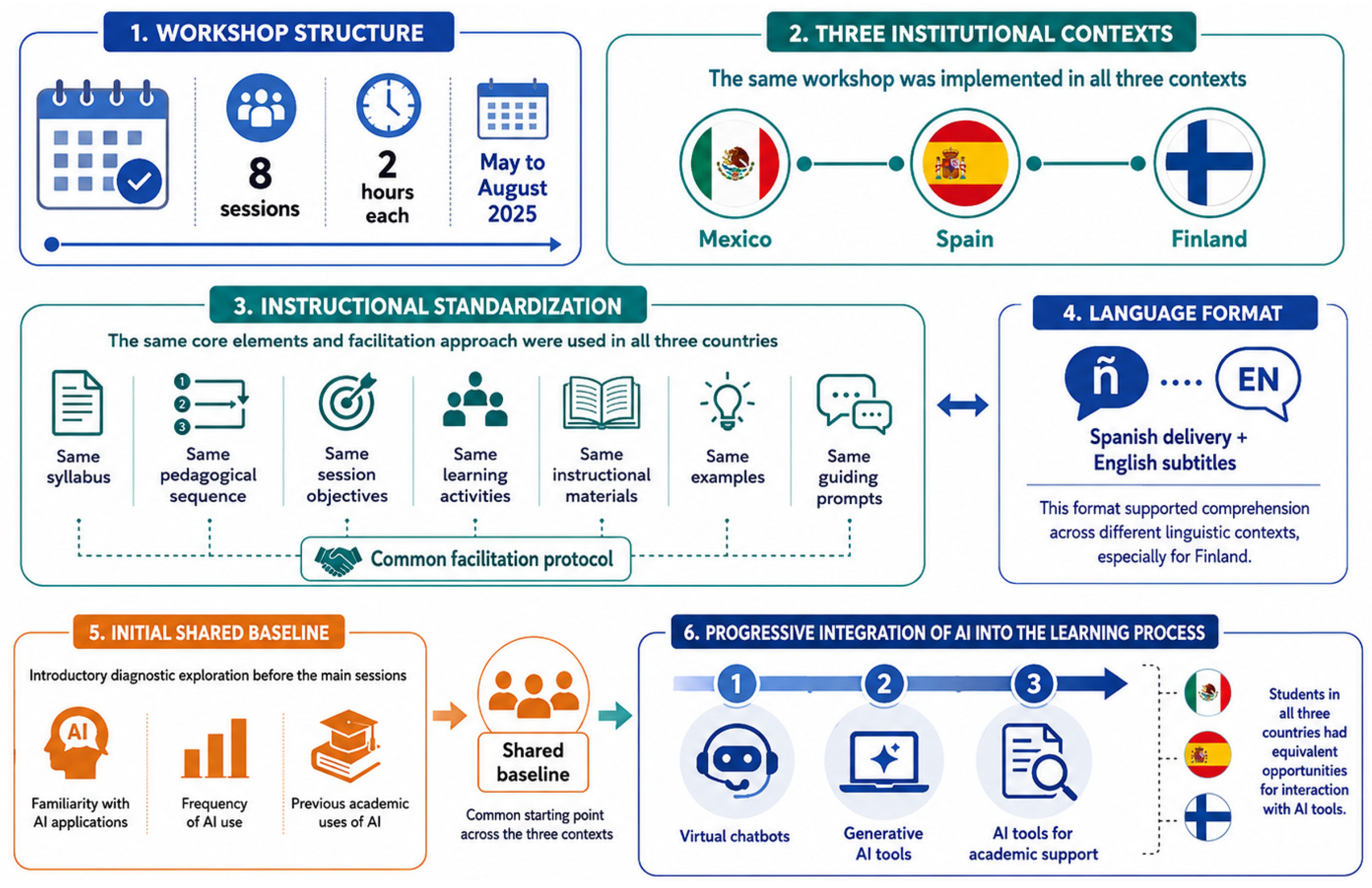
2.3. Procedure
2.4. Ethical Considerations
2.5. Instrument
3. Results
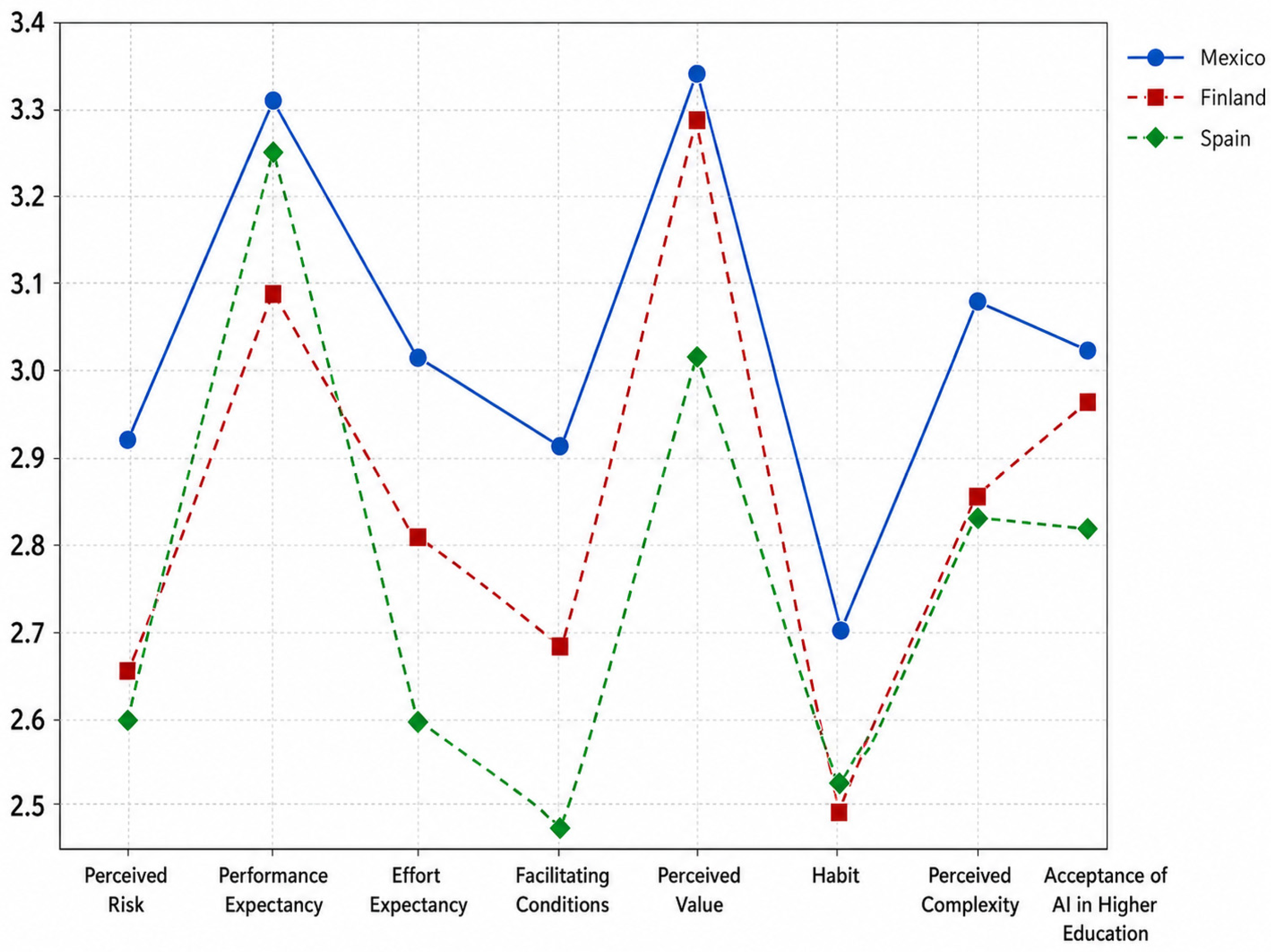
3.1. Descriptive Statistics by Institutional Context
3.2. Initial Perceptions of Participants
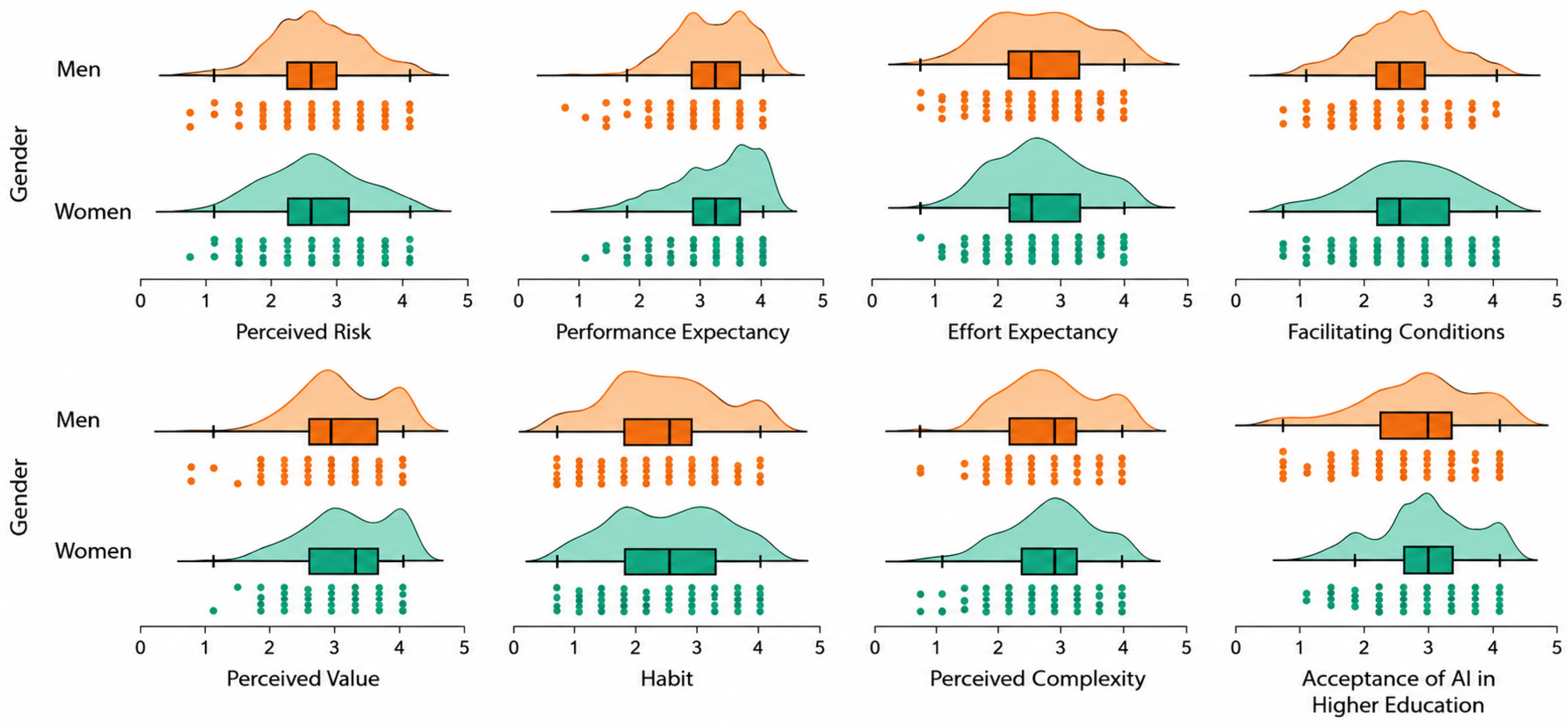
3.3. Gender Comparison
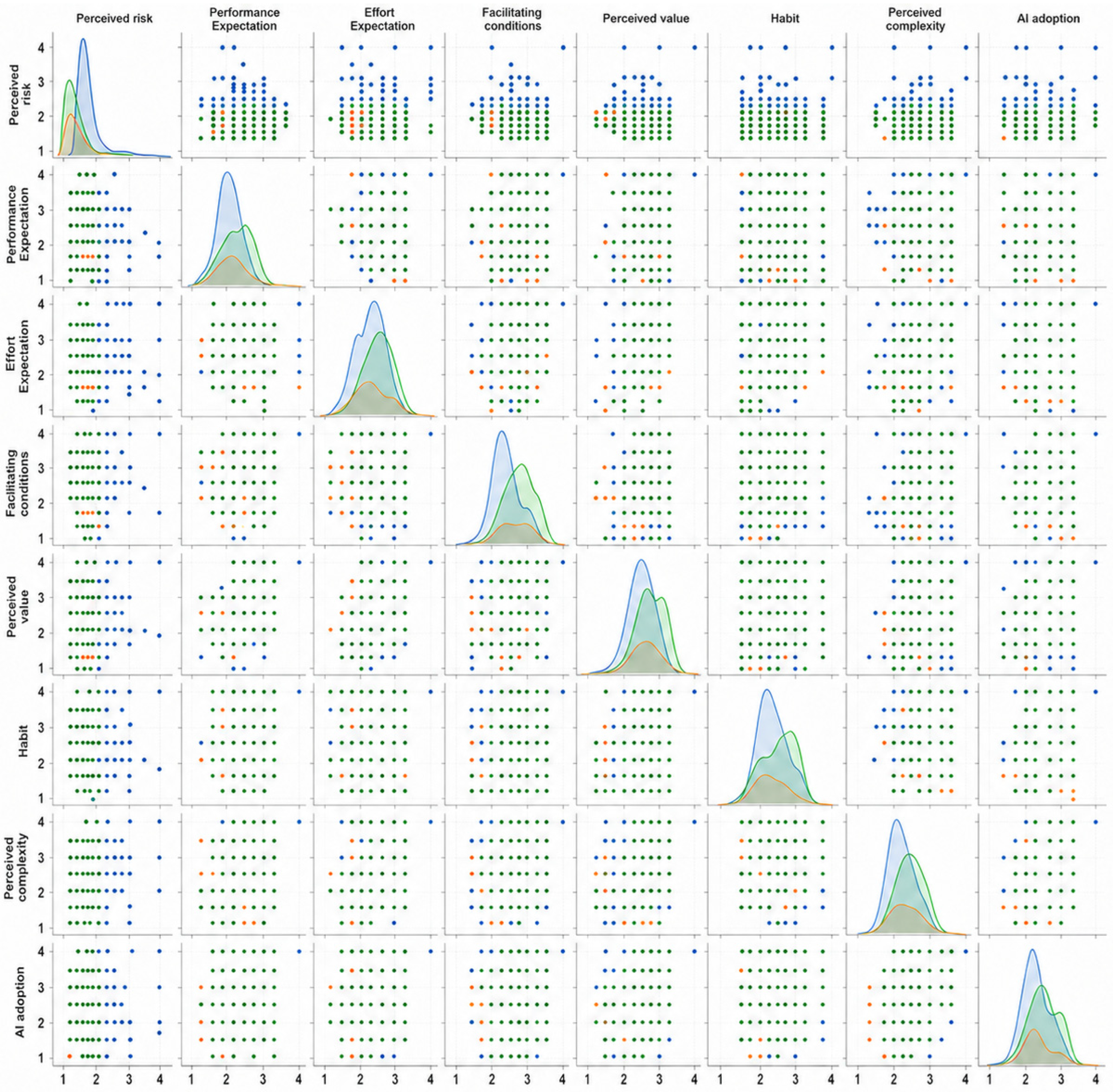
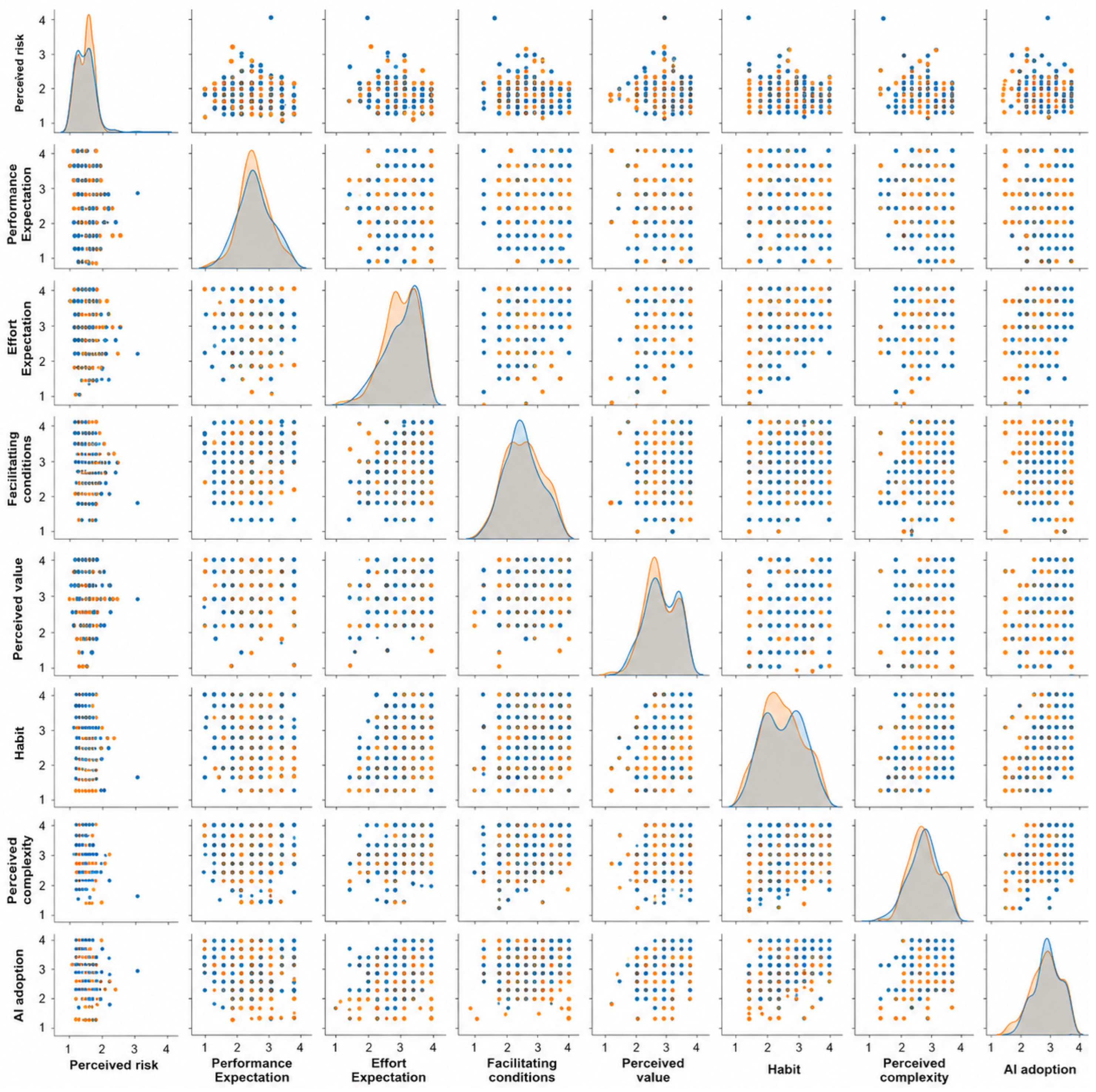
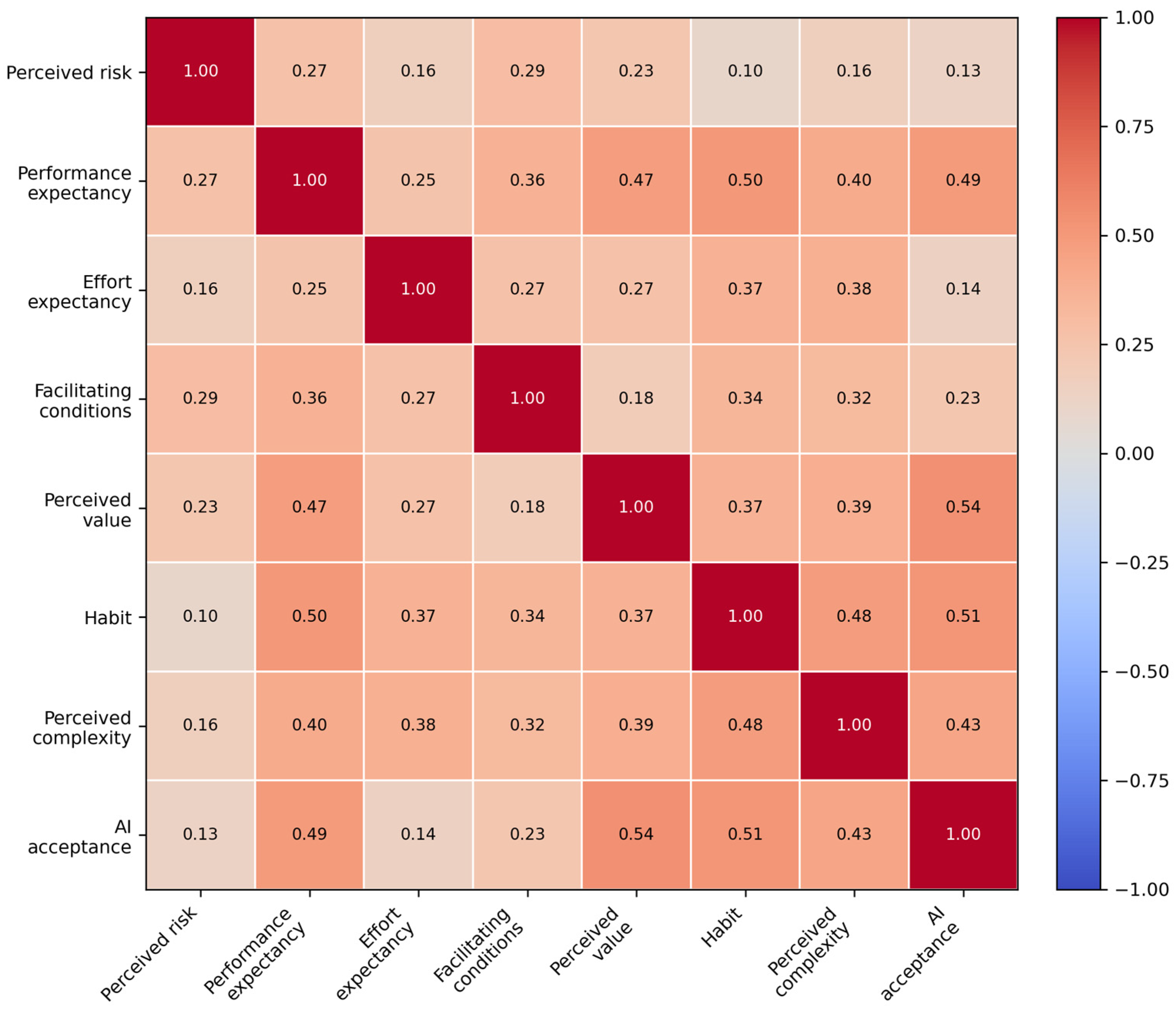
3.4. Scatterplot Matrices and Correlation Heat Map
4. Discussion
5. Conclusions
Author Contributions
Funding
Institutional Review Board Statement
Informed Consent Statement
Data Availability Statement
Acknowledgments
Conflicts of Interest
Abbreviations
| AI | Artificial intelligence |
| UTAUT | Unified Theory of Acceptance and Use of Technology |
| UTAUT2 | Extended Unified Theory of Acceptance and Use of Technology |
| SD | Standard deviation |
References
- Johnston, H.; Wells, R.F.; Shanks, E.M.; Boey, T.; Parsons, B.N. Student perspectives on the use of generative artificial intelligence technologies in higher education. Int. J. Educ. Integr. 2024, 20, 2. [Google Scholar] [CrossRef]
- Endris, A.; Tlili, A.; Huang, R.; Xu, L.; Chang, T.; Mishra, S. Features, components and processes of developing policy for artificial intelligence in education (AIED): Toward a sustainable AIED development and adoption. Leadersh. Policy Sch. 2024, 24, 233–241. [Google Scholar] [CrossRef]
- Kim, M.; Kim, N.; Heidari, A. Learner experience in artificial intelligence-scaffolded argumentation. Assess. Eval. High. Educ. 2022, 47, 1301–1316. [Google Scholar] [CrossRef]
- Chan, C.; Tsi, L.H.Y. The AI revolution in education: Will AI replace or assist teachers in higher education? arXiv 2023, arXiv:2305.01185. [Google Scholar] [CrossRef]
- Abdalgane, M.; Othman, K.A.J. Utilizing artificial intelligence technologies in Saudi EFL tertiary level classrooms. J. Intercult. Commun. 2023, 23, 92–99. [Google Scholar] [CrossRef]
- Venkatesh, V.; Morris, M.G.; Davis, G.B.; Davis, F.D. User acceptance of information technology: Toward a unified view. MIS Q. 2003, 27, 425–478. [Google Scholar] [CrossRef]
- Venkatesh, V.; Thong, J.Y.L.; Xu, X. Consumer Acceptance and Use of Information Technology: Extending the Unified Theory of Acceptance and Use of Technology. MIS Q. 2012, 36, 157–178. Available online: https://ssrn.com/abstract=2002388 (accessed on 11 November 2025). [CrossRef]
- Aranyossy, M. Technology adoption in the digital entertainment industry during the COVID-19 pandemic: An extended UTAUT2 model for online theater streaming. Informatics 2022, 9, 71. [Google Scholar] [CrossRef]
- Gansser, O.; Reich, C. A new acceptance model for artificial intelligence with extensions to UTAUT2: An empirical study in three segments of application. Technol. Soc. 2021, 65, 101535. [Google Scholar] [CrossRef]
- Lainjo, B.; Tsmouche, H. Impact of artificial intelligence on higher learning institutions. Int. J. Educ. Teach. Soc. Sci. 2023, 3, 96–113. [Google Scholar] [CrossRef]
- Al-Saedi, K.; Al-Emran, M.; Ramayah, T.; Abusham, E. Developing a general extended UTAUT model for M-payment adoption. Technol. Soc. 2020, 62, 101293. [Google Scholar] [CrossRef]
- Musa, M.; Ismail, M.N.; Tahir, S.; Fudzee, M.F.M.; Jofri, M.H. Student acceptance towards online learning management system based on UTAUT2 model. Int. J. Adv. Comput. Sci. Appl. 2022, 13, 139–147. [Google Scholar] [CrossRef]
- Raman, A.; Thannimalai, R. Factors impacting the behavioural intention to use e-learning at higher education amid the COVID-19 pandemic: UTAUT2 model. Psychol. Sci. Educ. 2021, 26, 82–93. [Google Scholar] [CrossRef]
- Blut, M.; Chong, A.; Tsigna, Z.; Venkatesh, V. Meta-analysis of the unified theory of acceptance and use of technology (UTAUT): Challenging its validity and charting a research agenda in the red ocean. J. Assoc. Inf. Syst. 2022, 23, 10. [Google Scholar] [CrossRef]
- George-Reyes, C.E.; López-Caudana, E.O.; Avello-Martínez, R. Artificial intelligence adoption test based on UTAUT2 and complex thinking: Design with K coefficient and reliability analysis using structural equation modeling. Cogent Educ. 2025, 12, 2511446. [Google Scholar] [CrossRef]
- Tram, N.H.M. Unveiling the drivers of AI integration among language teachers: Integrating UTAUT and AI-TPACK. Comput. Sch. 2024, 42, 100–120. [Google Scholar] [CrossRef]
- Alqaisi, N.; Alshwayyat, S.; Aburumman, S.; Qassim, N.; Almasri, N.; Algroosh, F.; Alkhatib, M.; Hanifa, H.; AlRyalat, S.A. Assessing ChatGPT adoption in Jordanian medical education: A UTAUT model approach. BMC Med. Educ. 2025, 25, 750. [Google Scholar] [CrossRef]
- Harnad, S. Language writ large: LLMs, ChatGPT, meaning, and understanding. Front. Artif. Intell. 2024, 7, 1490698. [Google Scholar] [CrossRef]
- Habibi, A.; Mukminin, A.; Octavia, A.; Wahyuni, S.; Danibao, B.K.; Wibowo, Y.G. ChatGPT acceptance and use through UTAUT and TPB: A big survey in five Indonesian universities. Soc. Sci. Humanit. Open 2024, 10, 101136. [Google Scholar] [CrossRef]
- Ivanov, S.; Soliman, M. Game of algorithms: ChatGPT implications for the future of tourism education and research. J. Tour. Futures 2023, 9, 214–221. [Google Scholar] [CrossRef]
- Cabero-Almenara, J.; Palacios-Rodríguez, A.; Rojas Guzmán, H.D.L.Á.; Fernández-Scagliusi, V. Prediction of the use of generative artificial intelligence through ChatGPT among Costa Rican university students: A PLS model based on UTAUT2. Appl. Sci. 2025, 15, 3363. [Google Scholar] [CrossRef]
- Cernau, L.D.; Dioşan, L.S.; Serban, C. A pedagogical approach in interleaving software quality concerns at an artificial intelligence course. In Proceedings of the 2022 ACM Conference; ACM: New York, NY, USA, 2022; pp. 18–24. [Google Scholar] [CrossRef]
- Tossell, C.; Tenhundfeld, N.L.; Momen, A.; Cooley, K.; De Visser, E.J. Student perceptions of ChatGPT use in a college essay assignment: Implications for learning, grading, and trust in artificial intelligence. IEEE Trans. Learn. Technol. 2024, 17, 1069–1081. [Google Scholar] [CrossRef]
- Tsao, J.; Nogues, C. Beyond the author: Artificial intelligence, creative writing and intellectual emancipation. Poetics 2024, 102, 101865. [Google Scholar] [CrossRef]
- Vecchiarini, M.; Somià, T. Redefining entrepreneurship education in the age of artificial intelligence: An explorative analysis. Int. J. Manag. Educ. 2023, 21, 100879. [Google Scholar] [CrossRef]
- Crompton, H.; Burke, D. Artificial intelligence in higher education: The state of the field. Int. J. Educ. Technol. High. Educ. 2023, 20, 22. [Google Scholar] [CrossRef]
- Malik, A.R.; Pratiwi, Y.; Andajani, K.; Numertayasa, I.W.; Suharti, S.; Darwis, A. Exploring artificial intelligence in academic essay: Higher education student’s perspective. Int. J. Educ. Res. Open 2023, 5, 100296. [Google Scholar] [CrossRef]
- Slimi, Z. The impact of artificial intelligence on higher education: An empirical study. Eur. J. Educ. Sci. 2023, 10, 17–33. [Google Scholar] [CrossRef]
- Crompton, H.; Song, D. The potential of artificial intelligence in higher education. Rev. Virtual Univ. Católica Norte 2021, 62, 1–4. [Google Scholar] [CrossRef]
- Demartini, C.G.; Sciascia, L.; Bosso, A.; Manuri, F. Artificial intelligence bringing improvements to adaptive learning in education: A case study. Sustainability 2024, 16, 1347. [Google Scholar] [CrossRef]
- Tomar, P.; Verma, S. Impact and role of AI technologies in teaching, learning, and research in higher education. In Impact of AI Technologies on Teaching, Learning, and Research in Higher Education; Verma, S., Tomar, P., Eds.; IGI Global: Hershey, PA, USA, 2021; pp. 190–203. [Google Scholar] [CrossRef]
- Wang, T.; Lund, B.; Marengo, A.; Pagano, A.; Mannuru, N.; Teel, Z.; Pange, J. Exploring the potential impact of artificial intelligence (AI) on international students in higher education: Generative AI, chatbots, analytics, and international student success. Appl. Sci. 2023, 13, 6716. [Google Scholar] [CrossRef]
- Jiang, Z.; Xu, Z.; Pan, Z.; He, J.; Xie, K. Exploring the role of artificial intelligence in facilitating assessment of writing performance in second language learning. Languages 2023, 8, 247. [Google Scholar] [CrossRef]
- Zhang, J. Impact of artificial intelligence on higher education in the perspective of its application of transformation. Lect. Notes Educ. Psychol. Public Media 2023, 2, 822–830. [Google Scholar] [CrossRef]
- Chauke, T.; Mkhize, T.R.; Methi, L.; Dlamini, N. Postgraduate students’ perceptions on the benefits associated with artificial intelligence tools for academic success: The use of the ChatGPT AI tool. J. Curric. Stud. Res. 2024, 6, 44–59. [Google Scholar] [CrossRef]
- Bates, T.; Cobo, C.; Mariño, O.; Wheeler, S. Can artificial intelligence transform higher education? Int. J. Educ. Technol. High. Educ. 2020, 17, 42. [Google Scholar] [CrossRef]
- George-Reyes, C.E.; Glasserman-Morales, L.; Peláez, C. Digital environments of education 4.0 and complex thinking: Communicative literacy to close the digital gender gap. J. Interact. Media Educ. 2024, 1, 17–20. [Google Scholar] [CrossRef]
- Alzahrani, L. Analyzing students’ attitudes and behavior toward artificial intelligence technologies in higher education. Int. J. Recent Technol. Eng. 2023, 11, 65–73. [Google Scholar] [CrossRef]
- George, B.; Wooden, O. Managing the strategic transformation of higher education through artificial intelligence. Adm. Sci. 2023, 13, 196. [Google Scholar] [CrossRef]
- de Vicente, M.; López-Martínez, O.; Navarro-Navarro, V.; Cuéllar-Santiago, F. Writing, creativity, and artificial intelligence: ChatGPT in the university context. Comunicar 2023, 31, 47–57. [Google Scholar] [CrossRef]
- Daniel, S.; Pacheco, M.; Smith, B.; Burriss, S.; Hundley, M. Cultivating writerly virtues: Critical human elements of multimodal writing in the age of artificial intelligence. J. Adolesc. Adult Lit. 2023, 67, 32–38. [Google Scholar] [CrossRef]
- Ivanov, S. The dark side of artificial intelligence in higher education. Serv. Ind. J. 2023, 43, 1055–1082. [Google Scholar] [CrossRef]
- Chatterjee, S.; Bhattacharjee, K. Adoption of artificial intelligence in higher education: A quantitative analysis using structural equation modelling. Educ. Inf. Technol. 2020, 25, 3443–3463. [Google Scholar] [CrossRef]
- Shi, J.; Zhang, X. Integration of AI with higher education innovation: Reforming future educational directions. Int. J. Sci. Res. 2023, 12, 1727–1731. [Google Scholar] [CrossRef]
- Althubaiti, A.; Althubaiti, S.M. Flipping the online classroom to teach statistical data analysis software: A quasi-experimental study. SAGE Open 2024, 14, 1–12. [Google Scholar] [CrossRef]
- Novielli, J.; Kane, L.; Ashbaugh, A.R. Convenience sampling methods in psychology: A comparison between crowdsourced and student samples. Can. J. Behav. Sci. 2023, 57, 229–238. [Google Scholar] [CrossRef]
- Shi, J.; Cheung, A. The impacts of a social emotional learning program on elementary school students in China: A quasi-experimental study. Asia-Pac. Educ. Res. 2024, 33, 59–69. [Google Scholar] [CrossRef]
- World Medical Association. Declaration of Helsinki: Ethical Principles for Medical Research Involving Human Subjects. Available online: https://www.wma.net/es/policies-post/declaracion-de-helsinki/ (accessed on 12 May 2026).
- Merino-Soto, C. Aiken’s V coefficient: Differences in content validity judgments. MHSalud Rev. Cienc. Mov. Hum. Salud 2023, 20, 1–10. [Google Scholar] [CrossRef]
- Luh, W.M. A general framework for planning the number of items/subjects for evaluating Cronbach’s alpha: Integration of hypothesis testing and confidence intervals. Methodology 2024, 20, e10449. [Google Scholar] [CrossRef]
- Borroni, C.G.; De Capitani, L. Some measures of kurtosis and their inference on large datasets. AStA Adv. Stat. Anal. 2022, 106, 573–607. [Google Scholar] [CrossRef]
- Lugo-Armenta, J.; Pino-Fan, L. Inferential reasoning of high school mathematics teachers about t-Student statistic. Uniciencia 2022, 36, 1–29. [Google Scholar] [CrossRef]



| University | N | % | Male | Female |
|---|---|---|---|---|
| Mexico | 155 | 37.26 | 94 | 61 |
| Spain | 192 | 46.15 | 81 | 111 |
| Finland | 69 | 16.59 | 28 | 41 |
| Total | 416 | 100 | 203 (48.8%) | 213 (51.2%) |
| Session | Session Focus | Tools Used | Activities Carried Out | Pedagogical Purpose |
|---|---|---|---|---|
| 1 | Introduction to AI in Higher Education | Gems from Gemini (https://gemini.google/overview/gems/) | Initial exploration, conversational interaction, resolution of doubts | Familiarize students with the academic use of AI |
| 2 | Conceptual understanding and deepening | Virtual chatbots (https://chatbotchatapp.com) | Concept analysis and immediate feedback | Strengthen thematic understanding |
| 3 | Exploration and idea generation | Generative AI (https://chat.deepseek.com) | Brainstorming and initial content structuring | Stimulate creativity and conceptual organization |
| 4 | Assisted academic production | Generative AI (https://consensus.app) | Drafting and writing improvement | Develop academic writing skills |
| 5 | Scientific Information Management | AI platforms for bibliographic management (https://www.researchrabbit.ai) | Search and organization of references | Optimize the location and systematization of sources |
| 6 | Source Integration and Citation | AI-powered bibliographic platforms (https://www.zotero.org) | Organization of citations and academic references | Improve the formal quality of academic work |
| 7 | Integrated application of tools | Combined use of AI | Development of complete academic activity | Promote autonomy and strategic use of AI |
| 8 | Reflection and consolidation | Evaluation of the use of tools and critical discussion |
| Dimension | Item |
|---|---|
| Perceived risk | 1.1 The use of AI applications may result in an over-reliance on technology in my education. |
| 1.2 The use of AI applications in my university studies worries me in terms of privacy and security. | |
| 1.3 The use of AI applications to prepare assignments could be considered academic plagiarism. | |
| Performance expectancy | 2.1 Using AI applications improves my ability to understand information. |
| 2.2 AI applications help me solve problems more efficiently. | |
| 2.3 AI applications can help me get higher grades in my college courses. | |
| Effort expectancy | 3.1 Mastering the use of AI applications in my education is a straightforward process. |
| 3.2 Using AI applications to perform my academic assignments requires minimal effort on my part. | |
| 3.3 Adopting AI applications in my education requires a minimal investment of time on my part. | |
| Facilitating conditions | 4.1 My university actively promotes the use of AI applications in learning. |
| 4.2 The university’s technological infrastructure is suitable for implementing the use of AI applications. | |
| 4.3 AI applications are easily accessible at my educational institution. | |
| Perceived value | 5.1 With AI applications, more innovative educational resources can be developed. |
| 5.2 AI applications offer the advantage of personalizing my learning experience. | |
| 5.3 AI applications can automate tasks and processes to focus on more important activities, such as interacting with teachers and students. | |
| Habit | 6.1 Incorporating AI applications into my learning process is a frequent practice in my academic life. |
| 6.2 I consider it essential to use AI applications in my studies. | |
| 6.3 I tend to use AI apps as a regular part of my study routine. | |
| Perceived complexity | 7.1 The use of AI applications in my academic activities is complex. |
| 7.2 Using AI applications makes the completion of academic tasks more complex. | |
| 7.3 Using AI applications requires dealing with complicated technical concepts. | |
| AI acceptance in higher education | 8.1 The main benefit of AI applications in higher education is that students learn better. |
| 8.2 The applications of AI in higher education make the teaching-learning process more interactive. | |
| 8.3 AI applications in higher education make learning more engaging. |
| Cronbach’s Alpha | Mexico | Spain | Finland |
|---|---|---|---|
| General | 0.8832 | 0.8087 | 0.8675 |
| Alpha if dimension deleted | |||
| Perceived risk | 0.885 | 0.820 | 0.872 |
| Performance expectancy | 0.878 | 0.798 | 0.859 |
| Effort expectancy | 0.880 | 0.807 | 0.860 |
| Facilitating conditions | 0.881 | 0.804 | 0.865 |
| Perceived value | 0.879 | 0.800 | 0.859 |
| Habit | 0.873 | 0.792 | 0.857 |
| Perceived complexity | 0.877 | 0.798 | 0.862 |
| AI acceptance in higher education | 0.876 | 0.794 | 0.865 |
| Dimension | University | Mean | SD | Variance | Skewness |
|---|---|---|---|---|---|
| Perceived risk | Mexico | 2.918 | 0.707 | 0.500 | −0.389 |
| Perceived risk | Finland | 2.657 | 0.657 | 0.431 | 0.101 |
| Perceived risk | Spain | 2.597 | 0.516 | 0.266 | −0.049 |
| Performance expectancy | Mexico | 3.312 | 0.607 | 0.369 | −1.143 |
| Performance expectancy | Finland | 3.087 | 0.643 | 0.414 | −0.572 |
| Performance expectancy | Spain | 3.254 | 0.596 | 0.355 | −0.583 |
| Effort expectancy | Mexico | 3.017 | 0.704 | 0.496 | −0.395 |
| Effort expectancy | Finland | 2.821 | 0.789 | 0.623 | −0.227 |
| Effort expectancy | Spain | 2.599 | 0.642 | 0.413 | 0.265 |
| Facilitating conditions | Mexico | 2.918 | 0.702 | 0.493 | −0.589 |
| Facilitating conditions | Finland | 2.701 | 0.728 | 0.530 | −0.168 |
| Facilitating conditions | Spain | 2.462 | 0.642 | 0.413 | −0.059 |
| Perceived value | Mexico | 3.340 | 0.570 | 0.325 | −0.526 |
| Perceived value | Finland | 3.290 | 0.695 | 0.483 | −0.983 |
| Perceived value | Spain | 3.019 | 0.611 | 0.374 | −0.116 |
| Habit | Mexico | 2.714 | 0.899 | 0.809 | −0.265 |
| Habit | Finland | 2.469 | 0.815 | 0.664 | 0.232 |
| Habit | Spain | 2.524 | 0.800 | 0.640 | 0.096 |
| Perceived complexity | Mexico | 3.080 | 0.666 | 0.443 | −0.433 |
| Perceived complexity | Finland | 2.860 | 0.658 | 0.433 | 0.067 |
| Perceived complexity | Spain | 2.842 | 0.670 | 0.449 | −0.218 |
| AI acceptance in higher education | Mexico | 3.026 | 0.760 | 0.578 | −0.669 |
| AI acceptance in higher education | Finland | 2.961 | 0.653 | 0.427 | −0.328 |
| AI acceptance in higher education | Spain | 2.826 | 0.709 | 0.503 | −0.179 |
| Dimension | Testing | Statistics | df | p-Value | Cohen’s d |
|---|---|---|---|---|---|
| Perceived risk | Student | −0.030 | 414.000 | 0.976 | −0.003 |
| Perceived risk | Welch | −0.030 | 409.672 | 0.976 | −0.003 |
| Performance expectancy | Student | 1.027 | 414.000 | 0.305 | 0.101 |
| Performance expectancy | Welch | 1.026 | 410.639 | 0.306 | 0.101 |
| Effort expectancy | Student | −0.324 | 414.000 | 0.746 | −0.032 |
| Effort expectancy | Welch | −0.325 | 413.781 | 0.745 | −0.032 |
| Facilitating conditions | Student | 0.602 | 414.000 | 0.547 | 0.059 |
| Facilitating conditions | Welch | 0.600 | 399.679 | 0.549 | 0.059 |
| Perceived value | Student | 1.001 | 414.000 | 0.318 | 0.098 |
| Perceived value | Welch | 1.001 | 413.441 | 0.317 | 0.098 |
| Habit | Student | 0.398 | 414.000 | 0.691 | 0.039 |
| Habit | Welch | 0.397 | 412.685 | 0.691 | 0.039 |
| Perceived complexity | Student | −0.363 | 414.000 | 0.716 | −0.036 |
| Perceived complexity | Welch | −0.363 | 412.504 | 0.717 | −0.036 |
| AI acceptance in higher education | Student | 1.577 | 414.000 | 0.116 | 0.154 |
| AI acceptance in higher education | Welch | 1.583 | 409.627 | 0.114 | 0.155 |
| Items | Factor 1 | Factor 2 | Factor 3 | Factor 4 | Factor 5 | Uniqueness |
|---|---|---|---|---|---|---|
| 5.2 | 0.824 | 0.491 | ||||
| 8.3 | 0.748 | 0.511 | ||||
| 5.1 | 0.704 | 0.588 | ||||
| 8.2 | 0.673 | 0.534 | ||||
| 5.3 | 0.669 | 0.622 | ||||
| 8.1 | 0.544 | 0.568 | ||||
| 2.1 | 0.456 | 0.674 | ||||
| 2.2 | 0.442 | 0.686 | ||||
| 6.3 | 0.965 | 0.240 | ||||
| 6.1 | 0.796 | 0.383 | ||||
| 6.2 | 0.783 | 0.385 | ||||
| 3.3 | 0.829 | 0.368 | ||||
| 3.2 | 0.794 | 0.380 | ||||
| 7.1 | 0.423 | 0.560 | ||||
| 4.3 | 0.689 | 0.543 | ||||
| 4.1 | 0.652 | 0.514 | ||||
| 4.2 | 0.634 | 0.600 | ||||
| 1.2 | 0.636 | 0.596 | ||||
| 1.3 | 0.473 | 0.746 | ||||
| 1.1 | 0.777 | |||||
| 2.3 | 0.645 | |||||
| 3.1 | 0.736 | |||||
| 7.2 | 0.725 | |||||
| 7.3 | 0.723 |
Disclaimer/Publisher’s Note: The statements, opinions and data contained in all publications are solely those of the individual author(s) and contributor(s) and not of MDPI and/or the editor(s). MDPI and/or the editor(s) disclaim responsibility for any injury to people or property resulting from any ideas, methods, instructions or products referred to in the content. |
© 2026 by the authors. Licensee MDPI, Basel, Switzerland. This article is an open access article distributed under the terms and conditions of the Creative Commons Attribution (CC BY) license.
Share and Cite
George-Reyes, C.E.; Mérida-Córdova, E.J.; Yeguas-Bolivar, E.; Monzalvo-Serrano, L. Artificial Intelligence Acceptance in Higher Education: Perceptions from Mexico, Spain, and Finland. Information 2026, 17, 575. https://doi.org/10.3390/info17060575
George-Reyes CE, Mérida-Córdova EJ, Yeguas-Bolivar E, Monzalvo-Serrano L. Artificial Intelligence Acceptance in Higher Education: Perceptions from Mexico, Spain, and Finland. Information. 2026; 17(6):575. https://doi.org/10.3390/info17060575
Chicago/Turabian StyleGeorge-Reyes, Carlos Enrique, Ennio Jesús Mérida-Córdova, Enrique Yeguas-Bolivar, and Lucina Monzalvo-Serrano. 2026. "Artificial Intelligence Acceptance in Higher Education: Perceptions from Mexico, Spain, and Finland" Information 17, no. 6: 575. https://doi.org/10.3390/info17060575
APA StyleGeorge-Reyes, C. E., Mérida-Córdova, E. J., Yeguas-Bolivar, E., & Monzalvo-Serrano, L. (2026). Artificial Intelligence Acceptance in Higher Education: Perceptions from Mexico, Spain, and Finland. Information, 17(6), 575. https://doi.org/10.3390/info17060575