Article

Artificial Intelligence Acceptance in Higher Education: Perceptions from Mexico, Spain, and Finland


by
Carlos Enrique George-Reyes
1,*,
Ennio Jesús Mérida-Córdova
1,
Enrique Yeguas-Bolivar
2 and
Lucina Monzalvo-Serrano
3
1
Instituto Latinoamericano de Futuros de la Educación, Universidad Bolivariana del Ecuador, Durán 092406, Ecuador
2
Departamento de Informática y anális numerico, Universidad de Córdoba, 14071 Cordoba, Spain
3
Educación a Distancia, Universidad del Valle de México, Ciudad de México 11850, Mexico
*
Author to whom correspondence should be addressed.
Information 2026, 17(6), 575; https://doi.org/10.3390/info17060575 (registering DOI)
Submission received: 12 May 2026 / Revised: 3 June 2026 / Accepted: 5 June 2026 / Published: 10 June 2026
(This article belongs to the Section Artificial Intelligence)

Abstract

This study describes university students’ acceptance of artificial intelligence (AI) in higher education across three institutional contexts in Mexico, Spain, and Finland. A quantitative descriptive-correlational design was used with a non-probabilistic convenience sample of 416 undergraduate students who participated in a structured virtual workshop on the academic use of AI tools. The study did not include random assignment, a control group, or a pretest–posttest comparison; therefore, the results are interpreted in descriptive and associative terms. Data were collected using the AIComplex instrument, which assesses perceived risk, performance expectancy, effort expectancy, facilitating conditions, perceived value, habit, perceived complexity, and AI acceptance in higher education. The instrument showed adequate overall internal consistency across the three contexts. Additional psychometric evidence was obtained through measurement invariance analysis by dimension and exploratory factor analysis. Descriptive statistics, independent samples t-tests with effect sizes, Pearson correlations, scatterplot matrices, and a correlation heat map were used to examine students’ perceptions and associations among the dimensions. The results showed generally favorable perceptions of AI, particularly in performance expectancy and perceived value. No statistically significant gender differences were found, and the effect sizes were trivial. The strongest observed associations with AI acceptance were found for perceived value, habit, performance expectancy, and perceived complexity. The exploratory factor analysis suggested partial empirical overlap among some dimensions, while the invariance analysis indicated that cross-context comparisons should be interpreted cautiously. The findings provide contextual evidence on AI acceptance in higher education, highlighting associations among cognitive, institutional, and experiential dimensions without implying causal or nationally representative conclusions.

1. Introduction

The implementation of AI in higher education promises to transform the educational landscape [1], offering key benefits such as the personalization and acceptance of educational content to the individual needs and preferences of each student [2]. This personalization enables a more effective response to diverse learning styles, ensuring that each student receives appropriate support and resources for academic development [3].
In universities, AI has reshaped the way students interact with educational content [4] and has streamlined how instructors manage the teaching and learning process [5]. At the same time, theoretical models such as the Unified Theory of Acceptance and Use of Technology, UTAUT [6], and its extended version, UTAUT2 [7], have been widely used as reference frameworks to evaluate the acceptance and use of this technology [8,9], enabling researchers and practitioners to better understand the factors influencing its adoption [10].
These frameworks have been shown to explain technology effectiveness and acceptance through constructs such as performance expectancy, effort expectancy, social influence, and facilitating conditions [11,12]. In this regard, numerous studies have examined users’ perceptions and attitudes toward AI in education [13], providing a broader understanding of its impact [14]. In particular, UTAUT2 has been validated in various educational contexts and has demonstrated its effectiveness in assessing the acceptance of AI tools [15].
In this sense, AI expands the dimensions of UTAUT2 by introducing new forms of interaction, cognitive mediation, and adaptive learning that reshape traditional determinants of technology acceptance [16]. While the model focuses on variables such as performance expectancy, effort expectancy, perceived value, and facilitating conditions [17], AI introduces additional layers of complexity related to algorithmic autonomy, personalized experiences, and data-driven decision-making [18]. These characteristics modify users’ perceptions of usefulness, creating scenarios in which technology not only responds to human intention but also co-constructs meaning and learning processes [19].
Moreover, AI redefines the concepts of habit and social influence by shaping environments in which algorithms continuously adapt responses according to collective behavior patterns [20]. Therefore, the integration of AI requires a reinterpretation of the dimensions of UTAUT2 from a more dynamic perspective, in which technology acceptance is understood as a process of symbiotic interaction between human capability and computational intelligence, characterized by constant evolution and co-learning [21].
Based on the above, the objective of this study is to examine how cognitive and institutional factors are related to the acceptance of AI in higher education across different institutional contexts. Specifically, the research analyzes the associations between key determinants such as performance expectancy, perceived value, and facilitating conditions and students’ acceptance of AI within university settings in Mexico, Spain, and Finland. Accordingly, the guiding research question is as follows: How are cognitive and institutional factors related to the acceptance of AI in higher education across different institutional contexts?

Acceptance of AI in Educational Processes

AI has been implemented in various areas of higher education, ranging from the personalization of learning [22], support for academic writing [23], and the enhancement of creativity [24] to the automation of administrative tasks [25]. The use of AI not only improves educational processes but also provides opportunities to develop skills and competencies relevant to emerging labor markets [26]. It has been argued that AI can be an effective tool for improving academic performance [27], enabling students to achieve better outcomes through the implementation of data-driven pedagogical strategies that free up time for deeper learning [28].
Additionally, AI can enhance motivation and engagement in the learning process by promoting more interactive and appealing learning environments, fostering greater participation and sustained interest in educational content [29]. Some applications of AI are associated with intelligent tutoring systems that provide personalized support to students [30], offering detailed explanations, answering questions, and delivering immediate feedback [31]. These tools make it possible to design adaptive teaching strategies that support individualized learning improvement [32]. AI has also transformed assessment and grading methods in higher education [33]. Automated assessment systems can process large volumes of data and provide accurate and objective evaluations more efficiently than traditional methods [34]. This allows instructors to focus on more creative and pedagogical activities, thereby enhancing the quality of teaching [35].
Despite its numerous benefits, it is necessary to evaluate the acceptance of AI in higher education learning processes in order to ensure its effective integration [36,37]. This can be achieved by measuring students’ perceptions of AI [38]. Such evaluation is important because, although students recognize the potential of AI applications to enhance their learning experience, they also express concerns regarding privacy and the risk of excessive dependence on this technology [39]. Furthermore, assessing AI acceptance must consider ethical implications. While its use can foster creative writing skills [40], it is not always employed appropriately in activities related to academic writing [41]. In addition, AI may introduce biases in assessment and teaching processes, potentially affecting educational equity [42].
Therefore, achieving effective acceptance of AI in higher education requires the systematic development of strategies that continuously assess how students perceive and engage with these technologies. Monitoring key constructs such as performance expectancy and facilitating conditions is essential, as these dimensions shape not only initial adoption but also sustained and meaningful use [43]. Acceptance should not be understood as a static outcome, but rather as a dynamic process influenced by cognitive evaluations, institutional support, and contextual factors. By examining these interrelated dimensions, institutions can better align technological innovation with pedagogical objectives, ensuring that AI tools are integrated in ways that genuinely enhance learning experiences. Moreover, a comprehensive understanding of acceptance contributes to designing policies and training initiatives that respond to students’ evolving expectations and digital competencies. Such an approach is particularly relevant in an increasingly competitive and technology-driven labor market, where universities are expected to prepare students not only to use AI tools effectively, but also to critically understand their implications [44].

2. Materials and Methods

2.1. Research Design and Data Analysis

A quantitative research design with a descriptive and correlational scope was employed, framed within a post-intervention assessment of students’ acceptance of AI in higher education. The study did not include random assignment, a control group, or a pretest–posttest comparison; therefore, its purpose was not to determine causal effects of the intervention, but to describe students’ perceptions after their participation in a structured educational experience involving AI tools and to examine associations among the dimensions of AI acceptance. A non-probabilistic convenience sampling method was used [45], involving 416 university students enrolled in three higher education institutions located in Mexico, Spain, and Finland during the period from May to August 2025. Given the sampling strategy and the participation of one institution per country, the findings are interpreted as evidence from three specific institutional contexts rather than as nationally representative results. Data were collected using the AIComplex instrument, and statistical analyses were conducted with R software 2026.01.1 Build 403. Parametric analyses were mainly used for three reasons. First, the sample size was adequate for the application of parametric tests, which reduces the impact of minor deviations from normality because these procedures are robust in medium and large samples. Second, the analyses were conducted using composite scores calculated from multiple Likert-type items for each dimension, which can approximate continuous measurement when aggregated. Third, the descriptive distributions showed acceptable levels of dispersion and did not indicate severe asymmetry that would invalidate parametric analysis. Additionally, Welch corrections were applied when the assumption of equal variances was not met. Therefore, the use of t-tests and Pearson correlations was considered appropriate for the descriptive and correlational scope of the study, while the results were interpreted cautiously and in associative rather than causal terms.

2.2. Participants

Regarding the academic and contextual profile of the participants, the sample consisted of undergraduate students enrolled in full-time study programs. The disciplinary areas represented in the sample were mainly Social Sciences, which allowed the study to include students from fields with different forms of academic engagement with digital and AI-based tools. In terms of instructional context, participants were enrolled in programs delivered through a traditional educational modality.
As shown in Table 1, the gender distribution was balanced, with 203 men, representing 48.8%, and 213 women, representing 51.2% of the sample. A non-probabilistic convenience sampling method was employed [46,47], as participants were selected based on their availability and accessibility during the period of instrument administration. Although this sampling strategy allowed data to be collected from three different institutional contexts, the unequal distribution of participants across countries should be considered when interpreting the comparative results. The smaller Finnish subsample may reduce the stability of context-based comparisons and limit the statistical robustness of cross-country interpretations. Therefore, the findings are not intended to be nationally representative, but rather to provide evidence of students’ perceptions within the specific institutional settings included in the study.

2.3. Procedure

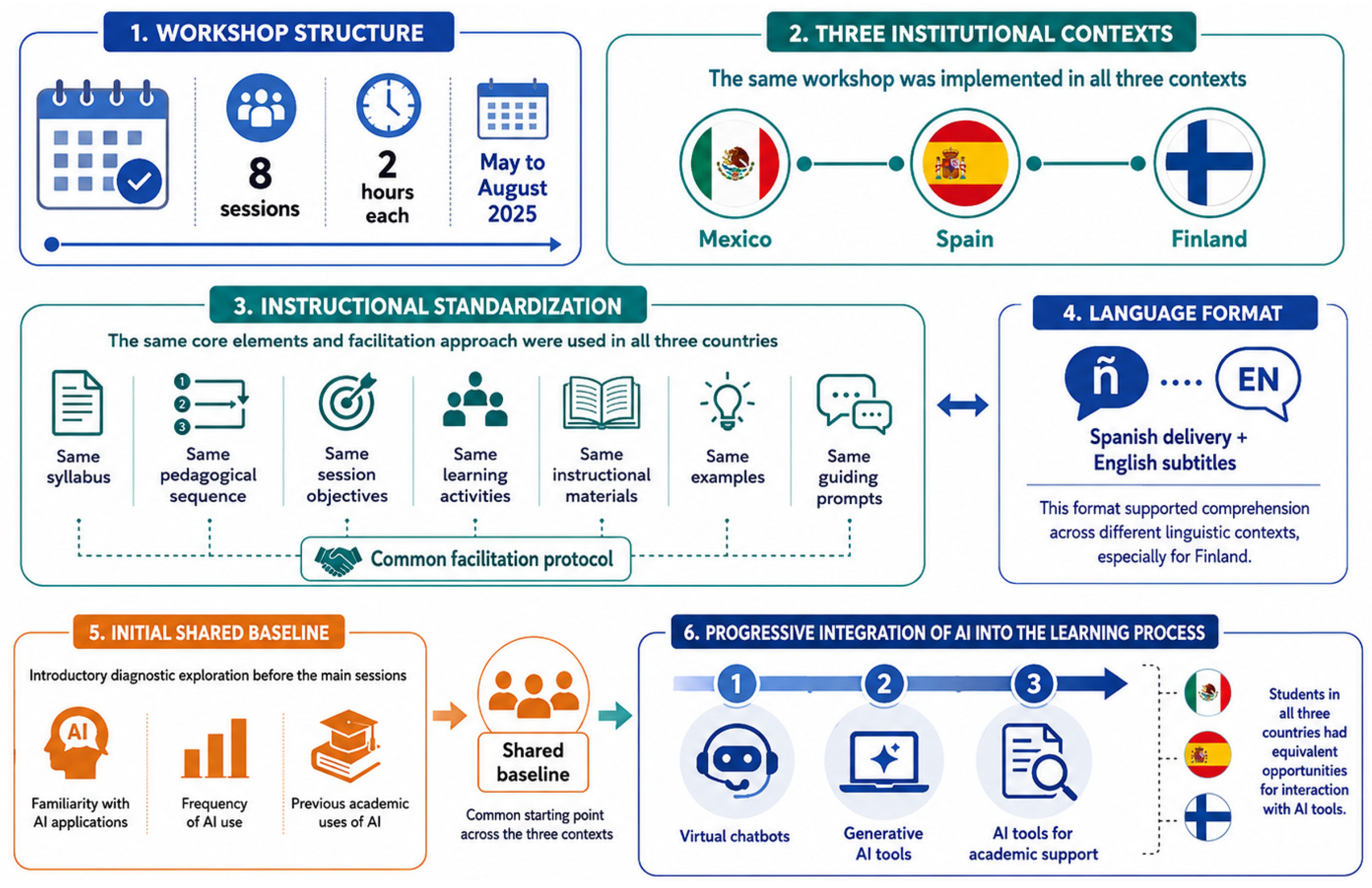
Students participated in a virtual workshop entitled Learning with AI: Strategies for University Education, which was structured into eight two-hour sessions conducted between May and August 2025. To ensure instructional standardization across the three participating institutional contexts, the workshop followed the same syllabus, pedagogical sequence, session objectives, learning activities, instructional materials, examples, and guiding prompts in all countries. The sessions were delivered using a common facilitation protocol so that students in Mexico, Spain, and Finland received equivalent content, activities, and opportunities for interaction with AI tools. The workshop was delivered in Spanish with English subtitles to support comprehension among participants from different linguistic contexts. At the beginning of the workshop, facilitators conducted a brief introductory exploration of students’ familiarity with AI applications, frequency of use, and common academic purposes for using these tools. This activity was used only as a pedagogical warm-up to contextualize the workshop examples and discussion; it was not collected as formal research data, nor was it used to measure, control, or statistically analyze students’ prior AI literacy or previous frequency of AI use. Figure 1 shows the structure of the workshop.
Throughout the sessions, virtual chatbots were used for academic interaction and question resolution, generative AI tools were employed for idea exploration and text production, and AI-supported platforms were used for the management and organization of bibliographic references. As shown in Table 2, the workshop followed a progressive pedagogical sequence aimed at promoting the strategic, critical, and reflective use of AI tools. This sequence supported personalized learning, strengthened academic writing skills, optimized the search and systematization of information, and fostered student autonomy in the academic use of emerging technologies.
To strengthen methodological reproducibility and clarify cross-country equivalence, the workshop implementation followed a standardized operational protocol across the three institutional contexts. This protocol included the same eight-session structure, duration, learning objectives, instructional sequence, digital tools, guiding prompts, activities, and criteria for administering the AIComplex questionnaire. All facilitators used the same instructional materials and followed a shared facilitation guide to reduce procedural variability between Mexico, Spain, and Finland. Therefore, equivalence between countries was addressed at two levels: first, through procedural standardization of the educational experience and data collection process; and second, through psychometric examination of the instrument using reliability analysis and measurement invariance testing.

2.4. Ethical Considerations

The questionnaire was administered exclusively to individuals over 18 years of age who were enrolled in higher education institutions. All participants were informed about the objectives, scope, and procedures of the study prior to their participation. Involvement in the research was voluntary and conducted in accordance with the principles of informed consent, anonymity, and confidentiality. Data collection was carried out in compliance with the ethical guidelines established in the Declaration of Helsinki for research involving human participants [48], ensuring respect for participants’ dignity, rights, and well-being throughout the study.

2.5. Instrument

The AIComplex: Acceptance of AI in Higher Education from Complexity questionnaire [15] was used to assess AI acceptance in higher education contexts. The instrument consists of a four-point Likert scale with the following response options: (1) strongly disagree, (2) disagree, (3) agree, and (4) strongly agree. Content validity was established through expert judgment, involving 16 specialists in educational sciences and AI. The instrument obtained an Aiken’s V coefficient of 0.8504, which is considered high and indicates strong agreement among experts regarding item relevance and clarity [49]. Table 3 presents the dimensions and corresponding items included in the questionnaire.
Although effort expectancy and perceived complexity may appear conceptually related, they were treated as separate constructs because they capture different aspects of students’ interaction with AI applications. Effort expectancy refers to the perceived ease of learning, mastering, and using AI tools for academic tasks, emphasizing the amount of time, effort, and operational difficulty required for use. In contrast, perceived complexity refers to the extent to which students consider AI applications to add technical, cognitive, or procedural difficulty to the completion of academic activities. Therefore, effort expectancy focuses on perceived ease of use, while perceived complexity captures the possible burden or complication introduced by the technology in the learning process.
The reliability of the questionnaire was assessed using Cronbach’s alpha. As shown in Table 4, Mexico and Finland obtained coefficients of 0.8832 and 0.8675, respectively, while Spain achieved a coefficient of 0.8087. All values indicate high internal consistency [50]. The dimensional analysis revealed a consistent trend above 0.80 across most constructs. The only exceptions were observed in the Spanish sample, where habit (0.792), effort expectancy (0.798), and acceptance of AI in higher education (0.794) showed slightly lower coefficients. Nevertheless, these values did not compromise the overall robustness and reliability of the instrument.
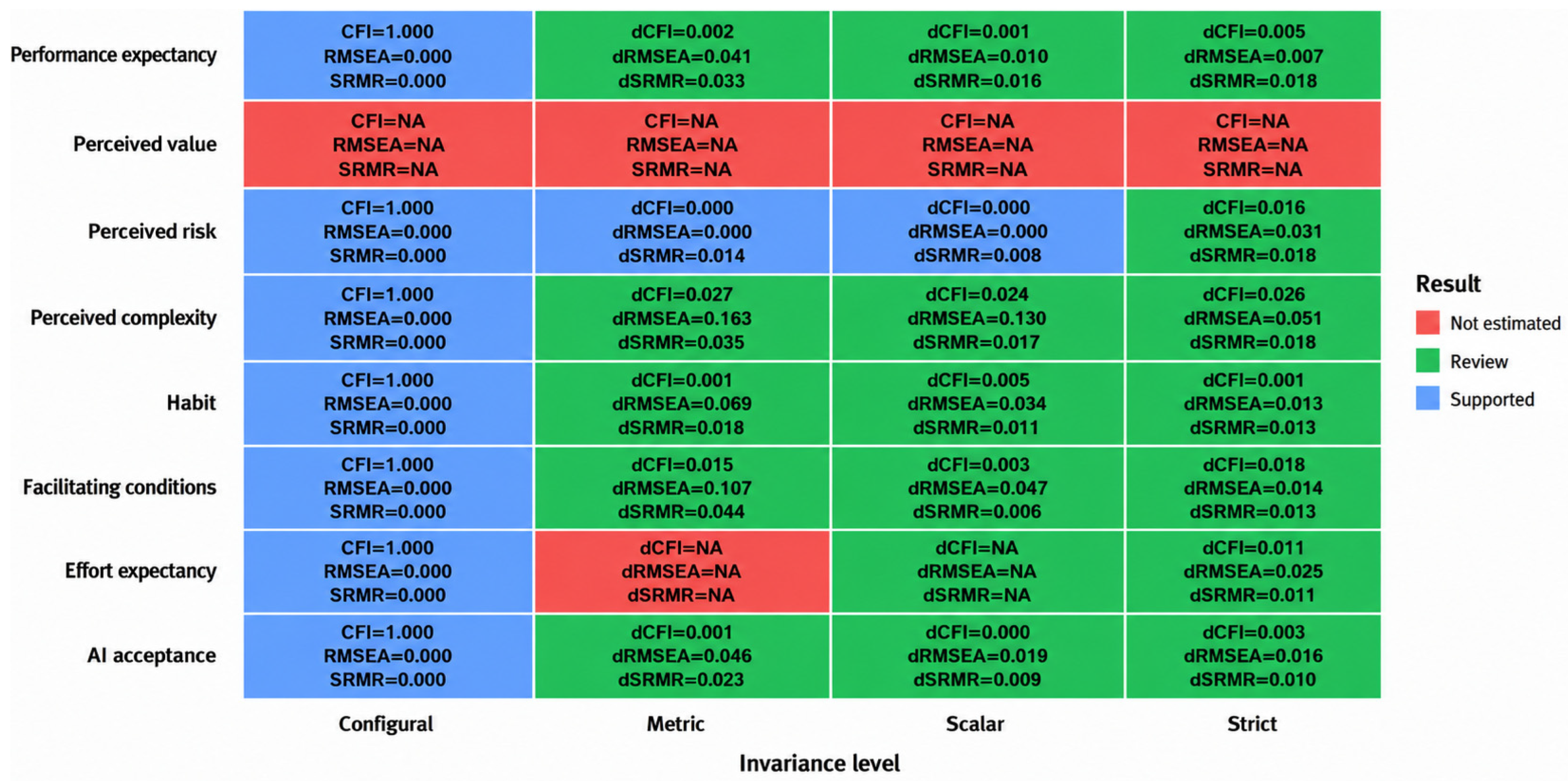
To provide additional psychometric evidence, a measurement invariance analysis was conducted by dimension using multigroup confirmatory factor analysis. Since the items were measured on a four-point Likert scale, they were treated as ordinal indicators and estimated using the WLSMV estimator. As observed in Figure 2, each dimension of the instrument was modeled separately across Mexico, Spain, and Finland, and four levels of invariance were examined sequentially: configural, metric, scalar, and strict invariance. Model evaluation was based on global fit indices, including CFI, RMSEA, and SRMR, as well as changes in fit indices between nested models. The results provided evidence of configural invariance for the estimable dimensions, indicating that the basic factorial structure was generally comparable across the three contexts. However, the metric, scalar, and strict models showed different degrees of stability across dimensions, suggesting that some constructs should be interpreted with caution in cross-context comparisons. The perceived value dimension could not be fully estimated due to sparse response categories, while dimensions such as perceived risk showed more stable invariance patterns.

3. Results

3.1. Descriptive Statistics by Institutional Context

The preliminary descriptive results suggest a generally favorable pattern of AI acceptance across the three institutional contexts, although with differentiated profiles. Table 5 shows that performance expectancy and perceived value obtained the highest mean scores in all universities, particularly in Mexico and Finland, indicating that students tend to accept AI when they perceive it as useful for improving academic performance, supporting problem-solving, and adding value to their learning experience. This finding is consistent with technology acceptance models, in which performance expectancy and perceived usefulness are central determinants of acceptance [7,11]. Mexico showed the highest averages in most dimensions, including performance expectancy, effort expectancy, facilitating conditions, habit, and overall acceptance, suggesting a more consolidated perception of AI as an accessible and academically valuable tool. Spain, by contrast, reported lower means in effort expectancy, facilitating conditions, perceived value, and acceptance, which may indicate that students recognize the potential of AI but perceive weaker institutional support or fewer enabling conditions for its systematic use.
Finland presented an intermediate profile, with high perceived value but lower habit, suggesting that students acknowledge the benefits of AI even though its integration into their academic routines is not yet fully consolidated. The relatively high standard deviations in habit across the three contexts indicate greater variability in students’ regular use of AI, which reinforces the idea that acceptance is not only shaped by perceived usefulness, but also by repeated experience and institutional scaffolding. The predominance of negative skewness in several dimensions suggests that responses tended to concentrate toward agreement, especially in performance expectancy, perceived value, and overall acceptance, supporting the interpretation that AI is viewed as a promising educational resource rather than as a marginal or resisted technology. Overall, these distributional patterns suggest that, despite minor variations across dimensions and institutional contexts, the data demonstrate sufficient robustness to justify the use of parametric tests that assume approximate normality [51].

3.2. Initial Perceptions of Participants

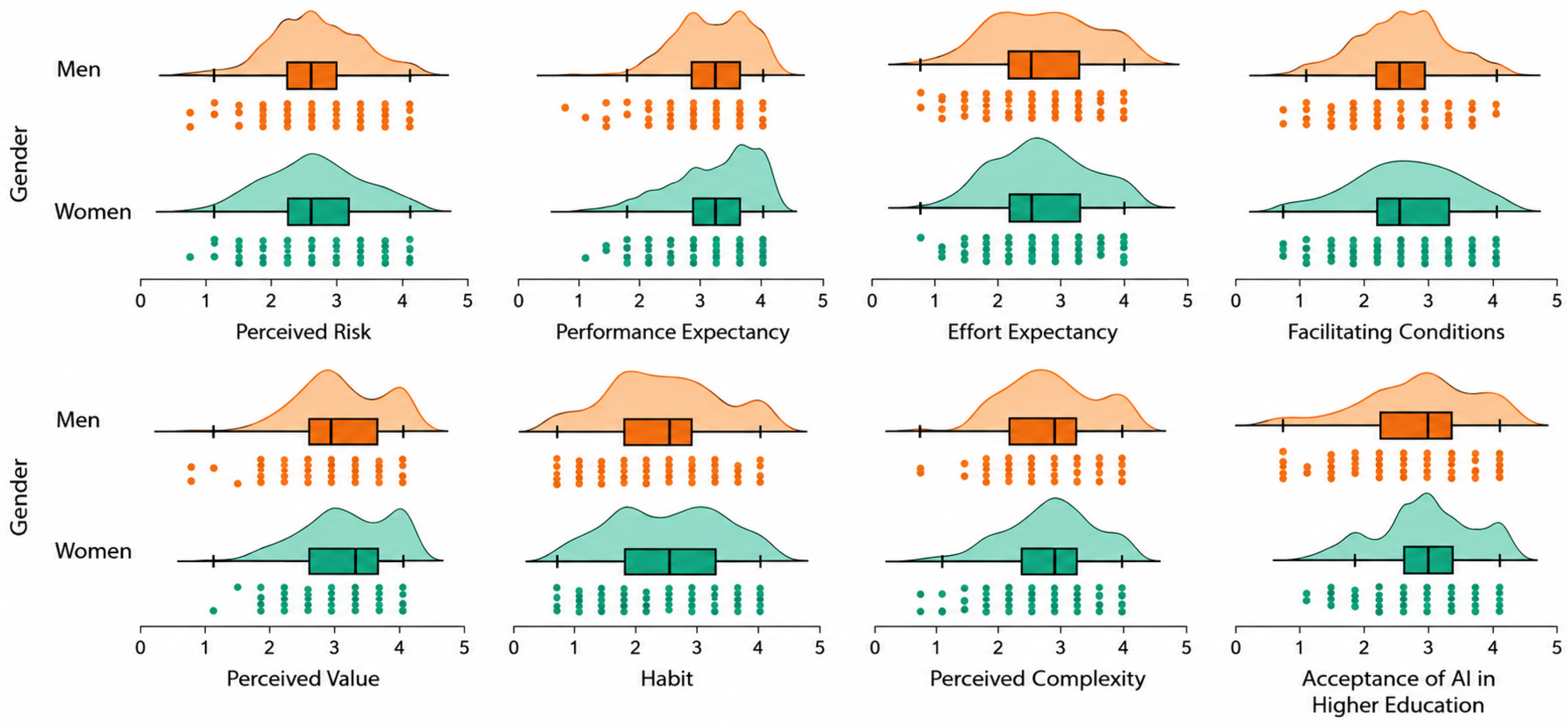
Figure 3 presents a comparison of male and female students’ perceptions. In the perceived risk dimension, male students reported slightly higher levels of concern, with a median close to 2.5, compared to female students, whose median was near 2. This descriptive difference suggests that men may express greater awareness of potential drawbacks associated with AI in educational contexts. In contrast, female students reported higher median scores in perceived value, approximately 3.5, indicating a stronger recognition of the potential benefits of AI implementation. In the performance expectancy dimension, both groups exhibited similar perceptions, with women showing marginally higher median values, reflecting a moderately high expectation regarding the positive impact of AI on academic performance.
Effort expectancy, which assesses perceived ease of use, appeared less problematic for female students, with a median close to 3, compared to male students, whose median was approximately 2.5. This pattern may suggest that women perceive AI tools as relatively more accessible or manageable [43]. Facilitating conditions, representing the availability of institutional resources and support, were positively evaluated by both groups, although women again reported slightly higher median values, near 3, compared to men, whose median was around 2.5. Regarding overall acceptance of AI, female students showed a higher median, close to 3.5, whereas male students reported a median around 3.
Differences were also observed in habit and perceived complexity. Female students reported stronger habitual use, with a median near 3.5, and lower perceived complexity, around 2, compared to male students, whose medians were approximately 3 for habit and 2.5 for perceived complexity. Descriptively, these patterns suggest that women may perceive AI as less complex and demonstrate a greater tendency to integrate it into their academic routines. However, as previously indicated in the inferential analyses, these differences did not reach statistical significance.
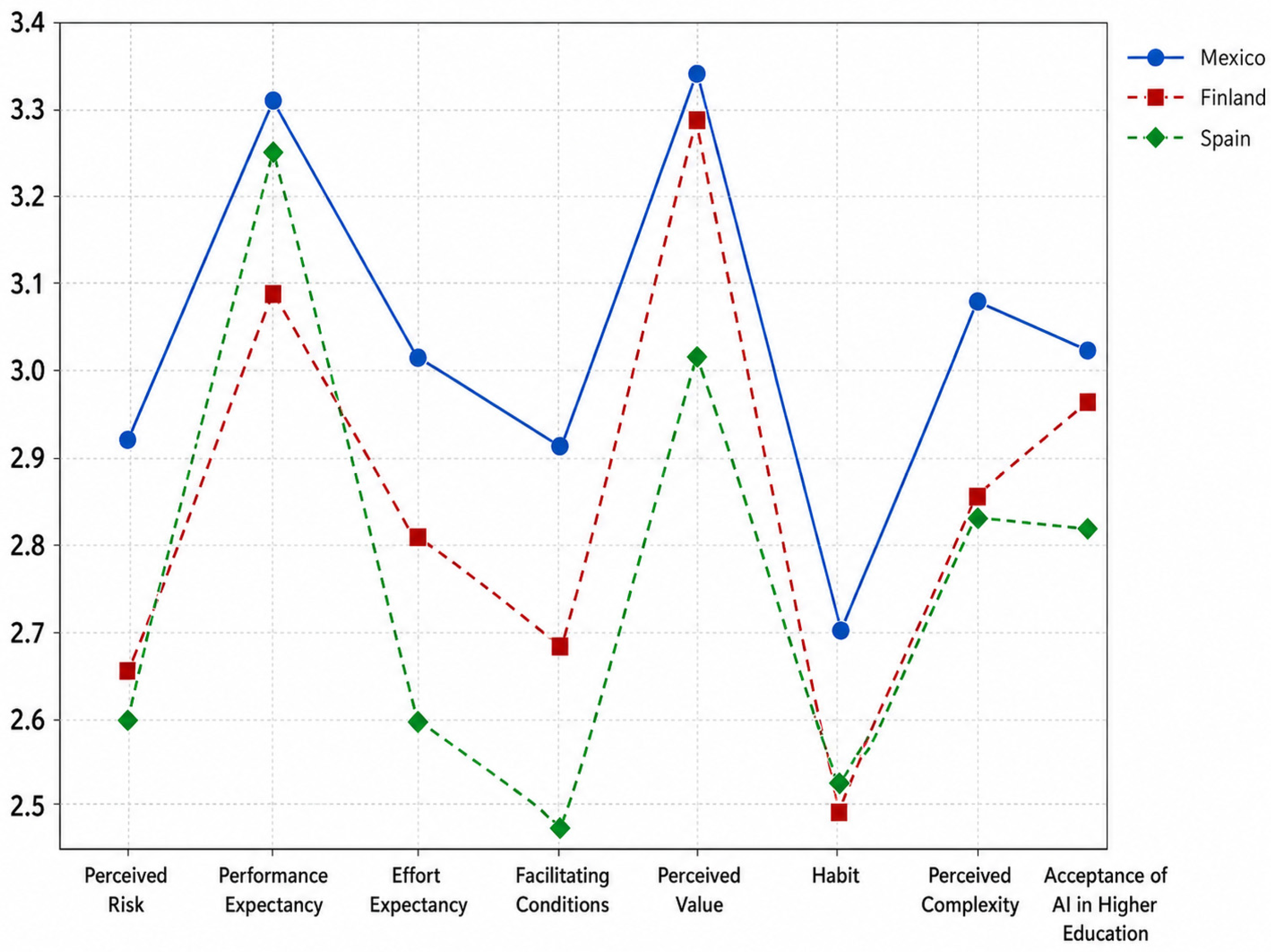
As shown in Figure 4, Mexican students demonstrated strong agreement regarding the benefits of AI, reaching mean scores of 3.3 in performance expectancy and 3.4 in perceived value. These findings suggest that they are convinced of AI’s potential to enhance academic performance and contribute positively to their educational experience. In comparison, Finnish students displayed more heterogeneous perceptions. They reported a relatively high mean score of 3.1 in facilitating conditions, indicating that they perceive favorable institutional support for the implementation of AI. However, their mean score of 2.6 in perceived risk reflects ongoing concerns about potential drawbacks associated with its use.
Additionally, the habit dimension obtained a mean of 2.7, suggesting that AI has not yet been fully integrated into their regular academic routines, which may limit sustained acceptance over time. Spanish students exhibited comparatively more critical perceptions, reflected in the lowest mean scores across several dimensions. For instance, they reported a mean of 2.6 in facilitating conditions and 2.5 in perceived value, indicating a less favorable evaluation of the institutional environment and the added value of AI. Their mean score of 2.7 in performance expectancy suggests that, although they acknowledge some potential benefits, they remain less convinced of its overall effectiveness in improving academic outcomes.

3.3. Gender Comparison

The comparison of AI acceptance by gender is presented in Table 6. In the perceived risk dimension, the results showed t-values of −0.030 (df = 414) and −0.030 (df = 409.672) for the Student and Welch tests, respectively, both with a p-value of 0.976. These results indicate no statistically significant differences between men and women in their perception of risk associated with AI, as the p-values are well above the conventional significance threshold of 0.05. For performance expectancy, t-values of 1.027 (df = 414, p = 0.305) and 1.026 (df = 410.639, p = 0.306) were observed for the Student and Welch tests, respectively. Similarly, effort expectancy yielded t-values of −0.324 (df = 414, p = 0.746) and −0.325 (df = 413.781, p = 0.745).
In both dimensions, although minor descriptive differences were observed between genders, these differences did not reach statistical significance. This pattern was consistent across facilitating conditions, perceived value, habit, and perceived complexity, where all p-values exceeded 0.05. Finally, the dimension of AI acceptance in higher education showed t-values of 1.577 (df = 414, p = 0.116) and 1.583 (df = 409.627, p = 0.114) under the Student and Welch corrections, respectively. Although this was the highest t value reported, the associated p-value remained above 0.05, indicating that the observed difference was not statistically significant [52].

3.4. Scatterplot Matrices and Correlation Heat Map

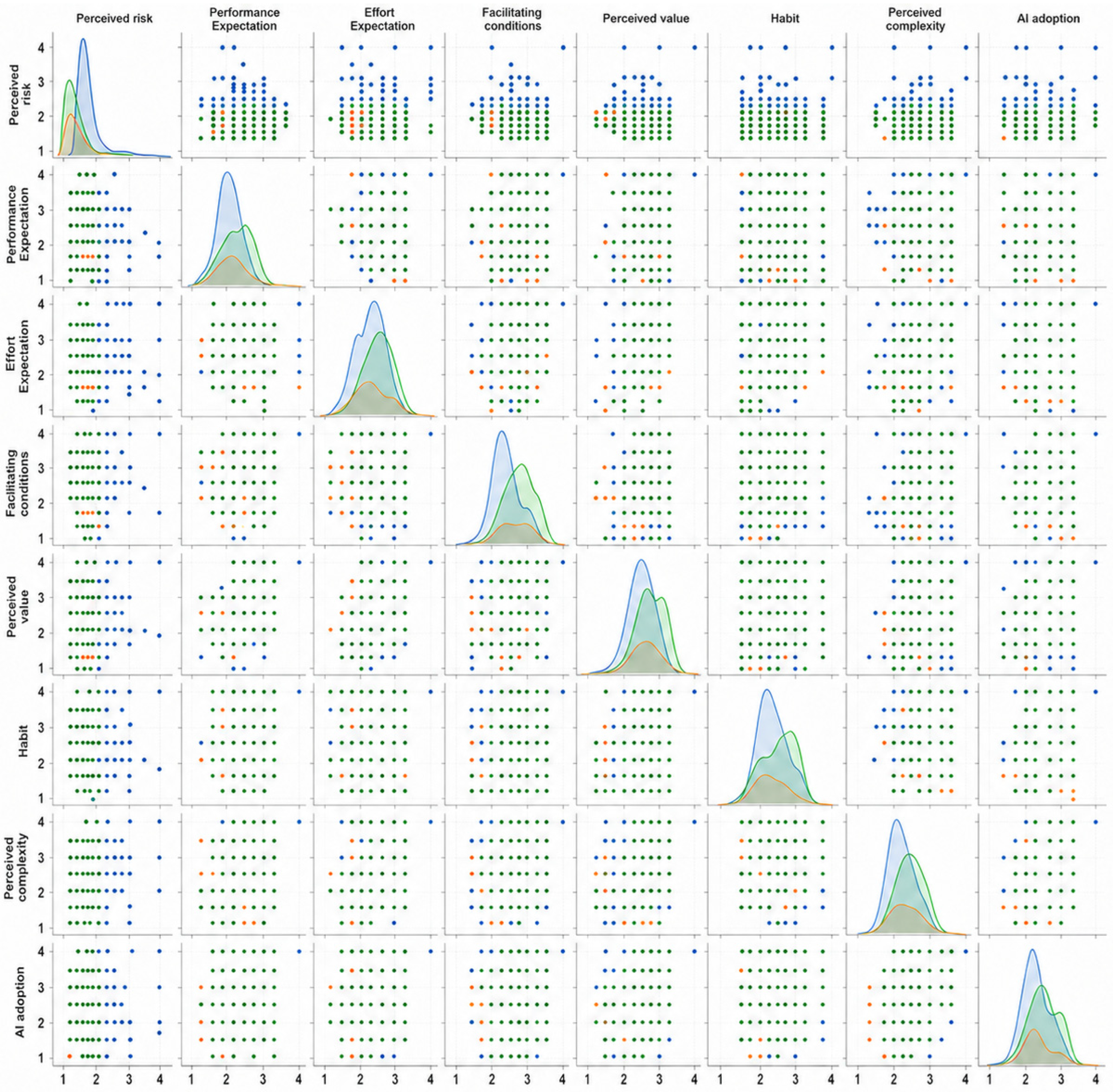
To further deepen the analysis, Figure 5 presents a scatterplot matrix with density distributions that allows the relationships among the study dimensions to be examined across the participating institutional contexts. The diagonal density plots show that students’ responses tend to concentrate around medium to high values in performance expectancy, perceived value, perceived complexity, and AI acceptance, suggesting that AI is generally perceived as a relevant academic resource rather than as a marginal technology. However, the dispersion of the points also indicates that this perception is not homogeneous across contexts. Perceived risk shows a more differentiated distribution, which suggests that concerns related to dependence, privacy, security, or academic integrity coexist with favorable evaluations of AI. This is important because acceptance does not appear to depend exclusively on a positive view of usefulness, but on the balance between perceived benefits and possible risks.
The strongest visual patterns are observed in the relationships between performance expectancy, perceived value and AI acceptance. Students who report higher expectations regarding the contribution of AI to academic performance also tend to assign greater value to its use and show higher levels of acceptance. This pattern is consistent with technology acceptance models, which emphasize that perceived usefulness and expected performance gains are central factors in the acceptance of emerging technologies.
Facilitating conditions also show relevant associations with the other dimensions, particularly with effort expectancy, perceived value, and AI acceptance. This suggests that institutional support, technological infrastructure, access to tools, and pedagogical guidance may contribute to reducing the perceived effort required to use AI and to strengthening students’ confidence in its educational value. Therefore, the figure supports the idea that AI acceptance is shaped by both individual perceptions and contextual conditions. Although perceived complexity remains present, it does not appear to prevent favorable evaluations of AI when students also perceive usefulness, value, and institutional support.
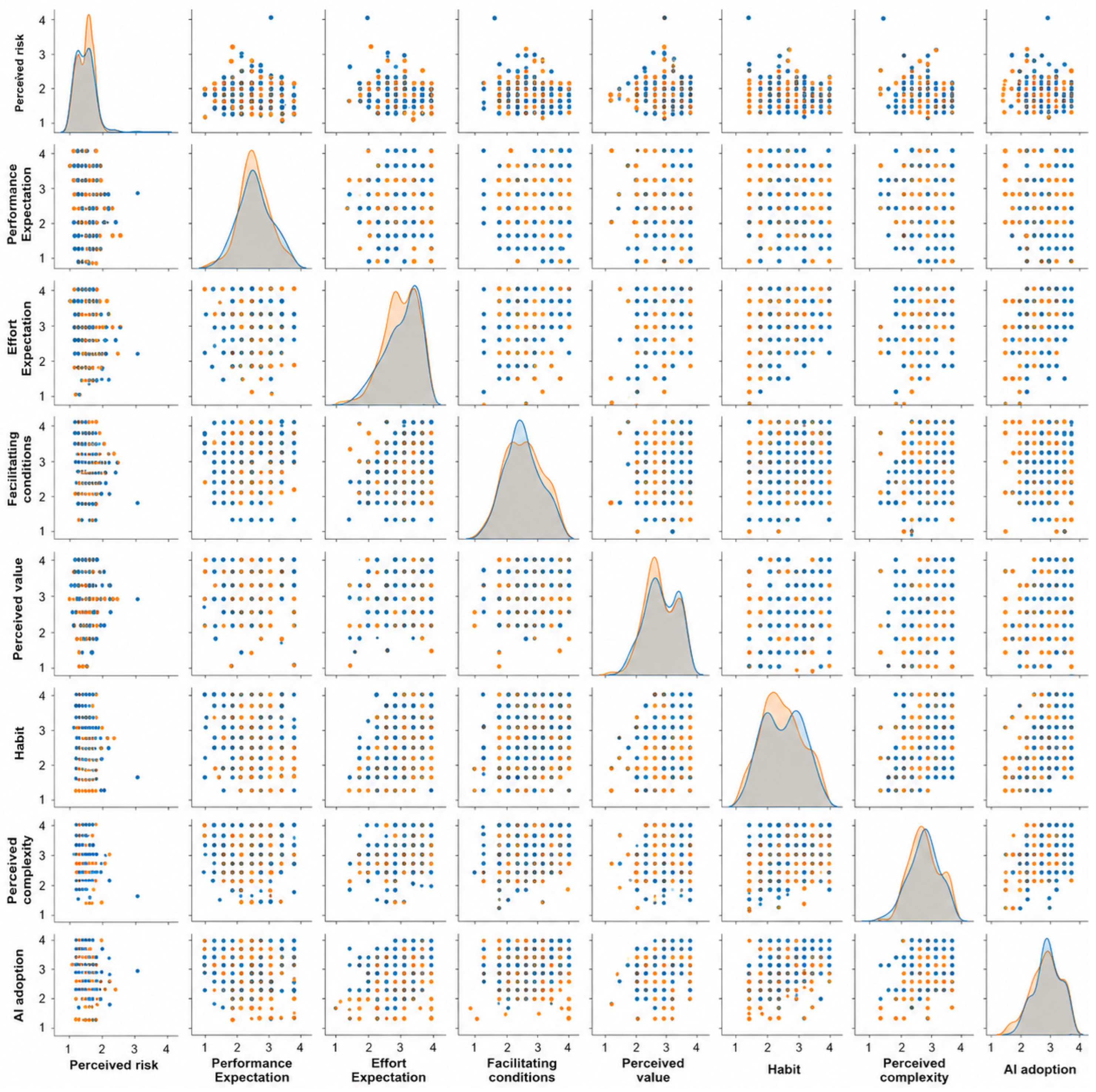
Furthermore, the density plots displayed along the diagonal of Figure 6 show a high degree of overlap between male and female students across the analyzed dimensions. This pattern suggests that gender does not introduce substantial differentiation in students’ perceptions of AI in higher education. Although minor descriptive variations can be observed in some dimensions, such as perceived risk, habit, perceived complexity, and AI acceptance, these differences are not sufficiently pronounced to indicate a clearly separated gender-based pattern. In this sense, the visual evidence is consistent with the inferential results reported in the t-tests, where no statistically significant differences were found between men and women.
The scatterplot matrix also shows that the relationships among the dimensions follow a similar pattern for both groups. Performance expectancy, perceived value, habit, and perceived complexity display visible associations with AI acceptance, indicating that students who recognize academic benefits, assign practical value to AI, and use these tools more regularly tend to report higher levels of acceptance. Facilitating conditions also appear connected to several dimensions, particularly effort expectancy and perceived value, suggesting that institutional support may contribute to making AI tools easier to use and more meaningful for academic purposes. In contrast, perceived risk shows weaker and less consistent associations with AI acceptance, which suggests that concerns about AI do not necessarily cancel out students’ recognition of its educational potential. This reinforces the idea that AI acceptance in higher education is better explained by the interaction between perceived usefulness, value, habitual use, perceived complexity, and institutional support than by gender differences. The similarity between male and female distributions indicates that both groups evaluate AI through comparable cognitive and contextual criteria.
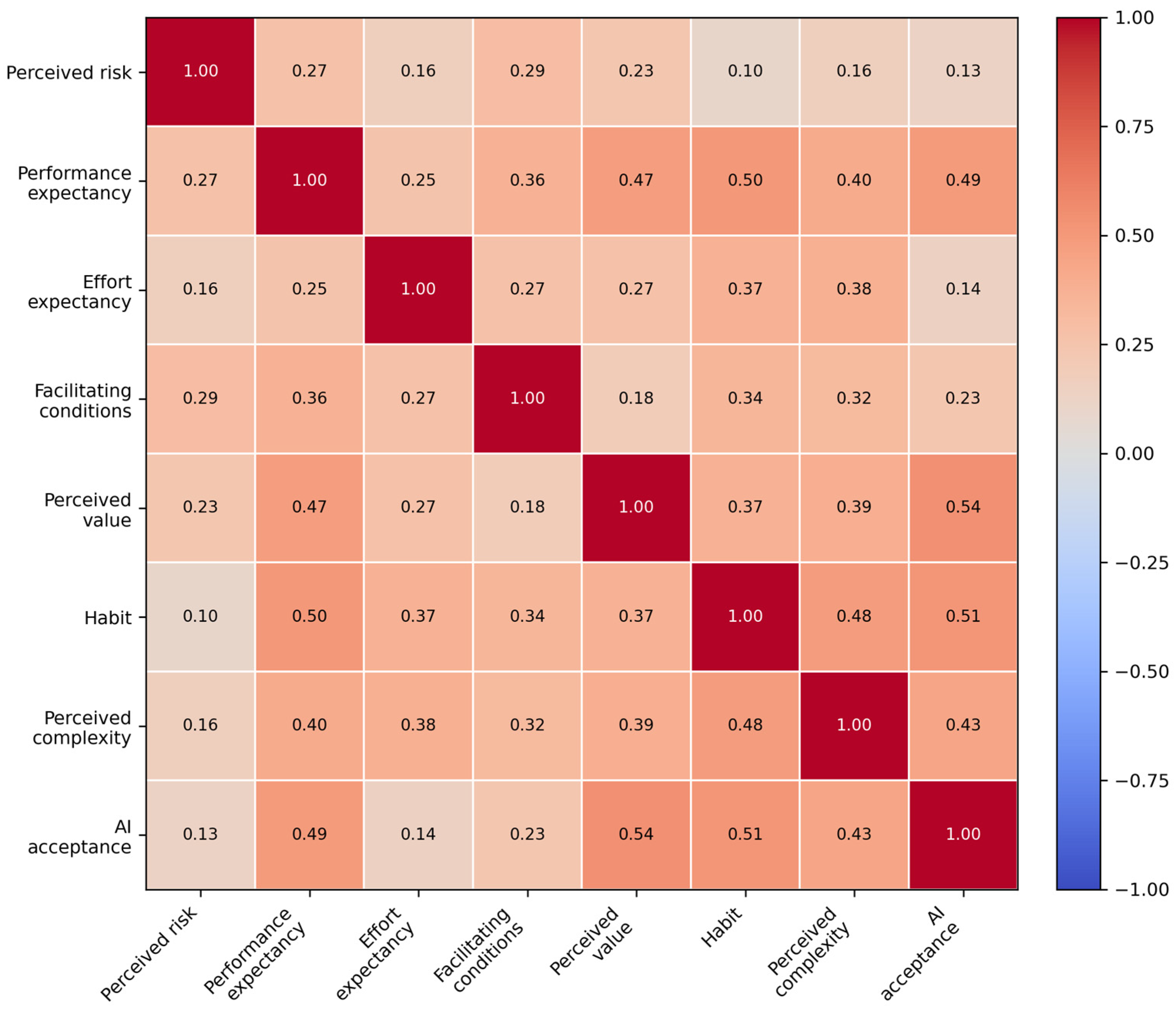
In the updated correlation heat map, Figure 7 no longer includes age, university, or gender, allowing the analysis to focus exclusively on the relationships among the core dimensions of AI acceptance. The results show that perceived risk has weak associations with AI acceptance (r = 0.13), perceived value (r = 0.23), habit (r = 0.10), and perceived complexity (r = 0.16). This suggests that students’ concerns regarding dependence, privacy, security, or academic integrity do not strongly interfere with their overall acceptance of AI. In other words, the presence of perceived risk does not appear to substantially reduce the educational value students attribute to AI tools.
The strongest relationships are observed between AI acceptance and perceived value (r = 0.54), habit (r = 0.51), performance expectancy (r = 0.49), and perceived complexity (r = 0.43). These results indicate that students are more likely to accept AI when they perceive clear academic benefits, when they use these tools regularly, and when they expect AI to improve their performance. This pattern is consistent with technology acceptance models, which emphasize that perceived usefulness, expected performance gains, and repeated use are central factors in the consolidation of technology acceptance. Therefore, AI acceptance appears to be associated not only with the recognition of its practical value but also with the gradual incorporation of AI into students’ academic routines.
The heat map also shows relevant associations among the explanatory dimensions. Performance expectancy is positively related to habit (r = 0.50), perceived value (r = 0.47), perceived complexity (r = 0.40), and facilitating conditions (r = 0.36), suggesting that students who perceive AI as useful for improving academic performance also tend to recognize its value, use it more frequently, and evaluate the institutional context more favorably. Similarly, effort expectancy is associated with perceived complexity (r = 0.38), habit (r = 0.37), and facilitating conditions (r = 0.27), indicating that students’ perception of ease of use is connected to both institutional support and accumulated experience with AI tools.
As shown in Table 7, the exploratory factor analysis yielded a five-factor empirical structure for the AIComplex items. The chi-squared test was statistically significant, χ2(166) = 366.117, p < 0.001, indicating that the reproduced correlation matrix differed significantly from the observed matrix. However, given the sensitivity of this test to sample size, the factor solution was interpreted in conjunction with the pattern of factor loadings and uniqueness values. Factor 1 grouped items mainly related to perceived value, AI acceptance, and part of performance expectancy, suggesting a close empirical relationship between students’ perception of AI benefits and their overall acceptance. Factor 2 clearly represented habit, with strong loadings for items 6.1, 6.2, and 6.3. Factor 3 included effort expectancy items and one perceived complexity item, suggesting partial overlap between ease of use and perceived difficulty. Factor 4 corresponded to facilitating conditions, while Factor 5 was mainly associated with perceived risk. Some items, such as 1.1, 2.3, 3.1, 7.2, and 7.3, showed no salient factor loadings and relatively high uniqueness values, indicating a greater proportion of item-specific variance. The five-factor solution was retained according to the factor extraction criteria applied in the analysis, including empirical fit, theoretical interpretability, and the observed pattern of item loadings. To facilitate interpretation, Table 7 reports only salient factor loadings equal to or greater than 0.40; therefore, blank cells indicate loadings below this threshold and should not be understood as missing data or excluded items. The loading pattern suggests partial empirical overlap among perceived value, AI acceptance, and performance expectancy, as well as proximity between effort expectancy and perceived complexity. Consequently, the factor solution should be interpreted cautiously, since it supports the multidimensional structure of the AIComplex instrument while also showing that some theoretically distinct dimensions may be perceived by students as closely related in practice.

4. Discussion

The findings of this study offer contextual evidence on AI acceptance in higher education across three institutional settings in Mexico, Spain, and Finland. Given the descriptive and correlational design, the results should not be interpreted as evidence of causal, predictive, or interaction effects. Instead, they show a set of observed associations among performance expectancy, perceived value, habit, facilitating conditions, perceived complexity, and AI acceptance. This interpretation is consistent with the methodological scope of the study, which examined students’ perceptions after participation in a structured educational experience involving AI tools.
From a theoretical perspective, the results are broadly consistent with the logic of UTAUT and UTAUT2, particularly regarding the relevance of performance expectancy and perceived value in technology acceptance processes [6,7]. Students who reported higher expectations about the academic usefulness of AI also tended to report higher levels of acceptance. This pattern suggests that, in the analyzed sample, AI was more favorably evaluated when students associated it with academic support, problem-solving, and learning improvement. However, this result should be interpreted as an observed association rather than as evidence that performance expectancy determines AI acceptance.
Perceived value also showed one of the strongest associations with AI acceptance. This finding reinforces the importance of examining not only whether students consider AI easy or accessible, but also whether they perceive it as meaningful for their academic experience. In this sense, the results align with studies that emphasize perceived usefulness, value, and educational relevance as important components of technology acceptance [11,43]. At the same time, this result should be contrasted with studies that warn that students may value AI tools pragmatically without necessarily developing critical or ethical understanding of their use. Therefore, perceived value should not be interpreted only as a positive indicator of acceptance, but also as a dimension that requires pedagogical mediation so that students can distinguish between instrumental use, responsible use, and meaningful academic integration.
The role of facilitating conditions also deserves theoretical attention. The positive associations between facilitating conditions and other dimensions suggest that institutional support, access to infrastructure, and academic guidance are relevant contextual elements in students’ perceptions of AI. This is coherent with technology acceptance approaches that recognize the importance of enabling conditions [12,37]. Nevertheless, unlike causal models that assume institutional support directly increases acceptance, the present study only shows that students who reported more favorable perceptions of facilitating conditions also tended to evaluate AI more positively. It is also possible that students with greater interest in AI perceive institutional conditions more favorably. Therefore, the direction of this relationship should be examined in future longitudinal or multivariate studies.
An important finding concerns perceived risk. Although prior studies have emphasized concerns related to privacy, dependency, academic integrity, bias, and ethical implications as possible barriers to AI adoption [39,42], the present results showed only weak associations between perceived risk and AI acceptance. This does not mean that risk is irrelevant. Rather, it suggests that, in this sample, students’ concerns about AI coexisted with favorable perceptions of its academic usefulness and value. This finding contributes to a more nuanced interpretation: students may recognize risks while still perceiving AI as useful for learning. Therefore, institutional strategies should not assume that acceptance depends on minimizing risk perceptions, but on helping students understand, manage, and critically evaluate those risks.
Perceived complexity also requires careful interpretation. In some technology acceptance models, complexity is commonly understood as a barrier to adoption. However, the positive association observed between perceived complexity and AI acceptance suggests a different possibility in the context of AI use in higher education. Students who accepted AI more favorably may also have been more aware of the technical, cognitive, or procedural demands involved in using these tools. Thus, perceived complexity may reflect not only difficulty, but also a more informed recognition of the demands associated with responsible AI use. This interpretation is especially relevant because it avoids reducing complexity to resistance. In AI-based learning environments, complexity may coexist with acceptance when students perceive that the academic benefits of AI justify the effort required to use it appropriately.
The association between habit and AI acceptance also supports a contextual reading of the results. Students who reported more regular use of AI tools tended to express more favorable acceptance. This pattern is consistent with UTAUT2, where habit is considered relevant for technology use [7]. However, in the present study, habit should not be interpreted as a consequence of the workshop or as a causal antecedent of acceptance. Since the data were collected at one point in time, the relationship may indicate that students who already use AI more frequently also evaluate it more positively, or that favorable perceptions and repeated use reinforce each other over time. Future longitudinal designs would be needed to examine this relationship more robustly.
The gender comparison also adds nuance to the interpretation of AI acceptance. The t-tests showed no statistically significant differences between men and women across the analyzed dimensions, and the effect sizes were trivial. This result contrasts with studies that have reported gender differences in technology confidence, digital self-efficacy, or attitudes toward emerging technologies. In the present sample, however, gender did not appear to differentiate students’ perceptions of AI acceptance in a meaningful way. Therefore, the discussion should avoid attributing acceptance patterns to gender differences and should instead emphasize the shared evaluative criteria observed across male and female students, particularly in relation to usefulness, value, habit, and institutional conditions.
The psychometric results also contribute to the theoretical interpretation of the findings. The exploratory factor analysis suggested a five-factor empirical structure, with some overlap among perceived value, AI acceptance, and performance expectancy, as well as partial proximity between effort expectancy and perceived complexity. This indicates that students may not distinguish these dimensions as sharply in practice as theoretical models suggest. Similarly, the measurement invariance analysis showed that some dimensions were more stable across contexts than others. These findings do not invalidate the instrument, but they suggest that AI acceptance is a complex construct whose dimensions may behave differently depending on institutional and cultural context. Therefore, cross-context comparisons should be interpreted cautiously.
Although effort expectancy and perceived complexity were conceptually differentiated in the instrument, the empirical results suggest that students partially connect both dimensions when evaluating AI tools. The positive association between these constructs and their proximity in the exploratory factor analysis indicate that perceived ease of use and perceived technical or cognitive difficulty may not operate as fully independent perceptions in practice. Rather, students may evaluate AI use through a combined judgment in which ease, required effort, and perceived complexity are interpreted together. Therefore, this overlap should be considered when interpreting the findings, since it suggests that the theoretical distinction between both constructs is useful, but empirically nuanced in the context of AI acceptance in higher education.
Taken together, the findings suggest that AI acceptance in higher education is associated with a multidimensional set of perceptions rather than with a single dominant factor. The observed pattern is theoretically meaningful because it shows that students’ acceptance of AI is related not only to perceived academic usefulness but also to perceived value, habitual use, institutional conditions, and awareness of complexity. At the same time, the weak role of perceived risk and the absence of gender differences show that acceptance patterns may vary depending on the educational context, the type of AI experience, and the characteristics of the sample. These results support the need for future studies that examine AI acceptance through longitudinal, comparative, and mixed-method designs, especially including variables such as prior AI literacy, frequency of use before instruction, disciplinary field, digital competence, ethical awareness, and institutional AI policy.

5. Conclusions

The results of this study provide contextual evidence on students’ acceptance of AI in higher education across three institutional settings located in Mexico, Spain, and Finland. From a descriptive and correlational perspective, AI acceptance was positively associated with performance expectancy, perceived value, habit, facilitating conditions, and perceived complexity. These associations indicate that students who reported more favorable perceptions of AI’s academic usefulness, practical value, regular use, institutional conditions, and perceived demands also tended to report higher levels of acceptance. However, these findings should not be interpreted as causal, predictive, or nationally representative, since the study did not include random assignment, a control group, or a pretest–posttest comparison.
The findings suggest that AI acceptance in the analyzed sample is related to a multidimensional set of perceptions rather than to a single isolated dimension. The strongest observed associations were found for perceived value, habit, performance expectancy, and perceived complexity, which indicates that students’ acceptance of AI was linked not only to perceived usefulness but also to the value they attributed to AI, their reported familiarity or regular use, and their recognition of the demands involved in using these tools. In this sense, the results support the need to understand AI acceptance as a contextual and relational phenomenon, particularly in educational environments where AI tools are introduced through structured academic experiences.
The study also contributes psychometric evidence regarding the use of the AIComplex instrument in three institutional contexts. The reliability results showed adequate internal consistency across the three groups. In addition, the exploratory factor analysis suggested a five-factor empirical structure, with some overlap among perceived value, AI acceptance, performance expectancy, effort expectancy, and perceived complexity. The measurement invariance analysis by dimension provided evidence of configural invariance for the estimable dimensions, although metric, scalar, and strict invariance showed different levels of stability. Therefore, comparisons across institutional contexts should be interpreted cautiously, especially for dimensions that showed weaker invariance or estimation limitations.
The gender comparison showed no statistically significant differences between men and women in any of the analyzed dimensions. The associated effect sizes were trivial, suggesting that gender did not meaningfully differentiate students’ perceptions of AI acceptance in this sample. This result reinforces the need to avoid overinterpreting minor descriptive differences and to focus instead on the broader patterns of association observed across the instrument dimensions.
Several limitations should be acknowledged. First, the use of non-probabilistic convenience sampling limits the generalizability of the findings. Since the study included one institution per country, the results should be interpreted as evidence from three specific institutional contexts, not as representative of Mexico, Spain, or Finland. Second, the unequal size of the country subsamples, particularly the smaller Finnish group, may affect the stability of cross-context comparisons. Third, the study was conducted after participation in a structured educational workshop, but the design does not allow conclusions about the effect of that experience on students’ perceptions. Fourth, the use of self-reported data may involve response bias or subjective interpretation of questionnaire items. Finally, some relevant contextual variables, such as socioeconomic background, prior AI literacy, frequency of AI use before the workshop, digital competency level, and disciplinary differences, were not systematically analyzed.
Future research should expand the sample to include a broader range of universities, disciplines, and institutional contexts. Longitudinal and mixed-method designs would be useful to examine how students’ perceptions of AI evolve over time and how repeated academic interaction with AI tools relates to acceptance, habits, ethical awareness, and learning practices. Future studies should also continue refining the psychometric structure of the AIComplex instrument, especially in relation to dimensions that showed empirical overlap or limited invariance. Overall, this study offers evidence that contributes to a more contextualized understanding of AI acceptance in higher education, emphasizing observed associations among cognitive, institutional, and experiential dimensions without implying causal or predictive conclusions.

Author Contributions

Conceptualization, L.M.-S. and C.E.G.-R.; methodology, C.E.G.-R. and E.Y.-B.; software, E.Y.-B. and C.E.G.-R.; validation, L.M.-S., E.J.M.-C., E.Y.-B. and C.E.G.-R.; formal analysis, C.E.G.-R. and E.Y.-B.; investigation, L.M.-S., E.J.M.-C. and C.E.G.-R.; data curation, E.Y.-B. and C.E.G.-R.; writing-original draft preparation, L.M.-S., E.J.M.-C. and C.E.G.-R.; writing-review and editing, L.M.-S., E.J.M.-C., E.Y.-B. and C.E.G.-R.; supervision, C.E.G.-R.; project administration, C.E.G.-R.; funding acquisition, C.E.G.-R. All authors have read and agreed to the published version of the manuscript.

Funding

This research was funded by the WISE—Women in Smart Education: AI Literacy Hub Research Network at the Universidad Bolivariana del Ecuador, grant number PROY-INB-UBE-030.

Institutional Review Board Statement

The study was conducted in accordance with the Declaration of Helsinki [48]. Ethics Committee Name: Ethics Committee of the WISE: AI Literacy Hub Research Network, Universidad Bolivariana del Ecuador. Approval Code: WISE-ET 2026, 5 January 2026.

Informed Consent Statement

Informed consent was obtained from all subjects involved in the study.

Data Availability Statement

The data presented in this study are available upon request from the corresponding author. The data are not publicly available because they contain institutional and participant-level information collected in specific educational contexts.

Acknowledgments

The authors gratefully acknowledge the technical support provided by the WISE—Women in Smart Education: AI Literacy Hub Research Network (PROY-INB-UBE-030) at the Universidad Bolivariana del Ecuador for the development of this study.

Conflicts of Interest

The authors declare no conflicts of interest.

Abbreviations

The following abbreviations are used in this manuscript:
AIArtificial intelligence
UTAUTUnified Theory of Acceptance and Use of Technology
UTAUT2Extended Unified Theory of Acceptance and Use of Technology
SDStandard deviation

References

  1. Johnston, H.; Wells, R.F.; Shanks, E.M.; Boey, T.; Parsons, B.N. Student perspectives on the use of generative artificial intelligence technologies in higher education. Int. J. Educ. Integr. 2024, 20, 2. [Google Scholar] [CrossRef]
  2. Endris, A.; Tlili, A.; Huang, R.; Xu, L.; Chang, T.; Mishra, S. Features, components and processes of developing policy for artificial intelligence in education (AIED): Toward a sustainable AIED development and adoption. Leadersh. Policy Sch. 2024, 24, 233–241. [Google Scholar] [CrossRef]
  3. Kim, M.; Kim, N.; Heidari, A. Learner experience in artificial intelligence-scaffolded argumentation. Assess. Eval. High. Educ. 2022, 47, 1301–1316. [Google Scholar] [CrossRef]
  4. Chan, C.; Tsi, L.H.Y. The AI revolution in education: Will AI replace or assist teachers in higher education? arXiv 2023, arXiv:2305.01185. [Google Scholar] [CrossRef]
  5. Abdalgane, M.; Othman, K.A.J. Utilizing artificial intelligence technologies in Saudi EFL tertiary level classrooms. J. Intercult. Commun. 2023, 23, 92–99. [Google Scholar] [CrossRef]
  6. Venkatesh, V.; Morris, M.G.; Davis, G.B.; Davis, F.D. User acceptance of information technology: Toward a unified view. MIS Q. 2003, 27, 425–478. [Google Scholar] [CrossRef]
  7. Venkatesh, V.; Thong, J.Y.L.; Xu, X. Consumer Acceptance and Use of Information Technology: Extending the Unified Theory of Acceptance and Use of Technology. MIS Q. 2012, 36, 157–178. Available online: https://ssrn.com/abstract=2002388 (accessed on 11 November 2025). [CrossRef]
  8. Aranyossy, M. Technology adoption in the digital entertainment industry during the COVID-19 pandemic: An extended UTAUT2 model for online theater streaming. Informatics 2022, 9, 71. [Google Scholar] [CrossRef]
  9. Gansser, O.; Reich, C. A new acceptance model for artificial intelligence with extensions to UTAUT2: An empirical study in three segments of application. Technol. Soc. 2021, 65, 101535. [Google Scholar] [CrossRef]
  10. Lainjo, B.; Tsmouche, H. Impact of artificial intelligence on higher learning institutions. Int. J. Educ. Teach. Soc. Sci. 2023, 3, 96–113. [Google Scholar] [CrossRef]
  11. Al-Saedi, K.; Al-Emran, M.; Ramayah, T.; Abusham, E. Developing a general extended UTAUT model for M-payment adoption. Technol. Soc. 2020, 62, 101293. [Google Scholar] [CrossRef]
  12. Musa, M.; Ismail, M.N.; Tahir, S.; Fudzee, M.F.M.; Jofri, M.H. Student acceptance towards online learning management system based on UTAUT2 model. Int. J. Adv. Comput. Sci. Appl. 2022, 13, 139–147. [Google Scholar] [CrossRef]
  13. Raman, A.; Thannimalai, R. Factors impacting the behavioural intention to use e-learning at higher education amid the COVID-19 pandemic: UTAUT2 model. Psychol. Sci. Educ. 2021, 26, 82–93. [Google Scholar] [CrossRef]
  14. Blut, M.; Chong, A.; Tsigna, Z.; Venkatesh, V. Meta-analysis of the unified theory of acceptance and use of technology (UTAUT): Challenging its validity and charting a research agenda in the red ocean. J. Assoc. Inf. Syst. 2022, 23, 10. [Google Scholar] [CrossRef]
  15. George-Reyes, C.E.; López-Caudana, E.O.; Avello-Martínez, R. Artificial intelligence adoption test based on UTAUT2 and complex thinking: Design with K coefficient and reliability analysis using structural equation modeling. Cogent Educ. 2025, 12, 2511446. [Google Scholar] [CrossRef]
  16. Tram, N.H.M. Unveiling the drivers of AI integration among language teachers: Integrating UTAUT and AI-TPACK. Comput. Sch. 2024, 42, 100–120. [Google Scholar] [CrossRef]
  17. Alqaisi, N.; Alshwayyat, S.; Aburumman, S.; Qassim, N.; Almasri, N.; Algroosh, F.; Alkhatib, M.; Hanifa, H.; AlRyalat, S.A. Assessing ChatGPT adoption in Jordanian medical education: A UTAUT model approach. BMC Med. Educ. 2025, 25, 750. [Google Scholar] [CrossRef]
  18. Harnad, S. Language writ large: LLMs, ChatGPT, meaning, and understanding. Front. Artif. Intell. 2024, 7, 1490698. [Google Scholar] [CrossRef]
  19. Habibi, A.; Mukminin, A.; Octavia, A.; Wahyuni, S.; Danibao, B.K.; Wibowo, Y.G. ChatGPT acceptance and use through UTAUT and TPB: A big survey in five Indonesian universities. Soc. Sci. Humanit. Open 2024, 10, 101136. [Google Scholar] [CrossRef]
  20. Ivanov, S.; Soliman, M. Game of algorithms: ChatGPT implications for the future of tourism education and research. J. Tour. Futures 2023, 9, 214–221. [Google Scholar] [CrossRef]
  21. Cabero-Almenara, J.; Palacios-Rodríguez, A.; Rojas Guzmán, H.D.L.Á.; Fernández-Scagliusi, V. Prediction of the use of generative artificial intelligence through ChatGPT among Costa Rican university students: A PLS model based on UTAUT2. Appl. Sci. 2025, 15, 3363. [Google Scholar] [CrossRef]
  22. Cernau, L.D.; Dioşan, L.S.; Serban, C. A pedagogical approach in interleaving software quality concerns at an artificial intelligence course. In Proceedings of the 2022 ACM Conference; ACM: New York, NY, USA, 2022; pp. 18–24. [Google Scholar] [CrossRef]
  23. Tossell, C.; Tenhundfeld, N.L.; Momen, A.; Cooley, K.; De Visser, E.J. Student perceptions of ChatGPT use in a college essay assignment: Implications for learning, grading, and trust in artificial intelligence. IEEE Trans. Learn. Technol. 2024, 17, 1069–1081. [Google Scholar] [CrossRef]
  24. Tsao, J.; Nogues, C. Beyond the author: Artificial intelligence, creative writing and intellectual emancipation. Poetics 2024, 102, 101865. [Google Scholar] [CrossRef]
  25. Vecchiarini, M.; Somià, T. Redefining entrepreneurship education in the age of artificial intelligence: An explorative analysis. Int. J. Manag. Educ. 2023, 21, 100879. [Google Scholar] [CrossRef]
  26. Crompton, H.; Burke, D. Artificial intelligence in higher education: The state of the field. Int. J. Educ. Technol. High. Educ. 2023, 20, 22. [Google Scholar] [CrossRef]
  27. Malik, A.R.; Pratiwi, Y.; Andajani, K.; Numertayasa, I.W.; Suharti, S.; Darwis, A. Exploring artificial intelligence in academic essay: Higher education student’s perspective. Int. J. Educ. Res. Open 2023, 5, 100296. [Google Scholar] [CrossRef]
  28. Slimi, Z. The impact of artificial intelligence on higher education: An empirical study. Eur. J. Educ. Sci. 2023, 10, 17–33. [Google Scholar] [CrossRef]
  29. Crompton, H.; Song, D. The potential of artificial intelligence in higher education. Rev. Virtual Univ. Católica Norte 2021, 62, 1–4. [Google Scholar] [CrossRef]
  30. Demartini, C.G.; Sciascia, L.; Bosso, A.; Manuri, F. Artificial intelligence bringing improvements to adaptive learning in education: A case study. Sustainability 2024, 16, 1347. [Google Scholar] [CrossRef]
  31. Tomar, P.; Verma, S. Impact and role of AI technologies in teaching, learning, and research in higher education. In Impact of AI Technologies on Teaching, Learning, and Research in Higher Education; Verma, S., Tomar, P., Eds.; IGI Global: Hershey, PA, USA, 2021; pp. 190–203. [Google Scholar] [CrossRef]
  32. Wang, T.; Lund, B.; Marengo, A.; Pagano, A.; Mannuru, N.; Teel, Z.; Pange, J. Exploring the potential impact of artificial intelligence (AI) on international students in higher education: Generative AI, chatbots, analytics, and international student success. Appl. Sci. 2023, 13, 6716. [Google Scholar] [CrossRef]
  33. Jiang, Z.; Xu, Z.; Pan, Z.; He, J.; Xie, K. Exploring the role of artificial intelligence in facilitating assessment of writing performance in second language learning. Languages 2023, 8, 247. [Google Scholar] [CrossRef]
  34. Zhang, J. Impact of artificial intelligence on higher education in the perspective of its application of transformation. Lect. Notes Educ. Psychol. Public Media 2023, 2, 822–830. [Google Scholar] [CrossRef]
  35. Chauke, T.; Mkhize, T.R.; Methi, L.; Dlamini, N. Postgraduate students’ perceptions on the benefits associated with artificial intelligence tools for academic success: The use of the ChatGPT AI tool. J. Curric. Stud. Res. 2024, 6, 44–59. [Google Scholar] [CrossRef]
  36. Bates, T.; Cobo, C.; Mariño, O.; Wheeler, S. Can artificial intelligence transform higher education? Int. J. Educ. Technol. High. Educ. 2020, 17, 42. [Google Scholar] [CrossRef]
  37. George-Reyes, C.E.; Glasserman-Morales, L.; Peláez, C. Digital environments of education 4.0 and complex thinking: Communicative literacy to close the digital gender gap. J. Interact. Media Educ. 2024, 1, 17–20. [Google Scholar] [CrossRef]
  38. Alzahrani, L. Analyzing students’ attitudes and behavior toward artificial intelligence technologies in higher education. Int. J. Recent Technol. Eng. 2023, 11, 65–73. [Google Scholar] [CrossRef]
  39. George, B.; Wooden, O. Managing the strategic transformation of higher education through artificial intelligence. Adm. Sci. 2023, 13, 196. [Google Scholar] [CrossRef]
  40. de Vicente, M.; López-Martínez, O.; Navarro-Navarro, V.; Cuéllar-Santiago, F. Writing, creativity, and artificial intelligence: ChatGPT in the university context. Comunicar 2023, 31, 47–57. [Google Scholar] [CrossRef]
  41. Daniel, S.; Pacheco, M.; Smith, B.; Burriss, S.; Hundley, M. Cultivating writerly virtues: Critical human elements of multimodal writing in the age of artificial intelligence. J. Adolesc. Adult Lit. 2023, 67, 32–38. [Google Scholar] [CrossRef]
  42. Ivanov, S. The dark side of artificial intelligence in higher education. Serv. Ind. J. 2023, 43, 1055–1082. [Google Scholar] [CrossRef]
  43. Chatterjee, S.; Bhattacharjee, K. Adoption of artificial intelligence in higher education: A quantitative analysis using structural equation modelling. Educ. Inf. Technol. 2020, 25, 3443–3463. [Google Scholar] [CrossRef]
  44. Shi, J.; Zhang, X. Integration of AI with higher education innovation: Reforming future educational directions. Int. J. Sci. Res. 2023, 12, 1727–1731. [Google Scholar] [CrossRef]
  45. Althubaiti, A.; Althubaiti, S.M. Flipping the online classroom to teach statistical data analysis software: A quasi-experimental study. SAGE Open 2024, 14, 1–12. [Google Scholar] [CrossRef]
  46. Novielli, J.; Kane, L.; Ashbaugh, A.R. Convenience sampling methods in psychology: A comparison between crowdsourced and student samples. Can. J. Behav. Sci. 2023, 57, 229–238. [Google Scholar] [CrossRef]
  47. Shi, J.; Cheung, A. The impacts of a social emotional learning program on elementary school students in China: A quasi-experimental study. Asia-Pac. Educ. Res. 2024, 33, 59–69. [Google Scholar] [CrossRef]
  48. World Medical Association. Declaration of Helsinki: Ethical Principles for Medical Research Involving Human Subjects. Available online: https://www.wma.net/es/policies-post/declaracion-de-helsinki/ (accessed on 12 May 2026).
  49. Merino-Soto, C. Aiken’s V coefficient: Differences in content validity judgments. MHSalud Rev. Cienc. Mov. Hum. Salud 2023, 20, 1–10. [Google Scholar] [CrossRef]
  50. Luh, W.M. A general framework for planning the number of items/subjects for evaluating Cronbach’s alpha: Integration of hypothesis testing and confidence intervals. Methodology 2024, 20, e10449. [Google Scholar] [CrossRef]
  51. Borroni, C.G.; De Capitani, L. Some measures of kurtosis and their inference on large datasets. AStA Adv. Stat. Anal. 2022, 106, 573–607. [Google Scholar] [CrossRef]
  52. Lugo-Armenta, J.; Pino-Fan, L. Inferential reasoning of high school mathematics teachers about t-Student statistic. Uniciencia 2022, 36, 1–29. [Google Scholar] [CrossRef]
Figure 1. Virtual workshop structure.
Information 17 00575 g001
Figure 2. Measurement invariance by AIComplex instrument.
Information 17 00575 g002
Figure 3. Raincloud plots by gender.
Information 17 00575 g003
Figure 4. Mean line plot by institutional context.
Information 17 00575 g004
Figure 5. Scatterplot matrix by university. Blue dots represent Spain, orange dots represent Finland, and green dots represent Mexico.
Information 17 00575 g005
Figure 6. Scatterplot matrix by gender. Blue dots represent men and orange dots represent women.
Information 17 00575 g006
Figure 7. Heat map with Pearson’s correlation coefficient.
Information 17 00575 g007
Table 1. Sample distribution by institutional context.
UniversityN%MaleFemale
Mexico15537.269461
Spain19246.1581111
Finland6916.592841
Total416100203 (48.8%)213 (51.2%)
Table 2. Organization of the intervention.
SessionSession FocusTools UsedActivities Carried OutPedagogical Purpose
1Introduction to AI in Higher EducationGems from Gemini (https://gemini.google/overview/gems/)Initial exploration, conversational interaction, resolution of doubtsFamiliarize students with the academic use of AI
2Conceptual understanding and deepeningVirtual chatbots (https://chatbotchatapp.com)Concept analysis and immediate feedbackStrengthen thematic understanding
3Exploration and idea generationGenerative AI
(https://chat.deepseek.com)
Brainstorming and initial content structuringStimulate creativity and conceptual organization
4Assisted academic productionGenerative AI
(https://consensus.app)
Drafting and writing improvementDevelop academic writing skills
5Scientific Information ManagementAI platforms for bibliographic management
(https://www.researchrabbit.ai)
Search and organization of referencesOptimize the location and systematization of sources
6Source Integration and CitationAI-powered bibliographic platforms
(https://www.zotero.org)
Organization of citations and academic referencesImprove the formal quality of academic work
7Integrated application of toolsCombined use of AIDevelopment of complete academic activityPromote autonomy and strategic use of AI
8Reflection and consolidationEvaluation of the use of tools and critical discussion
Note: The tool URLs were accessed on several occasions starting 2 May 2025.
Table 3. AIComplex questionnaire.
DimensionItem
Perceived risk1.1 The use of AI applications may result in an over-reliance on technology in my education.
1.2 The use of AI applications in my university studies worries me in terms of privacy and security.
1.3 The use of AI applications to prepare assignments could be considered academic plagiarism.
Performance expectancy2.1 Using AI applications improves my ability to understand information.
2.2 AI applications help me solve problems more efficiently.
2.3 AI applications can help me get higher grades in my college courses.
Effort expectancy3.1 Mastering the use of AI applications in my education is a straightforward process.
3.2 Using AI applications to perform my academic assignments requires minimal effort on my part.
3.3 Adopting AI applications in my education requires a minimal investment of time on my part.
Facilitating conditions4.1 My university actively promotes the use of AI applications in learning.
4.2 The university’s technological infrastructure is suitable for implementing the use of AI applications.
4.3 AI applications are easily accessible at my educational institution.
Perceived value5.1 With AI applications, more innovative educational resources can be developed.
5.2 AI applications offer the advantage of personalizing my learning experience.
5.3 AI applications can automate tasks and processes to focus on more important activities, such as interacting with teachers and students.
Habit6.1 Incorporating AI applications into my learning process is a frequent practice in my academic life.
6.2 I consider it essential to use AI applications in my studies.
6.3 I tend to use AI apps as a regular part of my study routine.
Perceived complexity7.1 The use of AI applications in my academic activities is complex.
7.2 Using AI applications makes the completion of academic tasks more complex.
7.3 Using AI applications requires dealing with complicated technical concepts.
AI acceptance in higher education8.1 The main benefit of AI applications in higher education is that students learn better.
8.2 The applications of AI in higher education make the teaching-learning process more interactive.
8.3 AI applications in higher education make learning more engaging.
Table 4. Cronbach’s alpha in general and if a dimension is eliminated.
Cronbach’s AlphaMexicoSpainFinland
General0.88320.80870.8675
Alpha if dimension deleted
Perceived risk0.8850.8200.872
Performance expectancy0.8780.7980.859
Effort expectancy0.8800.8070.860
Facilitating conditions0.8810.8040.865
Perceived value0.8790.8000.859
Habit0.8730.7920.857
Perceived complexity0.8770.7980.862
AI acceptance in higher education0.8760.7940.865
Table 5. Descriptive statistics by dimension and university.
DimensionUniversityMeanSDVarianceSkewness
Perceived riskMexico2.9180.7070.500−0.389
Perceived riskFinland2.6570.6570.4310.101
Perceived riskSpain2.5970.5160.266−0.049
Performance expectancyMexico3.3120.6070.369−1.143
Performance expectancyFinland3.0870.6430.414−0.572
Performance expectancySpain3.2540.5960.355−0.583
Effort expectancyMexico3.0170.7040.496−0.395
Effort expectancyFinland2.8210.7890.623−0.227
Effort expectancySpain2.5990.6420.4130.265
Facilitating conditionsMexico2.9180.7020.493−0.589
Facilitating conditionsFinland2.7010.7280.530−0.168
Facilitating conditionsSpain2.4620.6420.413−0.059
Perceived valueMexico3.3400.5700.325−0.526
Perceived valueFinland3.2900.6950.483−0.983
Perceived valueSpain3.0190.6110.374−0.116
HabitMexico2.7140.8990.809−0.265
HabitFinland2.4690.8150.6640.232
HabitSpain2.5240.8000.6400.096
Perceived complexityMexico3.0800.6660.443−0.433
Perceived complexityFinland2.8600.6580.4330.067
Perceived complexitySpain2.8420.6700.449−0.218
AI acceptance in higher educationMexico3.0260.7600.578−0.669
AI acceptance in higher educationFinland2.9610.6530.427−0.328
AI acceptance in higher educationSpain2.8260.7090.503−0.179
Table 6. Independent samples t-test by gender.
DimensionTestingStatisticsdfp-ValueCohen’s d
Perceived riskStudent−0.030414.0000.976−0.003
Perceived riskWelch−0.030409.6720.976−0.003
Performance expectancyStudent1.027414.0000.3050.101
Performance expectancyWelch1.026410.6390.3060.101
Effort expectancyStudent−0.324414.0000.746−0.032
Effort expectancyWelch−0.325413.7810.745−0.032
Facilitating conditionsStudent0.602414.0000.5470.059
Facilitating conditionsWelch0.600399.6790.5490.059
Perceived valueStudent1.001414.0000.3180.098
Perceived valueWelch1.001413.4410.3170.098
HabitStudent0.398414.0000.6910.039
HabitWelch0.397412.6850.6910.039
Perceived complexityStudent−0.363414.0000.716−0.036
Perceived complexityWelch−0.363412.5040.717−0.036
AI acceptance in higher educationStudent1.577414.0000.1160.154
AI acceptance in higher educationWelch1.583409.6270.1140.155
Table 7. Exploratory factor analysis.
ItemsFactor 1Factor 2Factor 3Factor 4Factor 5Uniqueness
5.20.824 0.491
8.30.748 0.511
5.10.704 0.588
8.20.673 0.534
5.30.669 0.622
8.10.544 0.568
2.10.456 0.674
2.20.442 0.686
6.3 0.965 0.240
6.1 0.796 0.383
6.2 0.783 0.385
3.3 0.829 0.368
3.2 0.794 0.380
7.1 0.423 0.560
4.3 0.689 0.543
4.1 0.652 0.514
4.2 0.634 0.600
1.2 0.6360.596
1.3 0.4730.746
1.1 0.777
2.3 0.645
3.1 0.736
7.2 0.725
7.3 0.723
Note: Applied rotation method is promax.
Disclaimer/Publisher’s Note: The statements, opinions and data contained in all publications are solely those of the individual author(s) and contributor(s) and not of MDPI and/or the editor(s). MDPI and/or the editor(s) disclaim responsibility for any injury to people or property resulting from any ideas, methods, instructions or products referred to in the content.