Efficiency vs. Equity: A Structured Interdisciplinary Review of AI in Criminal Justice Risk Assessments


Abstract
1. Introduction
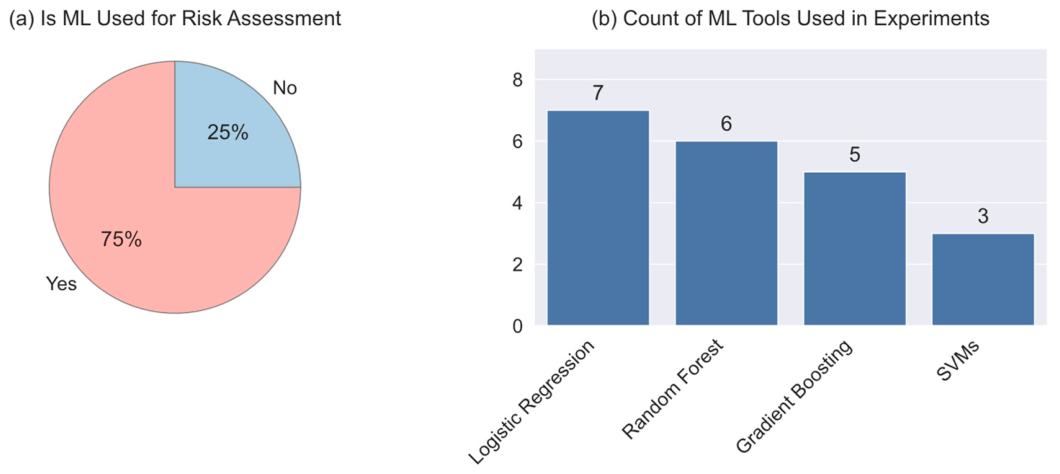
- Is machine learning being widely used as a technique for algorithmic risk assessment in the United States criminal justice system?
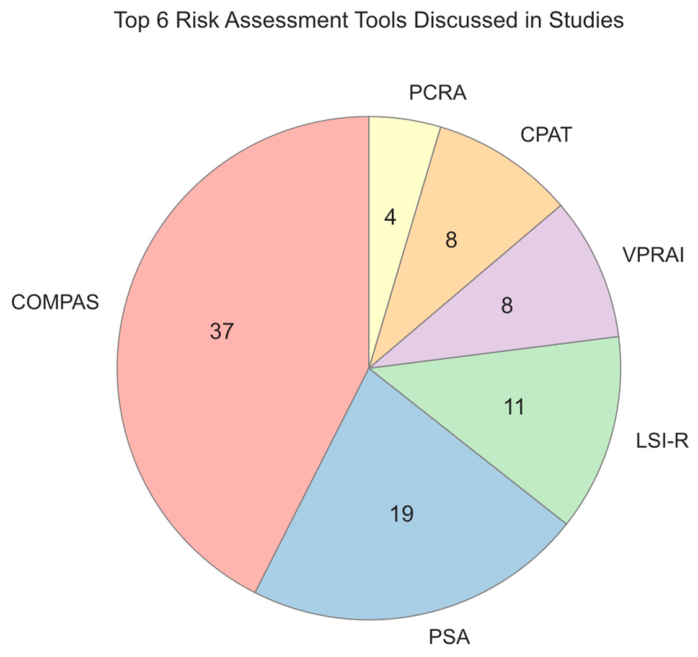
- What specific tools are being used for risk assessment at this time?
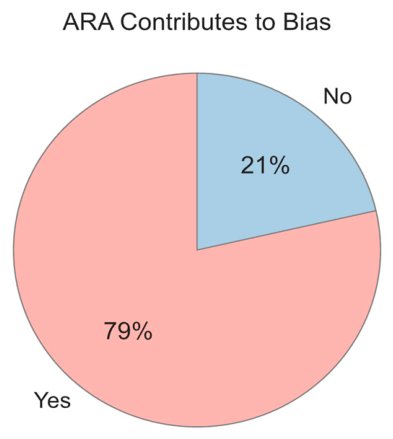
- Does algorithmic risk assessment contribute to bias or issues of fairness in the criminal justice system (i.e., in sentencing, setting bail, or granting parole)?
- What, if any, is the evidence that is commonly being used to suggest that algorithmic risk assessment tools contribute to bias?
2. Related Work
3. Defining Algorithmic Risk Assessment
3.1. Deterministic Methods
3.2. Artificial Intelligence
3.3. Machine Learning
3.4. Bias and Fairness
4. Source Collection
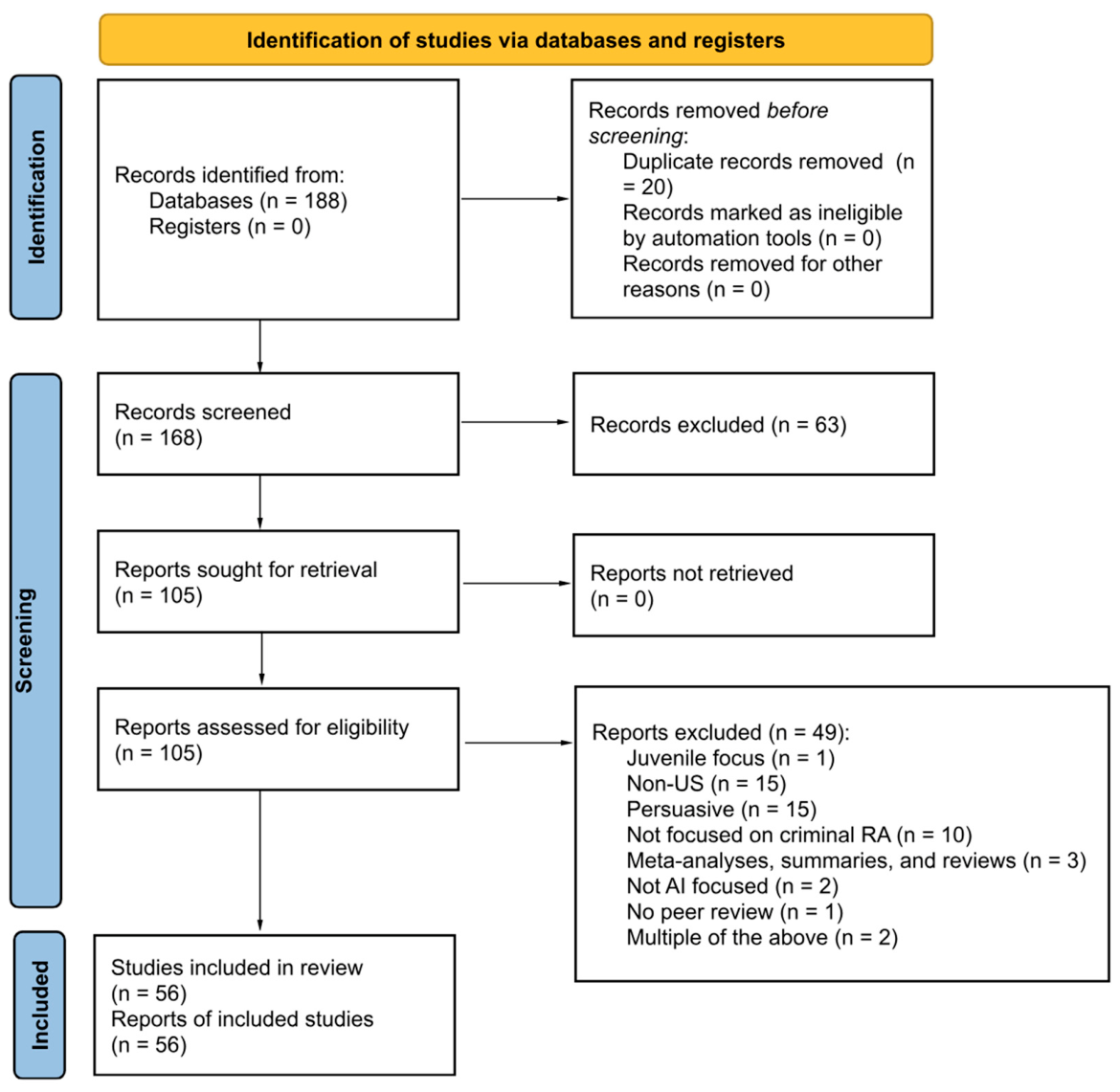
4.1. Inclusion Criteria
- Published in the year 2015 or later
- Published in a peer-reviewed, highly regarded journal or conference with a focus on law, criminal justice, or computer science
- Specifically focuses on the application of ARA in the United States legal system
- Applied transparent investigative techniques
- Focuses on the adult, rather than juvenile, legal system
4.2. Exclusion Criteria
4.3. Query Terms
5. Results
5.1. Question 1: Is Machine Learning Being Used as a Tool for Risk Assessment in the United States?
5.2. Question 2: What Specific Technologies Are Being Applied for Risk Assessment?
5.3. Question 3: Does Algorithmic Risk Assessment Contribute to Bias or Issues of Fairness?
5.4. Question 4: What, If Any, Is the Evidence and Apparent Source of Bias in Algorithmic Risk Assessment?
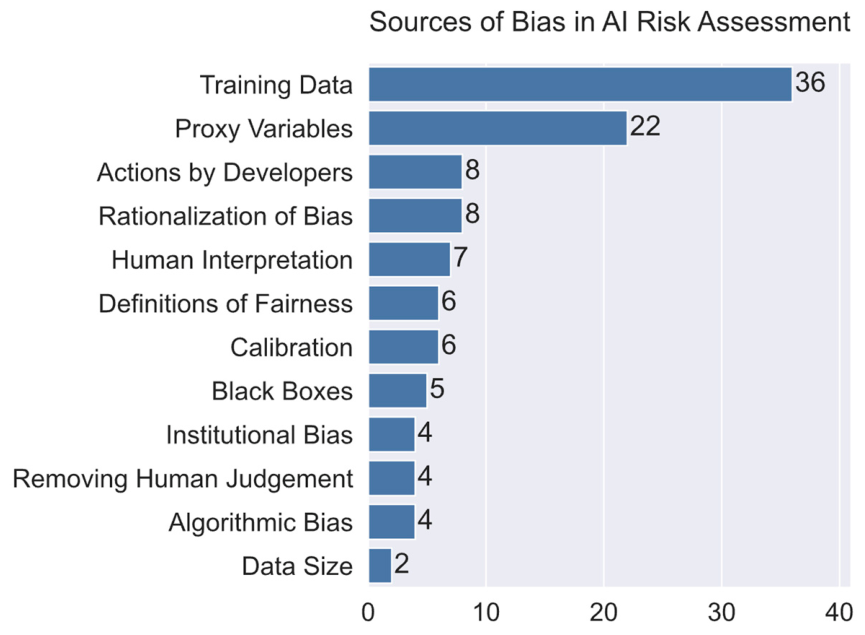
5.5. Observed Sources of Bias
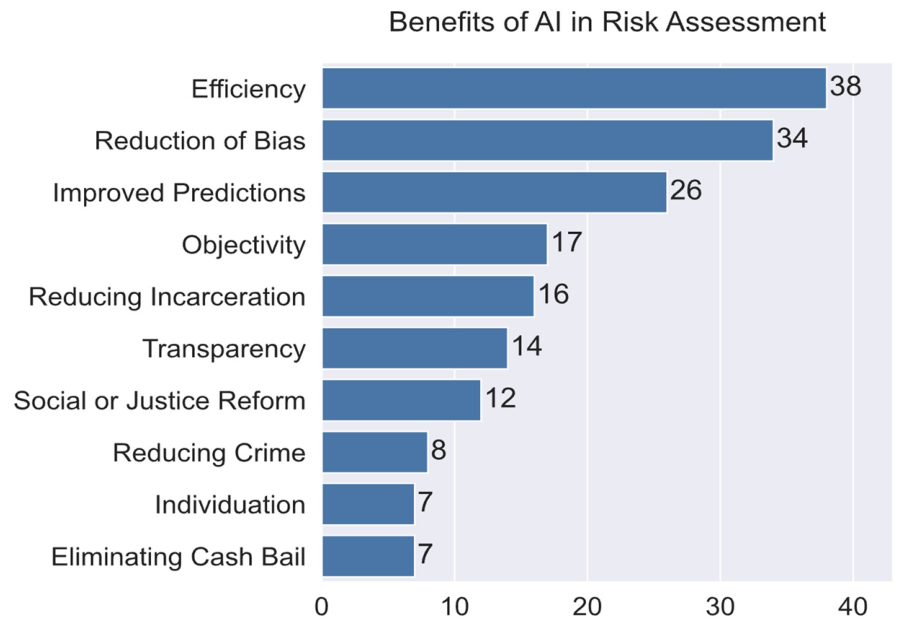
5.6. The Potential Benefits of AI
6. Discussion
6.1. COMPAS—A Cautionary Tale
6.2. Reactions to AI in the Real World
6.3. How These Tools Are Used Outside the Courtroom
6.4. Limitations of This Study
7. Conclusions and Future Work
Author Contributions
Funding
Data Availability Statement
Conflicts of Interest
Abbreviations
| AI | Artificial Intelligence |
| ARA | Algorithmic Risk Assessment |
| COMPAS | Correctional Offender Management Profiling for Alternative Sanctions |
| CPAT | Colorado Pretrial Risk Assessment Tool |
| LSI-R | Level of Service Inventory- Revised |
| ML | Machine Learning |
| PCRA | Post-Conviction Risk Assessment |
| PSA | Public Safety Assessment |
| RNA | Risk Need Assessment |
| SRA | Static Risk Assessment |
| VPRAI | Virginia Pretrial Risk Assessment Instrument |
Appendix A. Included Publications

| Title | Author(s) | Year | Journal |
|---|---|---|---|
| AI in Corrections | Rowland, Matthew G., Amit Shah, and Ashit Chandra | 2023 | Federal Probation |
| AI In Criminal Justice: Implications For Justice, Fairness, and Potential Biases | Ramandeep Kaur | 2023 | Nyaayshastra Law Review |
| Algorithmic Decision Making and the Cost of Fairness | Corbett-Davies, Sam, Emma Pierson, Avi Feller, Sharad Goel, and Aziz Huq | 2017 | Proceedings of the 23rd ACM SIGKDD international conference on knowledge discovery and data mining |
| Algorithmic governance from the bottom up | Hannah Bloch-Wehba | 2022 | BYU Law Review |
| Algorithmic risk assessment in the hands of humans | Stevenson, Megan T., and Jennifer L. Doleac | 2024 | American Economic Journal: Economic Policy |
| Algorithmic risk governance: Big data analytics, race and information activism in criminal justice debates | Hannah-Moffat, Kelly. | 2019 | Theoretical Criminology |
| Algorithms and the individual in criminal law | Jorgensen, Renée | 2022 | Canadian Journal of Philosophy |
| Algorithms in practice: Comparing web journalism and criminal justice | Christin, Angèle | 2017 | Big data & society |
| Artificial intelligence, due process and criminal sentencing | Villasenor, John, and Virginia Foggo | 2020 | Michigan State Law Review |
| Assessing risk assessment in action | Stevenson, Megan | 2018 | Minnesota Law Review |
| Bail or jail? Judicial versus algorithmic decision-making in the pretrial system | Elyounes, Doaa Abu | 2020 | The Columbia Science and Technology Law Review |
| Bias in, bias out | Mayson, Sandra G. | 2018 | The Yale Law Journal |
| Blind Justice: Algorithmically Masking Race in Charging Decisions | Chohlas-Wood, Alex, Joe Nudell, Keniel Yao, Zhiyuan Lin, Julian Nyarko, and Sharad Goel | 2021 | Proceedings of the 2021 AAAI/ACM Conference on AI, Ethics, and Society |
| Citizen Decisions and Machine Predictions: Coethnicity, Artificial Intelligence and Co-Production | Anastasopoulos, L. Jason, and Micah Gell-Redman | 2024 | New England Area Political Psychology Meeting |
| Constitutional dimensions of predictive algorithms in criminal justice | Brenner, Michael, Jeannie Suk Gersen, Michael Haley, Matthew Lin, Amil Merchant, Richard Jagdishwar Millett, Suproteem K. Sarkar, and Drew Wegner | 2020 | Harvard Civil Rights-Civil Liberties Law Review |
| Designed to fit: The development and validation of the STRONG-R recidivism risk assessment | Hamilton, Zachary, Alex Kigerl, Michael Campagna, Robert Barnoski, Stephen Lee, Jacqueline Van Wormer, and Lauren Block | 2016 | Criminal Justice and behavior |
| Disparate interactions: An algorithm-in-the-loop analysis of fairness in risk assessments | Green, Ben, and Yiling Chen | 2019 | Proceedings of the conference on fairness, accountability, and transparency. |
| Evaluating algorithmic risk assessment | Hamilton, Melissa | 2021 | New Criminal Law Review |
| Evaluating the evidence in algorithmic evidence-based decision-making: the case of US pretrial risk assessment tools | König, Pascal D., and Tobias D. Krafft | 2021 | Current Issues in Criminal Justice |
| Evidence-based sentencing and scientific evidence | Martínez-Garay, Lucía | 2023 | Frontiers in Psychology |
| Fair prediction with disparate impact: A study of bias in recidivism prediction instruments | Chouldechova, Alexandra | 2017 | Big Data |
| Fair risk assessments: A precarious approach for criminal justice reform | Green, Ben | 2018 | 5th Workshop on fairness, accountability, and transparency in machine learning |
| Fairness, accountability and transparency: notes on algorithmic decision-making in criminal justice | Chiao, Vincent | 2019 | International Journal of Law in Context |
| Formalizing Fairness: Statistical Measures of Parity for Recidivism Prediction Instruments | Song, Joshua | 2023 | Michigan Technology Law Review |
| Fragile algorithms and fallible decision-makers: lessons from the justice system | Ludwig, Jens, and Sendhil Mullainathan | 2021 | Journal of Economic Perspectives |
| Ghosting the machine: Judicial resistance to a recidivism risk assessment instrument | Pruss, Dasha | 2023 | 2023 ACM conference on fairness, accountability, and transparency |
| Human decisions and machine predictions | Kleinberg, Jon, Himabindu Lakkaraju, Jure Leskovec, Jens Ludwig, and Sendhil Mullainathan | 2018 | The quarterly journal of economics |
| Human perceptions of fairness in algorithmic decision making: A case study of criminal risk prediction | Grgic-Hlaca, Nina, Elissa M. Redmiles, Krishna P. Gummadi, and Adrian Weller | 2018 | Proceedings of the 2018 World Wide Web Conference |
| In pursuit of interpretable, fair and accurate machine learning for criminal recidivism prediction | Wang, Caroline, Bin Han, Bhrij Patel, and Cynthia Rudin | 2023 | Journal of Quantitative Criminology |
| Inherent trade-offs in the fair determination of risk scores | Kleinberg, Jon, Sendhil Mullainathan, and Manish Raghavan | 2017 | Leibniz International Proceedings in Informatics |
| Interpretable classification models for recidivism prediction | Zeng, Jiaming, Berk Ustun, and Cynthia Rudin | 2017 | Journal of the Royal Statistical Society Series A: Statistics in Society |
| Judging risk | Garrett, Brandon L., and John Monahan | 2020 | California Law Review |
| Life, liberty, and trade secrets: Intellectual property in the criminal justice system | Wexler, Rebecca. | 2018 | Stanford Law Review |
| Machine learning forecasts of risk to inform sentencing decisions | Berk, Richard, and Jordan Hyatt | 2015 | Federal Sentencing Reporter |
| On chances and risks of security related algorithmic decision making systems | Zweig, Katharina A., Georg Wenzelburger, and Tobias D. Krafft | 2018 | European Journal for Security Research |
| Paths to digital justice: Judicial robots, algorithmic decision-making, and due process | Fortes, Pedro Rubim Borges | 2020 | Asian Journal of Law and Society |
| Predictive Analytics and Risk Assessment: A Logical Response to Intimate Partner Homicide | Ross, Lee E. | 2017 | International Journal of Criminal and Forensic Science |
| Pretrial risk assessment instruments in practice: The role of judicial discretion in pretrial reform | Copp, Jennifer E., William Casey, Thomas G. Blomberg, and George Pesta | 2022 | Criminology & Public Policy |
| Pretrial risk assessment instruments in the US criminal justice system—what lessons can be learned for the European Union | Novokmet, Ante, Zvonimir Tomičić, and Zoran Vinković | 2022 | International journal of law and information technology |
| Reprogramming recidivism: the first step act and algorithmic prediction of risk | Cyphert, Amy B | 2020 | Seton Hall Law Review |
| Risk assessment in criminal sentencing | Monahan, John, and Jennifer L. Skeem | 2016 | Annual review of clinical psychology |
| Risk scores, label bias, and everything but the kitchen sink | Zanger-Tishler, Michael, Julian Nyarko, and Sharad Goel | 2024 | Science Advances |
| Smart Justice? Making sense of the rise of algorithm-based pre-trial risk assessment in criminal justice through ‘legal models | Wenzelburger, Georg, Karen Yeung, and Kathrin Hartmann | 2025 | Digital Society |
| Technologies of crime prediction: The reception of algorithms in policing and criminal courts | Brayne, Sarah, and Angèle Christin | 2021 | Social problems |
| The accuracy, fairness, and limits of predicting recidivism | Dressel, Julia, and Hany Farid | 2018 | Science advances |
| The effect of risk assessment scores on judicial behavior and defendant outcomes | Sloan, CarlyWill, George Naufal, and Heather Caspers | 2025 | Journal of Human Resources |
| The impact of algorithmic risk assessments on human predictions and its analysis via crowdsourcing studies | Fogliato, Riccardo, Alexandra Chouldechova, and Zachary Lipton | 2021 | Proceedings of the ACM on Human-Computer Interaction |
| The institutional life of algorithmic risk assessment | Solow-Niederman, Alicia, YooJung Choi, and Guy Van den Broeck | 2019 | Berkley Technology Law Journal |
| The intersection of race and algorithmic tools in the criminal legal system | Southerland, Vincent M | 2020 | Maryland Law Review |
| The intuitive-override model: Nudging judges toward pretrial risk assessment instruments | DeMichele, Matthew, Megan Comfort, Kelle Barrick, and Peter Baumgartner | 2021 | Federal Probation |
| Carlson, Alyssa M. “The need for transparency in the age of predictive sentencing algorithms | Carlson, Alyssa M | 2017 | Iowa Law Review |
| The use of artificial intelligence in gauging the risk of recidivism | Hillman, Noel L | 2019 | The Judges Journal |
| This thing called fairness: Disciplinary confusion realizing a value in technology | Mulligan, Deirdre K., Joshua A. Kroll, Nitin Kohli, and Richmond Y. Wong | 2019 | Proceedings of the ACM on Human-Computer Interaction |
| Time for a change: Examining the relationships between recidivism-free time, recidivism risk, and risk assessment | Frisch-Scott, Nicole E., and Kiminori Nakamura | 2022 | Justice Quarterly |
| Uncertainty, risk and the use of algorithms in policy decisions: A case study on criminal justice in the USA | Hartmann, Kathrin, and Georg Wenzelburger | 2021 | Policy Sciences |
| Using daubert to evaluate evidence-based sentencing | Hopkinson, Charlotte | 2017 | Cornell Law Review |
References
- Matz, A.K. The Debate and Concerns of Risk Assessment with Historically Marginalized Populations. In Handbook on Inequalities in Sentencing and Corrections Among Marginalized Populations; Routledge: Abingdon, UK, 2022; pp. 119–130. [Google Scholar]
- Kang, B.; Wu, S. False positives vs. false negatives: Public opinion on the cost ratio in criminal justice risk assessment. J. Exp. Criminol. 2023, 19, 919–941. [Google Scholar]
- Rowland, M.G.; Shah, A.; Chandra, A. AI in Corrections: The Basics and a Way to Experiment. Fed. Probat. 2023, 87, 4. [Google Scholar]
- Stevenson, M. Assessing risk assessment in action. Minn. Law Rev. 2018, 103, 303. [Google Scholar] [CrossRef]
- Kleinberg, J.; Lakkaraju, H.; Leskovec, J.; Ludwig, J.; Mullainathan, S. Human decisions and machine predictions. Q. J. Econ. 2018, 133, 237–293. [Google Scholar]
- Ludwig, J.; Mullainathan, S. Fragile algorithms and fallible decision-makers: Lessons from the justice system. J. Econ. Perspect. 2021, 35, 71–96. [Google Scholar] [CrossRef]
- Jegede, T.; Gerchick, M.K.; Mathai, A.S.; Horowitz, A. Challenge accepted? A critique of the 2021 National Institute of Justice recidivism forecasting challenge. In Proceedings of the 3rd ACM Conference on Equity and Access in Algorithms, Mechanisms, and Optimization, Boston, MA, USA, 30 October–1 November 2023. [Google Scholar]
- Desmarais, S.L.; Zottola, S.A.; Clarke, S.E.D.; Lowder, E.M. Predictive validity of pretrial risk assessments: A systematic review of the literature. Crim. Justice Behav. 2021, 48, 398–420. [Google Scholar] [CrossRef]
- Farayola, M.M.; Tal, I.; Connolly, R.; Saber, T.; Bendechache, M. Ethics and trustworthiness of ai for predicting the risk of recidivism: A systematic literature review. Information 2023, 14, 426. [Google Scholar] [CrossRef]
- Scaria, A.G.; Subramanian, V.; George, N.K.; Sengupta, N. Algorithms and recidivism: A multi-disciplinary systematic review. In Proceedings of the AAAI/ACM Conference on AI, Ethics, and Society, San Jose, CA, USA, 21–23 October 2024; Volume 7. [Google Scholar]
- Gottfredson, S.D.; Moriarty, L.J. Statistical risk assessment: Old problems and new applications. Crime Delinq. 2006, 52, 178–200. [Google Scholar]
- Taxman, F.S.; Dezember, A. The value and importance of risk and need assessment (RNA) in corrections and sentencing: An overview of the handbook. In Handbook on Risk and Need Assessment: Theory and Practice; Taxman, F.S., Ed.; Routledge: New York, NY, USA, 2017; pp. 1–20. [Google Scholar]
- Burrell, W.D. Risk and needs assessment in probation and parole: The persistent gap between promise and practice. In Handbook on Risk and Need Assessment: Theory and Practice; Taxman, F.S., Ed.; Routledge: New York, NY, USA, 2017; pp. 23–48. [Google Scholar]
- Kaur, R. AI in criminal justice: Implications for justice, fairness, and potential biases. Nyaayshastra Law Rev. 2024, 4, 1–11. [Google Scholar]
- Poole, D.L.; Mackworth, A.K. Artificial Intelligence: Foundations of Computational Agents, 3rd ed.; Cambridge University Press: Cambridge, UK, 2023. [Google Scholar]
- Russell, S.; Norvig, P. Artificial Intelligence: A Modern Approach; Pearson Education Limited: London, UK, 2015. [Google Scholar]
- Elyounes, D.A. Bail or jail? Judicial versus algorithmic decision-making in the pretrial system. Colum. Sci. Technol. Law Rev. 2019, 21, 376. [Google Scholar]
- Yeung, K.; Harkens, A. How do “technical” design-choices made when building algorithmic decision-making tools for criminal justice authorities create constitutional dangers? Part II. arXiv 2023, arXiv:2301.04715. [Google Scholar]
- Partnership on AI. Report on Algorithmic Risk Assessment Tools in the US Criminal Justice System; Partnership on AI: San Francisco, CA, USA, 2019. [Google Scholar]
- Bloch-Wehba, H. Algorithmic governance from the bottom up. BYU Law Rev. 2022, 48, 69. [Google Scholar] [CrossRef]
- Radford, A.; Narasimhan, K.; Salimans, T.; Sutskever, I. Improving Language Understanding by Generative Pre-Training. Open AI 2018. Available online: https://cdn.openai.com/research-covers/language-unsupervised/language_understanding_paper.pdf (accessed on 3 June 2026).
- Cyphert, A.B. Reprogramming recidivism: The first step act and algorithmic prediction of risk. Seton Hall Law Rev. 2020, 51, 331. [Google Scholar] [CrossRef]
- McKay, C. Predicting risk in criminal procedure: Actuarial tools, algorithms, AI and judicial decision-making. Curr. Issues Crim. Justice 2020, 32, 22–39. [Google Scholar] [CrossRef]
- Berk, R.; Berk, D.; Drougas, D. Machine Learning Risk Assessments in Criminal Justice Settings; Springer: New York, NY, USA, 2019. [Google Scholar]
- Blakeney, C.; Atkinson, G.; Huish, N.; Yan, Y.; Metsis, V.; Zong, Z. Measuring bias and fairness in multiclass classification. In Proceedings of the 2022 IEEE International Conference on Networking, Architecture and Storage (NAS), Philladelphia, PA, USA, 3–4 October 2022. [Google Scholar]
- Merriam-Webster. Merriam-Webster Dictionary; Merriam-Webster: Springfield, MA, USA, 2004. [Google Scholar]
- Clemons, T.R. Blind injustice: The Supreme Court, implicit racial bias, and the racial disparity in the criminal justice system. Am. Law Rev. 2014, 51, 689–714. [Google Scholar]
- Mauer, M. Addressing racial disparities in incarceration. Prison. J. 2011, 91, 87S–101S. [Google Scholar] [CrossRef]
- Butler, P.D. Poor people lose: Gideon and the critique of rights. Yale Law J. 2013, 122, 2176–2205. [Google Scholar]
- Berk, R.; Hyatt, J. Machine learning forecasts of risk to inform sentencing decisions. Fed. Sentencing Rep. 2015, 27, 222–228. [Google Scholar] [CrossRef]
- Maughan, K.; Near, J.P. Towards a measure of individual fairness for deep learning. arXiv 2020, arXiv:2009.13650. [Google Scholar] [CrossRef]
- Mehrabi, N.; Morstatter, F.; Saxena, N.; Lerman, K.; Galstyan, A. A survey on bias and fairness in machine learning. ACM Comput. Surv. (CSUR) 2021, 54, 1–35. [Google Scholar] [CrossRef]
- Jorgensen, R. Algorithms and the individual in criminal law. Can. J. Philos. 2022, 52, 61–77. [Google Scholar] [CrossRef]
- Chouldechova, A. Fair prediction with disparate impact: A study of bias in recidivism prediction instruments. Big Data 2017, 5, 153–163. [Google Scholar] [CrossRef] [PubMed]
- Stevenson, M.T.; Doleac, J.L. Algorithmic risk assessment in the hands of humans. Am. Econ. J. Econ. Policy 2024, 16, 382–414. [Google Scholar] [CrossRef]
- Wang, C.; Han, B.; Patel, B.; Rudin, C. In pursuit of interpretable, fair and accurate machine learning for criminal recidivism prediction. J. Quant. Criminol. 2023, 39, 519–581. [Google Scholar] [CrossRef]
- Chohlas-Wood, A.; Nudell, J.; Yao, K.; Lin, Z.; Nyarko, J.; Goel, S. Blind justice: Algorithmically masking race in charging decisions. In Proceedings of the 2021 AAAI/ACM Conference on AI, Ethics, and Society, Virtual, 19–21 May 2021. [Google Scholar]
- Brennan, T.; Dieterich, W.; Ehret, B. Evaluating the predictive validity of the COMPAS risk and needs assessment system. Crim. Justice Behav. 2009, 36, 21–40. [Google Scholar] [CrossRef]
- Brittain, B.J.; Georges, L.; Martin, J. Examining the predictive validity of the Public Safety Assessment. Crim. Justice Behav. 2021, 48, 1431–1449. [Google Scholar] [CrossRef]
- Austin, J.; Coleman, D.; Peyton, J.; Johnson, K.D. Reliability and Validity Study of the LSI-R Risk Assessment Instrument; The Institute on Crime, Justice, and Corrections, George Washington University: Washington, DC, USA, 2003. [Google Scholar]
- VanNostrand, M.; Rose, K.J. Pretrial Risk Assessment in Virginia: The Virginia Pretrial Risk Assessment Instrument (2009). BiblioCEJA, CEJA. 2016. Available online: https://biblioteca.cejamericas.org/bitstream/handle/2015/3099/Virginia_Risk_Assessment_2009.pdf?sequence=1 (accessed on 3 June 2026).
- Terranova, V.A.; Ward, K.C. Colorado Pretrial Assessment Tool Validation Study Final Report; National Association of Criminal Defense Lawyers: Washington, DC, USA, 2020. [Google Scholar]
- Johnson, J.L.; Lowenkamp, C.T.; VanBenschoten, S.W.; Robinson, C.R. The construction and validation of the federal Post Conviction Risk Assessment (PCRA). Fed. Probat. 2011, 75, 16. [Google Scholar]
- Dressel, J.; Farid, H. The accuracy, fairness, and limits of predicting recidivism. Sci. Adv. 2018, 4, Eaao5580. [Google Scholar] [CrossRef]
- Hamilton, M. Evaluating algorithmic risk assessment. New Crim. Law Rev. 2021, 24, 156–211. [Google Scholar] [CrossRef]
- Mayson, S.G. Bias in, bias out. Yale Law J. 2018, 128, 2218. [Google Scholar]
- Hamilton, Z.; Kigerl, A.; Campagna, M.; Barnoski, R.; Lee, S.; Van Wormer, J.; Block, L. Designed to fit: The development and validation of the STRONG-R recidivism risk assessment. Crim. Justice Behav. 2016, 43, 230–263. [Google Scholar] [CrossRef]
- Hopkinson, C. Using daubert to evaluate evidence-based sentencing. Cornell Law Rev. 2017, 103, 723. [Google Scholar]
- DeMichele, M.; Comfort, M.; Barrick, K.; Baumgartner, P. The intuitive-override model: Nudging judges toward pretrial risk assessment instruments. Fed. Probat. 2021, 85, 22. [Google Scholar] [CrossRef]
- Carlson, A.M. The need for transparency in the age of predictive sentencing algorithms. Iowa Law Rev. 2017, 103, 303. [Google Scholar]
- Wenzelburger, G.; Yeung, K.; Hartmann, K. Smart Justice? Making sense of the rise of algorithm-based pre-trial risk assessment in criminal justice through ‘legal models’. Digit. Soc. 2025, 4, 48. [Google Scholar]
- Novokmet, A.; Tomičić, Z.; Vinković, Z. Pretrial risk assessment instruments in the US criminal justice system—What lessons can be learned for the European Union. Int. J. Law Inf. Technol. 2022, 30, 1–22. [Google Scholar] [CrossRef]
- Green, B. “Fair” risk assessments: A precarious approach for criminal justice reform. In Proceedings of the 5th Workshop on Fairness, Accountability, and Transparency in Machine Learning, Stockholm, Sweden, 14 July 2018. [Google Scholar]
- Villasenor, J.; Foggo, V. Artificial intelligence, due process and criminal sentencing. Mich. St. Law Rev. 2020, 2020, 295. [Google Scholar]
- Pruss, D. Ghosting the machine: Judicial resistance to a recidivism risk assessment instrument. In Proceedings of the 2023 ACM Conference on Fairness, Accountability, and Transparency, Chicago, IL, USA, 12–15 June 2023. [Google Scholar]
- Christin, A. Algorithms in practice: Comparing web journalism and criminal justice. Big Data Soc. 2017, 4, 2053951717718855. [Google Scholar] [CrossRef]
- Green, B.; Chen, Y. Disparate interactions: An algorithm-in-the-loop analysis of fairness in risk assessments. In Proceedings of the Conference on Fairness, Accountability, and Transparency, Atlanta, Georgia, 29–31 January 2019. [Google Scholar]
- Hannah-Moffat, K. Algorithmic risk governance: Big data analytics, race and information activism in criminal justice debates. Theor. Criminol. 2019, 23, 453–470. [Google Scholar]
- Peeters, R.; Schuilenburg, M. Algorithmic governance: Technology, knowledge and power. In The SAGE Handbook of Digital Society; SAGE: Thousand Oaks, CA, USA, 2023; pp. 439–457. [Google Scholar]
- Westermann, H. Evidence-Based Sentencing: Risks and Opportunities. Lex Electron. 2020, 25, 71. [Google Scholar]
- Gravett, W. Sentenced by an algorithm—Bias and lack of accuracy in risk-assessment software in the United States criminal justice system. South Afr. J. Crim. Justice 2021, 34, 31–54. [Google Scholar]
- Solow-Niederman, A.; Choi, Y.J.; Van den Broeck, G. The institutional life of algorithmic risk assessment. Berkeley Technol. Law J. 2019, 34, 705. [Google Scholar]
- Nguyen, H.T.T.; Cao, H.Q.; Nguyen, K.V.T.; Pham, N.D.K. Evaluation of explainable artificial intelligence: Shap, lime, and cam. In Proceedings of the FPT AI Conference, Virtual, 17–21 August 2021. [Google Scholar]
- Brenner, M.; Gersen, J.S.; Haley, M.; Lin, M.; Merchant, A.; Millett, R.J.; Sarkar, S.K.; Wegner, D. Constitutional dimensions of predictive algorithms in criminal justice. Harv. Civ. Rights Civ. Lib. Law Rev. 2020, 55, 267. [Google Scholar]
- Washington, A.L. How to argue with an algorithm: Lessons from the COMPAS-ProPublica debate. Color. Technol. Law J. 2018, 17, 131. [Google Scholar]
- Copp, J.E.; Casey, W.; Blomberg, T.G.; Pesta, G. Pretrial risk assessment instruments in practice: The role of judicial discretion in pretrial reform. Criminol. Public Policy 2022, 21, 329–358. [Google Scholar] [CrossRef]
- Green, B.; Chen, Y. Algorithmic risk assessments can alter human decision-making processes in high-stakes government contexts. Proc. ACM Hum. Comput. Interact. 2021, 5, 1–33. [Google Scholar]
- Southerland, V.M. The intersection of race and algorithmic tools in the criminal legal system. Md. Law Rev. 2020, 80, 487. [Google Scholar]
- Longo, L.; Brcic, M.; Cabitza, F.; Choi, J.; Confalonieri, R.; Del Ser, J.; Guidotti, R.; Hayashi, Y.; Herrera, F.; Holzinger, A.; et al. Explainable Artificial Intelligence (XAI) 2.0: A manifesto of open challenges and interdisciplinary research directions. Inf. Fusion 2024, 106, 102301. [Google Scholar] [CrossRef]
- Wexler, R. Life, liberty, and trade secrets: Intellectual property in the criminal justice system. Stan. Law Rev. 2018, 70, 1343. [Google Scholar] [CrossRef]
- Eckhouse, L.; Lum, K.; Conti-Cook, C.; Ciccolini, J. Layers of bias: A unified approach for understanding problems with risk assessment. Crim. Justice Behav. 2019, 46, 185–209. [Google Scholar] [CrossRef]
- Epp, C.R.; Haider-Markel, D.P.; Maynard-Moody, S. Pulled Over: How Police Stops Define Race and Citizenship; University of Chicago Press: Chicago, IL, USA, 2014. [Google Scholar]
- Goel, S.; Rao, J.M.; Shroff, R. Precinct or prejudice? Understanding racial disparities in New York City’s stop-and-frisk policy. Ann. Appl. Stat. 2016, 10, 365–394. [Google Scholar] [CrossRef]


Disclaimer/Publisher’s Note: The statements, opinions and data contained in all publications are solely those of the individual author(s) and contributor(s) and not of MDPI and/or the editor(s). MDPI and/or the editor(s) disclaim responsibility for any injury to people or property resulting from any ideas, methods, instructions or products referred to in the content. |
© 2026 by the authors. Licensee MDPI, Basel, Switzerland. This article is an open access article distributed under the terms and conditions of the Creative Commons Attribution (CC BY) license.
Share and Cite
Atkinson, G.; Casagrande, K. Efficiency vs. Equity: A Structured Interdisciplinary Review of AI in Criminal Justice Risk Assessments. Information 2026, 17, 574. https://doi.org/10.3390/info17060574
Atkinson G, Casagrande K. Efficiency vs. Equity: A Structured Interdisciplinary Review of AI in Criminal Justice Risk Assessments. Information. 2026; 17(6):574. https://doi.org/10.3390/info17060574
Chicago/Turabian StyleAtkinson, Gentry, and Katlyn Casagrande. 2026. "Efficiency vs. Equity: A Structured Interdisciplinary Review of AI in Criminal Justice Risk Assessments" Information 17, no. 6: 574. https://doi.org/10.3390/info17060574
APA StyleAtkinson, G., & Casagrande, K. (2026). Efficiency vs. Equity: A Structured Interdisciplinary Review of AI in Criminal Justice Risk Assessments. Information, 17(6), 574. https://doi.org/10.3390/info17060574