Systematic Review

Cognitive Digital Twins: A Systematic Review of Definitions, Applications, and a Unified Definition


Faculty of Science and Engineering, Northumbria University, Ellison Pl, Newcastle upon-Tyne NE1 8ST, UK
*
Authors to whom correspondence should be addressed.
Information 2026, 17(6), 556; https://doi.org/10.3390/info17060556
Submission received: 7 May 2026 / Revised: 1 June 2026 / Accepted: 2 June 2026 / Published: 5 June 2026
(This article belongs to the Special Issue Machine Learning and Data Analytics for Business Process Improvement)

Abstract

Cognitive Digital Twins (CDTs) are regarded as an evolved version of existing Digital Twin (DT) systems and are capable of certain cognitive abilities. However, the various introduced definitions and characteristics of CDTs, and different understandings of “cognition”, create conceptual ambiguity around CDTs. This paper critically reviews key definitions, application domains, capabilities, and proposed architectures of CDTs. Following PRISMA 2020 guidelines, a systematic review methodology is conducted across Scopus and Web of Science to map existing definitions, cognitive capabilities, and application domains of CDTs. Studies that explicitly implement or conceptualise a DT and explicitly mention cognitive, intelligent, autonomous, or AI-driven properties are included. Conversely, conference papers, book chapters, editorial pieces, review articles, and non-English publications are excluded from this review. The results of 59 reviewed studies present bibliometric metadata and a thematic analysis of early and recent definitions and applications of CDTs across various domains, such as manufacturing, which is the most studied discipline in terms of CDT implementation. Findings show that the understanding of cognitive enhancement has shifted toward the semantic enrichment of DT systems, with a significant emphasis on knowledge-driven approaches. The discussion focuses on identifying key differences between DTs and CDTs and synthesising existing definitions. The key contribution of this study is a unified definition of CDT, a mapping of cognitive capabilities and application domains, and a future research agenda. The review is not registered. The review is limited to journal articles, and the enabling CDT technologies, along with their implementations, are not addressed within this paper.

1. Introduction

Cognitive Digital Twins (CDTs) are emerging as a promising framework of inquiry for intelligent systems. CDTs are a relatively new concept, where studies to date have presented knowledge on definitions, characteristics, and specific application areas of CDTs. Regarded as an evolution of Digital Twins (DTs) [1], they can sense and reason on complex and unpredictable behaviours and generate dynamic support for decision-making processes [2]. The concept represents an advanced evolution of the traditional DT concept by incorporating cognitive capabilities to enhance decision making, process optimisation, and system resilience (adaptability). A CDT can be thought of as a distributed cognitive system that involves all subsystems of its physical counterparts [3].
DTs have been explored across a wide range of domains, including healthcare, maritime and shipping, manufacturing, city management, aerospace [4] and the built environment [5]. A DT is defined as a “high-fidelity virtual replica of the physical asset with real-time two-way communication for simulation purposes and decision-aiding features for product service enhancement” [6]. Apart from the two key elements of DTs, physical and virtual parts, the two-way communication between them, as stated in the definition, defines the level of interaction and data flow. With the increasing network of digitally connected systems and the realised advancement of AI, the concept of DT has been criticised as merely a digital shadow of its physical counterpart and expanded to a concept in which the digital impacts its physical twin [7]. The descriptive nature of a DT is challenged to evolve towards incorporating predictive skills through algorithms for data-driven activities and decision-making systems. Maintaining constant connectivity and synchronisation while simulating the physical equivalent throughout time is essential for an effective DT [8]. This requires bidirectional, fully automated data transfer between digital and physical systems. The rising data collection and processing technologies support predictive capabilities, which in turn enable a successful link between the physical and the digital. Building upon the exploration of enhancing predictive skills and further advancing the concept to a more complex level, the CDT was first introduced by [1].
The CDT paradigm has rapidly evolved from the understanding of integrating data-driven models generated by data analytics and Machine Learning (ML) into the DT artifact [9] towards a System-of-Systems (SoS) with certain cognitive abilities, such as perception, memory, behaviour, adaptation, planning, learning and reasoning [9]. With the increasing interest in CDTs across various domains, studies provide various definitions and approaches, leading to conceptual fragmentation and disciplinary silos. The fragmented understanding of “cognition” in the context of DT studies poses challenges to further developing the conceptual frameworks needed to realise implementation-ready CDTs. The rapidly expanding field of research also challenges scholars to build on the existing repertoire while staying up to date with the latest knowledge. Therefore, this study aims to critically review and analyse articles on CDTs and intelligent DT systems to provide answers to the following research questions:
RQ1 (Definitions): How are CDTs defined in the literature?
RQ2 (Application Domains): What domains have introduced CDTs?
RQ3 (Characteristics): What cognitive capabilities are attributed to CDTs?
RQ4 (Architecture): How are CDT architectures structured in relation to conventional DT architectures?
The remaining sections of the paper are structured as follows: Section 2 introduces the methodology of the study, Section 3 presents the review findings and analysis, Section 4 discusses the synthesis of research findings on CDT definitions, cognitive functions, and CDT architecture and a future agenda and concludes the paper.

2. Methodology

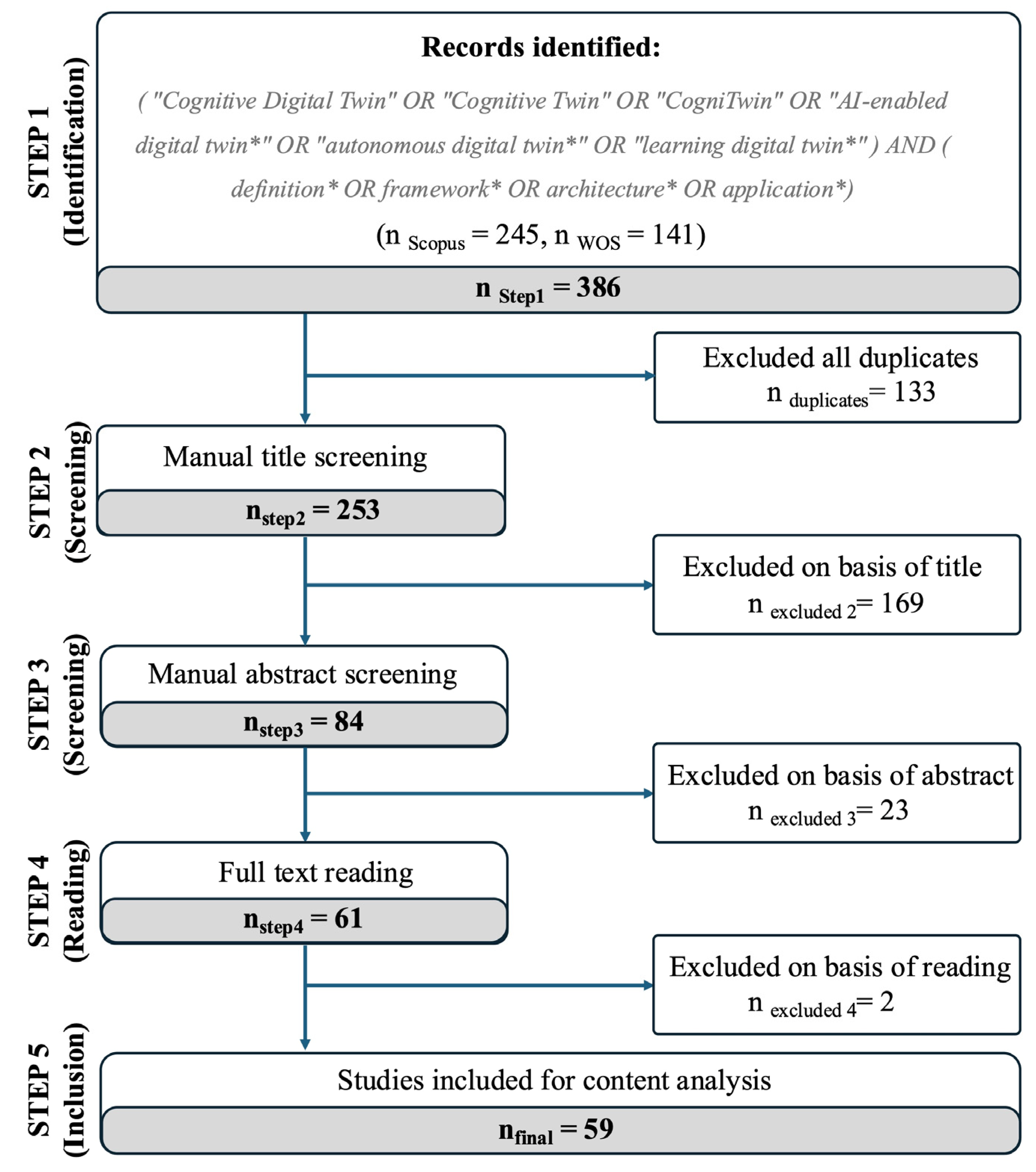
This study adopts a systematic review methodology to analyse how the CDT has been defined, conceptualised, and operationalised across domains by mapping existing definitions, application domains, cognitive capabilities, and architectures of CDTs. The systematic review presented in this paper was conducted following the PRISMA method [10] (Supplementary Materials). Screening and thematic coding were performed by a single researcher (reviewer), and the thematic analysis was subsequently reviewed with the broader research team, thereby establishing an additional layer of peer review to ensure coding consistency and analytical rigour. Two major academic databases are searched: a total of 386 papers, 245 articles from Scopus (excluding 15 conference reviews) and 141 articles from Web of Science, were sourced using the search string (“Cognitive Digital Twin” OR “Cognitive Twin” OR “CogniTwin” OR “AI-enabled Digital Twin*” OR “autonomous Digital Twin*” OR “learning Digital Twin*”) AND (definition* OR framework* OR architecture* OR application*). After the deduplication process (133 duplicates), 253 papers were included for title and abstract screening. Book chapters, conference papers, editorial pieces, and review papers are excluded. The papers went through a two-stage conceptual filtering process: (1) explicitly implementing or conceptualising a DT; and (2) explicitly mentioning cognitive/intelligent/autonomous/AI-driven properties to verify cognitive functionality. The filtering process ensures that reviewed papers do not overlap with the general DT literature that discusses some level of intelligence but does not genuinely implement or conceptualise cognitive aspects. Following that, 61 papers were screened for full-text eligibility. Two additional papers were excluded at this stage; one was discussing the cognitive performance of the human user rather than the DT system, and the other was identified as a review paper during the full-text reading, concluding with a final set of 59 papers for further analysis (Figure 1). Therefore, the final set of 59 reviewed papers was included due to their contribution to the definition and application of CDTs within specific domains, as well as the discussion of the cognitive capabilities, characteristics, and architectures of CDTs.
Figure 1. Steps of the reviewing process. The * in the search string is added to include plurals and alternative suffixes.
Information 17 00556 g001

2.1. Review Process

This paper reviews existing studies that define, implement, or develop CDTs and studies on DTs that feature intelligent functions (such as prediction, optimisation, AI integration for further analytics, etc.). The search string facilitates a domain-independent review, resulting in a comprehensive analysis of the existing CDT body of knowledge across all academic disciplines. Such an approach is essential for determining whether the CDT signifies a continuation of the DT paradigm or a paradigm shift. The review process started with retrieving papers from Scopus and Web of Science databases. The search string yielded a total of 386 papers, of which 59 were included for thematic analysis following deduplication, title screening, abstract screening, and full-text reading. The filtering process followed a set of predefined inclusion and exclusion criteria shown in Table 1. EndNote was used to store and organise the final set of readings, and the raw data was handled manually in XML format. The risk of bias was addressed through a structured selection process using predefined inclusion and exclusion criteria. Included studies were individually appraised for methodological rigour and reliability of findings.

2.2. Method of Analysis

The concluding collection of papers was subjected to two distinct analytical approaches: a brief bibliometric analysis and thematic analysis. The former seeks to evaluate publication trends, keyword co-occurrence (VOSViewer(Version 1.6.20 (0))), and sources of academic publications, leading to establishing the context for the significance of this study. The latter aims to provide a comprehensive understanding of the existing body of knowledge.

2.3. Thematic Clustering

Thematic analysis aims to extract meaningful information from the reviewed papers in a structured manner to answer the research questions. The study follows the steps of thematic analysis defined by Braun and Clarke [11], namely, familiarising oneself with the data, generating initial codes, searching for themes, reviewing themes, defining and naming themes, and producing the report. Eleven themes are identified as a result of this process, and four clusters are presented within this paper.
The coding process generated the themes (1) research domain, (2) proposed framework, (3) AI approach, (4) defined CDT or DT architecture, (5) definition of CDT made, (6) cognitive functions mentioned, (7) DT–cognition relation, and (8) main difference from DT, defined prior to full-text reading. Throughout the readings, further clusters were identified, such as (9) evaluation method, (10) ontology description, and (11) knowledge graph inclusion, and added as themes. This addition of three themes required an iteration and re-evaluation of papers. This paper presents findings on the following four categories: definitions of CDT, research domain, cognitive functions, and the DT–cognition relation (Table 2). Each of the four clusters is described below:
  • Definition of CDT: A formal definition or description of a CDT proposed by the authors. These definitions can either be explicitly stated, conceptualisations, or implicit definitions stated by authors. If the reviewed study adopts an existing definition, it is not included in the list.
  • Research domain: The application context or disciplinary field in which the CDT is developed, implemented, or studied. The research domain reflects the problem environment and operational context of the CDT, such as manufacturing, healthcare, energy systems, or the built environment, rather than the enabling technologies used to implement the CDT (e.g., Artificial Intelligence (AI), IoT, or knowledge graphs). The research domain of each study was identified based on the primary application area of the proposed CDT or DT, as described by the authors. Where studies addressed multiple sectors, the domain was assigned based on the main system or industry targeted by the CDT application.
  • Cognitive functions: The set of functions mentioned, which are components of human-like cognitive processes (perception, attention, reasoning, problem solving, memory types, and learning), requires a specific degree of intelligence, exceeding mere descriptive analytics. Cognitive functions identify the system’s capabilities and describe its level of cognition.
  • Architectural relation of DT and cognition: The architectural positioning of cognition within a DT system or a CDT system. The structural relationship identifies various layers of CDT understanding, reflecting different interpretations of CDT structure, and demonstrates the architectural transition from a DT to CDT.

3. Findings

Findings show results of the bibliometric analysis and introduce the thematic clustering results and interpretations derived from the content analysis. First, the research trend, academic sources, and concepts correlating with CDTs are presented. Following the bibliometric analysis, findings on definitions of CDTs, research domains, cognitive functions, and CDT architectures are presented.

3.1. Bibliometric Analysis Results

CDT research has gained strong attention in recent years and is a fast-growing field of inquiry, likely driven by advances in AI, Industry 4.0/5.0, and autonomous systems.
Figure 2 shows the distribution of reviewed publications by year, indicating an increase, particularly after 2023, with a significant peak in 2025. This shows a positive trend in journal articles introducing frameworks, applications, and architectures for CDTs and intelligent DT systems.
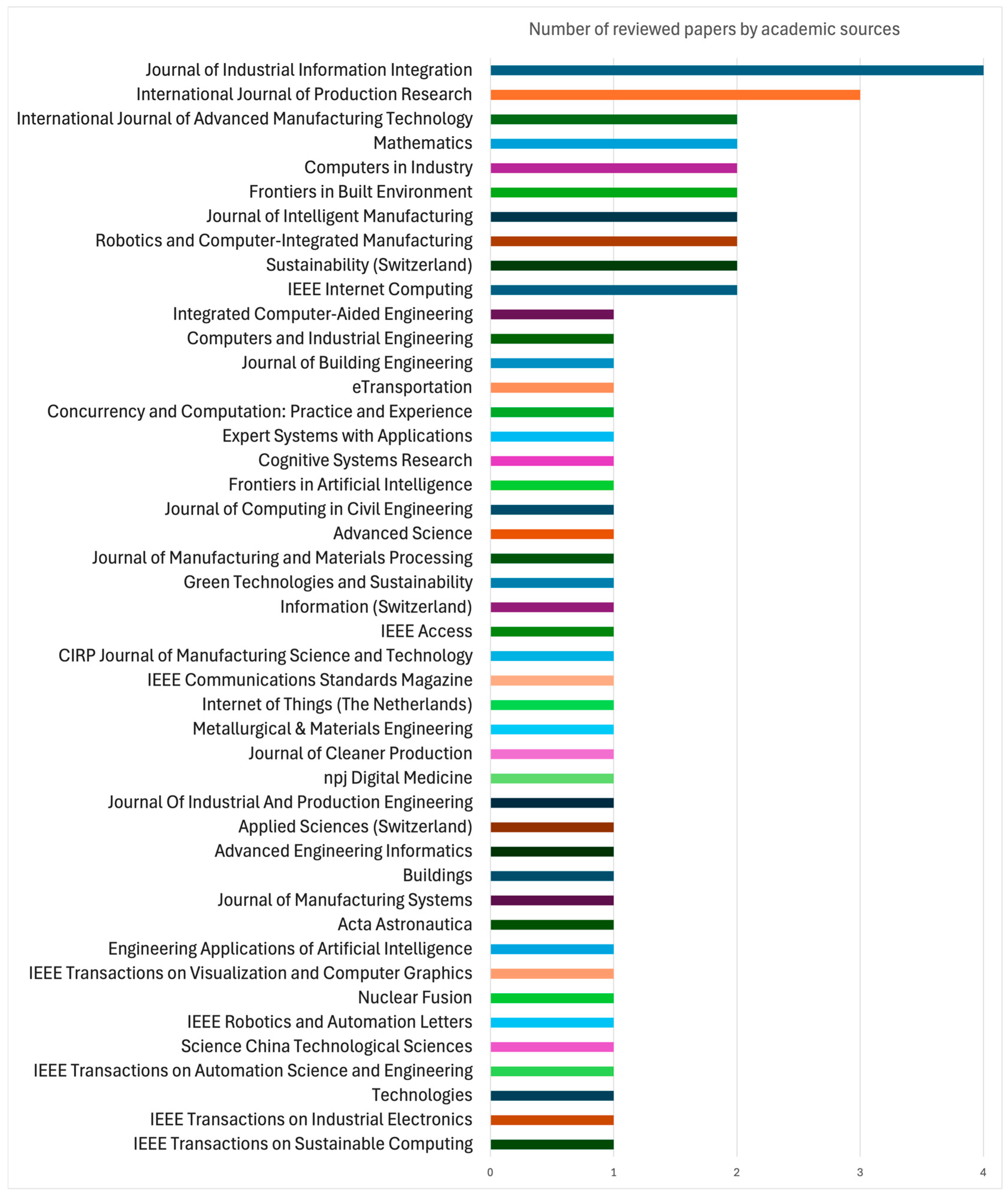
Reviewed CDT studies are published in a variety of academic sources. However, the Journal of Industrial Information Integration appears as one of the leading sources of CDT studies, followed by the International Journal of Production Research, as seen in Figure 3. The majority of the identified sources are top-tier journals in their areas, indicating that CDTs are considered a high-impact and strategically important research area. Despite being an emerging field of research, the high value has already been realised by the research community.
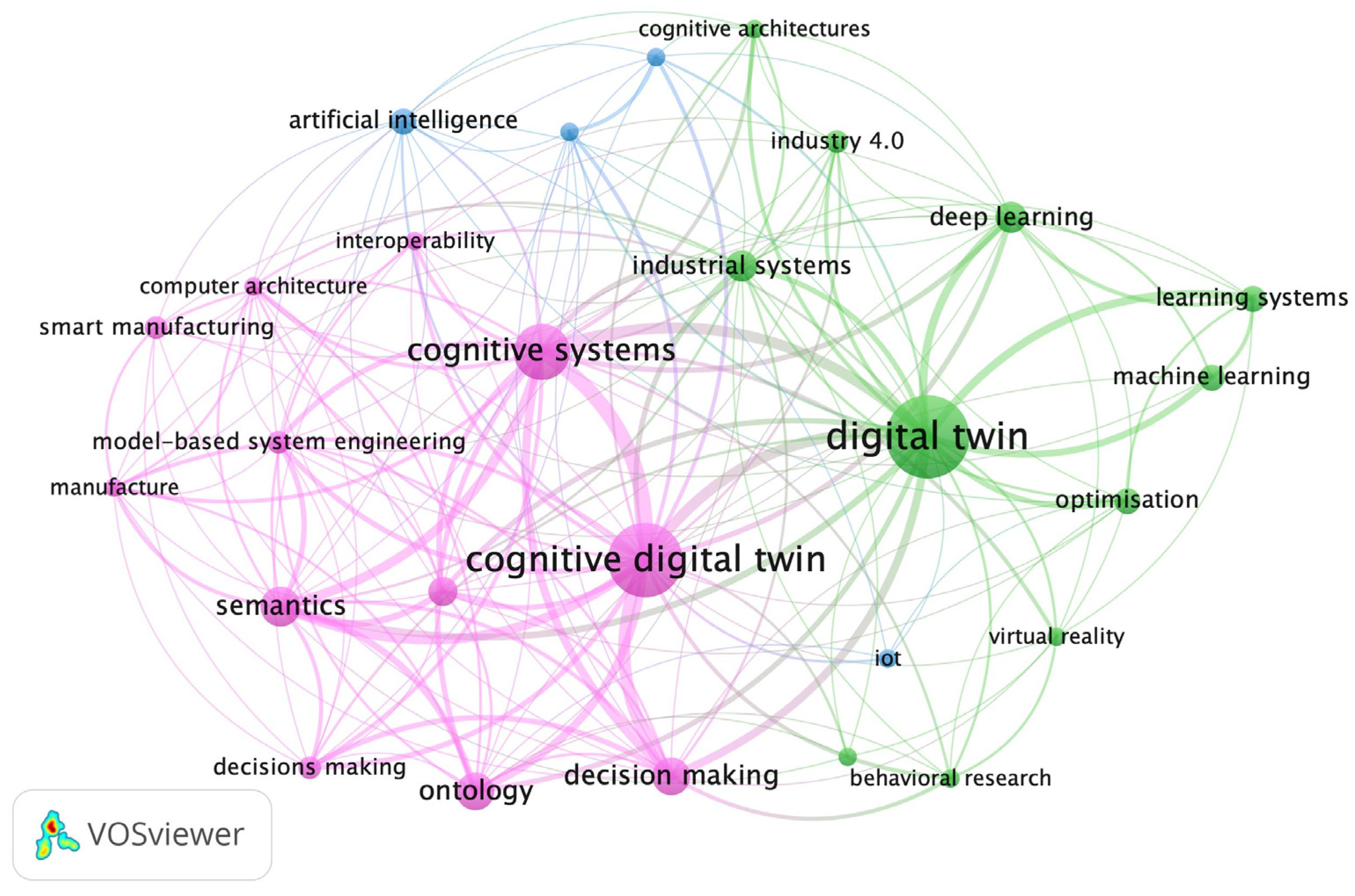
The intellectual structure of the CDT research field is analysed through a keyword co-occurrence network. The network identifies the relation between core and secondary concepts. The frequency of keywords is represented by node sizes, and “digital twin” appears to be the core of CDT studies, followed by the “cognitive digital twin” concept. The high frequency of framework proposals also indicates that the field is moving towards conceptualising and structuring CDT systems. As seen in Figure 4, there are strong links between CDT and AI. The keywords presented in the network diagram appear at least three times.
The CDT research field emerges at the intersection of DTs and AI, representing an evolution of DT systems towards a higher level of intelligence, autonomy, and adaptability. While AI and relevant technologies act as enablers, the main goals in reviewed studies include decision support, optimisation, uncertainty analysis, forecasting, and energy efficiency. The field also adopts from cognitive systems, cognitive architectures, and theories from cognitive science. Especially, the use of ontologies and semantic representation through knowledge graphs supports the understanding of a CDT as a distributed cognitive system that “understands” and evolves with its environment [13,14,15,16,17,18,19].

3.2. Thematic Analysis Results

Understanding of a scientific phenomenon is often associated with explanation. According to Newman [20], explanatory understanding involves the ability to draw inferences about why the explanans explains the explanandum, meaning that understanding is achieved when one can infer how and why a phenomenon occurs based on an explanatory framework. Similarly, Grimm [21] argues that understanding is closely related to reasoning about how a system would behave under different conditions. Together, these perspectives suggest that understanding a concept requires not only a definition but also an explanation of its structure and the mechanisms through which it operates.
For this reason, this section not only collects explicit definitions of CDTs from the literature but also analyses how a CDT is conceptually described, how cognition is characterised, and how CDT architectures are structured in relation to DTs. By examining definitions, conceptual descriptions, cognitive functions, and system architectures, the paper develops a clearer conceptual understanding of CDTs. Based on this analysis, the following section introduces a synthesised definition of cognitive digital twins that reflects the common characteristics identified across the reviewed literature.

3.3. Definitions of Cognitive Digital Twin

The definition of DTs has been much debated in the literature. Therefore, DT studies provide a strong foundation for developing initial concepts of CDTs. The early definitions of CDTs were made by Adl [1] and Fariz Saracevic [22] based on the evolving cognitive abilities of IoT technologies, cognitive computing and AI. A common approach to CDTs is to define them as a System-of-Systems (SoS) design problem. Based on the SoS definition of Kumar, Merzouki [23], this approach highlights that a CDT consists of independent component systems that communicate to meet a shared goal within a large-scale system. In parallel with the SoS approach to CDTs, Zheng et al. [24] define a CDT as “a digital representation of a physical system that is augmented with certain cognitive capabilities and support to execute autonomous activities; comprises a set of semantically interlinked digital models related to different lifecycle phases of the physical system, including its subsystems and components; and evolves continuously with the physical system across the entire lifecycle”. The study of Zheng et al. [24] introduces characteristics and definitions of CDTs and proposes a CDT implementation architecture. It is claimed that the main difference between a CDT and a DT is that a “CDT should incorporate cognitive features to enable sensing complex and unpredictable behaviours; and reasoning for optimisation strategies leading to a system that continuously evolves”. The characteristics of CDTs are listed as DT-based, cognition capability, full lifecycle management, autonomy capability, and continuous evolution.
Several patterns in CDT definitions are identified in the above dataset (Table 3). The majority of studies describe a CDT as an extension of a DT augmented with specific capabilities; some define a CDT as an SoS, and some highlight the context of complex and unpredictable environments in their definitions.

3.3.1. CDT as an Extension of DT

Often, a DT is seen as the core of a CDT, and definitions are shaped around defining the enhancement of DTs, differentiating the concept from conventional DTs. The analysed definitions provided in the reviewed studies show that some studies explicitly define CDTs as DTs and a common understanding is that CDTs are DTs augmented with various capabilities and layers such as ML [30], algorithms and AI [2,14], ontologies, knowledge graphs, and LLMs [31], human-like cognitive capabilities [32,44], a cognitive system [13], augmented with semantic capabilities [18], and autonomy [29]. The latter is majorly highlighted in definitions, appearing as one of the significant characteristics of CDTs. The authors of [13,27,29] introduce autonomous learning as a capability of CDTs.

3.3.2. CDT as a System-of-Systems

A System-of-Systems (SoS) is defined as “a large-scale integrated system with multiple independent systems working collectively for a common mission” [23]. A common approach among the reviewed papers is to define a CDT as a system that consists of multiple subsystems or multiple DT entities. This is a shared understanding, especially in aerospace, aviation, and space systems [18,41,42], the manufacturing sector [3] and in supply chain studies [17,39]. Moving beyond the characterisation of the CDT as an evolution of DTs, the SoS approach asserts that CDTs comprise multiple digital models. The interconnections among these subsystems are described through ontologies [42]. This perspective on CDTs underscores the significance of semantic capabilities and knowledge representation. In particular, knowledge-based CDTs facilitate interoperability among their digital subsystems.

3.3.3. Complex Environments and CDT

The CDT appears to be a solution domain for complex, unpredictable dynamic environments [2]. Complex systems are described as “… being a large network of components, many-to-many communication channels, and sophisticated information processing that makes prediction of system states difficult” [45]. The challenge of complex environments is the uncertainty they introduce [40]. Physical environments are challenging to represent digitally through acquired data, even if the system runs in real time, due to the many-to-many communications happening. For predictive analytics or reasoning on streaming data, a deep and abstract representation is essential. Studies that focus on semantic enrichment are promising in this regard, particularly because they enable adaptability in CDTs, which is key in dynamically changing complex environments.

3.4. CDT Applications Across Domains

CDTs have a broad spectrum of application domains (Table 4) and primarily emerge in contexts where:
  • Cyber-physical integration is mature.
  • Real-time data or protocol for bidirectional data flow is available.
  • Operational optimisation is valuable and applicable, and autonomous or semi-autonomous decision making is feasible.
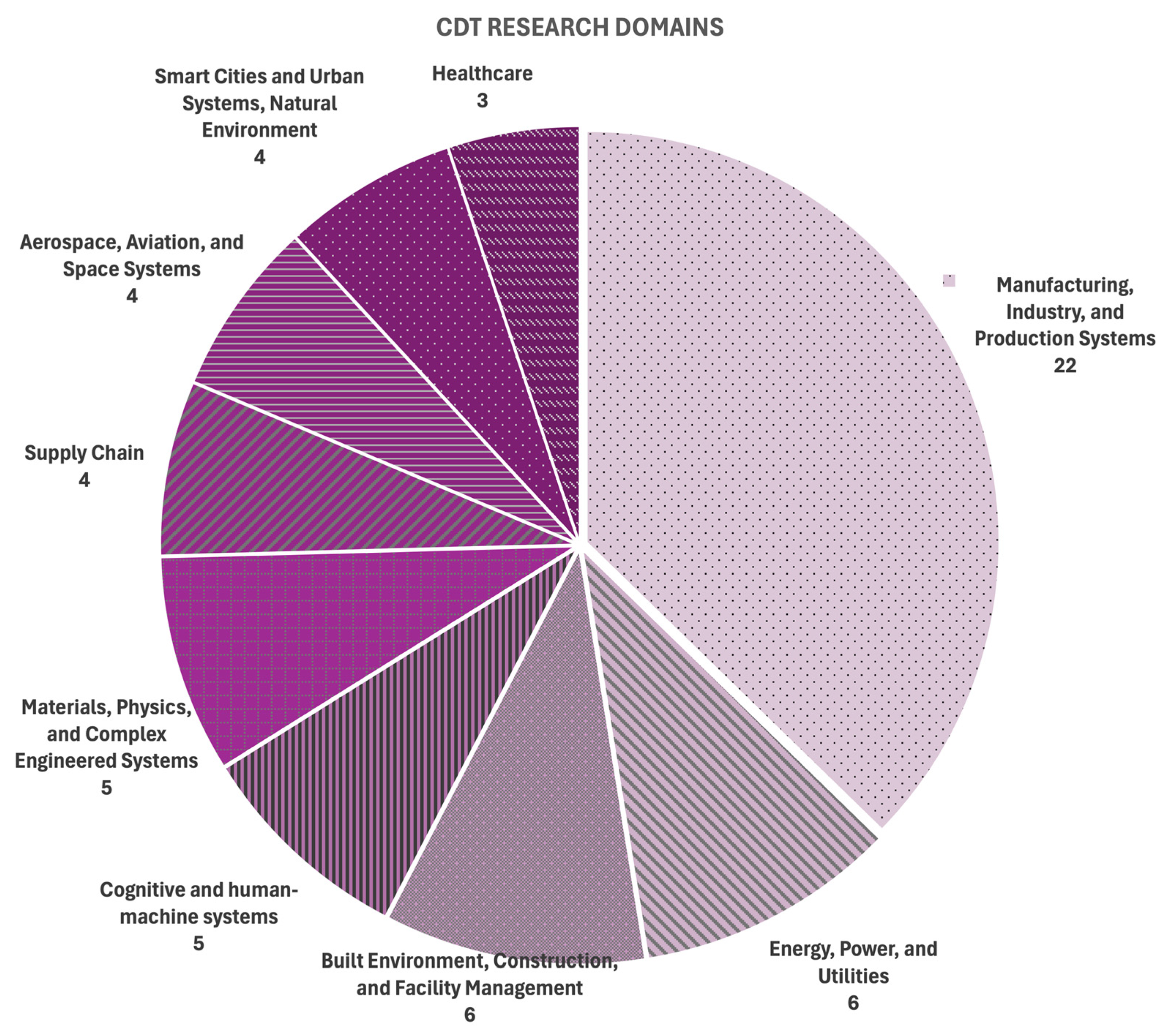
Therefore, it is not surprising that the manufacturing domain (manufacturing accounts for 22 (37%) of the 59 papers) is the most studied discipline, as seen in Figure 5, in terms of CDT implementation, and proposes CDT systems with a high level of maturity.
There are a significant number of CDT studies for smart manufacturing systems. Al Faruque et al. [75] state that CDTs are promising in terms of impact on all lifecycle stages of a manufacturing system, elaborating on the difference between DTs and CDTs through their cognitive abilities, in addition to the learning ability of a DT. The cognitive abilities consist of attention, perception, memory, reasoning, learning, and problem solving. The study represents a system for enabling CDTs for the product design stage that starts with a search operation on relevant DT products, processes, or systems. This operation aims to provide a base for designing the required DT by making use of relevant existing knowledge. Another deterministic operation is to share knowledge between DTs. To be considered cognitive, the system should be able to apply what it learns from one task to another. The authors state a significant research gap in terms of the flexibility and scalability of sharing knowledge. Resolving scalability issues of transfer learning is highly promising in terms of generalising knowledge transfer across domains for novel cognitive capabilities.
According to Eirinakis et al. [25], DTs are used in various stages in smart manufacturing from the early design phase to manufacturing optimisation. Most commonly, it is used in initial product design, production line design, shop floor optimisation, data management, information continuity, data management throughout the product lifecycle, monitoring of physical twin assets, and optimisation of system behaviour. The study introduces the enhanced cognitive twin concept, which has control over the physical twin’s activities through optimisation methods. This enhances the concept of the CDT by including optimisation capabilities and decision making with anomaly detection and behavioural learning via cognitive skills. The study proposes a quantitative-driven and qualitative-driven approach that combines ML and knowledge graphs to provide the necessary abstraction layer to understand the complex interactions of data and ML processes. Such hybrid approaches for CDT systems hold the potential to close the gap between artificial narrow intelligence [76] and human-like reasoning mechanisms [77].
The hybrid approach of knowledge-driven and data-driven CDT architectures proposed in the manufacturing domain is highly mature. One study proposes an actionable cognitive twin that has four components: ontology and knowledge graph, data, algorithms, and actions [14]. Meyers et al. [78] introduce a CDT of manufacturing operations that exposes all production system data and information as a knowledge graph. This CDT provides an abstraction layer for data to ease access to heterogeneous data through a single interface and is aimed to assist the AI cycle: finding and analysing production system correlations, learning, deploying, executing, and validating an AI model.
With the introduction of new technologies into the Architecture, Engineering, and Construction (AEC) industry, building phases have developed towards being more efficient and effective, as well as introduced proactive approaches for the post-occupancy phase [8]. For instance, the intelligence level aimed at for the management of HVAC systems requires three levels of DTs with descriptive and diagnostic capabilities and predictive and prescriptive and autonomous capabilities [64]. Implementing automated decision-making processes is one of the main targeted levels of intelligence that exceeds conventional DTs.

3.5. Cognition: Spectrum of Capabilities

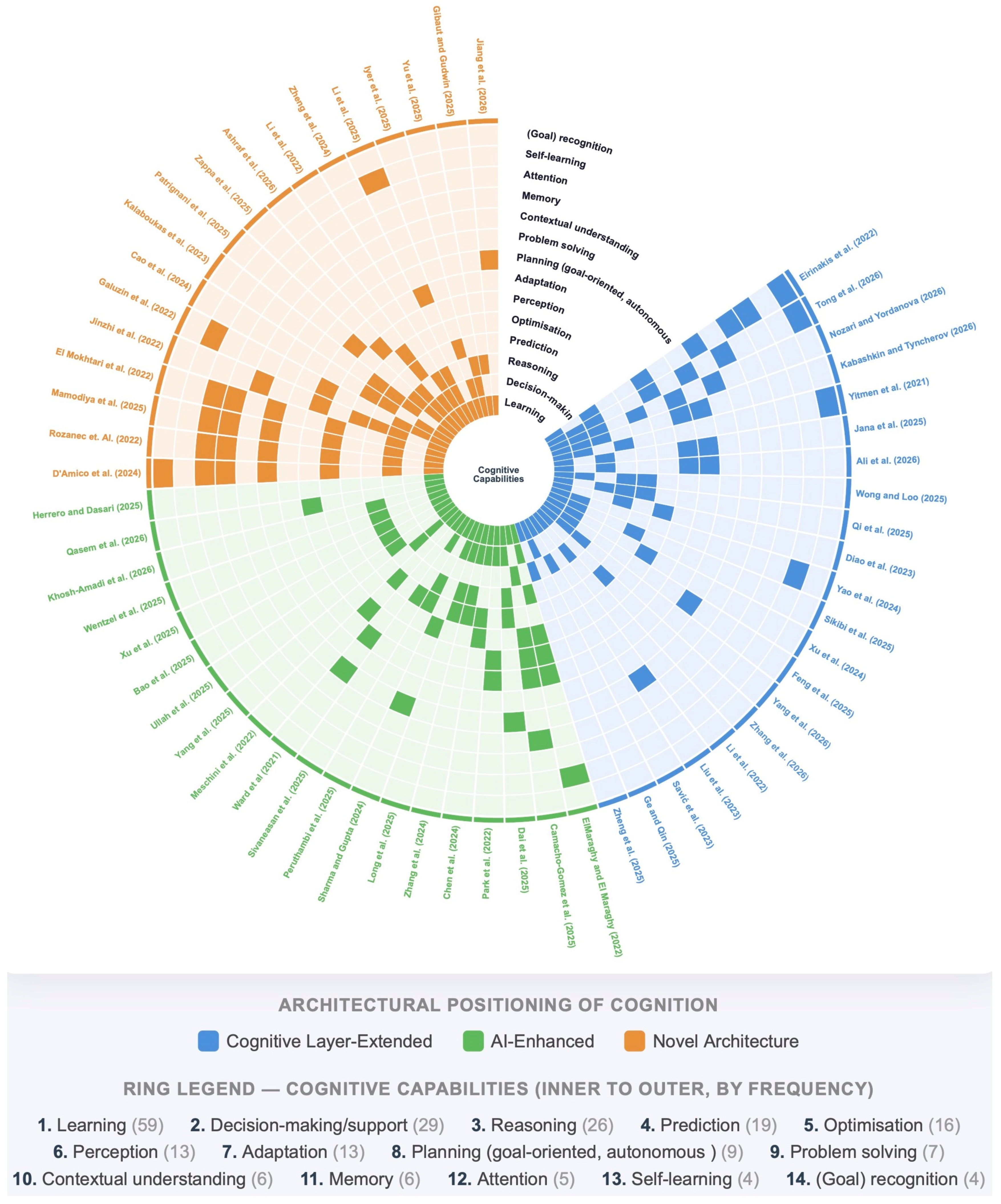
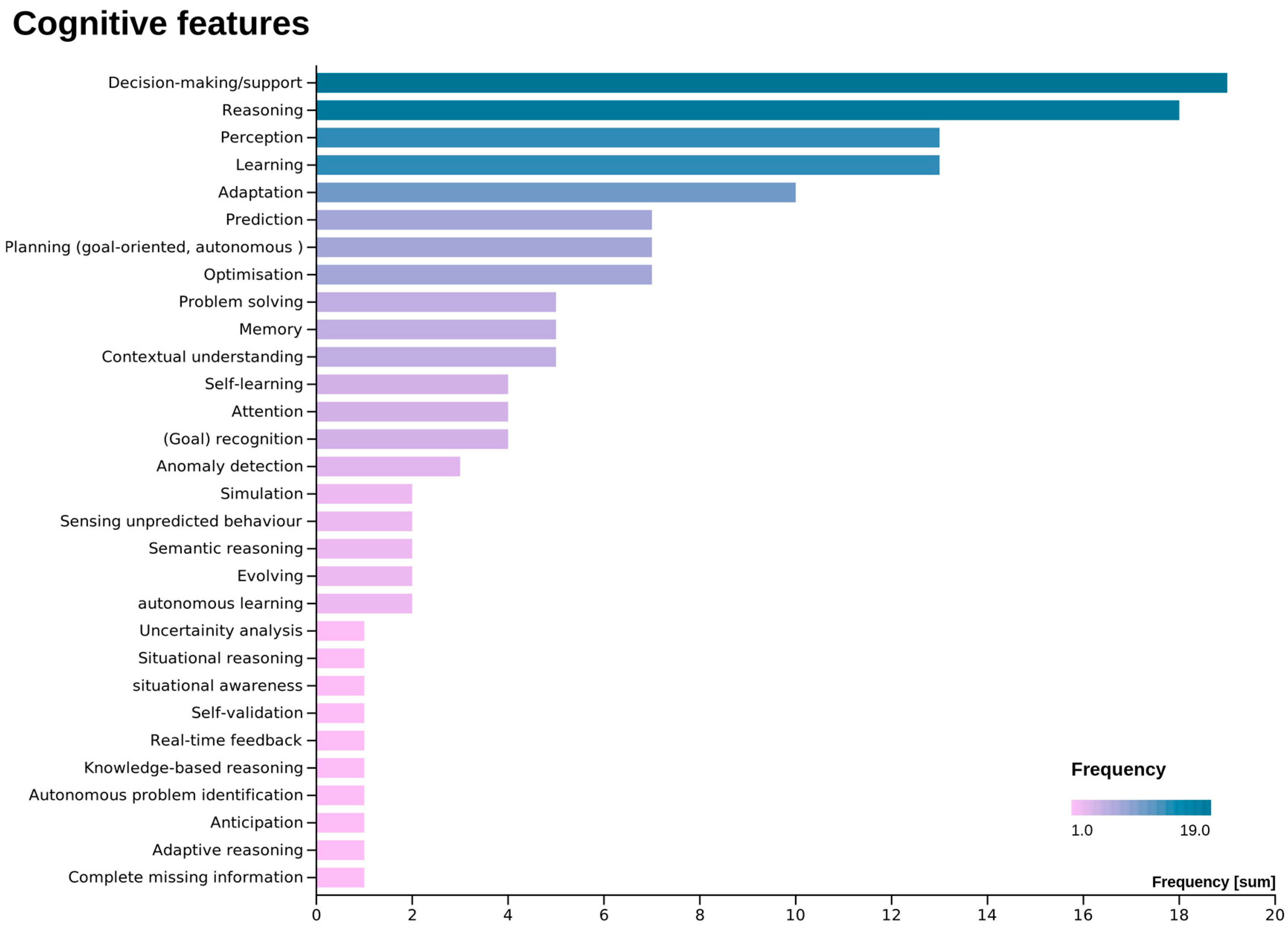
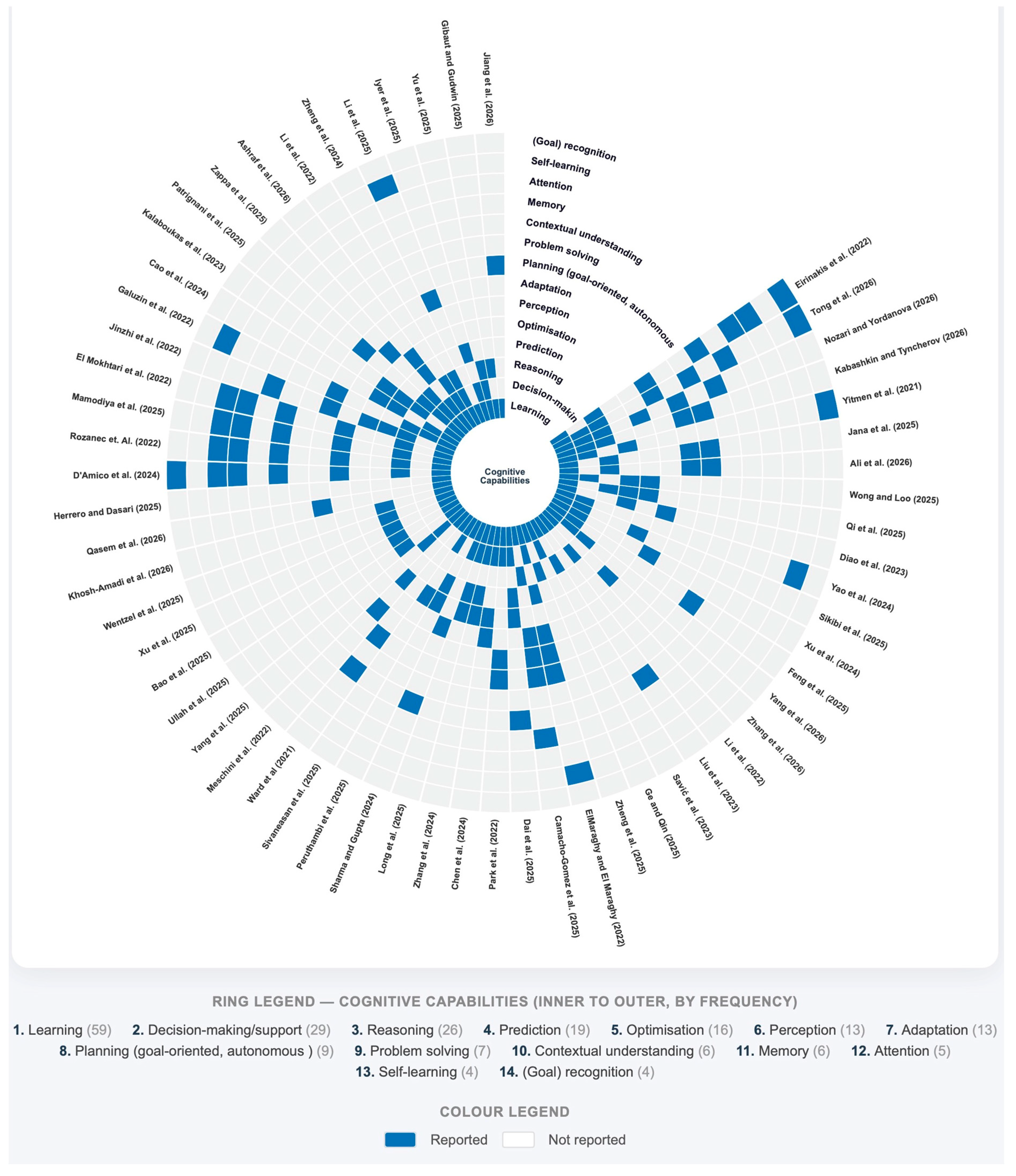
Prior to exploring how researchers have addressed the phenomenon of cognition, it is important to acknowledge that no standardised definition or comprehensive theory of cognition currently exists. The aim of integrating cognition is to scale intelligence the human way for systems that introduce problem structures that are not reasonable through rule-based and data-driven models. According to the unified theories of cognition [79], intelligent agents operate through fixed mechanisms and processes, including memory systems, knowledge representation, functional processes from perception to behaviour, and learning mechanisms. The reviewed literature indicates that these foundational constructs are operationalised across a broad spectrum of cognitive features (Figure 6) in diverse application domains.
The focus on cognition is to enable an AI system to exhibit cognitive characteristics comparable to those of human cognition [80]. CDT studies focus on abilities such as decision making/support/optimisation, reasoning, perception, learning, adaptation, optimisation, prediction, planning (goal-oriented, autonomous), problem solving, contextual understanding, memory, attention, self-learning, (goal) recognition, anomaly detection, sensing unpredicted behaviour, semantic reasoning, autonomous learning, simulation, evolving, situational awareness, autonomous problem identification, anticipation, completing missing information, uncertainty analysis, knowledge-based reasoning, situational reasoning, self-validation, adaptive reasoning, and real-time feedback (Figure 6). The heatmap shows that reasoning, decision making/support, learning, and prediction are the most targeted cognitive abilities (Figure 7).
To ensure a common understanding of each cognitive function, a set of definitions is listed below:
  • Reasoning: Reasoning is regarded as a high-level cognitive skill. Within this study, reasoning is regarded as remembering and reapplying the lessons of prior episodes [81] and drawing inferences from observations, beliefs, and models.
  • Decision making: The process of transforming “the analytical outputs of the cognitive layer into multi-objective, actionable decisions” [40]. With the human-in-the-loop, systems gain information and knowledge and apply them to provide recommendations on possible actions.
  • Learning: Attributed to any new knowledge, skill, or behaviour gained from experience or observation. However, from a machine learning perspective, learning will mean “computational methods using experience to improve performance or to make accurate predictions” [82].
  • Prediction: Briefly explained as drawing statistical inference on future states.
  • Perception: The process that converts raw input into the system’s internal form, enabling it to perform cognitive tasks [83]. In other words, it is forming useful precepts from raw sensory data [25].
  • Adaptation: Adaptation can be described as adjusting thinking and information processing in response to environmental changes [84].
  • Optimisation: In mathematical programming, optimisation refers to the process of selecting the best state or solution from a set of feasible alternatives. Similarly, from a human cognition perspective, it is defined as “finding the best solution for an objective function and set of constraints. Objective functions define the costs and benefits of different solutions, whereas soft constraints (e.g., costs) and hard constraints (e.g., boundary conditions) limit the space of possible solutions” [85].
  • Planning (Autonomy): Following the definition in [19], autonomy is “the ability of an SoS component to make its own decisions independently of other systems present in its scope”.
  • Problem solving: Eirinakis et al. [25] briefly describe it as achieving goals and to support, Simon and Newell [86] describe problem solving as the intervention between a goal state and a problem space to complete a complex task.
  • Contextual understanding: Making context-aware decisions through contextual semantics.
  • Memory: Despite the fact that the description of memory can vary depending on the goals and constraints of the cognitive model, memory is a core part of system-level models that stores and organises information or results of computation by a limited (working memory) or unlimited (long-term memory) capacity and duration [87]. Briefly, memory stands for the encoding and retrieval of knowledge.
  • Attention: Attention selects and modulates input information from various external sources and internally generated information [83]. From an AI point of view, an attention function is “mapping a query and a set of key-value pairs to an output, where the query, keys, values, and output are all vectors. The output is computed as a weighted sum of the values, where the weight assigned to each value is computed by a compatibility function of the query with the corresponding key” [88].
  • Self-learning: The ability of “cognitive machine learning automating diagnostics using algorithms that learn from data without the need for precise programming” [3].
  • (Goal) Recognition: The semantic-driven knowledge core in CDTs.
Learning (n: 59) is a focus in all reviewed studies, showing the strong relationship between CDTs and ML integration. Decision making and reasoning emerge as the most integrated capabilities (n: 29 and n: 26, respectively), reflecting their centrality to enabling systems with decision-making capability and navigating complex, uncertain problem spaces. Prediction (n: 19), optimisation (n: 16), and perception (n: 13) capture the anticipatory and goal-directed dimension of cognition, enabling systems to project future states, allocate resources efficiently, and ground intelligent behaviour in sensory interpretation and experiential improvement, while adaptation (n: 13) underscores the necessity for dynamic self-modification in response to evolving operational conditions. Planning (n: 9) indicates studies that involve pursuing objectives autonomously. At an intermediate level of adoption, problem solving (n: 7), memory (n: 6), and contextual understanding (n: 6) represent the integrative substrates through which agents maintain coherent situational models, retrieve relevant prior knowledge, and reason about their operating environment in a holistic manner. Attention (n: 5), self-learning (n: 4), and goal recognition (n: 4) extend this picture further toward autonomous agency, enabling systems to prioritise information, identify emergent objectives, and refine their own competence without explicit external human intervention or mainly programming. Less frequently addressed yet conceptually significant capabilities, including anomaly detection, simulation, semantic reasoning, sensing of unpredicted behaviour, and evolving architectures, point to the field’s growing interest in more nuanced cognitive mechanisms that bridge reactive and deliberative processing. At the frontier, features such as uncertainty analysis, situational reasoning and awareness, self-validation, real-time feedback, knowledge-based reasoning, autonomous problem identification, anticipation, adaptive reasoning, and completing missing information collectively signal an emerging trajectory toward increasingly comprehensive cognitive architectures. Taken together, this distribution reveals that the integration of cognition into DT systems is not a matter of embedding any single isolated mechanism. Rather, it requires orchestrating an interdependent ensemble of processes, consistent with Newell’s unified architecture. Only through such orchestration can CDTs achieve robust, flexible, and human-like intelligent behaviour in problem domains where purely rule-based or data-driven models remain insufficient.

3.6. Architectural Positioning of Cognition Relative to DT

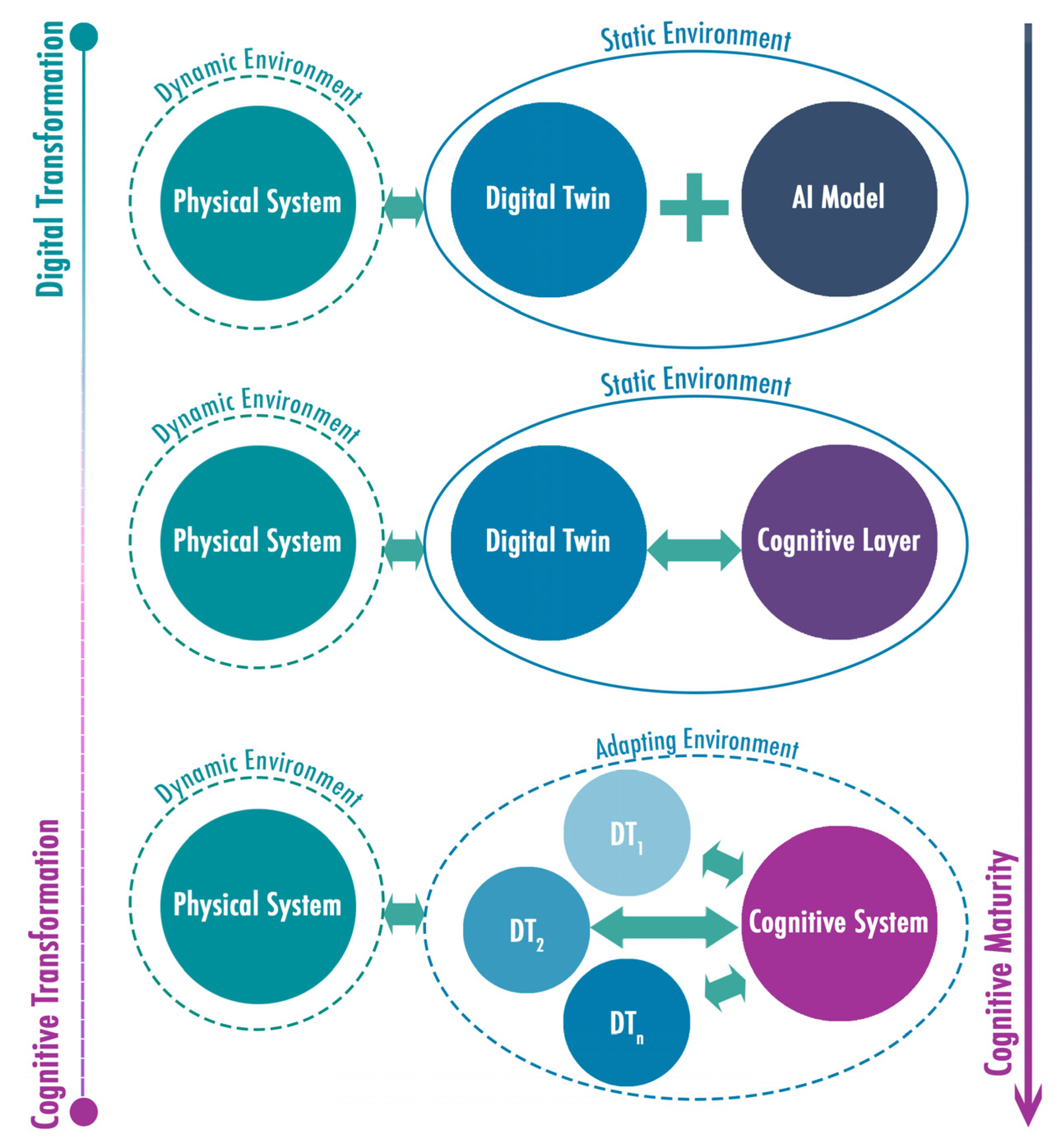
It becomes apparent from the literature that the concept of the CDT is not yet fully stabilised, as studies introduce various positionings of “cognition” within proposed architectures. However, it is possible to read three main axes that define the architecture of CDTs, as follows: (1) an AI-enhanced DT, (2) a DT extended by a cognitive layer, and (3) a distinct architecture beyond the conventional DT (Figure 8).

3.6.1. CDT as an AI-Enhanced DT

Following the understanding of the CDT as an evolved version of DT systems, AI integration into DT systems is equated with cognitively enhanced systems. Such studies primarily propose DT systems and may not explicitly address cognitive aspects. However, the aim of enhancing the intelligence level of DTs is a shared goal with the CDT paradigm. Herrero and Dasari [46] propose a network protocol layer with learning models as an addition to the DT system to automate interactions between physical and digital assets. The patterns between sensing and actuation are used for training and prediction in both directions. The experimental work presents the results of simple decision-tree prediction. However, the authors discuss the potential use of various models, such as multi-layer perceptron networks or more complex Long Short-Term Memory (LSTM) networks.
Iyer et al. [26] propose integrating AI into the DT framework for anomaly detection and prediction. Three XAI models (1-Dimensional Convolutional Neural Network (1D CNN), bidirectional Long Short-Term Memory (bi-LSTM), and Temporal Fusion Transformer (TFT)) are compared for prediction, and the Temporal Fusion Transformer is used due to its high accuracy. The AI integration enables detecting bottlenecks caused by anomalies and provides transparency in prediction results through the proposed XAI model.
The study by Sivaneasan, Tan [58] proposes an intelligence enhancement through integrating a cloud-based DT server that hosts various optimisation algorithms communicating optimal actions to the main DT layer. Despite that, prominent cognitive functions are not discussed; the real-time communication of optimised actions is introduced as a cognitive achievement. From a similar aspect as introduced in Ullah, Younas [30], a simulation engine that uses ML for prediction and enables performance optimisation is regarded as cognitive functioning. Following a similar logic, Xu, Chen [71] implement a physics-informed neural network for real-time calibration, using simulation-based predictions of material behaviour. However, cognition is not mentioned within that study. This distinction creates ambiguity regarding whether the integration of AI into DT systems can be regarded as a cognitive function or not. In the following sections, it will be demonstrated that recent CDT studies in various domains tend to discuss cognition in regard to human-level intelligence, diverging from the approach of CDTs as “two-way communication with physical and logical assets, analytical and simulation models. AI and analytics” [3]. AI-based prediction models extend the capability of DT systems and enable proactive management and decision-making support. As introduced in Khosh-Amadi, Talebi [63], indoor air quality data from IoT sensors is used to train linear regression models for short-term prediction of any health-risk-causing value, enabling advanced ventilation adjustments. Similar studies enhance the intelligence level of DTs using AI and integrate optimiser and estimator algorithms [60], prediction and analysis layers through ML models (KNN-GPR-EPM module and UGMM module) integrating physical constraints with data-driven modelling [49], physics-based model data input for ML models to predict tumour growth [67], and multi-model AI layers (generative AI for data generation and scenario simulation, predictive AI, explainable AI for transparency, context-aware AI for environment adaptation, agentic AI for autonomous decision making) that support real-time and proactive decision making in manufacturing [50]. Reinforcement learning agents are commonly integrated into DTs as enablers of cognitive capabilities such as autonomous learning (proximal policy optimisation agent) and dynamic decision optimisation (actor–critic architecture) [38].

3.6.2. CDT as a Cognitive-Layer-Extended DT

The integration of AI into DTs enables an increased level of intelligence, as discussed in the previous section. However, there is a significant distinction between purely data-based modelling approaches and frameworks that also incorporate knowledge-based models using semantic technologies to realise cognitive functions in CDTs. Together, data-based and knowledge-based methods are seen as enablers to achieve cognitive capabilities [36]. The limitation of data-based models is that they require human intervention to test and optimise and are likely to fall behind in representing the actual state of the physical twin, especially in dynamic, fast-changing environments. At that point, knowledge-based models enable adaptation to dynamic environments as they aim to model the semantic relationships of data. A common understanding of enabling cognitive abilities within a DT system is to integrate a semantic layer that provides contextual information about the data, enabling reasoning [57]. Ontology-based models are widely used in such studies. Qi et al. [28] introduce an architecture in which a cognition model works together with DTs and extends the cognitive capability. Cognitive capabilities consist of reasoning, prediction, and the completion of missing entities, enabled by several ontologies and domain-knowledge representations, including conceptual knowledge and experience.

3.6.3. CDT as a Novel Architecture Beyond Conventional DT

CDTs modelled as an SoS are distinguished from the previously discussed architectures as such models include multiple virtual submodels across the whole lifecycle of the system. As proposed in [73], each subsystem has its own ontology descriptions to define the interrelationships among these various virtual models. This view introduces a switch from the singular intelligent system understanding towards a distributed cognition view, introducing a network of actors and interrelationships of digital models. This approach also introduces the need for the orchestration of multiple entities. An orchestration mechanism in CDTs is necessary to overcome the modularity of DT architectures, which comprise physical and digital entities, ML models, ontology layers and knowledge representation for reasoning [15]. Based on the discussion of the positioning of “cognition” identified in the reviewed studies, the cognitive ecosystem shown in Figure 7 is mapped with three architecture patterns for deeper analysis into the cognitive maturity level (Figure 9).
As illustrated in the figure, learning models are included in all of the reviewed studies; however, core cognitive abilities such as reasoning are considered in studies that propose CDTs with a high level of cognitive maturity. The ML aspect in AI-enhanced DT studies is applied as prediction models. A more homogeneous distribution of cognitive abilities is observed in studies that propose DTs with a cognitive layer and in studies that introduce novel cognitive systems.

3.7. Cognitive Technologies Enabling CDTs

Beyond identifying the cognitive functions of CDTs, it is equally important to consider how these functions are computationally realised. This subsection analyses the AI and computational technologies employed across the reviewed studies to operationalise cognition within CDT systems. Table 5 summarises the technology categories, their frequency, and representative studies.

3.7.1. Deep Learning and Neural Networks

Deep learning and neural networks constitute the most prevalent technology class, appearing in over 60% of the reviewed studies. Long Short-Term Memory (LSTM) networks are particularly dominant [2,26,49,52,62,69,71], reflecting the temporal and sequential nature of physical system data that CDTs must process. Convolutional Neural Networks (CNNs) are employed for spatial pattern recognition and classification tasks [51,65,67,72], while Physics-Informed Neural Networks (PINNs) bridge data-driven learning with domain knowledge by embedding physical laws as constraints [60,71]. Graph Neural Networks (GNNs) and Transformers have emerged in more recent studies [16,29,72], enabling relational reasoning over structured data, which is a capability well-aligned with the semantic interoperability requirements of CDTs.

3.7.2. Reinforcement Learning

Reinforcement Learning (RL) represents the second most common technology category, adopted by studies requiring autonomous decision making and adaptive control [28,31,33,38,40,43,58,62,68,72]. Deep RL variants, including Proximal Policy Optimisation (PPO) [31,38], Soft Actor–Critic (SAC) [28,31], and Deep Q-Networks (DQNs) [72], enable CDTs to learn optimal policies through interaction with their environment, directly supporting the cognitive functions of planning, adaptation, and autonomous decision making. Multi-Agent Reinforcement Learning (MARL) [33] extends this capability to SoS architectures where multiple CDT subsystems must coordinate.

3.7.3. Large Language Models

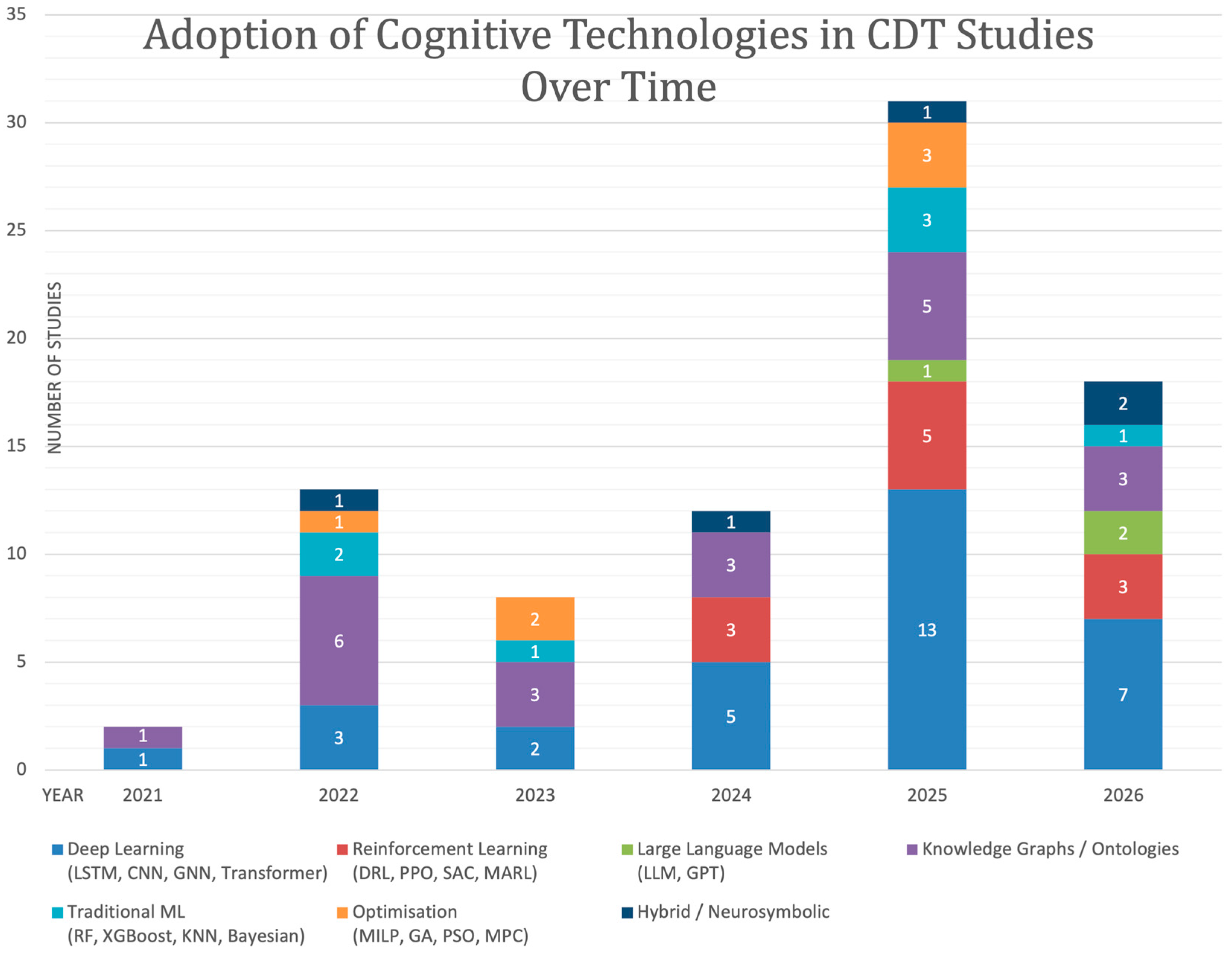
Large Language Models (LLMs) represent an emerging trend, appearing exclusively in studies from 2025–2026 [16,29,31] (Figure 10). LLMs enable natural-language-based reasoning, contextual understanding, and knowledge synthesis, and these capabilities align with higher-order cognitive functions such as semantic reasoning and goal-oriented planning. Their integration with knowledge graphs [29,31] and multi-modal perception systems [16] suggests a trajectory toward more human-like cognitive architectures.

3.7.4. Knowledge Representation

Knowledge representation technologies, including ontologies, knowledge graphs, and semantic reasoning engines, appear in approximately 40% of the reviewed studies. These technologies are not AI models themselves but serve as the fundamental infrastructure that enables cognitive interoperability. Ontology-based approaches [14,15,18,25,32,39,42,57,73] provide formal domain semantics, while knowledge graphs [14,25,29,31,37,44,70,74] enable relational reasoning and contextual inference. Their co-occurrence with neural approaches in several studies [16,29,31,37,74] reflects a neurosymbolic trend combining statistical learning with structured knowledge.

3.7.5. Traditional Machine Learning Methods and Optimisation

Traditional machine learning methods, such as random forest [30,40,51], XGBoost [51], K-nearest neighbours [49], and Bayesian networks [65], remain present, particularly for classification and prediction tasks in studies where interpretability or data efficiency is prioritised over model expressiveness.
Optimisation algorithms, including mixed-integer linear programming [25,58], genetic algorithms [57,70], and particle swarm optimisation [64], serve as decision engines within CDT architectures, typically operationalising the cognitive function of planning and resource allocation.

3.7.6. Hybrid and Neurosymbolic Models

Hybrid and neurosymbolic approaches are increasingly prevalent, combining symbolic reasoning (ontologies, rules) with subsymbolic learning (neural networks) [13,15,33,74]. This hybridisation directly mirrors cognitive science frameworks, echoing the dual-process cognitive architectures observed in CDT designs [27].

3.7.7. Emerging Trends in Enabling CDT Technologies

A notable shift is observed from conventional ML and optimisation methods (2021–2022) towards deep RL and LLM-based architectures (2025–2026), indicating an increasing level of sophistication in the computational modelling of cognition. Early CDT implementations relied predominantly on supervised learning for prediction, whereas recent studies employ generative and agentic AI for autonomous reasoning and self-directed behaviour [16,29,31,50].

4. Discussion and Final Remarks

The abilities of DTs can be listed as connecting physical and digital assets in both directions, monitoring and visualising data and descriptive analysis, and, in the most advanced understanding, providing recommendations based on predictive analysis enabled through machine/deep learning integration. CDTs take this level further and enable sensing and reasoning mechanisms in complex and unpredictable environments. This enhanced ability demonstrates the potential of CDT systems to adapt to dynamic behaviour and provide autonomous decision-making support.

4.1. Characteristics of CDT

The emergence of CDTs is based on studies that explored enhancing the cognitive abilities of DTs. Research in this area is focused on improving the cognitive capacities of DTs through the use of ontologies and semantic technologies such as knowledge graphs. To facilitate dynamic decision making and management in complex systems, the emphasis was on documenting and depicting system properties, interactions, and information [89,90,91,92].
High cognitive maturity is possible if a CDT is designed as an SoS, in which multiple virtual subsystems interrelate to form a distributed cognitive system. Ontologies and knowledge representation are key to semantically interlinked digital models. Therefore, the main components of a CDT system are the virtual model and the ontology-based relationship definitions. As described by Wagg, Burr [93] DTs are holistic in nature, purpose-driven, time-evolving, context-specific, counter-parsimonious, reconstructivist, and biased. In addition, CDTs are cognitive machines that can sense, learn, reason, act, and evolve [1]. Similar to a DT, the lifetime of a CDT is longer than that of its physical twin, in that it will continue to evolve and share knowledge and experience. CDTs evolve through learning by doing and continuous unsupervised ML and learn to deal with complex tasks in a smarter way over time. Overall, the distinction of CDTs from DTs is that a CDT is a system of multiple DTs, which autonomously adapts and evolves through cognitive capabilities (perception, attention, learning, reasoning, decision making) and is a human-in-the-loop system that provides explainable outputs.
  • DT-based foundation: CDTs are further developed forms of DTs, incorporating physical entities, virtual representations, and their interconnections, but with enhanced unified semantics [94] and topology specifications to handle highly complex scenarios involving numerous digital models.
  • Full lifecycle system management: A CDT should represent various stages of a system’s lifecycle, from design and construction to operation, maintenance, disassembly, and recycling. It integrates, analyses, and manages data, information, and knowledge generated throughout these phases, supporting cognitive processes.
  • Autonomous adaptation: CDTs are designed to perceive complex and unpredictable behaviours and reason about optimisation techniques, leading to autonomous adaptation of the virtual system. Autonomous adaptation requires changing learning paths by automatically selecting the appropriate learning algorithm based on its training signals. Then the system adapts reasoning mechanisms according to the problem structure. It defines asynchronously evolving models according to the changing needs of the environment without any human intervention.
  • Continuous self-improvement and evolution: The autonomous adaptation of learning requires the system to continuously evolve through feedback mechanisms, creating a self-managing system. This ongoing evolution ensures that the CDT remains responsive to internal and external stimuli, aiding decision making and facilitating proactive responses. This seeks a diverse memory system, such as continual knowledge acquisition from long-term memory to working memory.
  • Human-in-the-loop system: The CDT is based on the human–AI co-evolution understanding, and therefore, the system is expected to provide explainable outputs to the end user and continuously evolves through interaction with the user.
To provide a theoretical (constitutive) definition, the prescriptive framework of Wong, Chu [95] is followed, which suggests comprehensiveness, precision, consistency, and non-circularity in defining a scientific concept.
Based on the discussion above, this study defines a CDT as a system of DTs with augmented semantic capabilities, enabling cognitive interoperability (shared situational awareness) between virtual systems, adapting and evolving autonomously with its environment through high-level reasoning, and providing in-depth knowledge and experience-based outputs to the physical system. Cognitive interoperability is defined as “the ability of different agents (human or artificial) to align their thoughts and perception of information, allowing for mutual understanding and shared intentions. It involves creating shared mental models, aligning knowledge, and ensuring a common way to use, interpret and reason knowledge” [13]. To operationalise this definition, a CDT requires:
(i)
a digital twin foundation structured as a system-of-systems;
(ii)
a semantic layer enabling contextual interpretation;
(iii)
cognitive interoperability through shared situational awareness among virtual subsystems;
(iv)
autonomous adaptation and co-evolution with the physical environment;
(v)
high-level reasoning capabilities transcending data-driven pattern recognition; and
(vi)
knowledge- and experience-grounded outputs actionable by the physical system.

4.2. Cognitive Architectures and CDT

Various theoretical models of cognitive processes offer structured views of cognitive systems. Since the 1950s, hundreds of architectures have aimed to enable reasoning, insight, adaptation, and self-reflection, providing a solid foundation for CDT studies in achieving cognitive goals. As aimed for in CDT systems, intelligent behaviour is the result of what the system knows and its ability to apply that knowledge in appropriate environments to be able to adapt [96]. In addition, the representation of that knowledge in the cognitive system, as well as how representations are altered, merged, and transmitted across the system, is a significant concept [97]. It is believed that the overall functioning of the cognitive system is caused or explained by the qualities of these representations within the system and the processes that use representations.
It is worth starting this discussion by clarifying the difference in knowledge representations. To distinguish between data-driven models and the logic behind cognitive architectures, data-driven models or subsymbolic representations rely mainly on implicit data. However, cognitive architectures often propose hybrid structures that use explicit knowledge structures or symbolic representations and implicit representations. Neural systems are implemented for perception, learning, and pattern extraction, whereas symbolic or structured layers are used for reasoning, decision making, and explanation. This difference also makes an impact on the explainability of these two approaches. Symbolic representations ensure transparency in terms of understanding a system’s response. However, data-driven AI methods often lack transparency and act as a black box.
The primary objective of cognitive architectures is to mimic human-like cognitive processes, which necessitates the integration of multiple functions and various levels for each function. Human-level cognition employs multiple levels of reasoning and diverse conceptual representations of knowledge. For instance, different memory types and knowledge transfer between these memories, various levels of reasoning in terms of abstraction or depth, and attention mechanisms. Within a well-defined task, subsymbolic models can perform cognitive tasks in an isolated manner. However, for ill-defined or unfamiliar tasks, sophisticated problem-solving capabilities are required, involving the integration of various learning models and the alignment of cognitive processes such as analogy, imagery, and mental modelling [98].

4.3. Future Agenda

The potential of cognitively enhanced digital twin systems is realised across various domains. However, healthcare, particularly non-clinical studies, remains an underexplored area within the body of CDT research. Given the direct influence such research could exert on well-being and the quality of care, future investigations should prioritise the development and implementation of CDTs in healthcare facilities management, with a specific focus on Emergency Departments (EDs). Healthcare is an area where any enhancement to clinical and non-clinical processes can save lives. Also, healthcare spaces are complex environments where a variety of individuals and entities interact, making it challenging to understand the system behaviour due to these complex interactions. This addresses the need for adaptable systems that can evolve with their dynamic environment and reason on unfamiliar scenarios. The current body of CDT studies indicates that healthcare remains an underexplored area of research. However, the advancement of AI is realised in healthcare-related studies and is mature enough to inform the development of cognitive systems. From a non-clinical perspective, such studies focus on operation and resource management and patient flow and service delivery [99], which are two areas of potential contribution of CDTs in the context of healthcare. The research field majorly applies predictive and data-driven analytics as a solution for decision support and demand forecasting, showing a limited level of intelligence when compared to CDT systems.
The management of patient flow in EDs represents a critical challenge situated at the intersection of operational management, resource management, service delivery, and patient flow dynamics. Patient flow is seen as a critical component of process management in healthcare facilities. Patient flow involves, from entry to discharge, the required medical care, physical resources, and internal systems [100]. For an optimised and efficient patient flow, the resources should match each care demand efficiently and effectively to enhance coordination, safety, and health outcomes [101]. Delays and long waiting times in healthcare services are regarded as a flow problem [102]. Despite such delays being experienced in healthcare environments in general, in some departments, such as EDs, critical care units, and operating rooms, which play a crucial role in providing treatment inside the hospital and cannot be replaced, often experience significant problems in terms of patient flow.
The next step in the research is to build a CDT conceptual framework and design a cognitive system architecture for EDs.

Supplementary Materials

The following supporting information can be downloaded at: https://www.mdpi.com/article/10.3390/info17060556/s1, Figure S1: Mapping of reviewed papers to CDT conceptual patterns; Figure S2: PRISMA 2020 checklist; Figure S3: PRISMA Flow diagram.

Author Contributions

Conceptualisation, T.B., Y.A. and O.D.; methodology, T.B. and K.R.; formal analysis, T.B.; investigation, T.B.; writing—original draft preparation, T.B.; writing—review and editing, Y.A., O.D., K.R. and R.L.; visualisation, T.B.; supervision, Y.A., O.D., K.R. and R.L. All authors have read and agreed to the published version of the manuscript.

Funding

This research is funded by a studentship from the Northern Bridge Consortium, supported by the UKRI Arts and Humanities Research Council (AHRC), grant number 2920679. Available online: https://gtr.ukri.org/projects?ref=studentship-2920679 (accessed on 31 July 2025).

Institutional Review Board Statement

Not applicable.

Informed Consent Statement

Not applicable.

Data Availability Statement

All data, models and code generated or used during the study appear in the article. Further inquiries can be directed to the corresponding authors.

Conflicts of Interest

The authors declare no conflicts of interest.

Abbreviations

The following abbreviations are used in this manuscript:
AECArchitecture, Engineering, and Construction
AHRCArts and Humanities Research Council
AIArtificial Intelligence
Bi-LSTMBidirectional Long Short-Term Memory
CDTCognitive Digital Twin
CNNConvolutional Neural Network
DLDeep Learning
DRLDeep Reinforcement Learning
DTDigital Twin
EDEmergency Department
GAGenetic Algorithm
GNNGraph Neural Network
GPR-EPMGaussian Process Regression based Erosion Prediction Model
HVACHeating, Ventilation, and Air Conditioning
IoTInternet of Things
KNNK-Nearest Neighbours
LLMLarge Language Model
LSTMLong Short-Term Memory
MARLMulti-Agent Reinforcement Learning
MILPMixed-Integer Linear Programming
MLMachine Learning
MPCModel Predictive Control
PPOProximal Policy Optimisation
PRISMAPreferred Reporting Items for Systematic Reviews and Meta-Analyses
PSOParticle Swarm Optimisation
RFRandom Forest
SACSoft Actor–Critic
SoSSystem-of-Systems
TFTTemporal Fusion Transformer
UGMMUnbiased Grey-Markov Model
XAIExplainable Artificial Intelligence
XGBoosteXtreme Gradient Boosting

References

  1. Adl, A.E. The Cognitive Digital Twins. 2016. Available online: https://www.slideshare.net/aeladl/the-cognitive-digital-twin (accessed on 3 April 2025).
  2. Ashraf, M.; Ali, I.; Eltawil, A. A Hybrid Deep Learning-Based Approach for Disruption Detection and Recovery Planning in a Prototype Cognitive Digital Supply Chain Twin. Expert Syst. Appl. 2025, 297, 129531. [Google Scholar] [CrossRef]
  3. ElMaraghy, H.; ElMaraghy, W. Adaptive cognitive manufacturing system (ACMS)—A new paradigm. Int. J. Prod. Res. 2022, 60, 7436–7449. [Google Scholar] [CrossRef]
  4. Semeraro, C.; Lezoche, M.; Panetto, H.; Dassisti, M. Digital twin paradigm: A systematic literature review. Comput. Ind. 2021, 130, 103469. [Google Scholar] [CrossRef]
  5. Rogage, K.; Mahamedi, E.; Brilakis, I.; Kassem, M. Beyond digital shadows: A Digital Twin for monitoring earthwork operation in large infrastructure projects. AI Civ. Eng. 2022, 1, 7. [Google Scholar] [CrossRef]
  6. Lim, K.Y.H.; Zheng, P.; Chen, C.-H. A state-of-the-art survey of Digital Twin: Techniques, engineering product lifecycle management and business innovation perspectives. J. Intell. Manuf. 2020, 31, 1313–1337. [Google Scholar] [CrossRef]
  7. Sepasgozar, S.M. Differentiating digital twin from digital shadow: Elucidating a paradigm shift to expedite a smart, sustainable built environment. Buildings 2021, 11, 151. [Google Scholar] [CrossRef]
  8. Agostinelli, S. COGNIBUILD: Cognitive Digital Twin Framework for Advanced Building Management and Predictive Maintenance. In Technological Imagination in the Green and Digital Transition; Urban Book Series; Springer: Cham, Switzerland, 2023; Volume Part F813, pp. 69–78. [Google Scholar]
  9. Eirinakis, P.; Kalaboukas, K.; Lounis, S.; Mourtos, I.; Rozanec, J.M.; Stojanovic, N.; Zois, G. Enhancing Cognition for Digital Twins. In Proceedings of the 2020 IEEE International Conference on Engineering, Technology and Innovation, ICE/ITMC 2020, Cardiff, UK, 15–17 June 2020. [Google Scholar]
  10. Page, M.J.; McKenzie, J.E.; Bossuyt, P.M.; Boutron, I.; Hoffmann, T.C.; Mulrow, C.D.; Shamseer, L.; Tetzlaff, J.M.; Akl, E.A.; Brennan, S.E. The PRISMA 2020 statement: An updated guideline for reporting systematic reviews. BMJ 2021, 372, n71. [Google Scholar] [CrossRef]
  11. Braun, V.; Clarke, V. Using thematic analysis in psychology. Qual. Res. Psychol. 2006, 3, 77–101. [Google Scholar] [CrossRef]
  12. Van Eck, N.; Waltman, L. Software survey: VOSviewer, a computer program for bibliometric mapping. Scientometrics 2010, 84, 523–538. [Google Scholar] [CrossRef] [PubMed]
  13. Ali, J.A.H.; Gaffinet, B.; Lezoche, M.; Panetto, H.; Naudet, Y. Enabling human–CPS cognitive interoperability: Cognitive architectures as technologies for human-like cognitive digital twins. J. Ind. Inf. Integr. 2025, 48, 100969. [Google Scholar]
  14. Rožanec, J.M.; Jinzhi, L.; Košmerlj, A.; Kenda, K.; Dimitris, K.; Jovanoski, V.; Rupnik, J.; Karlovčec, M.; Fortuna, B. Towards actionable cognitive digital twins for manufacturing. In Proceedings of the CEUR Workshop Proceedings, Crete, Greece, 3 June 2020. [Google Scholar]
  15. Kabashkin, I.; Tyncherov, T. From Reliability Modelling to Cognitive Orchestration: A Paradigm Shift in Aircraft Predictive Maintenance. Mathematics 2025, 14, 76. [Google Scholar] [CrossRef]
  16. Li, X.; He, B.; Wang, Z.; Zhou, Y.; Li, G.; Li, X. Toward cognitive digital twin system of human-robot collaboration manipulation. IEEE Trans. Autom. Sci. Eng. 2024, 22, 6677–6690. [Google Scholar] [CrossRef]
  17. Kalaboukas, K.; Kiritsis, D.; Arampatzis, G. Governance framework for autonomous and cognitive digital twins in agile supply chains. Comput. Ind. 2023, 146, 103857. [Google Scholar] [CrossRef]
  18. Li, H.; Wang, G.; Lu, J.; Kiritsis, D. Cognitive twin construction for system of systems operation based on semantic integration and high-level architecture. Integr. Comput.-Aided Eng. 2022, 29, 277–295. [Google Scholar] [CrossRef]
  19. Gibaut, W.; Gudwin, R. Building a Cognitive Twin using a distributed cognitive system and an evolution strategy. Cogn. Syst. Res. 2025, 90, 101326. [Google Scholar] [CrossRef]
  20. Newman, M. An inferential model of scientific understanding. Int. Stud. Philos. Sci. 2012, 26, 1–26. [Google Scholar] [CrossRef]
  21. Grimm, S.R. Understanding as knowledge of causes. In Virtue Epistemology Naturalized: Bridges Between Virtue Epistemology and Philosophy of Science; Springer: Berlin/Heidelberg, Germany, 2014; pp. 329–345. [Google Scholar]
  22. Saracevic, F. Cognitive Digital Twin. Technical Report. 2017. Available online: https://www.slideshare.net/BosniaAgile/cognitive-digital-twin-by-fariz-saraevi (accessed on 31 July 2025).
  23. Kumar, P.; Merzouki, R.; Bouamama, B.O. Multilevel Modeling of System of Systems. IEEE Trans. Syst. Man Cybern. Syst. 2018, 48, 1309–1320. [Google Scholar] [CrossRef]
  24. Zheng, X.C.; Lu, J.Z.; Kiritsis, D. The emergence of cognitive digital twin: Vision, challenges and opportunities. Int. J. Prod. Res. 2022, 60, 7610–7632. [Google Scholar] [CrossRef]
  25. Eirinakis, P.; Lounis, S.; Plitsos, S.; Arampatzis, G.; Kalaboukas, K.; Kenda, K.; Lu, J.; Rožanec, J.M.; Stojanovic, N. Cognitive Digital Twins for Resilience in Production: A Conceptual Framework. Information 2022, 13, 33. [Google Scholar] [CrossRef]
  26. Iyer, S.V.; Sangwan, K.S.; Dhiraj. A cognitive digital twin for process chain anomaly detection and bottleneck analysis. J. Ind. Prod. Eng. 2025, 42, 65–87. [Google Scholar] [CrossRef]
  27. Jiang, H.; You, J.; Chen, Z.; Ming, X.; Sun, P.Z. Cognitive collaboration: A design methodology for future-oriented intelligent industrial systems. J. Ind. Inf. Integr. 2026, 50, 101071. [Google Scholar] [CrossRef]
  28. Qi, L.; Xu, W.; Wang, K.; Liu, J.; Ye, X.; Yang, H.; Zhong, Y. Mixed-model product disassembly sequence optimization based on cognitive digital twin. J. Manuf. Syst. 2025, 82, 497–508. [Google Scholar] [CrossRef]
  29. Tong, X.; Li, K.; Bao, J. GNN-LLM hybrid cognitive architectures for generative task adaptation in multi-human multi-robot collaborative disassembly. Robot. Comput.-Integr. Manuf. 2026, 98, 103169. [Google Scholar] [CrossRef]
  30. Ullah, A.; Younas, M.; Saharudin, M.S. Transforming manufacturing quality management with cognitive twins: A data-driven, predictive approach to real-time optimization of quality. J. Manuf. Mater. Process. 2025, 9, 79. [Google Scholar] [CrossRef]
  31. Yang, H.; Xu, W.; Pham, D.T.; Qi, L.; Ba, M. Decentralised task planning and motion coordination for scalable multi-robot collaborative manufacturing. Robot. Comput.-Integr. Manuf. 2026, 100, 103255. [Google Scholar] [CrossRef]
  32. Zappa, S.; Franciosi, C.; Polenghi, A.; Voisin, A. Cognitive Digital Twin for industrial maintenance: Operational framework for fault detection and diagnosis. J. Ind. Inf. Integr. 2025, 48, 100974. [Google Scholar] [CrossRef]
  33. Cao, Z.; Zhou, X.; Wu, X.; Zhu, Z.; Liu, T.; Neng, J.; Wen, Y. Data Center Sustainability: Revisits and Outlooks. IEEE Trans. Sustain. Comput. 2023, 9, 236–248. [Google Scholar] [CrossRef]
  34. Meschini, S.; Pellegrini, L.; Locatelli, M.; Accardo, D.; Tagliabue, L.C.; Di Giuda, G.M.; Avena, M. Toward cognitive digital twins using a BIM-GIS asset management system for a diffused university. Front. Built Environ. 2022, 8, 959475. [Google Scholar] [CrossRef]
  35. Yitmen, I.; Alizadehsalehi, S.; Akıner, İ.; Akıner, M.E. An adapted model of cognitive digital twins for building lifecycle management. Appl. Sci. 2021, 11, 4276. [Google Scholar] [CrossRef]
  36. Zhang, J.; Sun, J.; Zhao, H.; Huang, F.; Xu, B.; Wang, Q. Toward Smart and Green Energy Stations: A Cognitive Digital Twin Framework for Intelligent Management. IEEE Internet Comput. 2026, 30, 46–55. [Google Scholar] [CrossRef]
  37. D’Amico, R.D.; Sarkar, A.; Karray, M.H.; Addepalli, S.; Erkoyuncu, J.A. Knowledge transfer in digital twins: The methodology to develop cognitive digital twins. CIRP J. Manuf. Sci. Technol. 2024, 52, 366–385. [Google Scholar] [CrossRef]
  38. Sikibi, M.; Kunene, T.J.; Tartibu, L. AI-Driven Cognitive Digital Twin for Optimizing Energy Efficiency in Industrial Air Compressors. Technologies 2025, 13, 519. [Google Scholar] [CrossRef]
  39. Galuzin, V.; Galitskaya, A.; Grachev, S.; Larukhin, V.; Novichkov, D.; Skobelev, P.; Zhilyaev, A. Autonomous digital twin of enterprise: Method and toolset for knowledge-based multi-agent adaptive management of tasks and resources in real time. Mathematics 2022, 10, 1662. [Google Scholar] [CrossRef]
  40. Nozari, H.; Yordanova, Z. An intelligent digital twin approach for optimizing multi-channel supply chains in uncertain environments. Green Technol. Sustain. 2025, 4, 100309. [Google Scholar] [CrossRef]
  41. Patrignani, L.; Laurenza, E.; Sallinger, E.; Vlad, A.; Gaudenzi, P. SpaceKG: Towards exploiting Knowledge Graphs in space systems. Acta Astronaut. 2025, 236, 967–981. [Google Scholar] [CrossRef]
  42. Zheng, X.; Hu, X.; Arista, R.; Lu, J.; Sorvari, J.; Lentes, J.; Ubis, F.; Kiritsis, D. A semantic-driven tradespace framework to accelerate aircraft manufacturing system design. J. Intell. Manuf. 2024, 35, 175–198. [Google Scholar] [CrossRef]
  43. Feng, J.; Tang, H.; Zhou, S.; Cai, Y.; Zhang, J. Cognitive digital twins of the natural environment: Framework and application. Eng. Appl. Artif. Intell. 2025, 139, 109587. [Google Scholar] [CrossRef]
  44. Yu, G.; Li, J.; Xiong, J.; Hu, M.; Zeng, R.; Sugumaran, V. Scenario Modeling for Urban Road Emergency Management: A Cognitive Digital Twin–Based Method. J. Comput. Civ. Eng. 2025, 39, 04025058. [Google Scholar] [CrossRef]
  45. Mitchell, M. Complexity: A Guided Tour; Oxford University Press: Oxford, UK, 2009. [Google Scholar]
  46. Herrero, R.; Dasari, M. Edge-based physical asset and digital twin virtualization framework to support cognitive digital twins. Internet Things 2025, 31, 101601. [Google Scholar] [CrossRef]
  47. Diao, J.; Tang, R.; Gu, Y.; Tian, S.; Jiang, Z. Cognitive-Digital-Twin-Based Driving Assistance. IEEE Robot. Autom. Lett. 2023, 8, 5188–5195. [Google Scholar] [CrossRef]
  48. Xu, W.; Yang, H.; Ji, Z.; Ba, M. Cognitive digital twin-enabled multi-robot collaborative manufacturing: Framework and approaches. Comput. Ind. Eng. 2024, 194, 110418. [Google Scholar] [CrossRef]
  49. Bao, Y.; Shi, Z.; Li, X.; An, Y.; Song, W.; Li, Y.; Wu, W.; Wei, L.; Yan, Y.; Li, D. Intelligent Prognostics of Syngas Pipeline Elbow Erosion via a Hybrid Machine Learning–Digital Twin Framework. J. Ind. Inf. Integr. 2025, 48, 101006. [Google Scholar] [CrossRef]
  50. Dai, D.; Zhao, B.; Yu, Z.; Franciosa, P.; Ceglarek, D. Generative and Predictive AI for digital twin systems in manufacturing. Front. Artif. Intell. 2025, 8, 1655470. [Google Scholar] [CrossRef]
  51. Peruthambi, V.; Pandiri, L.; Kaulwar, P.K.; Koppolu, H.K.R.; Adusupalli, B.; Pamisetty, A. Big Data-Driven Predictive Maintenance for Industrial IoT (IIoT) Systems. Metall. Mater. Eng. 2022, 31, 21–30. [Google Scholar] [CrossRef]
  52. Zhang, L.; Wang, X.; He, S.; Mao, X.; Li, B.; Liu, H. Multi-models associated with process information-driven process autonomous digital twin for multi-variety production of intelligent machines. Sci. China Technol. Sci. 2024, 67, 3825–3842. [Google Scholar] [CrossRef]
  53. Park, K.T.; Lee, S.H.; Noh, S.D. Information fusion and systematic logic library-generation methods for self-configuration of autonomous digital twin. J. Intell. Manuf. 2022, 33, 2409–2439. [Google Scholar] [CrossRef]
  54. Ward, R.; Sun, C.; Dominguez-Caballero, J.; Ojo, S.; Ayvar-Soberanis, S.; Curtis, D.; Ozturk, E. Machining Digital Twin using real-time model-based simulations and lookahead function for closed loop machining control. Int. J. Adv. Manuf. Technol. 2021, 117, 3615–3629. [Google Scholar] [CrossRef]
  55. Sharma, R.; Gupta, H. Leveraging cognitive digital twins in industry 5.0 for achieving sustainable development goal 9: An exploration of inclusive and sustainable industrialization strategies. J. Clean. Prod. 2024, 448, 141364. [Google Scholar] [CrossRef]
  56. Ge, C.; Qin, S. Resilient cognitive twin: A generative approach. Adv. Eng. Inform. 2025, 68, 103768. [Google Scholar] [CrossRef]
  57. Savic, G.; Segedinac, M.; Konjovic, Z.; Vidakovic, M.; Dutina, R. Towards a Domain-Neutral Platform for Sustainable Digital Twin Development. Sustainability 2023, 15, 13612. [Google Scholar] [CrossRef]
  58. Sivaneasan, B.; Tan, K.T.; Zhang, W. Cognitive digital twins for the microgrid: A real-world study for intelligent energy management and optimization. IEEE Internet Comput. 2024, 29, 39–47. [Google Scholar] [CrossRef]
  59. Zheng, J.; Wang, H.; Zeng, Y.; Xu, H.; Mou, D.; Li, H.; Rodriguez, J. Cognitive digital twins-based model predictive control for high-frequency power converters. IEEE Trans. Ind. Electron. 2025, 72, 13310–13321. [Google Scholar] [CrossRef]
  60. Qasem, M.; Stubblefield, J.; Qandil, M.; Yassin, Y.; Haddadin, M.; Krishnamurthy, M. Real-time ai-enabled digital twin for battery health estimation and fast charging using partial-discharge data. eTransportation 2025, 27, 100528. [Google Scholar] [CrossRef]
  61. Chen, C.; Lv, Z.; Li, N.; Zhang, T.; Zhang, Z.; Chang, H. Design and multilevel reconstruction method of intelligent power industry control system based on digital twins. Concurr. Comput. Pract. Exp. 2024, 36, e8102. [Google Scholar] [CrossRef]
  62. Mamodiya, U.; Kishor, I.; Sinha, D.; Guler, N.; Naik, N. Cognitive Digital Twin Framework With Virtual Reality for Interactive Control of Solar PV Infrastructure. IEEE Access 2025, 13, 181874–181898. [Google Scholar] [CrossRef]
  63. Khosh-Amadi, N.; Talebi, S.; Cheung, F.; Al-Adhami, M. Development of a spatially contextualised and AI-enabled digital twin for asthma-specific indoor air quality management. J. Build. Eng. 2025, 118, 115027. [Google Scholar] [CrossRef]
  64. Wong, R.W.; Loo, B.P. Improving energy efficiency in hotels through evolutionary digital twin technology: A conceptual framework and empirical evidence. Buildings 2025, 15, 4406. [Google Scholar] [CrossRef]
  65. El Mokhtari, K.; Panushev, I.; McArthur, J. Development of a cognitive digital twin for building management and operations. Front. Built Environ. 2022, 8, 856873. [Google Scholar] [CrossRef]
  66. Yang, J.; Khan, A.A.; Yang, X.; Xu, X.; Abdel-Salam, M.; Hu, D.; Xie, C.-Z.T.; Yee, L. Toward Secure and Standardized AI Frameworks in Metaverse-Enabled Cognitive Digital Twins for Healthcare. IEEE Commun. Stand. Mag. 2025. Early Access. [Google Scholar] [CrossRef]
  67. Camacho-Gomez, D.; Borau, C.; Garcia-Aznar, J.M.; Gomez-Benito, M.J.; Girolami, M.; Perez, M.A. Physics-informed machine learning digital twin for reconstructing prostate cancer tumor growth via PSA tests. npj Digit. Med. 2025, 8, 485. [Google Scholar] [CrossRef]
  68. Wentzel, A.; Attia, S.; Zhang, X.; Canahuate, G.; Fuller, C.D.; Marai, G.E. DITTO: A visual digital twin for interventions and temporal treatment outcomes in head and neck cancer. IEEE Trans. Vis. Comput. Graph. 2024, 31, 65–75. [Google Scholar] [CrossRef]
  69. Long, K.; Ma, C.; Li, H.; Li, Z.; Huang, H.; Shi, H.; Huang, Z.; Sheng, Z.; Shi, L.; Li, P. AI-Enabled Digital Twin Framework for Safe and Sustainable Intelligent Transportation. Sustainability 2025, 17, 4391. [Google Scholar] [CrossRef]
  70. Liu, Y.; Pan, S.; Folz, P.; Ramparany, F.; Bolle, S.; Ballot, E.; Coupaye, T. Cognitive digital twins for freight parking management in last mile delivery under smart cities paradigm. Comput. Ind. 2023, 153, 104022. [Google Scholar] [CrossRef]
  71. Xu, J.; Chen, X.; Bai, X.; Ding, C.; Liu, G.; Sun, Y.; Zong, H.; Ding, X. Mechanism-Aware Digital Twin for High-Temperature Creep Prediction in Mo–Re Alloys. Adv. Sci. 2025, 12, e09725. [Google Scholar] [CrossRef]
  72. Yao, Z.; Wu, H.; Song, Y.; Cheng, Y.; Pan, H.; Wu, M.; Li, M.; Qin, G.; Wang, Q.; Zhang, X. Surrogate model-based cognitive digital twin for smart remote maintenance of fusion reactor: Modeling and implementation. Nucl. Fusion 2024, 64, 126007. [Google Scholar] [CrossRef]
  73. Li, Y.; Chen, J.; Hu, Z.; Zhang, H.; Lu, J.; Kiritsis, D. Co-simulation of complex engineered systems enabled by a cognitive twin architecture. Int. J. Prod. Res. 2022, 60, 7588–7609. [Google Scholar] [CrossRef]
  74. Lu, J.; Yang, Z.; Zheng, X.; Wang, J.; Dimitris, K. Exploring the concept of Cognitive Digital Twin from model-based systems engineering perspective. Int. J. Adv. Manuf. Technol. 2022, 121, 5835–5854. [Google Scholar] [CrossRef]
  75. Al Faruque, M.A.; Muthirayan, D.; Yu, S.-Y.; Khargonekar, P.P. Cognitive digital twin for manufacturing systems. In Proceedings of the 2021 Design, Automation & Test in Europe Conference & Exhibition (DATE), Grenoble, France, 1–5 February 2021; IEEE: Piscataway, NJ, USA, 2021; pp. 440–445. [Google Scholar]
  76. Korteling, J.E.; van de Boer-Visschedijk, G.C.; Blankendaal, R.A.; Boonekamp, R.C.; Eikelboom, A.R. Human-versus artificial intelligence. Front. Artif. Intell. 2021, 4, 622364. [Google Scholar] [CrossRef]
  77. Pennachin, C.; Goertzel, B. Contemporary approaches to artificial general intelligence. In Artificial General Intelligence; Springer: Berlin/Heidelberg, Germany, 2007; pp. 1–30. [Google Scholar]
  78. Meyers, B.; Van Noten, J.; Lietaert, P.; Tielemans, B.; Hristov, H.; Maes, D.; Gadeyne, K. Knowledge Graphs in Digital Twins for Manufacturing—Lessons Learned from an Industrial Case at Atlas Copco Airpower. In Proceedings of the 10th IFAC Triennial Conference on Manufacturing Modelling, Management and Control (MIM), Nantes, France, 22–24 June 2022; pp. 13–18. [Google Scholar]
  79. Newell, A. Unified Theories of Cognition; Harvard University Press: Cambridge, MA, USA, 1994. [Google Scholar]
  80. Goertzel, B. Artificial general intelligence: Concept, state of the art, and future prospects. J. Artif. Gen. Intell. 2014, 5, 1–48. [Google Scholar] [CrossRef]
  81. Leake, D.B. Cognition as case-based reasoning. In A Companion to Cognitive Science; Blackwell: Oxford, UK, 1998; pp. 465–476. [Google Scholar]
  82. Mohri, M.; Rostamizadeh, A.; Talwalkar, A. Foundations of Machine Learning; MIT Press: Cambridge, MA, USA, 2018. [Google Scholar]
  83. Kotseruba, I.; Tsotsos, J.K. 40 years of cognitive architectures: Core cognitive abilities and practical applications. Artif. Intell. Rev. 2020, 53, 17–94. [Google Scholar] [CrossRef]
  84. Rachmad, Y.E. Adaptive Cognitive Theory; Ferrara Castello Libri Internazionali: Ferrara, Italy, 2022. [Google Scholar]
  85. Ritz, H.; Leng, X.; Shenhav, A. Cognitive control as a multivariate optimization problem. J. Cogn. Neurosci. 2022, 34, 569–591. [Google Scholar] [CrossRef]
  86. Simon, H.A.; Newell, A. Human problem solving: The state of the theory in 1970. Am. Psychol. 1971, 26, 145. [Google Scholar] [CrossRef]
  87. Sweller, J.; Van Merriënboer, J.J.; Paas, F. Cognitive architecture and instructional design: 20 years later. Educ. Psychol. Rev. 2019, 31, 261–292. [Google Scholar] [CrossRef]
  88. Vaswani, A. Attention is all you need. arXiv 2017, arXiv:1706.03762. [Google Scholar]
  89. Boschert, S.; Heinrich, C.; Rosen, R. Next generation digital twin. In Proceedings of the TMCE 2018, Las Palmas de Gran Canaria, Spain, 6–10 May 2018; pp. 7–11. [Google Scholar]
  90. Banerjee, A.; Dalal, R.; Mittal, S.; Joshi, K.P. Generating digital twin models using knowledge graphs for industrial production lines. In Proceedings of the WebSci’17: ACM Web Science Conference, Troy, NY, USA, 25–28 June 2017. [Google Scholar]
  91. Kharlamov, E.; Martin-Recuerda, F.; Perry, B.; Cameron, D.; Fjellheim, R.; Waaler, A. Towards semantically enhanced digital twins. In Proceedings of the 2018 IEEE International Conference on Big Data (Big Data), Seattle, WA, USA, 10–13 December 2018; IEEE: Piscataway, NJ, USA, 2018; pp. 4189–4193. [Google Scholar]
  92. Gómez-Berbís, J.M.; de Amescua-Seco, A. SEDIT: Semantic digital twin based on industrial IoT data management and knowledge graphs. In Proceedings of the Technologies and Innovation: 5th International Conference, CITI 2019, Guayaquil, Ecuador, 2–5 December 2019; Proceedings 5; Springer: Cham, Switzerland, 2019; pp. 178–188. [Google Scholar]
  93. Wagg, D.J.; Burr, C.; Shepherd, J.; Conti, Z.X.; Enzer, M.; Niederer, S. The philosophical foundations of digital twinning. Data-Centric Eng. 2025, 6, e12. [Google Scholar] [CrossRef]
  94. Niknam, M.; Karshenas, S. A shared ontology approach to semantic representation of BIM data. Autom. Constr. 2017, 80, 22–36. [Google Scholar] [CrossRef]
  95. Wong, C.L.; Chu, H.-E.; Yap, K.C. A framework for defining scientific concepts in science education. Asia-Pac. Sci. Educ. 2020, 6, 615–644. [Google Scholar] [CrossRef]
  96. Brachman, R.; Levesque, H. Knowledge Representation and Reasoning; Elsevier: Amsterdam, The Netherlands, 2004. [Google Scholar]
  97. Simon, H.A. The Sciences of the Artificial; MIT Press: Cambridge, MA, USA, 1996. [Google Scholar]
  98. Nersessian, N.J. Creating Scientific Concepts; MIT Press: Cambridge, MA, USA, 2010. [Google Scholar]
  99. Bacnak, T.Z.; Arayici, Y. Enabling Cognitive Digital Twins in Healthcare: Data Types and Application Insights from Machine Learning Research. In Proceedings of the EC3 Conference 2025, Porto, Portugal, 14–17 July 2025; European Council on Computing in Construction: Sint-Niklaas, Belgium, 2025. [Google Scholar]
  100. Catalyst, N. What is patient flow? NEJM Catal. 2018, 4. Available online: https://catalyst.nejm.org/doi/full/10.1056/CAT.18.0289 (accessed on 2 February 2026).
  101. Beck, M.J.; Okerblom, D.; Kumar, A.; Bandyopadhyay, S.; Scalzi, L.V. Lean intervention improves patient discharge times, improves emergency department throughput and reduces congestion. Hosp. Pract. 2016, 44, 252–259. [Google Scholar] [CrossRef] [PubMed]
  102. Haraden, C.; Resar, R. Patient flow in hospitals: Understanding and controlling it better. Front. Health Serv. Manag. 2004, 20, 3. [Google Scholar] [CrossRef]
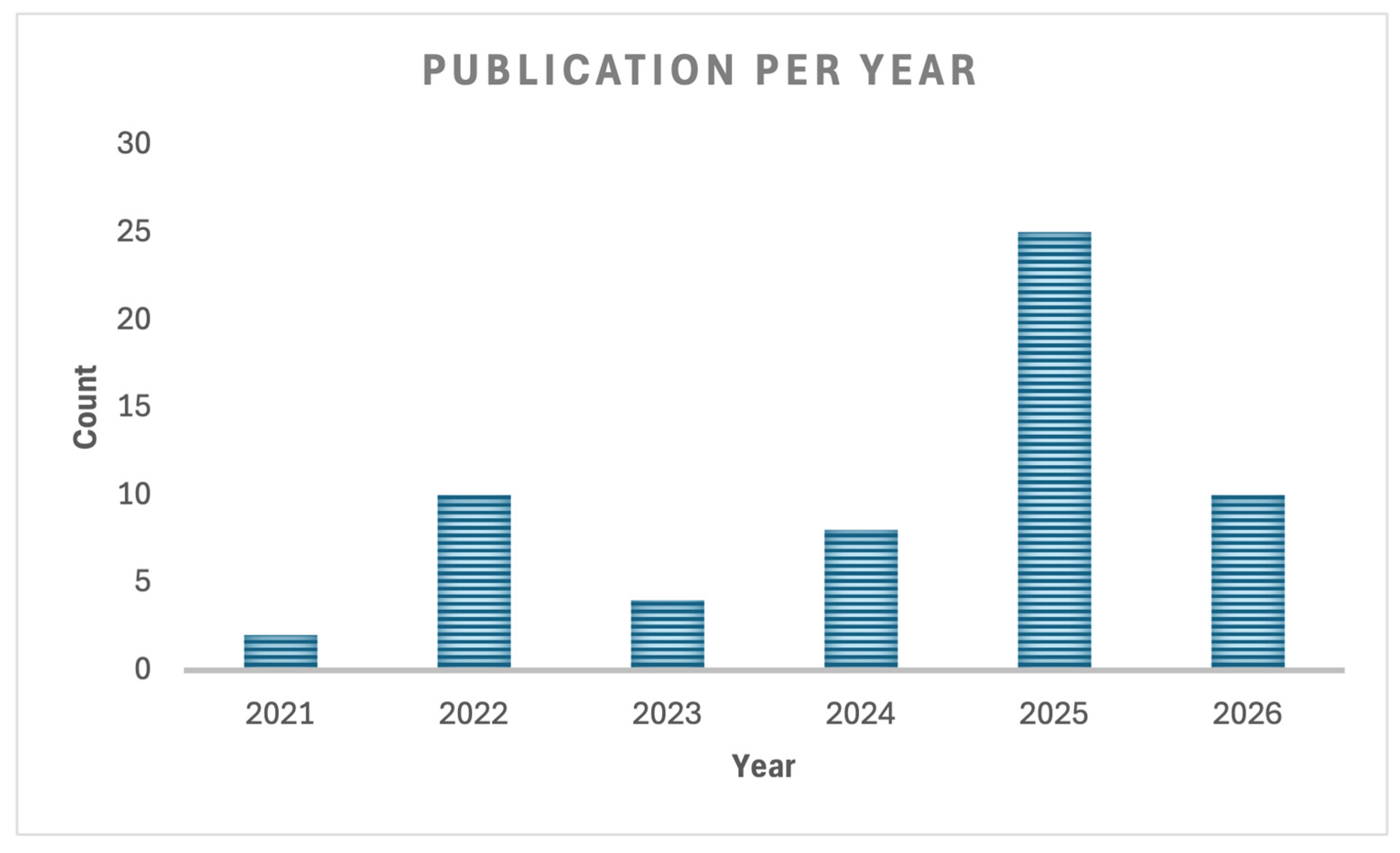
Figure 2. Number of publications per year of reviewed articles.
Information 17 00556 g002
Figure 3. Academic sources of reviewed journal articles.
Information 17 00556 g003
Figure 4. Keyword co-occurrence analysis of reviewed papers (created with [12]).
Information 17 00556 g004
Figure 5. Distribution of reviewed papers by domain.
Information 17 00556 g005
Figure 6. Cognitive features retrieved from the reviewed studies.
Information 17 00556 g006
Figure 7. Radial heatmap showing the distribution of cognitive capabilities across reviewed studies. Each ring is a cognitive capability (ordered by frequency, most frequent = innermost), and each angular slice indicates a paper. Blue shading indicates the value for the reported cognitive features, whereas grey cells denote features that are not reported.
Information 17 00556 g007
Figure 8. CDT architectures defined in the reviewed studies (top to bottom). Top: CDT as an Extension of DT (a Digital Twin combined with an AI model operating within a static digital environment while mirroring a physical). Middle: CDT with a dedicated Cognitive Layer (the Digital Twin is enhanced with a cognitive component enabling bidirectional reasoning, still within a static environment). Bottom: CDT as a System-of-Systems (multiple Digital Twins (DT1, DT2, …, DTn) are orchestrated by a Cognitive System within an adapting environment, representing full cognitive transformation). The vertical axes indicate the progression from digital transformation (left) to cognitive maturity (right).
Information 17 00556 g008
Figure 9. Sunburst diagram mapping the 59 reviewed papers to 14 cognitive capabilities identified in CDT literature, colour-coded by architectural positioning of cognition. Three architectural categories are distinguished: AI-Enhanced (green) (architectures that embed AI/ML models directly within the Digital Twin); Cognitive-Layer–Extended (blue) (architectures that augment a Digital Twin with a cognitive layer); and Novel Architecture (orange) (architectures that propose fundamentally new CDT systems beyond conventional DT augmentation). Light-shaded cells with “N/A” denote capabilities that are not addressed by the respective study.
Information 17 00556 g009
Figure 10. Enabling CDT technologies by year.
Information 17 00556 g010
Table 1. Article inclusion and exclusion criteria.
ExclusionInclusion
Conference papersJournal articles
Book chaptersAny publication date
Editorial piecesEnglish documents
Review papersStudies explicitly implementing or conceptualising a DT 
Non-EnglishStudies explicitly mentioning cognitive/intelligent/autonomous/AI-driven properties to verify cognitive functionality
No access to full text 
Table 2. Thematic clusters and aimed research question.
Thematic ClustersRelevant Research Question
CDT definition(RQ1) What is a CDT?
Research domain(RQ2) Where is a CDT used?
Cognitive functions(RQ3) What is cognition?
DT–cognition relation (architectures)(RQ4) How is a CDT structured?
Table 3. CDT definitions by research domain.
Research DomainSourceDefinition
Manufacturing,
Industry 4.0/5.0, and
Production
Systems
Eirinakis et al.
[25]
“CDTs offer the ability to monitor the current status of the corresponding manufacturing elements, identify (or even predict) anomalies in production and explore their root-cause and in turn calculate, evaluate and hence support decisions on possible actions for the appropriate (optimized) response towards mitigating the consequences of the corresponding disruptions”.
Iyer et al. [26]“…capability to predict future bottlenecks by using its memory component and attending to different parts of the same input sequence when making predictions, learn from the process parameters added to the database”.
ElMaraghy and ElMaraghy [3]“CDT is a digital representation, augmentation, and intelligent companion of its physical Twin as a whole including subsystems and across all of its life cycles and evaluation phases”.
Jiang et al. [27]“…a digital mirror with autonomous learning and decision- making capabilities”.
Qi et al. [28]“…digital mappings of physical systems and augmented with cognitive capabilities to support autonomous update optimisation”.
Rožanec et al.
[14]
“…DTs with entities that describe physical assets and actors as well as how data is ingested into the digital counterpart, leveraged by algorithms and AI, and how are their outcomes linked to advice on potential actions that can be taken to mitigate observed issues to help on decision making”.
Tong et al. [29]“…a fully autonomous DT, distinguished from conventional DTs by its capacity for self-directed decision-making, action execution, and particularly autonomous learning to achieve specific objectives”.
Ullah et al. [30]“…integrating the DT with ML models…”
Yang et al. [31]“…integrating ontologies, knowledge graphs, and LLMs into DTs…”
Zappa et al. [32]“…an augmented DT with human-like cognitive capabilities (attention, perception, memory, reasoning, learning, and problem-solving), promoting its self-adaptiveness, awareness, collaboration, and enhanced decision-making abilities”.
Energy, Power, and UtilitiesCao et al. [33]“…a system that encapsulates the DT engine that can simulate the full system states and the data-driven decision engine to derive optimal control policy”.
Built Environment, Construction, and Facility
Management
Meschini et al.
[34]
“…buildings with cognitive functions able to autonomously and dynamically react to environmental changes”.
Yitmen et al.
[35]
“…a robust monitoring and control mechanism and an essential part of the decision-making action that leads to system optimisation”.
Zhang et al. [36]“…model that integrates AI, data analytics, and simulation technologies to accurately represent the states and behaviours of physical entities in a virtual environment…”
Cognitive and
Human–Machine Systems
D’Amico et al.
[37]
“…an enhanced system, capable of creating a digital representation of a physical entity and comprehending and using the knowledge concerning the entity to enhance operations and support decision-making”.
Gibaut and Gudwin [19]“…a digital replica of the dynamics and cognitive—or just cognitive—processes of an intelligent physical system, usually aimed at a partial representation of a person”.
Ali et al. [13]“CDT is a DT and a cognitive system. As a DT, it emulates a physical system that can be or not itself cognitive. As a cognitive system, it possesses cognitive functions, bringing it in particular the ability to semantically model, process and interpret information autonomously and actively learning from its interactions”.
Materials, Physics, and Complex Engineered SystemsSikibi et al. [38]“…incorporating AI and ML algorithms, enabling the DT to independently learn from telemetry, adjust to malfunctions, and enhance decision-making in real-time”.
Supply ChainAshraf et al. [2]“…integration of AI in DT technology, which can sense and detect complex and unpredictable behaviours”.
Galuzin et al.
[39]
“…a hybrid knowledge-based multi-agent cyber-physical system which can contain a cyber-physical subsystem, including sensors, computers, communication units and executors, and an intelligent decision-making subsystem, which contains a knowledge base and a multi-agent decision making system, synchronized with enterprise equipment via sensors and with employees via mobile devices”.
Kalaboukas et al. [17]“CDTs of all the involved stakeholders, their critical processes and affecting assets, which are linked by sharing information and apply decision-making (cognition) using specific norms, criteria, and other operational conditions”.
Nozari and Yordanova [40]“…real-time adaptation to uncertainty by continuously updating the D-number confidence weights through feedback from the cognitive (AI-reasoning) layer…a self-learning and data-driven environment for optimisation that bridges uncertainty modelling and intelligent decision-making in an unprecedented way”.
Aerospace,
Aviation, and Space Systems
Li et al. [18]“…DTs with augmented semantic capabilities for promoting the understanding of interrelationships between virtual models and enhancing the decision-making”.
Patrignani et al. [41]“…a real-time, data-driven, dynamically evolving system that encompasses all relevant information about the evolution of the elements comprising the space system”.
Zheng et al. [42]Adopts the definition of Zheng et al. [24]: “…a digital representation of a physical system that is augmented with certain cognitive capabilities and support to execute autonomous activities; comprises a set of semantically interlinked digital models related to different lifecycle phases of the physical system including its subsystems and components; and evolves continuously with the physical system across the entire lifecycle”.
Smart Cities and Urban Systems, Natural EnvironmentFeng et al. [43]“…integrate human cognitive capabilities and minimize reliance on human intervention…”
Yu et al. [44]“…DT with enhanced cognitive capabilities and realizes DT integration with the help of semantic technologies such as ontology and knowledge graph…”
Table 4. Classification of CDT and Intelligent DT system research domains.
DomainsRelated SubjectsSource
Manufacturing, Industry, and Production SystemsSmart manufacturing, Industry 4.0, Industry 5.0, industrial systems, maintenance monitoring and prognostics, quality management, industrial maintenance, human–robot collaboration, multi-robot collaboration, production and management systems [37], IoT systems[3,14,16,25,26,27,28,29,30,31,32,37,46,47,48,49,50,51,52,53,54,55]
Cognitive and Human–Machine SystemsHuman–computer interaction, cyber-physical systems, human–cyber-physical systems, cognitive systems, driving assistance system, sustainable DT[13,19,56,57]
Supply ChainSupply chain, agile supply chain, enterprise resource management[2,17,39,40]
Energy, Power, and Utilitiespower grid (microgrid), PV systems, high-frequency power converters, sustainability (data centres); Indoor Air Quality (IAQ) monitoring[33,58,59,60,61,62],
Built Environment, Construction, and Facility ManagementFacility management, HVAC systems, Indoor Air Quality (IAQ) monitoring building management and operations, built environment (asset management), (Construction 4.0) building lifecycle management[34,35,36,63,64,65]
HealthcareMedicine, virtual healthcare, oncology[66,67,68]
Aerospace, Aviation, and Space SystemsAircraft maintenance, aircraft manufacturing system design, space engineering, SoS (Unmanned Aerial Vehicles (UAVs))[15,18,41,42]
Smart Cities and Urban Systems, and Natural EnvironmentSmart cities, transportation, urban road emergency management, natural disaster management[43,44,69,70]
Materials, Physics, and Complex Engineered SystemsMaterials science and engineering; physics (fusion reactor maintenance); complex industrial system (SoS) [38,71,72,73,74]
Table 5. Cognitive technologies employed in the reviewed CDT studies, categorised by technology class.
Technology CategoryPapers (n)Representative StudiesPrimary Cognitive Functions Enabled
Deep Learning (LSTM, CNN, GNN, Transformer)35[2,16,29,65,72]Learning, Prediction, Perception
Reinforcement Learning (DRL, PPO, SAC, MARL)12[28,31,33,38]Planning, Adaptation, Decision Making
Large Language Models (LLMs)3[16,29,31]Reasoning, Contextual Understanding
Knowledge Graphs/Ontologies22[15,18,37,42,44]Reasoning, Interoperability, Memory
Traditional ML (RF, XGBoost, KNN, Bayesian)8[30,40,49,65]Prediction, Classification
Optimisation (MILP, GA, PSO, MPC)8[25,58,64,70]Planning, Optimisation
Hybrid/Neurosymbolic6[13,15,33,74]Reasoning + Learning (dual process)
Disclaimer/Publisher’s Note: The statements, opinions and data contained in all publications are solely those of the individual author(s) and contributor(s) and not of MDPI and/or the editor(s). MDPI and/or the editor(s) disclaim responsibility for any injury to people or property resulting from any ideas, methods, instructions or products referred to in the content.