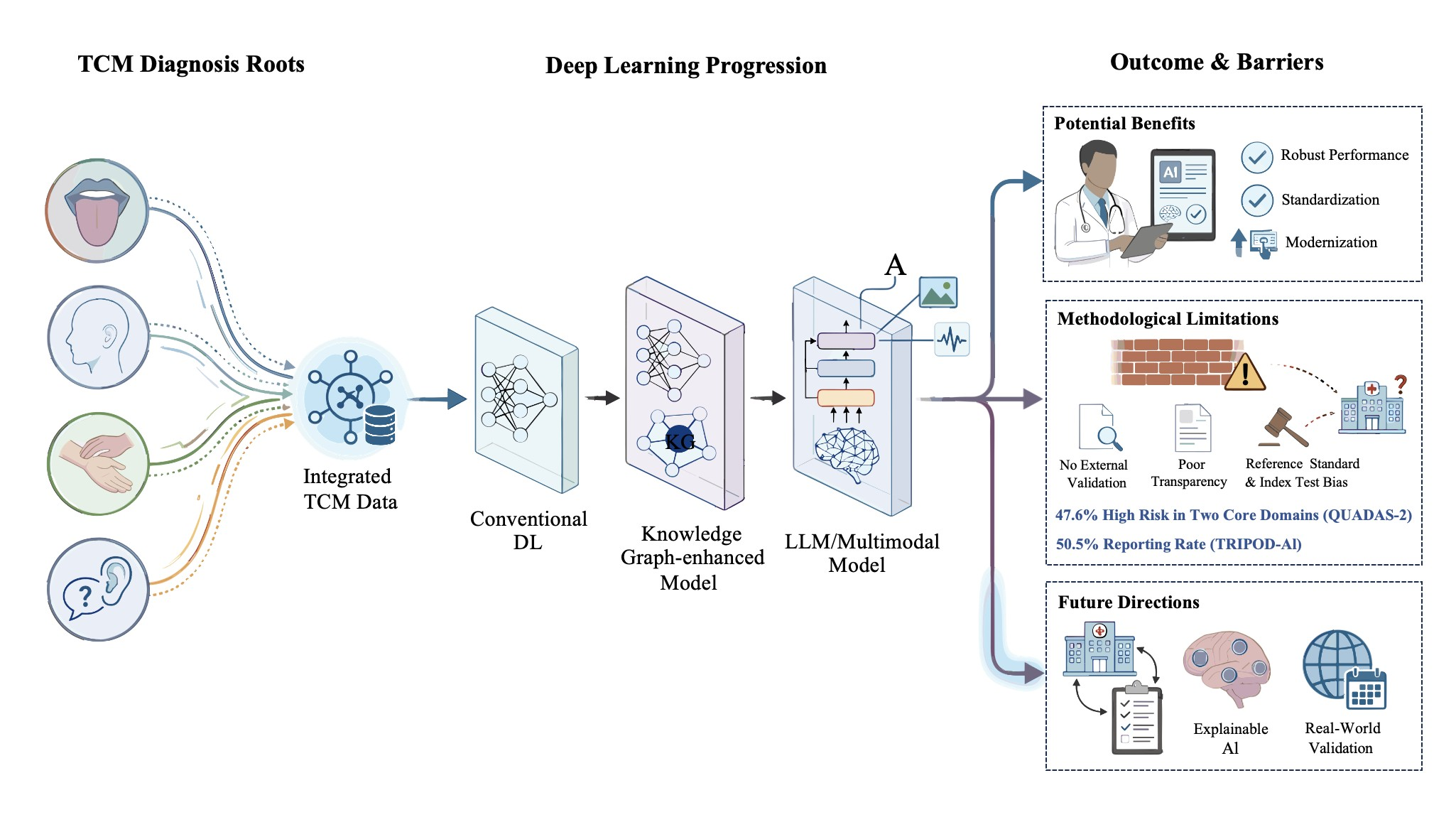
Methodological Quality and Clinical Translation of Deep Learning in Traditional Chinese Medicine Disease Diagnosis: A Systematic Review and Validation Gap Analysis


Abstract
1. Introduction
1.1. The Diagnostic Framework and Modernization Challenges of TCM
1.2. The Technological Opportunity: Deep Learning in Medicine
1.3. Evolution of Intelligent TCM Diagnostic Research
1.4. Persistent Challenges and Knowledge Gaps
2. Methods
2.1. Eligibility Criteria
2.2. Information Sources and Search
2.3. Study Selection
2.4. Data Collection and Extraction
2.5. Quality Assessment
3. Results
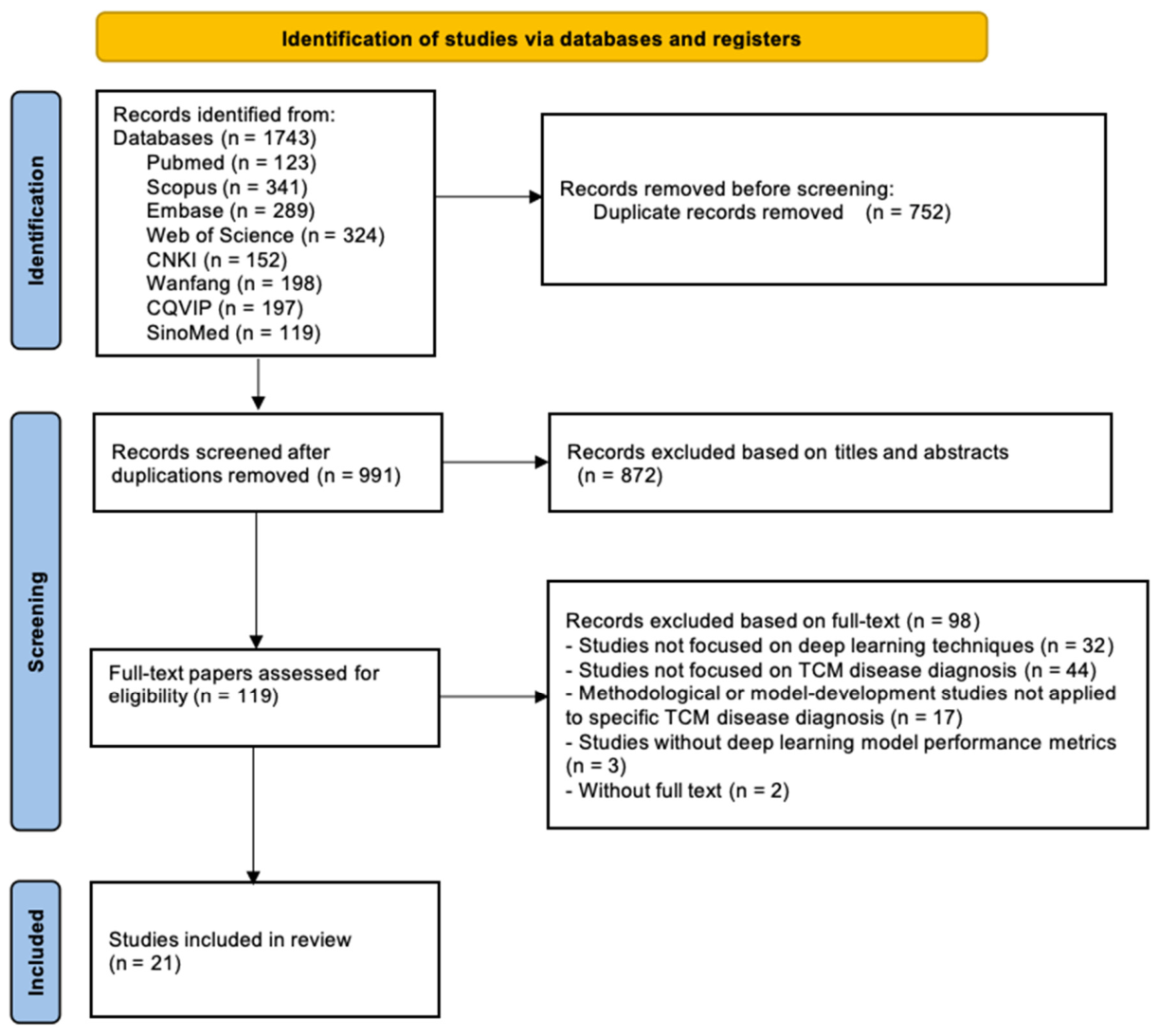
3.1. Literature Search
3.2. Description of Included Studies
3.3. Reporting Quality and Risk of Bias
3.3.1. Reporting Quality Assessed Using the TRIPOD-AI Checklist
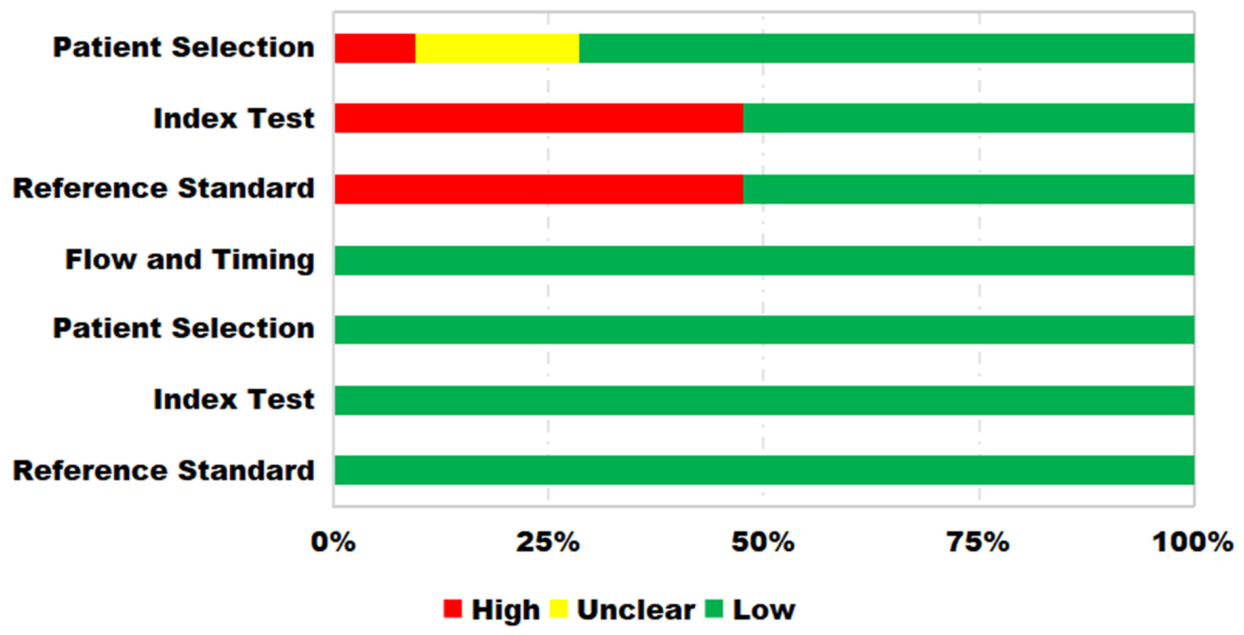
3.3.2. Risk of Bias and Applicability Concerns Assessed Using QUADAS-2
3.4. Deep Learning Development Trends in TCM Diagnosis
3.4.1. Evolution of Diagnostic Data Modalities
3.4.2. Evolution of Model Architectures
Conventional DL Architectures
CNN and Visual Diagnostic Models
Knowledge-Enhanced Architectures and Pretrained Language Models
Large Language Models and Diagnostic Reasoning Frameworks
Multimodal Fusion Frameworks
4. Discussion
4.1. Technological Evolution and Paradigm Shift
4.2. Methodological Limitations and Barriers to Clinical Translation
4.3. The Gap Between Theoretical Framework and Technical Implementation
4.4. Clinical Implications and Future Directions
4.4.1. Clinical Implications
4.4.2. Future Directions
4.5. Advantages and Limitations of the Study
5. Conclusions
Supplementary Materials
Author Contributions
Funding
Institutional Review Board Statement
Informed Consent Statement
Data Availability Statement
Acknowledgments
Conflicts of Interest
Abbreviations
| 3STCoT | Three-Stage Chain-of-Thought |
| AI | Artificial Intelligence |
| ANN | Artificial Neural Network |
| AUC | Area Under the Curve |
| BERT | Bidirectional Encoder Representations from Transformers |
| BiLSTM | Bidirectional Long Short-Term Memory |
| BLEU | Bilingual Evaluation Understudy |
| BP-NN | Backpropagation Neural Network |
| CAM | Class Activation Mapping |
| CHAID | Chi-squared Automatic Interaction Detector |
| CHD | Coronary Heart Disease |
| CHD-SEDD | Coronary Heart Disease Syndrome Element Diagnostic Device |
| CNN | Convolutional Neural Network |
| CoT | Chain of Thought |
| CRF | Chronic Renal Failure |
| Cubic SVM | Cubic Support Vector Machine |
| DBN | Deep Belief Network |
| DenseNet | Densely Connected Convolutional Network |
| DKD | Diabetic Kidney Disease |
| DL | Deep Learning |
| DNN | Deep Neural Network |
| EMR | Electronic Medical Record |
| ERNIE | Enhanced Representation through kNowledge IntEgration |
| FCN | Fully Connected Network |
| FFT | Fast Fourier Transform |
| GAT | Graph Attention Network |
| GKFP | Knowledge-Driven Key Feature Prompting |
| GPT | Generative Pre-trained Transformer |
| GraphRAG | Graph Retrieval-Augmented Generation |
| GRU | Gated Recurrent Unit |
| KBRNN | Knowledge-Based Recurrent Neural Network |
| KG-PLM | Knowledge Graph Pre-trained Language Model |
| Lasso | Least Absolute Shrinkage and Selection Operator |
| LightGBM | Light Gradient Boosting Machine |
| LLMs | Large Language Models |
| LoRA | Low-Rank Adaptation |
| LS | Least Squares |
| LSTM | Long Short-Term Memory |
| MFCC | Mel-Frequency Cepstral Coefficients |
| MLP | Multilayer Perceptron |
| MLR | Multiple Linear Regression |
| NA | Not Applicable |
| NLP | Natural Language Processing |
| PCA | Principal Component Analysis |
| PCOS | Polycystic Ovary Syndrome |
| PDAD | Pattern Diagnosis and Acupuncture Dataset |
| PLM | Pre-trained Language Model |
| PRISMA | Preferred Reporting Items for Systematic Reviews and Meta-Analyses |
| PRISMA-AI | Preferred Reporting Items for Systematic Reviews and Meta-Analyses for Artificial Intelligence |
| PROBAST-AI | Prediction model Risk Of Bias ASsessment Tool for Artificial Intelligence |
| PROSPERO | International Prospective Register of Systematic Reviews |
| QUADAS-2 | Quality Assessment of Diagnostic Accuracy Studies 2 |
| RAG | Retrieval-Augmented Generation |
| RCNN | Recurrent Convolutional Neural Network |
| ResNet | Residual Network |
| RGCN | Relational Graph Convolutional Network |
| RNN | Recurrent Neural Network |
| ROUGE | Recall-Oriented Understudy for Gisting Evaluation |
| SKQD | Spleen-Kidney Qi Deficiency |
| SSEM | Semantic Similarity Evaluation Model |
| SVM | Support Vector Machine |
| T2DM | Type 2 Diabetes Mellitus |
| TCM | Traditional Chinese Medicine |
| TRIPOD-AI | Transparent Reporting of a Multivariable Prediction Model for Individual Prognosis or Diagnosis—Artificial Intelligence |
| TS-Model | Tongue-Syndrome Multimodal Fusion Model |
| XGBoost | Extreme Gradient Boosting |
References
- Sui, D.; Zhang, L.; Yang, F. Data-driven based four examinations in TCM: A survey. Digit. Chin. Med. 2022, 5, 377–385. [Google Scholar] [CrossRef]
- Jiang, M.; Lu, C.; Zhang, C.; Yang, J.; Tan, Y.; Lu, A.; Chan, K. Syndrome differentiation in modern research of traditional Chinese medicine. J. Ethnopharmacol. 2012, 140, 634–642. [Google Scholar] [CrossRef]
- Bensoussan, A.; Talley, N.J.; Hing, M.; Menzies, R.; Guo, A.; Ngu, M. Treatment of irritable bowel syndrome with Chinese herbal medicine: A randomized controlled trial. JAMA 1998, 280, 1585–1589. [Google Scholar] [CrossRef] [PubMed]
- Chen, S.C.; Yu, J.; Wang, H.S.; Wang, D.D.; Sun, Y.; Cheng, H.L.; Suen, L.K.; Yeung, W.F. Parent-administered pediatric Tuina for attention deficit/hyperactivity disorder symptoms in preschool children: A pilot randomized controlled trial embedded with a process evaluation. Phytomedicine 2022, 102, 154191. [Google Scholar] [CrossRef] [PubMed]
- Yeung, W.F.; Yu, B.Y.; Yuen, J.W.; Ho, J.Y.S.; Chung, K.F.; Zhang, Z.J.; Mak, D.S.Y.; Suen, L.K.; Ho, L.M. Semi-Individualized Acupuncture for Insomnia Disorder and Oxidative Stress: A Randomized, Double-Blind, Sham-Controlled Trial. Nat. Sci. Sleep 2021, 13, 1195–1207. [Google Scholar] [CrossRef]
- Tian, D.; Chen, W.; Xu, D.; Xu, L.; Xu, G.; Guo, Y.; Yao, Y. A review of traditional Chinese medicine diagnosis using machine learning: Inspection, auscultation-olfaction, inquiry, and palpation. Comput. Biol. Med. 2024, 170, 108074. [Google Scholar] [CrossRef]
- Poon, M.M.; Chung, K.F.; Yeung, W.F.; Yau, V.H.; Zhang, S.P. Classification of insomnia using the traditional chinese medicine system: A systematic review. Evid. Based Complement. Altern. Med. 2012, 2012, 735078. [Google Scholar] [CrossRef]
- Liu, J.Y.; Li, X. Standardization, objectification, and essence research of traditional Chinese medicine syndrome: A 15-year bibliometric and content analysis from 2006 to 2020 in Web of Science database. Anat. Rec. 2023, 306, 2974–2983. [Google Scholar] [CrossRef] [PubMed]
- Lu, A.; Jiang, M.; Zhang, C.; Chan, K. An integrative approach of linking traditional Chinese medicine pattern classification and biomedicine diagnosis. J. Ethnopharmacol. 2012, 141, 549–556. [Google Scholar] [CrossRef]
- Matos, L.C.; Machado, J.P.; Monteiro, F.J.; Greten, H.J. Can Traditional Chinese Medicine Diagnosis Be Parameterized and Standardized? A Narrative Review. Healthcare 2021, 9, 177. [Google Scholar] [CrossRef]
- Hu, Y.; Wang, Z.; Ni, K.; Yang, J. Challenges in Traditional Chinese Medicine Clinical Trials: How to Balance Personalized Treatment and Standardized Research? Ther. Clin. Risk Manag. 2025, 21, 1085–1094. [Google Scholar] [CrossRef]
- Wang, J.; Guo, Y.; Li, G.L. Current Status of Standardization of Traditional Chinese Medicine in China. Evid. Based Complement. Altern. Med. 2016, 2016, 9123103. [Google Scholar] [CrossRef]
- Chen, S.C.; Chen, Y.; Yeung, W.F.; Ren, G.; Chen, S.; Du, H.X.; Qin, J. Deep learning in acupuncture: A systematic review. Artif. Intell. Med. 2026, 171, 103300. [Google Scholar] [CrossRef]
- Faiyazuddin, M.; Rahman, S.J.Q.; Anand, G.; Siddiqui, R.K.; Mehta, R.; Khatib, M.N.; Gaidhane, S.; Zahiruddin, Q.S.; Hussain, A.; Sah, R. The Impact of Artificial Intelligence on Healthcare: A Comprehensive Review of Advancements in Diagnostics, Treatment, and Operational Efficiency. Health Sci. Rep. 2025, 8, e70312. [Google Scholar] [CrossRef] [PubMed]
- Mienye, I.D.; Swart, T.G. A Comprehensive Review of Deep Learning: Architectures, Recent Advances, and Applications. Information 2024, 15, 755. [Google Scholar] [CrossRef]
- Sarker, I.H. Deep Learning: A Comprehensive Overview on Techniques, Taxonomy, Applications and Research Directions. SN Comput. Sci. 2021, 2, 420. [Google Scholar] [CrossRef] [PubMed]
- Shickel, B.; Tighe, P.J.; Bihorac, A.; Rashidi, P. Deep EHR: A Survey of Recent Advances in Deep Learning Techniques for Electronic Health Record (EHR) Analysis. IEEE J. Biomed. Health Inform. 2018, 22, 1589–1604. [Google Scholar] [CrossRef]
- Chen, R.J.; Lu, M.Y.; Williamson, D.F.K.; Chen, T.Y.; Lipkova, J.; Noor, Z.; Shaban, M.; Shady, M.; Williams, M.; Joo, B.; et al. Pan-cancer integrative histology-genomic analysis via multimodal deep learning. Cancer Cell 2022, 40, 865–878.e866. [Google Scholar] [CrossRef] [PubMed]
- Muzammil, M.A.; Javid, S.; Afridi, A.K.; Siddineni, R.; Shahabi, M.; Haseeb, M.; Fariha, F.N.U.; Kumar, S.; Zaveri, S.; Nashwan, A.J. Artificial intelligence-enhanced electrocardiography for accurate diagnosis and management of cardiovascular diseases. J. Electrocardiol. 2024, 83, 30–40. [Google Scholar] [CrossRef]
- Askr, H.; Elgeldawi, E.; Aboul Ella, H.; Elshaier, Y.; Gomaa, M.M.; Hassanien, A.E. Deep learning in drug discovery: An integrative review and future challenges. Artif. Intell. Rev. 2023, 56, 5975–6037. [Google Scholar] [CrossRef]
- Tian, Z.; Wang, D.; Sun, X.; Fan, Y.; Guan, Y.; Zhang, N.; Zhou, M.; Zeng, X.; Yuan, Y.; Bu, H.; et al. Current status and trends of artificial intelligence research on the four traditional Chinese medicine diagnostic methods: A scientometric study. Ann. Transl. Med. 2023, 11, 145. [Google Scholar] [CrossRef] [PubMed]
- Meng, D.; Cao, G.; Duan, Y.; Zhu, M.; Tu, L.; Xu, D.; Xu, J. Tongue Images Classification Based on Constrained High Dispersal Network. Evid. Based Complement. Altern. Med. 2017, 2017, 7452427. [Google Scholar] [CrossRef]
- Quanyu, E. Pulse Signal Analysis Based on Deep Learning Network. BioMed Res. Int. 2022, 2022, 6256126. [Google Scholar] [CrossRef]
- Yang, L.; Dong, Q.; Lin, D.; Lü, X. TongueNet: A multi-modal fusion and multi-label classification model for traditional Chinese Medicine tongue diagnosis. Front. Physiol. 2025, 16, 1527751. [Google Scholar] [CrossRef]
- Liu, Y.; Fan, L.; Zhao, M.; Wei, D.; Zhao, M.; Dong, Y.; Zhang, X. Study on a Traditional Chinese Medicine constitution recognition model using tongue image characteristics and deep learning: A prospective dual-center investigation. Chin. Med. 2025, 20, 84. [Google Scholar] [CrossRef]
- Xiao, L.; Wang, J.W.; Wang, C.W.; Wang, Y.; Yan, J.F.; Peng, Q.H. Knowledge graph for traditional Chinese medicine diagnosis and treatment of diabetic retinopathy: Design, construction, and applications. Int. J. Ophthalmol. 2025, 18, 2011–2021. [Google Scholar] [CrossRef]
- He, J.; Guo, Y.; Lam, L.; Leung, W.; He, L.; Jiang, Y.; Wang, C.; Xing, G.; Chen, H. OpenTCM: A GraphRAG-Empowered LLM-based System for Traditional Chinese Medicine Knowledge Retrieval and Diagnosis. arXiv 2025, arXiv:2504.20118. [Google Scholar] [CrossRef]
- Lim, J.; Li, J.; Zhou, M.; Xiao, X.; Xu, Z. Machine Learning Research Trends in Traditional Chinese Medicine: A Bibliometric Review. Int. J. Gen. Med. 2024, 17, 5397–5414. [Google Scholar] [CrossRef]
- Wang, S.; Zhao, X. Deep Learning in Tongue Diagnosis for Traditional Chinese Medicine: A Review. Front. Comput. Intell. Syst. 2025, 12, 139–143. [Google Scholar] [CrossRef]
- Page, M.J.; McKenzie, J.E.; Bossuyt, P.M.; Boutron, I.; Hoffmann, T.C.; Mulrow, C.D.; Shamseer, L.; Tetzlaff, J.M.; Akl, E.A.; Brennan, S.E.; et al. The PRISMA 2020 statement: An updated guideline for reporting systematic reviews. BMJ 2021, 372, n71. [Google Scholar] [CrossRef] [PubMed]
- Cacciamani, G.E.; Chu, T.N.; Sanford, D.I.; Abreu, A.; Duddalwar, V.; Oberai, A.; Kuo, C.J.; Liu, X.; Denniston, A.K.; Vasey, B.; et al. PRISMA AI reporting guidelines for systematic reviews and meta-analyses on AI in healthcare. Nat. Med. 2023, 29, 14–15. [Google Scholar] [CrossRef]
- Krizhevsky, A.; Sutskever, I.; Hinton, G.E. ImageNet classification with deep convolutional neural networks. Commun. ACM 2017, 60, 84–90. [Google Scholar] [CrossRef]
- Collins, G.S.; Moons, K.G.M.; Dhiman, P.; Riley, R.D.; Beam, A.L.; Van Calster, B.; Ghassemi, M.; Liu, X.; Reitsma, J.B.; van Smeden, M.; et al. TRIPOD+AI statement: Updated guidance for reporting clinical prediction models that use regression or machine learning methods. BMJ 2024, 385, e078378. [Google Scholar] [CrossRef] [PubMed]
- Whiting, P.F.; Rutjes, A.W.; Westwood, M.E.; Mallett, S.; Deeks, J.J.; Reitsma, J.B.; Leeflang, M.M.; Sterne, J.A.; Bossuyt, P.M. QUADAS-2: A revised tool for the quality assessment of diagnostic accuracy studies. Ann. Intern. Med. 2011, 155, 529–536. [Google Scholar] [CrossRef] [PubMed]
- Liu, J.; Dan, W.; Liu, X.; Zhong, X.; Chen, C.; He, Q.; Wang, J. Development and validation of predictive model based on deep learning method for classification of dyslipidemia in Chinese medicine. Health Inf. Sci. Syst. 2023, 11, 21. [Google Scholar] [CrossRef] [PubMed]
- Wang, C.Y.; Huang, K.L.; Dai, G.W.; Qiang, M.; Wang, Q. Research on Tongue Image Classification of Traditional Chinese Medicine Syndrome Differentiation in Stroke Based on Convolutional Neural Networks. J. Hunan Univ. Chin. Med. 2023, 43, 1460–1467. (In Chinese) [Google Scholar] [CrossRef]
- Yu, X.; He, L.; Wang, Q.; Zhang, Z.; Zhu, H.; Song, J. Heat syndrome types prediction of traditional Chinese medicine in acute ischemic stroke through deep learning: A pilot study. Front. Pharmacol. 2025, 16, 1601601. [Google Scholar] [CrossRef]
- Zhang, Y.; Ling, N.; Zhang, G.H.; Chen, X.; Ren, C.L. Construction and Implementation of Syndrome Differentiation Classification for Polycystic Ovary Syndrome Based on Deep Learning. J. Liaoning Univ. Tradit. Chin. Med. 2019, 21, 13–16. (In Chinese) [Google Scholar] [CrossRef]
- Zhang, M.Q.; Deng, X. Exploration of Constructing an Intelligent Syndrome Differentiation Model for Compensated Cirrhosis Based on Integrated Learning and Neural Network Algorithm. J. Guangzhou Univ. Chin. Med. 2023, 40, 2650–2660. (In Chinese) [Google Scholar] [CrossRef]
- Zhao, Z.H.; Zhou, Y.; Li, W.H.; Tang, C.H.; Guo, Q.; Chen, R.G. Construction of a Traditional Chinese Medicine Syndrome Differentiation Model for Type 2 Diabetes Based on Deep Learning Multimodal Fusion. World Sci. Technol. Mod. Chin. Med. 2024, 26, 908–918. (In Chinese) [Google Scholar] [CrossRef]
- Ding, Y.; Wang, Y.; Liu, J.; Wang, N.Y. Construction of a Diagnostic Model for Coronary Heart Disease with Blood Stasis Pattern Based on Objective Multimodal Data Fusion. J. Tradit. Chin. Med. 2025, 66, 2239–2248. (In Chinese) [Google Scholar] [CrossRef]
- Ding, Y.; Wang, Y.; Liu, J.; Wang, N.Y. Diagnostic Model Construction for Blood Stasis Syndrome in T2DM Based on Objective Multimodal Data Fusion. J. Basic. Chin. Med. 2025, 31, 1592–1598. (In Chinese) [Google Scholar] [CrossRef]
- Zhang, Q.Q.; Yang, H.; Wu, Y.X.; Li, S.J.; Peng, X. Diagnostic and Treatment Decision Support System for TCM Diabetic Nephropathy Based on Artificial Intelligence. Chin. J. Health Inform. Manag. 2025, 22, 998–1006, 1021. (In Chinese) [Google Scholar] [CrossRef]
- Li, H.P.; Han, Z.Y.; Hu, W.Y.; Wang, H.Y.; Li, Y.L. Deep learning-assisted diagnosis model of depression based on TCM facial inspection. Mod. Chin. Clin. Med. 2026, 33, 27–32. (In Chinese) [Google Scholar] [CrossRef]
- Cao, M.R.; Wang, Z.C. Accuracy Study of AI-Assisted Syndrome Differentiation in Determining Traditional Chinese Medicine Syndrome Types (Using Spleen Deficiency Pattern as an Example) in Patients with Gastrointestinal Tumors. Mystery 2023, 6, 49–51. Available online: https://qikan.cqvip.com/Qikan/Article/Detail?id=7201982295 (accessed on 10 May 2026). (In Chinese)
- Liu, Z.F.; Wu, J.H. Research on TCM Syndrome Diagnosis Based on Knowledge Graph and Attention Mechanism. J. Sci. Res. Appl. 2025, 1, 89–93. Available online: https://qikan.cqvip.com/Qikan/Article/Detail?id=7202913824 (accessed on 10 May 2026). (In Chinese)
- Yang, L.; Tong, T.; Lu, Y.; Wang, W.; Wei, C.Y.; Wang, R.T.; Ouyang, Y.L.; Moossavi, M.; Liu, H.X.; Ma, X.L. Deep Learning Based on the Facial Color Images for Assisted Diagnosis of Chronic Renal Failure with Spleen-Kidney Qi Deficiency Syndrome. World J. Tradit. Chin. Med. 2026, 12, 55–67. [Google Scholar] [CrossRef] [PubMed]
- Ding, L.; Zhang, X.Y.; Liu, L.P.; Niu, X.L.; Guo, Y.K. A Primary Liver Cancer Syndrome Diagnosis Classification Prediction Model Based on Deep Neural Networks. World Sci. Technol. Mod. Chin. Med. 2020, 22, 4185–4192. (In Chinese) [Google Scholar] [CrossRef]
- Li, H.Z.; Wang, J.; Zhang, Z.P.; Guo, Y.C.; Du, Q.; Gao, J.L.; Dong, Y.; Li, J.N.; Li, Q.Y. Research on the Distribution and Combination Patterns of Syndrome Elements Throughout the Course of Coronary Heart Disease Based on an Improved Deep Learning Algorithm. World Sci. Technol. Mod. Chin. Med. 2021, 23, 3086–3094. (In Chinese) [Google Scholar] [CrossRef]
- Li, D.; Qu, J.; Tian, Z.; Mou, Z.; Zhang, L.; Zhang, X. Knowledge-Based Recurrent Neural Network for TCM Cerebral Palsy Diagnosis. Evid. Based Complement. Altern. Med. 2022, 2022, 7708376. [Google Scholar] [CrossRef]
- Zhu, L.; Zheng, W.T.; Zhang, Z.L.; Tian, S.L.; Li, J.H. Research on the Syndrome Prediction Model of Ulcerative Colitis Based on Convolutional Neural Networks. China Digit. Med. 2022, 17, 49–55. (In Chinese) [Google Scholar] [CrossRef]
- Jiaze, W.; Hao, L.; Haoran, D.; Hongliang, R.; Baoli, L. Clinical decision and prescription generation for diarrhea in traditional Chinese medicine based on large language model. Digit. Chin. Med. 2026, 9, 13–30. [Google Scholar] [CrossRef]
- Cai, S.X.; Zhu, D.N.; Xu, H.W.; Huang, J.Q.; Li, X.Y.; Li, Z.H.; Liu, X.F.; Yan, Y.H. Application of a deep learning-based tongue image classification system in TCM syndrome identification of psoriasis. J. Pract. Med. 2026, 42, 395–405. (In Chinese) [Google Scholar] [CrossRef]
- Li, S.; Tan, W.; Zhang, C.; Li, J.; Ren, H.; Guo, Y.; Jia, J.; Liu, Y.; Pan, X.; Guo, J.; et al. Taming large language models to implement diagnosis and evaluating the generation of LLMs at the semantic similarity level in acupuncture and moxibustion. Expert. Syst. Appl. 2025, 264, 125920. [Google Scholar] [CrossRef]
- Wang, J.; Song, Y.J.; Hui, X.S.; Zhang, Z.P.; Zhang, X.C. Chain Thinking-driven Large Language Model for Traditional Chinese Medicine Syndrome Element Differentiation of Coronary Heart Disease. Chin. J. Exp. Tradit. Med. Formulae 2025, 31, 1–10. (In Chinese) [Google Scholar] [CrossRef]
- Lin, S.Y.; Huang, H.W.; Liu, C.; Liu, W.T.; Li, J.M.; Qu, Y.Q.; Cao, L.Y. Cognitive mechanisms and multimodal research methodologies of traditional Chinese medicine diagnostics under the large language model perspective. CJTCMP 2025, 40, 97–102. (In Chinese) [Google Scholar]
- Aggarwal, R.; Sounderajah, V.; Martin, G.; Ting, D.S.W.; Karthikesalingam, A.; King, D.; Ashrafian, H.; Darzi, A. Diagnostic accuracy of deep learning in medical imaging: A systematic review and meta-analysis. npj Digit. Med. 2021, 4, 65. [Google Scholar] [CrossRef] [PubMed]
- Nwanosike, E.M.; Conway, B.R.; Merchant, H.A.; Hasan, S.S. Potential applications and performance of machine learning techniques and algorithms in clinical practice: A systematic review. Int. J. Med. Inform. 2022, 159, 104679. [Google Scholar] [CrossRef]
- Vecchi, E.; Pospíšil, L.; Albrecht, S.; Kane, T.J.O.; Horenko, I. eSPA+: Scalable Entropy-Optimal Machine Learning Classification for Small Data Problems. Neural Comput. 2022, 34, 1220–1255. [Google Scholar] [CrossRef]
- Chen, P.-H.C.; Mermel, C.H.; Liu, Y. Evaluation of artificial intelligence on a reference standard based on subjective interpretation. Lancet Digit. Health 2021, 3, e693–e695. [Google Scholar] [CrossRef]
- Wu, D.; Smith, D.; VanBerlo, B.; Roshankar, A.; Lee, H.; Li, B.; Ali, F.; Rahman, M.; Basmaji, J.; Tschirhart, J.; et al. Improving the Generalizability and Performance of an Ultrasound Deep Learning Model Using Limited Multicenter Data for Lung Sliding Artifact Identification. Diagnostics 2024, 14, 1081. [Google Scholar] [CrossRef]
- Cascarano, A.; Mur-Petit, J.; Hernández-González, J.; Camacho, M.; de Toro Eadie, N.; Gkontra, P.; Chadeau-Hyam, M.; Vitrià, J.; Lekadir, K. Machine and deep learning for longitudinal biomedical data: A review of methods and applications. Artif. Intell. Rev. 2023, 56, 1711–1771. [Google Scholar] [CrossRef]
- Li, Y.; El Habib Daho, M.; Conze, P.H.; Zeghlache, R.; Le Boité, H.; Tadayoni, R.; Cochener, B.; Lamard, M.; Quellec, G. A review of deep learning-based information fusion techniques for multimodal medical image classification. Comput. Biol. Med. 2024, 177, 108635. [Google Scholar] [CrossRef]
- Wang, J.; Liu, Y.M.; Li, J.; He, H.Q.; Liu, C.; Song, Y.J.; Ma, S.Y. Artificial Intelligence in Traditional Chinese Medicine: Multimodal Fusion and Machine Learning for Enhanced Diagnosis and Treatment Efficacy. Curr. Med. Sci. 2025, 45, 1013–1022. [Google Scholar] [CrossRef]
- Song, Y.J.; Ma, S.Y.; Dai, Y.S.; Lu, J. AI-Assisted TCM Syndrome Differentiation: Key Issues and Technical Challenges. Chin. Eng. Sci. 2024, 26, 234–244. [Google Scholar] [CrossRef]
- Wenderoth, L. Exploring Multi-Modality Dynamics: Insights and Challenges in Multimodal Fusion for Biomedical Tasks. arXiv 2022, arXiv:2411.00725. [Google Scholar] [CrossRef]
- Gomez-Cabello, C.A.; Borna, S.; Pressman, S.; Haider, S.A.; Haider, C.R.; Forte, A.J. Artificial-Intelligence-Based Clinical Decision Support Systems in Primary Care: A Scoping Review of Current Clinical Implementations. Eur. J. Investig. Health Psychol. Educ. 2024, 14, 685–698. [Google Scholar] [CrossRef]
- Yanhong, W.; Xin, Y.; Yun, Y.; Ji, C.; Ge, Z.; Jianhui, T. Research progress and challenges in artificial intelligence-driven intelligent traditional Chinese medicine diagnosis and treatment. Shanghai J. Tradit. Chin. Med. 2026, 60, 1–11. [Google Scholar] [CrossRef]
- Gao, Z.; Chen, T.; Ha, Y.; Shi, Y.; Xu, X.; Li, B.; Liu, Q. Staged identification of CAP in fever patients across epidemic environments: Modeling & validation. Sci. Rep. 2025, 16, 258. [Google Scholar] [CrossRef]
- Dai, Y.; Shao, X.; Zhang, J.; Chen, Y.; Chen, Q.; Liao, J.; Chi, F.; Zhang, J.; Fan, X. TCMChat: A generative large language model for traditional Chinese medicine. Pharmacol. Res. 2024, 210, 107530. [Google Scholar] [CrossRef]
- Deng, R.Y.; Ding, K.; Zhu, Y.X.; Li, M.; Zhu, H.T.; Du, L. Distribution Characteristics and Risk Factors of Traditional Chinese Medicine Syndrome Types of Mixed Hemorrhoids Based on Large Language Models and Latent Class Models: A Multicenter Real-World Study. J. Tradit. Chin. Med. 2026, 67, 755–763. (In Chinese) [Google Scholar] [CrossRef]
- Syed, M.; Hamidi, M.; Bikkanuri, M.; Dierschke, N.A.; Katragadda, H.V.; Zozus, M.; Teixeira, A.L. Translating evidence into practice: Adapting TrialGPT for real-world clinical trial eligibility screening. J. Am. Med. Inform. Assoc. 2026, 33, 909–913. [Google Scholar] [CrossRef]
- Moons, K.G.M.; Damen, J.A.A.; Kaul, T.; Hooft, L.; Andaur Navarro, C.; Dhiman, P.; Beam, A.L.; Van Calster, B.; Celi, L.A.; Denaxas, S.; et al. PROBAST+AI: An updated quality, risk of bias, and applicability assessment tool for prediction models using regression or artificial intelligence methods. BMJ 2025, 388, e082505. [Google Scholar] [CrossRef]
- Berlin, J.A.; Fihn, S.D. Encouraging the Registration of Observational Studies. JAMA Netw. Open 2025, 8, e2524181. [Google Scholar] [CrossRef]
- Binney, R.J.; Smith, L.J.; Rossit, S.; Demeyere, N.; Learmonth, G.; Olgiati, E.; Halai, A.D.; Rounis, E.; Evans, J.; Edelstyn, N.M.J.; et al. Practical routes to preregistration: A guide to enhanced transparency and rigour in neuropsychological research. Brain Commun. 2025, 7, fcaf162. [Google Scholar] [CrossRef]
- Gou, X.; Yao, J.; Lai, W.; Gao, Y.; Wang, S.; Zhou, C.; Ye, H.; Tian, J.; Yi, J.; Cao, D. A framework for normalized extraction of fine-grained traditional Chinese medicine symptom entities and relations. BMC Med. Inform. Decis. Mak. 2025, 25, 441. [Google Scholar] [CrossRef]
- Jacobson, E.; Conboy, L.; Tsering, D.; Shields, M.; McKnight, P.; Wayne, P.M.; Schnyer, R. Experimental Studies of Inter-Rater Agreement in Traditional Chinese Medicine: A Systematic Review. J. Altern. Complement. Med. 2019, 25, 1085–1096. [Google Scholar] [CrossRef]
- Weikang, K.; Chuanbiao, W.; Yue, L. Knowledge graph-enhanced long-tail learning approach for traditional Chinese medicine syndrome differentiation. Digit. Chin. Med. 2026, 9, 57–67. [Google Scholar] [CrossRef]


| Variable | n (%) |
|---|---|
| Year of Publication | |
| 2019–2021 | 3 (14.3) |
| 2022–2024 | 7 (33.3) |
| 2025–2026 | 11 (52.4) |
| Language | |
| Chinese | 15 (71.4) |
| English | 6 (28.6) |
| Disease category | |
| Cardiovascular and cerebrovascular diseases | 6 (28.6) |
| Digestive system diseases | 5 (23.8) |
| Endocrine and metabolic diseases | 4 (19.0) |
| Others (renal, neurological, psychiatric, dermatological, reproductive, multisystem, etc.) | 6 (28.6) |
| TCM patterns reported | |
| Yes | 20 (95.2) |
| No | 1 (4.8) |
| Disease diagnostic criteria * | |
| Guidelines/Consensus | 10 (47.6) |
| Industry/National standard | 3 (14.3) |
| Textbook | 1 (4.8) |
| Study-specific criteria | 1 (4.8) |
| Not reported | 7 (33.3) |
| TCM pattern diagnostic criteria * | |
| Guidelines/Consensus | 8 (38.1) |
| Industry/National standard | 9 (42.9) |
| Textbook | 3 (14.3) |
| Study-specific criteria | 2 (9.5) |
| Not reported | 3 (14.3) |
| Data sources | |
| Self-built database | 17 (81.0) |
| Public dataset | 1 (4.8) |
| Mixed sources | 3 (14.3) |
| Data source center type | |
| Single-center | 12 (57.1) |
| Multi-center | 8 (38.1) |
| Not applicable | 1 (4.8) |
| Modality type | |
| Text | 12 (57.1) |
| Image | 4 (19.0) |
| Multimodal | 5 (23.8) |
| Label source | |
| Expert/Clinician annotation | 12 (57.1) |
| Guideline/Standard/EMR extraction | 3 (14.3) |
| LLM-assisted + manual review | 1 (4.8) |
| Not reported | 5 (23.8) |
| Task category | |
| Classification Tasks | 13 (61.9) |
| Identification/Analysis Tasks | 6 (28.6) |
| Generation/Decision Tasks | 2 (9.5) |
| Performance metrics category * | |
| Accuracy metrics | 20 (95.2) |
| Error/Loss metrics | 2 (9.5) |
| Generation quality metrics | 2 (9.5) |
| Efficiency/Computational metrics | 3 (14.3) |
| Others (segmentation metrics, etc.) | 1 (4.8) |
| External validation | |
| No | 21 (100) |
| Type of comparison * | |
| Comparison with other computational models | 12 (57.1) |
| Comparison with clinical/human experts | 2 (9.5) |
| Ablation study/Internal control | 7 (33.3) |
| Other comparisons (healthy/disease controls) | 1 (4.8) |
| Not applicable | 1 (4.8) |
| Study ID | Tasks | Models | Modality Type | Process | Performance Metrics |
|---|---|---|---|---|---|
| Classification Tasks | |||||
| Liu (2023) [35] | Predict dyslipidemia occurrence | ANNs | Text (structured clinical data: symptoms, tongue, pulse) | Data Preparation: Clinical data cleaned and features selected. Model Training: ANN trained with class balancing and early stopping. Model Validation: Evaluated on independent test set. | Model-11 (test): TP = 51, FP = 15, TN = 129, FN = 9; Loss 0.3241; Accuracy 0.8672; Precision 0.7138; Recall 0.8286; AUC 0.9268. |
| Wang (2023) [36] | Classify stroke tongue images into eight TCM patterns | DenseNet201 | Tongue images | Data Preparation: Tongue images processed and deep features extracted. Model Training: DenseNet + SVM used for classification. Model Validation: Evaluated by cross-validation. | Accuracy 95.74–98.22%; F1 96.49–98.31%; Precision & Sensitivity >95%. |
| Yu (2025) [37] | Classify heat vs. non-heat patterns in acute ischemic stroke | CNN | Image/Text (TCM pattern characteristics, lab indicators, tongue/facial) | Data Preparation: Data preprocessed and features selected. Model Training: CNN trained with leave-one-out validation. Model Validation: Tested on independent dataset. | Accuracy 0.95; F1 0.95; AUC 0.91 (test). |
| Zhang (2019) [38] | Predict TCM patterns for PCOS | DBN | Text (structured clinical indicators) | Data Preparation: Data normalized. Model Training: DBN built and optimized. Model Validation: Evaluated model accuracy. | Total accuracy 87.07%; Liver stagnation 81.58%; Kidney deficiency 82.5%; Phlegm-dampness 92.42%; Blood stasis 88.24%. |
| Zhang (2023) [39] | Predict TCM patterns for compensated liver cirrhosis | BP-NN | Text (structured symptom, sign, tongue, pulse data) | Data Preparation: Multiple ML models built. Model Training: BP neural network used for stacking fusion. Model Validation: Evaluated hybrid model performance. | Fusion model (BP-NN): Accuracy 0.94; Precision 0.92; Recall 0.90; F1 0.95; AUC 0.99. |
| Zhao (2024) [40] | Predict 14 Zheng elements (location and nature) | U2-Net; ResNet34; FCN; TS-Model | Tongue images + Text (structured symptom data) | Data Preparation: Tongue and symptom data preprocessed. Model Training: T-Model and S-Model fused for multimodal learning. Model Validation: Compared with unimodal baselines. | TS-Model F1 range: T 0–86.73%, S 0–97.83%, TS 55.56–99.07%; TS model more stable and superior to unimodal models. |
| Ding (2025) a [41] | Classify blood stasis vs. non-blood stasis in CHD patients | CNN | Text + Image/Video (pulse: 193 features; tongue: sublingual vessel images; voice: MFCC; inquiry: clinical questionnaire) | Data Preparation: Multi-center collection, cleaning, single-modal analysis (pulse/tongue/inquiry); Model Training: Multimodal fusion with DL; Model Validation: Test set evaluation. | Single-modal tongue: 83.33%; Four-modal fusion: 86.11% (precision 86.17%, recall 86.35%, F1 86.11%) |
| Ding (2025) b [42] | Classify blood stasis vs. non-blood stasis in T2DM patients | Attention network | Text + Image/Video (pulse: time/frequency domain; tongue: sublingual vessel images; voice: MFCC; inquiry: symptom features) | Data Preparation: National multi-center collection, cleaning, single-modal analysis (pulse/tongue/voice/inquiry); Model Training: Multimodal fusion with deep learning; Model Validation: Test set evaluation. | Single-modal inquiry: 78.38%; Four-modal fusion: 86.12% (precision 86.45%, recall 86.09%, F1 86.27%) |
| Zhang (2025) [43] | Classify DKD patients into 11 TCM patterns (multi-label) | GAT-BERT | Text (EMR: chief complaint, tongue/pulse, present illness, specialty exam, past history, physical exam, personal history) | Data Preparation: DKD knowledge graph construction, subgraph generation; Model Training: Graph + text embedding with multi-label classification; Model Validation: 5-fold cross-validation. | Micro-F1 0.901, Macro-F1 0.821 |
| Li (2026) [44] | Classify depression with TCM pattern vs. non-depressed same pattern vs. healthy control | EfficientNet, MobileNet V3, ResNet18 | Image (facial images, RGB) | Data Preparation: Facial image QC, preprocessing, augmentation; Model Training: EfficientNet/MobileNet V3/ResNet18; Model Validation: Validation, test, CAM visualization. | EfficientNet: 98.6% (4.01 M); MobileNet V3: 92.7% (1.52 M); ResNet18: 92.2% (11.18 M) |
| Cao (2023) [45] | Classify spleen deficiency vs. non-spleen deficiency | CNN + RNN | Text + Image (tongue images via CNN; symptoms/signs/pulse via RNN) | Data Preparation: Expert consensus establishment, clinical data collection; Model Training: AI system differentiation; Model Validation: Comparison with expert consensus, subgroup analysis. | Accuracy 91.46%, Kappa 0.808 (gastric 93.55%, colorectal 89.66%, esophageal 90.91%) |
| Liu (2025) [46] | Classify 5 TCM syndromes | Knowledge Graph + Attention | Text (symptoms only) | Data Preparation: Knowledge graph construction, embedding; Model Training: Attention mechanism with DNN; Model Validation: Testing on held-out data. | Macro F1 0.8998, Macro AUC 0.9833 |
| Yang (2026) [47] | Classify SKQD vs. non-SKQD in CRF patients | ResNet-18 | Image (facial images, 3 angles: frontal/left/right; RGB + Lab) | Data Preparation: Facial image color correction, ROI extraction, augmentation; Model Training: Multibranch ResNet-18, CHAID, logistic regression; Model Validation: Test set + 10-fold cross-validation. | DL model: accuracy 73.77%, AUC 0.74; DL + clinical: accuracy 75.41%, AUC 0.75 |
| Identification/Analysis Tasks | |||||
| Ding (2020) [48] | Diagnose and classify TCM patterns in primary liver cancer | DNN | Text (TCM symptoms, signs, tongue, pulse) | Data Preparation: Medical records collected and syndrome factors quantified. Model Training: DNN constructed to predict TCM syndromes. Model Validation: Tested and validated with association rule consistency. | Pattern prediction accuracy 82.86–92.76%; Rule validation consistency 75–100%. |
| Li (2021) [49] | Diagnose TCM pattern elements in coronary artery disease | Transformer | Text (symptoms, tongue, pulse descriptions) | Data Preparation: Standardized symptom and syndrome data. Model Training: Transformer model applied for syndrome element diagnosis. Model Validation: Compared with physician diagnosis for accuracy. | Diagnostic accuracy 96.46 ± 8.96%. |
| Li (2022) [50] | Identify TCM patterns using electronic medical records | KBRNN | Text (symptom descriptions) | Data Preparation: Extracted and standardized EMR and knowledge graph data. Model Training: KBRNN fine-tuned with knowledge injection. Model Validation: Evaluated on test set against baseline models. | KBRNN accuracy: untrained 79.31%, trained 83.12%. |
| Zhu (2022) [51] | Predict TCM patterns of ulcerative colitis from clinical records | CNN-GRU | Text (clinical manifestations, tongue, pulse, questionnaires) | Data Preparation: Symptoms extracted and labels digitized. Model Training: CNN–GRU trained for pattern classification. Model Validation: Tested for accuracy and generalization. | CNN: Accuracy 88%, Recall 88%, F1 0.88; GRU: Accuracy 86%, Recall 86%, F1 0.86. |
| Wu (2026) [52] | Generate diagnosis (binary), differentiate 6-class syndromes, and recommend prescription | Qwen2.5-7B | Text (clinical records, symptoms, tongue/pulse descriptions) | Data Preparation: Filtering, deduplication, instruction/CoT annotation; Model Training: Two-stage LoRA fine-tuning on Qwen2.5-7B; Model Validation: 10-fold cross-validation. | Disease diagnosis: accuracy 97.05%, F1 91.48%; Syndrome differentiation: accuracy 74.54%, F1 74.21% |
| Cai (2026) [53] | Tongue segmentation and identify TCM syndromes | Improved U-Net, EfficientNet-B3, Swin-Tiny | Image (tongue images, RGB) | Data Preparation: Tongue image collection, manual annotation, preprocessing; Model Training: Improved U-Net (segmentation) + EfficientNet-B3/Swin-Tiny (classification); Model Validation: 5-fold cross-validation. | Segmentation: Dice 0.98; Classification: HybridModel accuracy 98.16%, AUC 99.93% |
| Generation/Decision Tasks | |||||
| Li (2025) [54] | Generate acupuncture diagnosis and treatment plans | AcupunctureGPT | Text (patient description, clinical records, diagnosis and treatment plan texts extracted from hospital case database, electronic textbooks, and acupuncture guides) | Data Preparation: Built PDAD dataset for acupuncture diagnosis. Model Training: Fine-tuned GPT model (AcupunctureGPT). Model Validation: Improved reasoning and evaluation with SSEM and GKFP. | BLEU-1 F1 0.2012; ROUGE-1 F1 0.3268; Higher semantic similarity vs. other LLMs. |
| Wang (2025) [55] | Identify 8 syndrome elements and 6 target syndromes | DeepSeek-r1:32b | Text (symptoms from medical records) | Data Preparation: Symptom standardization (7973 → 218 terms), prompt template; Model Training: DeepSeek-r1:32b with zero-shot inference; Model Validation: Output interpretation. | CHD-SEDD: Macro-F1 85.0%; No Prompt baseline: Macro-F1 61.2% |
| Section/Topic | Item | Reported | Not Reported | Not Applicable | Item-Specific Reporting Rates |
|---|---|---|---|---|---|
| Title | |||||
| Title | 1 | 21 | 0 | 0 | 100.0% |
| Abstract | |||||
| Abstract | 21 | 0 | 0 | 0 | 100.0% |
| Introduction | |||||
| Background | 3a | 21 | 0 | 0 | 100.0% |
| 3b | 21 | 0 | 0 | 100.0% | |
| 3c | 0 | 21 | 0 | 0.0% | |
| Objectives | 4 | 21 | 0 | 0 | 100.0% |
| Methods | |||||
| Data | 5a | 21 | 0 | 0 | 100.0% |
| 5b | 17 | 4 | 0 | 81.0% | |
| Participants | 6a | 21 | 0 | 0 | 100.0% |
| 6b | 21 | 0 | 0 | 100.0% | |
| 6c | 0 | 0 | 21 | 0.0% | |
| Data preparation | 7 | 21 | 0 | 0 | 100.0% |
| Outcome | 8a | 21 | 0 | 0 | 100.0% |
| 8b | 10 | 11 | 0 | 47.6% | |
| 8c | 1 | 20 | 0 | 4.8% | |
| Predictors | 9a | 21 | 0 | 0 | 100.0% |
| 9b | 21 | 0 | 0 | 100.0% | |
| 9c | 3 | 18 | 0 | 14.3% | |
| Sample size | 10 | 2 | 19 | 0 | 9.5% |
| Missing data | 11 | 18 | 3 | 0 | 85.7% |
| Analytical | 12a | 21 | 0 | 0 | 100.0% |
| 12b | 21 | 0 | 0 | 100.0% | |
| 12c | 21 | 0 | 0 | 100.0% | |
| 12d | 0 | 21 | 0 | 0.0% | |
| 12e | 21 | 0 | 0 | 100.0% | |
| 12f | 0 | 0 | 21 | 0.0% | |
| 12g | 0 | 21 | 0 | 0.0% | |
| Class imbalance | 13 | 5 | 16 | 0 | 23.8% |
| Fairness | 14 | 0 | 21 | 0 | 0.0% |
| Model output | 15 | 0 | 21 | 0 | 0.0% |
| Training vs. evaluation | 16 | 0 | 21 | 0 | 0.0% |
| Ethical approval | 17 | 13 | 8 | 0 | 61.9% |
| Open Science | |||||
| Funding | 18a | 7 | 14 | 0 | 33.3% |
| Conflicts | 18b | 9 | 12 | 0 | 42.9% |
| Protocol | 18c | 0 | 21 | 0 | 0.0% |
| Registration | 18d | 0 | 21 | 0 | 0.0% |
| Data sharing | 18e | 5 | 16 | 0 | 23.8% |
| Code sharing | 18f | 0 | 21 | 0 | 0.0% |
| Patient & public involvement | |||||
| Patient involvement | 19 | 0 | 21 | 0 | 0.0% |
| Results | |||||
| Participants | 20a | 17 | 4 | 0 | 81.0% |
| 20b | 0 | 21 | 0 | 0.0% | |
| 20c | 0 | 21 | 0 | 0.0% | |
| Model development | 21 | 21 | 0 | 0 | 100.0% |
| Model specification | 22 | 0 | 21 | 0 | 0.0% |
| Model performance | 23a | 13 | 8 | 0 | 61.9% |
| 23b | 0 | 0 | 21 | 0.0% | |
| Model updating | 24 | 0 | 0 | 21 | 0.0% |
| Discussion | |||||
| Interpretation | 25 | 12 | 9 | 0 | 57.1% |
| Limitations | 26 | 21 | 0 | 0 | 100.0% |
| Usability | 27a | 0 | 21 | 0 | 0.0% |
| 27b | 0 | 21 | 0 | 0.0% | |
| 27c | 1 | 20 | 0 | 4.8% | |
Disclaimer/Publisher’s Note: The statements, opinions and data contained in all publications are solely those of the individual author(s) and contributor(s) and not of MDPI and/or the editor(s). MDPI and/or the editor(s) disclaim responsibility for any injury to people or property resulting from any ideas, methods, instructions or products referred to in the content. |
© 2026 by the authors. Licensee MDPI, Basel, Switzerland. This article is an open access article distributed under the terms and conditions of the Creative Commons Attribution (CC BY) license.
Share and Cite
Lu, L.-C.; Li, H.; Liu, Y.-M.; Du, H.-X.; Qin, J.; Yeung, W.-F.; Zhong, C.C.; Xiong, L.; Chen, S.-C. Methodological Quality and Clinical Translation of Deep Learning in Traditional Chinese Medicine Disease Diagnosis: A Systematic Review and Validation Gap Analysis. Information 2026, 17, 554. https://doi.org/10.3390/info17060554
Lu L-C, Li H, Liu Y-M, Du H-X, Qin J, Yeung W-F, Zhong CC, Xiong L, Chen S-C. Methodological Quality and Clinical Translation of Deep Learning in Traditional Chinese Medicine Disease Diagnosis: A Systematic Review and Validation Gap Analysis. Information. 2026; 17(6):554. https://doi.org/10.3390/info17060554
Chicago/Turabian StyleLu, Li-Chun, Han Li, Yu-Meng Liu, Hao-Xun Du, Jing Qin, Wing-Fai Yeung, Claire Chenwen Zhong, Lei Xiong, and Shu-Cheng Chen. 2026. "Methodological Quality and Clinical Translation of Deep Learning in Traditional Chinese Medicine Disease Diagnosis: A Systematic Review and Validation Gap Analysis" Information 17, no. 6: 554. https://doi.org/10.3390/info17060554
APA StyleLu, L.-C., Li, H., Liu, Y.-M., Du, H.-X., Qin, J., Yeung, W.-F., Zhong, C. C., Xiong, L., & Chen, S.-C. (2026). Methodological Quality and Clinical Translation of Deep Learning in Traditional Chinese Medicine Disease Diagnosis: A Systematic Review and Validation Gap Analysis. Information, 17(6), 554. https://doi.org/10.3390/info17060554