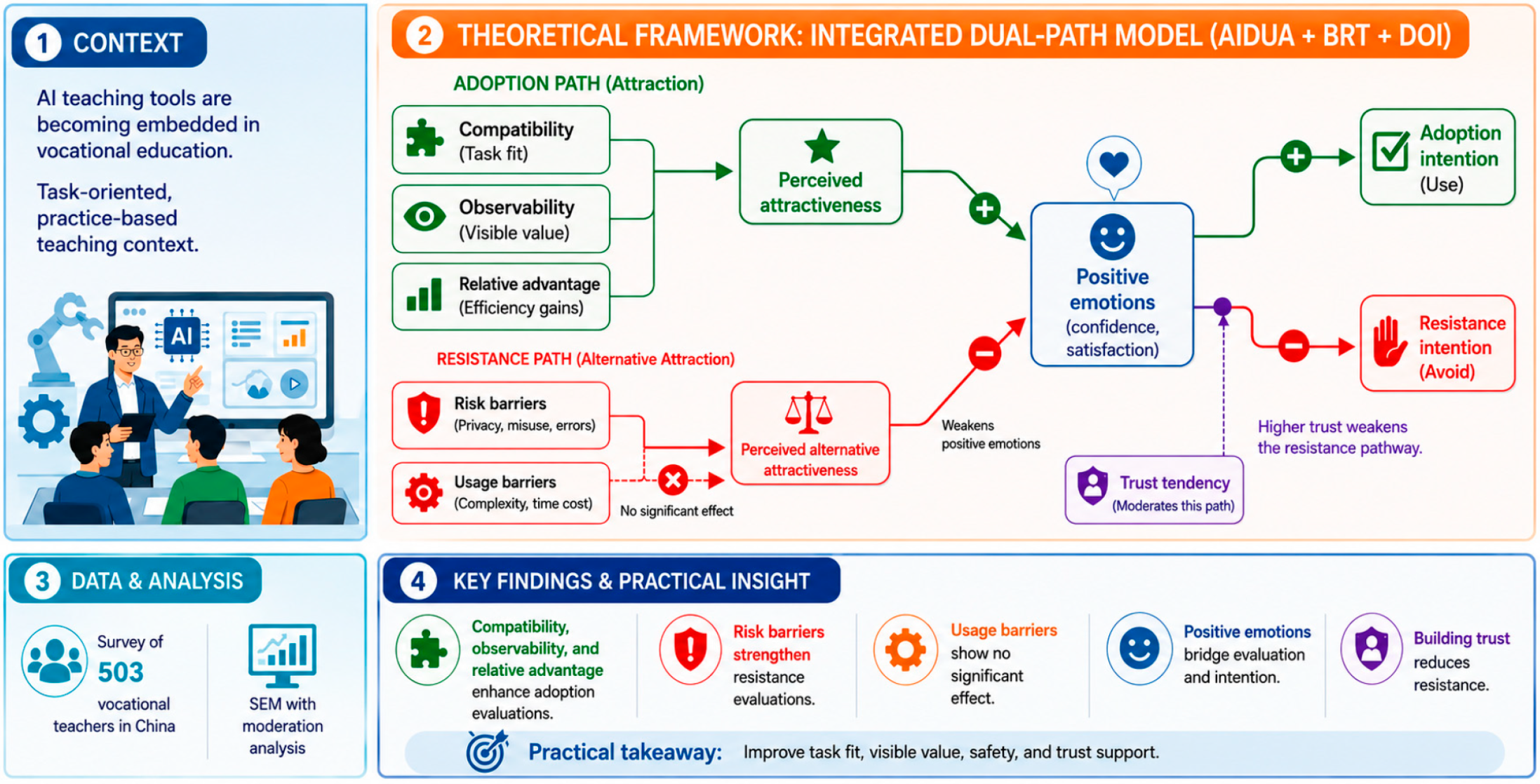
Vocational Teachers’ Adoption of and Resistance to AI Teaching Tools: A Dual-Path Framework


Abstract
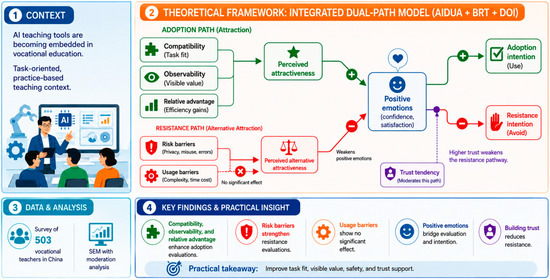
1. Introduction
2. Literature Review and Research Hypotheses
2.1. Vocational College Teachers’ Acceptance of AI Technologies
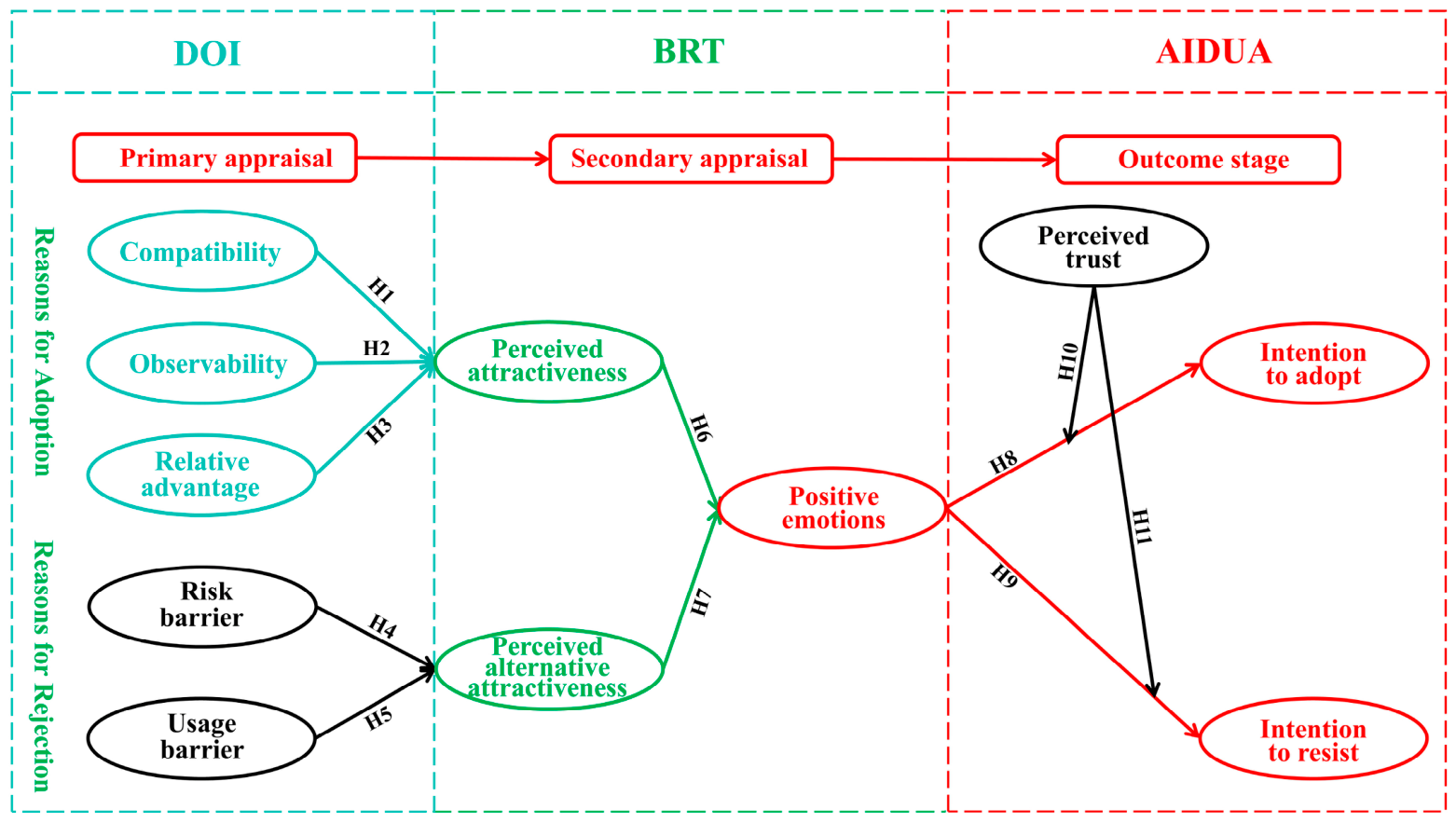
2.2. Theoretical Foundations and Model Development: AIDUA, Behavioral Reasoning Theory, and Innovation Diffusion Theory
2.3. Research Hypotheses
2.3.1. The Effect of Compatibility on Attractiveness
2.3.2. The Effect of Observability on Perceived Attractiveness
2.3.3. The Effect of Relative Advantage on Perceived Attractiveness
2.3.4. The Effect of Risk Barriers on Perceived Alternative Attractiveness
2.3.5. The Effect of Usage Barriers on Perceived Alternative Attractiveness
2.3.6. The Effects of Perceived Attractiveness and Perceived Alternative Attractiveness on Positive Emotions
2.3.7. The Effects of Positive Emotions on Adoption Intention and Resistance Intention
2.3.8. The Moderating Effect of Trust Tendency
3. Methodology
3.1. Measures
3.2. Sample and Data Collection
3.3. Common Method Bias
4. Results and Discussion
4.1. Confirmatory Factor Analysis
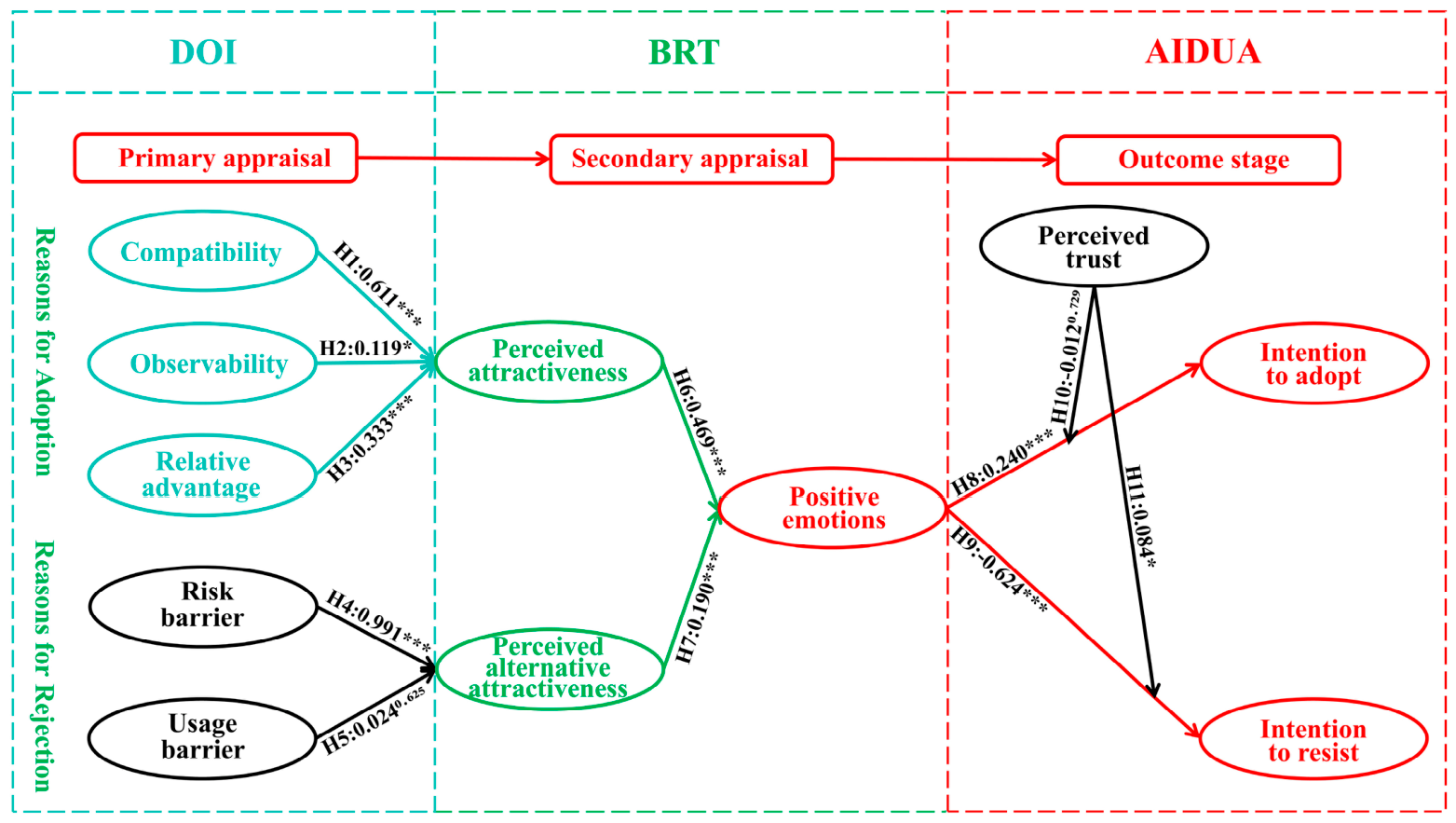
4.2. Structural Model Testing
4.3. Direct, Indirect, and Total Effect Analysis
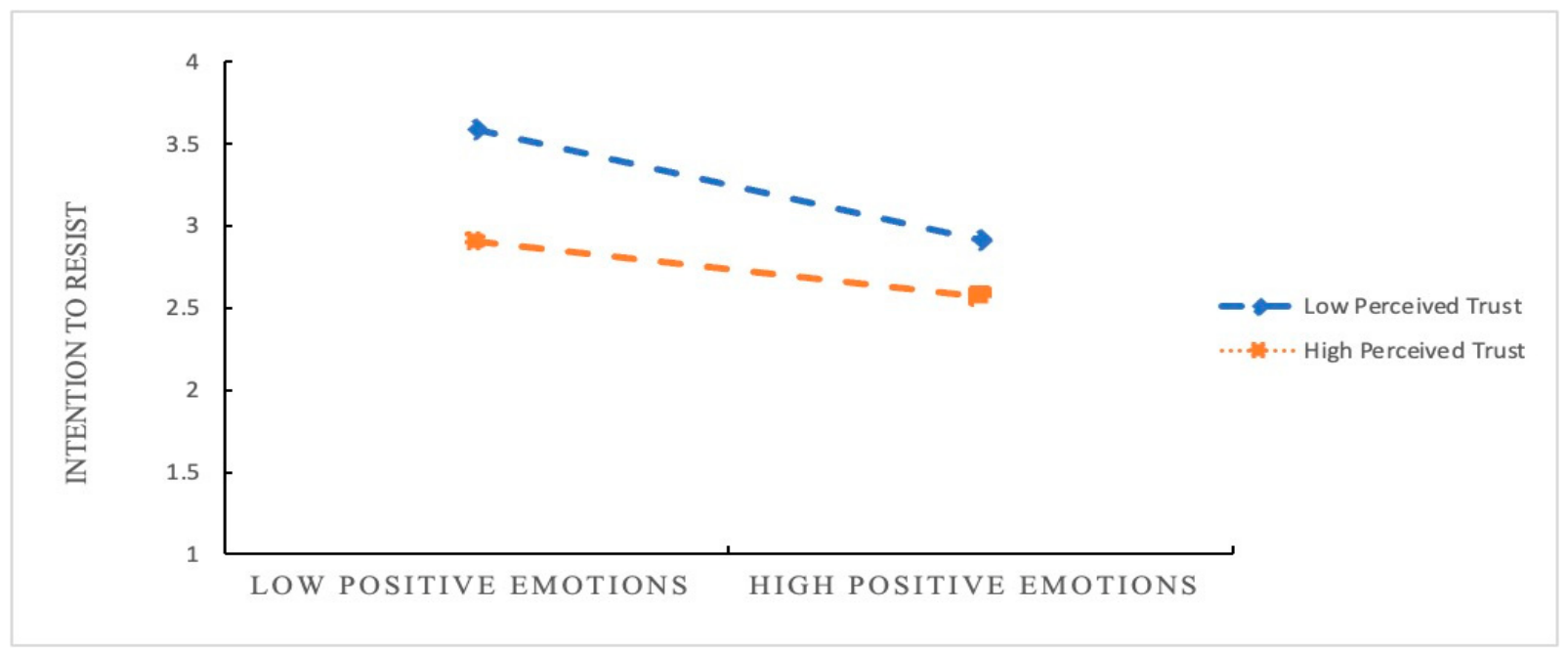
4.4. Moderating Effect Analysis
4.5. Discussion of Results
5. Conclusions
5.1. Theoretical Contributions
5.2. Implications for Management
5.3. Limitations and Future Research
Author Contributions
Funding
Institutional Review Board Statement
Informed Consent Statement
Data Availability Statement
Acknowledgments
Conflicts of Interest
Abbreviations
| AITTs | AI-based teaching tools |
| AIDUA | Artificial Intelligence Device Use Acceptance |
| BRT | Behavioral Reasoning Theory |
| DOI | Diffusion of Innovation |
Appendix A

| Construct | ID | Measurement | Source |
|---|---|---|---|
| Compatibility | COM1 | I believe that AI-based teaching tools align well with my current teaching practices. | Petschnig M et al., 2014 [28] |
| COM2 | I think AI-based teaching tools are consistent with my teaching philosophy and instructional goals. | ||
| COM3 | AI-based teaching tools are compatible with the teaching activities I am familiar with. | ||
| COM4 | The use of AI-based teaching tools does not disrupt my established teaching style. | ||
| COM5 | AI-based teaching tools can be easily integrated into my daily teaching resources. | ||
| Observability | OBS1 | I have observed other teachers successfully using AI-based teaching tools. | |
| OBS2 | I have learned about the applications of AI-based teaching tools through different channels. | ||
| OBS3 | I have seen how AI-based teaching tools improve teaching efficiency. | ||
| OBS4 | I can clearly perceive the benefits of using AI-based teaching tools. | ||
| Relative advantage | REA1 | I think AI-based teaching tools are more effective than traditional methods. | |
| REA2 | I believe AI-based teaching tools help me improve teaching performance. | ||
| REA3 | Using AI-based teaching tools enhances the quality of my classroom instruction. | ||
| REA4 | I believe AI-based teaching tools improve my teaching efficiency. | ||
| REA5 | AI-based teaching tools bring better teaching outcomes than traditional methods. | ||
| Risk barrier | RIB1 | I am concerned about the overall safety of AI-based teaching tools in teaching. | Yuen K F et al., 2020; Zhang C et al., 2025 [29,42] |
| RIB2 | I worry that malfunctions or system failures of AI-based teaching tools may cause teaching accidents. | ||
| RIB3 | I am concerned that AI-based teaching tools collect too much personal information. | ||
| RIB4 | I worry that my personal data could be accessed or exploited by AI-based teaching tools beyond their intended purposes without my explicit consent. | ||
| RIB5 | I am concerned that AI-based teaching tools may share my personal information with other entities without authorization. | ||
| Usage barrier | USB1 | I feel that it is difficult to learn how to use AI-based teaching tools. | Chen C C et al., 2022 [34] |
| USB2 | I find it troublesome to operate AI-based teaching tools. | ||
| USB3 | Using AI-based teaching tools consumes too much time. | ||
| USB4 | It is challenging for me to use AI-based teaching tools without external assistance. | ||
| USB5 | I need extra training to effectively use AI-based teaching tools. | ||
| Perceived attractiveness | PEA1 | Compared with traditional teaching methods or other instructional technologies, I believe that AI-based teaching tools can bring me more benefits. | Koh L Y, Yuen K F, 2024 [16] |
| PEA2 | AI-based teaching tools make me feel interested and motivated. | ||
| PEA3 | I feel positive emotions when using AI-based teaching tools. | ||
| PEA4 | I think AI-based teaching tools are appealing to me. | ||
| PEA5 | I feel encouraged and inspired when using AI-based teaching tools. | ||
| Perceived alternative attractiveness | PEL1 | Compared with AI-based teaching tools, I find traditional teaching methods more reliable. | |
| PEL2 | Compared with AI-based teaching tools, I prefer other educational technologies. | ||
| PEL3 | Compared with AI-based teaching tools, I believe traditional methods are more effective. | ||
| PEL4 | Compared with AI-based teaching tools, I think other methods are more valuable. | ||
| PEL5 | I am more willing to use traditional teaching methods instead of AI-based teaching tools. | ||
| Positive emotions | POE1 | I feel delighted when using AI-based teaching tools. | |
| POE2 | I feel a sense of achievement when AI-based teaching tools help me teach effectively. | ||
| POE3 | I feel excited when using AI-based teaching tools in the classroom. | ||
| POE4 | I am satisfied with my teaching experience when using AI-based teaching tools. | ||
| POE5 | I feel happy when thinking about using AI-based teaching tools in the future. | ||
| Intention to adopt | INA1 | I am likely to adopt AI-based teaching tools in my future instructional practice. | |
| INA2 | I will consider AI-based teaching tools as my first choice for classroom assistance. | ||
| INA3 | I will recommend AI-based teaching tools to my colleagues or students. | ||
| INA4 | I will speak positively about AI-based teaching tools when communicating with others. | ||
| INA5 | I predict that I will continue to use AI-based teaching tools in the future. | ||
| Intention to resist | INR1 | I oppose introducing AI-based teaching tools into the current teaching model. | |
| INR2 | I am unwilling to cooperate in using AI-based teaching tools for teaching activities. | ||
| INR3 | I prefer to continue using traditional teaching methods rather than AI-based teaching tools. | ||
| INR4 | I feel uneasy when using AI-based teaching tools. | ||
| INR5 | I feel resistant to using AI-based teaching tools in teaching. | ||
| Perceived Trust | PT1 | I think that the AI-based teaching tools used in teaching can provide reliable support for my instructional decisions. | Choi S et al., 2023 [2] |
| PT2 | I think that the suggestions or feedback generated by the AI-based teaching tools are fair and unbiased. | ||
| PT3 | I feel that the AI-based teaching tools used in vocational teaching are dependable in practical use. | ||
| PT4 | Overall, I can trust the AI-based teaching tools used in my teaching activities. |
References
- Alwaqdani, M. Investigating teachers’ perceptions of artificial intelligence tools in education: Potential and difficulties. Educ. Inf. Technol. 2025, 30, 2737–2755. [Google Scholar] [CrossRef]
- Choi, S.; Jang, Y.; Kim, H. Influence of pedagogical beliefs and perceived trust on teachers’ acceptance of educational artificial intelligence tools. Int. J. Hum.–Comput. Interact. 2023, 39, 910–922. [Google Scholar] [CrossRef]
- Celik, I. Towards Intelligent-TPACK: An empirical study on teachers’ professional knowledge to ethically integrate artificial intelligence (AI)-based tools into education. Comput. Hum. Behav. 2023, 138, 107468. [Google Scholar] [CrossRef]
- Song, Z.; Qin, J.; Jin, F.; Cheung, W.M.; Lin, C.H. A case study of teachers’ generative artificial intelligence integration processes and factors influencing them. Teach. Teach. Educ. 2025, 165, 105157. [Google Scholar] [CrossRef]
- Liu, Y.; Awang, H.; Mansor, N.S. Exploring the potential barrier factors of AI chatbot usage among teacher trainees: From the perspective of innovation resistance theory. Sustainability 2025, 17, 4081. [Google Scholar] [CrossRef]
- Song, P.; Wang, X. A bibliometric analysis of worldwide educational artificial intelligence research development in recent twenty years. Asia Pac. Educ. Rev. 2020, 21, 473–486. [Google Scholar] [CrossRef]
- Pal, D.; Patra, S. University students’ perception of video-based learning in times of COVID-19: A TAM/TTF perspective. Int. J. Hum.–Comput. Interact. 2021, 37, 903–921. [Google Scholar] [CrossRef]
- Filiz, O.; Kaya, M.H.; Adiguzel, T. Teachers and AI: Understanding the factors influencing AI integration in K-12 education. Educ. Inf. Technol. 2025, 30, 17931–17967. [Google Scholar] [CrossRef]
- McGrath, S.; Yamada, S. Skills for development and vocational education and training: Current and emergent trends. Int. J. Educ. Dev. 2023, 102, 102853. [Google Scholar] [CrossRef]
- Long, Y.; Zhang, X.; Zeng, X. Application and effect analysis of virtual reality technology in vocational education practical training. Educ. Inf. Technol. 2025, 30, 9755–9786. [Google Scholar] [CrossRef]
- Wu, H.; Li, D.; Mo, X. Understanding GAI risk awareness among higher vocational education students: An AI literacy perspective. Educ. Inf. Technol. 2025, 30, 14273–14304. [Google Scholar] [CrossRef]
- Kelly, S.; Kaye, S.A.; Oviedo-Trespalacios, O. What factors contribute to the acceptance of artificial intelligence? A systematic review. Telemat. Inform. 2023, 77, 101925. [Google Scholar] [CrossRef]
- Zhai, X. Transforming teachers’ roles and agencies in the era of generative AI: Perceptions, acceptance, knowledge, and practices. J. Sci. Educ. Technol. 2025, 34, 1323–1333. [Google Scholar] [CrossRef]
- Hazzan-Bishara, A.; Kol, O.; Levy, S. The factors affecting teachers’ adoption of AI technologies: A unified model of external and internal determinants. Educ. Inf. Technol. 2025, 30, 15043–15069. [Google Scholar] [CrossRef]
- Gursoy, D.; Chi, O.H.; Lu, L.; Nunkoo, R. Consumers acceptance of artificially intelligent (AI) device use in service delivery. Int. J. Inf. Manag. 2019, 49, 157–169. [Google Scholar] [CrossRef]
- Koh, L.Y.; Yuen, K.F. The role of motivators, barriers, attractiveness, and positive emotions on consumers’ intention to adopt and resist self-driving delivery robots. J. Retail. Consum. Serv. 2024, 81, 103998. [Google Scholar] [CrossRef]
- Westaby, J.D. Behavioral reasoning theory: Identifying new linkages underlying intentions and behavior. Organ. Behav. Hum. Decis. Process. 2005, 98, 97–120. [Google Scholar] [CrossRef]
- Rogers, E.M.; Singhal, A.; Quinlan, M.M. Diffusion of innovations 1. In An Integrated Approach to Communication Theory and Research; Routledge: London, UK, 2019; pp. 415–434. [Google Scholar]
- Zhang, C.; Schießl, J.; Plößl, L.; Hofmann, F.; Gläser-Zikuda, M. Acceptance of artificial intelligence among pre-service teachers: A multigroup analysis. Int. J. Educ. Technol. High. Educ. 2023, 20, 49. [Google Scholar] [CrossRef]
- Alhwaiti, M. Acceptance of artificial intelligence application in the post-covid ERA and its impact on faculty members’ occupational well-being and teaching self efficacy: A path analysis using the utaut 2 model. Appl. Artif. Intell. 2023, 37, 2175110. [Google Scholar] [CrossRef]
- Hu, L.; Wang, H.; Xin, Y. Factors influencing Chinese pre-service teachers’ adoption of generative AI in teaching: An empirical study based on UTAUT2 and PLS-SEM. Educ. Inf. Technol. 2025, 30, 12609–12631. [Google Scholar] [CrossRef]
- Guo, S.; Shi, L.; Zhai, X. Developing and validating an instrument for teachers’ acceptance of artificial intelligence in education. Educ. Inf. Technol. 2025, 30, 13439–13461. [Google Scholar] [CrossRef]
- Xu, S.; Chen, P.; Zhang, G. Exploring Chinese university educators’ acceptance and intention to use AI tools: An application of the UTAUT2 model. Sage Open 2024, 14, 21582440241290013. [Google Scholar] [CrossRef]
- Zhao, J.; Li, S.; Zhang, J. Understanding teachers’ adoption of AI technologies: An empirical study from Chinese middle schools. Systems 2025, 13, 302. [Google Scholar] [CrossRef]
- Rogers, E.M. Diffusion of Innovations/Everett M. rogers; Simon and Schuster: New York, NY, USA, 2003; p. 576. [Google Scholar]
- Wut, T.M.; Ka-man Sum, C.; Shun-mun Wong, H. Does perceived risk of AI matter? Teachers’ AI literacy and institutional support: Perspective from self-determination theory. Educ. Inf. Technol. 2025, 30, 23271–23293. [Google Scholar] [CrossRef]
- Frei-Landau, R.; Muchnik-Rozanov, Y.; Avidov-Ungar, O. Using Rogers’ diffusion of innovation theory to conceptualize the mobile-learning adoption process in teacher education in the COVID-19 era. Educ. Inf. Technol. 2022, 27, 12811–12838. [Google Scholar] [CrossRef] [PubMed]
- Petschnig, M.; Heidenreich, S.; Spieth, P. Innovative alternatives take action–Investigating determinants of alternative fuel vehicle adoption. Transp. Res. Part A Policy Pract. 2014, 61, 68–83. [Google Scholar] [CrossRef]
- Yuen, K.F.; Wong, Y.D.; Ma, F.; Wang, X. The determinants of public acceptance of autonomous vehicles: An innovation diffusion perspective. J. Clean. Prod. 2020, 270, 121904. [Google Scholar] [CrossRef]
- Pinho, C.; Franco, M.; Mendes, L. Application of innovation diffusion theory to the E-learning process: Higher education context. Educ. Inf. Technol. 2021, 26, 421–440. [Google Scholar] [CrossRef]
- Yin, J.; Qiu, X. AI technology and online purchase intention: Structural equation model based on perceived value. Sustainability 2021, 13, 5671. [Google Scholar] [CrossRef]
- Cabeza-Ramírez, L.J.; Sánchez-Cañizares, S.M.; Santos-Roldán, L.M.; Fuentes-García, F.J. Impact of the perceived risk in influencers’ product recommendations on their followers’ purchase attitudes and intention. Technol. Forecast. Soc. Change 2022, 184, 121997. [Google Scholar] [CrossRef]
- Adu-Gyamfi, G.; Song, H.; Obuobi, B.; Nketiah, E.; Wang, H.; Cudjoe, D. Who will adopt? Investigating the adoption intention for battery swap technology for electric vehicles. Renew. Sustain. Energy Rev. 2022, 156, 111979. [Google Scholar] [CrossRef]
- Chen, C.C.; Chang, C.H.; Hsiao, K.L. Exploring the factors of using mobile ticketing applications: Perspectives from innovation resistance theory. J. Retail. Consum. Serv. 2022, 67, 102974. [Google Scholar] [CrossRef]
- Huang, D.; Jin, X.; Coghlan, A. Advances in consumer innovation resistance research: A review and research agenda. Technol. Forecast. Soc. Change 2021, 166, 120594. [Google Scholar] [CrossRef]
- Ray, A.; Bala, P.K.; Dwivedi, Y.K. Exploring barriers affecting eLearning usage intentions: An NLP-based multi-method approach. Behav. Inf. Technol. 2022, 41, 1002–1018. [Google Scholar] [CrossRef]
- Schrepp, M.; Held, T.; Laugwitz, B. The influence of hedonic quality on the attractiveness of user interfaces of business management software. Interact. Comput. 2006, 18, 1055–1069. [Google Scholar] [CrossRef]
- Perugini, M.; Bagozzi, R.P. The role of desires and anticipated emotions in goal-directed behaviours: Broadening and deepening the theory of planned behaviour. Br. J. Soc. Psychol. 2001, 40, 79–98. [Google Scholar] [CrossRef]
- Kim, M.; Beehr, T.A. Empowering leadership improves employees’ positive psychological states to result in more favorable behaviors. Int. J. Hum. Resour. Manag. 2023, 34, 2002–2038. [Google Scholar] [CrossRef]
- Lazarus, R.S. Cognition and motivation in emotion. Am. Psychol. 1991, 46, 352. [Google Scholar] [CrossRef]
- Lin, H.; Chi, O.H.; Gursoy, D. Antecedents of customers’ acceptance of artificially intelligent robotic device use in hospitality services. J. Hosp. Mark. Manag. 2020, 29, 530–549. [Google Scholar] [CrossRef]
- Zhang, C.; Hu, M.; Wu, W.; Kamran, F.; Wang, X. Unpacking perceived risks and AI trust influences pre-service teachers’ AI acceptance: A structural equation modeling-based multi-group analysis. Educ. Inf. Technol. 2025, 30, 2645–2672. [Google Scholar] [CrossRef]
- Lucas, M.; Zhang, Y.; Bem-Haja, P.; Vicente, P.N. The interplay between teachers’ trust in artificial intelligence and digital competence. Educ. Inf. Technol. 2024, 29, 22991–23010. [Google Scholar] [CrossRef]
- Luo, Y.; Zhou, G.; Cui, Y. Understanding generative artificial intelligence adoption in higher education faculty: Evidence from Chinese Universities and technical and vocational colleges. Educ. Inf. Technol. 2026, 31, 1711–1751. [Google Scholar] [CrossRef]
- Meade, A.W.; Craig, S.B. Identifying careless responses in survey data. Psychol. Methods 2012, 17, 437. [Google Scholar] [CrossRef]
- Ding, N.; Hu, L.; Kim, K.T.; Chen, M. When Generative Artificial Intelligence Becomes a Colleague: Dual Pathways of Empowerment and Depletion in University Design Teachers’ Work Behaviors. Sustainability 2026, 18, 1775. [Google Scholar] [CrossRef]
- Podsakoff, P.M.; MacKenzie, S.B.; Podsakoff, N.P. Sources of method bias in social science research and recommendations on how to control it. Annu. Rev. Psychol. 2012, 63, 539–569. [Google Scholar] [CrossRef] [PubMed]
- Huang, Y.; Jiang, M.; Dai, Z.; Hu, C. Empowering future educators: How school connectedness relates to employability through future work self salience and learning engagement. BMC Psychol. 2026, 14, 223. [Google Scholar] [CrossRef] [PubMed]
- Hair, J.F.; Risher, J.J.; Sarstedt, M.; Ringle, C.M. When to use and how to report the results of PLS-SEM. Eur. Bus. Rev. 2019, 31, 2–24. [Google Scholar] [CrossRef]
- Anderson, J.C.; Gerbing, D.W. Structural equation modeling in practice: A review and recommended two-step approach. Psychol. Bull. 1988, 103, 411. [Google Scholar] [CrossRef]
- Fornell, C.; Larcker, D.F. Evaluating structural equation models with unobservable variables and measurement error. J. Mark. Res. 1981, 18, 39–50. [Google Scholar] [CrossRef]
- Shuraida, S.; Titah, R. An examination of cloud computing adoption decisions: Rational choice or cognitive bias? Technol. Soc. 2023, 74, 102284. [Google Scholar] [CrossRef]
- Mobarak, A.M.; Saldanha, N.A. Remove barriers to technology adoption for people in poverty. Nat. Hum. Behav. 2022, 6, 480–482. [Google Scholar] [CrossRef]
- Mahmud, H.; Islam, A.N.; Mitra, R.K. What drives managers towards algorithm aversion and how to overcome it? Mitigating the impact of innovation resistance through technology readiness. Technol. Forecast. Soc. Change 2023, 193, 122641. [Google Scholar] [CrossRef]
- Lee, G.; Kim, Y. Effects of resistance barriers to service robots on alternative attractiveness and intention to use. Sage Open 2022, 12, 21582440221099293. [Google Scholar] [CrossRef]
- Kim, H.W.; Kankanhalli, A. Investigating user resistance to information systems implementation: A status quo bias perspective1. MIS Q. 2009, 33, 567–582. [Google Scholar] [CrossRef]
- Huang, D.; Chen, Q.; Huang, S.; Liu, X. Consumer intention to use service robots: A cognitive–affective–conative framework. Int. J. Contemp. Hosp. Manag. 2024, 36, 1893–1913. [Google Scholar] [CrossRef]
- Ribeiro, M.A.; Gursoy, D.; Chi, O.H. Customer acceptance of autonomous vehicles in travel and tourism. J. Travel Res. 2022, 61, 620–636. [Google Scholar] [CrossRef]
- Gerli, P.; Clement, J.; Esposito, G.; Mora, L.; Crutzen, N. The hidden power of emotions: How psychological factors influence skill development in smart technology adoption. Technol. Forecast. Soc. Change 2022, 180, 121721. [Google Scholar] [CrossRef]
- Glikson, E.; Woolley, A.W. Human trust in artificial intelligence: Review of empirical research. Acad. Manag. Ann. 2020, 14, 627–660. [Google Scholar] [CrossRef]
- Kaplan, A.D.; Kessler, T.T.; Brill, J.C.; Hancock, P.A. Trust in artificial intelligence: Meta-analytic findings. Hum. Factors 2023, 65, 337–359. [Google Scholar] [CrossRef]
- Henriksen, D.; Creely, E.; Gruber, N.; Leahy, S. Social-emotional learning and generative AI: A critical literature review and framework for teacher education. J. Teach. Educ. 2025, 76, 312–328. [Google Scholar] [CrossRef]
- Mouta, A.; Torrecilla-Sánchez, E.M.; Pinto-Llorente, A.M. Comprehensive professional learning for teacher agency in addressing ethical challenges of AIED: Insights from educational design research. Educ. Inf. Technol. 2025, 30, 3343–3387. [Google Scholar] [CrossRef]
- Nazaretsky, T.; Ariely, M.; Cukurova, M.; Alexandron, G. Teachers’ trust in AI-powered educational technology and a professional development program to improve it. Br. J. Educ. Technol. 2022, 53, 914–931. [Google Scholar] [CrossRef]



| Construct | Item | Mean | SD | Loadings | Cronbach’s Alpha | AVE | CR |
|---|---|---|---|---|---|---|---|
| Compatibility | COM1 | 3.493 | 1.015 | 0.706 | 0.843 | 0.518 | 0.843 |
| COM2 | 0.730 | ||||||
| COM3 | 0.716 | ||||||
| COM4 | 0.709 | ||||||
| COM5 | 0.738 | ||||||
| Observability | OBS1 | 3.517 | 0.966 | 0.702 | 0.816 | 0.526 | 0.816 |
| OBS2 | 0.729 | ||||||
| OBS3 | 0.745 | ||||||
| OBS4 | 0.725 | ||||||
| Relative advantage | RA1 | 3.544 | 0.945 | 0.889 | 0.900 | 0.649 | 0.902 |
| RA2 | 0.791 | ||||||
| RA3 | 0.742 | ||||||
| RA4 | 0.808 | ||||||
| RA5 | 0.792 | ||||||
| Risk barrier | RB1 | 3.053 | 1.091 | 0.699 | 0.785 | 0.550 | 0.786 |
| RB2 | 0.763 | ||||||
| RB3 | 0.762 | ||||||
| Usage barrier | UB1 | 3.026 | 1.058 | 0.832 | 0.898 | 0.750 | 0.900 |
| UB2 | 0.917 | ||||||
| UB3 | 0.847 | ||||||
| Perceived attractiveness | PA1 | 3.554 | 0.910 | 0.878 | 0.903 | 0.653 | 0.904 |
| PA2 | 0.782 | ||||||
| PA3 | 0.770 | ||||||
| PA4 | 0.782 | ||||||
| PA5 | 0.824 | ||||||
| Perceived alternative attractiveness | PAA1 | 2.864 | 1.010 | 0.894 | 0.923 | 0.709 | 0.924 |
| PAA2 | 0.850 | ||||||
| PAA3 | 0.735 | ||||||
| PAA4 | 0.882 | ||||||
| PAA5 | 0.841 | ||||||
| Positive emotions | PE1 | 3.317 | 0.971 | 0.707 | 0.847 | 0.525 | 0.847 |
| PE2 | 0.668 | ||||||
| PE3 | 0.780 | ||||||
| PE4 | 0.729 | ||||||
| PE5 | 0.735 | ||||||
| Intention to adopt | IA1 | 3.628 | 0.908 | 0.797 | 0.870 | 0.574 | 0.870 |
| IA2 | 0.701 | ||||||
| IA3 | 0.782 | ||||||
| IA4 | 0.749 | ||||||
| IA5 | 0.754 | ||||||
| Intention to resist | IR1 | 3.045 | 1.021 | 0.724 | 0.850 | 0.531 | 0.850 |
| IR2 | 0.736 | ||||||
| IR3 | 0.737 | ||||||
| IR4 | 0.717 | ||||||
| IR5 | 0.730 | ||||||
| Perceived Trust | PT1 | 3.235 | 1.163 | 0.791 | 0.878 | 0.642 | 0.878 |
| PT2 | 0.805 | ||||||
| PT3 | 0.808 | ||||||
| PT4 | 0.802 |
| PT | PA | IR | IA | PAA | PE | UB | RB | RA | OBS | COM | |
|---|---|---|---|---|---|---|---|---|---|---|---|
| PT | 0.801 a | ||||||||||
| PA | 0.622 | 0.808 | |||||||||
| IR | −0.505 | −0.64 | 0.729 | ||||||||
| IA | 0.137 | 0.143 | −0.109 | 0.758 | |||||||
| PAA | −0.541 | −0.665 | 0.569 | −0.158 | 0.842 | ||||||
| PE | 0.648 | 0.686 | −0.485 | 0.191 | −0.594 | 0.725 | |||||
| UB | −0.377 | −0.417 | 0.314 | −0.069 | 0.321 | −0.523 | 0.866 | ||||
| RB | −0.543 | −0.692 | 0.583 | −0.098 | 0.653 | −0.632 | 0.405 | 0.742 | |||
| RA | 0.619 | 0.681 | −0.573 | 0.104 | −0.639 | 0.661 | −0.516 | −0.622 | 0.806 | ||
| OBS | 0.394 | 0.468 | −0.327 | 0.220 | −0.365 | 0.475 | −0.348 | −0.363 | 0.458 | 0.725 | |
| COM | 0.637 | 0.721 | −0.611 | 0.174 | −0.623 | 0.724 | −0.454 | −0.65 | 0.676 | 0.471 | 0.720 |
| Exogenous (i) | Endogenous (j) | ||||
|---|---|---|---|---|---|
| Perceived Attractiveness (1) | Perceived Alternative Attractiveness (2) | Positive Emotions (3) | Intention to Adopt (4) | Intention to Resist (5) | |
| Direct effects (aij) of ‘… | |||||
| Compatibility (1) | 0.611 | — | — | — | — |
| Observability (2) | 0.119 | — | — | — | — |
| Relative advantage (3) | 0.333 | — | — | — | — |
| Risk barrier (4) | — | 0.991 | — | — | — |
| Usage barrier (5) | — | — | — | — | — |
| Perceived attractiveness (6) | — | — | 0.469 | — | — |
| Perceived alternative attractiveness (7) | — | — | −0.190 | — | — |
| Positive emotions (8) | — | — | — | 0.240 | −0.624 |
| Indirect effects (bij) of ‘… | |||||
| Compatibility (1) | — | — | 0.287 | 0.069 | −0.179 |
| Observability (2) | — | — | 0.056 | 0.013 | −0.035 |
| Relative advantage (3) | — | — | 0.156 | 0.037 | −0.097 |
| Risk barrier (4) | — | — | −0.188 | −0.045 | 0.117 |
| Usage barrier (5) | — | — | — | — | — |
| Perceived attractiveness (6) | — | — | — | 0.113 | −0.293 |
| Perceived alternative attractiveness (7) | — | — | — | −0.046 | 0.119 |
| Positive emotions (8) | — | — | — | — | — |
| Total effects (cij) of ‘… | |||||
| Compatibility (1) | 0.611 | — | 0.287 | 0.069 | −0.179 |
| Observability (2) | 0.119 | — | 0.056 | 0.013 | −0.035 |
| Relative advantage (3) | 0.333 | — | 0.156 | 0.037 | −0.097 |
| Risk barrier (4) | — | 0.991 | −0.188 | −0.045 | 0.117 |
| Usage barrier (5) | — | — | — | — | — |
| Perceived attractiveness (6) | — | — | 0.469 | 0.113 | −0.293 |
| Perceived alternative attractiveness (7) | — | — | −0.190 | −0.046 | 0.119 |
| Positive emotions (8) | — | — | — | 0.240 | −0.624 |
Disclaimer/Publisher’s Note: The statements, opinions and data contained in all publications are solely those of the individual author(s) and contributor(s) and not of MDPI and/or the editor(s). MDPI and/or the editor(s) disclaim responsibility for any injury to people or property resulting from any ideas, methods, instructions or products referred to in the content. |
© 2026 by the authors. Licensee MDPI, Basel, Switzerland. This article is an open access article distributed under the terms and conditions of the Creative Commons Attribution (CC BY) license.
Share and Cite
Wang, J.; Li, J.; Ni, Y. Vocational Teachers’ Adoption of and Resistance to AI Teaching Tools: A Dual-Path Framework. Information 2026, 17, 544. https://doi.org/10.3390/info17060544
Wang J, Li J, Ni Y. Vocational Teachers’ Adoption of and Resistance to AI Teaching Tools: A Dual-Path Framework. Information. 2026; 17(6):544. https://doi.org/10.3390/info17060544
Chicago/Turabian StyleWang, Jiaqi, Jing Li, and Yao Ni. 2026. "Vocational Teachers’ Adoption of and Resistance to AI Teaching Tools: A Dual-Path Framework" Information 17, no. 6: 544. https://doi.org/10.3390/info17060544
APA StyleWang, J., Li, J., & Ni, Y. (2026). Vocational Teachers’ Adoption of and Resistance to AI Teaching Tools: A Dual-Path Framework. Information, 17(6), 544. https://doi.org/10.3390/info17060544