Trustworthy Assessment of University Competitiveness Using a Neural Network Model


Abstract
1. Introduction
- (1)
- To what extent can neural network models accurately predict the competitiveness of universities based on empirical data?
- (2)
- How can explainable AI techniques contribute to trustworthy and sustainable neural network–based assessments of university competitiveness by improving transparency and interpretability, and which factors emerge as the most influential?
2. National Research Assessment Systems and University Competitive Position
2.1. Research Evaluation as a Basis for Public Fund Allocation
2.2. Competitive Position of Universities
2.3. The Increasing Role of Evaluation and Prediction Methods
3. Methodology
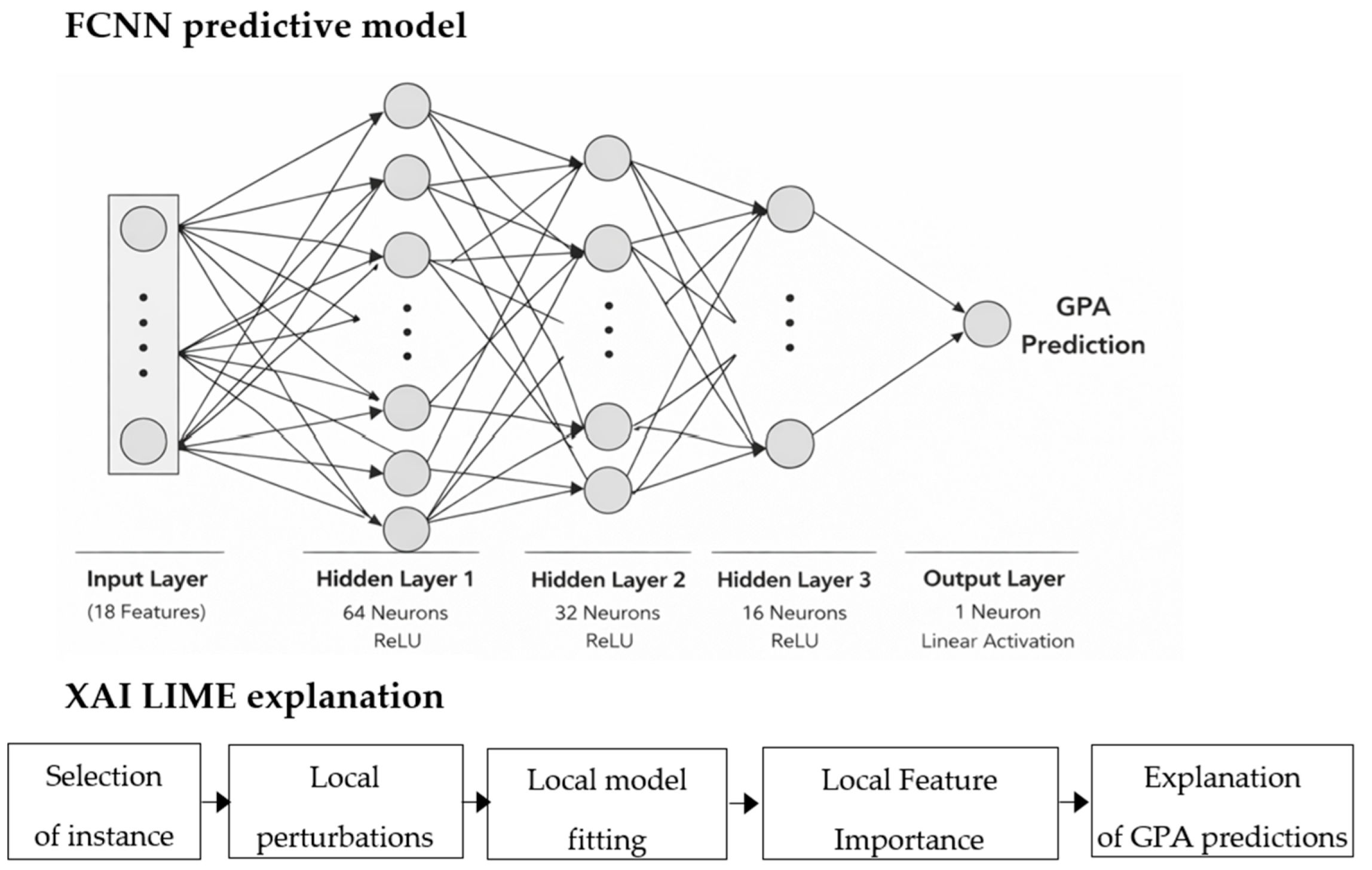
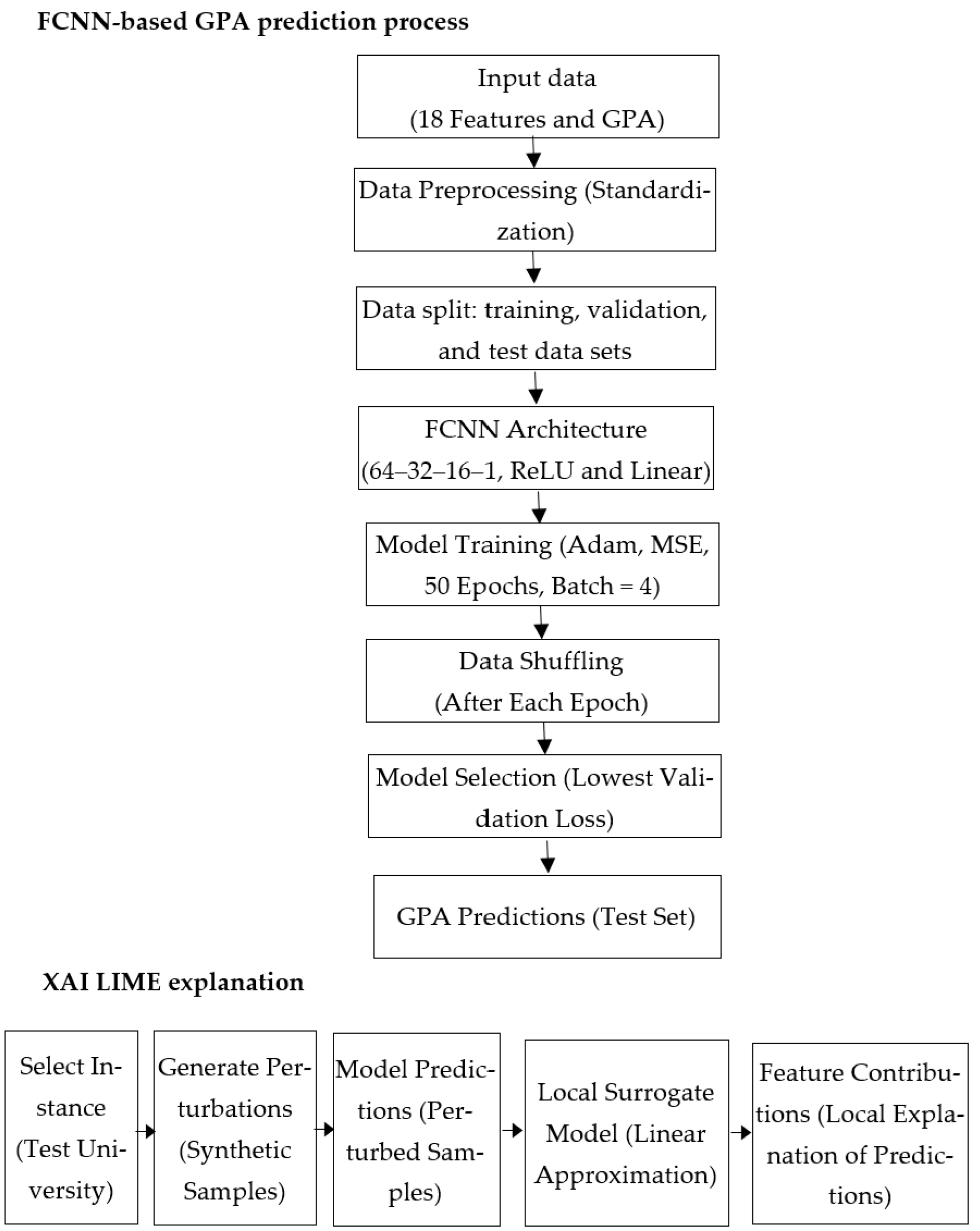
- An individual instance is first selected as the target of the explanation and justification process.
- A synthetic dataset is then created by introducing random perturbations in the vicinity of the selected instance.
- The trained neural network, treated as a black box model, is applied to the perturbed instances to obtain corresponding predictions.
- Each perturbed sample is assigned a proximity-based weight, reflecting its similarity to the original instance and determining its relative influence in the explanation process.
- The most relevant features contributing to the neural network’s prediction are identified based on the perturbed data.
- A simplified and interpretable surrogate model is subsequently trained using the weighted perturbed samples.
- Finally, the local behavior of the neural network is explained by analyzing the feature contributions derived from the surrogate model.
4. Results and Discussion
5. Conclusions
5.1. Methodological Contributions
5.2. Limitations and Directions for Future Research
Funding
Institutional Review Board Statement
Informed Consent Statement
Data Availability Statement
Acknowledgments
Conflicts of Interest
Abbreviations
| FCNN | Fully Connected Neural Network |
| LIME | Local Interpretable Model-agnostic Explanations |
| REF | Research Excellence Framework |
| GPA | Grade Point Average |
| UoAs | Units of Assessment |
| ERA | Excellence in Research for Australia |
| PBRF | Performance-Based Research Fund |
| RCN | Research Council of Norway |
| RAE | Research Assessment Exercise |
| GDPR | General Data Protection Regulation |
| BART | Bayesian Additive Regression Trees |
| ReLU | Rectified Linear Unit |
| MSE | Mean Squared Error |
| MCDA | Multi-Criteria Decision Analysis |
| XAI | Explainable AI |
References
- Wood, T.; Wilner, A. Research Impact Assessment: Developing and Applying a Viable Model for the Social Sciences. Res. Eval. 2024, 35, rvae022. [Google Scholar] [CrossRef]
- Kosmützky, A.; Meier, F. Competing: An Analytical Framework and Application in Higher Education. Stud. High. Educ. 2025, 51, 18–38. [Google Scholar] [CrossRef]
- Omodei, E.; De Domenico, M.; Arenas, A. Evaluating the Impact of Interdisciplinary Research: A Multilayer Network Approach. Netw. Sci. 2017, 5, 235–246. [Google Scholar] [CrossRef]
- Pinar, M.; Unlu, E. Evaluating the Potential Effect of the Increased Importance of the Impact Component in the Research Excellence Framework of the UK. Br. Educ. Res. J. 2020, 46, 140–160. [Google Scholar] [CrossRef]
- Traag, V.A.; Waltman, L. Systematic Analysis of Agreement between Metrics and Peer Review in the UK REF. Palgrave Commun. 2019, 5, 29. [Google Scholar] [CrossRef]
- Pride, D.; Knoth, P. Peer Review and Citation Data in Predicting University Rankings, a Large-Scale Analysis. In Digital Libraries for Open Knowledge; Méndez, E., Crestani, F., Ribeiro, C., David, G., Lopes, J.C., Eds.; Lecture Notes in Computer Science; Springer International Publishing: Cham, Switzerland, 2018; Volume 11057, pp. 195–207. [Google Scholar]
- Bendickson, J. Building Entrepreneurship Research for Impact: Scope, Phenomenon, and Translation. J. Small Bus. Manag. 2021, 59, 535–543. [Google Scholar] [CrossRef]
- Wickert, C.; Post, C.; Doh, J.P.; Prescott, J.E.; Prencipe, A. Management Research That Makes a Difference: Broadening the Meaning of Impact. J. Manag. Stud. 2021, 58, 297–320. [Google Scholar] [CrossRef]
- Marginson, S.; Yang, L. Higher Education and Public Good in England. High Educ. 2025, 89, 183–203. [Google Scholar] [CrossRef]
- Zacharewicz, T.; Lepori, B.; Reale, E.; Jonkers, K. Performance-Based Research Funding in EU Member States—A Comparative Assessment. Sci. Public Policy 2019, 46, 105–115. [Google Scholar] [CrossRef]
- Menter, M.; Lehmann, E.E.; Klarl, T. In Search of Excellence: A Case Study of the First Excellence Initiative of Germany. J. Bus. Econ. 2018, 88, 1105–1132. [Google Scholar] [CrossRef]
- Pinar, M.; Horne, T.J. Assessing Research Excellence: Evaluating the Research Excellence Framework. Res. Eval. 2022, 31, 173–187. [Google Scholar] [CrossRef]
- Dotti, N.F.; Walczyk, J. What Is the Societal Impact of University Research? A Policy-Oriented Review to Map Approaches, Identify Monitoring Methods and Success Factors. Eval. Program Plan. 2022, 95, 102157. [Google Scholar] [CrossRef] [PubMed]
- Liu, P.; Lai, Y.; Liu, D. Artificial Intelligence Research in Organizations: A Bibliometric Approach. Cogent Bus. Manag. 2024, 11, 2408439. [Google Scholar] [CrossRef]
- Forero-Corba, W.; Negre Bennasar, F. Técnicas y Aplicaciones Del Machine Learning e Inteligencia Artificial En Educación: Una Revisión Sistemática. RIED-Rev. Iberoam. Educ. Distancia 2023, 27, 209–253. [Google Scholar] [CrossRef]
- Cheng, Y.; Weng, S.; Cui, Z. An Exploration of the Path for Artificial Intelligence to Assist in the Competitive Performance Evaluation in University. In Advances in Transdisciplinary Engineering; Hu, Z., Zhang, Q., He, M., Wang, C., Yanovsky, F., Eds.; IOS Press: Amsterdam, The Netherlands, 2026. [Google Scholar]
- Blackburn, R.; Dibb, S.; Tonks, I. Business and Management Studies in the United Kingdom’s 2021 Research Excellence Framework: Implications for Research Quality Assessment. Br. J. Manag. 2024, 35, 434–448. [Google Scholar] [CrossRef]
- Li, D.; Lo, W.Y.W.; Yang, R. Unpacking the Discourse Surrounding the Impact Agenda in the Hong Kong Research Assessment Exercise 2020. Res. Eval. 2024, 33, rvae034. [Google Scholar] [CrossRef]
- Gunn, A.; Mintrom, M. Higher Education Policy Change in Europe: Academic Research Funding and the Impact Agenda. Eur. Educ. 2016, 48, 241–257. [Google Scholar] [CrossRef]
- Grzeszczyk, T.A. Developing Methods for Assessing the Social Impact of Scientific Study. In European Conference on Research Methodology for Business and Management Studies; Academic Conferences International Limited Curtis Farm: Reading, UK, 2024; Volume 23, pp. 121–127. [Google Scholar] [CrossRef]
- Reale, E.; Zinilli, A. Evaluation for the Allocation of University Research Project Funding: Can Rules Improve the Peer Review? Res. Eval. 2017, 26, 190–198. [Google Scholar] [CrossRef]
- Radovanović, M.; Jovčić, S.; Petrovski, A.; Cirkin, E. Evaluation of University Professors Using the Spherical Fuzzy AHP and Grey MARCOS Multi-Criteria Decision-Making Model: A Case Study. Spectr. Decis. Mak. Appl. 2025, 2, 197–217. [Google Scholar] [CrossRef]
- Penfield, T.; Baker, M.J.; Scoble, R.; Wykes, M.C. Assessment, Evaluations, and Definitions of Research Impact: A Review. Res. Eval. 2014, 23, 21–32. [Google Scholar] [CrossRef]
- Crano, W.D.; Brewer, M.B.; Lac, A. Principles and Methods of Social Research, 3rd ed.; Routledge, Taylor & Francis Group: New York, NY, USA; London, UK, 2015. [Google Scholar]
- Krüger, A.K.; Petersohn, S. From Research Evaluation to Research Analytics. The Digitization of Academic Performance Measurement. Valuat. Stud. 2022, 9, 11–46. [Google Scholar] [CrossRef]
- Wilsdon, J. The Metric Tide: Independent Review of the Role of Metrics in Research Assessment and Management; Online-Ausg.; Sage Publications: Los Angeles, CA, USA, 2016. [Google Scholar]
- De Silva, P.U.K.; K. Vance, C. Assessing the Societal Impact of Scientific Research. In Scientific Scholarly Communication; Fascinating Life Sciences; Springer International Publishing: Cham, Switzerland, 2017; pp. 117–132. [Google Scholar]
- Fenby-Hulse, K.; Heywood, E.; Walker, K. (Eds.) Research Impact and the Early-Career Researcher; Routledge: Abingdon, UK; New York, NY, USA, 2019. [Google Scholar]
- Vinkler, P. The Evaluation of Research by Scientometric Indicators; Chandos Pub: Oxford, UK, 2010. [Google Scholar]
- Ter Bogt, H.J.; Scapens, R.W. Performance Management in Universities: Effects of the Transition to More Quantitative Measurement Systems. Eur. Account. Rev. 2012, 21, 451–497. [Google Scholar] [CrossRef]
- Daraio, C.; Bonaccorsi, A.; Simar, L. Rankings and University Performance: A Conditional Multidimensional Approach. Eur. J. Oper. Res. 2015, 244, 918–930. [Google Scholar] [CrossRef]
- Abulibdeh, A.; Baya Chatti, C.; Alkhereibi, A.; El Menshawy, S. A Scoping Review of the Strategic Integration of Artificial Intelligence in Higher Education: Transforming University Excellence Themes and Strategic Planning in the Digital Era. Eur. J. Educ. 2025, 60, e12908. [Google Scholar] [CrossRef]
- Alshkeili, H.M.H.A.; Almheiri, S.J.; Khan, M.A. Privacy-Preserving Interpretability: An Explainable Federated Learning Model for Predictive Maintenance in Sustainable Manufacturing and Industry 4.0. AI 2025, 6, 117. [Google Scholar] [CrossRef]
- Lee, J.; Rew, J. Vision-Language Model-Based Local Interpretable Model-Agnostic Explanations Analysis for Explainable In-Vehicle Controller Area Network Intrusion Detection. Sensors 2025, 25, 3020. [Google Scholar] [CrossRef] [PubMed]
- Grzeszczyk, T.A.; Grzeszczyk, M.K. Justifying Short-Term Load Forecasts Obtained with the Use of Neural Models. Energies 2022, 15, 1852. [Google Scholar] [CrossRef]
- Saarela, M.; Podgorelec, V. Recent Applications of Explainable AI (XAI): A Systematic Literature Review. Appl. Sci. 2024, 14, 8884. [Google Scholar] [CrossRef]
- Grzeszczyk, T.A. Neural Classification of Research Scientific Excellence in Universities. Procedia Comput. Sci. 2025, 270, 5138–5146. [Google Scholar] [CrossRef]
- Raji, A.; Hassan, A. Sustainability and Stakeholder Awareness: A Case Study of a Scottish University. Sustainability 2021, 13, 4186. [Google Scholar] [CrossRef]
- Python Software Foundation 2025. Available online: http://python.org (accessed on 22 September 2025).
- Ribeiro, M.T. Lime: Explaining the Predictions of Any Machine Learning Classifier. 2025. Available online: https://github.com/marcotcr/lime (accessed on 25 September 2025).
- Ribeiro, M.T.; Singh, S.; Guestrin, C. Anchors: High-Precision Model-Agnostic Explanations. In Proceedings of the Thirty-Second AAAI Conference on Artificial Intelligence, New Orleans, LA, USA, 2–7 February 2018; Volume 32. [Google Scholar] [CrossRef]
- Shams Amiri, S.; Mottahedi, S.; Lee, E.R.; Hoque, S. Peeking inside the Black-Box: Explainable Machine Learning Applied to Household Transportation Energy Consumption. Comput. Environ. Urban Syst. 2021, 88, 101647. [Google Scholar] [CrossRef]
- Balbuena, L.D. The UK Research Excellence Framework and the Matthew Effect: Insights from Machine Learning. PLoS ONE 2018, 13, e0207919. [Google Scholar] [CrossRef]
- Balbuena, L.D. UK REF 2014 Analysis Data and R Script V.2. 2025. Available online: https://www.protocols.io/view/uk-ref-2014-analysis-data-and-r-script-j8nlk55y6l5r/v2 (accessed on 5 September 2025).
- Ribeiro, M.T.; Singh, S.; Guestrin, C. “Why Should I Trust You?”: Explaining the Predictions of Any Classifier. In Proceedings of the 22nd ACM SIGKDD International Conference on Knowledge Discovery and Data Mining; ACM: New York, NY, USA, 2016; pp. 1135–1144. [Google Scholar]
- Xia, H.; Ding, Y.; Chen, W.; Zhang, J.; Li, H.; Zhao, H.; Song, R. Measurement Uncertainty Evaluation with Small Samples: A Review and Prospect. Measurement 2026, 258, 119031. [Google Scholar] [CrossRef]
- Papagni, G.; De Pagter, J.; Zafari, S.; Filzmoser, M.; Koeszegi, S.T. Artificial Agents’ Explainability to Support Trust: Considerations on Timing and Context. AI Soc. 2023, 38, 947–960. [Google Scholar] [CrossRef]
- Toderas, M. Artificial Intelligence for Sustainability: A Systematic Review and Critical Analysis of AI Applications, Challenges, and Future Directions. Sustainability 2025, 17, 8049. [Google Scholar] [CrossRef]
- Smart, A.; Kasirzadeh, A. Beyond Model Interpretability: Socio-Structural Explanations in Machine Learning. AI Soc. 2025, 40, 2045–2053. [Google Scholar] [CrossRef]
- Wulff, K.; Finnestrand, H. Creating Meaningful Work in the Age of AI: Explainable AI, Explainability, and Why It Matters to Organizational Designers. AI Soc. 2024, 39, 1843–1856. [Google Scholar] [CrossRef]
- Varma, S.; Simon, R. Bias in Error Estimation When Using Cross-Validation for Model Selection. BMC Bioinform. 2006, 7, 91. [Google Scholar] [CrossRef] [PubMed]
- Raschka, S.; Liu, Y.; Mirjalili, V. Machine Learning with PyTorch and Scikit-Learn: Develop Machine Learning and Deep Learning Models with Python; Packt Publishing: Birmingham, UK, 2022. [Google Scholar]
- Heaton, J. Ian Goodfellow, Yoshua Bengio, and Aaron Courville: Deep Learning. Genet. Program. Evolvable Mach. 2018, 19, 305–307. [Google Scholar] [CrossRef]
- Hastie, T.; Tibshirani, R.; Friedman, J. The Elements of Statistical Learning; Springer Series in Statistics; Springer: New York, NY, USA, 2009. [Google Scholar]
- Roberts, M.; Driggs, D.; Thorpe, M.; Gilbey, J.; Yeung, M.; Ursprung, S.; Aviles-Rivero, A.I.; Etmann, C.; McCague, C.; Beer, L.; et al. Common Pitfalls and Recommendations for Using Machine Learning to Detect and Prognosticate for COVID-19 Using Chest Radiographs and CT Scans. Nat. Mach. Intell. 2021, 3, 199–217. [Google Scholar] [CrossRef]
- Kapoor, S.; Narayanan, A. Leakage and the Reproducibility Crisis in Machine-Learning-Based Science. Patterns 2023, 4, 100804. [Google Scholar] [CrossRef] [PubMed]
- Floridi, L.; Cowls, J.; Beltrametti, M.; Chatila, R.; Chazerand, P.; Dignum, V.; Luetge, C.; Madelin, R.; Pagallo, U.; Rossi, F.; et al. AI4People—An Ethical Framework for a Good AI Society: Opportunities, Risks, Principles, and Recommendations. Minds Mach. 2018, 28, 689–707. [Google Scholar] [CrossRef]
- Ethics Guidelines for Trustworthy AI|Shaping Europe’s Digital Future. Available online: https://digital-strategy.ec.europa.eu/en/library/ethics-guidelines-trustworthy-ai (accessed on 30 January 2026).
- Doshi-Velez, F.; Kim, B. Towards A Rigorous Science of Interpretable Machine Learning. arXiv 2017, arXiv:1702.08608. [Google Scholar] [CrossRef]
- Guidotti, R.; Monreale, A.; Ruggieri, S.; Turini, F.; Pedreschi, D.; Giannotti, F. A Survey Of Methods For Explaining Black Box Models. ACM Comput. Surv. 2018, 51, 1–42. [Google Scholar] [CrossRef]
- Wang, Y.; Fang, X.; Xu, Z.; Li, J.; Wang, L. Exploring the Impact of Explainability in Large Language Model (LLM) Applications on User Experience. In Proceedings of the Extended Abstracts of the CHI Conference on Human Factors in Computing Systems, Yokohama, Japan, 26 April 2025; ACM: New York, NY, USA, 2025; pp. 1–8. [Google Scholar]
- Spannaus, A.; Hanson, H.A.; Tourassi, G.; Penberthy, L. Topological Interpretability for Deep Learning. In Proceedings of the Platform for Advanced Scientific Computing Conference, Zurich, Switzerland, 3 June 2024; ACM: New York, NY, USA, 2024; pp. 1–11. [Google Scholar]
- Hwang, H.; Bell, A.; Fonseca, J.; Pliatsika, V.; Stoyanovich, J.; Whang, S.E. SHAP-Based Explanations Are Sensitive to Feature Representation. In Proceedings of the 2025 ACM Conference on Fairness, Accountability, and Transparency, Athens, Greece, 23 June 2025; ACM: New York, NY, USA, 2025; pp. 1588–1601. [Google Scholar]
- Lundberg, S.; Lee, S.-I. A Unified Approach to Interpreting Model Predictions. In Proceedings of the 31st International Conference on Neural Information Processing Systems; Curran Associates Inc.: Red Hook, NY, USA, 2017; pp. 4768–4777. [Google Scholar]
- Adebayo, J.; Gilmer, J.; Muelly, M.; Goodfellow, I.; Hardt, M.; Kim, B. Sanity Checks for Saliency Maps. In Proceedings of the 32nd International Conference on Neural Information Processing Systems; Curran Associates Inc.: Red Hook, NY, USA, 2018; pp. 9525–9536. [Google Scholar]
- Begoli, E.; Bhattacharya, T.; Kusnezov, D. The Need for Uncertainty Quantification in Machine-Assisted Medical Decision Making. Nat. Mach. Intell. 2019, 1, 20–23. [Google Scholar] [CrossRef]



| Expected Predictive Performance | Interpretability/Explainability | Data Efficiency | Robustness/Low Risk of Misleading Results | Scalability | Prognostic/Decision Utility | |
|---|---|---|---|---|---|---|
| Expert-based MCDA | Low-Moderate | High | High | Low-Moderate | Low-Moderate | Moderate-High |
| FCNN, MLP | Moderate-High | Low | Low | Moderate | High | Moderate |
| Fuzzy Inference Systems | Moderate | High | Moderate–High | Moderate | Moderate | Moderate |
| Case-Based Reasoning | Moderate | High | Moderate | Moderate | Low-Moderate | Low-Moderate |
| FCNN with LIME | High | Moderate-High | Low | Moderate | Moderate | High, if validated and calibrated |
| Variable | Description | Example Value |
|---|---|---|
| GPA | Target variable: overall REF GPA | 3.22 |
| entry_tariff | Average entry tariff indicating the academic qualification of students | 520 |
| websci_docs | Total number of Web of Science publications | 75,168 |
| pctStateSchools | Percentage of students from state schools | 65.7 |
| univ_income | Total institutional income | 940,019 |
| stud_staff_ratio | Student-to-staff ratio | 10.10 |
| pct_phd_faculty | Percentage of academic staff holding a PhD | 55.24 |
| cite_impact | Average citation impact | 1.70 |
Disclaimer/Publisher’s Note: The statements, opinions and data contained in all publications are solely those of the individual author(s) and contributor(s) and not of MDPI and/or the editor(s). MDPI and/or the editor(s) disclaim responsibility for any injury to people or property resulting from any ideas, methods, instructions or products referred to in the content. |
© 2026 by the author. Licensee MDPI, Basel, Switzerland. This article is an open access article distributed under the terms and conditions of the Creative Commons Attribution (CC BY) license.
Share and Cite
Grzeszczyk, T.A. Trustworthy Assessment of University Competitiveness Using a Neural Network Model. Information 2026, 17, 536. https://doi.org/10.3390/info17060536
Grzeszczyk TA. Trustworthy Assessment of University Competitiveness Using a Neural Network Model. Information. 2026; 17(6):536. https://doi.org/10.3390/info17060536
Chicago/Turabian StyleGrzeszczyk, Tadeusz A. 2026. "Trustworthy Assessment of University Competitiveness Using a Neural Network Model" Information 17, no. 6: 536. https://doi.org/10.3390/info17060536
APA StyleGrzeszczyk, T. A. (2026). Trustworthy Assessment of University Competitiveness Using a Neural Network Model. Information, 17(6), 536. https://doi.org/10.3390/info17060536