Article

A Modular Approach to Automated Archery Coaching for Action Quality Assessment and Feedback Generation Using Large Language Models


1
School of Automation, Southeast University, Nanjing 210096, China
2
Department of Physical Education, Southeast University, Nanjing 210096, China
3
Advanced Ocean Institute of Southeast University, Southeast University, Nantong 226010, China
*
Author to whom correspondence should be addressed.
Information 2026, 17(5), 511; https://doi.org/10.3390/info17050511
Submission received: 4 April 2026 / Revised: 14 May 2026 / Accepted: 15 May 2026 / Published: 21 May 2026
(This article belongs to the Section Artificial Intelligence)

Abstract

Archery is a fine-grained skill sport in which small posture deviations can markedly affect performance, motivating the need for reliable automated technique assessment. However, most existing methods still focus on large-amplitude sports and cannot match coach-level nuance. To overcome these limitations, we introduce SEMA (Semantic Evidence-Driven Multimodal Assessment), a large language model (LLM)-based end-to-end system for fine-grained archery action quality assessment. Beyond score prediction and evaluation-text generation, SEMA further supports knowledge-grounded question answering and feedback generation through a hierarchical multi-source knowledge framework that integrates assessment outputs, structured coaching guidance, and general archery knowledge. Experimental results show that SEMA achieves strong performance on the novel AAV dataset, outperforming general-purpose VLMs and adapted prior AQA methods. In addition, we introduce the AAV (Archery Action Video) dataset, the first multimodal, fine-grained action quality assessment (AQA) dataset dedicated to archery, and release it publicly to the community. This dataset addresses a critical gap in current benchmarks for assessing archery action quality and intelligent archery training.

1. Introduction

Archery is a precision sport in which high-quality technique depends on subtle, fine-grained body control and long-term skill accumulation. With the growing popularity and professionalization of archery, the demand for effective instruction and training has increased accordingly. However, in many real-world settings, coaching still relies heavily on manual observation and subjective experience, making feedback costly, inconsistent, and difficult to scale. Developing an intelligent assessment system that can provide accurate, fine-grained, and actionable technique feedback is therefore important for modern archery training.
In parallel, AQA has rapidly evolved as a core topic in sports video understanding, aiming to map spatiotemporal human motion to skill scores and instructional feedback. Meanwhile, recent LLMs and multimodal LLMs have demonstrated strong capabilities in visual understanding and natural-language generation, offering new opportunities to move beyond score regression toward coach-like explanation and guidance.
Despite this progress, existing AQA methods and benchmarks are still largely built around sports with salient, large-amplitude motions. Recent studies have improved temporal modeling, skeletal representation, and score regression for activities such as diving, figure skating, gymnastics, and trampoline, where action quality is often reflected in visually prominent body trajectories, execution rhythm, and global motion patterns [1,2]. However, these settings differ substantially from precision sports such as archery, in which the decisive factors are not always expressed as large-scale movements, but rather as subtle and highly localized kinematic variations, including shoulder–arm alignment, torso stability, head orientation, and other biomechanical factors. Small differences in these factors can significantly influence technical quality and coach-level assessment [3]. Moreover, although recent multimodal and large-model-based approaches have begun to explore expert comment generation for sports training, they usually rely on high-level visual-language representations or predicted skill levels to produce feedback, without explicitly grounding each coaching comment in fine-grained motion evidence and domain-specific evaluation criteria [4]. In addition, large multimodal models are prone to generating plausible but insufficiently grounded explanations when the visual evidence is ambiguous or the domain constraints are weak [5].
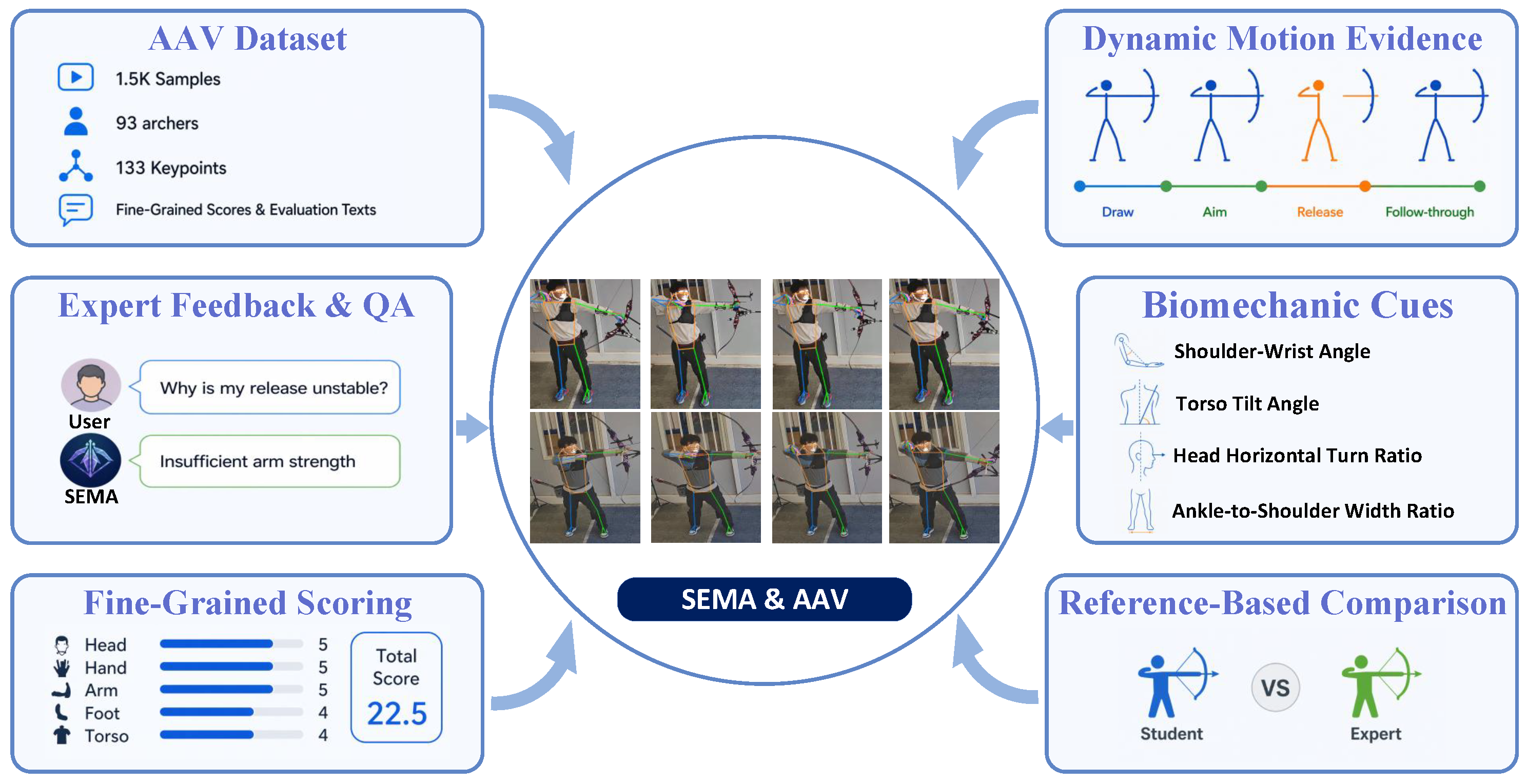
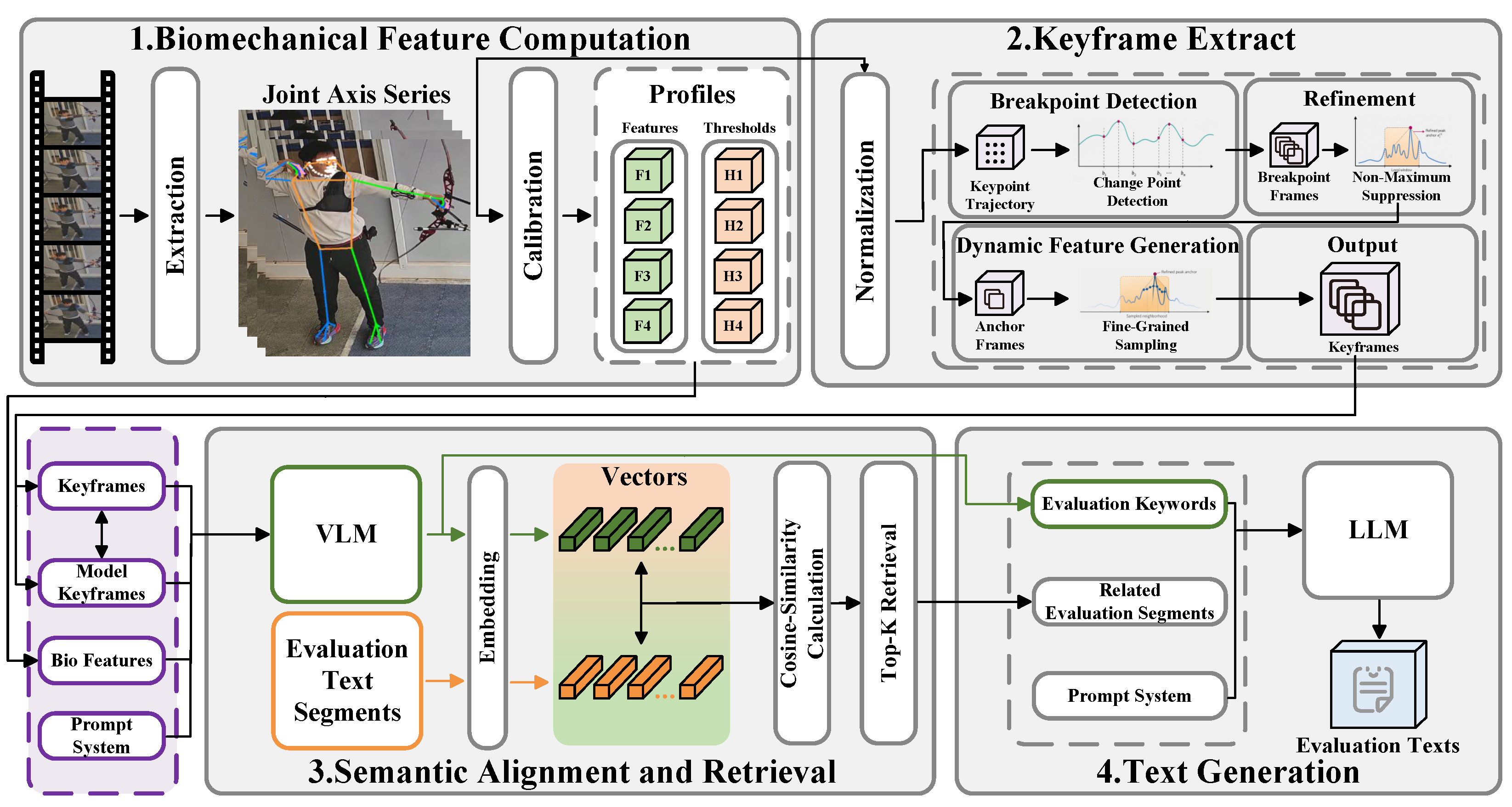
To address these challenges, we propose a new archery AQA paradigm that aligns visual features in archery videos with textual features of professional evaluation reports. Based on this alignment, we leverage the LLM to generate structured, expert-style feedback and body-part-level scores. To further improve faithfulness, professionalism, and usability, we incorporate human biomechanical features, archery motion keyframe sequences, and template keyframe sequences as explicit evidence, and further introduce coach-curated keyword lexicons and fine-grained evaluation rules for archery actions to guide retrieval and feedback generation. Figure 1 provides an overview of our work. Although this study focuses on archery, the same evidence-grounded and knowledge-guided paradigm may also be extended to other sports AQA tasks, such as diving, football, basketball, and other skill-oriented movements, provided that the biomechanical features, key motion phases, evaluation rules, and domain knowledge are adapted to the target sport.
Crucially, implementing such a multimodal, fine-grained evaluation framework requires dedicated data support. However, to the best of our knowledge, there is no publicly available dataset that targets archery with multimodal, fine-grained supervision. Guided by professional archery coaches, we therefore design the dataset schema and annotation protocol and build a fine-grained multimodal dataset to support research on coach-level archery action quality assessment.
The main contributions of this work are summarized as follows:
1.
We propose SEMA, a unified end-to-end system that integrates expert-level action quality scores and instructional feedback based on the archery AQA paradigm.
2.
We introduce AAV, the first multimodal fine-grained archery action quality assessment dataset, which provides expert-authored coaching feedback and body-part-level quality supervision and is released publicly to the community, enabling AQA beyond score prediction.
3.
We present a broadly applicable evaluation protocol that provides practical guidance for assessing similar AQA systems and conduct comprehensive experiments under this protocol to rigorously validate the effectiveness of SEMA.

2. Related Work

2.1. AQA

AQA aims to map spatiotemporal human motion in videos to quality scores. In the standard setting, it is commonly formulated as learning a function f : V s , where V denotes a complete action video and s is a single overall quality score, or a score distribution, for the entire performance. Early works framed AQA as a regression problem using pose-based features and SVR [6], while later methods introduced temporal modeling with LSTM-based architectures to better capture long-range motion dynamics [7,8]. Recent approaches predominantly rely on skeleton-based graph neural networks, which model spatial joint dependencies and their temporal evolution via spatiotemporal graph convolutions [9,10]. To improve scoring reliability, uncertainty-aware score-distribution learning [11] and relative comparison within action groups [12] have also been explored.
Beyond score prediction, recent studies have begun to extend AQA and sports assessment toward multimodal understanding and language-based feedback generation. Seino et al. [4] use a large multimodal model with video and spatiotemporal motion cues to generate skill-level-aware expert comments, while Xu et al. [13] introduce language guidance into audio–visual sports assessment, and FSBench [14] broadens figure-skating research to multimodal question answering and commentary-oriented evaluation. In parallel, general video-language research has substantially improved fine-grained temporal reasoning through Video-LLMs such as VTimeLLM [15], Seq2Time [16], and factorized temporally grounded video-language models [17].
Despite these advances, most existing AQA formulations still target global quality prediction for actions with relatively salient motion patterns. By contrast, fine-grained archery AQA requires a more structured task definition. Given an archery video, the goal is to predict a set of body-part-level scores together with expert-style textual feedback. On the input side, the model must attend to subtle deviations in both the static posture during the aiming phase and the dynamic motion during the release phase. On the output side, it must produce interpretable, criterion-grounded judgments that explain where the technical execution deviates and why. Therefore, this task calls for a framework that can capture fine-grained motion evidence across different phases of the shooting process and translate it into criterion-grounded scoring and feedback. To this end, our approach integrates multimodal motion representations with LLM-based reasoning to produce accurate, fine-grained, and coach-level assessments of archery action quality.

2.2. Sports Video Datasets

Compared with generic action recognition, sports action understanding is substantially more challenging due to homogeneous scenes, highly specialized and similar technical movements, and subtle yet critical motion details. As a result, generic human action datasets are often insufficient, and most studies rely on sports-specific video datasets.
Early efforts mainly focused on large-scale sports action classification and recognition. Karpathy et al. [18] introduced Sports-1M, a large-scale dataset covering hundreds of sports categories, and demonstrated the effectiveness of fine-tuning deep models on sports videos. Safdarnejad et al. [19] proposed SVW, an unconstrained sports video dataset with temporal extent annotations to support action recognition and detection. Moving beyond recognition, Parmar et al. [7] studied Olympic scoring for diving, vault, and figure skating, and released UNLV subsets for diving and vault, laying the groundwork for AQA research. More recent datasets emphasize fine-grained annotations and complex motion modeling. MultiSports [20] provides dense spatiotemporal annotations for multi-person sports scenes, while SportMOT [21] focuses on high-speed multi-object tracking in sports videos. FineSports [22] and TeamTrack [23] further address fine-grained action localization and multi-view tracking in cooperative sports scenarios. For AQA, FineDiving [24] and its extension FineDiving-HM [25] introduce sub-action decomposition and human-centric modeling, significantly enhancing the representation of fine-grained temporal dynamics. In contrast to the datasets above, AAV is the first fine-grained sports video dataset specifically designed for action quality assessment in archery. It incorporates expert-written evaluation and feedback texts together with structured pose annotations, enabling the modeling of subtle, body-part-level technical characteristics and providing high-quality semantic supervision for authoritative archery AQA.

3. Dataset

In this section, we introduce our proposed dataset from four perspectives:
1.
Composition of the dataset.
2.
Statistics of the dataset.
3.
Novelty and advantages of the dataset.
4.
The process of constructing the dataset.

3.1. Dataset Composition

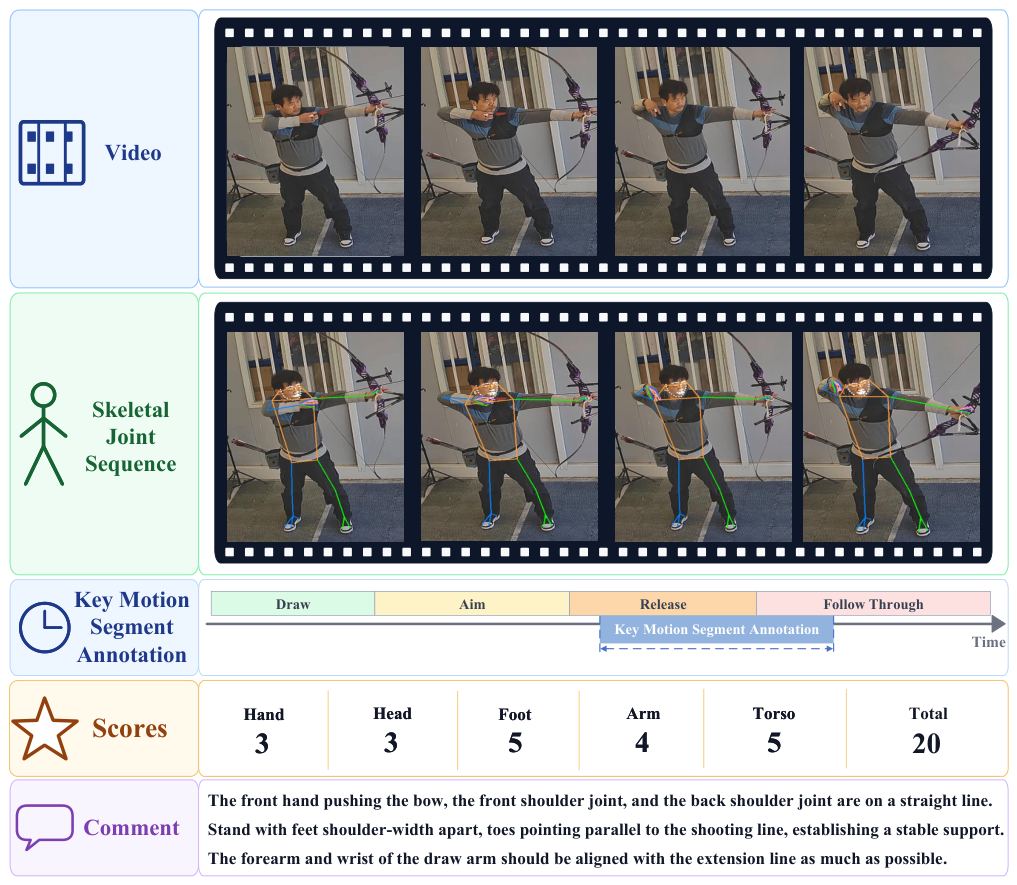
An example of the sample composition in the dataset is illustrated in Figure 2. Each data sample consists of:
1.
An archery video capturing a complete shooting sequence performed by a single archer, including stance setup, drawing, aiming, release, and follow-through.
2.
A temporal annotation of the key motion segment, specifying the start and end of the interval that covers the archer’s complete dynamic shooting process.
3.
A temporally ordered sequence of human skeletal keypoints extracted frame by frame from the video. Each frame contains 133 keypoints, providing a clear, complete, and accurate representation of the archer’s posture.
4.
Action quality scores, including fine-grained scores for key body parts (head, hand, foot, arm, and torso) as well as a total score. Each body-part score is rated on a 5-point scale, while the overall score has a maximum of 25 points.
5.
A natural-language evaluation text written in a fluent, instructional style. The paragraph-level structured assessment simulates professional coaching feedback and includes both qualitative evaluation and targeted improvement suggestions.
Action quality assessment is conducted based on a set of fine-grained criteria aligned with real-world coaching practices. All evaluation texts are authored by professional archery coaches and systematically cover fine-grained static and dynamic technical characteristics throughout the shooting process, such as stance during aiming, the posture of the bow hand during release, and the movement characteristics of the string hand, with explicit explanations provided for each technical detail. This hierarchical fine-grained annotation structure enables the dataset to support multimodal models that jointly reason over language and human motion, facilitating more accurate extraction and understanding of subtle archery-specific action characteristics. The authoritative evaluation texts also provide high practical value for real-world archery instruction.
As summarized in Table 1, existing sports datasets are either large-scale recognition or tracking benchmarks without quality supervision, or AQA datasets that still lack explicit skeletal annotations, textual evaluation, or fine-grained scoring. In this comparison, AAV is the only dataset that simultaneously provides all three.

3.2. Dataset Statistics

3.2.1. Action Quality Level Distribution

To characterize the skill composition of AAV, we partition the coach-assigned overall score s into four ordinal quality levels: excellent ( s 23 ), good ( 21 s < 23 ), average ( 19 s < 21 ), and poor ( s < 19 ). This partition follows the full 25-point scoring scale and provides an interpretable summary of the distribution of action quality across the dataset.
As shown in Table 2, the distribution is naturally skewed toward higher-quality performances, while the remaining samples still span three lower score levels with sufficient coverage. This composition preserves a large pool of high-quality samples that can serve as stable references for comparison-based assessment, while also retaining a substantial number of non-expert and imperfect performances. Such coverage is important for modeling action defects and for evaluating the robustness of fine-grained assessment systems under realistic training conditions.

3.2.2. Body-Proportion Distribution

Beyond action quality, we further analyze the distribution of body proportions to examine whether AAV covers meaningful inter-subject physique variation. For each sample, we first average the 2D position of each keypoint over the 124-frame sequence to obtain a representative keypoint position vector:
p ¯ k = 1 T t = 1 T p k , t T = 124
We then define the torso length as the Euclidean distance between the shoulder midpoint and the hip midpoint:
L torso = p ¯ LShoulder + p ¯ RShoulder 2 p ¯ LHip + p ¯ RHip 2 2
All subsequent length-related descriptors are normalized by L torso , which converts absolute measurements into dimensionless ratios and makes samples with different body sizes directly comparable. Let ( a , b ) = p ¯ a p ¯ b 2 . We first define the average segment lengths of the upper arm, forearm, thigh, and shank as
L upperarm = ( LShoulder , LElbow ) + ( RShoulder , RElbow ) 2 L forearm = ( LElbow , LWrist ) + ( RElbow , RWrist ) 2 L thigh = ( LHip , LKnee ) + ( RHip , RKnee ) 2 L shank = ( LKnee , LAnkle ) + ( RKnee , RAnkle ) 2
Following standard anthropometric practice, which characterizes body type using normalized body-proportion indices rather than absolute segment lengths [29], we compute four body-proportion features:
R shoulder = ( LShoulder , RShoulder ) L torso R arm = L upperarm + L forearm L torso R leg = L thigh + L shank L torso R forearm - upperarm = L forearm L upperarm
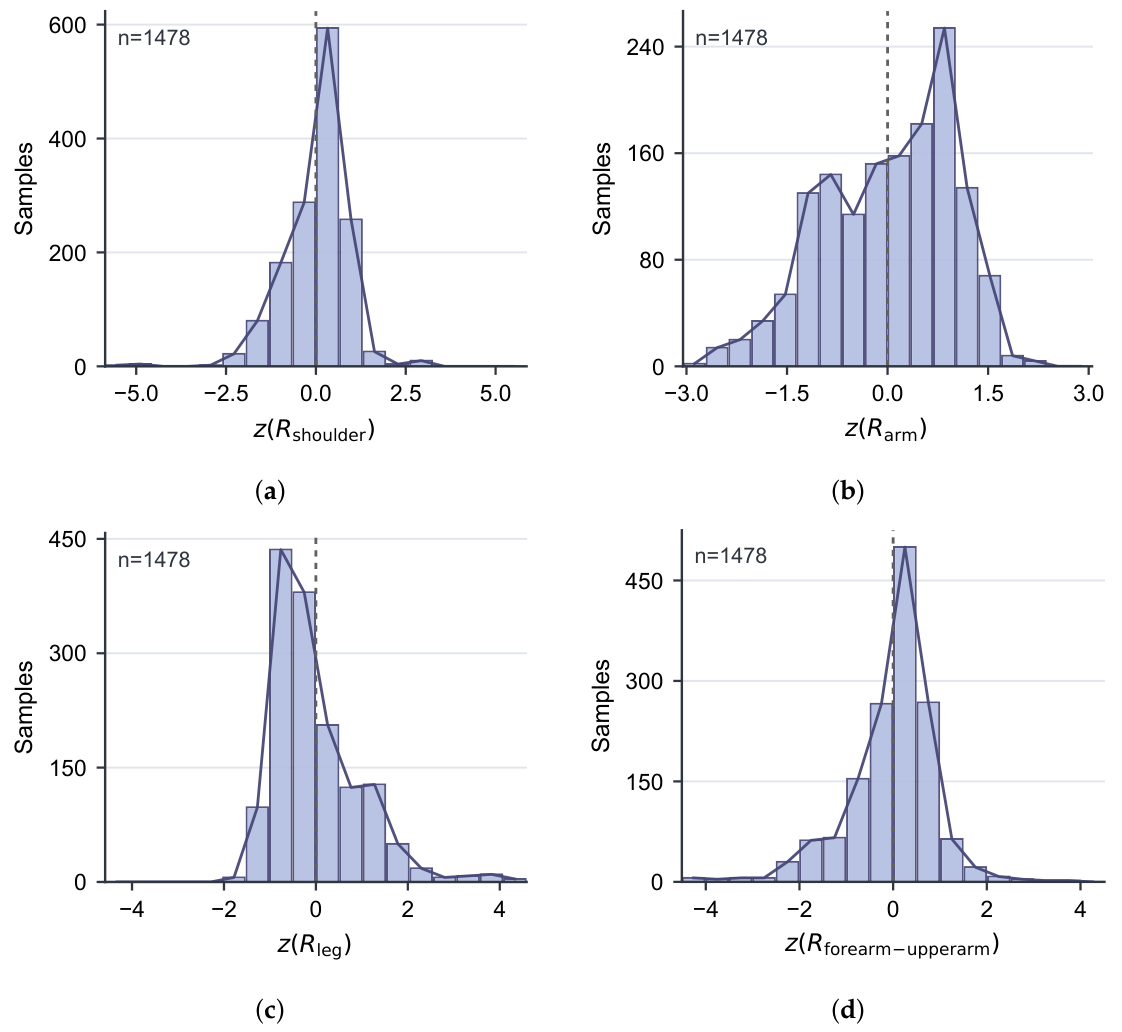
Figure 3 shows that the four normalized ratios are generally concentrated around the population mean but still exhibit clear variation across samples, indicating that AAV is not limited to a single body-type template. The shoulder-to-torso ratio in Figure 3a is the most concentrated distribution, with a sharp peak near the mean and only a small number of extreme outliers, which suggests relatively stable upper-body transverse proportions across the dataset. The arm-to-torso ratio in Figure 3b exhibits a broader spread and a mild left tail, indicating noticeable variation in relative arm length. The leg-to-torso ratio in Figure 3c shows the clearest right-skewed distribution, which implies that a subset of archers has comparatively longer lower-limb proportions after torso normalization. The forearm-to-upper-arm ratio in Figure 3d is also centered near the mean, but it shows a broader spread than the shoulder-to-torso ratio. This indicates that the relative lengths of the forearm and upper arm vary moderately across archers. Across all four metrics, more than 94% of samples fall within ± 2 standard deviations, indicating that the dataset covers natural physique variation without being dominated by extreme body shapes. This property is important for learning models that should remain robust to inter-subject morphology rather than overfit to a narrow body configuration.

3.3. Novelty and Advantages of the Dataset

Compared with existing multimodal action quality assessment datasets, our dataset offers the following advantages:
1.
Fine-grained: The dataset provides action quality scores for each key body part of the archer, enabling a more accurate and interpretable representation of technical details throughout the archery process. This compensates for the difficulty of extracting fine-grained motion features from purely visual data.
2.
Practical relevance: The evaluation texts closely reflect the guidance that archery coaches provide in daily teaching practice. They are highly interpretable and practically meaningful, making the dataset directly applicable to real-world archery instruction and training scenarios.
3.
Sample diversity: As shown in Table 2 and Figure 3, the dataset covers 93 archers, spans four overall score groups, and exhibits measurable variation in normalized body proportions. This diversity improves the coverage of AAV at both the skill and physique levels, which is important for robust fine-grained action assessment.
4.
Out-of-the-box usability: With its rich multimodal content, the dataset can be directly utilized for training or evaluating graph neural networks that use skeletal keypoint sequences as input, as well as for fine-tuning LLMs in the domain of archery action assessment, offering both academic research and practical application value.

3.4. Dataset Construction

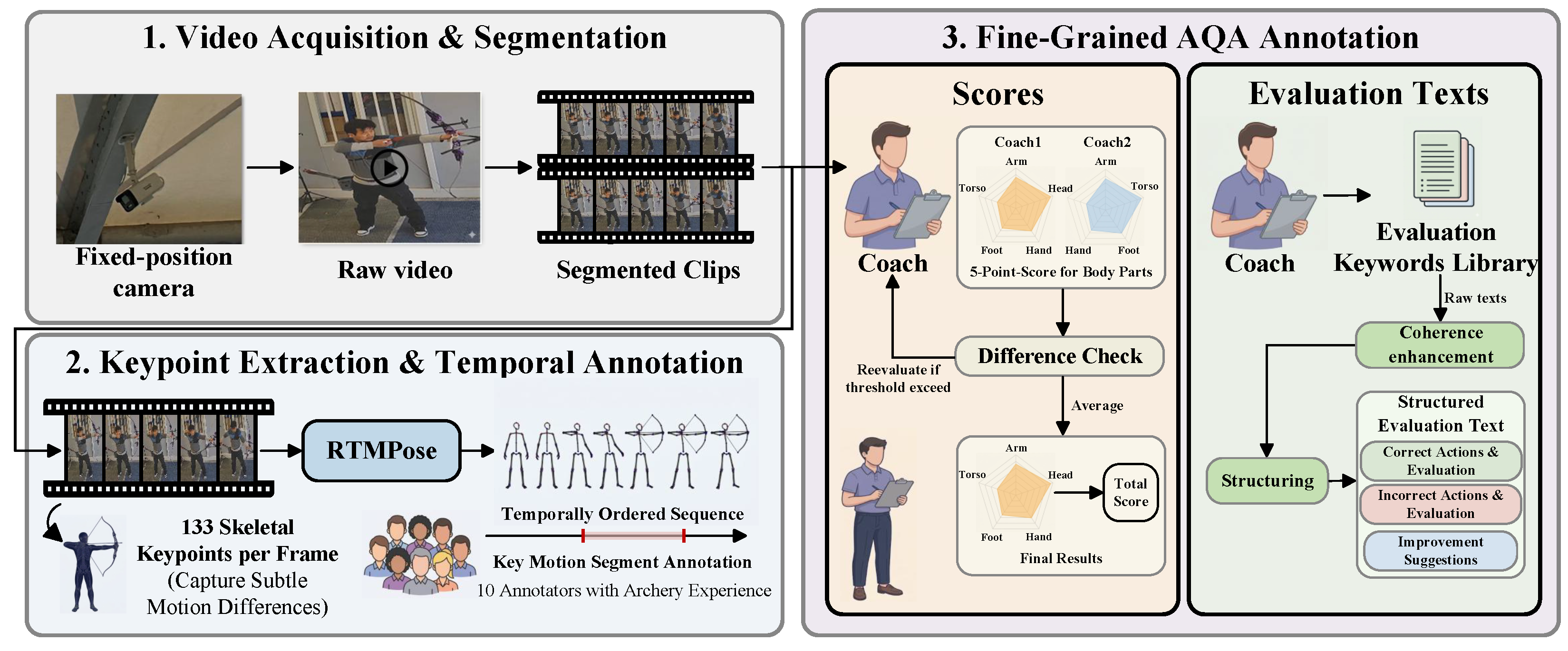
Figure 4 summarizes the construction process of AAV, which consists of video acquisition and segmentation, skeletal keypoint extraction, and coach-guided action quality annotation.

3.4.1. Video Acquisition and Segmentation

We collect videos in archery ranges using fixed-position cameras, capturing complete shooting sessions under consistent viewpoints and backgrounds. Each raw video contains a continuous sequence of 10 arrow shots from a single archer and is segmented into high-resolution clips at the individual-shot level. All clips are temporally normalized to a fixed length, and the shooting process follows standardized procedures, which helps maintain relatively consistent execution speed and reduces irrelevant variation across samples. These properties make the dataset well suited for a wide range of research and practical applications in archery action quality assessment.

3.4.2. Skeletal Keypoint Extraction

Given that archery actions exhibit prominent fine-grained characteristics in upper-limb posture, joint angles, and subtle displacements, we employed RTMPose [30] to accurately model human poses in the videos. Continuous skeletal keypoint sequences were extracted frame by frame, with 133 keypoints per frame. The high-precision keypoint localization of RTMPose effectively captures subtle yet critical motion differences during shooting, providing a solid foundation for subsequent action quality assessment.

3.4.3. Action Quality Assessment Annotation

For each segmented video, annotators carefully reviewed the footage. They performed detailed evaluations of the archer’s movements for each body part. We designed a standardized annotation workflow and set of rules to enhance both authority and efficiency in the annotation process.
Key Motion Segment Annotation. To explicitly capture temporally localized dynamic evidence in archery, we annotated the key motion segment for each sample video. This annotation task was carried out by 10 annotators with archery experience. Before formal annotation, all annotators were instructed to follow a unified annotation protocol. First, they identified the keyframe in which the arrow was released. Second, after the arrow-release frame, they located the first frame where the archer’s head started to rotate or the feet started to move. If neither head rotation nor foot movement was observed after arrow release, the last frame of the video was used as the endpoint. Finally, the key motion segment was defined as the interval starting from eight frames before the arrow-release frame and ending at the detected post-release movement onset frame.
For each sample, we extracted an ordered frame sequence from the video at two-frame intervals, after which the annotators reviewed the sampled frames and marked the corresponding start and end timestamps according to the above protocol. The resulting temporal interval covers the key dynamic process of the archery action.
Action Quality Scoring Rules. We adopted an independent blinded scoring protocol together with a discrepancy-based quality-control procedure. For each video, two professional archery coaches independently scored the five key body parts and the overall action quality of the sample. Each body part was scored on a 0–5 scale, and the overall score was capped at 25 points. Scores were assigned according to the fine-grained technical standards for each body part. If the score difference for any body part exceeded two points, or if the overall score difference exceeded three points, the sample was returned for reevaluation; otherwise, the final score was defined as the average of the ratings of the two coaches.
Evaluation-Text Keyword Library. To ensure the professionalism and authority of the evaluation texts, we collaborated with two archery coaches to review the completion standards of all fine-grained movements in archery. These standards were compiled into a library of keywords and phrases that comprehensively cover all aspects of archery action quality assessment. Coaches were required to refer to this keyword library when composing evaluation texts.
Structured Evaluation Texts. To ensure that the evaluation texts are consistent in length, clear, and comprehensive, we structured the evaluation texts. The raw coach-written texts were input into DeepSeek-V3.2 along with structured prompts (only adding necessary connecting words to maintain coherence and standardization without altering the original content) to generate standardized, structured evaluation texts. The structured evaluation texts follow the format below:
1.
Correct actions and corresponding evaluation text.
2.
Incorrect actions and corresponding evaluation text.
3.
Improvement suggestions for incorrect actions.

4. Methodology

4.1. Overview

The overall architecture of SEMA is illustrated in Figure 5. Given an input archery video, we first extract skeletal keypoints, compute biomechanical features for key body parts, and localize the temporally concentrated dynamic motion evidence through keyframe extraction. The resulting keyframe sequence is then compared frame by frame with that of an expert-level reference sample. The vision–language model (VLM) then reasons over deviations from this high-quality reference in conjunction with fine-grained action assessment criteria. It produces body-part-level scores together with a structured keyword sequence summarizing the critical evidence of action quality (Section 4.2). This keyword sequence is further projected into a unified semantic space and used to retrieve semantically corresponding professional evaluation-text segments for final evaluation generation (Section 4.3). Finally, the personalized assessment outputs are incorporated into the hierarchical multi-source knowledge framework, where they are combined with structured coaching guidance and general archery knowledge to support both archery technique-related and knowledge-based question answering (Section 4.4).

4.2. Action Quality Evaluation

4.2.1. Human Biomechanical Feature Modeling

Based on the skeletal topology and coach-defined archery assessment criteria, we formulate a set of hand-crafted temporal biomechanical features for four body parts, as summarized in Table 3. We do not define a standalone biomechanical feature for the hand. This is because hand assessment in archery requires a joint analysis of static postural control and dynamic release behavior throughout the shooting process, and therefore cannot be reliably characterized by a single scalar indicator.
These biomechanical features alone are insufficient for auxiliary assessment because effective scoring also requires explicit criteria that map feature-value ranges to the motion quality of each body part. We therefore calibrate each feature against coach-annotated scores, so that the extracted kinematic evidence can be interpreted under a standardized quality rubric.
Specifically, we construct a representative calibration subset of 30 samples from AAV by stratified sampling according to overall score distribution.
For each sample, we consider the value x i of a biomechanical feature and the corresponding part-level ground-truth score y i for the associated body part. We discretize y i into a four-grade label g i , and denote by g ^ i the grade predicted by a candidate threshold set. Intuitively, this calibration step converts a continuous biomechanical measurement into an interpretable four-level decision rule. The role of threshold search is to find the interval boundaries that best reproduce the coach-provided grading pattern on the calibration subset.
For one-sided features, which are theoretically expected to have a monotonic relationship with the score of the corresponding body part, we search for three ordered thresholds to maximize balanced accuracy:
δ E , δ G , δ A = arg max δ E δ G δ A BA g ^ i , g i
where
BA = 1 G obs c G obs i 1 g i = c , g ^ i = c i 1 g i = c
This objective can be understood as the average recall over all observed grades. For target-type features, which are theoretically expected to achieve the highest score near an ideal value and lower scores as the feature deviates in either direction, we first estimate an optimal center
c = arg max c ρ s | x i c | , y i
The center c has a direct physical interpretation: it is the feature value that best represents the ideal posture or motion state for that body part. After fixing c , the target-type feature is converted into a deviation variable d i = | x i c | , so the remaining threshold search again becomes a monotonic grading problem: the farther the feature moves away from the ideal center, the lower the expected quality grade.
We then search three ordered deviation thresholds on d i = | x i c | :
δ E , δ G , δ A = arg max δ E δ G δ A BA g ^ i , g i
The resulting feature thresholds are provided to the VLM together with the corresponding biomechanical measurements, serving as explicit criteria for judging body-part action quality and assigning scores. For example, consider a one-sided feature such as SWA. If the measured angle stays within the interval associated with the highest grade, the arm posture is treated as technically stable and supports a high score. Once it crosses the subsequent thresholds, the decision is downgraded step by step to lower action quality grades. By contrast, for a target-type feature such as HTR, the assessment is performed using nested threshold intervals around the calibrated reference value c . The distance d i = | x i c | determines which interval the measurement falls into: values within the innermost interval correspond to the highest grade, values between the first and second thresholds correspond to the next grade, and values beyond the outermost threshold correspond to the lowest grade.

4.2.2. Video Keyframe Extraction

Archery requires effective analysis of fine-grained actions. Precisely localizing where fine-grained actions occur in archery videos is therefore a fundamental task that is critical for accurately evaluating archery action quality. Directly feeding archery videos into a VLM to perform fine-grained action localization is feasible, but this strategy has clear limitations. First, mainstream multimodal LLMs mainly extract useful information from videos through long-range holistic temporal modeling, which is better suited to coarse description or summarization of video content. In archery videos, however, the information that reveals critical fine-grained action cues is extremely sparse. In addition, keyframes are highly similar to their adjacent background frames. These two characteristics make it difficult for LLMs to extract precise temporal boundaries of specific actions [15,31]. Second, the temporal window of critical fine-grained action cues is extremely short. Large models with Transformer-based visual architectures also lack temporal structural priors. Together, these factors complicate the precise modeling of temporal boundaries and the capture of instantaneous actions in videos [32]. To address this issue, we propose a video keyframe extraction method based on change-point detection. The method detects the overall variation in selected human skeletal keypoints in a video and uses it to determine the locations of keyframes. It therefore accurately extracts the temporal boundaries of fine-grained actions from archery videos and generates a keyframe sequence that reflects the dynamic process of archery. This method thereby precisely localizes fine-grained actions in archery videos, pre-extracts critical video information, and substantially increases information density.
Input Representation. We first construct the input representation of the method. We select only 12 core keypoints on the archer’s hands and arms as the input. This selection is guided by the motion characteristics of the release phase and is further confirmed by professional archery coaches, since the most decisive motion changes for keyframe localization are concentrated in these joints. By contrast, the remaining landmarks usually exhibit only weak variations during standard execution and contribute limited evidence for identifying the release moment, while potentially introducing redundant noise. Given an input video V, we first extract the coordinates of these core keypoints frame by frame to form a motion sequence.
Let the position coordinates of the i-th keypoint in the t-th frame be
s ˜ t ( i ) = x ˜ t ( i ) , y ˜ t ( i ) R 2 , t = 0 , 1 , , T 1
where T denotes the total number of frames in the video. To reduce the effect of scale variation introduced by subtle changes in recording conditions on detection accuracy, we apply column-wise standardization to each keypoint sequence:
s t ( i ) = s ˜ t ( i ) μ ( i ) σ ( i ) , μ ( i ) = 1 T t = 0 T 1 s ˜ t ( i ) , σ ( i ) = 1 T t = 0 T 1 s ˜ t ( i ) μ ( i ) 2
where μ ( i ) , σ ( i ) R 2 denote the mean and standard deviation of the two-dimensional coordinates of this keypoint, respectively.
Keyframe Localization Based on Change-Point Detection. To obtain keyframe-sequence encoding from the motion sequence of the core keypoints, we design a keyframe localization method based on change-point detection. This method refines the keyframe sequence through a carefully designed pipeline of breakpoint sequence extraction → local refinement → coherent dynamic feature construction, as described below.
During archery, fine-grained actions are often accompanied by substantial overall changes in the coordinates of the core keypoints. To extract keyframes, we first perform change-point detection on the preprocessed keypoint sequence { s t ( i ) } t = 0 T 1 to obtain a coarse breakpoint sequence that predicts where the coordinates of the core keypoints change substantially. Specifically, we adopt the offline multiple change-point detection method proposed by Truong et al. [33]. We use a nonparametric cost model based on the Gaussian kernel and choose greedy Binary Segmentation (BinSeg) as the approximate search strategy. Under the constraint of a target number of change points N i , this procedure yields the breakpoint set B ( i ) = { b 1 ( i ) , , b N i ( i ) } . This sequence preserves the key fine-grained action cues throughout the archery process, but it is still insufficient for direct use as candidate keyframes. The first issue is that dynamic motion cues are missing. Dynamic motion evaluation is critical for archery action quality assessment, yet the breakpoints in each sequence are too scattered and insufficiently coherent to reflect the archer’s motion dynamics. The second issue is limited localization accuracy. To suppress high-frequency jitter of skeletal keypoints during detection and improve keypoint detection accuracy in archery scenes, we use a first-order Kalman filter, which introduces a certain amount of lag and prevents precise localization of key actions.
To address these issues, we perform local refinement on individual elements in the breakpoint sequence. Specifically, we first define the frame-wise positional change as
d t ( i ) = s t ( i ) s t 1 ( i ) = max Δ x t ( i ) , Δ y t ( i ) , t = 1 , , T 1
We then take the frame at which d t ( i ) reaches its peak within the breakpoint neighborhood [ b j ( i ) w r , b j ( i ) + w r ] as the anchor point:
b ^ j ( i ) = arg max t [ b j ( i ) w r , b j ( i ) + w r ] d t ( i )
Finally, we extract frames within the anchor neighborhood [ b ^ j ( i ) w s , b ^ j ( i ) + w s ] using a small stride to form continuous dynamic features. The resulting keyframe sequence is then fed into the VLM for subsequent action-feature analysis. In this way, sparse fine-grained cues in the original video can be accurately localized and highly condensed, which alleviates the difficulty of extracting subtle evidence directly from long raw videos. Meanwhile, representing the input as a short sequence of dynamically informative images substantially reduces token consumption while preserving the motion details most relevant to assessment, thereby supporting efficient downstream action quality analysis.

4.2.3. Comparative Evaluation with an Exemplary Reference Sample

In real-world archery training, archers usually follow a highly standardized shooting procedure, and the recording environment is often visually homogeneous in terms of viewpoint, background, and scene layout. Under such conditions, analyzing a single sample in isolation mainly captures the archer’s absolute motion characteristics rather than the subtle deviations that truly determine action quality. However, in archery, the decisive evidence often lies in local posture offsets and fine-grained execution details, which are precisely the cues that general-purpose VLMs are prone to overlook. By introducing paired comparison between two samples recorded under the same or highly similar conditions, these subtle differences become more salient. This reference-based setting guides the model to focus on the discriminative motion evidence that is genuinely relevant to evaluation and also improves the interpretability of the resulting assessment.
Based on this finding, we adopt a comparative evaluation strategy to further improve the accuracy of LLM-based assessment. Specifically, we adopt a two-stage selection strategy to construct the exemplary reference. First, we automatically screen the AAV dataset and retain all samples with a full total score as candidate references. Second, a professional archery coach holistically reviews these candidate samples and selects the one with the most standardized and high-quality shooting motion as the final exemplary reference sequence. This reference sample is manually verified to achieve full scores on all body parts as well as on the overall performance, with no observable technical flaws. We then apply the keyframe extraction method described in Section 4.2.2 to obtain the reference keyframe sequence. During score prediction, the keyframe sequence of the target video and that of the exemplary sample are provided to the model in a frame-aligned manner. This transforms the original absolute scoring process into a relative assessment of deviations from a full-score reference. From a design perspective, this comparative formulation is also relatively robust to nuisance factors in practical training scenarios. Because the target and reference sequences follow the same shooting protocol and are processed by the same keyframe extraction and frame-alignment pipeline, the model is encouraged to focus on relative motion deviations rather than unstable absolute appearance cues. At the same time, the robustness of this design still depends on the quality and representativeness of the selected reference sample, which is further examined in the ablation study. The same comparison is further applied to refine the generated evaluation keyword sequence by reasoning over the deviations between the target action and the action demonstrated in the exemplary sample, thereby correcting the original assessment conclusions. This strategy compensates for the limited fine-grained action understanding of general-purpose multimodal LLMs in specialized sports scenarios and significantly improves the precision of the final evaluation.

4.2.4. Evaluation Keyword Sequence Generation

We integrate the video or keyframe sequence, human biomechanical features, and the exemplary reference keyframe sequence, and feed them into Qwen-VL-Plus. Conditioned on body-part-specific action quality criteria, the model generates an evaluation keyword sequence that summarizes the overall quality of the archer’s motion and predicts action quality scores for each key body part. To ensure authority and controllability, both the evaluation sequence and the predicted scores are generated under strict constraints. These constraints substantially reduce the risk of hallucination and force the outputs to remain grounded in the provided evidence rather than in implicit knowledge of the model or unconstrained reasoning. The detailed constraints and generation rules are presented in Section 4.5.

4.3. Semantic Alignment and Retrieval of Professional Evaluation Knowledge

Although the evaluation keyword sequence derived from multimodal evidence can already reflect the archer’s action quality accurately and comprehensively, it remains overly compact, highly information-dense, and insufficiently professional in expression. As a result, a substantial gap still exists between such condensed evidence and the realistic guidance style adopted by professional coaches. This gap makes it necessary to generate more professional evaluation text with a level of expertise comparable to that of a coach. To achieve this goal, we first collect a broad range of expert-written assessment texts covering diverse archery action scenarios and construct a knowledge base. We then align the evaluation keyword sequence and professional evaluation texts in a unified embedding space, enabling the retrieval of semantically corresponding expert assessments based on semantic similarity. During the generation process, the evaluation keyword sequence is used as the query to retrieve highly relevant professional evaluations, which are further exploited to produce the final professional assessment text.

4.3.1. Semantic Alignment of Visual Features and Textual Information

To better capture fine-grained motion semantics in archery videos, we adopt an indirect alignment strategy based on high-level semantic descriptions. Specifically, the evaluation keyword sequence generated in Section 4.2.4 is used as a semantic proxy for the critical motion evidence in the target video. The keyword sequence and the evaluation texts are then encoded into a shared textual embedding space to obtain semantically aligned textual representations. This design enables the visual information in the video to be indirectly projected into a unified semantic space through structured textual descriptions, thereby supporting comprehensive assessment of action quality.

4.3.2. Text Retrieval Based on RAG

To support RAG-based text retrieval, we first collect assessment comments from professional archery coaches in instructional practice. These comments are then refined and expanded into formal evaluation texts using an LLM. To avoid semantic dilution caused by excessive text length and to stay within the processing limits of the text encoders and LLMs, we impose a maximum length on each generated passage and segment the corpus into multiple chunks. The resulting knowledge base contains 665 entries, each averaging approximately 70 Chinese characters. Each chunk is then embedded into the shared representation space, yielding a set of vector representations D = { d 1 , d 2 , , d n } .
Given a query video V, we first project it into the unified semantic space using the indirect alignment strategies described in Section 4.3.1, obtaining the video representation v video . Since both video and text embeddings are normalized, we compute the cosine similarity between v video and each text embedding d i in the knowledge base as
Sim ( v video , d i ) = v video · d i v video d i
We retrieve the top-k text embeddings with the highest similarity scores. The corresponding text fragments provide professional evaluation evidence that is highly relevant to the current archer’s action quality and directly support the subsequent generation of the assessment text.

4.3.3. Evaluation-Text Generation

After retrieving the key information based on video-text semantic alignment, we integrate these inputs and feed them into LLM to generate professional evaluation texts. To ensure reliability and controllability, text generation is conducted under strict constraints, such that the outputs are predominantly driven by the provided inputs rather than the LLM’s implicit knowledge or free-form reasoning. This design confines the role of the LLM to structured language realization based on encoded information. Details of the constraints and generation rules are provided in Section 4.5.

4.4. The Hierarchical Multi-Source Knowledge Framework

In archery training and instructional practice, coaches are expected not only to assess an archer’s movements accurately, but also to provide targeted corrective feedback and answer follow-up questions. Such guidance is critical to improving both athletic performance and coaching effectiveness. In this section, we present a multi-source knowledge fusion framework built on a carefully designed hierarchical knowledge architecture. It integrates action quality assessment results, expert coaching knowledge for targeted guidance, and general archery knowledge for broader reasoning support. Through interactive question answering, the framework provides professional, weakness-oriented guidance to help archers identify and address technical deficiencies.

4.4.1. Construction of the Hierarchical Knowledge Architecture

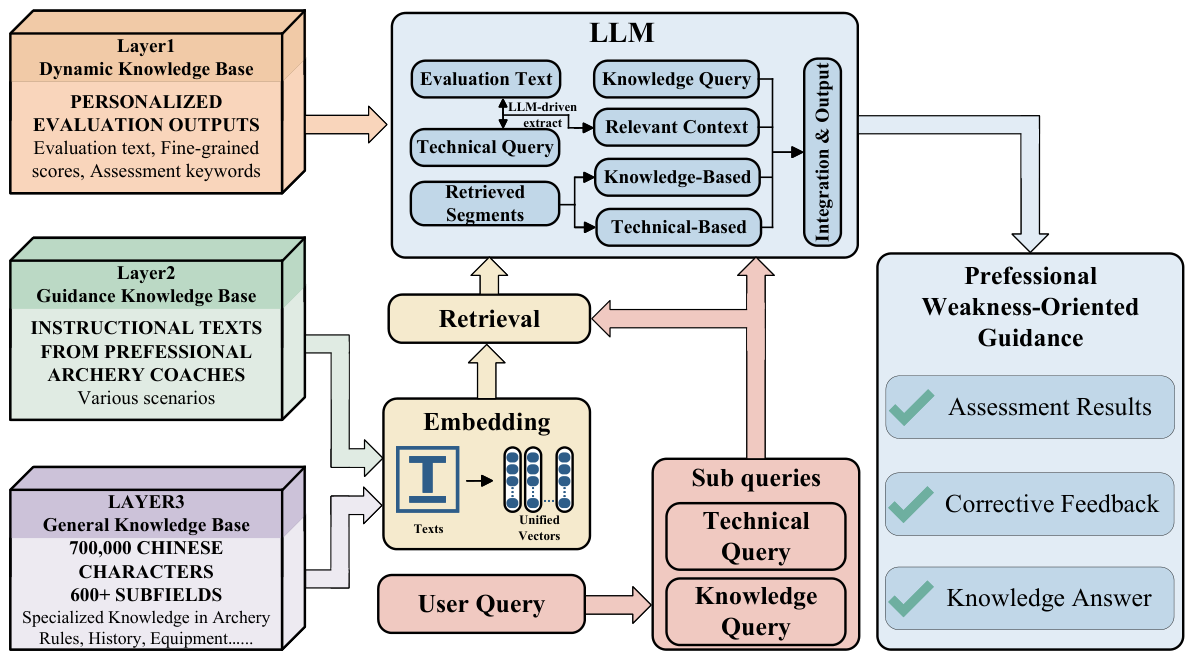
This fusion knowledge framework consists of three layers.
The first layer is a dynamic knowledge base driven by the archer’s action quality information. It is derived from SEMA’s outputs after video analysis and contains personalized, structured technical data. This layer provides a solid foundation for precise answers to technical questions and for the generation of professional guidance plans.
The second layer is the structured coaching guidance knowledge base. It integrates instructional texts from professional archery coaches for various archery action quality issues under different scenarios. Together with the first layer, it supports the specific actions in the guidance plan.
The third layer is the general knowledge base, which serves as a relatively independent component. It contains a pre-collected corpus of approximately 700,000 Chinese characters, including archery rules, historical and cultural knowledge, and specialized knowledge in the archery domain, covering more than 600 subfields. This layer helps the LLM better understand the rich connotations of archery and improves the depth of its reasoning.
Figure 6 shows the overall structure of the framework. All structured data are vectorized with a unified text embedding model, which enables the retrieval module to perform accurate semantic retrieval for question-oriented information.

4.4.2. Hierarchical RAG-Based Guidance Scheme Generation

Based on the fusion knowledge framework, we provide tailored guidance in response to user queries. We find that simple database queries alone are insufficient for this task, and even when answers can be produced, their quality remains unsatisfactory. To generate professional and accurate guidance plans, we follow the architecture of the fusion knowledge framework and combine hierarchical reasoning with retrieval augmentation. The pipeline is as follows: query decomposition → context-aware hierarchical semantic retrieval → reasoning-based generation.
In the query decomposition stage, the input question is first split into technical and knowledge-oriented sub-questions to support the subsequent hierarchical retrieval process. Since this step depends on fine-grained semantic understanding rather than rigid surface segmentation, we use the LLM to parse the query and expand each sub-question with brief descriptive context. For example, consider a request for suggestions on correcting weak arm movements and selecting suitable training equipment for an archer with limited arm strength. This request can be decomposed into improving the deficient arm action and selecting beginner-friendly bows with lower draw weight. At the same time, we compress the structured data in the dynamic knowledge base so that it retains only the information directly related to the current query, such as the assessment results for the arm.
We then perform context-aware hierarchical semantic retrieval on the decomposed queries. Answering a question in isolation is often insufficient because targeted guidance depends on the archer’s personalized technical characteristics. We therefore combine the compressed structured data with the technical sub-question and conduct reasoning-guided retrieval on the second layer of the fusion knowledge framework. Specifically, the structured evidence and the technical sub-question are used jointly to infer a sequence of retrieval keywords. This sequence is embedded into the shared semantic space and matched against the structured coaching guidance knowledge base. The knowledge-oriented sub-question is embedded directly and retrieved from the third layer of the framework. For the general knowledge base, retrieval proceeds in two stages: we first identify relevant subdomain titles through vector-based search and then perform fine-grained retrieval within the selected titles. This design improves the relevance and precision of short-query retrieval in a large corpus.
Finally, we integrate the results returned by hierarchical retrieval and use the LLM to generate a coherent, well-structured, and readable guidance plan. This layered retrieval architecture improves the model’s understanding of the user’s intent while grounding the response in the archer’s actual training context, which helps ensure that the generated guidance remains both professional and effective.

4.5. Prompt Engineering

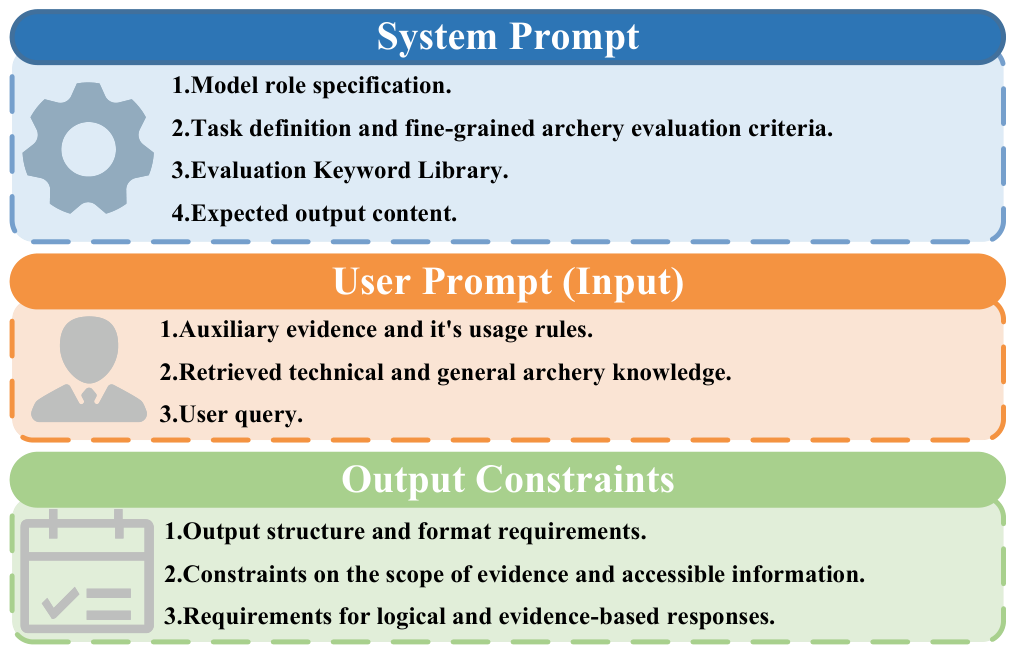
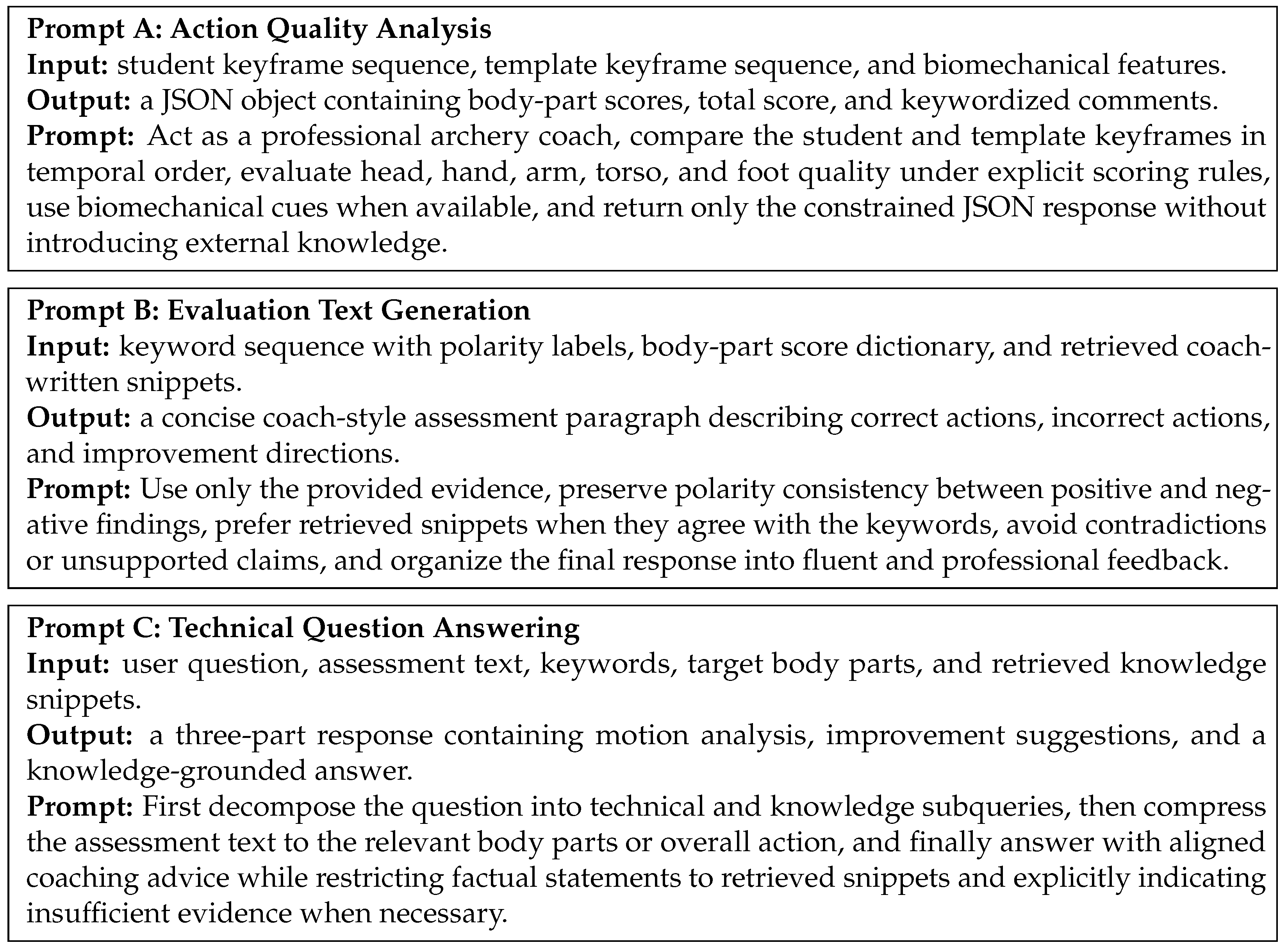
To ensure that the LLM can accurately internalize fine-grained evaluation criteria during reasoning while reducing hallucination risk, we design a specialized prompt engineering framework for SEMA. This framework provides task-specific prompts for action quality analysis, evaluation-text generation, and knowledge-based question answering. The model therefore receives explicit role definitions, assessment criteria, input usage instructions, and output constraints in different inference scenarios. Developed under the guidance of professional archery coaches, these prompts incorporate fine-grained standards for archery action assessment and enable the model to produce structured and professional feedback. Figure 7 summarizes the overall prompt composition framework, while Figure 8 illustrates the core prompt content used in different scenarios.

5. Examples

In this section, we present two interesting application examples to illustrate the effectiveness of SEMA in real-world scenarios. The source code and deployed application are available at https://huggingface.co/spaces/yunyixuan/SEMA (accessed on 16 March 2026).

5.1. Action Quality Analysis and Evaluation

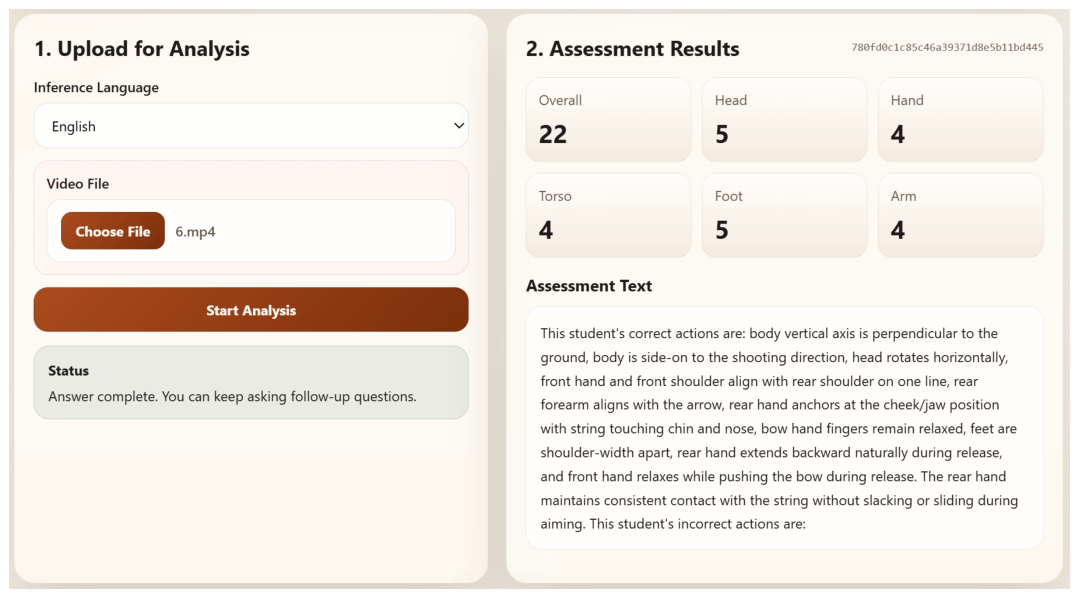
Our action quality analysis pipeline enables users to upload an archery video and obtain a personalized and professional assessment of the archer’s movement quality. Specifically, we first apply SEMA to localize human key posture landmarks and compute biomechanical features. Based on these cues, representative keyframes are extracted from the temporal sequence to preserve the core information of critical phases. The resulting posture cues, temporal dynamics, and biomechanical descriptors are then integrated for joint reasoning, producing action quality scores together with fine-grained evaluation of action quality. A representative example of this case is presented in Figure 9.

5.2. Interactive Question Answering for Archery Technique and Knowledge

After the evaluation is completed, users can continue to interact with SEMA to obtain accurate instructional guidance. Specifically, based on the fusion knowledge framework described in Section 4.4, we first decompose each user query into semantically coherent sub-questions. These sub-questions are then processed through context-aware hierarchical semantic retrieval, which selectively grounds the reasoning process in personalized assessment outputs, structured coaching guidance, and general archery knowledge. The retrieved evidence is finally integrated for reasoning generation, producing coherent guidance suggestions and precise responses to user questions. A representative example of this case is presented in Figure 10.
From a practical deployment perspective, SEMA follows a lightweight web-based workflow and does not require local deployment of large multimodal models or additional database clusters. The system can be launched on a single laptop with modest hardware resources, which is already sufficient to support the complete action quality assessment workflow, covering biomechanical feature computation, dynamic keyframe extraction, semantic similarity retrieval, model inference through external interfaces, and subsequent interactive feedback. This low deployment barrier makes SEMA easy to operate and suitable for routine use in small-scale training environments.
In a practical training scenario, a coach can first upload a short video from a training round and use SEMA as a rapid pre-analysis tool. The system returns body-part scores, keyframe evidence, and coach-style feedback, allowing the coach to quickly identify the dominant technical problem before giving targeted instruction. The student can then use the same interface for self-review, follow up with specific questions about the detected errors, and compare later attempts after adjustment. In this way, SEMA supports both coach-led guidance and student self-correction in routine training.

6. Experiments and Results

In this section, we conduct a comprehensive evaluation of SEMA by addressing the following research questions:
1.
RQ1: Can SEMA outperform representative AQA methods and mainstream multimodal LLM baselines, and how close can it approach the evaluation quality of professional archery coaches?
2.
RQ2: Are the core design choices of SEMA reasonable and effective for fine-grained archery action quality assessment?
3.
RQ3: How do the major components of SEMA contribute to the quality of action assessment and feedback generation?
We first present the experimental data and implementation settings. We then introduce the unified evaluation protocol to assess the performance of individual SEMA components and their contributions to the overall system, while also benchmarking SEMA against representative AQA methods and mainstream multimodal LLM baselines in score prediction, and against mainstream multimodal LLM baselines in text fidelity and practical coaching quality. The corresponding experimental results are reported and discussed alongside each evaluation setting to analyze the effectiveness of SEMA from both quantitative and human-centered perspectives.

6.1. Experimental Setup and Implementation Details

6.1.1. Dataset for Evaluation

To ensure persuasive evaluation, the benchmark should satisfy two basic requirements: sufficient scale and a reasonable sample distribution. Rather than using the full AAV dataset directly, we construct the evaluation set by stratified sampling over the total-score distribution and retain 500 representative samples. This sample size is considered sufficient to satisfy the requirements for both diversity and evaluation scale, while reducing the influence of similar samples on the evaluation results and thereby enabling a comprehensive and objective assessment. The benchmark serves as a diverse, realistic, and challenging testbed for evaluating the practical performance of SEMA and its individual components.

6.1.2. Baseline Methods and Adaptation Protocol

To better characterize the performance of SEMA in both body-part scoring and evaluation-text generation, we construct the baselines from two perspectives. The first group consists of representative flagship multimodal LLMs, including Qwen3-VL-Plus, Kimi-K2.5, GLM-4.6V, Claude-Sonnet-4, GPT-5.2, GPT-4.1, Gemini-3-Flash-Preview, and LLAMA-4-Maverick. These models are included as general-purpose reference baselines because specialized studies on fine-grained archery action quality assessment remain limited, leaving only a small number of directly comparable task-specific methods. Therefore, comparing SEMA with these frontier multimodal LLMs provides a strong reference for assessing its ability to perform fine-grained scoring and expert-style feedback generation in this specialized sports assessment task. The second group contains representative task-specific AQA methods, namely CoRe [12], USDL [11], and ST-GCN [9]. These methods are included to provide dedicated AQA model baselines in addition to the general-purpose multimodal LLMs. Since their scoring heads can be adapted to the archery assessment data using the fine-tuning protocol described below, they allow us to compare SEMA with task-specific models under supervised training settings. Because these methods are designed for score prediction rather than natural-language feedback generation, they are used only in the quantitative scoring comparison. Directly applying either baseline group to fine-grained archery assessment, however, would introduce a substantial task-mismatch effect. Existing dedicated AQA methods are typically developed for other sports and usually target overall quality scores rather than body-part-level assessment, while general-purpose multimodal LLMs are not optimized for specialized sports evaluation under explicit coaching criteria. Without adaptation, the resulting comparison would partly reflect interface mismatch rather than the actual capability of the baseline methods. We therefore adopt a unified adaptation protocol to make the comparison as fair and informative as possible.
For the multimodal LLM baselines, we provide the same fine-grained archery assessment criteria, body-part definitions, and structured output constraints used by SEMA, so that all compared models solve the same task under the same scoring standard. For the dedicated AQA methods, we retain their pretrained backbones and adapt the scoring heads to predict body-part-level archery action quality scores directly. Since the amount of labeled archery data remains limited, these models are fine-tuned on the labeled data outside the held-out subset under a five-fold cross-validation protocol, and the final results are reported by averaging the performance over all five folds. This adaptation protocol reduces the influence of task mismatch and limited sample size, enabling a fairer comparison that better reflects the actual strengths and limitations of each baseline family under the current evaluation setting.

6.1.3. Statistical Analysis Method

Considering the finite size of the evaluation set and the stochastic nature of LLM-based outputs, we repeat the subset of experiments used to support the core conclusions five times, report the mean value across repeated runs for each method, and average the repeated results within each sample to obtain stable estimates for significance testing. Paired statistical significance tests are then conducted on these averaged metric values for each evaluation metric, following the unified procedure described below, to determine whether the observed performance differences between the target method and the baseline are statistically reliable rather than arising from random variation. We compute paired sample-level differences, with the direction defined such that a positive value always indicates better performance of the target method. A two-sided paired permutation test is used to evaluate whether the mean paired difference is significantly different from zero. In addition to the p-value, we report the mean effect size, the standard deviation of sample-level differences, and the 95 % confidence interval estimated by bootstrap resampling over paired samples. The numbers of Monte Carlo permutations and bootstrap resampling iterations are both set to 10,000. Following common practice in empirical evaluation, results with p < 0.05 are regarded as statistically significant.

6.1.4. Implementation Details

All experiments are implemented in a Python 3.9 environment. For action quality analysis, we use pretrained RTMPose with the ONNX Runtime backend to extract frame-wise whole-body keypoints from each input video, and we compute biomechanical features from the resulting skeleton sequences using NumPy. Temporal change-point detection in the motion analysis pipeline is implemented with ruptures. In the coarse breakpoint extraction stage described in Section 4.2.2, we use the Gaussian-kernel cost with Binary Segmentation, fix N i = 22 for all videos, and refine the resulting breakpoint sequence to 6 final keyframes per sample. For the RAG, semantic alignment, and question-answering modules, the knowledge bases are built with SQLite, and text-embedding-v4 is used with the default 1024-dimensional output to construct a unified embedding space for semantic retrieval.
For multimodal assessment, SEMA uses qwen3-vl-plus as the assessment model and qwen-plus for response generation. The same decoding configuration is used for SEMA and all compared API-based multimodal LLM baselines. The temperature is set to 0.2, t o p p is set to 1, and reasoning mode is disabled. The software stack additionally includes ONNX Runtime (https://onnxruntime.ai/, accessed on 3 April 2026), NumPy (https://numpy.org/, accessed on 3 April 2026), ruptures (https://centre-borelli.github.io/ruptures-docs/, accessed on 3 April 2026), and SQLite (https://www.sqlite.org/, accessed on 3 April 2026).
For the supervised AQA baselines, the 500-sample evaluation subset is fixed as the test subset. The remaining labeled samples are partitioned into five folds with split seed 20260425. Fine-tuning is repeated over five rounds. In each round, four folds are used for training or fine-tuning, the remaining fold is used for validation, and the final performance on the fixed test subset is averaged across the five rounds.
To adapt USDL, CoRe, and ST-GCN to the body-part-level scoring task, we reconfigure their output heads according to their original task formulations. For USDL, the original score-distribution head is expanded into five parallel distribution heads for head, hand, torso, foot, and arm scoring. Each head outputs a probability distribution over discrete score levels through a softmax function, where the score levels are defined with an interval of 0.2 from 0 to 5. The final predicted score is obtained by selecting the score level with the highest predicted probability. For CoRe, the original single relative-score tree is extended to five part-specific trees that share one video backbone, with each tree directly outputting a scalar score for the corresponding body part. For ST-GCN, which was originally designed for skeleton-based classification, we replace the final classification layer with a fully connected regression layer that outputs five scalar scores corresponding to head, hand, torso, foot, and arm. Since ST-GCN is adapted to OpenPose-style skeleton representations, we convert the 133-keypoint skeleton sequence provided in AAV into an 18-keypoint OpenPose-style skeleton sequence according to the corresponding body-part mapping. The converted skeleton sequence is then used as the input to ST-GCN.
For the training-stage configuration, the optimizer choices and hyperparameter settings follow the default configurations of the corresponding original methods. USDL and CoRe use I3D [34] as the video feature extractor, whose weights are frozen during training. Both methods are optimized with Adam using a batch size of 8 and trained for 60 fixed epochs. The global training seed is set to 20260425. For USDL, the learning rate is set to 1 × 10 4 and the weight decay is set to 1 × 10 5 . The training loss is the sum of five KLDivLoss terms, corresponding to the five body-part score-distribution heads. For CoRe, the learning rate is set to 1 × 10 4 for the shared backbone and 1 × 10 3 for the part-specific trees, with weight decay set to 0. The training loss combines NLLLoss for leaf classification and MSELoss for within-leaf regression. For ST-GCN, we follow the default optimizer configuration of the original method and use SGD with momentum of 0.9, a learning rate of 0.1, weight decay 1 × 10 4 , batch size of 8, a fixed training length of 60 epochs, and training seed 20260425. The loss function is MSELoss .

6.2. Evaluation Protocol

To answer the three research questions raised at the beginning of Section 6, our evaluation protocol focuses on three aspects:
1.
Quantitative validation and comparative analysis of SEMA in both action quality scoring and evaluation-text generation.
2.
Task-aligned quantitative evaluation of key components, where each component is assessed on a specific task that directly reflects its intended function within the framework.
3.
Ablation experiments based on the baseline methods, where modules are progressively added to examine the impact of core components on SEMA.

6.2.1. Quantitative Validation of SEMA

To evaluate the action quality analysis and assessment performance of SEMA, we apply SEMA to the experimental samples to generate evaluation texts and action quality scores. For comparison, we evaluate representative AQA methods on the same scoring task, and we ask mainstream multimodal LLM baselines to follow the same text-generation-and-scoring procedure.
Metric: For the compared multimodal LLM baselines, we extract all action frames from each sample video and sample them at an interval of eight frames to preserve complete motion cues. For the dedicated AQA methods, we evaluate their scoring performance under a five-fold cross-validation protocol, and the final results are obtained by averaging the performance over all five folds. We use mean absolute error (MAE) to measure scoring accuracy, as it directly reflects the quality of action assessment. For text generation, which is inherently subjective, we first use BERTScore [35] to quantify the semantic similarity between the generated evaluation texts and the reference texts. In addition, we invite ten archery learners to conduct a blind evaluation of all generated texts, selecting between the generated texts and the reference texts according to professionalism, accuracy, and usability. We also invite two professional archery coaches as evaluators and adopt the reference evaluation text as the scoring template. Under a blind evaluation protocol, the generation method of the evaluated text is concealed. They then score the generated texts on the same three criteria using a 5-point Likert scale.
Results: As shown in Table 4, SEMA achieves competitive but uneven scoring performance on the test subset derived from AAV when compared with general-purpose multimodal LLM baselines and adapted prior AQA methods. It achieves the best results on the head, arm, and foot regions, indicating its effectiveness in capturing several fine-grained and body-part-specific posture features. However, SEMA does not obtain the best performance on all body-part scores. In particular, GLM-4.6V performs better on the hand and torso regions. This suggests that while SEMA shows strong overall competitiveness on the AAV benchmark, further improvement is still needed for hand- and torso-related assessment.
Statistical analysis: To further examine whether the observed performance differences are statistically reliable, we conduct paired statistical analysis against the strongest baseline on scoring performance and assessment-text quality.
For body-part scoring performance, GLM-4.6V is selected as the strongest baseline because it achieves the most competitive overall performance among the compared multimodal LLM baselines in Table 4. As shown in Table 5, SEMA shows statistically significant advantages over GLM-4.6V on head, arm, and foot. Among these dimensions, the largest improvement appears on foot, followed by arm and head. For hand and torso, the confidence intervals are negative, showing that SEMA underperforms GLM-4.6V on these two dimensions. All paired comparisons yield p < 0.0001 , indicating that these differences are statistically reliable. These results demonstrate the reliability of SEMA in body-part scoring, while also indicating that its performance on fine-grained hand-related cues and torso posture modeling still requires further improvement.
As shown in Table 6, compared with representative multimodal LLM baselines, SEMA achieves the highest overall semantic similarity to expert-written references. More importantly, its advantage becomes even more pronounced in human evaluation: SEMA is preferred by 36.923% of learners, substantially higher than the next-best compared multimodal LLM (6.923%). These results indicate that the quality of the texts generated by SEMA is generally superior to that of mainstream multimodal LLMs and is close to the level of human coaches. The best-performing SAR module will be introduced in Section 6.2.2.
For assessment-text quality, GPT-5.2 is selected as the strongest baseline according to its competitive semantic similarity and human evaluation performance in Table 6. As shown in Table 7, the 95% confidence intervals of Δ are entirely above zero for BERTScore precision, recall, and F1, with p = 0.0018 for precision and p < 0.0001 for recall and F1. However, it is worth noting that the absolute BERTScore improvements are relatively small, ranging from approximately 0.001 to 0.021. These results reveal that SEMA provides a modest but consistent improvement in assessment-text generation over the strongest baseline.

6.2.2. Quantitative Validation of Key Components

Keyframe extraction module. Since the purpose of this module is to generate a frame sequence that can fully present the archer’s dynamic motion characteristics, an effective evaluation should directly measure whether the extracted keyframes cover the temporally localized motion evidence.
Metric. For each sample video, we use the temporal annotation of the key motion segment provided in the dataset (Section 3.1) as the reference interval. We then apply the proposed keyframe extraction module and calculate the hit rate as the proportion of extracted keyframes that fall within the annotated interval. This protocol directly evaluates whether the module can effectively capture the dynamic motion process that is critical for action feature analysis.
We compare our module against a FastDTW-based baseline [36]. Specifically, following the exemplary reference sample introduced in Section 4.2.3, we first extract the skeletal keypoints of the template keyframes and use FastDTW to align the frame-wise keypoint sequence of the evaluated video with the template sequence. The aligned positions are then taken as the estimated keyframe locations. In contrast, our method detects keyframes from the motion structure of the target video itself, rather than relying only on sequence-level template matching.
Because the module takes human keypoints as input, we further conduct a sensitivity analysis to examine its robustness to keypoint jitter and localization offsets. Specifically, we add Gaussian noise with a standard deviation of 0.001 to the normalized keypoints and repeat the same detection and statistical procedure. This setting simulates small perturbations in pose estimation and allows us to assess whether the module remains stable under realistic keypoint detection errors.
Results. As shown in Table 8, the keyframe extraction module in SEMA demonstrates superior performance on this task, with the mean hit rates clearly exceeding those of FastDTW. Although increasing noise affects the module to some extent, it still exhibits strong robustness and maintains relatively good performance under adverse conditions. These results demonstrate that the keyframes extracted by the keyframe extraction module accurately cover the dynamic archery process.
Biomechanical Feature Computation Module. Since the purpose of these features is to provide effective and interpretable cues for archery action quality assessment, the evaluation should directly measure whether they can support prediction of action quality when used as standalone inputs.
Metric. For each evaluation sample, we compute the biomechanical features listed in Table 3 for the corresponding body parts and directly estimate the associated part-level score using the threshold described in Section 4.2.1. This evaluation is performed without invoking the downstream VLM, so that the predictive utility of the biomechanical features themselves can be examined in isolation. We then compare the estimated part-level scores with the coach-annotated ground truth using MAE.
Results. As shown in Table 9, the biomechanical feature computation module alone achieves body-part score estimation accuracy that is superior to representative multimodal LLM baselines, while approaching the performance of SEMA. These results indicate that the biomechanical evaluation profile, consisting of biomechanical features and their corresponding thresholds, provides sufficiently precise and reliable assessment criteria for fine-grained archery action quality evaluation, thereby offering effective support for the downstream tasks.
To further quantify the effect of threshold perturbation on the biomechanical feature computation module, we uniformly perturb the learned thresholds and report the resulting body-part MAE in Table 10. Overall, the results indicate that the proposed module is not overly sensitive to threshold perturbations. Under small perturbations, i.e., ϵ = ± 5 % , the MAE of head, arm, and foot changes only moderately compared with the original thresholds. When the perturbation magnitude increases to ± 10 % or ± 20 % , the performance degradation becomes more evident for several body parts, especially head and arm under positive perturbations and torso under negative perturbations. These results suggest that the learned thresholds are reasonably robust to small calibration deviations, while accurate threshold estimation is still beneficial for maintaining optimal scoring performance.
Semantic Alignment and Retrieval Module. Since the core function of this module is to retrieve professional evaluation content that can faithfully support downstream text generation, an effective evaluation should examine the quality of the generated output under correct semantic input.
Metric. For each evaluation sample, we use the manually annotated evaluation keyword sequence as the query input to the module and perform retrieval-based evaluation-text generation, thereby avoiding confounding retrieval quality with errors introduced by the upstream reasoning process.
We then compare the generated evaluation text with the corresponding coach-authored reference text using the same automatic metrics adopted in Section 6.2.1.
Results. As shown in Table 6, when provided with ground-truth evaluation keywords, the semantic alignment and retrieval module shows no substantial advantage over SEMA on automatic semantic similarity metrics, but achieves clearly better performance in human evaluation. It delivers the best performance across most evaluation metrics under this controlled setting, outperforming all mainstream multimodal LLM baselines as well as the full SEMA pipeline. These results indicate that the module is not limited to retrieving semantically related text, but can effectively ground structured evaluation evidence in professional assessment knowledge and transform it into feedback with higher accuracy, professionalism, and practical value. These findings provide direct evidence for the effectiveness of the semantic alignment and retrieval module.

6.2.3. Ablation Experiment

We further conduct ablation experiments to examine whether the four core components of SEMA (the keyframe extraction module (KE), the human biomechanical feature computation module (BFC), the comparative evaluation module (CE), and the semantic alignment and retrieval module (SAR)) contribute positively to the inference pipeline. These experiments are designed to isolate the role of each component and to clarify how each design choice affects the overall performance of SEMA.
Metric. All ablation studies are performed under a controlled setting in which only the target component is changed, while the remaining pipeline and prompt settings are kept fixed. As the baseline, we directly use Qwen3-VL-Plus to process the entire video and generate end-to-end score predictions together with evaluation text. Based on this baseline, we progressively introduce the KE module, the BFC module, and the CE module to evaluate their effects on action quality assessment, and we select the best-performing pipeline for the subsequent analysis of professional-level text generation. Finally, on top of this best pipeline, we further incorporate the SAR module to assess its contribution to the quality of the generated professional evaluation text.
To analyze the influence of the action quality of the reference sample used for keyframe comparison on the CE module, we further include a low-quality-reference variant, in which the reference keyframes are sampled from low-scoring samples. This setting is intended to examine how the action quality of the reference sample affects the performance of CE when the keyframe-based comparison mechanism remains unchanged.
To further investigate whether CE is robust to inter-subject physique variation when the reference quality is kept high, we conduct an additional reference-sensitivity analysis within the full-score candidate pool. For each candidate reference r, we construct a four-dimensional standardized body-proportion vector z r = [ z r ( 1 ) , z r ( 2 ) , z r ( 3 ) , z r ( 4 ) ] using the four normalized ratios defined in Section 3.2.2. We then measure the physique difference between two candidate references r a and r b by the squared Euclidean distance
D ( r a , r b ) = k = 1 4 z r a ( k ) z r b ( k ) 2
We first select the pair of high-quality references with the largest D ( r a , r b ) and denote them by r 1 and r 2 . We then choose the third reference as
r 3 = arg max r R { r 1 , r 2 } min D ( r , r 1 ) , D ( r , r 2 )
where R denotes the full-score candidate pool. We then run +(KE + BFC + CE(High)) three times, each time using one of the three selected high-quality references. For each body part, we report the mean MAE and the standard deviation across the three reference settings in a dedicated robustness-analysis table. This allows us to assess whether the scoring performance of CE remains stable when the reference sample changes among high-quality archers with different body proportions.
After selecting the best-performing scoring pipeline, we use it for professional-level text generation and further evaluate the contribution of the SAR module. We also introduce a random-retrieval variant, where semantic retrieval is disabled and the same number of entries are randomly sampled from the coach evaluation-text knowledge base as auxiliary context. Together with the no-SAR setting, this comparison is used to further analyze whether SAR influences professional evaluation-text generation by providing semantically relevant contextual information, and to clarify the role of the retrieval process in supporting higher-quality evaluation-text generation. For fair comparison, all variants are evaluated using the same criteria as those described in Section 6.2.1.
Results. As shown in Table 11, the modules designed to assist action quality analysis exhibit clear complementarity. The most distinctive effect of the KE module appears on hand, where the MAE is reduced by 29.6%, much more substantially than on the other body parts. We believe this improvement can be attributed to the ability of the KE module to accurately capture the dynamic features of the release phase, where nearly all evaluation criteria for hand scoring are concentrated.
After further introducing the BFC module, the MAE on head, arm, foot, and torso is further reduced by 51.9%, 46.6%, 86.2%, and 19.0%, respectively, indicating that explicit biomechanical measurements are especially effective for body parts whose quality depends more heavily on relatively static posture cues.
When the CE module is applied on top of both KE and BFC with a high-quality reference sample, i.e., +(KE + BFC + CE(High)), the MAE is further reduced on all five body parts. Compared with +(KE + BFC), the clearest additional gains appear on foot and arm, where the MAE decreases from 0.051 to 0.035 and from 0.503 to 0.437, respectively. This contrast between +(KE + CE(High)) and +(KE + BFC + CE(High)) suggests that CE is more effective as a complementary refinement module after reliable biomechanical cues have been extracted. When we replace the high-quality reference with a low-quality one, i.e., +(KE + BFC + CE(Low)), performance degrades on all five body parts. The deterioration is especially evident on foot and torso, where the MAE increases from 0.035 to 0.083 and from 0.634 to 0.864, respectively. We believe this may be because high-quality samples usually exhibit highly standardized motion quality across different body parts and thus can serve as reliable references. In contrast, the technical defects in low-quality samples are often random and uncertain, so using them as references may introduce obvious preference bias into the comparative evaluation process.
When the reference sample is restricted to high-quality samples but deliberately varied across substantially different body types, Table 12 shows that the CE module maintains a generally stable performance. Except for arm, the standard deviations of all body parts remain at a low level, indicating that replacing the high-quality reference sample with another high-quality archer of a different body proportion has only a limited effect on the scoring results. Although arm exhibits a larger standard deviation than the other body parts, the fluctuation is still within an acceptable range. These results suggest that CE has relatively strong robustness to high-quality reference replacement across different body types, while its robustness on arm is weaker.
To further isolate the effect of the CE module, we additionally evaluate a variant that combines KE with CE but does not include BFC, denoted as +(KE + CE(High)). Compared with +KE, this variant only brings limited MAE reductions on head, hand, arm, and foot. Meanwhile, the MAE on torso slightly increases from 0.847 to 0.863. These results indicate that comparative evaluation can provide useful reference-guided cues, but its effect is relatively weak when explicit biomechanical feature computation is absent.
The assessment-text ablation results in Table 13 further improves both semantic similarity and the overall quality of the generated text. Compared with the variant without SAR, the full model achieves the most evident gains in professionalism and usability, which increase by 7.6% and 25.3%, respectively, while the accuracy score remains nearly unchanged. More importantly, the Full-Random variant shows that simply increasing the amount of contextual information is not sufficient to improve feedback quality. When the semantically matched retrieval process is replaced by random context selection, the accuracy score drops markedly from 3.824 to 3.521, and the usability score decreases substantially from 4.055 to 2.563. This comparison indicates that semantic similarity-based retrieval is the core factor enabling SAR to improve the comprehensive quality of assessment texts, because it provides relevant evidence for organizing the feedback generation process. Meanwhile, the relatively high professionalism score of Full-Random suggests that even unrelated contextual information may help the model produce more formal and professional expressions; however, without semantic alignment, such context can severely impair the correctness and practical usefulness of the generated feedback.
Statistical analysis. To further examine whether the gains observed in the ablation study are statistically reliable, we conduct paired statistical analysis on both scoring performance and assessment-text quality.
For body-part scoring performance, each subpipeline is compared with its immediately preceding variant to isolate the contribution of the newly added module. As shown in Table 14, +KE yields statistically significant improvements over the baseline on all five body parts, with the largest gain on hand. Adding the BFC module leads to further significant error reduction across all five body parts, with the most pronounced gains on arm, head, and foot. The subsequent CE module still provides smaller but statistically reliable refinements on all five body parts, especially on arm. All confidence intervals remain above zero and all paired tests satisfy p < 0.05 , indicating that the gains introduced by KE, BFC, and CE are incremental and statistically reliable.
For assessment-text quality, the full pipeline is compared with the variant without SAR, denoted as +(KE + BFC + CE). As shown in Table 15, the 95% confidence intervals of Δ are entirely above zero for BERTScore precision, recall, and F1, and all paired tests yield p < 0.001 . The largest gain appears on recall, followed by F1 and precision. These results show that SAR contributes a statistically reliable improvement in the semantic similarity of the generated assessment texts.

7. Discussion

The results of this study suggest that fine-grained archery AQA benefits most from an evidence-decomposition strategy. Existing AQA methods and recent sports comment generation systems have shown strong performance in sports dominated by salient global motion patterns [1,2,4], whereas archery depends on subtle local deviations that are sparse in time and difficult to localize reliably [15,31]. From this perspective, the contribution pattern of the modules is methodologically informative. Dynamic evidence is most useful when the critical cue is concentrated in the release phase, explicit biomechanical rules are most useful when the judgment depends on stable posture, and semantically aligned retrieval is necessary when the system must transform compact motion evidence into coach-style language. This interpretation goes beyond a simple performance comparison.
An important boundary of the current study is that technical quality and shot outcome are related but not identical targets. In real archery, the ultimate objective is to place the arrow as close as possible to the target, and some athletes may achieve satisfactory outcomes with individualized movements that deviate from a textbook form. The present version of AAV does not contain outcome annotations such as arrow landing position or official shooting scores, so the current experiments cannot determine when a non-standard movement reflects a stable and effective personal strategy rather than a technical defect. For this reason, SEMA should be interpreted as a system for coach-style technique assessment rather than as a complete model of competitive performance. This focus is still scientifically meaningful because reproducible biomechanical control remains closely related to performance consistency and injury-related considerations in archery [3]. A natural extension of this work is therefore to augment AAV with shot-outcome labels and study a joint formulation that evaluates both technical execution and final shooting result.
The remaining error distribution also points to the next stage of development. The current framework is consistently strong overall, but the comparative results indicate that hand-related cues and torso modeling remain more difficult than several other body parts. This is reasonable because hand quality is concentrated in a short release interval, while torso assessment is sensitive to view, alignment, and individual compensation patterns. Future work should therefore strengthen local interaction modeling around the bow hand and string hand and incorporate richer posture representations for torso analysis, potentially through multi-view or more explicitly structured motion descriptions. More broadly, the transfer of this paradigm to long-term coaching will require larger subject diversity and more personalized reference criteria, in line with the general trend that fine-grained sports understanding benefits from increasingly structured supervision [14,24,25]. These extensions would improve the robustness and practical scope of fine-grained archery assessment.
Another limitation concerns the evidence available to verify annotation consistency in AAV. During dataset construction, the two professional archery coaches scored each sample independently, and the discrepancy-based rule described in Section 3.4.3 was used for quality control. However, during the organization of the current dataset version, we retained the final scores after discrepancy checking and averaging but did not preserve the complete original independent scoring records for every sample. As a result, the present version of AAV does not support rigorous post hoc computation of formal inter-annotator agreement statistics, such as ICC, weighted Cohen’s kappa, or inter-coach score correlations. The discrepancy-based procedure should therefore be interpreted as a quality-control mechanism rather than as a formal agreement analysis. This is a limitation of the current dataset construction process. Future extensions of AAV will retain the full independent scoring records of each annotator so that annotation consistency can be reported more systematically.

8. Conclusions

This paper presents SEMA, a unified framework for fine-grained archery action quality assessment that combines multimodal motion evidence with LLM-based evaluation and retrieval-based knowledge grounding, and further supports knowledge-grounded question answering. We also introduce AAV, the first multimodal dataset for archery action quality assessment, and establish an evaluation protocol that measures both scoring performance and the quality of generated feedback. Experimental results show that SEMA achieves overall better performance than representative AQA methods and mainstream multimodal LLM baselines in body-part scoring and generally outperforms the mainstream multimodal LLM baselines in evaluation-text generation. In addition, the quantitative evaluation and ablation studies further demonstrate the sound design of SEMA’s core components and their complementary contributions to the overall performance. We hope that SEMA and AAV can support future research on fine-grained sports assessment, feedback generation, and knowledge-grounded question answering for archery training.

Author Contributions

Conceptualization, S.X. and Y.Z.; methodology, Y.Z.; software, Y.Z.; validation, Y.Z.; formal analysis, Y.Z.; investigation, Y.Z.; resources, Y.Z., H.W., B.Z. and X.L.; data curation, Y.Z., H.W., B.Z. and X.L.; writing—original draft preparation, Y.Z., H.W. and B.Z.; writing—review and editing, Y.Z. and S.X.; visualization, Y.Z.; supervision, S.X.; project administration, S.X. All authors have read and agreed to the published version of the manuscript.

Funding

This research was supported by the Research Fund for Advanced Ocean Institute of Southeast University, Nantong (No. GP20010002).

Institutional Review Board Statement

Not applicable.

Informed Consent Statement

Not applicable.

Data Availability Statement

The source code and dataset used in this study are publicly available in SEMA at https://doi.org/10.5281/zenodo.19417291 (accessed on 16 March 2026). The code has been released through an open source repository, and the dataset can be accessed publicly for research purposes.

Conflicts of Interest

The authors declare no conflicts of interest.

References

  1. Lei, Q.; Zhang, H.-B.; Du, J.-X.; Hsiao, T.-C.; Chen, C.-C. Learning Effective Skeletal Representations on RGB Video for Fine-Grained Human Action Quality Assessment. Electronics 2020, 9, 568. [Google Scholar] [CrossRef]
  2. Lin, F.; Huang, J.; Chen, Z.; Zhu, K.; Feng, C. Enhancing Long-Term Action Quality Assessment: A Dual-Modality Dataset and Causal Cross-Modal Framework for Trampoline Gymnastics. Sensors 2025, 25, 5824. [Google Scholar] [CrossRef] [PubMed]
  3. Ji, X.; Miller, J.; Gao, X.; Al Tamimi, Z.; Arzalluz, I.; Piovesan, D. An Ergonomics Analysis of Archers through Motion Tracking to Prevent Injuries and Improve Performance. Sensors 2024, 24, 1862. [Google Scholar] [CrossRef] [PubMed]
  4. Seino, T.; Saito, N.; Ogawa, T.; Asamizu, S.; Haseyama, M. Expert Comment Generation Considering Sports Skill Level Using a Large Multimodal Model with Video and Spatial-Temporal Motion Features. Sensors 2025, 25, 447. [Google Scholar] [CrossRef] [PubMed]
  5. Zhang, Z.; Sun, W.; Zhai, G. A Perspective on Quality Evaluation for AI-Generated Videos. Sensors 2025, 25, 4668. [Google Scholar] [CrossRef] [PubMed]
  6. Pirsiavash, H.; Vondrick, C.; Torralba, A. Assessing the Quality of Actions. In Proceedings of the European Conference on Computer Vision (ECCV), Zurich, Switzerland, 6–12 September 2014; pp. 556–571. [Google Scholar] [CrossRef]
  7. Parmar, P.; Morris, B.T. Learning to Score Olympic Events. In Proceedings of the 2017 IEEE Conference on Computer Vision and Pattern Recognition Workshops (CVPRW), Honolulu, HI, USA, 21–26 July 2017; pp. 76–84. [Google Scholar] [CrossRef]
  8. Xu, C.; Fu, Y.; Zhang, B.; Chen, Z.; Jiang, Y.-G.; Xue, X. Learning to Score Figure Skating Sport Videos. IEEE Trans. Circuits Syst. Video Technol. 2020, 30, 4578–4590. [Google Scholar] [CrossRef]
  9. Yan, S.; Xiong, Y.; Lin, D. Spatial Temporal Graph Convolutional Networks for Skeleton-Based Action Recognition. In Proceedings of the AAAI Conference on Artificial Intelligence, New Orleans, LA, USA, 2–7 February 2018; Volume 32. [Google Scholar] [CrossRef]
  10. Pan, J.-H.; Gao, J.; Zheng, W.-S. Action Assessment by Joint Relation Graphs. In Proceedings of the 2019 IEEE/CVF International Conference on Computer Vision (ICCV), Seoul, Republic of Korea, 27 October–2 November 2019; pp. 6330–6339. [Google Scholar] [CrossRef]
  11. Tang, Y.; Ni, Z.; Zhou, J.; Zhang, D.; Lu, J.; Wu, Y.; Zhou, J. Uncertainty-Aware Score Distribution Learning for Action Quality Assessment. In Proceedings of the 2020 IEEE/CVF Conference on Computer Vision and Pattern Recognition (CVPR), Seattle, WA, USA, 13–19 June 2020; pp. 9836–9845. [Google Scholar] [CrossRef]
  12. Yu, X.; Rao, Y.; Zhao, W.; Lu, J.; Zhou, J. Group-aware Contrastive Regression for Action Quality Assessment. In Proceedings of the 2021 IEEE/CVF International Conference on Computer Vision (ICCV), Montreal, QC, Canada, 10–17 October 2021; pp. 7899–7908. [Google Scholar] [CrossRef]
  13. Xu, H.; Ke, X.; Wu, H.; Xu, R.; Li, Y.; Guo, W. Language-Guided Audio-Visual Learning for Long-Term Sports Assessment. In Proceedings of the IEEE/CVF Conference on Computer Vision and Pattern Recognition (CVPR), Nashville, TN, USA, 11–15 June 2025; pp. 23967–23977. [Google Scholar] [CrossRef]
  14. Gao, R.; Liu, X.; Hu, Z.; Xing, B.; Xia, B.; Yu, Z.; Kälviäinen, H. FSBench: A Figure Skating Benchmark for Advancing Artistic Sports Understanding. In Proceedings of the IEEE/CVF Conference on Computer Vision and Pattern Recognition (CVPR), Nashville, TN, USA, 11–15 June 2025; pp. 13595–13605. [Google Scholar] [CrossRef]
  15. Huang, B.; Wang, X.; Chen, H.; Song, Z.; Zhu, W. VTimeLLM: Empower LLM to Grasp Video Moments. In Proceedings of the 2024 IEEE/CVF Conference on Computer Vision and Pattern Recognition (CVPR), Seattle, WA, USA, 16–22 June 2024; pp. 14271–14280. [Google Scholar] [CrossRef]
  16. Deng, A.; Gao, Z.; Choudhuri, A.; Planche, B.; Zheng, M.; Wang, B.; Chen, T.; Chen, C.; Wu, Z. Seq2Time: Sequential Knowledge Transfer for Video LLM Temporal Grounding. In Proceedings of the IEEE/CVF Conference on Computer Vision and Pattern Recognition (CVPR), Nashville, TN, USA, 11–15 June 2025; pp. 13766–13775. [Google Scholar] [CrossRef]
  17. Zeng, W.; Gao, D.; Shou, M.Z.; Ng, H.T. Factorized Learning for Temporally Grounded Video-Language Models. In Proceedings of the IEEE/CVF International Conference on Computer Vision (ICCV), Honolulu, HI, USA, 19–23 October 2025; pp. 20683–20693. Available online: https://openaccess.thecvf.com/content/ICCV2025/html/Zeng_Factorized_Learning_for_Temporally_Grounded_Video-Language_Models_ICCV_2025_paper.html (accessed on 1 May 2026).
  18. Karpathy, A.; Toderici, G.; Shetty, S.; Leung, T.; Sukthankar, R.; Fei-Fei, L. Large-Scale Video Classification with Convolutional Neural Networks. In Proceedings of the 2014 IEEE Conference on Computer Vision and Pattern Recognition (CVPR), Columbus, OH, USA, 23–28 June 2014; pp. 1725–1732. [Google Scholar] [CrossRef]
  19. Safdarnejad, S.M.; Liu, X.; Udpa, L.; Andrus, B.; Wood, J.; Craven, D. Sports Videos in the Wild (SVW): A Video Dataset for Sports Analysis. In Proceedings of the 2015 11th IEEE International Conference and Workshops on Automatic Face and Gesture Recognition (FG), Ljubljana, Slovenia, 4–8 May 2015; pp. 1–7. [Google Scholar] [CrossRef]
  20. Li, Y.; Chen, L.; He, R.; Wang, Z.; Wu, G.; Wang, L. MultiSports: A Multi-Person Video Dataset of Spatio-Temporally Localized Sports Actions. In Proceedings of the 2021 IEEE/CVF International Conference on Computer Vision (ICCV), Montreal, QC, Canada, 10–17 October 2021; pp. 13516–13525. [Google Scholar] [CrossRef]
  21. Cui, Y.; Zeng, C.; Zhao, X.; Yang, Y.; Wu, G.; Wang, L. SportsMOT: A Large Multi-Object Tracking Dataset in Multiple Sports Scenes. In Proceedings of the 2023 IEEE/CVF International Conference on Computer Vision (ICCV), Paris, France, 1–6 October 2023; pp. 9887–9897. [Google Scholar] [CrossRef]
  22. Xu, J.; Zhao, G.; Yin, S.; Zhou, W.; Peng, Y. FineSports: A Multi-Person Hierarchical Sports Video Dataset for Fine-Grained Action Understanding. In Proceedings of the 2024 IEEE/CVF Conference on Computer Vision and Pattern Recognition (CVPR), Seattle, WA, USA, 16–22 June 2024; pp. 21773–21782. [Google Scholar] [CrossRef]
  23. Scott, A.; Uchida, I.; Ding, N.; Umemoto, R.; Bunker, R.; Kobayashi, R.; Koyama, T.; Onishi, M.; Kameda, Y.; Fujii, K. TeamTrack: A Dataset for Multi-Sport Multi-Object Tracking in Full-pitch Videos. In Proceedings of the 2024 IEEE/CVF Conference on Computer Vision and Pattern Recognition Workshops (CVPRW), Seattle, WA, USA, 17–18 June 2024; pp. 3357–3366. [Google Scholar] [CrossRef]
  24. Xu, J.; Rao, Y.; Yu, X.; Chen, G.; Zhou, J.; Lu, J. FineDiving: A Fine-grained Dataset for Procedure-aware Action Quality Assessment. In Proceedings of the 2022 IEEE/CVF Conference on Computer Vision and Pattern Recognition (CVPR), New Orleans, LA, USA, 18–24 June 2022; pp. 2939–2948. [Google Scholar] [CrossRef]
  25. Xu, J.; Yin, S.; Zhao, G.; Wang, Z.; Peng, Y. FineParser: A Fine-Grained Spatio-Temporal Action Parser for Human-Centric Action Quality Assessment. In Proceedings of the 2024 IEEE/CVF Conference on Computer Vision and Pattern Recognition (CVPR), Seattle, WA, USA, 16–22 June 2024; pp. 14628–14637. [Google Scholar] [CrossRef]
  26. Parmar, P.; Morris, B.T. What and How Well You Performed? A Multitask Learning Approach to Action Quality Assessment. In Proceedings of the 2019 IEEE/CVF Conference on Computer Vision and Pattern Recognition (CVPR), Long Beach, CA, USA, 15–20 June 2019; pp. 304–313. [Google Scholar] [CrossRef]
  27. Parmar, P.; Morris, B. Action Quality Assessment Across Multiple Actions. In Proceedings of the 2019 IEEE Winter Conference on Applications of Computer Vision (WACV), Waikoloa Village, HI, USA, 7–11 January 2019; pp. 1468–1476. [Google Scholar] [CrossRef]
  28. Qi, M.; Wu, Y.; Zhang, X.; Ma, H. Explainable Action Form Assessment by Exploiting Multimodal Chain-of-Thoughts Reasoning. arXiv 2025, arXiv:2512.15153. [Google Scholar] [CrossRef]
  29. Saco-Ledo, G.; Porta, J.; Monson, T.A.; Brasil, M.F.; Duyar, I. Body Proportions According to Stature Groups in Elite Athletes. Res. Sport. Med. 2022, 30, 516–528. [Google Scholar] [CrossRef] [PubMed]
  30. Jiang, T.; Lu, P.; Zhang, L.; Ma, N.; Han, R.; Lyu, C.; Li, Y.; Chen, K. RTMPose: Real-Time Multi-Person Pose Estimation based on MMPose. arXiv 2023, arXiv:2303.07399. [Google Scholar] [CrossRef]
  31. Wang, B.; Zhao, Y.; Yang, L.; Long, T.; Li, X. Temporal Action Localization in the Deep Learning Era: A Survey. IEEE Trans. Pattern Anal. Mach. Intell. 2024, 46, 2171–2190. [Google Scholar] [CrossRef] [PubMed]
  32. Wang, H.; Xu, Z.; Cheng, Y.; Diao, S.; Zhou, Y.; Cao, Y.; Wang, Q.; Ge, W.; Huang, L. Grounded-VideoLLM: Sharpening Fine-grained Temporal Grounding in Video Large Language Models. In Proceedings of the Findings of the Association for Computational Linguistics: EMNLP 2025, Suzhou, China, 4–9 November 2025; pp. 959–975. [Google Scholar] [CrossRef]
  33. Truong, C.; Oudre, L.; Vayatis, N. Selective Review of Offline Change Point Detection Methods. Signal Process. 2020, 167, 107299. [Google Scholar] [CrossRef]
  34. Carreira, J.; Zisserman, A. Quo Vadis, Action Recognition? A New Model and the Kinetics Dataset. In Proceedings of the 2017 IEEE Conference on Computer Vision and Pattern Recognition (CVPR), Honolulu, HI, USA, 21–26 July 2017; pp. 4724–4733. [Google Scholar] [CrossRef]
  35. Zhang, T.; Kishore, V.; Wu, F.; Weinberger, K.Q.; Artzi, Y. BERTScore: Evaluating Text Generation with BERT. arXiv 2019, arXiv:1904.09675. [Google Scholar] [CrossRef]
  36. Salvador, S.; Chan, P. Toward Accurate Dynamic Time Warping in Linear Time and Space. Intell. Data Anal. 2007, 11, 561–580. [Google Scholar] [CrossRef]
Figure 1. Overview of our work. We introduce AAV and SEMA for fine-grained archery action quality assessment. AAV provides multimodal supervision with videos, skeletal keypoints, body-part scores, and expert evaluation texts. Given an archer video, SEMA extracts dynamic motion evidence and biomechanical cues, and uses reference-based comparison to highlight subtle deviations in action quality, producing fine-grained scoring, expert feedback, and knowledge-grounded question answering.
Information 17 00511 g001
Figure 2. Overview of a single sample in the AAV dataset.
Information 17 00511 g002
Figure 3. Distribution of z-score standardized body-proportion ratios in AAV: (a) shoulder-to-torso ratio, (b) average arm-to-torso ratio, (c) average leg-to-torso ratio, and (d) forearm-to-upper-arm ratio.
Information 17 00511 g003
Figure 4. Construction pipeline of AAV. We first collect raw archery videos with fixed-position cameras, segment them into individual-shot clips, and normalize them temporally. We then extract temporally ordered skeletal keypoints and annotate the key motion segment of each sample. Finally, we ask professional coaches to assign fine-grained body-part scores and evaluation comments, build an evaluation keyword library, and convert raw comments into structured evaluation texts, thereby constructing multimodal samples composed of video clips, temporal annotations, skeleton sequences, fine-grained scores, and evaluation texts.
Information 17 00511 g004
Figure 5. Architecture of SEMA. The biomechanical feature computation module extracts human skeletal keypoints and calculates biomechanical features. The keyframe extraction module detects change points and generates keyframes that capture the dynamic shooting process. The semantic alignment and retrieval module aligns evaluation keywords generated by the VLM with professional evaluation-text segments in a shared embedding space and retrieves relevant evidence. The text generation module combines evaluation keywords, retrieved segments, and prompt constraints to produce the final evaluation text.
Information 17 00511 g005
Figure 6. Overview of the hierarchical multi-source knowledge framework. Personalized assessment outputs, structured coaching guidance, and general archery knowledge are embedded in a unified semantic space to support hierarchical retrieval and question-oriented guidance generation.
Information 17 00511 g006
Figure 7. Structural framework of SEMA prompt engineering, incorporating role definition, evaluation criteria, output constraints, and expert knowledge to ensure accurate, professional, and actionable assessments.
Information 17 00511 g007
Figure 8. Compact task-specific prompt templates in SEMA. Each template is summarized from the full implementation prompts to highlight the task input, constrained output, and core instruction design.
Information 17 00511 g008
Figure 9. Example application of SEMA for action quality assessment. Given an archery video, SEMA performs fine-grained feature extraction and assessment reasoning to produce accurate action quality scores and professional evaluation texts.
Information 17 00511 g009
Figure 10. Example application of SEMA for interactive question answering. Based on the hierarchical multi-source knowledge framework, SEMA integrates the archer’s action quality assessment results and provides professional improvement suggestions in response to specific technical questions.
Information 17 00511 g010
Table 1. Overview of representative sports video datasets related to action quality assessment. Text Eval. indicates whether evaluation or commentary text is provided. Fine-grained scores indicates whether supervision beyond a single overall quality score is available. ✓ indicates that the corresponding annotation is available, and – indicates that it is not provided.
DatasetTypeScaleContextText Eval.Fine-Grained Scores
Sports-1M [18]Videos1.13M487 Sports
SVW [19]Videos4.1k30 Sports
UNLV-Dive [7]Videos546Diving
FineSports [22]Videos10kBasketball
TeamTrack [23]Videos4MTeam Sports
FineDiving [24]Videos3kDiving
MTL-AQA [26]Videos1.4kDiving
AQA-7 [27]Videos11067 Actions
CoT-AFA [28]Videos3392Fitness
AAV (This Work)Videos1.5kArchery
Table 2. Distribution of overall action quality levels in AAV.
Skill LevelScore RangeProportion
Excellent s 23 50.26%
Good 21 s < 23 20.31%
Average 19 s < 21 17.71%
Poor s < 19 11.72%
Table 3. Definitions of biomechanical features used for evaluating archery motion quality. All features are computed based on human joint sequences, with normalized joint coordinates.
AbbreviationBrief DefinitionAssociated Body PartFeature Type
SWAshoulder–wrist angleArmOne-Sided
TTAtorso tilt angleTorsoOne-Sided
HTRhead horizontal turn ratioHeadTarget
ASWRankle-to-shoulder width ratioFootOne-Sided
Table 4. Quantitative evaluation results on scoring performance of SEMA, representative AQA methods, and mainstream multimodal LLM baselines. Red, orange, and yellow backgrounds indicate the first-, second-, and third-best results for each metric, respectively.
MethodMAE ↓
HeadHandArmFootTorso
Qwen3-VL-Plus1.0061.0060.4651.0220.766
Kimi-K2.51.3011.3761.7211.2421.306
GLM-4.6V0.5120.8410.5710.3690.449
Claude-Sonnet-41.1971.0491.3681.3191.213
GPT-5.20.9501.1411.5001.6331.633
GPT-4.10.9921.0660.5410.8030.745
Gemini-3-Flash-Preview0.6671.0631.9201.0230.532
LLAMA-4-Maverick1.3180.9921.2241.5121.016
CoRe [12]2.6211.4442.5720.9451.747
USDL [11]0.8752.5301.4740.9940.743
ST-GCN [9]0.6040.9470.5400.9140.823
SEMA0.3350.8870.4370.0350.634
Table 5. Paired statistical analysis on body-part scoring performance of SEMA and GLM-4.6V (the best baseline method). Δ is defined as MAE GLM - 4.6 V MAE SEMA , so positive values favor SEMA. CI denotes the 95% confidence interval of Δ .
ComparisonStat.HeadHandArmFootTorso
SEMA vs. GLM-4.6VCI[0.114, 0.183][−0.065, −0.021][0.126, 0.194][0.274, 0.352][−0.201, −0.173]
p<0.001<0.001<0.001<0.001<0.001
Table 6. Quantitative evaluation results on assessment-text quality for SEMA, its semantic alignment and retrieval module (SAR module), and representative multimodal LLMs. Red, orange, and yellow backgrounds indicate the first-, second-, and third-best results for each metric, respectively, and ↑ indicates that higher values are better. The results are reported in three aspects: semantic similarity (BERTScore), learner evaluation (selection percentage), and coach evaluation. Acc, P, and U denote accuracy, professionalism, and usability, respectively.
MethodBERTScore ↑Learner Evaluation ↑Coach Evaluation ↑
PrecisionRecallF1Choose PercentAccPU
Qwen3-VL-Plus0.8740.8800.87702.3312.7422.327
Kimi-K2.50.8750.8800.87802.1662.5062.008
GLM-4.6V0.8560.8870.87201.9482.1461.658
Claude-Sonnet-40.8700.8810.87602.6863.0822.725
GPT-5.20.8770.8750.8766.923%3.3694.1703.726
GPT-4.10.8700.8770.87402.7533.2453.140
Gemini-3-Flash-Preview0.8720.8890.88002.6883.2542.898
LLAMA-4-Maverick0.8470.8860.86602.0232.1822.066
SEMA0.8770.8970.88736.923%3.8244.1704.055
SAR Module0.9020.8650.88456.154%4.5374.6684.302
Table 7. Paired statistical analysis on the semantic similarity aspect of assessment-text quality for SEMA and GPT-5.2 (the best baseline method). Δ is defined as BERTScore SEMA BERTScore GPT - 5.2 .
ComparisonStat.PrecisionRecallF1
SEMA vs. GPT-5.2CI[0.001, 0.002][0.020, 0.021][0.010, 0.012]
p0.002<0.001<0.001
Table 8. Results of the quantitative evaluation on the keyframe extraction (KE) module. The red background indicates the best result, and ↑ and ↓ indicate that higher and lower values are better, respectively.
MethodHit Rate (avg) ↑Hit Rate (std) ↓
FastDTW [36]0.7490.172
KE Module0.8480.246
KE Module (Gaussian Noise)0.8140.303
Table 9. Quantitative evaluation results on biomechanical feature computation (BFC) module. The red background indicates the best result for each metric, and ↓ indicates that lower values are better. “Best Among Compared LLMs” denotes a virtual summary row formed by taking the best value for each metric among all compared LLM baselines. Hand is not reported because hand assessment depends on more complex evaluation criteria, and no standalone biomechanical feature is designed for hand in the BFC module.
MethodMAE ↓
HeadArmFootTorso
Best Among Compared LLMs0.5120.4650.3690.449
SEMA0.3350.4370.0350.634
BFC Module0.5460.4590.0570.313
Table 10. Threshold perturbation results for the biomechanical feature computation module. The learned thresholds are uniformly perturbed by ϵ .
ϵ MAE ↓
HeadArmFootTorso
20 % 0.6840.5280.1580.833
10 % 0.6220.4910.0880.528
5 % 0.5760.4890.0760.424
0 % 0.5460.4590.0570.313
+ 5 % 0.5890.5060.0670.255
+ 10 % 0.6940.5720.0730.230
+ 20 % 0.7630.6410.1030.216
Table 11. Results of the ablation study on scoring performance. ↓ indicates that lower values are better.
MethodMAE ↓
HeadHandArmFootTorso
Baseline0.8751.3681.2560.3740.968
+KE0.7640.9630.9420.3700.847
+(KE + BFC)0.3670.8900.5030.0510.686
+(KE + CE(High))0.7510.9390.9050.3620.863
+(KE + BFC + CE(High))0.3350.8870.4370.0350.634
+(KE + BFC + CE(Low))0.3720.9840.5170.0830.864
Table 12. Results of the robustness analysis of the CE module under high-quality reference samples with different body proportions. ↓ indicates that lower values are better.
Body PartMean MAE ↓Std. Dev. ↓
Head0.3420.011
Hand0.8910.012
Arm0.4500.098
Foot0.0330.006
Torso0.6570.014
Table 13. Results of the ablation study on assessment-text quality. ↑ indicates that higher values are better.
MethodBERTScore ↑Human Evaluation ↑
PrecisionRecallF1AccPU
+(KE + BFC + CE)0.8530.8650.8583.8203.8753.234
Full0.8770.8970.8873.8244.1704.055
Full-Random0.8680.8940.8813.5214.0932.563
Table 14. Paired statistical analysis on body-part scoring performance among the ablation subpipelines.
ComparisonStat.HeadHandArmFootTorso
+KE vs. BaselineCI[0.093, 0.264][0.215, 0.449][0.035, 0.342][0.003, 0.006][0.012, 0.147]
p<0.0010.0170.0090.032<0.001
+(KE + BFC) vs. +KECI[0.368, 0.485][0.043, 0.201][0.426, 0.542][0.301, 0.405][0.113, 0.247]
p<0.0010.0170.009<0.0010.007
+(KE + BFC + CE) vs. +(KE + BFC)CI[0.019, 0.115][0.001, 0.075][0.054, 0.135][0.001, 0.035][0.018, 0.076]
p0.0240.0130.0010.0230.001
Table 15. Paired statistical analysis on the semantic similarity aspect of assessment-text quality for the SAR module ablation. The comparison is conducted between the full pipeline and the variant without SAR, denoted as +(KE + BFC + CE).
ComparisonStat.PrecisionRecallF1
Full vs. +(KE + BFC + CE)CI[0.014, 0.037][0.025, 0.049][0.016, 0.042]
p<0.001<0.001<0.001
Disclaimer/Publisher’s Note: The statements, opinions and data contained in all publications are solely those of the individual author(s) and contributor(s) and not of MDPI and/or the editor(s). MDPI and/or the editor(s) disclaim responsibility for any injury to people or property resulting from any ideas, methods, instructions or products referred to in the content.