Article

Research on the Long-Term Mechanism of Digital Transformation in High-End Equipment Manufacturing Based on a Four-Party Evolutionary Game

National University of Defense Technology, Wuhan 450001, China
*
Authors to whom correspondence should be addressed.
Information 2026, 17(5), 502; https://doi.org/10.3390/info17050502
Submission received: 22 April 2026 / Revised: 10 May 2026 / Accepted: 13 May 2026 / Published: 19 May 2026
(This article belongs to the Section Information Systems)

Abstract

The digital transformation of high-end equipment is not only a critical means to enhance national core competitiveness, but also a necessary requirement within the framework of national development strategy. Major stakeholders in this transformation include local governments, high-end equipment manufacturers, financial institutions, and industrial technology platforms, all of whose interactions significantly influence the transformation process. This paper constructs a four-party evolutionary game model involving local governments, high-end equipment manufacturers, financial support institutions, and industrial technology platforms. Numerical simulations are conducted to analyze the stable strategies and evolutionary trends of these four players under various parameters, while also exploring the long-term mechanisms for the digital transformation of high-end equipment facilitated by government subsidies. The results indicate that in the initial stage of digital transformation, the government assumes a leading role by implementing high-subsidy policies to encourage participation from manufacturers, financial institutions, and technology platforms. As the transformation progresses into a stable promotion phase, the government gradually reduces subsidies to a normal level and increasingly relies on market mechanisms to foster active engagement. Both models represent ideal scenarios for the digital transformation of high-end equipment. Finally, this paper offers relevant policy recommendations aimed at enhancing policy guidance, stimulating the motivation of market entities, and improving the benefit linkage mechanism among all four stakeholders.

1. Introduction

China’s digital economy is expanding rapidly. The 20th National Congress of the Communist Party of China and the No. 1 Central Document of 2025 explicitly call for accelerating the development of smart industries and the application of artificial intelligence, big data, and low-altitude systems. In this context, the digital transformation of high-end equipment manufacturing (HEM) has become a strategic imperative for upgrading the manufacturing value chain and achieving high-quality development [1,2,3].
To support this transformation, the state has introduced a range of policies, including funding for major digital projects, encouraging financial institutions to provide tailored services, and offering regional subsidies to attract social capital. These policies involve four key stakeholders: local governments (which lead and coordinate efforts), HEM manufacturers (the primary implementers), financial institutions (the capital providers), and digital platforms (which serve as technology and ecosystem enablers). The decisions made by these stakeholders are highly interdependent, and the success of the digital transformation relies on sustained collaboration among all four parties [4,5,6,7].
Digital transformation is inherently a high-investment, high-risk, and uncertain innovative activity, often yielding private benefits that are lower than the associated social returns. Thus, local government subsidies play a critical role [8,9,10]. However, existing research has insufficiently addressed the simultaneous strategic interactions among all four stakeholders. Most studies employ tripartite evolutionary game models that focus on governments, manufacturers, and either financial institutions or platforms, yet they rarely incorporate both financial institutions and digital platforms as fully endogenous players simultaneously [11,12]. Moreover, high-end equipment manufacturing (HEM) possesses unique characteristics—such as long product life cycles, high entry barriers, and strong path dependence—that fundamentally influence transformation dynamics and necessitate a specific analytical framework [13,14].
The novelty of this paper lies in the construction of a four-party evolutionary game model that simultaneously includes local governments, HEM manufacturers, financial institutions, and digital platforms. Compared to tripartite models, our framework offers three theoretical advancements. First, it captures the bidirectional financial–technological interdependency: manufacturers’ transformation decisions depend on both the availability of bank credit (financing constraints) and the quality of platform services (technology constraints), while the lending strategies of financial institutions are influenced by government subsidies and the digital maturity of manufacturers. Second, it allows digital platforms to strategically adjust their level of technology provision in response to subsidy policies and manufacturer demand, thus moving beyond the perspective of platforms as merely passive service providers [15,16]. Third, the four-party setting enables an analysis of how the mechanisms for subsidy allocation (e.g., directing subsidies to manufacturers, platforms, or financial institutions) differentially affect long-term equilibrium outcomes—an aspect that tripartite models often overlook [17,18].
By integrating government subsidy policies and treating all four parties as strategic actors whose decisions co-evolve, we reveal how subsidies, financing decisions, technology provision, and transformation efforts collectively shape a long-term, sustainable transformation mechanism. Utilizing evolutionary game theory and numerical simulation, we explore dynamic equilibrium conditions and provide policy recommendations tailored to each stakeholder group.

2. Construction of the Four-Party Evolutionary Game Model

2.1. Analysis of Game Relationships Among Multi-Agent Collaborative Participants

Digital transformation of high-end equipment refers to the digitization of various elements of complex equipment systems and the comprehensive management of high-end equipment through digital means. It facilitates the transformation of equipment R&D and production modes from traditional to modern, and shifts economic activities from closed to open, thereby enhancing technical strength and resource utilization efficiency. The digital transformation of high-end equipment requires the exertion of multi-agent synergy. The strategy selection of each agent is influenced by its own interests; participants tend to cooperate only when the expected collaborative benefits exceed the costs.
Within this framework, the four parties are local government, high-end equipment manufacturers, financial support institutions, and industrial technology platforms. Local governments encourage manufacturers to upgrade their technological capabilities and achieve digital transformation through policy incentives and financial support. High-end equipment manufacturers actively innovate and improve product competitiveness according to market demand and technological trends. Financial support institutions provide necessary financing to mitigate financial risks during the transformation process. Industrial technology platforms offer data analysis and technical services to promote digital development.
By analyzing the game relationships among agents, we can reveal the dynamic changes in behavioral decisions and benefit distribution during the transformation, providing an important reference for future policy formulation and strategy implementation.

2.2. Model Construction

To construct a four-party evolutionary game model for high-end equipment digital transformation under government subsidies, this paper proposes the following assumptions based on the differential impacts of subsidy modes on various agents and actual government support policies:
Assumption 1.
The four game agents are local government (A, hereinafter referred to as government), high-end equipment manufacturers (B), financial support institutions (C), and industrial technology platforms (D). All agents are assumed to be bounded rational with asymmetric information, and all are at the initial stage of the evolutionary game.
  • Government strategy set: (high subsidy, normal subsidy), probabilities (x, 1 − x).
  • Financial institution strategy set: (respond, not respond), probabilities (y, 1 − y).
  • Manufacturer strategy set: (adopt, not adopt) digital technology, probabilities (z, 1 − z).
  • Platform strategy set: (upgrade, maintain) digital services, probabilities (w, 1 − w).
  • where 0 ≤ x, y, z, w ≤ 1.
Assumption 2.
When the government subsidizes agents to promote digital transformation, regional economic growth is denoted as S1, policy implementation cost as K1(rK1), with r representing subsidy intensity (0 < r < 1). Special subsidies for financial institutions, manufacturers, and platforms are K2(rK2), K3(rK3), K4(rK4), respectively. Under subsidies, financial institutions and platforms pay taxes on additional income: S2(vS2) and S3(gS3), where v and g are coefficients.
Assumption 3.
If financial institutions respond actively, the basic revenue is R21. When all three other agents participate, the additional revenue is R22; if one or two do not participate, the additional revenue is vR22 (0 < v < 1); non-participation yields zero extra revenue. Lending cost is C21 and idle financial resource loss is C22. Non-participation leads to reputational loss F2.
Assumption 4.
If manufacturers adopt digital technology, the basic revenue is R31. Under joint support from high subsidies, responsive finance and upgraded platforms, the additional revenue is R32. Cost includes loan interest and service fees C31; extra cost C32 arises if at least one agent does not participate.
Assumption 5.
If platforms upgrade services, the basic revenue is R41, the maintenance cost C41, and the idle resource loss C42. When all three others participate, the additional market share revenue is R42; otherwise gR42 (0 < g < 1). Maintaining old services causes market share loss F4.
Based on the above assumptions and strategy combinations, a payoff matrix under 16 strategy profiles is constructed, as shown in Table 1
The stability analysis of strategies for each game player can be found at the Supplementary Materials, including the Stability Analysis of Government Strategy Choice; Stability Analysis of Financial Institutions’ Strategy Choice; Stability Analysis of High-End Equipment Manufacturers’ Strategy Choice; Stability Analysis of Industrial Technology Platforms’ Strategy Choice.

3. Analysis of Strategy Stability Conditions

Based on the above analysis of the evolutionary stable strategies of each participant, the stability of the strategy profile of the system is further analyzed according to Lyapunov’s First Method. By combining the replicator dynamic equations of all game players, a four-party replicator dynamic system for promoting the digital transformation of high-end equipment is constructed as follows:
F ( x ) = x ( 1 x ) ( S 1 K 1 + r K 1 K 4 w K 2 y + S 2 y + r K 2 y K 3 z + r K 3 z + S 3 w y + g S 3 w y ) F ( y ) = y ( 1 y ) ( F 2 c 21 + R 21 + r K 2 + χ K 2 r K 2 x + C 22 w z x + R 22 w z x v R 22 w z x ) F ( z ) = z ( 1 z ) ( R 31 c 32 C 31 + r K 3 r K 3 x C 32 w y + R 32 w y ) F ( w ) = w ( 1 w ) ( F 4 c 41 + R 41 + r K 4 + χ K 4 r K 4 x + c 42 x y 2 + R 42 x y 2 g R 42 x y z )
Meanwhile, according to the evolutionary game method proposed by Friedman, the evolutionary strategy of the differential equation system is determined by the stability analysis of the Jacobian matrix of the system. The Jacobian matrix of the system derived from Equation (2) is given by
J = F ( x ) x F ( x ) y F ( x ) z F ( x ) w F ( y ) x F ( y ) y F ( y ) z F ( y ) w F ( z ) x F ( z ) y F ( z ) z F ( z ) w F ( w ) x F ( w ) y F ( w ) z F ( w ) w
In the replicator dynamic system composed of the government, financial institutions, high-end equipment manufacturers, and industrial technology platforms, let F x = F y = F z = F w = 0 in Equation (2), and a set of feasible solutions can be obtained. According to Ritzberger [19] and Selten [20], since the stable solution in a multi-population evolutionary game is a strict Nash equilibrium, the Lyapunov’s First Method is adopted to analyze the stability of the 16 local equilibrium points. To simplify the stability analysis of the four-party replicator dynamic system for promoting the digital transformation of high-end equipment and make it consistent with reality, combined with practical conditions, it is assumed that
R 31 + r K 3 C 32 C 31 > 0 R 41 + r K 4 + F 4 C 41 > 0
That is, for high-end equipment manufacturers and industrial technology platforms that pursue profit maximization, their benefits from participating in the digital transformation of high-end equipment are greater than the costs under government subsidies. Based on the asymptotic stability analysis of equilibrium points in Table 2, four groups of solutions may form asymptotically stable strategy combinations. According to the government subsidy scheme, two groups correspond to the high-subsidy strategy, and the other two groups correspond to the normal subsidy strategy.

3.1. Asymptotic Stability Analysis of Equilibrium Points Under Normal Government Subsidy Intensity

(1) When S 1 K 3 K 4 K 1 + r K 1 + r K 3 + r K 4 < 0 and F 2 C 21 + r K 2 + R 21 < 0 , all eigenvalues corresponding to equilibrium point E 11 are non-positive. Therefore, E 11 ( 0 , 0 , 1 , 1 ) is the evolutionary stable point of the replicator dynamic system, and (normal subsidy, non-response, adoption, upgrading) is the evolutionary stable strategy. At this time, the net cost under normal government subsidy is lower than that under high subsidy, i.e., the relative net benefit of the government choosing normal subsidy is greater than 0. The sum of social reputation loss and government subsidy for non-responsive financial institutions is less than the difference between lending cost and basic benefit when financial institutions respond, i.e., the net benefit of non-response for financial institutions is greater than 0. In this scenario, it is optimal for the government to provide normal subsidies and for financial institutions not to respond to central policies. Although high-end equipment manufacturers and industrial technology platforms actively participate in digital transformation, the government fails to exert the maximum guiding role of policies or motivate financial institutions to participate. Relying only on these two parties makes it difficult to sustainably promote the digital transformation of high-end equipment.
(2) When S 1 K 2 K 3 K 4 K 1 + S 2 + S 3 g S 3 + r K 1 + r K 2 + r K 3 + r K 4 v S 2 < 0   and   C 21 F 2 r K 2 R 21 < 0 , all eigenvalues corresponding to equilibrium point E 13 are non-positive. Thus, E 13 ( 0 , 1 , 1 , 1 ) is the evolutionary stable point of the replicator dynamic system, and (normal subsidy, response, adoption, upgrading) is the evolutionary stable strategy. Compared with the stable strategy point E11, when high-end equipment manufacturers and industrial technology platforms actively participate in the digital transformation of high-end equipment, financial institutions can obtain profits by providing financial support to these two parties and gain government subsidies by responding to central policies. The profits obtained can effectively compensate for the loss of social reputation associated with non-participation, leading financial institutions to adopt the response strategy. Meanwhile, the net cost of standard government subsidies remains lower than that of high-intensity subsidies. In this context, the government opts for standard subsidies while the other three parties choose to actively participate. Theoretically, this scenario represents an ideal condition for the digital transformation of high-end equipment to enter a stable promotion stage. However, in reality, the digital transformation of high-end equipment in China remains relatively slow, with high digital costs across all stages. If the government does not increase the intensity of subsidies, the other three parties may lack the endogenous motivation needed for active participation.

3.2. Asymptotic Stability Analysis of Equilibrium Points Under High Government Subsidy Intensity

(1) When K 1 + K 3 + K 4 S 1 r K 1 r K 3 r K 4 < 0 and C 22 C 21 + F 2 + K 2 + R 21 + R 22 v R 22 < 0 , all eigenvalues corresponding to equilibrium point E 15 are non-positive. Thus, E 15 ( 1 , 0 , 1 , 1 ) is the evolutionary stable point of the replicator dynamic system, and (high subsidy, non-response, adoption, upgrading) is the evolutionary stable strategy. Under high government subsidies, when the benefits of regional economic development can effectively compensate for the cost of additional subsidies, the government chooses to increase subsidies for market entities. Although the government strengthens policy support, financial institutions still prefer non-response because the subsidies they receive are less than the net benefits of non-response. The other three parties actively participate in promoting the digital transformation of high-end equipment. Therefore, in practice, when the government provides subsidies according to the response degree of financial institutions, it is crucial to implement differentiated special subsidies for different response levels.
(2) When K 1 + K 2 + K 3 + K 4 S 1 S 2 S 3 + g S 3 r K 1 r K 2 r K 3 r K 4 + v S 2 < 0 and C 21 C 22 F 2 K 2 R 21 R 22 + v R 22 < 0 , all eigenvalues corresponding to equilibrium point E 16 are non-positive. Thus, E 16 ( 1 , 1 , 1 , 1 ) is the evolutionary stable point of the replicator dynamic system, and (high subsidy, response, adoption, upgrading) is the evolutionary stable strategy. Compared with the stable strategy point E15, under high government subsidies, financial institutions will consider the increasing financial demand brought by the digital technology adoption of high-end equipment manufacturers and service upgrading of industrial technology platforms, and choose the response strategy. In this situation, the net cost of responding to central policies is lower than that of non-response. Meanwhile, the other three parties will choose to actively participate when the benefits of engaging in digital transformation outweigh the costs, i.e., when the net benefit is positive. In practice, due to the high initial costs and long payback periods associated with the digital transformation of high-end equipment, the government must take a leading role, while other market entities need to join forces to establish a long-term mechanism. Therefore, substantial government subsidies, responsive actions from financial institutions, the adoption of digital technology by manufacturers, and product/service upgrades by industrial technology platforms constitute the priority strategy during the initial stage of high-end equipment digital transformation.

4. Numerical Simulation Analysis

To more intuitively demonstrate the evolution of strategy combinations in the replicator dynamic system of digital transformation of high-end equipment under the four-party game, as well as the influence of key factors on the process and outcome of the game evolution, this paper conducts numerical simulation experiments using MATLAB 2019a software based on the replicator dynamic equations and constraint conditions. Initially, it is assumed that the probabilities of the government, financial institutions, high-end equipment manufacturers, and industrial technology platforms choosing different strategies are all 0.5. Drawing on existing studies and practical situations, parameters in the evolutionary game are assigned as follows: S1 = 8, S2 = 1, S3 = 3, r =0.5, v = 0.5, g = 0.5, K1 =5, K2 = 7, K3 =1, K4 = 4, R21 =2, C21= 7, C22= 3, F2= 2, R31= 3, R32 = 2, C31 = 2, C32 =1, R41 = 2, R42 = 6, C41 = 3, C42 = 2, F4 = 1.

4.1. Initial Evolutionary Path of System Simulation

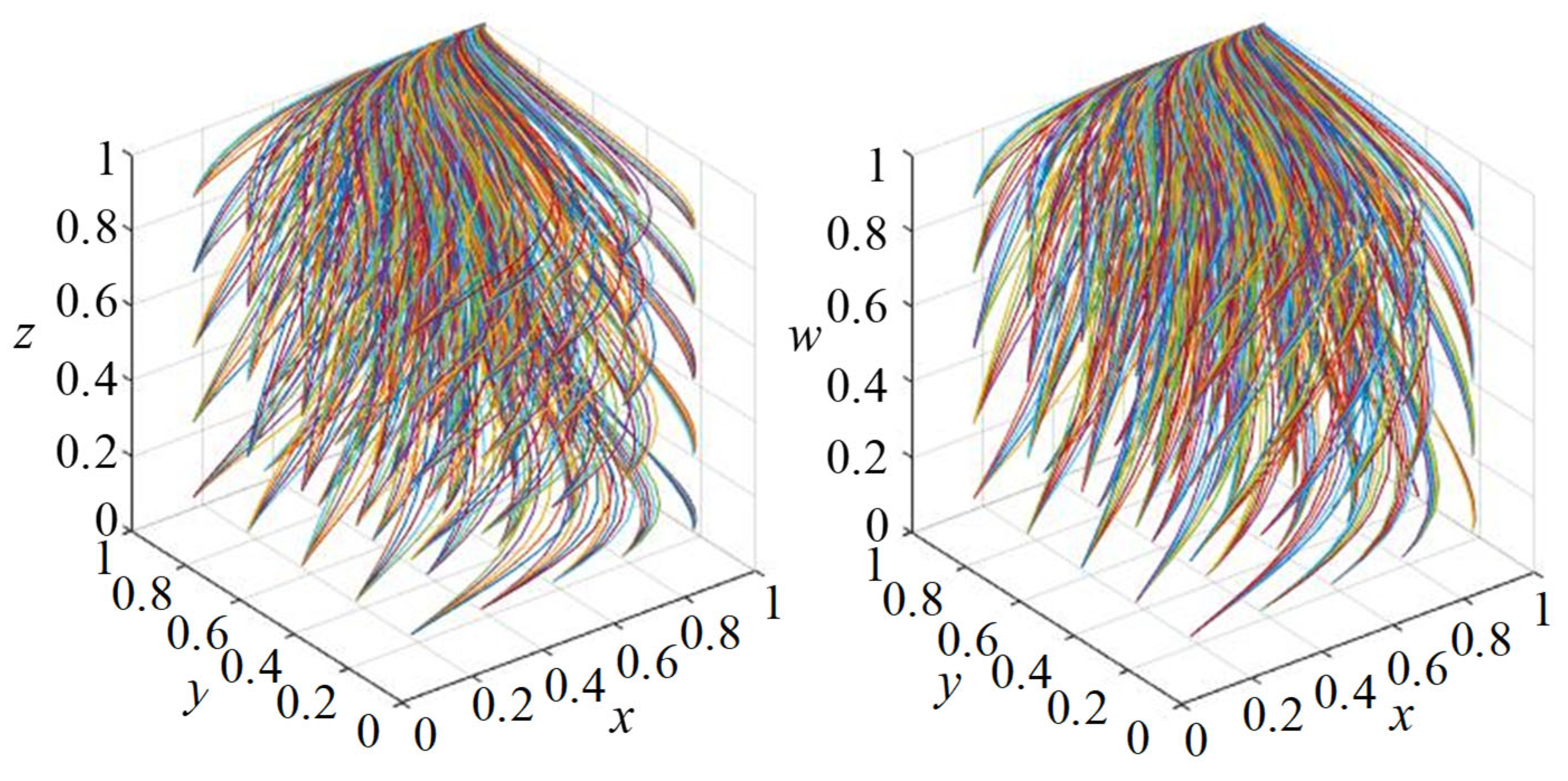
To verify the accuracy of the theoretical analysis presented above, an evolutionary path diagram of the system under the initial state has been constructed based on the simulation parameters (Figure 1). The multitude of curves in different colors represent the parameter variations corresponding to various test values. This simulates and demonstrates the overall evolutionary stability of the strategy combination among the four parties involved in promoting the digital transformation of high-end equipment. It was observed that over time, the government, financial institutions, high-end equipment manufacturers, and industrial technology platforms all evolve toward supporting digital transformation, ultimately converging to the rational stable state {high subsidy, response, adoption, upgrading}. This indicates that the government’s high-subsidy policy plays a crucial empowering role. By reducing the participation costs for market entities, it renders digital transformation profitable for various market players. Financial institutions and industrial technology platforms are motivated to engage in digital transformation by offering discounted interest loans and interest-free loans, optimizing the supply of digital products, and upgrading digital technologies and other measures to collaboratively support high-end equipment manufacturers. With backing from the government, financial institutions, and industrial technology platforms, high-end equipment manufacturers encounter lower costs and higher returns, making them more inclined to pursue digital transformation. Ultimately, this leads to the establishment of a long-term mechanism for digital transformation driven by multiple entities, thereby confirming the previous theoretical analysis. Furthermore, while changes in the initial decision probabilities of each participant do not alter the evolutionary outcome, the speed of reaching the ideal stable state varies depending on different initial values.

4.2. Influence of Initial Strategy Selection on the System

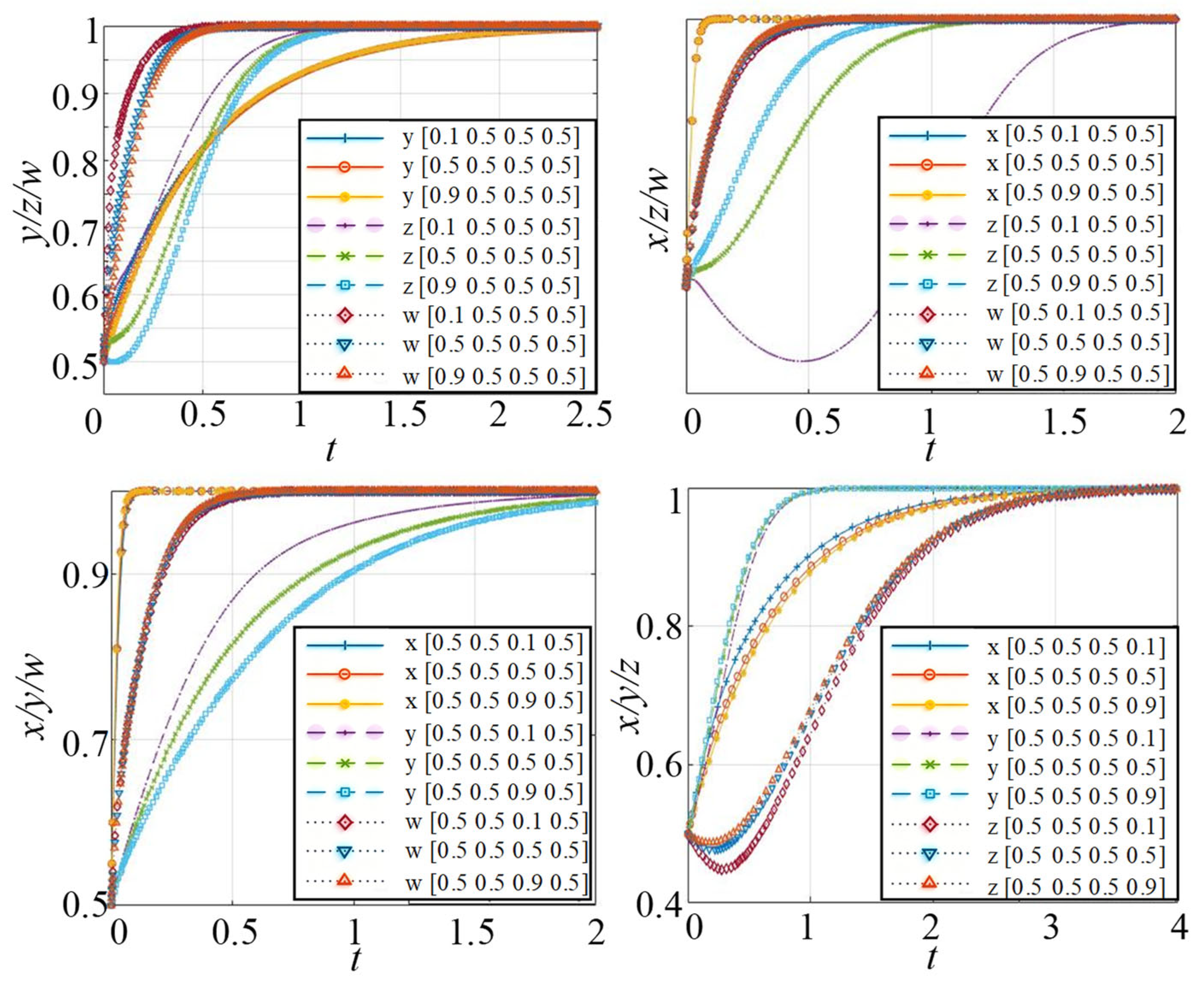
Initial participation strategies include: high subsidy intensity by the government, response by financial institutions to central policies, digital technology adoption by high-end equipment manufacturers, and product/service upgrading by industrial technology platforms. Let x = y = z = w { 0.1,0.5,0.9 } . With other parameters unchanged, the strategy evolution process when the initial probability of one party varies and the other three remain at 0.5 is as follows.

4.2.1. Evolutionary Strategies of the Other Three Parties Under Changes in the Government’s Initial Strategy

As time evolves, the government’s initial strategy probability x gradually increases. The convergence rate of financial institutions’ strategy probability to 1 remains basically unchanged, while the convergence rate of high-end equipment manufacturers and industrial technology platforms to active participation slows down. This indicates that high-end equipment manufacturers and industrial technology platforms have a tendency to reject digital technology adoption and product upgrading, respectively. Further analysis shows that high government subsidies tend to induce innovation inertia: once subsidies sufficiently cover costs, manufacturers and platforms face less urgency for technological iteration under guaranteed profits, thus reducing their enthusiasm for digital transformation.

4.2.2. Evolutionary Strategies of the Other Three Parties Under Changes in Financial Institutions’ Initial Strategy

When financial institutions’ initial strategy probability y gradually increases, the final evolutionary results of the other three parties all approach 1. The convergence rates of the government and industrial technology platforms remain stable, while the convergence speed of high-end equipment manufacturers accelerates significantly. This shows that a higher probability of financial institutions responding to central policies effectively promotes manufacturers to adopt digital technologies. Active financial support measures strongly incentivize manufacturers to participate in digital transformation.

4.2.3. Evolutionary Strategies of the Other Three Parties Under Changes in Manufacturers’ Initial Strategy

When the probability of manufacturers adopting digital technologies increases from 0.1 to 0.9, the evolutionary speeds of the government’s high subsidy and the platform’s upgrading decisions change slightly. The main variation is that the convergence speed of financial institutions’ response slows down. This implies that higher manufacturer participation reduces financial institutions’ willingness to respond. Due to the high-cost nature of digital transformation, manufacturers’ loan demand rises. Under high government subsidies, financial institutions prefer low-input and stable returns, weakening their motivation for active response.

4.2.4. Evolutionary Strategies of the Other Three Parties Under Changes in Platforms’ Initial Strategy

As the industrial technology platform’s initial probability of choosing the upgrading strategy gradually increases, the probabilities of financial institutions’ response and manufacturers’ adoption change slightly, while the government’s enthusiasm for high subsidies decreases significantly, as shown in Figure 2. The reason is that, as the regulator, the government aims to maximize overall social welfare. With stronger willingness of industrial technology platforms to participate, the government tends to maintain normal subsidy levels and let the market play a decisive role in resource allocation.

4.3. Influence of Parameter Changes on the System

4.3.1. Influence of Government Support Intensity K2 for Financial Institutions on the System

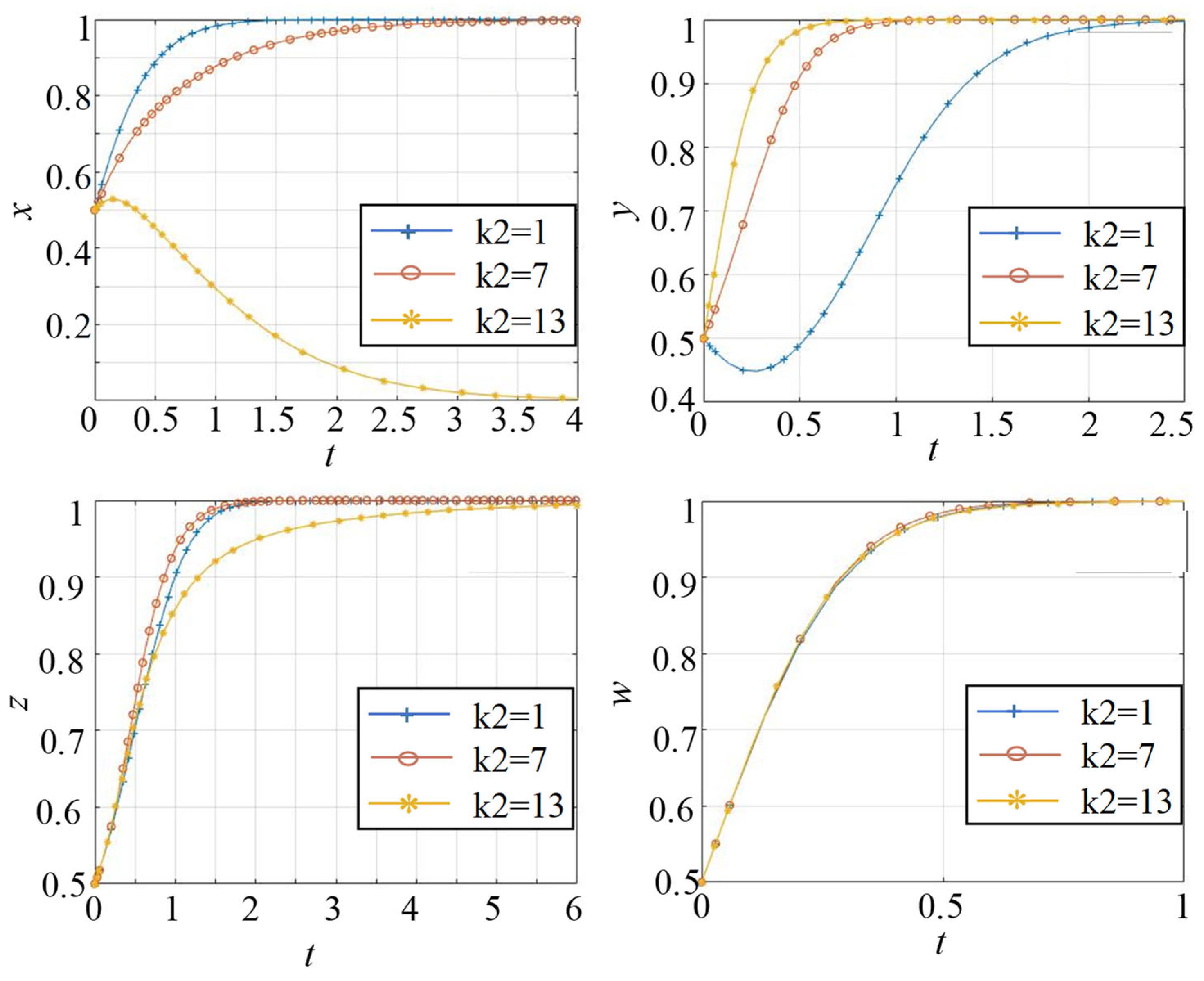
With other parameters unchanged, the government support intensity for financial institutions is gradually increased from K2 = 1 to 7 and 13. The influence of such changes on the strategy selection of the four parties is shown in Figure 3. When K2 = 1 and 7, the probability that the government chooses high subsidy evolves to 1 at t = 1.4 and t = 3, respectively. When K2 = 13, the government evolves toward normal subsidy, and the probability of choosing high subsidy converges to 0 at t = 3.8. In addition, as the direct beneficiary of subsidies, financial institutions take less time to choose the response strategy as K2 increases. For high-end equipment manufacturers, the probability of adopting digital technology evolves to 1 at t = 2 when K2 = 1 and 7. When K2 further rises to 13, the time required increases significantly to 6. However, changes in K2 have minimal impact on the probability that industrial technology platforms will choose to upgrade. It is evident that increasing government support for financial institutions accelerates their active participation in digital transformation. Nevertheless, when support exceeds a certain threshold, the government’s benefits from high subsidies diminish relative to the costs, resulting in a shift toward normal subsidies. Meanwhile, manufacturers and platforms continue to evolve toward active participation. Therefore, the government should adjust K2 based on actual conditions to ensure fiscal balance, stimulate the endogenous motivation of financial institutions, and guide the system toward the ideal stable state.

4.3.2. Influence of Government Support Intensity K3 for High-End Equipment Manufacturers on the System

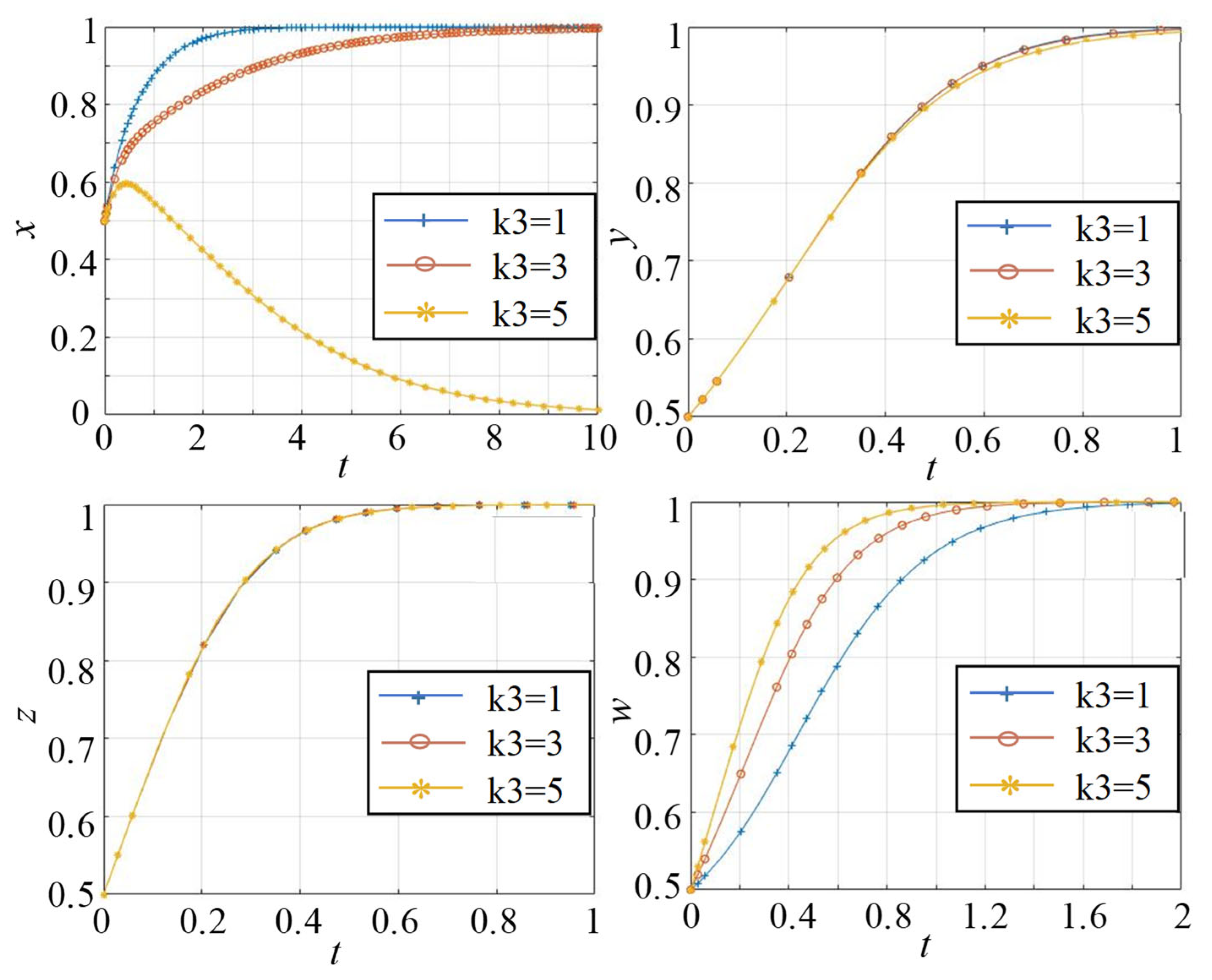
With other parameters unchanged, the government support intensity for high-end equipment manufacturers is gradually increased from K3 = 1 to 3 and 5. The influence of such changes on the strategy selection of the four parties is shown in Figure 4. When K3 = 1 and 3, the probability that the government chooses high subsidy evolves to 1 at t = 3 and t = 8, respectively. When K3 further increases to 5, the government evolves toward normal subsidy, and the probability of choosing high subsidy drops to approximately 0.02 at t = 10. As K3 gradually increases, high-end equipment manufacturers gradually evolve toward adopting digital technology, but there are differences in the time required for the adoption probability to evolve to 1: the higher the subsidy intensity, the shorter the time to adopt digital technology. In addition, changes in K3 have almost no impact on the probability that financial institutions and industrial technology platforms actively participate in the digital transformation of high-end equipment, and the time required for their probabilities to evolve to 1 is basically the same. It is evident that when the government’s support intensity for high-end equipment manufacturers is low, it is more inclined to increase subsidy intensity. However, once the support intensity reaches a certain threshold, the high-subsidy policy begins to impose a fiscal burden on the government, leading to a gradual decrease in the probability of the government choosing the high-subsidy strategy, potentially down to zero. The strategy selection of high-end equipment manufacturers is positively correlated with that of the government. Therefore, when providing support, the government should identify the critical point of subsidy efficiency to achieve a dynamic balance between policy effectiveness and fiscal sustainability.

4.3.3. Influence of Government Support Quota K4 for Industrial Technology Platforms on the System

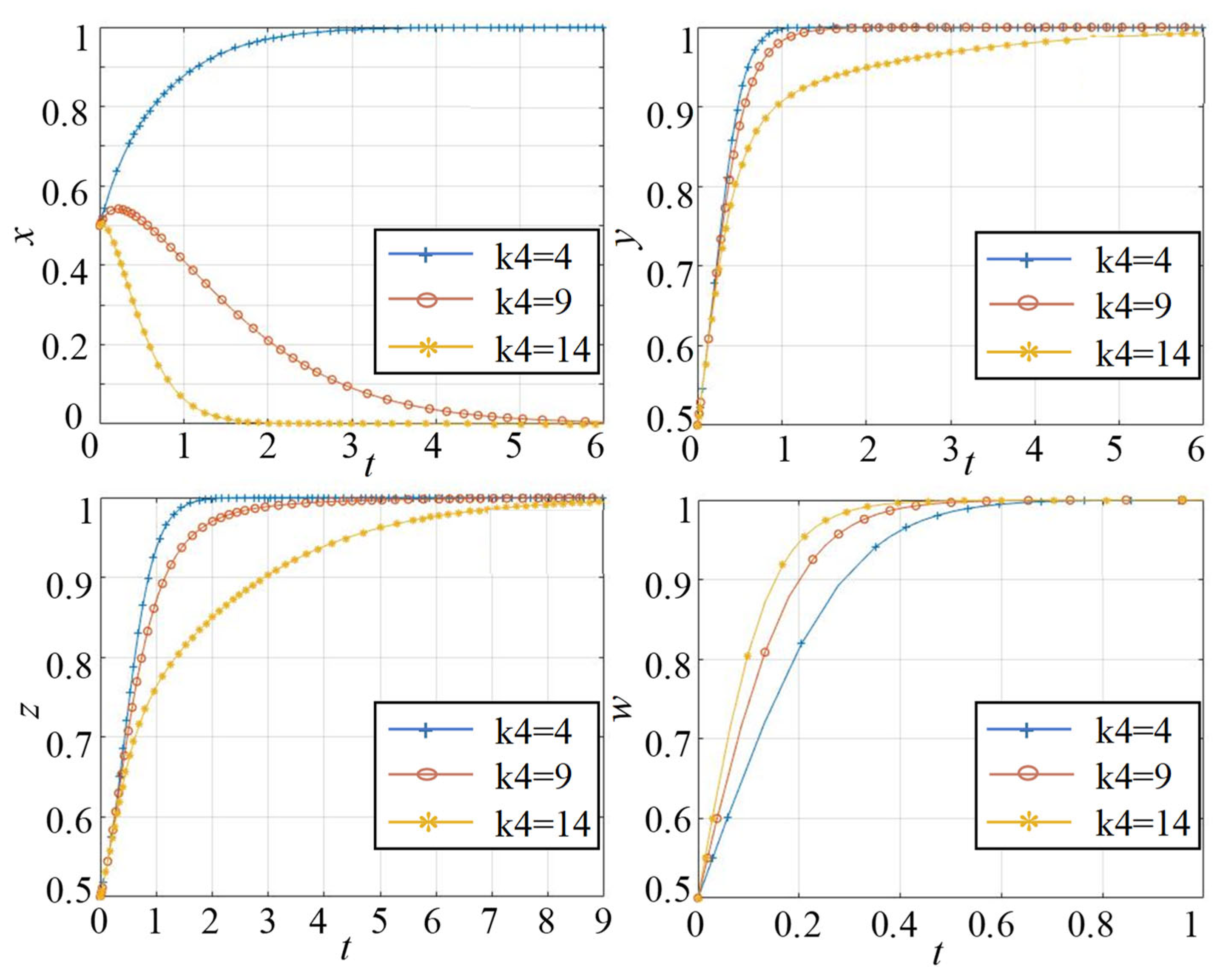
With other parameters unchanged, the government’s support quota for industrial technology platforms is gradually increased, with the subsidy quota raised from K4 = 4 to 9 and 14. The impact of such changes on the strategic choices of the four parties is shown in Figure 5. When K4 = 4, the government will evolve the probability of high subsidies to 1 at t = 3; as K4 gradually increases to 9 and 14, the government’s decision will evolve toward choosing normal subsidies, with the probability of high subsidies dropping to 0 at t = 5.8 and t = 2, respectively. The probability of industrial technology platforms choosing upgrading strategies is directly affected by K4: the higher the support quota, the shorter the time for industrial technology platforms to choose upgrading strategies, and the faster the convergence rate to 1. This is because upgrading products and services of industrial technology platforms requires a lot of cost input, and the income is uncertain. Government support can provide a basic guarantee for them to choose upgrading strategies, reducing the risk of investment. At this time, as K4 increases, both financial institutions and high-end equipment manufacturers will move toward actively participating in the digital transformation of high-end equipment. However, the time for financial institutions to respond and for high-end equipment manufacturers to use digital technology to reach 1 is negatively correlated with the value of K4—the higher the support quota, the shorter the time required to reach a stable state. It can be seen that in the process of promoting the digital transformation of high-end equipment, the government’s support for industrial technology platforms can effectively stimulate their enthusiasm for upgrading, and drive the positive participation of financial institutions and high-end equipment manufacturers. Therefore, the government should control the support quota K4 within a reasonable range. While encouraging industrial technology platforms to upgrade, it should also avoid the negative impact of excessive subsidies on the decision-making of financial institutions and high-end equipment manufacturers, so as to promote the stable operation of the entire system.

4.3.4. Influence of Government Subsidy Intensity r on the System

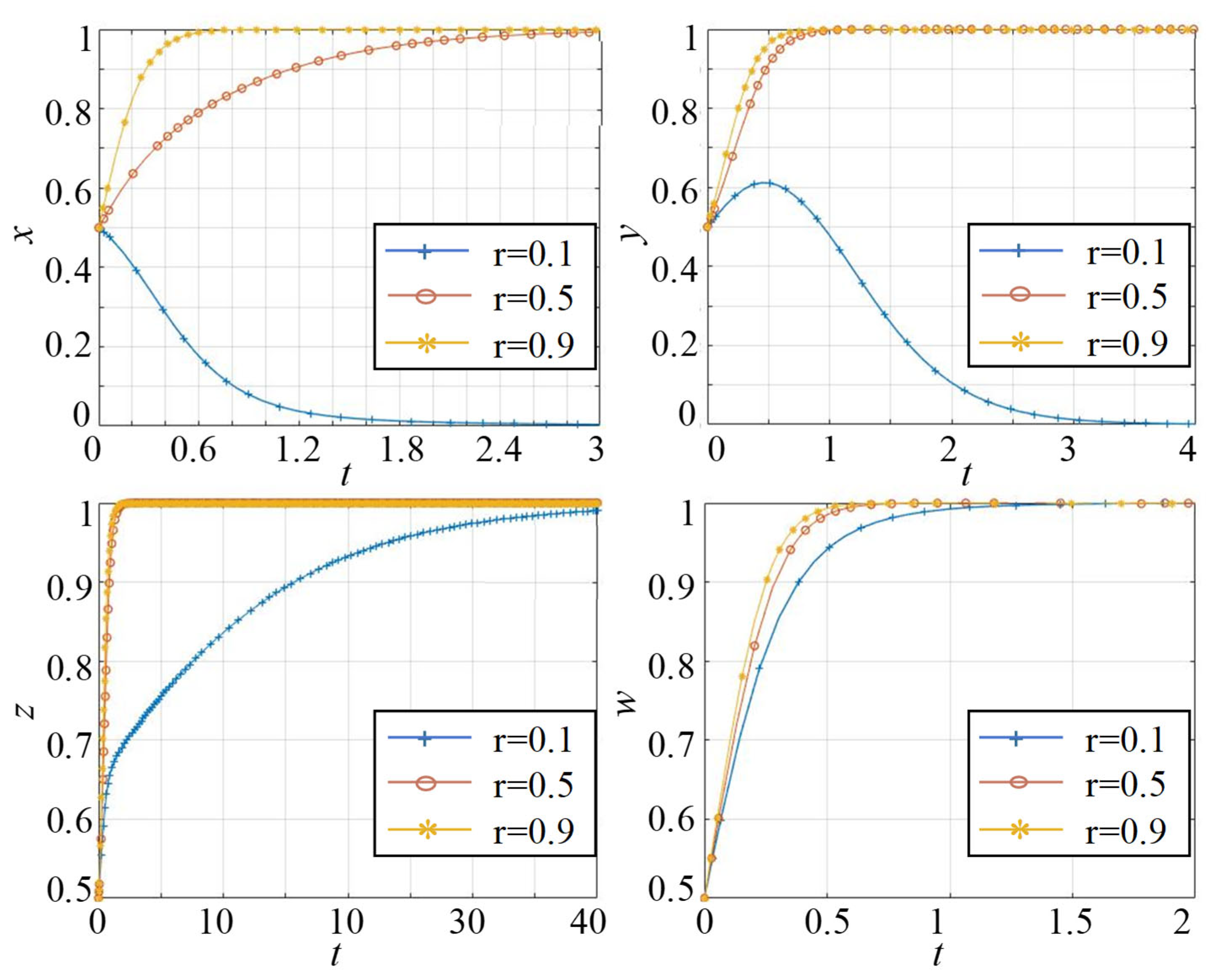
With other parameters unchanged, the government’s subsidy intensity is gradually increased, with the subsidy intensity r raised from 0.1 to 0.4 and 0.9. The impact of such changes on the strategic choices of all parties is shown in Figure 6. When r = 0.1, the government’s high-subsidy decision converges slowly, and the enthusiasm of market entities to participate in digital transformation is relatively low; when r = 0.4, the convergence speed of each subject’s strategy is moderate, and the participation enthusiasm of all parties is at a reasonable level; when r = 0.9, the government’s high-subsidy decision converges the fastest, and the enthusiasm of market entities to participate in digital transformation is significantly improved. It can be seen that the government’s subsidy intensity r has a direct impact on the enthusiasm of all market entities to participate in digital transformation. The higher the subsidy intensity, the stronger the motivation of each subject to participate actively, the faster the convergence speed of the system, and the more conducive it is to promoting the stable operation of the entire digital transformation process.

4.3.5. Influence of the Additional Income Coefficient v for Financial Institutions on the System

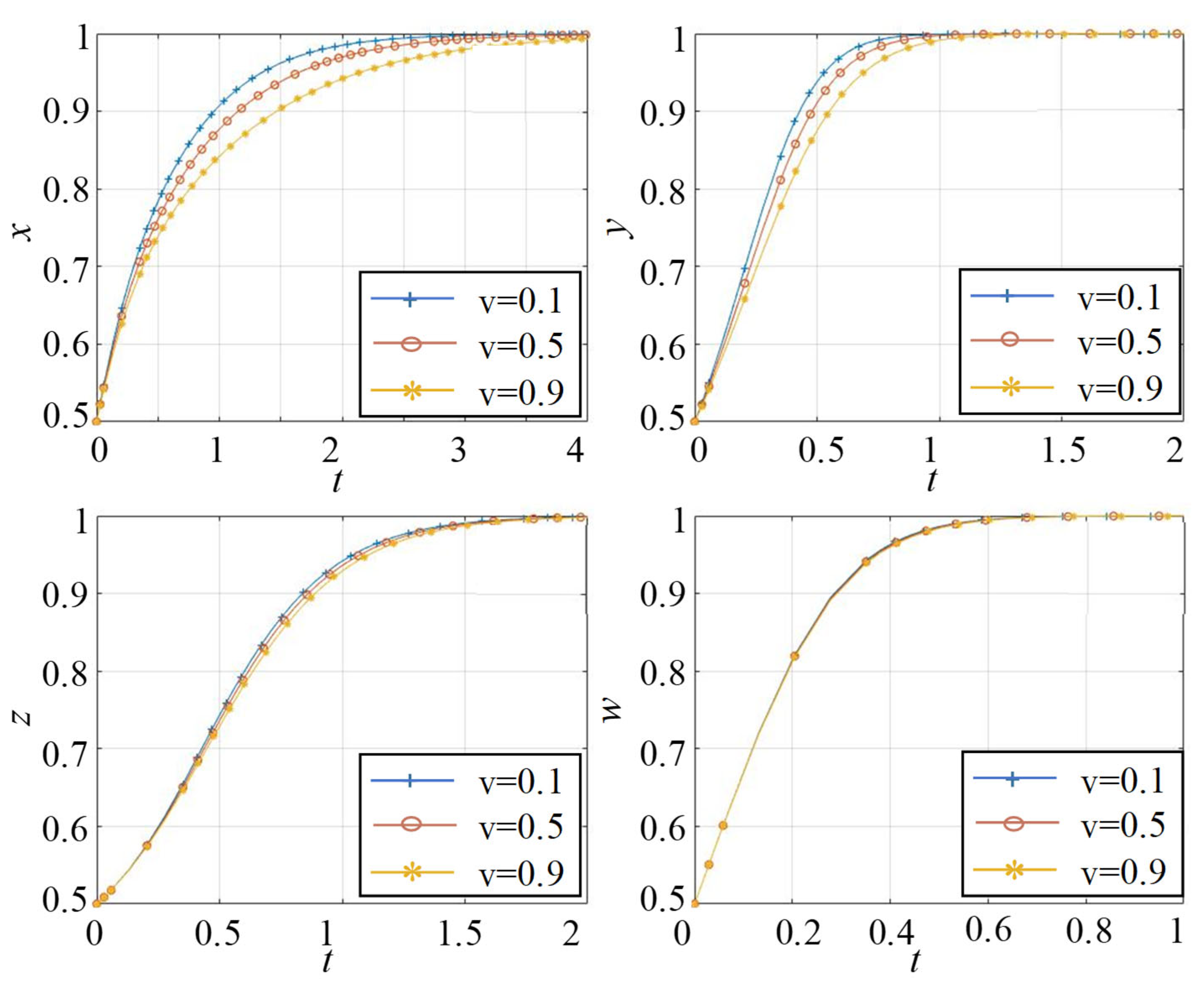
With other parameters unchanged, the additional income coefficient v of financial institutions is gradually increased from v = 0.1 to 0.5 and 0.9. The impact of such changes on the strategy selection of the four parties is shown in Figure 7. With the increase in v, all four parties evolve toward actively promoting the digital transformation of high-end equipment. Among them, the time required for the government’s high subsidy probability and financial institutions’ response probability to reach 1 gradually increases, while v has almost no effect on high-end equipment manufacturers and industrial technology platforms. When financial institutions respond to central policies, the additional tax revenue obtained by the government under normal subsidies from financial institutions is vS2. Therefore, an increase in v promotes tax growth under normal government subsidies, which inevitably prolongs the decision-making time for financial institutions and delays the government’s choice to implement the high-subsidy strategy. Similarly, the additional income that financial institutions can obtain without responding to central policies is also represented by vS2. A larger v will further cause financial institutions to delay adopting the response strategy. For high-end equipment manufacturers and industrial technology platforms, changes in v have minimal influence on their strategies. It is evident that once the digital transformation of high-end equipment enters the post-initial stage, the increasing additional income coefficient v for financial institutions results in diminishing marginal returns on the incentive effect of high government subsidies. Consequently, this leads to a longer time for both parties to achieve a probability of 1 for active participation.

4.3.6. Influence of the Additional Income Coefficient g for Industrial Technology Platforms on the System

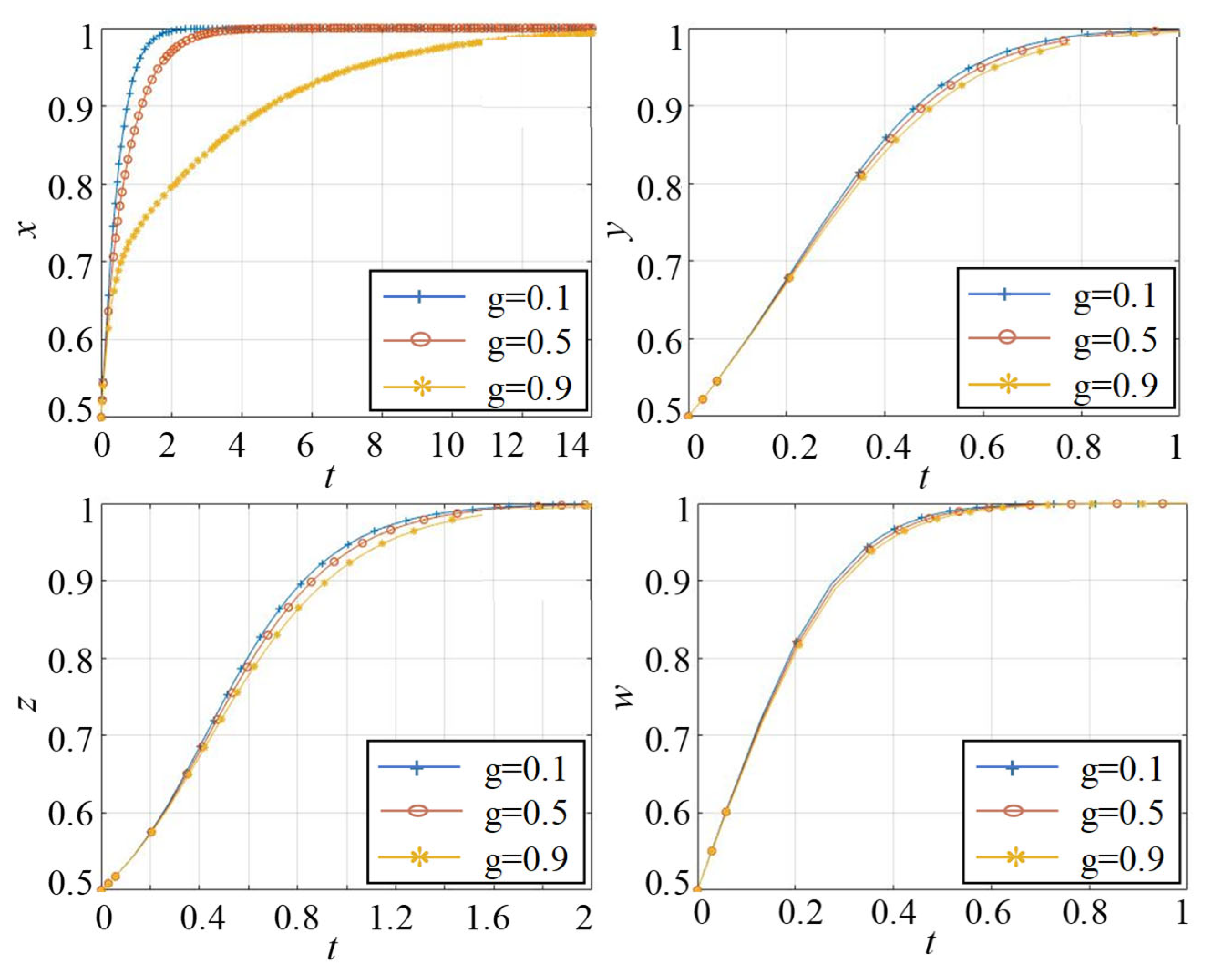
With other parameters unchanged, the additional income coefficient g for industrial technology platforms is gradually increased from g = 0.1 to 0.5 and 0.9. The impact of such changes on the strategy selection of the four parties is shown in Figure 8. As g increases, the evolution rate of the government’s high-subsidy strategy slows down with an increasing time trend, while the increase in g has almost no effect on the evolutionary trends of the other three parties. This is mainly because when industrial technology platforms choose different strategies, the taxes they pay to the government are S2 and gS2, respectively. With the increase in g, the cost–benefit gap of the government under high subsidies gradually narrows, thus prolonging the government’s decision-making time and delaying the moment when the probability of high subsidies reaches 1. In addition, the additional incomes obtained by industrial technology platforms under upgrading and non-upgrading are R42 and gR42, respectively. As g increases, the additional incomes from different decisions become similar, resulting in an insignificant change in the evolutionary trend of platforms’ decisions. Therefore, after the digital transformation of high-end equipment has advanced to a certain stage, the incentive effect of high government subsidies on financial institutions, high-end equipment manufacturers and industrial technology platforms slows down, and the time for the government’s high-subsidy probability to reach 1 becomes longer. Nevertheless, the system will still eventually converge to the ideal equilibrium state.

5. Conclusions and Recommendations

5.1. Research Conclusions

This paper constructs a four-party evolutionary game model for the digital transformation of high-end equipment manufacturing (HEM), analyzing the strategic interactions among governments, financial institutions, manufacturers, and technology platforms. The main conclusions are as follows:
First, among the 16 pure strategy equilibrium points identified, 4 are conditionally stable while 12 are unstable. The four conditional equilibria represent possible stakeholder strategies when relative net benefits are positive. Specifically, E13(0,1,1,1) and E16(1,1,1,1) represent ideal states: during the initial stage, low market participation necessitates high government-led subsidies to drive all parties toward the ideal equilibrium (1,1,1,1); in the stable promotion stage, the government reverts to normal subsidy levels, relying on market mechanisms to achieve the state (0,1,1,1).
Second, the mutual influences among initial strategies are asymmetric. The convergence of the government’s high-subsidy strategy slows down when platforms evolve more rapidly toward participation. Additionally, financial institutions exhibit a delayed response when manufacturers increase initial participation levels. Manufacturers’ adoption of technology accelerates with the evolution of financial institutions but decelerates with changes in government strategy. The active participation of platforms is inversely related to the government’s initial strategy probability.
Third, the government’s subsidy strategy critically guides the actions of other players. Increasing subsidies promotes participation; however, beyond a certain threshold, the active probability of the government decreases. The intensity of subsidies affects all players; exceeding a threshold drives the system toward the ideal equilibrium. Furthermore, the additional income coefficient for financial institutions impacts the convergence speed of government and financial institutions—larger coefficients slow down convergence, although eventual stability is still achieved. In contrast, the coefficient for platforms significantly influences the evolution of the government’s strategy.

5.2. Policy Recommendations

To enhance stakeholders’ willingness to promote the digital transformation of high-end equipment manufacturing (HEM) and to establish a sustainable long-term mechanism, this paper proposes the following measures:
Differentiated Subsidy Strategies for HEM. In the initial stage, the government should increase subsidies for financial institutions that develop HEM-specific credit products, manufacturers investing in digital twins and predictive maintenance technologies, and platforms building vertical infrastructure. As the transformation progresses, subsidies should be front-loaded during the R&D phases and gradually tapered once digital penetration exceeds 60%, transitioning to tax incentives and demonstration bases. Performance metrics should be sector-specific: manufacturers should be assessed based on equipment connectivity and defect prediction accuracy; financial institutions should be evaluated on digital loan ratios and non-performing loan (NPL) rates; and platforms should be monitored for response times and cost reductions achieved.
Stimulating Endogenous Dynamics Among Stakeholders. Financial institutions should offer installment loans tailored to the cash flows of HEM projects and introduce technology insurance–credit hybrids. Manufacturers should adopt tiered strategies—where large firms integrate Product Lifecycle Management (PLM), Manufacturing Execution Systems (MES), and Enterprise Resource Planning (ERP) systems; medium firms utilize cloud-based Software as a Service (SaaS); and small suppliers leverage plug-and-play modules—while also cultivating versatile talent. Platforms should focus on developing equipment-as-a-service models that incorporate predictive maintenance, rapid deployment combined with deep customization architectures, and ecosystem alliances to establish interoperability standards.
Improving Interest Linkage Mechanisms. The government should lead collaborative platforms that integrate regulatory oversight, operational data-based credit scoring, and cross-site production management, with subsidies adjusted according to cost reduction outcomes. To protect vulnerable manufacturers, joint ventures should be established with revenue-sharing arrangements tied to efficiency gains, success fee models contingent on measurable improvements, and data co-ownership frameworks that safeguard process know-how.

Supplementary Materials

The following supporting information can be downloaded at: https://www.mdpi.com/article/10.3390/info17050502/s1, Figure S1: Phase diagram of government subsidy strategy choice; Figure S2: Phase diagram of financial institutions choosing the response strategy; Figure S3: Phase diagram of high-end equipment manufacturers choosing the participation strategy; Figure S4: Phase diagram of industrial technology platforms choosing the participation strategy; Table S1: Notation, Description and English Translation of All Symbols in the Manuscript.

Author Contributions

Conceptualization, X.Z. and J.Y.; Methodology, X.Z. and J.Y.; Software, X.Z. and J.Y.; Validation, X.Z. and J.Y.; Formal Analysis, X.Z. and J.Y.; Investigation, X.Z. and J.Y.; Resources, X.Z. and J.Y.; Data Curation, X.Z. and J.Y.; Writing—Original Draft Preparation, X.Z. and J.Y.; Writing—Review and Editing, X.Z. and J.Y.; Visualization, X.Z. and J.Y.; Supervision, X.Z. and J.Y.; Project Administration, X.Z. and J.Y.; Funding Acquisition, X.Z. and J.Y. All authors have read and agreed to the published version of the manuscript.

Funding

This research received no external funding.

Institutional Review Board Statement

Not applicable.

Informed Consent Statement

Not applicable.

Data Availability Statement

Data are available on request due to restrictions. The data presented in this study are available from the corresponding authors upon reasonable request. The data are not publicly available because they involve proprietary experimental datasets and are subject to institutional data-sharing restrictions.

Conflicts of Interest

The authors declare no conflicts of interest.

References

  1. Mammadli, M.; Namazova, N.; Zeynalova, Z. Digital Platform Capability and Enterprise Digital Transformation in Azerbaijan’s Organic Product Value Chain. Sustainability 2026, 18, 634. [Google Scholar] [CrossRef] [Scilit]
  2. Chen, Y.; Huang, J.; Li, Y. Measuring digital transformation in high-end equipment manufacturing: An IPO model-based approach. Sci. Rep. 2025, 15, 27339. [Google Scholar] [CrossRef] [Scilit] [PubMed]
  3. Tian, L.; Sun, L.; Wang, X. Evaluation of Digital Transformation and Upgrading in Emerging Industry Innovation Ecosystems: A Hybrid Model Approach. Sustainability 2025, 17, 7969. [Google Scholar] [CrossRef] [Scilit]
  4. Qiu, Z.; Chen, Y.; Han, H.; Wang, T. Research on Digital Technology to Promote Low-Carbon Transformation of Manufacturing Industries Under the Perspective of Green Credit: An Evolutionary Game Theory Approach. Sustainability 2024, 16, 11203. [Google Scholar] [CrossRef] [Scilit]
  5. Wu, Y.; Zeng, H.; Hao, N.; Ma, S. The impact of economic policy uncertainty on the domestic value added rate of construction enterprise exports—Evidence from China. J. Asian Archit. Build. Eng. 2025, 25, 2111–2125. [Google Scholar] [CrossRef] [Scilit]
  6. Shen, D.; Zhao, X.; Lyu, S.; Liu, H.; Zeng, H.; Ma, S. Qualification and construction enterprise innovation–quasi-natural experiments based on specialized, high-end and innovation-driven “small giant” enterprises. J. Asian Archit. Build. Eng. 2025, 25, 2222–2240. [Google Scholar] [CrossRef] [Scilit]
  7. Li, Y.; Cong, R.; Zhang, K.; Ma, S.; Fu, C. Four-way game analysis of transformation and upgrading of manufacturing enterprises relying on industrial internet platform under developers’ participation. J. Asian Archit. Build. Eng. 2025, 24, 5886–5907. [Google Scholar] [CrossRef] [Scilit]
  8. Dong, Z.; Dai, P. Dynamic mechanism of digital transformation in equipment manufacturing enterprises based on evolutionary game theory: Evidence from China. Systems 2023, 11, 493. [Google Scholar] [CrossRef] [Scilit]
  9. Zhang, X.; Zhao, X.; Chen, R.; Wu, H. Analysis of manufacturers’ digital transformation strategies in response to government incentives. J. Model. Manag. 2025, 20, 1769–1788. [Google Scholar] [CrossRef] [Scilit]
  10. Wang, D.; Shao, X. Research on the impact of digital transformation on the production efficiency of manufacturing enterprises: Institution-based analysis of the threshold effect. Int. Rev. Econ. Financ. 2024, 91, 883–897. [Google Scholar] [CrossRef] [Scilit]
  11. Pan, H.; Qin, C.; Li, Y.; Jing, H.; Zhang, Y. Does financial flexibility affect corporate ESG Performance? Evidence from China. Int. Rev. Econ. Financ. 2025, 102, 104272. [Google Scholar] [CrossRef] [Scilit]
  12. Ma, S.; Zeng, H.; Abedin, M.Z. The impact of the reforms in the Chinese equities exchange and quotations on innovation in cross-border e-commerce enterprises. Asia Pac. Bus. Rev. 2025, 1–41. [Google Scholar] [CrossRef] [Scilit]
  13. Sun, X.; Du, L.; Zhu, X. Interpretable Neural Network-Based Early Warning of Proxy-Based Supply Chain Disruption Vulnerability: Evidence from Cross-Border Equipment Manufacturing Enterprises in Shandong, China. Sustainability 2026, 18, 3821. [Google Scholar] [CrossRef] [Scilit]
  14. Eirikas, U. AI and Cloud Innovation in Banking: A Deep-Tech Approach to Optimizing Core Financial Operations. Master’s Thesis, Vilnius University, Vilnius, Lithuania, 2026. [Google Scholar]
  15. Alves, M.; Martinho, D.; Marcão, R.; Sobreiro, P. Generative AI Adoption in B2B Firms: Ethical Governance, Innovation Capabilities, and Long-Term Competitive Performance. Systems 2026, 14, 410. [Google Scholar] [CrossRef] [Scilit]
  16. Zhuang, C.; Lin, Y.; Wang, L. Research on ambidextrous digital innovation strategies of SMEs embedded in industrial internet platforms based on evolutionary game theory. Sci. Rep. 2025, 16, 1876. [Google Scholar] [CrossRef] [Scilit] [PubMed]
  17. Shi, Y.; Wen, Z.; Zhang, Z. Evolutionary game analysis of empowering smes’ digital transformation by core manufacturing enterprises under government subsidies. Systems 2025, 13, 225. [Google Scholar] [CrossRef] [Scilit]
  18. Wang, Y.; Hou, R.; Xiang, L. From Policy Catalysis to Market Relay: A Tripartite Evolutionary Game Study on Digital–Green Synergy in E-Commerce. J. Theor. Appl. Electron. Commer. Res. 2026, 21, 117. [Google Scholar] [CrossRef] [Scilit]
  19. Ritzberger, K.; Weibull, J.W. Evolutionary selection in normal-form games. Econom. J. Econom. Soc. 1995, 63, 1371–1399. [Google Scholar] [CrossRef] [Scilit]
  20. Selten, R. A note on evolutionarily stable strategies in asymmetric animal conflicts. In Models of Strategic Rationality; Springer: Berlin/Heidelberg, Germany, 1988; pp. 67–75. [Google Scholar]
Figure 1. Initial evolutionary path diagram of the four-party game. The multitude of curves in different colors represent the parameter variations corresponding to various test values.
Information 17 00502 g001
Figure 2. Strategy evolution of the other three parties when the initial strategy selection probabilities x, y, z, and w change, respectively.
Information 17 00502 g002
Figure 3. Evolution of four-party decisions under changes in government support intensity K2.
Information 17 00502 g003
Figure 4. Evolution of four-party decisions under changes in government support intensity K3.
Information 17 00502 g004
Figure 5. Evolution of four-party decisions under changes in government support intensity K4.
Information 17 00502 g005
Figure 6. Evolution of four-party decisions under changes in government subsidy intensity r.
Information 17 00502 g006
Figure 7. Evolution of four-party decisions under changes in the additional income coefficient v of financial institutions.
Information 17 00502 g007
Figure 8. Evolution of four-party decisions under changes in the additional income coefficient g of industrial technology platforms.
Information 17 00502 g008
Table 1. Payoff matrix of the four parties promoting the digital transformation of high-end equipment.
Financial Institution Uses (z)Financial Institution Does Not Use (1 − z)
Digital Platform Upgrade (w)Digital Platform Maintain (1 − w)Digital Platform Upgrade (w)Digital Platform Maintain (1 − w)
Government high subsidy (x)Financial institution responds (y) a 1 = S 1 + S 2 + S 3 K 1 K 2 K 3 K 4
b 1 = K 2 + R 21 + R 22 C 21
c 1 = K 3 + R 31 + R 32 C 31
d 1 = K 4 + R 41 + R 42 C 41
a 2 = S 1 + S 2 K 1 K 2 K 3
b 2 = K 2 + R 21 + v R 22 C 21 C 22
c 2 = K 3 + R 31 C 31 C 32
d 2 = g R 42 F 4 C 42
a 3 = S 1 + S 2 + S 3 K 1 K 2 K 4
b 3 = K 2 + R 21 + v R 22 C 21 C 22
c 3 = 0
d 3 = K 4 + R 41 + g R 42 C 41 C 42
a 4 = S 1 + S 2 K 1 K 2
b 4 = K 2 + R 21 + v R 22 C 21 C 22
c 4 = 0
d 4 = g R 42 F 4 C 42
Financial institution not respond (1 y) a 5 = S 1 + g S 3 K 1 K 3 K 4
b 5 = v R 22 C 22 F 2
c 5 = K 3 + R 31 C 31 C 32
d 5 = K 4 + R 41 + g R 42 C 41 C 42
a 6 = S 1 K 1 K 3
b 6 = v R 22 C 22 F 2
c 6 = K 3 + R 31 C 31 C 32
d 6 = g R 42 F 4 C 42
a 7 = S 1 + g S 3 K 1 K 4
b 7 = v R 22 C 22 F 2
c 7 = 0
d 7 = K 4 + R 41 + g R 42 C 41 C 42
a 8 = S 1 K 1
b 8 = v R 22 C 22 F 2
c 8 = 0
d 8 = g R 42 F 4 C 42
Government normal subsidy (1 − x)Financial institution responds (y) a 9 = v S 2 + g S 3 r K 1 r K 2 r K 3 r K 4
b 9 = r K 2 + R 21 + v R 22 C 21 C 22
c 9 = r K 3 + R 31 C 31 C 32
d 9 = r K 4 + R 41 + g R 42 C 41 C 42
a 10 = v S 2 r K 1 r K 2 r K 3
b 10 = r K 2 + R 21 + v R 22 C 21 C 22
c 10 = r K 3 + R 31 C 31 C 32
d 10 = g R 42 F 4 C 42
a 11 = v S 2 + g S 3 r K 1 r K 2 r K 4
b 11 = r K 2 + R 21 + v R 22 C 21 C 22
c 11 = 0
d 11 = r K 4 + R 41 + g R 42 C 41 C 42
a 12 = v S 2 r K 1 r K 2
b 12 = r K 2 + R 21 C 21 C 22
c 12 = 0
d 12 = g R 42 F 4 C 42
Financial institution not respond (1 y) a 13 = g S 3 r K 1 r K 3 r K 4
b 13 = v R 22 C 22 F 2
c 13 = r K 3 + R 31 C 31 C 32
d 13 = r K 4 + R 41 + g R 42 C 41 C 42
a 14 = r K 1 r K 3
b 14 = v R 22 C 22 F 2
c 14 = r K 3 + R 31 C 31 C 32
d 14 = g R 42 F 4 C 42
a 15 = g S 3 r K 1 r K 4
b 15 = v R 22 C 22 F 2
c 15 = 0
d 15 = r K 4 + R 41 + g R 42 C 41 C 42
a 16 = r K 1
b 16 = C 22 F 2
c 16 = 0
d 16 = g R 42 F 4 C 42
Note: The payoffs from top to bottom are for the government, high-end equipment manufacturers, financial institutions, and industrial technology platforms, respectively.
Table 2. Asymptotic stability analysis of equilibrium points for promoting digital transformation of high-end equipment.
Equilibrium Point Eigenvalues   λ 1 ,   λ 2 ,   λ 3 ,   λ 4 SignStability
E 1 ( 0,0 , 0 , 0 ) S 1 + r K 1 K 1 , F 2 C 21 + R 21 + r K 2 ,   R 31 C 32 C 31 + r K 3 ,   F 4   C 41   + R 41   + r K 4 X X + + Unstable
E 2 ( 0,0 , 0,1 ) S 1 K 4 K 1 + r K 1 + r K 4 , F 2 C 21 + R 21 + r K 2 , R 31 C 32 C 31 + r K 3 ,   C 41   F 4   R 41 r K 4 X X + + Unstable
E 3 ( 0,0 , 1,0 ) S 1 K 3 K 1 + r K 1 + r K 3 , F 2 C 21 + R 21 + r K 2 , C 31 + C 32 R 31 r K 3 , F 4 C 41 + R 41 + r K 4 X X + Unstable
E 4 ( 0,1 , 0,0 ) S 1 K 2 K 1 + S 2 + r K 1 + r K 2 v S 2 , C 21 F 2 R 21 r K 2 ,   R 31 C 32 C 31 + r K 3 , F 4   C 41 + R 41 + r K 4 X X + + Unstable
E 5 ( 1,0 , 0,0 ) K 1 S 1 r K 1 , F 2 C 21 + K 2 + R 21 ,   K 3 C 32 C 31 + R 31 ,   F 4   C 41 + R 41 + K 4 X X + + Unstable
E 6 ( 1,1 , 0,0 ) K 1 + K 2 S 1 S 2 r K 1 r K 2 + v S 2 , C 21 F 2 K 2 R 21 , K 3 C 32 C 31 + R 31 ,   F 4   C 41 + R 41 + K 4 X X + + Unstable
E 7 ( 1,0 , 1,0 ) K 1 + K 3 S 1 r K 1 r K 3 , F 2 C 21 + R 21 + K 2 , C 31 + C 32 K 3 R 31 ,   F 4 C 41 + R 41 + K 4 X X + Unstable
E 8 ( 1,0 , 0,1 ) K 1 + K 4 S 1 r K 1 r K 4 , F 2 C 21 + K 2 + R 21 , K 3 C 32 C 31 + R 31 , C 41 F 4 R 41 K 4 X X + Unstable
E 9 ( 0,1 , 1,0 ) S 1 K 2 K 3 K 1 + S 2 + r K 1 + r K 2 + r K 3 v S 2 , C 21 F 2 r K 2 R 21 ,   C 31 + C 32 r K 3 R 31 ,   F 4 C 41 + R 41 + r K 4 X X + Unstable
E 10 ( 0,1 , 0,1 ) S 1 K 2 K 4 K 1 + S 2 + S 3 g S 3 + r K 1 + r K 2 + r K 4 v S 2 , C 21 F 2 r K 2 R 21 ,   R 31 C 32 C 31 + r K 3 ,   C 41 F 4 R 41 r K 4 X X + Unstable
E 11 ( 0,0 , 1,1 ) S 1 K 3 K 4 K 1 + r K 1 + r K 3 + r K 4 , F 2 C 21 + r K 2 + R 21 ,   C 31 + C 32 r K 3 R 31 , C 41 F 4 R 41 r K 4 X X ESS
E 12 ( 1,1 , 0,1 ) K 1 + K 2 + K 4 S 1 S 2 S 3 + g S 3 r K 1 r K 2 r K 4 + v S 2 , C 21 F 2 K 2 R 21 , K 3 C 31 + R 31 + R 32 , C 41 F 4 R 41 K 4 X X + Unstable
E 13 ( 0,1 , 1,1 ) S 1 K 2 K 3 K 4 K 1 + S 2 + S 3 g S 3 + r K 1 + r K 2 + r K 3 + r K 4 v S 2 , C 21 F 2 r K 2 R 21 , C 31 + C 32 r K 3 R 31 ,   C 41 F 4 R 41 r K 4 X X ESS
E 14 ( 1,1 , 1,0 ) K 1 + K 2 + K 3 S 1 S 2 r K 1 r K 2 r K 3 + v S 2 , C 21 F 2 K 2 R 21 , C 31 + C 32 K 3 R 31 ,   C 42   C 41 + F 4 + K 4 + R 41 + R 42 g R 42 X X + Unstable
E 15 ( 1,0 , 1,1 ) K 1 + K 3 + K 4 S 1 r K 1 r K 3 r K 4 , C 22 C 21 + F 2 + K 2 + R 21 + R 22 v R 22 , C 31 + C 32 K 3 R 31 ,   C 41 F 4 R 41 K 4 X X X X ESS
E 16 ( 1,1 , 1,1 ) K 1 + K 2 + K 3 + K 4 S 1 S 2 S 3 + g S 3 r K 1 r K 2 r K 3 r K 4 + v S 2 , C 21 C 22 F 2 K 2 R 21 R 22 + v R 22 , C 31 K 3 R 31 R 32 , C 41 C 42 F 4 R 41 R 42 K 4 + g R 42 X X X X ESS
Note: X represents uncertainty in sign.
Disclaimer/Publisher’s Note: The statements, opinions and data contained in all publications are solely those of the individual author(s) and contributor(s) and not of MDPI and/or the editor(s). MDPI and/or the editor(s) disclaim responsibility for any injury to people or property resulting from any ideas, methods, instructions or products referred to in the content.