

Applying Integrated Delphi–AHP to Maintenance Competency Prioritization in Industry 4.0: A Formally Specified Group Decision Framework with Consistency and Sensitivity Diagnostics


Abstract
1. Introduction
1.1. Background and Motivation
1.2. Application Context: Maintenance Competency in Industry 4.0
1.3. Related Work and Specification Gap
1.4. Problem Statement and Objectives
1.5. Significance and Contributions
- Application contribution: It presents the first formally specified application of integrated Delphi–AHP with full diagnostics to Industry 4.0 maintenance-competency prioritization—a domain where MCDA has been underutilized despite the inherent multi-criteria nature of workforce assessment in asset-intensive operations.
- Procedural contribution: It closes common specification gaps in published Delphi–AHP implementations by making the complete procedural chain explicit: consolidation and retention rules, group aggregation operator (with theoretical justification), normalization, consistency screening, and agreement/robustness reporting. A bounded AI-assisted consistency-check step for terminology harmonization is formalized with explicit constraints and expert-panel validation.
1.6. Scope, Limitations, and Paper Organization
1.7. Methodological Rationale
2. Mathematical Framework and Methods
2.1. Notation and Problem Formulation
2.2. Delphi Consensus and Stability Metrics
2.3. AHP Prioritization and Group Aggregation
- Pairwise Comparison Matrix
- Aggregation of Group Judgments (AIJ)
- Priority Vector and Consistency Check
2.4. Theoretical Justification of the Aggregation Operators
- The Aczél–Saaty Theorem
- Eigenvector Method Validity
- AIJ Versus AIP
- Compensatory Nature and Distinction from Weighted-Sum Methods
- Independence Assumption and Scope
2.5. Agreement and Sensitivity Diagnostics
- Kendall’s Coefficient of Concordance
- Perturbation-Based Sensitivity
2.6. AI-Assisted Consistency Check Protocol
- Ambiguity Detection: Flagging vague or inconsistent wording across expert statements.
- Terminology Harmonization: Proposing neutral and standardized phrasing for panel review.
- Coverage Check: Identifying potentially underrepresented themes for expert reconsideration.
| Algorithm 1 AI-assisted consistency check protocol |
|
2.7. Workflow Overview and Algorithmic Summary
| Algorithm 2 Delphi consensus protocol with stability check |
|
| Algorithm 3 AHP prioritization with consistency check and expert aggregation |
|
3. Application: Maintenance Competency Prioritization
3.1. Context, Expert Panel, and Data Collection
3.2. Delphi Consensus Results
- Round 1: Open-ended questions were distributed to elicit potential competencies and performance indicators. Redundant responses were removed, and conceptually similar statements were consolidated into an initial list. A bounded AI-assisted consistency check was used only to flag semantic overlap and ambiguous wording during this consolidation; it did not add items or change any weights without expert acceptance.
- Round 2: Experts rated the importance of each item using a five-point Likert scale. Median and interquartile range (IQR) statistics were computed to evaluate agreement and identify contentious items.
- Round 3: Feedback summaries were provided to participants, who re-evaluated items based on the group consensus. Items meeting the retention criteria (median , IQR ) were retained as final indicators.
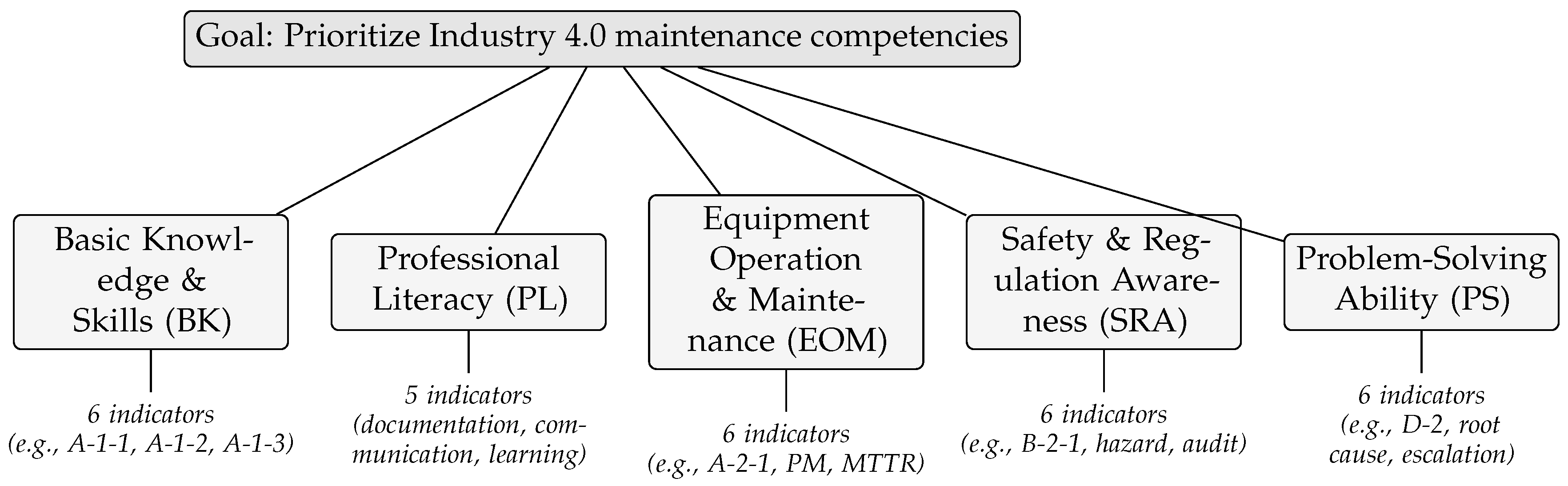
- Basic Knowledge and Skills;
- Professional Literacy;
- Equipment Operation and Maintenance;
- Safety and Regulation Awareness;
- Problem-Solving Ability.
3.3. AHP Prioritization Results
3.4. Agreement and Sensitivity Results
- Agreement (Kendall’s W)
- Sensitivity (Bounded Perturbation)
3.5. Workflow Summary and Table Integration
3.6. Framework Validation and Operational KPI Mapping
4. Discussion
4.1. Interpretation for Industry 4.0 Asset Management
4.2. Role of AI-Assisted Preprocessing
4.3. Comparison with Prior Delphi–AHP Implementations
4.4. Practical Implications
- Recruitment Screening: The high weight of Basic Knowledge and Skills indicates that role-specific fundamentals should be assessed at hiring through targeted evaluations reflecting the operating context, procedures, and documentation practices.
- Training Resource Allocation: Since Safety Awareness and Problem-Solving ranked highly, training plans should allocate comparable emphasis to hazard control and diagnosis practice, rather than treating safety as a secondary topic. Structured feedback methods drawn from related learning-science work—for example, video-based feedback approaches developed for skill acquisition in other domains [31]—offer a transferable design pattern for procedural-skill rehearsal in maintenance training programs.
- Standardized Evaluation: The 29 indicators can serve as a weighted checklist for performance reviews, supporting a data-driven approach to competency scoring and skill-gap analysis.
4.5. Limitations
5. Conclusions
5.1. Summary and Contributions
- Application contribution: It demonstrates that integrated Delphi–AHP with formal diagnostics is effective for maintenance-competency prioritization in Industry 4.0—providing evidence-based guidance for workforce development, training allocation, and performance evaluation in asset-intensive operations.
- Procedural contribution: It closes common specification gaps in published Delphi–AHP implementations by making the complete procedural chain explicit at the operator level: consolidation and retention rules, geometric-mean group aggregation with theoretical justification, consistency screening, and agreement/robustness reporting. A bounded AI-assisted consistency-check step is formalized as preprocessing for terminology harmonization, with explicit constraints and expert-panel validation.
5.2. Limitations and Future Work
Author Contributions
Funding
Institutional Review Board Statement
Informed Consent Statement
Data Availability Statement
Acknowledgments
Conflicts of Interest
Abbreviations
| AHP | Analytic Hierarchy Process |
| AIJ | Aggregation of Individual Judgments |
| AIP | Aggregation of Individual Priorities |
| CI | Consistency Index (AHP) |
| CR | Consistency Ratio |
| IoT | Internet of Things |
| IQR | Interquartile Range |
| KPI | Key Performance Indicator |
| MCDA | Multiple Criteria Decision Analysis |
| MCDM | Multi-Criteria Decision-Making |
| MTTR | Mean Time To Repair |
| PM | Preventive Maintenance |
| RI | Random Index |
| SD | Standard Deviation |
| WSM | Weighted Sum Method |
References
- Madzík, P.; Falát, L. State-of-the-Art on Analytic Hierarchy Process in the Last 40 Years: Literature Review Based on Latent Dirichlet Allocation Topic Modelling. PLoS ONE 2022, 17, e0268777. [Google Scholar] [CrossRef] [Scilit] [PubMed]
- Dang, T.M.; Nguyen, L.T.D. Integration of Delphi Technique and Analytical Hierarchy Process Method in Assessing the Groundwater Potential Influence Criteria: A Case Study of the Ba River Basin. Inżynieria Miner. 2021. [Google Scholar]
- Liu, S.; Zeng, W.; Li, X. Toward an Integrated Framework of Ocean Literacy: A Delphi–AHP Approach. Mar. Policy 2023, 157, 105830. [Google Scholar] [CrossRef] [Scilit]
- Abdul, D.; Jiang, W.; Tanveer, A.; Sameeroddin, M. Comprehensive Analysis of Renewable Energy Technologies Adoption in Remote Areas Using the Integrated Delphi–Fuzzy AHP–VIKOR Approach. Arab. J. Sci. Eng. 2024, 49, 7585–7610. [Google Scholar] [CrossRef] [Scilit]
- Yildiz, A.; Ozkan, C. A Novel Modified Delphi-Based Spherical Fuzzy AHP Integrated Spherical Fuzzy CODAS Methodology for Vending Machine Location Selection Problem: A Real-Life Case Study in İstanbul. Neural Comput. Appl. 2024, 36, 823–842. [Google Scholar] [CrossRef] [Scilit]
- Liao, C.W.; Yao, K.C.; Wang, C.H.; Hsieh, H.H.; Wang, I.C.; Ho, W.S.; Huang, S.H. Fuzzy Delphi and DEMATEL Approaches in Sustainable Wearable Technologies: Prioritizing User-Centric Design Indicators. Appl. Sci. 2025, 15, 461. [Google Scholar] [CrossRef] [Scilit]
- Liao, C.W.; Lin, J.H.; Chen, T.W. Research on a Framework for Sustainable Campus Eco-Architecture Selection: Taking a Taiwan High School as an Example. Sustainability 2022, 14, 6265. [Google Scholar] [CrossRef] [Scilit]
- Shyr, W.J.; Liao, Y.C.; Cheng, S.H.; Ho, C.M.; Liao, C.W. Competency Frameworks for Promoting Technology-Assisted Self-Regulated Learning Among Vocational High School Teachers. SAGE Open 2025, 15, 21582440251381183. [Google Scholar] [CrossRef] [Scilit]
- Liao, C.W.; Chang, C.P.; Lee, H.C.; Lee, H.Y.; Liao, Y.C. Research on Core Competency Indicators for Battery Electric Vehicle Sales Personnel: Aligning with SDG Goals for Sustainable Mobility and Workforce Development. World Electr. Veh. J. 2025, 16, 213. [Google Scholar] [CrossRef] [Scilit]
- Yu, H.C.; Hsueh, T.J.; Wu, T.Y.; Liu, C.; Liao, C.W.; Fu, Y.K. A Competency Framework for Electric Vehicle Maintenance Technicians: Addressing the Environmental, Social, and Governance (ESG) Imperatives of the BEV Industry. World Electr. Veh. J. 2025, 16, 314. [Google Scholar] [CrossRef] [Scilit]
- Ulanov, V.L. The Need for the Green Economy Factors in Assessing the Development and Growth of Russian Raw Materials Companies. J. Compr. Bus. Adm. Res. 2024, 1, 19–26. [Google Scholar] [CrossRef] [Scilit]
- Kumar, P.; Sharma, M.K. Sustainable Manufacturing Practices in Global Context. Circ. Econ. Sustain. 2025, 5, 5903–5933. [Google Scholar] [CrossRef] [Scilit]
- Nureen, N.; Nuţă, A.C. Envisioning the Invisible: Unleashing the Interplay Between Green Supply Chain Management and Green Human Resource Management. J. Compr. Bus. Adm. Res. 2024, 1, 55–64. [Google Scholar] [CrossRef] [Scilit]
- Chen, H.; Jia, X.; Wang, H.; Ning, Y.; Li, X.; Lin, D. Optimization and Evaluation of a Near-Zero Carbon Energy System. Energy Convers. Manag. 2025, 327, 119583. [Google Scholar] [CrossRef] [Scilit]
- Maqousi, A.; al-Qerem, A.; Basu, K.; Alateef, S. Comprehensive Framework for Smart City Assessment Indicators, Methods, and Practical Applications. In Revolutionizing Urban Development and Governance with Emerging Technologies; IGI Global: Hershey, PA, USA, 2025; pp. 549–578. [Google Scholar]
- Islam, M.T.; Sepanloo, K.; Woo, S.; Woo, S.H.; Son, Y.J. A Review of the Industry 4.0 to 5.0 Transition. Machines 2025, 13, 267. [Google Scholar] [CrossRef] [Scilit]
- Pintelon, L.; Parodi-Herz, A. Maintenance: An Evolutionary Perspective. In Complex System Maintenance Handbook; Kobbacy, K.A.H., Murthy, D.N.P., Eds.; Springer: London, UK, 2008; pp. 21–48. [Google Scholar]
- Keshar, A. Advancing Industrial IoT and Industry 4.0 through Digital Twin Technologies. World J. Adv. Eng. Technol. Sci. 2025, 14, 228–240. [Google Scholar] [CrossRef] [Scilit]
- Qiu, F.; Kumar, A.; Hu, J.; Sharma, P.; Tang, Y.B.; Xu Xiang, Y.; Hong, J. A Review on Integrating IoT, IIoT, and Industry 4.0. IET Inf. Secur. 2025, 2025, 9275962. [Google Scholar] [CrossRef] [Scilit]
- Tao, F.; Zhang, M. Digital Twin Shop-Floor: A New Shop-Floor Paradigm Towards Smart Manufacturing. IEEE Access 2017, 5, 20418–20427. [Google Scholar] [CrossRef] [Scilit]
- Luo, X.; Wang, A.; Zhang, X.; Huang, K.; Wang, S.; Chen, L.; Cui, Y. Toward Intelligent AIoT: A Comprehensive Survey on Digital Twin and Multimodal Generative AI Integration. Mathematics 2025, 13, 3382. [Google Scholar] [CrossRef] [Scilit]
- Ren, H.; Li, W.; Ding, Y.; Feng, Y.; Li, H.; Li, J.; Zhang, J.; Xiao, H.; Li, J.; Wang, S.; et al. Flexible Tactile Sensors for Enhancing Robotic Perception. Smart Wearable Technol. 2025, 1, A2. [Google Scholar] [CrossRef] [Scilit]
- Dhalmahapatra, K.; Maiti, J.; Krishna, O.B. Assessment of Virtual Reality Based Safety Training Simulator for Electric Overhead Crane Operations. Saf. Sci. 2021, 139, 105241. [Google Scholar] [CrossRef] [Scilit]
- Mourtzis, D.; Angelopoulos, J.; Panopoulos, N. Operator 5.0: A Survey on Enabling Technologies and a Framework for Digital Manufacturing Based on Extended Reality. J. Mach. Eng. 2022, 22, 43–69. [Google Scholar] [CrossRef] [Scilit]
- Karabegovic, I. AI-Enhanced Mobile and Collaborative Robotics for Autonomous Inspection and Predictive Maintenance in Smart Manufacturing. Smart Wearable Technol. 2025, 1. [Google Scholar] [CrossRef] [Scilit]
- Aczél, J.; Saaty, T.L. Procedures for Synthesizing Ratio Judgements. J. Math. Psychol. 1983, 27, 93–102. [Google Scholar] [CrossRef] [Scilit]
- Forman, E.; Peniwati, K. Aggregating Individual Judgments and Priorities with the Analytic Hierarchy Process. Eur. J. Oper. Res. 1998, 108, 165–169. [Google Scholar] [CrossRef] [Scilit]
- Saaty, T.L. Decision Making with the Analytic Hierarchy Process. Int. J. Serv. Sci. 2008, 1, 83–98. [Google Scholar] [CrossRef] [Scilit]
- Saaty, T.L. A Scaling Method for Priorities in Hierarchical Structures. J. Math. Psychol. 1977, 15, 234–281. [Google Scholar] [CrossRef] [Scilit]
- Xian, S.; Zhang, L. Robustness Measurement of Comprehensive Evaluation Model Based on the Intraclass Correlation Coefficient. Mathematics 2025, 13, 1748. [Google Scholar] [CrossRef] [Scilit]
- Sookhanaphibarn, T. Video-Based Feedback in Table Tennis Training: Toward a Wearable Learning for Undergraduate Education. Smart Wearable Technol. 2025, 1, A11. [Google Scholar] [CrossRef] [Scilit]


| Study | Consensus Thresholds | Aggregation Operator | Consistency Handling | Sensitivity Analysis |
|---|---|---|---|---|
| Liu et al. (2023) [3] | ✓ | – | ✓ | – |
| Abdul et al. (2024) [4] | – | – | ✓ | – |
| Yildiz & Ozkan (2024) [5] | ✓ | – | ✓ | ✓ |
| Dang & Nguyen (2021) [2] | – | – | ✓ | – |
| Present study | ✓ | ✓ | ✓ | ✓ |
| Competency Indicator (Code) | Mode | Mean | SD |
|---|---|---|---|
| Equipment startup procedures (A-1-1) | 5 | 4.67 | 0.62 |
| Tooling changeover and setup (A-1-2) | 5 | 4.67 | 0.49 |
| Basic fault isolation (A-1-3) | 5 | 4.53 | 0.64 |
| Preventive maintenance scheduling (A-2-1) | 5 | 4.67 | 0.62 |
| Safety lockout/tagout compliance (B-2-1) | 5 | 4.67 | 0.49 |
| Incident reporting and lessons learned (D-2) | 5 | 4.73 | 0.46 |
| BK | PL | EOM | SRA | PS | |
|---|---|---|---|---|---|
| BK | 1.00 | 3.24 | 2.05 | 1.35 | 1.78 |
| PL | 0.31 | 1.00 | 0.68 | 0.51 | 0.58 |
| EOM | 0.49 | 1.47 | 1.00 | 0.72 | 0.86 |
| SRA | 0.74 | 1.96 | 1.39 | 1.00 | 1.25 |
| PS | 0.56 | 1.72 | 1.16 | 0.80 | 1.00 |
| Competency Dimension | Local Weight | Rank |
|---|---|---|
| Basic Knowledge and Skills (BK) | 0.330 | 1 |
| Safety and Regulation Awareness (SRA) | 0.228 | 2 |
| Problem-Solving Ability (PS) | 0.185 | 3 |
| Equipment Operation and Maintenance (EOM) | 0.154 | 4 |
| Professional Literacy (PL) | 0.103 | 5 |
| Perturbed | Shock | BK | SRA | PS | EOM | PL | Rank Order | Rank |
|---|---|---|---|---|---|---|---|---|
| – | baseline | 0.330 | 0.228 | 0.185 | 0.154 | 0.103 | BK ≻ SRA ≻ PS ≻ EOM ≻ PL | 0 |
| BK | 0.307 | 0.236 | 0.191 | 0.159 | 0.107 | BK ≻ SRA ≻ PS ≻ EOM ≻ PL | 0 | |
| BK | 0.351 | 0.221 | 0.179 | 0.149 | 0.100 | BK ≻ SRA ≻ PS ≻ EOM ≻ PL | 0 | |
| SRA | 0.338 | 0.210 | 0.189 | 0.158 | 0.105 | BK ≻ SRA ≻ PS ≻ EOM ≻ PL | 0 | |
| SRA | 0.323 | 0.245 | 0.181 | 0.151 | 0.101 | BK ≻ SRA ≻ PS ≻ EOM ≻ PL | 0 | |
| PS | 0.336 | 0.232 | 0.170 | 0.157 | 0.105 | BK ≻ SRA ≻ PS ≻ EOM ≻ PL | 0 | |
| PS | 0.324 | 0.224 | 0.200 | 0.151 | 0.101 | BK ≻ SRA ≻ PS ≻ EOM ≻ PL | 0 | |
| EOM | 0.335 | 0.231 | 0.188 | 0.141 | 0.105 | BK ≻ SRA ≻ PS ≻ EOM ≻ PL | 0 | |
| EOM | 0.325 | 0.225 | 0.182 | 0.167 | 0.101 | BK ≻ SRA ≻ PS ≻ EOM ≻ PL | 0 | |
| PL | 0.333 | 0.230 | 0.187 | 0.156 | 0.094 | BK ≻ SRA ≻ PS ≻ EOM ≻ PL | 0 | |
| PL | 0.327 | 0.226 | 0.183 | 0.152 | 0.112 | BK ≻ SRA ≻ PS ≻ EOM ≻ PL | 0 |
| Competency Dimension | Indicative Indicators (Examples) | Expected Operational/ Resource Effect |
|---|---|---|
| Basic Knowledge and Skills | Setup stability; standard work adherence; parameter control | Fewer adjustments and retries; reduced scrap and energy waste |
| Equipment Operation and Maintenance | Unplanned downtime (%); MTTR; first-time-fix; PM compliance | Higher asset utilization; lower waste and rework; improved yield stability |
| Safety and Regulation Awareness | Lockout/tagout compliance; incident rate; risk-assessment adherence | Fewer safety incidents; regulatory compliance; reduced intervention risk |
| Problem-Solving Ability | Root-cause identification rate; diagnostic accuracy; escalation frequency | Faster fault recovery; fewer repeat failures |
| Professional Literacy | Documentation quality; cross-shift handover; communication effectiveness | Faster containment and recovery; knowledge transfer across teams |
Disclaimer/Publisher’s Note: The statements, opinions and data contained in all publications are solely those of the individual author(s) and contributor(s) and not of MDPI and/or the editor(s). MDPI and/or the editor(s) disclaim responsibility for any injury to people or property resulting from any ideas, methods, instructions or products referred to in the content. |
© 2026 by the authors. Licensee MDPI, Basel, Switzerland. This article is an open access article distributed under the terms and conditions of the Creative Commons Attribution (CC BY) license.
Share and Cite
Liao, C.-W.; Thanh, N.V.; Tai, Y.-H. Applying Integrated Delphi–AHP to Maintenance Competency Prioritization in Industry 4.0: A Formally Specified Group Decision Framework with Consistency and Sensitivity Diagnostics. Information 2026, 17, 500. https://doi.org/10.3390/info17050500
Liao C-W, Thanh NV, Tai Y-H. Applying Integrated Delphi–AHP to Maintenance Competency Prioritization in Industry 4.0: A Formally Specified Group Decision Framework with Consistency and Sensitivity Diagnostics. Information. 2026; 17(5):500. https://doi.org/10.3390/info17050500
Chicago/Turabian StyleLiao, Chin-Wen, Nguyen Van Thanh, and Yi-Hsin Tai. 2026. "Applying Integrated Delphi–AHP to Maintenance Competency Prioritization in Industry 4.0: A Formally Specified Group Decision Framework with Consistency and Sensitivity Diagnostics" Information 17, no. 5: 500. https://doi.org/10.3390/info17050500
APA StyleLiao, C.-W., Thanh, N. V., & Tai, Y.-H. (2026). Applying Integrated Delphi–AHP to Maintenance Competency Prioritization in Industry 4.0: A Formally Specified Group Decision Framework with Consistency and Sensitivity Diagnostics. Information, 17(5), 500. https://doi.org/10.3390/info17050500