Forensic Video Recovery from Multi-Channel Analog DVR Systems: Channel Demultiplexing and Temporal Reconstruction from Interleaved DHAV Streams
 , , , and
Abstract
1. Introduction
1.1. Architectural Distinction: Analog vs. Digital DVR Storage
- 1.
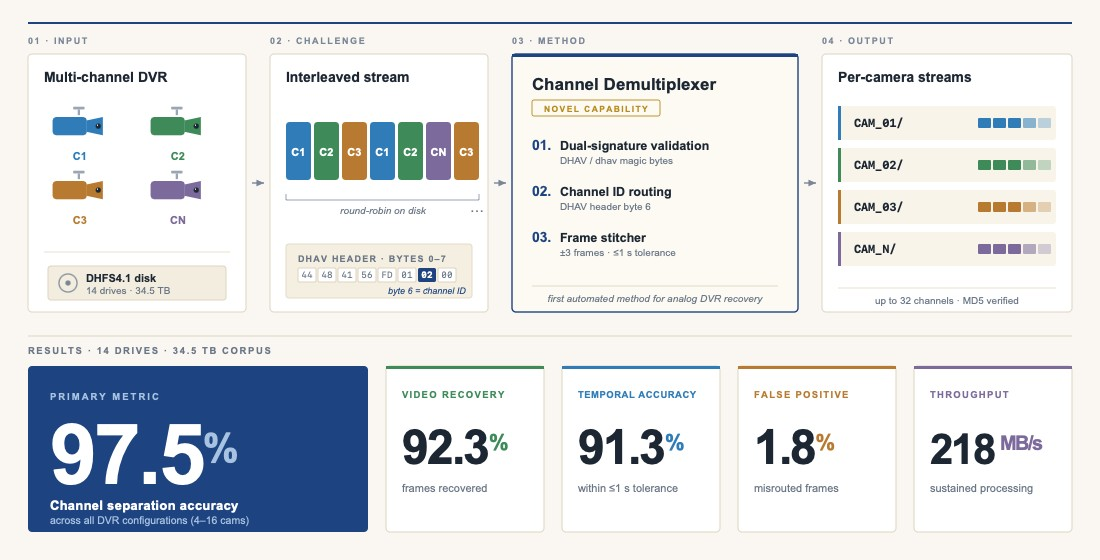
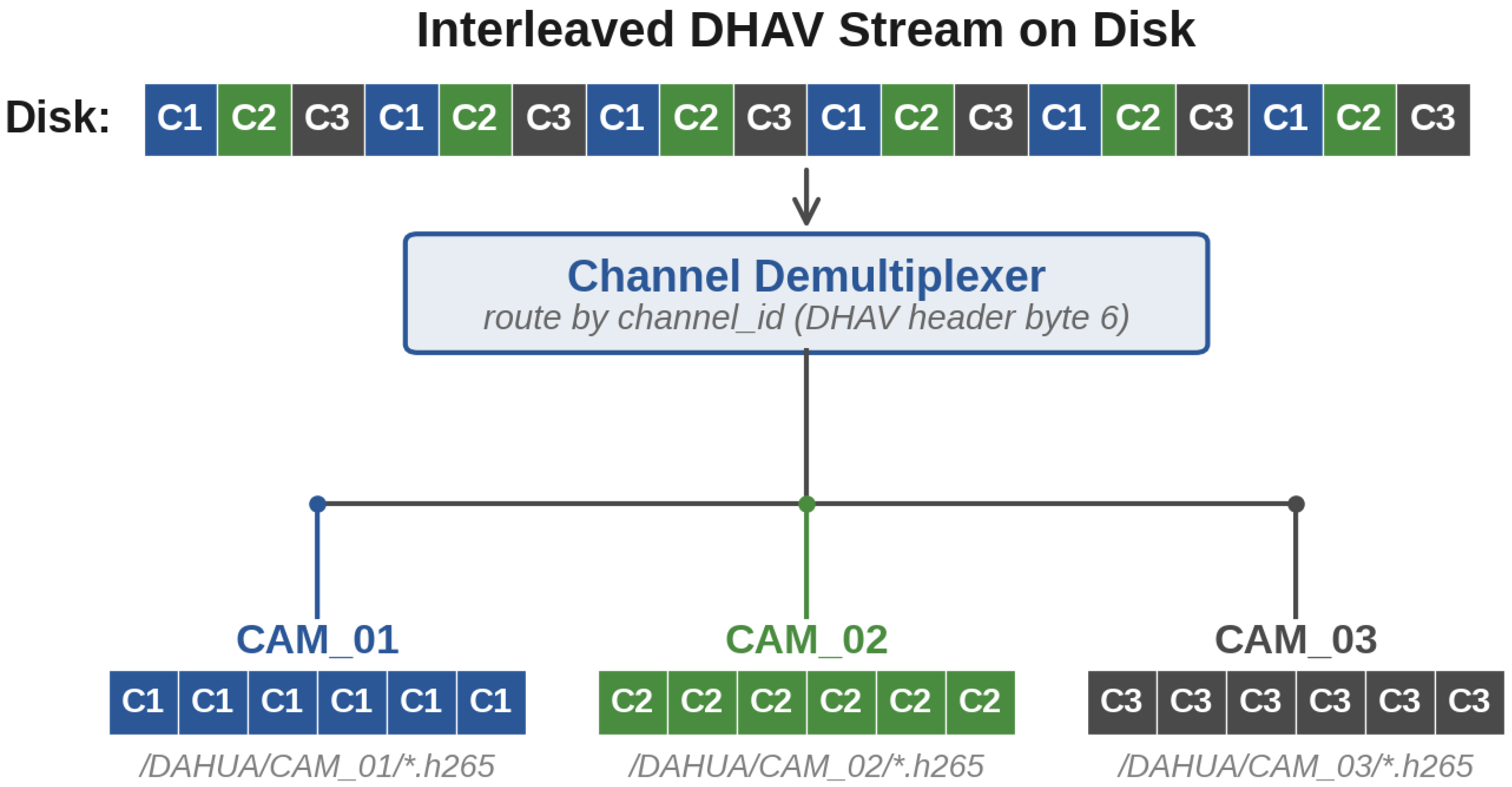
- Channel demultiplexing: Recovered frames must be classified and separated by their source camera channel before meaningful video reconstruction can occur. Without proper demultiplexing, the recovered output contains an incomprehensible mixture of frames from different cameras, rendering the evidence unusable.
- 2.
- Cross-channel frame sequence discontinuities: When reading the disk sequentially, consecutive frames from the same camera may be separated by hundreds or thousands of frames from other cameras, creating apparent gaps in frame numbering that must be distinguished from actual recording interruptions.
- 3.
- Temporal interleaving complexity: Timestamps from different cameras may overlap or be closely spaced, requiring channel-aware temporal analysis rather than simple chronological sorting.
1.2. Research Gap and Motivation
1.3. Research Contributions
- 1.
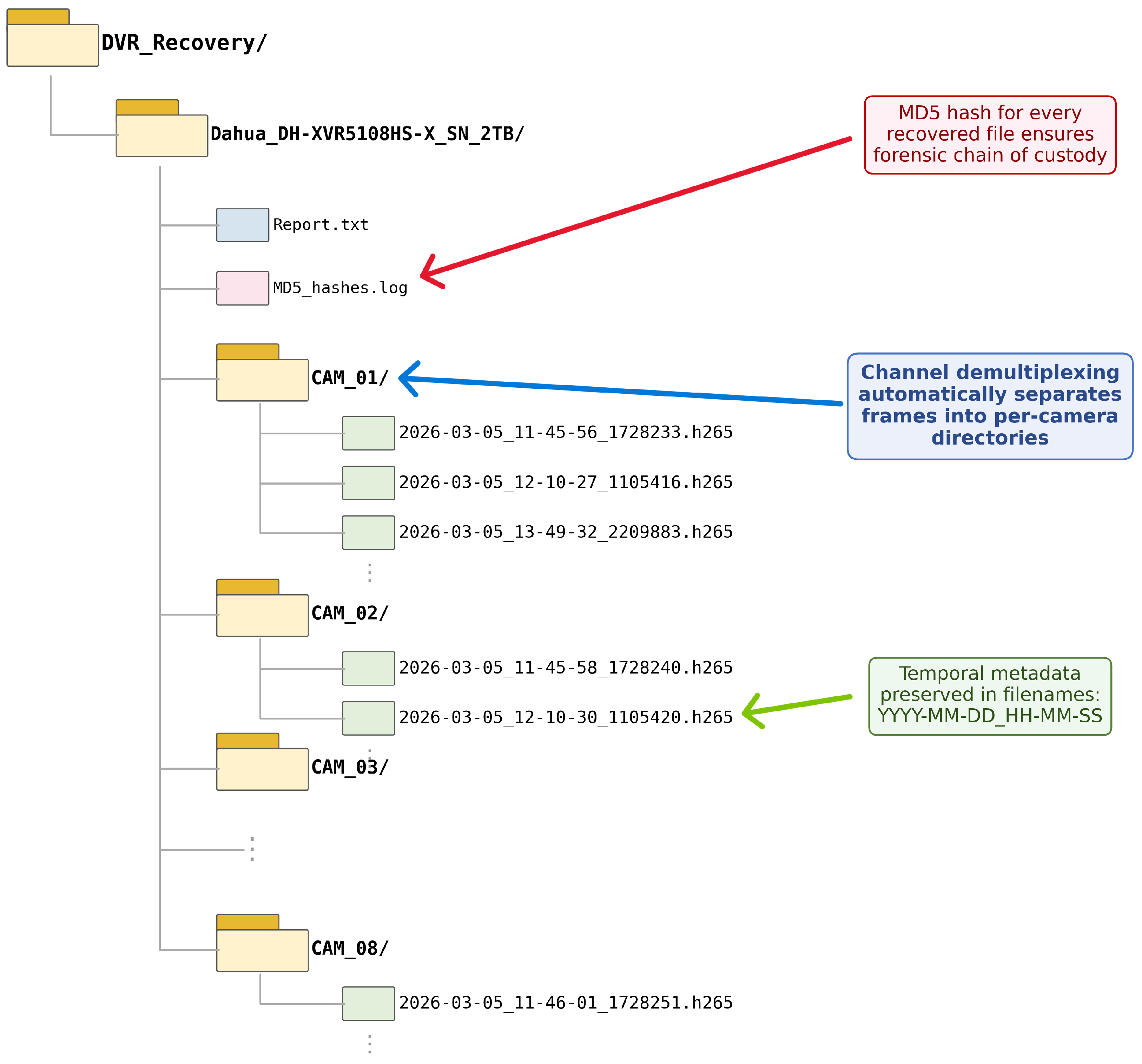
- Channel demultiplexing algorithm: An automated tool to separate interleaved DHAV frames of an arbitrary number of camera channels (maximum of 32) according to the channel identifiers embedded in them and generate per-camera video files stored in separate output directories (CAM_01, CAM_02, and so on).
- 2.
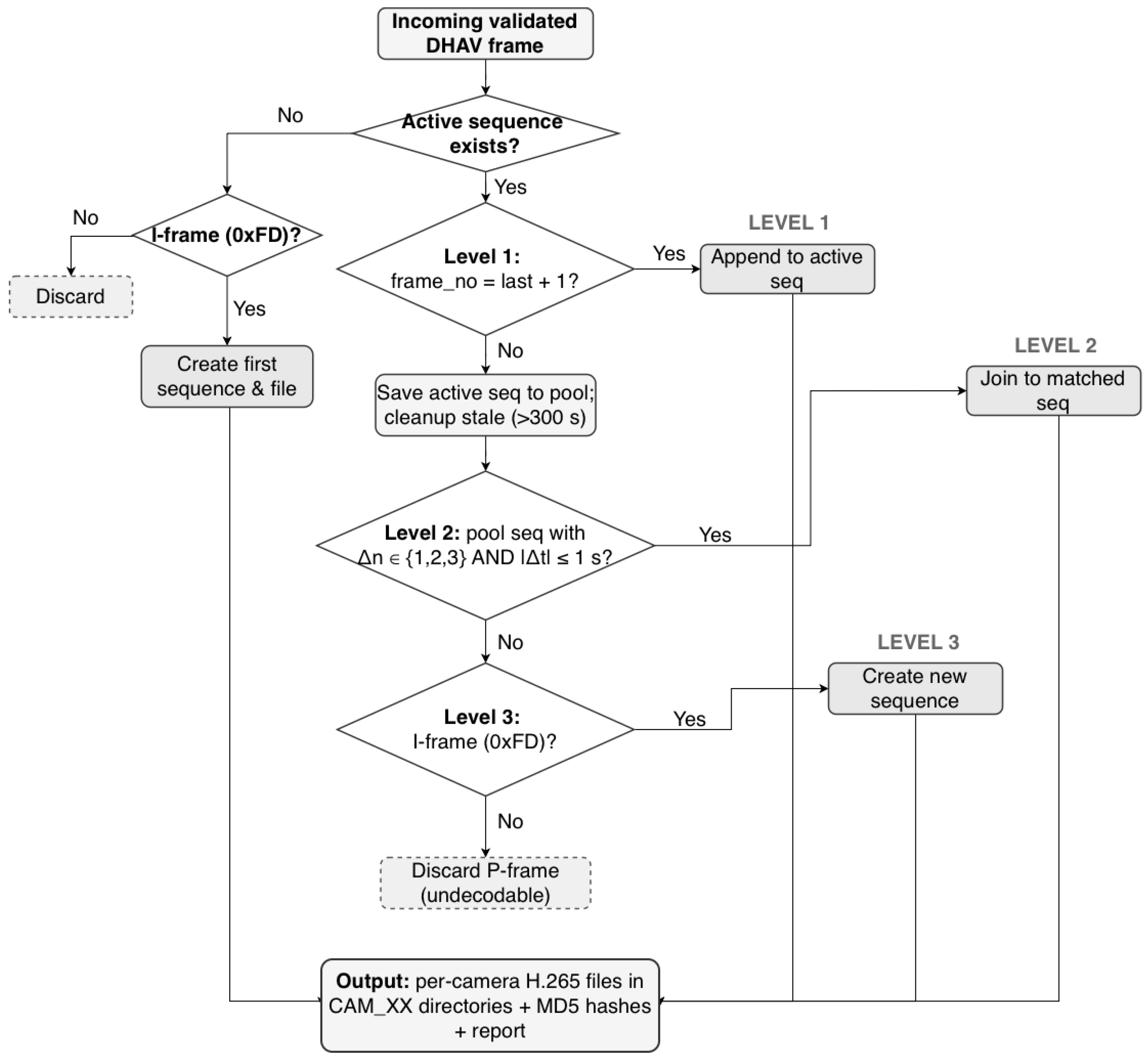
- Frame sequence stitching with adaptive tolerance: A reconstruction system that uses a multi-level matching strategy to assemble continuous video blocks at the non-contiguous disk blocks: exact sequential match (frame ), near-sequential match (frame or frame ), with temporal coherence verification (less than one second difference between the frame timestamps) to avoid false joins between recording sessions.
- 3.
- Dual-signature frame validation: An extension of standard DHAV header–footer validation (“DHAV”/“dhav” magic bytes) that additionally checks frame size consistency, timestamp plausibility, and frame-type playability (I-frame/P-frame) before accepting a frame as valid.
- 4.
- Deleted file detection: This is a heuristic system that can be used to detect the existence of a deleted recording based on the video end timestamps versus the time of drive initiation and give investigators some evidence of destruction.
- 5.
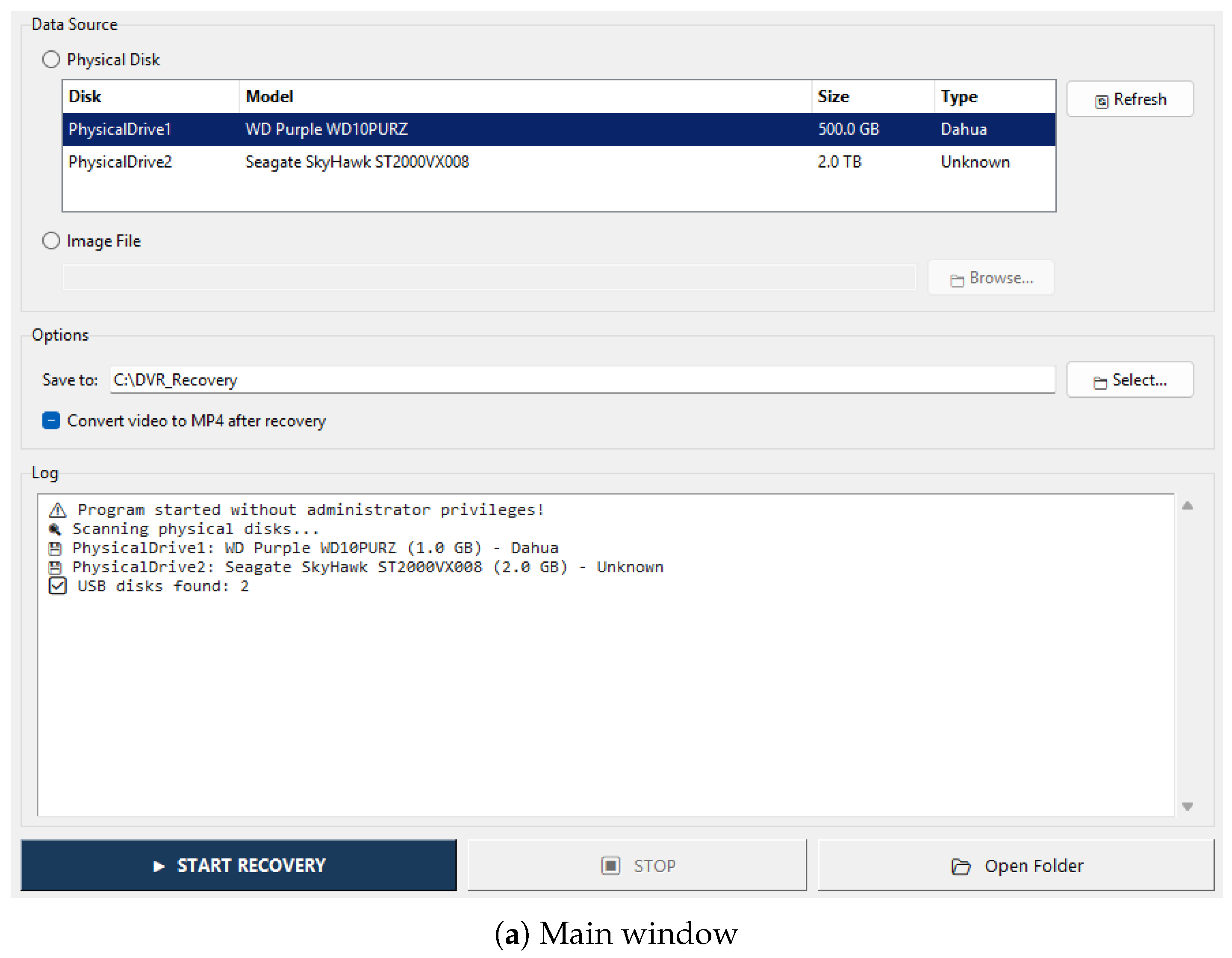
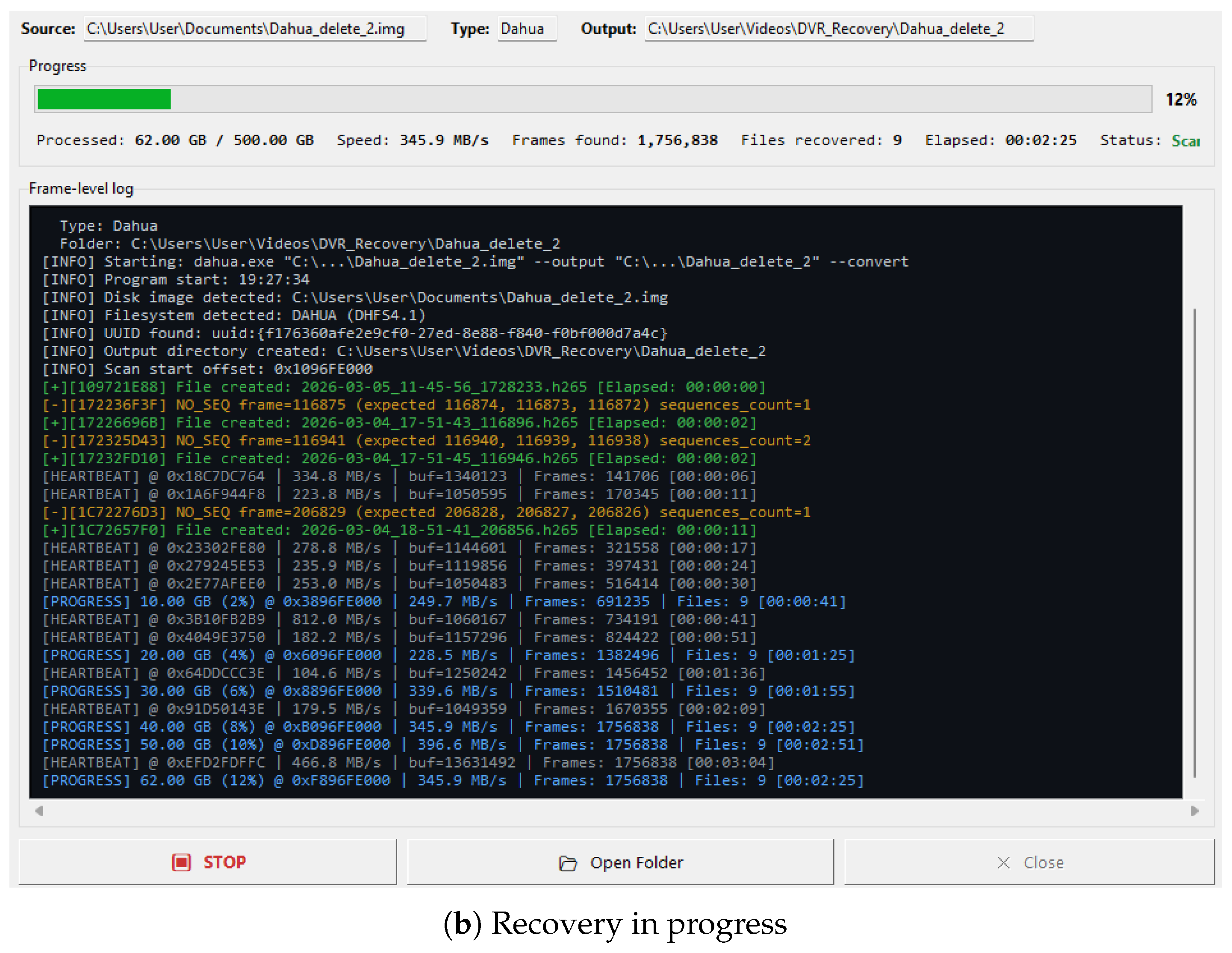
- High-performance native implementation: A C language-based application with a Win32 graphical user interface that offers the ability to access physical drive hardware directly through ATA Pass-Through commands for disk identification. Such a tool also performs integrated MD5 hash calculation for forensic integrity verification and allows the user to monitor the recovery process in real time.
2. Related Work
2.1. Forensic Analysis of Proprietary Surveillance Systems
2.2. File Carving and Video Recovery Techniques
2.3. The Analog DVR Forensic Gap
2.4. Commercial Tool Landscape
3. Materials and Methods
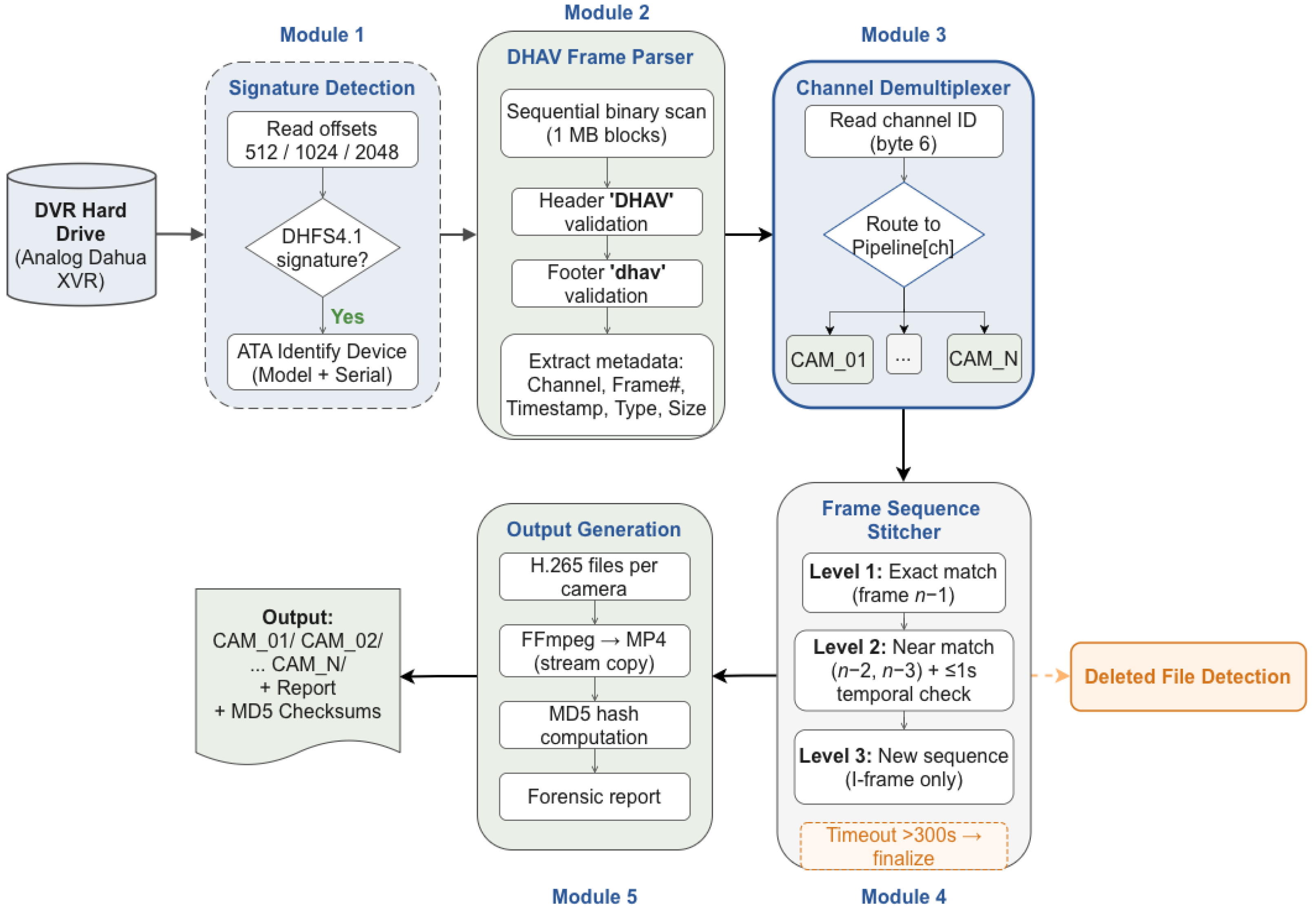
3.1. System Architecture Overview
- 1.
- Disk Access and Signature Detection Module: Gives direct access to physical drives or disk images, detects the manufacturer of the surveillance system by analyzing the signature and retrieves disk metadata through ATA Pass-Through commands.
- 2.
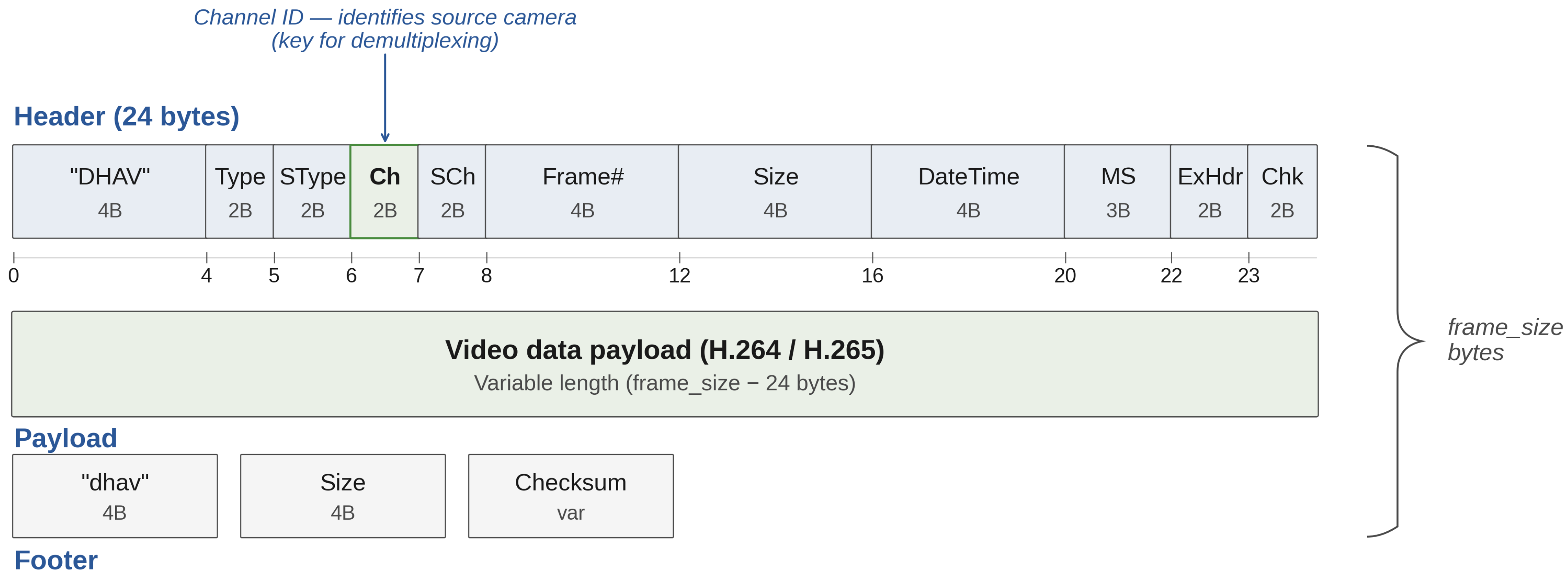
- DHAV Frame Parser: Via two-signature matching (header DHAV and footer dhav) of the disk, locates the boundaries of DHAV frames and extracts frame metadata (channel identifier, frame number, timestamp, frame type, and checksum).
- 3.
- Channel Demultiplexer: Classifies extracted frames by source camera channel and routes each frame to the appropriate per-channel output stream.
- 4.
- Frame Sequence Stitcher: Maintains active sequences in each channel, reassembling continuous video segments with non-contiguous frames based on adaptive frame number tolerance with temporal validation.
- 5.
- Output Module: Creates per-camera H.265 videos in channel directories, optionally converts to MP4 with FFmpeg, calculates MD5 checksums to ensure integrity, and creates recovery reports.
3.2. Disk Access and Manufacturer Detection
3.3. DHAV Frame Format and Parsing
- 1.
- Header signature verification: Confirm the presence of “DHAV” (bytes 0x44, 0x48, 0x41, 0x56) at the current offset.
- 2.
- Frame size plausibility: Verify that the declared frame size is within acceptable bounds ( bytes) to reject corrupted headers.
- 3.
- Footer signature verification: Read the expected footer position (current offset + frame size) and confirm the presence of “dhav” (bytes 0x64, 0x68, 0x61, 0x76), establishing dual-signature validation.
- 4.
- Timestamp plausibility: Reject frames with year 2000 timestamps, which indicate corrupted or uninitialized metadata regions.
- 5.
- Channel identifier validation: Verify that the channel number falls within the supported range (0–31 for up to 32 cameras).
3.4. Channel Demultiplexing Algorithm
3.5. Frame Sequence Stitching
Computational Complexity Analysis
3.6. Deleted File Detection Mechanism
3.7. Forensic Integrity and Output Generation
3.8. Graphical User Interface
3.9. Experimental Setup
3.10. Automated Channel Separation Verification
- 1.
- Channel identifier uniformity. Every frame is re-parsed and its embedded DHAV channel identifier is compared with the assigned output channel c:Any frame whose embedded channel ID does not match the output assignment is counted as a misclassification.
- 2.
- Temporal monotonicity. Within , frame timestamps must be non-decreasing up to the stitching tolerance:A backward jump exceeding indicates that frames from a different recording session—and frequently from a different physical camera—were stitched into the file.
- 3.
- Codec-parameter consistency. The H.264/H.265 sequence parameter set (SPS) and picture parameter set (PPS) extracted from the first I-frame of must match those of every subsequent I-frame within the file. Resolution, profile, and level fields are compared exactly:This is the strongest of the three invariants: in multi-camera installations, cameras are routinely configured with different resolutions or codec profiles, so an SPS/PPS mismatch within a single output file is a near-certain indicator of misclassification.
4. Results
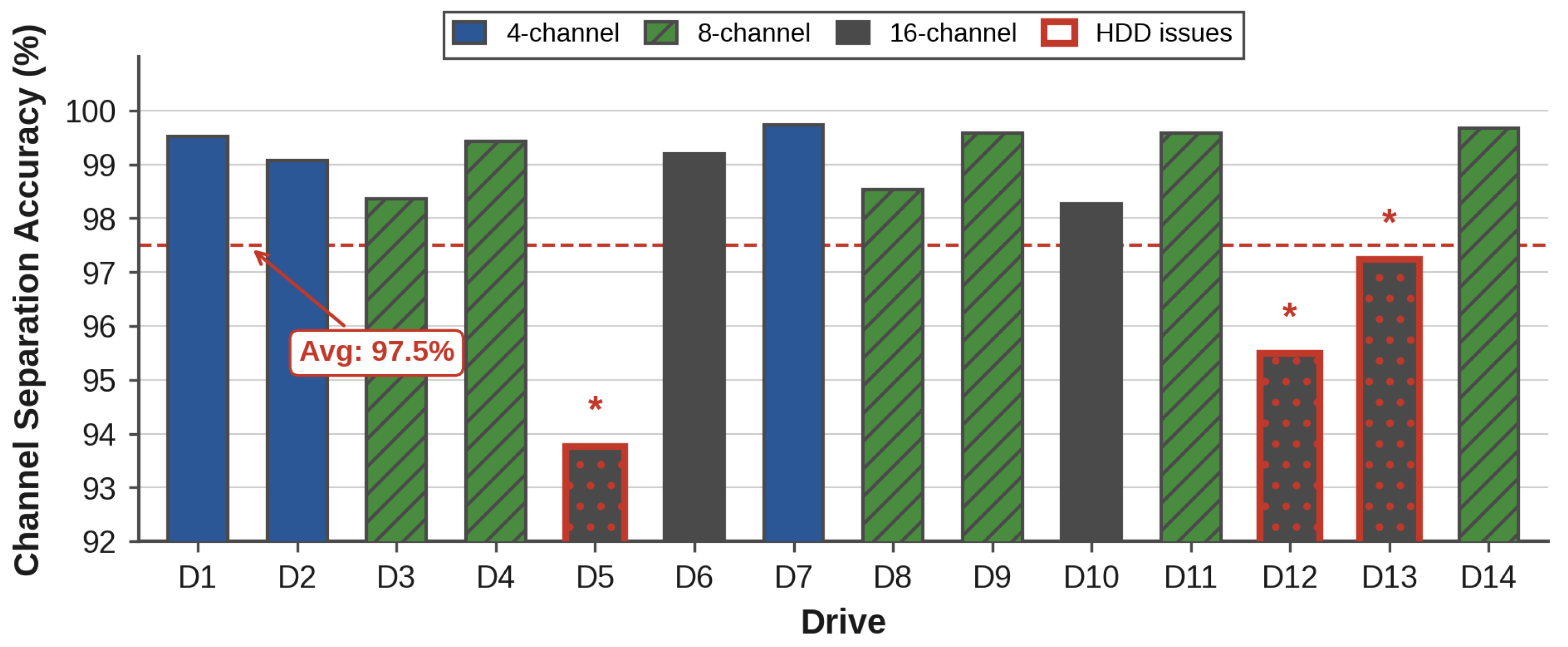
4.1. Channel Demultiplexing Performance
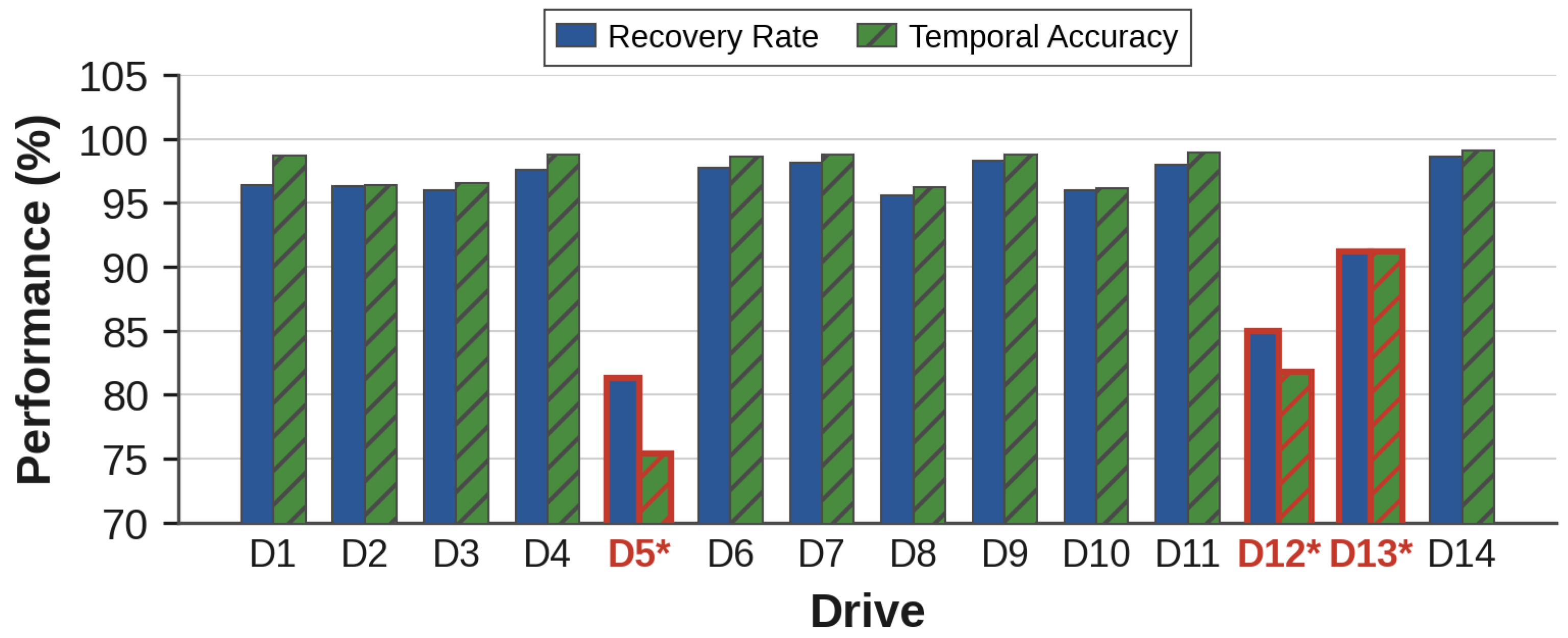
4.2. Recovery Performance Analysis
4.3. Comprehensive Performance Metrics
4.4. Deleted File Detection Results
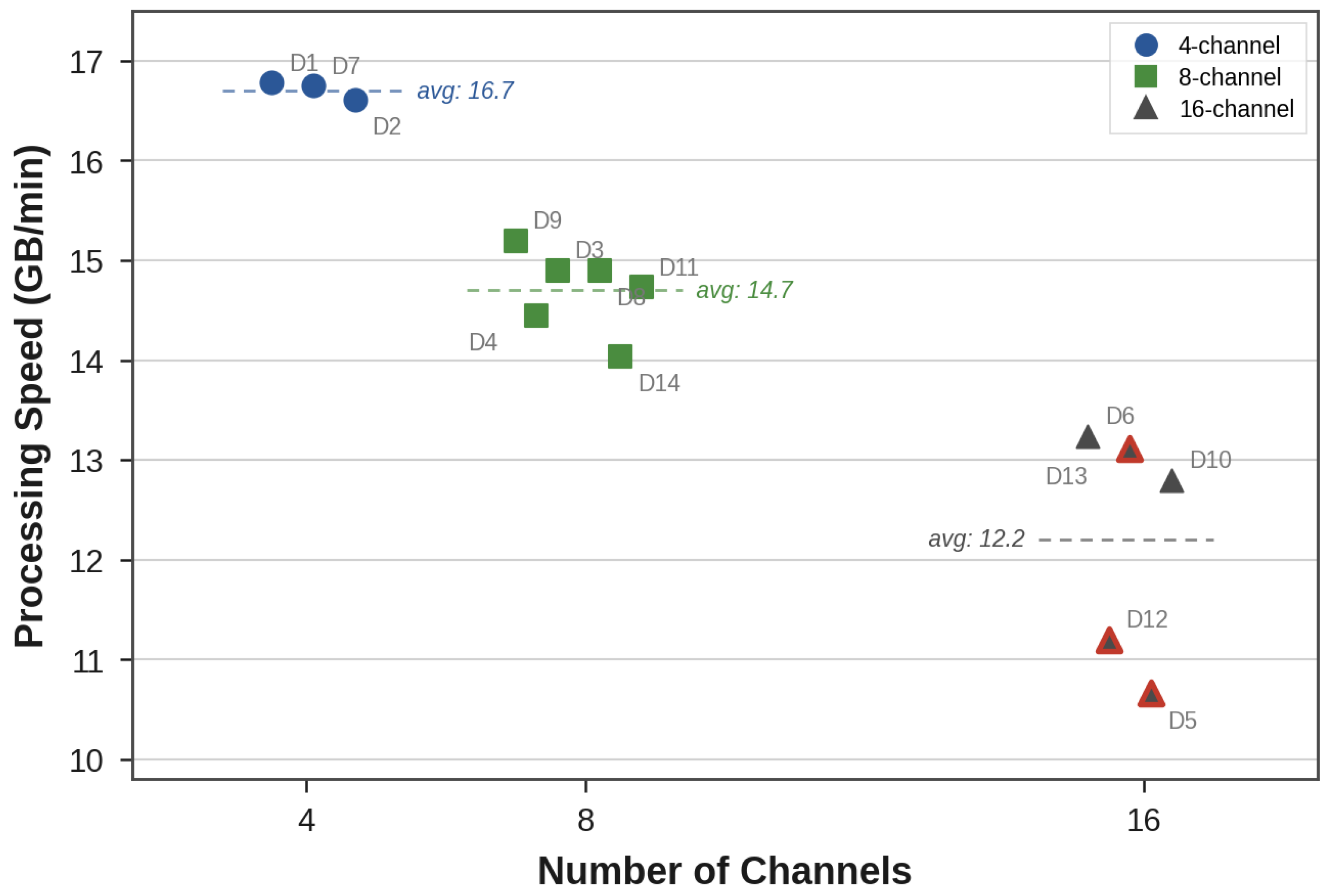
4.5. Processing Efficiency
4.6. Contextual Comparison with Existing Tools
5. Discussion
5.1. Channel Demultiplexing as a Novel Forensic Capability
5.2. Performance in Context
5.3. Processing Speed Analysis
5.4. Generalizability to Other Analog DVR Vendors
5.5. Limitations
5.6. Future Research Directions
6. Conclusions
Author Contributions
Funding
Institutional Review Board Statement
Informed Consent Statement
Data Availability Statement
Conflicts of Interest
Abbreviations
| DVR | Digital Video Recorder |
| NVR | Network Video Recorder |
| CCTV | Closed-Circuit Television |
| BNC | Bayonet Neill–Concelman (connector type) |
| DHAV | Dahua Audio/Video (frame format) |
| DHFS | Dahua File System |
| ATA | Advanced Technology Attachment |
| GUI | Graphical User Interface |
| MD5 | Message-Digest Algorithm 5 |
References
- Grand View Research. Video Surveillance Market Size, Share & Industry Report. 2025. Available online: https://www.grandviewresearch.com/industry-analysis/video-surveillance-market-report (accessed on 20 March 2026).
- Han, J.; Jeong, D.; Lee, S. Analysis of the HIKVISION DVR file system. In Digital Forensics and Cyber Crime. ICDF2C 2015. Lecture Notes of the Institute for Computer Sciences, Social Informatics and Telecommunications Engineering; Springer: Berlin/Heidelberg, Germany, 2015; Volume 157, pp. 175–188. [Google Scholar] [CrossRef]
- Dragonas, M.; Lambrinoudakis, C.; Kotsis, M. IoT forensics: Exploiting log records from the DAHUA technology CCTV systems. J. Forensic Sci. 2023, 69, 117–130. [Google Scholar] [CrossRef] [PubMed]
- Magnet Forensics. DVR Examiner. 2025. Available online: https://www.demux.co.uk/software/dvr-examiner (accessed on 20 March 2026).
- SalvationDATA. VIP 2.0: Video Investigation Portable. 2025. Available online: https://www.salvationdata.com/knowledge/digital-forensics-software/ (accessed on 20 March 2026).
- DiskInternals. DVR Recovery: Secure CCTV and DVR Data Recovery. 2025. Available online: https://www.diskinternals.com/dvr-recovery/ (accessed on 20 March 2026).
- IFSEC Global. Global Video Surveillance Market Report 2023. 2023. Available online: https://www.ifsecglobal.com/downloads-resources/the-video-surveillance-report-2023/ (accessed on 20 March 2026).
- Statista. Number of IoT Connected Devices Worldwide 2019–2030. 2024. Available online: https://www.statista.com/statistics/1183457/iot-connected-devices-worldwide/ (accessed on 20 March 2026).
- Dragonas, M.; Lambrinoudakis, C.; Kotsis, M. IoT forensics: Exploiting unexplored log records from the HIKVISION file system. J. Forensic Sci. 2023, 68, 2002–2011. [Google Scholar] [CrossRef] [PubMed]
- Yang, F.; Li, R.; Wu, C. Basic principle and application of video recovery software for “Dahua” and “Hikvision” brand. SHS Web Conf. 2015, 14, 01010. [Google Scholar] [CrossRef]
- Ariffin, A.; Choo, K.K.R.; Yunos, Z.; Amran, N.N. Data recovery from proprietary formatted CCTV hard disks. In Advances in Digital Forensics IX; Springer: Berlin/Heidelberg, Germany, 2013; pp. 213–223. [Google Scholar]
- Rzayeva, L.; Shayakhmetov, M.; Atanbayev, Y.; Budenov, R.; Mutaher, H. Automated forensic recovery methodology for video evidence from Hikvision and Dahua DVR/NVR systems. Information 2025, 16, 983. [Google Scholar] [CrossRef]
- Forensic Focus. Forensic Video Data Recovery Tools for CCTV DVRs. 2025. Available online: https://www.forensicfocus.com/forums/general/forensic-video-data-recovery-tools-for-cctv-dvrs/ (accessed on 20 March 2026).
- Gomm, R.; Leong, S.; Kechadi, T.; Le-Khac, N.-A. CCTV forensics in the big data era: Challenges and approaches. In Trends and Applications in Knowledge Discovery and Data Mining; Springer: Berlin/Heidelberg, Germany, 2020; pp. 75–90. [Google Scholar]
- Shin, D.-H.; Han, S.-J.; Kim, Y.-B.; Euom, I.-C. Research on digital forensics analyzing heterogeneous Internet of Things incident investigations. Appl. Sci. 2024, 14, 1128. [Google Scholar] [CrossRef]
- Ahmed, A.A.; Farhan, K.; Jabbar, W.A.; Al-Othmani, A.; Abdulrahman, A.G. IoT forensics: Current perspectives and future directions. Sensors 2024, 24, 5210. [Google Scholar] [CrossRef] [PubMed]
- Stoyanova, M.; Nikoloudakis, Y.; Panagiotakis, S.; Pallis, E.; Markakis, E.K. A survey on the Internet of Things (IoT) forensics: Challenges, approaches, and open issues. IEEE Commun. Surv. Tutor. 2020, 22, 1191–1221. [Google Scholar] [CrossRef]
- Imanberdi, A.; Khassanova, A.; Yermekov, Y.; Shayakhmetov, M.; Alibek, A.; Konakbayev, O. Development of a data decryption method for the raw disk image of mobile phone. In Proceedings of the 2025 IEEE/ACIS 29th International Conference on Software Engineering, Artificial Intelligence, Networking and Parallel/Distributed Computing (SNPD), Busan, Republic of Korea, 25–27 June 2025; IEEE: Piscataway, NJ, USA, 2025; pp. 106–110. [Google Scholar] [CrossRef]
- Richard, G.G.; Roussev, V. Scalpel: A frugal, high performance file carver. In Proceedings of the 2005 Digital Forensics Research Workshop (DFRWS), New Orleans, LA, USA, 17–19 August 2005. [Google Scholar]
- Pal, A.; Memon, N. The evolution of file carving. IEEE Signal Process. Mag. 2009, 26, 59–71. [Google Scholar] [CrossRef]
- Garfinkel, S.L. Carving contiguous and fragmented files with fast object validation. Digit. Investig. 2007, 4, 2–12. [Google Scholar] [CrossRef]
- Haque, M.E.; Tozal, M.E. Byte embeddings for file fragment classification. Future Gener. Comput. Syst. 2022, 127, 448–461. [Google Scholar] [CrossRef]
- Zhu, N.; Liu, Y.; Wang, K.; Ma, C. File fragment type identification based on CNN and LSTM. In Proceedings of the 2023 7th International Conference on Digital Signal Processing, Chengdu, China, 17–19 February 2023; ACM: New York, NY, USA, 2023; pp. 1–6. [Google Scholar]
- Dunsin, D.; Ghanem, M.C.; Ouazzane, K.; Vassilev, V. A comprehensive analysis of the role of artificial intelligence and machine learning in modern digital forensics and incident response. Forensic Sci. Int. Digit. Investig. 2024, 48, 301675. [Google Scholar] [CrossRef]
- Oh, J.; Lee, S.; Hwang, H. Forensic recovery of file system metadata for digital forensic investigation. IEEE Access 2022, 10, 111591–111606. [Google Scholar] [CrossRef]
- Tobin, L.; Shosha, A.; Gladyshev, P. Reverse engineering a CCTV system, a case study. Forensic Sci. Int. Digit. Investig. 2014, 46, 301607. [Google Scholar] [CrossRef]
- Seckiner, D.; Mallett, X.; Roux, C.; Meuwly, D.; Maynard, P. Forensic image analysis—CCTV distortion and artefacts. Forensic Sci. Int. 2018, 285, 77–85. [Google Scholar] [CrossRef] [PubMed]
- Bruehs, W.E.; Stout, D. Quantifying and ranking quality for acquired recordings on digital video recorders. J. Forensic Sci. 2020, 65, 1155–1168. [Google Scholar] [CrossRef] [PubMed]



| # | DVR Model | Ch. | HDD Size | HDD Model |
|---|---|---|---|---|
| 1 | DH-XVR1B04 | 4 | 500 GB | WD Purple WD05PURZ |
| 2 | DH-XVR1B04 | 4 | 1 TB | Seagate SkyHawk ST1000VX005 |
| 3 | DH-XVR1B08 | 8 | 1 TB | WD Purple WD10PURZ |
| 4 | DH-XVR1B08H | 8 | 2 TB | Seagate SkyHawk ST2000VX008 |
| 5 | DH-XVR1B16 | 16 | 2 TB | WD Purple WD20PURZ a |
| 6 | DH-XVR1B16H | 16 | 4 TB | Seagate SkyHawk ST4000VX007 |
| 7 | DH-XVR4104HS-X | 4 | 1 TB | WD Purple WD10PURZ |
| 8 | DH-XVR4108HS-X | 8 | 2 TB | Toshiba S300 HDWT720 |
| 9 | DH-XVR5108HS-X | 8 | 2 TB | Seagate SkyHawk ST2000VX008 |
| 10 | DH-XVR5116HS-X | 16 | 4 TB | WD Purple WD40PURZ |
| 11 | DH-XVR5108H-X | 8 | 2 TB | WD Purple WD20PURZ |
| 12 | DH-XVR5216AN-X | 16 | 8 TB | Seagate SkyHawk ST4000VX007 × 2 b |
| 13 | DH-XVR4116HS-X | 16 | 1 TB | Toshiba S300 HDWT710 c |
| 14 | DH-XVR7108HE-4KL-X | 8 | 4 TB | WD Purple WD40PURZ |
| Drive | Model | Cameras | Correctly Assigned | Accuracy (%) |
|---|---|---|---|---|
| 1 | DH-XVR1B04 | 4 | 289,800 | 99.52 |
| 2 | DH-XVR1B04 | 4 | 622,700 | 99.08 |
| 3 | DH-XVR1B08 | 8 | 1,241,300 | 98.36 |
| 4 | DH-XVR1B08H | 8 | 1,363,000 | 99.42 |
| 5 | DH-XVR1B16 | 16 | 2,298,000 | 93.76 |
| 6 | DH-XVR1B16H | 16 | 4,541,000 | 99.19 |
| 7 | DH-XVR4104HS-X | 4 | 686,200 | 99.74 |
| 8 | DH-XVR4108HS-X | 8 | 1,411,000 | 98.53 |
| 9 | DH-XVR5108HS-X | 8 | 1,409,000 | 99.58 |
| 10 | DH-XVR5116HS-X | 16 | 4,591,000 | 98.27 |
| 11 | DH-XVR5108H-X | 8 | 1,435,000 | 99.58 |
| 12 | DH-XVR5216AN-X | 16 | 8,542,000 | 95.49 |
| 13 | DH-XVR4116HS-X | 16 | 1,052,000 | 97.23 |
| 14 | DH-XVR7108HE-4KL-X | 8 | 1,547,000 | 99.68 |
| Overall | 31,029,000 | 97.5 | ||
| Drive | Model | Expected | Recovered | Recovery (%) | Temp. Acc. (%) |
|---|---|---|---|---|---|
| 1 | DH-XVR1B04 | 112 | 108 | 96.4 | 98.7 |
| 2 | DH-XVR1B04 | 245 | 236 | 96.3 | 96.4 |
| 3 | DH-XVR1B08 | 480 | 461 | 96.0 | 96.5 |
| 4 | DH-XVR1B08H | 510 | 498 | 97.6 | 98.8 |
| 5 | DH-XVR1B16 | 920 | 748 | 81.3 | 75.4 |
| 6 | DH-XVR1B16H | 1680 | 1641 | 97.7 | 98.6 |
| 7 | DH-XVR4104HS-X | 260 | 255 | 98.1 | 98.8 |
| 8 | DH-XVR4108HS-X | 540 | 516 | 95.6 | 96.2 |
| 9 | DH-XVR5108HS-X | 530 | 521 | 98.3 | 98.8 |
| 10 | DH-XVR5116HS-X | 1720 | 1652 | 96.0 | 96.1 |
| 11 | DH-XVR5108H-X | 545 | 534 | 98.0 | 98.9 |
| 12 | DH-XVR5216AN-X | 3280 | 2789 | 85.0 | 81.8 |
| 13 | DH-XVR4116HS-X | 410 | 374 | 91.2 | 91.2 |
| 14 | DH-XVR7108HE-4KL-X | 580 | 572 | 98.6 | 99.1 |
| Overall | 11,812 | 10,905 | 92.3 | 91.3 | |
| TP | FP | FN | TN | Precision (%) | Recall (%) | Specificity (%) | F1 |
|---|---|---|---|---|---|---|---|
| 10,905 | 200 | 907 | 131,484 | 98.2 | 92.3 | 99.85 | 95.2 |
| Configuration | Drives | Avg. Speed (GB/min) | Speed Range (GB/min) |
|---|---|---|---|
| 4-channel | 3 | 16.7 | 16.6–16.8 |
| 8-channel | 6 | 14.9 | 14.5–16.8 |
| 16-channel | 5 | 12.4 | 10.7–13.2 |
| Overall | 14 | 13.1 | 10.7–16.8 |
| Feature | Magnet DVR Examiner | VIP 2.0 | DiskInternals DVR | Scalpel | Proposed |
|---|---|---|---|---|---|
| IP-based DVR/NVR support | Yes | Yes | Yes | Partial | Yes a |
| Analog interleaved DVR support | No | No | No | No | Yes |
| Channel demultiplexing | N/A | N/A | N/A | N/A | Yes |
| Per-camera output organization | Yes b | Yes b | Yes b | No | Yes |
| Dual-signature validation | Unknown | Unknown | Unknown | No | Yes |
| Deleted file detection | Yes | Yes | Partial | No | Yes |
| MD5 hash verification | Yes | Yes | Yes | No | Yes |
| Transparent algorithms | No | No | No | Yes | Yes |
| DHAV frame format support | Partial | Partial | Partial | No | Full |
Disclaimer/Publisher’s Note: The statements, opinions and data contained in all publications are solely those of the individual author(s) and contributor(s) and not of MDPI and/or the editor(s). MDPI and/or the editor(s) disclaim responsibility for any injury to people or property resulting from any ideas, methods, instructions or products referred to in the content. |
© 2026 by the authors. Licensee MDPI, Basel, Switzerland. This article is an open access article distributed under the terms and conditions of the Creative Commons Attribution (CC BY) license.
Share and Cite
Rzayeva, L.; Shayakhmetov, M.; Konakbayev, O.; Jussupova, G.G.; Seniushin, I.; Tasbolat, A. Forensic Video Recovery from Multi-Channel Analog DVR Systems: Channel Demultiplexing and Temporal Reconstruction from Interleaved DHAV Streams. Information 2026, 17, 493. https://doi.org/10.3390/info17050493
Rzayeva L, Shayakhmetov M, Konakbayev O, Jussupova GG, Seniushin I, Tasbolat A. Forensic Video Recovery from Multi-Channel Analog DVR Systems: Channel Demultiplexing and Temporal Reconstruction from Interleaved DHAV Streams. Information. 2026; 17(5):493. https://doi.org/10.3390/info17050493
Chicago/Turabian StyleRzayeva, Leila, Madi Shayakhmetov, Olzhas Konakbayev, Gul Gabdulualitovna Jussupova, Igor Seniushin, and Anara Tasbolat. 2026. "Forensic Video Recovery from Multi-Channel Analog DVR Systems: Channel Demultiplexing and Temporal Reconstruction from Interleaved DHAV Streams" Information 17, no. 5: 493. https://doi.org/10.3390/info17050493
APA StyleRzayeva, L., Shayakhmetov, M., Konakbayev, O., Jussupova, G. G., Seniushin, I., & Tasbolat, A. (2026). Forensic Video Recovery from Multi-Channel Analog DVR Systems: Channel Demultiplexing and Temporal Reconstruction from Interleaved DHAV Streams. Information, 17(5), 493. https://doi.org/10.3390/info17050493