Antagonistic Differential Game of Critical Infrastructure Migration Management to Post-Quantum Cryptography Under HNDL Conditions
 , , , and
Abstract
1. Introduction
2. Statement of the Problem
3. Review of Previous Research
4. Methods and Models
| Algorithm 1: Forward–Backward Sweep Method (FBSM) for PQC migration |
| Planning horizon , integration step ; Network and cost parameters: , Convergence tolerance . Output: Optimal control trajectories , ; Optimal state trajectories , . Initialization: Set and . Set initial states for all sectors i: . Initialize control guesses for . While do: Forward Sweep: Solve the state system (equations for and from to using the 4th-order Runge–Kutta method (RK4), employing current controls . Store the resulting state trajectories as and . Transversality Conditions: Calculate terminal values for adjoint variables: Backward Sweep: Solve the adjoint system (equations for and backward in time from to 0 using RK4, employing current states , and controls Store the resulting adjoint trajectories as and . Control Update: For each time step and sector i:
Convergence Check: . End While Return as the optimal solution. |
5. Computational Experiment
5.1. Stages of the Computational Experiment
5.2. Methodology for Conducting Simulation
6. Discussion of the Research Results
7. Conclusions
Author Contributions
Funding
Institutional Review Board Statement
Informed Consent Statement
Data Availability Statement
Conflicts of Interest
References
- Qader, T. Systematic Security: Building Quantum Security: Preparing for Q-Day and Beyond; CRC Press: Boca Raton, FL, USA, 2026. [Google Scholar]
- Mosca, M. Cybersecurity in an era with quantum computers: Will we be ready? IEEE Secur. Priv. 2018, 16, 38–41. [Google Scholar] [CrossRef]
- Bellizia, D.; El Mrabet, N.; Fournaris, A.P.; Pontié, S.; Regazzoni, F.; Standaert, F.X.; Tasso, É.; Valea, E. Post-quantum cryptography: Challenges and opportunities for robust and secure hw design. In 2021 IEEE International Symposium on Defect and Fault Tolerance in VLSI and Nanotechnology Systems (DFT), Virtual, 6–8 October 2021; IEEE: New York, NY, USA, 2021; pp. 1–6. [Google Scholar] [CrossRef]
- Burita, L.; Le, D.T. Cyber security and APT groups. In Proceedings of the 2021 Communication and Information Technologies (KIT), Prague, Czech Republic, 13–15 October 2021; IEEE: New York, NY, USA, 2021; pp. 1–7. [Google Scholar]
- Bavdekar, R.; Chopde, E.J.; Agrawal, A.; Bhatia, A.; Tiwari, K. Post-quantum cryptography: A review of techniques, challenges and standardizations. In Proceedings of the 2023 International Conference on Information Networking (ICOIN), Bangkok, Thailand, 11–14 January 2023; IEEE: New York, NY, USA, 2023; pp. 146–151. [Google Scholar]
- Zhang, H.; Jiang, L.V.; Huang, S.; Wang, J.; Zhang, Y. Attack-defense differential game model for network defense strategy selection. IEEE Access 2019, 7, 50618–50629. [Google Scholar] [CrossRef]
- Tushar, W.; Yuen, C.; Saha, T.K.; Nizami, S.; Alam, M.R.; Smith, D.B.; Poor, H.V. A survey of cyber-physical systems from a game-theoretic perspective. IEEE Access 2023, 11, 9799–9834. [Google Scholar] [CrossRef]
- Liu, D.; Lv, T.; Su, W.; Cong, L.; Wu, D. A game theory model for network attack–defense strategy selection in power Internet of Things. Electronics 2026, 15, 426. [Google Scholar] [CrossRef]
- Yang, J.; Li, R.; Gan, Q.; Huang, X. Zero-sum-game-based fixed-time event-triggered optimal consensus control of multi-agent systems under FDI attacks. Mathematics 2025, 13, 543. [Google Scholar] [CrossRef]
- Lakhno, V.; Desiatko, A.; Chubaievskyi, V.; Roskladka, A.; Kaminskyi, S. Mathematical modelling and adaptation strategies in the confrontation between cryptocurrencies and quantum computers. In Proceedings of the Workshop on Cybersecurity Providing in Information and Telecommunication Systems (CPITS 2025), Kyiv, Ukraine, 28 February 2025; pp. 562–569. [Google Scholar]
- Naik, A.S.; Yeniaras, E.; Hellstern, G.; Prasad, G.; Vishwakarma, S.K.L.P. From portfolio optimization to quantum blockchain and security: A systematic review of quantum computing in finance. Financ. Innov. 2025, 11, 88. [Google Scholar] [CrossRef]
- Kagai, F.; Branch, P.; But, J.; Allen, R. Harvest-now, decrypt-later: A temporal cybersecurity risk in the quantum transition. Telecom 2025, 6, 100. [Google Scholar] [CrossRef]
- Mascelli, J.; Rodden, M. Harvest Now Decrypt Later: Examining Post-Quantum Cryptography and the Data Privacy Risks for Distributed Ledger Networks. Available online: https://www.federalreserve.gov/econres/feds/harvest-now-decrypt-later-examining-post-quantum-cryptography-and-the-data-privacy-risks-for-distributed-ledger-networks.htm (accessed on 14 March 2026).
- Chou, S.H.; Yang, Y.H.; Chin, W.L.; Chen, C.; Tsao, C.Y.; Tung, P.L. High-throughput post-quantum cryptographic system: CRYSTALS-Kyber with computational scheduling and architecture optimization. Electronics 2025, 14, 2969. [Google Scholar] [CrossRef]
- Gupta, N.; Jati, A.; Chattopadhyay, A. CRYSTALS-Dilithium on RISC-V processor: Lightweight secure boot using post-quantum digital signature. In Proceedings of the 2023 IEEE/ACM International Conference on Computer-Aided Design (ICCAD), San Francisco, CA, USA, 29 October–2 November 2023; IEEE: New York, NY, USA, 2023; pp. 1–7. [Google Scholar]
- Alagic, G.; Bros, M.; Ciadoux, P.; Cooper, D.; Dang, Q.; Dang, T.; Kelsey, J.; Lichtinger, J.; Liu, Y.K.; Miller, C.; et al. Status report on the first round of the additional digital signature schemes for the nist post-quantum cryptography standardization process. In NIST Interagency/Internal Report (NISTIR); National Institute of Standards and Technology: Gaithersburg, MD, USA, 2024. [Google Scholar] [CrossRef]
- Adapting Constrained Devices for Post-Quantum Cryptography; draft-ietf-pquip-pqc-hsm-constrained-03. Available online: https://datatracker.ietf.org/doc/draft-ietf-pquip-pqc-hsm-constrained/ (accessed on 14 March 2026).
- del Moral, J.O.; deMarti iOlius, A.; Vidal, G.; Crespo, P.M.; Martinez, J.E. Cybersecurity in critical infrastructures: A post-quantum cryptography perspective. IEEE Internet Things J. 2024, 11, 30217–30244. [Google Scholar] [CrossRef]
- Ghosh, S.; Zaman, M.; Joshi, R.; Sampalli, S. Multi-phase quantum resistant framework for secure communication in SCADA systems. IEEE Trans. Dependable Secur. Comput. 2024, 21, 5461–5478. [Google Scholar] [CrossRef]
- El Bizri, M.; El-Hajj, A.M.; Sliman, L.; Haidar, A.M. Institutional approaches to post-quantum cryptography: A comparative analysis of migration frameworks. IEEE Access 2026, 14, 3259–3283. [Google Scholar] [CrossRef]
- Geremew, A.; Mohammad, A. Preparing critical infrastructure for post-quantum cryptography: Strategies for transitioning ahead of cryptanalytically relevant quantum computing. Int. J. Eng. Sci. Technol. 2024, 6, 338–365. [Google Scholar] [CrossRef]
- Boccaletti, S.; Chavez, M. Synchronization of complex networks. In Advanced Topics on Cellular Self-Organizing Nets and Chaotic Nonlinear Dynamics to Model and Control Complex Systems; Springer: Berlin/Heidelberg, Germany, 2008; pp. 123–157. [Google Scholar]
- Venkatasubramanian, B.V.; Laoudias, C.; Panteli, M. Cascading failures and resilience in interdependent critical infrastructures: A dynamic approach. IEEE Syst. J. 2025, 19, 999–1010. [Google Scholar] [CrossRef]
- Battiston, F.; Petri, G. Higher-Order Systems; Springer: Cham, Switzerland, 2022. [Google Scholar]
- Nägele, T.; Hooman, J. Co-simulation of cyber-physical systems using HLA. In Proceedings of the 2017 IEEE Computing and Communication Workshop and Conference (CCWC), Las Vegas, NV, USA, 9–11 January 2017; IEEE: New York, NY, USA, 2017; pp. 1–6. [Google Scholar]
- Wang, J.; Chen, H.; Sun, Z. Context-aware quantification for VANET security: A Markov chain-based scheme. IEEE Access 2020, 8, 173618–173626. [Google Scholar] [CrossRef]
- He, X.; Cha, E.J. Modeling the damage and recovery of interdependent civil infrastructure network using dynamic integrated network model. Sustain. Resilient Infrastruct. 2020, 5, 152–167. [Google Scholar] [CrossRef]
- Karakaya, A.; Ulu, A. A survey on post-quantum-based approaches for edge computing security. WIREs Comput. Stat. 2024, 16, e1644. [Google Scholar] [CrossRef]
- Radwan, A.; Alenezi, T.A.; Alrashdan, W.; Hwang, W.J. Balancing tradeoffs in network queue management problem via forward–backward sweeping with finite checkpoints. Symmetry 2023, 15, 1395. [Google Scholar] [CrossRef]
- Alrashdan, W.; Radwan, A. Storage reduction of forward-backward sweeping method of optimal control of active queue management. In International Conference on Optimization, Simulation and Control; Springer International Publishing: Cham, Switzerland, 2022; pp. 129–137. [Google Scholar]



| Designation | Parameter Name | Value/Range | Physical and Economic Meaning |
|---|---|---|---|
| Environment and Topology Parameters | |||
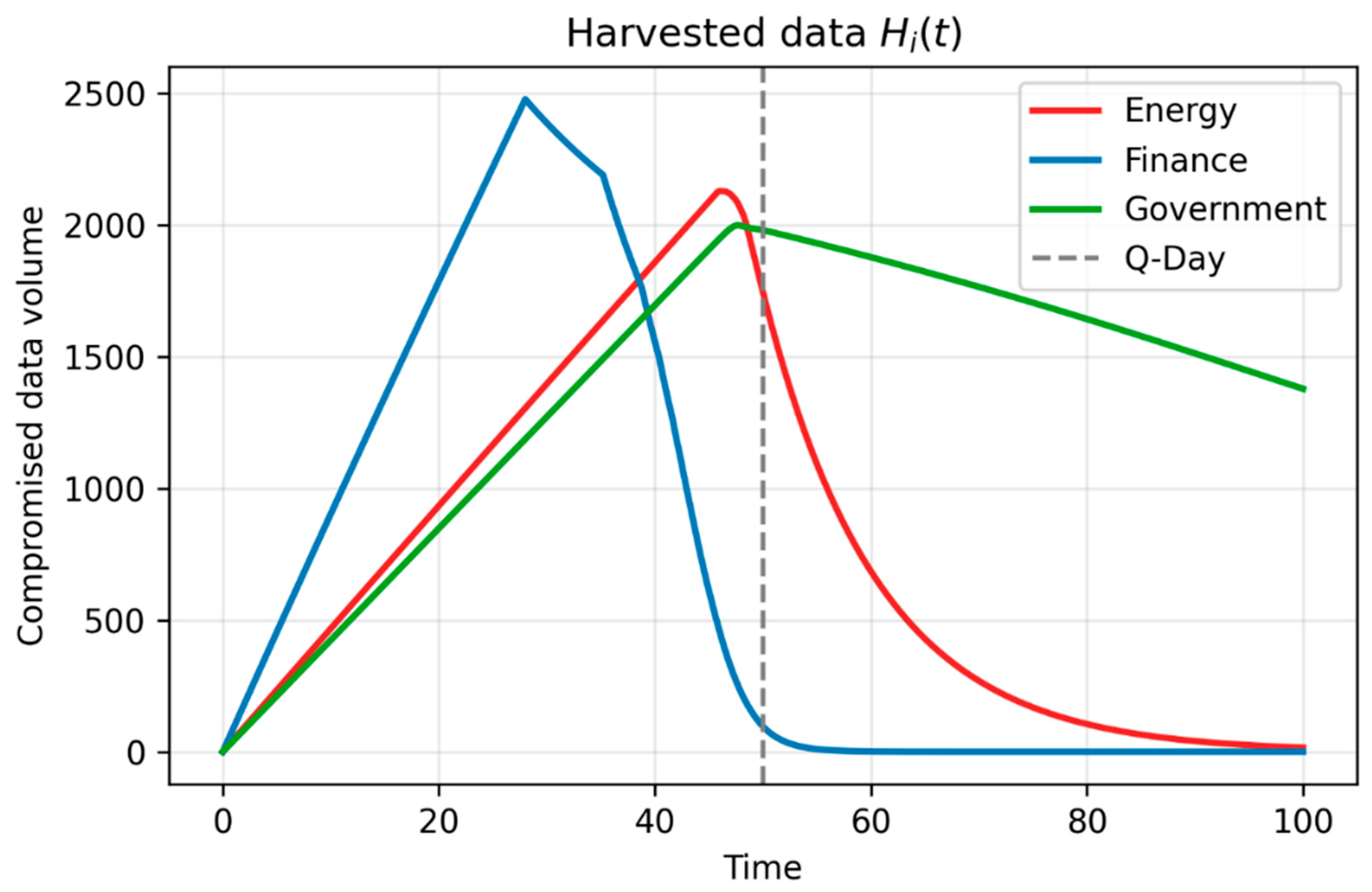
| Network dimension | 3 | The three main sectors of the Republic of Kazakhstan are energy (high friction), finance (high connectivity), and public administration (high data value). | |
| Planning horizon | 100 c.u. | The period encompassing the accumulation phase, the point of quantum supremacy, and post-crisis stabilization. | |
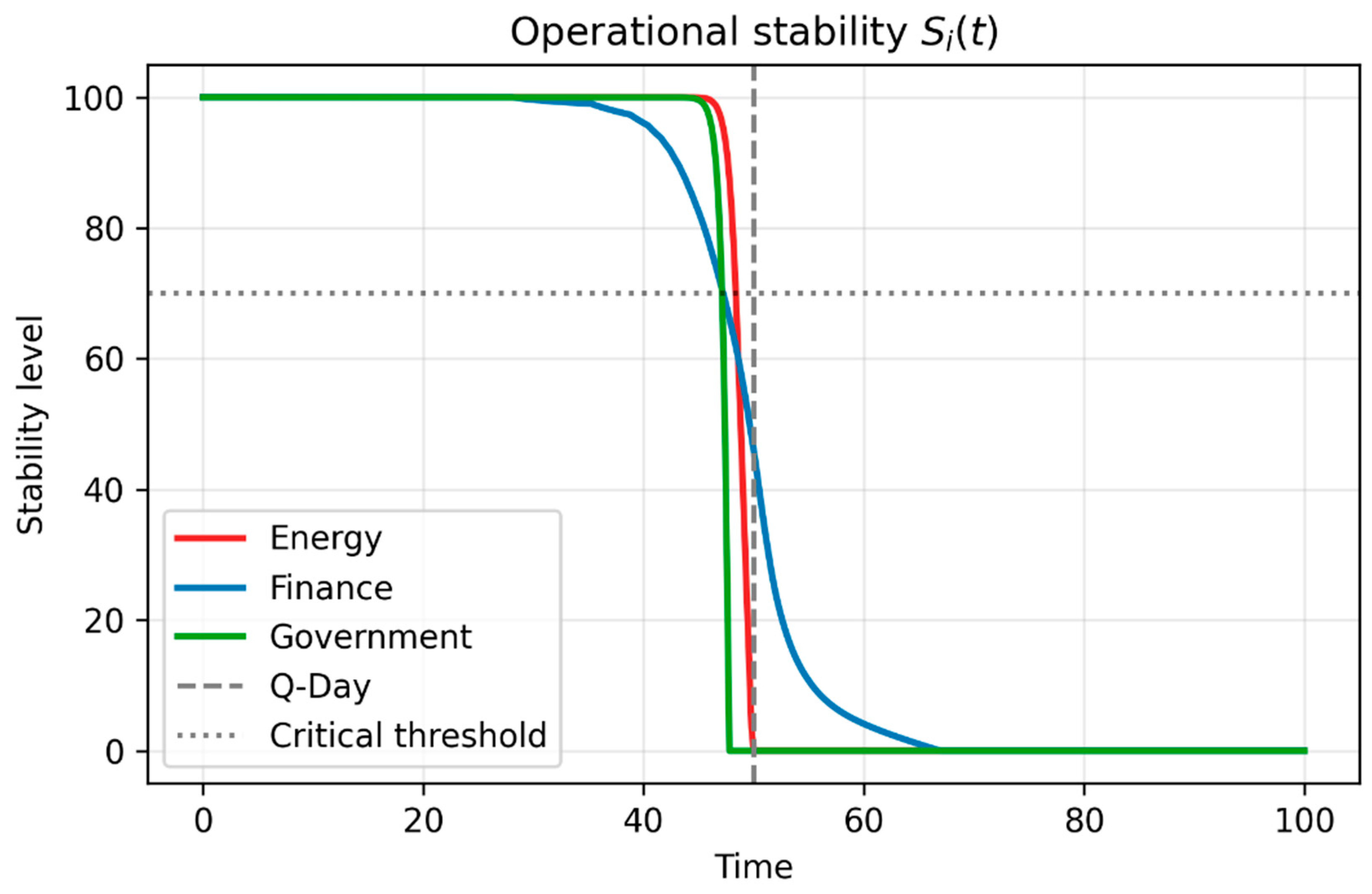
| Expected Q-Day point | 50 c.u. | Chronological moment of activation of the accumulated quantum threat (HNDL). | |
| Steepness of the function | 2.0 | The speed of transition from the classical paradigm of threats to the quantum one. | |
| CII Node Change Parameters | |||
| Coefficient of recovery | 0.05–0.15 | Inertia of repair and IT services. Minimal for energy, maximum for finance. | |
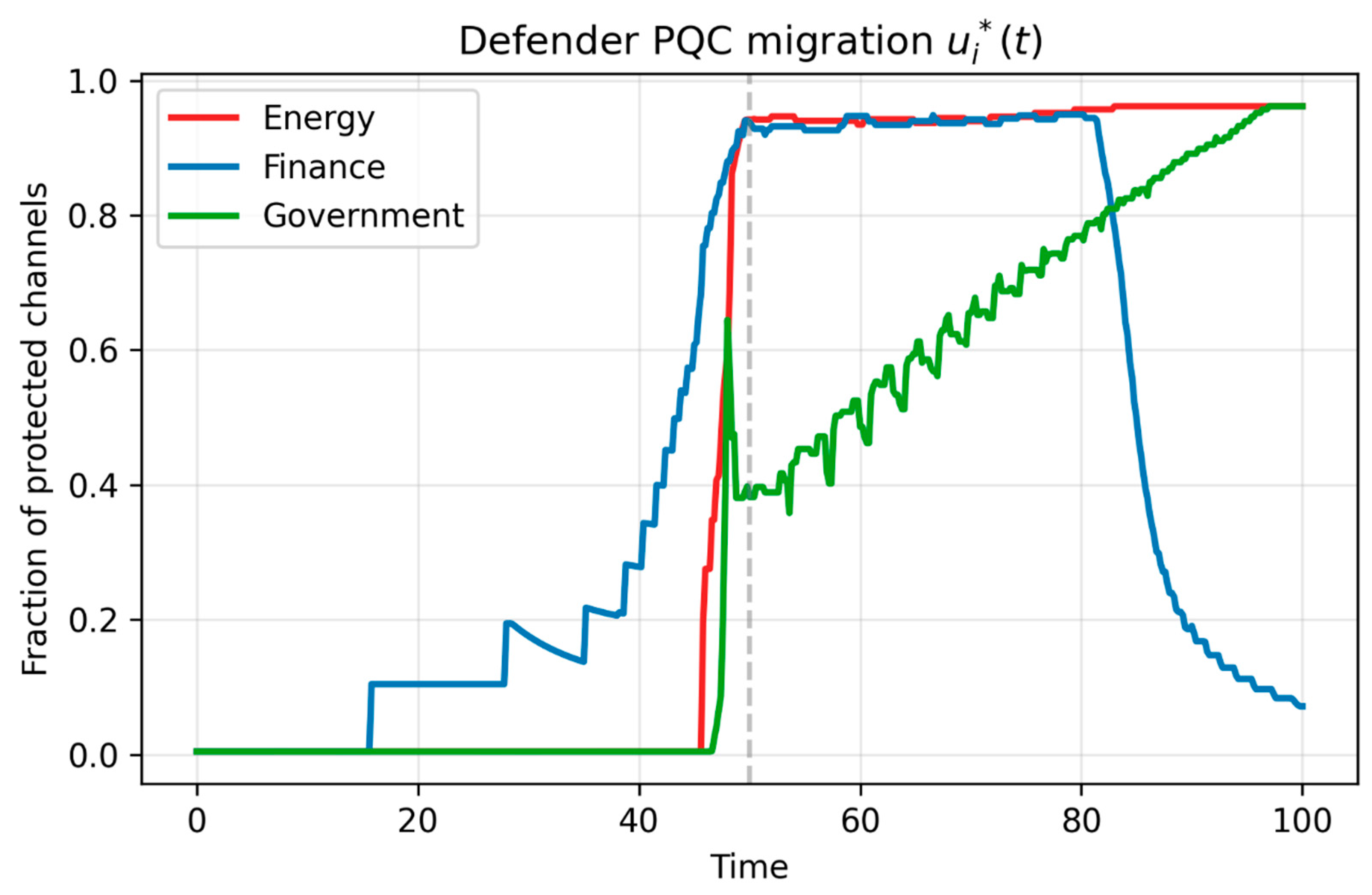
| Technological friction | 0.2–0.8 | PQC implementation overhead costs. Maximum for legacy industrial controllers in the energy sector. | |
| Nonlinearity of friction | 2.0–4.0 | Exponential growth of load as the share of PQC traffic approaches 100%. | |
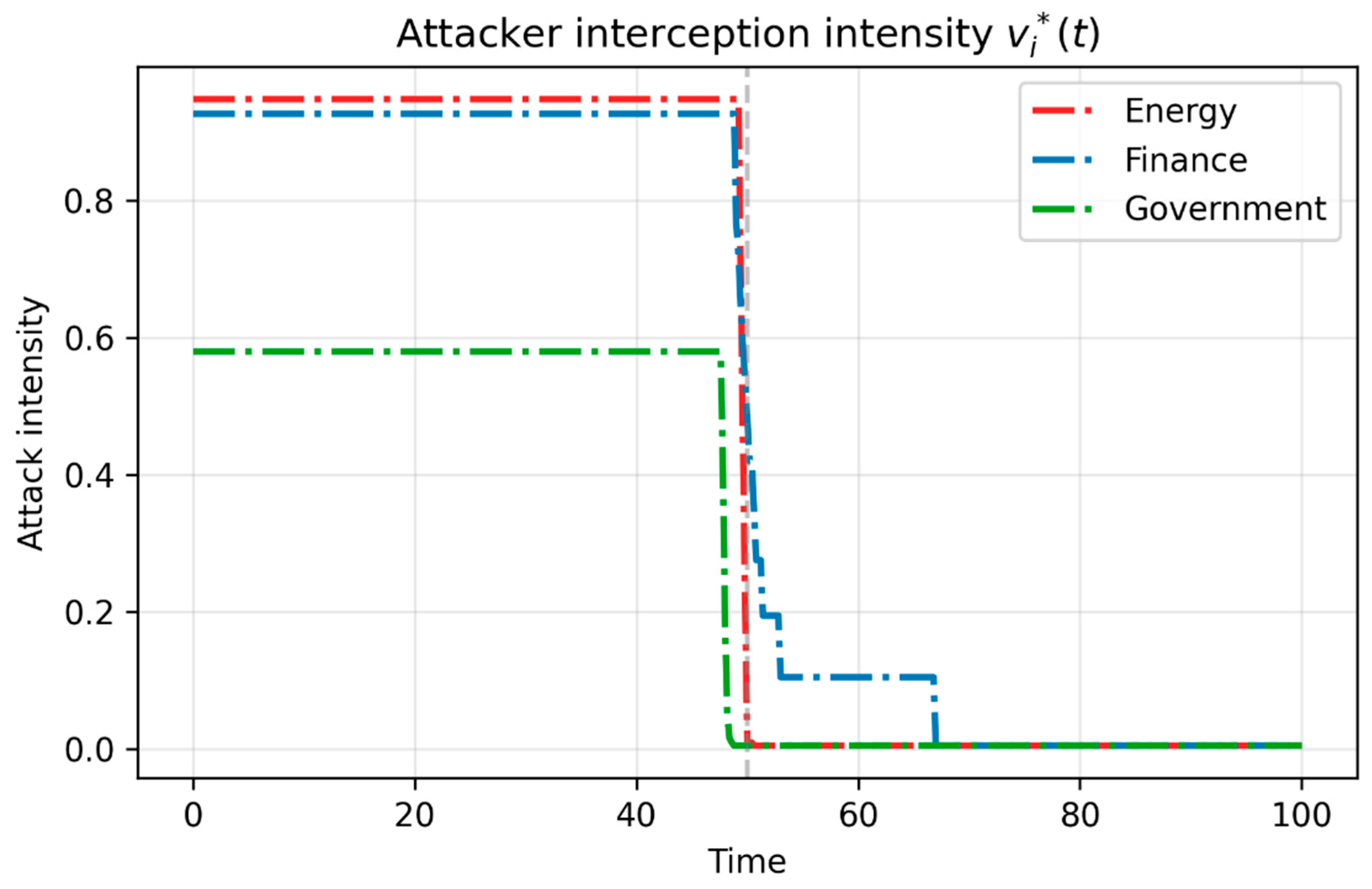
| Interception efficiency | 0.5–1.0 | The adversary’s basic ability to accumulate encrypted traffic of a node. | |
| Data aging rate | 0.01–0.5 | The life cycle of information. For the state administration RK , data remains relevant for decades. | |
| Specific data criticality | 1.0–10.0 | Potential damage from decrypting 1 TB of sector data after Q-Day. | |
| Payment Functionality Coefficients—Game Parameters | |||
| Penalty for loss of stability | 1.0–5.0 | The strategic importance of the continuity of the sector’s operations for the state. | |
| Defender control cost | 0.5–2.0 | Budget constraints and costs for the forced procurement of PQC-compatible equipment. | |
| Attacker’s resource cost | 0.5–1.5 | APT group’s costs for storage systems and computing clusters for the HNDL attack. | |
| Terminal fine | 5.0–10.0 | The significance of the final state of the system at time . | |
| Metric | Reactive Strategy | Optimal Control (Model) | Improvement (%) |
|---|---|---|---|
| Integral loss (Functional J) | 145.2 | 118.7 | 18.2% |
| Accumulated data volume (H at time T) | 2840 conventional units | 1960 conventional units | 31.0% |
| Average stability level ) | 62.4% | 81.6% | 30.8% |
Disclaimer/Publisher’s Note: The statements, opinions and data contained in all publications are solely those of the individual author(s) and contributor(s) and not of MDPI and/or the editor(s). MDPI and/or the editor(s) disclaim responsibility for any injury to people or property resulting from any ideas, methods, instructions or products referred to in the content. |
© 2026 by the authors. Licensee MDPI, Basel, Switzerland. This article is an open access article distributed under the terms and conditions of the Creative Commons Attribution (CC BY) license.
Share and Cite
Malikova, F.; Lakhno, V.; Alimseitova, Z.; Lakhno, M.; Togzhanova, K.; Beketova, G. Antagonistic Differential Game of Critical Infrastructure Migration Management to Post-Quantum Cryptography Under HNDL Conditions. Information 2026, 17, 485. https://doi.org/10.3390/info17050485
Malikova F, Lakhno V, Alimseitova Z, Lakhno M, Togzhanova K, Beketova G. Antagonistic Differential Game of Critical Infrastructure Migration Management to Post-Quantum Cryptography Under HNDL Conditions. Information. 2026; 17(5):485. https://doi.org/10.3390/info17050485
Chicago/Turabian StyleMalikova, Feruza, Valery Lakhno, Zhuldyz Alimseitova, Myroslav Lakhno, Kuljan Togzhanova, and Gulzhanat Beketova. 2026. "Antagonistic Differential Game of Critical Infrastructure Migration Management to Post-Quantum Cryptography Under HNDL Conditions" Information 17, no. 5: 485. https://doi.org/10.3390/info17050485
APA StyleMalikova, F., Lakhno, V., Alimseitova, Z., Lakhno, M., Togzhanova, K., & Beketova, G. (2026). Antagonistic Differential Game of Critical Infrastructure Migration Management to Post-Quantum Cryptography Under HNDL Conditions. Information, 17(5), 485. https://doi.org/10.3390/info17050485