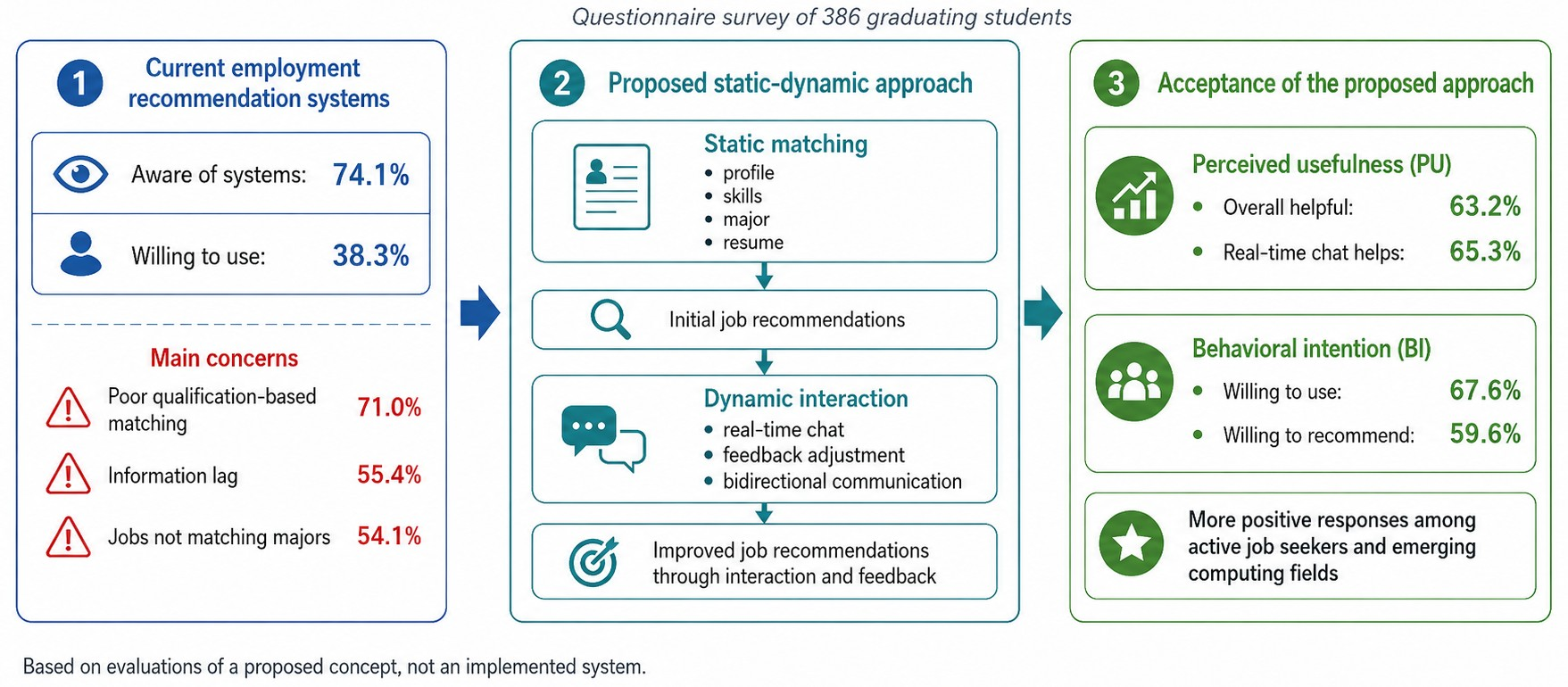
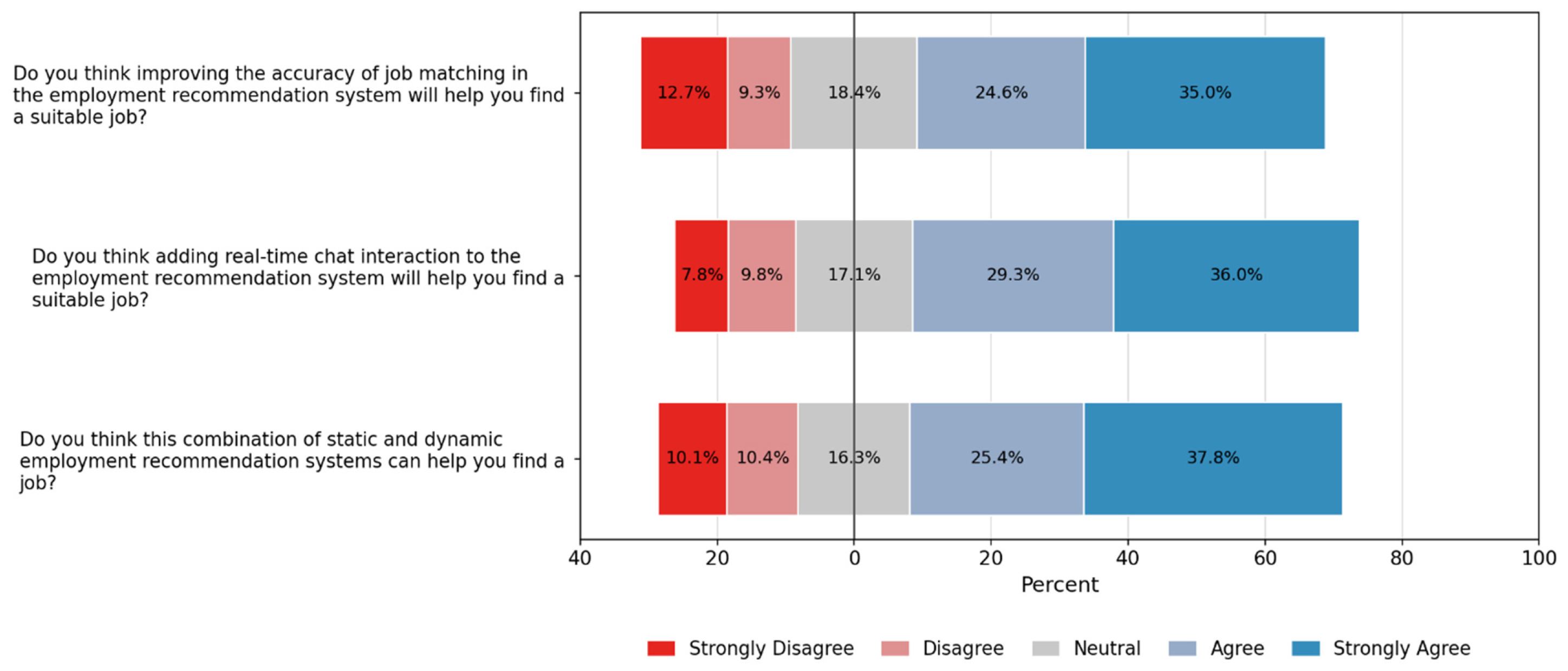
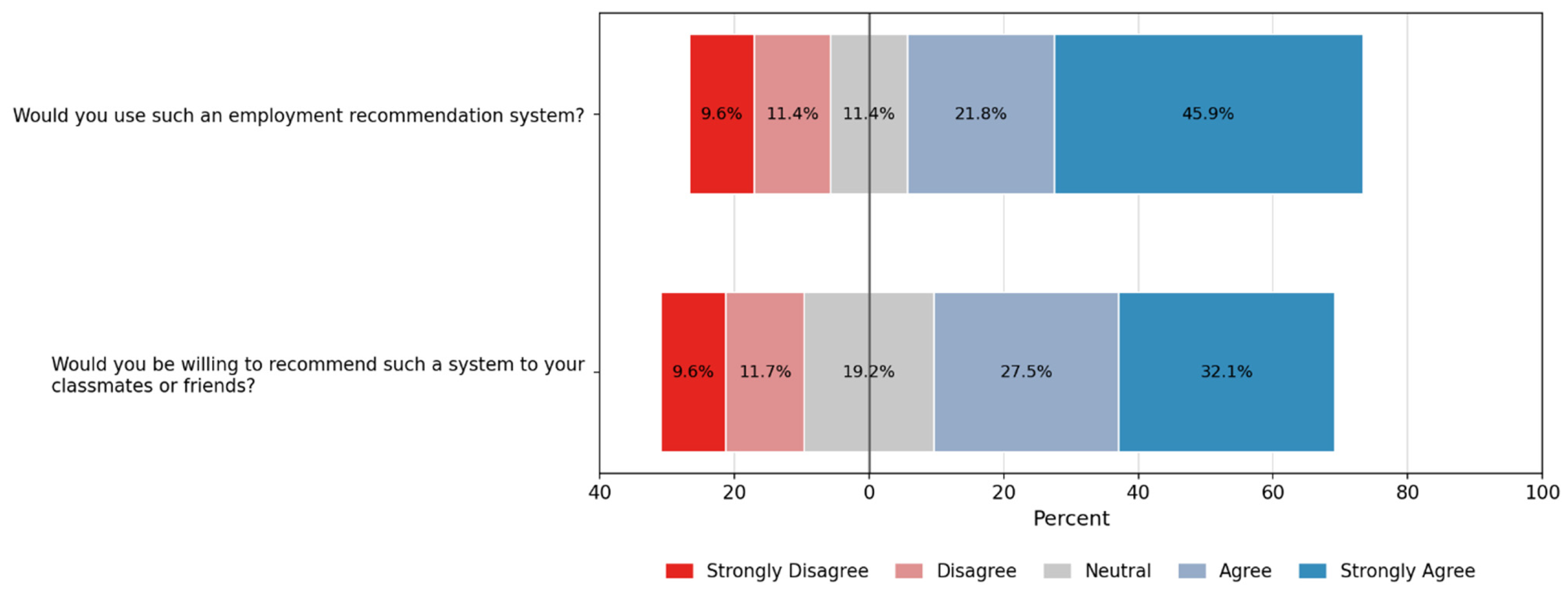
User Acceptance of a Proposed Static-Dynamic Employment Recommendation Approach Among Computer Science Graduating Students


Abstract
1. Introduction
2. Materials and Methods
2.1. Ethical Considerations
2.2. Participants and Data Collection
2.3. Theoretical Framework
2.4. Existing Employment Recommendation Systems and the Proposed Static-Dynamic Approach
2.5. Questionnaire Design and Measurement
2.6. Research Design and Data Analysis
2.7. Methodological Limitations
3. Results
3.1. Sociodemographic Characteristics
3.2. Reliability and Validity Analysis
3.3. System Awareness and Willingness to Use
3.4. Evaluation of the Existing Employment Recommendation Systems
3.5. Limitations of Existing Employment Recommendation Systems
3.5.1. Severe Deficiencies in Matching Functionality
3.5.2. Multiple Challenges to Information Quality
3.5.3. Significant Mismatch in Professional Suitability
3.5.4. Other Issues
3.6. Respondents’ Acceptance of the Proposed Static-Dynamic Job Recommendation Approach
3.7. Qualitative Summary of Open-Ended Feedback and Design Suggestions
3.7.1. Information Governance and Trust Building
3.7.2. Algorithm Optimization and Personalized Services
3.7.3. Privacy, Security, and Algorithm Transparency
3.7.4. Functionality Improvement and Experience Refinement
3.8. Exploratory Chi-Square Subgroup Analysis
4. Discussion
4.1. A Differential Analysis Based on Job-Seeking Status and Professional Orientation
4.2. Research Findings and Theoretical Alignment
4.3. Practical Implications for System Design
4.4. Limitations
4.5. Future Directions
5. Conclusions
Author Contributions
Funding
Institutional Review Board Statement
Informed Consent Statement
Data Availability Statement
Acknowledgments
Conflicts of Interest
References
- Portnoi, L.M.; Bagley, S.S.; Rust, V.D. Mapping the terrain: The global competition phenomenon in higher education. In Higher Education, Policy, and the Global Competition Phenomenon; Springer: New York, NY, USA, 2010; pp. 1–13. [Google Scholar] [CrossRef] [Scilit]
- Günay, A. Challenges for higher education graduates in the post-pandemic labor market. In International Perspectives and Strategies for Managing an Aging Workforce; Ince, F., Ed.; IGI Global: Hershey, PA, USA, 2022; pp. 144–159. [Google Scholar] [CrossRef] [Scilit]
- Xiang, B.; Wang, H.; Wang, H. Is There a Surplus of College Graduates in China? Exploring Strategies for Sustainable Employment of College Graduates. Sustainability 2023, 15, 15540. [Google Scholar] [CrossRef] [Scilit]
- Ministry of Education of the People’s Republic of China. 2001 Statistical Communiqué on National Education Development. Available online: https://www.moe.gov.cn/jyb_sjzl/sjzl_fztjgb/tnull_844.html (accessed on 15 March 2026).
- Ministry of Education of the People’s Republic of China. 2025 College Graduates Expected to Reach 12.22 Million. Available online: https://www.moe.gov.cn/jyb_xwfb/s5147/202411/t20241115_1163118.html (accessed on 15 March 2026).
- Xinhua News Agency. The Number of 2026 College Graduates is Expected to Reach 12.70 Million. Available online: https://www.news.cn/20251120/ead0f25dff2948dfa7f01fa78f207882/c.html (accessed on 15 March 2026).
- Hang, T.; Zhou, Y. Chinese University Major Decision and Its Effect on Wages: Modeling Interaction Between Major Specificity and Education-Job Relevancy Using Machine Learning Approaches. J. Chin. Political Sci. 2025, 30, 475–500. [Google Scholar] [CrossRef] [Scilit]
- Montobbio, F.; Staccioli, J.; Virgillito, M.E.; Vivarelli, M. The empirics of technology, employment and occupations: Lessons learned and challenges ahead. J. Econ. Surv. 2024, 38, 1622–1655. [Google Scholar] [CrossRef] [Scilit]
- Pan, Y.; Gao, F.; Xing, Z. The impact of skill-biased technological change on urban-rural income inequality: Evidence from China. Appl. Geogr. 2026, 187, 103891. [Google Scholar] [CrossRef] [Scilit]
- Bone, M.; González Ehlinger, E.; Stephany, F. Skills or degree? The rise of skill-based hiring for AI and green jobs. Technol. Forecast. Soc. Change 2025, 214, 124042. [Google Scholar] [CrossRef] [Scilit]
- Lynn, T.; Rosati, P.; Conway, E.; van der Werff, L. The Future of Work: Challenges and Prospects for Organisations, Jobs and Workers; Palgrave Macmillan: Cham, Switzerland, 2023. [Google Scholar] [CrossRef] [Scilit]
- Feng, J.; Yang, J.; Li, S.; Miao, Q.; Xi, Y.; Xia, Z. Enhancing person-job fit through multi-temporal career trajectory modeling. Expert Syst. Appl. 2026, 300, 130413. [Google Scholar] [CrossRef] [Scilit]
- Xiong, Y.; Yu, J.; Wu, H. The relationship between psychological resilience and employability among higher vocational college students: The chain mediating effects of perceived social support and career decision-making self-efficacy. Front. Psychol. 2026, 16, 1707655. [Google Scholar] [CrossRef] [Scilit] [PubMed]
- Zayed, Y.; Salman, Y.; Awad, M.; Hasasneh, A. Employment Recommendation System for Graduates Using Machine Learning. Int. J. Eng. Appl. 2023, 11, 308–317. [Google Scholar] [CrossRef] [Scilit]
- Shi, Q. The Employment Management for College Students Based on Deep Learning and Big Data. IEEE Access 2023, 11, 115627–115634. [Google Scholar] [CrossRef] [Scilit]
- Ricci, F.; Rokach, L.; Shapira, B. Recommender Systems: Techniques, Applications, and Challenges. In Recommender Systems Handbook; Springer: New York, NY, USA, 2022; pp. 1–35. [Google Scholar] [CrossRef] [Scilit]
- Wang, Y. Design and implementation of student job matching system based on personalized recommendation algorithm. Syst. Soft Comput. 2025, 7, 200302. [Google Scholar] [CrossRef] [Scilit]
- Zhipin, B. BOSS Zhipin Official Website. Available online: https://www.zhipin.com/ (accessed on 25 April 2026).
- Zhaopin. Zhaopin Official Recruitment Platform. Available online: https://www.zhaopin.com/ (accessed on 25 April 2026).
- 51job. 51job Official Recruitment Platform. Available online: https://www.51job.com/ (accessed on 25 April 2026).
- Lagou. Lagou Official Recruitment Platform. Available online: https://www.lagou.com/ (accessed on 25 April 2026).
- Çelik Ertuğrul, D.; Bitirim, S. Job recommender systems: A systematic literature review, applications, open issues, and challenges. J. Big Data 2025, 12, 140. [Google Scholar] [CrossRef] [Scilit]
- Mashayekhi, Y.; Li, N.; Kang, B.; Lijffijt, J.; De Bie, T. A Challenge-based Survey of E-recruitment Recommendation Systems. Acm Comput. Surv. 2024, 56, 252. [Google Scholar] [CrossRef] [Scilit]
- Huang, X.; Lian, J.; Lei, Y.; Yao, J.; Lian, D.; Xie, X. Recommender AI Agent: Integrating Large Language Models for Interactive Recommendations. ACM Trans. Inf. Syst. 2025, 43, 96. [Google Scholar] [CrossRef] [Scilit]
- Konstan, J.; Terveen, L. Human-centered recommender systems: Origins, advances, challenges, and opportunities. AI Mag. 2021, 42, 31–42. [Google Scholar] [CrossRef] [Scilit]
- Tang, F.; Zhu, R.; Yao, F.; Wang, J.; Luo, L.; Li, B. Explainable person–job recommendations: Challenges, approaches, and comparative analysis. Front. Artif. Intell. 2025, 8, 1660548. [Google Scholar] [CrossRef] [Scilit] [PubMed]
- Knijnenburg, B.P.; Bostandjiev, S.; O’Donovan, J.; Kobsa, A. Inspectability and control in social recommenders. In Proceedings of the Sixth ACM Conference on Recommender Systems, Dublin, Ireland, 9–13 September 2012; pp. 43–50. [Google Scholar] [CrossRef] [Scilit]
- He, X.; Liu, Q.; Jung, S. The impact of recommendation system on user satisfaction: A moderated mediation approach. J. Theor. Appl. Electron. Commer. Res. 2024, 19, 448–466. [Google Scholar] [CrossRef] [Scilit]
- He, C.; Parra, D.; Verbert, K. Interactive recommender systems: A survey of the state of the art and future research challenges and opportunities. Expert Syst. Appl. 2016, 56, 9–27. [Google Scholar] [CrossRef] [Scilit]
- Roppelt, J.S.; Schuster, A.; Greimel, N.S.; Kanbach, D.K.; Sen, K. Towards effective adoption of artificial intelligence in talent acquisition: A mixed method study. Int. J. Inf. Manag. 2025, 82, 102870. [Google Scholar] [CrossRef] [Scilit]
- Cochran, W.G. Sampling Techniques, 3rd ed.; Johan Wiley & Sons: New York, NY, USA, 1977. [Google Scholar]
- Davis, F.D. Perceived Usefulness, Perceived Ease of Use, and User Acceptance of Information Technology. Manag. Inf. Syst. Q. 1989, 13, 319–340. [Google Scholar] [CrossRef] [Scilit] [PubMed]
- DeLone, W.; McLean, E. Information Systems Success: The Quest for the Dependent Variable. Inf. Syst. Res. 1992, 3, 60–95. [Google Scholar] [CrossRef] [Scilit]
- DeLone, W.H.; McLean, E.R. The DeLone and McLean model of information systems success: A ten-year update. J. Manag. Inf. Syst. 2003, 19, 9–30. [Google Scholar] [CrossRef] [Scilit]
- Venkatesh, V.; Davis, F.D. A theoretical extension of the technology acceptance model: Four longitudinal field studies. Manag. Sci. 2000, 46, 186–204. [Google Scholar] [CrossRef] [Scilit]
- Xu, Y.; Chen, L. Personalized recommendations and consumer trust: The role of perceived control and locus of control. Acta Psychol. 2025, 261, 105936. [Google Scholar] [CrossRef] [Scilit]
- Wang, Z.; Wei, W.; Xu, C.; Xu, J.; Mao, X. Person-job fit estimation from candidate profile and related recruitment history with co-attention neural networks. Neurocomputing 2022, 501, 14–24. [Google Scholar] [CrossRef] [Scilit]
- Akram, S.; Buono, P.; Lanzilotti, R. Recruitment chatbot acceptance in a company: A mixed method study on human-centered technology acceptance model. Pers. Ubiquitous Comput. 2024, 28, 961–984. [Google Scholar] [CrossRef] [Scilit]
- Gao, C.; Lei, W.; He, X.; de Rijke, M.; Chua, T.-s. Advances and Challenges in Conversational Recommender Systems: A Survey. AI Open 2021, 2, 100–126. [Google Scholar] [CrossRef] [Scilit]
- Mensah, I.K.; Zeng, G.; Luo, C. Determinants of social commerce purchase and recommendation intentions within the context of swift guanxi among Chinese college students. Sage Open 2023, 13, 21582440231175370. [Google Scholar] [CrossRef] [Scilit]
- Marikyan, D.; Papagiannidis, S.; Stewart, G. Technology acceptance research: Meta-analysis. J. Inf. Sci. 2023, 52, 429–450. [Google Scholar] [CrossRef] [Scilit]
- Al Naqbi, S.H. A mixed-method approach to post-implementation success of technology performance in UAE universities: Assessing DeLone and McLean IS success model. Sage Open 2024, 14, 21582440241240827. [Google Scholar] [CrossRef] [Scilit]
- Kingsley, S.; Silberman, M.S.; Wang, C.; Lambeth, R.; Zhi, J.; Eslami, M.; Li, B.; Bigham, J. ‘Your Duties Are To Sweep A Floor Remotely’: Low Information Quality in Job Advertisements is a Barrier to Low-Income Job-Seekers’ Successful Use of Digital Platforms. In Proceedings of the 3rd Annual Meeting of the Symposium on Human-Computer Interaction for Work, Newcastle upon Tyne, UK, 25–27 June 2024; pp. 18:11–18:20. [Google Scholar]
- Kissi, P.S. Job seekers satisfy or dissatisfy with the existing electronic recruitment: A theoretical and empirical investigation. Cogent Bus. Manag. 2023, 10, 2278233. [Google Scholar] [CrossRef] [Scilit]
- Du, Y.; Liu, H.; Zhu, H.; Song, Y.; Zheng, Z.; Wu, Z. Quasi-Metric Learning for Bilateral Person-Job Fit. IEEE Trans. Pattern Anal. Mach. Intell. 2025, 47, 3947–3960. [Google Scholar] [CrossRef] [Scilit]
- Gong, Z.; Song, Y.; Zhang, T.; Wen, J.-R.; Zhao, D.; Yan, R. Your Career Path Matters in Person-Job Fit. Proc. AAAI Conf. Artif. Intell. 2024, 38, 8427–8435. [Google Scholar] [CrossRef] [Scilit]
- Saito, Y.; Sugiyama, K. Multi-Behavior Job Recommendation with Dynamic Availability. In Proceedings of the 1st ACM SIGIR-AP Conference on Research and Development in Information Retrieval in the Asia Pacific Region, Beijing, China, 26–29 November 2023; pp. 264–271. [Google Scholar] [CrossRef] [Scilit]
- Ogunniye, G.; Legastelois, B.; Rovatsos, M.; Dowthwaite, L.; Portillo, V.; Vallejos, E.; Zhao, J.; Jirotka, M. Understanding User Perceptions of Trustworthiness in E-Recruitment Systems. IEEE Internet Comput. 2021, 25, 23–32. [Google Scholar] [CrossRef] [Scilit]
- Boldi, A.; Silacci, A.; Rapp, A.; Caon, M. Designing for transparency: A web job board for e-recruitment to explore job seekers’ privacy behaviours. Behav. Inf. Technol. 2025, 44, 3038–3063. [Google Scholar] [CrossRef] [Scilit]
- Amaar, A.; Aljedaani, W.; Rustam, F.; Ullah, S.; Rupapara, V.; Ludi, S. Detection of Fake Job Postings by Utilizing Machine Learning and Natural Language Processing Approaches. Neural Process. Lett. 2022, 54, 2219–2247. [Google Scholar] [CrossRef] [Scilit]
- Hosain, M.S.; Amin, M.B.; Debnath, G.C.; Rahaman, M.A. The use of Artificial Intelligence (AI) in the hiring process: Job applicants’ perceptions of procedural justice. Comput. Hum. Behav. Rep. 2025, 19, 100713. [Google Scholar] [CrossRef] [Scilit]
- Siro, C.; Aliannejadi, M.; De Rijke, M. Understanding and Predicting User Satisfaction with Conversational Recommender Systems. ACM Trans. Inf. Syst. 2024, 42, 55. [Google Scholar] [CrossRef] [Scilit]
- Naeem, M.; Ozuem, W.; Howell, K.; Ranfagni, S. A step-by-step process of thematic analysis to develop a conceptual model in qualitative research. Int. J. Qual. Methods 2023, 22, 1–18. [Google Scholar] [CrossRef] [Scilit]
- Verma, J.P. Data Analysis in Management with SPSS Software; Springer Science & Business Media: Berlin/Heidelberg, Germany, 2012. [Google Scholar] [CrossRef] [Scilit]
- Tavakol, M.; Dennick, R. Making sense of Cronbach’s alpha. Int. J. Med. Educ. 2011, 2, 53–55. [Google Scholar] [CrossRef] [Scilit]
- Nunnally, J.C.; Bernstein, I.H. Psychometric Theory, 3rd ed.; McGraw-Hill: New York, NY, USA, 1994. [Google Scholar]
- Cortina, J.M. What is coefficient alpha? An examination of theory and applications. J. Appl. Psychol. 1993, 78, 98–104. [Google Scholar] [CrossRef]
- Hair, J.F.; Black, W.C.; Babin, B.J.; Anderson, R.E. Multivariate Data Analysis, 8th ed.; Cengage Learning: Andover, UK, 2019. [Google Scholar]
- Nigar, M.; Juli, J.F.; Golder, U.; Alam, M.J.; Hossain, M.K. Artificial intelligence and technological unemployment: Understanding trends, technology’s adverse roles, and current mitigation guidelines. J. Open Innov. Technol. Mark. Complex. 2025, 11, 100607. [Google Scholar] [CrossRef] [Scilit]
- Agresti, A. Categorical Data Analysis, 3rd ed.; John Wiley & Sons: Hoboken, NJ, USA, 2013. [Google Scholar]
- Armstrong, L.; Metaxa, D. Navigating automated hiring: Perceptions, strategy use, and outcomes among young job seekers. Proc. ACM Hum.-Comput. Interact. 2025, 9, CSCW140. [Google Scholar] [CrossRef] [Scilit]
- Jannach, D.; Manzoor, A.; Cai, W.; Chen, L. A survey on conversational recommender systems. ACM Comput. Surv. 2021, 54, 105. [Google Scholar] [CrossRef] [Scilit]
- Deriu, V.; Pozharliev, R.; De Angelis, M. How trust and attachment styles jointly shape job candidates’ AI receptivity. J. Bus. Res. 2024, 179, 114717. [Google Scholar] [CrossRef] [Scilit]
- Smaldone, F.; Ippolito, A.; Lagger, J.; Pellicano, M. Employability skills: Profiling data scientists in the digital labour market. Eur. Manag. J. 2022, 40, 671–684. [Google Scholar] [CrossRef] [Scilit]
- Ma, Y.; Ziegler, J. Investigating meta-intents: User interaction preferences in conversational recommender systems. User Model. User-Adapt. Interact. 2024, 34, 1535–1580. [Google Scholar] [CrossRef] [Scilit]
- Podsakoff, P.M.; Podsakoff, N.P.; Williams, L.J.; Huang, C.; Yang, J. Common method bias: It’s bad, it’s complex, it’s widespread, and it’s not easy to fix. Annu. Rev. Organ. Psychol. Organ. Behav. 2024, 11, 17–61. [Google Scholar] [CrossRef] [Scilit]
- Knijnenburg, B.P.; Willemsen, M.C.; Gantner, Z.; Soncu, H.; Newell, C. Explaining the user experience of recommender systems. User Model. User-Adapt. Interact. 2012, 22, 441–504. [Google Scholar] [CrossRef] [Scilit]
- Jin, Y.; Chen, L.; Cai, W.; Zhao, X. CRS-Que: A user-centric evaluation framework for conversational recommender systems. ACM Trans. Recomm. Syst. 2024, 2, 2. [Google Scholar] [CrossRef] [Scilit]
- Jannach, D. Evaluating conversational recommender systems: A landscape of research. Artif. Intell. Rev. 2023, 56, 2365–2400. [Google Scholar] [CrossRef] [Scilit]
- Chen, A.; Han, F.; Zhang, X.; Lu, Y. Cracking the AI recruitment code: Striving for transparency in finding the right person–job fit. Inf. Manag. 2025, 62, 104156. [Google Scholar] [CrossRef] [Scilit]
- Niessen, A.S.M.; Neumann, M. Transparency and Trust in Simple Algorithmic Hiring Procedures. Int. J. Sel. Assess. 2026, 34, e70045. [Google Scholar] [CrossRef] [Scilit]



| Characteristic | Number (n) | Percentage (%) |
|---|---|---|
| Gender | ||
| Male | 222 | 57.5 |
| Female | 164 | 42.5 |
| Major/Specialization | ||
| Computer Science and Technology | 165 | 42.7 |
| Artificial Intelligence | 78 | 20.2 |
| Internet of Things Engineering | 29 | 7.5 |
| Software Engineering | 23 | 6.0 |
| Virtual Reality Technology | 22 | 5.7 |
| Network Engineering | 21 | 5.4 |
| Data Science | 18 | 4.7 |
| Other | 30 | 7.8 |
| Post-graduation Intention | ||
| Plan to seek employment | 365 | 94.6 |
| No immediate employment plans | 21 | 5.4 |
| Current Job Search Status | ||
| Actively searching, no interview yet | 198 | 51.3 |
| Currently in an internship | 76 | 19.7 |
| Not actively looking | 93 | 24.1 |
| Received job offer (signed contract) | 19 | 4.9 |
| Item | Corrected Total Correlation | α Coefficient with Item Deleted | Cronbach Alpha |
|---|---|---|---|
| Overall scale | 0.818 | ||
| Do you think improving the accuracy of job matching in the employment recommendation system will help you find a suitable job? | 0.706 | 0.752 | |
| Do you think adding real-time chat interaction to the employment recommendation system will help you find a suitable job? | 0.764 | 0.738 | |
| Do you think this combination of static and dynamic employment recommendation systems can help you find a job? | 0.768 | 0.733 | |
| Would you use such an employment recommendation system? | 0.455 | 0.827 | |
| Would you be willing to recommend such an employment recommendation system to your classmates or friends? | 0.391 | 0.842 | |
| Perceived usefulness (PU) | 0.928 | ||
| Do you think improving the accuracy of job matching in the employment recommendation system will help you find a suitable job? | 0.773 | 0.961 | |
| Do you think adding real-time chat interaction to the employment recommendation system will help you find a suitable job? | 0.901 | 0.860 | |
| Do you think this combination of static and dynamic employment recommendation systems can help you find a job? | 0.892 | 0.864 | |
| Behavioral intention (BI) | 0.630 | ||
| Would you use such an employment recommendation system? | 0.460 | / | |
| Would you be willing to recommend such an employment recommendation system to your classmates or friends? | 0.460 | / |
| Test | Value |
|---|---|
| KMO | 0.735 |
| Bartlett’s Test of Sphericity | 1269.598 |
| df | 10 |
| Sig. | 0.000 |
| Item | Component 1 | Component 2 | Communality |
|---|---|---|---|
| Do you think improving the accuracy of job matching in the employment recommendation system will help you find a suitable job? | 0.867 | 0.209 | 0.796 |
| Do you think adding real-time chat interaction to the employment recommendation system will help you find a suitable job? | 0.947 | 0.158 | 0.923 |
| Do you think this combination of static and dynamic employment recommendation systems can help you find a job? | 0.940 | 0.180 | 0.916 |
| Would you use such an employment recommendation system? | 0.217 | 0.818 | 0.716 |
| Would you be willing to recommend such an employment recommendation system to your classmates or friends? | 0.120 | 0.857 | 0.749 |
| Options | Number (n) | Percentage (%) |
|---|---|---|
| Strongly agree | 37 | 9.6 |
| Agree | 56 | 14.5 |
| Neutral | 106 | 27.5 |
| Disagree | 112 | 29.0 |
| Strongly disagree | 75 | 19.4 |
| Limitations | Number (n) | Percentage (%) |
|---|---|---|
| Severe deficiencies in matching functionality and responsiveness | 274 | 71 |
| Multiple challenges to information quality | 214 | 55.4 |
| Significant mismatch in professional suitability | 209 | 54.1 |
| Other issues | 8 | 2.1 |
| Item | Active Job-Seeking (n, %) | Less Active Job-Seeking (n, %) | χ2 | p-Value |
|---|---|---|---|---|
| Do you think improving the accuracy of job matching in the employment recommendation system will help you find a suitable job? | 174/274 (63.5%) | 56/112 (50.0%) | 6.020 | 0.014 |
| Do you think adding real-time chat interaction to the employment recommendation system will help you find a suitable job? | 190/274 (69.3%) | 62/112 (55.4%) | 6.862 | 0.009 |
| Do you think this combination of static and dynamic employment recommendation systems can help you find a job? | 183/274 (66.8%) | 61/112 (54.5%) | 5.193 | 0.023 |
| Would you use such an employment recommendation system? | 195/274 (71.2%) | 66/112 (58.9%) | 5.439 | 0.020 |
| Would you be willing to recommend such an employment recommendation system to your classmates or friends? | 173/274 (63.1%) | 57/112 (50.9%) | 4.951 | 0.026 |
| Item | Emerging Fields (n, %) | Traditional Computing (n, %) | χ2 | p-Value |
|---|---|---|---|---|
| Do you think improving the accuracy of job matching in the employment recommendation system will help you find a suitable job? | 80/118 (67.8%) | 135/238 (56.7%) | 4.044 | 0.044 |
| Do you think adding real-time chat interaction to the employment recommendation system will help you find a suitable job? | 87/118 (73.7%) | 147/238 (61.8%) | 5.013 | 0.025 |
| Do you think this combination of static and dynamic employment recommendation systems can help you find a job? | 84/118 (71.2%) | 142/238 (59.7%) | 4.518 | 0.034 |
| Would you use such an employment recommendation system? | 91/118 (77.1%) | 151/238 (63.4%) | 6.775 | 0.009 |
| Would you be willing to recommend such an employment recommendation system to your classmates or friends? | 83/118 (70.3%) | 130/238 (54.6%) | 8.108 | 0.004 |
| Grouping Variable | Comparison | Dimension | Group 1 Mean Rank | Group 2 Mean Rank | U | Z | p-Value |
|---|---|---|---|---|---|---|---|
| Professional orientation | Emerging Fields (n = 118) vs. Traditional Computing (n = 238) | PU | 193.98 | 170.82 | 12,215.000 | −2.018 | 0.044 |
| Emerging Fields (n = 118) vs. Traditional Computing (n = 238) | BI | 198.93 | 168.37 | 11,631.500 | −2.674 | 0.007 | |
| Job-seeking status | Active job-seeking (n = 274) vs. Less active job-seeking (n = 112) | PU | 201.43 | 174.09 | 13,170.500 | −2.206 | 0.027 |
| Active job-seeking (n = 274) vs. Less active job-seeking (n = 112) | BI | 204.23 | 167.25 | 12,404.500 | −2.996 | 0.003 |
Disclaimer/Publisher’s Note: The statements, opinions and data contained in all publications are solely those of the individual author(s) and contributor(s) and not of MDPI and/or the editor(s). MDPI and/or the editor(s) disclaim responsibility for any injury to people or property resulting from any ideas, methods, instructions or products referred to in the content. |
© 2026 by the authors. Licensee MDPI, Basel, Switzerland. This article is an open access article distributed under the terms and conditions of the Creative Commons Attribution (CC BY) license.
Share and Cite
Qu, H.; Sahrani, S.; Fauzi, F.; Song, X.; Zhao, Y. User Acceptance of a Proposed Static-Dynamic Employment Recommendation Approach Among Computer Science Graduating Students. Information 2026, 17, 479. https://doi.org/10.3390/info17050479
Qu H, Sahrani S, Fauzi F, Song X, Zhao Y. User Acceptance of a Proposed Static-Dynamic Employment Recommendation Approach Among Computer Science Graduating Students. Information. 2026; 17(5):479. https://doi.org/10.3390/info17050479
Chicago/Turabian StyleQu, Huafeng, Shafrida Sahrani, Fariza Fauzi, Xiacheng Song, and Yanfeng Zhao. 2026. "User Acceptance of a Proposed Static-Dynamic Employment Recommendation Approach Among Computer Science Graduating Students" Information 17, no. 5: 479. https://doi.org/10.3390/info17050479
APA StyleQu, H., Sahrani, S., Fauzi, F., Song, X., & Zhao, Y. (2026). User Acceptance of a Proposed Static-Dynamic Employment Recommendation Approach Among Computer Science Graduating Students. Information, 17(5), 479. https://doi.org/10.3390/info17050479