1. Introduction
Web analytics, as a discipline and a commercial practice, was built on a specific bet about what the internet is: a space where humans act and where those actions leave interpretable traces. The entire inferential architecture of the field, from session tracking and funnel analysis to engagement scoring and cohort retention, assumes that the entity generating data is a person whose behavior can be explained, predicted, and influenced through psychological, economic, or social models. A pageview meant someone looked at something. A click meant someone wanted something. A purchase meant someone decided something. These assumptions held for roughly three decades, not because they were theoretically airtight, but because they were close enough to the truth to be useful. However, that margin of adequacy is narrowing.
The emergence of autonomous AI agents capable of browsing, interacting with, and transacting on the web has introduced a category of actors that share few of the properties the analytics framework requires. These agents do not have preferences in any psychologically meaningful sense. They do not persist across sessions the way a returning customer does. They are instantiated to accomplish a task and dissolved when it is done, leaving behind data traces that look identical to human behavior but mean something categorically different. The volume of such traffic is not trivial. Automated entities already constitute a substantial fraction of online interactions: estimates on social media platforms alone have ranged from 9% to 15% of active accounts [
1], while Ng and Carley [
2], drawing on global social media data, found that approximately 20% of social media chatter about major events is bot-generated. On the open web, honeypot studies have found that bot-generated requests dominate the traffic logs of newly registered domains [
3], and Kirdeev et al. [
4] estimated that non-human traffic constitutes close to half of all web traffic. These figures predate the current generation of large language model (LLM)-powered agents, which are more capable and harder to distinguish from humans than the bots of five years ago.
The consequence is a measurement problem with epistemic teeth. If a meaningful and growing portion of the data flowing through analytics pipelines originates from entities whose behavior cannot be interpreted using the models the field has built, then the outputs of those models (the dashboards, the attribution reports, the conversion funnels, the engagement scores) become harder to interpret even as their precision improves. The field is measuring more, with better tools, while the relationship between what is measured and what those measurements were designed to mean grows looser.
This paper advances a direct argument: web analytics should supplement, and in places replace, the human user as its default unit of analysis with constructs that can characterize interaction in a hybrid environment where human actors, AI agents, and recursive agent-to-agent exchanges coexist and are often indistinguishable from one another. This calls for rethinking the conceptual foundations of the field, from the definition of a session to the meaning of intent and from the logic of attribution to the epistemological status of behavioral data itself. The challenge is not confined to web analytics. Parallel debates about algorithmic accountability, governance-integrated explainability, and responsible system design have already surfaced in sectors where autonomous AI makes decisions with direct consequences for human welfare [
5,
6,
7]. The energy sector, in particular, has developed governance frameworks for AI-driven systems that face structurally similar problems: black-box decision-making, accountability gaps when automated systems fail, and the difficulty of maintaining human oversight as the ratio of machine-to-human activity shifts. Web analytics has yet to learn systematically from these efforts. We argue that some of that machinery transfers and some of it does not, and we mark the line.
Article Type, Scope, and Contribution
This is a position paper. It does not present new empirical data, and it is not a systematic review in the PRISMA sense. It is a conceptual synthesis built on a structured narrative review of literature across five domains: agent architecture and capabilities, bot and agent detection, web measurement and validity, governance of automated systems in adjacent regulated sectors (notably energy and critical infrastructure), and the epistemology of digital trace data. Sources were selected purposively from peer-reviewed venues, recognized industry research (HUMAN Security, Anthropic Research), and high-citation preprints, with a temporal emphasis on work from 2017 to early 2026. Adjacent sectors enter the analysis where they offer transferable governance machinery, not as direct empirical evidence about web traffic.
Source retrieval combined searches in Scopus, Web of Science, IEEE Xplore, ACM Digital Library, and arXiv with targeted lookups for industry research and policy reports cited in those venues. Inclusion required relevance to one of the five thematic domains, traceable provenance, and either peer-reviewed status or, for industry and preprint sources, demonstrated citation impact or established institutional standing. Several claims, particularly those concerning current LLM-agent traffic volumes and detection trajectories, rest in part on industry reports and preprints: we use cautious verbs (suggests, indicates) for those claims and reserve stronger language for findings supported by peer-reviewed evidence.
The paper’s claims sit at three levels, and we take the trouble to keep them separate. The first is structural diagnosis: the conceptual architecture of conventional web analytics, built on identity persistence, intentional intelligibility of behavior, and a behavioral-to-psychological inference chain, was designed for a population that increasingly does not match the data. We support this through the cited literature. The second is reasoned projection: agent share and agent–human indistinguishability will continue to grow, and the field’s ability to compensate through better detection alone will reach diminishing returns. We argue this from documented trajectories and known dynamics, not from forecasts of our own. The third is programmatic proposal: the five measurement primitives we sketch in
Section 7 (task chain, actor class, interaction provenance, objective alignment, signal authenticity) and the layered governance architecture we describe in
Section 7.3 are candidate constructs for future development and empirical validation. We present them as testable proposals, not as deployed systems.
The primary domain of application is transactional site analytics: e-commerce, SaaS funnels, content platforms with measurable conversion outcomes, and ad-supported publishing. The secondary domain is broader hybrid digital ecosystems where measurement supports business decisions, including community platforms and search-mediated information services. We are not making claims about archival web crawling, scientific scraping, or non-commercial information retrieval, where similar issues arise but where the incentive structures, stakes, and tooling differ. We flag the boundary because some of our claims about metric corruption depend on commercial decision-making contexts that do not apply elsewhere.
The remainder of the paper proceeds as follows.
Section 2 reconstructs the implicit theory of the user that grounds conventional analytics and identifies its core commitments.
Section 3 traces the empirical emergence of web agents, fixes a working taxonomy of automated traffic, and isolates the three properties of LLM agents that distinguish the present challenge from prior bot-detection work.
Section 4 examines the specific mechanisms through which agent traffic corrupts traditional metrics.
Section 5 and
Section 6 develop two of the most consequential problems: identity discontinuity and synthetic traffic loops.
Section 7 proposes the outlines of an agent-aware analytics paradigm, with operational definitions for each primitive and three worked examples.
Section 8 confronts the epistemological limits that any such paradigm must accept.
Section 9 and
Section 10 turn to discussion and conclusions, with the latter calibrating what the paper demonstrates, what it infers, and what it proposes.
3. The Agent Incursion
3.1. A Working Taxonomy
The literature on automated web traffic uses several overlapping terms, and the implications of the agent problem differ depending on which category an observer has in mind. We adopt the following distinctions throughout the paper.
A crawler is an automated process that retrieves and indexes web content according to fixed rules. Search engine crawlers, archive bots, and academic scrapers fall in this category. Crawlers typically identify themselves through user-agent strings and respect robots.txt directives, and the analytics industry has long-established conventions for filtering them out of human-traffic reporting.
A traditional bot is an automated process designed to perform a specific function (form submission, content posting, ad clicking, vulnerability scanning) using rule-based or shallow-learning logic. Bots can be benign or adversarial. Most of the bot-detection literature reviewed in
Section 3.3 was developed against this category. Their behavior is repetitive, their intent is often inferable from request patterns, and their evasion techniques (rotating IPs, randomized timing) are bounded by the architectures available to their authors.
An AI agent, in the sense relevant here, is a system that perceives a digital environment, reasons about goals, and takes multi-step actions to advance those goals. The agent’s behavior is not fixed in advance; instead, it adapts to what the environment returns. This category includes earlier reinforcement-learning agents but is dominated, at the time of writing, by language model-driven systems.
An LLM-powered agent is an AI agent whose reasoning module is a large language model. These agents read rendered web pages much as humans do, interpret natural-language goals, and select actions through prompts rather than scripts. WebArena [
11], commercial browser-automation agents from major model providers, and Claude Code in its agentic configurations exemplify this class for now.
An autonomous agent is an LLM-powered agent that operates with minimal human-in-the-loop intervention between goal specification and outcome. Autonomy is a matter of degree, ranging from supervised copilots that pause for confirmation at consequential steps to fully autonomous shopping or research agents that complete entire transactions without further input.
Synthetic traffic, in this paper, refers to web traffic generated by any of the above non-human actors. We do not treat synthetic traffic as inherently fraudulent. An autonomous shopping agent placing a real order on behalf of a real human generates synthetic traffic that represents genuine commerce; the issue is interpretive, not legal.
These categories shade into one another in practice. A modern e-commerce site sees crawler traffic, traditional bot traffic, LLM-agent traffic, and human traffic in the same pipeline, often without reliable signals to distinguish them. The argument of this paper concerns primarily the third and fourth categories, but it is sharpened by the fact that the field’s tooling cannot cleanly separate any of the four.
3.5. Scale, Trajectory, and the Detection Arms Race
Estimating the current proportion of agent-generated web traffic is difficult because the most capable agents are designed to be indistinguishable from humans. The trajectory, however, is clear from less sophisticated proxies. Varol et al. [
1] estimated that between 9% and 15% of active Twitter accounts were bots. Li et al. [
3], studying web traffic to honeypot domains over seven months, found that bots constituted the vast majority of visitors. In e-commerce, Xu et al. [
12] documented that automated traffic represented a substantial portion of search queries, requiring dedicated detection and separation systems. Ng and Carley [
2], working with global social media data, found that approximately 20% of chatter about major events is bot-generated, and that bot and human behavioral signatures remain consistently distinguishable across geographies and platforms. That cross-platform baseline is valuable, but it was established against bots far less sophisticated than the LLM-powered agents now entering the web.
The detection side of this equation faces its own compounding difficulty. The HUMAN Security Research Team [
21] identifies key detection signals for distinguishing human users from autonomous AI agents, including network context, browser authenticity, and execution environment artifacts. Their report makes a critical concession: modern AI agents often rotate identifiers and emulate real browser environments, making single-indicator detection unreliable. Layered, context-aware behavioral analysis is now the minimum viable approach, and even that faces diminishing returns as agent architectures evolve. Gajewski et al. [
22], proposing a dual approach that combines rule-based methods with supervised learning to distinguish human from bot behavior, demonstrate that hybrid recognition systems outperform single-method techniques. They also acknowledge the growing challenge of bots that accurately mimic human interaction patterns. The detection problem has the structure of an arms race, and the arms race favors the agents, because advances in language modeling improve both agent capability and agent camouflage simultaneously.
Additional evidence from the detection literature confirms the difficulty of the classification problem. Hayawi et al. [
23] review deep learning approaches to social media bot detection and find that while neural models achieve strong performance against conventional bots, they face a moving target as bot sophistication increases. Aljabri et al. [
24] catalog the full range of ML-based detection methods (profile-based, content-based, graph-based, and temporal) and conclude that no single approach will suffice for the current generation of LLM-driven agents. Sayyad et al. [
25] demonstrate that behavioral biometrics, particularly mouse movement patterns and interaction timing, can reliably distinguish humans from automated agents, though their work predates the most capable agent architectures now in development. Xu et al. [
26], reviewing LLM applications in cybersecurity, show that the same language-modeling advances that power useful web agents also enable more sophisticated evasion of detection systems, confirming the arms-race dynamic described above.
These figures establish a baseline. The agents now entering the web are more capable, more varied in their behavior, and harder to classify. The proportion of web traffic they generate will increase as agent-based interfaces (voice assistants, copilots, autonomous shopping agents) become a more common mode of web interaction for both consumer and enterprise users.
Table 1 classifies the sources reviewed in this paper across five thematic domains. Several sources contribute to more than one domain; the table reflects each source’s primary contribution. The classification reveals that detection and agent architecture research have developed in parallel, with limited cross-pollination, while governance frameworks from adjacent sectors (particularly energy systems) offer transferable models that the analytics literature has not yet absorbed.
Table 1.
Classification of Reviewed Literature by Thematic Domain.
| Thematic Domain | Sources | Core Concern for Analytics |
|---|
| Agent architectures and capabilities | [11,14,15,16,17,18,19,20,27] | Agents execute goal-directed tasks across web interfaces using perception, reasoning, and action modules, generating traffic structurally unlike human browsing |
| Bot and agent detection | [2,3,12,13,21,22,23,24,25,28,29] | Detection faces an arms race; behavioral biometrics, deep learning, and hybrid methods achieve strong results against current bots but face diminishing returns as agents improve |
| Metric corruption and measurement validity | [4,9,10,30,31,32,33] | Sessions, conversions, retention, and engagement metrics lose interpretive validity when applied to agent-generated data |
| Identity, attribution, and epistemology | [1,8,33,34] | The intentional stance underlying analytics requires a persistent, psychologically legible subject; agents lack these properties, weakening the inferential bridge |
| Governance, ethics, and institutional design | [5,6,7,35,36,37,38,39,40,41,42] | Governance frameworks (regulatory sandboxes, responsible design, accountability mapping) provide partial transferable models for analytics governance |
7. Toward an Agent-Aware Analytics Paradigm
If the arguments of the preceding sections hold, then the field of web analytics faces a choice between two paths. The first is to treat the agent problem as an extension of the bot problem: improve detection, improve filtering, and continue interpreting the remaining data under the traditional framework. The second is to accept that the traditional framework’s assumptions hold less well as agent share rises, and to begin constructing an alternative that accommodates both kinds of actor.
We argue that the first path will reach diminishing returns. It will fail because the most capable agents are designed to be behaviorally similar to humans on every standard signal, because the boundary between human and agent traffic is a spectrum rather than a line, and because filtering out agent traffic will increasingly mean filtering out a large share of the legitimate web interactions (and thus the economic activity) that occur through agent-mediated channels. An analytics framework that excludes agent behavior from its scope will become a framework that measures a shrinking and unrepresentative slice of the web.
The second path requires rethinking several foundational commitments. We sketch the alternative below, with explicit operational definitions for each proposed primitive.
7.2. New Measurement Primitives, Operationally Specified
Krupp et al. [
16] and Bandi et al. [
15] have documented the measurement frameworks being developed within the agent evaluation community. These frameworks evaluate agents on task completion, step efficiency, error recovery, and resource consumption. Web analytics could draw on these metrics to develop a parallel vocabulary for characterizing the agent-side of web interactions. Anthropic Research [
17] has gone further, proposing specific primitives for quantifying agent autonomy, including interruption rates and decision scope, that could serve as building blocks for analytics systems designed to operate in mixed-actor environments.
To make our proposals testable rather than metaphorical, we specify each primitive in terms of inputs, unit of analysis, output, and inferential limits. We do not claim these specifications are final; we offer them as the minimum scaffolding needed to evaluate the constructs as candidate analytical instruments.
Interaction provenance assigns each event a probabilistic label indicating whether it was generated by a human, an agent, or a hybrid actor. Inputs include declared user-agent metadata, network-level signals (IP reputation, ASN, residential-versus-datacenter origin), browser-environment fingerprints, behavioral biometrics where available (cursor dynamics, scroll micro-timing), and any provenance headers transmitted by cooperating agent operators. The unit of analysis is the individual event. The output is a continuous probability distribution over actor classes, with calibrated uncertainty. The inferential limits are substantial: provenance cannot be recovered for events from non-cooperating agents that fully emulate human signatures, and the calibration of the probability distribution depends on the availability of ground-truth labels, which are increasingly hard to obtain.
Actor class characterizes the entity generating a sequence of events along three dimensions: autonomy level (categorical, from fully human to fully autonomous), persistence (categorical, from ephemeral to persistent), and objective transparency (categorical, from stated to inferred to opaque). Inputs are the sequence of events, their provenance probabilities, and any operator-declared metadata about the actor. The unit of analysis is the actor instance, defined as a contiguous behavioral trace plausibly attributable to a single decision-making entity. The output is a structured tuple specifying the actor’s position on each dimension, with confidence intervals. The inferential limit is that the actor instance is itself a constructed object, not a recovered identity; for opaque actors, the construction may not stably correspond to anything in the underlying system.
Task chain characterizes a goal-directed sequence of interactions that may span multiple actors, sessions, and sites. Inputs are timestamped event sequences, provenance labels, and inferred goal markers extracted through structural analysis (form submissions, conversion events, navigation patterns) or natural-language goal declarations from cooperating agents. The unit of analysis is the chain itself, identified by stable opening and closing conditions. The output is a structured representation of the chain’s topology (linear, branching, recursive), its actor composition (the sequence of actor classes involved), and its outcome (completion, abandonment, error). The inferential limit is that chain boundaries are heuristic; chains that interleave human and agent actions across long time horizons may be impossible to bound reliably.
Objective alignment estimates the relationship between an actor’s inferred goal and the goals of the system being interacted with. Inputs are the task chain representation, the site’s stated objectives (sell products, retain users, surface relevant content), and the inferred objective of the actor. The unit of analysis is the task chain. The output is a continuous score representing the degree of goal alignment, ranging from full alignment (a customer browsing for a product they intend to buy) to neutral (a research agent gathering price information without intent to transact) to misaligned (a scraping operation extracting data the site does not intend to provide). The inferential limit is that actor objectives must be inferred from observable behavior; for goals that have no behavioral signature, the score collapses to a default value and ceases to be informative.
Signal authenticity estimates the degree to which a behavioral signal reflects a choice that is interpretable under the traditional framework; that is, the probability that the signal can be read as evidence of preference, intent, or satisfaction in the way conventional analytics assumes. Inputs are the event itself, its provenance probability, the actor class, and the behavioral context (the surrounding event sequence). The unit of analysis is the individual signal type (a click, a dwell, a scroll, a conversion). The output is a continuous confidence score indicating how much weight the analyst should place on the signal as evidence of human preference, with separate scores for separate interpretive uses. The inferential limit is that authenticity is not a property of the signal alone but of the interpretive question being asked: the same agent click may carry low authenticity for inferring preference and high authenticity for measuring task completion.
Concretely, the proposed outputs take five different formal shapes: interaction provenance is a probability distribution over actor classes; actor class is an ordinal-categorical tuple with confidence intervals on each dimension; the task chain is a relational structure encoding topology, actor composition, and outcome; objective alignment and signal authenticity are bounded continuous scores; and the principal–agent graph (introduced in
Section 5.2 and listed in
Table 3) is a directed graph whose nodes are principals and agents and whose edges are delegation relationships. We treat these as candidate output formats for empirical refinement, not as mathematically stabilized metrics.
Table 3 maps these primitives against the traditional analytics concepts they would supplement or replace. The right column identifies the conceptual shift each new primitive requires.
Three Worked Examples
To make the proposed primitives more concrete, consider how three common analytics situations would change under an agent-aware framework.
Example 1. A retail site reports a 3.2% conversion rate, up from 2.8% the previous quarter. Under traditional analytics, this is straightforwardly good news. Under a provenance-aware framework, the same data is decomposed: 1.8% conversions from high-confidence human visitors (down from 2.0%), 1.1% from human-assisted agent visitors (autonomous shopping copilots placing orders for stated principals), and 0.3% from fully autonomous agents acting on stored configurations. The aggregate is up; the human channel is down. The provenance decomposition does not invalidate the headline number, but it changes the implications: the marketing team’s attempt to improve the human conversion path is failing, while the rise in agent-mediated orders is being driven by upstream platform changes the team has no visibility into. Without provenance, the team optimizes against the wrong signal.
Example 2. A content publisher’s most-engaged article, by dwell time and scroll depth, is a long-form piece on industrial supply chain practices. Under signal-authenticity scoring, the article is flagged: dwell-time signals on this piece have low authenticity for inferring human interest, because a substantial share of the dwell minutes come from agents that load and parse the full page as part of monitoring or training tasks. The article may genuinely be interesting to humans; it may also be a magnet for agent traffic because of its keyword density and structured information. The authenticity score does not tell the publisher which is true; it tells them that the engagement signal alone cannot answer the question. They can then either invest in higher-fidelity human-signal collection (surveys, qualitative feedback) for that piece or accept that engagement is noisy here and weight it less in editorial decisions.
Example 3. A SaaS platform tracks customer journeys across marketing emails, search ads, and the trial signup flow. A particular cohort of trial users converts at unusually high rates after clicking a specific paid search ad. Under task-chain analysis, the cohort’s trajectories are reconstructed across the principal–agent graph. In 60% of cases, the click came from a research agent comparing competing SaaS tools on behalf of an enterprise buyer who had already made a tentative selection; the agent visited multiple competing platforms, but the human principal had pre-committed to the eventual purchase before the agent click occurred. The attribution model credited the paid ad. The task chain reveals that the ad participated in a navigation step but did not cause the conversion in any persuasion-relevant sense. Reallocating budget toward this ad on the basis of the original attribution would be a category error.
These examples are illustrative, not validated. We offer them to show what the proposed primitives would change in practice, and to make their failure modes legible: each example identifies an interpretive question the new framework helps with, and a residual uncertainty the framework does not resolve.
7.4. A Layered Architecture
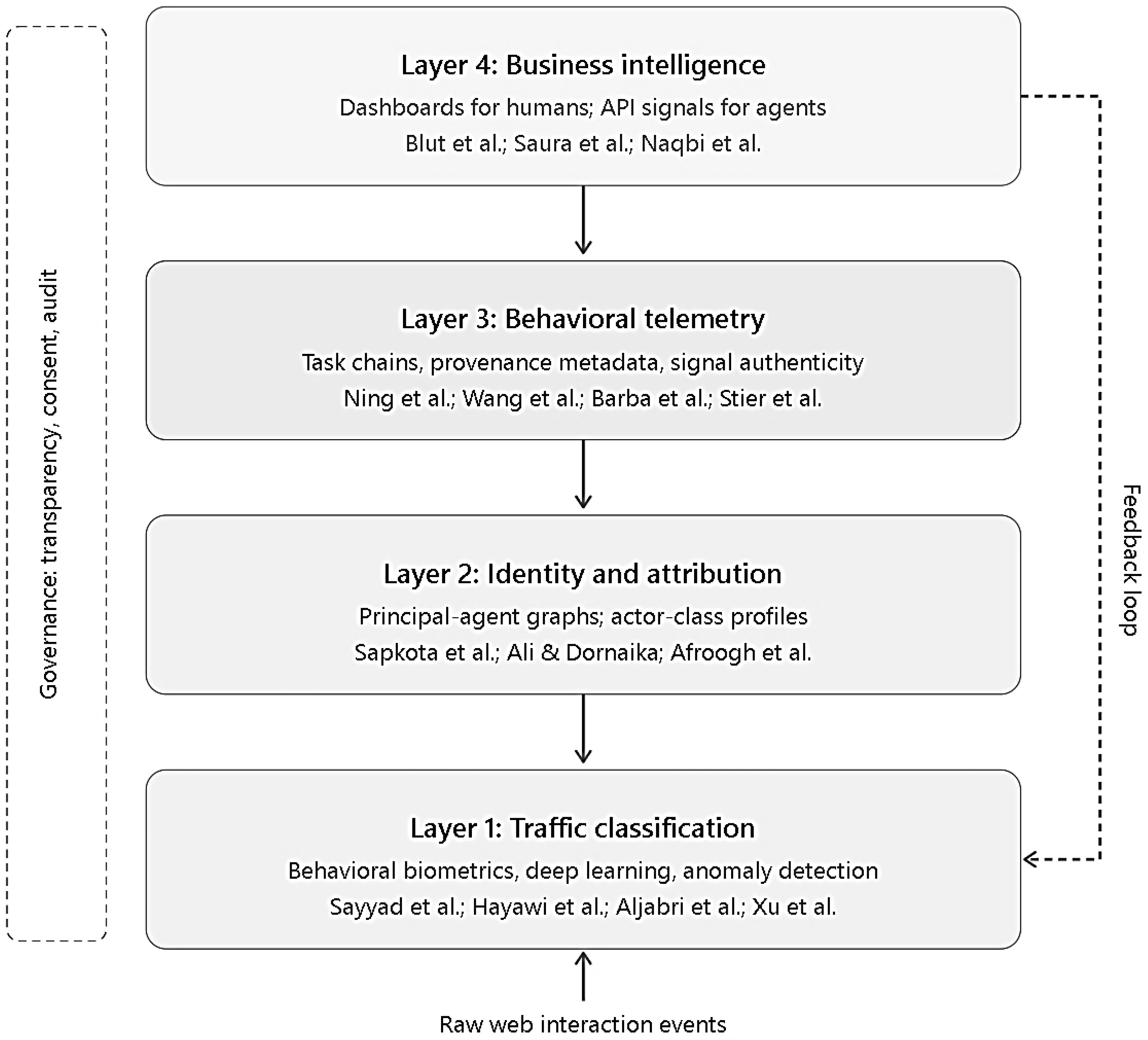
Figure 1 presents a proposed layered architecture that integrates the primitives, governance requirements, and detection methods discussed above. The architecture is layered in the sense that each layer transforms the output of the layer below, and information moves upward with progressively richer interpretive context.
Layer 1, traffic classification, takes raw interaction events from web pages and APIs as input and applies behavioral biometrics, deep learning, and anomaly detection to attach probabilistic actor-class labels to each event. Detection methods reviewed in
Section 3.5 operate at this layer. The unit of information moving upward is the classified event: a record annotated with its likely origin in human, agent, or hybrid activity rather than a bare timestamp and URL.
Layer 2, identity and attribution, maps classified events onto principal–agent graphs and actor-class profiles. Information moves upward as classified events tied to interpretable actor structures: who, or what, is plausibly acting, and on whose behalf. Where cooperating agents transmit provenance metadata, that metadata enters here.
Layer 3, behavioral telemetry, groups attributed events into task chains and computes signal-authenticity and objective-alignment scores. The interpretive status is now action-level rather than event-level, and the analyst can reason about whether a chain represents goal-aligned commerce, neutral information retrieval, or misaligned extraction.
Layer 4, business intelligence, aggregates task chains into the metrics that decision-makers consume. Information moves upward as decision-ready summaries with explicit confidence intervals reflecting the authenticity scores from below. The interpretive status is now suitable for action, but the action is taken with awareness of the underlying composition of human and agent activity.
Feedback loops connect Layer 4 back to Layer 1: agent behavior responds to analytics-derived signals (visibility on engagement-ranked surfaces, ad pricing on conversion-driven auctions), generating new traffic that re-enters the classification pipeline. Governance requirements (transparency, consent, audit, distributional equity) cross-cut all four layers. Provenance metadata declared by cooperating agents enters at Layer 2; audit logs are produced at every layer for compliance and reconstruction; consent and equity considerations shape which inferences are licensed at Layers 3 and 4.
In a production implementation, this layered architecture would replace the single-pipeline model (collect, attribute, report) that characterizes current analytics platforms. We do not present this architecture as a deployed system. We present it as a candidate design that future research and engineering can test, refine, or replace.
The four-layer stack (traffic classification; identity and attribution; behavioral telemetry; business intelligence) carries information upward with progressively richer interpretive context, while feedback loops from Layer 4 back to Layer 1 capture how agent behavior responds to analytics-derived signals. Governance requirements cross-cut all four layers.
10. Conclusions
This paper demonstrated that the conceptual architecture of conventional web analytics rests on three commitments (identity persistence, intentional intelligibility, behavioral-to-psychological inference) that were sound when human users dominated web traffic and that lose force as agent share increases. The reviewed evidence shows that automated traffic broadly is already a substantial fraction of online interactions, that the share of autonomous LLM-agent traffic specifically is rising on a clear trajectory even where its current magnitude is hard to enumerate directly, that detection has the structure of an arms race rather than a solvable classification problem, and that the inferential bridge connecting clicks to mental states does not extend to entities without mental states. We have also documented, through the cited literature, that the analytics field and the agent-evaluation field are building parallel measurement vocabularies for the same interactions without speaking to one another.
We inferred, reasoning from cited trajectories rather than original measurement, that filtering will not be enough. The most capable agents are designed to be indistinguishable from humans on every behavioral signal in current use, and the same advances in language modeling improve agents and their camouflage in the same step. A field that depends on isolating human signal from a stream that may soon be majority-agent in some contexts will have to reckon with the limits of separation as a strategy. We do not claim a generalized collapse of current analytics. We claim that the domain of validity is shrinking and that the rate of shrinkage is faster than the field has acknowledged.
This paper has proposed certain key programmatic ideas, too. The five primitives we sketch (task chain, actor class, interaction provenance, objective alignment, signal authenticity) are candidate constructs, not deployed systems. We have specified each in terms of inputs, unit of analysis, output, and inferential limits, so that future empirical work can test, refine, or replace them. The layered governance architecture we describe borrows machinery from regulated infrastructure sectors (sandboxes, accountability mapping, responsible design) and translates it into a less regulated commercial environment, with the limits of that transfer made explicit. We offer the architecture as a research and development agenda, not as a settled solution.
Other sectors, particularly energy systems governance, have begun developing the institutional and technical frameworks needed to manage AI-driven systems that operate at scales where human oversight cannot extend to every decision. Web analytics can borrow procedural ideas from their experience: from regulatory sandboxes that test governance models before deployment, from accountability frameworks that map automated decisions to responsible actors, and from responsible design practices that embed ethical considerations into algorithmic systems from the start. We have been careful not to claim that the regulatory or commercial settings transfer; the procedural mechanisms can travel even when the contexts cannot.
The vanishing user of this paper’s title is not a forecast about humans leaving the web. Humans will continue to use the web. But the user as the field’s organizing abstraction, the stable, intentional, psychologically legible subject whose behavior anchors every metric, is becoming a less reliable proxy for the entity that actually generates the data. The interesting question is no longer how to track that subject more precisely. The interesting question is what web measurement can mean in an environment where the subject is, increasingly, a configuration rather than a person, and where the answer will require new theories, new methods, and a measure of humility about the limits of measurement itself.