Systematic Review

Large Language Models in Intelligent Education Systems: New Educational Perspectives—A Systematic Review


by
Tatyana Ivanova
1,* and
Valentina Terzieva
2
1
Technical College of Sofia, Technical University of Sofia, 1756 Sofia, Bulgaria
2
Institute of Information and Communication Technologies, Bulgarian Academy of Sciences, 1113 Sofia, Bulgaria
*
Author to whom correspondence should be addressed.
Information 2026, 17(5), 433; https://doi.org/10.3390/info17050433
Submission received: 11 March 2026 / Revised: 24 April 2026 / Accepted: 28 April 2026 / Published: 1 May 2026
(This article belongs to the Special Issue Trends in Artificial Intelligence-Supported E-Learning)

Abstract

Large language models (LLMs) are an emerging artificial intelligence-driven technology, based on transformer architecture. LLMs are widely used in modern education, both by learners and tutors, as standalone tools or integrated into e-learning systems, where they can support personalization, adaptive learning, automated assessment and feedback, content generation, and intelligent tutoring. LLMs offer many benefits for learners, but they also have significant limitations. One approach to address the limitations of LLMs is to combine them with other intelligent technologies. The primary goal of this systematic survey is to identify appropriate supporting technologies, mechanisms of use, and methodological approaches able to help overcome the limitations of LLMs and support their responsible and effective use in education. For this reason, analysis and discussion of recent scientific research (published over the last four years) accessible through Google Scholar, ACM, IEEE Xplore, or indexed in Scopus or Web of Science (WoS) is performed. A bibliometric analysis of results from the initial general query strings is used to refine and formulate more specific search queries during the literature retrieval process in the selected databases. Full-text exploration of relevant search results serves as a source for critical analysis and deductions leading to the following conclusion: LLMs should be integrated into e-learning systems, combined with knowledge graphs, ontologies, learning analytics, and multimodal reasoning to enhance reliability, improve pedagogical effectiveness, and enable true personalization. New pedagogical approaches are also needed to ensure the effective use of LLMs in both tutoring and assessment contexts. Therefore, the authors propose methodological guidelines for integrating LLMs in complex modular educational systems.

1. Introduction

Generative Artificial Intelligence (GenAI) technologies have been increasingly used in education during the last few years. GenAI is a technology that can create new content, including text, images, or software code, in response to natural-language prompts. It produces original content by learning patterns from large datasets. GenAI’s capabilities stem from the application of machine learning algorithms that analyze statistical distributions of words or pixels to identify common patterns, such as concepts and word associations. GenAI models are trained on large datasets collected from webpages, social media conversations, online media, and other specialized sources. These intelligent technologies rely on artificial neural network (ANN) algorithms to continuously improve their performance through data-driven learning. GenAI class includes large language models (LLMs), multimodal LLMs (MLLMs), and some other generative systems for complex media generation. LLMs, such as GPT-based systems, have been widely used over the past three to four years for generating textual content and understanding contextual information [1,2,3]. LLMs can provide advanced linguistic features based on statistical patterns learned from large-scale text corpora and integration of various technologies such as pre-training, deep learning, reinforcement learning, and fine-tuning. They can be divided into general-purpose LLMs (e.g., GPT, Claude, and Gemini) and specialized ones in specific domains and purposes (e.g., BioGPT for biomedical research, Med-PaLM for medical questions, Code Llama for code generation). General-purpose LLMs are very useful in education because of their excellent interdisciplinary capabilities. They are trained on a vast amount of data, which is a significant advantage for knowledge integration. LLMs can provide authentic conversational teaching in various scenarios, simulate a teacher’s role, and ask questions to encourage critical thinking. The applications of LLMs in education are very broad. They are useful both as individual learning tools and as part of intelligent tutoring systems where they can support personalized learning, automated feedback, curriculum generation, or adaptive instructional assistance. The ability of LLMs to generate coherent and contextually relevant responses makes them valuable tools in educational environments. Moreover, these systems can adapt to individual learning styles by providing tailored content that addresses the specific needs of each student. Unfortunately, the personalization capabilities of LLMs are limited. They adjust responses using minimal, short-term user context (such as preferences or location) without building detailed long-term profiles, ensuring privacy, fairness, and consistent behavior across users.
Despite many advantages of LLMs, their educational applications raise several concerns about the reliability and quality of the content they produce. In some cases, LLMs may give factually incorrect, misleading, or biased outputs. Such inaccuracies can have serious effects on the educational process, hampering students’ understanding and reinforcing misconceptions, or introducing unintended bias into learning materials. The integration of LLMs in the educational context is a very hot research area; however, it poses several pedagogical issues, including hindering students’ problem-solving, reasoning, and critical thinking skills. Therefore, despite LLMs’ significant capabilities in text processing and knowledge management, they must be carefully deployed with thorough evaluation for accuracy, transparency, and accountability [4]. Also, tutors should strictly supervise their use in accordance with educational goals. Many research papers and surveys on this topic have been published recently [1,2,3,5]. Most comprehensive and good surveys of LLM use in education focus only on narrowly defined contexts. Examples include a comprehensive survey focused on the transparency and explainability of LLM-based applications in educational systems [4], a systematic review [5] focused on advances in applying LLM agents in educational settings, and a survey of specific types of LLMs, such as MLLMs [6]. The authors of [7,8] claim to present comprehensive, up-to-date surveys of LLMs across a broad range of educational applications, along with a thorough technological analysis. However, they do not consider all the complementary AI technologies increasingly integrated with LLM-powered systems in education, such as ontologies, knowledge graphs (KG), rules, machine learning (ML) techniques, and learning analytics (LA).
The proposed systematic survey addresses this research gap. The main research hypothesis is that the full potential of LLMs in personalized educational systems can be realized only in combination with symbolic and machine-learning-based AI technologies. To prove it, the authors examine the usage of LLMs in e-learning, with particular attention to their integration with other intelligent educational technologies. Thus, the main goal is to explore ways to integrate LLMs with other intelligent technologies to compensate for their shortcomings in educational contexts. By analyzing the combined use of LLMs and other intelligent technologies, this survey aims to highlight how such an approach can mitigate limitations and enhance the overall effectiveness of these technologies in the educational context. As LLMs are large-scale deep learning models that extend traditional deep learning approaches, the deep learning algorithms (DLA) are directly related to LLMs. Discussing the direct use of DLA is not the primary goal of the current survey. Yet, it is a very interesting area that also deserves discussion, especially the use of deep learning algorithms in student achievement evaluation. DLAs are also among the additional intelligent techniques that should be integrated into LLM-powered educational environments to increase their effectiveness.
Without a doubt, all participants in the educational process can benefit greatly from LLMs, although LLMs can sometimes generate misleading or inaccurate content. The correctness of the outputs depends on multiple factors, including the chosen model, the natural language used in the prompt, the prompt adequacy, and the specific domain of application. Relying solely on educators and institutions to check and verify the results of these systems is not a sufficient solution to this challenge.
In this survey, the primary goal is to identify appropriate technologies and methodological approaches that can support the responsible and effective use of LLMs and maximize their effectiveness and learning outcomes in e-learning environments. Our research questions are:
RQ1. In what tasks are LLMs used in education, and what are the predominant mechanisms of their use?
RQ2: What are the major limitations associated with using LLMs in e-learning, and which complementary AI-driven approaches can be integrated with LLMs to address and overcome these challenges?
RQ3: Which knowledge representation and modeling technologies should be integrated with LLMs in education systems to ensure high-quality education and enable personalization? Outline trends in these integrations (taxonomy/classification)
RQ4: What are the roles of large language models applied in intelligent educational systems to support high-quality educational processes, and knowledge and educational content development? (cognitive, metacognitive, and affective aspects of learning)
RQ5: What pedagogical, technical, ethical, and methodological challenges and perspectives emerge from the integration of large language models into intelligent education?
RQ5a: What pedagogical and methodological challenges are associated with the use of large language models in educational contexts?
RQ5b: What technical challenges and opportunities accompany the implementation of large language models in support of emerging educational perspectives?
RQ5c: What ethical and data privacy considerations must be addressed when deploying large language models in intelligent educational environments?
This study is organized as follows: Section 2, titled “Materials and Methods,” describes the research methodology, as well as the methods and tools used. Section 3 presents the results, Section 4 provides the discussion, and Section 5 provides conclusions from the research findings.

2. Materials and Methods

2.1. Research Methods and Tools

In the current research, search engines and academic databases, such as Google Scholar, Scopus, ACM, IEEE Xplore, and Web of Science, are used to identify and collect relevant research papers. Also, the bibliometric analysis tool VOSviewer 1.6.20, academic databases analytical tools, and Microsoft Excel spreadsheets are employed to analyze and visualize the collected data.

2.2. Research Methodology

This survey follows a PRISMA checklist [9]. The searching, selection, evaluation, inclusion, and exclusion of articles occurred as follows:
Initial search queries, including keywords such as LLM and large language models, combined with e-learning and education were sent to Scopus scientific database.
  • Returned results are exported in CSV format, and initial preprocessing is performed in Excel spreadsheets;
  • A bibliometric analysis of selected records using VOSViewer was performed; concepts related to other technologies usable in combination with LLMs in education were selected, including knowledge graphs, ontologies, machine learning, deep learning, and personalized learning;
  • Based on the related terms, queries were sent to scientific databases Scopus, WoS, ACM, IEEE Xplore, and Google Scholar, and the returned records were analyzed;
  • The authors define gradual relevance criteria weakly relevant, moderately relevant, relevant, and strongly relevant as follows:
    • The result is weakly relevant when the discussed technology is mentioned (possibly without substantive analysis) somewhere in the source. All the returned records from Google Scholar or ACM that contain research terms in the title or snippets are weakly relevant;
    • The result is moderately relevant if the discussed technology is mentioned and some of the terms are discussed (possibly to a limited extent);
    • The result is relevant if the discussed technology is explored and used (possibly without evaluation). Full-text browsing is applied to check the relevance criteria;
    • The result is strongly relevant if the discussed technology is explored, used in practice, and successfully evaluated. Full-text browsing is applied to check the relevance criteria.
  • Applying weak relevance criteria, the authors selected Google Scholar and ACM records, analyzed them in Microsoft Excel spreadsheets, and visualized trends in the use of LLMs combined with other intelligent technologies in education.
  • Applying strong relevance criteria, the authors selected scientific research papers and surveys for a comprehensive analysis of the use of LLMs in combination with other intelligent technologies in e-learning.
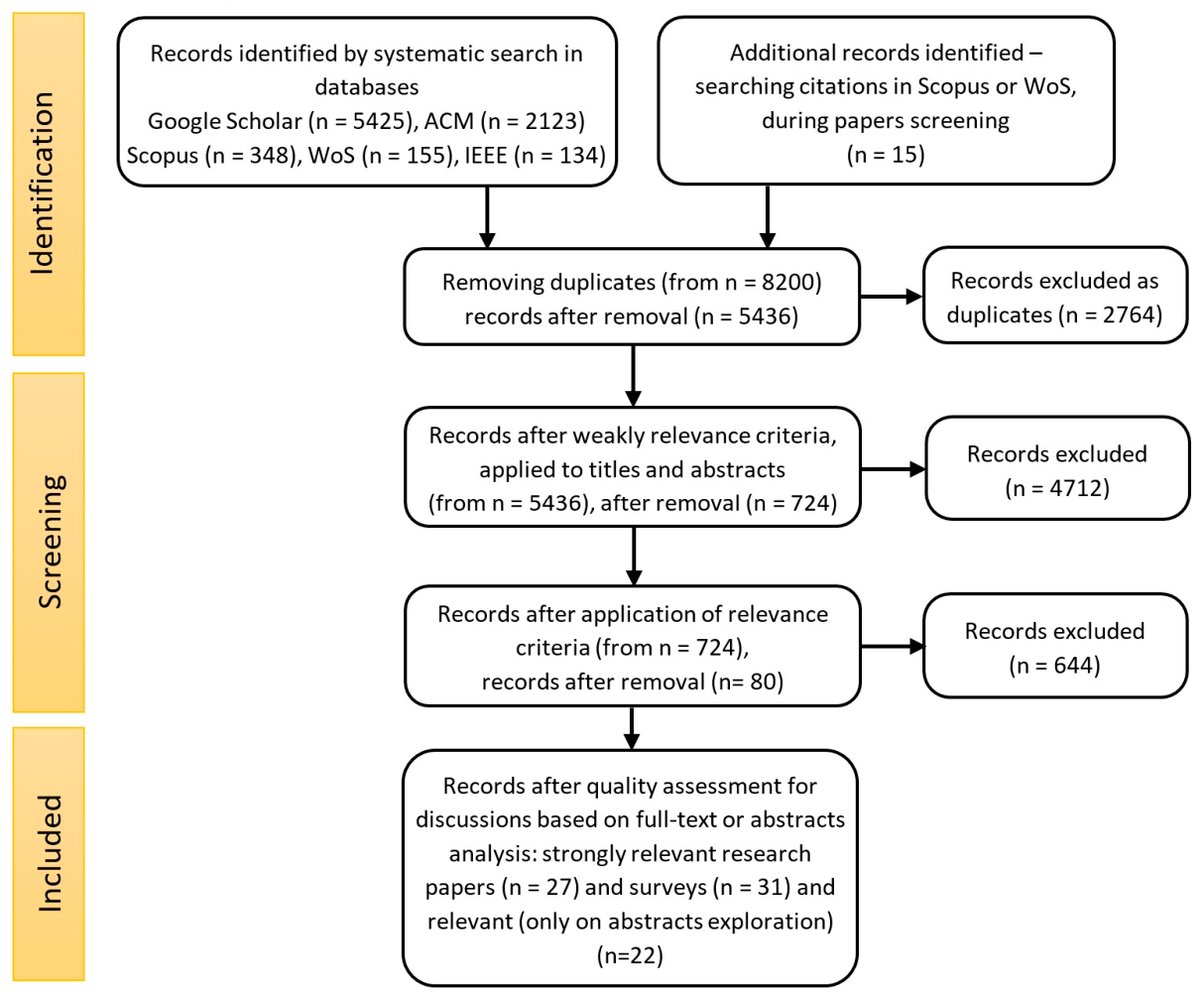
This study focuses on the 2022–2025 period, as LLM-based methods and tools have been increasingly used in educational settings during this time. Table 1 presents the inclusion and exclusion criteria applied in the current survey. A result is considered weakly relevant if it is a scholarly publication in English, belongs to categories such as papers, abstracts, short papers, or surveys, and meets the weak relevance criteria defined above. The PRISMA-compliant data retrieval, screening, and cleaning processes, following the PRISMA checklist, are shown in Figure 1.
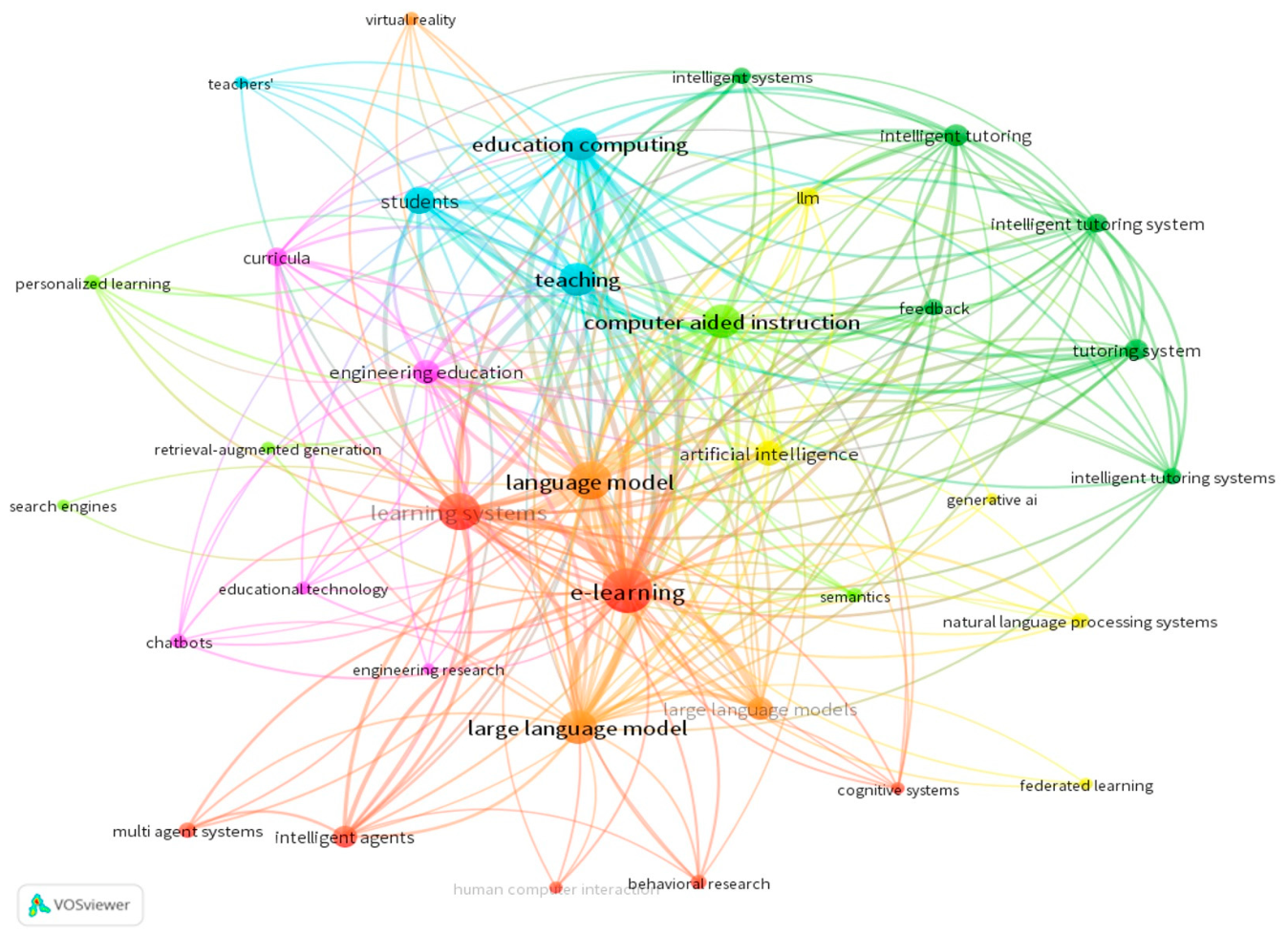
The authors begin with queries “Intelligent and e-learning and LLM” and “Intelligent and e-learning and LLM”. Following this, additional search queries were formulated based on the bibliometric analysis of Scopus records (see Figure 2 and Figure 3), the examination of returned highly cited surveys and their citing publications, and the researcher’s domain expertise in intelligent personalized e-learning.
Starting from a general research question, 8 queries were sent to Scopus, Web of Science (WoS), ACM, IEEE Xplore and Google Scholar: Intelligent and e-learning and LLM; e-learning and LLM; e-learning and LLM and ontology; e-learning and LLM and KG; e-learning and LLM and machine learning; e-learning and LLM and Learning analytics; Personalized learning and LLM; education and LLM and ontology; education and LLM and KG.
The strategy applied was as follows: one of the authors performed the extraction and verification, the other one performed the extraction and then the results were merged and discussed. Semi-automatic data extraction was achieved using word searches, Excel spreadsheets, data analysis capabilities of scientific databases, database export and structured import, and the bibliographic tool VOSviewer.
The authors believe that scientific interest is not limited to reputable (highly ranked) papers. It encompasses the relevance of a research problem, the identification of gaps in existing knowledge, and the exploration of emerging or underexplored areas. It is shaped by the full range of related research, not solely by peer-reviewed publications. Therefore, in this review, relatively broad relevance criteria are applied to select sources to outline scientific interest. In this regard, Google Scholar is considered to be the most suitable search engine for exploring trends in scientific interest, as it serves as a general-purpose scholarly search platform. Additionally, the ACM database is used to evaluate trends in scientifically recognized research within the specific field explored.
The total number of returned records from the three databases was 8200. As Google Scholar returns almost all records produced by other searching tools, there is a significant number of duplicates. By eliminating 2764 duplicates, the number of records dropped to 5436. After applying weak relevance criteria on titles and abstracts (or snippets in Google Scholar), the number of records dropped to 724. Language, publication year, and journal and conference filters were applied where applicable. The authors performed manual full-text screening and selected 80 relevant papers. After full-text exploration and analysis of relevant papers, the first author selects as strongly relevant 27 research papers and 31 surveys for a comprehensive discussion. Then, the second author also performed the full-text reading of all the relevant papers and categorized them as “reviews”, “research papers presenting systems, models, and applications”, and “books or other research papers”.
Data collection was conducted in two stages. The first stage took place from 3 January 2026 to 10 March 2026, and the second stage was from 30 March 2026 to 14 April 2026. Weak relevance criteria were applied in the initial stage, and the weakly relevant results were used to outline general trends in scientific interest. Subsequently, the relevance criteria were applied, resulting in the selection of 80 cited studies. Finally, strong relevance criteria were applied (see Table 1). Strongly relevant research papers presenting hybrid architectures are analyzed in Section 3.4.4, while strongly relevant survey papers are summarized in Section 4.6.
Weakly relevant papers returned by Google Scholar and ACM as results of the queries “learning analytics” + e-learning; “Large language model”; “knowledge graph” + e-learning; “Large language model” + ontology + e-learning; “Large language model” + ML + e-learning were used for outlining trends in the combined usage of AI-driven technologies.
The network visualization of the VOSviewer map representing the results for the query “Intelligent and e-learning and LLM” (Figure 2) allows making basic, preliminary conclusions. Generative AI, LLMs, chatbots, and tutoring systems are in a single small cluster. KGs, semantics, and RAG (Retrieval-Augmented Generation)are in another small cluster. Therefore, these terms are closely related but relatively limited in size or influence compared to other terms associated with the educational systems. These entities have not yet been sufficiently studied.
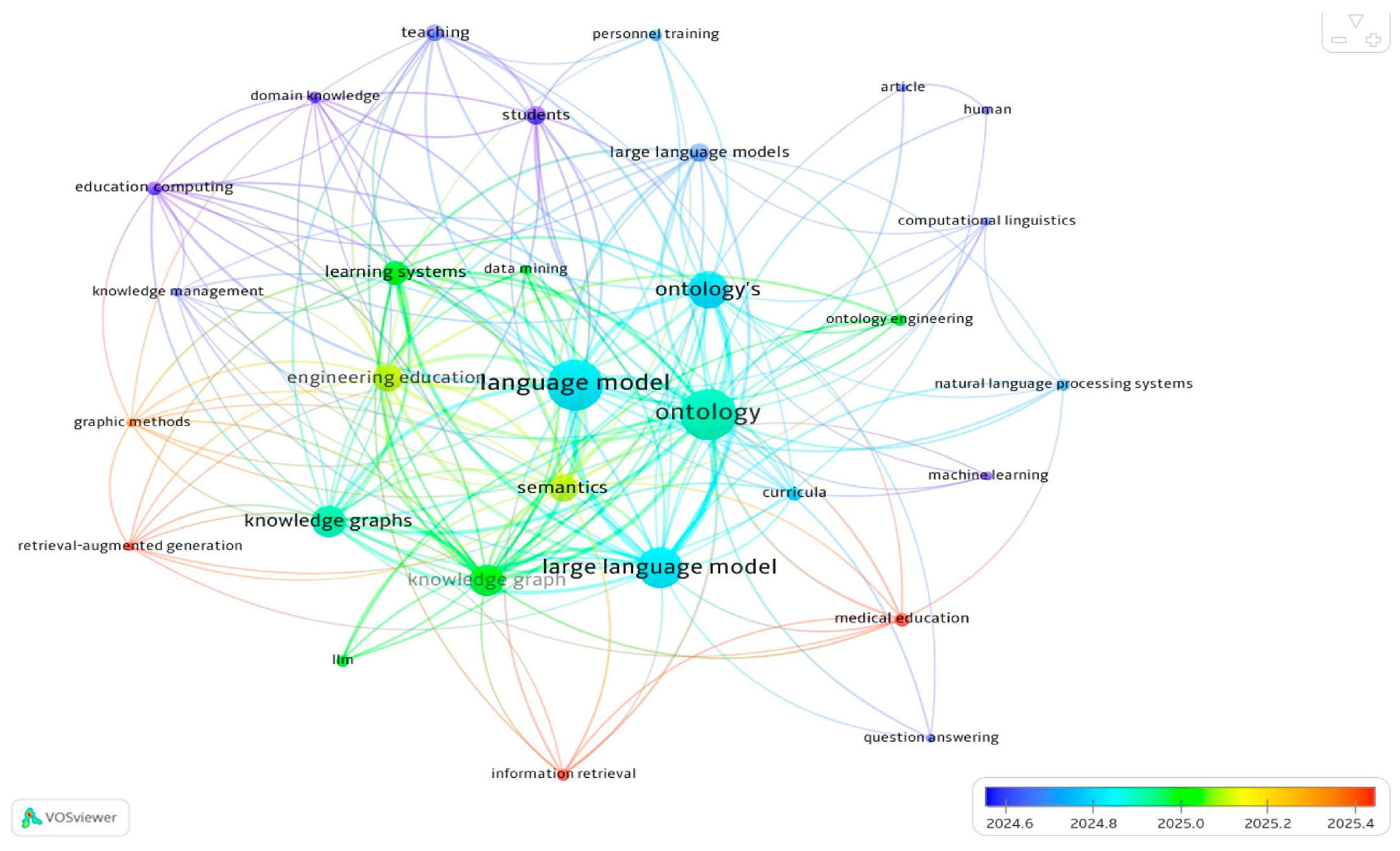
The overlay visualization of the map on the query “education and LLM and ontology” shows the emerging related concepts (small but linked nodes): federated learning, prompt engineering, ontology engineering, machine learning, chatbots, intelligent agents, and RAG. Ontologies, KGs, and LLMs are also included in these relations, but are bigger in size (more explored). Also, RAG, medical computing, and graph methods are emerging as new research areas. All these remarks help formulate search queries and act as guidelines in the current research.
The authors’ hypothesis on the expected importance of the combination of LLMs, symbolic AI technologies, machine learning, and statistical AI for improving e-learning is partially based on the performed bibliometric analysis of selected query results. Bibliometric maps demonstrate tight relationships in recent research between symbolic AI (presented by terms such as semantics and knowledge graphs and ontologies), deep learning, generative AI, presented by LLMs, agents, multi-agent systems, and intelligent education, represented by terms such as reinforcement learning, engineering education, intelligent tutoring, and personalized learning. These relationships are both the starting point and the guidelines for our future literature analysis.
During full reading, the authors pay special attention to possibilities for technology integration to overcome each other’s drawbacks or limitations.

3. Results

The influence of LLMs on education can be observed across teaching, learning, assessment, educational resource development, and institutional processes. According to [2], there are ten areas or tasks in education, where impacts of LLMs are observable (RQ1):
  • Personalized learning support. LLMs can be used as personalized tutors that propose services such as answering questions interactively, adjusting difficulty level, explaining concepts or relationships interactively, step-by-step, or providing alternative explanations [10,11]. LLMs can adjust explanations for beginner, intermediate, or advanced students;
  • Assessment and personalized feedback [12,13,14,15]. LLMs can assist in automated grading of short answers, rubric-based evaluation, adaptive feedback generation, and formative assessment support. At the same time, the widespread availability of LLMs introduces serious new assessment challenges related to the possibilities of assessing actual student knowledge and understanding;
  • Wide accessibility of subject knowledge [16]. LLMs are trained on large, diverse corpora and can provide actual information in almost all subject areas. Students can ask various follow-up questions, request deeper dives into subtopics, or explore related concepts instantly. LLMs are widely accessible but sometimes produce plausible, but inconsistent or incorrect responses;
  • Interdisciplinary learning [17]. LLMs can connect concepts across disciplines according to the interests or knowledge levels of students. But the correctness of LLM-generated responses is not guaranteed and varies significantly depending on the domain, the language of interaction, and the specific prompts used;
  • Thinking under time constraints and real-time problem solving [18,19]. LLMs can demonstrate how to break complex problems into manageable steps, explain reasoning clearly, show alternative solution methods, and help identify misconceptions. Instant suggestions for improvement or identification of common errors can also be very useful for real-time problem-solving. Still, sometimes they are not aligned with pedagogical goals or cannot lead to the best solutions;
  • Learning across time and space, student writing support [16]. In integration with Grammarly, Microsoft Copilot, or through interactive prompting, LLMs can help students with grammar correction, paraphrasing, brainstorming ideas, structure suggestions for specific writing works, etc.;
  • Provision of additional learning resources and tools [20,21,22]. LLMs can provide adequate recommendation readings, practice tasks, supplementary explanations, revision strategies, etc. Recommendations can be personalized based on learner needs, but sometimes this personalization is shallow, because it is not supported by sufficient knowledge of learners’ profiles;
  • Promotion of critical thinking [23]. Educators should encourage their students to use LLMs as cognitive helpers. Students can ask the model to identify reasoning gaps, critique their proposals, provide counterarguments, recognize uncertainties, or assess confidence in answers;
  • In professional content development for educators. LLMs can generate initial versions of quizzes, reading summaries, lesson plans, case studies, homework questions, or help tutors actualize educational content [24,25]. Both MagicSchool AI and ChatGPT are very useful tools for teachers. LLMs are also useful for structured knowledge generation (e.g., automating ontology development and maintenance [26,27,28]). Curriculum LLMs can also help in aligning lessons with standards, suggesting complementary topics, designing comprehensive syllabi;
  • Accessibility and inclusivity in education [8,29]. LLMs can be used for automated text simplification (e.g., to make text easier to read for people with dyslexia), translation of educational content in a preferred language, generation of alternative explanations, or delivery of multimodal content. Despite their growing adoption, LLMs remain underexplored in accessibility contexts, and the quality of text translation depends heavily on the target languages and, in some cases, on the educational domain and contextual factors.
Notwithstanding, LLMs are very useful in educational domain both for learners and educators, and in almost all educational and resource development tasks. LLMs are useful because of their built-in capabilities, but according to various research, these capabilities are not sufficient to guarantee the required high level of performance for educational tasks [4,30,31,32]. LMMs can be used in education indirectly through AI-powered tools or directly via educational environments (RQ1). The authors will further discuss these two main strategies for LLM use and the possibilities for controlling the quality of LLM-powered education.

3.1. Usage of LLMs and LLM-Powered Tools in Education

Educational chatbots, AI-based teaching assistants, writing assistants, coding and STEM assistants, and AI content creation tools for educators are frequently used LLM-powered intelligent educational tools.
Since chatbots are software programs developed to simulate conversation with users, they can respond to user questions. They are good for simple tasks such as question answering or basic guidance. There are two main types of chatbots: administrative and academic. Administrative bots answer course logistics questions, provide deadlines and policy explanations, and guide onboarding. Academic support bots provide subject-specific question-answering, exam revision, programming help, etc. Most LLM-based chatbots or assistants use general-purpose LLMs such as ChatGPT. VizChat [33], for example, is a chatbot that offers on-demand explanations that aim to improve user comprehension.
Intelligent AI-powered assistants and educational agents are more sophisticated tools, capable of ensuring some level of flexibility and personalization. LLM-based agents in education are AI systems built around large language models that can reason, plan, and take actions to support teaching and learning goals. Unlike a basic chatbot that only answers questions, an educational agent can diagnose what the student already knows, detect knowledge gaps, and track a student’s progress. Some sophisticated agents are multifunctional—they can adapt content difficulty, adjust explanation level, generate practice problems, update learning plan, break problems into steps, recommend learning paths, or switch teaching styles (visual, examples, analogies). An intelligent programming assistant, ProgMate [34], leverages LLMs to monitor the learning process, participate in intelligent assignment grading, identify knowledge gaps, and assess students’ learning abilities. It supports the integration of collaborative teaching and personalized guidance, promotes continuous learning, and enables effective utilization of learning resources. Another example of an LLM-powered assistant in the field of computer programming is KOGI [35]. It integrates runtime data from the Jupyter programming environment into the prompts before sending them to LLM. The programming assistant CodeTailor [36] can check the code, and if it is incorrect, generate a personalized, corrected solution similar to what was submitted by the student and creates an interactive puzzle for students to learn from their mistakes. The tool Iris [37], specialized in the computer science area, first checks the student’s query relevance, retrieves relevant exercise context and the student’s code with the build log from the Artemis learning management system, generates feedback, and finally self-reviews the response to ensure it follows the guidelines. The LLM-based assistant in the databases area MoodleBot [38], integrated in the Moodle learning management system, uses RAG to provide course-specific assistance to students. Quizizz AI [39] is an AI-powered assistant built into the Quizizz educational platform that helps teachers create and improve quizzes, lessons, and assessments faster and smarter.
Tools that use LLMs are usually developed for specific tutoring domains and employ popular LLM techniques. Simple LLM-based tools can generate texts, images, or code in response to formulated prompts. More complex tools, implementing intelligent agent-based architectures or operating in multi-agent environments can autonomously decide when and how to react to external information, or how to interpret contextual information and follow goal-directed dialogue strategy. Intelligent agents can remember previous interactions and work toward a predefined goal over multiple steps. They can also use tools (APIs, calculators, databases, browsers), built-in knowledge and decide what to do next.
Important LLM-related techniques used in LLM-based educational tools that ensure high-quality responses were discussed in [40]: prompt engineering, multi-stage pipeline, prompt chaining, RAG, few-shot prompting, fine-tuning, and fact-checker or validator technique. Contextual educational information about difficulty level, pedagogical approaches, learning styles, feedback depth, etc., can be delivered to LLMs through adequate prompt engineering. Prompts with more contextual information are more likely to produce meaningful output. RAG provide a combination of knowledge from institutional materials, textbooks, lecture notes, etc., to improve factual accuracy and curriculum alignment. Ensuring few-shot prompting or adding a fact-checker/validator step usually requires integrating an LLM into a larger software system rather than relying on a single prompt. Such approaches are typically implemented as LLM-powered pipelines. Therefore, the full potential of LLM-powered educational tools, including chatbots, can be realized only when they are integrated into complex software systems, such as knowledge-based IES or multi-agent systems.

3.2. General Purpose vs. Specialized LLMs in Educational Systems

Much research argues that general purpose LLMs (e.g., GPT-type models) exhibit several shortcomings when applied directly to education [41]. The main limitations include a lack of pedagogical alignment, reduced cognitive engagement, insufficient learner modeling, some risk of hallucinations, limited explainability, and potential inaccuracies, particularly in certain specialized tutoring domains. Domain-adapted, language-adapted, or education-specific LLMs have been developed to overcome some of these limitations.
Some examples of language-adapted LLMs are fourteen Chinese educational large language models (Ce-LLMs) discussed in [41]. Ce-LLMs are university products and were classified into three categories: teaching assistance, language learning, and subject education. Some of them specialize in writing, essay correction, personalized tutoring, or homework tutoring in domains such as mathematics, programming, or language learning.
Adapting general large language models for education is an important approach to making them effective and relevant within specific educational contexts. Fine-tuning is a method that can be applied on general purpose LLMs to customize them for particular educational purposes tasks. Instruction fine-tuning is a specific variant of fine-tuning that uses natural language instructions to direct the LLM towards the desired results. Instruction fine-tuning is frequently used to adapt LLMs to educational domain [42].
The iFLYTEK Spark [19] is a Chinese LLM, and its accuracy, as tested on questions from the Nursing Professional Qualification Exam, appears to be very insufficient (about 50%). It has specific capabilities in multimodal interaction, coding, text generation, solving math problems, and general question answering, but its quality highly depends on the language used. Chinese and English are the primary training and optimization languages, so iFLYTEK Spark’s accuracy when used with other languages is insufficient for educational purposes.
MathGPT [43] is an LLM, specialized in math problem-solving and lecturing. Its primary application scenario is to answer specific questions from students. The MoE approach, proposed in [42], uses specialized LLMs under the direction of a central controller for various subjects.
Table 2 presents the results of a comparison of general purpose and specialized LLMs in educational systems based on their short review.
In e-learning systems, the choice between adapting general LLMs and applying techniques such as RAG, few-shot prompting, or adding a fact-checker/validator strongly depends on the usage context. Therefore, an effective intelligent educational system should incorporate a combination of these techniques.

3.3. Limitations of LLMs in Education and AI-Driven Solutions to Overcome Them

As a result of the comprehensive literature analysis the authors found several important limitations of LLMs in educational contexts, as follows (RQ2):
  • Possibility of inaccurate information (hallucinations) [6];
  • Lack of educational domain adequacy (may not align with curricula, course materials, or institutional standards) [3,8];
  • Insufficient pedagogical awareness and relevance [3];
  • Limited personalization (because of the absence of learner modeling, it is impossible to track individual learners’ knowledge, progress, or misconceptions over time) [44];
  • Poor explainability and transparency—reasoning behind answers is often opaque, reducing trustworthiness [4];
  • Bias and ethical risks (may reproduce harmful or culturally insensitive biases from training data) [45];
  • Static knowledge (LLMs cannot automatically incorporate new research or updated learning materials);
  • Inconsistent quality/reliability (output quality can vary across prompts and topics) [46];
  • Limited multimodal understanding (struggles with images, diagrams, or interactive content without extensions).
The use of symbolic AI-based tools and approaches, including knowledge graphs, ontologies, and RAGs, can reduce the spread of inaccurate information. Grounding answers in verified, structured knowledge and retrieving up-to-date information can help reduce hallucinations.
The appropriate use of knowledge graphs, domain ontologies, and curriculum-aligned knowledge databases can mitigate bias and enhance domain grounding in LLMs. Such resources can help ensure that LLM responses are consistent with course content, learning objectives, and institutional standards. Thus, they can provide learners with more accurate and contextually relevant information.
Pedagogical awareness can be increased by using pedagogical rules. Such an approach is applied in Intelligent Tutoring Systems (ITS) [1]. Implementing instructional strategies like scaffolding, hints, formative assessment, and adaptive guidance. Better personalization, explainability, and transparency can also be achieved through the application of symbolic AI technologies such as ontologies and KGs.
Despite the recent advances in multimodal AI systems, LLMs remain limited in their ability to accurately interpret and reason over diagrams, symbolic visual representations, and interactive educational environments. This constraint reduces their reliability in some educational areas, such as technical, mathematical, or STEM education, and emphasizes the continued need for human oversight in multimodal learning contexts. Multimodal large language models (MLLMs) have also been developed recently. They extend traditional text-based LLMs by processing and generating multiple data modalities—such as text, images, audio, and sometimes video—within a unified framework. In educational contexts, MLLMs have growing significance because learning materials are inherently multimodal [47].
Transparency is an essential property in education, referring to the extent to which learners or teachers can understand how a system operates and makes decisions. Transparency is a crucial fundamental aspect of building trust between users and AI-based systems. Learners and tutors need to understand how LLMs arrive at their conclusions to integrate these tools effectively into their teaching and learning. Students should be able to comprehend the rationale behind the feedback from an AI-driven tutor. Explainability of a system is its ability to provide understandable justifications. It serves not only as a source of knowledge; it also promotes motivation. Students should not only know what to improve but also why improvements are necessary. This will foster a deeper learning experience and engagement. The explainability and transparency in educational systems using LLMs are insufficient and can be increased by creating user-friendly interfaces or by providing comprehensive training and suitable resources [4]. Recommendations for improving transparency and explainability in LLM-based educational tools to ensure the necessary trust and effective use in learning environments are proposed in [4].
Addressing bias and ethical risks in the use of LLMs in education requires a combination of technical safeguards, institutional policies, and pedagogical practices. Technical mitigation strategies include teacher evaluation, grounding responses in curriculum-aligned sources, maintaining transparent source documentation when possible, and ensuring teacher review for high-stakes outputs (grading, feedback, instructional materials).
Pedagogical strategies can involve instructing students on the mechanisms of LLMs’ work, their limitations and bias risks; encouraging critical evaluation of AI-generated responses; and using AI responses as material for bias analysis exercises. Developing institutional AI ethical guidelines aligned with fairness, accountability, transparency, and privacy principles, and defining boundaries for acceptable AI use in assessment and feedback, are essential institutional policies for integrating LLMs in education. Overcoming the limitations of static LLMs’ knowledge, inconsistent response quality, and limited multimodal understanding in LLMs requires combining them with complementary AI architectures and system-level design strategies. These will be thoroughly discussed later.
LLMs can be used directly for peripheral tasks around tutoring systems (e.g., content generation) or can be actually integrated into tutoring logic, feedback loops, adaptivity, or learner interaction [32]. As LLMs deliver context-dependent answers, the educational context should be precisely integrated into prompts. LLM-powered educational tools can support personalized and adaptive learning by providing individualized explanations of complex concepts and personalized feedback, such as adaptive hints, learning paths, or specific additional resource recommendations. ChatGPT, for example, has built-in personalization capabilities and can facilitate personalized or interactive learning, improve assessment, and create ongoing feedback [3]. Personalization relies on the collection, modeling, storage, and management of information or knowledge about learners and educational resources. This requires explicit representation of educational context metadata using knowledge modeling technologies. Therefore, the full potential of LLM-powered educational tools can be realized only when educational environments support them with well-structured, up-to-date knowledge about learners. Thus, knowledge representation and modeling technologies are needed to support the effective usage of LLMs in ITS.

3.4. Combined Use of LLMs with Knowledge Representation and Modeling Technologies

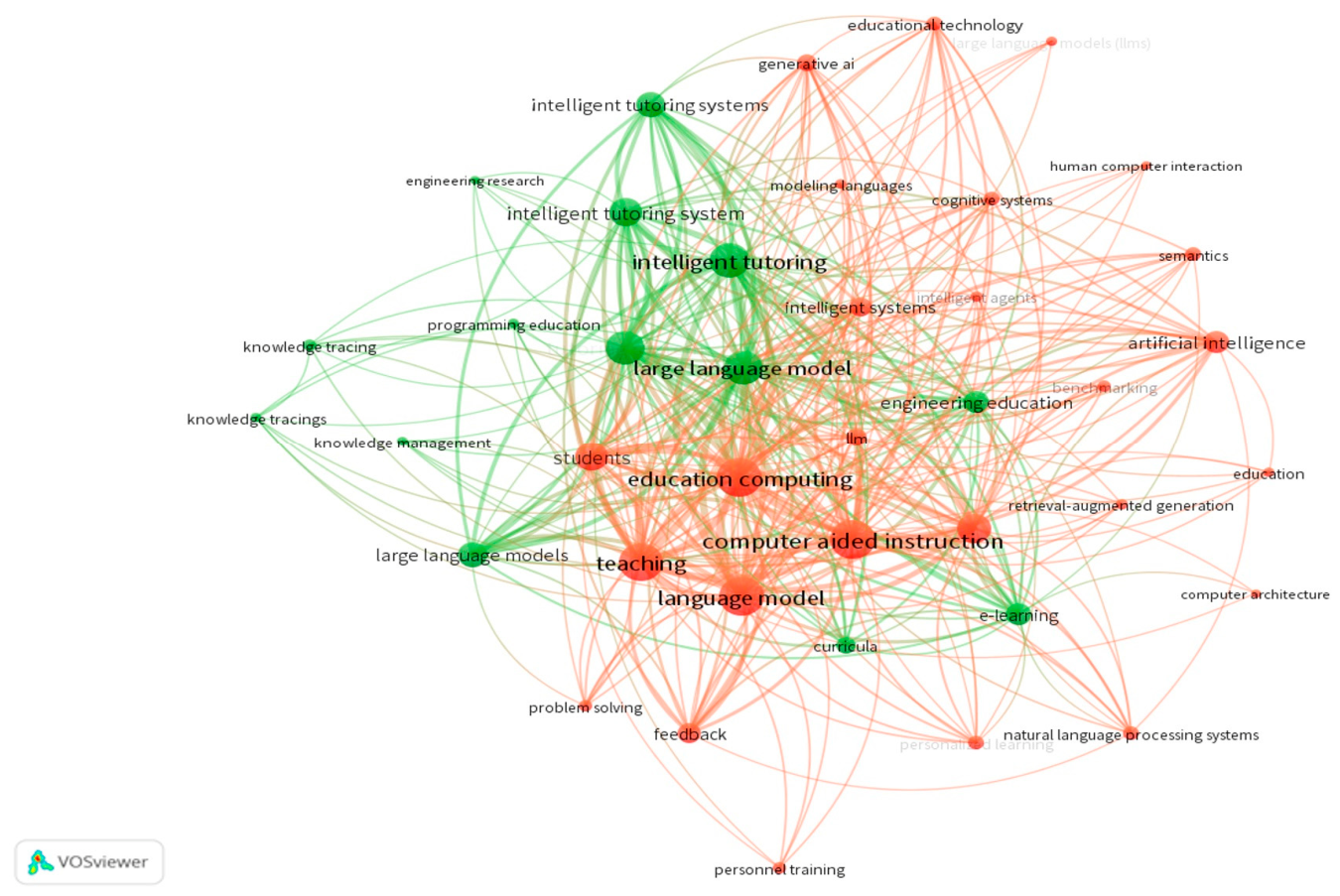
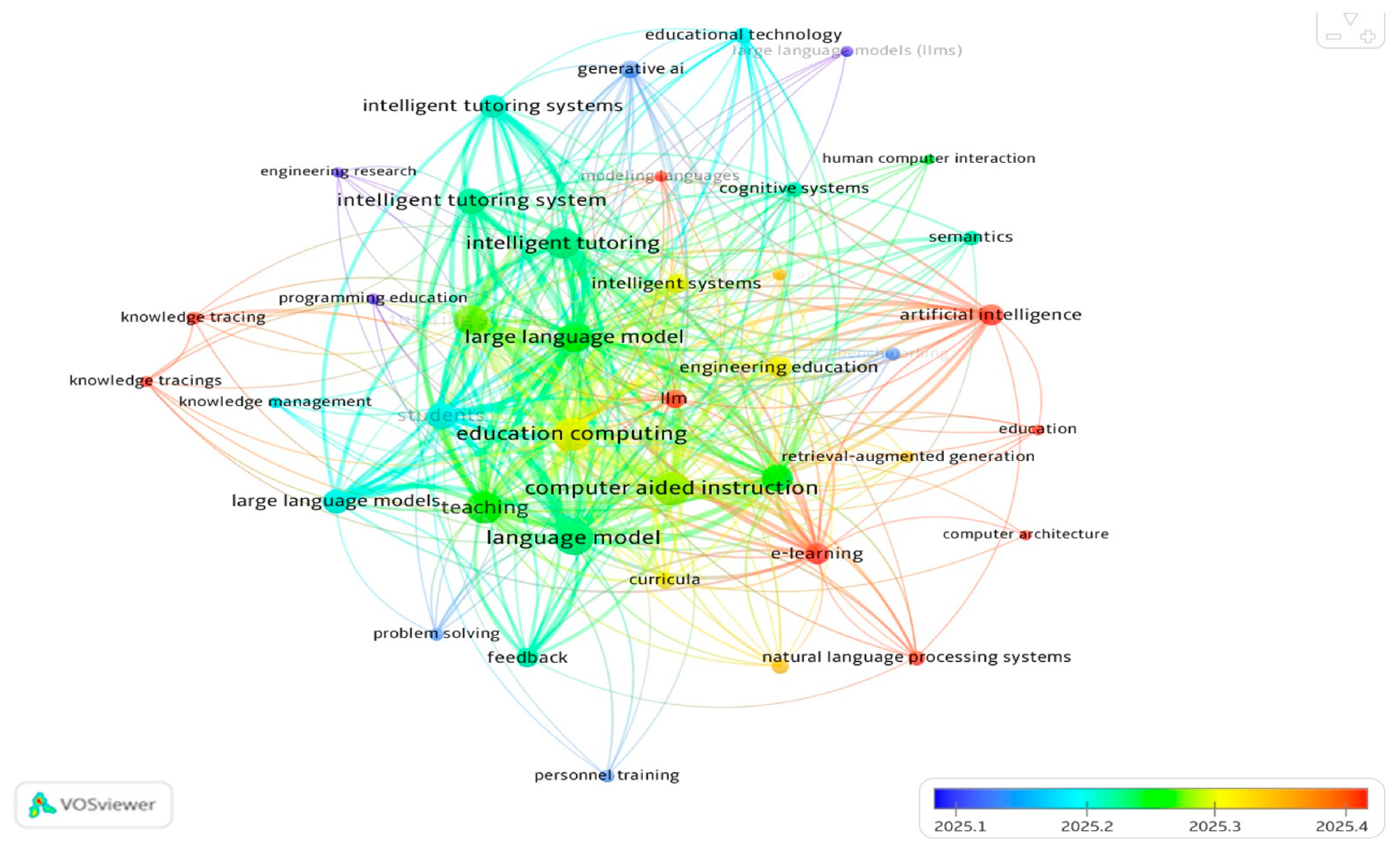
To manage and analyze results returned from the query “Intelligent Tutoring” and LLM, sent to Scopus, the bibliometric tool VOSviewer is used (see Figure 4).
The overlay visualization highlights RAG, chatbots, prompt engineering, multi-agent systems, critical thinking, and AI in education as small yellow nodes, indicating that these are emerging topics still insufficiently studied in an educational context. Adaptive learning and automated feedback appear as earlier topics. They are also still relatively underexplored. Research on intelligent systems, KGs, and LLMs is the most prominent, also very recent, mainly emerging around 2025. These findings suggest that the identified topics are closely interconnected and collectively represent a rapidly evolving research area.
The cluster, colored in blue, includes intelligent tutoring, critical thinking, chatbots, multi-agent systems, and AI in education—closely related terms. The green cluster contains prompt engineering, generative AI, LLMs, and computer-aided instruction, as interconnected terms. Semantics, AI, NLP, RAF, and automated feedback are in the red cluster. Semantics are related to ontologies and knowledge graphs. This cluster represents the conceptual and pedagogical foundation of intelligent education. These terms are related to long-standing research in educational AI and system-level approaches to personalization.
The configuration of clusters and terms in Figure 5 provides the authors with a reasonable basis to build the following hypothesis: High-quality intelligent education systems will increasingly depend on hybrid architectures that integrate traditional ITS and symbolic intelligence-based approaches with emerging generative AI and machine learning technologies.
Knowledge representation and modeling technologies to be integrated with LLMs include knowledge graphs, ontologies, and semantic web technologies, as well as models of learners and competency, curriculum and pedagogical models, assessment and prerequisite models, learning analytics and affective models, and explainability and provenance frameworks.
The LLMs’ hallucination phenomenon poses a significant challenge to their reliability in educational contexts. Integration of LLMs with symbolic AI technologies (including ontologies, KGs, or rule-based systems) is one of the main approaches to decreasing hallucinations.

3.4.1. Integration of Knowledge Graphs with LLMs

Knowledge graphs are used to represent domain knowledge, learning objectives, prerequisites, and dependencies among concepts. Knowledge systems (KSs) are particularly effective for concept-level mastery tracking, the generation and selection of personalized learning paths, and the provision of explainable recommendations for learning content or learning trajectories. In this context, LLMs are very useful for supporting semantic, natural-language-based reasoning over knowledge graphs (e.g., in personalized resource recommendation or information retrieval tasks).
Integrating an education knowledge graph (EduKG) standard with some LLM can support the creation of systems that both use well-structured and curriculum-aware knowledge and flexible natural-language capabilities (from the LLM) [27]. Hybrid KG + LLM methods, and their relevance to educational question–answering (QA) systems are discussed in [13,14,27].
A personalized and explainable education framework integrating foundation models, knowledge graphs, and prompt engineering for LLMs is presented in [11]. This approach uses knowledge graphs for domain knowledge and user representations, enabling personalized recommendations and adaptive instruction. However, integrating LLM reasoning, KG querying, and prompt generation pipelines is difficult, complex, and costly. At the same time, while KGs provide structure, they frequently lack fine-grained curriculum knowledge and cannot compensate for the poor pedagogical alignment of LLMs, which is an ongoing challenge.
Nevertheless, LLMs have also become valuable in constructing and maintaining knowledge graphs for educational purposes. Recent research presents a knowledge graph construction and usage approach in an LLM-enabled educational question-answering system [12]. This system proposes approaches for incorporating new or institution-specific knowledge and reducing hallucinations by combining LLMs with KGs. This hybrid approach leverages retrieval-augmented generation (RAG), enabling external structured knowledge to support the LLM’s responses and mitigating the risk of hallucinations. Further, an LLM-assisted knowledge graph completion approach for curriculum and domain modeling in personalized higher education recommendations is proposed in [48]. An advanced LLM-based method for KG construction using a prompt-generation framework to automatically extract and evaluate educational triples from the original text, is described in [14]. The study [28] utilizes KeyBERT to extract semantically rich, domain-specific phrases from educational content. These extracted terms can be used for constructing well-structured knowledge graphs or ontologies.
Despite the promising results reported, LLMs still suffer from significant limitations in knowledge extraction. They may fail to identify important relationships or generate incorrect triples when transforming unstructured text into structured representations. As a result, the produced knowledge graphs are usually of low quality, so expert evaluation and validation are necessary to ensure their reliability.

3.4.2. Integrating LLMs with Logic-Based Knowledge Models and Ontologies

Significant recent research can be found both on the use of LLMs in educational ontology maintenance and the direct combined use of LLMs and ontologies in e-learning systems. The research [48], for example, proposes an agentic, role-based simulation framework to automate collaborative ontology engineering using LLM-powered agents enhanced with Retrieval-Augmented Generation. By emulating expert roles and structured negotiation, the system aims to improve ontology quality, reduce hallucination, and accelerate knowledge modeling. The approach represents a significant advancement in hybrid neuro-symbolic AI and opens new directions for automated, scalable ontology development in complex domains such as education. Research [49] explores the development of an educational ontology for Python that can serve as a domain model for adaptive learning systems and support the annotation of programming exercises using LLMs. In such cases, the capabilities of LLMs frequently serve for ontology development or refinement by extracting concepts and relations from text, suggesting missing links, detecting inconsistencies, and generating examples to clarify abstract concepts. However, in some contexts, the ontologies generated by LLMs may be plausible yet incorrect or inconsistent, which leads to semantic inaccuracies, especially in specialized or high-stakes domains. Therefore, ontologies developed with the support of LLMs should be evaluated by domain experts and complemented with formal reasoning tools to verify logical consistency, coherence, and compliance with defined constraints.
The research [17] introduces CyberRAG, a hybrid QA framework that combines retrieval-augmented generation with ontology-based validation to enhance accuracy, domain relevance, and safety of AI-generated answers in cybersecurity education. By grounding responses in curated knowledge and enforcing semantic constraints, CyberRAG addresses core limitations of standard LLM systems in technical educational contexts and aligns with pedagogical goals of reliable, interactive learning.
The paper [50] proposes an ontology-driven federated infrastructure for benchmarking LLM tools in British schools. By formalizing evaluation criteria, risk categories, and compliance requirements within a shared semantic model, the framework enables standardized, privacy-aware assessment across decentralized institutions.
Ontologies and semantic web technologies provide formal semantics for modeling and reasoning over educational content, learning outcomes, skills, and assessment criteria. They also support interoperability between platforms, such as Learning Management Systems (LMSs), Intelligent Tutoring Systems (ITSs), analytics tools, and other web-based educational systems, as well as the reuse of educational resources. Learner models are required to store individualized data related to prior knowledge, learning styles, difficulties, preferences, learning progress, misconceptions, and affective states. These models can be implemented or updated through direct development approaches, Bayesian knowledge tracing, or deep knowledge tracing.
From the examples provided above, it appears that LLMs provide significant benefits to educational systems. Among them are supporting natural-language interaction and facilitating the mapping between learners’ expressions and structured ontology concepts, thus allowing systems to better understand user intents. Also, LLMs can interpret learner responses to dynamically adjust explanations, generate relevant examples, and tailor task difficulty.

3.4.3. LLMs and Educational Data Mining Techniques

Educational data mining (EDM) is an interdisciplinary research field that applies statistical, machine learning, data mining, and learning analytics techniques to analyze learner data and extract information necessary to optimize educational processes and improve learning outcomes. Learning analytics and EDM analyze data such as interaction logs, error patterns, time-on-task, engagement indicators, and learning achievements. Their primary goals are to identify struggling learners, detect knowledge gaps, and evaluate the effectiveness of pedagogical strategies. LLMs can be used in combination with analytics results to generate personalized feedback and propose adaptive hints and reflective summaries for both students and teachers. Deep learning is one of the techniques used within EDM. Convolutional neural networks for are highly valuable for analyzing student’s academic performance, predicting final grades or dropouts, and identifying at-risk students [29].
GenAI tools can enhance the depth, interactivity, and multimodality of the LA interventions. LLMs and learning analytics form a partnership where LLMs expand the data that can be analyzed and how it can be interpreted, while LA give contextual structure to that information for educational decision-making [51]. Integrating LLMs into LA systems enables richer data interpretation, personalized learning, proactive interventions, and smarter recommendations, effectively making LA systems more intelligent, interactive, and student-centered [20]. GenAI and LA are mutually informative fields. Positives of its integrations are that GenAI provides new tools, methods, and data for LA, and LA offers frameworks for understanding GenAI’s impact on learning [52].

3.4.4. Trends According to Google Scholar and ACM (RQ3)

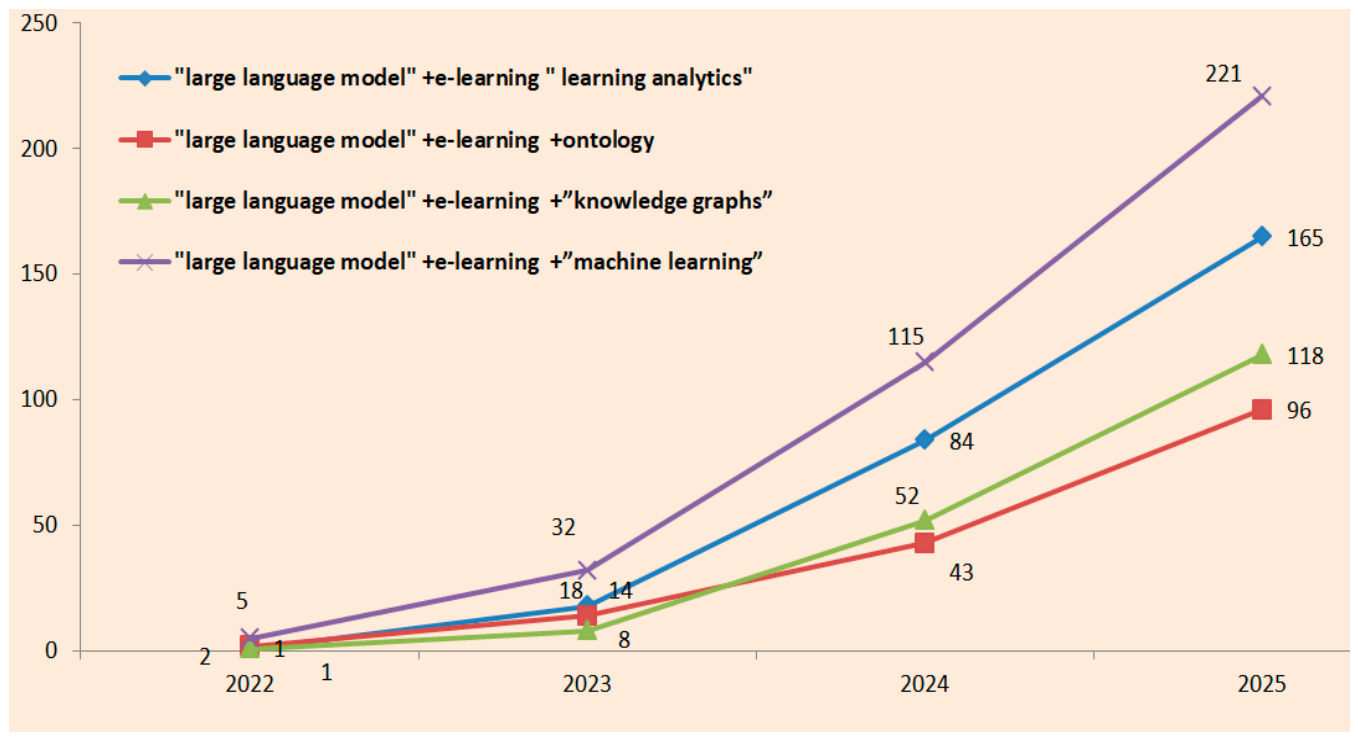
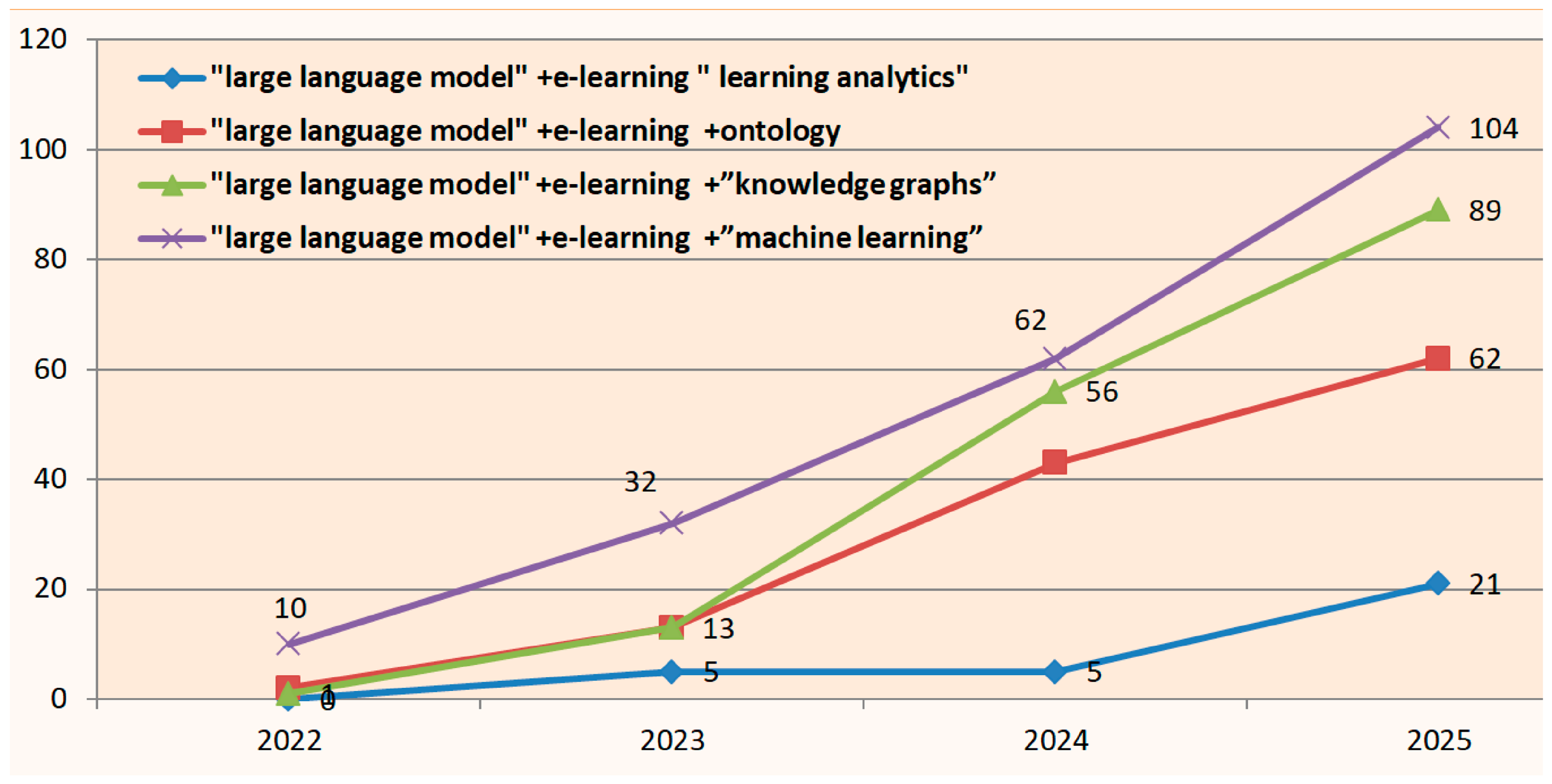
Google Scholar is very useful for identifying research trends because it combines a huge academic database with a very powerful search engine. Google Scholar aggregates sources from many disciplines, which is particularly important, given that education is a multidisciplinary field. The main limitation of Google Scholar is unguaranteed quality of results. Some of the returned results may be of lower quality, not formally reviewed, or may even be even practically irrelevant. The authors applied the weak relevance criteria to titles and snippets of year-filtering selected queries (see Figure 6). The results indicate rapid growth in scientific interest in the combined use of LLMs and symbolic AI technologies, including ontologies and knowledge graphs in e-learning. The same is also true for the combined use of LLMs, ML, and learning analytics in e-learning. Thus, these are emerging trends (RQ3). The research trends are accessed again by applying the same search queries to the ACM database. The assessment of the publications indexed in ACM outlines similar trends (see Figure 7). Analysis of multiple studies and surveys reveals that some papers addressing machine learning, large language models (LLMs), and education do not focus on the direct application of machine learning in educational systems. Instead, they examine machine learning within the context of LLM development and usage. Therefore, more refined and targeted queries are necessary to differentiate between research that applies machine learning as part of LLM technologies and research that employs machine learning directly to support educational objectives within integrated e-learning systems.
The most notable difference between trends derived from Google Scholar and those from the ACM Digital Library lies in the placement of LLM- and LA-related research curve within the e-learning context. In Google Scholar-based trends, this curve is positioned higher, whereas in ACM-based trends it appears in the lowest position. This discrepancy can be attributed to the fundamental differences between the two sources: ACM primarily emphasizes technical computer science research (including computing education), while Google Scholar offers broader interdisciplinary coverage and is more likely to capture studies focused on education and learning analytics.
Table 3 presents a summary of research on the combined use of LLMs and some of Symbolic AI, ML, or LA-based technologies and their context of use in education.
The summarization of the frequency of usage of these supplementing techniques is presented in Table 4.
The conclusions drawn from this brief analysis are that the integration of knowledge graphs (KGs) with LLMs is the most extensively explored approach, followed by the use of ontologies. Some of the explored research uses both KGs and ontologies. In contrast, despite the strong theoretical potential of agent-based architectures in knowledge-driven, LLM-powered educational systems, relatively few studies have addressed this direction, suggesting that it remains underexplored. Furthermore, while prompt engineering is clearly a critical component for the effective deployment of LLMs in educational contexts, it has not yet been sufficiently investigated, and this is an important gap for future research.
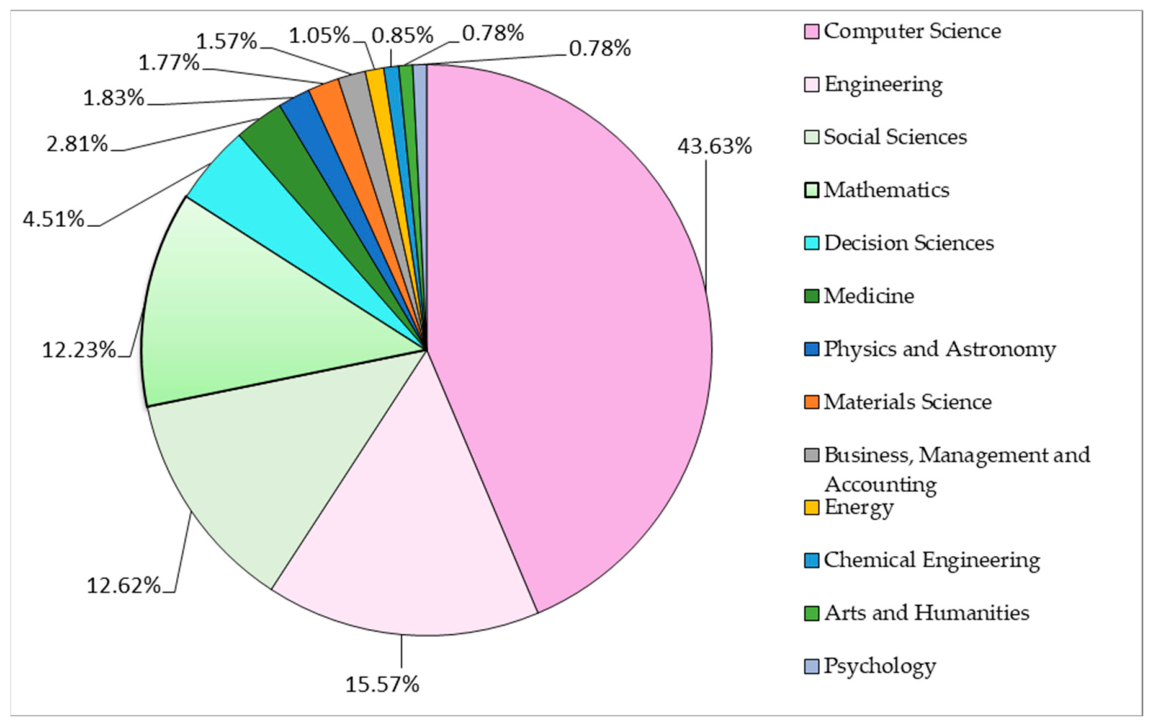
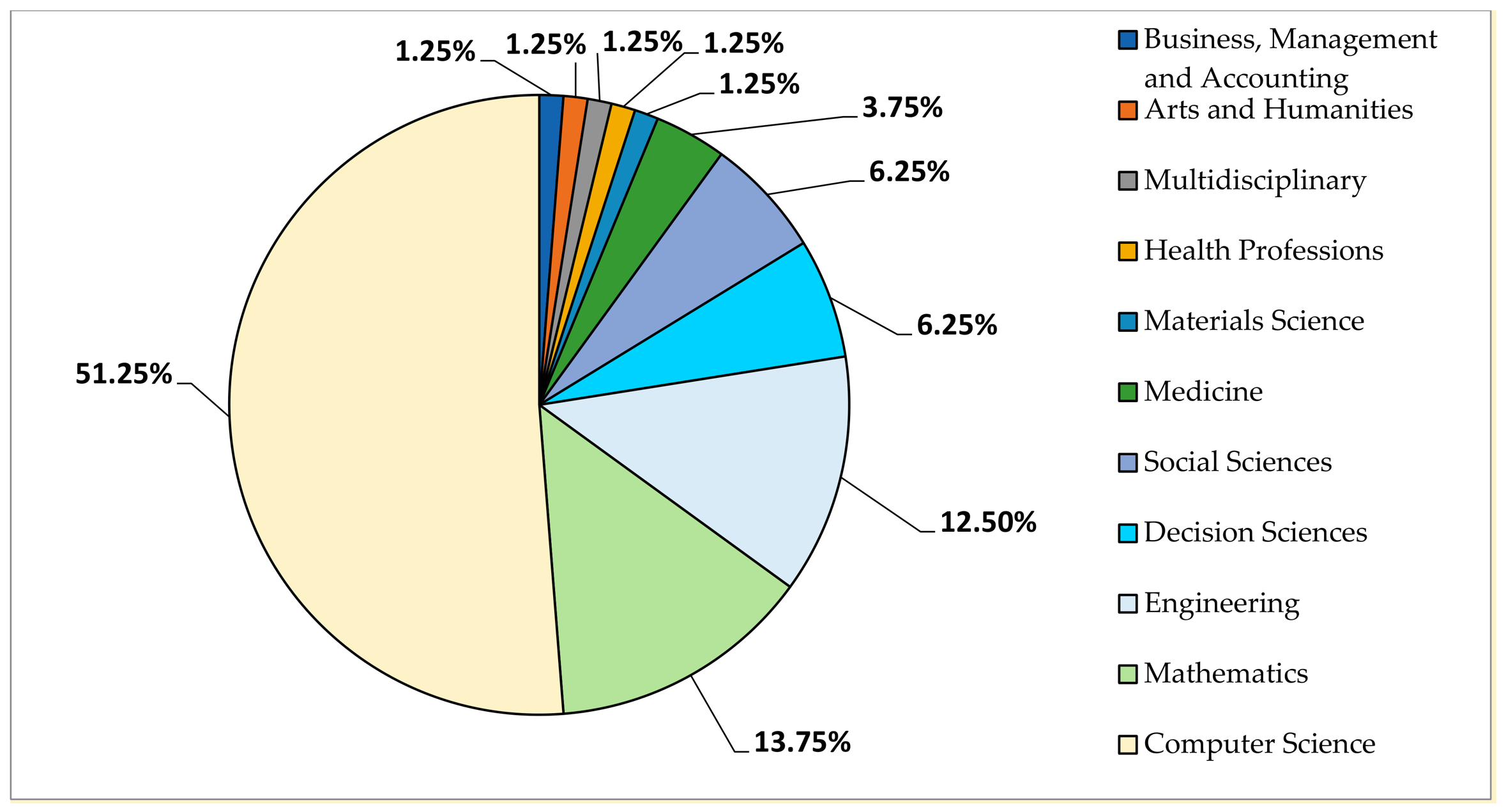
An especially important question is which educational domains integrating LLMs, and also LLMs with ontologies, have been most extensively explored. From a theoretical point of view, one of the main application areas of LLMs is bioinformatics and medicine, as LLMs’ strengths are related to understanding, generating, transforming, and reasoning over text in natural language, and medical science relies mainly on unstructured knowledge and natural-language-based reasoning. On the other hand, according to Scopus search results, the use of LLMs in the medical domain education is currently very limited (see Figure 8 and Figure 9).
Diagrams indicate that current trends primarily focus on integrating LLMs into computer science, mathematics, and engineering education. This is because of the novelty of this computer-based technology and its relatively limited adoption in other fields. Nevertheless, implementing LLM-powered technologies in e-learning across a wide range of scientific disciplines is an important area of research.

3.4.5. Data Privacy and Security

Most tools using LLMs have built-in capabilities to process user-sensitive information dynamically, which requires careful design, governance, and monitoring of sensitive data usage. Federated Learning (FL) is an emerging machine learning paradigm that addresses data privacy [50]. The survey [65] provides a thorough review of the security and privacy challenges of LLMs along with application-based risks on various domains, including education.
LLMs often use data from learner profiles, such as performance data, behavioral patterns, and interaction logs, which may include personal identifiers, and can also memorize them. Educational systems that use LLMs should follow regional privacy regulations and ensure required student data protection and consent. Post-processing validation is important for ensuring correct LLM output. It includes semantic checking of generated content against known facts or constraints and domain standards (may be specified in ontologies or KGs).

4. Discussion

The application of LLMs in educational systems is closely related to prompt engineering techniques. Prompts should be dynamically generated based on the learner model, curriculum, and ontologies, integrated into intelligent e-learning systems.

4.1. Prompt Engineering Techniques in Intelligent Educational Environments

Effective educational use of LLMs in an educational context typically includes adequate retrieval or tool-integration strategies, generating structured prompts aligned with instructional rubrics, human-in-the-loop review, and explicit safeguards.
Prompts should explicitly define the intended learning objectives, the learner’s personal and academic profile, their cognitive and proficiency level, as well as the required format and constraints of the response. Carefully constructed prompt-generation strategies are essential for eliciting high-quality outputs from large language models. Moreover, aligning prompts with grading rubrics enhances transparency, ensures consistency in evaluation, and improves the overall quality and reliability of generated responses. Prompt engineering can simulate human interactions that are critical for learning and development of various skill sets. Training in high-order prompt engineering skills is crucial for preparing higher education students for effective communication and efficient use of generative AI technologies.
The authors outline three important research and practice directions in prompt engineering in the educational context:
  • Development and evaluation of students’ prompt engineering skills;
  • Development of a comprehensive, validated prompt taxonomy to systematize and store the most useful prompts or prompt generation strategies;
  • Long-term research on prompt generation frameworks in educational contexts.
Other major research goals include the identification and systematic evaluation of context-sensitive prompting strategies for content generation, supporting personalized and adaptive instructional approaches, self-directed education, and enhancement of accessibility and inclusion. The aim of using LLMs is not to replace other knowledge-based technologies but to act as a semantic reasoning and interaction layer on top of structured educational knowledge.
Good prompts are essential for extracting relevant information from large language models. However, even an excellent prompt cannot retrieve knowledge that is not present in the model. In some cases, general-purpose LLMs may not contain the specific information needed to achieve certain learning goals. In such situations, specialized LLMs, fine-tuning, or retrieval-augmented generation can be useful solutions.

4.2. RAG Technology and Usage of LLMs in Education

General-purpose LLMs are not the best choice for educational purposes, as they are not aligned to specific educational content and tutoring-domain pedagogy. These problems can be overcome by applying additional training to models or by using an RAG-based approach to connect LLMs to course learning materials. Common adaptation approaches used to adjust general LLMs to the educational context aim to improve instructional relevance and response quality by fine-tuning on educational data, reinforcement learning with human feedback, retrieval-augmented generation, or learner modeling and adaptive systems. Educational data fine-tuning includes the usage of curriculum-aligned materials, annotated student interactions, domain-specific question–answer datasets, or pedagogical dialogue data. Human educators provide feedback to align outputs with pedagogical goals, reduce harmful or misleading responses, or improve clarity and quality of explanation. LLMs can be connected to textbooks, verified learning resources, and institutional knowledge bases to reduce hallucination and improve factual accuracy. The integration of student progress tracking, knowledge-tracing models, and adaptive feedback mechanisms in general LLMs can make outputs more personalized and pedagogically meaningful.
The combination of BERT/RoBERTa models, GPT-style LLMs, and knowledge graphs or taxonomies represents a significant trend in the development of intelligent educational systems. BERT and RoBERTa can ensure high-precision structured knowledge extraction [66], particularly in tasks such as skill identification, concept tagging, and classification. GPT-style LLMs, on the other hand, are more suitable for contextual inference, semantic interpretation, and natural language generation. Knowledge graphs and taxonomies provide standardization, conceptual alignment, and support for symbolic logical reasoning. Together, these technologies enable hybrid neuro-symbolic architectures that integrate statistical learning with structured knowledge representation, enhancing personalization, explainability, and semantic consistency in educational applications.
Retrieval-augmented generation is an approach in which a language model retrieves relevant information from external knowledge sources (such as documents, databases, or knowledge graphs) at query time and uses this retrieved evidence to generate responses that are more accurate, up-to-date, explainable, and grounded in factual data. An RAG-based approach can be used to combine general knowledge, implemented in LLMs with specific educational content by connecting LLMs to course learning materials [17]. In this a way, LLMs, combined with RAG technology in e-learning, can support personalization and context-awareness based on course materials.
An approach to integrate LLMs with an ontology-aware RAG mechanism to enhance the safety and reliability of QA systems in education, called CyberRAG, is discussed in [24]. This approach focuses on reducing LLM hallucinations and increasing the quality of the generated results, which is critical in education. It augments the LLM knowledge with domain-specific data from educational content and validates responses through educational ontologies and KGs. Another RAG-based architecture that uses KG to support a semantic search tool for dental products and materials is also discussed. It uses an integrated knowledge base that stores documents and contextual domain knowledge from the ontology. The advantages of the proposed approach include knowledge reuse, flexibility, and improved context.
LLMs are used as the reasoning and generation unit of RAG when formulating retrieval queries, interpreting and integrating the retrieved results, and generating context-aware responses based on that external knowledge. An agent-based, multi-agent framework enhanced by RAG to support semi-automated ontology construction and refinement is presented in [48]. An approach for automating agent-based collaborative ontology engineering with role-playing simulation of LLM-powered agents and RAG technology [53].
One of the main goals of LLMs usage in education is knowledge modeling and generation [62,67]. Knowledge modeling and generation relate not only to the representation and production of educational domain-specific content but also to the modeling of structured knowledge required for the integration of symbolic AI technologies within educational systems. It also includes the development and maintenance of ontologies for educational domains. Ontology engineering remains one of the most complex and time-consuming tasks in developing intelligent educational systems that integrate generative, symbolic, and statistical AI technologies. In the following subsection, we briefly discuss the new opportunities that LLMs introduce for making ontology development and maintenance easier and more effective.

4.3. The Impact of LLMs on Ontology Development, Mapping, or Maintenance for Education

Ontology development and maintenance require deep domain understanding, structured knowledge engineering skills, and significant manual effort. Ontology learning (OL) aims to decrease ontology development effort and support dynamic automated ontology maintenance. This is crucial for education as personalized education usually requires several different ontologies (e.g., domain, learner, and pedagogical models), and educational knowledge is frequently changing, but most of educators lack ontology development skills. Unfortunately, in the educational domain, OL is also challenging due to the scarcity of linked and labeled data and the need for tight integration among educational knowledge concepts, student behaviors, and pedagogical knowledge. Advancements in large language models have offered a novel opportunity to automate and refine ontology development, maintenance, and mapping processes [10,54,56].
LLMs are very useful for dynamic ontology updating, extracting concepts or relations from newly added learning content, identifying obsolete or redundant nodes, or detecting emerging concepts. Usage of LLMs can shift ontology development or maintenance from a static process to a more flexible, dynamic, AI-assisted paradigm. LLM-enhanced OL can also support learner modeling by enabling mastery tracking, misconception detection, or fine-grained learner profiles maintenance.
LLMs are also very useful for generating natural-language explanations of concept dependencies, describing prerequisite gaps in understandable terms, and explanations why a learning resource was recommended. LLMs also are useful for detecting logical inconsistencies in definitions, identifying circular dependencies, contradictory definitions,
General-purpose LLMs, such as GPT-4, demonstrate promising capabilities in ontology generation and ontology mapping tasks. However, domain-specific training or fine-tuning remains essential and is one of the main approaches to ensure high-quality ontology management. For example, Ref. [26] presents a novel neural approach that trains LLMs to construct entire ontology substructures from annotated documents. It integrates semantic and structural evaluation metrics and works well both in domain and cross-domain ontology generation.
LLMs can make ontology development easier and more effective, and ontologies are one of the components of the intelligent educational system, considered as an environment, needed for effective use of LLMs in education. In the current research, the authors will propose a short methodology for the development of an intelligent education environment, supporting effective use of LLMs.

4.4. LLMs Limitations

The authors systematize LLMs limitations and technological and pedagogical approaches to overcome them in Table 5. The external techniques column of Table 5 emphasizes the importance of integrating complex AI-driven modular and agent-based technologies for achieving the full potential of LLMs in the educational context. Overcoming the limitations of LLMs can be achieved by integrating them with symbolic AI, machine learning, and LA in complex, modular educational systems.
This summary suggests that the limitations of LLMs in educational settings are substantial. To address these challenges, it is necessary to integrate more sophisticated technological and pedagogical strategies. The current research focuses on technological approaches in education, yet their usage depends on pedagogy. Thus, most of the above-mentioned papers also discussed their pedagogical alignment. The particular pedagogical context in which LLMs are applied should guide the choice of specific approaches. Based on the analysis of the studies discussed above, and the authors’ research experience in personalized and adaptive AI-based education, methodological guidelines for integrating LLMs into intelligent e-learning systems are proposed.

4.5. Methodological Guidelines for Integrating LLMs in e-Learning Systems

  • Define pedagogical objectives and usage goals of AI-based tools or applications (needed type of expertise, e.g., diagnostic, advisory)
    a.
    Define how the use of LLMs aligns with learning outcomes;
    b.
    Define the combined use of LLMs and symbolic AI technologies (ontologies, KGs or rule-based systems) to pedagogical objectives.
  • Plan role-based LLM integration. LLMs can be used as AI Tutors, or content generators, or feedback assistants, as it is discussed above.
    a.
    Define roles of AI tutors, if needed (as personalized explanations, questioning);
    b.
    Define roles of content generators for learners and teachers (explanations of generation capabilities for learners, quizzes, summaries for teachers);
    c.
    Define roles of feedback assistants (formative feedback on writing or coding).
  • Specify main components of personalization framework. Ontology or knowledge graph-based learner, pedagogy, or tutoring domain models can be used integrated with LLM-based techniques and tools.
    a.
    Specify components of structured learner models—knowledge models, performance analytics, and decision rules;
    b.
    Specify LLMs’ explanations based on learners’ prior knowledge, cognitive level, disabilities, etc.
  • Specify techniques for integration of LLMs with symbolic knowledge and other statistical techniques
    a.
    Specify usage of RAG for connecting LLM to KB and retrieving relevant facts before generating output;
    b.
    Specify prompt engineering strategies;
    c.
    Specify continuous learning and feedback procedures (to collect user feedback, update KB, improve prompts or fine-tune model, etc.).
  • Define adaptive assessment strategy.
    a.
    Include LLMs for low-stakes formative assessments;
    b.
    Combine AI feedback with rubric-based evaluation.
  • Define key rules to ensure security, privacy, ethical compliance, and knowledge accuracy.
    a.
    Minimize collection of personal data;
    b.
    Apply anonymization where possible;
    c.
    Encrypt stored and transmitted data, where needed;
    d.
    Define rules for reducing hallucinations;
    e.
    Use RAG from verified course materials;
    f.
    Restrict responses to approved curriculum databases.
  • Develop scalable architectural models for the tight integration of LLMs and other knowledge models and tools
    a.
    Explore available LLMs;
    b.
    Select the most relevant LLMs for the specified goals by mapping LLM properties and educational objectives;
    c.
    Develop the needed integration architectures.
    d.
    Select appropriate symbolic AI-driven models and technologies (ontologies, ontology management tools, KGs, rules or rule-based systems);
    e.
    Select appropriate ML technologies;
    f.
    Select appropriate LA techniques.
  • Approval of the model by discussing usage scenarios of the developed system, prototypes or real implementation.
  • Implementation of the system, using above discussed technologies and tools
    a.
    Development of knowledge bases;
    b.
    Development of ML-based or LA-based knowledge extraction algorithms;
    c.
    Integration of developed components.
  • Continuous evaluation and improvement, based on the new rapid technological and pedagogical developments, and changing learner’s needs.
The proposed methodological guidelines must be validated and refined throughout the development of complex AI-driven educational systems to ensure both technical reliability and pedagogical effectiveness.

4.6. Review and Critical Analysis of Related Works on the Usage of LLMs in Education

Although LLMs have only recently become widely available, valuable and rapidly growing research, including systematic reviews, has investigated their applications in e-learning contexts. Despite its novelty, most surveys (more than 60%) are indexed in scientifically recognized databases such as Scopus or Web of Science. Most of the papers that are not indexed present very recent research (developed in 2025) and are currently available as preprints or as newly published papers that have not yet been indexed due to their recent appearance (see Table 6).
General surveys focus on the emerging technologies, pedagogy, challenges, and future developments related to the usage of LLMs in education [1,7]. Some of them consider pedagogical approaches, while others list most AI technologies, but discuss only a few of them in depth [1]. Other surveys discuss almost all of the technologies, but only in the context of a specific type education, such as engineering or Computer Science education [68]. Most surveys are specialized only in some Learning environment components, e.g., LLMs [3,46], specific LLM-powered tools [34,69], or specific LLM-driven techniques. The paper [46], for example, presents a review of prompt engineering in the context of higher education.
Other surveys focus on understanding the effects and mechanisms of personalization, feedback, and learner monitoring in specific educational contexts, such as engineering education [29].
Table 6. Analysis of related surveys on the usage of LLMs in education.
Paper, Year, IndexingPedagogical AspectsTechnological
Aspects
Usage TasksData Integrity and Governance
[1], 2025,
Sc, WoS (370) *
General, multimodal learning,
transparency, and
accountability
LLMs, RAG, NLPAdaptive learning,
assessment, resource
development, knowledge tracing
Reliability and safety, privacy
[5], 2025Science learning, language learning, and professional
development.
Agents for teaching assistance,
for student support
Adaptive learning, knowledge tracing,
curriculum design, feedback
comment generation
Discusses need for stronger data
protection
mechanisms
[69], 2025ProgrammingLLM tools Assessment, teaching,
learning
Not discussed
[2], 2025,
Sc, WoS
ITSLLMs, tools,
chatbots
Technical reliability issues, assessment fairness, empirical evidence of benefitsPrivacy
[42], 2024Mathematics, writing,
programming, and
reasoning.
LLMsIndividualized feedback and their possibility in content creation, including videos, quizzes, and plans.Privacy is briefly
discussed
[70], 2024, ScNo specializationDeep learning models, MLLMAll pedagogical approachesSecurity, privacy
[3], 2023, (296)Individual usage by
students
ChatGPTPersonalized and
interactive learning,
assessment and creation of feedback
-
[71], 2024, Sc, WoSK–12, undergraduate, and graduate levelsLLM-based
chatbots
Language learning-
[68], 2026, Sc, Computer Science
Education
LLM-based agentsPersonalized and
adaptive learning and
problem-solving
Cultural diversity and inclusivity
[44], 2026, Sc, WoSFederated learning
Affective learning
Emotional intelligence
in pedagogy
Specialized LLMs knowledge graph, biometric sensorsEmotion-adaptive
privacy-preserving
personalization
Privacy
[4], 2025,
Sc, ACM
Not explicitly addressed to educationLLMsTransparency and
explainability
Ethics, trust
[6], 2025, (1809)Not explicitly addressed to educationSurvey of
hallucinations in LLM-based agents.
Not discussedNot discussed
[72], 2024Adaptive learning, knowledge mapping,
curriculum design,
semantic search
LLM + Knowledge graphKnowledge graph
generation
Not discussed
[73], 2025STEM educationLLM + Concept mapActivities through
concept map
generation
Not discussed
[46], 2025, Sc (213)Higher educationLLMPrompt engineering Not discussed
[8], 2025,
Sc
General educational context, Inclusive educationTools, chatbots, LLM usageAssessment, adaptive learning, feedback, knowledge tracing, gamification Reliability and Safety, Privacy
[74], 2024General educational context, in writing, math,
programming,
and reasoning.
LLMs,
MAS-GAI
convergence
Individualized feedback content creation,
including videos,
quizzes, and plans,
personalized education
Student data
privacy
[75], 2024, ScopusMedical education (domain and tack—specific, case-based reasoning)Ontologies, rules, deep learning, NLP, LLMsAutomatic generation of medical case-based
methodologies,
applications, evaluation
Dataset
comprehensiveness
[51], 2025, ScMultimodal LA solutions, explanatory analytics, visual and explanatory analytics.Generative
artificial intelligence in learning analytics
Accessibility,
personalization,
adaptive learning
Ethical and equitable
integration of GenAI in LA
[16], 2025, WoSMOOC environmentsIntegration of ML, GenAI into LASpatiotemporal learning behaviors, dropout detection and risk assessment,
analysis of learner feedback,
behavioral profiling
Security and privacy
issues are mentioned
[45], 2025,
ACM (130)
Increasing the reliability of LLM agentsLLM agents.Defensive strategiesPrivacy and security
issues
[31], 2025, Sc, WoS (115)Programming, reasoning, and knowledge-based question answeringAdapted LLMApplicability to construct a comprehensive educational supermodel, personalization, learning pathsNot discussed
[23], 2024, Sc, WoS, (59)Higher educationLLMImprove critical thinking, personalization,
develop
collaborative projects
Privacy and security
issues
[76], 2024, ScLarge-scale educational
systems
LLM in learning environments, NLP, neural network Personalization,
adaptability
Ethical concerns, data privacy and bias
[65], 2025, Sc, WoS, (648)EducationLLMs-Security and privacy challenges application-based risks
[22], 2024, Sc (1154)Large-scale educational
systems
LLMs, MLTeaching, grading, knowledge
representation, feedback, content generation, and
recommendation
Privacy
[77], 2025, Sc, WoS (269)Higher educationLLMsAutomating instructional tasks personalized learning experiences.Privacy, information accuracy and information verification
[29], 2025, Sc Application of AI-powered ITS, Engineering
Education
NLP, LLMs, KGs (only mentioned), learning algorithmsPersonalization, learning pathways, real-time
feedback, learner
progress tracking
Discusses privacy-preserving profiles,
privacy- aware
learner-state layer as
future research
[78], 2025, ACM, ScNine domains: medicine, law, biology, finance, social
computer programming
robots and agents
5 LLMs
evaluation
results were
discussed
Testing and evaluationNot discussed
[79], 2025, ACM, ScEducation only mentionedLLMs are
compared,
evaluation
-Ethical concerns, data privacy and bias
[80], 2025, ACM, Sc ChatGPT is testedTest evaluationNot discussed
(n) * is the number of citations for the paper.
All the surveys explored are very recent (developed in the last two years) and highly valuable. Most of them are indexed in reputable scientific databases and have a vast number of citations (see Table 4). According to the scope, the surveys can be categorized as discussing only some aspects of LLMs and discussing a combination of technologies closely related to LLMs. About half of the surveys consider only single usage of LLMs and LLM-powered tools in education (see Table 7).
The analysis and categorization of the examined studies reveal that existing approaches primarily explore simple combinations of LLMs with individual techniques such as machine learning, retrieval-augmented generation, knowledge graphs, learning analytics, or concept maps. However, no single approach integrates all of these components. The authors’ hypothesis is that integration of all these technologies is essential to achieving high-quality personalization in intelligent educational environments.
This study not only covers all aspects of AI-based technologies relevant to personalized education, but also maps most of them to pedagogical, management, and security issues. It also aims to identify the effective combination of these technologies to achieve important educational goals.

4.7. Roles of LLMs in Intelligent Educational Systems (RQ4)

As a result of the comprehensive literature survey, the authors outline the following general key roles and implications of LLMs in modern education systems (see Table 8):
  • Performing direct content generation, including plain text, programming code, graphical or multimedia content (for supporting both learners and teachers) [49,54,56];
  • Assisting in educational content development and enhancement by aligning educational content with curriculum standards and helping in the generation, modification, or evolution of educational content, choosing adequate presentation and complexity level [55,56];
  • Supporting or conducting personalization tasks in LLMs-powered adaptive tutoring systems by adjusting difficulty levels based on learner performance or offering personalized hints [10,27,54,58]. LLMs can ensure interactive personalized question answering, concept explanation, and misconception correction;
  • Assisting or supporting knowledge structuring—LLMs can help with multiple tasks—from classifying, summarizing, and linking educational content, to ontology and KG development and maintenance [10,26,27,53];
  • Supporting intelligent assessment and feedback—automated grading of essays and open-ended responses, supporting formative assessment through dialogue, evaluating learners’ responses, and generating instant constructive feedback [12,13,14,15,18];
  • Knowledge discovery—information retrieval and summarization for curriculum development, or research—LLMs can find or analyze external resources, scientific papers, etc. [21];
  • Enhancing collaboration and communication—LLMs can assist teachers and educational content developers to collaborate in resource development, provide translation and localization of educational content, and broaden accessibility [8,29,40,48,53].
Usage of LLMs in education tasks was categorized into nine general categories [22]: in profiling/labelling (concept classification, cognitive level classification), in detection (urgency, conversational intent detection, learner’s behavior), in grading, teaching support, prediction, knowledge representation, feedback, content generation, and in recommendation tasks.
Formative feedback typically includes two main approaches: (1) generating hints and explanations to help students identify and understand their errors, and (2) providing supporting candidate examples or suggested repairs. All feedback is domain- and context-specific. For example, in language tutoring, feedback may include well-structured natural language texts, whereas in programming education, corrected code in the relevant programming language is provided [67].
The role of LLMs in assessment is to function as intelligent assistants that support assessment design, feedback generation, and diagnostic analysis. Human experts retain authority over evaluation standards and final judgments.
Thus, the conclusion is that the most effective approach is AI-assisted learning, where students think first and actively participate. AI supports their learning and assessment, including personalization at different levels and contexts, while teachers guide learning and evaluation, and critical thinking, active participation, and collaborations remain central.
Prompt engineering, multi-stage pipelines, and prompt chaining are most useful and frequently used in LLM-powered tools for education and in complex AI-powered educational systems. Equal access and privacy-preserving practices are of great importance in LLM-powered education. Inclusive design (accessible interfaces, multilingual support) and digital literacy training can support equal access to technology and digital services. Privacy-enhancing techniques, such as maximal possible anonymization, differential privacy, and federated learning, are important privacy-preserving approaches.

4.8. Trends Related to the Adoption and Evolution of LLMs Usage in IES

  • Integrating LLMs with educational standards (e.g., LMS LD, Bloom’s taxonomy, curricula frameworks);
  • Integration with machine translation models and enhancing cross-lingual and multilingual support;
  • Hybrid approaches that combine LLMs for text analysis or generation with knowledge graphs and/or domain ontologies to maintain accuracy and consistency of results are increasingly frequently used;
  • Combining LLMs with rule-based systems and learning analytics tools for extracting knowledge about learners’ progress and ensuring pedagogically valid guidance;
  • Use of LLMs within complex knowledge-based education frameworks to ensure personalized tutoring or generate personalized content, study plans, and feedback;
  • Implementing role-based data access controls to ensure privacy-limiting LLMs’ data access, based on the user’s role;
  • Filtering inputs and controlling prompts to reduce the risk of attack and increase model security;
  • LLMs’ output verification to reduce hallucination and misinformation;
  • Providing interpretable explanations for recommended content, feedback, clear documentation of sources and rules, used in data collection and processing;
  • Allowing users to decide what level of data sharing and personalization they wish to use;
  • Usage of deep learning algorithms in the evaluation of students’ achievements or the prediction of the students’ progress [63];
  • Preferable usage of federated learning as a machine-learning technique to decrease data privacy problems. In this approach, most sensitive data remain on local devices, while only model updates are shared;
  • Increasing LLM-powered agents and multi-agent architectures in educational systems [5,6,25,53].
The integration of large language models into intelligent educational systems offers transformative potential, enabling rapid and seamless access to vast, cross-disciplinary knowledge. At the same time, it introduces complex pedagogical, technical, ethical, and methodological challenges that require careful consideration and responsible implementation.
Based on the comprehensive analysis of the most recent research in this field, the authors identify the following research directions, challenges, and perspectives concerning the adoption and ongoing evolution of LLMs within intelligent educational systems (RQ5):
Pedagogical challenges (RQ5a)
  • Development of clear and widely adopted directions about what LLMs to use and usage strategies in specific educational contexts;
  • The great convenience of LLMs may foster intellectual passivity or cognitive offloading. Therefore, it is essential to identify and implement widely adopted pedagogical strategies that mitigate this risk and preserve deep learning and critical thinking;
  • Evaluate and decrease the risk of generating incorrect information (hallucinations). Minimal hallucinations in general domains and common-sense reasoning don’t imply the same for specialized domains such as software development; developing effective evaluation methods for specialized domains. Designing hallucination evaluation methods for specialized educational domains is an unresolved issue;
  • Developing effective assessment strategies in the context of the LLMs’ use is a challenge;
  • Flexible and dynamic integration of AI technologies into the educational environment through collaborative discussions about the appropriate use of generative AI, outcomes of their application, and potential reasons for avoiding their use are of crucial importance.
Technological challenges (RQ5b):
  • Finding or selecting the most appropriate LLM for every specific educational subdomain or context. Choosing which LLM to use in education depends heavily on the domain. Evaluations, summarized in [78], show that LLMs’ capabilities (reasoning, coding, factuality, multimodality, etc.) can vary significantly. There is no single “best model”—only the best fit for domain and purpose;
  • Binding question and answering systems and LLMs to learner-state information to ensure automated inclusion of learner-specific information in LLM prompts or support LLM-powered agents and chatboats with needed information for personalized communication with learners;
  • Aligning learning analytics with learning design in GenAI-mediated contexts to fully leverage LLMs’ contextual capabilities;
  • Development of robust strategies and technological frameworks to enable valid measurement of learning in LLM-mediated educational contexts;
  • Development of complex knowledge bases (including ontologies) that are necessary for the dynamic integration of generative and symbolic AI technologies;
  • Integrating multi-agent systems in traditional LMS to ensure the needed flexibility of dynamic personalization;
  • Adaptive learning content development for personalized and inclusive education;
  • Expanding the use of LLM-powered technologies in e-learning across diverse scientific disciplines is a significant and emerging research direction;
  • Establish standards for quality control and safe usage of LLMs by instructors for automated generation of educational content;
  • Development of assessment methods for students’ prompt engineering skills and a comprehensive, validated prompt taxonomy. Future research on systematically validated prompts and investigation of the long-term efficacy of prompt-generation frameworks, especially in an educational context, is needed;
  • Development of advanced methods for adaptation of LLMs to meet the specific requirements of different educational domains with an emphasis on improving accuracy, fairness, and pedagogical alignment.
Meeting data privacy regulations is also a challenge for the effective use of LLMs in education, particularly in personalized learning contexts (RQ5c). Personalized systems require access to learners’ personal data to provide adaptive support. Strict privacy requirements can limit the collection and processing of essential data for effective personalization. Achieving an appropriate balance between meaningful personalization and strong ethical privacy protections is an important direction for future research. Privacy, trust, and ethics in LLM-driven educational environments require coordinated normative, technical, and research-oriented efforts, including the following:
  • Establishing clear ethical norms for the responsible use of LLMs in educational contexts, including guidelines on academic integrity, accountability, and appropriate human oversight;
  • Strengthening the explainability and transparency of LLM-generated outputs to enhance trust, interpretability, and informed decision-making in AI-augmented learning environments;
  • Data privacy and security-related research directions should focus on adopting privacy-protection mechanisms, such as encryption, anonymization, and differential privacy, to ensure the confidentiality and integrity of sensitive educational data [29];
  • Comprehensive research on the security and privacy preserving when using LLM-powered agents is also needed.

4.9. Limitations of LLMs-Powered Personalized Learning Systems

Some disconnects between user expectations and the actual capabilities of LLM-powered educational systems and tools (e.g., the risk of significant hallucinations in specific domains) remain, and integration of LLMs into learning environments cannot compensate for them. Often, users, both learners and educators, also feel that the systems do not adequately meet the needs for transparency and explainability [4]. Adding fact-checking layers or secondary models based on semantic ontological representations of knowledge is an outstanding approach for decreasing hallucinations and increasing transparency and trust. Developers should enhance user trust and improve the overall effectiveness of LLM-based educational systems by providing intuitive user interfaces, comprehensive documentation, and training resources to help users understand how LLMs and LLM-based tools operate.
Most existing studies focus on isolated applications of LLMs (such as automated content creation, language tutoring, intelligent assistants, or chatbots). Development of structured theoretical frameworks to guide the integration of LLMs into education systems is needed.
The personalization that LLMs can ensure is shallow. LLMs simulate personalization but do not deeply understand learners. Integration with learner models (knowledge level, preferences, history), developed by using KGs or ontologies, can ensure the knowledge needed for real personalization. Most of the LLMs are not aligned with pedagogy and learning science. A promising approach to addressing this limitation is to integrate LLMs with pedagogical rules, ontologies, and learning analytics, thus enabling more effective pedagogically grounded personalization.
Most existing studies focus on specific educational contexts (e.g., higher education, specific personalization approaches, or particular tasks). Scientific research on the integration of LLMs into diverse practical learning environments, including the popular LMSs used in K-12 education, is very limited. There is also a pedagogical aspect of the integration of LLMs in practical e-learning systems. Tutors should promote active learning and critical thinking. Simulation of debates or role-play, inquiry-based learning, and problem-based learning are important approaches that support effective integration of LLMs in e-learning systems.
Despite the large number of studies on the use of LLMs in education, only a limited subset conducts rigorous evaluations of their performance and outcomes. For example, one study assessed the capabilities of eight LLMs for ontology development, identifying common errors and hallucinations. The results indicate that GPT-based models outperform others; however, the evaluation was not specifically focused on educational ontologies. Although GPT models achieved comparatively better performance, approximately 10% of their outputs were still incorrect, while other models exhibited error rates ranging from 10% to 30%. Such levels of inaccuracy are not acceptable in educational domains, where precision, consistency, and reliability are essential. Five LLMs were evaluated in nine educational domains: medicine, law, biology, finance, social computer programming, robots, and agents [78,79]. The evaluation results differ across domains, models, and tasks, when accuracy is between 40% and 90%—insufficient for the educational domain. The best results are reported for the GPT model in the computer science domain, and the lowest results are in the test generation task in the medical domain.

4.10. Perspectives for the Effective Use of LLMs in e-Learning and Future Research Directions

LLMs hold significant potential as valuable educational tools, capable of generating content that should be used after careful critical analysis, verification, and, when necessary, correction. Educators’ work should be based on the principle that meaningful learning outcomes are achieved only when students engage in effortful cognitive work. Future research on the use of LLMs in education should also focus on improving transparency and explainability, strengthening alignment with pedagogical requirements and approaches, and flexibly integrating them into personalized educational systems. To ensure that these requirements are met, LLMs should be integrated into intelligent educational environments combined with other AI-based technologies. Therefore, this research proposes a general methodology to support such integration. A key direction for future research is the validation of this methodology through developing case studies and prototypes of AI-driven educational systems, including the integration of LLMs with symbolic AI and statistical approaches in specific educational domains. Some more specific research directions that are significant for the development of a well-working intelligent education system using LLMs are also outlined.
From a technological point of view, effective use of LLMs requires the development of more productive prompt-engineering techniques, verification strategies for generated content, and hallucination detection. Tight integration of LLMs with other AI-based technologies is needed to ensure a high level of personalization.
Effective strategies for combining built-in personalization capabilities of LLMs with external personalized education approaches are another potential research area. Research is also needed to identify domains or subjects that can benefit most from LLM-powered tutoring.
From a pedagogical point of view, effective LLM usage requires preserving cognitive effort, making thinking visible, and teaching critical AI use. Educators should also design tasks that require personal context or lived experience. Collaborative discussions on the ways and effects of GenAI use, or motives for avoiding it, can also contribute to the development of approaches to GenAI integration in education.
Analysis of survey findings outlines important future research directions: ensuring factual accuracy of LLMs, approaches to their precise evaluation, and methods to encourage critical-thinking abilities, in conjunction with LLM-facilitated learning. Development of new standards for AI-integrated assessment is also an essential research direction.
Comprehensive empirical research is also needed to examine the influence of LLMs on student engagement in various educational contexts, as well as the effects of emerging LLM-based personalized learning approaches on educational outcomes.

5. Conclusions

LLMs are now widely used in education by learners and educators, both as stand-alone tools and integrated into e-learning systems. This study presents a systematic analysis, classification, and discussion of scientific research from the last four years, available through global research databases. The survey results are a basis for critical analysis and identification of appropriate supporting technologies and approaches for use, which can help overcome LLMs’ limitations and contribute to their effective application in education. As a result, ten areas or tasks and the impacts of LLMs in education are outlined. LLMs can support various tasks, most important of which are personalized and adaptive learning, automated assessment and feedback, and content generation. LLMs offer many advantages for education, but significant limitations have also been identified (e.g., the risk of severe hallucinations and insufficient accuracy), and AI-driven solutions to overcome them are proposed. Further, a comparison of general-purpose and specialized LLMs in educational systems is made. A summary of research on the combined use of LLMs and other intelligent technologies, as well as their application context in education, is provided. A discussion on prompt engineering techniques closely related to the application of LLMs in intelligent educational systems is presented. The methodology for integrating LLMs into intelligent e-learning systems to ensure their effective use is proposed.
LLMs are rapidly evolving AI technologies that are crucial for education. They can be used by students both directly, through stand-alone interactions, and via integration into educational tools and platforms, while other technologies can compensate for their limitations. Pedagogically aligned training of some general or domain-specific LLMs is needed to make them more effective in education, including for direct usage by learners. An innovative (pedagogical) tutoring and examination paradigm is necessary to position LLMs as collaborative learning partners in intelligent education. There is a need for new institutional governance structures to ensure accountability in the use of LLMs. Also, the roles of teachers, administrators, and policymakers should be clearly established.
LLMs can also work through intelligent assistants, content generators, intelligent tutors, and analytics engines. LLMs can operate behind the scenes inside LMS, intelligent tutoring systems, or content management platforms, including built-in intelligent tools such as assistants or chatbots. Scalable personalization, instant feedback, wide availability, and adaptive question answering are major benefits of LLMs for education. LLMs also have capabilities to automate content generation, including instructional videos, quizzes, and structured lesson plans. These functionalities can assist educators in creating instructional materials and in adapting content to different learner needs.
While LLMs offer significant potential benefits in e-learning, they still have limitations (e.g., hallucinations and weak pedagogical awareness and personalization), so their maximal potential can be achieved by integrating them into hybrid neuro-symbolic AI-powered architectures. By combining LLMs with knowledge graphs, ontologies, learning analytics, intelligent tutoring systems, explainable AI, and multimodal reasoning, education systems can enhance reliability, adaptivity, and pedagogical effectiveness. LLMs are highly valuable in almost all educational tasks, but their effectiveness depends on integration with other AI or digital technologies and on active participation from human experts. They should function as components within a broader human-centered educational ecosystem rather than as standalone solutions. The effectiveness of LLMs in education also depends on how well their capabilities align with specific pedagogical goals in each particular context.
Effective use of LLMs in educational contexts should encompass approaches to overcome their limitations and strengthen students’ critical thinking skills. They include integration of multiple AI technologies (symbolic, statistical, and machine-learning-based approaches), innovative pedagogical strategies, and strict ethical policies.

Supplementary Materials

The following supporting information can be downloaded at: https://www.mdpi.com/article/10.3390/info17050433/s1, Table S1. PRISMA Checklist.

Author Contributions

Conceptualization T.I.; methodology T.I. and V.T.; validation T.I. and V.T.; formal analysis T.I. and V.T.; investigation T.I.; resources T.I. and V.T.; data curation T.I. and V.T.; writing—original draft preparation T.I.; writing—review and editing V.T.; visualization T.I.; supervision V.T.; project administration T.I. and V.T.; funding acquisition T.I. All authors have read and agreed to the published version of the manuscript.

Funding

This work has been accomplished with financial support by the European Regional Development Fund within the Operational Programme “Bulgarian National recovery and resilience plan”, procedure for direct provision of grants “Establishing of a network of research education institutions in Bulgaria”, and under project №BG-RRP-2.004-0005 “Improving the research capacity and quality to achieve international recognition and resilience of TU-Sofia (IDEAS)”.

Data Availability Statement

The original contributions presented in this study are included in the article and supplementary material. Further inquiries can be directed to the corresponding author.

Acknowledgments

This research is also supported by the project UNITe BG16RFPR002-1.014-0004 funded by PRIDST. During the preparation of this manuscript, the authors used ChatGPT 5.2 online version for the purposes of minor improvements in grammar and style of some sentences. The authors have reviewed and edited the output and take full responsibility for the content of this publication.

Conflicts of Interest

The author declares no conflicts of interest.

Abbreviations

The following abbreviations are used in this manuscript:
AIArtificial intelligence
AIGCAI-generated content
ChatGPTChat generative pre-training transformer
CVComputer vision
DLADeep learning algorithms
DNNsDeep neural networks
GPTGenerative pre-trained transformer
LLMsLarge language models
NLPNatural language processing
STEMScience, technology, engineering, and mathematics
ITSIntelligent Tutoring Systems
RAGRetrieval-augmented generation
LALearning analytics
LMSLearning management system
QAQuestion answering
GNNGraph neural network
EDMEducational data mining
MOOCMassive open online course
LMS LDLearning management systems learning design
OLOntology learning
KGKnowledge graphs
MLLMsMultimodal large language models
SGNNsSigned graph neural networks
FLFederated learning

References

  1. Wang, S.; Xu, T.; Li, H.; Zhang, C.; Liang, J.; Tang, J.; Yu, P.S.; Wen, Q. Large language models for education: A survey and outlook. IEEE Signal Process. Mag. 2026, 42, 51–63. [Google Scholar] [CrossRef]
  2. Shi, Y.; Yu, K.; Dong, Y.; Chen, F. Large language models in education: A systematic review of empirical applications, benefits, and challenges. Comput. Educ. Artif. Intell. 2025, 10, 100529. [Google Scholar] [CrossRef]
  3. Hosseini, M.; Gao, C.A.; Liebovitz, D.M.; Carvalho, A.M.; Ahmad, F.S.; Luo, Y.; Kho, A. An exploratory survey about using ChatGPT in education, healthcare, and research. PLoS ONE 2023, 18, e0292216. [Google Scholar] [CrossRef]
  4. Zhao, H.; Chen, H.; Yang, F.; Liu, N.; Deng, H.; Cai, H.; Du, M. Explainability for large language models: A survey. ACM Trans. Intell. Syst. Technol. 2024, 15, 20. [Google Scholar] [CrossRef]
  5. Yang, J.; Wang, M.; Du, X.; Na, R. A Comprehensive Survey on Large Language Model based Agents for Education. IEEE Trans. Learn. Technol. 2025, 18, 898–913. [Google Scholar] [CrossRef]
  6. Xing, W.; Zhu, T.; Wang, J.; Liu, B. A survey on MLLMs in education: Application and future directions. Future Internet 2024, 16, 467. [Google Scholar] [CrossRef]
  7. Xu, H.; Gan, W.; Qi, Z.; Wu, J.; Yu, P.S. Large language models for education: A survey. arXiv 2024, arXiv:2405.13001. [Google Scholar] [CrossRef]
  8. Sharma, S.; Mittal, P.; Kumar, M.; Bhardwaj, V. The role of large language models in personalized learning: A systematic review of educational impact. Discov. Sustain. 2025, 6, 243. [Google Scholar] [CrossRef]
  9. Page, M.J.; McKenzie, J.E.; Bossuyt, P.M.; Boutron, I.; Hoffmann, T.C.; Mulrow, C.D.; Shamseer, L.; Tetzlaff, J.M.; Akl, E.A.; Brennan, S.E.; et al. The PRISMA 2020 statement: An updated guideline for reporting systematic reviews. BMJ 2021, 372, 71. [Google Scholar] [CrossRef]
  10. Zeng, Y.; Xie, H.; Zhou, X.; Xu, C.; Jiang, Y.; Lau, S.T. Developing a Nursing Research Education Agent Using Knowledge Graphs and Large Language Models: A Proof-of-Concept Study. Nurse Educ. 2025, 51, E105–E109. [Google Scholar] [CrossRef]
  11. Silan, H.; Xiaoning, W. Foke: A personalized and explainable education framework integrating foundation models, knowledge graphs, and prompt engineering. In China National Conference on Big Data and Social Computing; Springer: Singapore, 2024; pp. 399–411. [Google Scholar] [CrossRef]
  12. Bui, T.; Tran, O.; Nguyen, P.; Ho, B.; Nguyen, L.; Bui, T.; Quan, T. Cross-data knowledge graph construction for LLM-enabled educational question-answering system: A case study at HCMUT. In Proceedings of the 1st ACM Workshop on AI-Powered Q&A Systems for Multimedia 2024, Phuket, Thailand, 10 June 2024; pp. 36–43. [Google Scholar] [CrossRef]
  13. Zhao, R.; Zeng, W.; Tang, J.; Tian, F.; Zhao, X. Educational Knowledge Graph Question Answering: Insights from Benchmarks and LLM-based Solutions. IEEE Trans. Artif. Intell. 2025, 7, 1931–1941. [Google Scholar] [CrossRef]
  14. Sun, J.; Zhang, Z.; He, X. LLM4edukg: LLM for automatic construction of educational knowledge graph. In 2024 International Conference on Networking and Network Applications (NaNA); IEEE: New York, NY, USA, 2024; pp. 269–275. [Google Scholar] [CrossRef]
  15. Li, L.; Wang, Z.; Jose, J.M.; Ge, X. LLM supporting knowledge tracing leveraging global subject and student specific knowledge graphs. Inf. Fusion 2025, 126, 103577. [Google Scholar] [CrossRef]
  16. Rodríguez-Ortiz, M.Á.; Santana-Mancilla, P.C.; Anido-Rifón, L.E. Machine learning and generative AI in learning analytics for higher education: A systematic review of models, trends, and challenges. Appl. Sci. 2025, 15, 8679. [Google Scholar] [CrossRef]
  17. Zhao, C.; Agrawal, G.; Zhang, F.; Kumarage, T.; Tan, Z.; Deng, Y.; Chen, Y.-C.; Liu, H. Ontology-aware rag for improved question-answering in cybersecurity education. In 2025 IEEE International Conference on Big Data (BigData); IEEE: New York, NY, USA, 2025; pp. 3161–3170. [Google Scholar] [CrossRef]
  18. Pankiewicz, M.; Baker, R.S. Enhancing Student Focus and Problem-Solving with Real-Time LLM Feedback on Compiler Errors. In European Conference on Technology Enhanced Learning; Springer Nature: Cham, Switzerland, 2025; pp. 412–426. [Google Scholar] [CrossRef]
  19. Li, P.; Jiang, M.; Chen, J.; Ning, N. Performance of Large Language Models in Nursing Examinations: Comparative Analysis of ChatGPT-3.5, ChatGPT-4 and iFLYTEK Spark in China. Nurs. Open 2025, 12, e70317. [Google Scholar] [CrossRef]
  20. Mazzullo, E.; Bulut, O.; Wongvorachan, T.; Tan, B. Learning analytics in the era of large language models. Analytics 2023, 2, 877–898. [Google Scholar] [CrossRef]
  21. Abu-Rasheed, H.; Weber, C.; Fathi, M. Knowledge graphs as context sources for LLM-based explanations of learning recommendations. In 2024 IEEE Global Engineering Education Conference (EDUCON); IEEE: New York, NY, USA, 2024; pp. 1–5. [Google Scholar] [CrossRef]
  22. Yan, L.; Sha, L.; Zhao, L.; Li, Y.; Martinez-Maldonado, R.; Chen, G.; Gašević, D. Practical and ethical challenges of large language models in education: A systematic scoping review. Br. J. Educ. Technol. 2024, 55, 90–112. [Google Scholar] [CrossRef]
  23. Filippi, S.; Motyl, B. Large language models (LLMs) in engineering education: A systematic review and suggestions for practical adoption. Information 2024, 15, 345. [Google Scholar] [CrossRef]
  24. Gopi, S.; Sreekanth, D.; Dehbozorgi, N. Enhancing Engineering Education Through LLM-Driven Adaptive Quiz Generation: A RAG-Based Approach. In 2024 IEEE Frontiers in Education Conference (FIE); IEEE: New York, NY, USA, 2024; pp. 1–8. [Google Scholar] [CrossRef]
  25. dos Santos, O.L.; Cury, D. Intelligent multi-agent systems with generative AI in education: A systematic literature mapping. In Proceedings of the 18th Annual International Conference of Education, Research and Innovation (ICERI2025 Proceedings), Seville, Spain, 10–12 November 2025; pp. 9037–9046. [Google Scholar] [CrossRef]
  26. Lo, A.; Jiang, A.Q.; Li, W.; Jamnik, M. End-to-end ontology learning with large language models. In Proceedings of the Advances in Neural Information Processing Systems, Vancouver, BC, Canada, 10–15 December 2024; Volume 37, pp. 87184–87225. [Google Scholar] [CrossRef]
  27. Xu, B.; Tong, R.J.; Li, Y.; Chen, P.; Li, H.; Liang, J.; Fan, X.; Tong, J. An Architectural Framework for Educational Knowledge Graphs (IEEE P2807. 6): Ontology Design, LLM Integration, and Adaptive Learning Applications. In 2025 IEEE Conference on Artificial Intelligence (CAI); IEEE: New York, NY, USA, 2025; pp. 1610–1616. [Google Scholar] [CrossRef]
  28. Zhuang, G.; Lu, X. A KeyBERT-Enhanced Pipeline for Electronic Information Curriculum Knowledge Graphs: Design, Evaluation, and Ontology Alignment. Information 2025, 16, 580. [Google Scholar] [CrossRef]
  29. Rodrigues, B.; Pinto, R.; Gonçalves, G. A Systematic Literature Review of AI-Driven Intelligent Tutoring Systems in Engineering Education: Emphasizing Personalization, Feedback, and Student Monitoring. IEEE Access 2025, 13, 190152–190177. [Google Scholar] [CrossRef]
  30. Guizani, S.; Mazhar, T.; Shahzad, T.; Ahmad, W.; Bibi, A.; Hamam, H. A systematic literature review to implement large language model in higher education: Issues and solutions. Discov. Educ. 2025, 4, 35. [Google Scholar] [CrossRef]
  31. Raihan, N.; Siddiq, M.L.; Santos, J.C.; Zampieri, M. Large language models in computer science education: A systematic literature review. In Proceedings of the 56th ACM Technical Symposium on Computer Science Education, Pittsburgh, PA, USA, 26 February–1 March 2025; Volume 1, pp. 938–944. [Google Scholar] [CrossRef]
  32. Tithi, S.D.; Ramesh, A.K.; DiMarco, C.; Tian, X.; Alam, N.; Fazeli, K.; Barnes, T. The promise and limits of LLMs in constructing proofs and hints for logic problems in intelligent tutoring systems. Comput. Educ. Artif. Intell. 2025, 9, 100490. [Google Scholar] [CrossRef]
  33. Yan, L.; Zhao, L.; Echeverria, V.; Jin, Y.; Alfredo, R.; Li, X.; Martinez-Maldonado, R. VizChat: Enhancing learning analytics dashboards with contextualised explanations using multimodal generative AI chatbots. In International Conference on Artificial Intelligence in Education; Springer Nature: Cham, Switzerland, 2024; pp. 180–193. [Google Scholar] [CrossRef]
  34. Li, Y.; Yang, R.; Zhang, X.; Shi, P.; Yang, D.; Huang, X. ProgMate: An Intelligent Programming Assistant Based on LLM. In 2024 IEEE Frontiers in Education Conference (FIE); IEEE: New York, NY, USA, 2024; pp. 1–5. [Google Scholar] [CrossRef]
  35. Kuramitsu, K.; Obara, Y.; Sato, M.; Obara, M. KOGI: A Seamless Integration of ChatGPT into Jupyter Environments for Programming Education. In Proceedings of the 2023 ACM SIGPLAN International Symposium on SPLASH-E; Association for Computing Machinery: New York, NY, USA, 2023; pp. 50–59. [Google Scholar] [CrossRef]
  36. Hou, X.; Wu, Z.; Wang, X.; Ericson, B.J. CodeTailor: LLM-Powered Personalized Parsons Puzzles for Engaging Support While Learning Programming. In Proceedings of the Eleventh ACM Conference on Learning @ Scale; Association for Computing Machinery: New York, NY, USA, 2024; pp. 51–62. [Google Scholar] [CrossRef]
  37. Bassner, P.; Frankford, E.; Krusche, S. Iris: An AI-Driven Virtual Tutor for Computer Science Education. In Proceedings of the 2024 on Innovation and Technology in Computer Science Education; Association for Computing Machinery: New York, NY, USA, 2024; Volume 1, pp. 394–400. [Google Scholar] [CrossRef]
  38. Neumann, A.T.; Yin, Y.; Sowe, S.; Decker, S.; Jarke, M. An LLM-Driven Chatbot in Higher Education for Databases and Information Systems. IEEE Trans. Educ. 2025, 68, 103–116. [Google Scholar] [CrossRef]
  39. Al Adawiyah, A.; Handayani, S.; Fitrasih, R.; Kurniawati, N.; Rohman, Y.L. Enhancement of artificial intelligence learning using Quizizz AI for SMA Negeri 3 Semarang teachers. Abdimas J. Pengabdi. Masy. Univ. Merdeka Malang 2025, 10, 759–770. [Google Scholar] [CrossRef]
  40. Petrillo, A.; Awasare, K.; Rehman, M. The ALES Platform: State-of-the-Art and Gap Analysis for an Academic LLM Chatbot. Procedia Comput. Sci. 2025, 274, 359–372. [Google Scholar] [CrossRef]
  41. Xie, T.; Zhou, Y.; Yu, J. Ce-LLMs: Status and trends of education-specific large language models developed in China. Future Educ. Res. 2025, 3, 505–525. [Google Scholar] [CrossRef]
  42. Razafinirina, M.A.; Dimbisoa, W.G.; Mahatody, T. Pedagogical alignment of large language models (LLM) for personalized learning: A survey, trends and challenges. J. Intell. Learn. Syst. Appl. 2024, 16, 448–480. [Google Scholar] [CrossRef]
  43. Sun, Y.; Zou, J. Opportunities and Challenges of Big Models in Middle School Mathematics Teaching. Eng. Proc. 2025, 103, 20. [Google Scholar] [CrossRef]
  44. Ben Chaabene, N.E.H.; Hammami, H. Neuro-symbolic synergy in education: A survey of LLM-knowledge graph integration for explainable reasoning and emotion-aware student support. Smart Learn. Environ. 2026, 13, 6. [Google Scholar] [CrossRef]
  45. He, F.; Zhu, T.; Ye, D.; Liu, B.; Zhou, W.; Yu, P.S. The emerged security and privacy of llm agent: A survey with case studies. ACM Comput. Surv. 2025, 58, 162. [Google Scholar] [CrossRef]
  46. Lee, D.; Palmer, E. Prompt engineering in higher education: A systematic review to help inform curricula. Int. J. Educ. Technol. High. Educ. 2025, 22, 7. [Google Scholar] [CrossRef]
  47. Chen, Y.; Li, Y.; Ren, Y.; Liu, Y.; Ma, Y. Educational Evaluation with MLLMs: Framework, Dataset, and Comprehensive Assessment. Electronics 2025, 14, 3713. [Google Scholar] [CrossRef]
  48. Zhu, J.; Chen, Z.; Meo, P.D.; Guan, J.; Han, Z.; Shi, W. KnowPath: An LLM-Supported Knowledge Graph Construction and Path Finding Framework to Explainable MOOC Recommendations. ACM Trans. Inf. Syst. 2026, 44, 1–28. [Google Scholar] [CrossRef]
  49. Obradović, I.; Vrdoljak, B.; Miličević, M.; Lipovac, A. An Educational Ontology for Introductory Python Programming: Structuring Knowledge to Enable Personalization. IEEE Access 2026, 14, 5317–5339. [Google Scholar] [CrossRef]
  50. Majeed, H.; Lancaster, T.; Collison, M. Ontological Infrastructure Design for Benchmarking Federated LLM Tools in British Schools. Bachelor’s Thesis, Imperial College London, London, UK, 2025. [Google Scholar]
  51. Yan, L.; Martinez-Maldonado, R.; Gasevic, D. Generative artificial intelligence in learning analytics: Contextualising opportunities and challenges through the learning analytics cycle. In Proceedings of the 14th Learning Analytics and Knowledge Conference 2024, Kyoto, Japan, 18–22 March 2024; pp. 101–111. [Google Scholar] [CrossRef]
  52. Khosravi, H.; Shibani, A.; Jovanovic, J.; Pardos, Z.A.; Yan, L. Generative AI and learning analytics: Pushing boundaries, preserving principles. J. Learn. Anal. 2025, 12, 1–11. [Google Scholar] [CrossRef]
  53. Soularidis, A.; Doumanas, D.; Kotis, K.; Vouros, G.A. Automating agentic collaborative ontology engineering with role-playing simulation of LLM-powered agents and RAG technology. Knowl. Eng. Rev. 2025, 40, e10. [Google Scholar] [CrossRef]
  54. Li, G.; Tang, C.; Chen, L.; Deguchi, D.; Yamashita, T.; Shimada, A. LLM-driven ontology learning to augment student performance analysis in higher education. In International Conference on Knowledge Science, Engineering and Management; Springer Nature: Singapore, 2024; pp. 57–68. [Google Scholar] [CrossRef]
  55. Pruski, C.; Gallais, M.; Da Silveira, M. Enhancing ESCO with Generative AI: A Dynamic Approach to Supporting 21st Century Education. In 2025 IEEE Global Engineering Education Conference (EDUCON); IEEE: New York, NY, USA, 2025; pp. 1–5. [Google Scholar] [CrossRef]
  56. Tharaniya Sairaj, R.; Balasundaram, S.R. Ontology Mapping for Retrieval Augmented Modelling to Reduce Factual Hallucinations in Pretrained Language Model-Based Auto-Generated Questions. Appl. Ontol. 2025, 20, 69–88. [Google Scholar] [CrossRef]
  57. Fahl, W. GraphWiseLearn: Personalized Learning Through Semantified TEL, Leveraging QA-Enhanced LLM-Generated Content. In European Semantic Web Conference; Springer Nature: Cham, Switzerland, 2024; pp. 74–83. [Google Scholar] [CrossRef]
  58. Li, Q.; Xie, Y.; Chakravarty, S.; Lee, D. EduMAS: A novel LLM-powered multi-agent framework for educational support. In 2024 IEEE International Conference on Big Data (BigData); IEEE: New York, NY, USA, 2024; pp. 8309–8316. [Google Scholar] [CrossRef]
  59. Wang, S.; Ni, L.; Zhang, Z.; Li, X.; Zheng, X.; Liu, J. Multimodal prediction of student performance: A fusion of signed graph neural networks and large language models. Pattern Recognit. Lett. 2024, 181, 1–8. [Google Scholar] [CrossRef]
  60. Zhu, H.; Li, T.; He, P.; Zhou, J. Enhancing automated grading in science education through LLM-driven causal reasoning and multimodal analysis. In Proceedings of the Thirty-Fourth International Joint Conference on Artificial Intelligence, Montreal, QC, Canada, 16–22 August 2025; pp. 10352–10360. [Google Scholar] [CrossRef]
  61. Scientific, L.L. Innovative approaches to educational knowledge graphs: Leveraging neo4j and LLM for synthetic data generation. J. Theor. Appl. Inf. Technol. 2026, 104, 296–318. Available online: https://www.jatit.org/volumes/Vol104No4/21Vol104No4.pdf (accessed on 5 March 2026).
  62. Wang, X.J.; Lee, C.P.; Mutlu, B. LearnMate: Enhancing online education with LLM-powered personalized learning plans and support. In Proceedings of the Extended Abstracts of the CHI Conference on Human Factors in Computing Systems, Yokohama, Japan, 26 April–1 May 2025; pp. 1–10. [Google Scholar] [CrossRef]
  63. Zhou, H.; Shen, S.; Su, Y.; Miao, Y.; Liu, Q.; Zhu, L.; Huang, Z. LLM-EPSP: Large language model empowered early prediction of student performance. Inf. Process. Manag. 2026, 63, 104351. [Google Scholar] [CrossRef]
  64. Ciatto, G.; Agiollo, A.; Magnini, M.; Omicini, A. Large language models as oracles for instantiating ontologies with domain-specific knowledge. Knowl.-Based Syst. 2025, 310, 112940. [Google Scholar] [CrossRef]
  65. Das, B.C.; Amini, M.H.; Wu, Y. Security and privacy challenges of large language models: A survey. ACM Comput. Surv. 2025, 57, 1–39. [Google Scholar] [CrossRef]
  66. Pilicita, A.; Barra, E. LLMs in education: Evaluation GPT and BERT models in student comment classification. Multimodal Technol. Interact. 2025, 9, 44. [Google Scholar] [CrossRef]
  67. Pitts, G.; Hridi, A.P.; Narayanan, A.B.L. A Survey of LLM-Based Applications in Programming Education: Balancing Automation and Human Oversight. In Proceedings of the Fourth Workshop on Bridging Human-Computer Interaction and Natural Language Processing (HCI+NLP), Suzhou, China, 9 November 2025; pp. 255–262. [Google Scholar] [CrossRef]
  68. Adejumo, A.A.; Oyelere, S.S.; Sanusi, I.T.; Suhonen, J. A systematic review of the impact of GenAI on learning performance, AI hallucinations, and problem-solving in computer science education. Comput. Educ. Artif. Intell. 2026, 13, 100570. [Google Scholar] [CrossRef]
  69. Estévez-Ayres, I.; Callejo, P.; Hombrados-Herrera, M.Á.; Alario-Hoyos, C.; Delgado Kloos, C. Evaluation of LLM tools for feedback generation in a course on concurrent programming. Int. J. Artif. Intell. Educ. 2025, 35, 774–790. [Google Scholar] [CrossRef]
  70. Rahman, M.A.; Alqahtani, L.; Albooq, A.; Ainousah, A. A survey on security and privacy of large multimodal deep learning models: Teaching and learning perspective. In 2024 21st Learning and Technology Conference (L&T); IEEE: New York, NY, USA, 2024; pp. 13–18. [Google Scholar] [CrossRef]
  71. Aldhafeeri, L.; Aljumah, F.; Thabyan, F.; Alabbad, M.; AlShahrani, S.; Alanazi, F.; Al-Nafjan, A. Generative AI chatbots across domains: A systematic review. Appl. Sci. 2025, 15, 11220. [Google Scholar] [CrossRef]
  72. Abu-Salih, B.; Alotaibi, S. A systematic literature review of knowledge graph construction and application in education. Heliyon 2024, 10, e25383. [Google Scholar] [CrossRef]
  73. Schicchi, D.; Limongelli, C.; Monteleone, V.; Taibi, D. A closer look at ChatGPT’s role in concept map generation for education. Interact. Learn. Environ. 2026, 34, 276–296. [Google Scholar] [CrossRef]
  74. Rodrigues, B.; Pinto, R.; Gonçalves, G. EngiBot: An AI-based tutoring system for personalized learning in engineering education. In Proceedings of the 12th International Conference on E-Learning in Industrial Electronics (ICELIE 2025), Madrid, Spain, 14–17 October 2025. [Google Scholar] [CrossRef]
  75. Al Shuraiqi, S.; Aal Abdulsalam, A.; Masters, K.; Zidoum, H.; AlZaabi, A. Automatic generation of medical case-based multiple-choice questions (MCQs): A review of methodologies, applications, evaluation, and future directions. Big Data Cogn. Comput. 2024, 8, 139. [Google Scholar] [CrossRef]
  76. Shahzad, T.; Mazhar, T.; Tariq, M.U.; Ahmad, W.; Ouahada, K.; Hamam, H. A comprehensive review of large language models: Issues and solutions in learning environments. Discov. Sustain. 2025, 6, 27. [Google Scholar] [CrossRef]
  77. Babaei Giglou, H.; D’Souza, J.; Auer, S. LLMs4OL: Large language models for ontology learning. In International Semantic Web Conference; Payne, T.R., Presutti, V., Qi, G., Poveda-Villalón, M., Stoilos, G., Hollink, L., Kaoudi, Z., Cheng, G., Li, J., Eds.; Springer: Cham, Switzerland, 2023; Volume 14265, pp. 408–427. [Google Scholar] [CrossRef]
  78. Li, J.; Gao, Y.; Yang, Y.; Bai, Y.; Zhou, X.; Li, Y.; Sun, H.; Liu, Y.; Si, X.; Ye, Y.; et al. Fundamental capabilities and applications of large language models: A survey. ACM Comput. Surv. 2025, 58, 1–42. [Google Scholar] [CrossRef]
  79. Voultsiou, E.; Moussiades, L. A systematic review of AI, VR, and LLM applications in special education: Opportunities, challenges, and future directions. Educ. Inf. Technol. 2025, 30, 19141–19181. [Google Scholar] [CrossRef]
  80. Jauhiainen, J.S.; Guerra, A.B.G. Educational evaluation with large language models (LLMs): ChatGPT-4 in recalling and evaluating students’ written responses. J. Inf. Technol. Educ. Innov. Pract. 2025, 24, 2. [Google Scholar] [CrossRef] [PubMed]
Figure 1. PRISMA-compliant data retrieval, screening, and cleaning processes.
Information 17 00433 g001
Figure 2. The keywords map on the Scopus records of the query “Intelligent and e-learning and LLM”—network visualization.
Information 17 00433 g002
Figure 3. The keywords map on the Scopus records of the query “education and LLM and ontology”—overlay visualization.
Information 17 00433 g003
Figure 4. The keywords co-occurrence network of the results of Scopus query “Intelligent tutoring” and LLM results—overlay visualization.
Information 17 00433 g004
Figure 5. The keywords co-occurrence network of the results of Scopus query “Intelligent tutoring” and LLM results—network visualization.
Information 17 00433 g005
Figure 6. Google Scholar-based trends in research on combining LLMs with Symbolic AI, ML, LA.
Information 17 00433 g006
Figure 7. ACM-based trends in research on combining LLMs with Symbolic AI, ML, LA.
Information 17 00433 g007
Figure 8. The diagram of documents by subject area classification, based on the Scopus query “large language model” AND e-learning.
Information 17 00433 g008
Figure 9. The diagram of documents by subject area classification, based on the Scopus query ontology and LLM and education.
Information 17 00433 g009
Table 1. The inclusion and exclusion criteria (for strong relevance only).
Inclusion Criteria (Strong Relevance)Exclusion Criteria
1. Paper involves a comprehensive discussion of one or more aspects of the usage of LLMs in education.
2. Research is focused on some of the technological aspects of the usage of LLMs in education.
3. Research is a comprehensive survey or presentation of some LLM-powered tool, educational model or application.
1. Paper is not in English.
2. Paper is not a peer-reviewed research study.
3. Paper is not accessible via university subscriptions.
4. Paper is a duplicate study.
5. Main text (excl. references) is under four pages.
Table 2. Comparison of usability aspects of general-purpose and specialized LLMs in educational systems.
AspectGeneral-Purpose LLMs (e.g., ChatGPT,
Gemini)
Specialized LLMs (e.g., MathGPT,
BioGPT)
ScopeBroad, includes multi-domain and
cross-domain knowledge
Narrow, focused on specific domains
AccuracyModerate, depending on the required
topics
High within the target domain
ReliabilityVariable depending on prompt and
context
Higher, but only in specialized domains or tasks
Pedagogical
Alignment
General explanations, low pedagogical
alignment
Closely aligned with the curriculum and
standards
AdaptabilityHighly flexible across subjectsLimited to specific subject areas
Language
Performance
Stronger in high-resource languagesOptimized for specific languages and lower for others.
Accessibility UseGeneral support, but variable qualityBetter for tailored accessibility solutions
Development CostLow, prompting ready-to-use systems High, requires domain data and fine-tuning
MaintenanceMinimal for usersRequires periodical updates
Table 3. Research on hybrid architectures.
Paper, Year,
Indexing
Pedagogical AspectsTechnological
Aspects
Usage TasksPrivacy, Policy, Security,
Correctness
Evaluation
[12] 2024
Sc *
Higher education, LMSLLMs + KGs construction + RAGAccurate feedback,
questions and
answering
Limiting what is indexed or retrieved into the RAGEvaluated on three datasets in banking domain
[48] 2025
IEEE
Higher
education
LLMs + KGs + Curriculum, domain, and user model ontologiesPersonalization recommendations, cross-disciplinary connectionsNot discussedBy domain
experts
[53] 2025
Sc, WoS
Higher education and specialized professional domainsLLMs + RAG +
ontologies
Agents, hybrid
neuro-symbolic AI
Curriculum ontology
construction, domain knowledge modeling
Restricting which agents can access which knowledge sourcesQuantitative
and qualitative measures are
employed
[50] 2025British schoolsLLMs + ontologies
Generative LLM tools Symbolic ontological control
Interoperability,
safeguarding
Data privacySentiment and bias expert
evaluation
[26] 2024
IEEE
Higher
education and
specialized
professional
domains
Neural LLMs-based OL approachNot discussedNot discussedNovel suite of
semantic and
structural metrics for evaluating
ontologies
[17] 2024
IEEE
Domain-specific inquiry learning, ITS, higher
education
RAG +
ontology-based
validation
Questions and
answering
CybersecurityOntology-based reasoning
[13,14] 2025, ScDomain-specific learningLLMs + KGQuestions and
answering
Not discussedIn-depth evaluation of the EDUCEQ
dataset
[24] Sc
IEEE
Engineering education, specialized STEM tracksLLM-driven RAG-based
approach
Adaptive quiz
generation: formative
assessment
Not discussedTopic relevancy, answer relevancy, and a contextual relevancy score.
[54] 2024
WoS
Competency-based education, higher educationLLM-driven
ontology learning
Graph neural network (GNN) for student performance
prediction.
Personalized academic advising, student
interactions in ontology learning
Security and
privacy were only briefly mentioned
Empirical and
expert-based
[55] 2025
WoS
Engineering education, lifelong learningLLM-driven
ontology evolution
Dynamic ontology evolution, curriculum
design
Not discussedExpert-based
[27] 2025 IEEEFor large-scale systemsEducational KG EduKG integrated with LLMs and RAGPersonalized and interactive learning, interoperability, semantic search, question
answering, dynamic
content generation
Security and
privacy were
discussed at a
technical and
architectural level
Expert-based
evaluation
[28] 2025
Sc, WoS
For large-scale systemsLLMs, KG, ontology alignmentKeyBERT-based constructing KG of the electronic information curriculum systemNot discussedSemantic similarity, precision, recall, and F1-score against the gold
labels
[49] 2025 For programming educationLLM, ontology, KGDevelopment and
evaluation of the Python educational ontology
Not discussedSix datasets from the Mastery Grid and StudyLens learning platforms were examined
using learning curves analysis
[34], 2024 ScAnything, to anyone, anywhere, at any time learningLLM, intelligent
programming
assistant ProgMate
Intelligent assignment grading, identification of knowledge gaps, and
assessment of learning abilities
Not discussedPrototype
evaluation
[56] 2025
Sc
ITS, STEM
Education
LLM, RAG,
ontologies
Ontology mapping,
automated content
generation
Reduce
hallucination
Benchmark datasets and evaluation metrics ROUGE-L and RAGAS-precision scores
[57] 2024Technology-enhanced learning LLM, KG, LA,
Dynamic
competence maps
Personalized tutoring Not discussedExperiments,
engagement
evaluation
[58] 2024
Sc, IEEE
College-level physics
education
LLM, agents, KGsEmotional awareness mechanism contextual adaptationSecurity and
privacy were only briefly mentioned
Evaluated by six state-of-the-art LLMs
[15] 2025MOOCLLMs to enrich the knowledge graphKnowledge tracing, predictionsMentioned web securityExtensive evaluations on three public educational datasets: FrcSub, Xes3g5m, MOOCRadar.
[10] 2025Nursing
education
Agent, knowledge graphs and large language modelsAddressing
theory-practice gap, personalization
Ethical guidelinesQuantitative and qualitative evaluation of learning outcomes, expert-based evaluation of KG
[59] 2024
ACM
Online
educational
platforms
Signed graph
Neural networks (SGNNs), LLM, KG, contrastive learning
Predicting student
performance
Policy-based,
internet security
Evaluating five real-world datasets, metric F1
[60] 2025
ACM
K–12
science
education
LLM usage to
generate causal knowledge graphs, visual drawing
evaluation
Evaluation and
assessment
Not discussedAccuracy and
consistency
[21] 2024
Sc, IEEE
STEM education, lifelong learningKnowledge graphs as a source of factual context for LLM promptsFor learning
recommendations,
explanations
Reducing
hallucinations
Quantitatively—Rouge-N and Rouge-L measures, qualitatively with experts and
learners
[61] 2024
Sc
Chinese Law educationLLM enhanced with a knowledge graph, LAResource development, knowledge acquisitionNot discussedExperimental
evaluation
[62] 2025
ACM
Cosmology and astronomy coursePersonalized
learning agent, LearnMate
Adaptive testing
strategy, adaptive
learning paths
On conceptual levelPrototype level
[11] 2024
Sc
Chinese STEMKnowledge forest for structured domain knowledge, knowledge graphs, and prompt engineering for LLMsPersonalized, interactive, and explainable
educational services
Not discussedOnly discussed
[63] 2026
Sc
Higher
education
Deep learning, CNN, LLMStudents’ academic
performance analysis and alerting system
Not discussedTested using OULAD and the UCI dataset
[64] 2025
ACM, Sc
Nutritional
domain
Ontology, KG, LLM Domain ontology
development
Not discussedSWOT analysis,
expert validation
* Sc—denotes database Scopus.
Table 4. Frequency of the use of technologies supplementing LLMs in educational projects.
Supplementing TechnologyNumber of the Projects that Use It
Ontology11
Agents4
RAG6
NNs6
KG13
Prompt engineering2
Table 5. Summary of LLMs limitations and ways to overcome them.
LLMs LimitationLLM-Related Techniques to CompensateExternal Techniques to CompensatePedagogical Approaches
HallucinationsPrompt chaining, few-shot prompting, fine-tuning, RAG, prompt engineering, multi-stage pipelineOntologies, knowledge graphs, fact-checker or
validator technique
Critical thinking, step-by-step learning, human feedback, expert annotations
Limited multimodal understandingUse multimodal models, training on diverse multimodal datasets, fine-tuning with multimodal tasksRAG, knowledge graph, modular AI Systems,
multimodal simulation
environments
Complex multimodal reasoning, multimodal problem-based
learning, multimodal feedback
Static knowledgeFine-tuning with updated data, specialized LLMs for educationRAG, knowledge graph, ML, multisource knowledge
integration, agent-based
architectures
Lifelong learning, curriculum-based knowledge updates,
self-improving models
Inconsistent qualityParameter-efficient fine-tuning, specialized LLMs for educationOntologies, knowledge graphs, data filtering, RAG, automated fact-checking
systems
Reinforcement learning with
human feedback
Bias and ethical risksUse diverse and
representative training data
Bias detection and evaluation tools, privacy and data
protection (anonymizing
student information)
Teachers’ oversight and review, ethical AI usage guidelines,
federated learning
Limited personalizationFine-tuning on learner
data, memory-augmented LLMs
RAG, ontologies, knowledge graphs, ML, rules, LA,
adaptive prompting, modular and multi-agent systems
Reinforcement learning with
feedback
Lack of educational domain groundingEducational domain-specific fine-tuning, curriculum-aligned promptingRAG, ontologies, knowledge graphs, modular educational agentsReinforcement learning with
expert feedback
Poor explainability and transparencyTrain or prompt LLMs to explain their answers in plain language, specialized LLMs for educationOntologies, knowledge graphs, rules, RAG, modular and multi-agent architecturesStep-by-step guided learning, evidence-based justification, concept mapping, layered explanations, Interactive teaching and feedback
Weak pedagogical awarenessPrompt engineering for pedagogy, memory-augmented systems, specialized LLMs for educationOntologies, knowledge graphs, rules, adaptive
personalization, adaptive
modular architectures
Human-in-the-loop educational feedback pedagogical evaluation metrics
Table 7. Categorization of LLMs-related surveys.
AspectLLMs, ToolsLLMsLLMs RAGNLP, KGs LLMsLLMs, MLLLM, NNLLM, NN, LALLM,
Ontologies
LLM,
Concept Map
General33
Test, evaluation 2
Educational tasks341232321
Prompt engineering 1
Ontology or KG
development
1 2
Table 8. Key LLMs roles in important educational tasks.
For Tasks in
Educational System
Roles of LLMs in
Educational System
Supporting Techniques
or Tools
Needs of Human Validation
Educational ontology or KG managementConcept identification, ontology generation or expansion Reasoning engines (Fact, Pellet, HermiTex)Final validation by experts or knowledge engineers
Ontology refinement and
validation
Reasoning engines (Fact, Pellet, HermiTex)Final validation by experts or knowledge engineers
Ontology populationReasoning engines (Fact, Pellet, HermiTex)Final validation by experts or knowledge engineers
Related to ontology or KG usageMap learning objectives to ontology classes, detect
missing conceptual links
LMS toolsFinal validation by teachers or experts
Metadata annotationAnnotation toolsFinal validation by teachers or experts
Semantic mapping and
interoperability
Reasoning engines (Fact, Pellet, HermiTex)Final validation by teachers or experts
Related to teaching and learningPersonalized tutoringOntologies, KGs, ML, LA, GNN for predictionTeachers’ participation
Writing/content generationInternetValidation by learners
Communication supportInternetTeachers, partners
Language learningInternetTeachers, partners
CodingProgramming
environments
Learners, teachers
Formative feedbackLATeachers
Technical learningSpecific toolsLearners, teachers
Related to
Assessment
Formative assessment
(immediate feedback)
Ontologies, KGsTeachers, experts
Summative assessment,
feedback
Learning AnalyticsTeachers, experts
Performance assessment, feedbackLearning AnalyticsTeachers, experts
Related to
resource (learning or assessment content) development
Initial draft creation
Instructional design supportOntologies, KGsTeachers, experts
Personalized content
development
Ontologies, KGsTeachers, experts
Multimedia and interactive content supportMultimediaTeachers, experts
Knowledge structuringOntologies, KGsTeachers, experts
Assessment-embedded
content
Ontologies, KGsTeachers, experts
Disclaimer/Publisher’s Note: The statements, opinions and data contained in all publications are solely those of the individual author(s) and contributor(s) and not of MDPI and/or the editor(s). MDPI and/or the editor(s) disclaim responsibility for any injury to people or property resulting from any ideas, methods, instructions or products referred to in the content.