Authentic Digital Interaction with E-Government: A Systematic Review of Key Determinants


Abstract
1. Introduction
2. Materials and Methods
2.1. Research Scope and Review Question
2.2. Review Design and Protocol
2.3. Review Scope and Timeframe
2.4. Information Sources
2.5. Search Strategy
2.6. Eligibility Criteria
- Examined citizen-facing interaction with e-government or digital government services (web or mobile);
- Investigated at least one determinant relevant to ADI (for example usefulness, ease of use, trust, security and privacy, usability, service or information quality, digital literacy, accessibility, interactivity, transparency, participation, cultural or demographic influences, value co-creation);
- Were peer-reviewed journal articles or review papers;
- Were published in English between January 2020 and October 2025;
- Had full text available.
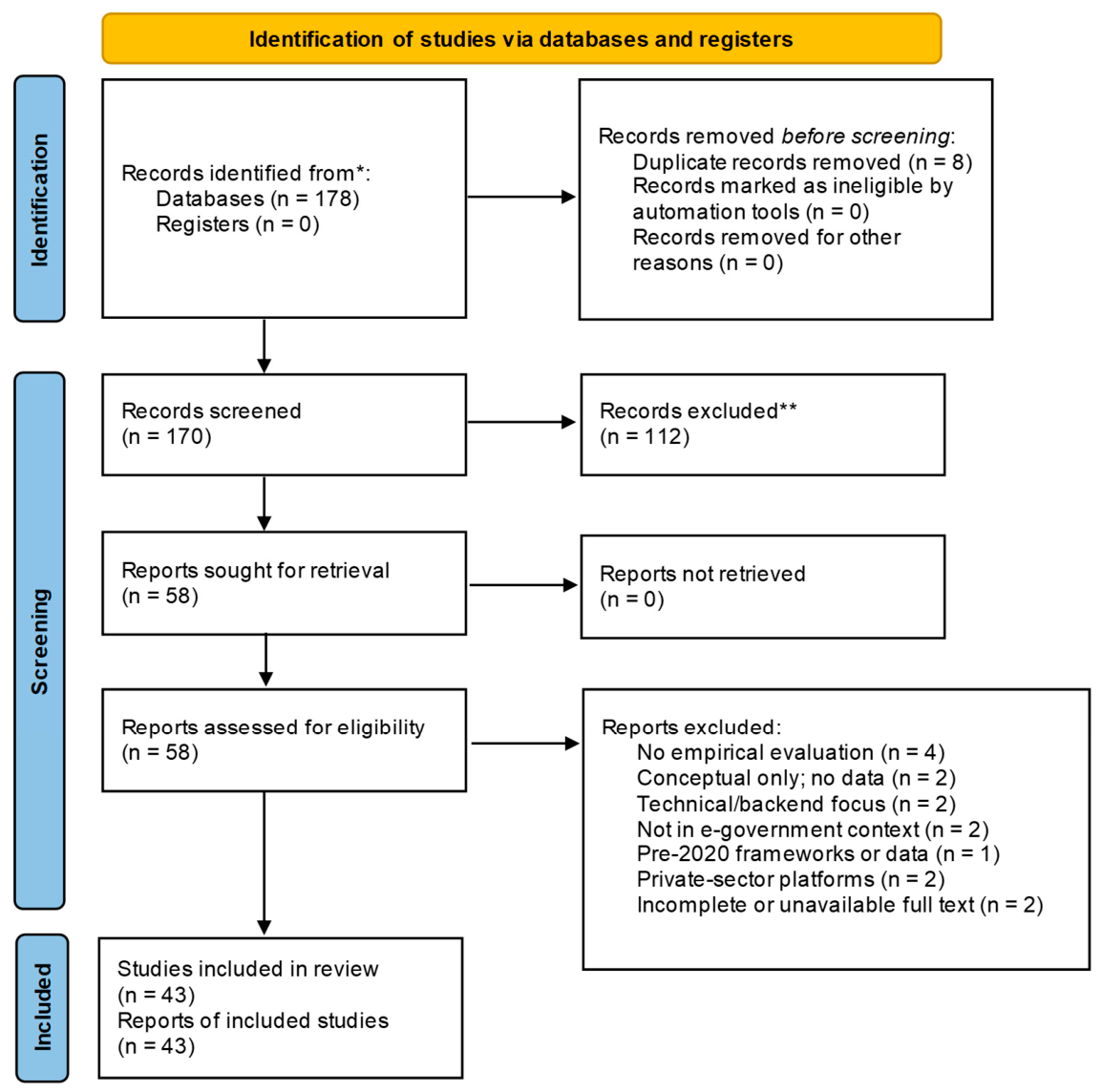
2.7. Study Selection and Screening
2.8. Data Extraction
2.9. Quality Considerations
2.10. Data Synthesis
3. Results
3.1. Descriptive Characteristics of the Included Studies
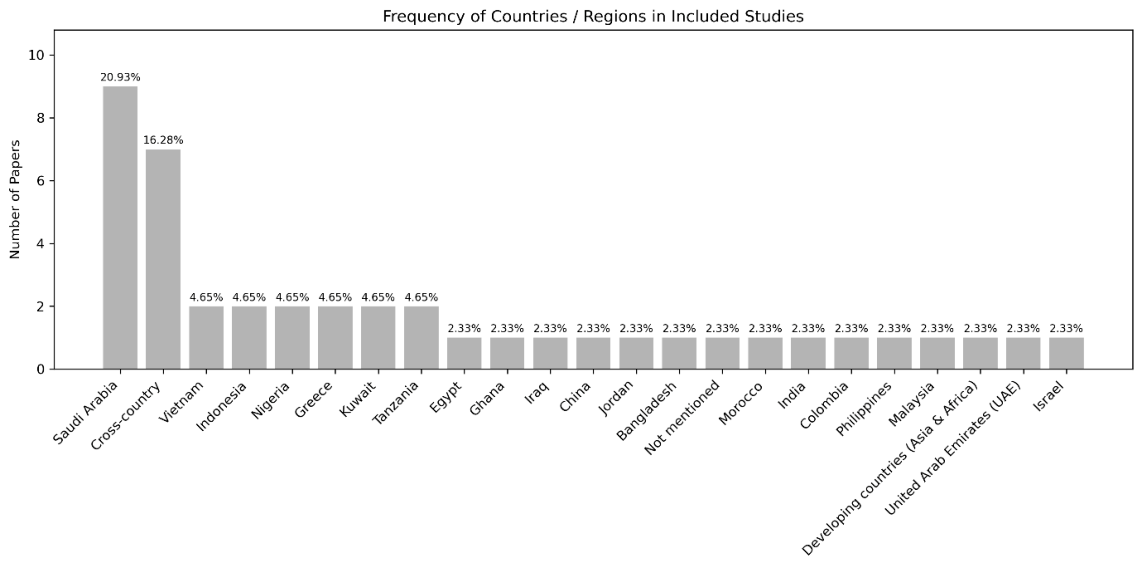
3.1.1. Country and Regional Distribution
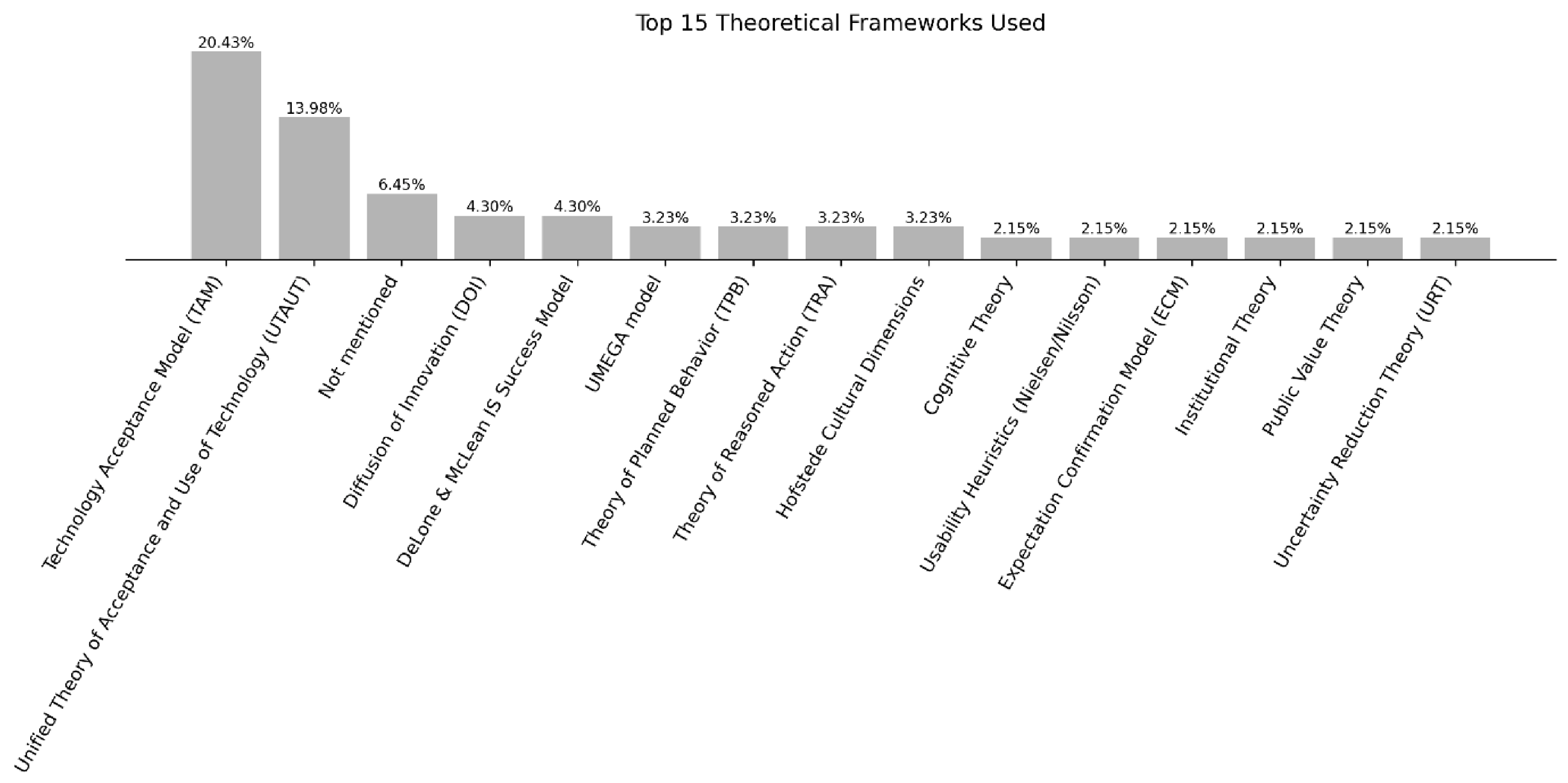
3.1.2. Theoretical Frameworks Used
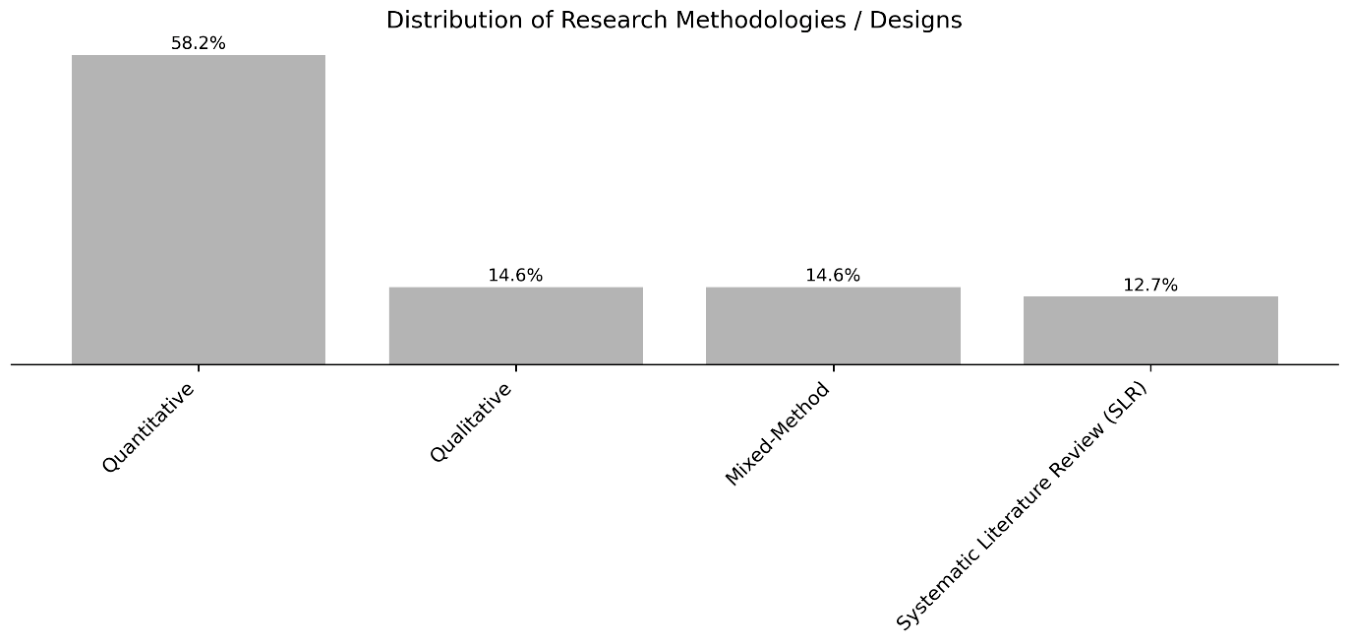
3.1.3. Research Methodologies and Study Design
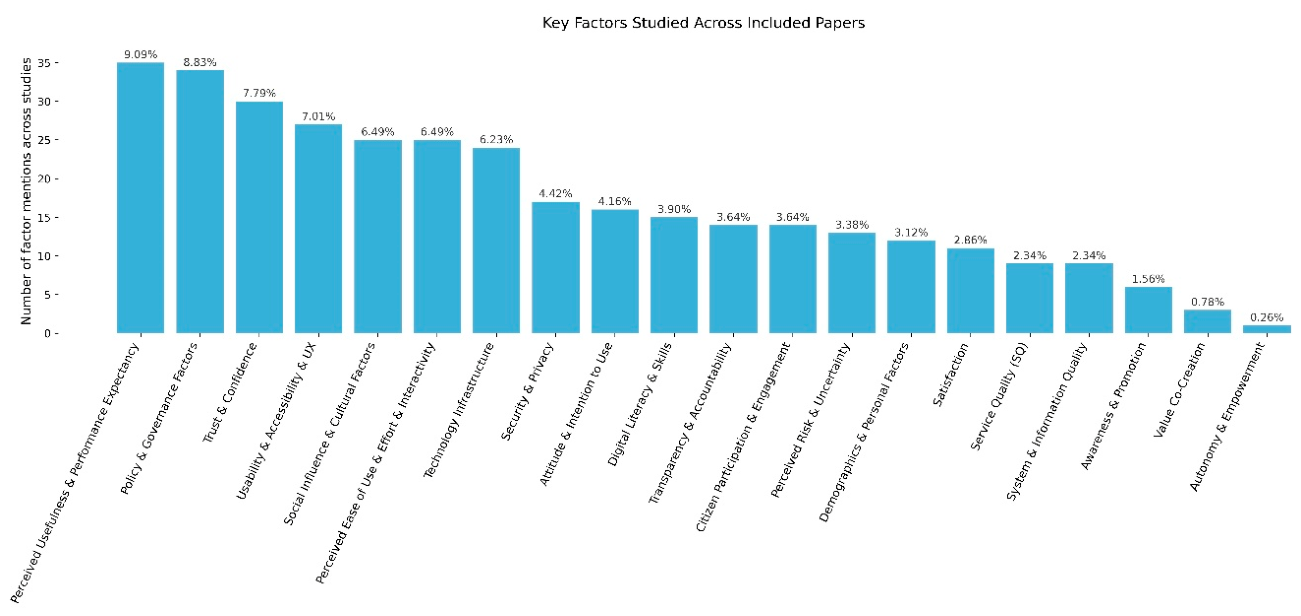
3.1.4. Reported Determinants Across Included Studies
3.2. Determinant Evidence Summary by Higher-Order Groupings
3.2.1. Citizen-Perceived Value and Effort
3.2.2. Institutional Assurance and Risk Management
3.2.3. Service Experience and Interaction Design
3.2.4. Capability, Inclusion, and User Characteristics
3.2.5. Governance and Service Capacity
3.2.6. Participation, Co-Creation, Autonomy, and Empowerment
4. Discussion
- What ADI contributes beyond adoption and IS success models?
- Strength of evidence and remaining gaps
4.1. Implications for Practice and Policy
4.2. Challenges and Future Directions
- I.
- Conceptual and measurement challenges: Analytically distinct constructs are sometimes operationalized in overlapping ways. Perceived usefulness or performance expectancy can drift toward service quality, while effort expectancy can be conflated with usability. Future work should use validated scales, report reliability and model fit, test for multicollinearity when co-modeled with quality constructs, and complement self-reports with behavioral indicators such as completion, abandonment, and reuse.
- II.
- Methodological challenges: Much of the evidence is cross-sectional and based on convenience samples, which limits causal inference and generalizability. There is limited reporting of effect sizes, moderator tests, and robustness checks. Longitudinal designs, natural experiments, and field trials are needed to trace intention into continued use and e-loyalty, and to isolate the effects of transparency, participation features, or accessibility improvements on behavior.
- III.
- Data and reporting challenges: Studies rarely report accessibility conformance or detailed user characteristics related to disability, language, or connectivity constraints. Participation and value co-creation are under-examined despite their conceptual relevance to authenticity. Future research should adopt reporting standards that include accessibility, assisted-channel use, device patterns, and socio-demographic moderators, and should elevate participation from rhetoric to measurable features in the service journey.
- IV.
- Context and equity challenges: Evidence is concentrated in specific regions and service types, while rural settings, low-resource contexts, and complex multi-agency transactions are less visible. Cultural norms and legal safeguards appear to moderate trust and value perceptions, yet are not consistently modeled. Comparative, multi-country studies and multi-level models that incorporate institutional variables would strengthen generalizability and external validity.
- V.
- Implementation challenges for agencies: Delivering ADI at scale requires balancing security and privacy with ease of use, modernizing legacy systems without disrupting essential services, coordinating across agencies, and sustaining accessible-by-default practices under tight budgets. Practical strategies include progressive enhancement for low-bandwidth users, mobile-first patterns that reduce data entry, clear consent and data-use notices at the point of capture, and transparent service level indicators that set expectations and build trust over time.
- Rigorous tests of transparency, status tracking, and participation features on intention, use, and continuance.
- Longitudinal studies linking early experience, satisfaction, and perceived value to e-loyalty.
- Inclusion of accessibility and literacy measures as first-class variables.
- Mixed methods design that explains why determinants succeed or fail in particular contexts; and
- Development of a concise ADI measurement toolkit that pairs validated scales with behavioral telemetry for replication across services.
5. Conclusions
Author Contributions
Funding
Institutional Review Board Statement
Informed Consent Statement
Data Availability Statement
Acknowledgments
Conflicts of Interest
Appendix A
- Search Strings Used
- Search string:TITLE-ABS-KEY ((“Authentic Digital Interaction” OR “Digital Interaction” OR “Citizen Engagement” OR “E-Government Interaction” OR “E-Government Adoption”)AND (“Perceived Ease of Use” OR “Perceived Usefulness” OR Trust OR “Digital Literacy” OR “Digital Capability” OR “System Interactivity” OR “Digital Culture” OR “Digital Stress” OR “Value Co-Creation”)AND (“E-Government” OR “Digital Government” OR “Public Sector Digitalization” OR “Government-to-Citizen”)AND (“Saudi Arabia” OR “Kingdom of Saudi Arabia” OR “Middle East” OR “GCC” OR “Developing Countries” OR “Global” OR “Worldwide” OR “Cross-Country” OR “International Study”))Filters applied: Publication years 2020–2025; language = English; document types = Article or Review.
- Search string:TS = ((“Authentic Digital Interaction” OR “Digital Interaction” OR “Citizen Engagement” OR “E-Government Interaction” OR “E-Government Adoption” OR “Digital Participation”)AND (“Perceived Ease of Use” OR “Perceived Usefulness” OR Trust OR “Digital Literacy” OR “Digital Capability” OR “System Interactivity” OR “Digital Culture” OR “Digital Stress” OR “Value Co-Creation”)AND (“E-Government” OR “Digital Government” OR “Government-to-Citizen” OR “Public Sector Digitalization”)AND (“Saudi Arabia” OR “Middle East” OR “Developing Countries” OR “Global” OR “Worldwide” OR “Cross-Country” OR “International”))Filters applied: Publication years 2020–2025; document types = Article or Review; language = English.
- Search string:(“E-Government” OR “Digital Government” OR “Public Sector Digitalization”)AND (“Authentic Digital Interaction” OR “Digital Interaction” OR “Citizen Engagement” OR “E-Government Adoption”)AND (“Trust” OR “Digital Literacy” OR “System Interactivity” OR “Perceived Ease of Use” OR “Digital Culture” OR “Digital Stress” OR “Value Co-Creation”)AND (“Saudi Arabia” OR “Middle East” OR “Developing Countries” OR “Global” OR “Worldwide” OR “Cross-Country”)Filters applied: Publication years 2020–2025. Where available, results were limited to English-language article and review-type records.
- Search string:(“E-Government” OR “Digital Government” OR “Public Sector Digitalization”)AND (“Authentic Digital Interaction” OR “Digital Interaction” OR “Citizen Engagement” OR “E-Government Adoption” OR “Digital Participation”)AND (“Trust” OR “Digital Literacy” OR “System Interactivity” OR “Perceived Ease of Use” OR “Digital Culture” OR “Digital Stress” OR “Value Co-Creation”)AND (“Saudi Arabia” OR “Middle East” OR “Developing Countries” OR “Global” OR “Worldwide” OR “Cross-Country” OR “International Study”)Filters applied: Publication years 2020–2025; language = English; document types = Article or Review.
- Search string:(“E-Government” OR “Digital Government”)AND (“Citizen Engagement” OR “Digital Interaction” OR “E-Government Adoption”)AND (“Trust” OR “Digital Literacy” OR “System Interactivity” OR “Ease of Use” OR “Value Co-Creation”)AND (“Saudi Arabia” OR “Middle East” OR “Developing Countries” OR “Global” OR “International Study”)Filters applied: Publication years 2020–2025. Where available, results were limited to English-language article and review-type records.
References
- Alzahrani, A.I. A periodical analysis of e-government maturity in Saudi Arabia. Transform. Gov. People Process Policy 2022, 16, 18–31. [Google Scholar] [CrossRef]
- Hashim, H. E-government impact on developing smart cities initiative in Saudi Arabia: Opportunities & challenges. Alex. Eng. J. 2024, 96, 124–131. [Google Scholar] [CrossRef]
- Makki, A.A.; Alqahtani, A.Y. Modeling the Barriers Surrounding Digital Government Implementation: Revealing Prospect Opportunities in Saudi Arabia. Sustainability 2022, 14, 15780. [Google Scholar] [CrossRef]
- Bougherra, M.; Shaikh, A.K.; Yenigun, C.; Hassan-Yari, H. E-government performance in democracies versus autocracies. Int. J. Organ. Anal. 2023, 31, 3275–3294. [Google Scholar] [CrossRef]
- Tissayakorn, K. Comparative analysis of E-government development status of ASEAN member states: Accomplishments and challenges. Sustain. Futures 2025, 10, 101353. [Google Scholar] [CrossRef]
- Aloboud, N.; Alotaibi, R.; Alqahtani, A. Evaluating the Usability and the Accessibility of Saudi E-Government Websites. In Human-Computer Interaction. Design and User Experience. HCII 2020; Lecture Notes in Computer Science (Including Subseries Lecture Notes in Artificial Intelligence and Lecture Notes in Bioinformatics); Springer International Publishing: Cham, Switzerland, 2020; pp. 363–372. [Google Scholar]
- Abdulreda, H.; Abu Doush, I.; AlMeraj, Z. E-government Mobile Web Accessibility Challenges facing People with Visual Impairments: A Multi-Method Evaluation. In Proceedings of the 11th International Conference on Software Development and Technologies for Enhancing Accessibility and Fighting Info-Exclusion; ACM: New York, NY, USA, 2024; pp. 124–132. [Google Scholar]
- Djuric, A. Challenges, Citizens’ Trust and Privacy Protection Models in e-Government Systems: Security and Privacy Perspective: Student paper. In Proceedings of the 2024 23rd International Symposium INFOTEH-JAHORINA (INFOTEH); IEEE: New York, NY, USA, 2024; pp. 1–6. [Google Scholar]
- Venkatesh, V.; Thong, J.Y.L.; Xu, X. Consumer Acceptance and Use of Information Technology: Extending the Unified Theory of Acceptance and Use of Technology. MIS Q. 2012, 36, 157–178. [Google Scholar] [CrossRef]
- Venkatesh, V.; Morris, M.G.; Davis, G.B.; Davis, F.D. User Acceptance of Information Technology: Toward a Unified View. MIS Q. 2003, 27, 425–478. [Google Scholar] [CrossRef]
- DeLone, W.H.; McLean, E.R. Information systems success: The quest for the dependent variable. Inf. Syst. Res. 1992, 3, 60–95. [Google Scholar] [CrossRef]
- Davis, F.D. Perceived Usefulness, Perceived Ease of Use, and User Acceptance of Information Technology. MIS Q. 1989, 13, 319–340. [Google Scholar] [CrossRef]
- Abdulkareem, A.K.; Mohd Ramli, R. Does trust in e-government influence the performance of e-government? An integration of information system success model and public value theory. Transform. Gov. People Process Policy 2022, 16, 1–17. [Google Scholar] [CrossRef]
- Amin, S.F.; Saad, A.B.; Lajis, A. Technology Acceptance Factors for Implementing the E-Government Systems in Saudi Arabia. Adv. Internet Things 2022, 12, 125–141. [Google Scholar] [CrossRef]
- Alsarraf, H.A.; Aljazzaf, S.; Ashkanani, A.M. Do you see my effort? An investigation of the relationship between e-government service quality and trust in government. Transform. Gov. People Process Policy 2023, 17, 116–133. [Google Scholar] [CrossRef]
- AbdulKareem, A.K.; Oladimeji, K.A. Cultivating the digital citizen: Trust, digital literacy and e-government adoption. Transform. Gov. People Process Policy 2024, 18, 270–286. [Google Scholar] [CrossRef]
- Saleh, R.A.; Haizan Nor, R.N.; Islam, M.T.; Jusoh, Y.Y.; Abdullah, S.; Mooduto, H.; Dahlan, A.A. Citizen Adoption of E-Government Services: A Systematic Literature Review with Weight and Meta-Analysis. Int. J. Adv. Sci. Eng. Inf. Technol. 2024, 14, 1470–1479. [Google Scholar] [CrossRef]
- Aleisa, N. Key factors influencing the e-government adoption: A systematic literature review. J. Innov. Digit. Transform. 2024, 1, 14–31. [Google Scholar] [CrossRef]
- Tremblay-Cantin, C.-A.; Mellouli, S.; Cheikh-Ammar, M.; Khechine, H. E-government Service Adoption by Citizens: A Literature Review and a High-level Model of Influential Factors. Digit. Gov. Res. Pract. 2023, 4, 1–24. [Google Scholar] [CrossRef]
- Hasan, A.; Alenazy, A.A.; Habib, S.; Husain, S. Examining the drivers and barriers to adoption of e-government services in Saudi Arabia. J. Innov. Digit. Transform. 2024, 1, 139–157. [Google Scholar] [CrossRef]
- Moher, D.; Shamseer, L.; Clarke, M.; Ghersi, D.; Liberati, A.; Petticrew, M.; Shekelle, P.; Stewart, L.A.; PRISMA-P Group. Preferred reporting items for systematic review and meta-analysis protocols (PRISMA-P) 2015 statement. Syst. Rev. 2015, 4, 1. [Google Scholar] [CrossRef] [PubMed]
- Stone, P.W. Popping the (PICO) question in research and evidence-based practice. Appl. Nurs. Res. 2002, 15, 197–198. [Google Scholar] [CrossRef]
- Sihotang, D.M.; Hidayanto, A.N.; Purwandari, B.; Wijoyono, E.; Diana, E.; Putra, R.R. Factors Affecting E-government Adoption at the Micro Level of Government in Developing Countries: A Systematic Literature Review. In Proceedings of the 2023 7th International Conference on Business and Information Management (ICBIM); IEEE: New York, NY, USA, 2023; pp. 26–30. [Google Scholar]
- Setyawan, N.H.; Sulistyo, S.; Hartanto, R. A Review E-Government Implementation: Its Impact on Public Value Creation and Citizen Perspectives. In Proceedings of the 2024 International Conference on Smart Computing, IoT and Machine Learning (SIML); IEEE: New York, NY, USA, 2024; pp. 137–144. [Google Scholar]
- Quaye, J.D.; Sneiders, E. E-government Adoption: The Role of Perception of Digital Technology in the Public Service of Ghana. In Proceedings of the 2020 Seventh International Conference on eDemocracy & eGovernment (ICEDEG); IEEE: New York, NY, USA, 2020; pp. 225–230. [Google Scholar]
- Almufti, M.; Sellami, R.; Belguith, L.H. Validation of a Measuring Model as a Key Aspect in the Adoption of E-Government in Developing Countries. In Proceedings of the 2024 5th International Conference on Advancements in Computational Sciences (ICACS); IEEE: New York, NY, USA, 2024; pp. 1–7. [Google Scholar]
- Uyen Nguyen, T.T.; Van Nguyen, P.; Truong, G.Q.; Ngoc Huynh, H.T.; Hoang Le, T.P.M. Investigating the impact of citizen relationship quality and the moderating effects of citizen involvement on E-government adoption. J. Open Innov. Technol. Mark. Complex. 2024, 10, 100372. [Google Scholar] [CrossRef]
- Amosun, T.S.; Chu, J.; Rufai, O.H.; Muhideen, S.; Shahani, R.; Gonlepa, M.K. Does e-government help shape citizens’ engagement during the COVID-19 crisis? A study of mediational effects of how citizens perceive the government. Online Inf. Rev. 2022, 46, 846–866. [Google Scholar] [CrossRef]
- Khan, A.; Krishnan, S. Citizen engagement in co-creation of e-government services: A process theory view from a meta-synthesis approach. Internet Res. 2021, 31, 1318–1375. [Google Scholar] [CrossRef]
- Nawafleh, S.; Khasawneh, A. Drivers of citizens E-loyalty in E-government services: E-service quality mediated by E-trust based on moderation role by system anxiety. Transform. Gov. People Process Policy 2024, 18, 217–240. [Google Scholar] [CrossRef]
- Rahman, M.; Yeasmin, T.; Hasan, M.M.; Sharmeen, S. An Analytical Approach to Evaluating the Usability of E-Government Websites in Bangladesh. In Proceedings of the 3rd International Conference on Computing Advancements; ACM: New York, NY, USA, 2024; pp. 216–223. [Google Scholar]
- Bernadas, A.G.P.; Maiquez, J.D.P.; Cahigas, M.M.L. Evaluation of the Usability and User Experience of Selected Philippine E-Government Service Websites. In Proceedings of the 2024 8th International Conference on Software and e-Business; ACM: New York, NY, USA, 2024; pp. 19–24. [Google Scholar]
- Méndez-Rivera, C.; Patiño-Toro, O.; Valencia-Arias, A.; Arango-Botero, D. Factors Influencing the Adoption of E-Government Services: A Study among University Students. Economies 2023, 11, 225. [Google Scholar] [CrossRef]
- Kumar, R.; Mukherjee, A.; Sachan, A. Factors influencing indirect adoption of e-Government services: A qualitative study. Inf. Syst. e-Bus. Manag. 2023, 21, 471–504. [Google Scholar] [CrossRef]
- El Harim, O.; El Harmouzi, N. The Role of Media in the E-Government Adoption in Morocco: A Diffusion of Innovation and Technology Acceptance Model Perspective Using PLS-SEM. Digital 2025, 5, 39. [Google Scholar] [CrossRef]
- Thi Uyen Nguyen, T.; Van Nguyen, P.; Thi Ngoc Huynh, H.; Truong, G.Q.; Do, L. Unlocking e-government adoption: Exploring the role of perceived usefulness, ease of use, trust, and social media engagement in Vietnam. J. Open Innov. Technol. Mark. Complex. 2024, 10, 100291. [Google Scholar] [CrossRef]
- Pamungkas, A.C.; Anityasari, M.; Sonhaji, A.I. Measuring User Acceptance on E-Government Adoption in an Indonesian Context: A Study of Extended Technology Acceptance Model. Int. J. Electron. Gov. 2024, 16, 172–195. [Google Scholar] [CrossRef]
- Fakhruzzaman, M.N.; Dimitrova, D.V. Factors influencing e-government adoption in indonesia: The importance of perceived risk. J. Adv. Res. Dyn. Control Syst. 2020, 12, 125–131. [Google Scholar]
- Abdul Rahim, N.F.; Abbasi, G.A.; Iranmanesh, M.; Christopher, N.; Amran, A. Determinants of continuous intention to use e-government services: An extension of technology continuance theory. J. Syst. Inf. Technol. 2023, 25, 245–267. [Google Scholar] [CrossRef]
- Al Sayegh, A.J.; Ahmad, S.Z.; AlFaqeeh, K.M.; Singh, S.K. Factors affecting e-government adoption in the UAE public sector organisations: The knowledge management perspective. J. Knowl. Manag. 2023, 27, 717–737. [Google Scholar] [CrossRef]
- Alajmi, M.; Mohammadian, M.; Talukder, M. The determinants of smart government systems adoption by public sector organizations in Saudi Arabia. Heliyon 2023, 9, e20394. [Google Scholar] [CrossRef]
- Al-Hawamleh, A.M. Investigating the multifaceted dynamics of cybersecurity practices and their impact on the quality of e-government services: Evidence from the KSA. Digit. Policy Regul. Gov. 2024, 26, 317–336. [Google Scholar] [CrossRef]
- Ayyash, M.M.; Herzallah, F.A.T.; Al Sharafi, M.A. Arab cultural dimensions model for e-government services adoption in public sector organisations: An empirical examination. Electron. Gov. Int. J. 2022, 18, 9–44. [Google Scholar] [CrossRef]
- Mandari, H.E.; Koloseni, D.N. Determinants of continuance intention of using e-government services in Tanzania: The role of system interactivity as moderating factor. Transform. Gov. People Process Policy 2023, 17, 15–38. [Google Scholar] [CrossRef]
- Mirkovski, K.; Rouibah, K.; Lowry, P.; Paliszkiewicz, J.; Ganc, M. Cross-country determinants of citizens’ e-government reuse intention: Empirical evidence from Kuwait and Poland. Inf. Technol. People 2024, 37, 1864–1896. [Google Scholar] [CrossRef]
- Mushi, R.M. Assessing the factors influencing intention to use e-government in Tanzania: The perspective of trust, participation and transparency. J. Electron. Bus. Digit. Econ. 2024, 3, 156–169. [Google Scholar] [CrossRef]
- Patergiannaki, Z.; Pollalis, Y.A. Bridging the gap: Assessing disparities in e-Government service offerings and citizen demand. Transform. Gov. People Process Policy 2023, 17, 532–551. [Google Scholar] [CrossRef]
- Patergiannaki, Z.; Pollalis, Y.A. E-government quality from the citizen’s perspective: The role of perceived factors, demographic variables and the digital divide. Int. J. Public Sect. Manag. 2024, 37, 232–254. [Google Scholar] [CrossRef]
- Rosenberg, D. Older adults’ e-government use for bureaucratic and transactional purposes: The role of website-related perceptions and subjective digital skills. Transform. Gov. People Process Policy 2024, 18, 257–269. [Google Scholar] [CrossRef]



| No. | Author(s) | Title of Study | Country/Region | Key Factors Studied | Theoretical Framework Used | Methodology/Design | Sample/Participants |
|---|---|---|---|---|---|---|---|
| 1 | [23] | Factors Affecting E-government Adoption at the Micro Level of Government in Developing Countries: A Systematic Literature Review | Cross-country (Malaysia, Namibia, India, Africa, Tanzania, Peru, Indonesia, Nebraska, China, Pakistan, Afghanistan, Thailand) | -Social influence -Facilitating conditions -ICT skill/capability -Financial -Leadership -Trust -Self-efficacy -Compatibility -Ease of use -Usefulness -Awareness -Image -Trialability -Government support | Technology Acceptance Model (TAM); Unified Theory of Acceptance and Use of Technology (UTAUT); Theory of Diffusion of Innovation (DoI) | Systematic Literature Review (SLR) | Secondary data review (35 relevant papers from Science Direct, Scopus, IEEE Xplore, and ACM) |
| 2 | [8] | Challenges, Citizens’ Trust and Privacy Protection Models in e-Government Systems: Security and Privacy Perspective: Student paper | Cross-country (Switzerland, United Kingdom, Oman, India, China, Netherlands, Russian Federation, and others from Africa, South America, Asia, and Europe) | -Security -Privacy -Trust -Digital Divide -Inadequate Services -Limited Technology Access -Robust Security Protocols -Secure Communication -Data Protection Legislation | Barbara Kitchenham’s framework for systematic literature reviews | Systematic Literature Review | Secondary data review |
| 3 | [24] | A Review E-Government Implementation: Its Impact on Public Value Creation and Citizen Perspectives | Cross-country (China, India, Nigeria, Pakistan, and others) | -Information Quality -System Quality -Trust in e-government -Behavioral Intention to Use -Citizen Satisfaction -Public Value -Effort Expectancy -Ease of Use -Facilitating Condition -Performance Expectancy -Social Influence -Perceived Usefulness -Transparency -Openness -Responsiveness -Trust of Internet/Social Media/Technology -Citizen Engagement -Performance -Effectiveness -Acceptance -Adoption of e-Government | Unified Theory of Acceptance and Use of Technology (UTAUT); DeLone & McLean Model; SAP-LAP Framework; Conceptual models inspired by UTAUT, TAM, IS Success Model, UMEGA, Public Value theory, and eGOVQUAL | Systematic Literature Review (using PRISMA method) | Secondary data review (systematic literature review of 69 papers) |
| 4 | [25] | E-government Adoption: the Role of Perception of Digital Technology in the Public Service of Ghana | Ghana | -Perceived Usefulness -Perceived Ease of Use -Language as a Medium of Communication -Belief in Job Performance Gains -Commitment and Skills of Workmates -Availability of Digital Tools -Willingness to Go Paperless -Availability of Skilled Human Resources -Lack of Clear Plans for Digitization -Lack of Enjoyment in Using Digital Technology -Flexible Access to Information and Services | Technology Acceptance Model (TAM) | Quantitative (online questionnaire-based survey analysis) | 61 public servants (Ghana) |
| 5 | [26] | Validation of a Measuring Model as a Key Aspect in the Adoption of E-Government in Developing Countries | Iraq | -Political Factors -Economic Factors -Social Factors -Technological Factors -Expected Performance -Expected Effort -Social Influence -Facilitating Conditions -Behavioral Intention | Unified Theory of Acceptance and Use of Technology (UTAUT) model integrated with the PEST framework | Quantitative (survey-based SEM analysis) | 560 Iraqi citizens |
| 6 | [27] | Investigating the impact of citizen relationship quality and the moderating effects of citizen involvement on E-government adoption | Vietnam | -Relational bonds (financial, social, and structural) -Relationship quality (trust and satisfaction) -Citizen involvement (enduring and situational) -SocioCitizenry theory -Traditional models (TAM, TRA, UTAUT) | SocioCitizenry theory; Technology Acceptance Model (TAM); Theory of Reasoned Action (TRA); Unified Theory of Acceptance and Use of Technology (UTAUT) | Quantitative (survey-based SEM analysis) | 595 citizens (Tien Giang Province, Vietnam) |
| 7 | [4] | E-government performance in democracies versus autocracies | Egypt | Citizen Participation, Transparency, Efficiency, International Competitiveness, Strategic Management, Policy Objectives | Not mentioned (the paper does not specify a particular theoretical framework or model like TAM, UTAUT, or IS Success Model) | Mixed-method (quantitative analysis using statistical databases and Jupyter software; qualitative analysis using expert interviews) | 4 expert interviewees (professors of political science and economics at Cairo University) |
| 8 | [2] | E-government impact on developing smart cities initiative in Saudi Arabia: Opportunities & challenges | Saudi Arabia | Trust, Digital Infrastructure, Funding, Confidence, Accessibility, Usability, Participation, Autonomy, Service Quality | Not mentioned (the paper does not specify any theoretical framework or model like TAM, UTAUT, or IS Success Model) | Qualitative (meta-synthesis technique) | Secondary data review |
| 9 | [28] | Does e-government help shape citizens’ engagement during the COVID-19 crisis? A study of mediational effects of how citizens perceive the government | China | Trust in Government, Government Transparency, Government Reputation | Not mentioned (the paper does not specify a particular theoretical framework or model) | Quantitative (survey-based SEM analysis) | 866 Chinese citizens (Hefei, Shanghai, and Nanjing) |
| 10 | [29] | Citizen engagement in co-creation of e-government services: a process theory view from a meta-synthesis approach | Cross-country (United Kingdom, USA, Estonia, Burkina Faso) | -Government’s Role in Fostering Participation -Bottom-Up Approach -Organizational Readiness (Strategies, Leadership, Human Resources, Communication, Collaboration, Policy Formulation, Financial Sustainability, Change Management) -Social Readiness (Government Officials’ Commitment, Societal Awareness, Civic Capacity) -Environmental Readiness (Legal Systems and Regulations) -Stages of Co-creation (Initiation, Open Participation, Open Collaboration, Engagement) | Process Theory View of Enabling Co-creation of E-Government Services; Open Innovation | Qualitative (meta-synthesis of qualitative case studies) | Secondary data review (meta-synthesis of 14 qualitative studies) |
| 11 | [5] | Comparative analysis of E-government development status of ASEAN member states: Accomplishments and challenges | Brunei; Cambodia; Indonesia; Laos; Malaysia; Myanmar; Philippines; Singapore; Thailand; Vietnam | -Inadequate internet access -Low digital literacy -Digital divides -Public distrust in digital platforms -Digital infrastructure development -Cybersecurity and data protection laws -Transparency -Participation (EPI) -Digital literacy enhancement -Public trust | Neoinstitutional Theory; Diffusion of Innovation Theory | Mixed-method (qualitative literature review; quantitative analysis using descriptive statistics, Pearson correlation analysis, and cluster analysis) | Secondary data review (United Nations E-government Survey data from 2014 to 2024) |
| 12 | [30] | Drivers of citizens E-loyalty in E-government services: E-service quality mediated by E-trust based on moderation role by system anxiety | Jordan | -E-service quality (e-SQ) -E-trust -System anxiety -Transparency -Accountability -Data security -Personalized services -Citizen engagement -Continuous feedback evaluation -User-centric design principles | Not mentioned (the study does not specify a particular theoretical framework like TAM or UTAUT, but rather explores the interconnections between e-SQ, e-trust, e-loyalty, and system anxiety in the context of e-government services) | Quantitative (survey-based SEM analysis) | 532 Jordanian citizens using e-government services; 47.4% male, 52.6% female; majority under 24 years old; predominantly high educational background (63.3% with bachelor’s degree or higher) |
| 13 | [31] | An Analytical Approach to Evaluating the Usability of E-Government Websites in Bangladesh | Bangladesh | Usability, User Satisfaction, Digital Literacy, Language Flexibility, Symbolic Layout, Operational Status | ISO9241 standards; Usability Heuristics | Mixed-method (systematic literature review and heuristic evaluation) | Secondary data review (190 government websites in Bangladesh) |
| 14 | [19] | E-government Service Adoption by Citizens: A Literature Review and a High-level Model of Influential Factors | Not mentioned (the paper does not specify a country or region, and the context is broad and international) | -Citizen’s internal factors -Risk and security -Practicality -Sociodemographic factors -Social factors -Potential benefits -User adoption -Citizen’s trust -Government factors -Perceived ease of use -Perceived usefulness -Trust | The study proposes a new model specific to the e-government context, informed by existing theories such as TRA, TPB, TAM, and UTAUT, but does not primarily apply any of these models as its theoretical framework. | Systematic Literature Review | Secondary data review |
| 15 | [7] | E-government Mobile Web Accessibility Challenges facing People with Visual Impairments: A Multi-Method Evaluation | Kuwait | Usability, Accessibility, User Experience, Technical Barriers (e.g., alternative text, color contrast) | Not mentioned (the paper does not specify a theoretical framework like TAM, UTAUT, or IS Success Model) | Mixed-method (usability testing with visually impaired participants, automatic accessibility evaluation tools, and expert evaluations) | 12 participants with visual impairments and blindness (Kuwait)-recruited from the Kuwait Blind Association |
| 16 | [32] | Evaluation of the Usability and User Experience of Selected Philippine E-Government Service Websites | Philippines | Usability, Perceived Usefulness (PU), Perceived Ease of Use (PEOU), Behavioral Intention to Use (BI), Learnability, Efficiency, Memorability, Errors, Satisfaction | System Usability Scale (SUS); Technology Acceptance Model (TAM) | Quantitative (survey-based SUS and TAM analysis with multivariate correlation and linear regression) | 30 citizens/users (Philippines) |
| 17 | [33] | Factors Influencing the Adoption of E-Government Services: A Study among University Students | Colombia | -Perceived Usefulness -Subjective Norm -Perceived Ease-of-Use -Cultural Factors -Usability -Data Privacy -Lack of Trust in Governments -Entrenched Mentalities -Inadequate Infrastructure -Digital Literacy Gaps -Resistance to Change | Technology Acceptance Model (TAM); Unified Theory of Acceptance and Use of Technology (UTAUT); Decomposed Theory of Planned Behavior (DTPB); C-TAM-TPB Model | Quantitative (survey-based SEM analysis) | 403 university students (Medellín) |
| 18 | [34] | Factors influencing indirect adoption of e-Government services: a qualitative study | India | -Access convenience to intermediary -Intermediaries’ service charge -Risk-averse characteristics -Value-added services -Lack of resources -Lack of computer self-efficacy -Perceived difficulty-to-use -Lack of multilingual option -Perceived awareness -Perceived benefits -Compatibility -Trust of intermediary -Social influence | Grounded Theory Approach | Qualitative (grounded theory approach using semi-structured interviews) | 47 e-Government users in India (including government servants, working professionals, businesspersons, academicians, unemployed, and retired people) |
| 19 | [35] | The Role of Media in the E-Government Adoption in Morocco: A Diffusion of Innovation and Technology Acceptance Model Perspective Using PLS-SEM | Morocco | Trust, Perceived Ease of Use, Satisfaction, Relative Advantage, Complexity, Observability, Compatibility, Media Influence, Digitalization | Technology Acceptance Model (TAM); Diffusion of Innovations (DOI) theory | Quantitative (survey-based SEM analysis) | 311 residents of the Rabat-Salé-Kénitra region, Morocco; including civil service employees, students, and private sector employees |
| 20 | [36] | Unlocking e-government adoption: Exploring the role of perceived usefulness, ease of use, trust, and social media engagement in Vietnam | Vietnam | -Perceived Usefulness (PUF) -Perceived Ease of Use (PEU) -Trust in E-government (TEG) -Social Media Use -Citizen Satisfaction | Technology Acceptance Model (TAM) | Quantitative (survey-based SEM analysis) | 529 citizens (southern Vietnam), primarily heads of households with experience in online public services and in management positions |
| 21 | [37] | Measuring user acceptance of e-government adoption in an Indonesian context: a study of the extended technology acceptance model | Indonesia | Trust, Perceived Risk, Attitude towards Use, Perceived Usefulness, Perceived Ease of Use, Computer Self-Efficacy, Subjective Norms, Behavioral Intention | Extended Technology Acceptance Model (TAM) | Quantitative (survey-based SEM analysis) | 363 Surabaya residents (citizens/users of KLAMPID) |
| 22 | [17] | Citizen Adoption of E-Government Services: A Systematic Literature Review with Weight and Meta-Analysis | context: developing countries in Asia and Africa | -Perceived Trust -Perceived Quality -Performance Expectancy -Effort Expectancy -Social Influence -Self-Efficacy -Facilitating Conditions -Perceived Satisfaction (mediator) -Attitude (mediator) -Age (moderator) -Gender (moderator) -Education (moderator) -Experience with e-government services (moderator) | Unified Theory of Acceptance and Use of Technology (UTAUT); Technology Acceptance Model (TAM); UMEGA model; Government Adoption Model (GAM); Theory of Reasoned Action (TRA); Theory of Planned Behavior (TPB); Information Systems Success Model (DeLone & McLean) | Systematic Literature Review (quantitative meta-analysis) | Secondary data review of 43 quantitative research articles on e-government adoption in developing countries (Asia and Africa) |
| 23 | [38] | Factors influencing e-government adoption in indonesia: The importance of perceived risk | Indonesia | Perceived Usefulness, Perceived Ease of Use, Perceived Risk, Trust, Social Influence | Technology Acceptance Model (TAM) with additional factors: Perceived Risk, Social Influence, and Trust | Quantitative (survey-based SEM analysis) | 472 students from several universities in Indonesia (Institut Teknologi Sepuluh Nopember, Universitas Indonesia, Universitas Airlangga, Universitas Hasanuddin, Universitas Diponegoro, and Institut Pertanian Bogor) |
| 24 | [39] | Determinants of continuous intention to use e-government services: an extension of technology continuance theory | Malaysia | Trust, Transparency, Habit, Perceived Ease of Use (PEOU), Perceived Usefulness (PU), Confirmation, Satisfaction, Attitude | Technology Continuance Theory (TCT), which integrates elements from Technology Acceptance Model (TAM), Expectation-Confirmation Model (ECM), and Cognitive Model (COGM), extended with trust, transparency, and habit constructs. | Quantitative (survey-based SEM analysis) | 260 residents (Penang, Malaysia) |
| 25 | [13] | Does trust in e-government influence the performance of e-government? An integration of information system success model and public value theory | Nigeria | Trust, Information Quality, Service Quality, System Quality, Public Value, Citizen Participation, Usability, Accessibility | DeLone and Mclean IS Success Model; Public Value Theory | Quantitative (survey-based SEM analysis) | 369 e-government users (Nigeria); primarily staff and students from six federal universities |
| 26 | [16] | Cultivating the digital citizen: trust, digital literacy and e-government adoption | Nigeria | Trust, Digital Literacy, Perceived Usefulness, Perceived Ease of Use, Reliability, Security, Transparency, Usability, Accessibility | Technology Acceptance Model (TAM) | Quantitative (survey-based SEM analysis) | 876 Nigerian citizens who had used e-filing services for tax returns |
| 27 | [40] | Factors affecting e-government adoption in the UAE public sector organisations: the knowledge management perspective | United Arab Emirates (UAE) | -Performance Expectancy: Short-term job performance, Long-term job performance, Client impact -Facilitating Conditions: Leadership support, Employee training, Organizational preparedness | Unified Theory of Acceptance and Use of Technology (UTAUT); 10-factor model | Quantitative (survey-based SEM analysis) | 172 government employees (Dubai and Sharjah, UAE) |
| 28 | [41] | The determinants of smart government systems adoption by public sector organizations in Saudi Arabia | Saudi Arabia | -Security concerns -ICT strategy -Managerial support -Incentives -Trust -Perception | Technology Acceptance Model (TAM); Unified Theory of Acceptance and Use of Technology (UTAUT); Technology, Organization, and Environment (TOE) framework | Quantitative (survey-based SEM analysis) | 419 government employees (Saudi Arabia) from the IT division of the Ministry of Health, Ministry of Foreign Affairs, Ministry of Justice, and Ministry of Education |
| 29 | [18] | Key factors influencing the e-government adoption: a systematic literature review | Indonesia; Ireland; Saudi Arabia | -Trust in e-government (TEG) -Security perceptions -Non-technical factors (cultural, religious, social influences) -Performance expectancy -Effect expectancy -Perceived system quality (PSQ) -Perceived information quality (PIQ) -User satisfaction (US) -Perceived ease of use (PEOU) -Transparency -Previous experiences -Digital divide | Unified Theory of Acceptance and Use of Technology (UTAUT); Technology Acceptance Model (TAM); Diffusion of Innovation (DOI); Theory of Planned Behaviour (TPB); Social Cognitive Theory (SCT); Model of Personal Computer Utilisation (MPCU); Self-determination Theory (SDT); Uncertainty Reduction Theory (URT); Information Systems [IS] Continuance Model; Quality-value-loyalty Chain Model; Theory of Reasoned Action (TRA); Unified Model of Electronic Government Adoption (UMEGA) | Systematic Literature Review | Secondary data review |
| 30 | [42] | Investigating the multifaceted dynamics of cybersecurity practices and their impact on the quality of e-government services: evidence from the KSA | Saudi Arabia | -Organizational culture -Technology infrastructure -Adherence to standards and regulations -Employee training and awareness -Financial investment in cybersecurity | Not mentioned (the paper does not specify a particular theoretical framework or model) | Quantitative (survey-based SEM analysis) | 285 employees (Saudi Electronic University) from a sample of 320 participants |
| 31 | [6] | Evaluating the Usability and the Accessibility of Saudi E-Government Websites | Saudi Arabia | Usability, Accessibility (WCAG 2.0 principles: perceivable, operable, understandable, robust), Consistency and standards, Visibility of system status, Error prevention and recovery | Nilsson’s 10 heuristics; Web Content Accessibility Guidelines (WCAG 2.0) | Mixed-method (expert reviews for usability, automated tools and manual evaluation for accessibility) | Secondary data review (evaluation of five e-government sub-websites) |
| 32 | [15] | Do you see my effort? An investigation of the relationship between e-government service quality and trust in government | Kuwait | -E-government Service Quality -Satisfaction -Perceived Government Effort -Trust in Government | SERVQUAL model; e-SERVQUAL model; Satisfaction framework | Quantitative (survey-based mediated regression analysis) | 723 citizens (Kuwait) |
| 33 | [1] | A periodical analysis of e-government maturity in Saudi Arabia | Saudi Arabia | -Service Quality -Accessibility -Financial Investment -Institutional Governance -Technical Infrastructure (TII) -Institutional Coordination -Usability | Five-stage model | Quantitative (secondary data analysis using the five-stage maturity model) | Secondary data review of 22 government websites in Saudi Arabia |
| 34 | [14] | Technology Acceptance Factors for Implementing the E-Government Systems in Saudi Arabia | Saudi Arabia | -Relative Advantage -Compatibility -Security -Management Support -Performance Expectancy -Perceived Usefulness -Ease of Use -IT Infrastructure -Language -Uncertainty -Financial Resources -Social Influence | Unified Theory of Acceptance and Use of Technology (UTAUT) | Quantitative (survey-based SEM analysis) | 200 participants (employees and end-users of E-Government systems) with a 58% response rate |
| 35 | [43] | Arab cultural dimensions model for e-government services adoption in public sector organisations: an empirical examination | Saudi Arabia | -Power Distance -Uncertainty Avoidance -Collectivism vs. Individualism -Masculinity vs. Femininity -Nepotism -Face-to-face Interactions | Hofstede’s Cultural Dimensions Model; Nepotism; Face-to-face interactions | Quantitative (survey-based SEM analysis) | 137 administrative employees (Saudi Arabia) |
| 36 | [20] | Examining the drivers and barriers to adoption of e-government services in Saudi Arabia | Saudi Arabia | -Cultural Factors -Digital Literacy -Government Policy and Interventions -Privacy and Security -Technical Infrastructure -Support Services -Citizen Trust -Citizen Motivation -Perceived Usefulness -Ease of Use -Perceived Risk | -Technology Acceptance Model (TAM) -Unified Theory of Acceptance and Use of Technology (UTAUT) -Institutional Theory -Hofstede Cultural Dimensions Theory | Mixed-method (quantitative survey-based SEM analysis) | 487 respondents (Jeddah and Madina)-predominantly aged 21–30, nearly equal gender distribution, diverse education levels, well-distributed income, and various occupations including service, students, and business. |
| 37 | [3] | Modeling the Barriers Surrounding Digital Government Implementation: Revealing Prospect Opportunities in Saudi Arabia | Saudi Arabia | -Institutional habits -Political coordination -Ethical concerns -Perceived barriers related to law, organizational practice, finances -Risk aversion -Capacity and skills (project management) -Lack of engagement with and demand from users/citizens -Lack of awareness/strategic thinking -Legal framework issues -Technological resources (software and standards) -Technological infrastructure (computers and networks) -Difficulty articulating benefits to others -Political and management support and leadership | Interpretive Structural Modeling (ISM) | Qualitative (ISM approach with expert opinions collected via questionnaire) | 24 DG experts (Saudi Arabia); leaders and decision-makers in Saudi government agencies responsible for digital transformation programs |
| 38 | [44] | Determinants of continuance intention of using e-government services in Tanzania: the role of system interactivity as moderating factor | Tanzania | System Interactivity, Computer Self-Efficacy, Management Support, Confirmation, Satisfaction, Perceived Usefulness | Expectancy Confirmation Model (ECM) | Quantitative (survey-based SEM analysis) | 213 citizens (Tanzania) who were users of e-government services |
| 39 | [45] | Cross-country determinants of citizens’ e-government reuse intention: empirical evidence from Kuwait and Poland | Cross-country (Kuwait and Poland) | -System Quality -Service Quality -Information Quality -Perceived Value -User Satisfaction -Citizen Trust -Overall Risk -Time Risk -Privacy Risk -Psychological Risks -Uncertainty Avoidance -Masculinity-Femininity -Individualism-Collectivism -Cross-Cultural Trust and Risk | -Delone and McLean IS Success Model -Trust and Risk Models -Hofstede’s Cultural Model | Mixed-method (qualitative interviews and quantitative surveys with PLS regression analysis) | -Qualitative interviews: 81 Kuwaiti citizens -Quantitative surveys: 1582 Kuwaiti citizens; 355 Polish citizens |
| 40 | [46] | Assessing the factors influencing intention to use e-government in Tanzania: the perspective of trust, participation and transparency | Tanzania | Participation, Trust, Transparency | Technology Acceptance Model (TAM) extended with additional constructs: trust, transparency, and participation | Quantitative (survey-based SEM analysis) | 153 respondents (Tanzania)-citizens with experience using e-government sites; 80 males, 119 females |
| 41 | [47] | Bridging the gap: assessing disparities in e-Government service offerings and citizen demand | Greece | Usability, Accessibility, Service Quality, Citizen Participation, System Quality | The study uses a task-oriented categorization framework and a people-centric approach, emphasizing resident engagement and participatory design. It does not explicitly mention specific theoretical models like TAM or UTAUT. | Mixed-method (quantitative survey-based analysis and qualitative content analysis) | 707 residents from 49 Greek municipalities |
| 42 | [48] | E-government quality from the citizen’s perspective: the role of perceived factors, demographic variables and the digital divide | Greece | Perceived Attractiveness (PA), Perceived Usefulness (PU), Perceived Ease of Use (PEOU), Awareness (AWA), Demographic Variables (Age, Education, Economic Activity, Income), Digital Divide | Technology Acceptance Model (TAM); Cognitive Theory | Quantitative (survey-based SEM analysis) | 707 respondents (Greek municipalities) |
| 43 | [49] | Older adults’ e-government use for bureaucratic and transactional purposes: the role of website-related perceptions and subjective digital skills | Israel | -Perceived Security -Perceived Clarity and Simplicity -Subjective Digital Skills | -Uncertainty Reduction Theory -Technology Acceptance Model (TAM) -Resource Appropriation Theory | Quantitative (survey-based binary logistic regression analysis) | 735 Israeli older internet users (aged 60 years and older) |
Disclaimer/Publisher’s Note: The statements, opinions and data contained in all publications are solely those of the individual author(s) and contributor(s) and not of MDPI and/or the editor(s). MDPI and/or the editor(s) disclaim responsibility for any injury to people or property resulting from any ideas, methods, instructions or products referred to in the content. |
© 2026 by the authors. Licensee MDPI, Basel, Switzerland. This article is an open access article distributed under the terms and conditions of the Creative Commons Attribution (CC BY) license.
Share and Cite
Alsalem, H.; Yahya, Y.; Elias, N.F. Authentic Digital Interaction with E-Government: A Systematic Review of Key Determinants. Information 2026, 17, 427. https://doi.org/10.3390/info17050427
Alsalem H, Yahya Y, Elias NF. Authentic Digital Interaction with E-Government: A Systematic Review of Key Determinants. Information. 2026; 17(5):427. https://doi.org/10.3390/info17050427
Chicago/Turabian StyleAlsalem, Hassan, Yazrina Yahya, and Nur Fazidah Elias. 2026. "Authentic Digital Interaction with E-Government: A Systematic Review of Key Determinants" Information 17, no. 5: 427. https://doi.org/10.3390/info17050427
APA StyleAlsalem, H., Yahya, Y., & Elias, N. F. (2026). Authentic Digital Interaction with E-Government: A Systematic Review of Key Determinants. Information, 17(5), 427. https://doi.org/10.3390/info17050427