Artificial Intelligence Governance Mechanisms—The Chief Data Officer Perspective with a Focus on Agentic AI Governance


Abstract
1. Introduction
- Identify AI governance mechanisms.
- Identify agentic AI governance mechanisms.
- Provide organizations with guidance on the mechanisms that must be addressed in AI governance, with particular emphasis on the mechanisms for agentic AI.
- RQ1. What are AI governance mechanisms?
- RQ2. What are agentic AI governance mechanisms?
2. Background and Related Work
2.1. AI Governance Initiatives and Legislation
2.2. AI Governance Purposes and Context
3. Theoretical Background
3.1. Artificial Intelligence Stakeholder Management
3.2. Model and Data Ownership
3.3. Artificial Intelligence Steering Committee
3.4. Audit and Impact Assessments
3.5. Staff Training

| # | AI Governance Mechanism | References (AI Governance) | References (Agentic AI Governance) |
|---|---|---|---|
| 1 | Artificial Intelligence Stakeholders Involvement | [27,47,73,76,78,79] | [74,75,77,80] |
| 2 | Model and Data Ownership | [3,56,82,83,84,85,86,89,90] | [7,81,87,88] |
| 3 | Artificial Intelligence Steering Committee | [47,56,91,92,93,96,97,98] | [30,94,95,99] |
| 4 | Audit and Impact Assessments | [100,101,103,104,105,106] | [7,102,107,108] |
| 5 | Staff Training | [27,110,113,114] | [8,109,111,112] |
4. Methodology
4.1. Subject-Matter Expert Interviews
4.2. Profiles of Subject-Matter Interviewees
4.3. Coding of the Interviews
4.4. Workshop Agentic AI Governance
5. Findings
5.1. Artificial Intelligence Stakeholder Involvement
5.2. Model and Data Ownership
5.3. Artificial Intelligence Steering Committee
5.4. Audit and Impact Assessments
5.5. Staff Training
5.6. Additional AI Governance Mechanisms and Observations
5.7. AI Governance Framework
6. Discussion
7. Conclusions
Author Contributions
Funding
Institutional Review Board Statement
Informed Consent Statement
Data Availability Statement
Acknowledgments
Conflicts of Interest
Appendix A. Questionnaire Subject-Matter Interviews
- AI Governance definition: How would you define AI Governance?
- Purpose of AI Governance: What are the three most important outcomes of AI Governance?
- AI Governance context:
- How is legislation versus self-regulation impacting AI Governance?
- How is AI Governance related to Data Governance?
- How is AI Governance related to Information Technology Governance?
- How is AI Governance related to Corporate Governance?
- AI Stakeholders: Who are the stakeholders for AI Governance and how can the stakeholders be engaged?
- AI Model life cycle:
- AI Model Development—data scientist perspective: What practices in AI Model Development are required for AI Governance?
- AI Model Maintenance—data scientist perspective: What practices in AI Model Maintenance are required for AI Governance?
- AI Governance mechanisms & measures:
- Is a “human” in the loop a pre-requisite for AI Governance?
- Is model- and data ownership pivotal in achieving AI Governance?
- How is AI Governance impacted by leveraging unstructured data versus structured data?
- Are organizations benefiting from an AI Steering Committee?
- Are organizations benefiting from conducting audits and impact assessments? What is the recommended frequency?
- Are organizations benefiting from staff training—including awareness training? Is training diversification for targeted audiences important?
Appendix B. Overview Interview Findings by Governance Mechanism
| Governance Mechanisms | Interviewees |
|---|---|
| 1. Stakeholder (Artificial Intelligence Stakeholders management) | All interviewees mentioned business as stakeholder, except for four interviewees—implicit mentioning (I5, I7, I18, I19, and I21) and external perspective (I23) Mention explicit C-level roles (I1, I3, I5, I6, I17, I19, and I20) and clarify roles and responsibilities (I10) |
| 2. Model owner or data owner (Model and data ownership) | Need for RACI for model ownership (I2, I5, I6, I15, I17, I18, I21 and I23) Parallels for model and data ownership (I1, I2, I4, I5, I8, I10, I14, I17, I18, I20, I22, and I23) Model stewards (I8, I9, I10, I18, I22, I23) |
| 3. Committee or council (Artificial Intelligence steering committee) | Positive contributions—all interviewees were generally positive on AI steering committee as governance mechanism Concerns (I2, I5, I10, I14, I17, I19 and I21) Making investment decisions (I4 and I5) |
| 4. Audit or impact assessment (Audi and impact assessments) | Despite low AI audit capabilities interviewees were generally positive on audit and impact assessments as governance mechanism Interviewees shared AI audit topics (I2, I3, I4, I5, I6, I15, I17, I21 and I23 |
| 5. Training or awareness or literacy (Staff training) | AI awareness training (I2-I5, I17, I19, I12, and I13) versus AI specialist training (I4, I5, and I13) |
| 6. AI tooling | Additional governance mechanism (I3, I5, I13, I15, I20 and I23) |
Appendix C. Round Table Information Gathering Form

Appendix D. Round Table 1–7 Likert Scores
| # | Q1 | Q2 | Q3 | Q4 | Q5 | |
|---|---|---|---|---|---|---|
| 1 | 5 | 6 | 6 | 5 | 7 | |
| 2 | 1 | 7 | 7 | 4 | 5 | |
| 3 | 7 | 7 | 3 | 3 | 7 | |
| 4 | 1 | 7 | 3 | 2 | 5 | |
| 5 | 6 | 5 | 6 | 6 | 7 | |
| 6 | 4 | 5 | 7 | 6 | 7 | |
| 7 | 5 | 3 | 6 | 3 | 6 | |
| 8 | 3 | 7 | 5 | 5 | 3 | |
| 9 | 5 | 7 | 6 | 6 | 7 | |
| 10 | 6 | 7 | 5 | 4 | 6 | |
| 11 | 3 | 7 | 7 | 4 | 5 | |
| 12 | 7 | 7 | 3 | 2 | 1 | |
| 13 | 3 | 2 | 4 | 5 | 4 | |
| 14 | 4 | 5 | 5 | 4 | 6 | |
| 15 | 4 | 5 | 7 | 6 | 7 | |
| 16 | 5 | 6 | 5 | 6 | 7 | |
| 17 | 5 | 4 | 6 | 5 | 4 | |
| 18 | 5 | 5 | 6 | 4 | 6 | |
| 19 | 3 | 7 | 5 | 4 | 3 | |
| 20 | 6 | 6 | 6 | 1 | 2 | |
| 21 | 6 | 7 | 4 | 4 | 5 | |
| 22 | 5 | 5 | 6 | 4 | 2 | |
| 23 | 5 | 6 | 6 | 6 | 7 | |
| 24 | 6 | 6 | 5 | 2 | 6 | |
| 25 | 4 | 4 | 4 | 4 | 5 | |
| 26 | 3 | 5 | 5 | 4 | 4 | |
| 27 | 3 | 6 | 7 | 4 | 5 | |
| 28 | 5 | 7 | 5 | 7 | 5 | |
| 29 | 5 | 7 | 6 | 7 | 5 | |
| 30 | 5 | 6 | 6 | 4 | 6 | |
| 31 | 6 | 5 | 4 | 6 | 6 | |
| 4.5 | 5.8 | 5.4 | 4.4 | 5.2 | AVERAGE | |
| 1.50 | 1.31 | 1.20 | 1.50 | 1.66 | STDEV |
References
- OECD. Artificial Intelligence in Society; OECD Publishing: Paris, France, 2019. [Google Scholar] [CrossRef]
- European Union. Artificial Intelligence Act (Regulation (EU) 2024/1689). 2024. Available online: https://eur-lex.europa.eu/eli/reg/2024/1689/oj (accessed on 1 June 2025).
- Chawla, C.; Chatterjee, S.; Gadadinni, S.S.; Verma, P.; Banerjee, S. Agentic AI: The building blocks of sophisticated AI business applications. J. AI Robot. Workplace Autom. 2024, 3, 196–210. [Google Scholar] [CrossRef]
- Elgendy, I.A.; Helal, M.Y.; Al-Sharafi, M.A.; Albashrawi, M.A.; Al-Ahmadi, M.S.; Jeon, I.; Dwivedi, Y.K. Agentic systems as catalysts for innovation in FinTech: Exploring opportunities, challenges and a research agenda. Inf. Discov. Deliv. 2025; in press. [CrossRef]
- Rasheed, Z.; Waseem, M.; Sami, M.A.; Kemell, K.K.; Ahmad, A.; Duc, A.N.; Systä, K.; Abrahamsson, P. Autonomous agents in software development: A vision paper. In Agile Processes in Software Engineering and Extreme Programming—Workshops; International Conference on Agile Software Development; Springer Nature: Cham, Switzerland, 2024; pp. 15–23. [Google Scholar]
- Tiwari, A. Conceptualising the emergence of Agentic Urban AI: From automation to agency. Urban Inform. 2025, 4, 13. [Google Scholar] [CrossRef]
- Mukherjee, A.; Chang, H.H. Agentic AI: Autonomy, Accountability, and the Algorithmic Society. arXiv 2025, arXiv:2502.00289. [Google Scholar]
- Sapkota, R.; Roumeliotis, K.I.; Karkee, M. Ai agents vs. agentic ai: A conceptual taxonomy, applications and challenges. arXiv 2025, arXiv:2505.10468. [Google Scholar] [CrossRef]
- Borghoff, U.M.; Bottoni, P.; Pareschi, R. An organizational theory for multi-agent interactions integrating human agents, LLMs, and specialized AI. Discov. Comput. 2025, 28, 138. [Google Scholar] [CrossRef]
- Mosqueira-Rey, E.; Hernández-Pereira, E.; Alonso-Ríos, D.; Bobes-Bascarán, J.; Fernández-Leal, Á. Human-in-the-loop machine learning: A state of the art. Artif. Intell. Rev. 2023, 56, 3005–3054. [Google Scholar] [CrossRef]
- Chen, W.; Chen, L. Generative AI for Business: Frameworks, Techniques, and Governance; GenAI Flows Publishing: Stamford, CT, USA, 2025; ISBN 9798999716118. [Google Scholar]
- Dafoe, A. AI Governance: A Research Agenda; Governance of AI Program: London, UK; Future of Humanity Institute: Oxford, UK; University of Oxford: Oxford, UK, 2018; pp. 1442–1443. [Google Scholar]
- Bengio, Y.; Hinton, G.; Yao, A.; Song, D.; Abbeel, P.; Darrell, T.; Harari, Y.N.; Zhang, Y.-Q.; Xue, L.; Shalev-Shwartz, S.; et al. Managing AI risks in an era of rapid progress. arXiv 2023, arXiv:2310.17688. [Google Scholar] [CrossRef]
- Hendrycks, D.; Mazeika, M.; Woodside, T. An overview of catastrophic AI risks. arXiv 2023, arXiv:2306.12001. [Google Scholar] [CrossRef]
- Rane, N.; Choudhary, S.; Rane, J. Artificial intelligence for enhancing resilience. J. Appl. Artif. Intell. 2024, 5, 1–33. [Google Scholar] [CrossRef]
- Sadeghi, K.; Ojha, D.; Kaur, P.; Mahto, R.V.; Dhir, A. Explainable artificial intelligence and agile decision-making in supply chain cyber resilience. Decis. Support Syst. 2024, 180, 114194. [Google Scholar] [CrossRef]
- Zhang, R.; Chen, X.; Lu, J.; Wen, S.; Nepal, S.; Xiang, Y. Using AI to hack IA: A new stealthy spyware against voice assistance functions in smart phones. arXiv 2018, arXiv:1805.06187. [Google Scholar] [CrossRef]
- Renaud, K.; Warkentin, M.; Westerman, G. From ChatGPT to HackGPT: Meeting the Cybersecurity Threat of Generative AI; MIT Sloan Management Review: Cambridge, MA, USA, 2023; p. 64428. [Google Scholar]
- Wirtz, B.W.; Weyerer, J.C.; Sturm, B.J. The dark sides of artificial intelligence: An integrated AI governance framework for public administration. Int. J. Public Adm. 2020, 43, 818–829. [Google Scholar] [CrossRef]
- Papagiannidis, E.; Enholm, I.M.; Dremel, C.; Mikalef, P.; Krogstie, J. Toward AI governance: Identifying best practices and potential barriers and outcomes. Inf. Syst. Front. 2023, 25, 123–141. [Google Scholar] [CrossRef] [PubMed]
- Tortorella, G.L.; Powell, D.; Hines, P.; Mac Cawley Vergara, A.; Tlapa-Mendoza, D.; Vassolo, R. How does artificial intelligence impact employees’ engagement in lean organisations? Int. J. Prod. Res. 2025, 63, 1011–1027. [Google Scholar] [CrossRef]
- Goos, M.; Savona, M. The governance of artificial intelligence: Harnessing opportunities and mitigating challenges. Res. Policy 2024, 53, 104928. [Google Scholar] [CrossRef]
- Forrester. Forrester Global Tech-Spend to Surpass 4.9 Trillion in 2025. 12 February 2025. Available online: https://www.forrester.com/press-newsroom/forrester-global-tech-spend-to-surpass-4-9-trillion-in-2025/ (accessed on 1 June 2025).
- Gartner. Gartner Forecasts Worldwide GenAI Spending to Reach $644 Billion in 2025. 31 March 2025. Available online: https://www.gartner.com/en/newsroom/press-releases/2025-03-31-gartner-forecasts-worldwide-genai-spending-to-reach-644-billion-in-2025 (accessed on 1 June 2025).
- Brock, J.K.U.; Von Wangenheim, F. Demystifying AI: What digital transformation leaders can teach you about realistic artificial intelligence. Calif. Manag. Rev. 2019, 61, 110–134. [Google Scholar] [CrossRef]
- Beulen, E. Digital Maturity: A Survey in the Netherlands. In Digital Technologies for Global Sourcing of Services; Global Sourcing 2019; Lecture Notes in Business Information Processing; Oshri, I., Kotlarsky, J., Willcocks, L.P., Eds.; Springer: Cham, Switzerland, 2020; Volume 410. [Google Scholar]
- Papagiannidis, E.; Mikalef, P.; Conboy, K. Responsible artificial intelligence governance: A review and research framework. J. Strateg. Inf. Syst. 2025, 34, 101885. [Google Scholar] [CrossRef]
- Townsend, D.M.; Hunt, R.A.; Rady, J.; Manocha, P.; Jin, J.H. Are the Futures Computable? Knightian Uncertainty and Artificial Intelligence. Acad. Manag. Rev. 2025, 50, 415–440. [Google Scholar] [CrossRef]
- Hosseini, S.; Seilani, H. The role of agentic ai in shaping a smart future: A systematic review. Array 2025, 26, 100399. [Google Scholar] [CrossRef]
- Hughes, L.; Dwivedi, Y.K.; Li, K.; Appanderanda, M.; Al-Bashrawi, M.A.; Chae, I. AI Agents and Agentic Systems: Redefining Global it Management. J. Glob. Inf. Technol. Manag. 2025, 28, 175–185. [Google Scholar] [CrossRef]
- Butcher, J.; Beridze, I. What is the state of artificial intelligence governance globally? RUSI J. 2019, 164, 88–96. [Google Scholar] [CrossRef]
- Schiff, D.; Rakova, B.; Ayesh, A.; Fanti, A.; Lennon, M. Explaining the principles to practices gap in AI. IEEE Technol. Soc. Mag. 2021, 40, 81–94. [Google Scholar] [CrossRef]
- Almeida, V.; Mendes, L.S.; Doneda, D. On the development of AI governance frameworks. IEEE Internet Comput. 2023, 27, 70–74. [Google Scholar] [CrossRef]
- Ghosh, A.; Saini, A.; Barad, H. Artificial intelligence in governance: Recent trends, risks, challenges, innovative frameworks and future directions. AI Soc. 2025, 40, 5685–5707. [Google Scholar] [CrossRef]
- Meske, C.; Bunde, E.; Schneider, J.; Gersch, M. Explainable artificial intelligence: Objectives, stakeholders, and future research opportunities. Inf. Syst. Manag. 2022, 39, 53–63. [Google Scholar] [CrossRef]
- Batool, A.; Zowghi, D.; Bano, M. AI governance: A systematic literature review. AI Ethics 2025, 5, 3265–3279. [Google Scholar] [CrossRef]
- Beulen, E.; Plugge, A.; van Hillegersberg, J. Formal and relational governance of artificial intelligence outsourcing. Inf. Syst. e-Bus. Manag. 2022, 20, 719–748. [Google Scholar] [CrossRef]
- Hussein, R.; Zink, A.; Ramadan, B.; Howard, F.M.; Hightower, M.; Shah, S.; Beaulieu-Jones, B.K. Advancing Healthcare AI Governance: A Comprehensive Maturity Model Based on Systematic Review. medRxiv 2024. [Google Scholar] [CrossRef]
- Robles, P.; Mallinson, D.J. Advancing AI governance with a unified theoretical framework: A systematic review. Perspect. Public Manag. Gov. 2025, 8, 213–227. [Google Scholar] [CrossRef]
- Gasser, U.; Almeida, V.A. A layered model for AI governance. IEEE Internet Comput. 2017, 21, 58–62. [Google Scholar] [CrossRef]
- Cihon, P.; Maas, M.M.; Kemp, L. Fragmentation and the future: Investigating architectures for international AI governance. Glob. Policy 2020, 11, 545–556. [Google Scholar] [CrossRef]
- Radu, R. Steering the governance of artificial intelligence: National strategies in perspective. Policy Soc. 2021, 40, 178–193. [Google Scholar] [CrossRef]
- Sigfrids, A.; Leikas, J.; Salo-Pöntinen, H.; Koskimies, E. Human-centricity in AI governance: A systemic approach. Front. Artif. Intell. 2023, 6, 976887. [Google Scholar] [CrossRef] [PubMed]
- Thierer, A.; Castillo O’Sullivan, R.; Mitchell, A.; O’Keeffe, M. Artificial Intelligence and Public Policy; Mercatus Research; Mercatus Center at George Mason University: Arlington, VA, USA, 2017. [Google Scholar]
- Baum, K.; Bryson, J.; Dignum, F.; Dignum, V.; Grobelnik, M.; Hoos, H.; Irgens, M.; Lukowicz, P.; Muller, C.; Rossi, F.; et al. From fear to action: AI governance and opportunities for all. Front. Comput. Sci. 2023, 5, 1210421. [Google Scholar] [CrossRef]
- Taeihagh, A. Governance of artificial intelligence. Policy Soc. 2021, 40, 137–157. [Google Scholar] [CrossRef]
- Birkstedt, T.; Minkkinen, M.; Tandon, A.; Mäntymäki, M. AI governance: Themes, knowledge gaps and future agendas. Internet Res. 2023, 33, 133–167. [Google Scholar] [CrossRef]
- ISO/IEC 42001:2023; Information Technology—Artificial Intelligence—Management System. International Organization for Standardization/International Electrotechnical Commission: Geneva, Switzerland, 2023.
- ISO/IEC 23053:2022; Framework for Artificial Intelligence (AI) Systems Using Machine Learning (ML). International Organization for Standardization/International Electrotechnical Commission: Geneva, Switzerland, 2022.
- IEEE 7000-2021; IEEE Standard Model Process for Addressing Ethical Concerns During System Design. Institute of Electrical and Electronics Engineers: Piscataway, NJ, USA, 2021.
- IEEE P2247.2; Interoperability Standards for Adaptive Instructional Systems (AISs). Institute of Electrical and Electronics Engineers: Piscataway, NJ, USA, (in Development). Available online: https://standards.ieee.org/ieee/2247.2/12085/ (accessed on 19 March 2026).
- IEEE P3474; Standard for Human Intentions and Artificial Intelligence Alignment in Autonomous Driving Agent. Institute of Electrical and Electronics Engineers: Piscataway, NJ, USA, (in Development). Available online: https://standards.ieee.org/ieee/3474/11639/ (accessed on 19 March 2026).
- IEEE 7003-2024; IEEE Standard for Algorithmic Bias Considerations. Institute of Electrical and Electronics Engineers: Piscataway, NJ, USA, 2024.
- IEEE P7008; Standard for Ethically Driven Nudging for Robotic, Intelligent and Autonomous Systems. Institute of Electrical and Electronics Engineers: Piscataway, NJ, USA. (in Development)
- IEEE 7009-2024; IEEE Standard for Fail-Safe Design of Autonomous and Semi-Autonomous Systems. Institute of Electrical and Electronics Engineers: Piscataway, NJ, USA, 2024.
- Beulen, E.; Dans, M.A. Data Analytics and Digital Transformation; Routledge: London, UK, 2023. [Google Scholar]
- Larsson, S. On the governance of artificial intelligence through ethics guidelines. Asian J. Law Soc. 2020, 7, 437–451. [Google Scholar] [CrossRef]
- Beulen, E.; Plugge, A.; van Hillegersberg, J. Formal and relational outsourcing governance of artificial intelligence and algorithms. In Transformation in Global Outsourcing; Willcocks, L., Oshri, I., Kotlarsky, J., Eds.; Palgrave Macmillan: Cham, Switzerland, 2024; pp. 355–391. [Google Scholar]
- Ehrlinger, L.; Wöß, W. A survey of data quality measurement and monitoring tools. Front. Big Data 2022, 5, 850611. [Google Scholar] [CrossRef]
- Munappy, A.R.; Bosch, J.; Olsson, H.H.; Arpteg, A.; Brinne, B. Data management for production quality deep learning models: Challenges and solutions. J. Syst. Softw. 2022, 191, 111359. [Google Scholar] [CrossRef]
- Djotaroeno, M.; Beulen, E. Information security awareness in the insurance sector: Cognitive and internal factors and combined recommendations. Information 2024, 15, 505. [Google Scholar] [CrossRef]
- Ross, J.W.; Weill, P.; Robertson, D. Enterprise Architecture as Strategy: Creating a Foundation for Business Execution; Harvard Business Press: Brighton, MA, USA, 2006. [Google Scholar]
- Tsaih, R.H.; Chang, H.L.; Hsu, C.C.; Yen, D.C. The AI tech-stack model. Commun. ACM 2023, 66, 69–77. [Google Scholar] [CrossRef]
- Bogner, J.; Verdecchia, R.; Gerostathopoulos, I. Characterizing technical debt and antipatterns in AI-based systems: A systematic mapping study. In Proceedings of the 2021 IEEE/ACM International Conference on Technical Debt (TechDebt); IEEE: Washington, DC, USA, 2021; pp. 64–73. [Google Scholar]
- Petrozzino, C. Who pays for ethical debt in AI? AI Ethics 2021, 1, 205–208. [Google Scholar] [CrossRef]
- Beulen, E.; Bode, R. An information technology and innovation committee to guide digital transformations. Corp. Board Role Duties Compos. 2021, 17, 38–53. [Google Scholar] [CrossRef]
- Montagnani, M.L.; Passador, M.L. Toward an Enhanced Level of Corporate Governance: Tech Committees as a Game Changer for the Board of Directors. J. Bus. Entrep. Law 2022, 15, 1–80. [Google Scholar]
- Sundararajan, A. How Corporate Boards Must Approach AI Governance. SSRN 2024. [Google Scholar] [CrossRef]
- Hilb, M. Toward artificial governance? The role of artificial intelligence in shaping the future of corporate governance. J. Manag. Gov. 2020, 24, 851–870. [Google Scholar] [CrossRef]
- Cath, C. Governing artificial intelligence: Ethical, legal and technical opportunities and challenges. Philos. Trans. R. Soc. A Math. Phys. Eng. Sci. 2018, 376, 20180080. [Google Scholar] [CrossRef]
- Mohanty, P.; Mishra, S.; Stephen, T.K. AI Governance Maturity Matrix: A Roadmap for Smarter Boards; California Management Review (Insight), UC Berkeley Haas School of Business: Berkeley, CA, USA, 2025; Available online: https://cmr.berkeley.edu/2025/05/ai-governance-maturity-matrix-a-roadmap-for-smarter-boards/ (accessed on 1 June 2025).
- Freeman, R.E. Strategic Management: A Stakeholder Approach; Pitman: Boston, MA, USA, 1984; ISBN 978-0-273-01913-8. [Google Scholar]
- Kinney, M.; Anastasiadou, M.; Naranjo-Zolotov, M.; Santos, V. Expectation management in AI: A framework for understanding stakeholder trust and acceptance of artificial intelligence systems. Heliyon 2024, 10, e28562. [Google Scholar] [CrossRef]
- Chong, T.; Yu, T.; Keeling, D.I.; de Ruyter, K.; Hilken, T. Stakeholder engagement with AI service interactions. J. Prod. Innov. Manag. 2026, 43, 31–56. [Google Scholar] [CrossRef]
- Ajmani, L.H.; Abdelkadir, N.A.; Chancellor, S. Secondary Stakeholders in AI: Fighting for, Brokering, and Navigating Agency. In Proceedings of the 2025 ACM Conference on Fairness, Accountability, and Transparency; Association for Computing Machinery: New York, NY, USA, 2025; pp. 1095–1107. [Google Scholar]
- Hollebeek, L.D.; Katsikeas, C.S.; Kopalle, P.K.; Viglia, G. Innovations Leveraging Artificial Intelligence, Stakeholder Engagement, and Innovation Value: An Investment Model Perspective. J. Prod. Innov. Manag. 2026, 43, 3–13. [Google Scholar] [CrossRef]
- Grote, G.; Parker, S.K.; Crowston, K. Taming artificial intelligence: A theory of control-accountability alignment among AI developers and users. Acad. Manag. Rev. 2024; in press. [CrossRef]
- Lämmermann, L.; Hofmann, P.; Urbach, N. Managing artificial intelligence applications in healthcare: Promoting information processing among stakeholders. Int. J. Inf. Manag. 2024, 75, 102728. [Google Scholar] [CrossRef]
- Chang, Y.L.; Ke, J. Socially responsible artificial intelligence empowered people analytics: A novel framework towards sustainability. Hum. Resour. Dev. Rev. 2024, 23, 88–120. [Google Scholar] [CrossRef]
- Hughes, L.; Dwivedi, Y.K.; Malik, T.; Shawosh, M.; Albashrawi, M.A.; Jeon, I.; Dutot, V.; Appanderanda, M.; Crick, T.; De’, R.; et al. AI agents and agentic systems: A multi-expert analysis. J. Comput. Inf. Syst. 2025, 65, 489–517. [Google Scholar] [CrossRef]
- Bohnsack, R.; de Wet, M. AI is the Strategy: From Agentic AI to Autonomous Business Models onto Strategy in the Age of AI. arXiv 2025, arXiv:2506.17339. [Google Scholar] [CrossRef]
- Bisoyi, A. Ownership, liability, patentability, and creativity issues in artificial intelligence. Inf. Secur. J. Glob. Perspect. 2022, 31, 377–386. [Google Scholar] [CrossRef]
- Schuster, W.M. Artificial intelligence and patent ownership. Wash. Lee Law Rev. 2018, 75, 1945. [Google Scholar]
- Margoni, T. Artificial Intelligence, Machine learning and EU copyright law: Who owns AI? Machine learning and EU copyright law: Who owns AI. SSRN 2018. [Google Scholar] [CrossRef]
- Van Rijmenam, M. The Organisation of Tomorrow: How AI, Blockchain and Analytics Turn Your Business into a Data Organization; Routledge: London, UK, 2019. [Google Scholar]
- Plotkin, D. Data Stewardship: An Actionable Guide to Effective Data Management and Data Governance; Academic Press: Cambridge, MA, USA, 2020. [Google Scholar]
- Lau, T. Ownership, Rights, and Governance. In Banking on (Artificial) Intelligence: Navigating the Realities of AI in Financial Services; Springer Nature: Cham, Switzerland, 2025; pp. 155–169. [Google Scholar]
- Mieczkowski, H.N. AI-Mediated Communication: Examining Agency, Ownership, Expertise, and Roles of AI Systems; Stanford University: Stanford, CA, USA, 2022. [Google Scholar]
- Rezaei, M.; Pironti, M.; Quaglia, R. AI in knowledge sharing, which ethical challenges are raised in decision-making processes for organisations? Manag. Decis. 2025, 63, 3369–3388. [Google Scholar] [CrossRef]
- Hadley, E.; Blatecky, A.; Comfort, M. Investigating algorithm review boards for organizational responsible artificial intelligence governance. AI Ethics 2025, 5, 2485–2495. [Google Scholar] [CrossRef]
- Khatri, V.; Brown, C.V. Designing data governance. Commun. ACM 2010, 53, 148–152. [Google Scholar] [CrossRef]
- Korhonen, J.J.; Melleri, I.; Hiekkanen, K.; Helenius, M. Designing Data Governance Structure: An Organizational Perspective. GSTF J. Comput. (JoC) 2013, 2, 11–17. [Google Scholar]
- Jelinek, T.; Wallach, W.; Kerimi, D. Policy brief: The creation of a G20 coordinating committee for the governance of artificial intelligence. AI Ethics 2021, 1, 141–150. [Google Scholar] [CrossRef]
- Reuel, A.; Undheim, T.A. Generative AI needs adaptive governance. arXiv 2024, arXiv:2406.04554. [Google Scholar] [CrossRef]
- Raza, S.; Sapkota, R.; Karkee, M.; Emmanouilidis, C. Trism for agentic AI: A review of trust, risk, and security management in llm-based agentic multi-agent systems. arXiv 2025, arXiv:2506.04133. [Google Scholar] [CrossRef]
- Sharma, R. AI Governance. In AI and the Boardroom: Insights into Governance, Strategy, and the Responsible Adoption of AI; Apress: Berkeley, CA, USA, 2024; pp. 5–26. [Google Scholar]
- Sayles, J. AI Governance and Oversight Model. In Principles of AI Governance and Model Risk Management: Master the Techniques for Ethical and Transparent AI Systems; Apress: Berkeley, CA, USA, 2024; pp. 183–208. [Google Scholar]
- Wood, J.M. AI governance check: Navigating compliance and essential queries for board discussions. Board Leadersh. 2024, 2024, 1–8. [Google Scholar] [CrossRef]
- Piridi, S.; Asundi, S. Rise of the AI Bureaucrats: Autonomous Agents Transforming Public Services. SSRN Work. Pap. 2025. [Google Scholar] [CrossRef]
- Batarseh, F.A.; Freeman, L.; Huang, C.H. A survey on artificial intelligence assurance. J. Big Data 2021, 8, 60. [Google Scholar] [CrossRef]
- Stettinger, G.; Weissensteiner, P.; Khastgir, S. Trustworthiness assurance assessment for high-risk ai-based systems. IEEE Access 2024, 12, 22718–22745. [Google Scholar] [CrossRef]
- Allam, H.; Dempere, J. Agentic AI for IT and Beyond: A Qualitative Analysis of Capabilities, Challenges, and Governance. Artif. Intell. Bus. Rev. 2025, 1, 1. [Google Scholar] [CrossRef]
- Beulen, E.; Ribbers, P. Control in outsourcing relationships: Governance in action. In Proceedings of the 2007 40th Annual Hawaii International Conference on System Sciences (HICSS’07); IEEE: Piscataway, NJ, USA, 2007; p. 236b. [Google Scholar]
- Thomas, C.; Roberts, H.; Mökander, J.; Tsamados, A.; Taddeo, M.; Floridi, L. The case for a broader approach to AI assurance: Addressing “hidden” harms in the development of artificial intelligence. AI Soc. 2025, 40, 1469–1484. [Google Scholar] [CrossRef]
- Mantelero, A. AI and Big Data: A blueprint for a human rights, social and ethical impact assessment. Comput. Law Secur. Rev. 2018, 34, 754–772. [Google Scholar] [CrossRef]
- Stahl, B.C.; Antoniou, J.; Bhalla, N.; Brooks, L.; Jansen, P.; Lindqvist, B.; Kirichenko, A.; Marchal, S.; Rodrigues, R.; Santiago, N.; et al. A systematic review of artificial intelligence impact assessments. Artif. Intell. Rev. 2023, 56, 12799–12831. [Google Scholar] [CrossRef] [PubMed]
- Moore, E.; Abbas, F. Agentic AI as Guardian: Preventing Financial Crimes and Elevating Cybersecurity Compliance. Preprint 2024. [Google Scholar] [CrossRef]
- Schreyer, M.; Gu, H.; Moffitt, K.; Vasarhelyi, M.A. Artificial Intelligence Agentic Auditing. SSRN 2024. [Google Scholar] [CrossRef]
- Murugesan, S. The rise of agentic AI: Implications, concerns, and the path forward. IEEE Intell. Syst. 2025, 40, 8–14. [Google Scholar] [CrossRef]
- Scantamburlo, T.; Cortés, A.; Foffano, F.; Barrué, C.; Distefano, V.; Pham, L.; Fabris, A. Artificial intelligence across Europe: A study on awareness, attitude and trust. IEEE Trans. Artif. Intell. 2024, 6, 477–490. [Google Scholar] [CrossRef]
- Ackerman, L. Perceptions of Agentic AI in Organizations: Implications for Responsible AI and ROI. arXiv 2025, arXiv:2504.11564. [Google Scholar] [CrossRef]
- Li, X.; Shi, H.; Xu, R.; Xu, W. Ai awareness. arXiv 2025, arXiv:2504.20084. [Google Scholar]
- Cardon, P.; Fleischmann, C.; Aritz, J.; Logemann, M.; Heidewald, J. The challenges and opportunities of AI-assisted writing: Developing AI literacy for the AI age. Bus. Prof. Commun. Q. 2023, 86, 257–295. [Google Scholar] [CrossRef]
- Ng, D.T.K.; Leung, J.K.L.; Chu, K.W.S.; Qiao, M.S. AI literacy: Definition, teaching, evaluation and ethical issues. Proc. Assoc. Inf. Sci. Technol. 2021, 58, 504–509. [Google Scholar] [CrossRef]
- Thalheim, B. The theory of conceptual models, the theory of conceptual modelling and foundations of conceptual modelling. In Handbook of Conceptual Modeling: Theory, Practice, and Research Challenges; Springer: Berlin/Heidelberg, Germany, 2011; pp. 543–577. [Google Scholar]
- Döringer, S. ‘The problem-centred expert interview’: Combining qualitative interviewing approaches for investigating implicit expert knowledge. Int. J. Soc. Res. Methodol. 2021, 24, 265–278. [Google Scholar] [CrossRef]
- Meuser, M.; Nagel, U. The expert interview and changes in knowledge production. In Interviewing Experts; Palgrave Macmillan: London, UK, 2009; pp. 17–42. [Google Scholar]
- Solarino, A.M.; Aguinis, H. Challenges and best-practice recommendations for designing and conducting interviews with elite informants. J. Manag. Stud. 2021, 58, 649–672. [Google Scholar] [CrossRef]
- Tukey, J.W. Exploratory Data Analysis; Addison-Wesley: Reading, MA, USA, 1977; Volume 2, pp. 131–160. [Google Scholar]
- Strauss, A.; Corbin, J. Basics of Qualitative Research; Sage: Newbury Park, CA, USA, 1990; Volume 15. [Google Scholar]
- Ørngreen, R.; Levinsen, K.T. Workshops as a research methodology. Electron. J. E-Learn. 2017, 15, 70–81. [Google Scholar]
- Allen, I.E.; Seaman, C.A. Likert scales and data analyses. Qual. Prog. 2007, 40, 64–65. [Google Scholar]
- Guerra, A.L.; Gidel, T.; Vezzetti, E. Toward a common procedure using likert and likert-type scales in small groups comparative design observations. In DS 84: Proceedings of the DESIGN 2016 14th International Design Conference; The Design Society: Glasgow, UK, 2016; pp. 23–32. [Google Scholar]
- Zysman, J.; Nitzberg, M. Governing AI: Understanding the Limits, Possibility, and Risks of AI in an Era of Intelligent Tools and Systems; Woodrow Wilson International Center for Scholars: Washington, DC, USA, 2020. [Google Scholar]
- Torrance, A.W.; Tomlinson, B. Governance of the AI, by the AI, and for the AI. Miss. Law J. 2023, 93, 107. [Google Scholar]
- Taherdoost, H. What is the best response scale for survey and questionnaire design; review of different lengths of rating scale/attitude scale/Likert scale. Int. J. Acad. Res. Manag. (IJARM) 2019, 8, 1–10. [Google Scholar]
- Hartley, R.I.; Sturm, P. Triangulation. Comput. Vis. Image Underst. 1997, 68, 146–157. [Google Scholar] [CrossRef]
- The University of Manchester. Code of Good Research Conduct, Version 2.1; The University of Manchester: Manchester, UK, 2022. Available online: https://documents.manchester.ac.uk/display.aspx?DocID=2804 (accessed on 11 September 2025).
- Lincoln, Y.S.; Guba, E.G. Naturalistic Inquiry; Sage: Singapore, 1985. [Google Scholar]
- Kashefi, P.; Kashefi, Y.; Ghafouri Mirsaraei, A. Shaping the future of AI: Balancing innovation and ethics in global regulation. Unif. Law Rev. 2024, 29, 524–548. [Google Scholar] [CrossRef]
- Zaidan, E.; Ibrahim, I.A. AI governance in a complex and rapidly changing regulatory landscape: A global perspective. Humanit. Soc. Sci. Commun. 2024, 11, 1121. [Google Scholar] [CrossRef]
- Sheikh, H. European digital sovereignty: A layered approach. Digit. Soc. 2022, 1, 25. [Google Scholar] [CrossRef]
- Williams, C.K.; Karahanna, E. Causal Explanation in the Coordinating Process: A Critical Realist Case Study of Federated IT Governance Structures. Mis Q. 2013, 37, 933–964. [Google Scholar] [CrossRef]
- Dolhopolov, A.; Castelltort, A.; Laurent, A. Implementing federated governance in data mesh architecture. Future Internet 2024, 16, 115. [Google Scholar] [CrossRef]
- Abbott, K.W.; Snidal, D. Hard and soft law in international governance. Int. Organ. 2000, 54, 421–456. [Google Scholar] [CrossRef]
- Hagemann, R.; Huddleston Skees, J.; Thierer, A. Soft law for hard problems: The governance of emerging technologies in an uncertain future. Colo. Technol. Law J. 2018, 17, 37. [Google Scholar]
- Ofili, B.T.; Ezeadi, S.C.; Jegede, T.B. Securing US national interests with cloud innovation: Data sovereignty, threat intelligence and digital warfare preparedness. Int. J. Sci. Res. Arch. 2024, 12, 3160–3179. [Google Scholar] [CrossRef]
- Pasham, S.D. AI-Driven Cloud Cost Optimization for Small and Medium Enterprises (SMEs). Computertech 2017, 3, 1–24. [Google Scholar]
- Ismanov, I.; Qayumov, N.; Mukhamadjonova, D.; Akhmadaliyev, B. AI and cost management: Strategies for reducing expenses and improving profit margins in business. In Proceedings of the 2024 International Conference on Knowledge Engineering and Communication Systems (ICKECS); IEEE: Piscataway, NJ, USA, 2024; Volume 1, pp. 1–7. [Google Scholar]
- Usman, H.; Nawaz, B.; Naseer, S. The future of state sovereignty in the age of artificial intelligence. J. Law Soc. Stud. 2023, 5, 142–152. [Google Scholar] [CrossRef]

| # | Sector | Region |
|---|---|---|
| 1 | Government | Americas |
| 2 | Consumer Goods | Europe |
| 3 | FinTech | Europe |
| 4 | Financial Services | Americas |
| 5 | Consulting | Global |
| 6 | Government | Europe |
| 7 | Financial Services | Americas |
| 8 | Financial Services | Americas |
| 9 | Government | Americas |
| 10 | FinTech | Americas |
| 11 | Financial Services | Europe |
| 12 | Utilities | Europe |
| 13 | Financial Services | Europe |
| 14 | Manufacturing | Europe |
| 15 | Insurance | Europe |
| 16 | Financial Services | Americas |
| 17 | Consulting | Global |
| 18 | Government | Europe |
| 19 | Consulting | Global |
| 20 | Financial Services | Americas |
| 21 | Financial Services | Americas |
| 22 | Government | Americas |
| 23 | Financial Services | Americas |
| Round table topics (agentic AI governance) | ||||||
| 1. AI for AI governance | 2. Greater business involvement in AI governance to define and monitor key parameters | 3. Increased model & data stewardship effort | 4. Greater audit effort and more frequent assessments | 5. Increased AI awareness | ||
| Interview topics (AI governance) | 1. Artificial Intelligence Stakeholders Management | X | ||||
| 2. Model and Data Ownership | X | X | ||||
| 3. Artificial Intelligence Steering Committee | X | |||||
| 4. Audit and Impact Assessments | X | |||||
| 5. Staff Training | X | |||||
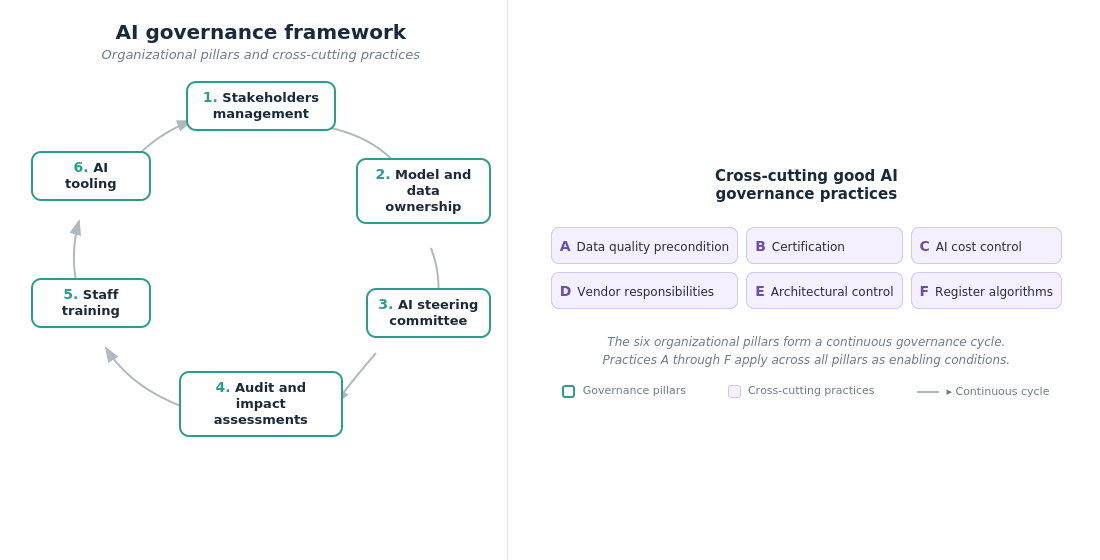
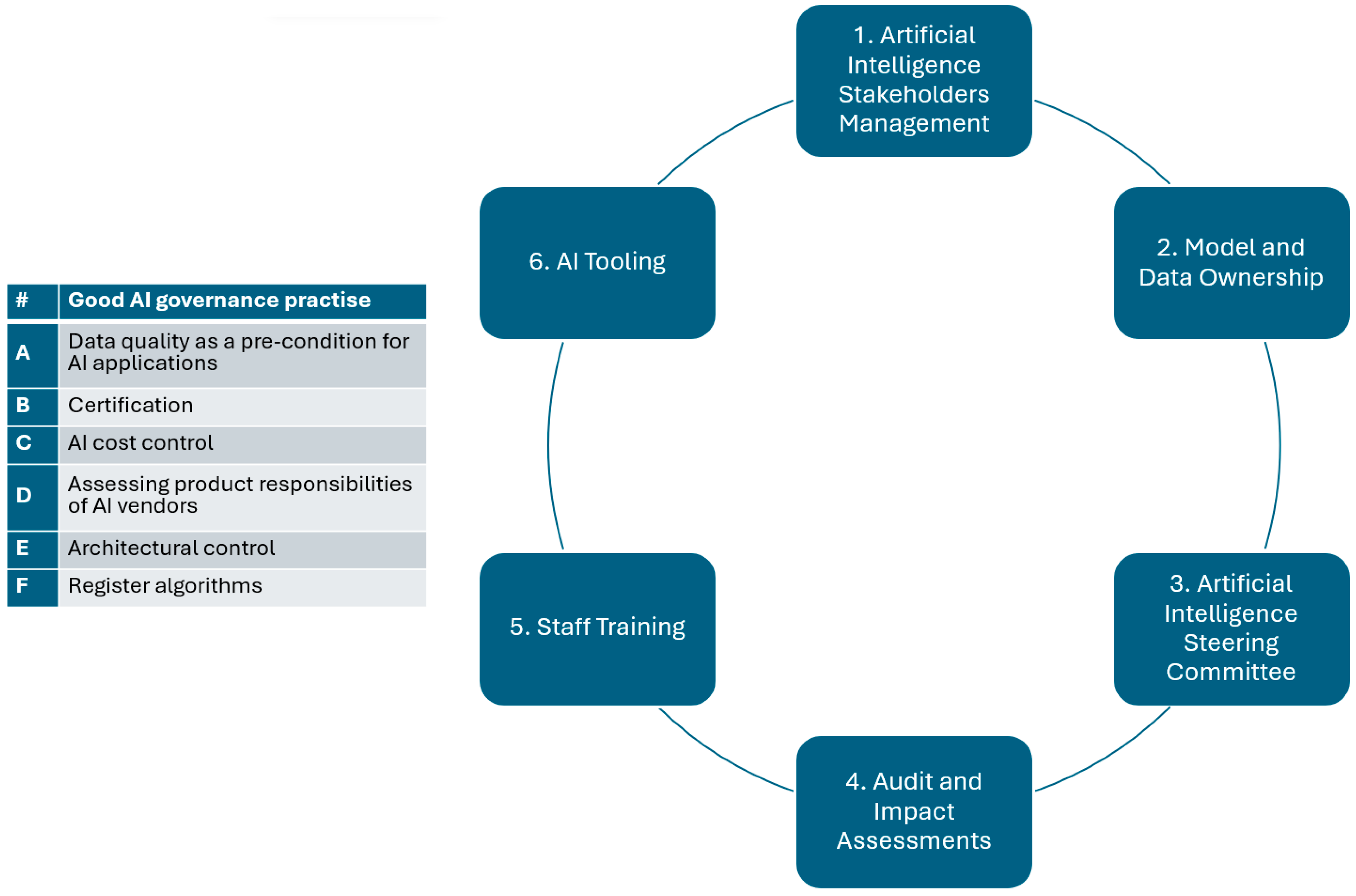
| 6. AI Tooling | X | |||||
| # | Good AI Governance Practice | Interviewee Reference (Specific Context) |
|---|---|---|
| A | Data quality as a pre-condition for AI applications | I2, I3, and I8 (training models); I4, I14, I15, and I17 (data flow and pipelines); I16 (data classification); and I23 (meta data and date linage) |
| B | Certification | I6 and I12 |
| C | AI cost control | I9 |
| D | Assessing product responsibilities of AI vendors | I10 |
| E | Architectural control | I11 (approved AI tools only) |
| F | Register algorithms | I18 |
Disclaimer/Publisher’s Note: The statements, opinions and data contained in all publications are solely those of the individual author(s) and contributor(s) and not of MDPI and/or the editor(s). MDPI and/or the editor(s) disclaim responsibility for any injury to people or property resulting from any ideas, methods, instructions or products referred to in the content. |
© 2026 by the authors. Licensee MDPI, Basel, Switzerland. This article is an open access article distributed under the terms and conditions of the Creative Commons Attribution (CC BY) license.
Share and Cite
Beulen, E.; Dans, M. Artificial Intelligence Governance Mechanisms—The Chief Data Officer Perspective with a Focus on Agentic AI Governance. Information 2026, 17, 336. https://doi.org/10.3390/info17040336
Beulen E, Dans M. Artificial Intelligence Governance Mechanisms—The Chief Data Officer Perspective with a Focus on Agentic AI Governance. Information. 2026; 17(4):336. https://doi.org/10.3390/info17040336
Chicago/Turabian StyleBeulen, Erik, and Marla Dans. 2026. "Artificial Intelligence Governance Mechanisms—The Chief Data Officer Perspective with a Focus on Agentic AI Governance" Information 17, no. 4: 336. https://doi.org/10.3390/info17040336
APA StyleBeulen, E., & Dans, M. (2026). Artificial Intelligence Governance Mechanisms—The Chief Data Officer Perspective with a Focus on Agentic AI Governance. Information, 17(4), 336. https://doi.org/10.3390/info17040336