Digitalisation, Digital Governance, and Eco-Innovation: Evidence from Cross-Country Data in 2022


Abstract
1. Introduction
2. Literature Review and Conceptual Background
2.1. Digital Transformation as Information Infrastructure
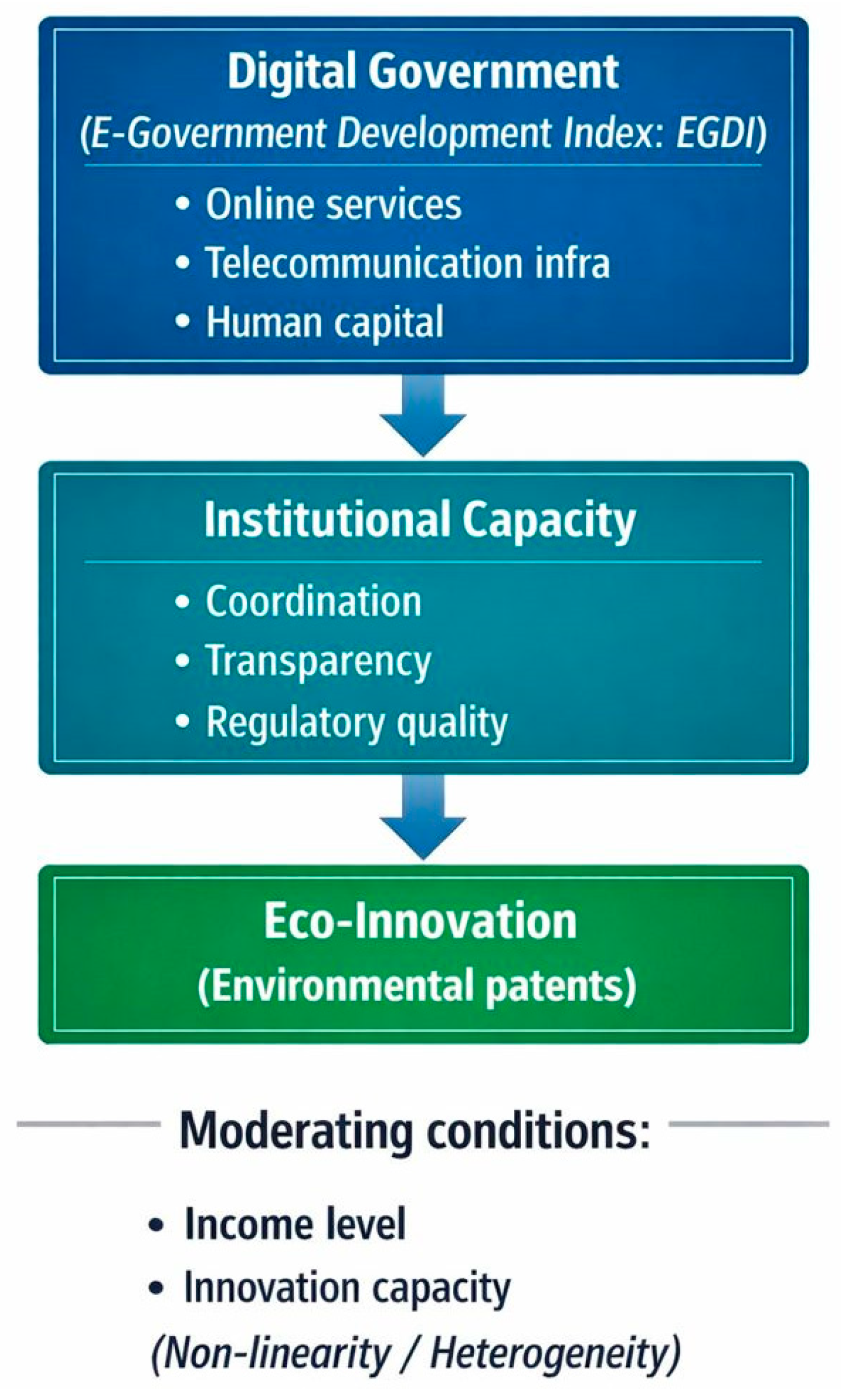
2.2. Digital Government and Institutional Capacity
2.3. Digital Standardisation and Information Interoperability
2.4. Digitalisation and Eco-Innovation
2.5. Research Gap and Contribution
3. Data and Empirical Strategy
3.1. Eco-Innovation
3.2. Digitalisation
3.3. Empirical Strategy
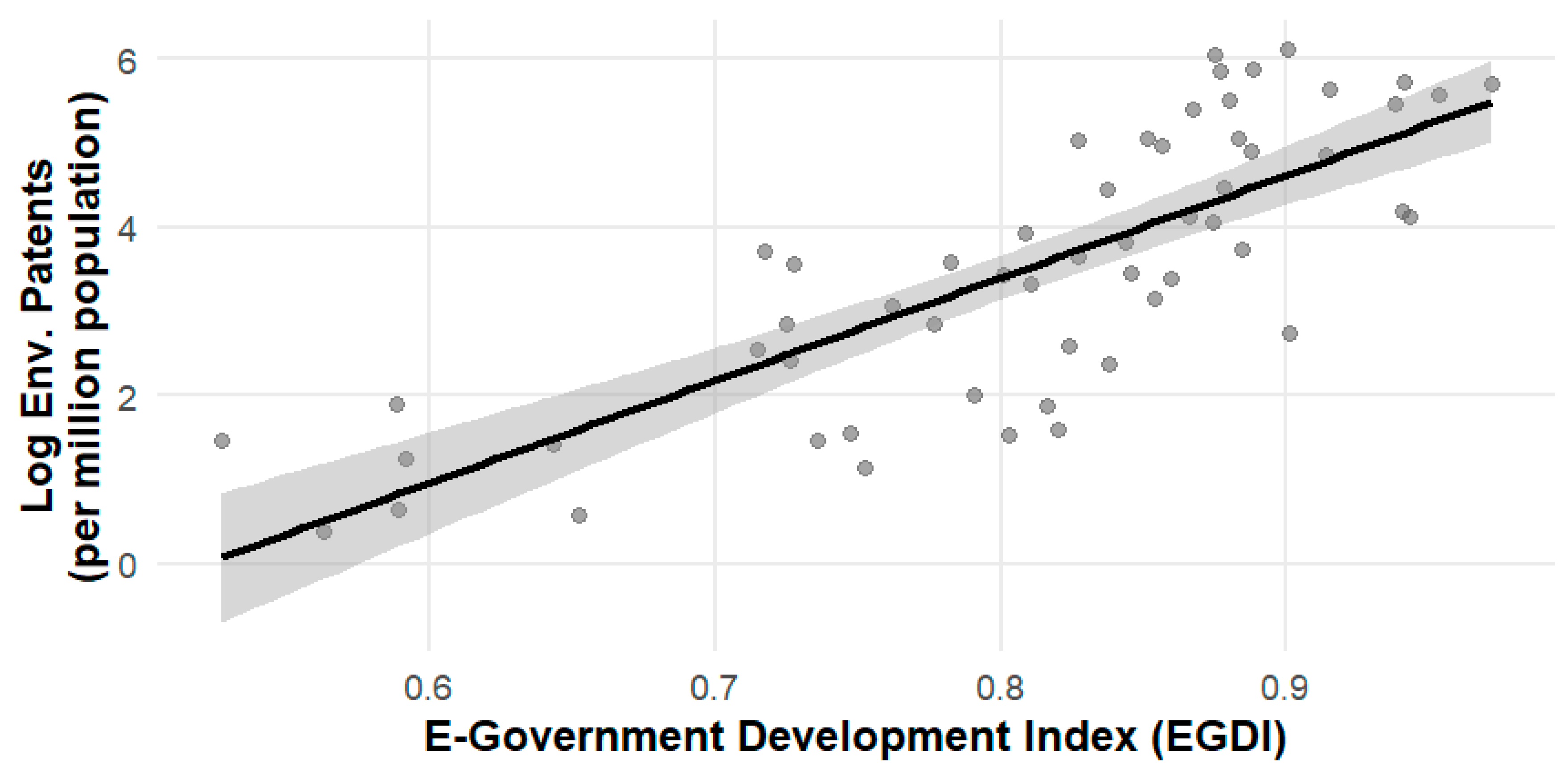
- Baseline OLS regressions, estimating the average association between digitalisation and eco-innovation;
- Population-weighted OLS regressions, accounting for cross-country differences in population size;
- Winsorised regressions, reducing sensitivity to extreme observations in patent counts;
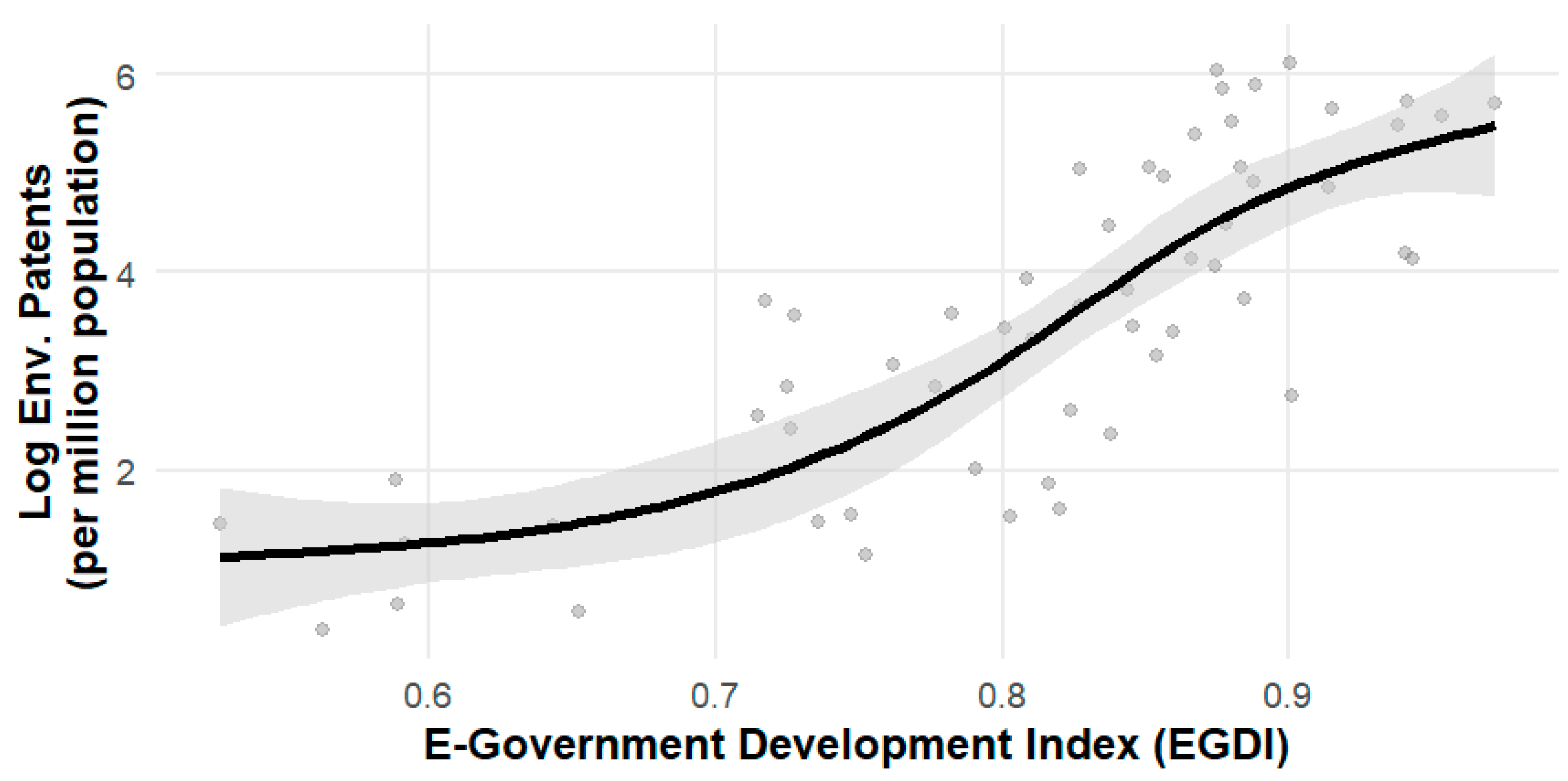
- Spline regressions, allowing for non-linear effects of digitalisation across different levels of EGDI;
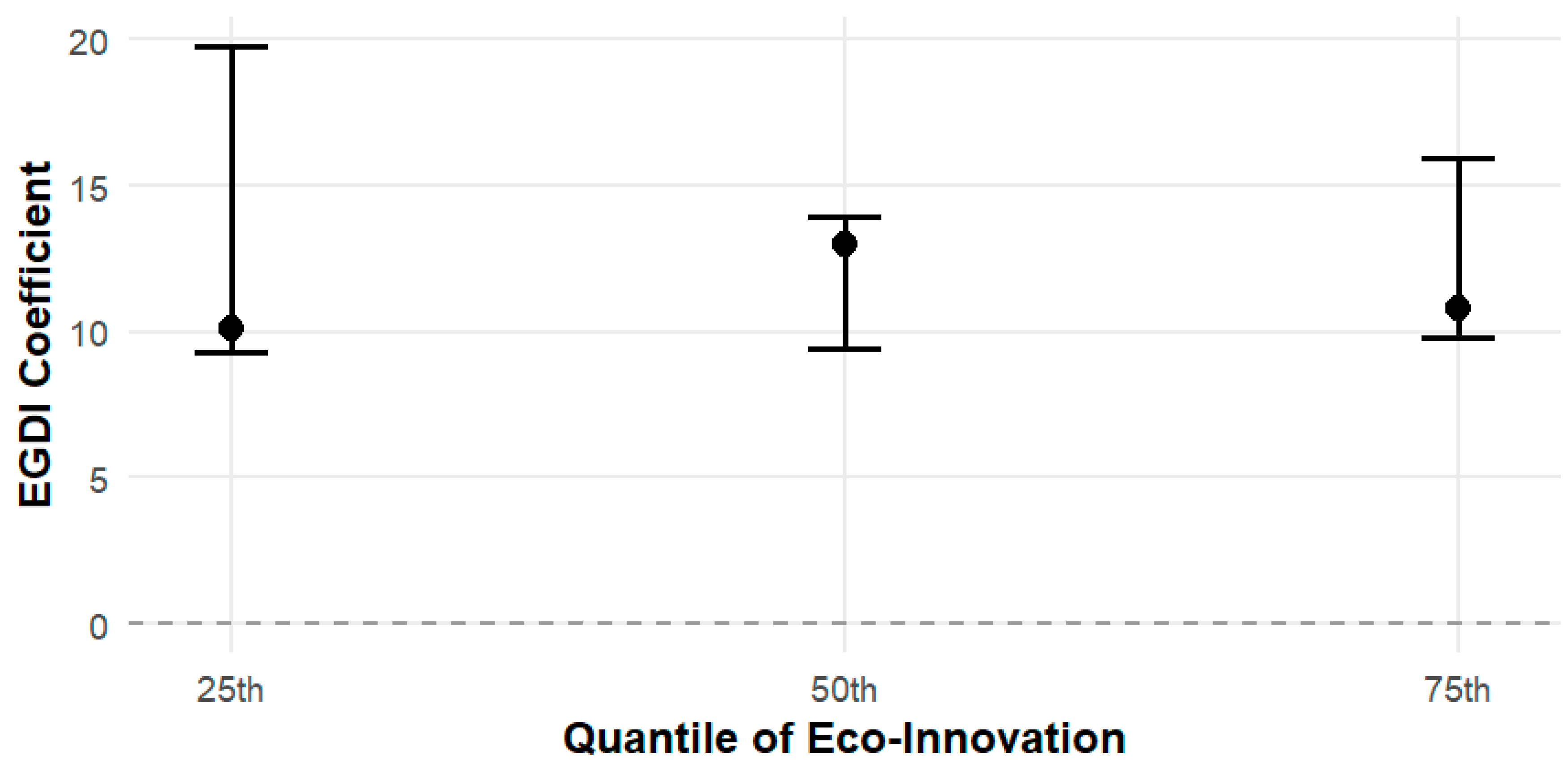
- Quantile regressions, examining heterogeneity in the digitalisation–eco-innovation relationship across the conditional distribution of eco-innovation outcomes [42].
4. Results: Digitalisation and Eco-Innovation
5. Discussion
6. Policy Implications
7. Limitations and Future Research
8. Conclusions
Funding
Institutional Review Board Statement
Informed Consent Statement
Data Availability Statement
Conflicts of Interest
References
- Brynjolfsson, E.; Hitt, L.M. Beyond computation: Information technology, organizational transformation and business performance. J. Econ. Perspect. 2000, 14, 23–48. [Google Scholar] [CrossRef]
- Bloom, N.; Sadun, R.; Van Reenen, J. Americans do IT better: US multinationals and the productivity miracle. Am. Econ. Rev. 2012, 102, 167–201. [Google Scholar] [CrossRef]
- Bharadwaj, A.; El Sawy, O.A.; Pavlou, P.A.; Venkatraman, N. Digital business strategy: Toward a next generation of insights. MIS Q. 2013, 37, 471–482. [Google Scholar] [CrossRef]
- Vial, G. Data governance and digital innovation: A translational account of practitioner issues for IS research. Inf. Organ. 2023, 33, 100450. [Google Scholar] [CrossRef]
- Aghion, P.; Dechezleprêtre, A.; Hémous, D.; Martin, R.; Van Reenen, J. Carbon taxes, path dependency, and directed technical change. Am. Econ. Rev. 2016, 106, 131–166. [Google Scholar] [CrossRef]
- Vial, G. Understanding digital transformation: A review and a research agenda. J. Strateg. Inf. Syst. 2019, 28, 118–144. [Google Scholar] [CrossRef]
- Yoo, Y.; Henfridsson, O.; Lyytinen, K. Research commentary—The new organizing logic of digital innovation: An agenda for information systems research. Inf. Syst. Res. 2010, 21, 724–735. [Google Scholar] [CrossRef]
- Tilson, D.; Lyytinen, K.; Sørensen, C. Research commentary—Digital infrastructures: The missing IS research agenda. Inf. Syst. Res. 2010, 21, 748–759. [Google Scholar] [CrossRef]
- Henfridsson, O.; Bygstad, B. The generative mechanisms of digital infrastructure evolution. MIS Q. 2013, 37, 907–931. [Google Scholar] [CrossRef]
- Mergel, I.; Edelmann, N.; Haug, N. Defining digital transformation: Results from expert interviews. Gov. Inf. Q. 2019, 36, 101385. [Google Scholar] [CrossRef]
- Dawes, S.S. Governance in the digital age: A research and action framework. Gov. Inf. Q. 2009, 26, 257–264. [Google Scholar] [CrossRef]
- Luna-Reyes, L.F.; Gil-Garcia, J.R. Digital government transformation and internet portals. Gov. Inf. Q. 2014, 31, 545–555. [Google Scholar] [CrossRef]
- Fountain, J.E. Building the Virtual State; Brookings Institution Press: Washington, DC, USA, 2004. [Google Scholar]
- Gil-Garcia, J.R. Enacting Electronic Government Success; Springer: New York, NY, USA, 2012. [Google Scholar]
- Brynjolfsson, E.; McAfee, A. The Second Machine Age; Norton: New York, NY, USA, 2014. [Google Scholar]
- Forman, C.; King, J.L.; Lyytinen, K. Information, technology, and the changing nature of work. Inf. Syst. Res. 2014, 25, 789–795. [Google Scholar] [CrossRef]
- Hanseth, O.; Lyytinen, K. Design theory for dynamic complexity in information infrastructures. J. Inf. Technol. 2010, 25, 1–19. [Google Scholar] [CrossRef]
- Lyytinen, K.; King, J.L. Standard making: A critical research frontier. MIS Q. 2006, 30, 405–411. [Google Scholar] [CrossRef]
- David, P.A.; Greenstein, S. The economics of compatibility standards. Econ. Innov. New Technol. 1990, 1, 3–41. [Google Scholar] [CrossRef]
- Blind, K. The Economics of Standards; Edward Elgar: Cheltenham, UK, 2004. [Google Scholar]
- United Nations. United Nations E-Government Survey 2022; United Nations: New York, NY, USA, 2022. [Google Scholar]
- Ren, S.; Hao, Y.; Wu, H. Digitalization and environmental governance. J. Environ. Plan. Manag. 2023, 66, 1533–1562. [Google Scholar] [CrossRef]
- Sun, S.; Guo, L. Digital transformation and green innovation. PLoS ONE 2022, 17, e0270928. [Google Scholar] [CrossRef]
- Zhang, Z.; Cheng, Y.; Zhang, J. Digital economy and green innovation efficiency. Environ. Dev. Sustain. 2025, 27, 6733–6755. [Google Scholar] [CrossRef]
- Mäkitie, T.; Hanson, J.; Damman, S.; Wardeberg, M. Digital innovation and sustainability transitions. Technol. Soc. 2023, 73, 102255. [Google Scholar] [CrossRef]
- Xie, G.; Hou, X.; Chu, P. Green spillover effects of corporate digital transformation: Evidence from a supply chain perspective. Emerg. Mark. Financ. Trade 2025, 61, 1–22. [Google Scholar] [CrossRef]
- Androniceanu, A.; Georgescu, I. E-government and environmental sustainability. NISPAcee J. Public Adm. Policy 2021, 14, 65–86. [Google Scholar] [CrossRef]
- Li, J.; Lou, W. Digital government and green innovation efficiency. Sustainability 2024, 16, 10030. [Google Scholar] [CrossRef]
- Peng, B. Digital leadership and governance. Cult. Sci. 2022, 5, 210–225. [Google Scholar] [CrossRef]
- Margetts, H.; Dunleavy, P. Digital-era governance. Philos. Trans. R. Soc. A 2013, 371, 20120382. [Google Scholar] [CrossRef]
- OECD. Digital Government Index 2019; OECD: Paris, France, 2020. [Google Scholar]
- Lange, S.; Pohl, J.; Santarius, T. Digitalization and energy consumption. Ecol. Econ. 2020, 176, 106760. [Google Scholar] [CrossRef]
- Wang, Q.; Liu, T.; Li, R. Digitalization and energy transition. Sustain. Dev. 2025, 33, 5038–5068. [Google Scholar] [CrossRef]
- Chen, Y. National AI talent ecosystem. Artif. Intell. Educ. Stud. 2025, 1, 28–42. [Google Scholar] [CrossRef]
- Atobishi, T.; Abu Bakir, S.M.; Nosratabadi, S. Digital capabilities and performance. Adm. Sci. 2024, 14, 37. [Google Scholar] [CrossRef]
- Acemoglu, D.; Aghion, P.; Lelarge, C.; Van Reenen, J.; Zilibotti, F. Technology, information, and the decentralization of the Firm. Q. J. Econ. 2007, 122, 1759–1799. [Google Scholar] [CrossRef]
- Cirera, X.; Comin, D.; Cruz, M. Bridging the Technological Divide; World Bank: Washington, DC, USA, 2022. [Google Scholar]
- Dechezleprêtre, A.; Sato, M. Environmental regulation and innovation. Rev. Environ. Econ. Policy 2017, 11, 183–206. [Google Scholar] [CrossRef]
- Johnstone, N.; Haščič, I.; Popp, D. Renewable energy policies and technological innovation. Environ. Resour. Econ. 2010, 45, 133–155. [Google Scholar] [CrossRef]
- OECD. Invention and Transfer of Environmental Technologies; OECD Publishing: Paris, France, 2011. [Google Scholar]
- Popp, D.; Pless, J.; Haščič, I.; Johnstone, N. Innovation and entrepreneurship in the energy sector. In The Role of Innovation and Entrepreneurship in Economic Growth; University of Chicago Press: Chicago, IL, USA, 2020. [Google Scholar]
- Koenker, R.; Bassett, G. Regression quantiles. Econometrica 1978, 46, 33–50. Available online: https://www.jstor.org/stable/1913643 (accessed on 1 January 2026). [CrossRef]
- Wang, Q.J.; Li, W.Z.; Gong, Z.Y.; Fu, J.Y. The coupling and coordination between digital economy and green economy: Evidence from China. Emerg. Mark. Financ. Trade 2025, 61, 562–578. [Google Scholar] [CrossRef]
- Kaplinsky, R.; Kraemer-Mbula, E. Innovation and uneven development: The challenge for low-and middle-income economies. Res. Policy 2022, 51, 104394. [Google Scholar] [CrossRef]
- Bresnahan, T.F.; Brynjolfsson, E.; Hitt, L.M. Information technology, workplace organization, and the demand for skilled labor. Q. J. Econ. 2002, 117, 339–376. [Google Scholar] [CrossRef]



| Panel A. Mean effects (OLS and spline regressions) | ||||
| (1) Baseline OLS | (2) Pop.-Weighted OLS | (3) Winsorised OLS | (4) Spline Regression | |
| Dependent variable | l_env_pat | l_env_pat | l_env_pat_w | l_env_pat_w |
| EGDI | 12.31 *** | 10.28 *** | 12.19 *** | |
| (1.145) | (2.032) | (1.122) | ||
| Spline term 1 | 3.593 *** | |||
| (0.429) | ||||
| Spline term 2 | 4.390 *** | |||
| (0.966) | ||||
| Spline term 3 | 4.185 *** | |||
| (0.403) | ||||
| Constant | −6.451 *** | −4.714 *** | −6.357 *** | 1.123 *** |
| (0.932) | (1.558) | (0.912) | (0.355) | |
| Observations | 57 | 57 | 57 | 57 |
| R2 | 0.627 | 0.652 | 0.624 | 0.663 |
| Panel B. Distributional effects (Quantile regression, τ = 0.5) | ||||
| Median (τ = 0.5) | ||||
| Dependent variable | l_env_pat_w | |||
| EGDI | 13.01 *** | |||
| (1.236) | ||||
| Constant | −6.942 *** | |||
| (1.016) | ||||
| Observations | 57 | |||
| Variable | Mean | Std. Dev. | Min | Max | N |
|---|---|---|---|---|---|
| Log env.-related patents per million (winsorised) | 3.530 | 1.616 | 0.382 | 6.112 | 57 |
| E-Government Development Index (EGDI) | 0.811 | 0.105 | 0.527 | 0.972 | 57 |
| Online Service Index | 0.780 | 0.129 | 0.420 | 0.983 | 57 |
| Telecommunication Infrastructure Index | 0.795 | 0.133 | 0.395 | 0.980 | 57 |
| Human Capital Index | 0.857 | 0.099 | 0.576 | 1.000 | 57 |
| Log GDP per capita | 9.880 | 1.065 | 7.498 | 11.585 | 57 |
| Tertiary enrollment rate (%) | 70.440 | 25.709 | 21.033 | 166.666 | 53 |
| Panel A. Digitalisation with Income and Education Controls | |
| Variables | (A1) |
| Online Service Index | 1.863 (1.174) |
| Telecommunication Infrastructure Index | 1.353 (1.872) |
| Human Capital Index | 1.432 (2.602) |
| Log GDP per capita | 0.964 * (0.166) |
| Constant | −9.747 *** (0.947) |
| Observations | 57 |
| R2 | 0.763 |
| Panel B. EGDI Components without Income Control | |
| Variables | (A2) |
| Online Service Index | 2.203 (1.577) |
| Telecommunication Infrastructure Index | 7.769 *** (1.700) |
| Human Capital Index | 1.515 (2.845) |
| Constant | −5.668 *** (1.116) |
| Observations | 57 |
| R2 | 0.656 |
| Category | Number of Countries |
|---|---|
| Advanced economies | 20 |
| Upper-middle-income economies | 18 |
| Lower-middle/emerging economies | 12 |
| Total | 57 |
Disclaimer/Publisher’s Note: The statements, opinions and data contained in all publications are solely those of the individual author(s) and contributor(s) and not of MDPI and/or the editor(s). MDPI and/or the editor(s) disclaim responsibility for any injury to people or property resulting from any ideas, methods, instructions or products referred to in the content. |
© 2026 by the author. Licensee MDPI, Basel, Switzerland. This article is an open access article distributed under the terms and conditions of the Creative Commons Attribution (CC BY) license.
Share and Cite
Kokubun, K. Digitalisation, Digital Governance, and Eco-Innovation: Evidence from Cross-Country Data in 2022. Information 2026, 17, 306. https://doi.org/10.3390/info17030306
Kokubun K. Digitalisation, Digital Governance, and Eco-Innovation: Evidence from Cross-Country Data in 2022. Information. 2026; 17(3):306. https://doi.org/10.3390/info17030306
Chicago/Turabian StyleKokubun, Keisuke. 2026. "Digitalisation, Digital Governance, and Eco-Innovation: Evidence from Cross-Country Data in 2022" Information 17, no. 3: 306. https://doi.org/10.3390/info17030306
APA StyleKokubun, K. (2026). Digitalisation, Digital Governance, and Eco-Innovation: Evidence from Cross-Country Data in 2022. Information, 17(3), 306. https://doi.org/10.3390/info17030306