Review

Artificial Intelligence for Detecting Electoral Disinformation on Social Media: Models, Datasets, and Evaluation


1
Escuela Profesional de Ingeniería de Sistemas, Facultad de Ingeniería y Arquitectura, Universidad Autónoma del Perú, Lima 15842, Peru
2
Facultad de Ingeniería, Universidad Tecnológica del Perú, Lima 15306, Peru
3
Escuela de Posgrado, Universidad Continental, Lima 15113, Peru
4
Departamento Académico de Cursos Básicos, Universidad Científica del Sur, Lima 15067, Peru
*
Author to whom correspondence should be addressed.
Information 2026, 17(3), 292; https://doi.org/10.3390/info17030292
Submission received: 12 February 2026 / Revised: 3 March 2026 / Accepted: 12 March 2026 / Published: 17 March 2026
(This article belongs to the Section Artificial Intelligence)

Abstract

During elections, information manipulation on social media has accelerated the use of artificial intelligence, yet the evidence is difficult to interpret without an integrated view of methods, data, and evaluation. We mapped 557 English-language journal articles from Scopus and Web of Science, combining performance indicators, science mapping, and a focused full-text synthesis of highly cited papers. The literature grows sharply after 2019, peaks in 2025, and shows geographically uneven production, with collaboration structured around a small set of hubs. The thematic structure suggests that, during the pandemic era, infodemic-related research served as a catalyst, intensifying scientific attention to fake news and disinformation and expanding the associated detection and monitoring agendas. In addition, socio-political harm constructs such as hate speech, extremism, and polarization appear as recurrent and structurally central targets, highlighting that election-relevant work often extends beyond veracity assessment toward monitoring discourse risks. Blockchain also emerges as a novel and adjacent integrity theme, aligned with authenticity and provenance-oriented mitigation rather than mainstream detection pipelines. AI for electoral disinformation is not reducible to veracity classification, as influential studies also target automation and coordinated behavior, verification support, diffusion analysis, and estimation frameworks that focus on exposure and impact. Evaluation remains heterogeneous and is often shaped by benchmark settings, making high accuracy values hard to compare and potentially misleading when labeling quality, topic leakage, or context shift are not characterized. Overall, the findings motivate evaluation protocols that align operational objectives with modeling roles and explicitly address robustness to temporal and platform changes, asymmetric error costs during election windows, and representativeness across electoral contexts and languages, while also guiding future work on emerging integrity challenges and governance-relevant deployment settings.

1. Introduction

Fake news and disinformation have become persistent challenges for contemporary information ecosystems, particularly because social media platforms enable rapid dissemination, amplification through recommender dynamics, and cross-platform circulation at scale. In high-attention events, misleading or strategically manipulated content can spread faster than traditional verification workflows can respond. At the same time, coordinated actors may exploit platform affordances to shape narratives, create artificial consensus, or erode trust in institutions [1,2,3,4].
Electoral contexts are especially sensitive to these dynamics. Elections concentrate public attention and political contestation, and they often involve coordinated communication strategies that operate alongside genuine civic debate. Within this setting, disinformation campaigns can affect democratic processes by distorting informational baselines, intensifying polarization, and interacting with harmful discourse such as hate speech and extremist messaging. Moreover, the same environments that support participatory political expression can also be leveraged for manipulation through automated accounts, coordinated inauthentic behavior, and increasingly sophisticated forms of synthetic media [5,6,7,8].
Against this background, artificial intelligence (AI) has emerged as a practical alternative for addressing the scale and speed of online disinformation. Methods from machine learning and natural language processing can support a range of tasks, including detection and classification, verification support, stance-oriented analysis, and network-based characterization of coordinated behavior [9,10]. At the same time, technical progress does not automatically translate into deployment-ready evidence: model objectives, dataset construction, platform constraints, and evaluation protocols strongly shape what can be concluded about real-world effectiveness, particularly when narratives, topics, and tactics shift over time [11,12].
Although previous reviews have addressed electoral disinformation and the broader issues of misinformation and fake news, current syntheses remain fragmented across partially overlapping research agendas. Certain studies concentrate on election-specific analyses of content dynamics and potential impacts, while others prioritize governance and regulatory frameworks related to platforms and electoral management. Another body of work examines AI-enabled risks, particularly those linked to generative AI and synthetic media, and highlights challenges concerning authenticity, provenance, and mitigation infrastructures. Despite a shared recognition of electoral vulnerability, these perspectives differ in their primary units of analysis and generally provide limited integration of the methodological choices that support empirical detection claims, particularly regarding model families, dataset construction and labeling practices, and evaluation protocols.
Within the first topic, election-focused content analyses converge on the idea that disinformation is often emotionally charged and strategically deployed. Comparative evidence from the 2024 United States presidential election and the 2024 European Parliament election indicates a strong emotional component, with negative emotions such as anger and fear frequently mobilized to polarize audiences and undermine institutional trust [13]. Similarly, a thematic analysis of debunked claims from the 2024 Indian General Election identifies recurring political and governance narratives and highlights that fact-checking priorities can diverge across institutional settings, which is particularly relevant for interpreting information disorder beyond Western electoral environments [14].
Within the second topic, governance-oriented work emphasizes that electoral vulnerability is shaped by sociotechnical infrastructures, including AI-enabled electoral administration, micro-targeting, coordinated campaigns, and bot-driven amplification, while also underscoring tensions around opacity, security, accountability, and freedom of expression [15,16,17,18]. More recent mappings further argue that generative AI and synthetic media intensify these challenges, motivating greater attention to deepfakes, provenance, and authenticity mechanisms, including proposals that connect verification ecosystems with blockchain-supported integrity narratives [19,20,21]. Despite this shared diagnosis, methodological consolidation remains limited: the literature repeatedly notes a shortage of empirical studies capable of credibly estimating AI-related effects on elections and calls for stronger methodological integration [22]. Consequently, the evidence base remains fragmented across (i) election-specific analyses of content and impact [13,14,21], (ii) governance and regulatory discussions of platforms and electoral management [15,16,17,18], and (iii) broader syntheses of generative AI risks and opportunities that are not centered on detection pipelines [20]. This fragmentation makes it difficult to obtain an updated, consolidated view of how AI is operationalized specifically to detect electoral disinformation on social media, which model families dominate, what dataset characteristics structure the empirical literature, and how robust current evaluation practices are in election-relevant settings. Accordingly, our contribution is a structured consolidation of detection-oriented evidence, enabling direct comparison of modeling, dataset, and evaluation choices within election-relevant social media contexts, rather than another high-level diagnosis of electoral vulnerability.
This review addresses that gap by providing an explicit and structured synthesis focused on models, datasets, and evaluation for the AI-based detection of electoral disinformation on social media. Accordingly, it is guided by the following research questions: How has the literature evolved over time and across publication venues and research communities? Which AI approaches and model families are most commonly used for detection and closely related operational tasks (verification support, actor characterization, or diffusion analysis) in election-relevant social media settings? What datasets, platforms, and electoral contexts are represented in the evidence base, and how are data sources and labeling practices typically specified? How is evaluation operationalized in terms of experimental design, metrics, and validation settings, and what does this imply for comparability and claims of generalizability in electoral contexts? In addition, the review characterizes the conceptual structure of the field through keyword-based science mapping to clarify the main thematic concentrations and their relationships while deliberately avoiding any anticipation of results.
To answer these questions, we applied a transparent database record-selection and corpus-construction workflow to perform a bibliometric review of journal articles indexed in Scopus and Web of Science. The corpus is retrieved through a structured search strategy that combines five concept blocks: AI and machine learning methods; information disorder and manipulation; electoral context; social media platforms; and terms related to detection, datasets, and evaluation. The analysis integrates performance indicators with science-mapping procedures and is complemented by a focused synthesis of highly cited papers, which is designed to consolidate, in a comparable manner, how influential studies formulate objectives, assign roles to AI, select data sources, and design evaluation protocols.
The paper employs a consistent organizing framework focused on (i) model families and AI roles, (ii) dataset and platform characteristics, and (iii) evaluation designs and validity considerations. This framework structures the study-level synthesis and guides the interpretation of the bibliometric and science-mapping evidence presented in the Results, Discussion, and Conclusions.
The remainder of this paper is organized as follows. Section 2 details the methodology, including information sources, the search strategy, corpus construction, and analytical procedures. Section 3 reports the results of the performance analyses and the science-mapping findings. Section 4 discusses the implications of the mapped landscape and the main methodological considerations for interpreting the evidence in election-relevant settings. Finally, Section 5 concludes by summarizing the contributions of the review and outlining directions for future research.

2. Methodology

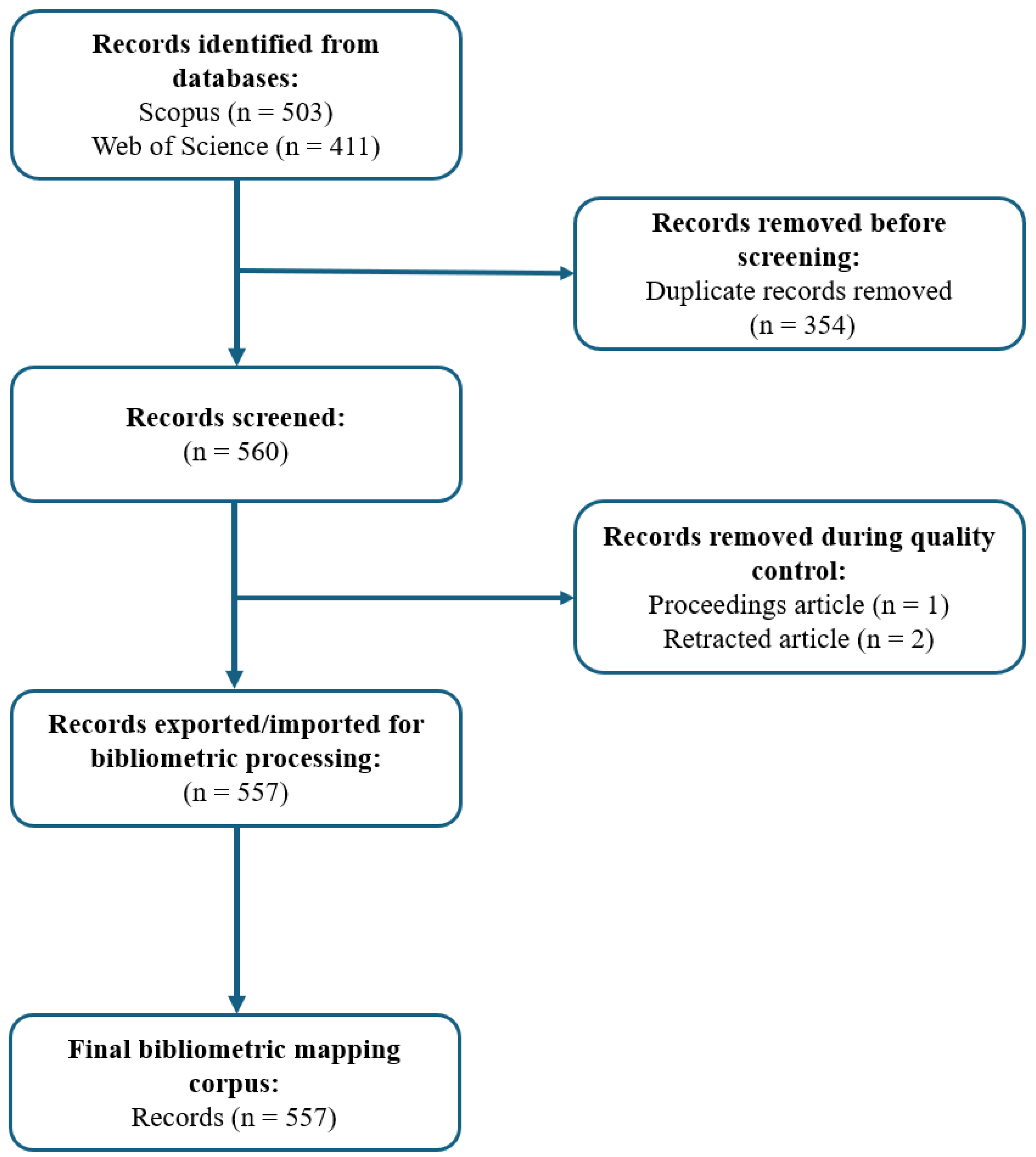
This review characterizes and maps the scientific literature on artificial intelligence for detecting electoral disinformation on social media, with emphasis on models, datasets, and evaluation methods. To ensure transparent reporting of database record selection and corpus construction, the workflow is summarized in the flow diagram shown in Figure 1. The minimally processed bibliographic dataset used for the analyses is provided as Supplementary Materials (File S1). Given the metadata-based mapping and bibliometric design of this review, it was not registered in a public registry and no review protocol was prepared.

2.1. Information Sources, Search Fields, and Search Date

Two multidisciplinary bibliographic databases were used: Scopus and Web of Science. The last search was executed on 1 February 2026. All years available in each database up to the search date were included. In Scopus, the query was applied to TITLE-ABS-KEY. In Web of Science, it was applied to Topic.

2.2. Search Strategy

To preserve traceability, the search query was structured into five conceptual blocks and implemented with Boolean operators. Within each block, synonyms and related expressions were linked using OR; the five blocks were combined using AND:
  • Group 1: AI/ML methods.
    (“artificial intelligence” OR “machine learning” OR “deep learning” OR “natural language processing” OR “text mining” OR transformer* OR BERT OR “large language model*” OR “generative ai” OR GPT* OR ChatGPT OR multimodal* OR “vision-language” OR “cross-modal” OR “graph neural network*” OR GNN OR “convolutional neural network*” OR CNN OR “support vector machine*” OR SVM OR “random forest” OR “gradient boosting” OR XGBoost)
  • Group 2: Information disorder and manipulation.
    (disinformation OR misinformation OR “fake news” OR “false information” OR propaganda OR rumor* OR “information disorder” OR “computational propaganda” OR “influence operation*” OR “information manipulation” OR “coordinated inauthentic behavior” OR astroturf* OR deepfake* OR “manipulated media”)
  • Group 3: Electoral context.
    (election* OR electoral OR campaign* OR vot* OR referendum* OR “electoral integrity” OR politic*)
  • Group 4: Social media and platforms.
    (“social media” OR “social network*” OR microblog* OR “online platform*” OR Twitter OR X OR Facebook OR YouTube OR TikTok OR Instagram OR WhatsApp OR Telegram OR Reddit OR Weibo OR WeChat)
  • Group 5: Detection, datasets, and evaluation.
    (detect* OR classif* OR identif* OR recogn* OR predict* OR “fact check*” OR “fact-check*” OR “claim verification” OR “stance detection” OR dataset* OR benchmark* OR corpus OR evaluation OR validation OR explainab* OR interpretab*)
The final equation was:
Group 1 AND Group 2 AND Group 3 AND Group 4 AND Group 5.

2.3. Corpus Construction and Quality Control

Records were obtained in three sequential stages within each database. First, the query was executed without filters, retrieving 1293 records in Scopus and 665 in Web of Science. Second, the document-type filter “Article” was applied, yielding 523 records in Scopus and 425 in Web of Science. Third, the language filter “English” was applied to the “Article” subset, yielding 503 records from Scopus and 411 from Web of Science. Export files from both databases were generated in BibTeX format. This restriction was adopted to ensure a consistent, cross-database bibliometric baseline with comparable document-type metadata and citation indicators; its implications for conference- and preprint-centric and non-English scholarship are discussed in Section 4.8.
Figure 1 summarizes the record-selection steps used to construct the bibliometric mapping corpus, starting from the post-filter subset (Article + English). The corresponding pre-filter counts are therefore reported only in the text above.
After exporting, merging, and deduplication, the merged dataset was processed in R 4.5.1 using RStudio 2025.09.1+404 and Biblioshiny v5.0 (Bibliometrix workflow [23]). The R script documenting the import, merge, and deduplication procedure implemented in bibliometrix is provided as Supplementary Materials (File S2). Deduplication removed 354 duplicate records, yielding 560 unique records. A post-download quality control step excluded 1 proceedings article and 2 retracted articles. The final bibliometric mapping corpus comprised 557 records, as shown in Figure 1.

2.4. Content Analysis of Highly Cited Papers

In order to complement the metadata-based bibliometric assessment, we performed a focused full-text synthesis of the most influential papers in the final corpus. This step was intended to document, in a comparable manner, how AI is operationalized in high-impact studies, and to summarize the main methodological choices in the studies (models, data sources, evaluation practices, and the degree to which an electoral context is central to the study).
Given that full-text synthesis at scale is not feasible for the entire corpus, a transparent citation-based selection approach is employed as a pragmatic proxy for scholarly influence and agenda-setting contributions. This step aims to ensure depth and comparability of methodological reporting, including models, dataset and labeling choices, and evaluation designs, within a compact subset rather than statistical representativeness across all documents. Distribution-level patterns are derived from corpus-wide bibliometric and science-mapping analyses, while the synthesis of highly cited works offers study-level detail to interpret influential research trajectories.

2.4.1. Selection Criteria

Papers were selected using a dual-impact rule that captures both citation magnitude and citation velocity. The dual-impact rule addresses age-related citation advantages by simultaneously measuring long-term cumulative influence, as indicated by total citations, and recent contributions, as reflected by citations per year.
First, all studies with more than 100 total citations were included. Second, one additional paper was incorporated despite not meeting the total citation threshold because it exhibited a notably high total citations per year rate, indicating strong annual impact relative to its publication time window.
All citation-based indicators reported in this review (total citations and citations per year) were computed from the merged bibliographic dataset generated in bibliometrix after deduplication and final corpus construction. For temporal normalization, we set 2026 as the cut-off year and treated it as a full observation year for standardizing annual citation rates. Accordingly, citations per year were calculated as the ratio between the total citations and the number of years elapsed from the publication year to the cut-off year (inclusive).

2.4.2. Extraction Template

This content-analysis step formalizes the focus on models, datasets, and evaluation by extracting, for each influential paper, a standardized set of descriptors. These descriptors include model choice and the role of artificial intelligence, dataset and platform construction, labeling context, evaluation setting, metrics, and validation design.
Accordingly, for each selected paper, we synthesized the evidence using a uniform reporting structure centered on the following: (i) study objective and design; (ii) the role assigned to AI in the study (detection/classification, prediction, measurement of exposure, support for causal inference, or content-impact estimation); (iii) the AI methods and text representations, when applicable; (iv) datasets and platforms (including data source and language, and whether an electoral context was explicitly addressed); (v) the evaluation setting and the metrics reported by the authors; and (vi) the principal findings highlighted in the paper.

2.4.3. Internal Consistency

In order to reduce redundancy and improve comparability across summaries, we applied the same reporting structure to all selected papers and restricted each narrative to information explicitly stated in the corresponding study. When a paper reported multiple models, datasets, or evaluation settings, we prioritized the configuration most central to the author’s main claims and referenced additional configurations only when necessary to interpret the contribution of the study. Brief cross-paper comparisons, when included, are explicitly presented as the synthesis of this review and are grounded in the extracted descriptors reported for each study.

2.4.4. Reporting in the Results

The resulting synthesis is presented in the Section 3.6 to contextualize the bibliometric evidence with study-level methodological detail and to clarify the dominant AI roles observed in the most influential contributions.

2.5. Bibliometric Indicators and Analytical Procedures

The bibliometric analysis was organized into two complementary components: performance analysis and science mapping. Performance indicators were used to describe the evolution and distribution of the literature, including (i) annual scientific production, (ii) scientific production by country and inter-country collaboration patterns, (iii) the most relevant journals (sources) and leading affiliations, and (iv) the most cited documents. In parallel, science-mapping techniques were used to examine the conceptual structure of the field through keyword analyses, including frequency profiling, co-occurrence networks, and thematic maps. Full counting was used for the performance indicators, and keyword network clustering was conducted using the Walktrap algorithm.

2.6. Keyword Strategy, Completeness Rationale, and Noise Reduction

Keyword-driven analyses were implemented using two fields: “Author Keywords” and “All Keywords” (Author Keywords + Keywords Plus). Because Keywords Plus exhibited substantial missingness (above 30%), as reported by Bibliometrix via Biblioshiny, analyses requiring a stable and comparable keyword structure, specifically co-occurrence networks and thematic mapping, were conducted using Author Keywords. “All Keywords” was retained for complementary descriptive inspection of term frequencies.
Before co-word analyses and thematic mapping, a curated stop-list of generic, redundant, and domain-ubiquitous terms was removed to reduce noise and prevent trivial clustering around high-frequency, non-discriminative expressions. For transparency, the removed terms are grouped as follows:
Group 1: Generic lexical and document/population terms.
deep, artificial, machine, big, natural, fake, intelligence, learning, information, communication, news, media, article, human, humans, na
Group 2: AI/ML umbrella terms, methodological labels, pipeline actions, evaluation terms, and data descriptors.
model, models, algorithm, algorithms, analysis, processing, training, method, methods, methodology, framework, approach, approaches, technology, technologies, system, systems, dataset, datasets, data, detect, detection, classify, classification, identify, identification, recognize, recognition, predict, prediction, accuracy, performance, impact, evaluation, metric, metrics, artificial intelligence, ai, machine learning, machine-learning, machine learning (ml), deep learning, natural language processing, nlp, language processing (nlp), bibliometric analysis, surveys, data models
Group 3: Digital environment/content terms, phenomenon/context keywords, platforms, and topic-specific outlier.
internet, online, platform, platforms, content, text, image, images, video, videos, network, networks, social, language, disinformation, misinformation, fake news, false information, election, elections, electoral, campaign, campaigns, voting, vote, referendum, referendums, political, politics, social media, social network, social networks, social networking, microblog, online platform, online platforms, twitter, x, facebook, youtube, tiktok, instagram, whatsapp, telegram, reddit, weibo, wechat, fake news detection, COVID-19, social networking (online)
In the keyword-based science-mapping analyses, we removed a set of high-frequency domain anchor terms—many of which are explicitly embedded in the search query and therefore recur ubiquitously across the corpus—to avoid trivial clustering driven by generic field descriptors rather than by substantive topical structure. Because these anchors appear in a large share of records, they tend to dominate co-occurrence links and centrality measures, yielding clusters that largely restate the corpus definition. Their removal was therefore intended to reveal more informative subthemes that would otherwise be masked by these ubiquitous descriptors. This filtering was applied exclusively to keyword-based analyses and therefore affected only keyword-derived outputs. It does not affect performance indicators computed from the merged bibliographic metadata.
Following this analytical structure, the next section first reports the performance indicators and subsequently presents the science-mapping results derived from the keyword analyses, as outlined in Section 2.5.

3. Results

The Results section is structured to facilitate a coherent interpretation of models, datasets, and evaluation. First, performance indicators describing the evolution and distribution of the literature are presented. Second, science-mapping findings derived from keyword analyses, including word clouds, co-occurrence networks, and the thematic map, are discussed. Additionally, document-level influence is contextualized through a focused synthesis of highly cited papers, presented in Section 3.6, reported using the extraction template in Section 2.4.

3.1. Annual Scientific Production

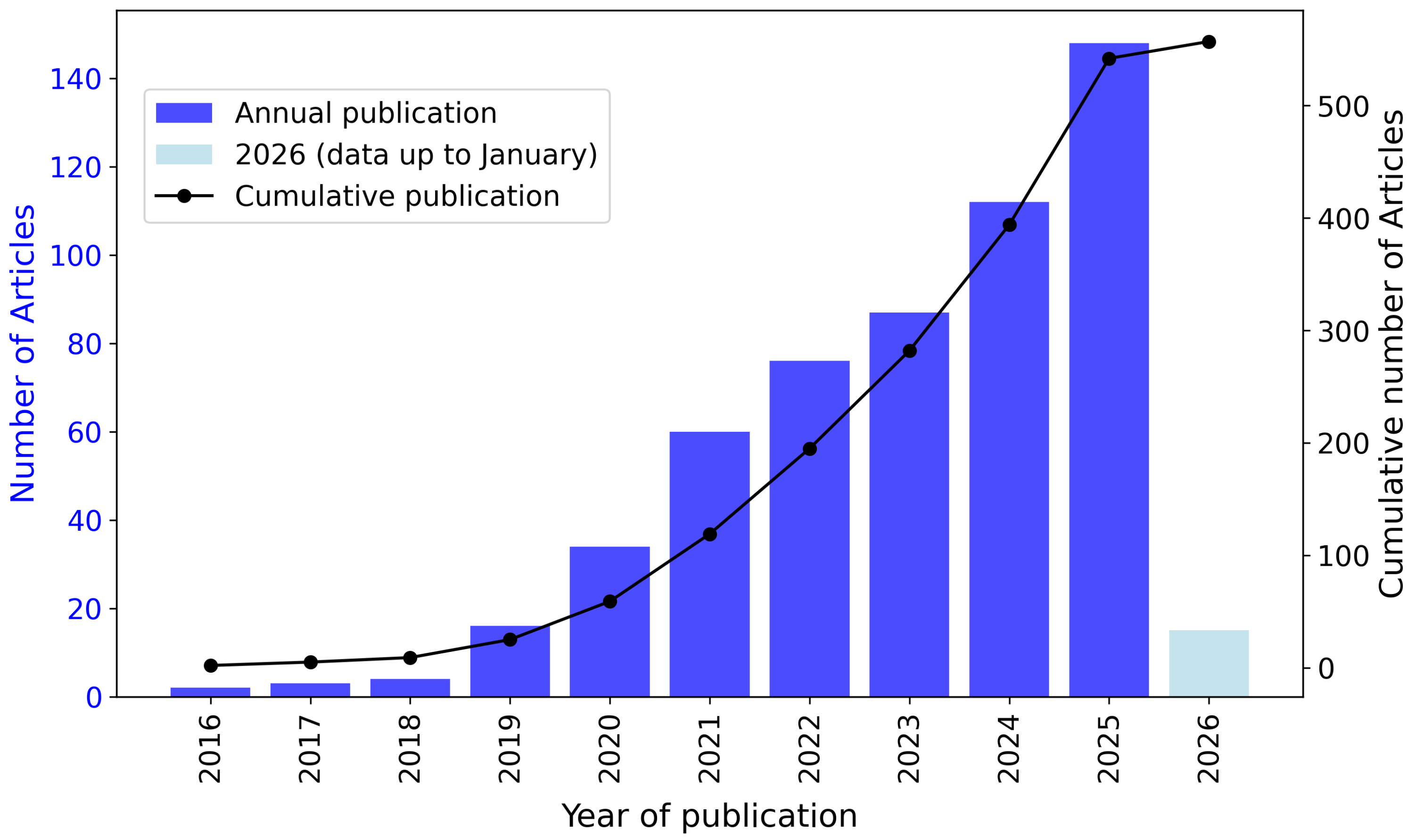
Figure 2 summarizes the temporal evolution of the literature on artificial intelligence for detecting electoral disinformation on social media. The annual output was very limited in the early phase (2016–2018: 2, 3, and 4 articles, respectively), followed by a marked inflection in 2019 (16 articles) and sustained growth thereafter. Publication volume increased from 34 articles in 2020 to 60 in 2021, and continued rising in subsequent years (76 in 2022; 87 in 2023; 112 in 2024), reaching its maximum in 2025 with 148 articles. Consistent with this expansion, the cumulative curve shows an accelerated accumulation after 2020, totaling 557 journal-article records by the end of the observation window. The 2026 value (15 articles) corresponds to records indexed up to January and should therefore be interpreted as a partial-year count rather than as directly comparable to complete annual totals.
  • Note that 2026 is treated as a partial-year count for annual scientific production, but as the cut-off year for citation-rate normalization (see Section 2.4.1).
Following this time-based overview of growth, the next subsection disaggregates scientific production by country in order to identify the field’s principal geographic contributors.

3.2. Scientific Production by Country

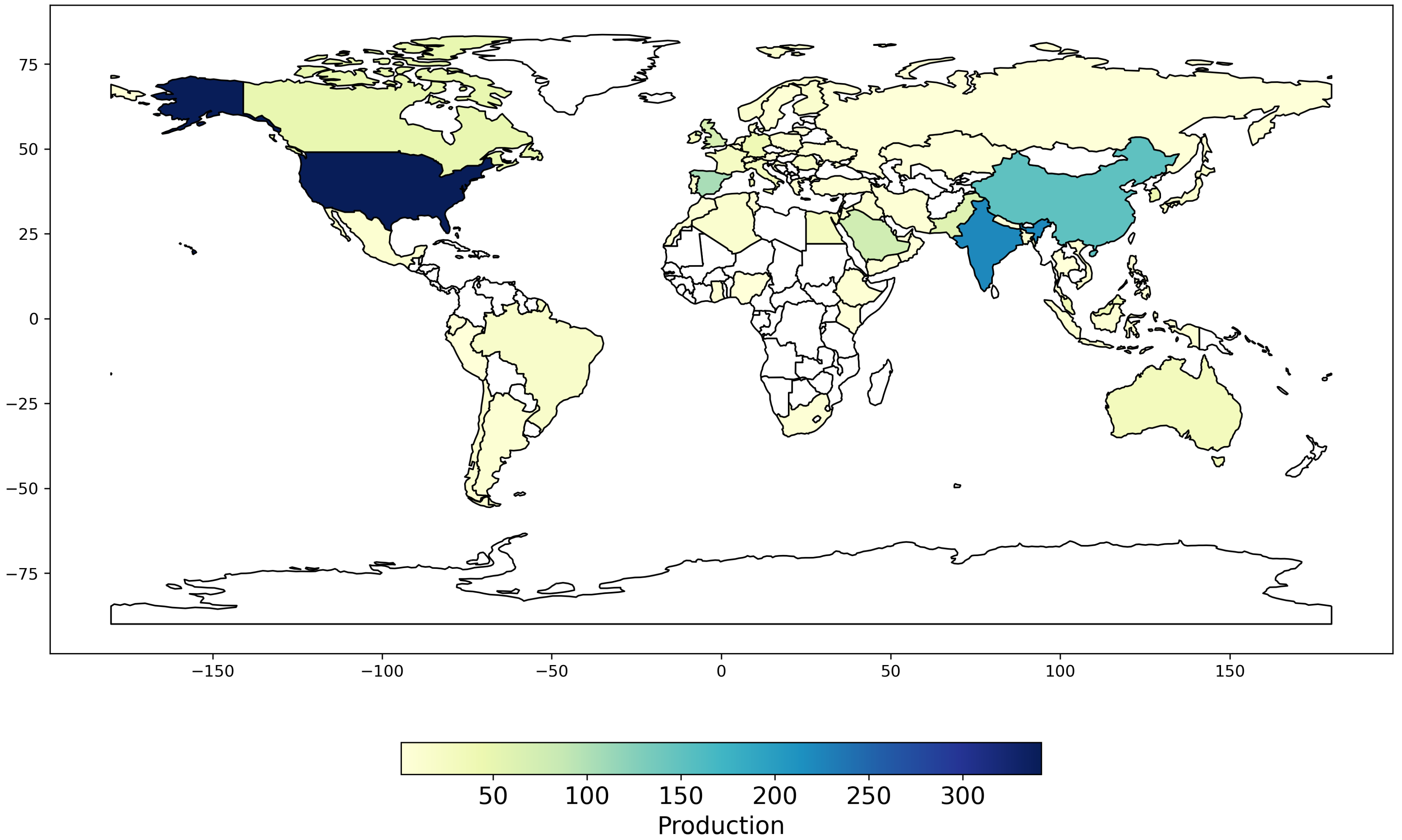
Following the growth pattern described in the annual production analysis, we next examine how this output is distributed geographically. Figure 3 shows a highly concentrated country profile, led by the United States (342), followed by India (222) and China (151); Spain (104) represents the next largest contributor in this dataset. A second tier includes Saudi Arabia (76), the United Kingdom (68), and Pakistan (60), with additional notable contributions from Canada (48), South Korea (44), Germany (39), Malaysia (36), and Australia (31). Italy (29), Egypt (25), France (24), Ireland (23), and Singapore (22) further illustrate sustained activity across Europe, North Africa, and Southeast Asia.
Beyond these leading contributors, the distribution displays a long tail of countries with smaller frequencies, as reflected in the lighter intensities in Figure 3. Latin American output is visible through Brazil (18), Chile (10), Mexico (9), Argentina (8), Ecuador (4), and Peru (2), while African contributions include Algeria (12), Ethiopia (7), Ghana (6), Morocco (5), South Africa (5), Tunisia (5), and Kenya (1). Several countries appear with single-digit or very low frequencies (Nepal 2; Oman 1; Nigeria 1; United Arab Emirates 1), indicating that the literature is geographically widespread but unevenly represented.
Given this heterogeneous country profile, the next subsection examines the international collaboration patterns to clarify how international co-authorship structures shape these production counts.

3.3. Inter-Country Collaboration Patterns

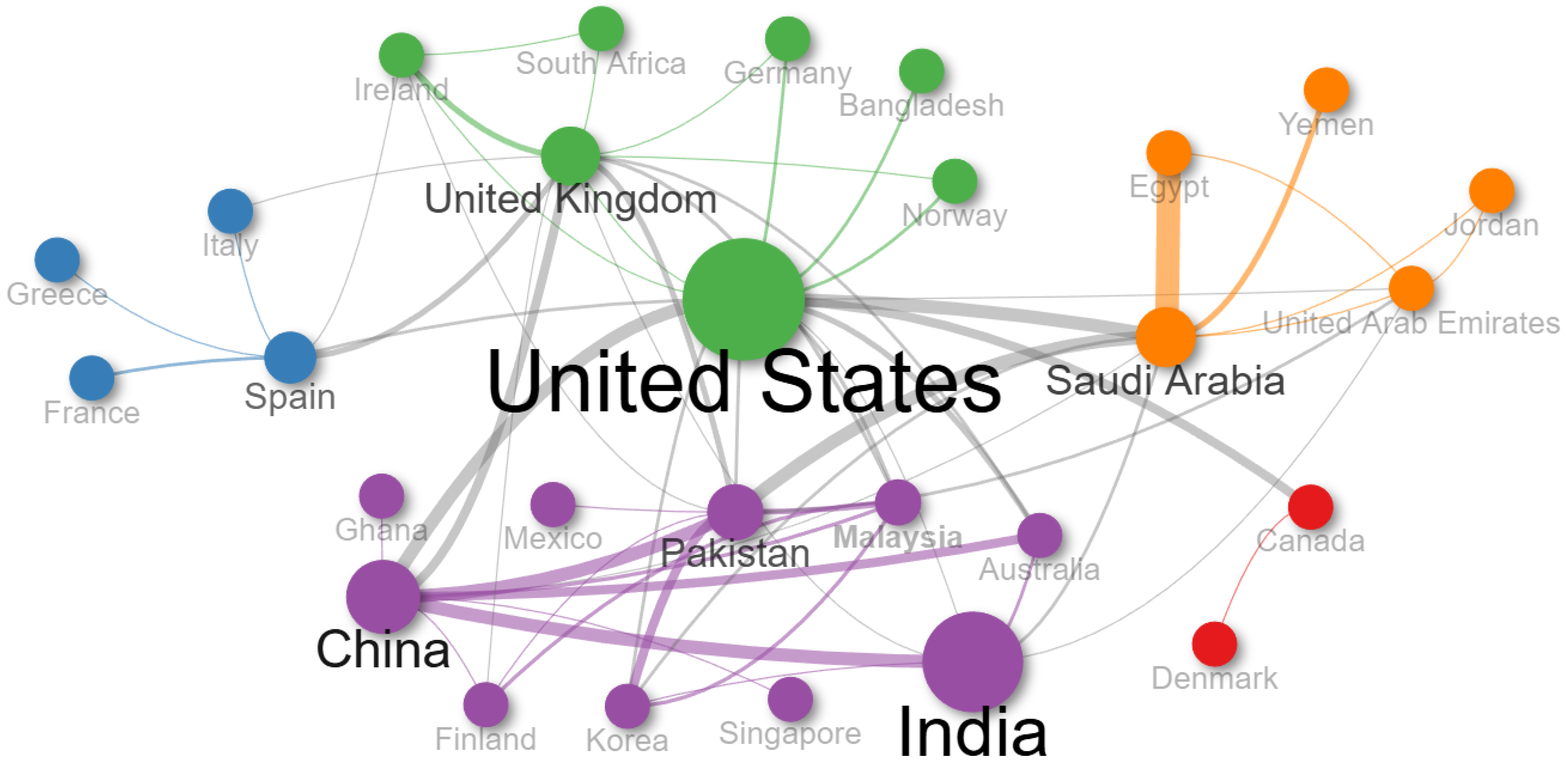
Building on the country-level production profile reported in the previous subsection, we next examine how this output is structured through international co-authorship. Figure 4 depicts the inter-country collaboration network, where node size reflects each country’s contribution and link thickness represents the relative intensity of co-authored publications. The network is strongly centralized around the United States, which appears as the dominant hub, connecting to multiple regional groupings through several high-weight links, indicating that a substantial share of international collaboration is mediated through this node.
A first collaboration community is organized around the United States and the United Kingdom, with the United Kingdom serving as a prominent connector to other European and associated partners, as shown in Figure 4 (Ireland, Germany, Norway, and South Africa). A distinct European-oriented substructure is also observed around Spain, which is linked to neighboring countries such as France, Greece, and Italy, while maintaining visible connections to the core hub through the broader network.
A second major community is centered on South and East Asia, with India and China appearing as large nodes and Pakistan occupying a bridging position within this cluster. Within this group, several links connect India, China, and Pakistan with additional partners, including Malaysia, Australia, Singapore, South Korea, and Finland, suggesting a multi-country collaboration backbone beyond bilateral ties. In parallel, a Middle East-oriented community is evident around Saudi Arabia, with visible connections to the United Arab Emirates and to Egypt, Yemen, and Jordan, indicating a geographically coherent collaboration pattern within that subnetwork. Finally, a smaller collaboration component is visible around Canada, with a clear connection to Denmark, consistent with a more localized bilateral linkage in the network.

3.4. Most Relevant Institutions

Following the country-level and collaboration analyses, we next identify the institutions with the highest publication output in the corpus. Table 1 indicates that King Saud University is the most productive affiliation, with 23 publications. The next position is held by the University of Florida (15), followed by the Symbiosis Institute of Technology (14), confirming that high-output contributions are distributed across multiple national higher-education systems rather than being confined to a single institutional ecosystem.
A subsequent tier includes Delhi Technological University and the University of Southern California (13 each), as well as Carnegie Mellon University and Universiti Kebangsaan Malaysia (12 each). The output at the 11 publications level is represented by the Bucharest University of Economic Studies. The table then shows a cluster of institutions with nine publications, namely Arizona State University, Northwestern Polytechnical University, The University of Texas at Austin, the University of Electronic Science and Technology of China, and the University of Münster. Additional contributors include 8 publications from the National Institute of Technology Hamirpur, Northwestern University, Princess Nourah bint Abdulrahman University, the University of Arkansas at Little Rock, and the University of California, San Diego. Finally, several affiliations contribute 6–7 publications each, including Tsinghua University, University of California, Berkeley, University of North Carolina, Monash University, Nanyang Technological University, University College Dublin, and Complutense University of Madrid, among others, as presented in Table 1.
Taken together, Table 1 suggests that the institutional production profile is characterized by a small set of leading affiliations and a broader group of recurrent contributors with mid-range output, consistent with the geographically distributed patterns described earlier. The next subsection complements this view by shifting from affiliations to publication venues, reporting the most relevant sources.

3.5. Most Relevant Sources

Complementing the institutional profile, Table 2 identifies the main publication venues that concentrate the largest shares of the corpus. IEEE Access emerges as the leading source with 32 publications (Q1). A second tier is formed by Expert Systems with Applications (Q1) and Social Network Analysis and Mining (Q1), each contributing 14 publications, followed by Multimedia Tools and Applications (Q1) with 13 and IEEE Transactions on Computational Social Systems (Q1) with 12. These outlets collectively indicate that the literature is strongly anchored in high-impact venues spanning applied AI, computational social systems, and social media analytics.
A further group of recurrent sources contributes between 10 and 8 publications. At the 10-publication level, Journal of Medical Internet Research (Q1) and PLOS ONE (Q1) highlight the presence of cross-disciplinary publication channels beyond core computer-science venues, particularly in digital-health and broad-scope science outlets. The 8-publication tier includes Applied Sciences (Switzerland) (Q2), JMIR Infodemiology (Q2), and Social Media + Society (Q1), reinforcing the field’s intersection between computational methods, platform dynamics, and societal implications.
At slightly lower frequencies, Scientific Reports (Q1) contributes 7 publications, while Applied Soft Computing (Q1) and Mathematics (Q2) contribute 6 each. Additional sources appear with 5 publications, including CMC–Computers, Materials & Continua (Q2) and the Journal of Computational Social Science (Q2). Finally, a set of venues contribute 4 publications each, spanning both domain-specific and generalist outlets, such as EPJ Data Science (Q1), IEEE Transactions on Knowledge and Data Engineering (Q1), Information Processing & Management (Q1), Proceedings of the ACM on Human-Computer Interaction (Q1), and Information (Switzerland) (Q2), among others, as displayed in Table 2.
The quartile labels reported in Table 2 correspond to the “Best Quartile” (SJR/SCImago) assigned to each source; for the International Journal of Intelligent Systems and Applications in Engineering, this value is not available in the consulted source and is therefore indicated as “Na”. Having established the principal venues this research focuses on, the following subsection turns to impact at the document level by presenting the most relevant articles in the corpus.

3.6. Most Relevant Articles

Table 3 reports the most cited articles in the corpus and provides a compact view of document-level impact. The table is organized into five columns. The Title column lists the full title of each highly cited study, while the Year column indicates its publication year. The Citations column reports the total number of citations each article has accumulated, and Citations/year normalizes this impact by time, allowing a more direct comparison across publications of different ages. Finally, the Study column links each record to its corresponding reference in the review, ensuring traceability to the bibliographic list.
As shown in Table 3, the most cited records include both foundational contributions published earlier in the time window (2017–2018) and more recent high-velocity publications with elevated citation rates per year (2024). The joint use of total citations and citations per year is particularly informative because it distinguishes long-term, cumulative influence from rapidly emerging papers that are currently shaping the field’s agenda.
In the following paragraphs, we summarize the content of each of these most relevant articles and describe their core contributions in relation to AI models, datasets, evaluation practices, and electoral or platform-specific contexts.
With the purpose of contextualizing the citation profile reported in Table 3, we briefly synthesize the scope, AI role, and empirical grounding of each highly cited contribution, emphasizing how their objectives and evidence bases complement—or differ from—model-centric electoral disinformation detection.
The most cited paper, ref. [24], provides a conceptual and analytical examination of algorithmic content moderation and the technical–political constraints of automated platform governance. Rather than proposing a supervised misinformation classifier or an election-specific detection pipeline, it frames moderation as a socio-technical system shaped by error modes, accountability gaps, and governance trade-offs. For this review, its contribution is primarily contextual: it clarifies why AI-mediated enforcement can be simultaneously necessary for scale and speed, yet structurally limited by opacity, contested definitions, and uneven impacts. Accordingly, benchmark datasets, training protocols, and quantitative detection metrics are not central outputs, and electoral disinformation is discussed as part of a broader governance problem rather than as the dominant empirical focus.
In contrast to [24], the second most cited study, ref. [25], centers on effects rather than detection by experimentally assessing how synthetic political video (deepfakes) influences deception, uncertainty, and trust in news. Using a survey experiment with a nationally representative UK sample (reported N = 2005 ), the work treats AI-enabled media generation as the threat vector and evaluates behavioral and perceptual outcomes (e.g., perceived accuracy, uncertainty, trust), not classifier performance. While social media is mainly treated as a dissemination context, the findings are directly relevant to electoral vulnerability because they highlight an epistemic pathway of harm: synthetic political videos can increase uncertainty and reduce trust, even when outright belief change is not the sole mechanism.
The third most cited article, ref. [26], shifts the focus to an election-anchored observational setting by analyzing the coordinated MacronLeaks campaign preceding the 2017 French presidential election. It leverages a large-scale Twitter corpus (nearly 17 million posts collected between 27 April and 7 May 2017) and uses AI primarily for social bot identification and behavioral characterization. The study evaluates multiple classifiers (e.g., Random Forest, AdaBoost, Logistic Regression, and shallow neural models) via cross-validation and reports performance in terms of accuracy and AUC–ROC (with Random Forest reaching roughly 93% accuracy and ~92% AUC–ROC; Logistic Regression selected for speed with ~92% accuracy and lower AUC–ROC). Substantively, it documents patterns consistent with organized amplification (including bot involvement) and suggests limited persuasive penetration within the domestic electorate relative to broader, externally engaged online communities, underscoring the importance of actor provenance and automation in election-related disinformation.
The article ranked fourth, ref. [27], represents a methods-and-system contribution oriented toward automated fake-news detection on social networks. It proposes a multi-feature pipeline that applies AI for supervised classification, using features extracted from user profiles and shared content, supported by a crawler integrated with Facebook for feature acquisition. The authors construct their own dataset via crawling and aggregation across multiple Facebook profiles, assign binary labels (fake vs. legitimate), and compare traditional baselines with a deep learning model centered on LSTM, evaluated using 10-fold cross-validation. The paper reports a best accuracy of approximately 99.4% for the deep learning configuration. Compared with election-anchored observational work such as [26], electoral context is not the primary organizing principle; instead, the contribution lies in platform-oriented detection mechanics and the combination of user- and content-centric signals, with generalization hinging on label validity and robustness to domain shifts across events and platforms.
The fifth most cited study, ref. [28], is similarly not election-centered but is instead methodologically instructive for scalable NLP pipelines. It uses AI-enabled sentiment and topic inference to quantify public attitudes on Facebook and Twitter in the UK and US toward COVID-19 vaccines, combining lexicon-based sentiment models with a pretrained deep learning language model (BERT) via an ensemble strategy. The dataset is explicitly quantified (over 300,000 posts total: 23,571 UK Facebook posts; 144,864 US Facebook posts; 40,268 UK tweets; 98,385 US tweets; 1 March to 22 November 2020), and validation is performed by manually annotating a random subsample (reported as 10%) and refining the ensemble based on diagnostic outputs. In comparison with [27], which emphasizes feature acquisition and supervised detection on a constructed Facebook dataset, ref. [28] foregrounds large-scale monitoring across two platforms using hybrid NLP components.
The article ranked sixth, ref. [29], returns to an election-proximate setting and complements [26] by focusing less on classifier construction and more on diffusion structure. Using the Hoaxy platform, it builds a Twitter diffusion network from approximately two million retweets generated by several hundred thousand accounts over the six months before the 2016 US presidential election, contrasting low-credibility sources with fact-checking content. AI enters primarily through bot detection (via Botometer) and algorithmic network analytics (k-core decomposition and centrality-based ranking). Rather than training a text classifier, the study evaluates diffusion dynamics and simulates mitigation by penalizing central accounts. A key structural result is that fact-checking becomes scarce toward the network core, which also exhibits higher prevalence of automated accounts—a finding that aligns with the emphasis on automation and provenance in [26], while offering a network-centric intervention logic.
The seventh most cited article, ref. [30], is a comprehensive survey that positions stance detection as a core subtask for rumor verification and fake news assessment. Its contribution is integrative rather than empirical, consolidating feature-based models, classical machine learning, neural architectures (CNN/RNN/LSTM variants), and transfer-learning approaches (including BERT and other transformers), alongside trends such as target generalization and domain adaptation. The survey catalogs widely used datasets and shared tasks (SemEval stance tasks, RumourEval, PHEME, and the Fake News Challenge) and summarizes evaluation practices (often accuracy and macro-/weighted F1, depending on imbalance). Relative to model-specific contributions in [27,32,33], it clarifies how stance detection is operationalized and evaluated across benchmarks, with elections appearing as an application domain rather than as a single-event empirical anchor.
The eighth most cited paper, ref. [31], provides a perspective-based synthesis of AI in digital media, with an emphasis on deepfakes. Like [24], it is not framed around a benchmark dataset or a supervised detection model evaluated on election-labeled social media content; instead, it explains enabling technologies and organizes implications across media production, distribution, and societal trust. Its value for this review is conceptual and complementary to [25]: whereas ref. [25] quantifies audience-level effects under experimental exposure, ref. [31] argues for treating detection and governance jointly (technical countermeasures, literacy, and policy responses) in a context of rapid content generation and cross-platform propagation.
The ninth most cited article, ref. [32], is explicitly benchmark-oriented and introduces WELFake as a consolidated dataset and baseline approach for fake news detection. It combines word embeddings with linguistic features and evaluates standard machine-learning classifiers using an ensemble voting scheme. WELFake merges four sources (Kaggle, McIntire, Reuters, and BuzzFeed Political) into a corpus of 72,134 news articles (35,028 real; 37,106 fake), with fields including title, text, and label. Performance is reported using standard metrics (accuracy, precision, recall, F1), alongside comparisons with deep learning baselines (CNN and BERT) and a cross-subset generalization assessment. In relation to [27], which builds a platform-specific Facebook corpus via crawling, ref. [32] instead emphasizes dataset consolidation and benchmark-style evaluation. At the same time, elections remain primarily a motivating context rather than the defining empirical scope.
The article ranked tenth, ref. [33], advances a deep learning stance-detection architecture (CNN–LSTM) for fake news assessment on the Fake News Challenge benchmark (FNC-1). It models relationships between headlines and article bodies, applies dimensionality reduction (PCA or Chi-square), and reports evaluation metrics including accuracy, precision, recall, and F1 (with k-fold cross-validation). The dataset comprises 75,385 labeled instances with 2587 article bodies linked to approximately 300 headlines, and the stance space includes agree, disagree, discuss, and unrelated. While elections are framed as a prominent societal domain impacted by misinformation, the empirical setup is benchmark-driven, complementing the broader benchmark emphasis of [32] and the survey-level consolidation in [30].
The eleventh most cited study, ref. [34], offers a content-driven supervised detection pipeline grounded in engineered linguistic features. It defines three feature groups (syntactic/semantic/grammatical features; readability indices; combined set, 20 dimensions) and compares classical ML baselines (Gaussian and kernel Naïve Bayes; linear and Gaussian SVM), ensemble variants, and neural approaches (a sequential neural model on engineered vectors and an LSTM on word embeddings). Evaluation includes accuracy, ROC curves, confusion matrices, learning curves, and training-time comparisons. Two English political-news datasets are used from the Horne2017_FakeNewsData1 repository: BuzzFeed Political News (48 fake, 53 real) and Random Political News (75 fake, 75 real). A salient result is that the sequential neural model over linguistic features reaches approximately 86% validation accuracy and remains comparable to LSTM performance (about 86.5%) while requiring substantially less training time, illustrating how feature engineering can compete with heavier sequence models in this setting.
The article anked twelfth, ref. [35], provides a comprehensive survey that formalizes false information detection (FID) on social media and organizes AI paradigms into content-based, social-context, feature-fusion, and deep learning approaches, including multimodal FID and hybrid human–machine detection. It catalogs datasets across platforms (notably Twitter and Sina Weibo) and fact-checking-driven corpora (LIAR, BuzzFeedWebis, FakeNewsNet), and it also argues for context-sensitive evaluation. Importantly for electoral settings, the paper notes that elections can shift metric priorities (e.g., privileging recall over precision), motivating evaluation protocols that reflect real-world risk trade-offs rather than relying exclusively on single-number summaries. In this sense, ref. [35] complements [30] by connecting methodological choices to operational objectives under election-driven constraints.
The thirteenth most cited paper, ref. [36], does not propose a detection model but offers a conceptual analysis of nefarious applications of generative AI and large language models, emphasizing how these systems can scale disinformation, deception, and propaganda through realism, volume, personalization, and operational scalability. Although it introduces no dataset and reports no predictive evaluation, its relevance to electoral disinformation lies in framing democratic manipulation as a key societal-scale harm and in motivating mitigation directions such as provenance mechanisms, labeling, watermarking, and continuous monitoring. Together with deepfake-focused works [25,31], it situates generative AI as a threat multiplier that challenges purely post-hoc moderation strategies.
Finally, study [37]—ranked twenty-seventh by total citations but included due to its high annual citation rate—extends the scope beyond veracity detection by estimating the societal impact of vaccine-related misinformation on Facebook, defined as the product of (i) persuasive influence conditional on exposure and (ii) population-level exposure. Methodologically, it integrates two randomized online survey experiments, privacy-protected measurements of Facebook URL views, and a crowd–machine learning (NLP) pipeline that extrapolates experimentally estimated persuasion effects to a broader universe of URLs. Notably, AI is not deployed as a true/false classifier; instead, the computational task is to infer the expected persuasive effect of content—whether exposure is likely to increase vaccine hesitancy—from headline and description metadata, thereby shifting the analytic question from “Is this false?” to “If seen, is this likely to reduce vaccination intentions?”
The core NLP module is a transformer-based model (COVID-Twitter-BERT) trained to predict a crowdsourced aggregate score from headline/description text, with the final specification selected based on the lowest test-set mean squared error and additional criteria. Predicted scores are mapped to URL-level treatment-effect estimates via a random-effects meta-regression calibrated on experimental results. Empirically, the framework links: (i) causal identification from two Lucid experiments (Study 1: N = 8603 ; Study 2: N = 10 , 122 ; total N = 18 , 725 ) using pre/post vaccination-intentions measures under single-exposure stimuli; (ii) exposure measurement using Facebook Social Science One/URL Shares data, yielding 13,206 vaccine-related URLs publicly shared more than 100 times and published in January–March 2021; and (iii) crowd labeling of the 130 experimental items plus an additional 1139 URLs to produce supervised labels for transformer training. Exposure is quantified as unique-user URL views, with total vaccine-related URL views reported as 2.7 billion. In contrast, URLs flagged by professional fact-checkers as “false/missing context/mixture” accumulate 8.7 million views (0.3%).
Evaluation is reported at multiple levels. For causal effects, Study 1 estimates that exposure to a single fact-checked misinformation item reduces vaccination intention by 1.5 percentage points on average ( P = 0.00004 ), with substantial heterogeneity across items; Study 2 further reports that the headline attribute “implies the vaccine is harmful to health” is the most consistent predictor of negative persuasive influence, while veracity becomes non-significant once perceived harm is included. For predictive validation, the NLP model is evaluated using an 85/15 stratified train–test split on the 1139 labeled URLs, reporting 86% of predictions within 0.5 scale points and 99% within 1 point, and, on a derived binary task (hesitancy-inducing vs. not), 97% AUC, 91% accuracy, and a 4% false-positive rate. These predictions are then converted into URL-level treatment-effect estimates and aggregated into population-level impact by weighting effects by observed views.
Although elections are not the primary empirical domain, ref. [37] explicitly situates the work within the broader misinformation agenda that intensified after the 2016 election and contrasts its scalable framework with one-off platform collaborations undertaken around the 2020 election; thus, the electoral dimension functions as contextual motivation and comparison. Facebook is the central platform throughout, since exposure measurement and impact estimation are based on Facebook data. Substantively, the study reports that fact-checked (flagged) misinformation appears more harmful conditional on exposure but reaches relatively few users; by contrast, unflagged yet vaccine-skeptical content receives far greater exposure and therefore dominates estimated impact. Restricting to the 3711 URLs predicted to be hesitancy-inducing, the estimated per-user impact is −2.28 percentage points (CI: [−3.4, −0.99]) for unflagged vaccine-skeptical content versus −0.05 percentage points (CI: [−0.07, −0.02]) for flagged misinformation, implying a 46-fold difference driven primarily by exposure disparities. This result challenges mitigation strategies that focus exclusively on veracity and supports broadening detection and intervention beyond outright falsehoods to include misleading content in the gray zone.
Overall, the most cited literature reports span (i) governance-oriented conceptual analyses [24,31,36], (ii) effect-focused experimental and observational studies [25,26,29,37], and (iii) model- and benchmark-centric detection and stance frameworks [27,30,32,33,34,35]. This heterogeneity clarifies that “AI for disinformation” encompasses multiple roles—moderation, threat generation, actor identification, diffusion analysis, and supervised detection—with elections functioning variably as a primary empirical anchor, an application context, or a motivating backdrop. In order to complement the analysis, the next subsection maps the conceptual structure of the field.

3.7. Word-Clouds and Keyword Co-Occurrence

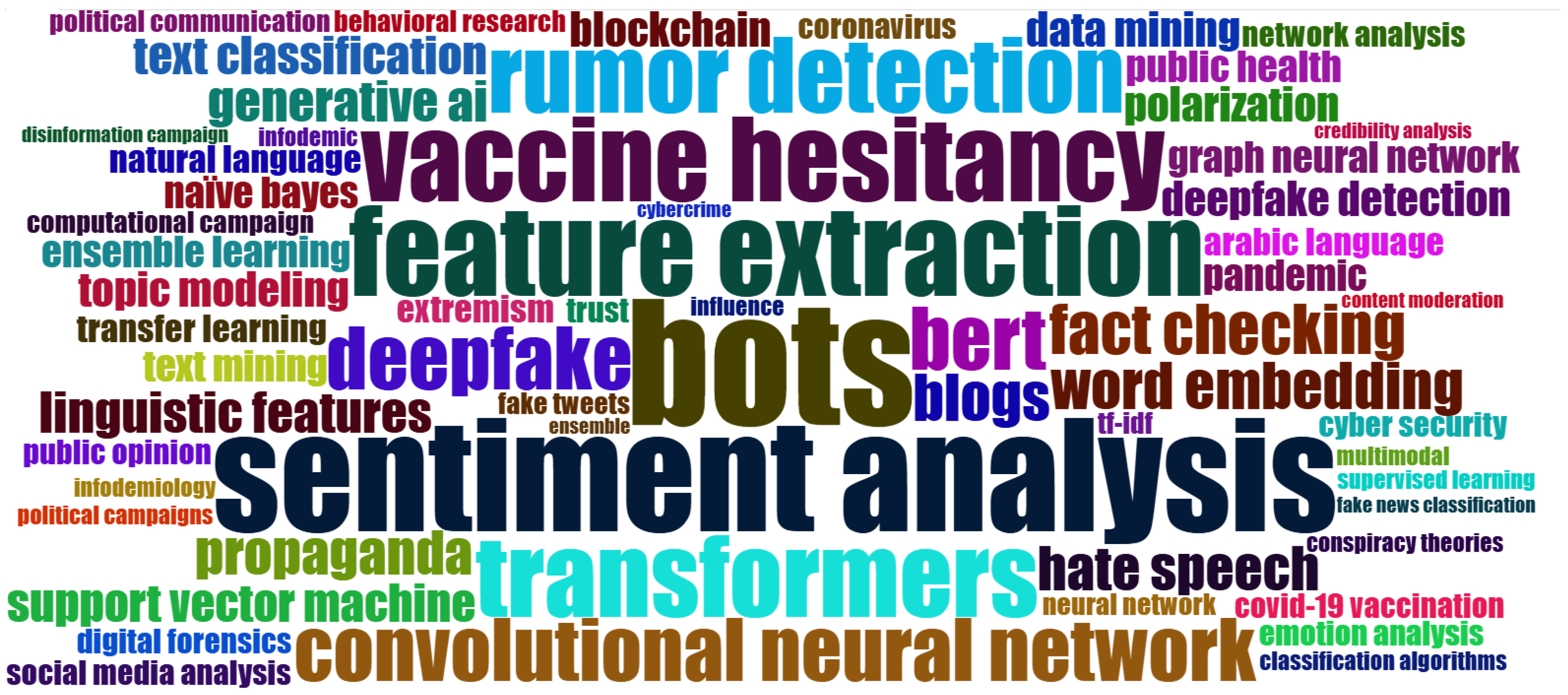
The previous subsection synthesized the literature at the document level; the present subsection examines the conceptual footprint through keyword frequency profiles and co-occurrence structure. Figure 5 presents the word cloud derived from Author Keywords, where term size reflects frequency in the corpus. The dominant signals combine actor and network-oriented perspectives, supervised and deep-learning detection pipelines, and health and infodemic adjacent themes that co-evolve with misinformation research.
The most frequent Author Keyword is bots (40), closely followed by sentiment analysis (36) and feature extraction (29), indicating that automated account characterization and feature engineering remain central motifs. A second set of highly salient terms includes vaccine hesitancy (27) and coronavirus (8), together with pandemic (10), public health (10), infodemic (6), and infodemiology (6), suggesting that COVID-19–related information disorder and vaccine discourse constitute a prominent, widely studied strand that intersects with broader misinformation detection agendas. In parallel, methodological keywords reflect the consolidation of modern NLP and deep learning: transformers (26), BERT (20), word embedding (15), and transfer learning (9), alongside architecture- and classifier-level terms such as long short-term memory (LSTM) (22), bi-directional long short-term memory (13), convolutional neural network (20), support vector machine (12), Naïve Bayes (10), and classification algorithms (6). The cloud also surfaces task- and intervention-oriented keywords—rumor detection (24), fact checking (16), misinformation detection (13), text classification (12), and topic modeling (11)—together with risk and content categories that frequently frame electoral and political discourse online, including polarization (11), hate speech (14), extremism (9), and propaganda (14). Finally, several more specialized yet visible terms point to adjacent technical and governance concerns: graph neural network (10), ensemble learning (10) and ensemble (5), tf-idf (7), multimodal (6), digital forensics (8), cyber security (8), and deepfake (20) with deepfake detection (11), as well as blockchain (11) and campaign-oriented descriptors such as computational campaign (7), political campaigns (6), disinformation campaign (5), and fake tweets (7), as shown in Figure 5.
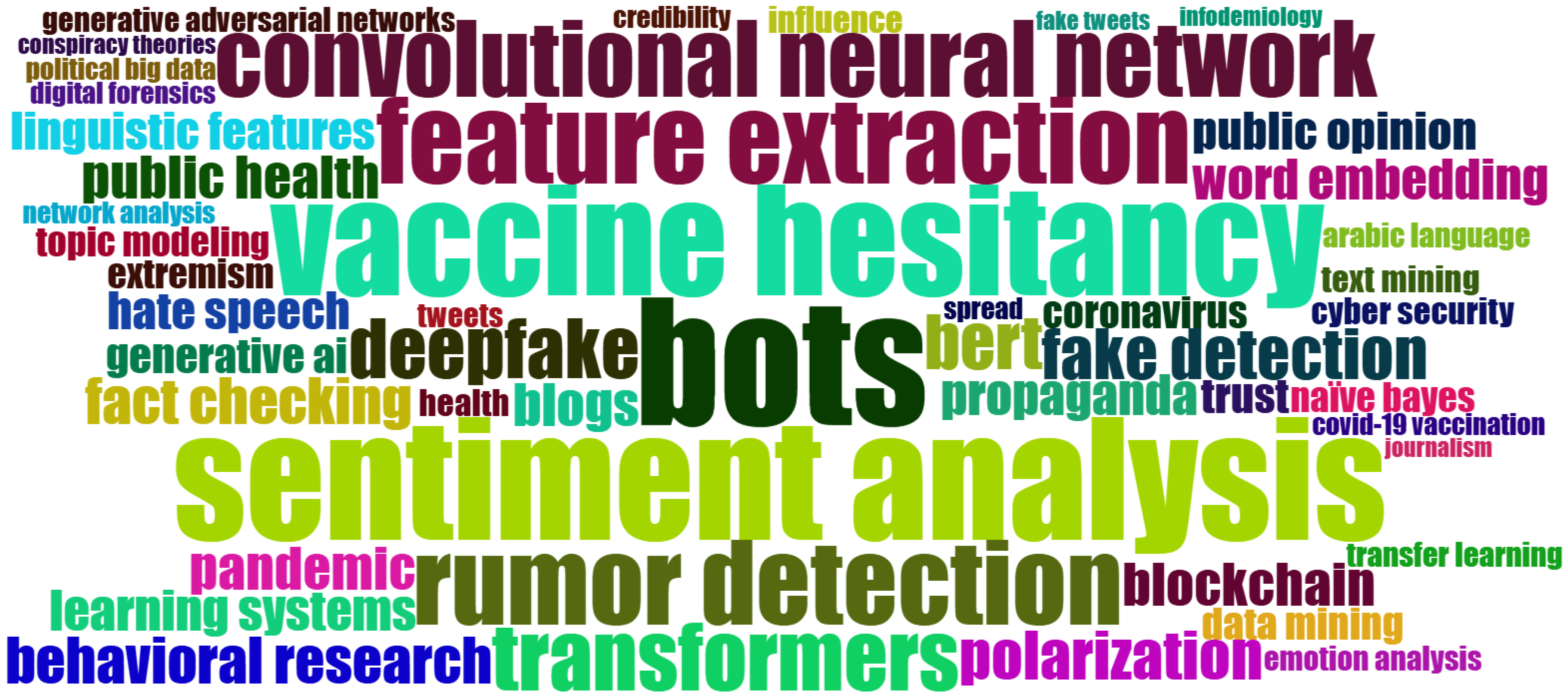
Figure 6 reports the corresponding word cloud for All Keywords (Author Keywords + Keywords Plus), which largely reinforces the same topical backbone while expanding it with broader indexing descriptors. The leading terms remain consistent, with higher counts in several cases, namely bots (47), sentiment analysis (45), vaccine hesitancy (41), feature extraction (32), and rumor detection (31), confirming their role as stable thematic anchors across keyword fields. Methodological continuity is also evident in the persistence of deep-learning and NLP terms, including convolutional neural network (28), transformers (25), long short-term memory (LSTM) (24), deepfake (22), and BERT (20), together with verification and threat-related concepts such as fact checking (17), blockchain (16), misinformation detection (14), large language models (17), generative AI (13), propaganda (15), hate speech (14), polarization (18), and extremism (11).
Compared with Author Keywords alone, shown in Figure 5, All Keywords additionally foregrounds terms that are either absent from or less explicit in the author-supplied vocabulary, including learning systems (15), health (10), information dissemination (9), public perception (9), tweets (9), social media platforms (8), spread (8), unsupervised learning (8), credibility (8), political big data (8), and journalism (7). In substantive terms, these additions broaden the interpretive frame from detection tasks and model families toward dissemination dynamics, perception-oriented constructs, and platform-level descriptors, which Keywords Plus tends to capture more systematically than Author Keywords.
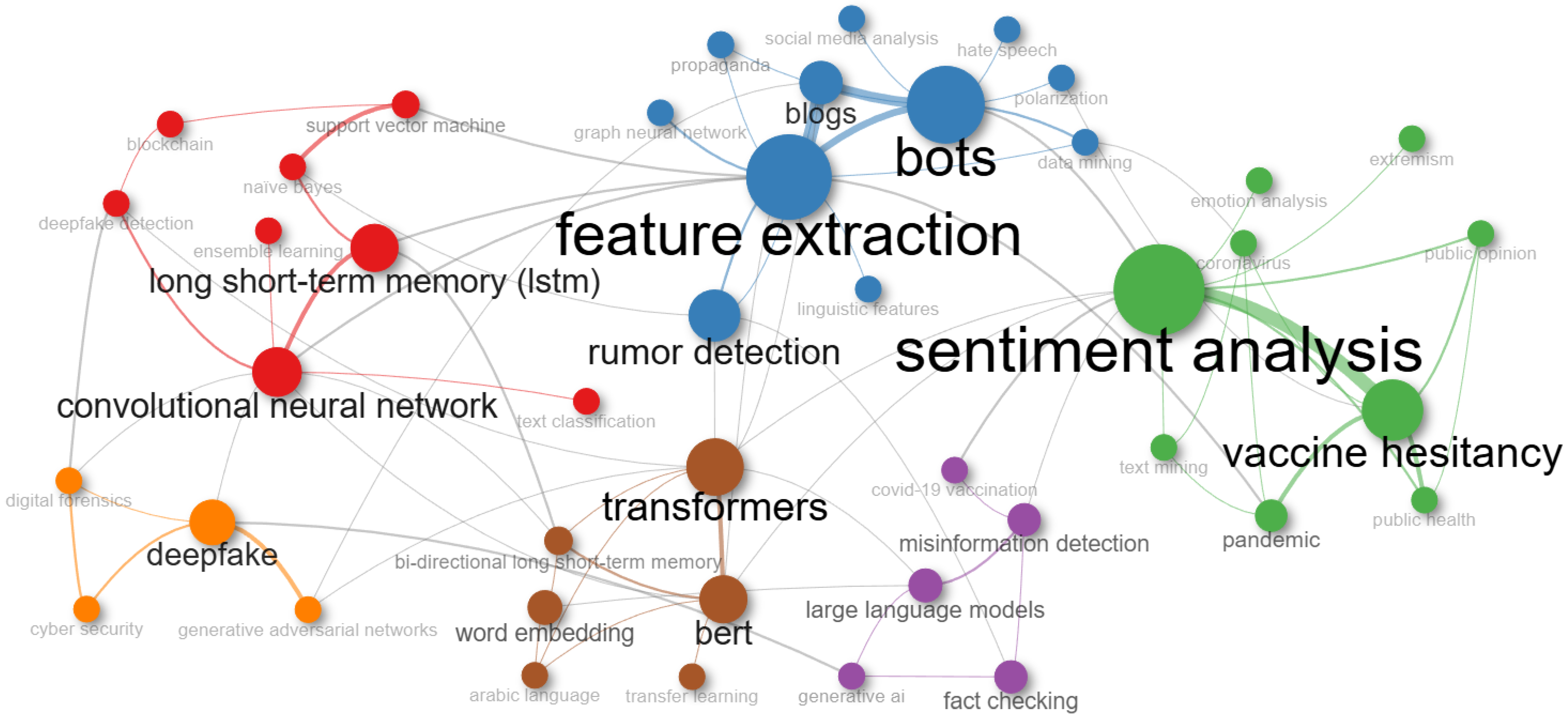
In order to move from frequency prominence to relational structure, Figure 7 shows the co-occurrence network built from Author Keywords. Nodes represent keywords and edges represent co-occurrence within documents; node size reflects keyword frequency, while proximity and edge thickness indicate stronger co-usage patterns. Six main thematic clusters are visible. The blue cluster concentrates around feature extraction and bots, linking these central nodes to terms that operationalize platform-scale analysis and content/context framing, including blogs, rumor detection, social media analysis, propaganda, hate speech, polarization, data mining, as well as more technical descriptors such as linguistic features and graph neural network. This structure is consistent with the high frequencies of bots (40) and feature extraction (29) in Figure 5, and it highlights how actor identification and engineered signals are frequently coupled with discourse-level risk categories.
The green cluster is anchored by sentiment analysis and vaccine hesitancy, with tightly associated public-health and COVID-19 descriptors such as coronavirus, pandemic, public health, and public opinion, together with affective and societal variables (emotion analysis, text mining, and extremism). In line with the word clouds, this cluster captures a prominent strand where misinformation research intersects with infodemic-era discourse monitoring and behavioral interpretation, as presented in Figure 5 and Figure 6. Moreover, the red cluster groups architecture and classifier-centric terms that operationalize supervised detection, including convolutional neural network, long short-term memory (LSTM), support vector machine, Naïve Bayes, ensemble learning, and text classification. Within the same cluster, blockchain and deepfake detection appear as adjacent, more specialized nodes, indicating their co-occurrence with detection-oriented method vocabularies in a subset of studies.
The orange cluster is organized around deepfake and connects it to security and forensics-adjacent keywords such as digital forensics, cyber security, and generative adversarial networks, reflecting a coherent synthetic-media threat and analysis thread. Additionally, the brown cluster is centered on representation learning and transformer-era NLP, grouping transformers with BERT, word embedding, bi-directional long short-term memory, and closely related enablers and markers such as transfer learning and Arabic language. Finally, the purple cluster captures verification- and modern-NLP-driven work by linking misinformation detection (positioned near and connected to the green cluster), fact checking, large language models, generative AI, and COVID-19 vaccination (also situated close to the green cluster). Through its proximity to the brown cluster (transformers, BERT, and word embedding) and its links to monitoring and health-related terms, this cluster bridges verification objectives with contemporary representation learning and generative-model contexts, mirroring the joint prominence of these topics across both keyword fields in Figure 5 and Figure 6.
Taken together, the word clouds and the co-occurrence network outline a thematic structure: (i) automated actors and engineered signals for identifying and characterizing manipulation (bots, feature extraction); (ii) supervised and deep-learning detection pipelines and their commonly used model families (CNN/LSTM and classical baselines); and (iii) verification-oriented and modern NLP paradigms that increasingly shape model design and evaluation (transformers, BERT, large language models, and fact checking). As a tightly coupled extension, synthetic-media threats and related detection work (deepfakes and deepfake detection) emerge alongside electoral disinformation. In parallel, socio-political risk constructs (hate speech, polarization, extremism) provide substantive anchors for the harmful content and behaviors that detection systems frequently operationalize. Building on this keyword-level structure, the next subsection uses the thematic map to position these clusters by centrality and degree of development in the field.

3.8. Thematic Map

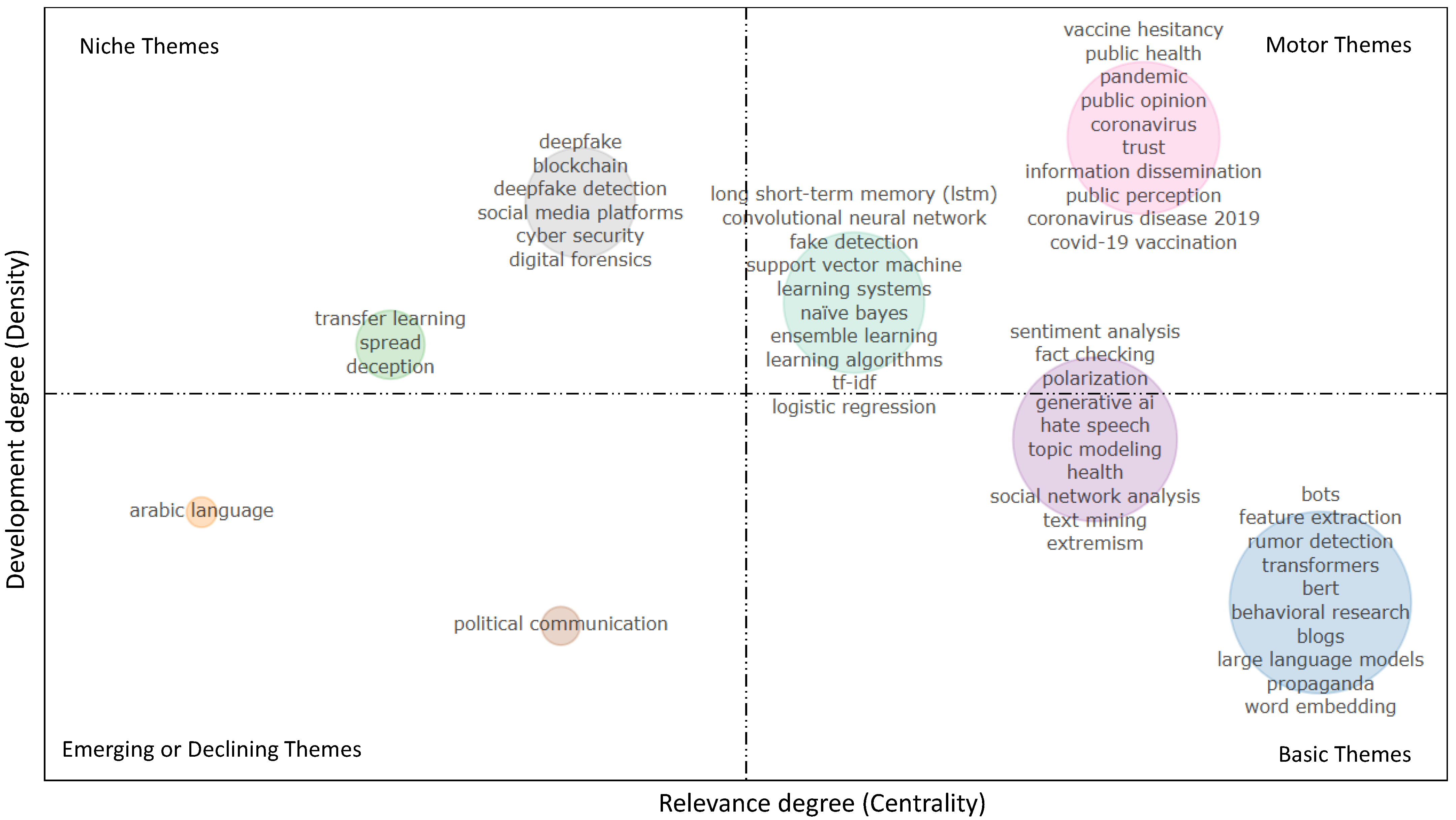
Figure 8 presents the thematic map derived from the Author Keywords, where themes are positioned according to two complementary dimensions: the relevance degree (centrality) on the x-axis and the development degree (density) on the y-axis. As outlined in Section 2.5 and Section 2.6, high-frequency domain anchors present in the search framing, such as election- and platform-related terms, were excluded from keyword-based analyses to prevent trivial clustering. Consequently, the themes depicted in Figure 8 represent subthemes identified after anchor removal within the corpus, rather than the complete definitional vocabulary of the field. Centrality captures how strongly a theme is connected to the overall conceptual structure of the field (its transversal importance), whereas density reflects the internal cohesion of the theme (how developed and self-contained it is). The plane is divided into four quadrants—Motor Themes (upper-right; high centrality and high density), Basic Themes (lower-right; high centrality and lower density), Niche Themes (upper-left; low centrality and high density), and Emerging or Declining Themes (lower-left; low centrality and low density):
  • In the Motor Themes quadrant, Figure 8 highlights a health and infodemic-adjacent cluster dominated by vaccine hesitancy, public health, pandemic, public opinion, coronavirus, and trust and accompanied by terms that emphasize population-scale information dynamics and perception, such as information dissemination, public perception, coronavirus disease 2019, and COVID-19 vaccination. In the same quadrant, a method-centric theme appears near the quadrant boundary, grouping widely used detection model families and learning paradigms—long short-term memory (LSTM), convolutional neural network, fake detection, support vector machine, and learning systems—together with Naïve Bayes, ensemble learning, and learning algorithms. This positioning indicates that these modelling choices are both well developed and structurally relevant within the keyword space of the corpus.
  • The Basic Themes quadrant concentrates the most central, field-defining vocabulary of AI-enabled disinformation research on social media. A large foundational cluster is anchored by bots and feature extraction, and includes rumor detection, transformers, BERT, behavioral research, blogs, large language models, propaganda, and word embedding. A second basic cluster, positioned closer to the density axis, integrates content and discourse-oriented risk constructs with analytical tasks and techniques, including sentiment analysis, fact checking, polarization, generative ai, hate speech, topic modeling, health, social network analysis, text mining, and extremism. Notably, tf-idf appears near the central boundary, while logistic regression lies close to the quadrant intersection, indicating their recurrent but comparatively less consolidated thematic roles.
  • In the Niche Themes quadrant, Figure 8 identifies a specialized, internally cohesive cluster around synthetic-media threats and integrity/security perspectives, grouping deepfake, deepfake detection, blockchain, social media platforms, cyber security, and digital forensics. A second niche cluster captures a compact set of concepts related to diffusion and influence dynamics—transfer learning, spread, and deception—suggesting a focused but less structurally central research pocket within the overall field.
  • Finally, the Emerging or Declining Themes quadrant includes low-centrality and low-density themes that appear more isolated in the current conceptual landscape, notably arabic language and political communication. Their location indicates that, within this corpus, these topics are either nascent and not yet fully integrated into the broader thematic structure, or they represent lines of work whose relative prominence is decreasing.
Overall, the thematic map indicates that the conceptual backbone of the literature is anchored by socially grounded detection targets (bots, rumor detection) and contemporary NLP/modeling choices (transformers, BERT, ensemble learning), while specialized themes (deepfake and related security/forensics keywords) remain comparatively more niche.

4. Discussion

This review mapped the scientific literature on artificial intelligence for detecting electoral disinformation on social media. The results reveal a rapidly expanding field, a geographically concentrated production structure with hub-dominated collaboration, a publication ecology anchored in high-impact venues, and a conceptual landscape in which detection-oriented pipelines coexist with governance, diffusion, and impact-estimation approaches. Importantly, although the search strategy enforced an electoral framing, the corpus exhibits strong thematic co-evolution with pandemic-era misinformation research and adjacent integrity technologies, including blockchain, indicating that methodological innovation and research attention have often been catalyzed by societal shock events and by broader platform-information integrity agendas.
From a contribution point of view, this review offers three complementary advances for the election-relevant disinformation literature. First, it presents a corpus-level analysis of growth signals, publication venues, and collaboration structures, clarifying the consolidation of the field and identifying potentially under-represented contexts and regions. Second, it integrates science-mapping evidence with an election-focused perspective to delineate the conceptual structure of the domain, demonstrating the coexistence of detection-oriented pipelines with governance, diffusion, and impact-estimation approaches, and illustrating how related integrity agendas, such as pandemic-era infodemic research and provenance-oriented themes, influence methodological focus. Third, it supplements these distribution-level insights with a structured synthesis of highly cited studies, enabling direct comparison of model choices, dataset and labeling characteristics, and evaluation designs, thereby facilitating limitation-aware interpretation of benchmark performance in contexts affected by domain and temporal shift.

4.1. Main Growth Signals and Consolidation of the Publication Ecosystem

The annual production profile indicates a pronounced acceleration after 2019, followed by sustained growth through 2025, with 2026 representing a partial-year count. This trajectory suggests that electoral disinformation detection has shifted from a niche methodological topic into a high-throughput research area that absorbs advances from machine learning and computational social science while responding to repeated real-world integrity crises. In parallel, the distribution of publication venues (Table 2) shows that the literature is not confined to specialized outlets: it concentrates in high-impact, predominantly Q1 sources spanning applied AI and computational social systems (IEEE Access, Expert Systems with Applications, IEEE Transactions on Computational Social Systems), while also extending into cross-disciplinary venues (Journal of Medical Internet Research, PLOS ONE). This pattern is consistent with the dual character of the field: it is simultaneously a technical detection problem and a societal-risk domain that attracts interdisciplinary perspectives.
At the institutional level (Table 1), production is distributed across multiple national systems rather than dominated by a single organizational cluster, yet the country profile remains highly concentrated (Figure 3). The United States, India, and China collectively account for a large share of output, with several European and Middle Eastern contributors forming a second tier. This asymmetry is mirrored in the inter-country collaboration network (Figure 4), where the United States functions as a central hub connecting multiple regional communities, while distinct collaboration substructures emerge around the United Kingdom, Spain, South/East Asia (India–China–Pakistan), and a geographically coherent Middle East-oriented component. Taken together, these results indicate that the field is global in participation but uneven in representation and connectivity, a structure that may shape which electoral contexts, languages, and platforms are most frequently studied and which become peripheral.

4.2. What “AI for Electoral Disinformation” Means in Practice: Heterogeneity of Roles

A key contribution of the Results is the clarification that “AI for disinformation” is not reducible to a single supervised veracity classifier. This clarification is consistent with broader syntheses that frame elections as a high stakes domain shaped by platform governance, regulatory design, and technopolitical infrastructures, where automation can both support electoral administration and amplify integrity risks [15,17,18]. At a higher level of abstraction, a systematic review on on AI influence on elections similarly emphasizes that the evidence base is methodologically heterogeneous and that many studies address governance and societal impact questions rather than detection system design [22]. Against this backdrop, the synthesis of highly cited papers (Section 3.6) shows three recurrent operational roles in the journal literature. First, governance focused analyses conceptualize algorithmic moderation as a sociotechnical system shaped by technical constraints and political constraints, positioning elections as part of a broader platform governance problem. Second, studies that focus on effects evaluate the consequences of manipulated or misleading content through experimental or observational designs, thereby emphasizing persuasion, uncertainty, trust, and diffusion rather than classifier performance. Third, studies centered on models and benchmarks develop supervised detection architectures or stance detection architectures and compare them under cross validation protocols, often in benchmark settings where elections motivate the work but do not always define the empirical scope.
This heterogeneity is methodologically consequential. It implies that progress in the field cannot be assessed exclusively through incremental performance gains on static datasets. Instead, it requires aligning the AI task definition with the operational objective, whether the goal is to identify coordinated inauthentic behavior, detect misleading narratives, support fact checking workflows, model diffusion, or estimate population level impact conditional on exposure. The most cited corpus illustrates all of these emphases, demonstrating that electoral vulnerability is shaped by interacting mechanisms, including content properties, actor automation, network structure, and platform governance. As a result, the literature motivates multi level analytical frameworks that can integrate these mechanisms, rather than isolated classifiers evaluated under narrow benchmark assumptions.

4.3. Conceptual Backbone from Keywords: Actors, Detection Pipelines, and Modern NLP

The science mapping results (Figure 5, Figure 6, Figure 7 and Figure 8) provide a coherent interpretation of how the field organizes its core problems. First, the prominence of bots and feature extraction across keyword fields, together with their central positioning in the co-occurrence network, indicates that actor characterization and engineered signals remain foundational. This pattern is consistent with election-focused accounts that emphasize coordinated amplification, automation, and the role of platform dynamics in shaping information exposure and political communication [16,18,21].
Second, families of detection models (CNN, LSTM, SVM, Naïve Bayes, ensemble learning) appear as a well-developed and structurally relevant theme in the thematic map. This configuration reflects the consolidation of supervised detection pipelines that remain widely deployed, in part because they can be implemented with comparatively accessible feature sets, benchmark datasets, and standardized validation procedures, which supports reproducibility and cross-study comparison within the constraints of the available literature.
Third, the sustained presence of transformers, BERT, and related representation learning terminology indicates a clear methodological shift toward modern NLP grounded in transformer architectures. In the co-occurrence structure, these terms form a dedicated cluster that connects to verification work (fact checking) and also links to large language models and generative AI. The inclusion of a rapidly cited paper on nefarious applications of generative AI in the highly cited subset further supports the interpretation that recent research attention is increasingly moving beyond discriminative detection pipelines toward threat modeling in an environment where persuasive content can be generated at scale and tailored to audiences [20,21]. In practical terms, this shift motivates additional evaluation requirements that are not fully addressed by static benchmarks, including robustness under adaptive manipulation, provenance and authenticity signals, and monitoring strategies that remain informative as the frontier of content generation evolves faster than dataset refresh cycles [19,20].

4.4. Socio-Political Harm Constructs as Central Detection Targets: Polarization, Hate Speech, and Extremism

Beyond model families and platform signals, the keyword evidence indicates that the field is substantively anchored in harm constructs that operationalize politically consequential forms of online discourse. In the Author Keywords profile, hate speech, polarization, and extremism appear among the recurrent content and risk categories that frame election related political communication online, and they remain visible under All Keywords with comparable or higher frequencies. This emphasis is consistent with election focused syntheses that describe how emotionally charged and polarizing narratives can be mobilized during campaign periods and then amplified through platform dynamics and coordinated activity [13,14,16]. In other words, “AI for electoral disinformation” is frequently formulated not only as veracity assessment, but also as the detection and monitoring of discourse patterns that plausibly mediate electoral harm, including hostility directed at social groups, radicalizing narratives, and polarized information environments.
This positioning is reinforced by the relational structure. In the co-occurrence network, these constructs co-appear with technical anchors (bots and feature extraction) and with analytic tasks (sentiment analysis, text mining, and fact checking), indicating that they are routinely embedded within full detection and monitoring pipelines rather than treated as peripheral topics. Consistently, the thematic map places polarization, hate speech, and extremism within a central basic theme cluster alongside sentiment analysis, topic modeling, and verification focused terms, suggesting that they function as transversal targets that connect multiple methodological approaches.
From the standpoint of implications, these patterns also clarify why evaluation and governance considerations cannot be decoupled from harm operationalization. Reviews that focus on regulation and platform accountability stress that interventions aimed at harmful political speech can interact with freedom of expression and due process safeguards, and that legitimacy depends on transparent and auditable mechanisms [17]. Therefore, future work that claims electoral relevance would benefit from making explicit which harm construct is being operationalized, how it is labeled or proxied, and whether evaluation protocols reflect asymmetric error costs and context sensitivity during election windows. This is precisely where the present review adds value relative to higher level syntheses: it links these harm constructs to the concrete choices that shape empirical claims, including model task formulation, dataset and labeling regimes, and evaluation designs.

4.5. Collateral but Structurally Important Themes: Pandemic-Driven Infodemic Research and Blockchain

Although the review is framed around elections, the keyword evidence shows that pandemic-era misinformation research is not a marginal add on but a central driver of the conceptual structure. Terms such as vaccine hesitancy, pandemic, public health, coronavirus, and infodemic or infodemiology are frequent and form a motor theme in the thematic map, indicating both high centrality and strong internal development. This configuration suggests that the COVID-19 period operated as a catalyst for misinformation research, accelerating methodological development in large scale monitoring, sentiment inference, topic modeling, and transformer based NLP, and producing datasets and workflows that can be partially adapted to election relevant settings. A complementary lesson from impact oriented work in the health context is that misinformation becomes especially consequential when rapid behavioral responses are required, which motivates methods that quantify exposure and downstream effects rather than focusing exclusively on classifier performance [22].
The presence of blockchain in the keyword results further indicates that integrity research extends beyond detection and verification into infrastructure-oriented approaches. In the co-occurrence network, blockchain appears near detection vocabulary and within the same cluster as deepfake related terms, while the thematic map places blockchain in a niche quadrant alongside synthetic media threats and security and forensics terminology. This pattern is consistent with broader integrity syntheses that foreground provenance, authenticity, and verification ecosystems, including work that proposes blockchain based mechanisms for tracking and validating media assets in response to deepfake risks [19]. At the same time, the niche placement is informative: blockchain oriented work appears internally cohesive but less central to the field than themes related to bots, feature extraction, and mainstream NLP. Consequently, within the present corpus, blockchain is best interpreted as an adjacent integrity subfield that is often invoked in discussions of provenance, tamper resistance, or verification ecosystems, rather than as a dominant methodological pillar for election relevant disinformation detection on social media. This positioning also reinforces a practical implication for evaluation: when integrity is pursued through infrastructure mechanisms, evidence should clarify how such mechanisms interact with detection pipelines, what assumptions they make about platform deployment, and how they perform under evolving synthetic media capabilities [20,21].

4.6. Evaluation Practices and the Persistent Problem of External Validity

Across the highly cited literature, evaluation practices remain heterogeneous and frequently centered on benchmarks. Many studies that focus on models report standard metrics such as accuracy and F1 related measures under k fold cross validation, whereas observational and experimental contributions emphasize different validity targets, including behavioral outcomes, diffusion structure, exposure measurement, and causal effects. This diversity is expected given the multiple AI roles identified above [18,22]. However, it also reveals a persistent gap between benchmark performance and operational readiness in election relevant deployments, a point that becomes especially salient when governance and regulatory discussions depend on credible evidence about effectiveness and error trade offs [17].
Two challenges are particularly salient. First, domain shift and temporal shift remain central threats to validity in electoral contexts, where narratives, targets, and platform affordances change rapidly. This concern is consistent with election focused accounts that document how manipulation tactics and AI enabled content generation capabilities evolve across election cycles and platforms, making static evaluations increasingly uninformative for real world use [20,21]. Second, platform specificity and data access constraints can bias what is measurable. This helps explain why some highly influential work emphasizes Twitter centered network dynamics, whereas other contributions focus on exposure measurement in Facebook settings, and why cross platform generalization is frequently stated as an aspiration rather than demonstrated through systematic empirical protocols [18,21,22]. Taken together, these patterns support a cautious interpretation of high accuracy values when dataset sampling, labeling quality, and potential topic leakage are not fully characterized within the evaluation design.
From an implications standpoint, the evidence motivates evaluation protocols that align operational objectives with modeling roles and that explicitly test robustness under temporal change and platform change, while also accounting for asymmetric error costs during election windows and representativeness across electoral contexts and languages. These requirements are closely coupled to the broader integrity and accountability concerns raised in governance oriented syntheses, but they must be instantiated through concrete methodological choices if reported performance is to be interpreted as deployment relevant evidence [17].

Recommended Minimum Reporting Checklist for Election-Relevant Evaluation

In order to facilitate limitation-aware interpretation and enhance comparability across heterogeneous benchmarks, studies should, at a minimum, report the following: (i) split design and generalization setting, specifying whether splits are random or time-aware and whether evaluation targets within-election or out-of-election transfer; (ii) leakage safeguards, including the unit of separation and checks for overlap across users, threads, near-duplicates, or topics; (iii) transfer evidence, when feasible, such as evaluation across platforms or elections as a proxy for domain shift; (iv) label provenance and quality controls, detailing who performed labeling, the guidelines used, adjudication procedures, and agreement or reliability indicators when available; (v) robustness and sensitivity checks, including perturbation tests, ablations, or stress tests under distribution shift; and (vi) error characterization beyond headline accuracy, such as per-class metrics, calibration where relevant, and discussion of asymmetric error costs in election contexts.

4.7. Implications for Future Research

The mapped landscape suggests several concrete research directions aligned with the field’s current structure:
  • From detection to impact and exposure-aware evaluation.
    The corpus contains influential examples where the analytic target shifts from binary veracity to measurable societal impact conditional on exposure. Extending this orientation to electoral settings would require linking content-level predictions to platform-scale exposure proxies and to outcomes that operationalize socio-political harms, including polarization dynamics, hate speech prevalence, and extremism-related narratives, while maintaining transparent assumptions and privacy-preserving measurement. In this context, evaluation should move beyond aggregate performance and incorporate cost-sensitive validation, calibration, and Robustness to temporal and narrative shifts, given that election-time risks are highly context-dependent.
  • Robustness under generative and multimodal threat regimes.
    Research on deepfakes and synthetic media detection constitutes a coherent niche that is likely to expand as multimodal generative systems mature and become more accessible. Research priorities include evaluating under distribution shifts, developing multimodal benchmarks, and developing provenance-aware mitigation strategies that remain valid as content-generation capabilities evolve.
  • Broadening representativeness across regions, languages, and electoral contexts.
    The country and collaboration structure indicates uneven representation. Expanding multilingual and non-Western electoral datasets and enabling reproducible evaluation across heterogeneous contexts is essential to avoid a field whose empirical claims generalize primarily to data-rich environments. The latter is particularly important when harm constructs (such as hate speech or extremism) depend on local linguistic cues, legal definitions, and cultural context.
  • Integrating governance constraints into technical evaluation.
    Highly cited conceptual work emphasizes that accountability, contestation, and trade-offs between error and other costs shape algorithmic moderation. Future detection research would benefit from evaluation protocols that explicitly reflect operational constraints (asymmetric costs of false negatives during election windows, appeal and auditing mechanisms, and transparency requirements) rather than relying only on aggregate performance metrics.

4.8. Limitations of This Review

Several limitations must be acknowledged when interpreting these findings. First, the corpus was constructed exclusively from Scopus and Web of Science records filtered to English-language journal articles. As a result, relevant research published in other languages or presented at conferences may be underrepresented. This limitation is particularly significant in computer science and natural language processing, where conference proceedings and preprints often serve as primary dissemination channels. Therefore, these findings should be viewed as a mapping of the journal-indexed segment of the field, as captured by Scopus and Web of Science, rather than as a comprehensive census of all election-relevant AI research. Second, the corpus-level analyses are based on bibliographic metadata, while the full-text synthesis was limited to highly cited papers selected by a dual-impact rule. Consequently, the study-level methodological conclusions primarily reflect influential contributions rather than the full range of practices across all documents. Third, keyword-based science mapping relied on Author Keywords due to substantial missingness in Keywords Plus. Although this approach improves stability for network analyses, it may fail to capture concepts that are systematically indexed but not specified by authors. Finally, the deliberate removal of high-frequency anchor terms in keyword analyses enhances thematic resolution but also means that the resulting clusters represent subthemes rather than the complete definitional vocabulary of the field.
Overall, the evidence supports the conclusion that AI-enabled electoral disinformation research has entered a phase of rapid growth and conceptual diversification. The field is anchored by actor and detection-centric foundations, increasingly shaped by transformer-era NLP and generative-AI threat considerations, and strongly influenced by pandemic-era infodemic research that has accelerated methods and shifted attention toward exposure, persuasion, and impact. Within this landscape, blockchain emerges as an adjacent integrity theme that is cohesive but currently peripheral relative to mainstream detection and monitoring paradigms.

5. Conclusions

This bibliometric review synthesized the scientific literature on artificial intelligence for detecting electoral disinformation on social media, using a transparent database record-selection and corpus-construction workflow (Figure 1) applied to 557 English-language journal-article records from Scopus and Web of Science. The performance indicators suggest that the field moved from limited early activity to sustained growth after 2019. This expansion has occurred within a publication ecosystem that remains concentrated in high-impact outlets and is shaped by geographically uneven production, as well as collaboration patterns that tend to be organized around a limited set of international hubs.
From a conceptual standpoint, the science-mapping evidence points to a stable backbone that combines automated actors and engineered signals (notably bots and feature extraction), widely used supervised and deep-learning detection pipelines (including CNN/LSTM families and classical baselines), and a clearly strengthening strand centered on transformer-based NLP and verification (for example, transformers, BERT, and fact checking). In terms of models, this mapped landscape therefore reflects a stable core of supervised detection pipelines alongside a strengthening shift toward transformer-based NLP and verification-oriented workflows. In terms of datasets, the evidence base remains shaped by platform- and benchmark-driven corpora, with uneven representativeness across languages, regions, and electoral contexts, which conditions what can be learned and compared. In terms of evaluation, the review highlights that benchmark-style performance is often insufficient for election-relevant claims unless validation designs address domain and temporal shift, asymmetric error costs, labeling quality, and external validity.
Importantly, the mapped structure also indicates that electorally relevant AI research is not only organized around model families, but it is also anchored in socio-political harm constructs that serve as recurrent targets for detection and monitoring, particularly polarization, hate speech, and extremism. These constructs appear intertwined with technical pipelines and analytical tasks, which suggests that they function as transversal problem framings rather than peripheral topics.
Consistent with the synthesis of highly cited papers, a central conclusion is that “AI for electoral disinformation” cannot be reduced to a single veracity-classification task. Instead, the literature assigns AI multiple operational roles, including algorithmic moderation and governance framing, bot identification and behavioral characterization, diffusion-oriented network analysis, supervised detection and stance-based verification, and estimation frameworks focused on exposure and impact. For this reason, interpreting progress requires an explicit alignment between the operational target (such as veracity, manipulation actors, or harm constructs), the modeling role (detection, monitoring, verification, diffusion analysis, or impact estimation), and the evaluation design. This alignment becomes particularly consequential during election time, when domain shift, asymmetric error costs, and platform-specific data limitations can degrade external validity even when benchmark performance appears strong.
The mapped landscape also suggests substantive co-evolution between electorally framed disinformation research and pandemic-era infodemic studies, in which health-related misinformation themes appear to be mature and central. This overlap is consistent with a growing emphasis on persuasion, exposure, and population-level impact, and it is also compatible with the broader methodological shift toward transformer-based workflows. At the same time, the increasing salience of generative AI and large language models as threat multipliers raises the stakes for approaches that move beyond purely post hoc detection and that incorporate robustness and provenance considerations.
Finally, blockchain emerges as a collateral yet structurally informative integrity theme. Within the present corpus, it is best interpreted as an adjacent subfield often aligned with provenance and tamper-resistance narratives and co-locating with synthetic-media integrity, security, and forensics perspectives (for example, deepfake detection and digital forensics), rather than as a dominant methodological pillar for electoral disinformation detection.
These conclusions should be interpreted within the scope of the review. The corpus is limited to English-language journal articles indexed in Scopus and Web of Science, the full-text synthesis emphasizes highly cited papers rather than the full distribution of practices, and keyword-based science mapping prioritizes Author Keywords due to missingness in Keywords Plus. Overall, the evidence supports a field that is simultaneously expanding and diversifying. It remains grounded in actor-centric and detection-centric foundations, yet it is increasingly shaped by transformer-based NLP, generative and multimodal threat regimes, and adjacent integrity agendas. Future research would benefit from evaluation protocols that reflect exposure and impact and that make cost sensitivity explicit, from robustness testing under temporal, narrative, and platform shifts (including generative and multimodal adversarial settings), from broader representativeness through multilingual and under-studied electoral contexts supported by reproducible benchmarks, and from tighter integration of governance and accountability constraints into technical validation.

Supplementary Materials

The following supporting information can be downloaded at https://www.mdpi.com/article/10.3390/info17030292/s1. File S1: Minimally processed CSV dataset used to support the mapping and bibliometric analyses (DOI, title, publication year, source, document type, keywords, and citation-based indicator values). File S2: R script documenting the corpus import, merge, and deduplication procedure implemented in bibliometrix, which can be executed by readers with institutional access to Scopus and Web of Science exports.

Author Contributions

Conceptualization, F.D. and N.C.; methodology, F.D.; software, F.D. and N.C.; validation, N.C., R.L. and B.M.; formal analysis, F.D. and N.C.; investigation, F.D. and N.C.; writing—original draft preparation, F.D., R.L., N.C. and B.M.; writing—review and editing, F.D.; supervision, F.D. All authors have read and agreed to the published version of the manuscript.

Funding

This research received no external funding.

Institutional Review Board Statement

Not applicable.

Informed Consent Statement

Not applicable.

Data Availability Statement

A minimally processed dataset supporting the mapping and science-mapping analyses is available in the Supplementary Materials (File S1). This dataset includes curated bibliographic descriptors and selected citation-based indicators derived from the merged and deduplicated corpus constructed in RStudio using bibliometrix, based on Scopus and Web of Science exports. In addition, an R script documenting the import, merge, and deduplication steps is provided (File S2). Raw bibliographic exports and extended metadata are not publicly shared due to database access and licensing restrictions; however, researchers with institutional access can reproduce the inputs by re-running the reported query and filters and then executing the provided script.

Conflicts of Interest

The authors declare no conflicts of interest.

References

  1. OECD. Facts Not Fakes: Tackling Disinformation, Strengthening Information Integrity; OECD Publishing: Paris, France, 2024. [Google Scholar] [CrossRef]
  2. Center for an Informed Public; Digital Forensic Research Lab; Graphika; Stanford Internet Observatory. The Long Fuse: Misinformation and the 2020 Election. In Stanford Digital Repository: Election Integrity Partnership; v1.3.0.; Stanford University: Stanford, CA, USA, 2021. [Google Scholar] [CrossRef]
  3. Pacheco, D.; Hui, P.-M.; Torres-Lugo, C.; Truong, B.T.; Flammini, A.; Menczer, F. Uncovering Coordinated Networks on Social Media: Methods and Case Studies. Proc. Int. AAAI Conf. Web Soc. Media 2021, 15, 455–466. [Google Scholar] [CrossRef]
  4. Caled, D.; Silva, M.J. Digital media and misinformation: An outlook on multidisciplinary strategies against manipulation. J. Comput. Soc. Sci. 2022, 5, 123–159. [Google Scholar] [CrossRef] [PubMed]
  5. Cinus, F.; Minici, M.; Luceri, L.; Ferrara, E. Exposing Cross-Platform Coordinated Inauthentic Activity in the Run-Up to the 2024 U.S. Election. In Proceedings of the ACM on Web Conference 2025 (WWW ’25); Association for Computing Machinery: New York, NY, USA, 2025; pp. 541–559. [Google Scholar] [CrossRef]
  6. Nielsen, R.K.; Fletcher, R. Democratic Creative Destruction? The Effect of a Changing Media Landscape on Democracy. In Social Media and Democracy: The State of the Field, Prospects for Reform; Persily, N., Tucker, J.A., Eds.; SSRC Anxieties of Democracy; Cambridge University Press: Cambridge, UK; New York, NY, USA, 2020; pp. 139–162. [Google Scholar] [CrossRef]
  7. Vasist, P.N.; Chatterjee, D.; Krishnan, S. The Polarizing Impact of Political Disinformation and Hate Speech: A Cross-country Configural Narrative. Inf. Syst. Front. 2024, 26, 663–688. [Google Scholar] [CrossRef] [PubMed]
  8. Margetts, H. Rethinking Democracy with Social Media. Political Q. 2019, 90, 107–123. [Google Scholar] [CrossRef]
  9. Augenstein, I.; Baldwin, T.; Cha, M.; Chakraborty, T.; Ciampaglia, G.L.; Corney, D.; DiResta, R.; Ferrara, E.; Hale, S.; Halevy, A.; et al. Factuality challenges in the era of large language models and opportunities for fact-checking. Nat. Mach. Intell. 2024, 6, 852–863. [Google Scholar] [CrossRef]
  10. Montoro-Montarroso, A.; Cantón-Correa, J.; Rosso, P.; Chulvi, B.; Panizo-Lledot, Á.; Huertas-Tato, J.; Calvo-Figueras, B.; Rementeria, M.J.; Gómez-Romero, J. Fighting disinformation with artificial intelligence: Fundamentals, advances and challenges. Prof. Inf. 2023, 32, e320322. [Google Scholar] [CrossRef]
  11. Hackenburg, K.; Margetts, H. Evaluating the persuasive influence of political microtargeting with large language models. Proc. Natl. Acad. Sci. USA 2024, 121, e2403116121. [Google Scholar] [CrossRef]
  12. Park, C.Y.; Mendelsohn, J.; Field, A.; Tsvetkov, Y. Challenges and Opportunities in Information Manipulation Detection: An Examination of Wartime Russian Media. In Findings of the Association for Computational Linguistics: EMNLP 2022; Association for Computational Linguistics: Abu Dhabi, United Arab Emirates, 2022; pp. 5209–5235. [Google Scholar] [CrossRef]
  13. Cordoba-Cabús, A.; Casero-Ripollés, A.; Alonso-Muñoz, L.; Tirado-García, A. Disinformation and emotions in the 2024 European Parliament and US presidential elections. Soc. Sci. Humanit. Open 2026, 13, 102502. [Google Scholar] [CrossRef]
  14. Bhoi, S.; Jha, V.K.; Kumar, R. Information Disorder in Democracy: A Thematic Analysis of Mis/Disinformation in the 2024 Indian General Election. Int. Inf. Libr. Rev. 2026, 1–17. [Google Scholar] [CrossRef]
  15. Syafhendry, S.; Ganaie, N.A.; Yama, A. Smart elections or rigged algorithms: The rise of artificial intelligence in electoral governance in Southeast Asia. Front. Political Sci. 2025, 7, 1672310. [Google Scholar] [CrossRef]
  16. Suherman, A.; Hidayatullah, M.; Sa’ban, L.O.M.A.; Mulia, F. Information Disorder and Electoral Integrity: The Impact of Disinformation on Elections in Developing Democracies. In Elections in the Global South and North: A Comprehensive Overview; Aluko, O.I., Ed.; IntechOpen: London, UK, 2026; Chapter 2. [Google Scholar] [CrossRef]
  17. Marsden, C.; Meyer, T.; Brown, I. Platform values and democratic elections: How can the law regulate digital disinformation? Comput. Law Secur. Rev. Int. J. Technol. Law Pract. 2019, 36, 105373. [Google Scholar] [CrossRef]
  18. López-López, P.C.; Barredo-Ibáñez, D.; Jaráiz-Gulías, E. Research on Digital Political Communication: Electoral Campaigns, Disinformation, and Artificial Intelligence. Societies 2023, 13, 126. [Google Scholar] [CrossRef]
  19. Islam, M.B.E.; Haseeb, M.; Batool, H.; Ahtasham, N.; Muhammad, Z. AI Threats to Politics, Elections, and Democracy: A Blockchain-Based Deepfake Authenticity Verification Framework. Blockchains 2024, 2, 458–481. [Google Scholar] [CrossRef]
  20. López-Borrull, A.; Lopezosa, C. Mapping the Impact of Generative AI on Disinformation: Insights from a Scoping Review. Publications 2025, 13, 33. [Google Scholar] [CrossRef]
  21. Ibrahim, N.T.; Attia, N.A. The impact of disinformation generated by AI on democracy case studies: The US presidential elections in 2016 & 2024. Rev. Econ. Political Sci. 2025; in press. [Google Scholar] [CrossRef]
  22. Lipińska, M. Research Methods of the Impact of AI on Elections–Systematic Review. In AI for People, Democratizing AI, Proceedings of the Second EAI International Conference, CAIP 2023, Bologna, Italy, 24–26 November 2023; Ziosi, M., Sartor, G., Cunha, J.M., Trotta, A., Wicke, P., Eds.; Lecture Notes of the Institute for Computer Sciences, Social Informatics and Telecommunications Engineering; Springer Nature AG: Cham, Switzerland, 2024; Volume 591, pp. 63–70. [Google Scholar] [CrossRef]
  23. Aria, M.; Cuccurullo, C. bibliometrix: An R-tool for comprehensive science mapping analysis. J. Inf. 2017, 11, 959–975. [Google Scholar] [CrossRef]
  24. Gorwa, R.; Binns, R.; Katzenbach, C. Algorithmic content moderation: Technical and political challenges in the automation of platform governance. Big Data Soc. 2020, 7, 2053951719897945. [Google Scholar] [CrossRef]
  25. Vaccari, C.; Chadwick, A. Deepfakes and Disinformation: Exploring the Impact of Synthetic Political Video on Deception, Uncertainty, and Trust in News. Soc. Media Soc. 2020, 6, 2056305120903408. [Google Scholar] [CrossRef]
  26. Ferrara, E. Disinformation and Social Bot Operations in the Run Up to the 2017 French Presidential Election. First Monday 2017, 22, 8. [Google Scholar] [CrossRef]
  27. Sahoo, S.R.; Gupta, B.B. Multiple features based approach for automatic fake news detection on social networks using deep learning. Appl. Soft Comput. J. 2021, 100, 106983. [Google Scholar] [CrossRef]
  28. Hussain, A.; Tahir, A.; Hussain, Z.; Sheikh, Z.; Gogate, M.; Dashtipour, K.; Ali, A.; Sheikh, A. Artificial Intelligence–Enabled Analysis of Public Attitudes on Facebook and Twitter Toward COVID-19 Vaccines in the United Kingdom and the United States: Observational Study. J. Med. Internet Res. 2021, 23, e26627. [Google Scholar] [CrossRef] [PubMed]
  29. Shao, C.; Hui, P.-M.; Wang, L.; Jiang, X.; Flammini, A.; Menczer, F.; Ciampaglia, G.L. Anatomy of an online misinformation network. PLoS ONE 2018, 13, e0196087. [Google Scholar] [CrossRef] [PubMed]
  30. ALDayel, A.; Magdy, W. Stance Detection on Social Media: State of the Art and Trends. Inf. Process. Manag. 2021, 58, 102597. [Google Scholar] [CrossRef]
  31. Karnouskos, S. Artificial Intelligence in Digital Media: The Era of Deepfakes. IEEE Trans. Technol. Soc. 2020, 1, 138–147. [Google Scholar] [CrossRef]
  32. Verma, P.K.; Agrawal, P.; Amorim, I.; Prodan, R. WELFake: Word Embedding Over Linguistic Features for Fake News Detection. IEEE Trans. Comput. Soc. Syst. 2021, 8, 881–893. [Google Scholar] [CrossRef]
  33. Umer, M.; Imtiaz, Z.; Ullah, S.; Mehmood, A.; Choi, G.S.; On, B.-W. Fake News Stance Detection Using Deep Learning Architecture (CNN-LSTM). IEEE Access 2020, 8, 156695–156706. [Google Scholar] [CrossRef]
  34. Choudhary, A.; Arora, A. Linguistic Feature Based Learning Model for Fake News Detection and Classification. Expert Syst. Appl. 2021, 169, 114171. [Google Scholar] [CrossRef]
  35. Guo, B.; Ding, Y.; Yao, L.; Liang, Y.; Yu, Z. The Future of False Information Detection on Social Media: New Perspectives and Trends. ACM Comput. Surv. 2020, 53, 68. [Google Scholar] [CrossRef]
  36. Ferrara, E. GenAI against humanity: Nefarious applications of generative artificial intelligence and large language models. J. Comput. Soc. Sci. 2024, 7, 549–569. [Google Scholar] [CrossRef]
  37. Allen, J.; Watts, D.J.; Rand, D.G. Quantifying the impact of misinformation and vaccine-skeptical content on Facebook. Science 2024, 384, eadk3451. [Google Scholar] [CrossRef]
Figure 1. A flow diagram for record selection and the construction of the final bibliometric mapping corpus from Scopus and Web of Science.
Information 17 00292 g001
Figure 2. Annual publications (blue bars, left axis) and cumulative publications (black line, right axis) for the 557 records. The 2026 bar reflects data up to 31 January (shaded).
Information 17 00292 g002
Figure 3. Geographical distribution of author affiliations (2016–January 2026).
Information 17 00292 g003
Figure 4. International collaboration network.
Information 17 00292 g004
Figure 5. Word-cloud of Author Keywords.
Information 17 00292 g005
Figure 6. Word-cloud of All Keywords.
Information 17 00292 g006
Figure 7. Co-occurrence network of Author Keywords.
Information 17 00292 g007
Figure 8. Thematic map of Author Keywords.
Information 17 00292 g008
Table 1. Most Relevant Affiliations.
Affiliation(s)Articles/Affiliation
King Saud University23
University of Florida15
Symbiosis Institute of Technology14
Delhi Technological University, University of Southern California13
Carnegie Mellon University, Universiti Kebangsaan Malaysia12
Bucharest University of Economic Studies11
Arizona State University, Northwestern Polytechnical University, The University of Texas at Austin, University of Electronic Science and Technology of China, University of Münster9
National Institute of Technology Hamirpur, Northwestern University, Princess Nourah bint Abdulrahman University, University of Arkansas at Little Rock, University of California, San Diego8
K L (Deemed to be University), Lovely Professional University, Simon Fraser University, Tsinghua University, University of California, Berkeley, University of North Carolina7
Indiana University Bloomington, Institut Català de la Salut, Kangwon National University, Mansoura University, Monash University, Nanyang Technological University, Sejong University, University of Cádiz, University College Dublin, Complutense University of Madrid6
Table 2. Most Relevant Sources.
Source(s)Articles/Journal
IEEE Access (Q1)32
Expert Systems with Applications (Q1), Social Network Analysis and
Mining (Q1)
14
Multimedia Tools and Applications (Q1)13
IEEE Transactions on Computational Social Systems (Q1)12
Journal of Medical Internet Research (Q1), PLOS ONE (Q1)10
Applied Sciences (Switzerland) (Q2), JMIR Infodemiology (Q2),
Social Media + Society (Q1)
8
Scientific Reports (Q1)7
Applied Soft Computing (Q1), Mathematics (Q2)6
CMC-Computers, Materials & Continua (Q2), Journal of Computational Social Science (Q2)5
ACM Transactions on Asian and Low-Resource Language Information Processing (Q2), Computational and Mathematical Organization Theory (Q2), EPJ Data Science (Q1), IEEE Transactions on Knowledge and Data Engineering (Q1), Information (Switzerland) (Q2), Information Processing & Management (Q1), International Journal of Advanced Computer Science and Applications (Q3), International Journal of Intelligent Systems and Applications in Engineering (Na), Multimedia Systems (Q1), Proceedings of the ACM on Human-Computer Interaction (Q1)4
Table 3. The most cited articles.
TitleYearCitationsCitations/YearStudy
Algorithmic content moderation: Technical and political challenges in the automation of platform governance202048168.71[24]
Deepfakes and Disinformation: Exploring the Impact of Synthetic Political Video on Deception, Uncertainty, and Trust in News202044263.14[25]
Disinformation and Social Bot Operations in the Run Up to the 2017 French Presidential Election201728828.80[26]
Multiple features based approach for automatic fake news detection on social networks using deep learning202124941.50[27]
Artificial Intelligence–Enabled Analysis of Public Attitudes on Facebook and Twitter Toward COVID-19 Vaccines in the United Kingdom and the United States: Observational Study202122838.00[28]
Anatomy of an online misinformation network201821523.89[29]
Stance detection on social media: State of the art and trends202116627.67[30]
Artificial Intelligence in Digital Media: The Era of Deepfakes202016323.29[31]
WELFake: Word Embedding Over Linguistic Features for Fake News Detection202115626.00[32]
Fake News Stance Detection Using Deep Learning Architecture (CNN-LSTM)202013519.29[33]
Linguistic feature based learning model for fake news detection and classification202112621.00[34]
The Future of False Information Detection on Social Media: New Perspectives and Trends202011616.57[35]
GenAI against humanity: nefarious applications of generative artificial intelligence and large language models202410635.33[36]
Quantifying the impact of misinformation and vaccine-skeptical content on Facebook20247324.33[37]
Disclaimer/Publisher’s Note: The statements, opinions and data contained in all publications are solely those of the individual author(s) and contributor(s) and not of MDPI and/or the editor(s). MDPI and/or the editor(s) disclaim responsibility for any injury to people or property resulting from any ideas, methods, instructions or products referred to in the content.