Collective Sense-Making in PhD Employment Discussions: A Topic Modeling Study of Social Media


Abstract
1. Introduction
2. Literature Review
2.1. PhD Employment Uncertainty and Evaluation
2.2. Information Behavior in the Context of Uncertainty
2.3. Social Media Information Practices and Computational Analysis
3. Methods
3.1. Data Source
3.2. Text Preprocessing and Analysis Workflow
3.3. Topic Modeling Method
- Semantic embedding. We used the Sentence-BERT model paraphrase-multilingual-MiniLM-L12-v2 (via the sentence-transformers library, version 4.0.1) to generate semantic vector representations of posts. The model supports multiple languages, including Chinese, and performs reliably on short-text semantic representation tasks;
- Dimensionality reduction. We reduced the high-dimensional embeddings using UMAP (version 0.5.7) with the following parameter settings: n_neighbors = 14 (to balance local and global structure), n_components = 8 (reduced dimensions), min_dist = 0.0 (allowing tighter clusters), cosine distance metric, and random_state = 42 (reproducibility);
- Density-based clustering. We clustered the reduced embeddings using HDBSCAN (version 0.8.40) to identify latent topics, setting min_cluster_size = 13 and min_samples = 1.
- Topic representation. For topic representation, we used class-based c-TF-IDF (class-based Term Frequency–Inverse Document Frequency). We extracted the top 20 keywords for each topic (top_n_words = 20) to improve interpretability.
3.4. Topic Number Selection and Model Validation
4. Results
4.1. High-Frequency Word Distribution in Social Media Discussions
4.2. Topic Identification Results Based on BERTopic
4.3. Analysis of Semantic Associations Between Topics
4.4. Topic Distribution and Core Topic Proportions
4.5. Discourse Analysis of Representative Texts
5. Discussion
5.1. Group Information Seeking Under Uncertainty
5.2. Strategy Negotiation and Perceived Risk in Information Behavior
5.3. Social Media as a Collective Sense-Making Platform
5.4. Implications for Sense-Making Theory
5.5. Limitations and Future Directions
6. Conclusions
Supplementary Materials
Author Contributions
Funding
Institutional Review Board Statement
Informed Consent Statement
Data Availability Statement
Acknowledgments
Conflicts of Interest
References
- Li, H. Hysteresis of habitus: Social origin and career decision-making among Chinese PhD students. High. Educ. 2025, 90, 283–300. [Google Scholar] [CrossRef]
- Kim, K.P. Changes in the South Korean academic labor market and labor struggle. Labor Hist. 2022, 63, 531–547. [Google Scholar] [CrossRef]
- Meng, S.; Shen, W. Determinants of Japanese-trained Chinese PhDs’ academic career attainments. Asia Pac. Educ. Rev. 2024, 25, 925–937. [Google Scholar] [CrossRef]
- Li, H.; Xing, X.; Zuo, B. Returnee scholars’ academic reintegration into Chinese regional universities: The role of transnational capital. J. Knowl. Econ. 2024, 15, 15304–15327. [Google Scholar] [CrossRef]
- Xu, J.; Ou, W.A. Facing rootlessness: Language and identity construction in teaching and research practices among bilingual returnee scholars in China. J. Lang. Identity Educ. 2024, 23, 842–857. [Google Scholar] [CrossRef]
- Bai, Q.; Nam, B.H.; English, A.S.; Marshall, R.C.; Tian, X. Mental health and early career adaptation challenges of Chinese returnees and Korean ambitionists among the STEAM doctoral cohorts in the post-pandemic academic job market. Comp. A J. Comp. Int. Educ. 2025, 55, 1030–1050. [Google Scholar] [CrossRef]
- Kuang, K.; Wang, N. A longitudinal investigation of information and support seeking processes that alter the uncertainty experiences of mental illness. Commun. Monogr. 2022, 89, 470–492. [Google Scholar] [CrossRef]
- Malik, A.; Islam, T.; Mahmood, K.; Arshad, A. Seeking information about Covid-19 vaccine on social media: A moderated mediated model of antecedents and behavioral outcomes. Libr. Hi Tech 2025, 43, 896–915. [Google Scholar] [CrossRef]
- Grootendorst, M. BERTopic: Neural topic modeling with a class-based TF-IDF procedure. arXiv 2022, arXiv:2203.05794. [Google Scholar]
- Hancock, S. What is known about doctoral employment? Reflections from a UK study and directions for future research. J. High. Educ. Policy Manag. 2021, 43, 520–536. [Google Scholar] [CrossRef]
- Chen, S. China: Quality assurance, internationalisation, doctoral employment, and COVID-19. Innov. Educ. Teach. Int. 2023, 60, 646–655. [Google Scholar] [CrossRef]
- Liu, X.; Zhu, Y.; Huang, B.; Zong, X. Academic stratification and faculty hiring networks: Analyzing the hierarchical structure of schools of education in China (1982–2022). High. Educ. 2025, 90, 1493–1516. [Google Scholar] [CrossRef]
- Tian, Y.; Chen, K.-H.; Yang, T. Exploring the LIS academic labor market in China: A supply and demand analysis. Portal Libr. Acad. 2023, 23, 427–448. [Google Scholar] [CrossRef]
- Qi, S. The psycho-social implications of institutional hierarchy: An exploratory study into Chinese doctoral graduates’ engagement in career planning for non-academic employment. Cogent Educ. 2024, 11, 2377841. [Google Scholar] [CrossRef]
- Przepiorka, W. Applications of signaling theory in sociological scholarship. Annu. Rev. Sociol. 2025, 51, 67–88. [Google Scholar] [CrossRef]
- Lin, S.; Zhang, K.; Liu, J.; Lyu, W. Credential inflation and employment of university faculty in China. Humanit. Soc. Sci. Commun. 2024, 11, 1191. [Google Scholar] [CrossRef]
- Araki, S.; Kariya, T. Credential inflation and decredentialization: Re-examining the mechanism of the devaluation of degrees. Eur. Sociol. Rev. 2022, 38, 904–919. [Google Scholar] [CrossRef]
- Horta, H.; Li, H. Ageism and age anxiety experienced by Chinese doctoral students in enacting a “successful” career script in academia. High. Educ. 2024, 88, 1429–1444. [Google Scholar] [CrossRef]
- Kuang, K.; Gettings, P.E. Interactions among actual uncertainty, desired uncertainty, and uncertainty discrepancy on anxiety and information seeking. J. Health Commun. 2021, 26, 127–136. [Google Scholar] [CrossRef]
- Zhang, Q.; Fan, J. Goal disruption and psychological disequilibrium during the outbreak of COVID-19: The roles of uncertainty, information seeking and social support. Health Commun. 2023, 38, 1994–2001. [Google Scholar] [CrossRef]
- Urquhart, C.; Cheuk, B.; Lam, L.; Snowden, D. Sense-making, sensemaking and sense making—A systematic review and meta-synthesis of literature in information science and education: An Annual Review of Information Science and Technology (ARIST) paper. J. Assoc. Inf. Sci. Technol. 2025, 76, 3–97. [Google Scholar] [CrossRef]
- Lund, B.; Ma, J. Exploring information seeking of rural older adults during the COVID-19 pandemic. Aslib J. Inf. Manag. 2022, 74, 54–77. [Google Scholar] [CrossRef]
- Heverin, T.; Zach, L. Use of microblogging for collective sense-making during violent crises: A study of three campus shootings. J. Am. Soc. Inf. Sci. Technol. 2012, 63, 34–47. [Google Scholar] [CrossRef]
- Dillahunt, T.R.; Israni, A.; Lu, A.J.; Cai, M.; Hsiao, J.C.Y. Examining the use of online platforms for employment: A survey of US job seekers. In Proceedings of the 2021 CHI Conference on Human Factors in Computing Systems; ACM: New York, NY, USA, 2021; pp. 1–23. [Google Scholar] [CrossRef]
- Zheng, J.H.; Zang, D. How online community experience influences college graduates’ proactive career behaviors. Soc. Behav. Personal. Int. J. 2025, 53, 1–7. [Google Scholar] [CrossRef]
- Jin, T.; Chen, Y.; Zhang, K. Effects of social media use on employment anxiety among Chinese youth: The roles of upward social comparison, online social support and self-esteem. Front. Psychol. 2024, 15, 1398801. [Google Scholar] [CrossRef] [PubMed]
- Li, F.; Chen, L.; Huang, L.; Ma, S. The effect of social media use on employment anxiety of college students: The mediating role of social support. Front. Psychol. 2025, 16, 1477306. [Google Scholar] [CrossRef] [PubMed]
- Egger, R.; Yu, J. A topic modeling comparison between LDA, NMF, Top2Vec, and BERTopic to demystify Twitter posts. Front. Sociol. 2022, 7, 886498. [Google Scholar] [CrossRef]
- Gokcimen, T.; Das, B. Exploring climate change discourse on social media and blogs using a topic modeling analysis. Heliyon 2024, 10, e32464. [Google Scholar] [CrossRef]
- Su, L.Y.F.; Chen, T.; Ng, Y.M.M.; Gong, Z.; Wang, Y.C. Integrating human insights into text analysis: Semi-supervised topic modeling of emerging food-technology businesses’ brand communication on social media. Soc. Sci. Comput. Rev. 2024, 42, 416–437. [Google Scholar] [CrossRef]
- Röder, M.; Both, A.; Hinneburg, A. Exploring the Space of Topic Coherence Measures. In Proceedings of the Eighth ACM International Conference on Web Search and Data Mining (WSDM 2015); ACM: New York, NY, USA, 2015; pp. 399–408. [Google Scholar] [CrossRef]
- Chagnon, E.; Pandolfi, R.; Donatelli, J.; Ushizima, D. Benchmarking Topic Models on Scientific Articles Using BERTeley. Nat. Lang. Process. J. 2024, 6, 100044. [Google Scholar] [CrossRef]
- Zhang, M.; Zhou, S.; Wu, Y.; Liu, S. Pressure from social media: Influence of social media usage on career exploration. Career Dev. Int. 2024, 29, 93–112. [Google Scholar] [CrossRef]
- Mao, E.; Zhao, L. The influence of job search stress on college students’ addictive social media use: Seeking of social support and perceived social support as serial mediators and sense of coherence as a moderator. Front. Psychol. 2023, 14, 1101674. [Google Scholar] [CrossRef]
- Wollney, E.N.; Bylund, C.L.; Kastrinos, A.L.; Campbell-Salome, G.; Sae-Hau, M.; Weiss, E.S.; Fisher, C.L. Understanding parents’ uncertainty sources and management strategies while caring for a child diagnosed with a hematologic cancer. PEC Innov. 2023, 3, 100198. [Google Scholar] [CrossRef]
- Bartoszek, G.; Ranney, R.M.; Curanovic, I.; Costello, S.J.; Behar, E. Intolerance of uncertainty and information-seeking behavior: Experimental manipulation of threat relevance. Behav. Res. Ther. 2022, 154, 104125. [Google Scholar] [CrossRef]
- Shen, Z.; Pritchard, M.; Tan, S.; Noteboom, C. Educative Sensemaking on Social Media: An Empirical Investigation of Informal Learning on YouTube. In Proceedings of the 55th Hawaii International Conference on System Sciences (HICSS), Online, 4–7 January 2022. [Google Scholar] [CrossRef]
- Savolainen, R. Information Use as Gap-Bridging: The Viewpoint of Sense-Making Methodology. J. Am. Soc. Inf. Sci. Technol. 2006, 57, 1116–1125. [Google Scholar] [CrossRef]



| Number of Topics | Coherence Score | Number of Topics | Coherence Score |
|---|---|---|---|
| 5 | 0.4054 | 11 | 0.3937 |
| 6 | 0.4228 | 12 | 0.3917 |
| 7 | 0.4139 | 13 | 0.3945 |
| 8 | 0.4108 | 14 | 0.3887 |
| 9 | 0.4149 | 15 | 0.3881 |
| 10 | 0.4089 | 16 | 0.3899 |
| Word | Frequency | Word | Frequency | Word | Frequency |
|---|---|---|---|---|---|
| PhD | 2499 | Domestic | 407 | Teacher | 270 |
| Korea | 1423 | Employment | 397 | Master’s | 268 |
| Graduation | 903 | Research | 375 | Choice | 261 |
| Work | 864 | Professor | 354 | Credentials | 260 |
| University (gaoxiao) | 701 | Thesis | 342 | Résumé | 260 |
| School | 565 | Pursuing PhD | 324 | Time | 242 |
| Major | 526 | Job seeking | 319 | Study abroad | 236 |
| University (daxue) | 519 | Direction | 292 | Recruitment | 231 |
| Application | 491 | Project | 288 | Supervisor | 227 |
| Interview | 442 | Student | 275 | Scientific research | 225 |
| Topic | Topic Name | Representative Keywords (10) |
|---|---|---|
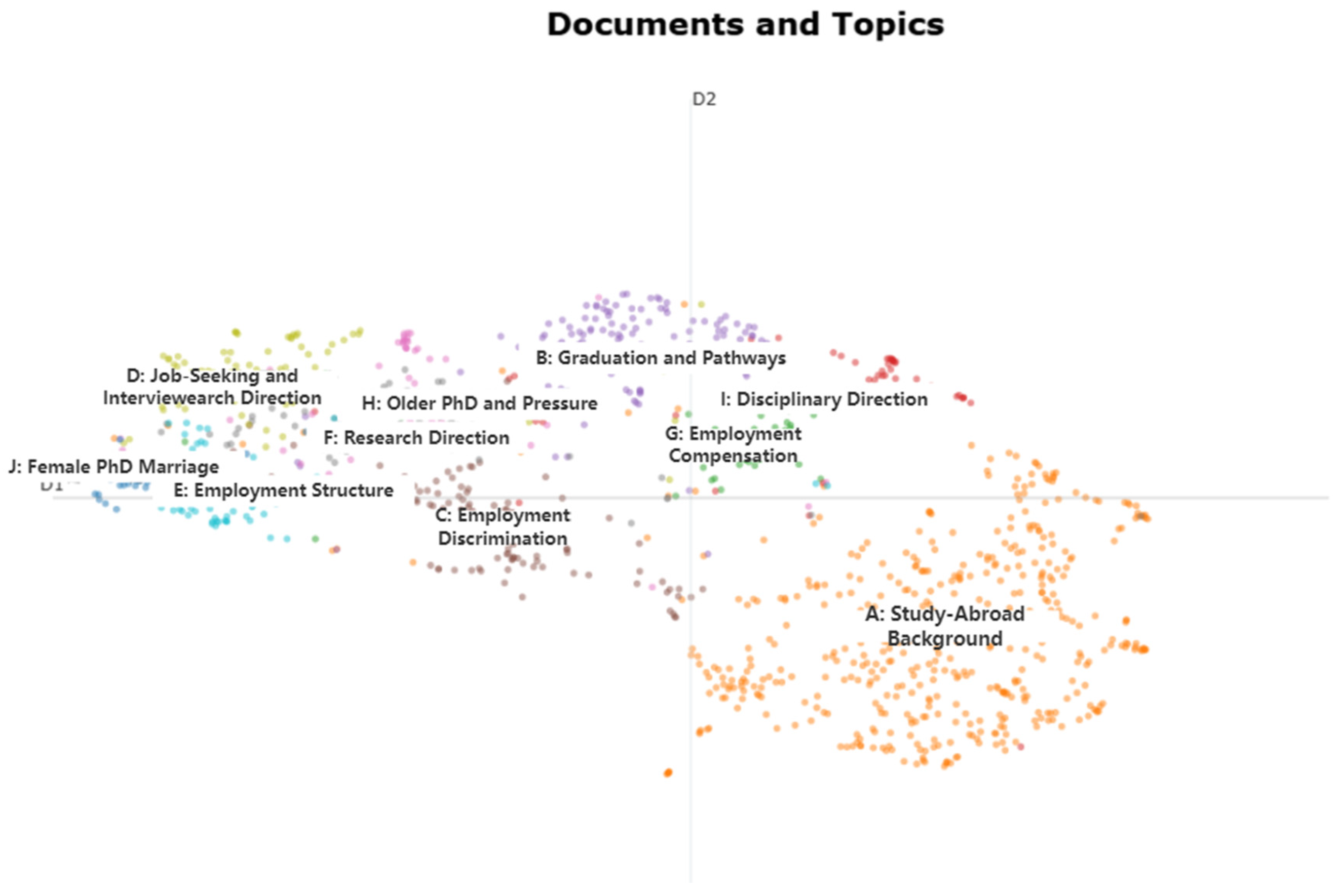
| A | PhD Study-Abroad Background and Return Employment | Korea; Southeast Asia; Korean language; study abroad; returning to China; domestic; credential recognition; employment; job seeking; interview |
| B | PhD Graduation and Job-Seeking Pathways | application; PhD enrollment; supervisor; master’s degree; academic credentials; academic track; research; projects; positions; postdoc |
| C | PhD Employment Discrimination and Supervisor Influence | discrimination; supervisor; overseas; New Zealand; study abroad; scholarship; credentials; domestic; positions; research |
| D | Job-Seeking Process and Interview Experience | interview; CV; job seeking; preparation; department head; positions; publications; universities; employment; application process |
| E | PhD Employment Structure and Market Saturation | market saturation; intensified competition; industry; demand; enterprises; career development; employment; credentials; PhD students; female PhDs |
| F | PhD Research Direction and University Demand | research direction; research; academic output; publications; professors; students; enterprises; CV; positions; biology |
| G | Employment Compensation and Talent Policies | subsidy; Beijing; Shanghai; social insurance; housing provident fund; annual salary; compensation package; talent programs; home purchase; hukou (residence permit) |
| H | Older PhD Candidates and Identity Pressure | age; older candidates; screening; life course; discrimination; credentials; supervisor; universities; graduation; employment |
| I | Disciplinary Direction and Engineering Positions | engineering; projects; technology; application; publications; discipline; chemistry; physics; energy; analysis |
| J | Female PhD Marriage and Employment | female PhDs; marriage and partner selection; single; dating; family background; “strong match” (high-status pairing); parity in partnership; employment; credentials; peers |
| Topic | Topic Name | Count (n) | Proportion (%) |
|---|---|---|---|
| A | PhD Study-Abroad Background and Return Employment | 494 | 42.99 |
| B | PhD Graduation and Job-Seeking Pathways | 128 | 11.14 |
| C | PhD Employment Discrimination and Supervisor Influence | 109 | 9.49 |
| D | Job-Seeking Process and Interview Experience | 97 | 8.44 |
| E | PhD Employment Structure and Market Saturation | 69 | 6.01 |
| F | PhD Research Direction and University Demand | 58 | 5.05 |
| G | Employment Compensation and Talent Policies | 56 | 4.87 |
| H | Older PhD Candidates and Identity Pressure | 49 | 4.26 |
| I | Disciplinary Direction and Engineering Positions | 47 | 4.09 |
| J | Female PhD Marriage and Employment | 42 | 3.66 |
Disclaimer/Publisher’s Note: The statements, opinions and data contained in all publications are solely those of the individual author(s) and contributor(s) and not of MDPI and/or the editor(s). MDPI and/or the editor(s) disclaim responsibility for any injury to people or property resulting from any ideas, methods, instructions or products referred to in the content. |
© 2026 by the authors. Licensee MDPI, Basel, Switzerland. This article is an open access article distributed under the terms and conditions of the Creative Commons Attribution (CC BY) license.
Share and Cite
Tang, Z.; Gu, Z.; Li, P. Collective Sense-Making in PhD Employment Discussions: A Topic Modeling Study of Social Media. Information 2026, 17, 268. https://doi.org/10.3390/info17030268
Tang Z, Gu Z, Li P. Collective Sense-Making in PhD Employment Discussions: A Topic Modeling Study of Social Media. Information. 2026; 17(3):268. https://doi.org/10.3390/info17030268
Chicago/Turabian StyleTang, Zhuoyuan, Zhouyi Gu, and Ping Li. 2026. "Collective Sense-Making in PhD Employment Discussions: A Topic Modeling Study of Social Media" Information 17, no. 3: 268. https://doi.org/10.3390/info17030268
APA StyleTang, Z., Gu, Z., & Li, P. (2026). Collective Sense-Making in PhD Employment Discussions: A Topic Modeling Study of Social Media. Information, 17(3), 268. https://doi.org/10.3390/info17030268