Systematic Review

Global Adoption and Impact of Blockchain Technology in Government: Enhancing Transparency, Efficiency, and Trust in Public Services


1
Department of Computer Information Science, Higher Colleges of Technology, Fujairah P.O. Box 1626, United Arab Emirates
2
Project Moon Hut Foundation, 8248 Barksdale Lane, Manlius, NY 13104, USA
3
Department of Computer Information Science, Higher Colleges of Technology, Sharjah P.O. Box 7946, United Arab Emirates
4
Mohammed Bin Rashid Housing Establishment, Dubai P.O. Box 2227, United Arab Emirates
5
Finswiss Research, Sydney, NSW 2100, Australia
*
Author to whom correspondence should be addressed.
Information 2026, 17(3), 235; https://doi.org/10.3390/info17030235
Submission received: 5 January 2026 / Revised: 31 January 2026 / Accepted: 3 February 2026 / Published: 1 March 2026

Abstract

Blockchain technology has increasingly drawn the attention of governments seeking to modernize public services through transparent, secure, and efficient digital infrastructures. Drawing on case studies from diverse regions, including the UAE, Estonia, Georgia, Colombia, and multiple Gulf Cooperation Council (GCC) nations, this systematic review synthesizes implementation patterns across domains such as land administration, digital identity, procurement, and intergovernmental payments. The critical analysis highlights blockchain’s capacity to establish tamper-evident records, automate verification, and reduce administrative overhead while also addressing technical and institutional factors that shape its impact. Outcomes across successful deployments suggest that benefits are most pronounced when blockchain aligns with real governance needs and is supported by robust legal and digital infrastructure. This review also identifies key barriers to adoption, including interoperability challenges, regulatory uncertainty, limited technical capacity, and resistance to organizational change. Notably, this review highlights a critical but underexplored dimension involving the need for public accountability not only in service delivery but also in the governance of blockchain systems themselves. By examining real-world use cases alongside technical and policy frameworks, this review advances a deeper understanding of blockchain’s role in reshaping public administration and sets a research agenda for building more trusted, auditable, and inclusive digital government systems.

1. Introduction

Governments around the world are under pressure to improve public services by making them more transparent, efficient, and trustworthy. In this context, blockchain technology is a type of distributed ledger that provides a secure, tamper-evident record of transactions has attracted significant interest as a tool to transform public sector governance [1,2]. Blockchains enable decentralized record-keeping where no single entity can unilaterally alter data, which in theory can reduce fraud, corruption, and error. By design, blockchain systems offer features such as immutability, traceability, and consensus-driven validation, all of which can increase the integrity of government records and processes [3]. Enthusiasts argue that this technology can bolster public trust by ensuring that official data and transactions are transparent and verifiable by citizens and auditors [4]. Moreover, smart contracts, which are self-executing code on a blockchain, hold the promise of automating administrative procedures, potentially improving efficiency in service delivery: for example, automating license renewals or welfare payments.
Motivated by these potential benefits, many governments launched blockchain initiatives in the late 2010s and early 2020s as part of digital transformation and e-government strategies. High-profile examples include Estonia’s integration of blockchain for securing public records, Dubai’s Blockchain Strategy aiming to move all government documents to blockchain, and Brazil’s and Colombia’s pilots of blockchain for transparent public procurement [5]. International organizations have also been active: The World Economic Forum (WEF) partnered with the Inter-American Development Bank to trial blockchain for public procurement in Latin America, and the European Union launched the European Blockchain Services Infrastructure (EBSI) to support cross-border public services on blockchain, e.g., diploma certification and business registries. These efforts reflect a broad-based belief that blockchain could revolutionize public sector governance by enabling new levels of interagency data sharing, citizen engagement, and accountability.
Despite the hype and a growing number of pilot projects, the real-world adoption of blockchain in government has been cautious and fragmented. Early studies noted that the public sector lagged the private sector in blockchain implementation [6]. By 2020, blockchain use in government was still limited, with most projects in proof-of-concept stages and few at full production scale. Governments face unique issues, including legal, technical, and organizational challenges, that can slow the diffusion of this innovation. There is also skepticism about whether blockchain is always the right tool; critics point out that in many cases a well-managed traditional database could suffice, and blockchain may introduce complexity without clear added value. Indeed, a 2022 review of blockchain in public governance found that many applications showed no clear advantage over conventional digital systems beyond improved security in record-keeping. This tempered view underscores the need to examine not just the promises but also the actual impacts and limitations of blockchain in government contexts [2].
It is also notable that governments have been slow to regulate the blockchain industry as it is a fragmented and a heterodox of use cases that range from disruptive to outright anarchic implementations, like Bitcoin. Only until recently did governments want to be associated with the “crypto” markets, seeing it as emergent yet lacking serious diffusion. Recent national and regional policy initiatives indicate growing institutional engagement with blockchain technologies, particularly in areas related to digital governance and public service delivery [7].
Despite the growing volume of literature on blockchain in government, existing review studies remain largely fragmented across sector-specific applications, such as land registries, digital identity, procurement, or financial services, and typically examine adoption through institutional, legal, or organizational lenses in isolation. While these studies have established that blockchain can enhance transparency, efficiency, and trust in selected public services, they rarely examine how these outcomes are shaped by the underlying digital infrastructure, telecommunications networks, and cross-platform governance arrangements that enable blockchain systems to operate at scale. In particular, prior reviews have not systematically integrated questions of interoperability, infrastructure resilience, cross-border connectivity, and permissioned governance into a unified analytical framework. As a result, the policy implications of blockchain as a foundational digital infrastructure for public administration remain under-theorized.
This review addresses this gap by providing a systematic, cross-domain synthesis of government blockchain adoption that explicitly situates blockchain within the broader context of digital infrastructure, telecommunications policy, and institutional governance. By integrating evidence from public administration, digital platforms, cross-border service infrastructures, and permissioned blockchain systems, this study moves beyond application-level descriptions to examine how technological architectures, regulatory frameworks, and governance models jointly shape public sector outcomes. In doing so, it provides a policy-relevant account of how blockchain contributes to trust, transparency, and efficiency not only through its technical properties but also through its embedding within national and transnational digital ecosystems.
Given the fast-evolving nature of this field, a comprehensive review is needed to assess how blockchain has been adopted globally in the government sector and what impacts it has had on public services. This paper addresses that need by synthesizing recent literature (2019–2025 and a few from 2015 as well) and documented case studies. The focus of this study was on a central question: How has blockchain technology enhanced transparency, efficiency, and trust in public sector services around the world, and what lessons have emerged from these experiences? This review covers a broad scope of use cases across different countries, rather than a single region or application, to identify overarching trends, benefits, challenges, and exemplary cases.

2. Methodology

2.1. Search Strategy and Screening Process

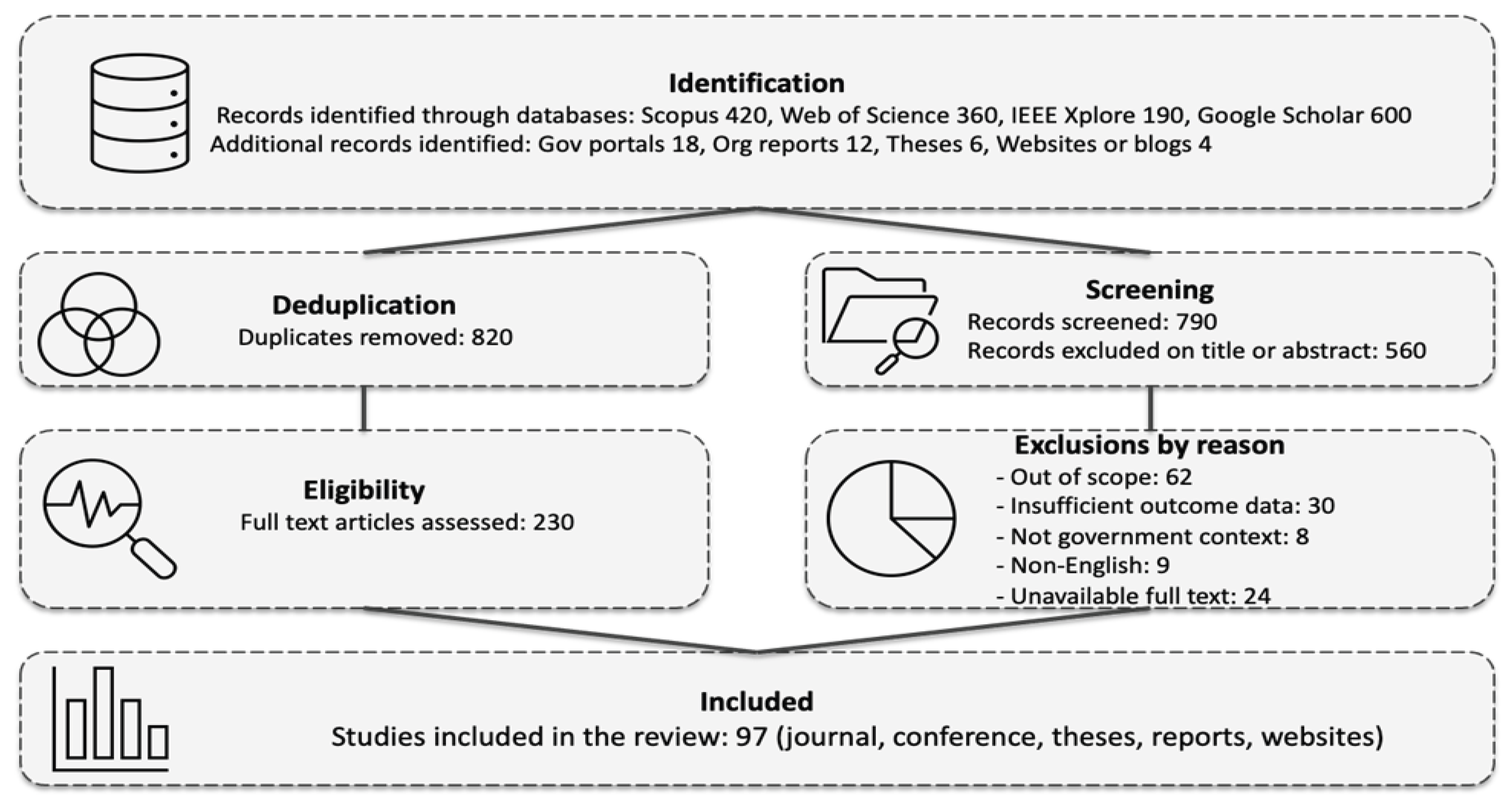
A systematic review methodology was employed to ensure comprehensive coverage and academic rigor. The relevant literature was identified through academic databases including Scopus, Web of Science, IEEE Xplore, and Google Scholar using targeted search terms such as “blockchain government”, “public sector blockchain adoption”, “blockchain transparency public services”, and “blockchain e-government”. Additional searches focused on specific use cases, including “blockchain land registry”, “blockchain voting government”, and “blockchain public procurement”. For regional studies like GCC-related studies, we had to use variants of keywords with country names. Only English-language publications were considered. Peer-reviewed journal articles, conference papers, and systematic reviews published mostly between 2019 and 2025 were used, with limited earlier studies included where foundational, along with select high-quality white papers and case study reports from reputable organizations such as the WEF and New America (Figure 1 and Figure S1).
Following duplicate removal, titles and abstracts were screened against predefined inclusion and exclusion criteria (mentioned further). Full-text screening was then performed to confirm relevance to government or public sector blockchain adoption. Screening and selection decisions were conducted by the authors through iterative consensus, with ambiguous cases discussed jointly to ensure consistent application of criteria. Moreover, Table 1 presents a structured overview of the reviewed literature, highlighting the distribution of research papers across different regions, thematic areas, and source types.
To ensure that this review captures both scholarly rigor and real-world policy relevance, the inclusion and exclusion criteria were designed to balance academic quality with practical governmental evidence. Peer-reviewed journal articles and conference papers were prioritized because they provide validated theoretical models, empirical findings, and reproducible methodologies. Government reports, institutional white papers, and doctoral theses were included when they documented national blockchain programs, regulatory frameworks, or implementation outcomes that are rarely covered in academic outlets but are essential for understanding public sector adoption. In contrast, commercial blogs, marketing reports, and non-technical media articles were excluded because they lack methodological transparency, stable citation value, and verifiable evidence. Non-English sources were excluded to ensure consistent interpretation and methodological comparability. These criteria were therefore selected to maximize both scientific reliability and policy relevance, allowing our review to reflect how blockchain is actually deployed, regulated, and evaluated in government environments rather than only how it is discussed in commercial or promotional contexts.

2.2. Study Quality Appraisal and Evidence Weighting

Given the heterogeneous nature of the included literature, encompassing conceptual analyses, case studies, and empirical evaluations, a formal risk-of-bias scoring tool was not applied. Instead, study quality was appraised narratively based on methodological transparency, clarity of data sources, empirical grounding, and relevance to public sector governance.
Empirical studies reporting measurable outcomes (e.g., efficiency gains, coordination improvements, or system performance indicators) were given greater analytical weight in the synthesis, while conceptual and policy-oriented studies were primarily used to contextualize governance mechanisms and institutional challenges. This qualitative evidence-weighting approach is consistent with systematic reviews in emerging technology domains where standardized evaluation metrics are not yet established.

2.3. Thematic Categorization and Qualitative Synthesis

Furthermore, to structure the qualitative synthesis, a thematic coding approach was applied to the full set of included studies. After full-text screening, each article was coded according to its primary application domain, technological focus, and governance context. Initial open coding identified recurring government use cases, such as land registration, digital identity, voting, procurement, and financial management. These categories were then consolidated through axial coding into higher-level thematic domains that reflect how blockchain is operationalized in public administration. For example, studies addressing property registries, cadastral systems, and title verification were grouped under “Land and Property Registration”, while those focusing on authentication, credentials, and citizen identification systems were grouped under “Digital Identity and Credentials”. This inductive process was iteratively refined by reviewing cross-study consistency and policy relevance, ensuring that the final categories emerged from patterns in the literature rather than from predefined assumptions. The resulting thematic structure provided the analytical foundation for organizing the literature review and comparing blockchain adoption across government functions and regions. This approach prioritizes transparency and reproducibility while remaining appropriate for a systematic review of an evolving, multidisciplinary research field.
The findings were synthesized into core thematic areas covering adoption trends, impacts on transparency, efficiency, trust, and the barriers to implementation. A comparative table was developed to summarize representative use cases across different regions. To ensure reliability, data were cross-verified across multiple credible sources where applicable. This methodology allowed us to capture a wide lens of global activity in blockchain-for-government while grounding the discussion in evidence-based findings. However, we acknowledge that many government blockchain projects are very recent or ongoing, so academic evaluation of their impact may lag behind implementation; in such cases, it has been carefully noted whether the claimed benefits are anticipated or realized.

2.4. PRISMA Compliance and Review Registration

This systematic review was conducted and reported in accordance with the Preferred Reporting Items for Systematic Reviews and Meta-Analyses (PRISMA) guidelines. A completed PRISMA checklist and flow diagram are provided to document the study identification, screening, eligibility, and inclusion process (Supplementary Table S1 and Figure S1 [8]).
This systematic review was not prospectively registered in a public registry. Given the review-based nature of this study and its focus on policy, governance, and technology literature, protocol registration was not undertaken.

3. Literature Review

3.1. Blockchain in Government: Foundation and Current Knowledge

Research on blockchain in the public sector has grown rapidly since 2017, as scholars seek to understand how this technology can support public administration goals. Several literature reviews and conceptual frameworks have been published in recent years, indicating both optimism and caution. Early studies established that blockchain’s core properties, such as decentralization, immutability, and transparency, align well with public values like accountability, transparency, and integrity in government records. By distributing trust from a single authority to a network, blockchain can introduce technological trust mechanisms in environments where institutional trust is low. For example, ref. [9] conducted a systematic review of blockchain in e-governments and found evidence of improved transparency and accountability in services like land registries when using blockchain. Similarly, ref. [10] argued that blockchain can serve as a record management tool to preserve the integrity of public documents, e.g., notarization or timestamping of official records, thereby deterring tampering and increasing citizens’ confidence in government data [3].

3.2. Blockchain as Digital Infrastructure and Platform Technology

At the same time, researchers have noted that blockchain adoption in the government has been slower and more challenging than the initial hype suggested. Ref. [1] observed that while blockchain was touted as a “trusted tool to apply transparency in the public sector,” actual implementations were limited and experimental. Their review identified major obstacles including security and privacy concerns, as well as the lack of supportive laws and regulations for blockchain use [1]. This is echoed by [11], who, through a lens of information security, noted that public sector managers are wary of risks related to data confidentiality and governance when considering blockchain systems [11]. The public sector often operates under strict legal constraints about data handling, such as personal data protection and record retention laws, which blockchain’s immutable and distributed nature can complicate. For instance, the “right to be forgotten” under privacy regulations conflicts with blockchain’s append-only design. Such legal and policy barriers mean that governments must carefully design pilot projects to remain compliant, often opting for permissioned blockchains where they retain greater control.
Organizational and inter-organizational factors play a significant role in the adoption of blockchain technology within the public sector. Ref. [6] studied seven public sector blockchain projects and found that adoption is influenced not just by technology merits but by factors such as hype and resistance, top management support, the perceived regulatory environment, and the level of trust between collaborating entities. In fact, they highlight a paradox that trust is both an antecedent to and an outcome of blockchain adoption. Government agencies and partners need a baseline of mutual trust and strong leadership support to agree to participate in a blockchain network, especially in consortia that span departmental or jurisdictional boundaries [6]. Once implemented and if successful, the blockchain system can then enhance trust among those parties and citizens by providing a single source of truth. This finding is important because it prompts that the technology alone does not create trust in a vacuum; social and institutional trust are critical enablers.
Moreover, public sector applications of blockchain commonly distinguish between permissionless (public) blockchains and permissioned (private or consortium-based) blockchains based on access control and governance requirements. Public blockchains like Bitcoin or Ethereum offer maximal transparency. Anyone can verify transactions; however, this is often viewed as unsuitable for government data due to privacy and control concerns. Most government applications use permissioned networks, where only authorized nodes, e.g., specific agencies, validate transactions. In Estonia’s government blockchain adoption, two contrasting approaches emerge. The “crypto anarchist” vision promotes highly decentralized public blockchains that aim to replace traditional authorities. In contrast, the “crypto institutionalist” model supports government-led private blockchain systems that integrate with existing institutions. This contrast reflects broader debates about decentralization and control in public governance. Estonia’s approach, for example, has been to use a permissioned blockchain, such as the KSI blockchain, as part of its e-government infrastructure to ensure data integrity rather than to expose data publicly. This highlights that governments tend to prioritize security and control for resilience against cyberattacks and maintaining data sovereignty over the radical transparency of public chains. Indeed, after a major cyberattack in 2007, Estonia’s adoption of blockchain was driven by a need for cybersecurity and resilient infrastructure, with transparency being a secondary benefit [12].
Recent empirical studies have started to report measurable impacts of blockchain pilot projects on government operations. Ref. [13] analyzed 165 blockchain use cases in European public administrations and found that the expected public value outcomes cluster around improvements in trust, efficiency, accountability, and transparency for external services that are often citizen-facing and around security and inter-organizational cooperation for internal administrative processes. Notably, most of these European cases aimed at enhancing public service provision and citizen satisfaction by increasing transparency and trust [13]. This aligns with the findings reported in [14], which conducted a large sample analysis of 167 public sector blockchain projects worldwide. They provided concrete evidence that blockchain can improve core government functions, such as public service governance, administrative efficiency, and open government capabilities, and drive process innovation and performance improvement in public services. These studies mark a shift from theoretical promise to documented outcomes. For example, improvements in administrative efficiency often manifest as reduced processing times for transactions or reduced manual paperwork due to shared ledgers. However, they also caution that truly transformative effects, called radical transformations in public services by [14], are contingent on how extensively the technology is implemented and integrated into workflows [14]. In many cases, the transformation is incremental—adding an extra verification layer, for example—rather than a complete overhaul of service delivery.

3.2.1. Infrastructure Dependencies Beyond IT Readiness

Treating blockchain as infrastructure clarifies the main adoption constraint. Blockchain networks depend on reliable telecommunication connectivity, resilient hosting for nodes, secure key management, and standardized interfaces to exchange data with legacy systems and external platforms. For example, in government identity and credential ecosystems, interoperable trust often depends on standards such as W3C Decentralized Identifiers (DIDs) and Verifiable Credentials [15], which define formats and verification mechanisms for cryptographically verifiable identity claims. Blockchain has increasingly been conceptualized as a platform for knowledge generation and verification across institutional boundaries healthcare as well [16]. This shifts policy attention toward the governance of identifiers, credential issuance, verification rights, and cross-platform recognition rather than treating blockchain as a standalone database.

3.2.2. DLT Applications in Telecommunications Infrastructure and Policy

The recent literature in telecommunications and network governance examines distributed ledger technologies as coordination and assurance mechanisms within next-generation digital infrastructure rather than as standalone financial systems. In 5G environments, blockchain has been proposed and piloted as a coordination layer for network slicing, where multiple virtual networks share the same physical infrastructure [17]. DLT-based approaches are used to record slice allocation, enforce service-level agreements, and provide auditable logs of resource usage across network operators and service providers. From a policy perspective, this introduces new questions regarding accountability, dispute resolution, and regulatory oversight in multi-operator 5G ecosystems, where traditional centralized control models are insufficient. In IoT ecosystems, blockchain is increasingly explored as a solution for device identity management, authentication, and data integrity. Large-scale IoT deployments depend on secure identification of heterogeneous devices and trustworthy data exchange across networks operated by different actors. Distributed ledgers have been applied to register device identities, manage access rights, and verify data provenance, reducing reliance on centralized authorities. For policymakers, this shifts regulatory focus toward governance of cryptographic identities, responsibility for compromised devices, and compliance with data protection regulations in highly distributed, telecom-dependent environments.
Blockchain has also been examined as an enabling technology for telecommunications data verification and monetization, particularly in contexts where network data is shared across organizational boundaries. DLTs can provide immutable records of data generation, access, and usage, supporting transparent billing, revenue sharing, and auditability in data marketplaces. These applications raise policy-relevant issues related to competition, fair access to network-generated data, and the regulation of emerging data markets within telecommunications platforms.
Finally, research on decentralized wireless (DeWi) models positions blockchain as a governance and incentive mechanism for connectivity provisioning in distributed network architectures. In these models, blockchain is used to coordinate participation, validate service delivery, and distribute rewards among network contributors. While largely experimental, DeWi highlights how blockchain can reshape assumptions about infrastructure ownership and control, prompting policy debates around licensing, spectrum governance, and regulatory responsibility in decentralized connectivity systems [18]. Collectively, these telecommunications-focused applications demonstrate that blockchain adoption is closely intertwined with infrastructure policy, standards development, and regulatory adaptation, reinforcing its relevance for telecommunications policy research beyond traditional government service delivery.

3.2.3. Cross-Sector Implication Strengthening the Government Argument

Evidence from outside government service delivery reinforces that adoption success is strongly shaped by platform governance, institutional readiness, and interoperability. Recent studies in healthcare and knowledge systems emphasize blockchain adoption drivers that are tied to knowledge sharing and organizational conditions [19]. Research on SMEs similarly finds adoption influences aligned with organizational and environmental readiness rather than purely technical features [20]. In professional services, work on blockchain usage in accounting and auditing highlights determinants and outcomes associated with technology acceptance and organizational change dynamics. Together, these cross-sector findings strengthen the policy argument that government blockchain programs require ecosystem-level alignment across infrastructure, standards, and governance arrangements, not only internal process redesign [21].

3.2.4. Standards and Assurance as Policy Tools for Trust Infrastructure

Infrastructure framing also clarifies what “trust” means operationally. Trust is not only a property of immutability or consensus but also a function of security assurance, compliance controls, and verifiable operational practices. In practice, governments and regulated ecosystems often rely on recognized assurance frameworks and standards such as ISO/IEC 27001 [22] for information security management (ISO/IEC 27001:2022 [22]), FIPS 140-3 [23] for validated cryptographic modules, and ISO/IEC 15408 [24] (Common Criteria) for security evaluation of IT products and systems [25,26]. In the digital trust services domain, standards such as ETSI EN 319 401 provide requirements for trust service providers, highlighting how policy-driven assurance frameworks can structure accountability for cryptographic trust infrastructure that blockchain-based services often depend on [27]. This is directly relevant for telecommunications policy because it ties blockchain deployment to measurable security and trust infrastructure obligations, including certification, audits, and cross-organizational governance.

3.2.5. Blockchain, Digital Media Platforms, and Content Governance

Beyond public administration and service delivery, blockchain has been increasingly examined in the context of digital media platforms, intellectual property management, and content governance, which are central policy domains within telecommunications and digital platform regulation. In these contexts, blockchain is not adopted to replace media infrastructures but to introduce verifiable ownership, licensing, and usage tracking mechanisms across complex content distribution ecosystems. Research on blockchain-based digital rights management highlights its potential to record provenance, automate licensing through smart contracts, and reduce disputes over content ownership in fragmented, platform-dominated media markets.
From a policy perspective, these applications raise governance questions that parallel those faced in government blockchain adoption. Digital media platforms rely on high-bandwidth telecommunications infrastructure, cloud-based content delivery networks, and cross-border data flows, making blockchain-based DRM systems dependent on interoperability with existing platform architectures. For regulators, this introduces challenges related to jurisdiction, enforcement of intellectual property rights, and accountability in decentralized or semi-decentralized systems. The emergence of non-fungible tokens (NFTs) as a mechanism for representing digital assets has further intensified policy debates around consumer protection, copyright enforcement, and platform responsibility, reinforcing the need for regulatory frameworks that address blockchain-enabled digital asset markets as part of broader telecommunications and platform governance ecosystems.
For government adoption, these developments are instructive because they demonstrate how blockchain-based trust mechanisms interact with platform power, infrastructure control, and regulatory oversight, rather than operating independently of them. The governance challenges observed in media and content ecosystems provide transferable insights for public sector applications, particularly where blockchain is used to manage high-value digital records, credentials, or data assets distributed across multiple institutional and technical platforms.

3.2.6. Decentralized Autonomous Organizations (DAOs) and Policy Innovation

Another strand of blockchain research relevant to telecommunications policy examines DAOs as alternative governance structures enabled by distributed ledger technologies. DAOs are typically described as rule-based organizational arrangements in which decision-making, resource allocation, and operational processes are encoded into smart contracts and executed across distributed networks. While most DAOs operate outside formal government structures, they have become a focal point in policy discussions concerning digital governance, regulatory oversight, and institutional accountability.
From a policy innovation perspective, DAOs challenge traditional assumptions about organizational authority, jurisdiction, and responsibility, particularly in digitally networked environments supported by global telecommunications infrastructure. Scholars and policy bodies have highlighted that DAO-based coordination relies heavily on reliable connectivity, cryptographic identity management, and platform governance mechanisms, making them deeply intertwined with digital infrastructure policy rather than purely technological experimentation. As a result, regulators have increasingly engaged with DAOs in discussions around legal personality, liability, and compliance, especially in financial services, digital asset management, and platform-mediated coordination.
For government blockchain adoption, DAOs are relevant not as models to be directly replicated but as boundary cases that expose the governance trade-offs inherent in decentralized and semi-decentralized systems. The contrast between DAO-based self-governance and state-led permissioned blockchains helps illuminate why governments often prioritize control, compliance, and accountability over full decentralization. At the same time, DAO research contributes analytical insights into how rule enforcement, transparency, and participation can be technologically mediated, informing policy debates on how public sector blockchain systems might balance efficiency, inclusiveness, and democratic oversight within existing legal and institutional frameworks.

3.3. Key Domains and Global Use Cases

Several key domains have been identified from the literature, in which governments have been experimenting with blockchain. Outlined below are the most prominent use case categories documented between 2019 and 2025, which will be further illustrated by global examples in the next section:

3.3.1. Land and Property Registries

Land and property registries are the earliest and most cited use cases [28]. Secure land ownership records are fundamental for economic development and trust in property rights. Blockchain’s immutability is applied to prevent fraudulent land title changes and enable easy verification of records by citizens. Countries like Georgia and Sweden piloted blockchain for land registries [29]. The results show increased transparency and a reduction in opportunities for officials to illicitly alter records [30]. Land registry projects often use a hybrid approach, e.g., hashing official records to a public blockchain, to combine government authority with blockchain integrity.

3.3.2. Digital Identity and Credentials

Governments are exploring blockchain for managing citizen identities and credentials, such as educational certificates and licenses. Self-sovereign identity (SSI) systems on blockchain allow individuals to control their identity data and share verifiable credentials without centralized intermediaries. For example, the city of Zug in Switzerland introduced a blockchain-based digital ID for its residents. British Columbia, Canada, implemented the OrgBook system, a blockchain-backed registry of business licenses and identities to streamline inter-agency verification, improving efficiency in service delivery (BC aims to cut government red tape with Hyperledger [31]). These efforts aim to enhance security by reducing identity fraud and efficiency by avoiding repetitive KYC checks in public services.

3.3.3. Voting and Electoral Processes

Blockchain based e-voting has been trialed to increase transparency and trust in elections. The idea is that votes recorded on an immutable ledger are harder to manipulate and can be independently audited. West Virginia, United States of America (USA), conducted a small-scale pilot for overseas voters using a blockchain-based mobile app in 2018, and countries like Switzerland (local referendums in Zug) and Russia (Moscow city Duma election) have tested blockchain voting systems. While these pilots demonstrated the feasibility of casting and counting votes via blockchain, they also revealed challenges such as ensuring ballot secrecy, system usability, and vulnerability to cyber-attacks on voting devices [32,33,34]. The security of blockchain voting remains debated, but it continues to be explored as a way to boost voter confidence with end-to-end verifiability [33].

3.3.4. Public Procurement and Supply Chain

Public procurement is highly prone to corruption and opacity. Blockchain has been trialed to log the entire procurement process, which includes tendering, bidding, and contract awards in a transparent manner. In Colombia, a notable pilot tracked the procurement of school meal contracts on Ethereum, aiming to make each step visible and auditable to prevent graft. The WEF’s 2020 report on this trial showed cautious optimism: The blockchain system increased transparency, but integrating it with existing procurement platforms and legal frameworks was complex. Similarly, Brazil and Mexico have explored blockchain for tracking government supply chains, e.g., medicine distribution, to ensure provenance and timely delivery. Early evidence suggests that blockchain can reduce fraud such as ghost suppliers, invoice duplication, and improve efficiency by automating verification steps [9,35].

3.3.5. Financial Management and Cryptocurrencies

Some governments are using blockchain in public finance, including issuing government digital currencies or tokens. Central bank digital currencies (CBDCs) are a related area, with countries like China and the Bahamas launching digital versions of their currencies on DLT platforms. In addition, blockchain has been used in public finance for municipal bonds. For instance, the city of Berkeley, California, explored tokenized bonds. Blockchain wallets have also supported welfare distribution. The UN’s World Food Programme piloted this approach in refugee camps. These initiatives focus on efficiency, with direct traceable transactions to beneficiaries and reducing leakages. For example, eToro and the City of Reno launched a trial using blockchain for tracking public project funding, improving transparency on how funds are spent (project “Reno DAO”). Such cases are still experimental but represent an intersection of public finance and blockchain aimed at enhancing accountability to taxpayers.
The Australian government and central bank have taken a cautious, research-driven approach. In 2023, the Reserve Bank of Australia (RBA), together with academia and industry (DFCRC), ran a “Digital Finance Innovation” pilot to explore CBDC use cases. That project concluded that a CBDC could enhance payment efficiency, resilience, and asset tokenization, for example, by enabling atomic settlement, programmable payments and new tokenized asset markets. The key findings noted that CBDC could complement private innovation, e.g., fully backed stablecoins, but this would raise legal, regulatory and technical challenges requiring further study. Reflecting this, the RBA and Treasury joint report (mid-2024) emphasizes wholesale CBDC applications over retail ones. They assess that benefits are most tangible in interbank and tokenized asset markets. As an example, Project Acacia is investigating a wholesale CBDC to settle tokenized securities, and it plans to prioritize CBDC initiatives in wholesale applications [36]. The RBA will expand experimental work on wholesale token settlement and asset tokenization, while the Treasury refines stablecoin regulations. At the same time, the government is strengthening crypto oversight. In early 2025, the Treasury proposed legislation focusing on licensing crypto exchanges, custodians, and stablecoin issuers, treating major stablecoins as Australia’s “stored value facilities” rather than broadly banning crypto issuance. Australia’s authorities see the greatest public benefit in using blockchain for financial markets and assets, and they are backing this view with pilots and future-proofed regulation [37].
Similarly, the U.S. federal government is actively engaging with blockchain and crypto, though it has steered away from a retail CBDC. The Federal Reserve emphasizes that it has made no decisions on whether to pursue or implement a CBDC, instead conducting research and public consultations on potential benefits and risks (federalreserve.gov). Meanwhile, Congress has taken action: In mid-2025 the Senate passed a bipartisan stablecoin regulatory bill, “the GENIUS Act”, requiring dollar-backed stablecoins to hold full reserves of cash or treasuries and disclose their holdings [38]. Regulatory agencies are clarifying crypto rules: For example, SEC staff in 2025 issued guidance to ease custodial and staking restrictions, which reflect a more favorable stance toward blockchain innovation [39]. In the private sector, major banks are developing on-chain cash solutions. For instance, in mid-2025, JPMorgan announced JPMD, a permissioned “deposit token” on the public Ethereum layer Base, representing U.S. dollar commercial bank deposits for institutional clients. This token will enable near-instant, 24/7 settlement across trusted counterparties. This step illustrates how traditional finance is moving toward blockchain rails [40]. These implications, along with the U.S.’s prior president Biden’s digital asset “working group” and open stance toward blockchain development, show the U.S. government’s commitment to balancing innovation, including stablecoins and tokenization with a focus on consumer protection. The Atlantic Council notes that the U.S. has joined a global wholesale-CBDC initiative named “Project Agorá” with other central banks, even as domestic retail CBDC proposals are politically blocked. Overall, the U.S. is strengthening its digital finance leadership by implicating private-sector crypto innovation and laying stable regulatory groundwork, while ensuring any central bank digital currency would not undermine the dollar’s role [41].
Moreover, leading western economies are also advancing blockchain/crypto projects. The United Kingdom’s Bank of England (BOE) is in a design phase for a “digital pound”. After a 2023 consultation and 2024 response, the BOE published a 2025 progress update and planned a “Digital Pound Lab” to test real-world use cases. The bank has made no decision yet; the earliest issuance is expected in the “second half of this decade”. The envisioned digital pound would be a digital form of cash denominated in sterling and issued by the BOE, coexisting with physical cash and accessed via private sector wallets to encourage innovation while safeguarding privacy [42]. In the European Union, the European Central Bank has moved from investigation into a “preparation phase” for a digital euro (launched Nov 2023). This initiative involves drafting the Digital Euro rulebook, testing platform architectures, and engaging stakeholders, including consumers and retailers, to ensure that the digital euro enables efficient, privacy-preserving payments across Europe.
Moreover, the EU implemented the MiCA regulation in June 2023, the first comprehensive crypto framework, setting capital/reserve rules and disclosure requirements for stablecoin and crypto-asset issuers across Europe [43]. Other Western regulators (e.g., Switzerland, Japan) continue to study CBDCs and often prioritize wholesale and cross-border uses. Overall, these governments are using pilots and policy design and, in the EU’s case, new laws to prepare for tokenized money and finance. This type of Western leadership, exemplified by the UK’s digital pound initiative and the ECB’s digital euro project, signals to other regions, such as the Gulf, how advanced economies intend to safely harness blockchain and digital currency.

3.3.6. Regulatory Compliance and Record Keeping

Governments have also applied blockchain for regulatory registries and compliance tracking. Company’s registries, as in Dubai’s Unified Business Registry, use blockchain to share data among trade licensing, tax, and economic departments, eliminating duplicate filings and reducing processing time [44]. This improves efficiency and ensures consistency of records. In healthcare, some national agencies have tested blockchain for medical license verification and tracking pharmaceutical supply to combat counterfeit drugs. Environmental agencies consider blockchains to trace carbon credits or recycling chains for improved transparency in sustainability programs. While these use cases are diverse, they commonly capitalize on blockchain’s single source of truth to streamline multi-party processes and improve oversight.

3.3.7. Blockchain, Artificial Intelligence, and Digital Twins in Smart Government Systems

Recent research increasingly frames blockchain not as a standalone government technology but as part of integrated digital ecosystems that combine artificial intelligence (AI), digital twins, and real-time data infrastructures in smart city environments. These hybrid systems rely on IoT and 5 G/6 G connectivity to stream urban data into digital twins, while AI models generate predictive and optimization outputs that are recorded and coordinated through blockchain-based trust layers [45,46]. In such architectures, blockchain does not replace operational platforms but ensures verifiable data provenance, secure coordination of AI models, and integrity of digital twin updates across distributed public and private actors.
Quantitative evidence from recent smart-city pilots demonstrates that this convergence produces measurable public sector benefits. In a blockchain-enabled digital-twin platform deployed for urban waste management, AI-based route optimization reduced operational costs by approximately 15% and fuel consumption by 12% over a three-month period, while smart waste bins enabled an 18% reduction in unnecessary collections and a 10% decrease in CO2 emissions. The same platform reported up to a 9% increase in recycling rates due to improved monitoring and citizen engagement through blockchain-based participatory governance. These results demonstrate that blockchain-supported digital twins and AI can generate direct efficiency, environmental, and service-quality gains in municipal operations [47].
From a systems and telecommunications perspective, the feasibility of these solutions depends on time-sensitive, high-reliability digital infrastructure. The CoTwin framework, implemented over an actual blockchain network, shows that AI-driven digital-twin models can be collaboratively trained and executed across distributed cells while maintaining stable execution times, even for large numbers of connected nodes. By exploiting 5G- and 6G-enabled highly connected cells, CoTwin enables real-time model updates without interrupting system operations, demonstrating that blockchain-based coordination can meet the strict latency and reliability requirements of cyber-physical public infrastructure [45].
At the data-governance level, the SIGNED framework demonstrates how blockchain can secure digital-twin data exchange across government agencies with negligible performance overhead while enforcing verifiable data ownership, provenance, and selective disclosure. In a smart-water management case study, SIGNED enabled multiple public agencies and service providers to exchange sensor data, operational metrics, and compliance information through cryptographically verifiable credentials, ensuring that shared data could be trusted, audited, and legally attributable across institutional boundaries [46].
Together, these studies show that the integration of AI-driven analytics, digital-twin modeling, and blockchain-based trust infrastructures is no longer conceptual but operational, producing quantifiable gains in cost efficiency, environmental performance, and data governance. Including this body of work situates government blockchain adoption within the broader evolution of telecommunications-enabled, data-intensive smart governance systems, strengthening this review’s alignment with the current state of the art in digital infrastructure and public sector innovation.

3.3.8. Empirical Performance Metrics in Government Blockchain Systems

Recent large-scale evidence shows that blockchain deployment in government is still mostly experimental, but where implemented, measurable operational impacts can already be observed. Based on a dataset of 165 blockchain use cases collected by the European Commission Joint Research Centre, 54% of government blockchain projects were pilots, while only 16% had reached full implementation and operational integration and 10% had already been discontinued, demonstrating that most public blockchain deployments are still in a testing or learning phase rather than fully institutionalized [13]. This distribution indicates that efficiency and cost benefits are currently realized primarily in controlled pilot environments rather than at scale.
In the Georgian land registry system, blockchain was introduced as an add-on integrity layer on top of existing digital processes. The full land registration process still takes up to four working days, but the transfer of land-title records from the National Agency of Public Registry (NAPR) database to the blockchain requires approximately 10 min, demonstrating a clear speed differential between legacy administrative processing and blockchain-based notarization and timestamping [48]. However, because blockchain was not accompanied by business-process re-engineering, the authors explicitly note that cost- and time-saving potential remains largely unrealized, and in some cases, transaction fees on the Bitcoin network can even increase costs.
In contrast, more recent integrated government platforms combining blockchain, artificial intelligence, and digital twins demonstrate stronger operational efficiency gains. In a smart-city pilot integrating Hyperledger Besu, AI-driven ETL pipelines, and digital twins, the system enabled near-instantaneous processing of streaming data instead of hours or days required by traditional ETL pipelines, along with cloud-native elastic scalability that reduces operational costs and enables continuous automated updates. The platform achieved measurable improvements in operational efficiency, cost reduction, environmental impact, and citizen engagement in its pilot deployment, confirming that blockchain delivers the largest performance benefits when embedded into end-to-end digital service architectures rather than used as a standalone ledger [47].
Together, these results show that blockchain alone does not automatically produce efficiency gains. Quantitative improvements in time, cost, and service quality are observed primarily when blockchain is combined with AI-enabled automation, digital twin-based process modeling, and interoperable data pipelines, while shallow add-on implementations mainly improve security and auditability without transforming operational performance.

3.3.9. From Blockchain Mechanisms to Governance Implications

Building on the reviewed literature, this study adopts a structured analytical framework that links blockchain’s core technical mechanisms to governance process variables and, ultimately, to public service outcomes. While prior reviews have primarily cataloged use cases or institutional drivers, fewer studies have articulated how specific blockchain design features translate into measurable governance improvements. Addressing this gap, the present review synthesizes existing evidence into a causal framework that can be operationalized in future empirical research.
At the technical layer, blockchain systems introduce distinct functional mechanisms, including immutability of records, distributed validation through consensus protocols, cryptographic traceability, and programmable execution via smart contracts. These mechanisms do not directly produce public value; rather, they influence intermediate governance processes. For example, immutable ledgers and cryptographic hashing enhance auditability by enabling verifiable record histories, while shared ledgers across agencies reduce coordination costs by minimizing reconciliation and duplication. Similarly, programmable rules embedded in smart contracts can automate compliance checks, thereby reshaping accountability chains and enforcement processes.
These governance process variables, in turn, affect observable public service outcomes. Enhanced auditability and traceability are associated with reduced corruption risk and improved regulatory oversight, while lower coordination and transaction costs contribute to service efficiency, such as faster processing times or reduced administrative overhead. Strengthened accountability mechanisms and verifiable service records further support citizen trust by increasing transparency and predictability in government interactions. Importantly, the strength of these outcome effects is contingent on contextual factors, including blockchain architecture (permissioned versus public), interoperability with legacy systems, and the reliability of the underlying digital and telecommunications infrastructure.
To support analytical rigor, the framework enables the identification of measurable indicators at each stage of the causal chain. Blockchain mechanisms can be characterized using architectural features (e.g., consensus type, permission model, smart-contract usage), governance processes can be assessed through indicators such as audit frequency, inter-agency reconciliation time, or degree of automated rule enforcement, and outcomes can be evaluated using performance metrics, including transaction time reductions, cost savings, error rates, or citizen satisfaction levels. By making these linkages explicit, the framework moves beyond descriptive synthesis and provides a foundation for hypothesis-driven evaluation of blockchain-enabled public services across institutional and national contexts.
To move beyond descriptive synthesis, the reviewed literature can be interpreted through an analytical mapping that links core blockchain characteristics to governance processes and observable public service outcomes. Rather than proposing a formal causal model, this mapping clarifies how specific technical properties discussed across studies are associated with policy-relevant effects reported in empirical cases. Table 2 summarizes this relationship and highlights the indicative performance measures that are already used in the literature, providing a structured basis for the subsequent discussion of barriers, governance trade-offs, and implementation risks.

3.4. GCC-Specific Government Applications

Recent government-led projects across the Gulf Cooperation Council (GCC) countries illustrate how blockchain is being applied in real-world public sector contexts. These initiatives align with global patterns while also reflecting region-specific priorities such as digital identity, trade facilitation, and central bank innovation.

3.4.1. United Arab Emirates (UAE)

The UAE has emerged as a regional frontrunner in blockchain adoption for public administration. The Emirates Blockchain Strategy 2021, launched in 2018, aimed to migrate 50% of government transactions onto blockchain by 2021 [49]. The initiative projected significant efficiency gains, including annual savings of AED 11 billion, elimination of 398 million paper documents, and recovery of 77 million work hours. By 2022, the federal government reported substantial progress, with blockchain becoming integral to its digital transformation agenda.
Among the flagship projects, the Ministry of Health and Prevention (MOHAP) introduced a blockchain-based national health licensing database in 2020 [50]. The platform records healthcare professionals’ credentials in a decentralized, immutable registry accessible to regulators and hospitals. It enables real-time verification, improves data consistency, and automates administrative processes, thereby strengthening transparency and operational efficiency in the health sector.
Another major initiative, UAE Pass, is a nationwide digital identity and signature system launched in 2018 [51]. A core component of the platform is its blockchain-secured digital document vault, which allows users to store and share official records such as certificates and contracts. By enabling tamper-evident, timestamped transactions, the UAE Pass reduces paperwork and enhances both service speed and trust. Identity verification processes that previously required physical visits now take less than five minutes via secure biometric onboarding. At the emirate level, Dubai implemented its own Dubai Blockchain Strategy 2020, with a focus on efficiency and digital industry development. Under this plan, the Dubai Paperless Initiative succeeded in digitizing all government transactions by 2021, relying heavily on blockchain for secure recordkeeping. The city reported annual savings of approximately AED 5.5 billion (USD 1.5 billion) from reduced manual processing and document handling.
Recent studies in the UAE highlight that blockchain-based frameworks can streamline the verification of housing loan and grant applications by securely integrating citizen data across government entities, significantly reducing costs and delays in service delivery [52].
Moreover, the Fujairah Honey Chain (FHC) presents an innovative application of blockchain in enhancing food authenticity and supply chain integrity. This framework uses blockchain in combination with an oracle system to monitor the production and trade of honey, a product frequently subject to adulteration. By assigning tokens to honey batches and validating quality data, the system enables transparent, tamper-proof tracking from origin to consumer. With transaction costs estimated under $1 and sensor data verification accuracy reaching 90%, FHC demonstrates the feasibility and value of blockchain for safeguarding food quality. This initiative is particularly impactful, as it aligns blockchain technology with consumer protection, agricultural sustainability, and market credibility in high-value food sectors [53].
These initiatives collectively demonstrate how the UAE has integrated blockchain into public services to advance transparency, streamline delivery, reduce costs, and enhance public trust.

3.4.2. Saudi Arabia

Within the framework of its Vision 2030 economic transformation agenda, Saudi Arabia has pursued blockchain adoption to modernize financial infrastructure and public sector services. A central initiative was Project Aber, launched in collaboration with the UAE Central Bank in 2019 as a one-year proof of concept to pilot a wholesale Central Bank Digital Currency (CBDC) for interbank settlements [54]. The project used distributed ledger technology to clear and settle cross-border transactions between Saudi and UAE commercial banks. The final report in 2020 confirmed significant improvements in transaction speed and cost compared to centralized systems. It demonstrated the feasibility of a dual issued digital currency and marked a pioneering collaboration between two national monetary authorities. The success of Aber earned both countries a Global Impact Award from Central Banking Magazine and laid the foundation for further exploration by SAMA into CBDC use cases for enhanced interbank resilience and efficiency [55,56].
Beyond central banking, Saudi Arabia has explored blockchain in trade and customs operations. In 2019, Saudi Customs conducted its first blockchain-based shipment pilot through IBM/Maersk’s TradeLens platform. The integration of Saudi’s single-window customs system (FASAH) with TradeLens enabled end-to-end visibility of container documentation for a shipment from Dammam Port to The Netherlands. Invoices, declarations, and bills of lading were shared on a unified ledger accessible to both Saudi and Dutch authorities. This trial illustrated the ability of blockchain to enhance transparency, eliminate paperwork delays, and provide a single source of truth in cross-border logistics. It also aligned with Saudi Arabia’s national push to digitize logistics and improve stakeholder trust in trade systems [57,58].
In the domestic financial context, SAMA employed blockchain in 2020 to electronically disburse SR50 billion in liquidity to local banks as part of its COVID-19 stimulus response. This marked the first live use of blockchain by a regional central bank for direct fund transfers. While the initiative served as a technical pilot, it demonstrated improved speed and security in emergency financial operations. It also complemented ongoing efforts under SAMA’s Regulatory Sandbox and the Fintech Saudi initiative to drive innovation in financial services [59,60].

3.4.3. Oman

Oman has adopted a strategic and infrastructure-first approach to blockchain, led by the government-owned Blockchain Solutions and Services (BSS) company, which launched the Oman Blockchain Platform in 2019. A key application followed in 2020 when the Capital Market Authority and Muscat Clearing and Depository Company deployed a blockchain-based electronic voting system for shareholder meetings, enabling remote, secure, and tamper-evident participation, one of the first such uses in the region [61]. In trade and logistics, the Port of Salalah joined the TradeLens network in 2019, enabling real-time data sharing with over 100 international stakeholders, while a 2020 partnership with Oracle initiated blockchain pilots across 120 public and semi-governmental entities. These pilots, spanning energy, shipping, and digital identity, aim to streamline processes and reduce transaction times. Supported by initiatives like the Blockchain Oman Forum, the country is steadily advancing blockchain adoption with early outcomes demonstrating improved transparency, operational efficiency, and trust across public services [62,63,64,65].

3.4.4. Bahrain

Bahrain has prioritized blockchain in fintech and regulatory innovation to support its goal of becoming a regional financial hub. A central initiative is the National Electronic KYC (eKYC) Platform, launched by the Central Bank of Bahrain and fully operational by 2021 [66]. Operated by BENEFIT in coordination with the Information & eGovernment Authority, the platform creates a unified blockchain-based digital identity vault, allowing banks to verify customer data in real time, maintain audit trails, and streamline compliance processes. It has improved efficiency, reduced onboarding time, and supported remote account access during the COVID-19 pandemic, positioning Bahrain as a regional leader in blockchain-based regulatory infrastructure. In logistics, Bahrain piloted blockchain at the Khalifa Bin Salman Port via the TradeLens platform in 2020, enabling shared access to shipping data across stakeholders and improving cargo visibility, customs efficiency, and document security [66,67,68]. These initiatives reflect Bahrain’s integrated approach to using blockchain for enhanced transparency, operational agility, and trust in both financial and logistics services.

3.4.5. Qatar

Qatar has taken a structured approach to blockchain adoption, beginning with the release of the National Blockchain Blueprint in 2022 by the Communications Regulatory Authority [69]. The strategy outlines the regulatory and infrastructural foundations needed to build a nationwide blockchain ecosystem, prioritizing sectors like finance, supply chain, and public services. A key pilot launched in 2023 saw the development of “Imdaat”, a blockchain platform by Genesis Technologies, supported by Qatar University and Qatar Development Bank. The platform successfully issued and verified over 130 digital certificates, demonstrating secure, on-chain validation for credentials such as diplomas and training records. The long-term aim is to register all official documents and digital signatures on a national blockchain, thereby enhancing fraud prevention and e-government services. Concurrently, the Qatar Central Bank has incorporated blockchain into its fintech strategy and is reportedly exploring a wholesale CBDC pilot. These initiatives reflect Qatar’s incremental yet focused trajectory toward secure, efficient, and trustworthy digital public infrastructure [70,71,72].

3.4.6. Kuwait

Kuwait’s blockchain journey has advanced cautiously, anchored in policy and digital infrastructure development. As part of its New Kuwait 2035 vision, the government has recognized blockchain’s potential, particularly in finance and smart city services [73]. In 2024, the Ministry of Commerce and Industry drafted a digital commerce law to formally enable blockchain and AI technologies in public services and e-commerce, aiming to improve transaction transparency, automation, and consumer protection. The Central Bank of Kuwait has also upgraded its payment systems through the Kuwait National Payment System (KNPS), establishing an electronic backbone for potential blockchain integration. Although a national digital currency (digital dinar) remains under study, KNPS has already digitized government payments, reducing paperwork and improving accuracy [74]. In parallel, pilot projects by public sector bodies such as KDIPA have explored blockchain for business licensing, and academic institutions have trialed its use in digital identity and smart governance. While no flagship blockchain platform has yet been deployed, Kuwait’s policy readiness and infrastructural groundwork suggest strong potential for near-future implementation [75].
Table 3 summarizes a selection of notable blockchain initiatives in the government sector across different countries. These examples cover various public service domains and geographic regions, highlighting the global nature of blockchain adoption in governance. Each case includes the context, the focus of blockchain usage, and reported outcomes in terms of transparency, efficiency, and trust.
The following illustrates notable government blockchain initiatives and reported outcomes:
Across the GCC, governments are using blockchain to improve document verification, streamline trade, increase financial transparency, and digitize public records. These regional cases reinforce global findings, showing that blockchain yields the most benefit when it is tightly integrated into a nation’s digital strategy, regulatory framework, and institutional architecture. Rather than standalone experiments, the most effective blockchain implementations complement broader public sector modernization goals, whether in cross-border finance, health credentialing, or digital identity systems [78].

4. Challenges and Barriers to Adoption

While blockchain has demonstrated clear benefits in public service delivery, including enhanced transparency, streamlined workflows, and stronger trust, these outcomes are highly context-dependent [79]. The governance and infrastructure barriers discussed in the following section are best understood in relation to the analytical mapping presented in Table 3, which clarifies where technical characteristics fail to translate into intended governance outcomes under real-world constraints. The systematic literature indicates that government adoption is constrained primarily by policy-mediated infrastructure realities rather than technical novelty alone. In public sector settings, blockchain systems must operate within a national digital ecosystem comprising telecommunications networks, identity services, cybersecurity controls, legacy registries, and regulatory mandates. Case studies from the GCC, Estonia, Georgia, and others show its ability to secure records, automate verification, and reduce process duplication. However, these impacts are not guaranteed. The value blockchain delivers depends on how well it aligns with institutional needs, regulatory structures, and user expectations. When introduced without a clear purpose or supportive infrastructure, it can add unnecessary complexity. Many pilot projects encounter hurdles that limit their effectiveness or prevent them from moving beyond the proof-of-concept stage [48,76]. This section synthesizes the barriers identified across the reviewed studies and interprets them as interconnected constraints that emerge at the intersection of blockchain design, digital infrastructure readiness, and public governance requirements. This framing aligns the barrier analysis with telecommunications policy concerns, where the reliability, interoperability, and governance of underlying digital infrastructure are central to public service performance and cross-sector coordination.

4.1. Technological Challenges (Scalability, Security, and Privacy)

Despite improvements in blockchain tech, issues of scalability and performance can be problematic for government applications that require high throughput. Public blockchains, such as the pre-upgrade version of Ethereum, have exhibited limitations in throughput and incurred high transaction costs, which render them unsuitable for data-intensive applications such as national land registries [80]. While permissioned blockchains can be more efficient, they still need to scale to potentially millions of users. Blockchain offers robust cryptographic security; however, vulnerabilities may still exist within associated components such as digital wallets and applications [81,82]. Given the critical nature of government systems, any perceived security risk can hinder adoption. Privacy presents an even greater technical challenge, as public sector applications frequently involve sensitive personal data that cannot be stored in plain text on public ledgers [83]. While techniques such as hashing and encryption are employed to mitigate this risk, metadata on a blockchain may still expose information. Furthermore, data protection regulations, including the General Data Protection Regulation (GDPR), mandate the right to data erasure, which conflicts with the inherent immutability of blockchain systems.
Beyond cryptographic integrity, digital trust in government depends on whether blockchain-enabled public services remain reliable and resilient under infrastructure stress. In permissioned government blockchains, trust is therefore a three-way constraint between (i) integrity and auditability, (ii) security and access control, and (iii) operational resilience of the underlying IT and telecommunications infrastructure that hosts validator nodes. Estonia’s KSI approach illustrates the point that the blockchain functions as an integrity layer over government data, but the public value of that integrity depends on resilient national infrastructure capable of sustaining secure inter-agency connectivity, continuous availability, and rapid incident response [84]. From a telecommunications policy perspective, trust in validator nodes is contingent on multiple infrastructure-level conditions, including network redundancy and failover mechanisms, resilience against distributed denial-of-service attacks and effective traffic filtering at the network edge, secure hosting environments with robust key protection (for example, hardware security module-backed key custody and controlled administrative access), reliable time-synchronization services to support trusted time stamping, and monitored service-level guarantees governing cross-agency connectivity. If these infrastructure controls fail, citizens and businesses may face service denial, delayed verification, or selective availability even when ledger records remain cryptographically immutable. This is why permissioned blockchain governance requires cross-sector infrastructure policies that couple cybersecurity assurance with telecom resilience obligations, including continuity requirements for node operators, auditable operational controls, and independent oversight mechanisms to validate that “trust” is supported by measurable infrastructure reliability rather than by immutability claims alone.
These concerns have led many implementations to favor permissioned or hybrid blockchain models. Nonetheless, achieving a balance between data confidentiality and transparency remains a complex design challenge [85]. Although emerging solutions such as Layer-2 networks and zero-knowledge proofs offer potential pathways to address these issues, their integration into government infrastructure remains limited as of 2025 [86].

4.2. Regulatory and Legal Uncertainty

The legal framework around blockchain in the public sector is often underdeveloped. Many jurisdictions lack comprehensive legal frameworks defining the status of blockchain records. The legal enforceability of digital documents, such as land titles recorded on a blockchain, often remains ambiguous in the absence of recognition by traditional registries [87]. Furthermore, the decentralized nature of blockchain systems introduces complexities related to liability, particularly in determining accountability when system failures or disputes occur. Cross-border node distribution further complicates legal governance, as it raises uncertainties about which national laws and regulations apply to transactions and data stored across multiple jurisdictions [88]. Ref. [1] highlighted that lack of supportive law and by-laws was a major barrier, as existing regulations did not accommodate blockchain [1]. Governments typically proceed cautiously in such a vacuum. Additionally, procurement laws and standards in government IT can be rigid; consequently, integrating an open source blockchain platform might not fit neatly into legacy procurement rules or might raise compliance issues. Some countries have proactively passed legislation; for example, Delaware in the USA amended laws to recognize blockchain stock ledgers for companies. However, in many places, public officials remain uncertain about what is permissible, causing delays projects. Standards development is needed so that blockchain solutions can be audited and certified for government use. Until regulatory clarity is achieved, many projects remain pilots [10].

4.3. Lack of Technical Skills and Infrastructure

Governments often face limitations in technical capacity required to design, implement, and maintain blockchain systems. The global shortage of skilled blockchain professionals, coupled with high demand, poses a challenge for public sector institutions that typically operate under constrained salary structures and slower recruitment processes. As a result, reliance on external vendors or consultants becomes common, which introduces the risk of limited knowledge transfer and long-term dependency. Additionally, the digital divide remains a significant barrier, particularly in regions lacking essential infrastructure such as stable internet connectivity and modern information systems. In such contexts, the deployment of blockchain technologies becomes impractical. For example, in rural settings with limited connectivity, such as certain areas of Afghanistan, basic or non-digital solutions may prove more suitable for improving public records than advanced blockchain systems [89]. These conditions underscore the need for foundational digitization and a certain level of IT maturity as prerequisites for effective blockchain adoption in government operations. In jurisdictions where basic e-government capabilities are still under development, the implementation of blockchain may be premature [2].

4.4. Interoperability and Integration with Legacy Systems

Governments typically operate within existing technological infrastructures then to develop systems from the scratch. As a result, blockchain implementation often involves integration with legacy databases, registries, and software. This integration process is complex and requires careful attention to data compatibility and consistency [90]. From a telecommunications infrastructure perspective, interoperability in permissioned government blockchains is fundamentally an infrastructure coordination problem rather than a purely application-level challenge. In systems such as Estonia’s KSI, the blockchain does not replace legacy databases but operates as an integrity verification layer that must continuously interoperate with existing registries, data centers, and networked government information systems [84]. This interoperability depends on secure, low-latency connectivity between government agencies and trusted service providers, often relying on private sector internet and telecommunications infrastructure to enable real-time synchronization and verification across distributed nodes [91].
Technically, such cross-platform interoperability requires standardized mechanisms for identity binding, cryptographic verification, and data exchange between blockchain layers and legacy systems. In the Estonian model, integrity proofs generated by the blockchain are linked to records stored in conventional databases, meaning that the trustworthiness of the overall system depends on the secure transmission of hashes, timestamps, and verification queries across institutional networks. This creates dependencies on network security controls, secure communication protocols, and trusted hosting environments that are governed by telecommunications and cybersecurity policy rather than by blockchain design alone. Evidence from healthcare systems shows that blockchain adoption is contingent on organizational knowledge-sharing capacity and supporting digital infrastructure [19].
Data migration to blockchain systems presents further challenges, particularly in ensuring the integrity and validation of the initial data. For instance, the Dubai case highlighted difficulties related to the safe transfer of legacy data and the determination of responsible parties for verifying its accuracy. Additionally, blockchain initiatives that involve multiple governmental bodies, especially those spanning national or regional boundaries, face interoperability concerns. These include ensuring that distinct blockchain networks can communicate effectively or recognize shared credentials. In infrastructures such as the EBSI, technical interoperability is enabled not only through shared ledger architecture but also through policy instruments including common technical standards, mutual recognition of trust services, and harmonized identity frameworks under the eIDAS regulation [92]. These mechanisms allow credentials or records issued in one member state to be verifiably recognized in another provided that underlying network connectivity, identity assurance levels, and trust service governance are aligned. This illustrates that cross-border blockchain interoperability is fundamentally a regulatory and infrastructure coordination challenge, requiring telecommunications policy tools that address data harmonization, network governance, and legal recognition alongside technical compatibility [44].
From a policy perspective, existing digital government and telecommunications regulations often lack a unified framework for blockchain interoperability across legacy systems and network infrastructure. While security and data protection standards such as ISO/IEC 27001 and cryptographic validation regimes like FIPS 140-3 provide baseline assurances, they do not address the coordination challenges associated with cross-platform verification and identity binding in distributed ledger environments [25,26]. Interoperability at the infrastructure level increasingly depends on standards such as W3C DIDs and Verifiable Credentials, which define how identities and claims can be securely exchanged across heterogeneous systems, and trust service frameworks such as ETSI EN 319 401 that govern cryptographic trust providers [15]. However, these standards are typically adopted on a voluntary or sector-specific basis, resulting in fragmented implementation across agencies and jurisdictions. From a telecommunications policy standpoint, this fragmentation highlights the absence of enforceable mandates that align blockchain interoperability with national connectivity governance, identity infrastructures, and cross-agency data exchange protocols.
Without such policy-backed technical standards and infrastructure governance arrangements, interoperability remains fragile, increasing the risk that permissioned blockchain deployments function as isolated verification tools rather than as scalable components of integrated public digital infrastructure. This illustrates why interoperability barriers in government blockchain adoption cannot be resolved through technical integration alone but require coordinated telecommunications policy, cybersecurity regulation, and institutional governance to ensure secure and reliable cross-platform operation.

4.5. Access Authentication, Authorization, and Consensus Governance as Policy Challenges

In government blockchain systems, trust does not emerge solely from immutability or distributed ledgers but from how access authentication, authorization, and consensus participation are governed. Public sector deployments typically rely on permissioned architectures in which only accredited institutions or agencies are allowed to operate nodes, submit transactions, or validate records. This shifts the trust problem from anonymous consensus to institutional identity management and access control, making authentication and authorization central policy concerns rather than purely technical design choices.
Recent research emphasizes that blockchain-based authentication mechanisms must integrate cryptographic identity assurance with institutional authorization frameworks to prevent misuse or exclusion. For example, Zhang et al. [93] demonstrate that access authentication combined with reputation-weighted voting mechanisms can improve reliability and resistance to malicious behavior in distributed industrial systems, but such mechanisms require clearly defined governance rules to determine who assigns identities, how reputations evolve, and how disputes are resolved. In public sector contexts, these questions translate into policy decisions about accreditation, oversight, and liability across participating agencies [93].
Consensus and voting mechanisms in permissioned blockchains introduce further governance challenges. Unlike public blockchains, where consensus rules are transparent and globally verifiable, government systems often rely on controlled validator sets operating under predefined institutional agreements. Zhu et al. [94] highlight that while blockchain-enhanced traceability can strengthen accountability, its effectiveness depends on the integrity and independence of validating entities. If validator roles are concentrated within a narrow institutional group, the system risks reproducing centralized control structures, undermining the transparency and trust benefits that blockchain is intended to deliver [94].
From a telecommunications and digital infrastructure policy perspective, these challenges are amplified by the dependence of consensus processes on reliable network connectivity, secure node hosting, and resilient communication channels. Authentication failures, authorization ambiguities, or disruptions in validator coordination can directly affect service availability and data integrity, reinforcing the need for policy frameworks that align cryptographic trust mechanisms with institutional accountability and infrastructure governance. As a result, access control and consensus design in government blockchains should be treated as cross-sector governance issues, linking technical standards, organizational responsibility, and regulatory oversight rather than as isolated system features.

4.6. Organizational, Political, and Social Barriers to Adoption

The adoption of blockchain in the public sector is often hindered by a combination of organizational inertia, cultural resistance, and political or social constraints [95]. Public institutions are typically cautious in embracing new technologies, with change management posing a significant challenge [96]. Resistance can stem from uncertainty about technological implications, concerns over potential job displacement due to automation, and a strong attachment to established processes. In several documented cases, initial enthusiasm around blockchain projects has not translated into sustained adoption, primarily due to internal resistance and lack of interdepartmental coordination [97]. The integration of blockchain often demands collaboration across government entities that may operate in silos, with differing mandates and concerns over data ownership or control. Without consensus and shared commitment, even well-designed systems remain underutilized. For instance, certain implementations have shown that technical readiness alone does not guarantee active use, highlighting a persistent gap between deployment and adoption. Furthermore, limited understanding of blockchain among decision-makers can hinder support for new initiatives. Comprehensive training and awareness programs are essential to build the necessary institutional capacity and confidence [6].
Cryptocurrency adoption, as a closely related area, reveals deep-seated regional and cultural differences [98]. In the Gulf states, uptake is largely concentrated among niche demographics. The UAE, for instance, actively attracts global crypto entrepreneurs and high-net-worth individuals [77], while Saudi Arabia’s crypto activity is heavily driven by its young population, 63% of whom are under 30 [99]. However, mainstream adoption remains limited across much of the general population. In contrast, the US, UK, and Australia report broader public involvement, with surveys indicating that roughly one-quarter of adults in the UK and US own crypto [100], and 30–33% of Australians have held digital assets [101]. These disparities reflect both regulatory environments and social norms. Speculative crypto trading, for instance, often conflicts with Islamic finance principles that prohibit excessive uncertainty and gambling [102], limiting mass market appeal in Muslim-majority nations despite increasing interest in blockchain-based fintech.
Moreover, in deregulated markets, the absence of strong oversight has led to a sharp rise in fraud. A systematic review of crypto crimes found Ponzi and HYIP schemes account for 44.4% of incidents, followed by ICO scams (28.6%), phishing attacks (15.9%), exchange scams (9.5%), and fraudulent wallet services (7.9%) [103]. The collapse of FTX in late 2022, which saw nearly $8 billion in investor losses, illustrates the systemic risks of underregulated environments (raconteur.net). In the wake of such events fraud has spiked, for instance, UK authorities reported £226 million lost to crypto fraud in a single year (a 33% jump), and U.S. regulators estimate over $1 billion lost in crypto scams since 2021 [104]. These cases show that without comprehensive regulatory frameworks and consumer protections, cryptocurrency markets can expose retail investors to high levels of risk and exploitation.
Social and institutional skepticism further slows adoption. Security concerns, such as fear of hacking, irreversible loss of funds, or weak fraud redressal, are cited frequently by hesitant users (www.business.yougov.com, accessed on 1 July 2025). Traditional financial institutions often resist crypto as well. One survey found that 20% of Australian crypto investors had their transactions blocked or delayed by banks (www.prweb.com, accessed on 1 July 2025). These frictions are reflected in persistently low public trust: For example, only 6–11% of adults in major Western countries such as the UK, France, and Italy report trust in cryptocurrencies [105]. Broader societal integration of crypto technologies, therefore, hinges not only on technological robustness but also on regulatory clarity, financial education, and cultural alignment.
In parallel, external political and social dynamics exert significant influence over the viability and continuity of blockchain projects. Political commitment is a critical enabler, and shifts in leadership or priorities can abruptly halt or delay projects, regardless of their technical progress. Public perception also plays a central role, especially in applications such as voting or digital currencies, where trust in the system is vital [106]. If citizens doubt the credibility or security of a blockchain-based platform, the intended benefits may be undermined. In some instances, the association of blockchain with cryptocurrencies has fueled skepticism among both policymakers and the public due to concerns over volatility, security, and regulatory uncertainty [89]. This has created reluctance to adopt blockchain solutions for official functions. Addressing such concerns requires clear communication strategies, transparency about system design and governance, and efforts to separate blockchain technology from misconceptions tied to speculative digital assets.
Ultimately, successful integration of blockchain in government is not solely a technical challenge. It involves navigating complex organizational structures, building institutional trust, securing political commitment, and encouraging societal acceptance. Without addressing these multifaceted barriers, many projects remain at the pilot stage, with limited progress toward large-scale, sustainable adoption [4].

4.7. Policy Infrastructure Intersections in Government Blockchain Adoption

Synthesizing the identified barriers reveals that government blockchain adoption is constrained less by technological immaturity and more by the alignment between digital infrastructure, institutional governance, and regulatory frameworks. Challenges related to interoperability, infrastructure readiness, and organizational capacity are interconnected and often mutually reinforcing. This suggests that blockchain adoption in government cannot be effectively addressed through isolated technical solutions but requires coordinated policy approaches that integrate telecommunications infrastructure planning, standards development, legal reform, and institutional capacity building. Framing these barriers as policy-relevant constraints provides a foundation for future empirical research and offers practical guidance for policymakers seeking to move beyond experimental pilots toward scalable, infrastructure-integrated blockchain systems.

5. Emerging Trends and Key Lessons

Despite ongoing challenges, recent global experiences with blockchain in the public sector have highlighted several important trends that inform more effective implementation strategies.

5.1. Government-Funded Pilots as Learning and Innovation Mechanisms

Governments across regions are increasingly funding blockchain pilot projects as structured mechanisms. This helps build institutional knowledge, test technical feasibility, and attract private-sector collaboration, particularly where in-house expertise is limited. In the U.S, the Federal Reserve’s Project Cedar explored cross-border digital settlements, while the Department of Homeland Security piloted blockchain for supply chain verification and identity management. Australia’s central bank ran a wholesale CBDC pilot to evaluate asset tokenization and platform interoperability. In the GCC, the UAE’s Ministry of Economy has supported blockchain sandboxes under the Digital Economy Strategy, including pilots in real estate tokenization and trade finance. Dubai Future Accelerators facilitated blockchain trials across judiciary, healthcare, and logistics domains [107]. Similarly, the UAE government’s Moonshot Pilot Grant program provides up to USD 100,000 per project to test disruptive innovations, including blockchain-based systems for document authentication and service delivery [108]. These pilot programs collectively serve as policy laboratories, enabling governments to de-risk innovation and inform regulatory frameworks before committing to full-scale deployments.

5.2. Adoption Strategies and Preferred Architectures

Most government blockchain implementations have favored permissioned architectures, where access and transaction validation are restricted to authorized entities. This approach aligns with public sector needs for data control, compliance, and operational oversight. Systems such as the European Blockchain Services Infrastructure, Dubai’s Unified Business Registry, and Estonia’s KSI blockchain illustrate the preference for controlled environments over fully decentralized public networks [109]. These configurations offer more predictable governance while ensuring data integrity and accountability across departments or jurisdictions [12,44]. In practice, adoption has also tended to follow an incremental strategy rather than full system replacement. Governments are integrating blockchain as a complementary layer to existing systems, often by anchoring records through cryptographic hashes. This minimizes disruption while enhancing data transparency and traceability. Gradual integration allows for controlled testing, reduces the risk of failure, and supports continuous improvement. Hybrid solutions, combining traditional databases with blockchain layers, have emerged as practical interim architectures that accommodate legacy systems while enabling innovation [110].

5.2.1. The Governance Paradox of Permissioned Blockchains

Permissioned blockchain architectures have become the dominant implementation choice in government because they align with operational control, cybersecurity objectives, and regulatory compliance requirements, including data retention and access restrictions. Estonia’s use of KSI illustrates this institutional approach: The blockchain layer is deployed to protect integrity of government data and systems while maintaining full data privacy, reflecting an integrity-first design rather than radical public transparency. However, this design choice produces a core policy paradox for public value claims. Although permissioned systems can be auditable, they are also controlled by a bounded set of authorized operators, meaning that the transparency available to citizens and external stakeholders is typically mediated through institutional access rules rather than guaranteed through public verifiability as in permissionless networks [16]. This can limit the extent to which permissioned deployments deliver the citizen-facing transparency associated with public blockchains and can risk reproducing opaque administrative power structures under a new technical layer [35].
Accountability for Consensus and Validator Governance
The paradox becomes most consequential at the level of validator governance. In permissioned networks, the state or an approved consortium controls node participation, transaction validation, and rule updates. This shifts the policy problem from “can records be made tamper-evident?” to “who is accountable for the entities that define validity and can exclude transactions?” To address this, the literature and operational guidance from public sector blockchain infrastructures imply the need for explicit governance controls that are external to the ledger protocol itself. Blockchain adoption often favors controlled, permissioned governance models to balance trust, compliance, and accountability [21]. For example, EBSI formalizes node operation through an approved node-operator model and operational requirements, illustrating that network integrity in public sector permissioned systems depends on institutional governance arrangements for node onboarding, operations, and accountability rather than on openness alone [92].
In practical policy terms, credible accountability for consensus mechanisms in government permissioned blockchains typically requires the following: (i) a publicly defined governance charter specifying who can operate validator nodes and under what conditions; (ii) auditable change control for protocol and configuration updates, including independent review of rule changes; (iii) mandatory, tamper-evident logging of validator actions and administrative interventions; (iv) periodic third-party audits covering both technical controls and governance compliance; and (v) enforceable transparency obligations describing what verification information is available to citizens, what is restricted, and why. These are not abstract ideals. They are governance instruments used to make permissioned infrastructures operationally trustworthy even when full public verifiability is not available [35].
Recourse When Validation Power Is Abused or Errors Occur
In a permissioned setting, recourse mechanisms must exist both inside the system (technical) and outside it (legal and administrative). Technical recourse includes maintaining immutable audit trails of validator decisions, requiring multi-party approvals for governance changes, and supporting dispute-evidence export that allows an affected citizen or business to demonstrate that a transaction was submitted, rejected, delayed, or altered under specific governance rules. Policy recourse includes formal complaint and appeal channels through administrative procedures, independent oversight bodies, and, where applicable, judicial review processes that can compel disclosure of governance actions and enforce accountability when public services are impacted. Framing these as mandatory design and policy requirements is essential because permissioned blockchains do not automatically guarantee citizen remedies when validator discretion is exercised.
Efficiency-Led Digital Government and Trust Implications in GCC
GCC digital government initiatives provide a high-relevance context for this paradox because state-led modernization agendas often prioritize service efficiency, integrated platforms, and centralized coordination. Dubai’s Paperless Strategy and Dubai Blockchain Policy explicitly position blockchain as an enabling technology to support efficiency, trust, and integrity within a government-led digital transformation framework, emphasizing coordinated deployment and institutional collaboration [111]. This creates a plausible tension: Permissioned architectures can accelerate implementation and compliance alignment, yet they may deliver “trust” primarily as institutional assurance rather than as citizen-verifiable transparency. The policy consequence is that public trust outcomes may hinge less on the existence of a blockchain layer and more on whether governance arrangements provide meaningful transparency about validator control, clear accountability for node operators, and accessible remedies for service users. Without these elements, permissioned blockchains may reinforce perceptions of centralized digital authority, which can weaken digital trust and participation even when operational efficiency improves.

5.3. Emphasis on High-Impact Use Cases

Blockchain initiatives gaining the most traction are those addressing areas of urgent public concern, such as land administration, procurement, and digital identity management. These domains benefit from blockchain’s capacity to improve data integrity, enhance auditability, and reduce opportunities for fraud. In contrast, initiatives lacking clear objectives or focused on speculative applications have seen limited advancement. This shift reflects a more evidence-based approach, where blockchain is implemented only when it clearly improves trust, transparency, or efficiency in ways not achievable through conventional systems [112,113].

5.4. Dependence on Institutional Readiness

The success of blockchain projects in the public sector is closely tied to the availability of administrative and technical capacity. Jurisdictions with mature digital infrastructures and skilled personnel, such as Estonia and the UAE, have demonstrated greater progress in both piloting and scaling blockchain systems. In contrast, governments lacking basic information and communication technology (ICT) infrastructure or facing skills shortages often struggle to initiate or sustain implementation efforts. This disparity highlights the importance of investing in foundational technologies and workforce development as prerequisites to blockchain adoption. Without adequate institutional readiness, even well-conceived projects are unlikely to achieve meaningful outcomes [114,115].
Recent quantitative evidence reinforces a key structural lesson emerging from government blockchain deployments: Blockchain produces measurable efficiency and cost benefits only when embedded within end-to-end digital service architectures rather than used as a standalone ledger. The European Commission dataset shows that more than half of government blockchain initiatives remain in pilot form, while fully operational systems represent a small minority, indicating that most public institutions are still experimenting rather than institutionalizing the technology. Case-level data from land registries and smart city platforms further demonstrate that shallow “add-on” deployments primarily enhance auditability and data integrity, while deeper integration with artificial intelligence, digital twins, and interoperable data pipelines enables substantial reductions in processing time, operational cost, and service overhead. These patterns suggest that the main driver of public value is not the blockchain itself but the extent to which it is aligned with digital infrastructure modernization and process reengineering [46,47].
From a policy perspective, this implies that governments seeking cost-effective blockchain adoption must prioritize architectural integration, interoperability standards, and data governance frameworks over isolated proof-of-concept projects. Investments in blockchain without corresponding upgrades to data platforms, automation, and cross-agency connectivity are unlikely to yield significant efficiency gains. In contrast, when blockchain is deployed as part of a broader digital transformation strategy, it becomes a catalytic layer that supports trusted data exchange, algorithmic decision-making, and scalable service delivery, translating technical feasibility into measurable administrative and fiscal performance.

5.5. Governance Models, Policy Alignment, and Collaboration

Effective blockchain adoption requires alignment between technical systems, institutional governance, and regulatory frameworks. While blockchain introduces decentralization at the technological level, its public sector use remains embedded in existing legal and administrative structures. Rather than replacing traditional institutions, blockchain systems typically operate within them, prompting legal reforms related to digital signatures, data standards, and record verification [116]. Parallel to these developments, many governments have pursued collaborative models, forming consortia that include public agencies, technology providers, and academic institutions. Initiatives such as the Netherlands’ Blockchain Coalition and multi-country platforms like those supported by the Organization for Economic Co-operation and Development (OECD) and WEF exemplify this trend [117]. These efforts promote shared learning, policy coordination, and the dissemination of good practices. Furthermore, there is growing interest in developing benchmarking tools and indices to evaluate blockchain implementation across governments and to measure outcomes systematically [118]. Ultimately, the key insight is that successful adoption depends not only on technical innovation but also on careful integration with policy, legal, and organizational systems.

6. Future Research Directions

Future research must shift from proof-of-concept evaluations to rigorous longitudinal investigations that measure blockchain’s sustained impact on public sector outcomes. This includes analyzing changes in transparency, administrative efficiency, and citizen trust through validated metrics such as auditability indices, process latency measurements, and trust perception surveys. Broader socio-economic dimensions also require attention, including the effect of blockchain on public sector workflows, staffing structures, and digital equity. Cost–benefit analyses should account for both direct savings and indirect outcomes such as improved data portability or reduced bureaucratic redundancy. Environmental implications, particularly when comparing permissioned and permissionless consensus protocols, e.g., proof of work (PoW), proof of stake (PoS), and Byzantine fault tolerance (BFT)-based models, should be assessed using standardized energy consumption metrics aligned with sustainability benchmarks.
In parallel, technical research should address the persistent challenges of interoperability, privacy, and user accessibility. Research is needed to design middleware, cross-chain protocols, and blockchain agnostic APIs that enable secure, real-time integration between distributed ledgers and legacy government databases. Privacy-preserving solutions such as zero-knowledge proofs (zk-SNARKs), homomorphic encryption, and secure multiparty computation (SMPC) should be tailored to public sector use cases and evaluated for both technical performance and legal compliance under frameworks like the GDPR. Additionally, governance-layer design must be addressed, defining transparent node control policies, auditable smart contract governance, and mechanisms for reversible transactions in case of administrative errors. The usability layer also requires human centered design research to develop adaptive interfaces for low-digital-literacy users, ensuring equitable access and minimizing cognitive load. These research directions are critical to ensure that blockchain systems are not only functional but institutionally trusted and socially inclusive.

7. Conclusions

As a technological innovation, blockchain represents a breakthrough in secure, tamper-evident, and decentralized data management. Its ability to create verifiable digital records across multiple stakeholders has already proven valuable in areas such as land administration, digital identity, and public procurement. At the same time, the findings of this review show that the public value of blockchain does not arise from decentralization alone but from how the technology is embedded within institutional governance structures, digital infrastructure, and regulatory frameworks. As governments increasingly adopt permissioned architectures, clarity is needed on who maintains control, how protocols evolve, and how these decisions align with public values. Embedding auditability, reversibility, and inclusive oversight into the design of blockchain networks will help strengthen public trust and long-term legitimacy. Beyond national implementations, the evidence further indicates that blockchain’s long-term impact will depend on the development of cross-border interoperability standards, mutual recognition of digital credentials, and harmonized technical and legal frameworks that allow distributed public services to operate across jurisdictions, as illustrated by initiatives such as the European Blockchain Services Infrastructure. Future research should therefore move toward empirical evaluation of these governance and infrastructure layers, including comparative benchmarking of national blockchain platforms, assessment of interoperability and cybersecurity standards, and analysis of how regulatory and technical design choices influence efficiency, transparency, and public trust in blockchain-enabled government systems.

Supplementary Materials

The following supporting information can be downloaded at https://www.mdpi.com/article/10.3390/info17030235/s1. Figure S1: PRISMA 2020 flow diagram of study selection process; Table S1: PRISMA 2020 Checklist. Reference [8] are cited in the Supplementary Materials.

Author Contributions

Conceptualization, K.A., S.B.M., N.S., S.A.A.-J., O.A. and C.Z.; methodology, K.A., S.B.M. and N.S.; validation, S.A.A.-J., O.A. and C.Z.; formal analysis, K.A., S.B.M. and N.S.; investigation, K.A., S.B.M. and N.S.; writing—original draft preparation, K.A., S.B.M., N.S., S.A.A.-J., O.A. and C.Z.; writing—review and editing, S.B.M., N.S. and C.Z.; supervision, K.A., S.A.A.-J. and O.A.; project administration, K.A., S.A.A.-J. and O.A. All authors have read and agreed to the published version of the manuscript.

Funding

This research received no external funding.

Institutional Review Board Statement

Not applicable.

Informed Consent Statement

Not applicable.

Data Availability Statement

No new data were created or analyzed in this study.

Conflicts of Interest

Author Shaher Bano Mirza is associated with Project Moon Hut. Author Camille Zufferey is the Director of Finswiss Research. The remaining authors declare that the research was conducted in the absence of any commercial or financial relationships that could be construed as a potential conflict of interest.

References

  1. Aburumman, N.; Fraij, J.; Szilágyi, R. Digitalization: The use of blockchain in public sector. Oradea J. Bus. Econ. 2020, 5, 72–82. [Google Scholar] [CrossRef]
  2. Bustamante, P.; Cai, M.; Gomez, M.; Harris, C.; Krishnamurthy, P.; Law, W.; Madison, M.J.; Murtazashvili, I.; Murtazashvili, J.B.; Mylovanov, T. Government by code? Blockchain applications to public sector governance. Front. Blockchain 2022, 5, 869665. [Google Scholar] [CrossRef]
  3. Lykidis, I.; Drosatos, G.; Rantos, K. The use of blockchain technology in e-government services. Computers 2021, 10, 168. [Google Scholar] [CrossRef]
  4. Gikay, A.A.; Stanescu, C.G. Technological populism and its archetypes: Blockchain and cryptocurrencies. Nord. J. Commer. Law 2019, 2, 66–109. [Google Scholar] [CrossRef]
  5. Hall, I. Colombian Blockchain Trial Cause for ‘Cautious Optimism’, Says WEF. 2020. Available online: https://www.globalgovernmentforum.com (accessed on 19 October 2025).
  6. Koster, F.; Borgman, H.P. New kid on the block! Understanding blockchain adoption in the public sector. In Proceedings of the 53rd Hawaii International Conference on System Sciences; Bui, T.X., Ed.; HICSS: Maui, HI, USA, 2020; pp. 1770–1779. [Google Scholar] [CrossRef]
  7. Krause, D. New SEC Chair and Crypto Czar Signal a Major Regulatory Shift. SSRN 2024. Available online: https://ssrn.com/abstract=5048233 (accessed on 1 October 2025).
  8. Page, M.J.; McKenzie, J.E.; Bossuyt, P.M.; Boutron, I.; Hoffmann, T.C.; Mulrow, C.D.; Shamseer, L.; Tetzlaff, J.M.; Akl, E.A.; Brennan, S.E.; et al. The PRISMA 2020 statement: An updated guideline for reporting systematic reviews. BMJ 2021, 372, n71. [Google Scholar] [CrossRef] [PubMed]
  9. Batubara, F.R.; Ubacht, J.; Janssen, M. Unraveling transparency and accountability in blockchain. In Proceedings of the 20th Annual International Conference on Digital Government Research (dg.o ’19); Association for Computing Machinery (ACM): New York, NY, USA, 2019; pp. 204–213. [Google Scholar] [CrossRef]
  10. Lemieux, V.; Hofman, D.; Batista, D.; Joo, A. Blockchain Technology & Recordkeeping; Technical Report; ARMA International Educational Foundation: Pineville, NC, USA, 2019; Available online: https://armaedfoundation.org/wp-content/uploads/2021/06/AIEF-Research-Paper-Blockchain-Technology-Recordkeeping.pdf (accessed on 1 October 2025).
  11. Warkentin, M.; Orgeron, C. Using the security triad to assess blockchain technology in public sector applications. Int. J. Inf. Manag. 2020, 52, 102090. [Google Scholar] [CrossRef]
  12. Semenzin, S.; Rozas, D.; Hassan, S. Blockchain-based application at a governmental level: Disruption or illusion? The case of Estonia. Policy Soc. 2022, 41, 386–401. [Google Scholar] [CrossRef]
  13. Rodriguez Müller, A.P.; Martin Bosch, J.; Tangi, L. An overview of the expected public values arising from blockchain adoption in the European public sector. Int. J. Public Sect. Manag. 2025, 38, 53–76. [Google Scholar] [CrossRef]
  14. Fosso Wamba, S.; Guthrie, C. The impact of blockchain adoption on competitive performance: The mediating role of process and relational innovation. Logistique Manag. 2020, 28, 88–96. [Google Scholar] [CrossRef]
  15. Rodríguez-Doncel, V. Web technologies for decentralised identity. In Governance and Control of Data and Digital Economy in the European Single Market; Springer: Cham, Switzerland, 2025; p. 111. [Google Scholar]
  16. Abdulmuhsin, A.A.; Dbesan, A.H.; Rehman, S.U.; Alnoor, A.; Alkhwaldi, A.F. Redefining knowledge-generation-driven blockchain for healthcare use: Insights from medical institutions. Health Serv. Manag. Res. 2025, 39, 37–54. [Google Scholar] [CrossRef]
  17. Diallo, E.H.; Al Agha, K.; Martin, S. TRADE-5G: A blockchain-based transparent and secure resource exchange for 5G network slicing. Blockchain Res. Appl. 2025, 6, 100246. [Google Scholar] [CrossRef]
  18. Moussaoui, M.; Bertin, E.; Crespi, N. Decentralized Wireless (DeWi): Which perspectives for blockchain-based mobile networks? In Proceedings of the IEEE 2023 5th Conference on Blockchain Research & Applications for Innovative Networks and Services (BRAINS), Paris, France, 11–13 October 2023; pp. 1–8. [Google Scholar]
  19. Dbesan, A.H.; Abdulmuhsin, A.A.; Alkhwaldi, A.F. Adopting knowledge-sharing-driven blockchain technology in healthcare: A developing country’s perspective. VINE J. Inf. Knowl. Manag. Syst. 2025, 55, 683–709. [Google Scholar] [CrossRef]
  20. Bhat, M.A.; Khan, S.T.; Alkhwaldi, A.F.; Abdulmuhsin, A.A. Unlocking the potential: Exploring the drivers behind blockchain and its influence on SMEs performance within the TOE framework. TQM J. 2025. ahead-of-print. [Google Scholar] [CrossRef]
  21. Alkhwaldi, A.F.; Alidarous, M.M.; Alharasis, E.E. Antecedents and outcomes of innovative blockchain usage in accounting and auditing profession: An extended UTAUT model. J. Organ. Change Manag. 2024, 37, 1102–1132. [Google Scholar] [CrossRef]
  22. ISO/IEC 27001; Information Security Management Systems—Requirements. International Organization for Standardization: Geneva, Switzerland, 2022.
  23. FIPS PUB 140-3; Security Requirements for Cryptographic Modules. U.S. Department of Commerce: Washington, DC, USA, 2019.
  24. ISO/IEC 15408; Information Security, Cybersecurity and Privacy Protection—Evaluation Criteria for IT Security. International Organization for Standardization: Geneva, Switzerland, 2022.
  25. Dotsenko, S.; Illiashenko, O.; Kamenskyi, S.; Kharchenko, V. Integrated model of knowledge management for security of information technologies: Standards ISO/IEC 15408 and ISO/IEC 18045. Inf. Secur. 2019, 43, 305–317. [Google Scholar] [CrossRef]
  26. Schaffer, K. FIPS 140-3 Derived Test Requirements (DTR): CMVP Validation Authority Updates to ISO/IEC 24759; NIST Special Publication SP 800-140 Draft; National Institute of Standards and Technology: Gaithersburg, MD, USA, 2019.
  27. ETSI. ETSI EN 319 401 v3.1.1: Electronic Signature and Infrastructures (ESI)—General Policy Requirements for Trust Service Providers; Technical Report EN 319 401; European Telecommunications Standards Institute: Valbonne, France, 2024. [Google Scholar]
  28. Shuaib, M.; Hassan, N.H.; Usman, S.; Alam, S.; Bhatia, S.; Koundal, D.; Belay, A. Identity model for blockchain-based land registry system: A comparison. Wirel. Commun. Mob. Comput. 2022, 2022, 5670714. [Google Scholar] [CrossRef]
  29. Mezquita, Y.; Parra-Domínguez, J.; Pérez-Pons, M.E.; Prieto, J.; Corchado, J.M. Blockchain-based land registry platforms: A survey on their implementation and potential challenges. Log. J. IGPL 2022, 30, 1017–1027. [Google Scholar] [CrossRef]
  30. New America. Restoring Trust in Public Land Registries. 2020. Available online: https://www.newamerica.org/digital-impact-governance-initiative/blog/project-capsule-georgia-land-titling-system/ (accessed on 19 October 2025).
  31. BC Aims to Cut Government Red Tape with Hyperledger Indy. 2020. Available online: https://www.lfdecentralizedtrust.org/case-studies/bc-aims-to-cut-government-red-tape-with-hyperledger-indy (accessed on 19 October 2025).
  32. Hajian Berenjestanaki, M.; Barzegar, H.R.; El Ioini, N.; Pahl, C. Blockchain-Based E-Voting Systems: A Technology Review. Electronics 2024, 13, 17. [Google Scholar] [CrossRef]
  33. Ibrahimy, M.M.; Norta, A.; Normak, P. Blockchain-based governance models supporting corruption-transparency: A systematic literature review. Blockchain Res. Appl. 2024, 5, 100186. [Google Scholar] [CrossRef]
  34. Ohize, H.O.; Onumanyi, A.J.; Umar, B.U.; Ajao, L.A.; Isah, R.O.; Dogo, E.M.; Nuhu, B.K.; Olaniyi, O.M.; Ambafi, J.G.; Sheidu, V.B.; et al. Blockchain for securing electronic voting systems: A survey of architectures, trends, solutions, and challenges. Clust. Comput. 2024, 28, 132. [Google Scholar] [CrossRef]
  35. Lannquist, A.; Raycraft, R.D. Exploring Blockchain Technology for Government Transparency: Blockchain-Based Public Procurement to Reduce Corruption; World Economic Forum: Geneva, Switzerland, 2020; Available online: https://www.weforum.org/ (accessed on 1 July 2025).
  36. Reserve Bank of Australia and Treasury. Central Bank Digital Currency and the Future of Digital Money in Australia. Joint Report. 18 September 2024. Available online: https://www.rba.gov.au/payments-and-infrastructure/central-bank-digital-currency/pdf/cbdc-and-the-future-of-digital-money-in-australia.pdf (accessed on 19 October 2025).
  37. Ledger Insights. Australia Plans Crypto Regulations Targeting Custody, Stablecoin Issuance. 2025. Available online: https://www.ledgerinsights.com/australia-plans-crypto-regulations-targeting-custody-stablecoin-issuance/ (accessed on 1 July 2025).
  38. Federal Reserve Board. Central Bank Digital Currency (CBDC). 2024. Available online: https://www.federalreserve.gov/central-bank-digital-currency.htm (accessed on 19 October 2025).
  39. Lang, H. US Senate Passes Stablecoin Bill in Milestone for Crypto Industry. Reuters, 17 June 2025. Available online: https://www.reuters.com/sustainability/boards-policy-regulation/us-senate-passes-stablecoin-bill-milestone-crypto-industry-2025-06-17/ (accessed on 19 October 2025).
  40. Saulsbery, G. JPMorgan Chase to Launch Deposit Token. 2025. Available online: https://www.bankingdive.com/news/jpmorgan-chase-to-launch-deposit-token/751083/ (accessed on 19 October 2025).
  41. Latham & Watkins LLP. US Crypto Policy Tracker Regulatory Developments. 2025. Available online: https://www.lw.com/en/us-crypto-policy-tracker/regulatory-developments (accessed on 19 October 2025).
  42. Bank of England. The Digital Pound. 2025. Available online: https://www.bankofengland.co.uk/the-digital-pound (accessed on 19 October 2025).
  43. European Securities and Markets Authority (ESMA). Markets in Crypto-Assets Regulation (MiCA). 2023. Available online: https://www.esma.europa.eu/esmas-activities/digital-finance-and-innovation/markets-crypto-assets-regulation-mica (accessed on 19 October 2025).
  44. Khan, S.; Shael, M.; Majdalawieh, M.; Nizamuddin, N.; Nicho, M. Blockchain for governments: The case of the Dubai government. Sustainability 2022, 14, 6576. [Google Scholar] [CrossRef]
  45. García-Valls, M.; Chirivella-Ciruelos, A.M. CoTwin: Collaborative improvement of digital twins enabled by blockchain. Future Gener. Comput. Syst. 2024, 157, 408–421. [Google Scholar] [CrossRef]
  46. Pervez, Z.; Khan, Z.; Ghafoor, A.; Soomro, K. SIGNED: Smart city digital twin verifiable data framework. IEEE Access 2023, 11, 29430–29446. [Google Scholar] [CrossRef]
  47. Lukić, I.; Köhler, M.; Krpić, Z.; Švarcmajer, M. Advancing smart city sustainability through artificial intelligence, digital twin and blockchain solutions. Technologies 2025, 13, 300. [Google Scholar] [CrossRef]
  48. Lazuashvili, N.; Norta, A.; Draheim, D. Integration of blockchain technology into a land registration system for immutable traceability: A case study of Georgia. In Business Process Management: Blockchain and Central and Eastern Europe Forum; Springer: Cham, Switzerland, 2019; pp. 219–233. [Google Scholar]
  49. United Arab Emirates Government Portal. Emirates Blockchain Strategy 2021. Government Portal. 2025. Available online: https://u.ae/en/about-the-uae/strategies-initiatives-and-awards/strategies-plans-and-visions/strategies-plans-and-visions-untill-2021/emirates-blockchain-strategy-2021 (accessed on 19 October 2025).
  50. Ministry of Health and Prevention. MoHAP Launches Region’s First National Registry to Store Up Data of Healthcare Professionals. Press Release. 2020. Available online: https://mohap.gov.ae/en/w/mohap-launches-region-s-first-national-registry-to-store-up-data-of-healthcare-professionals (accessed on 19 October 2025).
  51. UAE Government Portal. The UAE Pass. 2025. Available online: https://u.ae/en/about-the-uae/digital-uae/digital-transformation/platforms-and-apps/the-uae-pass-app (accessed on 31 May 2025).
  52. AlSuwaidi, M.; Almarri, M.H.; Almi’Ani, K.; Lee, Y.C.; Pasdar, A.; Hameed, Z. Blockchain-based framework for housing establishments support services. In ACSW ’24: Proceedings of the 2024 Australasian Computer Science Week; Association for Computing Machinery: New York, NY, USA, 2024; pp. 14–19. [Google Scholar] [CrossRef]
  53. Almiani, K.; Mirza, S.B.; Zufferey, C.; Alyammahi, K.M.; Lamghari, F. Fujairah Honey Chain (FHC): A Blockchain Framework for Monitoring Honey Production. Information 2025, 16, 626. [Google Scholar] [CrossRef]
  54. Alsolmy, M.; Hussain, F.K. Advancing Blockchain Integration in Manufacturing: A Roadmap Aligned with Saudi Vision 2030. In 2024 IEEE International Conference on e-Business Engineering (ICEBE); IEEE: Piscataway, NJ, USA, 2024; pp. 160–167. [Google Scholar] [CrossRef]
  55. Arewa, M.; Scarpini, C.; Megersa, K.; Cooper, B.; Esser, A. How Will Central Bank Digital Currencies (CBDCs) Influence Tax Administration in Developing Countries? Institute of Development Studies: Brighton, UK, 2024. [Google Scholar] [CrossRef]
  56. Swaiss, A. From Riyals to Crypto: Can Cryptocurrency Wages Accelerate Saudi Arabia’s Digital Transformation in the Vision 2030 Era? SSRN 2024. [Google Scholar] [CrossRef]
  57. Alshahrani, S.M. Enabling blockchain for Saudi Arabia drug supply chain using Internet of Things (IoT). PeerJ Comput. Sci. 2024, 10, e2072. [Google Scholar] [CrossRef] [PubMed]
  58. Caporale, G.M. Handbook of Financial Integration; Edward Elgar: Cheltenham, UK, 2024. [Google Scholar] [CrossRef]
  59. Osman, M.M.A. The Impact of Government Policies in Middle Eastern Countries on Digital Platform Startups. Master’s Thesis, Massachusetts Institute of Technology, Cambridge, MA, USA, 2024. Available online: https://dspace.mit.edu/handle/1721.1/157157 (accessed on 19 October 2025).
  60. Mohammed, A.; Khan, N.T.; Alkerishan, O.; Ghaithan, A. Identifying the barriers and enablers of blockchain adoption in Saudi Arabian last-mile logistics using principal component analysis. Technol. Anal. Strateg. Manag. 2025, 37, 4283–4299. [Google Scholar] [CrossRef]
  61. Abdul Malak, L. BSS Oman Signs Blockchain Agreement with Muscat Clearing & Deposit—UNLOCK Blockchain. Unlock Media. 2020. Available online: https://www.unlock-bc.com/news/2020-02-09/bss-oman-signs-blockchain-agreement-with-muscat-clearing-deposit/ (accessed on 19 October 2025).
  62. Rawdha, M.A.S.A.B.; Suliman, A.; Balushi, A.; Priya, C.R.; Jaffer, M.A.; Khan, A.; Shagufta, M.; Farooq, M.; Said, M.N.A.; Al-Kharusi, N.S.A.; et al. Insurance technology in gcc and oman. J. Southwest Jiaotong Univ. 2024, 59, 622–629. [Google Scholar]
  63. Shaikh, A.; Adhikari, N.; Nazir, A.; Shah, A.S.; Baig, S.; Al Shihi, H. Blockchain-enhanced electoral integrity: A robust model for secure digital voting systems in Oman. F1000Research 2025, 14, 223. [Google Scholar] [CrossRef] [PubMed]
  64. Sherimon, V.; Ismaeel, A. Decentralized finance system for Oman investment authority to oversee assets and funds. Int. J. Bioinform. Blockchain Technol. 2024, 2, IJBBCT_02_01_001. [Google Scholar]
  65. Shrivastava, P.; Banu, R.; Salman, M. Blockchain technology adoption for risk management: Case of operations and supply chain management in Oman. AIP Conf. Proc. 2024, 2895, 070006. [Google Scholar] [CrossRef]
  66. Ali, S.A.; Al-Absy, M.S.M.; Al Astal, A.Y.M.; Gharaibeh, A.M.O. Impact of financial technology on future of banking in Bahrain: Opportunities and challenges. Stud. Manag. Financ. Account. 2024, 36, 141–153. [Google Scholar] [CrossRef]
  67. Amin, M.F.B. Application of emerging FinTech in Islamic finance industry: Challenges and opportunities in GCC countries. In Proceedings of the 2nd Medan International Conference on Economic and Business (MICEB 2024); Faculty of Economics and Business, Universitas Muhammadiyah Sumatera Utara: Medan, Indonesia, 2024; Volume 2, pp. 549–559. [Google Scholar] [CrossRef]
  68. Meero, A.; Abdul Rahman, A.A.; Darwish, S.; Aljazrawi, Z.A.; Aljazrawi, D.A. Blockchain Adoption in Bahrain’s Banking Industry: A Survey-Based Analysis. In Studies in Big Data; Springer: Cham, Switzerland, 2025; Volume 170, pp. 43–56. [Google Scholar] [CrossRef]
  69. Al-Nassr, A.N.M.N.; Alazab, M.; Al-Siddiqi, E.H.M. A Study on Viability of Cryptocurrency Adoption in Qatar: A Thematic Coding Approach of Fifty Reviews. In 2024 International Conference on Computer and Applications (ICCA); IEEE: Piscataway, NJ, USA, 2024. [Google Scholar] [CrossRef]
  70. Al-Thani, S.K.; Mohamed, M.A.; Jacob, F.A.; Al Thani, S.A.; Khan, H.; Abunabaa, R.; Al Maadeed, F.Z.M.A. Sustainable Supply Chains. 2024. Available online: https://manara.qnl.qa/articles/report/SUSTAINABLE_SUPPLY_CHAINS/29148266/1?file=54823691 (accessed on 1 July 2025).
  71. Badran, A. From Industrial to Digital Economy. In Innovation Management for a Resilient Digital Economy; IGI Global: Hershey, PA, USA, 2024; Chapter 2; pp. 23–54. [Google Scholar] [CrossRef]
  72. El-Khoury, M.; Albarashdi, S. Navigating the privacy landscape of healthcare-driven AI in the Middle East: Case studies from Oman, Qatar, and Saudi Arabia. Soc. Sci. Humanit. Open 2025, 11, 101492. [Google Scholar] [CrossRef]
  73. Alkhaldi, A.; Malik, S.; Lytras, M.D. Transformative leadership in Kuwait direct investment promotion authority: Investing in talent, innovation and the next generation. In Transformative Leadership and Sustainable Innovation in Education: Interdisciplinary Perspectives; Emerald Publishing Limited: Leeds, UK, 2024; pp. 27–38. [Google Scholar] [CrossRef]
  74. Adeoye, I. Harnessing Blockchain Technology for Smart City Development: Enhancing Public Value in Kuwait’s Vision 2035. SSRN 2024. [Google Scholar] [CrossRef]
  75. Alsarraf, M.; Almutairi, S. Exploring Nation Branding in the Gulf Cooperation Council: A Thematic Review. Comp. Sociol. 2025, 24, 58–100. [Google Scholar] [CrossRef]
  76. Shang, Q.; Price, A. A blockchain-based land titling project in the Republic of Georgia: Rebuilding public trust and lessons for future pilot projects. Innov. Technol. Gov. Glob. 2019, 12, 72–78. [Google Scholar] [CrossRef]
  77. Chainalysis. Middle East & North Africa Crypto Adoption Trends and Analysis. 2023. Available online: https://www.chainalysis.com/blog/middle-east-north-africa-mena-cryptocurrency-adoption/ (accessed on 19 October 2025).
  78. Quamar, M.M.; Hameed, S.; Kumaraswamy, P.R. Kuwait. In Persian Gulf 2023: India’s Relations with the Region; Palgrave Macmillan: Singapore, 2023; pp. 163–203. [Google Scholar]
  79. Perdana, A.; Lee, W.E.; Lim, C.Y.; Pan, G.; Seow, P.S. Effects of ethics and culture on one’s trust in cryptocurrencies: An inter-country configurational analysis. Telemat. Inform. 2025, 102, 102315. [Google Scholar] [CrossRef]
  80. Sullivan, C.; Burger, E. E-residency and blockchain. Comput. Law Secur. Rev. 2017, 33, 470–481. [Google Scholar] [CrossRef]
  81. Alqaryouti, O.; Siyam, N.; Alkashri, Z.; Shaalan, K. Users’ knowledge and motivation on using cryptocurrency. In Information Systems; Lecture Notes in Business Information Processing (LNBIP, Volume 381); Springer: Cham, Switzerland, 2020; pp. 113–122. [Google Scholar] [CrossRef]
  82. Alqaryouti, O.; Siyam, N.; Alkashri, Z.; Shaalan, K. Cryptocurrency usage impact on perceived benefits and users’ behaviour. In Information Systems; Themistocleous, M., Papadaki, M., Eds.; Springer International Publishing: Cham, Switzerland, 2020; pp. 123–136. [Google Scholar] [CrossRef]
  83. Mawed, M. Insight into facilities management market in the UAE: Trends, drivers, and threats. Smart Sustain. Built Environ. 2024. ahead-of-print. [Google Scholar] [CrossRef]
  84. Vevera, A.V.; Vasiloiu, I.C. E-government in Romania and Estonia: Comparative analysis and future directions. Rom. Cyber Secur. J. 2024, 6, 73–83. [Google Scholar] [CrossRef]
  85. Perdana, A.; Jiow, H.J. Crypto-cognitive exploitation: Integrating cognitive, social, and technological perspectives on cryptocurrency fraud. Telemat. Inform. 2024, 95, 102191. [Google Scholar] [CrossRef]
  86. Batubara, F.R.; Ubacht, J.; Janssen, M. Challenges of blockchain technology adoption for e-government: A systematic literature review. In dg.o ’18: Proceedings of the 19th Annual International Conference on Digital Government Research: Governance in the Data Age; Association for Computing Machinery: New York, NY, USA, 2018; pp. 1–9. [Google Scholar]
  87. Lnenicka, M.; Nikiforova, A.; Wang, D.; Bernardini, F. UX competitive analysis of smart city open data portals: Usability framework, design recommendations, and a roadmap for sustainable data ecosystems. Telemat. Inform. 2025, 100, 102284. [Google Scholar] [CrossRef]
  88. Çabuk, U.C.; Adiguzel, E.; Karaarslan, E. A survey on feasibility and suitability of blockchain techniques for the e-voting systems. arXiv 2020, arXiv:2002.07175. [Google Scholar] [CrossRef]
  89. Konashevych, O. ‘GoLand Registry’ Case Study: Blockchain/DLT Adoption in Land Administration in Afghanistan. In dg.o ’21: Proceedings of the 22nd Annual International Conference on Digital Government Research; Association for Computing Machinery: New York, NY, USA, 2021; pp. 489–494. [Google Scholar]
  90. Atzori, M. Blockchain technology and decentralized governance: Is the state still necessary? SSRN 2015. [Google Scholar] [CrossRef]
  91. Subramanian, K.P.; Al Qamashoui, A.A.; V, R.; Jayashree, R.; Christopher, B.P. Integrating Blockchain Technology to Mitigate Trade Credit Risks and Boost SME Growth in Oman. J. Ecohumanism 2024, 3, 9982–9994. [Google Scholar] [CrossRef]
  92. Tan, E.; Du Seuil, D. Services Infrastructure (EBSI). In Public Governance and Emerging Technologies: Values, Trust, and Regulatory Compliance; Springer: Cham, Switzerland, 2025; p. 83. [Google Scholar]
  93. Zhang, P.; Yang, N.; Kumar, N.; Hsu, C.H.; Wu, S.; Zhou, F. RRV-BC: Random reputation voting mechanism and blockchain-assisted access authentication for industrial Internet of Things. IEEE Trans. Ind. Inform. 2024, 20, 713–722. [Google Scholar] [CrossRef]
  94. Zhu, J.; Hu, X.; Li, X.; Zhu, Q. Using blockchain technology to enhance the traceability of original achievements. IEEE Trans. Eng. Manag. 2023, 70, 1693–1707. [Google Scholar] [CrossRef]
  95. Zahid, H.; Ali, S.; Abu-Shanab, E.; Javed, H.M.U. Determinants of intention to use e-government services: An integrated marketing relation view. Telemat. Inform. 2022, 68, 101778. [Google Scholar] [CrossRef]
  96. Zambrano, R.; Seward, R.K.; Sayo, P. Unpacking the Disruptive Potential of Blockchain Technology for Human Development. 2017. Available online: https://www.findevgateway.org/paper/2017/08/blockchain-unpacking-disruptive-potential-blockchain-technology-human-development (accessed on 1 July 2025).
  97. Berg, C.; Davidson, S.; Potts, J. Blockchain technology as economic infrastructure: Revisiting the electronic markets hypothesis. Front. Blockchain 2019, 2, 22. [Google Scholar] [CrossRef]
  98. Shin, D.; Rice, J. Cryptocurrency: A panacea for economic growth and sustainability? A critical review of crypto innovation. Telemat. Inform. 2022, 71, 101830. [Google Scholar] [CrossRef]
  99. Kolkaila, A. The Future of Cryptocurrency in the Gulf Cooperation Council Countries. Carnegie Endowment for International Peace. 21 May 2025. Available online: https://carnegieendowment.org/research/2025/09/the-future-of-cryptocurrency-in-the-gulf-cooperation-council-countries (accessed on 19 October 2025).
  100. Partz, H. UK’s Crypto Ownership Has Posted the Biggest Rise in 2025. 2025. Available online: https://cointelegraph.com/news/uk-outpaces-global-crypto-ownership-growth-in-2025-says-gemini (accessed on 1 July 2025).
  101. Graham, D. New Data Reveals Record Crypto Adoption in Australia Amid Shifting Global Landscape. 2025. Available online: https://www.prweb.com/releases/new-data-reveals-record-crypto-adoption-in-australia-admin-shifting-global-landscape-302382822.html (accessed on 1 July 2025).
  102. Caiz. Why Crypto Adoption Among Muslims Remains Low—And How Caiz Is Breaking It. 2025. Available online: https://caizcoin.medium.com/why-crypto-adoption-among-muslims-remains-low-and-how-caiz-is-breaking-it-c198adb3ea00 (accessed on 1 July 2025).
  103. Trozze, A.; Kamps, J.; Akartuna, E.A.; Hetzel, F.J.; Kleinberg, B.; Davies, T.; Johnson, S.D. Cryptocurrencies and future financial crime. Crime Sci. 2022, 11, 1. [Google Scholar] [CrossRef] [PubMed]
  104. Hagrave, S. How the FTX Debacle Triggered a Wave of Crypto Fraud. 2023. Available online: https://www.raconteur.net/finance/how-the-ftx-debacle-triggered-a-wave-of-crypto-fraud (accessed on 1 July 2025).
  105. Choubey, S. Two-Thirds of UAE Adults Are Interested in Cryptocurrency, with Young Adults Showing Most Interest. YouGov. 2022. Available online: https://business.yougov.com/content/41850-two-thirds-uae-adults-are-interested-cryptocurrenc (accessed on 19 October 2025).
  106. Werbach, K. Trust, but verify: Why the blockchain needs the law. Berkeley Technol. Law J. 2018, 33, 487–550. [Google Scholar]
  107. Dubai Future Foundation. Blockchain Accelerator Programme Launched at Dubai’s Area 2071|DFF. 2019. Available online: https://www.dubaifuture.ae/latest-news/blockchain-accelerator-programme-launched-dubais-area-2071/ (accessed on 19 October 2025).
  108. Mohammed Bin Rashid Centre for Government Innovation. The UAE Government Launches “Moonshot Pilot Grant” to Support Public Sector Innovation. Press Release. 6 October 2021. Available online: https://www.wam.ae/en/article/hszrd7v2-uae-government-launches-moonshot-pilot-grant (accessed on 19 October 2025).
  109. Kassen, M. Blockchain and e-government innovation: Automation of public information processes. Inf. Syst. 2022, 103, 101862. [Google Scholar] [CrossRef]
  110. Popescu, G.; Thanasi-Boçe, M.; Hoxha, J. Blockchain for Sustainable Development: A Systematic Review. Sustainability 2025, 17, 4848. [Google Scholar] [CrossRef]
  111. Chaterera-Zambuko, F. Environmental sustainability in the United Arab Emirates’ digital records management landscape: An analysis of strategies and policies. Sustainability 2025, 17, 6266. [Google Scholar] [CrossRef]
  112. Adam, D.; Matellini, D.B.; Kaparaki, A. Benefits for the bunker industry in adopting blockchain technology for dispute resolution. Blockchain Res. Appl. 2023, 4, 100128. [Google Scholar] [CrossRef]
  113. Kumar, N.; Kumar, K.; Aeron, A.; Verre, F. Blockchain technology in supply chain management: Innovations, applications, and challenges. Telemat. Inform. Rep. 2025, 18, 100204. [Google Scholar] [CrossRef]
  114. Al Hemairy, M.; Abu Talib, M.; Khalil, A.; Zulfiqar, A.; Mohamed, T. Blockchain-based framework and platform for validation, authentication & equivalency of academic certification and institution’s accreditation: UAE case study and system performance (2022). Educ. Inf. Technol. 2024, 29, 18203–18232. [Google Scholar] [CrossRef]
  115. Spiga, G.; Ahmad, S.Z.; Yeoh, W. Blockchain adoption impact on real estate performance: The mediating role of real estate and blockchain transparency. Bus. Process Manag. J. 2024, 30, 1874–1894. [Google Scholar] [CrossRef]
  116. Fahad, S.; Su, F.; Nassani, A.A.; Arshed, N. From bytes to sustainability: Leveraging supply chain digitization for enhancing energy resilience. Energy Econ. 2025, 146, 108514. [Google Scholar] [CrossRef]
  117. Polcumpally, A.T.; Pandey, K.K.; Kumar, A.; Samadhiya, A. Blockchain governance and trust: A multi-sector thematic systematic review and exploration of future research directions. Heliyon 2024, 10, e32975. [Google Scholar] [CrossRef]
  118. Ashraf, N.; Adeniyi, D.; van Seters, J. External Implications of the Circular Economy Transition of the Netherlands and the EU; Technical Report Discussion Paper 362; European Centre for Development Policy Management (ECDPM): Maastricht, The Netherlands, 2024. [Google Scholar]
Figure 1. Schematic illustration of the literature survey methodology, outlining the process of database search, screening, selection, and categorization of research papers.
Information 17 00235 g001
Table 1. Summaryof the reviewed literature categorized by region, research topic, and source type.
RegionCount
Australia8
Europe (UK, EU, Estonia, Georgia, The Netherlands)24
GCC (UAE, Saudi, Qatar, Oman, Bahrain, Kuwait)47
Global/General14
USA25
TopicCount
Blockchain in governance (general)10
Blockchain in public sector28
Blockchain policy & regulation17
CBDC/cryptocurrency adoption27
Crypto adoption (general)3
E-voting & land registry8
FinTech & finance integration6
Fraud/crypto risks4
Supply chain & industry apps6
Systematic reviews/adoption syntheses8
Source TypeCount
Academic72
Academic Reviews9
Gov/Policy Reports23
Industry/Survey3
Mixed (academic + reports)6
News/Industry4
Table 2. Blockchain characteristics, enabled governance processes, and policy-relevant outcomes identified in the reviewed studies.
Blockchain CharacteristicGovernance Process EnabledPolicy-Relevant OutcomeIllustrative Indicators Reported in Reviewed Studies
ImmutabilityTamper-resistant record-keeping; preservation of audit trailsEnhanced accountability and reduced dispute riskReduction in record alteration incidents; decreased audit verification time [13]
TraceabilityEnd-to-end transaction visibility across administrative entitiesImproved transparency and procedural oversightEnhanced traceability of procurement steps; reduction in opaque intermediaries [35]
Distributed validation (permissioned)Shared trust among authorized institutions through consensus mechanismsImproved inter-agency coordination and data integrityDecrease in reconciliation delays between agencies; improved cross-agency data consistency [14]
Smart contract automationRule-based execution of administrative and regulatory proceduresOperational efficiency and cost reductionShorter transaction processing times; reduced manual intervention and administrative overhead [13]
Cryptographic assuranceSecure identity, credential, and transaction verificationIncreased trust in digital public servicesReduction in identity fraud incidents; faster and more reliable credential verification [46]
Indicators are illustrative examples synthesized from the reviewed literature and do not represent an exhaustive list.
Table 3. Summary of notable blockchain initiatives in the government sector across different countries and their impact.
Country/RegionUse Case & DomainOutcomes and Impact (Examples)
Estonia (Europe)National e-gov infra (KSI) for databases; e-voting supportSecure records, improved trust, stronger back-end security [12].
Georgia (Eurasia)Land registry (hashing to Bitcoin)Tamper-evident deeds, faster verification, improved lending trust [48,76].
Colombia (LatAm)Public procurement traceabilityAudit trail for tendering and awards; integration challenges [5].
Sierra Leone (Africa)Election tally pilot (2018)Real-time visibility, moderate trust gains; literacy concerns [77].
European UnionDiploma verification (EBSI)Instant diploma checks; reduced forgery; cross-border trust [13].
United Arab EmiratesUnified Business Registry; UAE Pass; health licensing; Fujairah Honey ChainCost/time reduction; paperless flows; verifiable credentials; supply-chain integrity [49,50,51,53].
Saudi ArabiaProject Aber (wholesale CBDC); TradeLens customs pilotFaster cross-border settlement; document transparency and efficiency [54].
OmanShareholder e-voting (CMA); Port of Salalah TradeLensTamper-proof voting; real-time cargo tracking [61].
BahrainNational eKYC; Port trade pilotsStreamlined onboarding; container visibility; fraud reduction [66].
QatarImdaat digital certificates pilotVerified credentials; reduced attestation friction [69].
KuwaitE-commerce/digital trade law groundworkLegal recognition for digital records; smart contract readiness [75].
Disclaimer/Publisher’s Note: The statements, opinions and data contained in all publications are solely those of the individual author(s) and contributor(s) and not of MDPI and/or the editor(s). MDPI and/or the editor(s) disclaim responsibility for any injury to people or property resulting from any ideas, methods, instructions or products referred to in the content.