Wireless and Emerging Technologies to Meet E-Government Demands: Applications, Benefits, and Challenges

 , ,
, ,
Abstract
1. Introduction
- To present a comprehensive analysis of the usage of wireless and emerging technologies across diverse e-government sectors.
- To identify and assess the theories applied within the framework of diverse technologies in e-government.
- To examine technological applications in e-government with respect to smart city development, sustainability assessment, cybersecurity, and energy efficiency.
- To examine the difficulties related to the evaluated technology in each situation.
- To present a practical example of a collaborative methodology utilizing selected technology for diverse objectives.
- RQ1: What is the current state of adoption and utilization of wireless and emerging technologies in e-government?
- RQ2: Which theories, models, and conceptual frameworks are used to analyze and understand emerging technologies in e-government?
- RQ3: How are emerging technologies applied in e-government across smart cities, sustainability, cybersecurity, and energy management domains?
- RQ4: What are the key technical, organizational, and operational challenges affecting the adoption of emerging technologies in e-government?
- RQ5: How can a collaborative technological methodology be designed and implemented to integrate multiple emerging technologies for achieving diverse e-government objectives?
2. E-Government and Smart Cities
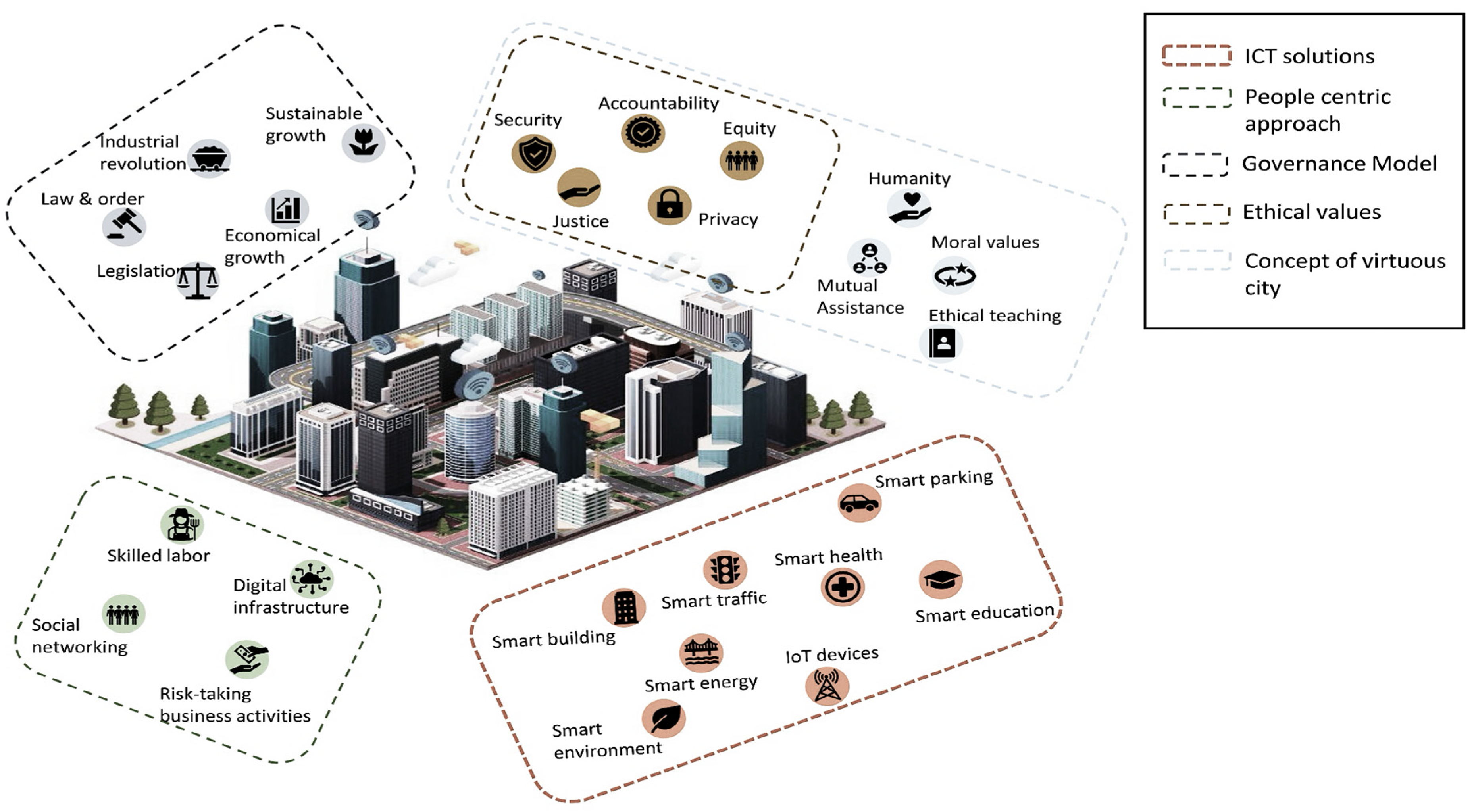
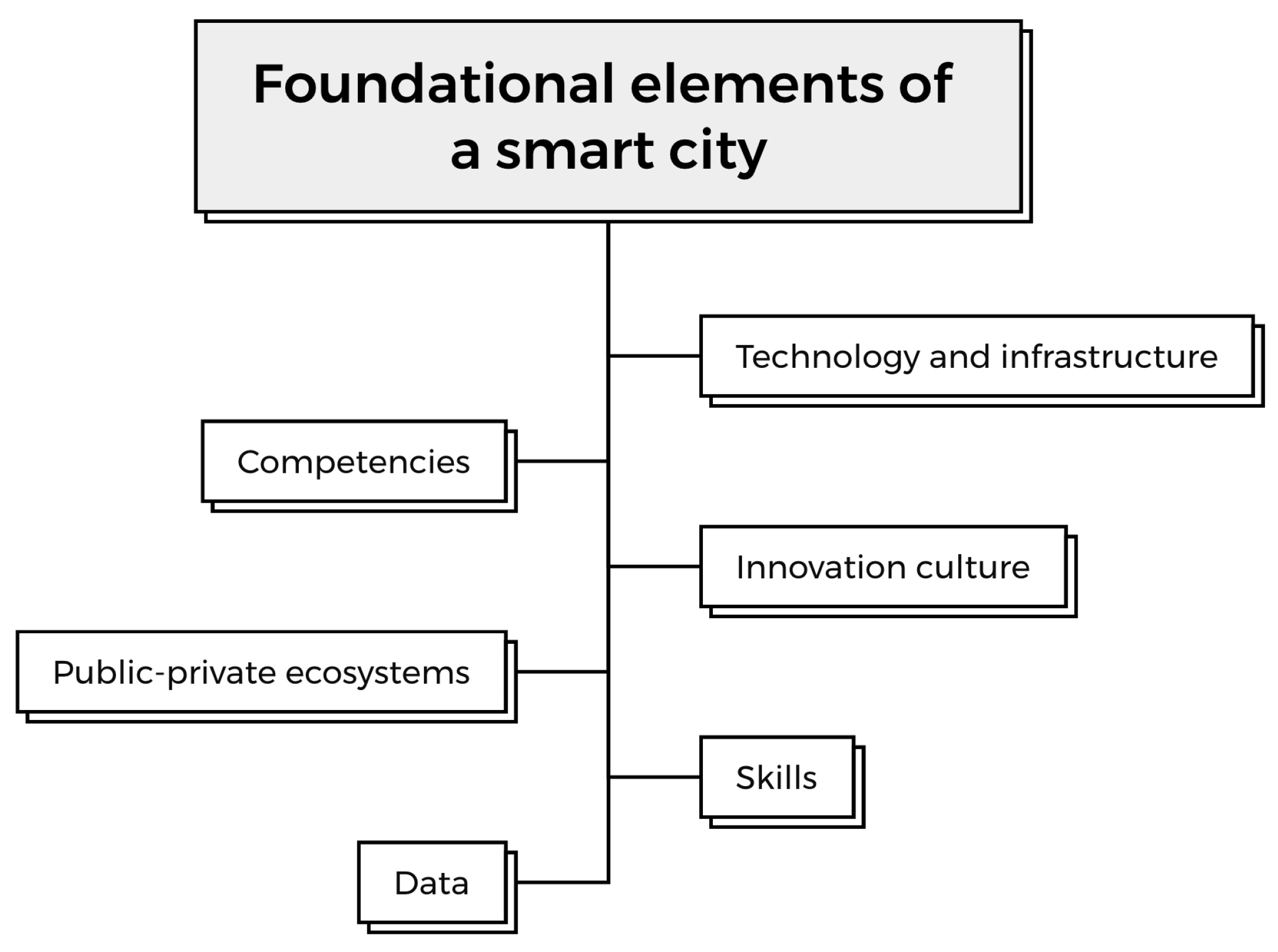
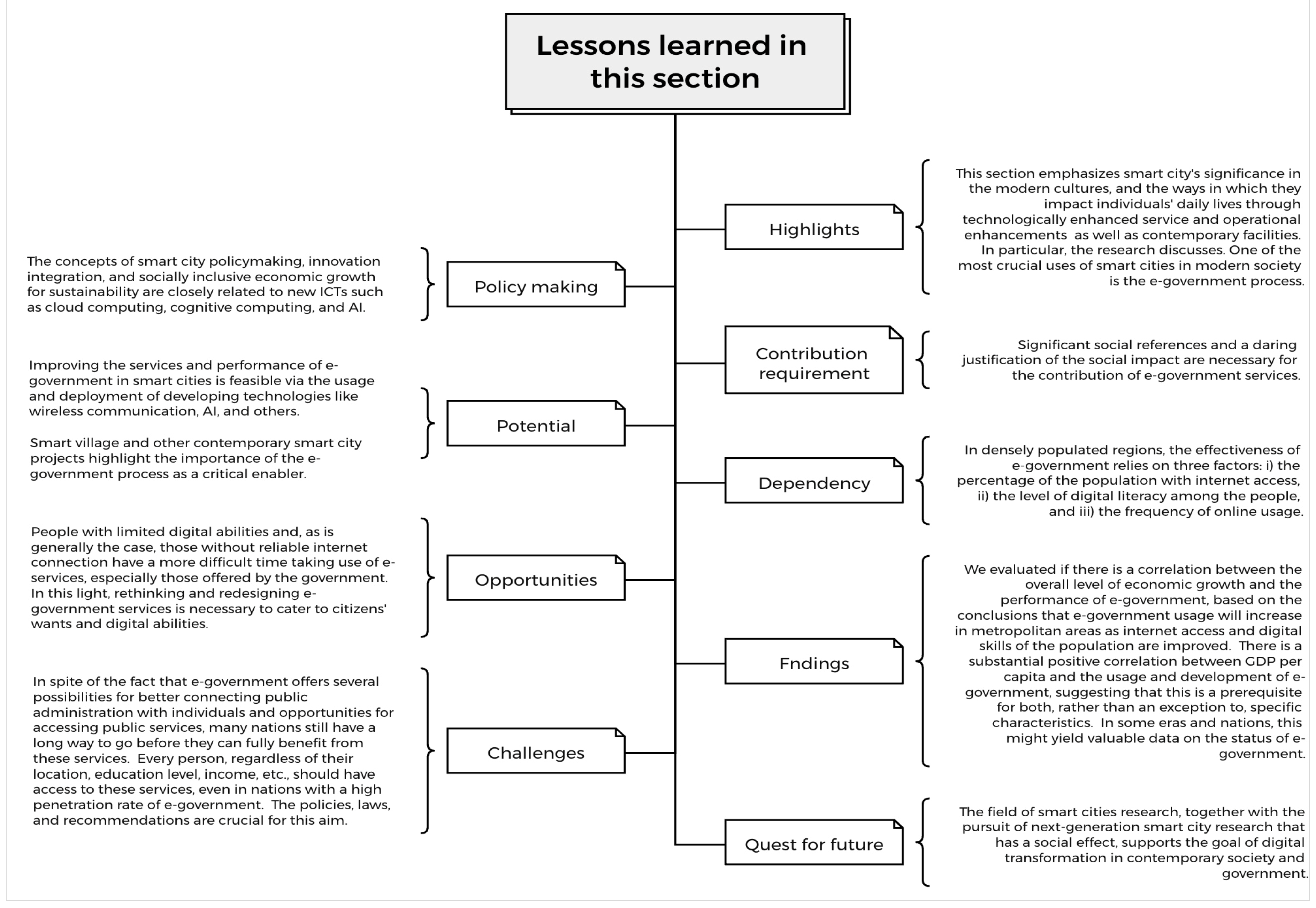
2.1. Smart Cities Understanding
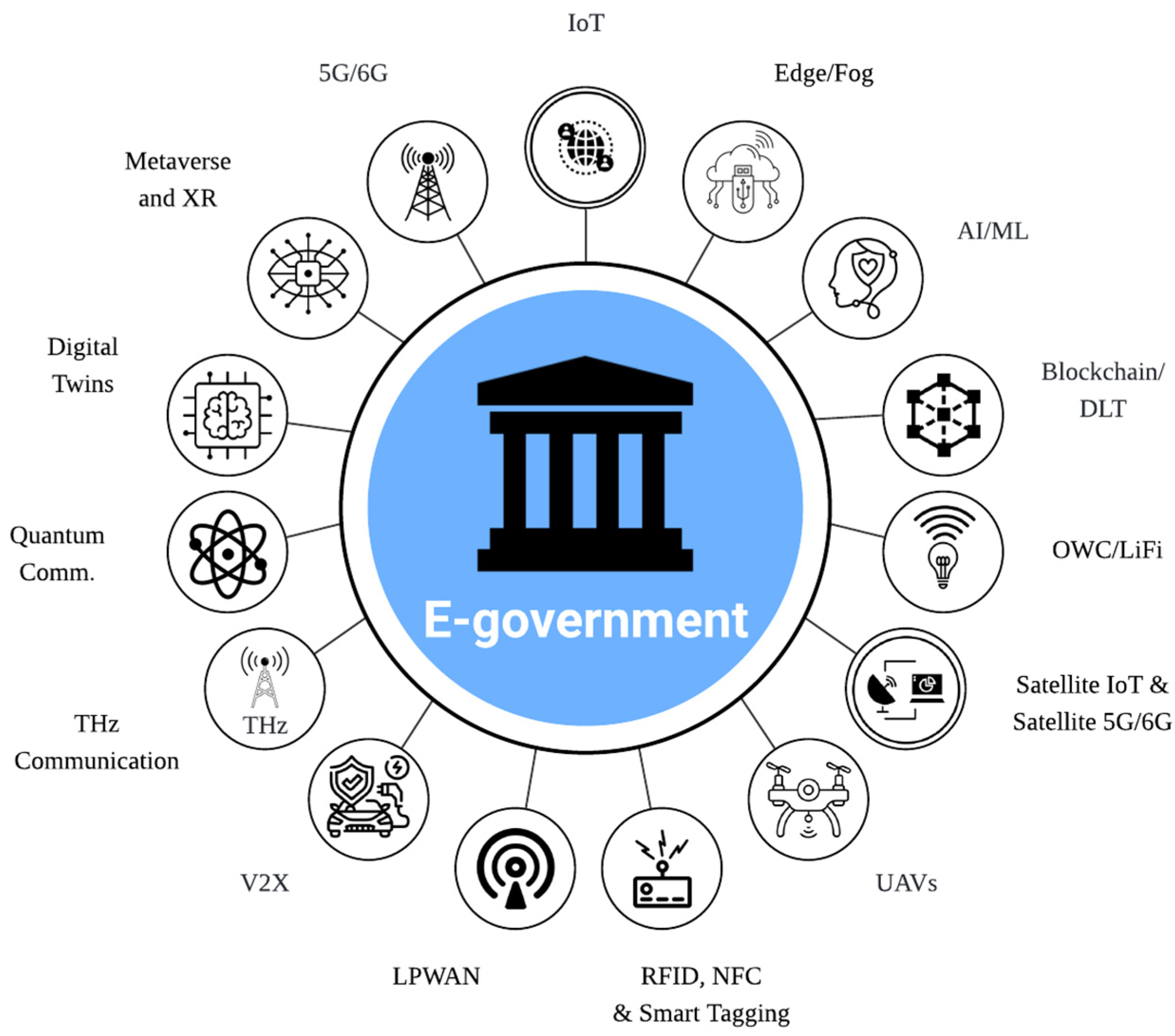
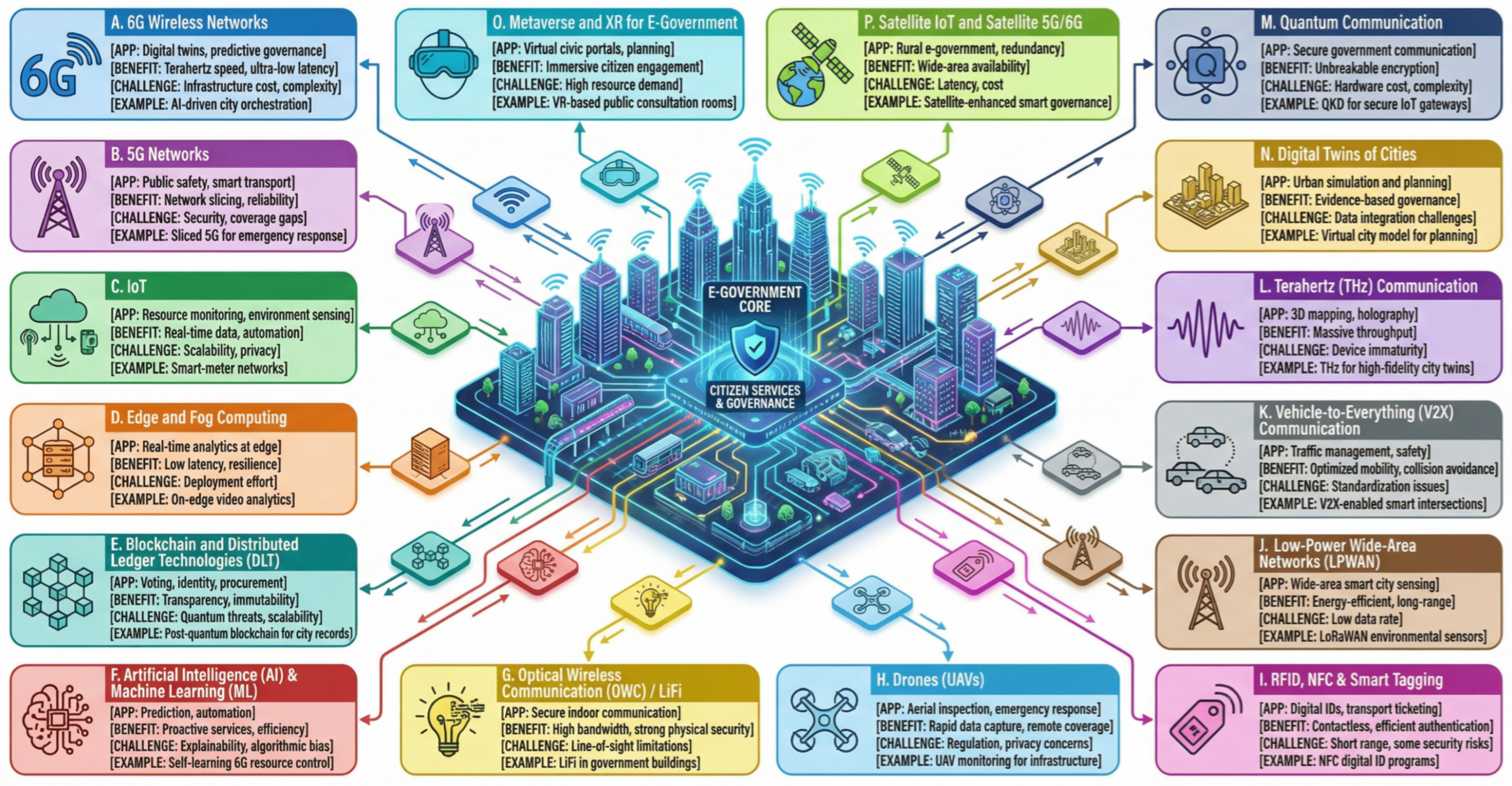
2.2. Information and Communication Technologies as a Catalyst for Smart City E-Government Development

| Ref. | City | Model | Main Technology | Preservation | Participation |
|---|---|---|---|---|---|
| [42] | Singapore | Intelligent nation scheme | AI, IoT, blockchain | Optimized service provision, augmented urban transportation, sustainable urban development | Public participation through digital platforms |
| [43] | Johannesburg | Aspirations for spatial change and urban governance | Digital platforms, geographic information system (GIS) | Concentrates on mitigating urban fragmentation and promoting sustainable development. | Community-based public engagement, local councils (baraza and indaba) |
| [44] | Leuven City | Intelligent nation scheme | Digital platforms, AI | Optimized company operations, streamlined public services | Active participation via electronic platforms |
| [45] | Kenya | Augmenting civic engagement in government | ICT, AI | Augmented public involvement, improved decision-making, and increased transparency | Community engagement, digital services for underrepresented populations |
| [46] | Tallinn | Integrated smart city framework | e-government platforms, AI | Enhanced efficacy in the provision of public services | Public engagement via e-governance platforms |
| [47] | Istanbul | Knowledge-driven urban development | Digital platforms, AI, urban analytics | Enhanced competitiveness and sustained economic advancement | Engagement within the community via digital platforms |
2.2.1. 5G/6G Wireless Networks
2.2.2. IoT
2.2.3. Edge and Fog Computing
2.2.4. Blockchain and Distributed Ledger Technologies (DLT)
2.2.5. AI and ML
2.2.6. Optical Wireless Communication (OWC)/LiFi
2.2.7. Drones (UAVs)
2.2.8. RFID, Near-Field Communication (NFC) and Smart Tagging
2.2.9. Low-Power Wide-Area Networks (LPWAN)
2.2.10. Vehicle-to-Everything (V2X) Communication
2.2.11. Terahertz (THz) Communication
2.2.12. Quantum Communication
2.2.13. DTs of Cities
2.2.14. Metaverse and XR for E-Government
2.2.15. Satellite IoT and Satellite 5G/6G
3. E-Government and Sustainability Metrics
3.1. Environmental Performance
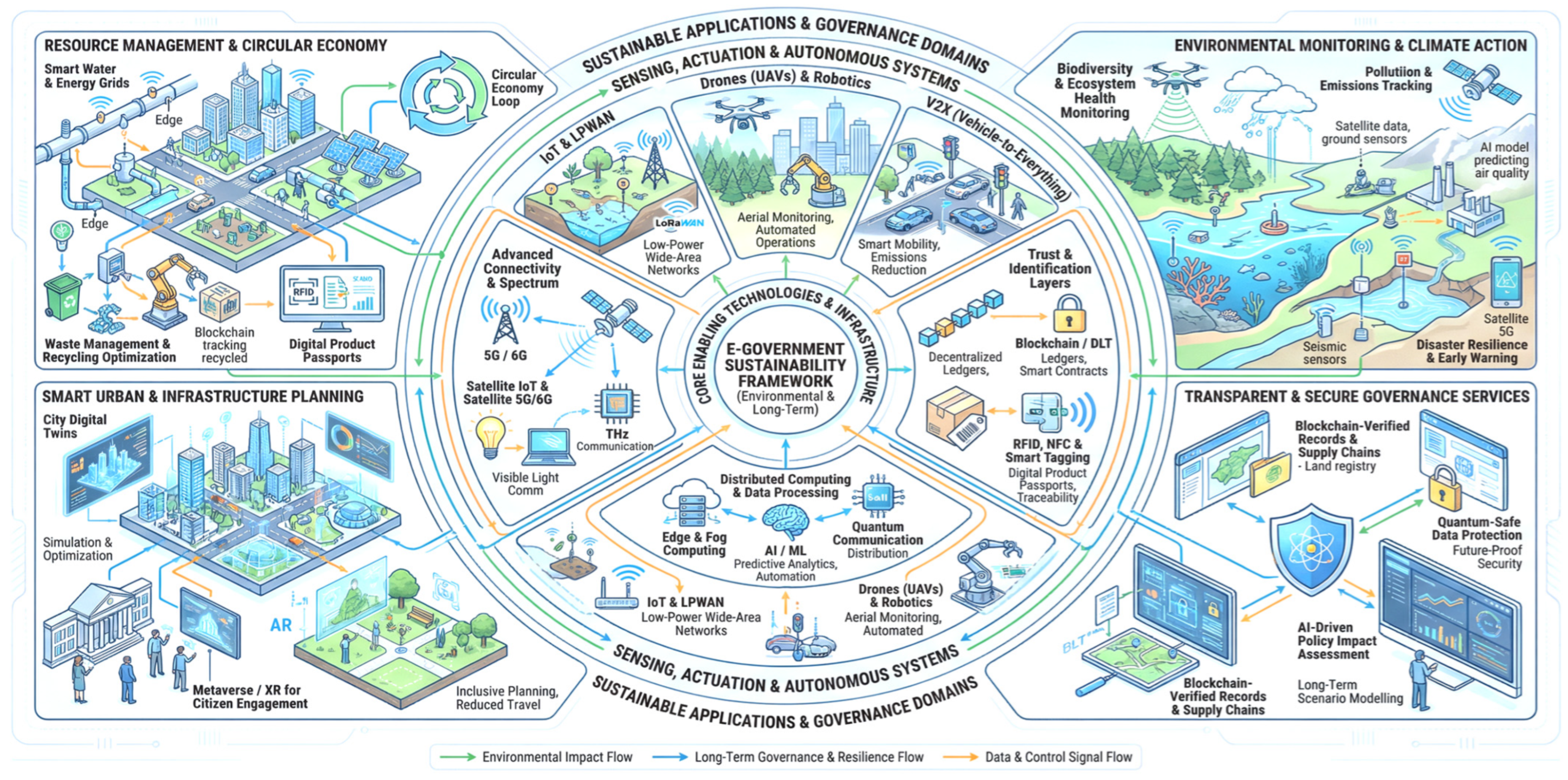
3.2. The Goal of ICTs in E-Government’s Environmental and Long-Term Sustainability
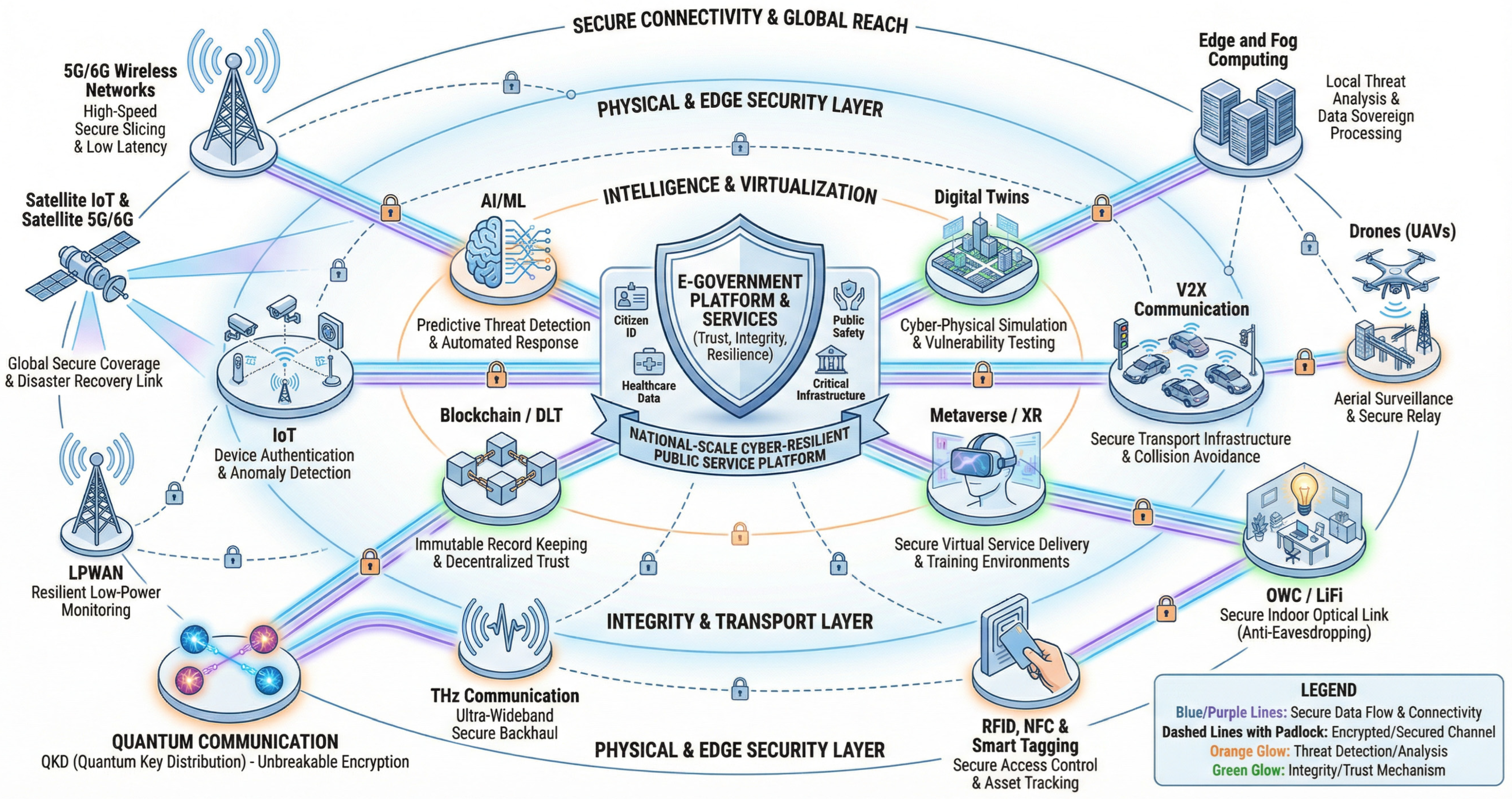
4. Technology Adoption and Cybersecurity for E-Government
- The first thing they do is keep private information that cybercriminals can exploit to steal personal information or money.
- Secondly, it is difficult for federal governments to guarantee cybersecurity due to the large number of local governments, whether they are urban or rural.
- Third, local administrations are unable to execute adequate cybersecurity measures due to restricted funding and staffing. Large, well-funded companies like Google, Yahoo!, Home Depot, and Target have all been the victims of cyberattacks.
- As a fourth point, fraudsters may easily gain access to sensitive records shared by local governments with other federal agencies.
- Finally, local governments face new security vulnerabilities and hazards due to the increasing use of the IoT in the quest to build “smart cities,” which brings advanced ways for managing assets but also exposes them to new threats.
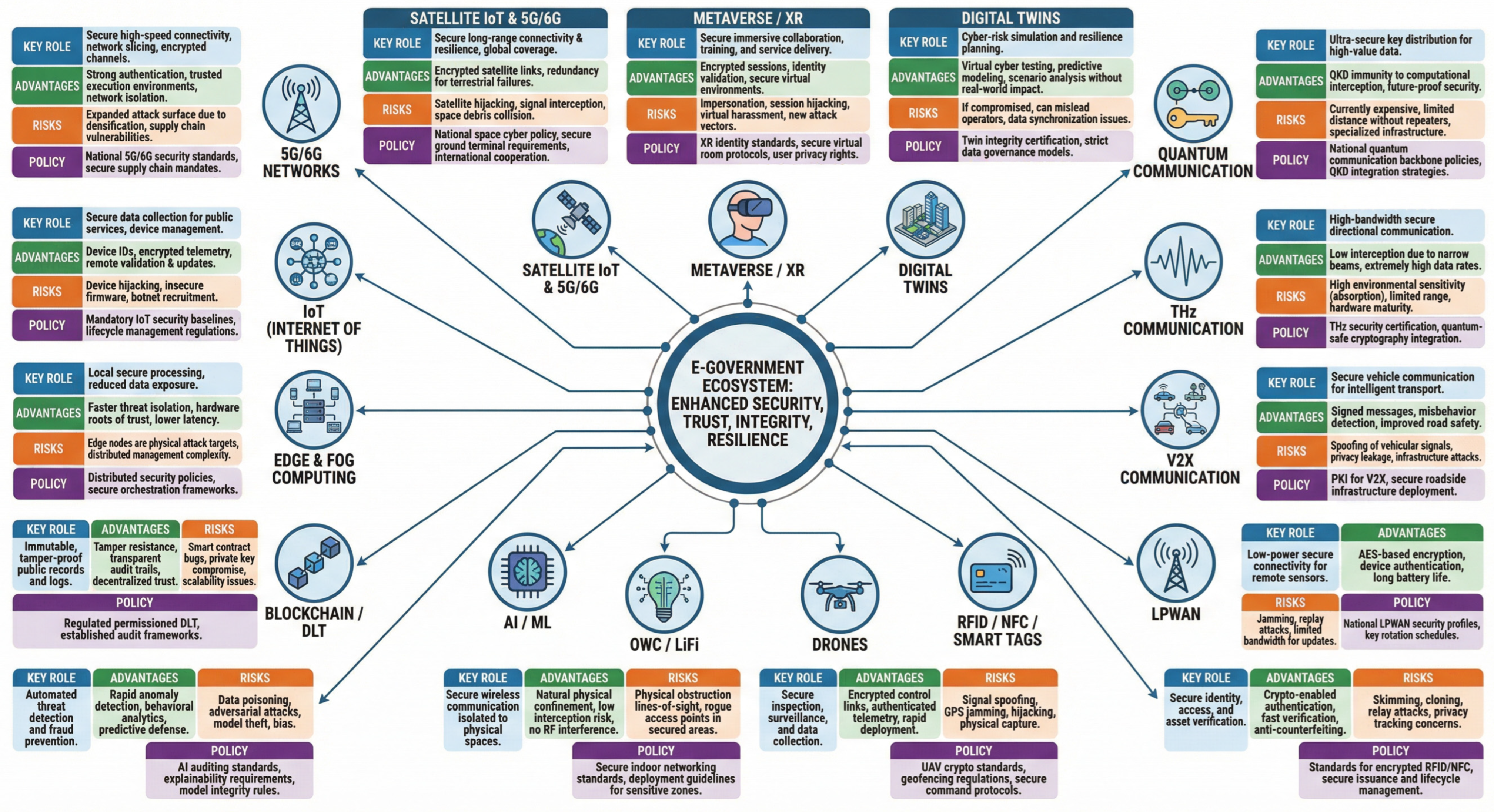
4.1. Cybersecurity Roles of Key Emerging Technologies in E-Government
4.1.1. 5G/6G Wireless Networks
4.1.2. IoT
- (i)
- wireless signal strength;
- (ii)
- IoT sensor node vulnerability;
- (iii)
- IoT architecture fluidity; and
- (iv)
- communication, computation, storage, and memory capacity.
4.1.3. Edge and Fog Computing
4.1.4. Blockchain/DLT
4.1.5. AI/ML
4.1.6. OWC/LiFi
4.1.7. UAVs
4.1.8. RFID, NFC, and Smart Tagging
4.1.9. LPWAN
4.1.10. V2X Communication
4.1.11. THz Communication
4.1.12. Quantum Communication
4.1.13. DTs
4.1.14. Metaverse/XR
4.1.15. Satellite IoT and Satellite 5G/6G
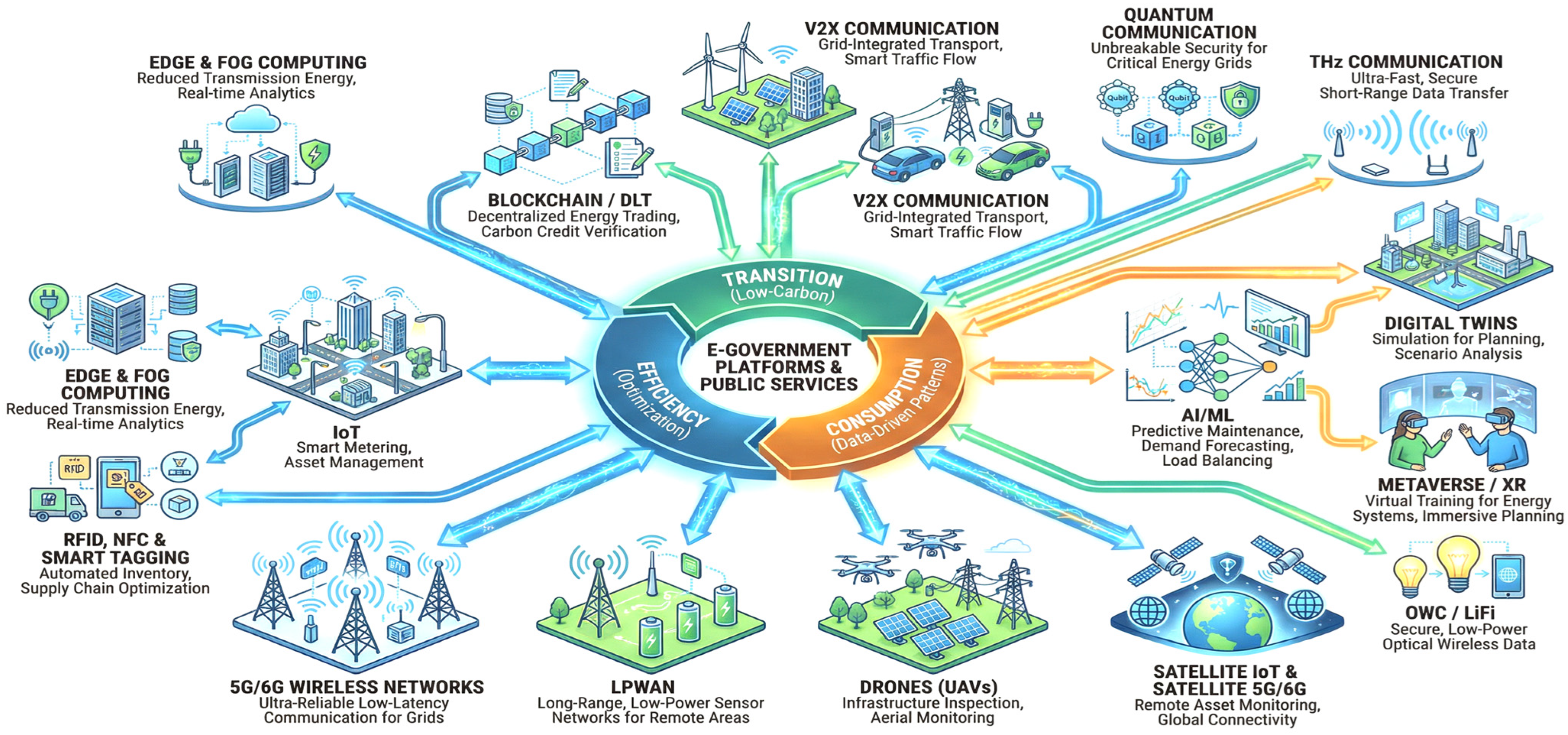
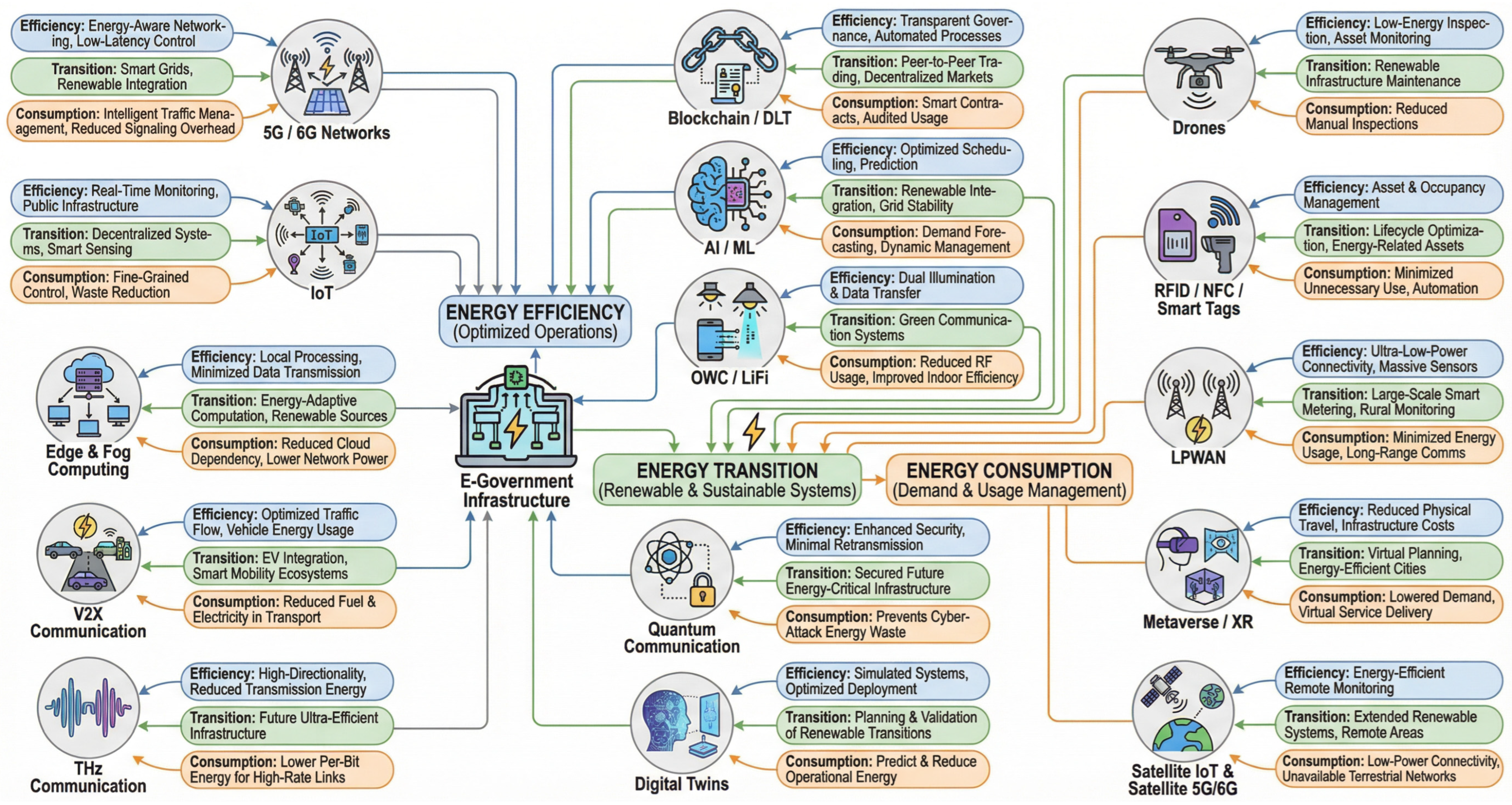
5. Efficiency, Transition, and Consumption (ETC) of Energy in E-Government
The Role of Key Emerging Technologies in the ETC of Energy in E-Government
6. Comparative Analysis
- (i)
- Low Maturity: This includes limited or no commercial deployment, laboratory or controlled pilot validation, incomplete standards and regulatory frameworks, high technical uncertainty, and dependence on future breakthroughs. These innovative technologies are long-term and not yet in use.
- (ii)
- Medium Maturity: Commercially accessible but developing. Classification shows sector-specific or pilot-heavy deployments rather than widespread acceptance; technical feasibility proved, but scalability, interoperability, or regulatory clarity still emerging, optimizing and growing the ecosystem. Though no longer experimental, they are not fully stable across governance contexts.
- (iii)
- High Maturity: Known for their worldwide standards and regulatory frameworks, fully marketed goods and services, widespread industry and governmental acceptance, and proven scalability and long-term operating success. Real-world infrastructures use these technologies after pilot testing.
7. Conclusions
- According to the report, few nations have implemented new technology for e-government services and applications. Studies focus on conceptual frameworks, architectural models, and prototype systems, with few large-scale real-world deployments. Recent adoption trends are optimistic; however, many technologies are still in development and underused owing to organizational, legislative, and infrastructural obstacles. Region-specific e-government ecosystem maturity affects technology dissemination and service integration.
- Traditional wireless communication technologies, IoT platforms, and UAV-based systems are the most commonly accepted and theoretically supported due to their technological maturity and practicality. Due to implementation complexity, legal constraints, energy problems, and integration issues, blockchain, AI, and LiFi remain underexplored. This indicates a research void in theoretical and operational models for next-generation e-government systems.
- Despite all developing technologies contributing to smart city growth in e-government ecosystems, some have higher practical impact and implementation readiness. Wireless communication, IoT, and edge–cloud computing suit real-time monitoring, intelligent transportation, and resource optimization well. Artificial intelligence improves data-driven decision-making and automation, notably in sustainability and energy optimization. Blockchain, quantum communication, and LiFi, while promising, are not widely used due to integration complexity, legislative limits, and infrastructure preparedness. These findings show how developing technologies differ in smart city, sustainability, cybersecurity, and energy management.
- The study found that high deployment and operational costs, interoperability issues, data privacy and security risks, regulatory and governance barriers, technical expertise gaps, infrastructure limitations, and energy consumption concerns hinder large-scale adoption. Reduced public trust, organizational resistance to change, and weak policy frameworks aggravate these issues. Strategic proposals include standardizing interoperability frameworks, tightening cybersecurity and privacy rules, investing in workforce training, improving infrastructure preparedness, and using energy-efficient system designs.
- Finally, this work reviews and synthesizes the literature to propose a collaborative technical e-government technique. The framework shows how coordinated technology deployment can support service automation, cybersecurity, sustainable energy management, and smart city development by systematically integrating wireless networks, IoT, AI, edge–cloud computing, blockchain, and advanced communication paradigms. This conceptual technique provides a structured reference model for developing scalable, secure, energy-efficient e-government ecosystems that promote interoperability, resilience, and sustainability.
Author Contributions
Funding
Data Availability Statement
Conflicts of Interest
References
- Islam, M.K.; Ya, C.; Sultana, S. E-government impact on Sustainable Development Goals (SDGs): A bibliometric insights. Soc. Sci. Humanit. Open 2025, 12, 101743. [Google Scholar] [CrossRef]
- Mohammed, S.A.; Murad, S.S.; Albeyboni, H.J.; Soltani, M.D.; Ahmed, R.A.; Badeel, R.; Chen, P. Supporting global communications of 6G networks using AI, digital twin, hybrid and integrated networks, and cloud: Features, challenges, and recommendations. Telecom 2025, 6, 35. [Google Scholar] [CrossRef]
- Murad, S.S.; Yussof, S.; Badeel, R. Wireless technologies for social distancing in the time of COVID-19: Literature review, open issues, and limitations. Sensors 2022, 22, 2313. [Google Scholar] [CrossRef]
- Lytras, M.D.; Şerban, A.C. E-government insights to smart cities research: European Union (EU) study and the role of regulations. IEEE Access 2020, 8, 65313–65326. [Google Scholar] [CrossRef]
- Alorini, F.T.; Alkhalifah, A.A. Exploring artificial intelligence adoption for e-government: A systematic lit-erature review. IEEE Access 2025, 13, 175686–175703. [Google Scholar] [CrossRef]
- Shao, D.; Ishengoma, F.R.; Alexopoulos, C.; Saxena, S.; Nikiforova, A.; Matheus, R. Integration of IoT into e-government. Foresight 2023, 25, 734–750. [Google Scholar] [CrossRef]
- Kassen, M. Blockchain and e-government innovation: Automation of public information processes. Inf. Syst. 2022, 103, 101862. [Google Scholar] [CrossRef]
- Dechamps, S.; Simonofski, A.; Burnay, C. Citizen-centricity in digital government: A theoretical and empirical typology. Gov. Inf. Q. 2025, 42, 102005. [Google Scholar] [CrossRef]
- Castro, C.; Lopes, C. Digital government and sustainable development. J. Knowl. Econ. 2022, 13, 880–903. [Google Scholar] [CrossRef]
- Huang, X.; Hu, Y.; Zhang, F.; Li, T. Government digital transformation for sustainable development: How e-government initiatives enhance total factor energy efficiency. Res. Int. Bus. Financ. 2025, 80, 103084. [Google Scholar] [CrossRef]
- Ai, S.; Ding, H.; Ping, Y.; Zuo, X.; Zhang, X. Exploration of digital transformation of government governance under the information environment. IEEE Access 2023, 11, 78984–78993. [Google Scholar] [CrossRef]
- Vrabie, C. E-government 3.0: An AI model to use for enhanced local democracies. Sustainability 2023, 15, 9572. [Google Scholar] [CrossRef]
- Adamatzky, A.; Kendon, V. (Eds.) From Astrophysics to Unconventional Computation; Springer International Publishing: Cham, Switzerland, 2020; Volume 35. [Google Scholar]
- Yigitcanlar, T.; Han, H.; Kamruzzaman, M.; Ioppolo, G.; Sabatini-Marques, J. The making of smart cities: Are Songdo, Masdar, Amsterdam, San Francisco and Brisbane the best we could build? Land Use Policy 2019, 88, 104187. [Google Scholar] [CrossRef]
- Macke, J.; Rubim Sarate, J.A.; de Atayde Moschen, S. Smart sustainable cities evaluation and sense of com-munity. J. Clean. Prod. 2019, 239, 118103. [Google Scholar] [CrossRef]
- Derudder, B.; Taylor, P.J. Three globalizations shaping the twenty-first century: Understanding the new world geography through its cities. Ann. Am. Assoc. Geogr. 2020, 110, 1831–1854. [Google Scholar] [CrossRef]
- Ammara, U.; Rasheed, K.; Mansoor, A.; Al-Fuqaha, A.; Qadir, J. Smart cities from the perspective of systems. Systems 2022, 10, 77. [Google Scholar] [CrossRef]
- Ramírez-Gordillo, T.; Mora, H.; Maciá-Lillo, A.; Amador, S.; Gil, D. Human-centric solutions and AI in the smart city context: The Industry 5.0 perspective. In The International Research & Innovation Forum; Springer: Cham, Switzerland, 2023; pp. 193–203. [Google Scholar]
- Skubis, I.; Wolniak, R.; Grebski, W.W. AI and human-centric approach in smart cities management: Case studies from Silesian and Lesser Poland Voivodships. Sustainability 2024, 16, 8279. [Google Scholar] [CrossRef]
- Ismagilova, E.; Hughes, L.; Dwivedi, Y.K.; Raman, K.R. Smart cities: Advances in research—An information systems perspective. Int. J. Inf. Manag. 2019, 47, 88–100. [Google Scholar] [CrossRef]
- Sarker, I.H. Smart city data science: Towards data-driven smart cities with open research issues. Internet Things 2022, 19, 100528. [Google Scholar] [CrossRef]
- Kasznar, A.P.P.; Hammad, A.W.A.; Najjar, M.; Qualharini, E.L.; Figueiredo, K.; Soares, C.A.P.; Haddad, A.N. Multiple dimensions of smart cities’ infrastructure: A review. Buildings 2021, 11, 73. [Google Scholar] [CrossRef]
- Penmetsa, M.K.; Bruque Camara, S.J. Building a super smart nation: Scenario analysis and framework of es-sential stakeholders, characteristics, pillars, and challenges. Sustainability 2022, 14, 2757. [Google Scholar] [CrossRef]
- Palvia, P.; Ghosh, J.; Jacks, T.; Serenko, A. Information technology issues and challenges of the globe: The world IT project. Inf. Manag. 2021, 58, 103545. [Google Scholar] [CrossRef]
- El Bhiri, B.; Merzouk, S.; Assoul, S. (Eds.) Industrial Innovations: New Technologies in Cities’ Digital Infrastructures; Springer Nature Switzerland: Cham, Switzerland, 2024. [Google Scholar]
- Lucas, P.J.; Robinson, R.; Treacy, L. What is Data Poverty. Nesta 2020. Available online: https://www.nesta.org.uk/ (accessed on 11 December 2025).
- Vasiliki, K.; Angelika, K.; Alain, O.; Theodoros, T. A Systematic Literature Review on Developing Job Profiles and Training Content for Open Data-Driven Smart Cities; Springer: Cham, Switzerland, 2024; pp. 326–337. [Google Scholar]
- AlQahtani, S.A. An evaluation of e-health service performance through the integration of 5G IoT, fog, and cloud computing. Sensors 2023, 23, 5006. [Google Scholar] [CrossRef]
- Jararweh, Y. Enabling efficient and secure energy cloud using edge computing and 5G. J. Parallel Distrib. Comput. 2020, 145, 42–49. [Google Scholar] [CrossRef]
- Del-Pozo-Puñal, E.; García-Carballeira, F.; Camarmas-Alonso, D. A scalable simulator for cloud, fog and edge computing platforms with mobility support. Future Gener. Comput. Syst. 2023, 144, 117–130. [Google Scholar] [CrossRef]
- Singh, S.K.; Rathore, S.; Park, J.H. BlockIoTIntelligence: A blockchain-enabled intelligent IoT architecture with artificial intelligence. Future Gener. Comput. Syst. 2020, 110, 721–743. [Google Scholar] [CrossRef]
- Ali, A.; Ali, H.; Saeed, A.; Khan, A.A.; Tin, T.T.; Assam, M.; Ghadi, Y.Y.; Mohamed, H.G. Blockchain-powered healthcare systems: Enhancing scalability and security with hybrid deep learning. Sensors 2023, 23, 7740. [Google Scholar] [CrossRef]
- Aljohani, A. Deep learning-based optimization of energy utilization in IoT-enabled smart cities: A pathway to sustainable development. Energy Reports 2024, 12, 2946–2957. [Google Scholar] [CrossRef]
- Amran, N.A.; Soltani, M.D.; Yaghoobi, M.; Safari, M. Learning indoor environment for effective LiFi com-munications: Signal detection and resource allocation. IEEE Access 2022, 10, 17400–17416. [Google Scholar] [CrossRef]
- Zhang, D.; Yang, L.T.; Chen, M.; Zhao, S.; Guo, M.; Zhang, Y. Real-time locating systems using active RFID for Internet of Things. IEEE Syst. J. 2014, 10, 1226–1235. [Google Scholar] [CrossRef]
- Dembski, F.; Wössner, U.; Letzgus, M.; Ruddat, M.; Yamu, C. Urban digital twins for smart cities and citizens: The case study of Herrenberg, Germany. Sustainability 2020, 12, 2307. [Google Scholar] [CrossRef]
- Machała, S.; Chamier-Gliszczyński, N.; Królikowski, T. Application of AR/VR technology in Industry 4.0. Procedia Comput. Sci. 2022, 207, 2990–2998. [Google Scholar] [CrossRef]
- Pereira, G.V.; Parycek, P.; Falco, E.; Kleinhans, R. Smart governance in the context of smart cities: A literature review. Inf. Polity 2018, 23, 143–162. [Google Scholar] [CrossRef]
- Salem, A.M.; Eyupoglu, S.Z.; Ma’aitah, M.K. The influence of machine learning on enhancing rational deci-sion-making and trust levels in e-government. Systems 2024, 12, 373. [Google Scholar] [CrossRef]
- Erdmann, G.; Neumann, A.; Loeschel, A. Studies in Energy, Resource and Environmental Economics; Springer: Cham, Switzerland, 2023. [Google Scholar]
- Cardullo, P. Citizens in the Smart City; Routledge: London, UK, 2020. [Google Scholar]
- Chia, E.S. Singapore’s smart nation program—Enablers and challenges. In Proceedings of the 11th System of Systems Engineering Conference (SoSE); IEEE: New York, NY, USA, 2016; pp. 1–5. [Google Scholar]
- Pieterse, E. Urban governance and spatial transformation ambitions in Johannesburg. J. Urban Aff. 2019, 41, 20–38. [Google Scholar] [CrossRef]
- Randma-Liiv, T.; Lember, V. Engaging Citizens in Policy Making: E-Participation Practices in Europe; Edward Elgar Publishing: Cheltenham, UK, 2022. [Google Scholar]
- Hao, C.; Nyaranga, M.S.; Hongo, D.O. Enhancing public participation in governance for sustainable devel-opment: Evidence from Bungoma County, Kenya. SAGE Open 2022, 12, 1–14. [Google Scholar] [CrossRef]
- Sarv, L.; Soe, R.-M. Transition towards smart city: The case of Tallinn. Sustainability 2021, 13, 4143. [Google Scholar] [CrossRef]
- Yigitcanlar, T.; Bulu, M. Dubaization of Istanbul: Insights from the knowledge-based urban development journey of an emerging local economy. Environ. Plan. A 2015, 47, 89–107. [Google Scholar] [CrossRef]
- Alkraiji, A.I. An examination of citizen satisfaction with mandatory e-government services: Comparison of two information systems success models. Transform. Gov. People Process Policy 2021, 15, 36–58. [Google Scholar] [CrossRef]
- Allessie, D.; Sobolewski, M. Blockchain for Digital Government: An Assessment of Pioneering Implementations in Public Services; Publications Office of the European Union: Luxembourg, 2019. [Google Scholar]
- Idahosa, M.E.; Eireyi-Edewede, S.; Eruanga, C.E. Application of cloud computing technology for enhanced e-government services in Edo State; IGI Global Scientific Publishing: Hershey, PA, USA, 2024; pp. 221–278. [Google Scholar]
- Zhang, Z.; Xiao, Y.; Ma, Z.; Xiao, M.; Ding, Z.; Lei, X.; Karagiannidis, G.K.; Fan, P. 6G wireless networks: Vision, requirements, architecture, and key technologies. IEEE Veh. Technol. Mag. 2019, 14, 28–41. [Google Scholar] [CrossRef]
- Wang, C.X.; Wang, J.; Hu, S.; Jiang, Z.H.; Tao, J.; Yan, F. Key technologies in 6G terahertz wireless com-munication systems: A survey. IEEE Veh. Technol. Mag. 2021, 16, 27–37. [Google Scholar] [CrossRef]
- Geraci, G.; Garcia-Rodriguez, A.; Azari, M.M.; Lozano, A.; Mezzavilla, M.; Chatzinotas, S.; Chen, Y.; Rangan, S.; Di Renzo, M. What will the future of UAV cellular communications be? A flight from 5G to 6G. IEEE Commun. Surv. Tutor. 2022, 24, 1304–1335. [Google Scholar] [CrossRef]
- Wei, L.; Hu, R.Q.; Qian, Y.; Wu, G. Key elements to enable millimeter wave communications for 5G wireless systems. IEEE Wirel. Commun. 2014, 21, 136–143. [Google Scholar] [CrossRef]
- Zhang, L.; Liang, Y.-C.; Niyato, D. 6G visions: Mobile ultra-broadband, super Internet-of-Things, and artificial intelligence. China Commun. 2019, 16, 1–14. [Google Scholar] [CrossRef]
- Dias, J.P.; Restivo, A.; Ferreira, H.S. Designing and constructing Internet-of-Things systems: An overview of the ecosystem. Internet Things 2022, 19, 100529. [Google Scholar] [CrossRef]
- Atzori, L.; Iera, A.; Morabito, G. The Internet of Things: A survey. Comput. Netw. 2010, 54, 2787–2805. [Google Scholar] [CrossRef]
- Tuli, S.; Mirhakimi, F.; Pallewatta, S.; Zawad, S.; Casale, G.; Javadi, B.; Yan, F.; Buyya, R.; Jennings, N.R. AI-augmented edge and fog computing: Trends and challenges. J. Netw. Comput. Appl. 2023, 216, 103648. [Google Scholar] [CrossRef]
- Laroui, M.; Nour, B.; Moungla, H.; Cherif, M.A.; Afifi, H.; Guizani, M. Edge and fog computing for IoT: A survey on current research activities and future directions. Comput. Commun. 2021, 180, 210–231. [Google Scholar] [CrossRef]
- Xu, C.; Wang, K.; Guo, M. Intelligent resource management in blockchain-based cloud datacenters. IEEE Cloud Comput. 2017, 4, 50–59. [Google Scholar] [CrossRef]
- Lu, Y. Blockchain: A survey on functions, applications and open issues. J. Ind. Integr. Manag. 2018, 3, 1850015. [Google Scholar] [CrossRef]
- Antonopoulos, I.; Robu, V.; Couraud, B.; Kirli, D.; Norbu, S.; Kiprakis, A.; Flynn, D.; Elizondo-Gonzalez, S.; Wattam, S. Artificial intelligence and machine learning approaches to energy demand-side response: A systematic review. Renew. Sustain. Energy Rev. 2020, 130, 109899. [Google Scholar] [CrossRef]
- Yang, H.; Alphones, A.; Xiong, Z.; Niyato, D.; Zhao, J.; Wu, K. Artificial-intelligence-enabled intelligent 6G networks. IEEE Netw. 2020, 34, 272–280. [Google Scholar] [CrossRef]
- Swaminathan, B.; Palani, S.; Kotecha, K.; Kumar, V.; V, S. IoT-driven artificial intelligence technique for fertilizer recommendation model. IEEE Consum. Electron. Mag. 2022, 12, 109–117. [Google Scholar] [CrossRef]
- Ahammed, T.B.; Patgiri, R.; Nayak, S. A vision on the artificial intelligence for 6G communication. ICT Express 2023, 9, 197–210. [Google Scholar] [CrossRef]
- Challita, U.; Ferdowsi, A.; Chen, M.; Saad, W. Machine learning for wireless connectivity and security of cellular-connected UAVs. IEEE Wirel. Commun. 2019, 26, 28–35. [Google Scholar] [CrossRef]
- Murad, S.S.; Yussof, S.; Hashim, W.; Badeel, R. Card-flipping decision-making technique for handover skip-ping and access point assignment: A novel approach for hybrid LiFi networks. IEEE Access 2024, 12, 146635–146667. [Google Scholar] [CrossRef]
- Ozyurt, A.B.; Popoola, W.O. LiFi-based D2D communication in industrial IoT. IEEE Syst. J. 2023, 17, 1591–1598. [Google Scholar] [CrossRef]
- Badeel, R.; Subramaniam, S.K.; Hanapi, Z.M.; Muhammed, A. A review on LiFi network research: Open issues, applications and future directions. Appl. Sci. 2021, 11, 11118. [Google Scholar] [CrossRef]
- Wu, X.; Soltani, M.D.; Zhou, L.; Safari, M.; Haas, H. Hybrid LiFi and WiFi networks: A survey. IEEE Commun. Surv. Tutor. 2021, 23, 1398–1420. [Google Scholar] [CrossRef]
- Zeng, Z.; Soltani, M.D.; Wang, Y.; Wu, X.; Haas, H. Realistic indoor hybrid WiFi and OFDMA-based LiFi networks. IEEE Trans. Commun. 2020, 68, 2978–2991. [Google Scholar] [CrossRef]
- Murad, S.S.; Badeel, R.; Ahmed, R.A.; Yussof, S. Using drones and robots for social distancing: Literature review, challenges and issues. In Proceedings of the Panhellenic Conference on Electronics and Telecommunications (PACET 2024); IEEE: New York, NY, USA, 2024. [Google Scholar]
- Arzykulov, S.; Celik, A.; Nauryzbayev, G.; Eltawil, A.M. UAV-assisted cooperative and cognitive NOMA: Deployment, clustering, and resource allocation. IEEE Trans. Cogn. Commun. Netw. 2022, 8, 263–281. [Google Scholar] [CrossRef]
- Chaudhari, B.S.; Zennaro, M.; Borkar, S. LPWAN technologies: Emerging application characteristics, re-quirements, and design considerations. Future Internet 2020, 12, 46. [Google Scholar] [CrossRef]
- Chen, Y.; Sambo, Y.A.; Onireti, O.; Imran, M.A. A survey on LPWAN–5G integration: Main challenges and potential solutions. IEEE Access 2022, 10, 32132–32149. [Google Scholar] [CrossRef]
- Zitouni, R.; Casto, F.C.; Mouelhi, S.; Senouci, B. Efficient V2X waveforms: NOMA combined with FBMC/UFMC reduces the co-channel interference. In Proceedings of the IEEE Middle East and North Africa Communications Conference (MENACOMM); IEEE: New York, NY, USA, 2022; pp. 141–146. [Google Scholar]
- Dhinesh Kumar, R.; Rammohan, A. Revolutionizing intelligent transportation systems with cellular vehicle-to-everything (C-V2X) technology: Current trends, use cases, emerging technologies, standardization bodies, industry analytics and future directions. Veh. Commun. 2023, 43, 100638. [Google Scholar]
- Amodu, O.A.; Jarray, C.; Busari, S.A.; Othman, M. THz-enabled UAV communications: Motivations, results, applications, challenges, and future considerations. Ad Hoc Netw. 2023, 140, 103073. [Google Scholar] [CrossRef]
- Chen, H.; El Azzoui, A.; Park, H.; Camacho, D.; Park, J.H. A Comprehensive Study of Quantum Computing Technologies in Smart City: Review and Future Directions. 2023. Available online: https://doi.org/10.2139/ssrn.4661705 (accessed on 11 December 2025).
- Manzalini, A. Quantum communications in future networks and services. Quantum Rep. 2020, 2, 221–232. [Google Scholar] [CrossRef]
- Ketzler, B.; Naserentin, V.; Latino, F.; Zangelidis, C.; Thuvander, L.; Logg, A. Digital twins for cities: A state-of-the-art review. Built Environ. 2020, 46, 547–573. [Google Scholar] [CrossRef]
- Jeddoub, I.; Nys, G.-A.; Hajji, R.; Billen, R. Digital twins for cities: Analyzing the gap between concepts and current implementations with a specific focus on data integration. Int. J. Appl. Earth Obs. Geoinf. 2023, 122, 103440. [Google Scholar] [CrossRef]
- Zhang, S.; Li, W. Applying extended reality (XR) technology in commerce, management, and business ap-plications: A survey. In Proceedings of the International Conference on Computer, Control and Robotics (ICCCR 2024); IEEE: New York, NY, USA, 2024; pp. 108–113. [Google Scholar]
- Morimoto, T.; Kobayashi, T.; Hirata, H.; Otani, K.; Sugimoto, M.; Tsukamoto, M.; Yoshihara, T.; Ueno, M.; Mawatari, M. XR (extended reality: Virtual reality, augmented reality, mixed reality) technology in spine medicine: Status quo and quo vadis. J. Clin. Med. 2022, 11, 470. [Google Scholar] [CrossRef]
- Pastukh, A.; Tikhvinskiy, V.; Dymkova, S.; Varlamov, O. Challenges of using the L-band and S-band for direct-to-cellular satellite 5G–6G NTN systems. Technologies 2023, 11, 110. [Google Scholar] [CrossRef]
- Chen, X.; Xu, Z.; Shang, L. Satellite Internet of Things: Challenges, solutions, and development trends. Front. Inf. Technol. Electron. Eng. 2023, 24, 935–944. [Google Scholar] [CrossRef]
- Centenaro, M.; Costa, C.E.; Granelli, F.; Sacchi, C.; Vangelista, L. A survey on technologies, standards and open challenges in satellite IoT. IEEE Commun. Surv. Tutor. 2021, 23, 1693–1720. [Google Scholar] [CrossRef]
- Van Kampen, J.M. From Plan to Reality: Applications of the European eGovernment Action Plan 2016–2020 on the National and Institutional Level. Ph.D. Thesis, University of Applied Sciences, Cologne, Germany, 2018. [Google Scholar]
- Silvia, B. Enhancing the Contribution of Digitalisation to the Smart Cities of the Future; OECD: Paris, France, 2019; Available online: http://www.oecd.org/regional/urban-development.html (accessed on 10 December 2025).
- Pareek, K.S.; Kumar, P.; Jain, V.K.; Pareek, K.S. (Eds.) The Stances of e-Government Policies, Processes and Tech-nologies; Routledge: London, UK, 2019. [Google Scholar]
- Doukidis, G.; Spinellis, D.; Ebert, C. Digital transformation? A primer for practitioners. IEEE Softw. 2020, 37, 13–21. [Google Scholar] [CrossRef]
- Ha, L.T.; Huong, T.T.L.; Thanh, T.T. Is digitalization a driver to enhance environmental performance? An empirical investigation of European countries. Sustain. Prod. Consum. 2022, 32, 230–247. [Google Scholar] [CrossRef]
- Rehman, S.U.; Kraus, S.; Shah, S.A.; Khanin, D.; Mahto, R.V. Analyzing the relationship between green innovation and environmental performance in large manufacturing firms. Technol. Forecast. Soc. Change 2021, 163, 120481. [Google Scholar] [CrossRef]
- Hou, Y.; Iqbal, W.; Shaikh, G.M.; Iqbal, N.; Solangi, Y.A.; Fatima, A. Measuring energy efficiency and en-vironmental performance: A case of South Asia. Processes 2019, 7, 325. [Google Scholar] [CrossRef]
- Iqbal, W.; Tang, Y.M.; Lijun, M.; Chau, K.Y.; Xuan, W.; Fatima, A. Energy policy paradox on environmental performance: The moderating role of renewable energy patents. J. Environ. Manag. 2021, 297, 113230. [Google Scholar] [CrossRef]
- Yang, H.C.; Feng, G.F.; Zhao, X.X.; Chang, C.P. The impacts of energy insecurity on green innovation: A multi-country study. Econ. Anal. Policy 2022, 74, 139–154. [Google Scholar] [CrossRef]
- Fu, Q.; Gong, Q.; Zhao, X.X.; Chang, C.P. The effects of international sanctions on green innovations. Technol. Econ. Dev. Econ. 2022, 29, 141–164. [Google Scholar] [CrossRef]
- He, P.; Zhang, Y.; Yuan, Y.; Qiao, Y.; Xin, L.; Zou, X. The relationship between environmental taxation, environmental performance and economic growth: Comparative study of Sweden and China (1985–2016). Ekoloji 2019, 107, 401. [Google Scholar]
- Ren, S.; He, D.; Zhang, T.; Chen, X. Symbolic reactions or substantive pro-environmental behaviour? An empirical study of corporate environmental performance under the government’s environmental subsidy scheme. Bus. Strategy Environ. 2019, 28, 1148–1165. [Google Scholar] [CrossRef]
- Ma, Y.; Xu, C.; Wu, M.; Zhang, F.; Wang, X.; Dong, J.; Cui, Q.; Shi, Z. One-dimensional core/shell radial heterojunction with cascade type-II energy-band alignment for enhanced broadband photodetection. Light Adv. Manuf. 2024, 5, 40. [Google Scholar] [CrossRef]
- Jiang, P.; Feng, G.; Wang, H.; Chang, C. CSR from different perspectives: The global ESG indexes updated. Corp. Soc. Responsib. Environ. Manag. 2024, 31, 4694–4714. [Google Scholar] [CrossRef]
- Yang, H.; Feng, G.; Gong, Q.; Chang, C. The impact of political competition on green innovation: A new insight into sustainable development. Sustain. Dev. 2023, 31, 3692–3708. [Google Scholar] [CrossRef]
- Elisa, N.; Yang, L.; Chao, F.; Cao, Y. A framework of blockchain-based secure and privacy-preserving e-government system. Wirel. Netw. 2023, 29, 1005–1015. [Google Scholar] [CrossRef]
- Al-Besher, A.; Kumar, K. Use of artificial intelligence to enhance e-government services. Meas. Sens. 2022, 24, 100484. [Google Scholar] [CrossRef]
- Mrabet, M.; Sliti, M. Climate change mitigation and adaptation through optical-wireless communication net-works: Applications, challenges, and opportunities. Front. Clim. 2024, 6, 1480190. [Google Scholar] [CrossRef]
- Stępniak, C.; Pawełoszek, I. Application of UAV technology in local public administration: Evidence from Polish municipalities. Procedia Comput. Sci. 2025, 270, 6086–6095. [Google Scholar] [CrossRef]
- Shrivastava, A.; Suji Prasad, S.J.; Yeruva, A.R.; Mani, P.; Nagpal, P.; Chaturvedi, A. IoT-based RFID attendance monitoring system of students using Arduino ESP8266 and Adafruit.io in a defined area. Cybern. Syst. 2025, 56, 21–32. [Google Scholar] [CrossRef]
- Usman, M.; Qaraqe, M.; Asghar, M.R.; Gebremariam, A.A.; Ansari, I.S.; Granelli, F.; Abbasi, Q.H. A business and legislative perspective of V2X and mobility applications in 5G networks. IEEE Access 2020, 8, 67426–67435. [Google Scholar] [CrossRef]
- Anshari, M.; Hamdan, M. Enhancing e-government with a digital twin for innovation management. J. Sci. Technol. Policy Manag. 2023, 14, 1055–1065. [Google Scholar] [CrossRef]
- Lnenicka, M.; Rizun, N.; Alexopoulos, C.; Saxena, S. E-government maturity models in the metaverse gov-ernment: A conceptual framework and future research agenda. J. Sci. Technol. Policy Manag. 2024, ahead-of-print. [Google Scholar]
- Christopoulou, M.; Koufos, I.; Xilouris, G.; Dimitriou, N. 5G/6G architecture evolution for XR and metaverse: Feasibility study, security, and privacy challenges for smart culture applications. IEEE Access 2025, 13, 103077–103094. [Google Scholar] [CrossRef]
- Papadopoulou, P.; Kolomvatsos, K.; Hadjiefthymiades, S. Internet of Things in e-government. Int. J. Artif. Intell. Mach. Learn. 2020, 10, 99–118. [Google Scholar] [CrossRef]
- Lea, R.; Adame, T.; Berne, A.; Azaiez, S. The Internet of Things, fog, and cloud continuum: Integration challenges and opportunities for smart cities. Future Internet 2025, 17, 281. [Google Scholar] [CrossRef]
- Noor-A-Rahim, M.; Zilong, L.; Haeyoung, L.; Omar, K.M.; Jianhua, H.; Dirk, P.; Klaus, M.; Walid, S.; Vincent, P.H. 6G for vehicle-to-everything (V2X) communications: Enabling technologies, challenges, and opportunities. Proc. IEEE 2022, 110, 712–734. [Google Scholar] [CrossRef]
- Chen, Z.; Ma, X.; Zhang, B.; Zhang, Y.; Niu, Z.; Kuang, N.; Chen, W.; Li, L.; Li, S. A survey on terahertz communications. China Commun. 2019, 16, 2. [Google Scholar]
- Van Haastrecht, M.; Ozkan, B.Y.; Brinkhuis, M.; Spruit, M. Respite for SMEs: A systematic review of so-cio-technical cybersecurity metrics. Appl. Sci. 2021, 11, 6909. [Google Scholar] [CrossRef]
- Hossain, S.T.; Yigitcanlar, T.; Nguyen, K.; Xu, Y. Understanding local government cybersecurity policy: A concept map and framework. Information 2024, 15, 342. [Google Scholar] [CrossRef]
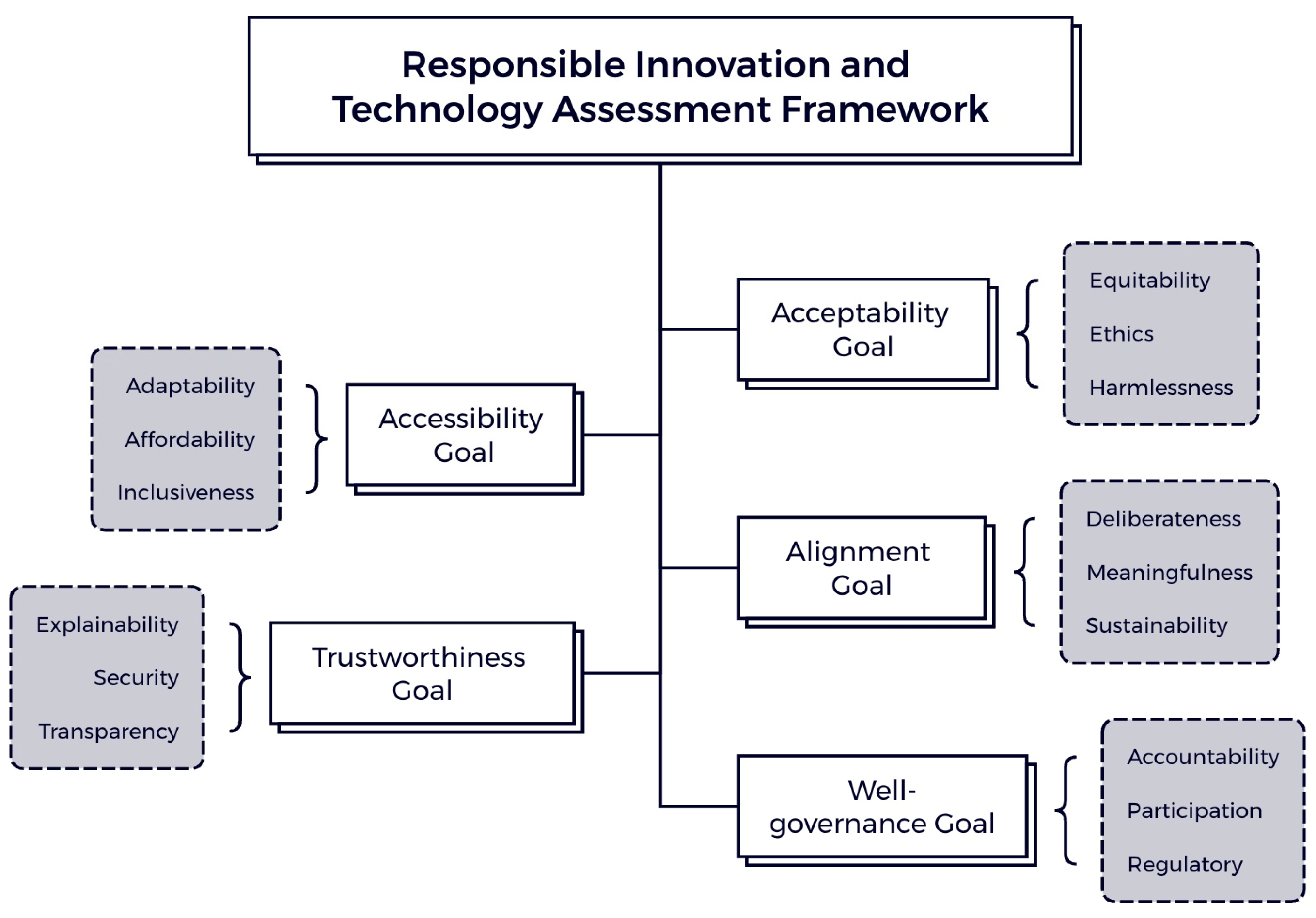
- Li, W.; Yigitcanlar, T.; Nili, A.; Browne, W. Tech giants’ responsible innovation and technology strategy: An international policy review. Smart Cities 2023, 6, 3454–3492. [Google Scholar] [CrossRef]
- Hou, K.M.; Diao, X.; Shi, H.; Ding, H.; Zhou, H.; de Vaulx, C. Trends and challenges in AIoT/IIoT/IoT im-plementation. Sensors 2023, 23, 5074. [Google Scholar] [CrossRef]
- Hossain, S.T.; Yigitcanlar, T.; Nguyen, K.; Xu, Y. Local government cybersecurity landscape: A systematic review and conceptual framework. Appl. Sci. 2024, 14, 5501. [Google Scholar] [CrossRef]
- Norris, D.F.; Mateczun, L.; Joshi, A.; Finin, T. Managing cybersecurity at the grassroots: Evidence from the first nationwide survey of local government cybersecurity. J. Urban Aff. 2021, 43, 1173–1195. [Google Scholar] [CrossRef]
- Norris, D.F.; Mateczun, L.K. Cyberattacks on local governments 2020: Findings from a key informant survey. J. Cyber Policy 2022, 7, 294–317. [Google Scholar] [CrossRef]
- Hatcher, W.; Meares, W.L.; Heslen, J. The cybersecurity of municipalities in the United States: An exploratory survey of policies and practices. J. Cyber Policy 2020, 5, 302–325. [Google Scholar] [CrossRef]
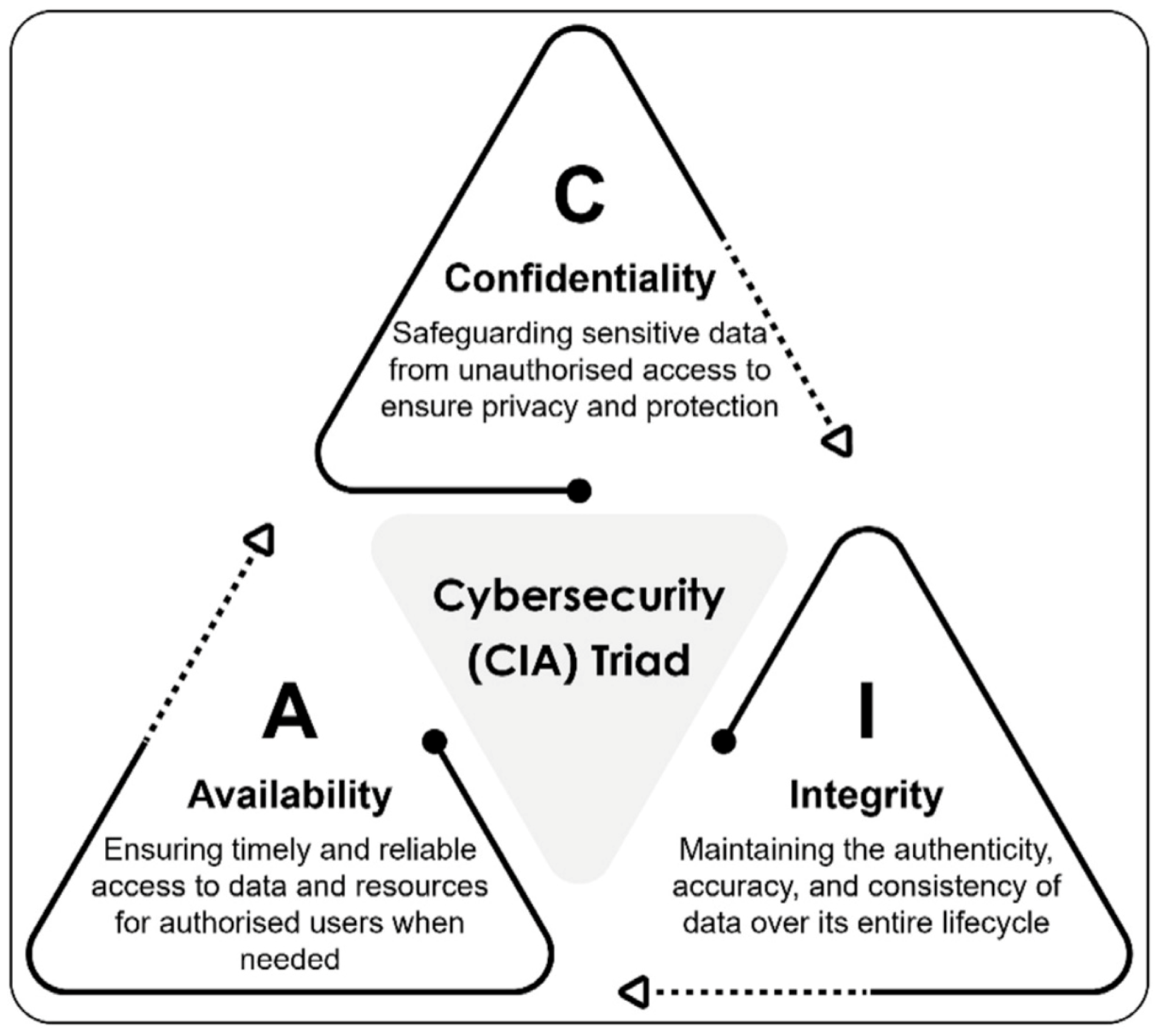
- Jones, N.; Whaiduzzaman, M.; Jan, T.; Adel, A.; Alazab, A.; Alkreisat, A. A CIA triad-based taxonomy of prompt attacks on large language models. Future Internet 2025, 17, 113. [Google Scholar] [CrossRef]
- Chałubińska-Jentkiewicz, K. The access to the ICT network as a public task of local government. Lex Localis 2021, 19, 175–195. [Google Scholar] [CrossRef] [PubMed]
- Sensuse, D.I.; Putro, P.A.W.; Rachmawati, R.; Sunindyo, W.D. Initial cybersecurity framework in the new capital city of Indonesia: Factors, objectives, and technology. Information 2022, 13, 580. [Google Scholar] [CrossRef]
- Ruggiero, A.F.; Owusu, T.D.; Staley, J.J. Ransomware in local government: Risk factors, vulnerabilities, and exploitation during a global pandemic. Issues Inf. Syst. 2022, 23, 4. [Google Scholar]
- Ganapati, S.; Ortega Franco, L.; Le, A.N. American state government cybersecurity policies. In Proceedings of the International Conference on Digital Government Research; ACM: New York, NY, USA, 2023; pp. 637–638. [Google Scholar]
- Siddiqui, S.; Hameed, S.; Shah, S.A.; Khan, A.K.; Aneiba, A. Smart contract-based security architecture for collaborative services in municipal smart cities. J. Syst. Archit. 2023, 135, 102802. [Google Scholar] [CrossRef]
- Algarni, A.M.; Thayananthan, V. Autonomous Vehicles with a 6G-Based Intelligent Cybersecurity Model. IEEE Access 2023, 11, 15284–15296. [Google Scholar] [CrossRef]
- Kim, H.; Lee, K. IIoT Malware Detection Using Edge Computing and Deep Learning for Cybersecurity in Smart Factories. Appl. Sci. 2022, 12, 7679. [Google Scholar] [CrossRef]
- Ogbogu, C.E.; Thornburg, J.; Okozi, S.O. Smart Grid Fault Mitigation and Cybersecurity with Wide-Area Measurement Systems: A Review. Energies 2025, 18, 994. [Google Scholar] [CrossRef]
- Singh, S.K.; Kumar, S.; Chhabra, A.; Sharma, A.; Arya, V.; Srinivasan, M.; Gupta, B.B. Advancements in Secure Quantum Communication and Robust Key Distribution Techniques for Cybersecurity Applications. Cyber Secur. Appl. 2025, 3, 100089. [Google Scholar] [CrossRef]
- Michael, K.; Abbas, R.; Roussos, G. AI in Cybersecurity: The Paradox. IEEE Trans. Technol. Soc. 2023, 4, 104–109. [Google Scholar] [CrossRef]
- Liu, M.; Yeoh, W.; Jiang, F.; Choo, K.-K.R. Blockchain for Cybersecurity: Systematic Literature Review and Classification. J. Comput. Inf. Syst. 2022, 62, 1182–1198. [Google Scholar] [CrossRef]
- Reveron, D.S.; Savage, J.E. Cybersecurity Convergence: Digital Human and National Security. Orbis 2020, 64, 555–570. [Google Scholar] [CrossRef]
- Yu, Z.; Wang, Z.; Yu, J.; Liu, D.; Song, H.H.; Li, Z. Cybersecurity of Unmanned Aerial Vehicles: A Survey. IEEE Aerosp. Electron. Syst. Mag. 2024, 39, 182–215. [Google Scholar] [CrossRef]
- Zhuang, P.; Zamir, T.; Liang, H. Blockchain for Cybersecurity in Smart Grid: A Comprehensive Survey. IEEE Trans. Ind. Inform. 2021, 17, 3–19. [Google Scholar] [CrossRef]
- Kumar, R.; Arnon, S. Enhancing Cybersecurity of Satellites at Sub-THz Bands; ACM: New York, NY, USA, 2022; pp. 356–365. [Google Scholar]
- Verma, A.R.K. Cybersecurity in Satellite Communication Networks: Key Threats and Neutralization Measures. IEEE Open J. Commun. Soc. 2025, 6, 5667–5692. [Google Scholar] [CrossRef]
- Lu, Y.; Xu, L.D. Internet of Things (IoT) Cybersecurity Research: A Review of Current Research Topics. IEEE Internet Things J. 2019, 6, 2103–2115. [Google Scholar] [CrossRef]
- Awadallah, A.; Eledlebi, K.; Zemerly, M.J.; Puthal, D.; Damiani, E.; Taha, K.; Kim, T.-Y.; Yoo, P.D.; Choo, K.-K.R.; Yim, M.-S.; et al. Artificial Intelligence-Based Cybersecurity for the Metaverse: Research Challenges and Opportunities. IEEE Commun. Surv. Tutor. 2025, 27, 1008–1052. [Google Scholar] [CrossRef]
- Ajrawi, S.; Rao, R.; Sarkar, M. Cybersecurity in Brain–Computer Interfaces: RFID-Based Design-Theoretical Framework. Inform. Med. Unlocked 2021, 22, 100489. [Google Scholar] [CrossRef]
- Homaei, M.; Mogollón-Gutiérrez, Ó.; Sancho, J.C.; Ávila, M.; Caro, A. A Review of Digital Twins and Their Application in Cybersecurity Based on Artificial Intelligence. Artif. Intell. Rev. 2024, 57, 201. [Google Scholar] [CrossRef]
- Qiu, M.; Kung, S.-Y.; Gai, K. Intelligent Security and Optimization in Edge/Fog Computing. Future Gener. Comput. Syst. 2020, 107, 1140–1142. [Google Scholar] [CrossRef]
- Apruzzese, G.; Laskov, P.; de Oca, E.M.; Mallouli, W.; Rapa, L.B.; Grammatopoulos, A.V.; Di Franco, F. The Role of Machine Learning in Cybersecurity. Digit. Threat. Res. Pract. 2023, 4, 1–38. [Google Scholar] [CrossRef]
- Shafik, W.; Matinkhah, S.M.; Shokoor, F. Cybersecurity in Unmanned Aerial Vehicles: A Review. Int. J. Smart Sens. Intell. Syst. 2023, 16, 1. [Google Scholar] [CrossRef]
- Onumadu, P.; Abroshan, H. Near-Field Communication (NFC) Cyber Threats and Mitigation Solutions in Payment Transactions: A Review. Sensors 2024, 24, 7423. [Google Scholar] [CrossRef]
- Loussaief, I.; Ksibi, S.; Jaidi, F.; Nouri, K. A Comprehensive Multi-Layered Cybersecurity Framework for Internet of Vehicles: Securing Vulnerable Nodes of V2X Communication Systems. In 2025 International Wireless Communications and Mobile Computing (IWCMC); IEEE: New York, NY, USA, 2025; pp. 1597–1603. [Google Scholar]
- Wu, C.-L. Enhanced Cybersecurity via Smart Antenna Technology for V2X; OhioLINK: Columbus, OH, USA, 2025. [Google Scholar]
- Salim, S.; Moustafa, N.; Reisslein, M. Cybersecurity of Satellite Communications Systems: A Comprehensive Survey of the Space, Ground, and Links Segments. IEEE Commun. Surv. Tutor. 2025, 27, 372–425. [Google Scholar] [CrossRef]
- Hossain, S.T.; Yigitcanlar, T.; Nguyen, K.; Xu, Y. Cybersecurity in Local Governments: A Systematic Review and Framework of Key Challenges. Urban Gov. 2025, 5, 1–19. [Google Scholar] [CrossRef]
- Cheung, K.-F.; Bell, M.G.H.; Bhattacharjya, J. Cybersecurity in Logistics and Supply Chain Management: An Overview and Future Research Directions. Transp. Res. Part E 2021, 146, 102217. [Google Scholar] [CrossRef]
- Ha, L.T. Are Digital Business and Digital Public Services a Driver for Better Energy Security? Evidence from a European Sample. Environ. Sci. Pollut. Res. 2022, 29, 27232–27256. [Google Scholar] [CrossRef]
- Ma, Z.; Wu, F. Smart City, Digitalization and CO2 Emissions: Evidence from 353 Cities in China. Sustainability 2022, 15, 225. [Google Scholar] [CrossRef]
- Liu, Q.; Zhao, Z.; Liu, Y.; He, Y. Natural Resources Commodity Prices Volatility, Economic Performance and Environment: Evaluating the Role of Oil Rents. Resour. Policy 2022, 76, 102548. [Google Scholar] [CrossRef]
- Asiamah, O.; Agyei, S.K.; Ahmed, B.; Agyei, E.A. Natural Resource Dependence and the Dutch Disease: Ev-idence from Sub-Saharan Africa. Resour. Policy 2022, 79, 103042. [Google Scholar] [CrossRef]
- Wandaogo, A. Does Digitalization Improve Government Effectiveness? Evidence from Developing and De-veloped Countries. Appl. Econ. 2022, 54, 3840–3860. [Google Scholar] [CrossRef]
- Zhu, Y.; Yu, D. Can Government Digitalization Promote Firm Productivity? Evidence from Chinese Listed Firms. Appl. Econ. 2024, 56, 3939–3952. [Google Scholar] [CrossRef]
- Gu, J. Digitalization, Spillover and Environmental, Social, and Governance Performance: Evidence from China. J. Environ. Dev. 2024, 33, 286–311. [Google Scholar] [CrossRef]
- Xu, C.; Jin, L. Effects of Government Digitalization on Firm Investment Efficiency: Evidence from China. Int. Rev. Econ. Financ. 2024, 92, 819–834. [Google Scholar] [CrossRef]
- Wang, X.; Li, Y.; Tian, L.; Hou, Y. Government Digital Initiatives and Firm Digital Innovation: Evidence from China. Technovation 2023, 119, 102545. [Google Scholar] [CrossRef]
- Tianren, L.; Sufeng, H. Does Digital-Industrial Technology Integration Reduce Corporate Carbon Emissions? Environ. Res. 2024, 257, 119313. [Google Scholar] [CrossRef]
- Tu, Y.-X.; Kubatko, O.; Piven, V.; Sotnyk, I.; Kurbatova, T. Determinants of Renewable Energy Development: Evidence from the EU Countries. Energies 2022, 15, 7093. [Google Scholar] [CrossRef]
- Conti, C.; Mancusi, M.L.; Sanna-Randaccio, F.; Sestini, R.; Verdolini, E. Transition towards a Green Economy in Europe: Innovation and Knowledge Integration in the Renewable Energy Sector. Res. Policy 2018, 47, 1996–2009. [Google Scholar] [CrossRef]
- Chen, C.; Pinar, M.; Stengos, T. Determinants of Renewable Energy Consumption: Importance of Democratic Institutions. Renew. Energy 2021, 179, 75–83. [Google Scholar] [CrossRef]
- Bourcet, C. Empirical Determinants of Renewable Energy Deployment: A Systematic Literature Review. Energy Econ. 2020, 85, 104563. [Google Scholar] [CrossRef]
- Ainou, F.Z.; Ali, M.; Sadiq, M. Green Energy Security Assessment in Morocco: Green Finance as a Step Toward Sustainable Energy Transition. Environ. Sci. Pollut. Res. 2022, 30, 61411–61429. [Google Scholar] [CrossRef]
- Doan, N.; Doan, H.; Nguyen, C.P. Green Transitions in Developing Countries: Perspectives on Women’s Political Leadership. J. Interdiscip. Econ. 2025, 37, 139–163. [Google Scholar] [CrossRef]
- Han, J.; Xie, D.; Ahmed, Z.; Khan, S.; Kirikkaleli, D. Green Technologies, Government Stability, and Green Energy Transition in a Globalized World: Evidence from E-7 Nations. Environ. Sci. Pollut. Res. 2023, 30, 92255–92266. [Google Scholar] [CrossRef]
- Wen, J.; Okolo, C.V.; Ugwuoke, I.C.; Kolani, K. Research on Influencing Factors of Renewable Energy and Energy Efficiency on Technological Innovation. Energy Policy 2022, 160, 112718. [Google Scholar] [CrossRef]
- Rodríguez-Martínez, C.C.; García-Sánchez, I.M.; Vicente-Galindo, P.; Galindo-Villardón, P. Exploring Rela-tionships between Environmental Performance, E-Government and Corruption: A Multivariate Perspective. Sustainability 2019, 11, 6497. [Google Scholar] [CrossRef]
- Arayankalam, J.; Khan, A.; Krishnan, S. How to Deal with Corruption? Examining the Roles of E-Government Maturity, Government Administrative Effectiveness, and Virtual Social Networks Diffusion. Int. J. Inf. Manag. 2021, 58, 102203. [Google Scholar] [CrossRef]
- Umbach, G.; Tkalec, I. Evaluating E-Governance through E-Government: Practices and Challenges of Assessing the Digitalisation of Public Governmental Services. Eval. Program Plan. 2022, 93, 102118. [Google Scholar] [CrossRef]
- Karnowski, V.; Kümpel, A.S. Diffusion of innovations. In Schlüsselwerke der Medienwirkungsforschung; Springer Fachmedien Wiesbaden: Wiesbaden, Germany, 2016; pp. 97–107. [Google Scholar]
- Stermieri, L.; Kober, T.; McKenna, R.; Schmidt, T.J.; Panos, E. The role of digital social practices and technologies in the Swiss energy transition towards net-zero carbon dioxide emissions in 2050. Energy Policy 2024, 193, 114203. [Google Scholar] [CrossRef]
- Hirose, K.; Matsumura, T. Optimal energy-saving investments and Jevons paradox in duopoly markets. Energy Econ. 2025, 147, 108544. [Google Scholar] [CrossRef]
- Gururaj, H.L.; Natarajan, R.; Almujally, N.A.; Flammini, F.; Krishna, S.; Gupta, S.K. Collaborative ener-gy-efficient routing protocol for sustainable communication in 5G/6G wireless sensor networks. IEEE Open J. Commun. Soc. 2023, 4, 2050–2061. [Google Scholar] [CrossRef]
- Feng, N.; Ran, C. Design and optimization of distributed energy management system based on edge computing and machine learning. Energy Inform. 2025, 8, 17. [Google Scholar] [CrossRef]
- Cong, P.; Ge, M.; Zhou, F.; Ning, D. Layout optimization of oscillating water column (OWC) wave energy converter (WEC) array coupled with a parabolic-wall energy concentrator. Energy 2025, 340, 139207. [Google Scholar] [CrossRef]
- Wei, Q.; Li, R.; Bai, W.; Han, Z. Multi-UAV-enabled energy-efficient data delivery for low-altitude economy: Joint coded caching, user grouping, and UAV deployment. IEEE Internet Things J. 2025, 12, 27519–27532. [Google Scholar] [CrossRef]
- Liu, Q.; Liang, H.; Luo, R.; Liu, Q. Energy-efficiency computation offloading strategy in UAV-aided V2X network with integrated sensing and communication. IEEE Open J. Commun. Soc. 2022, 3, 1337–1346. [Google Scholar] [CrossRef]
- Zhang, H.; Duan, Y.; Long, K.; Leung, V.C.M. Energy efficient resource allocation in terahertz downlink NOMA systems. IEEE Trans. Commun. 2021, 69, 1375–1384. [Google Scholar] [CrossRef]
- Wang, Q.; Chen, X.; Qi, Q. Energy-efficient design of satellite-terrestrial computing in 6G wireless networks. IEEE Trans. Commun. 2024, 72, 1759–1772. [Google Scholar] [CrossRef]
- Vedrtnam, A.; Negi, H.; Kalauni, K. Materials and energy-centric life cycle assessment for drones: A review. J. Compos. Sci. 2025, 9, 169. [Google Scholar] [CrossRef]
- Arshi, O.; Rai, A.; Gupta, G.; Pandey, J.K.; Mondal, S. IoT in energy: A comprehensive review of technologies, applications, and future directions. Peer--Peer Netw. Appl. 2024, 17, 2830–2869. [Google Scholar] [CrossRef]
- Atiewi, S.; Yussof, S.; Ezanee, M.; Almiani, M. A review of energy-efficient task scheduling algorithms in cloud computing. In Proceedings of the IEEE Long Island Systems, Applications and Technology Conference (LISAT); IEEE: New York, NY, USA, 2016. [Google Scholar]
- Shaheen, Q.; Shiraz, M.; Khan, S.; Majeed, R.; Guizani, M.; Khan, N.; Aseere, A.M. Towards energy saving in computational clouds: Taxonomy, review, and open challenges. IEEE Access 2018, 6, 29407–29418. [Google Scholar] [CrossRef]
- Zakarya, M. Energy, performance and cost efficient datacenters: A survey. Renew. Sustain. Energy Rev. 2018, 94, 363–385. [Google Scholar] [CrossRef]
- Khan, A.A.; Zakarya, M. Energy, performance and cost efficient cloud datacentres: A survey. Comput. Sci. Rev. 2021, 40, 100390. [Google Scholar] [CrossRef]
- Coroama, V.C.; Hilty, L.M. Assessing Internet energy intensity: A review of methods and results. Environ. Impact Assess. Rev. 2014, 45, 63–68. [Google Scholar] [CrossRef]
- Paudel, H.P.; Crawford, S.E.; Lee, Y.; Shugayev, R.A.; Leuenberger, M.N.; Syamlal, M.; Ohodnicki, P.R.; Lu, P.; Mollot, D.; Duan, Y. Quantum communication networks for energy applications: Review and perspective. Adv. Quantum Technol. 2023, 6, e2300096. [Google Scholar] [CrossRef]
- Reka, S.S.; Dragicevic, T. Future effectual role of energy delivery: A comprehensive review of Internet of Things and smart grid. Renew. Sustain. Energy Rev. 2018, 91, 90–108. [Google Scholar] [CrossRef]
- Abir, S.M.A.A.; Anwar, A.; Choi, J.; Kayes, A.S.M. IoT-enabled smart energy grid: Applications and challenges. IEEE Access 2021, 9, 50961–50981. [Google Scholar] [CrossRef]
- Tooki, O.O.; Popoola, O.M. A systematic review on blockchain-based energy trading in a decentralized trans-active energy system: Opportunities, complexities, strategic challenges, research directions. Results Eng. 2025, 27, 106237. [Google Scholar] [CrossRef]
- Javed, H.; Eid, F.; El-Sappagh, S.; Abuhmed, T. Sustainable energy management in the AI era: A comprehensive analysis of ML and DL approaches. Computing 2025, 107, 132. [Google Scholar] [CrossRef]
- Soltani, M.D.; Purwita, A.A.; Zeng, Z.; Haas, H.; Safari, M. Modeling the random orientation of mobile devices: Measurement, analysis and LiFi use case. IEEE Trans. Commun. 2019, 67, 2157–2172. [Google Scholar]
- Soltani, M.D.; Wu, X.; Safari, M.; Haas, H. Bidirectional user throughput maximization based on feedback re-duction in LiFi networks. IEEE Trans. Commun. 2018, 66, 3172–3186. [Google Scholar]
- Arfaoui, M.A.; Soltani, M.D.; Tavakkolnia, I.; Ghrayeb, A.; Assi, C.M.; Safari, M.; Haas, H. Invoking deep learning for joint estimation of indoor LiFi user position and orientation. IEEE J. Sel. Areas Commun. 2021, 39, 2890–2905. [Google Scholar] [CrossRef]
- Ghaderi, M.R.; Amiri, N. LoRaWAN sensor: Energy analysis and modeling. Wirel. Netw. 2024, 30, 1013–1036. [Google Scholar] [CrossRef]
- Yu, W.; Patros, P.; Young, B.; Klinac, E.; Walmsley, T.G. Energy digital twin technology for industrial energy management: Classification, challenges and future. Renew. Sustain. Energy Rev. 2022, 161, 112407. [Google Scholar] [CrossRef]
- Cespedes-Cubides, A.S.; Jradi, M. A review of building digital twins to improve energy efficiency in the building operational stage. Energy Inform. 2024, 7, 11. [Google Scholar] [CrossRef]
- Agbobli, D.; Mo, Y. Leveraging XR in AEC education focusing on occupant behavior-related building energy use: A systematic review. Energy Build. 2024, 323, 114821. [Google Scholar] [CrossRef]


| Ref. | Year | Journal | Technology | Description |
|---|---|---|---|---|
| [28] | 2023 | Sensors | 5G IoT, Fog, Cloud computing | To enhance resource management, businesses can employ network slicing, which divides the physical network into logical slices based on the Quality of Service (QoS) requirements. This study proposes an IoT-fog-cloud architecture for e-Health services. The framework comprises three interrelated systems: a cloud radio access network, fog computing system, and cloud computing system. A queuing network models the proposed system. |
| [29] | 2020 | Journal of Parallel and Distributed Computing | Cloud, edge computing, 5G | The rapid rise of energy cloud systems necessitates a major paradigm shift in energy asset management and optimization to meet consumer demands. This study presents and assesses an edge computing architecture to efficiently manage and optimize energy cloud systems while improving dependability, safety, and security. The suggested framework uses edge computing and 5G technology’s growing computing capabilities. |
| [30] | 2023 | Future Generation Computer Systems | IoT, cloud, fog, and edge | Building infrastructures and reducing costs requires using a simulation platform to model and analyze their behavior (power consumption, CPU utilization, bandwidth, etc.). Simulations must be scalable to add components and simulate big infrastructures without affecting performance. A scalable Edge, Fog, and Cloud computing infrastructure simulator, ENIGMA can simulate many devices and elements and assess their features. |
| [31] | 2020 | Future Generation Computer Systems | Blockchain, IoT, AI | AI powers real-time, scalable, and accurate large data analysis. Although AI-based big data analysis tools are valuable, centralized architecture, security, privacy, resource limits, and a shortage of training data present obstacles. The major objective is to build and create a blockchain-AI IoT infrastructure for large data processing. |
| [32] | 2023 | Sensors | Blockchain, deep learning | Blockchain can provide data integrity, privacy, and interoperability in healthcare systems without centralized authority. Blockchain and hybrid deep learning enable healthcare data analysis and decision-making. Combining deep learning algorithms with classic Machine Learning (ML) methods, hybrid deep learning processes complicated healthcare data including medical records, pictures, and sensor data accurately and efficiently. Hybrid deep learning models are used to create a permissions-based blockchain architecture for scalable and secure healthcare systems. The framework protects patient privacy by restricting access to and modification of sensitive health data while enabling healthcare provider data sharing and cooperation. |
| [33] | 2024 | Energy Reports | IoT, deep learning | The research details a novel approach to improving smart city energy consumption through the use of deep learning algorithms in conjunction with the IoT. It enables smart judgments on energy efficiency and savings by using real-time data from several sources, such as sensors, devices, and smart grids. |
| [34] | 2022 | IEEE Access | Light Fidelity (LiFi), deep learning | Geometrical designs and user behavior impacts were addressed for an indoor LiFi system with realistic channel models. Two learning-based techniques were subsequently proposed to improve signal identification and resource allocation with these channel models. Downlink (DL)-based methods achieve high performance even in irregular system environments, unlike conventional methods. In partial Channel State Information (CSI) and with furniture, the suggested DL approaches indirectly estimated the channel and improved signal identification and resource allocation by treating it as a black box. |
| [35] | 2014 | IEEE Systems Journal | Radio Frequency Identification (RFID), IoT | The IoT’s latest Real-time locating systems (RTLS), iLocate, uses active RFID to find items with high precision up to 30 cm and ultralong distance transmission. ILocate uses virtual reference tags for fine-grained localization. Routing RFID communication using frequency-hopping helps iLocate overcome signal multipath. iLocate uses ZigBee for massive RFID networks. |
| [36] | 2020 | Sustainability | Digital twin (DT) | They demonstrated an urban DT prototype for Herrenberg, Germany, a 30,000-person municipality. Urban DTs are advanced data models for collaboration. The prototype includes a 3D model of the built environment, a space syntax-based street network model, an urban mobility simulation, a wind flow simulation, and empirical quantitative and qualitative data from volunteered geographic information. |
| [37] | 2022 | Procedia Computer Science | Augmented reality (AR)/ Virtual Reality (VR) | This article examines how sector 4.0 might incorporate smart glasses and mobile device users into the augmented reality sector to speed up labor and data transfers in US manufacturing, warehousing, and transportation organizations. The paper demonstrated the potential of AR/VR technology and contemporary IT systems that are being used globally in TSL industries. |
| Ref. | Year | Journal | Technology | Description |
|---|---|---|---|---|
| [103] | 2023 | Wireless networks | Blockchain | Blockchain technology securely stores existing and new data in a ledger distributed throughout the network. In blockchain technology, data are encrypted and disseminated around the network, improving security and privacy. Using blockchain technology, this article offers a decentralized e-government peer-to-peer (P2P) system that protects data and builds public sector confidence. |
| [104] | 2022 | Measurement: Sensors | AI, IoT | To increase benefits, efficiency, and effectiveness, governments must understand the primary impediments to complete government transformation and design and offer e-government services utilizing AI and the IoT. For this, a reference model independent of technology platforms and organizational structure is needed to understand the framework and rules for deploying, analyzing, and simplifying e-government services for citizens. The internet is the backbone of e-governance. This article proposes using AI and IoT approaches to assess and improve e-government services for all stakeholders. |
| [105] | 2024 | Frontiers in Climate | OWC, | OWC networks can promote climate resilience and sustainable development but face challenges for integration into climate change mitigation. Along with economic concerns, the constraints include hurdles and complex legal structures. This article examines how OWC might mitigate and adapt to climate change. |
| [106] | 2025 | Procedia Computer Science | UAV | This study involved pilot and inventory research. It sought to establish whether municipalities use UAVs, why, and under what conditions. Municipalities’ legislative duties guided application evaluation. The study assessed whether UAVs enable basic data collecting or sophisticated roles including informing, analysis and control, planning support, or decision-making. The UAV Maturity Model for Local Government (UMMfLG) aids evaluation. Twenty-two Polish municipalities in the northern Silesian Voivodeship provided data. |
| [107] | 2025 | Cybernetics and Systems | IoT-based RFID | Finding a more accurate way to keep track of attendance (i.e., % of attendance) and finding a way to replace the current manual method with an automated one are the primary goals of this project. This project’s suggested approach is to enhance an RFID attendance system that is based on the internet of things. |
| [108] | 2020 | IEEE access | V2X | Highlighted V2X communications’ problems and commercial approaches. They presented methods to possibly tackle 5G network difficulties and a high-level hierarchy of a 5G-based V2X ecosystem business model. They also summarized V2X communication laws worldwide. |
| [109] | 2023 | Journal of Science and Technology Policy Management | DT | This study addresses a DT-enabled e-government knowledge gap and explores DTs in e-government innovation management. It used exploratory research to discuss a dynamic and interpretative model of DT development for the Fourth Industrial Revolution’s e-government integration. This study was conducted to understand how the DT will affect public service delivery in the future. |
| [110] | 2024 | Journal of Science and Technology Policy Management | Metaverse | The paper examines how the metaverse could transform governance, particularly e-government, and highlights the limitations, suggesting future research. An inductive research technique used book content analysis to uncover patterns and generalize them into topics and approaches. Creating a conceptual framework organizes metaverse government knowledge and explains how it improves e-government maturity models. |
| Technology | Environmental Benefits | Environmental Challenges | Sustainability Risks | Policy Implications |
|---|---|---|---|---|
| 5G/6G | • Enables real-time environmental monitoring and adaptive control (traffic, grids). • Facilitates remote services, reducing travel-related emissions. | • Dense site deployments increase operational energy demand. • Manufacturing and replacement of radio sites and antennas. | • Rising network energy consumption and embodied carbon. • Risk of lock-in to non-renewable energy sources. | • Require green-network renewable energy targets. • Mandate energy efficiency metrics and circular procurement. |
| IoT | • Continuous, fine-grained sensing of air, water, waste and biodiversity. • Enables automated, optimized resource use (smart lighting, meters). | • Battery disposal and e-waste from massive device volumes. • Device manufacturing requires raw materials and energy. | • Toxic e-waste accumulation and resource depletion. • Energy use from constant connectivity. | • Standards for recyclable/repairable devices and battery take-back. • Minimum device lifetime and energy budgets. |
| Edge and Fog Computing | • Reduces long-haul data transfer energy by local processing. • Enables real-time environmental controls with lower latency energy. | • Distributed hardware increases embodied environmental impact. • Local cooling and power management complexity. | • Shifts energy footprint from cloud to many edge nodes. • Hardware proliferation and shorter refresh cycles. | • Lifecycle procurement rules and energy caps. • Incentives for efficient, shared multi-tenant edge sites. |
| Blockchain/DLT | • Immutable traceability for carbon accounting and sustainable supply chains. • Enhances environmental compliance transparency. | • Some consensus mechanisms are energy-intensive. • Redundant storage increases resource use. | • High carbon footprint if using PoW-like systems. • Greenwashing risks when data quality is poor. | • Prefer PoS/permissioned low-energy consensus. • Certification for low-impact ledgers and data integrity. |
| AI/ML | • Optimizes energy, water and waste flows. • Enables automated detection of pollution incidents. | • High compute demand for model training and inference. • Data center cooling and hardware lifecycle impacts. | • Large carbon footprint at scale. • Concentration of compute in few data hubs increases vulnerability. | • Require energy reporting for AI workloads. • Promote lightweight/edge AI and shared training models. |
| OWC/LiFi | • Uses LED infrastructure (dual lighting + comms). • High spectral efficiency reduces need for RF hardware. | • Requires line-of-sight and indoor retrofitting. • Risk of higher lighting energy use if mismanaged. | • Increased emissions if lighting relies on non-renewables. • Waste from non-repairable or short-lived fixtures. | • Integrate with efficient LED standards. • Hybrid RF–LiFi planning for energy savings. |
| UAVs | • Replace many inspection vehicle trips → lower emissions. • Enable targeted surveys and rapid disaster assessment. | • Battery production and disposal issues. • Potential disturbance to wildlife. | • Battery waste and toxic materials. • Habitat disruption from unregulated deployments. | • Ecological impact zone regulations. • Battery recycling and low-impact UAV guidelines. |
| RFID, NFC and Smart Tagging | • Improves waste and asset tracking → higher recycling rates. • Reduces paper use. | • Mass production of tags adds to e-waste. • Low-cost tags often unrecyclable. | • Accumulation of low-value electronic waste. • Resource use for large tagging programs. | • Require recyclable/biodegradable tags. • Tag take-back and circular procurement. |
| LPWAN | • Ultra-low-power sensors with multi-year life. • Wide coverage for remote environmental monitoring. | • Battery replacement across many nodes creates waste. • Low data rates limit some sensing applications. | • Long-lived but non-recyclable batteries accumulate. • Overemployment increases waste. | • Battery recycling mandates. • Encourage energy-harvesting and hybrid sensor designs. |
| V2X | • Reduces congestion and emissions via real-time coordination. • Supports low-emission zones. | • Embodied emissions from vehicles and roadside units. • Short product cycles for on-board units. | • Electronic waste from vehicular modules. • Risk of uneven adoption shifting emissions. | • Modular and upgradeable unit standards. • Circular end-of-life plans and shared infrastructure. |
| THz Communication | • Enables ultra-detailed sensing and DTs. • Reduces need for physical inspection trips. | • Short ranges require many nodes. • High-power transmitters and cooling demand. | • Large embodied energy in dense deployments. • High operational energy if inefficient. | • Reserve THz for high-value use cases. • Strong energy-efficiency and reuse requirements. |
| Quantum Communication | • Protects environmental data integrity with low operational energy. • Enables secure environmental monitoring networks. | • High manufacturing footprint for specialized hardware. • Range limits lead to infrastructure concentration. | • Significant upfront environmental cost. • High embodied footprint for critical links. | • Targeted QKD deployment only. • Combine with post-quantum cryptography for scalability. |
| City DTs | • Simulates and optimizes environmental policies. • Supports lifecycle optimization of infrastructure. | • High compute and storage demand. • Expensive data pipelines and maintenance. | • High operational energy for real-time twins. • Dependence on high-quality sensor networks. | • Renewable-powered hosting requirements. • Standards for model efficiency and data minimization. |
| Metaverse/XR | • Reduces travel through virtual engagement. • Enables low-impact training and collaboration. | • High rendering/server energy. • Device manufacturing footprint. | • Energy use may offset travel savings. • Headset lifecycle waste and rare-earth materials. | • Promote lightweight XR and renewable hosting. • Enforce device recycling programs. |
| Satellite IoT and Satellite 5G/6G | • Enables remote/ocean environmental monitoring. • Ensures disaster-response service continuity. | • High launch emissions and hardware footprint. • Orbital debris and disposal challenges. | • Carbon and particulate emissions from launches. • Ground terminal energy demand. | • Reusable/low-impact launch tech. • De-orbit plans and efficient shared constellations. |
| Ref. | Year | Journal | Technology | Description |
|---|---|---|---|---|
| [129] | 2023 | Journal of Systems Architecture | IoT | An authentication and authorization-based service security architecture for constrained contexts was described for SDN and smart contract-enabled municipal smart cities. Multichain blockchain networks are testing the collaborative service security architecture. Smart contracts on multichain blockchains were used to propose a new data security strategy for smart city municipal architectural collaboration. Smart contracts are used to securely govern and regulate all interactions and transactions across heterogeneous IoT networks. |
| [130] | 2023 | IEEE Access | 6G | Based on growing threats, this article provides an intelligent cybersecurity model with 6G-based technologies. The model’s innovative architecture uses algorithms to make rapid, proactive judgments with intelligent cybersecurity based on 6G (IC6G) regulations when AVs are cyberattacked. This concept uses applied cryptography to construct intelligent network security methods. |
| [131] | 2022 | Applied Sciences | IoT, edge computing and deep learning | By sending massive volumes of data from Industrial Internet of Things (IIoT) traffic in smart factories to edge servers for deep learning processing, this study suggests a malware detection system that uses edge computing to effectively identify different types of intrusions. Utilizing four significant functions—model training and testing, model deployment, model inference, and training data transmission—for edge-based deep learning, the proposed malware detection system is tri-layered (edge device, edge, and cloud layers). |
| [132] | 2025 | Energies | ---- | In this research, they focused on Supervisory Control and Data Acquisition (SCADA)-based models for deploying phasor measurement units (PMU) and Wide-Area Measurement Systems (WAMS) to traditional grids in order to transform them into smart grids. Cybersecurity helps cyber-physical frameworks and grid stability and efficiency, as seen in poor country examples. By enhancing WAMS capabilities through the integration of ML, multi-level optimization, and predictive analytics, enhanced fault prediction, automated response, and multilayer cybersecurity may be achieved. |
| [133] | 2025 | Cyber Security and Applications | Quantum communication | This research examines quantum networks, communication, quantum states, QKD, and quantum cryptography algorithms, focusing on photon polarization states and entangled qubits as quantum information building blocks. BB84 and E91, two well-established quantum cryptography protocols, are also examined for their secure communication benefits. Long-distance quantum information transmission is hindered by quantum state loss in communication channels. To address these issues, error detection, measurement, and correction methods are investigated, with quantum error correction methods important for mitigating noise and imperfections, ensuring accurate quantum information transmission and improving quantum communication system efficiency. |
| Ref. | Year | Journal | Technology | Description |
|---|---|---|---|---|
| [178] | 2023 | IEEE Open Journal of the Communications Society | 5G/6G | Proposed a cooperative energy-efficient routing protocol (CEEPR) for 5G/6G WSNs to facilitate sustainable communication. In the beginning, the data were collected at the sink node for this study. Using the reinforcement learning (R.L.) approach, the network’s nodes are grouped. To improve data transmission, a cluster head selection technique based on residual energy (RE) is used. CEERP is presented as a collaborative energy-efficient routing protocol. In order to optimize the system and make it more efficient, they utilized a multi-objective improved seagull algorithm (MOISA). |
| [179] | 2025 | Energy Informatics | Edge computing and ML | Designed and refined a decentralized energy control system using edge computing and ML. Real-time data processing and analysis on edge devices reduces transmission latency and improves energy allocation. Distributed energy systems get smarter and more sustainable as energy prices drop. This research uses edge computing and ML to minimize computing load and delay, optimize distributed energy system control in real time, and increase data-driven energy management accuracy and flexibility. |
| [180] | 2025 | Energy | OWC | Using a parabolic structure can increase wave energy concentration in defined places, improving wave energy converter (WEC) energy collection efficiency. This study examines the wave environment around parabolic structures and the wave energy capture capability of OWC devices connected with them. This study found a vertex concentration mode of wave energy near the parabolic structure’s vertex in the low-frequency range. Significant wave energy concentration around the geometric focal point of the parabolic structure, called focal concentration mode, grows with wave frequency. The results show that an OWC device with a parabolic structure captures wave energy better than in open water. The high wave energy concentration and resonant water-column motion in the chamber maximize wave energy collection. |
| [181] | 2025 | IEEE Internet of Things Journal | UAV | The low energy and storage capacity of UAVs makes persistent and diversified multimedia transmission difficult. This work offers a multi-UAV-enabled coded caching technique for energy-efficient data delivery that meets communication coverage and cache hit objectives. Considering user mobility and preferences, they devised an energy minimization problem that optimized coding vectors, caching variables, user grouping, and updated UAV positions. Based on user locations, they deployed UAVs using a limited K-means clustering method and evaluated its efficacy with the silhouette coefficient. Their solution was a multi-UAV-enabled coded caching optimization (MUCCO) technique with a unique projected distance-based user grouping mechanism, semidefinite programming (SDP), and matching theory. |
| [182] | 2022 | IEEE Open Journal of the Communications Society | UAV, V2X | V2X networks bypass vehicle sensors’ restricted sensing range and ensure safe driving with flexibly deployed UAVs. This research presents energy-efficient computation offloading for multiple-sensor data fusion in UAV-aided V2X networks with integrated sensing and communication. First, a vehicle–UAV cooperative perception architecture is provided for various traffic scenarios. Second, a computation offloading technique that combined offloading choices with dynamic computing resource allocation is proposed. A sequential convex approximation (SCA) approach turns a non-convex formulation issue into a tractable one. |
| [183] | 2022 | IEEE Transactions on Communications | Terahertz comm. | Added downlink non-orthogonal multiple access (NOMA) to THz band small cell networks to maximize performance with the two primary enabling technologies. To reduce energy consumption caused by wireless services, they optimized energy efficiency (EE) and resource allocation in THz-NOMA downlink systems by addressing subchannel assignment and power optimization. First, they use THz-NOMA network properties to exploit a channel model for the downlink system. The resource allocation issue is solved and decomposed into two subproblems using Dinkelbach-style technique. A subchannel assignment technique and an ADMM-based power optimization approach are used to solve the problem. |
| [184] | 2023 | IEEE Transactions on Communications, | Satellite-6G | Examines the problem of satellite–terrestrial computing in 6G wireless networks, where Earth-based base stations (BSs) and satellites in LEO work together to supply edge computing services to GUEs and SUEs all over the globe. Using the features of 6G wireless networks as a guide, they developed a comprehensive mechanism for computation and communication between satellites and Earth. An energy-efficient approach for satellite–terrestrial computing is proposed, which optimizes offloading selection, beamforming design, and resource allocation simultaneously to reduce the weighted total energy consumption while ensuring computing workloads’ latency requirements. |
| Technology | Technology Maturity | Deployment Readiness in Smart Cities | Cross-Sector Suitability (Governance Domains) |
|---|---|---|---|
| 5G | High (commercially deployed) | High (widely deployed in urban areas) | Public safety, transport, healthcare, utilities, citizen portals |
| 6G | Low (research and early standardization) | Low (experimental phase) | Advanced DTs, holographic services, AI-native governance |
| IoT | High (mature ecosystem) | High (broad smart city adoption) | Utilities, environment, infrastructure, mobility |
| Edge/Fog Computing | Medium–high (commercial solutions with expanding edge infrastructure) | Medium–high (growing deployment) | Public safety, utilities, AI services, data privacy |
| AI/ML | High (widely implemented) | High (integrated in many services) | Fraud detection, traffic, urban planning, predictive governance |
| Blockchain/DLT | Medium (pilot deployments and evolving regulatory frameworks) | Medium (pilot and niche deployments) | Digital identity, land registry, procurement, voting |
| Quantum Communication | Low (experimental) | Low (limited pilot networks) | Critical infrastructure protection |
| LiFi/OWC | Medium (commercially available but niche adoption) | Medium (indoor and specialized deployments) | Government buildings, hospitals, secure facilities |
| UAVs | High (commercially operational with established regulations) | High (operational in many cities) | Surveillance, disaster response, inspection |
| RFID/NFC | High (standardized, low-cost, mass-market adoption) | High (mature and low cost) | Access control, asset tracking, transport ticketing |
| LPWAN | High (standardized and widely deployed for IoT networks) | High (large-scale IoT support) | Utilities, waste, environmental sensing |
| V2X | Medium (early commercial deployment with ongoing standardization) | Medium (expanding in its ecosystems) | Transport management, emergency response |
| THz Communication | Low (laboratory research and pre-commercial trials) | Low (laboratory/early trials) | Holographic services, high-capacity backhaul |
| DTs (City-Scale) | Medium (growing municipal adoption with integration challenges) | Medium (growing municipal adoption) | Urban planning, disaster simulation, infrastructure optimization |
| Metaverse/XR | Medium (emerging platforms with pilot public-sector use cases) | Medium (emerging pilots) | Public consultation, training, virtual services |
| Satellite IoT/Satellite 5G/6G | Medium (commercial expansion with evolving standards integration) | Medium (expanding global coverage) | Rural governance, disaster recovery, environmental monitoring |
Disclaimer/Publisher’s Note: The statements, opinions and data contained in all publications are solely those of the individual author(s) and contributor(s) and not of MDPI and/or the editor(s). MDPI and/or the editor(s) disclaim responsibility for any injury to people or property resulting from any ideas, methods, instructions or products referred to in the content. |
© 2026 by the authors. Licensee MDPI, Basel, Switzerland. This article is an open access article distributed under the terms and conditions of the Creative Commons Attribution (CC BY) license.
Share and Cite
Barakat, H.M.; Md Ali, S.H.; Xu, Z.; Murad, S.S.; Soltani, M.D.; Yussof, S.; Oraibi, B.-A.M. Wireless and Emerging Technologies to Meet E-Government Demands: Applications, Benefits, and Challenges. Information 2026, 17, 225. https://doi.org/10.3390/info17030225
Barakat HM, Md Ali SH, Xu Z, Murad SS, Soltani MD, Yussof S, Oraibi B-AM. Wireless and Emerging Technologies to Meet E-Government Demands: Applications, Benefits, and Challenges. Information. 2026; 17(3):225. https://doi.org/10.3390/info17030225
Chicago/Turabian StyleBarakat, Hussein Mohammed, Sawal Hamid Md Ali, Zixin Xu, Sallar S. Murad, Mohammad D. Soltani, Salman Yussof, and Bha-Aldan M. Oraibi. 2026. "Wireless and Emerging Technologies to Meet E-Government Demands: Applications, Benefits, and Challenges" Information 17, no. 3: 225. https://doi.org/10.3390/info17030225
APA StyleBarakat, H. M., Md Ali, S. H., Xu, Z., Murad, S. S., Soltani, M. D., Yussof, S., & Oraibi, B.-A. M. (2026). Wireless and Emerging Technologies to Meet E-Government Demands: Applications, Benefits, and Challenges. Information, 17(3), 225. https://doi.org/10.3390/info17030225