AI-Driven Typography: A Human-Centered Framework for Generative Font Design Using Large Language Models


Abstract
1. Introduction
2. Related Work
2.1. AI-Driven Creativity and Generative Design
2.2. Human-Centered AI and Co-Creative Design Frameworks
2.3. AI Applications in Typography and Visual Communication
3. Methodology
- The conceptual framing of human–AI co-creation;
- The development of a sequence-based generation model aligned with designer cognition; and
- Evaluation through design practice and user feedback.
3.1. Conceptual Framework: Human–AI Co-Creation in Typeface Design
- Style-Aware Latent Injector: A module that projects visual style features into the LLM’s continuous embedding space.
- Generative Decoder: An autoregressive Transformer that predicts the sequential evolution of glyph contours.
- Probabilistic Head: A Mixture Density Network (MDN) that outputs the statistical parameters of the next coordinate.
3.2. Network Architecture
3.2.1. Style-Aware Latent Injection and Initialization
3.2.2. Mixture Density Networks (MDN) for Trajectory Modeling
3.3. Optimization Objectives
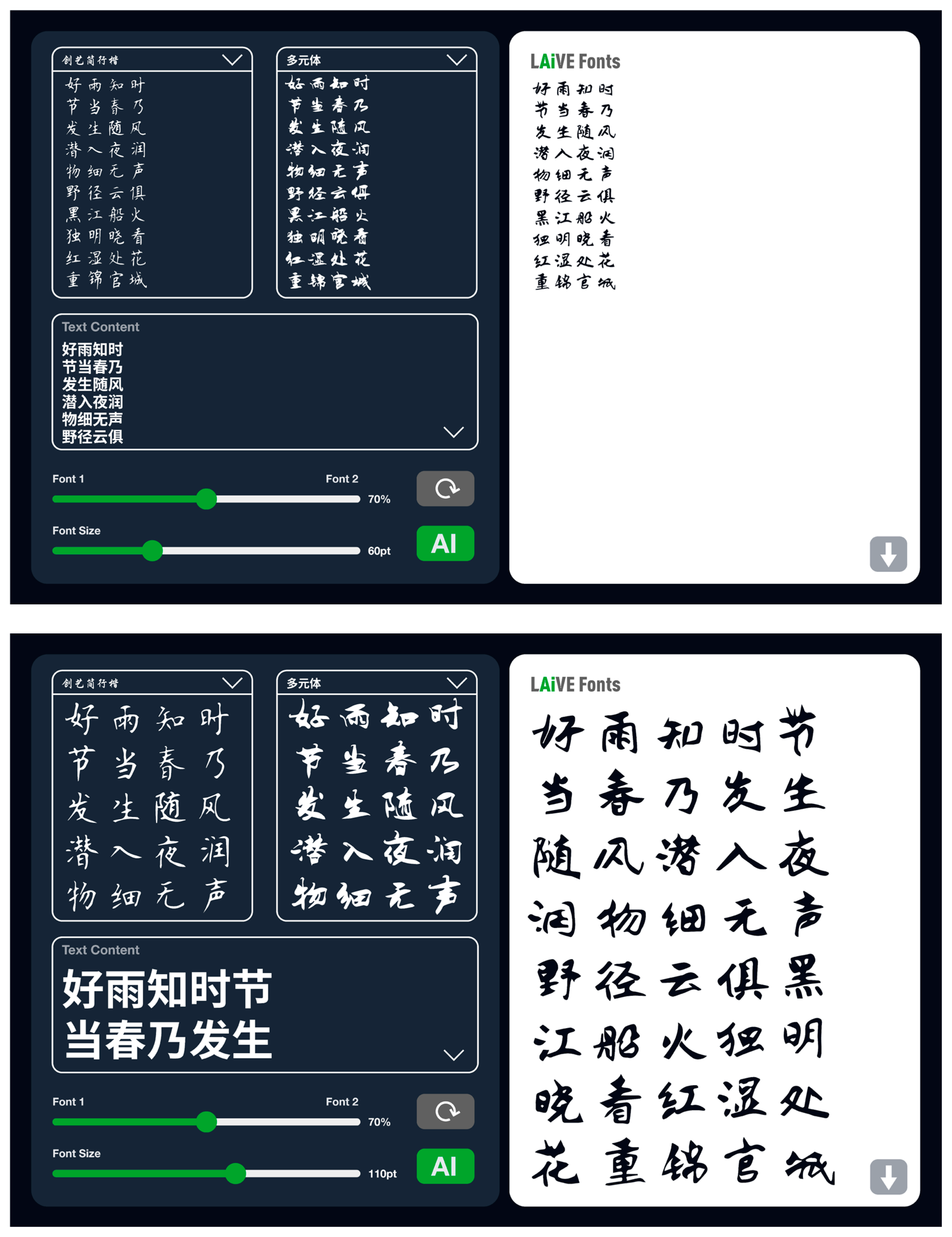
3.4. Sequence Modeling and Design Control Interface
- Input seed glyphs or stylistic references: users can choose two existing fonts as inputs.
- Adjust parameters: users have control over font weight and size that influence the output.
- Generate multiple typographic variations in real-time: the system can adjust these parameters dynamically and generate new fonts based on the selected inputs.
- Provide evaluative feedback for iterative refinement.
3.5. Evaluation Through Design Practice and User Feedback
- (a)
- Design Practice Evaluation
- (b)
- Quantitative Analysis
- (c)
- User Experience and Creativity Assessment
4. Results and Discussion
4.1. Datasets and Implementation Details
4.2. Evaluation
4.2.1. Datasets
- Google Fonts Dataset
- 2.
- Chinese Fonts Dataset
4.2.2. Baseline Models
- MX-Font
- 2.
- TTF-GAN
- 3.
- DeepFont
4.2.3. Evaluation Metrics
- Fréchet Inception Distance (FID)
- 2.
- Structural Similarity Index (SSIM)
- 3.
- Stroke Consistency (SC)
- 4.
- Diversity Score (DS)
4.2.4. Quantitative Comparison with Baseline Models
4.2.5. Subjective User Study
- Visual Fidelity: How well does the generated glyph preserve the structure and details of the reference style?
- Stylistic Coherence: Are the stroke weights and serifs consistent across different characters?
- Usability: Is the generated font legible and suitable for professional design applications?
4.3. Design Reflections: Human–AI Co-Creation in Practice
4.3.1. Ideation Through Variation
4.3.2. Negotiating Authorship and Control
4.3.3. Esthetic Learning and Reflective Practice
4.4. User Experience and Emotional Engagement
- “The AI gives me a sense of flow—I lose track of time while experimenting.”
- “It feels like sharing a sketchbook with an intelligent assistant.”
4.5. Discussion: Toward Human-Centered AI Typography
5. Conclusions, Limitation and Future Work
- Deepening Co-Creative Intelligence: Future systems may integrate reinforcement learning from designer feedback (RLHF) and context-aware prompting, enhancing the AI’s ability to adapt dynamically to personal design preferences and cultural nuances [14,15]. This will involve: (1) collecting explicit and implicit interaction data during design sessions; (2) training preference models that adjust stroke behavior and style projection dynamically; and (3) developing real-time adaptation algorithms that update style vectors as the designer iterates. Implementing these mechanisms will allow the system to evolve into a continuously learning co-creative partner rather than a static generative tool.
- Cross-Cultural and Emotional Typography: Expanding the dataset to include diverse writing systems (Arabic, Devanagari, Hangul, etc.) and incorporating affective labeling could enable the exploration of emotionally expressive and culturally adaptive typefaces, bridging computational design with semiotics and communication theory [3,9,12]. This expansion will involve: (1) constructing balanced, open-license datasets across language families; (2) annotating fonts with affective labels (e.g., formal, playful, solemn) to support emotional typography modeling; and (3) evaluating cross-cultural usability through user studies involving multilingual designers. This will enable the exploration of emotionally expressive and culturally adaptive typefaces, bridging computational design with linguistic and cultural semantics.
- Design Education and AI Literacy: The co-creative interface could also serve as a valuable pedagogical tool in design education, promoting AI literacy and reflective learning. By making computational processes transparent and interpretable, such tools can cultivate a new generation of designers who are fluent in both algorithmic and esthetic reasoning [23]. Future work will (1) deploy the system in classroom settings to study how students develop hybrid algorithmic–esthetic reasoning; (2) design curriculum modules that expose students to interpretable machine creativity; and (3) evaluate learning outcomes through mixed-method studies (task performance, reflection logs, pre/post-competency surveys). These steps will help cultivate AI literacy and empower emerging designers to understand, critique, and co-create with generative models.
Author Contributions
Funding
Institutional Review Board Statement
Informed Consent Statement
Data Availability Statement
Acknowledgments
Conflicts of Interest
References
- Goodfellow, I.; Pouget-Abadie, J.; Mirza, M.; Xu, B.; Warde-Farley, D.; Ozair, S.; Courville, A.; Bengio, Y. Generative Adversarial Nets. Adv. Neural Inf. Process. Syst. 2014, 27, 2672–2680. [Google Scholar] [CrossRef]
- Ho, J.; Jain, A.; Abbeel, P. Denoising Diffusion Probabilistic Models. Adv. Neural Inf. Process. Syst. 2020, 33, 6840–6851. [Google Scholar] [CrossRef]
- Lupton, E. Thinking with Type: A Critical Guide for Designers, Writers, Editors, and Students; Princeton Architectural Press: New York, NY, USA, 2010. [Google Scholar]
- Vaswani, A.; Shazeer, N.; Parmar, N.; Uszkoreit, J.; Jones, L.; Gomez, A.N.; Kaiser, Ł.; Polosukhin, I. Attention Is All You Need. Adv. Neural Inf. Process. Syst. 2017, 30, 5998–6008. [Google Scholar] [CrossRef]
- Kingma, D.P.; Welling, M. Auto-Encoding Variational Bayes. arXiv 2013, arXiv:1312.6114. [Google Scholar] [CrossRef]
- Jiang, Y.; Lian, Z.; Tang, Y. MX-Font: Multi-Style Coordinate Network for Few-Shot Typeface Generation. In Proceedings of the IEEE/CVF Conference on Computer Vision and Pattern Recognition, New Orleans, LA, USA, 18–24 June 2022; IEEE: New Orleans, LA, USA, 2022; pp. 14365–14374. [Google Scholar] [CrossRef]
- Carlier, A.; Danelljan, M.; Alahi, A.; Van Gool, L. DeepSVG: A Hierarchical Generative Network for Vector Graphics Animation. Adv. Neural Inf. Process. Syst. 2020, 33, 16351–16361. [Google Scholar] [CrossRef]
- Kang, H.; Ryu, J.; Joo, J.; Lee, S.; Ko, B. Diff-Font: Diffusion Model for Robust and High-Fidelity Font Generation. In Proceedings of the IEEE/CVF Conference on Computer Vision and Pattern Recognition, Vancouver, BC, Canada, 17–24 June 2023; IEEE: Vancouver, BC, Canada, 2023; pp. 11902–11911. [Google Scholar] [CrossRef]
- Bringhurst, R. The Elements of Typographic Style; Hartley & Marks: Vancouver, BC, Canada, 2012. [Google Scholar]
- Shneiderman, B. Human-Centered Artificial Intelligence: Reliable, Safe & Trustworthy. Int. J. Hum. Comput. Interact. 2020, 36, 495–504. [Google Scholar] [CrossRef]
- Norman, D.A.; Stappers, P.J. DesignX: Complex Sociotechnical Systems. She Ji J. Des. Econ. Innov. 2015, 1, 83–106. [Google Scholar] [CrossRef]
- Hassenzahl, M. Experience Design: Technology for All the Right Reasons. In Synthesis Lectures on Human-Centered Informatics; Morgan & Claypool: San Rafael, CA, USA, 2010. [Google Scholar] [CrossRef]
- McCormack, J.; Gifford, T.; Hutchings, P. Autonomy, Authenticity, Authorship and Intention in Computer Generated Art. In Computational Intelligence in Music, Sound, Art and Design; Springer: Cham, Switzerland, 2019; pp. 35–51. [Google Scholar] [CrossRef]
- Kadenhe, N.; Al Musleh, M.; Lompot, A. Human-AI Co-Design and Co-Creation: A Review of Emerging Approaches, Challenges, and Future Directions. Proc. AAAI Symp. Ser. 2025, 6, 265–270. [Google Scholar] [CrossRef]
- Goodarzi, M. Co-Creativity with AI: A Human-Centered Approach. Doctoral Dissertation, State University of New York, New York, NY, USA, 2025. [Google Scholar]
- Wang, N.; Kim, H.; Peng, J.; Wang, J. Exploring Creativity in Human–AI Co-Creation: A Comparative Study Across Design Experience. Front. Comput. Sci. 2025, 7, 1672735. [Google Scholar] [CrossRef]
- Yu, W.F. AI as a Co-Creator and a Design Material: Transforming the Design Process. Des. Stud. 2025, 97, 101303. [Google Scholar] [CrossRef]
- Anasuri, S.; Pappula, K.K. Human-AI Co-Creation Systems in Design and Art. Int. J. AI Big Data Comput. Manag. Stud. 2024, 5, 102–113. [Google Scholar] [CrossRef]
- Heusel, M.; Ramsauer, H.; Unterthiner, T.; Nessler, B.; Hochreiter, S. GANs Trained by a Two Time-Scale Update Rule Converge to a Local Nash Equilibrium. Adv. Neural Inf. Process. Syst. 2017, 30, 6626–6637. [Google Scholar] [CrossRef]
- Cherry, E.; Latulipe, C. Quantifying the creativity support of digital tools through the creativity support index. ACM Trans. Comput.-Hum. Interact. (TOCHI) 2014, 21, 1–25. [Google Scholar] [CrossRef]
- Laugwitz, B.; Held, T.; Schrepp, M. Construction and Evaluation of a User Experience Questionnaire. In Human–Computer Interaction and Usability Engineering; Springer: Berlin/Heidelberg, Germany, 2008; pp. 63–76. [Google Scholar] [CrossRef]
- Schön, D.A. The Reflective Practitioner: How Professionals Think in Action; Routledge: London, UK, 2017. [Google Scholar]
- Csikszentmihalyi, M. Flow: The Psychology of Happiness; Random House: New York, NY, USA, 2013. [Google Scholar]


| Model | FID (↓) | SSIM (↑) | Stroke Consistency (SC) (↑) | Diversity Score (DS) (↑) |
|---|---|---|---|---|
| MX-Font | 18.5 | 0.72 | 0.68 | 7.2 |
| TTF-GAN | 15.8 | 0.78 | 0.74 | 6.8 |
| DeepFont | 22.3 | 0.65 | 0.60 | 5.4 |
| LLM-based model (Ours) | 12.4 | 0.85 | 0.82 | 8.9 |
| Model | Visual Fidelity | Stylistic Coherence | Usability |
|---|---|---|---|
| GAN-based model | 3.42 ± 0.8 | 3.55 ± 0.7 | 3.20 ± 0.9 |
| Diff-Font model | 3.28 ± 0.9 | 3.30 ± 0.8 | 3.15 ± 0.8 |
| LLM-based model (Ours) | 4.15 ± 0.6 | 4.28 ± 0.5 | 4.05 ± 0.7 |
Disclaimer/Publisher’s Note: The statements, opinions and data contained in all publications are solely those of the individual author(s) and contributor(s) and not of MDPI and/or the editor(s). MDPI and/or the editor(s) disclaim responsibility for any injury to people or property resulting from any ideas, methods, instructions or products referred to in the content. |
© 2026 by the authors. Licensee MDPI, Basel, Switzerland. This article is an open access article distributed under the terms and conditions of the Creative Commons Attribution (CC BY) license.
Share and Cite
Dong, Y.; Gao, M. AI-Driven Typography: A Human-Centered Framework for Generative Font Design Using Large Language Models. Information 2026, 17, 150. https://doi.org/10.3390/info17020150
Dong Y, Gao M. AI-Driven Typography: A Human-Centered Framework for Generative Font Design Using Large Language Models. Information. 2026; 17(2):150. https://doi.org/10.3390/info17020150
Chicago/Turabian StyleDong, Yuexi, and Mingyong Gao. 2026. "AI-Driven Typography: A Human-Centered Framework for Generative Font Design Using Large Language Models" Information 17, no. 2: 150. https://doi.org/10.3390/info17020150
APA StyleDong, Y., & Gao, M. (2026). AI-Driven Typography: A Human-Centered Framework for Generative Font Design Using Large Language Models. Information, 17(2), 150. https://doi.org/10.3390/info17020150