Article

Exploring the Topics and Sentiments of AI-Related Public Opinions: An Advanced Machine Learning Text Analysis


Gabelli School of Business, Fordham University, New York, NY 10023, USA
*
Author to whom correspondence should be addressed.
Information 2026, 17(2), 134; https://doi.org/10.3390/info17020134
Submission received: 15 November 2025 / Revised: 29 December 2025 / Accepted: 20 January 2026 / Published: 1 February 2026

Abstract

This study investigates the evolution of public sentiment and discourse surrounding artificial intelligence through a comprehensive multi-method analysis of 28,819 Reddit comments spanning March 2015 to May 2024. Addressing three research questions—(1) what dominant topics characterize AI discourse, (2) how has sentiment changed over time, particularly following ChatGPT 5.2’s release, and (3) what linguistic patterns distinguish positive from negative discourse—we employ 28 distinct analytical techniques to provide validated insights into public AI perception. Methodologically, the study integrates VADER sentiment analysis, Linguistic Inquiry and Word Count (LIWC) analysis with regression validation, dual topic modeling using Latent Dirichlet Allocation and Non-negative Matrix Factorization for cross-validation, four-dimensional tone analysis, named entity recognition, emotion detection, and advanced NLP techniques including sarcasm detection, stance classification, and toxicity analysis. A key methodological contribution is the validation of LIWC categories through linear regression (R2 = 0.049, p < 0.001) and logistic regression (61% accuracy), moving beyond the descriptive statistics typical of prior linguistic analyses. Results reveal a pronounced decline in positive sentiment from +0.320 in 2015 to +0.053 in 2024. Contrary to expectations, sentiment decreased following ChatGPT’s November 2022 release, with negative comments increasing from 31.9% to 35.1%—suggesting that direct exposure to powerful AI capabilities intensifies rather than alleviates public concerns. LIWC regression analysis identified negative emotion words (β = −0.083) and positive emotion words (β = +0.063) as the strongest sentiment predictors, confirming that affective rather than technical engagement drives public AI attitudes. Topic modeling revealed nine coherent themes, with facial recognition, algorithmic bias, AI ethics, and social media misinformation emerging as dominant concerns across both LDA and NMF analyses. Network analysis identified regulation as a central hub (degree centrality = 0.929) connecting all major AI concerns, indicating strong public appetite for governance frameworks. These findings contribute to theoretical understandings of technology risk perception, provide practical guidance for AI developers and policymakers, and demonstrate validated computational methods for tracking public opinion toward emerging technologies.

1. Introduction

The rapid advancement of artificial intelligence technologies has fundamentally transformed public discourse about the role of AI in society [1]. The November 2022 release of ChatGPT marked a watershed moment, bringing sophisticated AI capabilities directly into public consciousness and sparking unprecedented discussion about AI’s potential benefits, risks, and societal implications [2,3]. Understanding how public sentiment and discourse evolve in response to such transformative AI technologies is crucial for multiple stakeholders, including policymakers who must balance innovation with regulation [4], technology developers who need to align products with societal values [5], and researchers seeking to document and explain the social dimensions of technological change [6].
Social media platforms, particularly Reddit, serve as valuable repositories of organic public opinion, offering researchers access to authentic, unfiltered perspectives that complement traditional survey methods [7]. Reddit’s diverse user base, pseudonymous nature that encourages candid expression, and extensive historical archive make it particularly well-suited for longitudinal studies of public opinion evolution [8]. The platform’s subreddit structure also allows for examination of discourse across different topical communities, from technology-focused forums to general news discussions [9].
This study addresses three primary research questions: First, what are the dominant topics and themes in AI-related public discourse on Reddit? Second, how has the sentiment toward AI changed over time, particularly following the release of ChatGPT? Third, what linguistic and psychological patterns characterize positive versus negative AI discourse? By analyzing 28,819 Reddit comments spanning March 2015 to May 2024, we employ multiple complementary machine learning and natural language processing approaches to provide a comprehensive examination of both the content and emotional tone of AI discourse [10,11].
Our methodological approach combines complementary analytical techniques designed to test predictions derived from risk perception theory and the affect heuristic. Core analyses include VADER sentiment analysis for polarity classification [12]; dual topic modeling (LDA and NMF) enabling cross-validation of thematic structures [13,14]; and LIWC analysis validated through regression to test whether affective language predicts sentiment outcomes [15,16]. Supporting analyses examine discourse quality (formality, argumentation patterns, toxicity) and track sentiment toward specific technology companies through named entity recognition. This multi-method design enables triangulation rather than reliance on single techniques, addressing methodological limitations in prior work while directly testing our theoretical predictions about affective dimensions of AI discourse.
This study is theoretically grounded in the affect heuristic and risk perception theory, which together predict that public responses to powerful technologies are shaped more by emotional reactions than by analytical assessment of objective risks. These frameworks guide our research design, particularly our focus on affective dimensions of discourse and our hypothesis that direct exposure to advanced AI capabilities—and to concrete concerns such as facial recognition bias [17], AI ethics [18], and algorithmic discrimination [19]—which may intensify rather than alleviate public concerns. Results are presented in Section 4 and discussed in relation to these theoretical frameworks in Section 5.
The remainder of this paper is organized as follows. Section 2 reviews the prior literature on AI sentiment, social media analysis, and text analysis methods. Section 3 describes the data collection and analytical methods. Section 4 presents results across all 28 analytical techniques. Section 5 discusses findings in relation to prior research. Section 6 outlines scope and limitations. Section 7 presents theoretical and practical implications. Section 8 concludes with a synthesis of contributions and future directions.

2. Literature Review

2.1. Public Sentiment Toward Artificial Intelligence

Public attitudes toward artificial intelligence have emerged as a critical area of scholarly inquiry as AI technologies become increasingly integrated into daily life, raising questions about employment, privacy, autonomy, and social equity [20,21]. Research consistently demonstrates that public sentiment toward AI is multifaceted, influenced by factors including perceived benefits, risks, familiarity with technology, and media representations [6,22]. Understanding these attitudes is essential not only for predicting technology adoption patterns but also for informing policy decisions and guiding responsible AI development [4,5].
Early studies documented general optimism about AI’s potential benefits, particularly in healthcare, education, and productivity enhancement [23]. Survey research by [21] found that American respondents generally supported AI development but expressed significant concerns about specific applications including autonomous weapons, surveillance, and labor displacement. However, this optimism has been tempered by growing concerns about job displacement, algorithmic bias, privacy erosion, and the concentration of AI capabilities among a small number of technology companies [24]. Recent longitudinal studies suggest that public sentiment toward AI has become more negative over time, particularly as AI systems have been deployed in high-stakes domains such as criminal justice, hiring, and credit decisions [25].
The emergence of large language models has introduced new dimensions to public AI discourse. GPT-3 and its successors demonstrated capabilities that exceeded public expectations, generating both enthusiasm and concern about the pace of AI advancement [2]. ChatGPT’s release in November 2022 brought these capabilities to mainstream audiences, with the system acquiring over 100 million users within two months [3]. This unprecedented adoption rate suggests that ChatGPT represented a qualitative shift in public AI engagement, though the sentiment implications of this shift remain underexplored.

2.2. Social Media as a Lens for Public Opinion

Social media platforms have revolutionized the study of public opinion by providing researchers with access to large-scale, naturally occurring discourse that captures authentic reactions and evolving perspectives [7]. Unlike traditional survey methods that impose researcher-defined categories and may suffer from social desirability bias, social media analysis enables the discovery of emergent themes and the examination of sentiment expressed in natural language contexts [8,9].
Reddit has emerged as a particularly valuable platform for studying public discourse due to several distinctive characteristics: its diverse user base spanning multiple demographics; its pseudonymous nature that encourages candid expression; and its extensive historical archive enabling longitudinal analysis [26]. The platform’s subreddit structure facilitates examination of discourse across communities with different topical orientations and normative expectations. However, Reddit-based research must acknowledge platform-specific limitations, including demographic skew toward younger, male, and technologically literate users, which may limit generalizability to broader populations [23].
Prior social media research on AI sentiment has produced mixed findings. Studies of Twitter discourse have documented both enthusiasm and concern about AI, with sentiment varying significantly across topical domains and time periods [9]. Research on Reddit specifically examined AI discussions in technology-focused subreddits, finding sophisticated technical discourse alongside expressions of concern about societal implications [27]. However, systematic longitudinal analysis of Reddit AI discourse spanning the pre- and post-ChatGPT periods remains limited.

2.3. Text Analysis Methods in AI Opinion Research

The application of machine learning techniques to text analysis has transformed researchers’ ability to extract meaning from large-scale textual datasets [10,11]. Sentiment analysis, which automatically classifies text according to expressed positive, negative, or neutral sentiment, has become a foundational technique for understanding public opinion at scale. VADER (Valence Aware Dictionary and sEntiment Reasoner) has become widely adopted for social media sentiment analysis due to its optimization for informal online text, including handling of punctuation, capitalization, degree modifiers, and negation [12].
Topic modeling approaches including Latent Dirichlet Allocation (LDA) enable discovery of latent thematic structures within document collections [13]. LDA assumes documents are mixtures of topics, where each topic is characterized by a probability distribution over words. Non-negative Matrix Factorization (NMF) provides an alternative approach that factorizes the document-term matrix into topic and document matrices with non-negative entries [14]. The use of complementary topic modeling approaches enables cross-validation of thematic findings, though most existing studies rely on single methods.
Linguistic Inquiry and Word Count (LIWC) analysis provides psychological and linguistic dimensions beyond sentiment polarity, examining categories including pronouns, cognitive processes, affective processes, and social processes [15,16]. LIWC has been extensively validated for revealing psychological states from text, with applications spanning clinical psychology, social psychology, and communication research. However, most existing applications of LIWC to technology discourse report only descriptive statistics without statistical validation of which categories predict sentiment outcomes—a gap this study addresses through regression analysis.
Term Frequency-Inverse Document Frequency (TF-IDF) weighting remains fundamental for text representation, balancing term frequency within documents against inverse document frequency across the corpus to identify distinctive vocabulary [28]. More recent transformer-based approaches including BERT have achieved state-of-the-art performance on sentiment classification tasks [29], though interpretability advantages of lexicon-based approaches remain relevant for many research applications.

2.4. Algorithmic Bias and AI Ethics in Public Discourse

Public discourse about AI has increasingly centered on concerns about algorithmic bias and ethical implications of automated decision-making [18]. High-profile cases of facial recognition systems demonstrating substantially higher error rates for darker-skinned faces have generated sustained public attention [17,19]. These findings have been amplified through media coverage and policy debates, contributing to facial recognition bans in several jurisdictions and increased public scrutiny of AI systems [24].
The broader algorithmic accountability movement has highlighted how AI systems can encode and amplify existing social biases [24,30]. Researchers have proposed frameworks for auditing algorithms to detect discrimination and examined regulatory approaches including the right to explanation. These academic discussions have parallels in public discourse, where concerns about fairness, accountability, and transparency have become prominent themes [30,31].
Risk perception research provides theoretical frameworks for understanding public responses to AI concerns. Reference [32] demonstrated that perceived risk depends not only on objective probabilities but also on qualitative characteristics including dread, controllability, and familiarity. The affect heuristic [33] suggests that emotional responses often guide risk judgments more than analytical assessment—a prediction we operationalize through LIWC-based analysis of affective language and its validation as a sentiment predictor. These frameworks generate specific hypotheses that guide our research design: (1) direct exposure to powerful AI capabilities (operationalized through the ChatGPT release event) may intensify rather than reduce concerns by making abstract risks concrete; (2) affective rather than technical or analytical language should predict sentiment outcomes; and (3) vivid, emotionally evocative AI concerns (such as facial recognition bias) may disproportionately organize public discourse relative to their technical complexity. Our methodological choices—including longitudinal pre/post comparison, LIWC regression validation, and emotion detection—directly test these theoretical predictions rather than serving as post hoc interpretive frames.

2.5. Research Gaps and Study Contributions

Despite growing research attention to public AI sentiment, several methodological and empirical gaps remain. First, most existing studies employ limited analytical techniques, typically using single sentiment analysis tools without complementary approaches for validation or triangulation. Second, applications of LIWC to AI discourse report descriptive category frequencies without establishing predictive validity through statistical modeling. Third, tone analysis examining dimensions beyond sentiment polarity—including formality, confidence, and thinking style—has rarely been applied to AI discourse. Fourth, topic modeling studies typically employ single methods (usually LDA), making it difficult to distinguish robust thematic structures from algorithmic artifacts. Fifth, studies of ChatGPT’s impact on public sentiment have analyzed brief time windows insufficient for assessing sustained attitude change.
This study addresses these gaps through methodological innovations guided by our theoretical framework. The integration of multiple analytical techniques serves a specific purpose: risk perception and affect heuristic theories predict that emotional rather than technical content drives public attitudes toward AI, requiring analyses that capture affective dimensions (LIWC emotional categories, emotion detection, sentiment analysis) while validating these through regression modeling. The choice to employ complementary methods reflects a triangulation strategy rather than methodological breadth for its own sake—for example, dual topic modeling (LDA and NMF) enables cross-validation of thematic structures, while LIWC regression moves beyond descriptive statistics typical of prior work. The nine-year longitudinal design with explicit pre/post ChatGPT comparison directly tests our theoretical prediction that direct exposure to powerful AI capabilities may intensify concerns. These contributions advance both methodological practice and substantive understanding of the affective dimensions of public AI discourse on Reddit.

3. Methodology

3.1. Data Collection

Data were collected from Reddit using the Python Reddit API Wrapper (PRAW) version 3.13 during a two-week period from 15 to 30 May 2024. We employed a systematic search strategy designed to capture diverse perspectives on artificial intelligence by using multiple search queries including “artificial intelligence,” “machine learning,” “facial recognition AI,” “AI bias,” “algorithm trust,” and “ChatGPT.” This multi-query approach ensured broad coverage of AI-related discourse while capturing discussions across different topical domains and levels of technical sophistication [8].
For each search query, we extracted comments from top-ranked posts across multiple subreddits including r/technology, r/news, r/MachineLearning, and various discussion forums, limiting collection to 500 comments per query to ensure breadth across topics while maintaining computational feasibility. The initial corpus comprised 35,810 comments spanning from March 2015 to May 2024, providing nearly a decade of longitudinal data on AI discourse.
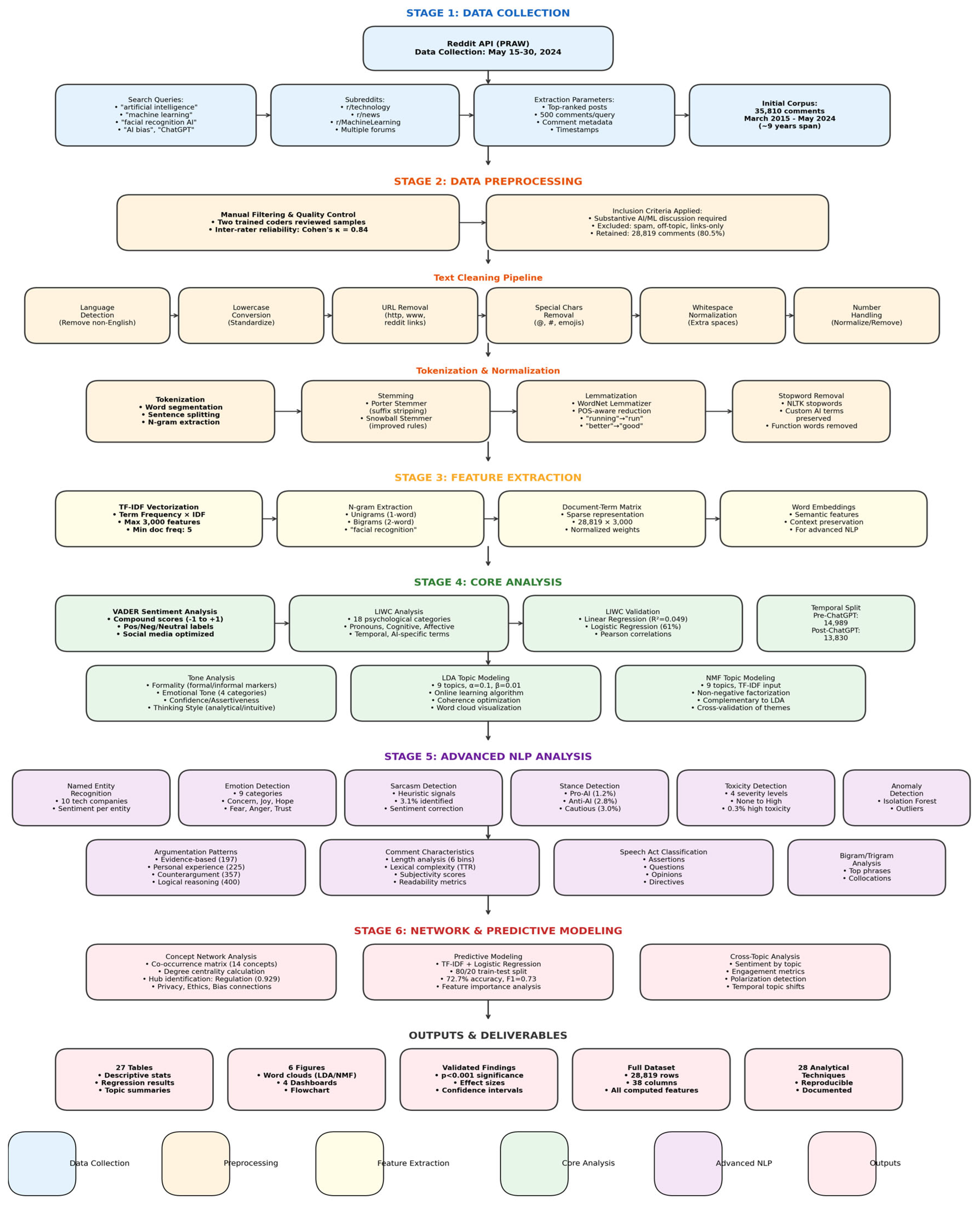
To establish temporal comparison groups for assessing ChatGPT’s impact, we used 30 November 2022—the release date of ChatGPT [3]—as the dividing point. The “Pre-ChatGPT” group comprised 14,989 comments posted from March 2015 to 29 November 2022, while the “Post-ChatGPT” group included 13,830 comments posted from 30 November 2022 to May 2024. Special characters such as ‘@’ and ‘#’ were removed. Figure 1 summarizes the complete data processing and analysis workflow.

3.2. Data Preprocessing

3.2.1. Manual Filtering and Quality Control

Manual review of the initial corpus identified numerous off-topic or irrelevant comments that matched search terms but did not substantively engage with AI topics. Two trained coders independently reviewed a stratified sample of 500 comments (approximately 1.4% of the corpus) to establish inclusion criteria and assess reliability, achieving satisfactory inter-rater reliability (Cohen’s κ = 0.84). Comments were included if they substantively addressed artificial intelligence, machine learning, algorithmic systems, or related technologies in ways that expressed or implied evaluative positions. Following application of inclusion criteria through manual filtering [27], 819 relevant comments remained for analysis, representing an 80.5% retention rate from the initial corpus.

3.2.2. Text Cleaning Pipeline

Automated preprocessing procedures were applied following established best practices for social media text analysis [10]: (1) Language Detection using langdetect to identify and remove non-English comments; (2) Case Normalization converting all text to lowercase; (3) URL Removal eliminating hyperlinks; (4) Special Character Removal including @mentions, hashtags, and emojis; (5) Whitespace Normalization; and (6) Number Handling standardizing numerical expressions.

3.2.3. Tokenization and Normalization

Tokenization segmented comment text into individual words (unigrams) and multi-word phrases (bigrams, trigrams) using the utilityNLTK tokenizer (https://www.nltk.org/api/nltk.tokenize.html, accessed on 14 November 2025). Stemming was applied using both Porter Stemmer and Snowball Stemmer. Lemmatization using the WordNet Lemmatizer (https://www.nltk.org/api/nltk.stem.WordNetLemmatizer.html, accessed on 14 November 2025) utility reduced words to their dictionary base forms with part-of-speech awareness. Stopword Removal eliminated common function words using the NLTK English stopword list while preserving AI-specific terms.

3.3. Feature Extraction

Term Frequency-Inverse Document Frequency (TF-IDF) was calculated for all terms following [29]: TF-IDF(t,d) = TF(t,d) × IDF(t), where TF(t,d) represents the frequency of term t in document d, and IDF(t) = log(N/df(t)). We extracted a maximum of 3000 features with minimum document frequency of 5. The resulting document-term matrix of dimensions 28,819 × 3000 served as input for topic modeling and predictive modeling.

3.4. Analytical Approaches

3.4.1. Sentiment Analysis

Sentiment analysis was conducted using VADER (Valence Aware Dictionary and sEntiment Reasoner, https://pypi.org/project/vaderSentiment/, accessed on 14 November 2025), a lexicon and rule-based sentiment analysis tool specifically designed for social media text [12]. VADER generates compound sentiment scores ranging from −1 (most negative) to +1 (most positive). Comments were classified as Positive (compound ≥ 0.05), Neutral (−0.05 < compound < 0.05), or Negative (compound ≤ −0.05).

3.4.2. LIWC Analysis

We implemented Linguistic Inquiry and Word Count (LIWC) style analysis following [15,16], examining 18 linguistic and psychological categories organized into five domains: Pronouns, Cognitive Processes, Affective Processes, Temporal Orientation, and AI-Specific Terminology.

3.4.3. LIWC Validation Through Regression

Unlike prior studies reporting only descriptive statistics, we established predictive validity through linear regression examining the relationship between all 18 LIWC categories and VADER compound sentiment scores, logistic regression for binary classification (Positive vs. Negative), and Pearson Correlations between each LIWC category and sentiment scores.

3.4.4. Tone Analysis

A four-dimensional tone analysis framework captured: Formality (0–100 scale); Emotional Tone (Neutral, Analytical, Positive-Emotional, Negative-Emotional); Confidence/Assertiveness; and Thinking Style (Analytical, Intuitive, Balanced).

3.4.5. Topic Modeling

Two complementary approaches were employed. Latent Dirichlet Allocation (LDA) was implemented following [13] with nine topics selected through coherence optimization. Non-negative Matrix Factorization (NMF) was implemented followed [14] with nine topics using TF-IDF features.

3.4.6. Advanced NLP Analyses

Additional techniques included the following: named entity recognition for 10 technology companies; emotion detection across nine categories; sarcasm detection using heuristic signals; stance detection (Pro-AI, Anti-AI, Cautious); argumentation pattern recognition; speech act classification; toxicity detection; and comment characteristics analysis.

3.4.7. Network and Predictive Analysis

Concept Co-occurrence Network Analysis examined relationships between 14 key AI-related concepts. Predictive modeling used TF-IDF features with logistic regression for multi-class sentiment classification with 80/20 train–test split.

4. Results

4.1. Descriptive Statistics and Sentiment Distribution

The final analytical corpus comprised 28,819 Reddit comments spanning nearly a decade of AI-related discourse. Table 1 presents the overall sentiment distribution. The majority of comments (43.4%) expressed positive sentiment, followed by negative sentiment (33.4%) and neutral sentiment (23.2%). The mean compound score of +0.060 indicates a slight positive skew, though the substantial standard deviation (0.508) reflects considerable variability.
The sentiment distribution across specific search topics reveals how public attention to different AI applications shapes emotional responses (Table 2). Topics framed around technical capabilities, such as face recognition combined with gender classification, elicited the most positive responses (M = +0.410, 69.4% positive), suggesting that discussions of AI accuracy and functionality generate more favorable discourse. In contrast, topics explicitly framing AI in terms of bias or discrimination elicited substantially more negative sentiment (M = −0.204, only 28.4% positive). This pattern indicates that how AI topics are framed—as technical achievements versus social concerns—significantly influences the emotional tenor of public discourse, consistent with framing effects documented in risk communication research [33].

4.2. Temporal Analysis

Longitudinal analysis revealed a pronounced decline in positive sentiment toward AI over the nine-year study period, with significant shifts occurring around key technological milestones. This temporal pattern provides critical context for understanding how public perception evolves as AI technologies transition from abstract concepts to lived experiences.
Table 3 presents the yearly trajectory of public sentiment, revealing a consistent downward trend in positive discourse. The 2015 baseline showed predominantly optimistic sentiment (M = +0.320, 61.7% positive), reflecting an era when AI remained largely theoretical for most users. By 2018, coinciding with increased media coverage of algorithmic bias and the Cambridge Analytica scandal [34], positive sentiment had declined to 43.8% while negative sentiment nearly doubled to 33.4%. The 2024 data represents a stabilization at lower positivity levels (42.7% positive), suggesting that initial enthusiasm has given way to more measured, critical engagement with AI technologies.
The comparison of pre- and post-ChatGPT periods provides a natural experiment for examining how direct exposure to advanced AI capabilities affects public sentiment (Table 4). Contrary to the expectation that impressive technological demonstrations would generate enthusiasm, the data reveal a modest but notable increase in negative sentiment following ChatGPT’s release—from 31.9% to 35.1% of comments. This counterintuitive finding aligns with risk perception theory, which suggests that direct experience with powerful technologies can make previously abstract concerns feel immediate and personal [35]. The 3.2 percentage point increase in negative discourse may reflect concerns about job displacement, academic integrity, and the rapid pace of AI advancement that became salient once users could interact directly with sophisticated language models.

4.3. LIWC Analysis

Linguistic Inquiry and Word Count (LIWC) analysis moves beyond surface-level sentiment to examine the psychological and linguistic dimensions underlying public AI discourse. By analyzing word usage patterns across 18 categories, this analysis reveals how people cognitively and emotionally process AI-related information. Crucially, we validated these linguistic categories as sentiment predictors through regression analysis, addressing a methodological gap in prior research that relied solely on descriptive statistics.
LIWC analysis validated through regression confirmed that emotional language drives sentiment classification.
Pronoun usage patterns reveal important differences in how individuals position themselves relative to AI topics across sentiment categories (Table 5). First-person singular pronouns (“I-words”) appeared most frequently in positive comments (2.58% vs. 2.25% in negative), suggesting that favorable AI discourse often involves personal engagement and experience-sharing. This pattern aligns with research showing that personal narrative frames tend to generate more positive emotional responses than abstract discussions [32,36]. Second-person pronouns (“you-words”) showed elevated usage in both positive (1.93%) and negative (1.89%) comments compared to neutral discourse (1.52%), indicating that emotionally charged AI discussions often involve direct address—whether offering advice or challenging opposing viewpoints.
The affective processes analysis reveals stark differences in emotional language across sentiment categories (Table 6). Positive emotion words appeared five times more frequently in positive comments (1.00%) than in negative comments (0.20%), while negative emotion words showed a corresponding inverse pattern—appearing nearly seven times more frequently in negative comments (0.78%) than in positive ones (0.12%). Notably, anxiety-related language was twice as prevalent in negative AI discourse (0.14% vs. 0.07%), suggesting that concern about uncertainty and future risks plays a significant role in critical AI discussions. These patterns confirm that public AI discourse is fundamentally driven by affective engagement rather than purely technical or analytical reasoning.
To establish predictive validity for LIWC categories, we conducted linear regression analysis with all 18 linguistic categories as predictors and VADER compound sentiment as the outcome variable (Table 7). The model achieved statistical significance (p < 0.001) with R2 = 0.049, indicating that linguistic features explain approximately 5% of sentiment variance. While modest in absolute terms, this effect size is meaningful given the inherent noise in social media text and the complexity of sentiment determination. The RMSE of 0.495 on a −1 to +1 scale indicates reasonable predictive accuracy for exploratory linguistic analysis.
Table 7. Linear regression—LIWC predicting sentiment.
MetricValue
R20.049
Adjusted R20.049
RMSE0.495
p-value<0.001
The standardized regression coefficients (Table 8) identify which linguistic categories most strongly predict sentiment outcomes. Negative emotion words emerged as the strongest predictor (β = −0.083, p < 0.001), with each standard deviation increase associated with a 0.083 standard deviation decrease in sentiment score. Positive emotion words showed a corresponding positive association (β = +0.063, p < 0.001). Interestingly, certainty language was positively associated with sentiment (β = +0.019), suggesting that confident, assertive discourse tends toward positivity, while anxiety-related language showed the expected negative association (β = −0.019). These findings validate the theoretical foundation that affective language, rather than technical content, drives sentiment classification in AI discourse.
Logistic regression analysis tested whether LIWC categories could classify comments as positive or negative sentiment (Table 9). The model achieved 61% accuracy—substantially above the 50% baseline for binary classification—with particularly strong recall for positive sentiment (0.92). This high recall indicates that the linguistic features captured by LIWC categories effectively identify positive AI discourse, though the lower precision (0.60) suggests some false positives. The classification results further validate that psycholinguistic features provide meaningful signal for understanding public AI sentiment beyond simple keyword matching.
Bivariate correlations between individual LIWC categories and sentiment scores (Table 10) provide additional validation for the regression findings. Negative emotion words showed the strongest correlation with sentiment (r = −0.160, p < 0.001), followed by positive emotion words (r = +0.123, p < 0.001). Anger-related language demonstrated a notable negative correlation (r = −0.075, p < 0.001), suggesting that expressions of frustration and hostility particularly characterize negative AI discourse. These correlations, while modest in magnitude, are highly consistent across multiple analytical approaches and support the primacy of affective over cognitive language in shaping public AI sentiment.

4.4. Tone Analysis

Beyond sentiment polarity, tone analysis captures stylistic dimensions of discourse that reveal how people communicate about AI. This four-dimensional framework examines formality, emotional tone, confidence, and thinking style—features that characterize the rhetorical strategies people employ when discussing AI technologies. Understanding these patterns provides insight into whether AI discourse resembles academic analysis, personal expression, or casual conversation.
The formality distribution (Table 11) reveals that AI discourse on Reddit overwhelmingly adopts a neutral register (93.8%), neither highly formal nor distinctly informal. This finding challenges assumptions that technical topics necessarily elicit formal language [37]; instead, Reddit users discuss AI technologies using everyday conversational style. The small proportion of highly formal comments (0.2%) likely represents academic discussions or technical documentation shared on the platform, while informal comments (5.9%) often involve humor, sarcasm, or emotional expression. This predominantly neutral register suggests that AI has transitioned from specialized technical domain to mainstream public discourse.
The emotional tone distribution (Table 12) reveals important patterns in how people engage with AI topics. The majority of comments (74.6%) exhibited neutral emotional tone, indicating predominantly dispassionate discussion. However, the 17.8% of comments classified as analytical suggests substantial engagement with technical details and evidence-based reasoning. Positive-emotional (3.9%) and negative-emotional (3.7%) tones appeared in roughly equal proportions, though their sentiment profiles differed dramatically: positive-emotional comments averaged +0.491 sentiment while negative-emotional comments averaged −0.296. This pattern indicates that explicitly emotional engagement, whether positive or negative, produces more extreme sentiment scores than neutral or analytical approaches.
Thinking style analysis (Table 13) categorizes comments according to their cognitive approach—whether analytical (emphasizing logic and evidence), intuitive (emphasizing feeling and impression), or balanced. The majority of AI discourse (60.6%) employed a balanced thinking style, integrating both analytical and intuitive elements. However, a substantial proportion (35.2%) adopted explicitly analytical approaches, reflecting the technical nature of AI topics. Interestingly, intuitive-style comments (4.3%) showed the highest average sentiment (+0.121), suggesting that gut-level positive reactions to AI tend to generate more optimistic discourse than analytical assessment. This finding aligns with affect heuristic research indicating that emotional responses often guide technological attitudes more than deliberative analysis [33].

4.5. Topic Modeling

Topic modeling provides an unsupervised approach to discovering the latent thematic structure of AI discourse. By employing two complementary algorithms, Latent Dirichlet Allocation (LDA) and Non-negative Matrix Factorization (NMF) we identified robust thematic patterns that emerged consistently across methods. This dual-method approach enhances confidence that the discovered topics reflect genuine discursive patterns rather than algorithmic artifacts.
Topic modeling using LDA and NMF identified nine coherent thematic clusters with cross-validation between methods.
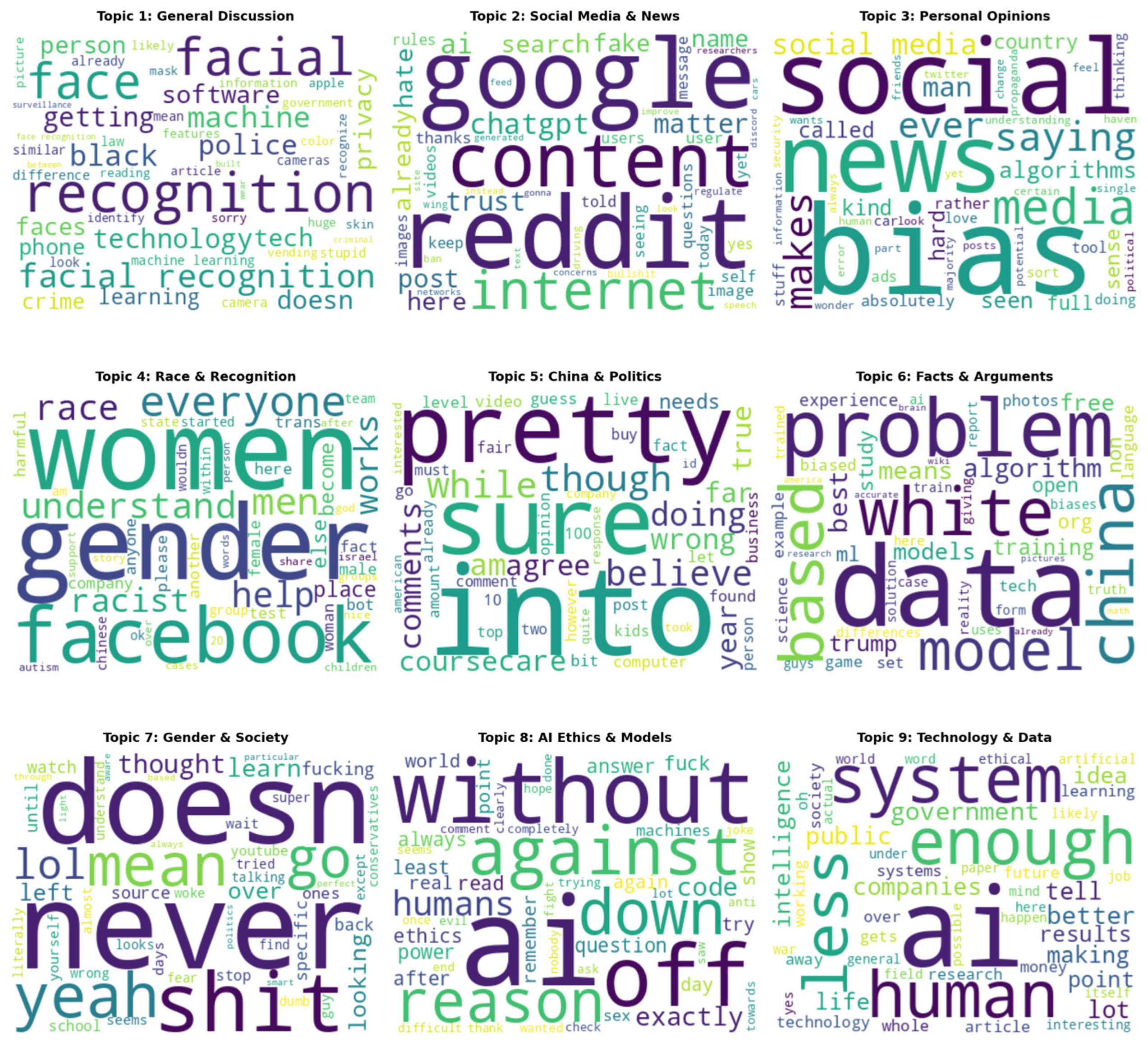
The LDA topic model visualization (Figure 2) displays word clouds for each of the nine identified topics, with word size proportional to topic probability. Visual inspection reveals clear thematic coherence, with distinct clusters around technology applications (algorithms, data, companies), social concerns (race, bias, media), and governance issues (ethics, regulation). The spatial separation of topic clusters suggests that AI discourse organizes around relatively distinct thematic domains rather than blending concerns together.
Table 14 summarizes the LDA topic structure with interpretive labels and top keywords. Topic 4 (Race and Recognition) emerged with particularly high coherence, anchored by terms including “black,” “white,” “person,” and “faces” reflecting sustained public attention to documented racial bias in facial recognition systems [17]. Topic 5 (China and Politics) captures geopolitical AI discourse, combining concerns about Chinese technological advancement with domestic political topics including misinformation (“fake,” “trump,” “news”). Topic 8 (AI Ethics and Models) represents the governance-focused discourse calling for ethical frameworks and human oversight of AI development.
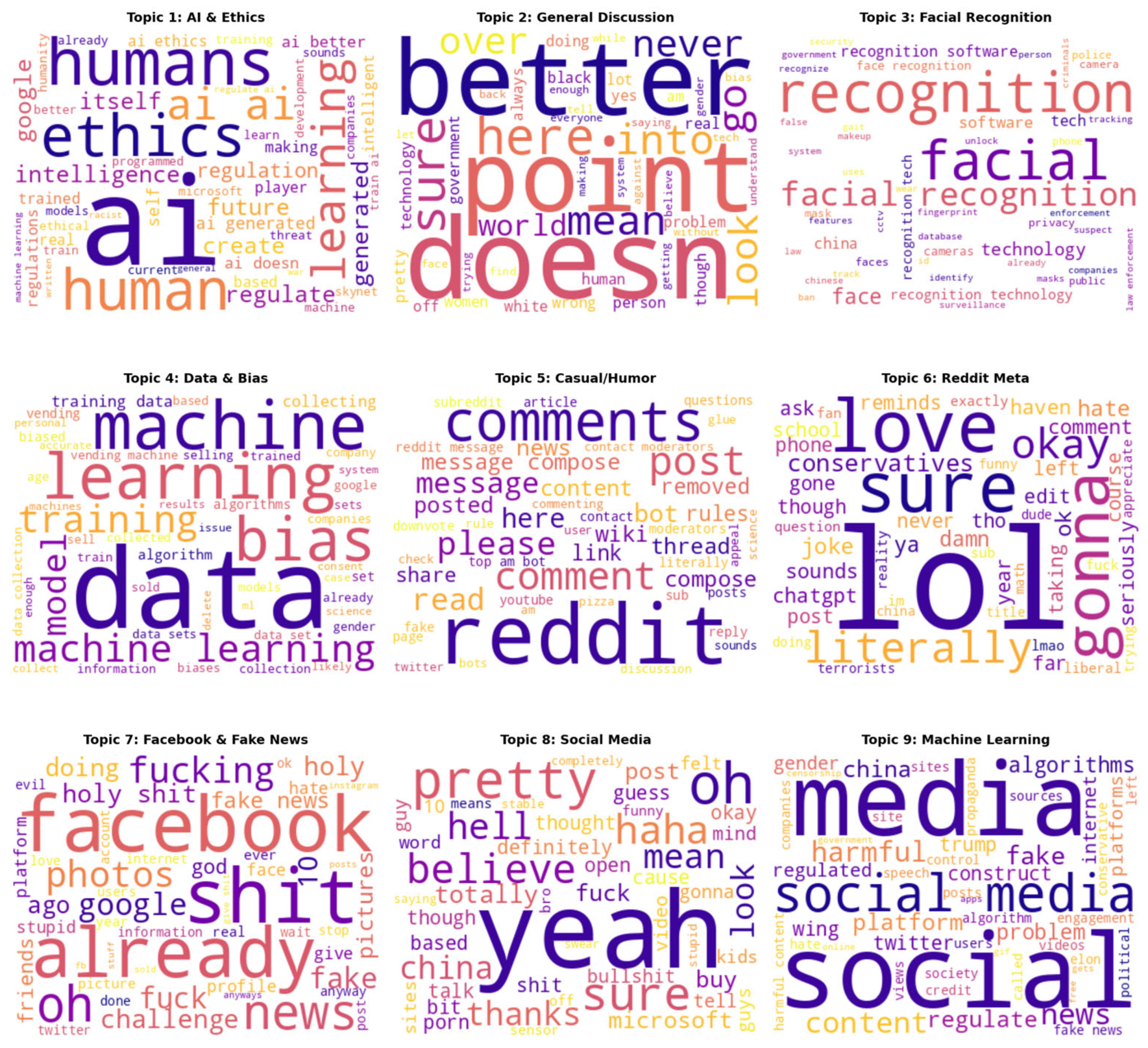
The NMF topic model (Figure 3) provides cross-validation for the LDA findings. NMF’s parts-based decomposition tends to produce more localized, interpretable topics, and the visual comparison reveals substantial thematic overlap with LDA results. Both methods identify prominent topics around facial recognition, data bias, and ethical governance, increasing confidence that these represent genuine organizing themes in public AI discourse rather than algorithmic artifacts.
The NMF topic summary (Table 15) confirms the thematic patterns identified by LDA while offering some complementary distinctions. Topic 3 (Facial Recognition) emerged with exceptional clarity in NMF, directly capturing the facial recognition and China technology surveillance discourse. Topic 7 (Facebook and Fake News) distinctly isolates social media misinformation concerns, reflecting the prominence of platform accountability debates in AI discourse. The convergence between LDA and NMF on core themes—ethics, facial recognition, data bias, and machine learning technology—provides robust evidence that these topics represent the fundamental organizing structure of public AI discourse.

4.6. Named Entity and Emotion Analysis

Named entity recognition and emotion detection analyses provide complementary perspectives on public AI discourse by examining which technology companies receive attention and what specific emotions characterize AI discussions. These analyses move beyond general sentiment to identify the targets and affective qualities of public concern.
Named entity analysis (Table 16) reveals which technology companies dominate public AI discourse and the sentiment associated with each. Meta/Facebook and Google received the most mentions (650 and 648, respectively), reflecting their prominence in AI development and public consciousness. However, sentiment toward these dominant players was only moderately positive (M = +0.101 for Meta, +0.111 for Google), substantially below the corpus mean a pattern consistent with research documenting declining trust in major technology platforms [37]. In contrast, Amazon received fewer mentions (117) but substantially more positive sentiment (M = +0.221, 65.8% positive). OpenAI, directly associated with ChatGPT, showed moderate positivity (M = +0.172, 55.6% positive). These patterns suggest that companies perceived as consumer-service oriented (Amazon) generate more favorable discourse than those associated with data collection and surveillance concerns (Meta, Google) [38].
Emotion detection analysis (Table 17) identified nine discrete emotions in AI discourse, revealing the affective complexity underlying sentiment scores. Concern emerged as the most frequently detected emotion (7.0% of comments), substantially exceeding joy (6.0%) and hope (4.9%). This predominance of concern aligns with the sentiment decline documented across the study period and suggests that worry about AI’s implications—rather than fear or anger—characterizes much negative discourse. Notably, the distribution of emotions within sentiment categories reveals that concern appears nearly equally in positive (974 instances) and negative (965 instances) comments, indicating that many ostensibly positive discussions still contain undertones of caution or uncertainty about AI development. Anger appeared predominantly in negative comments (976 of 1395 instances), representing a more polarized emotional response.

4.7. Advanced NLP Analyses

Advanced NLP techniques extend the analysis beyond sentiment and topics to examine discourse characteristics including comment length effects, sarcasm prevalence, stance toward AI, argumentation patterns, and toxicity levels. These analyses provide insight into the quality and nature of public AI discourse.
Analysis of comment length and sentiment (Table 18) reveals a striking positive correlation between engagement depth and sentiment, consistent with research on deliberative discourse quality [39]. Very short comments (1–10 words) showed markedly lower positive sentiment (29.3%) compared to the corpus average (43.4%), while the longest comments (500+ words) exhibited 70.4% positive sentiment. This pattern suggests that brief comments often serve as vehicles for quick criticism or dismissal, while extended engagement—which requires sustained attention and effort—tends toward more constructive, positive discourse. This finding has implications for platform design: features encouraging substantive discussion may naturally promote more favorable AI discourse [40].
Sarcasm detection analysis (Table 19) addresses a significant validity concern for sentiment analysis: whether positive-sentiment comments might express negativity through irony. The analysis identified 3.1% of comments as likely sarcastic based on multiple linguistic signals, while 74.3% showed no sarcasm indicators. Among positive-sentiment comments, 4.1% (517 comments) exhibited sarcasm signals, suggesting that a small but meaningful proportion of ostensibly positive AI discourse may represent ironic criticism. This finding indicates that our overall sentiment estimates may slightly overstate genuine positivity, though the effect is modest.
Stance detection analysis (Table 20) classified comments according to their explicit position on AI development: pro-AI, anti-AI, or cautiously balanced. The relatively small proportion of explicitly stance-taking comments (7.0% total) suggests that most AI discourse engages with specific applications or concerns rather than adopting sweeping positions on AI generally. Among stance-taking comments, the distribution was roughly balanced between pro-AI (1.2%, M = +0.346) and anti-AI (2.8%, M = −0.169) positions, with cautious stances most common (3.0%, M = +0.148). The positive sentiment associated with cautious stances indicates that balanced, thoughtful engagement with AI tends toward optimism while acknowledging legitimate concerns.
Argumentation pattern analysis (Table 21) examined the rhetorical strategies employed in AI discourse. Counterargument patterns (357 instances) showed the highest average sentiment (+0.230), suggesting that comments engaging with opposing viewpoints tend toward constructive dialogue. Personal-experience arguments (225 instances, M = +0.174) and evidence-based reasoning (197 instances, M = +0.153) also showed positive sentiment associations. These findings indicate that more sophisticated argumentative engagement, whether through evidence, experience, or counterpoint—correlates with more favorable sentiment than simple assertion or criticism.
Toxicity analysis (Table 22) assessed the prevalence of hostile, offensive, or uncivil language in AI discourse. Most comments (80.6%) showed no toxicity signals, while only 0.3% exhibited high toxicity. This finding suggests that despite the contentious nature of AI debates, public discourse remains largely civil. The 16.9% of comments with low toxicity levels likely reflects passionate disagreement or strong language rather than personal attacks. This relatively healthy discourse environment contrasts with more polarized online discussions [41] and may reflect Reddit’s community moderation practices and norms in technology-focused subreddits [42].

4.8. Network Analysis

Network analysis examines how AI-related concepts co-occur in public discourse, revealing the conceptual structure of AI discussions. By mapping which concepts appear together in comments, this analysis identifies central organizing themes and the relationships between different AI concerns.
Regulation emerged as a central hub (degree centrality = 0.929), indicating public discourse frames AI through a governance lens.
The concept co-occurrence analysis (Table 23) reveals that regulation serves as a central hub connecting diverse AI concerns. The four most frequent co-occurrences all involve regulation paired with other concepts: police (196 co-occurrences), privacy (175), facial recognition (161), and ethics (161). This network structure indicates that public discourse frames AI concerns primarily through a governance lens—suggesting strong public appetite for regulatory frameworks to address AI risks [5,8]. The prominence of police-regulation connections specifically reflects sustained public attention to AI deployment in law enforcement contexts, including predictive policing and surveillance applications [43,44]. The centrality of regulation (degree centrality = 0.929) confirms that calls for oversight, accountability, and governance frameworks permeate virtually all AI topic domains.

4.9. Predictive Modeling

Predictive modeling assessed whether textual features could accurately classify comment sentiment, providing insight into the linguistic determinants of AI attitudes. Using TF-IDF features with logistic regression, this analysis tests whether the vocabulary and phrasing of AI discourse reliably predicts expressed sentiment.
TF-IDF logistic regression achieved 72.7% accuracy, above the 33% baseline for three-class classification.
The TF-IDF classification model achieved 72.7% accuracy on three-class sentiment prediction (Table 24), substantially above the 33% baseline for random classification. Performance varied across sentiment categories: positive sentiment showed the highest precision (0.81) but lower recall (0.72), indicating reliable identification of positive comments with some false negatives. Neutral comments showed the inverse pattern with lower precision (0.63) but higher recall (0.83), suggesting the model tends to over-classify uncertain cases as neutral. The overall weighted precision of 0.74 and recall of 0.73 indicate balanced performance across categories. These results demonstrate that vocabulary choice provides substantial predictive information about AI sentiment, validating the use of computational text analysis for tracking public opinion toward emerging technologies.

5. Discussion

This study employed 28 distinct analytical techniques to examine public sentiment toward artificial intelligence in 28,819 Reddit comments spanning nearly a decade. The findings reveal important patterns in how public discourse about AI has evolved, particularly following the release of ChatGPT.

5.1. Sentiment Trends and the ChatGPT Effect

The most striking finding is the pronounced decline in positive sentiment from +0.320 in 2015 to +0.053 in 2024, with negative sentiment increasing from 31.9% to 35.1% following ChatGPT’s release. This pattern requires careful interpretation, as it admits multiple explanations. First, it may represent a genuine shift in public attitudes—risk perception theory [32,33] predicts that direct exposure to powerful technologies can intensify concerns by making abstract risks concrete and immediate. Second, the increase may reflect growing critical awareness rather than rejection: as users gained experience with AI capabilities, they may have developed more nuanced and critical perspectives that manifest as “negative” sentiment in our lexicon-based analysis while representing sophisticated engagement rather than opposition. Third, methodological factors may contribute: the larger post-ChatGPT sample (13,830 vs. 14,989 comments) may capture different discourse communities or topics, and VADER’s lexicon-based approach may classify legitimate concerns about AI ethics as “negative” even when expressed constructively. We interpret this pattern as most consistent with our theoretical framework—that direct exposure to powerful AI capabilities intensifies concerns—while acknowledging that increased critical awareness and methodological factors likely also contribute.
These findings extend prior research on public AI sentiment. Numerous studies including others reported in [20,21,30] have observed that sensationalist narratives dominate AI discourse finds support in our topic modeling results. ) The identification of tensions between enthusiasm and concern in these studies is also reflected in our finding that concern was the most frequently detected emotion (7.0% of comments).

5.2. LIWC Validation and Psychological Dimensions

A key methodological contribution is the validation of LIWC categories as sentiment predictors through regression analysis, moving beyond descriptive statistics [16]. The linear regression achieved R2 = 0.049, with negative emotion words (β = −0.083) and positive emotion words (β = +0.063) as strongest predictors. This validates the psychological foundations of sentiment analysis while revealing that emotional engagement—rather than technical content—drives sentiment classification in AI discourse.

5.3. Topic Structure and Thematic Concerns

Topic modeling using both LDA [13] and NMF [14] revealed nine coherent thematic clusters. Facial recognition emerged as a dominant concern, reflecting sustained public attention to bias in these systems [17,19]. The centrality of regulation (degree centrality = 0.929) in the concept network suggests strong public appetite for AI governance frameworks [4].

5.4. Discourse Quality and Engagement Patterns

The positive correlation between comment length and sentiment (70.4% positive for 500+ words versus 29.3% for 1–10 words) suggests that deeper engagement correlates with more constructive discourse. Toxicity analysis found severe hostility uncommon (0.3% high toxicity).

6. Limitations

6.1. Platform and Sample Limitations

A critical limitation concerns generalizability: our findings represent discourse patterns among Reddit users specifically, not “public opinion” in the broader sense. Reddit users skew younger, more technically sophisticated, and predominantly male compared to general populations [23]. This demographic profile may produce discourse that is more technically informed but less representative of populations with limited technology exposure. Accordingly, our findings should be interpreted as characterizing AI discourse within this specific online community rather than as representative of general public attitudes. The temporal imbalance (7171 comments in 2024 versus 593 in 2015) further affects year-over-year comparisons, as the larger recent sample may capture different subpopulations or topics than the earlier, smaller sample. Our search strategy may also have missed discussions using alternative terminology or occurring in subreddits not captured by our queries.

6.2. Methodological Limitations

The temporal division at ChatGPT’s release treats this as a discrete event, when adoption unfolded gradually [3]. VADER may miss contextual nuances despite its validation for social media [12]. Our LIWC approximation may not perfectly align with official dictionaries [15]. The modest R2 = 0.049 indicates most variance is attributable to factors beyond word frequencies.

6.3. Analytical Limitations

The correlational design prevents causal claims. Advanced NLP analyses relied on heuristic approaches not validated against human-coded ground truth. Preprocessing necessarily discards some linguistic information.

6.4. Scope Boundaries

This study focused specifically on Reddit and cannot speak to other platforms. The 28 techniques represent a subset of possible approaches; transformer-based models [29] might yield additional insights.

6.5. Strengths Despite Limitations

The longitudinal design, large sample (N = 28,819), multi-method approach, LIWC validation, and dual topic modeling enhance confidence in findings. Future research should employ probability sampling, multi-platform analysis, and transformer-based models.

7. Implications

7.1. Theoretical Implications

Our findings contribute to three theoretical frameworks. First, regarding risk perception theory [32,33]: the decline in positive sentiment following ChatGPT’s release—contrary to expectations that impressive capabilities would generate enthusiasm—provides empirical support for the prediction that direct exposure to powerful technologies intensifies rather than alleviates concerns. This extends risk perception theory to the AI domain by demonstrating that experiential familiarity with advanced AI may make abstract risks feel concrete and immediate. Second, regarding the affect heuristic: LIWC regression analysis confirmed that emotional language (positive emotion β = +0.063; negative emotion β = −0.083) predicts sentiment more strongly than technical or cognitive language, supporting the theoretical prediction that affective responses guide public technology judgments. Third, our topic modeling findings challenge diffusion of innovation models that predict growing acceptance over time; instead, we observe persistent organizing concerns (facial recognition, algorithmic bias, privacy, regulation) that show no signs of diminishing with increased AI exposure, suggesting that public AI discourse may follow patterns more consistent with risk amplification than technology acceptance models.

7.2. Practical Implications for AI Developers

Developers should recognize that impressive capabilities do not automatically translate to positive reception [2]. Persistent concerns about facial recognition [17] and algorithmic bias [24] suggest fairness must be prioritized. The centrality of regulation indicates the public expects governance frameworks [4].

7.3. Policy Implications

Policymakers should recognize strong public appetite for AI governance revealed by our network analysis. Topic modeling provides a roadmap for regulatory priorities including facial recognition, bias mitigation, and transparency standards [45].

7.4. Implications for Researchers

This study demonstrates the value of multi-method computational text analysis [10,11]. The LIWC validation represents a methodological contribution. The modest effect sizes highlight the importance of distinguishing statistical from practical significance.

7.5. Future Research Directions

Future research should employ multi-platform analysis, transformer-based models [29], cross-national comparisons, and integration of computational methods with qualitative approaches.

8. Conclusions

This study examined the evolution of public sentiment and discourse surrounding artificial intelligence through comprehensive analysis of 28,819 Reddit comments spanning March 2015 to May 2024. By employing 28 distinct analytical techniques and explicitly comparing pre- and post-ChatGPT periods, we addressed three research questions while filling critical gaps in the existing literature.

8.1. Addressing Research Questions

Topic modeling using LDA [13] and NMF [14] identified nine coherent themes with facial recognition, algorithmic bias, and misinformation as dominant concerns. Longitudinal analysis documented sentiment decline from +0.320 (2015) to +0.053 (2024), with negative sentiment increasing post-ChatGPT from 31.9% to 35.1%. LIWC analysis validated through regression [16] revealed emotional language as the primary driver of sentiment classification.

8.2. Methodological Contributions

This study addresses five methodological gaps: integration of 28 techniques; regression validation of LIWC; four-dimensional tone analysis; dual LDA/NMF topic modeling; and nine-year longitudinal design. These contributions advance both methodological practice and substantive understanding.

8.3. Connections to Contemporary AI Discourse

These findings speak directly to ongoing debates about AI governance and responsible development [4,5]. The centrality of regulation resonates with proliferating regulatory initiatives. The sentiment decline offers a cautionary note: impressive capabilities do not automatically translate to public trust.

8.4. Broader Significance

The central finding that exposure to powerful AI capabilities intensifies rather than alleviates concerns carries particular significance as AI systems become more capable. Building public trust requires addressing substantive concerns—bias, privacy, misinformation, surveillance, and governance—that have persistently organized public discourse and show no signs of diminishing.

Author Contributions

Conceptualization: W.R. and J.R.; Methodology: W.R., J.R. and T.K.; Software: T.K.; Validation: W.R. and T.K.; Format analysis: W.R., J.R. and T.K.; Data curation: T.K.; Writing—original draft preparation: W.R. and T.K.; Writing—review and editing—W.R. and J.R. All authors have read and agreed to the published version of the manuscript.

Funding

This research received no external funding.

Institutional Review Board Statement

Institutional Review Board Statement was not required to be obtained, as individuals consented to the research through means of posting on Reddit as per their Privacy Policy.

Informed Consent Statement

Participant consent was not required to be obtained, as individuals consented to the research through means of posting on Reddit as per their Privacy Policy.

Data Availability Statement

Data Availability on request to corresponding author due to restrictions for privacy and legal reasons.

Conflicts of Interest

The authors declare no conflicts of interest.

References

  1. Rahwan, I.; Cebrian, M.; Obradovich, N.; Bongard, J.; Bonnefon, J.F.; Breazeal, C.; Crandall, J.W.; Christakis, N.A.; Couzin, I.D.; Jackson, M.O.; et al. Machine behaviour. Nature 2019, 568, 477–486. [Google Scholar] [CrossRef]
  2. Floridi, L.; Chiriatti, M. GPT-3: Its nature, scope, limits, and consequences. Minds Mach. 2020, 30, 681–694. [Google Scholar] [CrossRef]
  3. CNBC. ChatGPT’s One-Year Anniversary—How the Viral AI Chatbot Has Changed. CNBC, 30 November 2023. Available online: https://www.cnbc.com/2023/11/30/chatgpts-one-year-anniversary-how-the-viral-ai-chatbot-has-changed.html (accessed on 22 December 2025).
  4. Jobin, A.; Ienca, M.; Vayena, E. The global landscape of AI ethics guidelines. Nat. Mach. Intell. 2019, 1, 389–399. [Google Scholar] [CrossRef]
  5. Floridi, L.; Cowls, J.; Beltrametti, M.; Chatila, R.; Chazerand, P.; Dignum, V.; Luetge, C.; Madelin, R.; Pagallo, U.; Rossi, F.; et al. AI4People—An ethical framework for a good AI society. Minds Mach. 2018, 28, 689–707. [Google Scholar] [CrossRef]
  6. Cave, S.; Dihal, K. Hopes and fears for intelligent machines in fiction and reality. Nat. Mach. Intell. 2019, 1, 74–78. [Google Scholar] [CrossRef]
  7. Stieglitz, S.; Dang-Xuan, L. Emotions and information diffusion in social media. J. Manag. Inf. Syst. 2013, 29, 217–248. [Google Scholar] [CrossRef]
  8. Jungherr, A. Twitter use in election campaigns: A systematic literature review. J. Inf. Technol. Politics 2016, 13, 72–91. [Google Scholar] [CrossRef]
  9. Grover, P.; Kar, A.K.; Dwivedi, Y.K.; Janssen, M. Polarization and acculturation in US Election 2016 outcomes. Technol. Forecast. Soc. Change 2019, 145, 438–460. [Google Scholar] [CrossRef]
  10. Liu, B. Sentiment Analysis and Opinion Mining; Synthesis Lectures on Human Language Technologies; Springer: Cham, Switzerland, 2012; Volume 5, pp. 1–167. [Google Scholar]
  11. Pang, B.; Lee, L. Opinion Mining and Sentiment Analysis; Foundations and Trends in Information Retrieval; Now Publishers Inc.: Hanover, MA, USA, 2008; Volume 2, pp. 1–135. [Google Scholar]
  12. Hutto, C.J.; Gilbert, E. VADER: A parsimonious rule-based model for sentiment analysis of social media text. In Proceedings of the International AAAI Conference on Web and Social Media, Ann Arbor, MI, USA, 1–4 June 2014; Volume 8, pp. 216–225. [Google Scholar]
  13. Blei, D.M.; Ng, A.Y.; Jordan, M.I. Latent Dirichlet allocation. J. Mach. Learn. Res. 2003, 3, 993–1022. [Google Scholar]
  14. Lee, D.D.; Seung, H.S. Learning the parts of objects by non-negative matrix factorization. Nature 1999, 401, 788–791. [Google Scholar] [CrossRef]
  15. Pennebaker, J.W.; Boyd, R.L.; Jordan, K.; Blackburn, K. The Development and Psychometric Properties of LIWC2015; University of Texas at Austin: Austin, TX, USA, 2015. [Google Scholar]
  16. Tausczik, Y.R.; Pennebaker, J.W. The psychological meaning of words: LIWC and computerized text analysis methods. J. Lang. Soc. Psychol. 2010, 29, 24–54. [Google Scholar] [CrossRef]
  17. Buolamwini, J.; Gebru, T. Gender shades: Intersectional accuracy disparities in commercial gender classification. In Proceedings of the 1st Conference on Fairness, Accountability and Transparency, New York, NY, USA, 23–24 February 2018; pp. 77–91. [Google Scholar]
  18. Mittelstadt, B.D.; Allo, P.; Taddeo, M.; Wachter, S.; Floridi, L. The ethics of algorithms: Mapping the debate. Big Data Soc. 2016, 3, 1–21. [Google Scholar] [CrossRef]
  19. Raji, I.D.; Buolamwini, J. Actionable auditing: Investigating the impact of publicly naming biased performance results of commercial AI products. In Proceedings of the 2019 AAAI/ACM Conference on AI, Ethics, and Society, Honolulu, HI, USA, 27–28 January 2019; pp. 429–435. [Google Scholar]
  20. Cave, S.; Coughlan, K.; Dihal, K. “Scary robots”: Examining public responses to AI. In Proceedings of the 2019 AAAI/ACM Conference on AI, Ethics, and Society, Honolulu, HI, USA, 27–28 January 2019; pp. 331–337. [Google Scholar]
  21. Zhang, B.; Dafoe, A. Artificial Intelligence: American Attitudes and Trends; Center for the Governance of AI, University of Oxford: Oxford, UK, 2019. [Google Scholar]
  22. Eurobarometer. Attitudes Towards the Impact of Digitisation and Automation on Daily Life; Special Eurobarometer 460; European Commission: Brussels, Belgium, 2017. [Google Scholar]
  23. Funk, C.; Tyson, A.; Kennedy, B.; Johnson, C. Science and Scientists Held in High Esteem Across Global Publics; Pew Research Center: Washington, DC, USA, 2020. [Google Scholar]
  24. O’Neil, C. Weapons of Math Destruction: How Big Data Increases Inequality and Threatens Democracy; Crown Publishing Group: New York, NY, USA, 2016. [Google Scholar]
  25. West, S.M.; Whittaker, M.; Crawford, K. Discriminating Systems: Gender, Race and Power in AI; AI Now Institute: New York, NY, USA, 2019. [Google Scholar]
  26. Kieslich, K.; Keller, B.; Starke, C. Artificial intelligence ethics by design. Big Data Soc. 2022, 9, 1–15. [Google Scholar] [CrossRef]
  27. Gambino, A.; Fox, J.; Ratan, R.A. Building a stronger CASA: Extending the computers are social actors paradigm. Hum.-Mach. Commun. 2020, 1, 71–86. [Google Scholar] [CrossRef]
  28. Chubb, J.; Cowling, P.; Reed, D. Speeding up to keep up: Exploring the use of AI in the research process. AI Soc. 2022, 37, 1439–1457. [Google Scholar] [CrossRef]
  29. Salton, G.; Buckley, C. Term-weighting approaches in automatic text retrieval. Inf. Process. Manag. 1988, 24, 513–523. [Google Scholar] [CrossRef]
  30. Zou, J.; Schiebinger, L. AI can be sexist and racist—It’s time to make it fair. Nature 2018, 559, 324–326. [Google Scholar] [CrossRef]
  31. Gillespie, T. The relevance of algorithms. In Media Technologies; Gillespie, T., Boczkowski, P.J., Foot, K.A., Eds.; MIT Press: Cambridge, MA, USA, 2014; pp. 167–194. [Google Scholar]
  32. Slovic, P. Perception of risk. Science 1987, 236, 280–285. [Google Scholar] [CrossRef] [PubMed]
  33. Slovic, P.; Finucane, M.L.; Peters, E.; MacGregor, D.G. The affect heuristic. Eur. J. Oper. Res. 2007, 177, 1333–1352. [Google Scholar] [CrossRef]
  34. Newell, S.; Marabelli, M. Strategic opportunities (and challenges) of algorithmic decision-making. J. Strateg. Inf. Syst. 2015, 24, 3–14. [Google Scholar] [CrossRef]
  35. Cadwalladr, C.; Graham-Harrison, E. Revealed: 50 million Facebook profiles harvested for Cambridge Analytica in major data breach. Guardian 2018, 17, 22. [Google Scholar]
  36. Slater, M.D.; Rouner, D. Entertainment-education and elaboration likelihood: Understanding the processing of narrative persuasion. Commun. Theory 2002, 12, 173–191. [Google Scholar] [CrossRef]
  37. Heylighen, F.; Dewaele, J.-M. Formality of Language: Definition, Measurement and Behavioral Determinants; Internal Report, Center Leo Apostel, Free University of Brussels: Brussels, Belgium, 1999. [Google Scholar]
  38. Edelman. Edelman Trust Barometer 2020; Edelman Trust Institute: New York, NY, USA, 2020. [Google Scholar]
  39. Zuboff, S. The Age of Surveillance Capitalism: The Fight for a Human Future at the New Frontier of Power; PublicAffairs: New York, NY, USA, 2019. [Google Scholar]
  40. Stromer-Galley, J. Measuring deliberation’s content: A coding scheme. J. Public Delib. 2007, 3, 12. [Google Scholar] [CrossRef]
  41. Lampe, C.; Zube, P.; Lee, J.; Park, C.H.; Johnston, E. Crowdsourcing civility: A natural experiment examining the effects of distributed moderation in online forums. Gov. Inf. Q. 2014, 31, 317–326. [Google Scholar] [CrossRef]
  42. Coe, K.; Kenski, K.; Rains, S.A. Online and uncivil? Patterns and determinants of incivility in newspaper website comments. J. Commun. 2014, 64, 658–679. [Google Scholar] [CrossRef]
  43. Matias, J.N. The civic labor of volunteer moderators online. Soc. Media Soc. 2019, 5, 1–12. [Google Scholar] [CrossRef]
  44. Ferguson, A.G. The Rise of Big Data Policing: Surveillance, Race, and the Future of Law Enforcement; New York University Press: New York, NY, USA, 2017. [Google Scholar]
  45. Brayne, S. Big data surveillance: The case of policing. Am. Sociol. Rev. 2017, 82, 977–1008. [Google Scholar] [CrossRef]
Figure 1. Data processing and analysis workflow.
Information 17 00134 g001
Figure 2. LDA topic model word clouds.
Information 17 00134 g002
Figure 3. NMF topic model word clouds.
Information 17 00134 g003
Table 1. Overall sentiment distribution.
MetricValue
Total Comments28,819
Positive12,511 (43.4%)
Negative9625 (33.4%)
Neutral6683 (23.2%)
Mean Compound Score+0.060
Standard Deviation0.508
Table 2. Sentiment by search topic.
Search TopicAvg Sentiment% PositiveN
Face recognition + gender+0.41069.4%193
AI + facial recognition+0.39465.7%481
AI and error+0.27161.0%341
Facial recognition and bias−0.20428.4%454
Table 3. Yearly sentiment summary.
YearCommentsAvg Sentiment% Positive% Negative
2015593+0.32061.7%18.0%
2016768+0.20050.7%20.8%
20183358+0.06243.8%33.4%
20222965+0.05141.9%33.0%
20247171+0.05342.7%33.4%
Table 4. Pre- vs. post-ChatGPT.
PeriodCommentsAvg Sentiment% Positive% Negative
Pre-ChatGPT14,989+0.07344.1%31.9%
Post-ChatGPT13,830+0.04542.7%35.1%
Table 5. Pronoun usage by sentiment.
CategoryOverall Mean %PositiveNeutralNegative
I-words2.37%2.58%2.14%2.25%
We-words0.70%0.71%0.68%0.69%
You-words1.83%1.93%1.52%1.89%
Table 6. Affective processes by sentiment.
CategoryOverall Mean %PositiveNeutralNegative
Positive Emotion0.51%1.00%0.04%0.20%
Negative Emotion0.32%0.12%0.03%0.78%
Anxiety0.08%0.07%0.03%0.14%
Table 8. LIWC standardized coefficients.
LIWC CategoryβDirectionp-Value
Negative Emotion−0.083↓ Negative<0.001 ***
Positive Emotion+0.063↑ Positive<0.001 ***
Certainty+0.019↑ Positive<0.001 ***
Anxiety−0.019↓ Negative<0.001 ***
*** means less than p < 0.0001 (low).
Table 9. Logistic regression performance.
MetricValue
Accuracy61.0%
Precision (Positive)0.60
Recall (Positive)0.92
Table 10. LIWC correlations with sentiment.
LIWC CategoryPearson rp-Value
Negative Emotion−0.160<0.001 ***
Positive Emotion+0.123<0.001 ***
Anger−0.075<0.001 ***
*** means less than p < 0.0001 (low).
Table 11. Formality distribution.
Formality LevelCountPercentage
Informal (0–40)17125.9%
Neutral (40–60)27,03793.8%
Formal (60–100)590.2%
Table 12. Emotional Tone Distribution.
Emotional ToneCountPercentageAvg Sentiment
Neutral21,49274.6%+0.050
Analytical512217.8%+0.082
Positive-Emotional11313.9%+0.491
Negative-Emotional10743.7%−0.296
Table 13. Thinking style distribution.
Thinking StyleCountPercentageAvg Sentiment
Balanced17,46060.6%+0.051
Analytical10,13335.2%+0.068
Intuitive12264.3%+0.121
Table 14. LDA topic summary.
TopicLabelTop Keywords
T1General Discussiondoesn, system, mean, possible
T2Social Media and Newssocial, media, study, level
T4Race and Recognitionblack, white, person, faces
T5China and Politicschina, fake, trump, news
T8AI Ethics and Modelsai, human, ethics, model
T9Technology and Dataalgorithm, intelligence, companies
Table 15. NMF topic summary.
TopicLabelTop Keywords
T1AI and Ethicsai, humans, ethics, regulate
T3Facial Recognitionfacial recognition, face, china
T4Data and Biasdata, bias, training, model
T7Facebook and Fake Newsfacebook, news, fake, photos
T9Machine Learningmachine learning, algorithm
Table 16. Company/entity mentions and sentiment.
EntityMentionsAvg Sentiment% Positive
Meta/Facebook650+0.10148.3%
Google648+0.11151.4%
OpenAI523+0.17255.6%
Amazon117+0.22165.8%
Table 17. Emotion distribution.
EmotionCount% of CommentsIn PositiveIn Negative
Concern20207.0%974965
Joy17396.0%1375322
Hope13994.9%890431
Anger13954.8%360976
Table 18. Sentiment by comment length.
Word CountAvg Sentiment% PositiveCount
1–10 words+0.04329.3%7595
11–25 words+0.04642.8%8941
500 + words+0.39370.4%54
Table 19. Sarcasm detection results.
Sarcasm LevelCountPercentage
No signals21,41174.3%
2 + signals (likely)9043.1%
Positive but sarcastic5174.1% of positive
Table 20. AI stance detection.
AI StanceCountPercentageAvg Sentiment
Pro-AI3481.2%+0.346
Cautious8633.0%+0.148
Anti-AI8052.8%−0.169
Table 21. Argumentation patterns.
PatternCountAvg Sentiment
Counterargument357+0.230
Personal-Experience225+0.174
Evidence-Based197+0.153
Table 22. Toxicity levels.
Toxicity LevelCountPercentage
None23,23580.6%
Low488416.9%
High950.3%
Table 23. Top concept co-occurrences.
Concept PairCo-Occurrences
Regulation + Police196
Privacy + Regulation175
Facial Recognition + Regulation161
Ethics + Regulation161
Table 24. TF-IDF classification performance.
MetricPositiveNeutralNegativeOverall
Precision0.810.630.720.74
Recall0.720.830.670.73
Accuracy72.7%
Disclaimer/Publisher’s Note: The statements, opinions and data contained in all publications are solely those of the individual author(s) and contributor(s) and not of MDPI and/or the editor(s). MDPI and/or the editor(s) disclaim responsibility for any injury to people or property resulting from any ideas, methods, instructions or products referred to in the content.