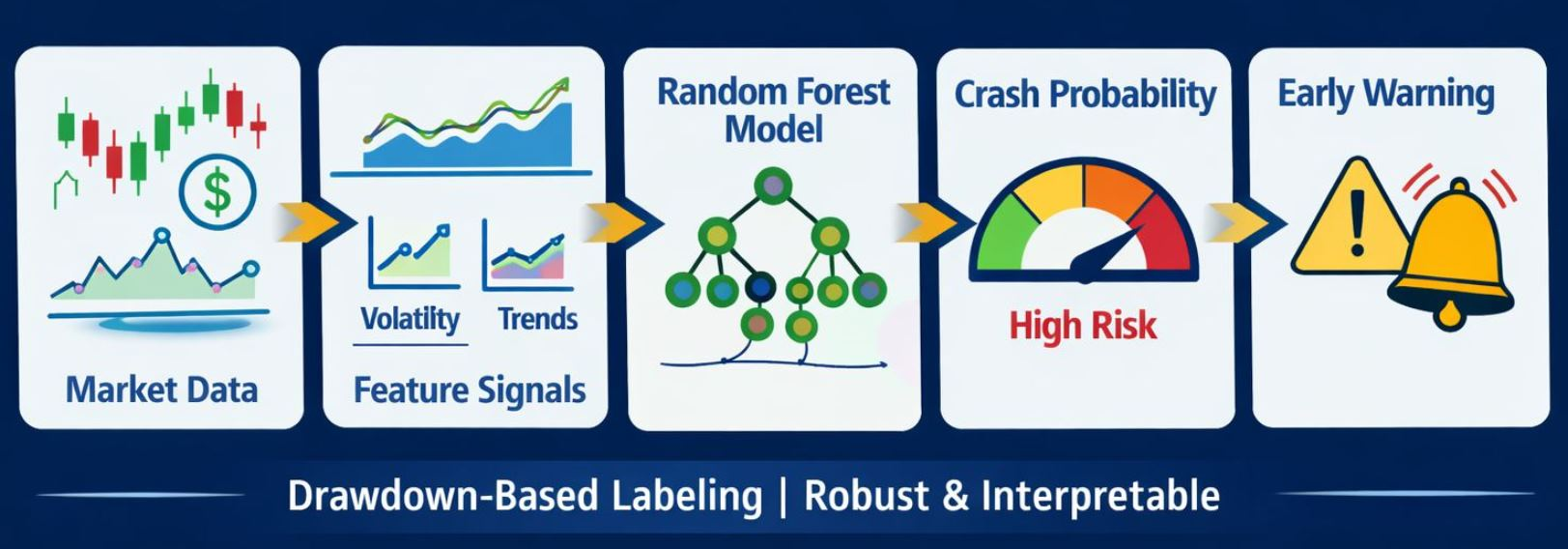
Explainable Ensemble Learning for Predicting Stock Market Crises: Calibration, Threshold Optimization, and Robustness Analysis



Abstract
1. Introduction
Related Work
2. Materials and Methods
2.1. Data Sources and Market Selection
2.2. Data Preprocessing and Log-Return Transformation
2.3. Feature Engineering
2.3.1. Moving Averages and Trend Ratios
2.3.2. Bollinger Band Width
2.3.3. Short-Horizon Volatility Measures
2.3.4. Short-Horizon Return Memory
2.4. Crash Label Construction
2.5. Model Architectures
2.5.1. Random Forest
- 500 trees;
- maximum depth = 7;
- minimum samples per leaf = 5,
- class weighting = “balanced”.
2.5.2. Baseline and Benchmark Models
- Logistic Regression with L2 regularization;
- GARCH(1,1) for volatility forecasting;
- LightGBM classifier;
- XGBoost classifier.
2.6. Threshold Optimization and Early-Warning Calibration
2.7. Lead-Time Measurement
2.8. Robustness and Stress Testing
- Gaussian noise injection
- 2.
- Return perturbation
- 3.
- Flash crash simulation
2.9. Model Interpretability
2.10. Use of Generative AI (GenAI)
2.11. Availability of Data, Code, and Materials
3. Results
3.1. Predictive Performance Across Competing Models
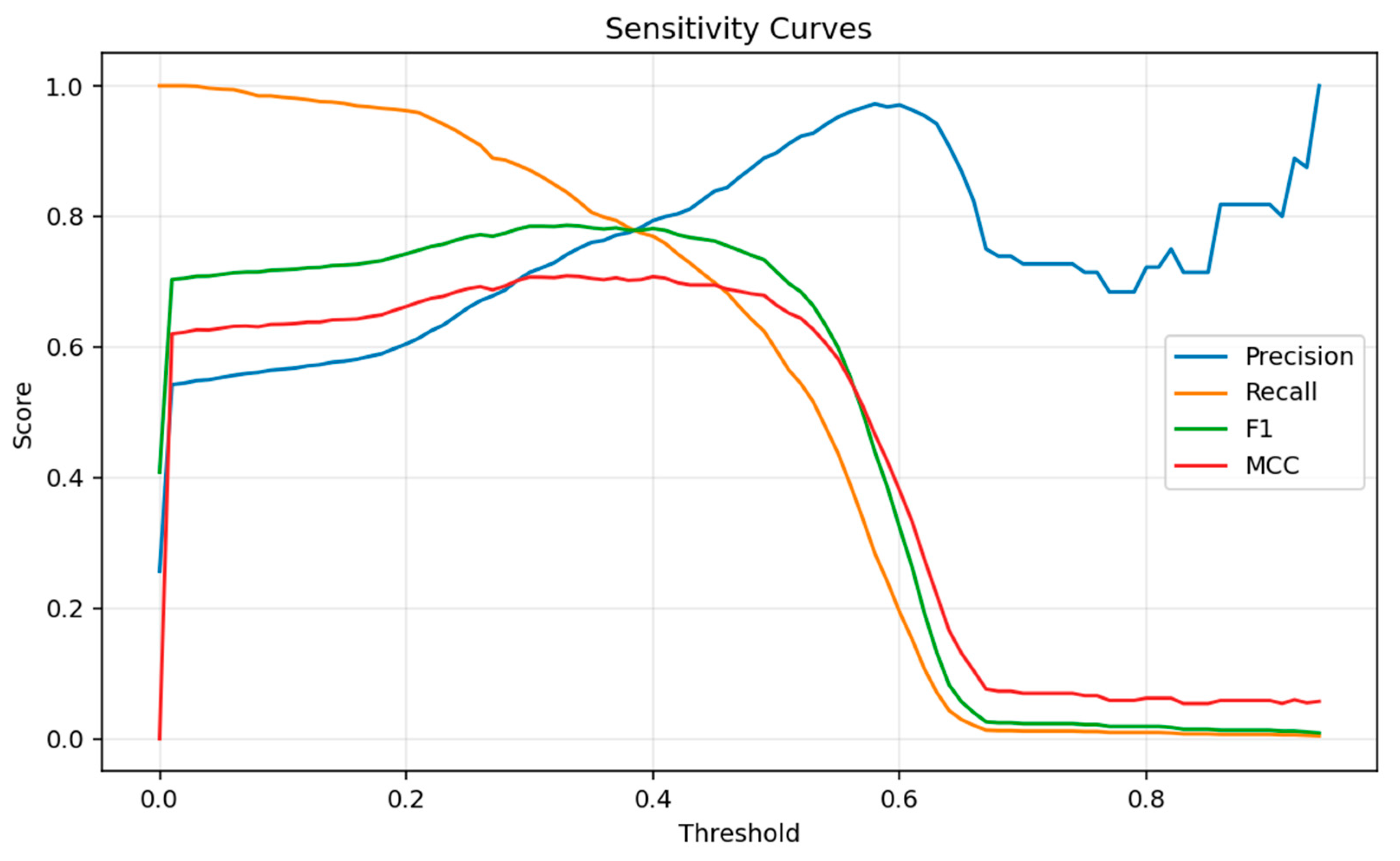
3.2. Threshold Calibration and Detection Trade-Offs
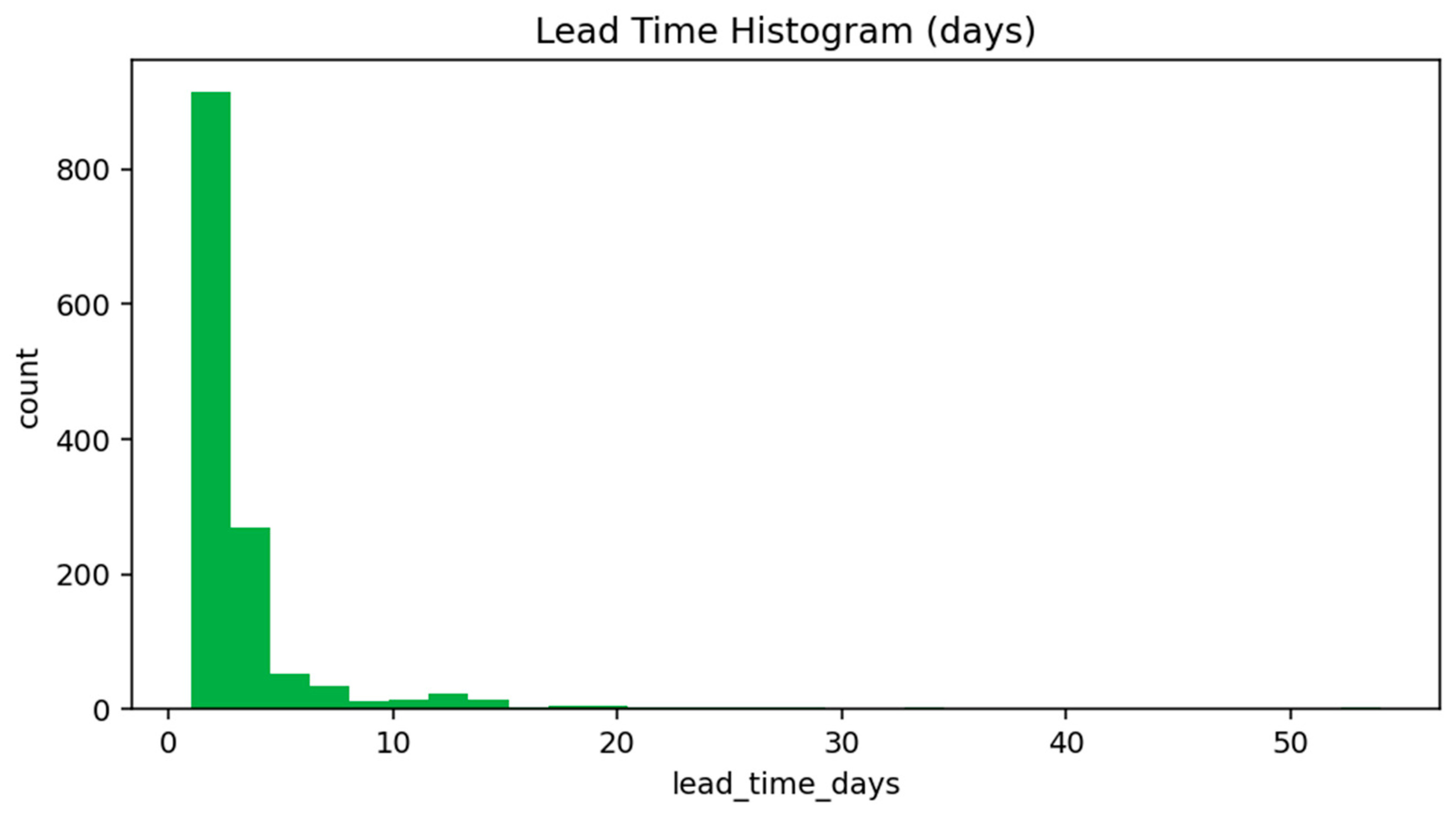
3.3. Lead-Time Characteristics of Correct Crash Detections
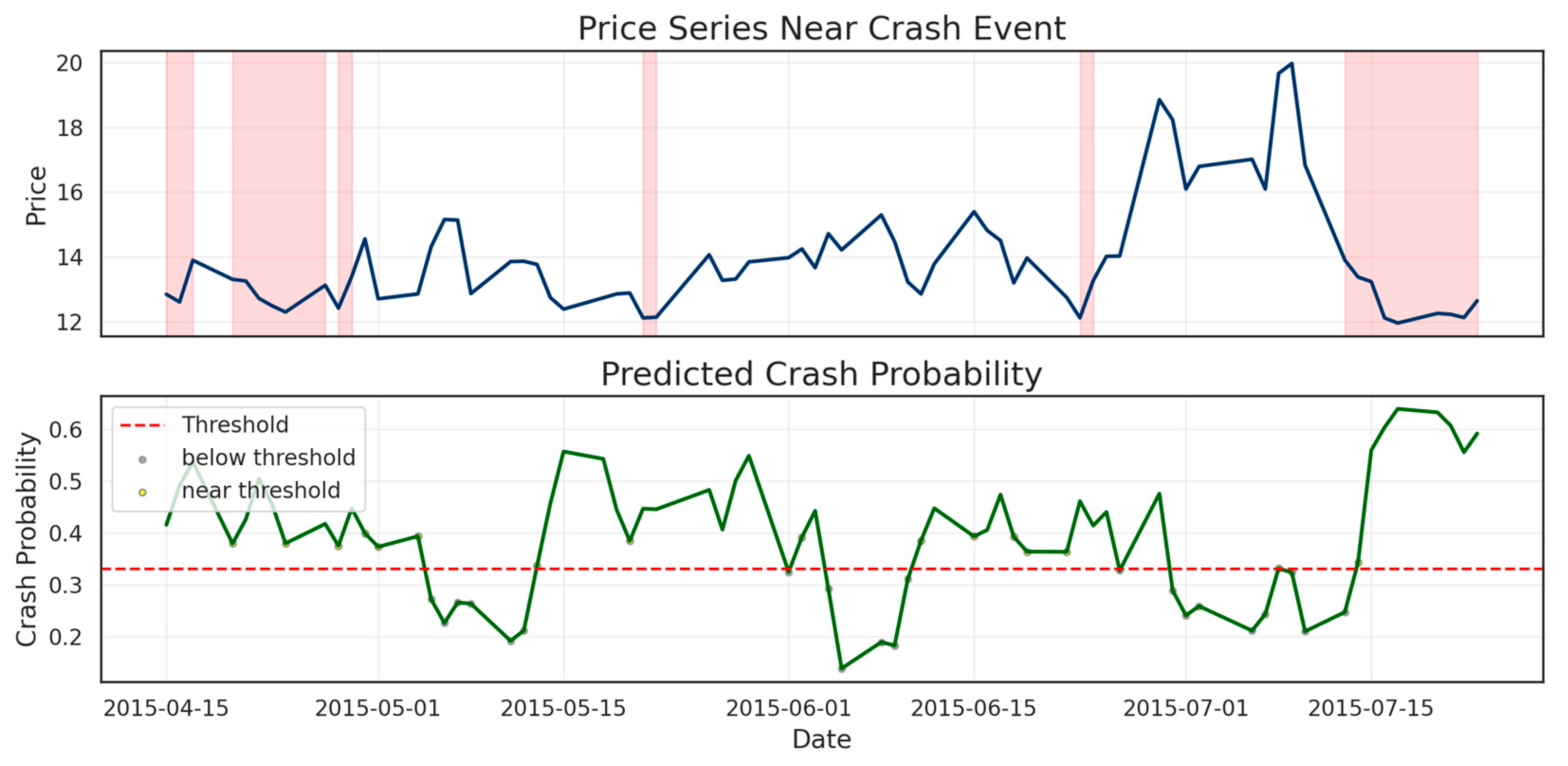
3.4. Error Analysis: Missed Crash Events
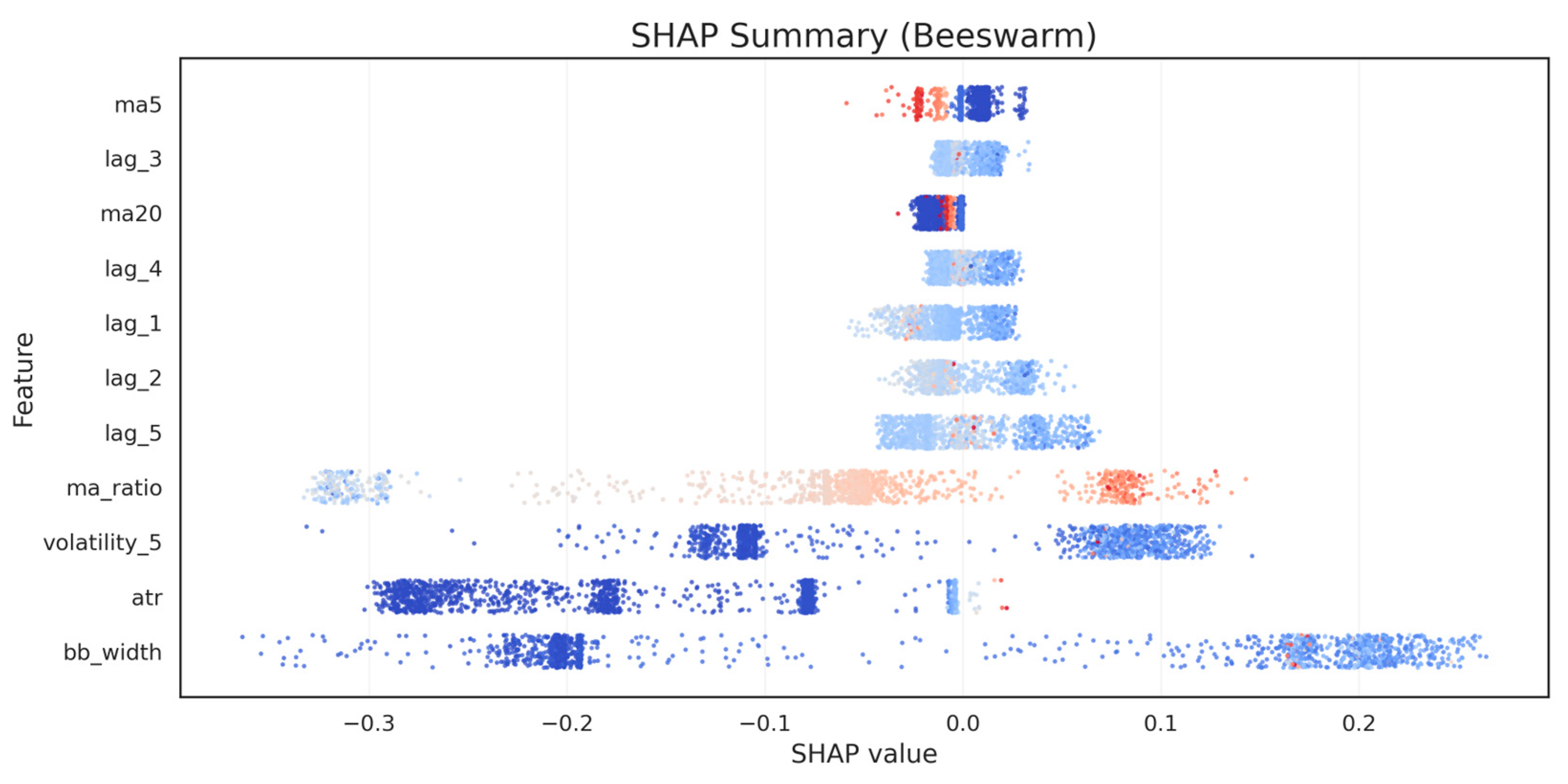
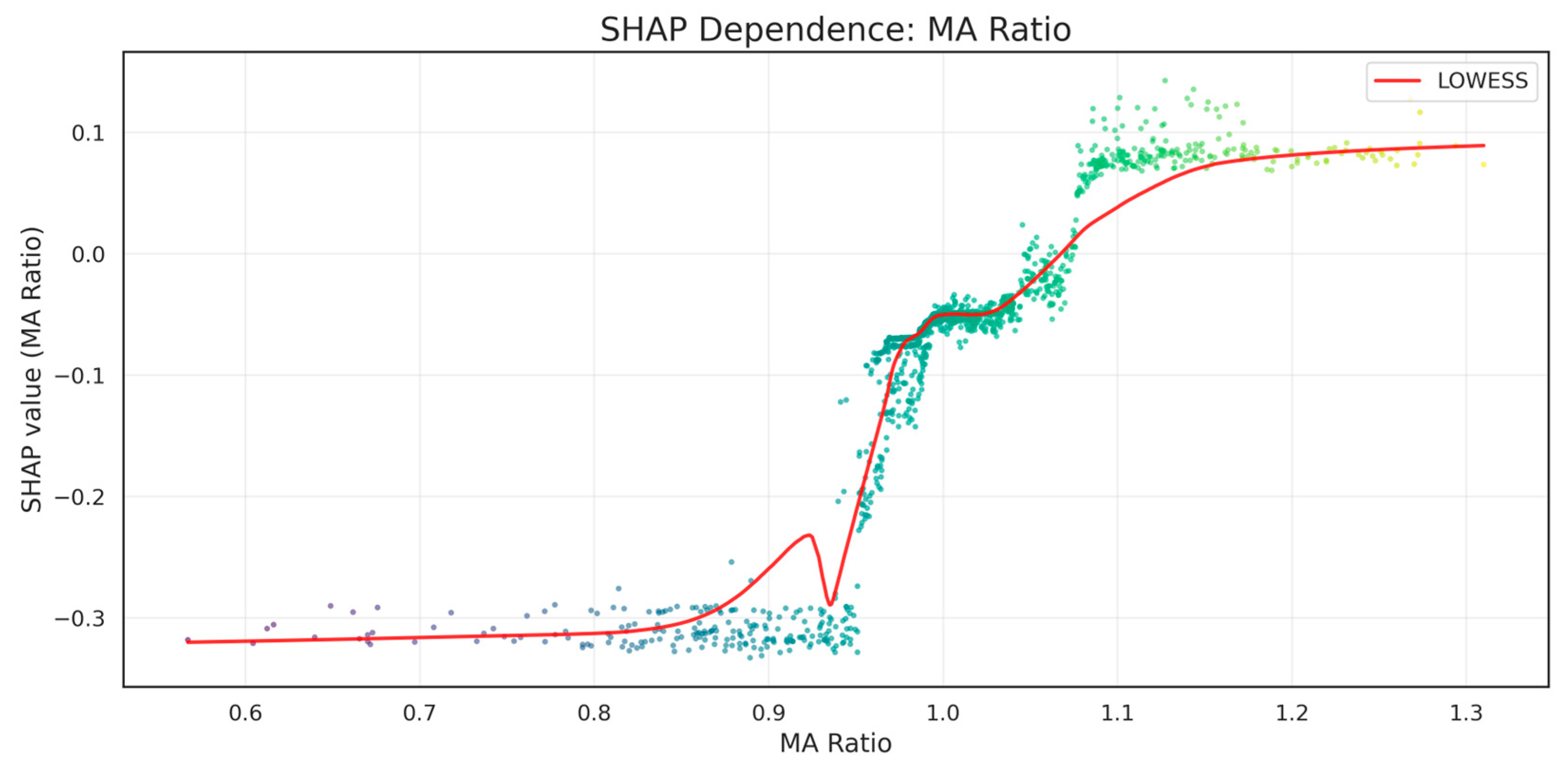
3.5. Interpretability via SHAP Feature Attribution
3.6. Variance Decomposition and Proportion of Variation Explained
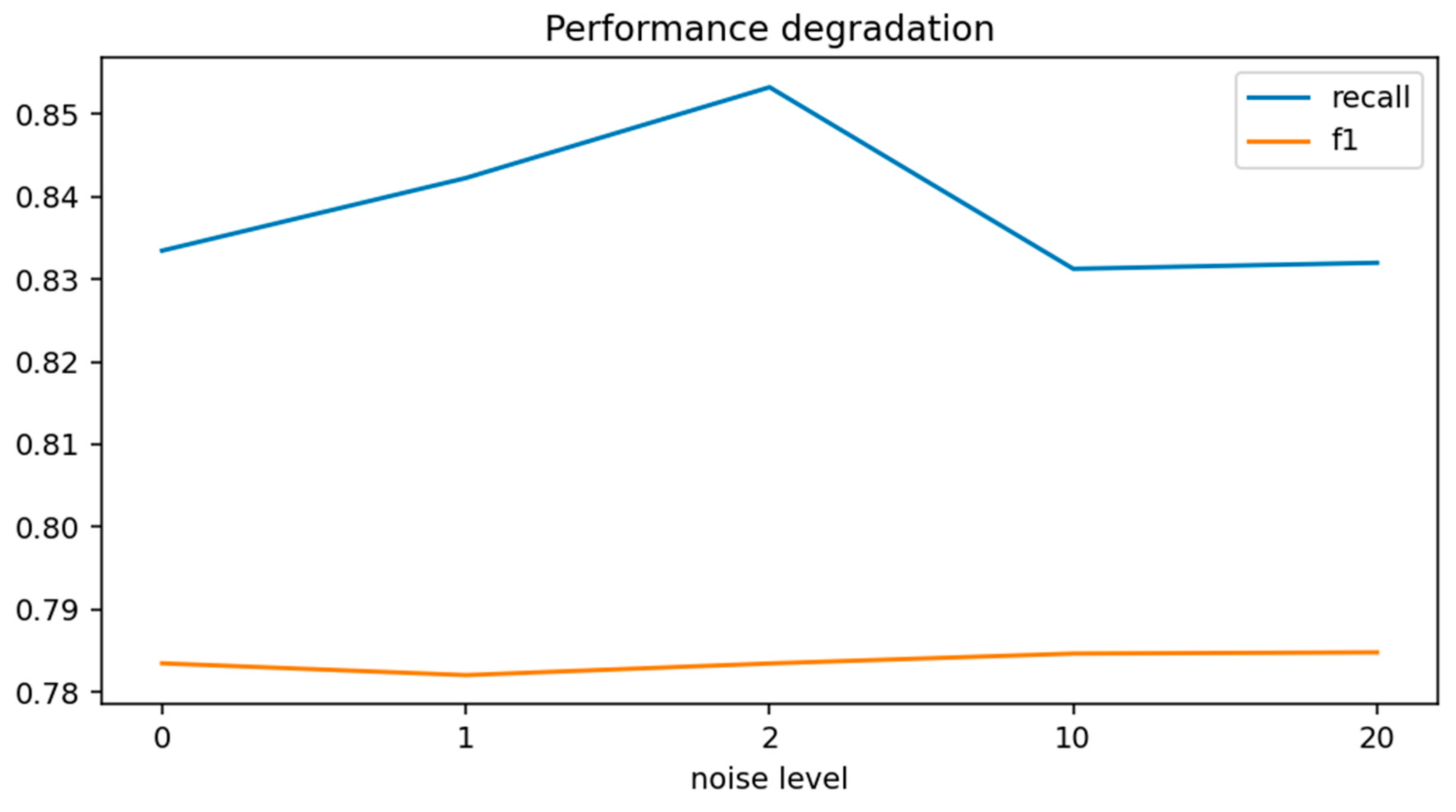
3.7. Robustness Under Noise and Shock Perturbations
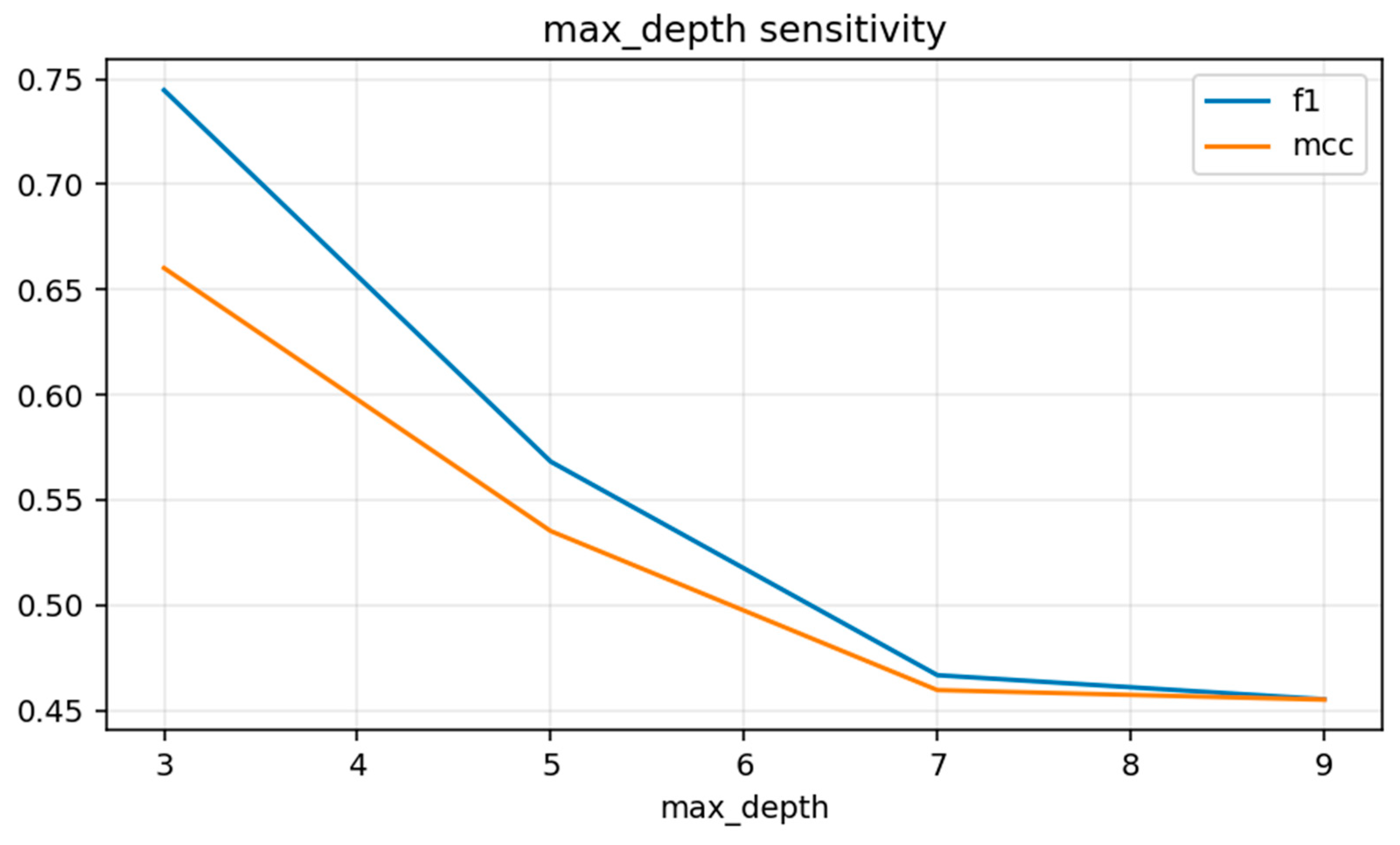
3.8. Hyperparameter Sensitivity and Stability
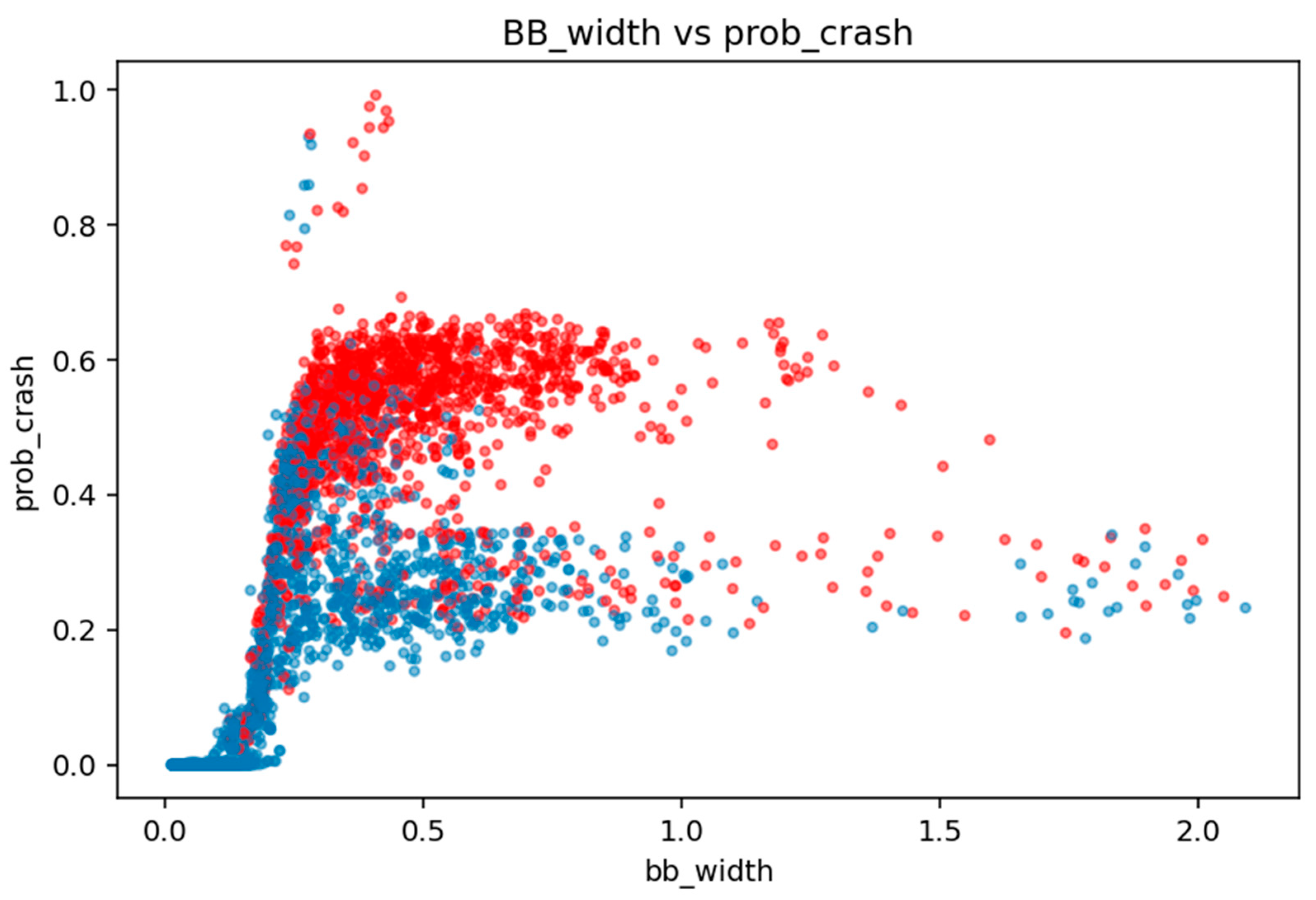
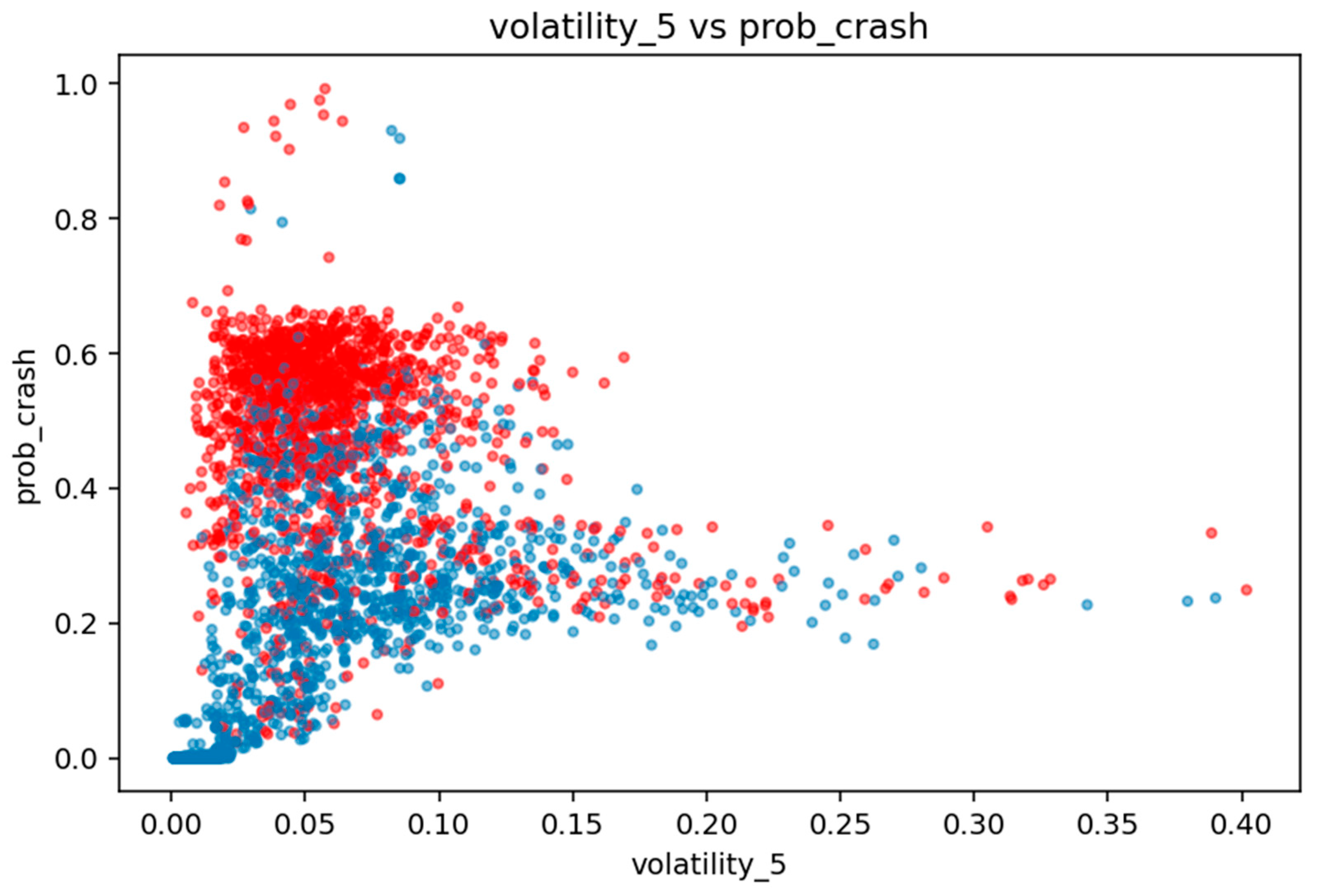
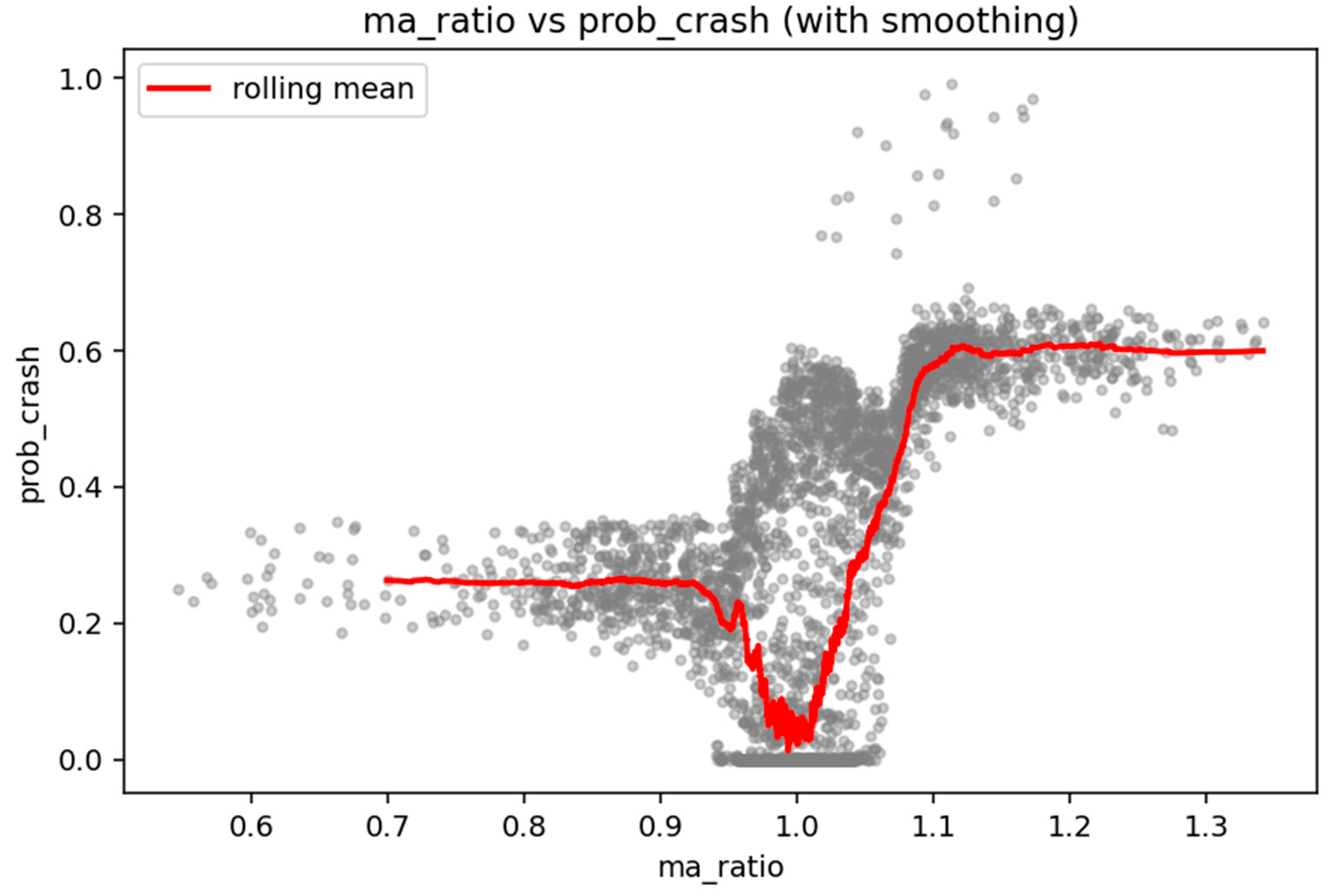
3.9. Financial-Theoretical Validation of Predictive Indicators
4. Discussion
4.1. Predictability of Market Crashes Through Nonlinear Interaction Structures
4.2. Threshold Calibration as a Structural Component of Rare-Event Forecasting
4.3. Early-Warning Horizons and Their Operational Significance
4.4. Structural Failure Modes and the Limits of Forecastability
4.5. Interpretability and Theoretical Coherence
4.6. Robustness to Noise and Structural Perturbations
4.7. Stability of Hyperparameter Configurations
4.8. Coherence Between Predictive Behavior and Financial Structure
4.9. Segmented Performance by Market Type and Size
4.10. Limitation and Future Research
4.11. Theoretical and Practical Implications
4.12. Overall Interpretation
5. Conclusions
Author Contributions
Funding
Data Availability Statement
Acknowledgments
Conflicts of Interest
Abbreviations
| RF | Random Forest |
| GARCH | Generalized Autoregressive Conditional Heteroskedasticity |
| MA | Moving Average |
| ATR | Average True Range |
| BB | Bollinger Bands |
| SHAP | SHapley Additive exPlanations |
| ROC-AUC | Receiver Operating Characteristic Area Under the Curve |
| PR-AUC | Precision–Recall Area Under the Curve |
| MCC | Matthews Correlation Coefficient |
| OHLCV | Open, High, Low, Close, Volume |
| VIX | Volatility Index |
References
- Vogl, M.; Rötzel, P.G. Chaoticity versus stochasticity in financial markets: Are daily S&P 500 return dynamics chaotic? Commun. Nonlinear Sci. Numer. Simul. 2022, 108, 106218. [Google Scholar] [CrossRef]
- Guo, H.; Kwok, P.Y.; Guo, Y.; Zhao, J.; Gu, D. FinLSPM: Large Stock Predict Model via Numerical Prior Knowledge from LLM. Expert Syst. Appl. 2025, 300, 130294. [Google Scholar] [CrossRef]
- Wei, L.; Chen, S.; Lin, J.; Shi, L. Enhancing return forecasting using LSTM with agent-based synthetic data. Decis. Support Syst. 2025, 193, 114452. [Google Scholar] [CrossRef]
- Sharif, A.; Aloui, C.; Yarovaya, L. COVID-19 pandemic, oil prices, stock market, geopolitical risk and policy uncertainty nexus in the US economy: Fresh evidence from the wavelet-based approach. Int. Rev. Financ. Anal. 2020, 70, 101496. [Google Scholar] [CrossRef] [PubMed]
- Aliyev, N.; He, X.Z. Ambiguous price formation. J. Math. Econ. 2023, 106, 102842. [Google Scholar] [CrossRef]
- Blaurock, I.; Schmitt, N.; Westerhoff, F. Market entry waves and volatility outbursts in stock markets. J. Econ. Behav. Organ. 2018, 153, 19–37. [Google Scholar] [CrossRef]
- Lesame, K.; Ngene, G.; Gupta, R.; Bouri, E. Herding in international REITs markets around the COVID-19 pandemic. Res. Int. Bus. Financ. 2024, 67, 102147. [Google Scholar] [CrossRef]
- Chowdhury, M.A.F.; Meo, M.S.; Aloui, C. How world uncertainties and global pandemics destabilized food, energy and stock markets? Fresh evidence from quantile on quantile regressions. Int. Rev. Financ. Anal. 2021, 76, 101759. [Google Scholar] [CrossRef]
- Machado, M.R.; Chen, D.T.; Osterrieder, J.R. An analytical approach to credit risk assessment using machine learning models. Decis. Anal. J. 2025, 16, 100605. [Google Scholar] [CrossRef]
- Bluwstein, K.; Buckmann, M.; Joseph, A.; Kapadia, S.; Şimşek, Ö. Credit growth, the yield curve and financial crisis prediction: Evidence from a machine learning approach. J. Int. Econ. 2023, 145, 103773. [Google Scholar] [CrossRef]
- Narayan, S.; Kumar, D. Macroprudential policy and systemic risk in G20 nations. J. Financ. Stab. 2024, 75, 101340. [Google Scholar] [CrossRef]
- Kaya, H.D.; Engkuchik, E.N.S. The effect of financial crises on stock market liquidity across global markets. Investig. Manag. Financ. Innov. 2017, 14, 38–50. [Google Scholar] [CrossRef]
- Bonera, M.; Barabino, B.; Yannis, G.; Maternini, G. Network-wide road crash risk screening: A new framework. Accid. Anal. Prev. 2024, 199, 107502. [Google Scholar] [CrossRef]
- Bianchi, M.L.; Del Vecchio, L.; Stara, F.M. Are parametric models still useful to measure the market risk of bank securities holdings? Borsa Istanb. Rev. 2025, 25, 1663–1681. [Google Scholar] [CrossRef]
- Tang, W.; Yang, S.; Khishe, M. Profit prediction optimization using financial accounting information system by optimized DLSTM. Heliyon 2023, 9, e19431. [Google Scholar] [CrossRef]
- Zhang, C.Y.; Lan, Q.; Mi, X.; Zhou, Z.; Ma, C.; Mi, X. A denoising method based on the nonlinear relationship between the target variable and input features. Expert. Syst. Appl. 2023, 218, 119585. [Google Scholar] [CrossRef]
- Nazareth, N.; Reddy, Y.V.R. Financial applications of machine learning: A literature review. Expert. Syst. Appl. 2023, 219, 119640. [Google Scholar] [CrossRef]
- Albada, A.; Al-Daweri, M.S.; Ramadan, R.A.; Al Qatiti, K.; Haoyang, L.; Shutong, P. Determinates of investor opinion gap around IPOs: A machine learning approach. Intell. Syst. Appl. 2024, 23, 200420. [Google Scholar] [CrossRef]
- Suprihadi, E.; Danila, N. Forecasting ESG Stock Indices Using a Machine Learning Approach. Glob. Bus. Rev. 2024. [Google Scholar] [CrossRef]
- Jakubik, P.; Moinescu, B.G. Tailored microprudential recommendations for bank profit retention using a risk tolerance framework. Int. Rev. Econ. Financ. 2025, 98, 103951. [Google Scholar] [CrossRef]
- Park, S.; Yang, J.S. Interpretable deep learning LSTM model for intelligent economic decision-making. Knowl. Based Syst. 2022, 248, 108907. [Google Scholar] [CrossRef]
- Ejaz, N.; Choudhury, S. A comprehensive survey of the machine learning pipeline for wildfire risk prediction and assessment. Ecol. Inform. 2025, 90, 103325. [Google Scholar] [CrossRef]
- Jiang, C.; Zhou, Y.; Chen, B. Mining semantic features in patent text for financial distress prediction. Technol. Forecast. Soc. Change 2023, 190, 122450. [Google Scholar] [CrossRef]
- Supsermpol, P.; Huynh, V.N.; Karnjanapatchara, T.; Chiadamrong, N. Post-IPO underpricing prediction: A case study of Thai capital market. J. Open Innov. Technol. Mark. Complex. 2025, 11, 100671. [Google Scholar] [CrossRef]
- Solís, M.; Gil-Gamboa, A.; Troncoso, A. Metalearning for improving time series forecasting based on deep learning: A water case study. Results Eng. 2025, 28, 107541. [Google Scholar] [CrossRef]
- Abdullahi, M.; Baashar, Y.; Alhussian, H.; Alwadain, A.; Aziz, N.; Capretz, L.F.; Abdulkadir, S.J. Detecting Cybersecurity Attacks in Internet of Things Using Artificial Intelligence Methods: A Systematic Literature Review. Electronics 2022, 11, 198. [Google Scholar] [CrossRef]
- Patel, D.; Hosseini, P.; Jalayer, M. A framework for proactive safety evaluation of intersection using surrogate safety measures and non-compliance behavior. Accid Anal. Prev. 2023, 192, 107264. [Google Scholar] [CrossRef]
- Mohammadpour, S.I.; Khedmati, M.; Zada, M.J.H. Classification of truck-involved crash severity: Dealing with missing, imbalanced, and high dimensional safety data. PLoS ONE 2023, 18, e0281901. [Google Scholar] [CrossRef]
- Li, Y.; Yang, Z.; Xing, L.; Yuan, C.; Liu, F.; Wu, D.; Yang, H. Crash injury severity prediction considering data imbalance: A Wasserstein generative adversarial network with gradient penalty approach. Accid. Anal. Prev. 2023, 192, 107271. [Google Scholar] [CrossRef]
- Ning, S.; Xu, L.; Xu, X.; Zhou, Y.; Zhang, Y.; Zhang, S.; Long, R.; Jin, J.; Thapa, B.R. Quantifying hydrothermal-driven dynamics of gross primary productivity in the Ta-Pieh mountains based on explainable artificial intelligence. J. Hydrol. Reg. Stud. 2025, 62, 102797. [Google Scholar] [CrossRef]
- Tan, B.; Gan, Z.; Wu, Y. The measurement and early warning of daily financial stability index based on XGBoost and SHAP: Evidence from China. Expert. Syst. Appl. 2023, 227, 120375. [Google Scholar] [CrossRef]
- Ding, F.; Zha, R.; Pan, L.; Chen, X.; García-Martín, J.F.; Lan, W. AI-empowered spectroscopic gas sensing towards real-time food system monitoring and predictive quality control. Trends Food Sci. Technol. 2025, 164, 105249. [Google Scholar] [CrossRef]
- Alghamdi, H.; Alqithami, S. A robust machine learning framework for stock market classification. Expert. Syst. Appl. 2025, 294, 128573. [Google Scholar] [CrossRef]
- Gigante, G.; Deco, G.; Marom, S.; Del Giudice, P. Network Events on Multiple Space and Time Scales in Cultured Neural Networks and in a Stochastic Rate Model. PLoS Comput. Biol. 2015, 11, e1004547. [Google Scholar] [CrossRef]
- Sun, W.; Wang, Y.; Zhang, L.; Chen, X.H.; Hoang, Y.H. Enhancing economic cycle forecasting based on interpretable machine learning and news narrative sentiment. Technol. Forecast. Soc. Change 2025, 215, 124094. [Google Scholar] [CrossRef]
- Hussain, S.; Mustafa, M.W.; Al-shqeerat, K.H.A.; Saeed, F.; Al-rimy, B.A.S. A Novel Feature-Engineered—NGBoost Machine-Learning Consumption Data. Sensors 2021, 21, 8423. [Google Scholar] [CrossRef]
- Yang, Y.; He, K.; Wang, Y.P.; Yuan, Z.Z.; Yin, Y.H.; Guo, M.Z. Identification of dynamic traffic crash risk for cross-area freeways based on statistical and machine learning methods. Phys. A Stat. Mech. Its Appl. 2022, 595, 127083. [Google Scholar] [CrossRef]
- Dierckx, T.; Davis, J.; Schoutens, W. Trading the FX volatility risk premium with machine learning and alternative data. J. Financ. Data Sci. 2022, 8, 162–179. [Google Scholar] [CrossRef]
- Zhen, K.; Xie, D.; Hu, X. A multi-feature selection fused with investor sentiment for stock price prediction. Expert. Syst. Appl. 2025, 278, 127381. [Google Scholar] [CrossRef]
- Biswas, A.K.; Bhuiyan, M.S.A.; Mir, M.N.H.; Rahman, A.; Mridha, M.F.; Islam, M.R.; Watanobe, Y. A Dual Output Temporal Convolutional Network With Attention Architecture for Stock Price Prediction and Risk Assessment. IEEE Access 2025, 13, 53621–53639. [Google Scholar] [CrossRef]
- Amiri, B.; Haddadi, A.; Mojdehi, K.F. A Novel Hybrid GCN-LSTM Algorithm for Energy Stock Price Prediction: Leveraging Temporal Dynamics and Inter-Stock Relationships. IEEE Access 2025, 13, 24815–24832. [Google Scholar] [CrossRef]
- Islam, M.S.; Bashir, M.; Rahman, S.; Al Montaser, M.A.; Bortty, J.C.; Nishan, A.; Haque, M.R. Machine Learning-Based Cryptocurrency Prediction: Enhancing Market Forecasting with Advanced Predictive Models. J. Ecohumanism 2025, 4, 2498–2519. [Google Scholar] [CrossRef]
- Belcastro, L.; Carbone, D.; Cosentino, C.; Marozzo, F.; Trunfio, P. Enhancing Cryptocurrency Price Forecasting by Integrating Machine Learning with Social Media and Market Data. Algorithms 2023, 16, 542. [Google Scholar] [CrossRef]
- Gnaciński, P.; Makowiec, D. Another type of log-periodic oscillations on Polish stock market. Phys. A Stat. Mech. Its Appl. 2004, 344, 322–325. [Google Scholar] [CrossRef][Green Version]
- Huang, Y.; Zhao, Y.; Capstick, A.; Palermo, F.; Haddadi, H.; Barnaghi, P. Analyzing entropy features in time-series data for pattern recognition in neurological conditions. Artif. Intell. Med. 2024, 150, 102821. [Google Scholar] [CrossRef] [PubMed]
- Zhang, Y.; Wu, R.; Dascalu, S.M.; Harris, F.C. A novel extreme adaptive GRU for multivariate time series forecasting. Sci. Rep. 2024, 14, 2991. [Google Scholar] [CrossRef]
- Sornette, D. Critical market crashes. Phys. Rep. 2003, 378, 1–98. [Google Scholar] [CrossRef]
- Zhao, X.; Shang, P.; Lin, A. Universal and non-universal properties of recurrence intervals of rare events. Phys. A Stat. Mech. Its Appl. 2016, 448, 132–143. [Google Scholar] [CrossRef]
- Perez, M.A.; Sudweeks, J.D.; Sears, E.; Antin, J.; Lee, S.; Hankey, J.M.; Dingus, T.A. Performance of basic kinematic thresholds in the identification of crash and near-crash events within naturalistic driving data. Accid. Anal. Prev. 2017, 103, 10–19. [Google Scholar] [CrossRef]
- AlShelahi, A.; Saigal, R. Insights into the macroscopic behavior of equity markets: Theory and application. Phys. A Stat. Mech. Its Appl. 2018, 505, 778–793. [Google Scholar] [CrossRef]
- Wang, H.; Yue, M.; Zhao, H. Cojumps in China’s spot and stock index futures markets. Pac. Basin Financ. J. 2015, 35, 541–557. [Google Scholar] [CrossRef]
- Au, S.Y.; Qiu, B.; Wu, S.Y. Do mandatory risk factor disclosures reduce stock price crash risk? J. Account. Public Policy 2023, 42, 107077. [Google Scholar] [CrossRef]
- Alsini, R.; Abu Al-Haija, Q.; Alsulami, A.A.; Alturki, B.; Alqurashi, A.A.; Mashat, M.D.; Alqahtani, A.; Alhebaishi, N. Forecasting cryptocurrency’s buy signal with a bagged tree learning approach to enhance purchase decisions. Front. Big Data 2024, 7, 1369895. [Google Scholar] [CrossRef] [PubMed]
- Wali, B.; Khattak, A.J.; Karnowski, T. The relationship between driving volatility in time to collision and crash-injury severity in a naturalistic driving environment. Anal. Methods Accid. Res. 2020, 28, 100136. [Google Scholar] [CrossRef]
- Butt, H.A.; Kolari, J.W.; Sadaqat, M. Revisiting momentum profits in emerging markets. Pac. Basin Financ. J. 2021, 65, 101486. [Google Scholar] [CrossRef]
- El Kalak, I.; Tosun, O.K.; Yamada, K. The Bank of Japan’s equity purchases and stock price crash risk. Econ. Lett. 2023, 229, 111214. [Google Scholar] [CrossRef]
- Porcelli, L.; Trovati, M.; Palmieri, F. Real-time anomaly detection in seasonal time series with conditional variational autoencoder. Appl. Soft Comput. 2025, 184, 113761. [Google Scholar] [CrossRef]
- Nasertork, A.; Ranjbar, S.; Rahai, M.; Nejad, F.M. Pavement raveling inspection using a new image texture-based feature set and artificial intelligence. Adv. Eng. Inform. 2024, 62, 102665. [Google Scholar] [CrossRef]
- Le, A.T.; Le, T.H.; Liu, W.M.; Fong, K.Y. Multiple duration analyses of dynamic limit order placement strategies and aggressiveness in a low-latency market environment. Int. Rev. Financ. Anal. 2020, 72, 101575. [Google Scholar] [CrossRef]
- El Oubani, A.; Lekhal, M. An agent-based model of financial market efficiency dynamics. Borsa Istanb. Rev. 2022, 22, 699–710. [Google Scholar] [CrossRef]
- Rizi, B.S.; Faramarzi, A.; Pertzborn, A.; Heidarinejad, M. Forecasting operation of a chiller plant facility using data-driven models. Int. J. Refrig. 2024, 167, 70–89. [Google Scholar] [CrossRef]
- Song, Y. Enhancing stock market trend reversal prediction using feature-enriched neural networks. Heliyon 2024, 10, e24136. [Google Scholar] [CrossRef]
- Yu, D.; Tang, N.S.; Shi, Y. Adaptively aggregated forecast for exponential family panel model. Int. J. Forecast. 2025, 41, 733–747. [Google Scholar] [CrossRef]
- Gong, J.; Wang, X.; Mu, Y. Nonprobabilistic reliability analysis method for series-parallel structural systems with correlated uncertainties. Comput. Struct. 2024, 301, 107459. [Google Scholar] [CrossRef]
- Ventre, V.; Martino, R.; Torrecillas, M.J.M. Relationship between an inconsistent degree of financial literacy and inconsistent decision-making in intertemporal choices. Heliyon 2024, 10, e27253. [Google Scholar] [CrossRef] [PubMed]





| Model | Precision | Recall | F1 Score | MCC | ROC-AUC | PR-AUC | Missed Crashes | Detection Rate |
|---|---|---|---|---|---|---|---|---|
| Random Forest | 0.897 | 0.595 | 0.715 | 0.664 | 0.955 | 0.868 | 552 | 0.595 |
| LightGBM | 0.749 | 0.829 | 0.786 | 0.713 | 0.947 | 0.842 | 392 | 0.829 |
| XGBoost | 0.751 | 0.825 | 0.786 | 0.721 | 0.953 | 0.848 | 398 | 0.825 |
| Logistic Regression | 0.605 | 0.963 | 0.743 | 0.641 | 0.932 | 0.794 | 97 | 0.963 |
| GARCH(1,1) | 0.130 | 0.088 | 0.132 | 0.041 | 0.578 | 0.091 | 941 | 0.088 |
| Metric | Optimal Threshold | Score |
|---|---|---|
| F1 | 0.33 | 0.786 |
| MCC | 0.33 | 0.709 |
| Statistic | Days |
|---|---|
| Mean Lead-Time | 60 |
| Median | 48 |
| Minimum | 3 |
| Maximum | 138 |
| Standard Deviation | 27 |
| Failure Category | Count |
|---|---|
| Low Signal Probability | 235 |
| Sharp Drop Events | 87 |
| No Prior Volatility Expansion | 63 |
| Other/Unclassified | 167 |
| Rank | Feature | Mean | Std |
|---|---|---|---|
| 1 | BB_width | 0.127 | 0.091 |
| 2 | volatility_5 | 0.098 | 0.076 |
| 3 | ma_ratio | 0.087 | 0.069 |
| 4 | return_lag_1 | 0.081 | 0.058 |
| 5 | return_lag_2 | 0.076 | 0.053 |
| 6 | return_lag_3 | 0.072 | 0.051 |
| 7 | ATR_14 | 0.064 | 0.047 |
| 8 | bb_upper | 0.058 | 0.044 |
| 9 | bb_lower | 0.055 | 0.041 |
| 10 | volatility_20 | 0.049 | 0.038 |
| Model | Features Included | McFadden Pseudo-R2 | Δ Pseudo-R2 | Share of Explained Variation |
|---|---|---|---|---|
| 0 | Intercept only | 0.000 | 0.000 | 0.000 |
| 1 | Volatility & Dispersion | 0.487 | 0.487 | 0.618 |
| 2 | Volatility & Dispersion + Trend & Price Level | 0.775 | 0.288 | 0.365 |
| 3 | Volatility & Dispersion + Trend + Return Memory | 0.789 | 0.014 | 0.018 |
| Scenario | F1 Score |
|---|---|
| Baseline (no noise) | 0.786 |
| Gaussian Noise 0.5% | 0.785 |
| Gaussian Noise 1% | 0.764 |
| Gaussian Noise 2% | 0.742 |
| Flash Crash −10% | 0.740 |
| Flash Crash −20% | 0.721 |
| Hyperparameter | Optimal Value |
|---|---|
| max_depth | 7 |
| n_estimators | 500 |
| min_samples_leaf | 5 |
| max_features | sqrt |
| class_weight | balanced |
| Feature | Pearson | Spearman | MI | Crash Mean | Normal Mean |
|---|---|---|---|---|---|
| BB_width | 0.677 | 0.847 | 0.910 | 0.495 | 0.151 |
| volatility_5 | 0.544 | 0.807 | 0.688 | 0.0638 | 0.026 |
| ma_ratio | 0.391 | 0.524 | 0.551 | 1.063 | 0.985 |
| Market_Type | n_obs | n_crash | Precision | Recall | f1 | da | auc | Brier |
|---|---|---|---|---|---|---|---|---|
| emerging | 26,568 | 1512 | 0.9954 | 1.0000 | 0.9977 | 0.9997 | 1.0000 | 0.0013 |
| Market_Type | Size_Bucket | n_obs | n_crash | Precision | Recall | f1 | da | auc | Brier |
|---|---|---|---|---|---|---|---|---|---|
| emerging | large | 26,568 | 1512 | 0.9954 | 1.0000 | 0.9977 | 0.9997 | 1.0000 | 0.0013 |
Disclaimer/Publisher’s Note: The statements, opinions and data contained in all publications are solely those of the individual author(s) and contributor(s) and not of MDPI and/or the editor(s). MDPI and/or the editor(s) disclaim responsibility for any injury to people or property resulting from any ideas, methods, instructions or products referred to in the content. |
© 2026 by the authors. Licensee MDPI, Basel, Switzerland. This article is an open access article distributed under the terms and conditions of the Creative Commons Attribution (CC BY) license.
Share and Cite
Suprihadi, E.; Danila, N.; Ali, Z.; Ananta, G.P. Explainable Ensemble Learning for Predicting Stock Market Crises: Calibration, Threshold Optimization, and Robustness Analysis. Information 2026, 17, 114. https://doi.org/10.3390/info17020114
Suprihadi E, Danila N, Ali Z, Ananta GP. Explainable Ensemble Learning for Predicting Stock Market Crises: Calibration, Threshold Optimization, and Robustness Analysis. Information. 2026; 17(2):114. https://doi.org/10.3390/info17020114
Chicago/Turabian StyleSuprihadi, Eddy, Nevi Danila, Zaiton Ali, and Gede Pramudya Ananta. 2026. "Explainable Ensemble Learning for Predicting Stock Market Crises: Calibration, Threshold Optimization, and Robustness Analysis" Information 17, no. 2: 114. https://doi.org/10.3390/info17020114
APA StyleSuprihadi, E., Danila, N., Ali, Z., & Ananta, G. P. (2026). Explainable Ensemble Learning for Predicting Stock Market Crises: Calibration, Threshold Optimization, and Robustness Analysis. Information, 17(2), 114. https://doi.org/10.3390/info17020114