Article

Integrating VIIRS Fire Detections and ERA5-Land Reanalysis for Modeling Wildfire Probability in Arid Mountain Systems of the Arabian Peninsula


by
Rahmah Al-Qthanin
1 and
Zubairul Islam
2,*
1
Department of Biology, College of Science, King Khalid University, Abha 61413, Saudi Arabia
2
Faculty of Environmental Sciences, Hensard University, Toru Orua 561101, Bayelsa, Nigeria
*
Author to whom correspondence should be addressed.
Information 2026, 17(1), 13; https://doi.org/10.3390/info17010013
Submission received: 2 November 2025 / Revised: 9 December 2025 / Accepted: 12 December 2025 / Published: 23 December 2025
(This article belongs to the Special Issue Predictive Analytics and Data Science, 3rd Edition)

Abstract

Wildfire occurrence in arid and semiarid landscapes is increasingly driven by shifts in climatic and biophysical conditions, yet its dynamics remain poorly understood in the mountainous environments of western Saudi Arabia. This study modeled wildfire probabilities across the Aseer, Al Baha, Makkah Al-Mukarramah, and Jazan regions via multisource Earth observation datasets from 2012–2025. Active fire detections from VIIRS were integrated with ERA5-Land reanalysis variables, vegetation indices, and Copernicus DEM GLO30 topography. A random forest classifier was trained and validated via stratified sampling and cross-validation to predict monthly burn probabilities. Calibration, reliability assessment, and independent temporal validation confirmed strong model performance (AUC-ROC = 0.96; Brier = 0.03). Climatic dryness (dew-point deficit), vegetation structure (LAI_lv), and surface soil moisture emerged as dominant predictors, underscoring the coupling between energy balance and fuel desiccation. Temporal trend analyses (Kendall’s τ and Sen’s slope) revealed the gradual intensification of fire probability during the dry-to-transition seasons (February–April and September–November), with Aseer showing the most persistent risk. These findings establish a scalable framework for wildfire early warning and landscape management in arid ecosystems under accelerating climatic stress.

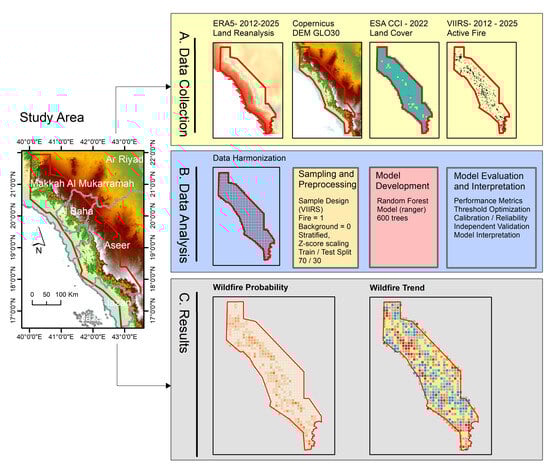
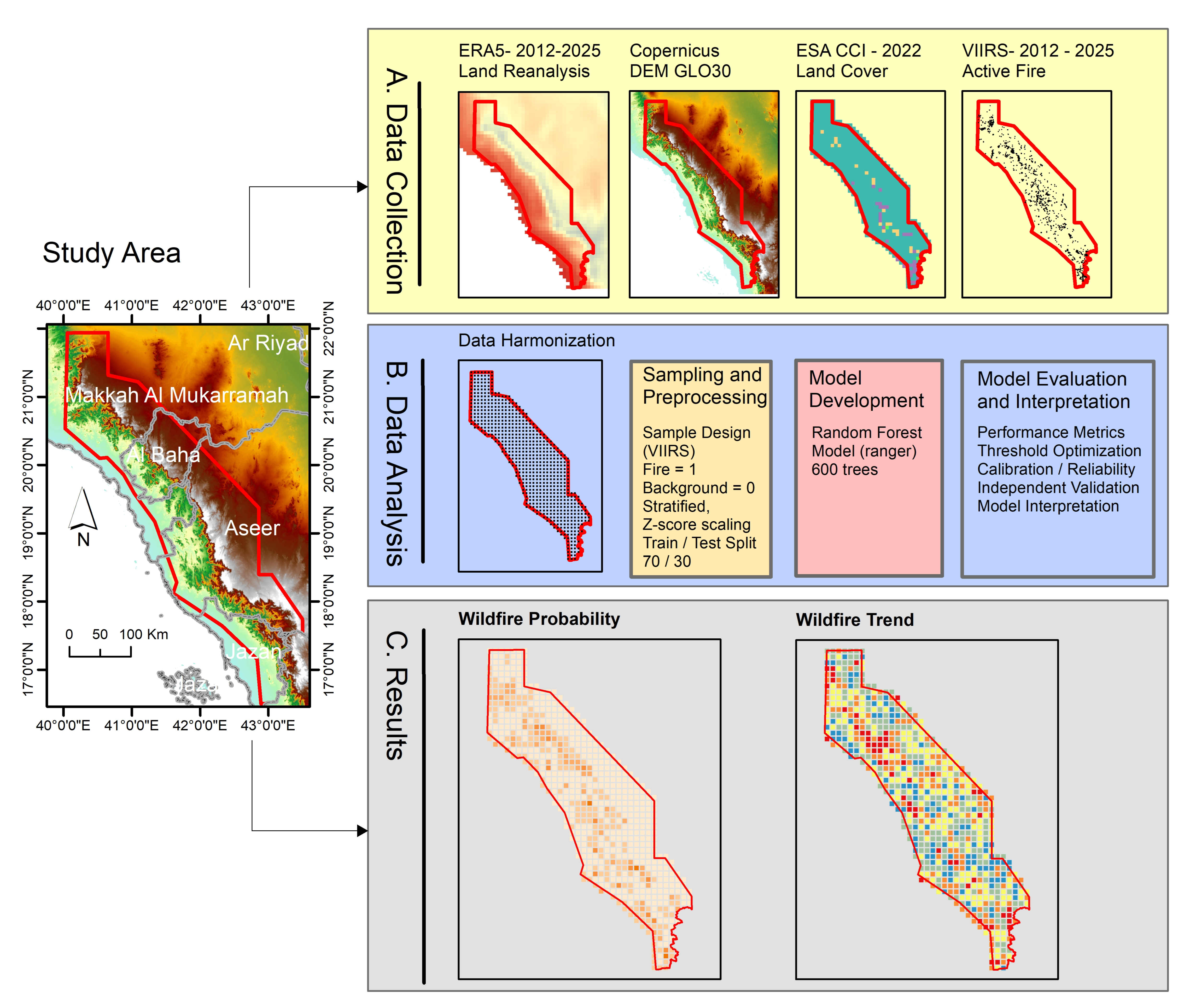
Graphical Abstract

1. Introduction

Wildfires have emerged as escalating environmental as well as socioeconomic threats across western Saudi Arabia, where steep topography, vegetation, and prolonged atmospheric dryness converge to create a highly flammable landscape. In recent decades, wildfire frequency and spatial extent have increased markedly in Aseer, Makkah Al-Mukarramah, Al Baha, and Jazan, intensifying risks to fragile ecosystems, rangelands, and expanding peri-urban settlements. These fires accelerate soil erosion, disrupt vegetation regeneration, and exacerbate desertification and biodiversity loss, thereby challenging the sustainability targets outlined under Saudi Vision 2030 [1,2].
Globally, the integration of satellite remote sensing and machine learning (ML) has transformed wildfire research, improving detection accuracy, predictive mapping, and hazard forecasting [3,4,5]. Numerous studies have demonstrated the potential of ML classifiers—such as random forest, gradient boosting, and neural networks—to capture nonlinear relationships between fire activity and environmental drivers [6,7,8]. However, arid and semiarid regions remain underrepresented in predictive fire modeling because of discontinuous fuel patterns, complex topographic–climatic interactions, and limited field validation [9,10]. In Saudi Arabia, most prior efforts have focused on burned-area mapping or descriptive fire incidence reports rather than probabilistic modeling of fire-prone conditions across spatial and temporal scales.
Recent advances in data availability—such as VIIRS active fire products, ERA5-Land reanalysis, and the Copernicus DEM GLO30—have enabled the coupling of fire occurrences with the thermal, radiative, and moisture regimes that govern surface combustibility. These multisource datasets provide a pathway to bridge the knowledge gap in understanding how energy balance, vegetation structure, and soil moisture interact to modulate ignition potential within desert–mountain ecotones [11,12,13].
This study addresses this gap by developing a machine learning-based wildfire probability model across the western escarpment of Saudi Arabia for the period of 2012–2025. Specifically, the objectives are to (i) integrate satellite, climatic, and topographic datasets for monthly fire-probability estimation and assess the resulting model’s accuracy, calibration, and transferability; (ii) identify dominant environmental predictors; and (iii) analyze long-term temporal trends and seasonal shifts in wildfire potential. The findings provide an operational framework for early warning systems, landscape-level fire risk zoning, and climate adaptation planning in one of the Kingdom’s most ecologically sensitive and socioeconomically critical regions.

2. Materials and Methods

2.1. Study Area

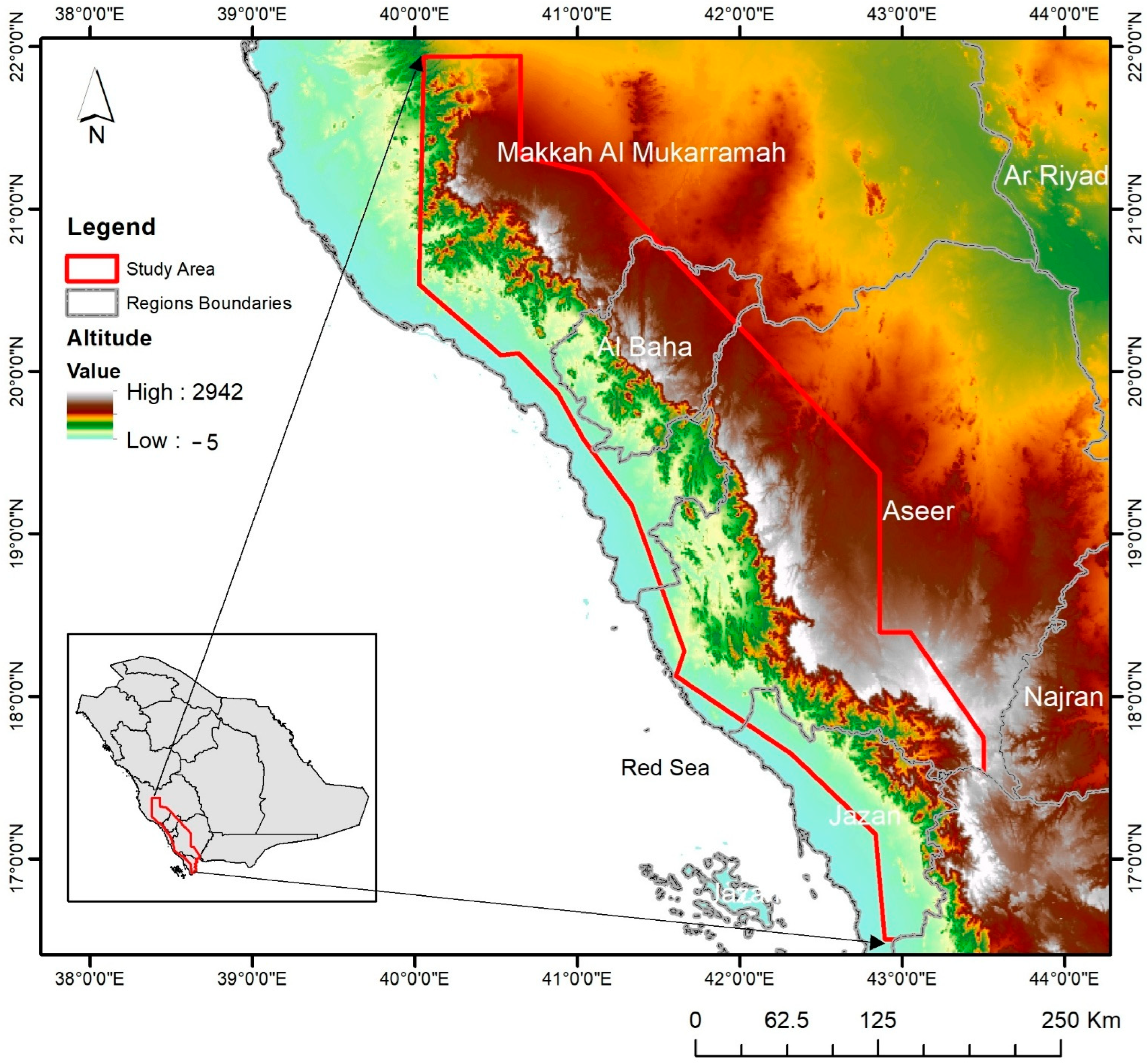
The study area extends across the western escarpment of Saudi Arabia, bounded by approximately 16°30′10″–21°56′32″ N and 40°01′15″–43°30′09″ E (Figure 1). It encompasses the mountainous and foothill landscapes of Aseer, Al Baha, Makkah Al-Mukarramah, and Jazan, forming a diverse topoclimatic corridor that spans humid lowlands to arid highlands exceeding 2000 m in elevation in Saudi Arabia. The region represents a critical ecological transition zone linking the Red Sea coastal plains with the Arabian Shield highlands, characterized by steep orographic gradients, pronounced altitudinal temperature contrasts, and variable moisture regimes [14,15].
Topographically, the landscape is dominated by rugged mountains and hills interspersed with limited plains and tablelands, collectively accounting for more than 85% of the surface area. The vegetation cover is predominantly sparse to discontinuous, with cropland–shrubland mosaics providing intermittent fuel continuity. Climatically, the area transitions from tropical dry and subtropical dry regimes in the lowlands to warm temperate uplands in Aseer and Al Baha. Persistent solar radiation, strong winds, and limited soil moisture create favorable conditions for combustion and rapid-fire spread [16,17].
Wildfire vulnerability in this region is closely linked to the interplay between terrain complexity, fuel discontinuity, and seasonal climatic variability. The mountainous systems of Aseer and northern Makkah exhibit recurrent fire activity due to steep slopes, orographic winds, and prolonged dry spells, whereas Jazan’s humid coastal lowlands remain relatively less prone to fire. These physiographic contrasts define a heterogeneous fire environment in which ignition probability and spread intensity are comodulated by elevation, vegetation cover, and atmospheric dryness. These conditions mirror broader pyroclimatic patterns observed in arid to semiarid mountain systems globally [18,19,20,21].

2.2. Schemetic Workflow

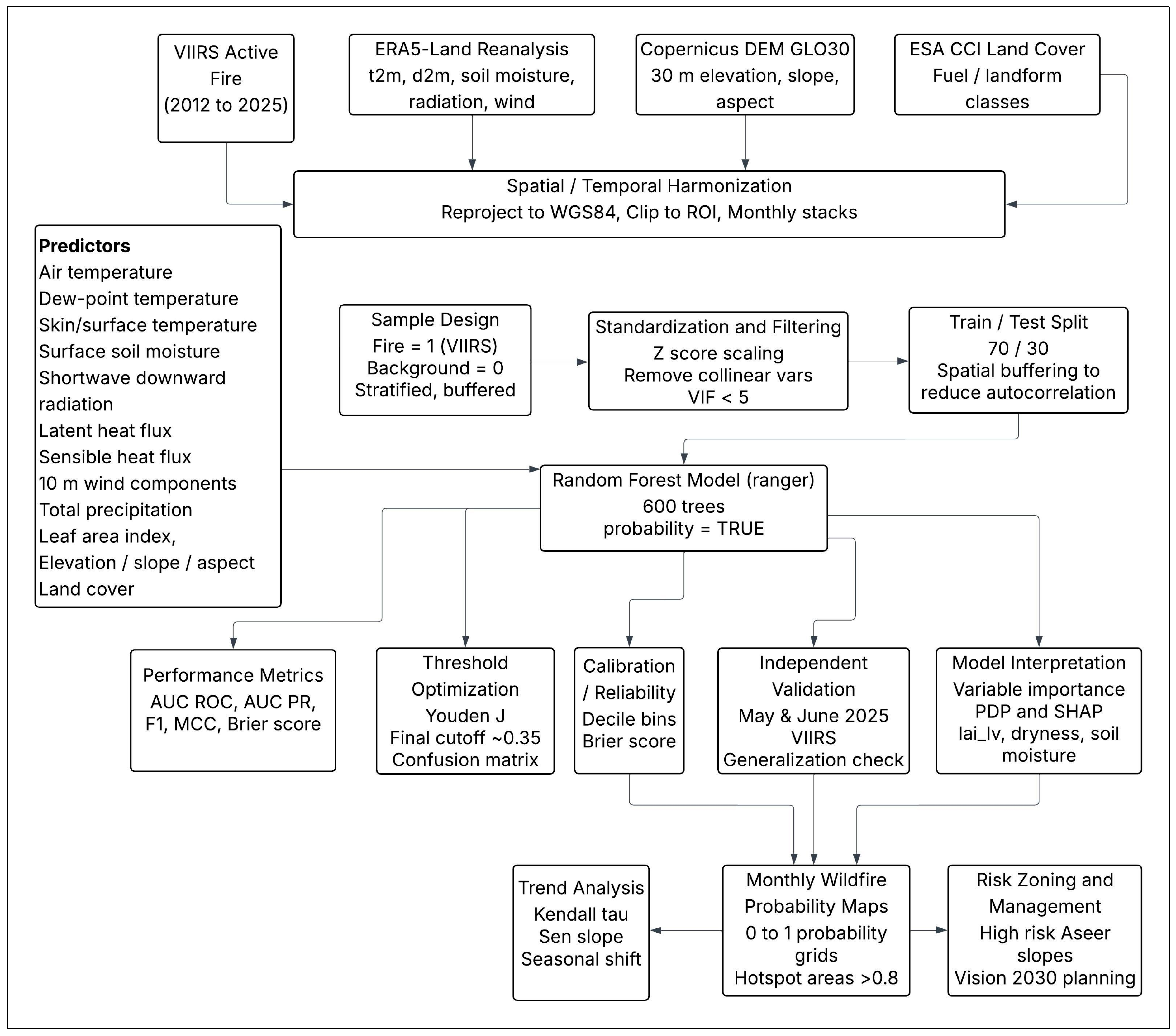
The schematic Figure 2 illustrates the integrated workflow adopted for wildfire probability modeling across the western Saudi Arabian escarpment. Multisource datasets—including VIIRS active fire detections, ERA5-Land climate reanalysis, Copernicus DEM topography, and ESA CCI land cover—were harmonized spatially and temporally to a unified monthly framework. Predictor variables representing thermal, moisture, radiative, and vegetation conditions were standardized and screened for multicollinearity prior to modeling. A Random Forest classifier was trained using stratified fire and non-fire samples, with 70/30 train–test partitioning and spatial buffering to minimize autocorrelation. Model performance and calibration were assessed using the area under the receiver operating characteristic curve (AUC-ROC), F1 score, Matthew’s correlation coefficient (MCC), and the Brier score, followed by independent temporal validation using VIIRS fire detections from 2025. Variable importance, SHAP analysis, and trend estimation (Kendall’s τ, Sen’s slope) supported ecological interpretation, risk zoning, and identification of high-probability wildfire hotspots for climate-adapted management under Vision 2030.

2.3. Data Acquisition and Inputs

2.3.1. Satellite, Reanalysis, and Ancillary Datasets

A combination of satellite, reanalysis, and ancillary geospatial datasets was used to characterize the climatic, biophysical, and topographic conditions influencing wildfire probability across western Saudi Arabia (Table 1). Active fire detections were derived from the Visible Infrared Imaging Radiometer Suite (VIIRS) Version 2 and Version 2.0 near real-time (NRT) products aboard the Suomi NPP and NOAA-20 satellites. The 375 m data (20 January 2012–8 July 2025) provided precise spatial and temporal fire locations, including pixel-level confidence and acquisition times [22].
Meteorological and surface variables were obtained from the ERA5-Land monthly reanalysis, encompassing dew-point temperature (d2m), air temperature (t2m), skin temperature (skt), volumetric soil water content (swvl1), surface latent and sensible heat fluxes (slhf, sshf), shortwave downward radiation (ssrd), 10 m wind components (u10, v10), total precipitation (tp), and leaf area indices for high and low vegetation (lai_hv, lai_lv) [11].
The topographic parameters were derived from the Copernicus DEM GLO30 (30 m), whereas the surface heterogeneity and land cover types were obtained from the ESA Climate Change Initiative (CCI) land cover dataset [23,24]. Administrative boundaries from the Common Operational Data on Administrative Boundaries (COD-AB) via the Humanitarian Data Exchange (HDX) were used to define and clip the regions of interest for analysis and visualization [25].

2.3.2. Data Preprocessing and Harmonization

All the input datasets were harmonized to ensure spatial and temporal consistency prior to modeling. ERA5-Land monthly reanalysis files (NetCDF4 format) were decoded via the terra and ncdf4 packages in R [26,27]. Temporal dimensions were converted from raw CF time units to ISO date-time, and subsets corresponding to January 2012–September 2025 were extracted. The temperature variables ( t 2 m , d 2 m , and s k t ) were converted from Kelvin to Celsius, whereas the precipitation ( t p ) was converted from meters to millimeters. All the layers were renamed sequentially as var_YYYY-MM for temporal indexing [28].
Each variable stack was exported as compressed GeoTIFFs, and area-of-interest (AOI) means were calculated for time series summaries. Bilinear resampling was applied to continuous fields (temperature, fluxes, soil moisture, and radiation), and nearest-neighbor resampling was used for categorical datasets (land cover and physiographic zones). Spatial alignment was conducted on the WGS84 (EPSG:4326) grid [29]. Fire points within the ROI were labeled positive (1), whereas randomly sampled nonfire locations represented background negatives (0). All the predictors were masked and clipped to the defined ROI boundary for consistency. All datasets originally had different spatial resolutions. To ensure scale consistency, all rasters were resampled to a unified 1 km spatial grid, and their values were extracted vector point framework for modeling, thereby eliminating resolution-driven biases and ensuring a common analytical scale.

2.3.3. Variable Derivation and Feature Engineering

The ERA5-Land variables capture the thermal, radiative, and moisture regimes governing surface combustibility. The predictors included air temperature (t2m), dew-point temperature (d2m), skin temperature (skt), soil water content (swvl1), latent (slhf) and sensible (sshf) heat fluxes, downward shortwave radiation (ssrd), total precipitation (tp), and 10 m wind components (u10, v10).
Two derived indicators were computed to better represent fire-relevant dynamics:
W S = u 10 2 + v 10 2
for surface wind speed, describing horizontal ventilation, and
D T D = t 2 m d 2 m
For the dew-point temperature deficit, quantifying the atmospheric dryness is critical for the ignition and propagation processes.
Leaf area indices for low and high vegetation (lai_lv, lai_hv) described canopy density and greenness, whereas surface soil moisture (swvl1) and radiative fluxes (ssrd, slhf, sshf) characterized energy–moisture interactions influencing fuel desiccation. Together with land-surface temperature (skt), these metrics represent vegetation productivity, fuel moisture, and surface heat availability, respectively, which drive fire probability.
Continuous predictors were standardized via z score normalization:
Z = X μ σ
where X is the raw value, μ is the mean, and σ is the standard deviation. Highly correlated variables (|r| ≥ 0.9) or those with a variance inflation factor (VIF) ≥ 5 were excluded to minimize redundancy. Light winsorization (0.1% tails) was applied to reduce the influence of extreme outliers, ensuring numerical stability and balanced variable importance during model fitting [30,31].

2.4. Model Development and Evaluation

2.4.1. Model Architecture and Training Strategy

A random forest (RF) classifier [32,33] was implemented in R via the ranger package. The model employed 600 trees with the following parameters: mtry = √p, min.node.size = 5, and probability = TRUE. Variable importance was derived via the impurity-based (Gini) method. A random seed of 4242 was set to ensure reproducibility. A brief sensitivity check using alternative settings (300/600/1000 trees and mtry = 2/√p/5) showed AUC-ROC differences < 0.008, confirming that the chosen parameters offered stable and efficient performance.

2.4.2. Training–Testing Framework

The dataset was split into 70% training and 30% testing subsets via stratified sampling, with 3 km spatial buffer applied to minimize spatial autocorrelation among neighboring samples. Negative (nonfire) samples were capped at five times the number of positive (fire) cases per month to maintain class balance. Both out-of-bag (OOB) and hold-out test AUC values were used to verify model consistency and generalizability.

2.4.3. Performance Metrics

Model discrimination and reliability were assessed via multiple performance indicators: the area under the receiver operating characteristic curve (AUC-ROC), area under the precision–recall curve (AUC-PR), accuracy, sensitivity, specificity, precision, F1 score, balanced accuracy, Matthews correlation coefficient (MCC), and Brier score [34].
The optimal probability threshold (T*) was determined using Youden’s J statistic (J), defined as:
J = Sensitivity + Specificity 1
which maximizes the trade-off between true-positive rates and false-positive rates.

2.4.4. Threshold Optimization and Confusion Analysis

Confusion matrices were generated at incremental probability thresholds (0.1–0.9) to evaluate classification stability. Threshold–performance curves (accuracy, F1 score, MCC, and Brier score vs. threshold) guided the final cutoff selection, ensuring robust discrimination and calibration across probability levels.

2.4.5. Calibration, Validation, and Reliability

The predicted event probabilities ( p ^ i ) were assessed for calibration via decile-based reliability curves. Test samples were binned into ten groups according to the predicted probability ( p ^ ), and for each bin, the observed event rate ( y ˎ ) was plotted against the mean predicted probability ( p ˎ ) [35].
Deviation from the 1:1 line indicates miscalibration. The overall probability accuracy was summarized via the Brier score:
Brier = 1 n i = 1 n ( p ^ i y i ) 2
The calibration quality was further visualized through side-by-side histograms and kernel density plots of p ^ for the fire and nonfire classes, confirming probability separation without overconfidence.
Model generalization was evaluated against VIIRS active fire detections for May and June 2025. For each month, background (nonburn) pixels were sampled from valid raster cells outside a 3 km buffer around detected fire points, maintaining a balanced 1:1 ratio (background: fire).
Validation metrics included ROC AUC (with 95% confidence intervals), PR AUC (average precision), and the Brier score. Ranking fidelity was examined via decile, lift, and cumulative gain analyses to quantify event concentration within top probability bins.
Differences in predicted probabilities ( p ^ ) between classes were summarized via classwise means and medians and statistically tested via a two-sample Kolmogorov–Smirnov (K–S) test [36].
Operational robustness was analyzed by sweeping the classification threshold T [ 0.1,0.9 ] (step = 0.1) and reporting the accuracy, sensitivity, specificity, precision, F1 score, balanced accuracy, MCC, and Brier score at each threshold.
The optimal threshold ( T ) was defined by Youden’s index:
J ( T ) = Sensitivity ( T ) + Specificity ( T ) 1
To evaluate model variance, out-of-bag (OOB) and hold-out metrics were compared, and light hyperparameter perturbations (±variations in mtry and num.trees) were applied to confirm the stability of the AUC, PR AUC, and calibration patterns. Collectively, these diagnostics demonstrate the reliability of monthly probability maps for near-term operational deployment.

2.4.6. Feature Importance and Model Interpretability Framework

Predictor influence was quantified via the mean decrease in impurity (Gini importance) derived from the random forest model. The highest-ranking predictors included the leaf area index of low vegetation (lai_lv), dew-point temperature (d2m), wind speed (computed from u10 and v10), latent heat flux (slhf), and soil moisture (swvl1), highlighting the dominant roles of vegetation structure and atmospheric dryness in controlling fire occurrence.
Partial dependence plots (PDPs) and SHapley Additive exPlanations (SHAPs) were used to interpret the functional relationships between the predictors and fire probability. These analyses revealed nonlinear response thresholds—for example, the fire probability increased sharply when lai_lv < 1.2 and the dew-point temperature deficit (DTD = t2md2m) > 7 °C—indicating synergistic effects of vegetation sparsity and atmospheric desiccation.
The dominant variables were linked to key biophysical fire mechanisms. Vegetation density and canopy moisture govern fuel continuity, whereas dew-point deficit and surface energy fluxes (ssrd, sshf) represent atmospheric and radiative processes that increase the ignition potential under semiarid conditions. These patterns collectively emphasize the coupling between vegetation dynamics and microclimatic stress in shaping fire susceptibility across the western escarpment.

2.5. Spatiotemporal and Statistical Analyses

2.5.1. Monthly and Seasonal Probability Distributions

The monthly wildfire probabilities (P1–P12) were computed for all the points across the study region to capture spatial–temporal variability. Descriptive statistics—minimum, percentiles (P10, P90), quartiles (Q1, median, Q3), mean, standard deviation, skewness, and kurtosis—characterized distributional shape and dispersion.
Hazard prevalence was expressed as the proportion of pixels exceeding thresholds (p > 0.2, 0.5, 0.8), denoting moderate, high, and extreme fire potential. Monthly and seasonal variations were visualized via violin–box plots and interquartile-range (IQR) ribbon charts [37].

2.5.2. Seasonality and Repeated-Measures Testing

Seasonal consistency was evaluated with the Friedman test, with each observation being treated as a repeated measure across months (H0: no significant difference). This nonparametric test avoids assumptions of normality and equal variance, detecting temporal heterogeneity in fire probability [38].
Significant pairwise contrasts were identified via Wilcoxon signed-rank tests with Holm correction, providing a robust framework for intraannual variation analysis.

2.5.3. Physiographic Influence Tests

To assess environmental and physiographic effects, Kruskal–Wallis tests were applied monthly across categorical variables (landform, climate region, and thermal regime), followed by Dunn’s post hoc tests with Benjamini–Hochberg correction. These analyses isolated terrain- and regime-specific controls on wildfire susceptibility [39].

2.5.4. Correlations with Vegetation and Elevation

Monthly Spearman’s rank correlations (ρ) were computed between burn probability, the NDVI, and altitude to examine vegetation–topography interactions.
A negative ρ with the NDVI indicates greater fire potential in sparsely vegetated or desiccated areas, whereas a positive ρ with elevation reflects greater susceptibility in high-relief zones characterized by steep slopes, low humidity, and strong orographic winds [40].

2.5.5. Temporal Trend Analysis (Kendall’s τ and Sen’s Slope)

Long-term monthly trends (2012–2025) in wildfire probability were assessed via Kendall’s τ, which measures monotonic changes over time. A positive τ signified increasing fire potential, and a negative τ signified a decline.
The trend magnitude was estimated via Sen’s slope:
β = median ( P j P i j i ) ,   i < j
where Pi and Pj denote the monthly mean probabilities in years i and j [41].
Spatial summaries include the mean τ, standard deviation, and proportion of positive τ values, which are visualized through state-month heatmaps to reveal temporal intensification patterns.

2.5.6. Ecological Gradient and Spatial Association

Spatial variation in τ was analyzed across landform, climate, and thermal regime classes via the Kruskal-Wallis test and Dunn’s test to detect ecological gradients of increasing fire probability. The share of positive τ values (τ > 0) within each class quantified the persistence of upward fire risk.
Correlation analyses between τ, NDVI, and altitude—conducted monthly and for the full series (adjusted for month effects)—elucidated how vegetation structure and elevation jointly modulate wildfire dynamics during the Saudi escarpment [42].

2.5.7. Spatial Autocorrelation Diagnostics (Moran’s I)

To quantify spatial dependence in the modeled wildfire probability surfaces, Global Moran’s I was computed for each monthly probability raster using a k-nearest-neighbor spatial weights matrix (k = 8). Moran’s I, z-scores, and p-values were calculated to assess the degree of spatial clustering and to confirm that spatial dependence was driven by underlying physiographic and climatic gradients rather than model artifacts.

2.6. Seasonal Shift and Timing Analysis Framework

Year-to-year changes in the timing of peak wildfire potential were derived from monthly probability rasters summarized as regional area means.
For each year y, we identified (i) the peak month
m ^ y = a r g   m a x m   P y , m ,
and (ii) a seasonal centroid (circular mean month) weighting months by their mean probability [43,44]:
θ m = 2 π ( m 1 ) 12 ,   C x = m = 1 12 P y , m   c o s   θ m ,   C y = m = 1 12 P y , m   s i n   θ m ,   ϕ y = a t a n 2   ( C y ,   C x ) , CentroidMonth y = 1 + ( ϕ y   m o d   2 π ) 2 π × 12 .
Here, P y , m represents the area-mean probability for month m in year y.
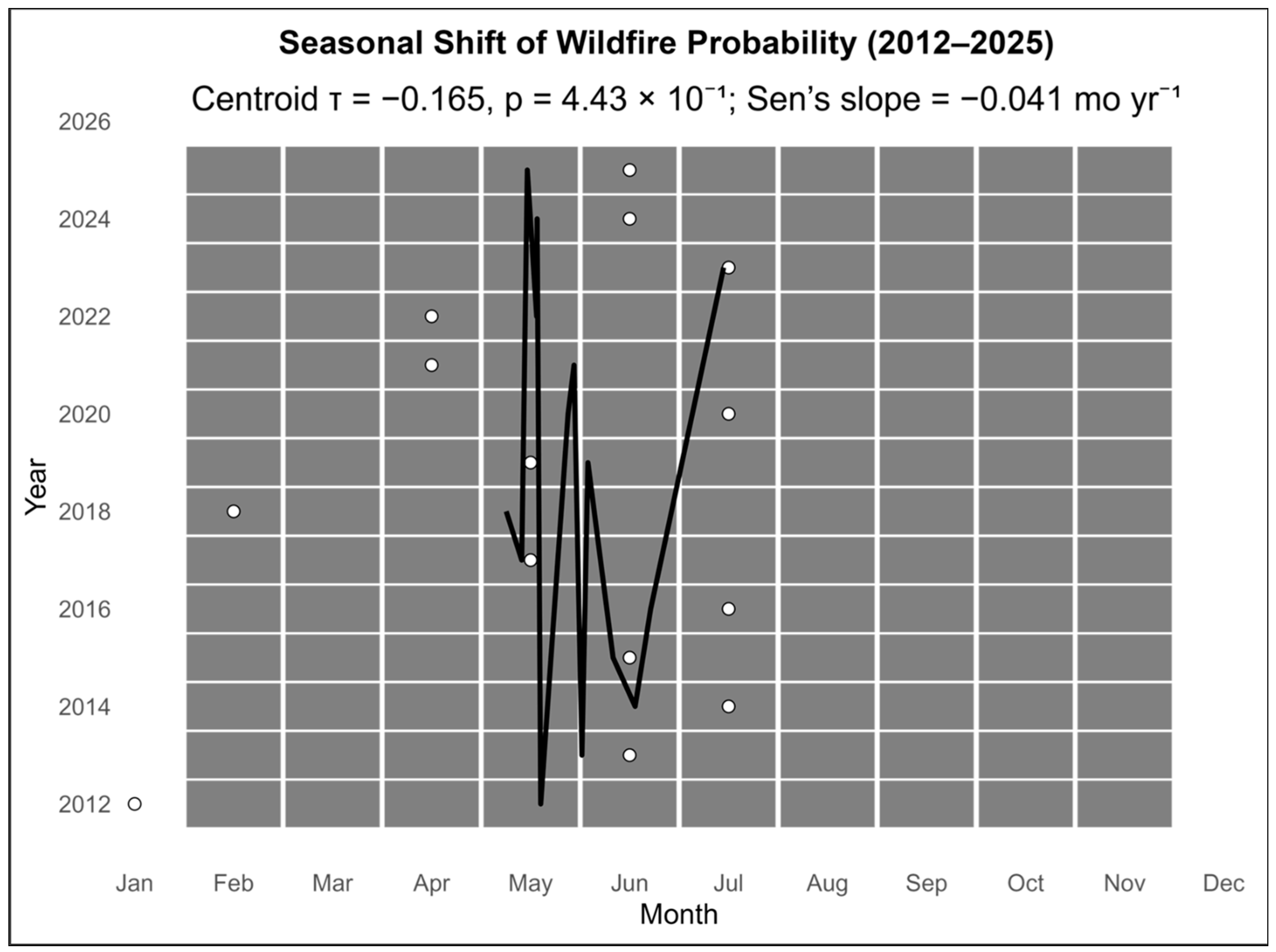
A year × month heatmap is visualized P y , m (fill), with annual peaks ( m ^ y ) shown as points and centroid trajectories ( CentroidMonth y ) as a polyline, revealing long-term seasonal drift.
Trend significance was assessed via Kendall’s τ for (a) the centroid series { CentroidMonth y } and (b) each fixed-month series { P y , m } y (n ≥ 6 years). The trend magnitude was estimated by Sen’s slope:
β ^ = m e d i a n   i < j Z j Z i j i ,
where Z represents either the centroid month or monthly probability.
We report τ, p values, and Sen’s slope with confidence intervals, expressed in months per year for centroid timing and probability units per year for monthly intensity.
This framework jointly quantifies (1) shifts in the timing of the seasonal fire peak and (2) monotonic changes in fire potential intensity without assuming linearity or normality [45,46].

2.7. Analytical Tools and Libraries

All data processing, statistical analyses, and figure generation were performed in R (version 4.3.2; R Core Team, 2024) within the RStudio (version 4.5.1) IDE on a Windows 10 × 64 system. The workflow integrated geospatial, statistical, and visualization libraries to ensure full reproducibility and analytical rigor.
Spatial processing: terra (raster manipulation, clipping, masking), sf (vector operations, reprojection), and sp (legacy spatial support).
Statistical computing: rstatix, Kendall, and trend for nonparametric inference, including the Friedman, Kruskal–Wallis, Wilcoxon, Mann–Kendall, and Sen’s slope tests.
Data transformation: dplyr, tidyr, stringr, readr, and broom for data wrangling, joining, and tidy statistical outputs.
Descriptive analysis: moments (skewness and kurtosis) and Hmisc (quantile summaries).
Modeling and machine learning: Ranger (random forest), caret (cross-validation and hyperparameter tuning), and SHAPforxgboost (feature interpretation).

3. Results

3.1. Model Performance

3.1.1. Predictive Accuracy and Discrimination

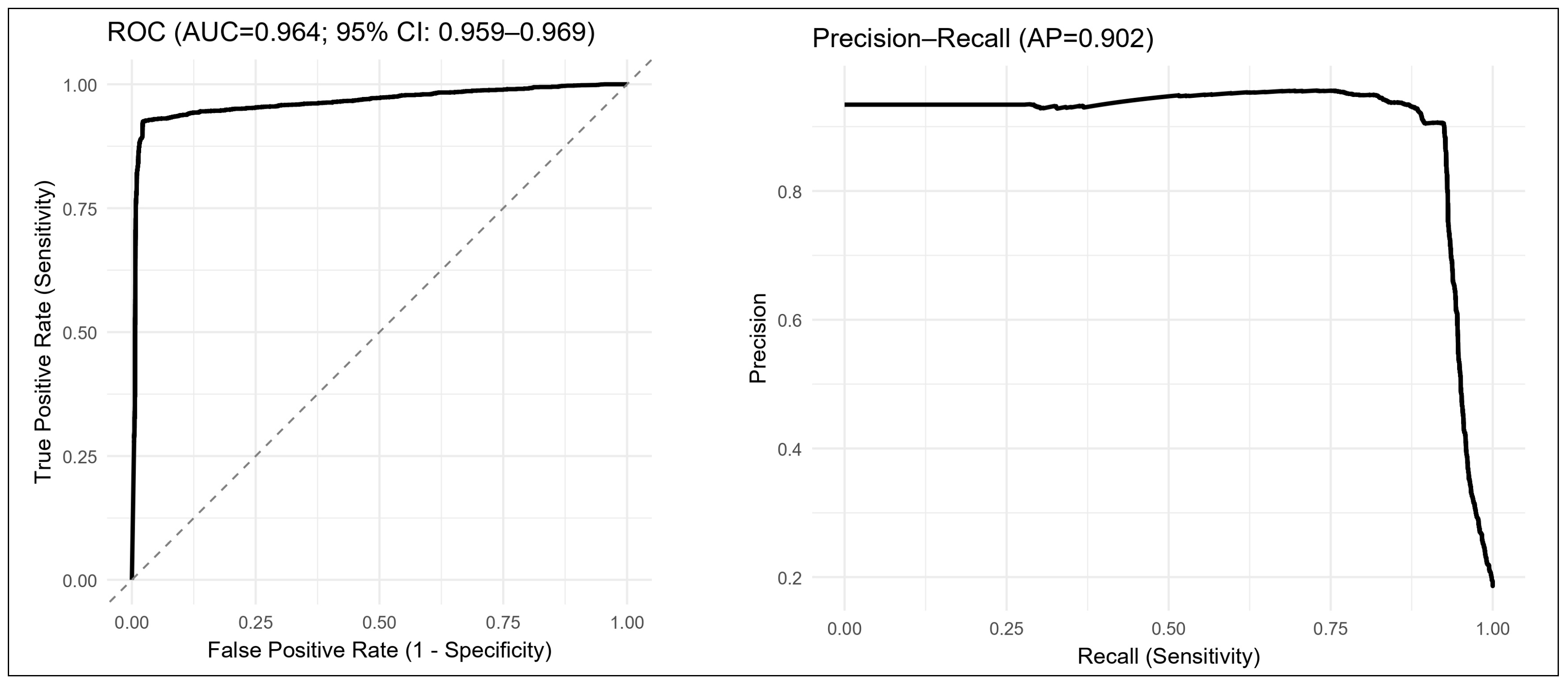
The random forest model showed excellent discrimination from 2012–2025. AUC-ROC = 0.964 (95% CI = 0.959–0.969) and AUC-PR = 0.902 confirmed outstanding classification performance (Figure 3). The Youden-optimized threshold (0.35) provided a balanced trade-off between sensitivity and specificity (Table 2).
The corresponding confusion matrix (Table 3) indicates high true-positive and true-negative counts, with very few misclassifications (316 FNs and 246 FPs), confirming that the model accurately distinguishes between fire-prone and nonfire pixels.

3.1.2. Calibration and Reliability

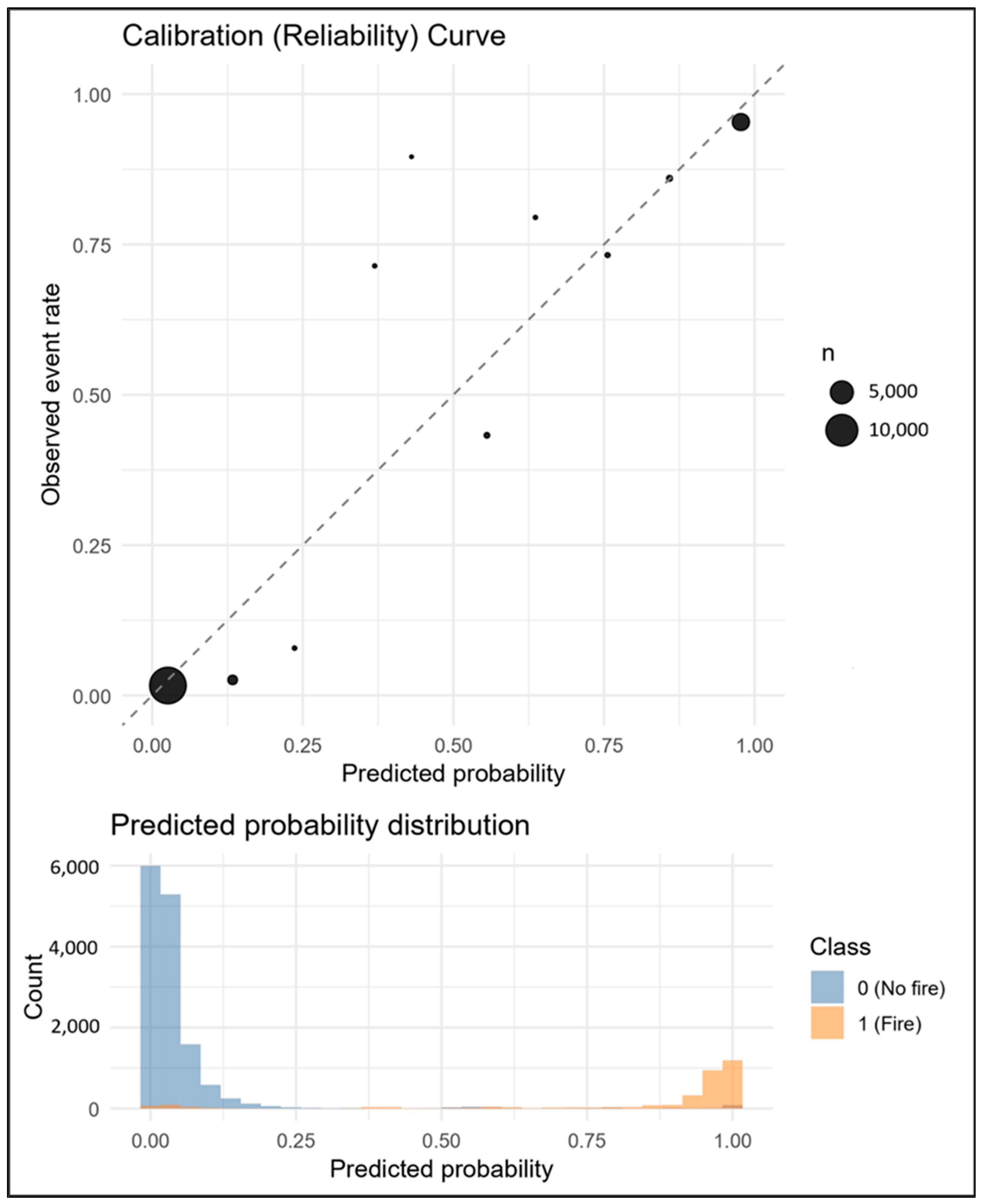
The calibration plots (Figure 4) revealed near-perfect 1:1 alignment between the predicted and observed probabilities.
A Brier score = 0.03 indicates excellent probabilistic accuracy. Across the thresholds of 0.1–0.9, the accuracy remained ≈ 0.87, and the Brier score ranged from 0.001–0.007 (Table 4), confirming consistent reliability.

3.1.3. Threshold-Based Classification Metrics

At the optimal threshold (0.35), the model attained accuracy = 0.968, sensitivity = 0.978, specificity = 0.925, and F1 = 0.98 (Table 3).
High precision (0.983) demonstrates minimal false positives, whereas an MCC = 0.895 denotes strong balanced predictive power.
The confusion matrix distribution (Table 3) further confirms the model’s excellent performance across both classes.

3.1.4. Independent Validation with Burn Pixels

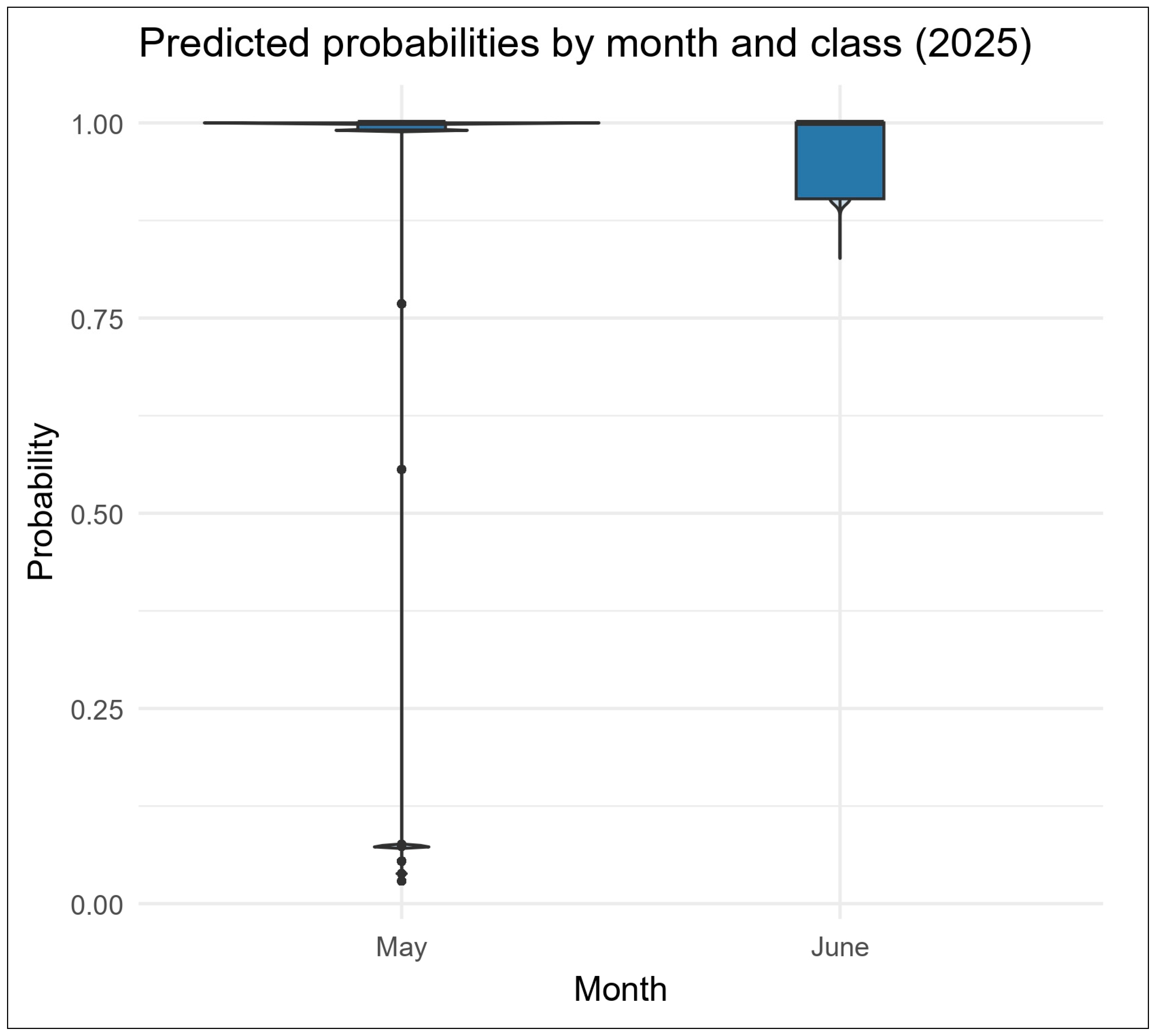
Validation with VIIRS detections (Table 5) confirmed strong generalization: mean predicted probabilities = 0.87 (May) and 0.97 (June) with low dispersion (SD = 0.05–0.32).
Sixty-four percent of burn pixels occurred within the top 10% of the predicted probabilities, and 87% occurred within the top 20%, confirming excellent ranking fidelity (Table 6).
Figure 5 shows the distribution of the predicted probabilities for May and June 2025, with consistently high probability values and tighter dispersion in June, confirming the model’s reliability across independent months.

3.1.5. Feature Importance and Model Interpretation

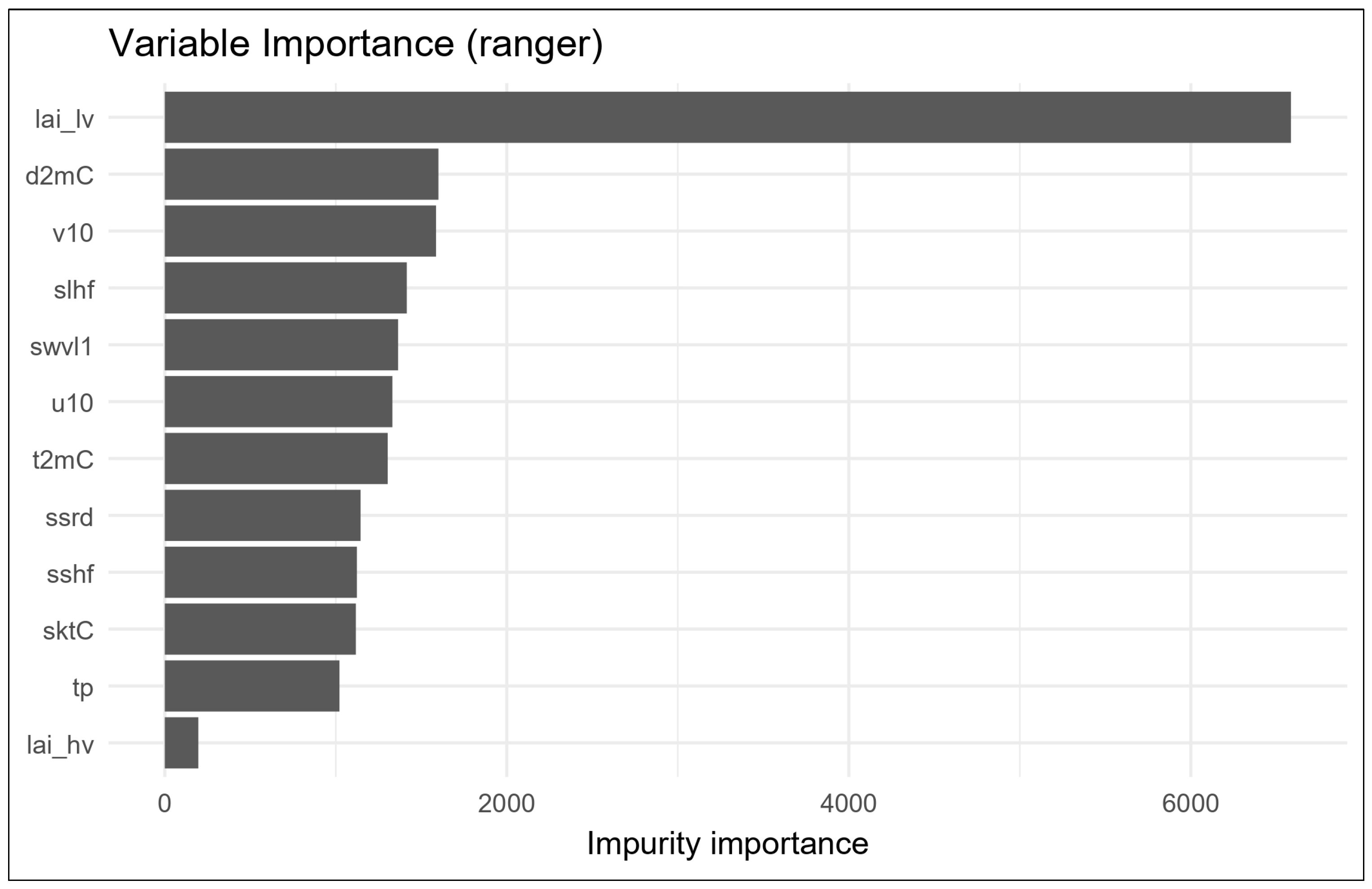
Variable-importance analysis (Figure 6) identified lai_lv as the most influential predictor, confirming that vegetation density and canopy activity govern fire probability in this semiarid system.
Next, dew-point temperature (d2m) and wind velocity (v10) regulate surface dryness and the oxygen supply.
Latent heat flux (slhf) and soil water content (swvl1) rank closely, representing energy balance and fuel-moisture effects.
Moderate influences arise from air temperature (t2m), shortwave radiation (ssrd), and sensible heat flux (sshf), whereas surface temperature (skt), precipitation (tp), and high-vegetation LAI (lai_hv) add marginal information.

3.1.6. Spatial Autocorrelation Diagnostics

Global Moran’s I statistics computed for the monthly wildfire probability surfaces confirmed significant spatial clustering across all months. Moran’s I values ranged from 0.089 (November) to 0.222 (July), far exceeding the expected value under spatial randomness (−0.0014). All months exhibited high positive z-scores (5.36–12.88) with p-values < 10−7, indicating that the modeled fire probabilities are spatially structured rather than randomly distributed. The strongest clustering occurred during June–July, coinciding with the peak dry-season buildup of flammable conditions, whereas November showed the weakest but still significant spatial dependence.

3.2. Spatiotemporal Distribution of Wildfire Probability

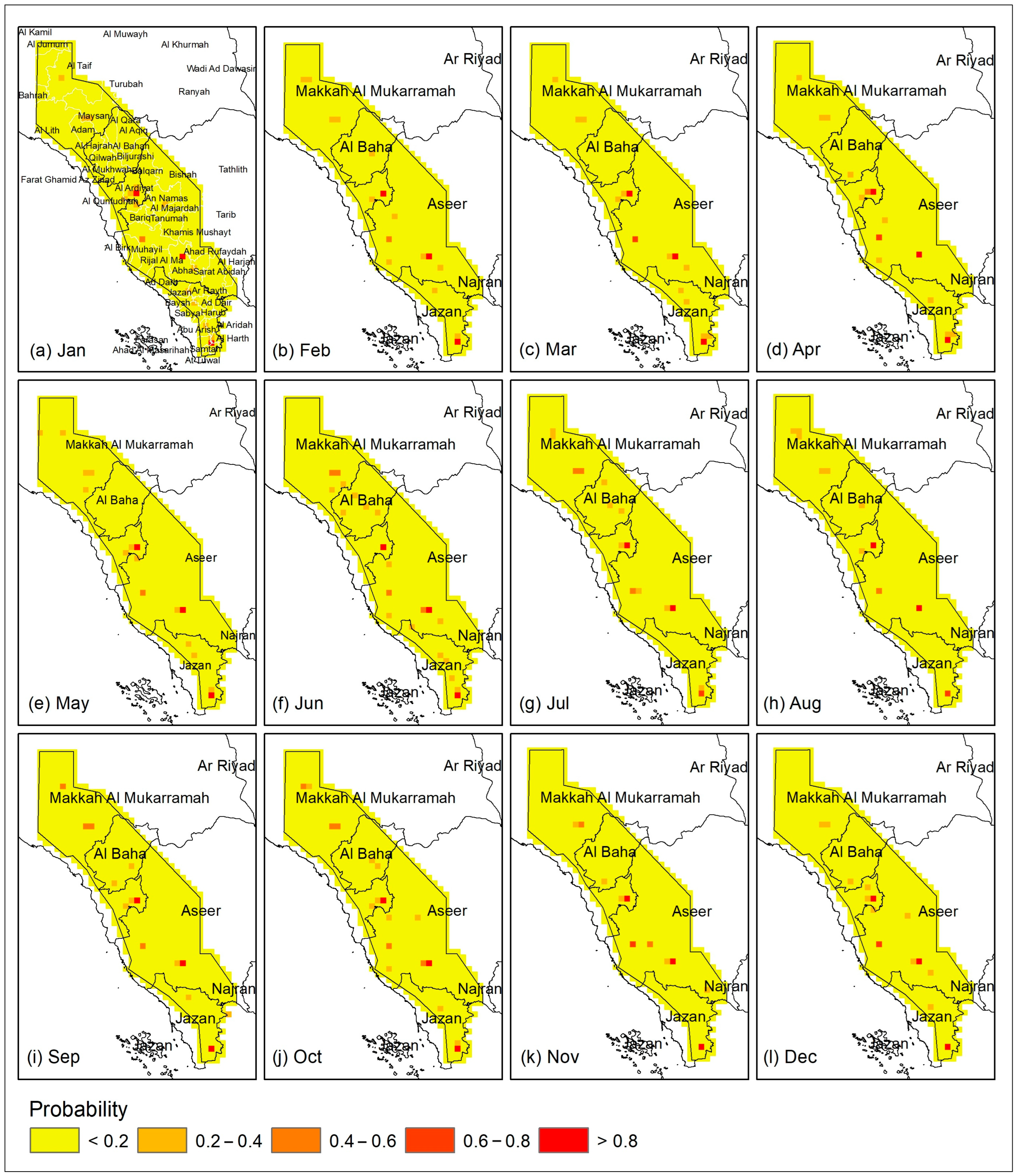
Wildfire probability (Figure 7a–l) showed strong and statistically significant seasonality (Friedman χ2 = 1274.04, df = 11, p = 1.77 × 10−266). The distribution was highly uneven across months, exhibiting pronounced right skewness (6.6–9.2) and extreme leptokurtosis (63–105), indicating a few localized zones with disproportionately high fire potential. The seasonal cycle intensified between May and July, when the probability values broadened in range and variance due to widespread fuel desiccation and premonsoon heat buildup. Very high probability classes (>0.80) occurred every month (~0.3–0.4% of the area), confirming persistent local hotspots despite low overall averages.
Across regions, Aseer consistently recorded the highest burn probabilities, significantly exceeding Jazan in all pairwise comparisons (Dunn post hoc Z = 6.1–8.5, p < 10−10–10−16). During the main fire season (April–July and September), Aseer also surpassed Makkah Al-Mukarramah (e.g., April Z = 3.01, p = 0.0039; June Z = 5.78, p = 2.3 × 10⁻⁸; July Z = 2.67, p = 0.011). Although smaller in extent, Al Baha often trailed Aseer in May–June (Z ≈ −2.9, p < 0.01) but did not differ significantly from Makkah. Jazan remained the lowest-probability region throughout the year (e.g., January Z = 6.72, p = 5.5 × 10⁻¹¹; December Z = 5.48, p = 1.3 × 10⁻⁷).
From a management perspective, Aseer represents the most fire-prone landscape, with May–July forming a high-alert period when more than 2–3% of the pixels exceed the 0.20 probability threshold, whereas Jazan maintains the lowest structural hazard.
Kruskal-Wallis tests confirmed the significant effects of landform type on burn probability every month (p < 10−11). Mountainous and hilly terrains presented higher probabilities than plains and tablelands did, reflecting steeper slopes, thinner soils, and greater wind exposure that accelerated fuel drying. This physiographic control accounts for much of the elevated risk in Aseer and northern Makkah, where topography amplifies thermal stress and dry-season fuel connectivity. The spatial clustering of exceedance zones within high-relief environments indicates that the terrain, rather than the regional climate alone, governs the fine-scale structure of wildfire potential across western Saudi Arabia.

3.3. Kendall’s τ Trend by Calendar Month (2012–2025)

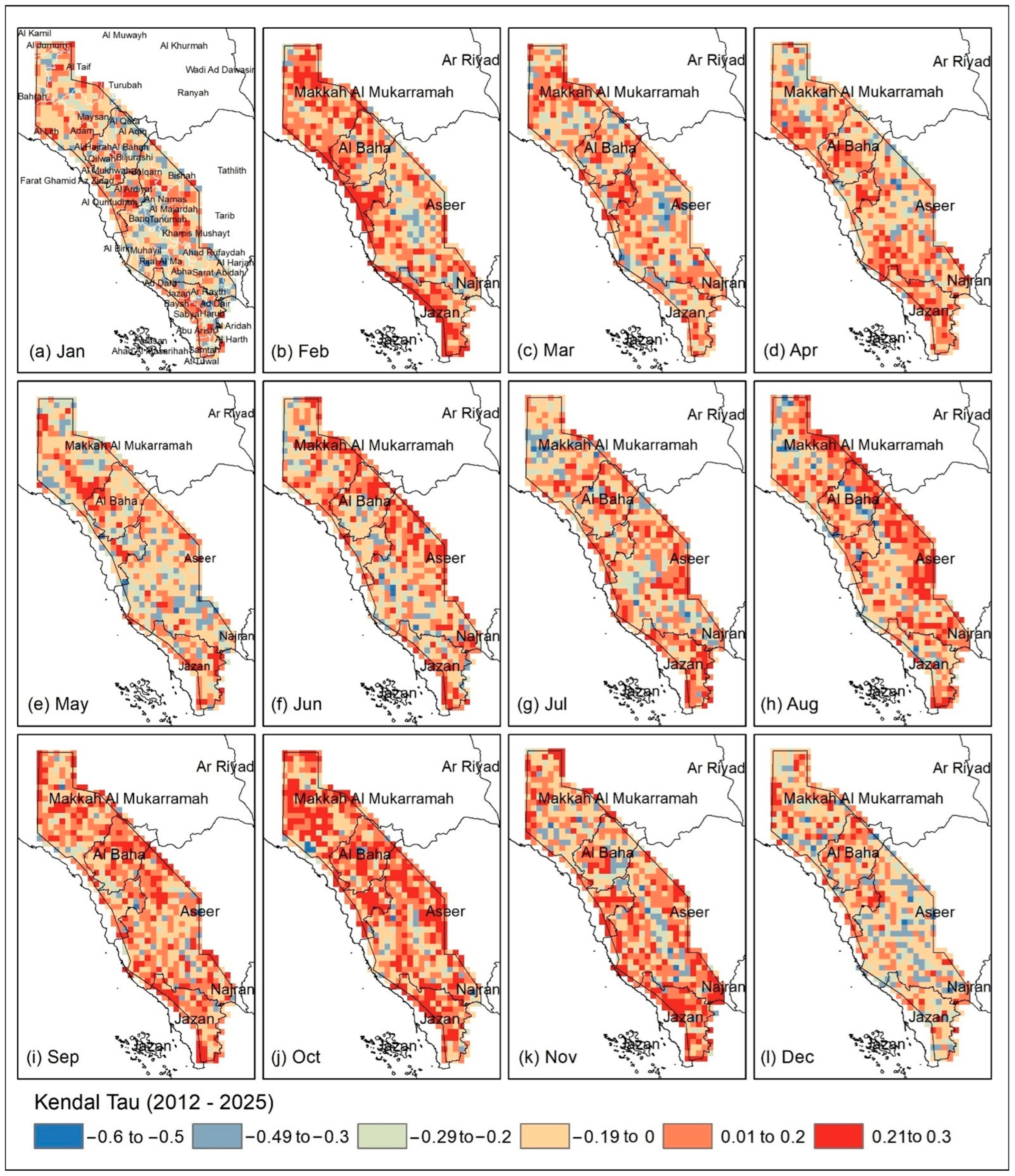
As shown in Figure 8a–l, Jazan exhibited the most persistent and spatially extensive positive trends, with significant increases during February, April, July, September, October, and November ( τ ¯ up to 0.18; p < 0.001). Over 75% of the area trended upward by late autumn, indicating a strong and coherent intensification of fire potential in coastal lowlands.
Aseer followed with consistent positive shifts from August to November, particularly in October ( τ ¯ ≈ 0.07; p = 1.7 × 10⁻⁶), when more than 60% of the region recorded increasing tendencies. This indicates a transition from early-year recovery to late-year recovery in terms of burn probability.
Makkah Al-Mukarramah showed notable increases in February, September, and October ( τ ¯ ≈ 0.10–0.12; p < 10−9–10−13), reflecting increased dry-season risk during escarpment.
In Al Baha, upward trends appeared mainly in September and October ( τ ¯ ≈ 0.05–0.09; p < 0.05), with approximately 70% of the sites trending positive in October.

3.4. Seasonal Shift and Timing

Kendall’s trend analysis of the monthly mean wildfire probability revealed no statistically significant monotonic shifts from 2012–2025 (|τ| < 0.32; p > 0.12). Weakly positive tendencies appeared in February–April and September–November, whereas the values in January, May, and December slightly decreased. The largest positive coefficient occurred in February with a modest Sen’s slope of ≈7 × 10⁻⁴ yr−1, suggesting a gradual but not yet significant intensification of early-year fire potential (Figure 9).
Importantly, the months showing positive trends correspond closely to those with the highest modeled seasonal probability, indicating that trend behavior is seasonally dependent. That is, the long-term increase in wildfire probability is concentrated within the months that already form the core of the regional fire season, reinforcing the link between seasonality and long-term intensification of fire risk.

4. Discussion

The modeled wildfire probability across western Saudi Arabia has a pronounced climatic and physiographic imprint, which is consistent with the region’s transitional arid–montane environment. The random forest classifier achieved high discriminatory performance (AUC-ROC = 0.96), aligning with previous machine learning studies in semiarid fire ecology that demonstrated the capacity of nonlinear ensemble models to capture complex vegetation–climate–topography interactions [47,48]. Over the past decade, machine-learning methods have substantially advanced wildfire probability modeling across different biomes regimes. Algorithms such as Random Forest, Gradient Boosting, and deep neural networks have demonstrated strong capability in capturing nonlinear interactions among fuel structure, topographic gradients, and climatic variability, outperforming traditional empirical and statistical models. These approaches increasingly integrate multisource Earth observation datasets, enabling finer spatial predictions and improved early-warning performance under complex environmental conditions. Building on this global progress, the present model enhances predictive accuracy through unified 1 km preprocessing, spatial buffering, and multivariate climatic–physiographic coupling, resulting in notably improved probability estimates for arid-montane ecosystems.
Across global dryland fire studies, similar patterns have been reported. Research from the Mediterranean Basin and North Africa indicates that fine-fuel dryness, vapor-pressure deficit, and soil moisture depletion are dominant drivers of ignition probability [49,50]. Studies in the Sahel and East African Highlands further show that canopy continuity and atmospheric desiccation amplify fire susceptibility during transitional seasons [51,52]. In mountainous dryland systems such as the Zagros and Andean foothills, steep slopes and orographic winds intensify fuel desiccation and produce spatial fire hotspots similar to those observed in the Aseer Highlands [53,54]. Additionally, dual-peak fire seasons associated with pre- and post-monsoon heating have been documented across Arabian and Saharan ecotones [55], consistent with the bimodal seasonality observed in the present study. Collectively, these findings demonstrate that the climatic and physiographic controls shaping wildfire probability in western Saudi Arabia align with broader fire–climate mechanisms in other arid and semiarid mountain ecosystems.
The dominant influence of the leaf area index of low vegetation (LAI_lv), dew-point deficit, and surface soil moisture (swvl1) support findings from Mediterranean and Sahelian systems, where fine-fuel dryness, canopy continuity, and atmospheric desiccation jointly modulate ignition likelihood and spread intensity [56]. Spatially, the Aseer Highlands emerged as the most fire-prone zone, reflecting the synergy between steep relief, intense solar loading, and persistent orographic winds that accelerate fuel desiccation. In contrast, the Jazan coastal belt presented consistently low probabilities associated with relatively high humidity and fragmented vegetation. These elevation-dependent gradients mirror altitudinal zonation patterns of combustibility reported across other tropical dry ecosystems [57], underscoring the role of topography in fire–climate coupling.
The bimodal seasonality of elevated burn probability—peaking from May–July and September–November—reflects a pre- and postmonsoon duality, where thermal accumulation and delayed rainfall jointly heighten the ignition potential. Similar dual-peak regimes in North African and Arabian transition zones [58] suggest that short windows of atmospheric instability, rather than prolonged dryness, drive fire occurrence across the region.
Trend analyses indicate a subtle but coherent increase in fire potential, especially during the early dry season. This likely reflects warming and rising vapor pressure deficits that gradually amplify flammability, which is consistent with ERA5-based evidence of increasing maximum temperatures and declining relative humidity since 2010. The positive Kendall’s τ values in Aseer and Makkah further emphasize the vulnerability of montane vegetation to climate-induced fuel desiccation, even under limited anthropogenic ignition sources.
From a management standpoint, the findings highlight the importance of integrating satellite-based early warning with physiographic risk zoning to enhance preparedness under Saudi Vision 2030. Resource allocation should prioritize Aseer’s montane slopes and northern Makkah escarpments during the pre-monsoon window when ignition risk peaks.
Future work should extend this framework by incorporating dynamic vegetation indices (NDVI/EVI time series), high-resolution wind–terrain interactions, and fire spread simulations under projected CMIP6 SSP2–4.5 and SSP5–8.5 scenarios to anticipate shifts in the regional fire regime.

5. Conclusions

This study modeled wildfire probability across western Saudi Arabia via multisource Earth observation datasets and random forest classification. The model achieved high predictive accuracy (AUC-ROC = 0.96) and revealed that vegetation structure (LAI_lv), atmospheric dryness (dew-point deficit), and surface soil moisture (swvl1) are the primary controls on fire potential. Spatial patterns identified the Aseer Highlands and northern Makkah escarpments as persistent high-risk zones, whereas the Jazan coastal plain exhibited low susceptibility due to humid conditions. Seasonal and trend analyses indicated a bimodal fire regime—with peaks in May–July and September–November—and the gradual intensification of early dry-season risk under conditions of a rising temperatures and vapor-pressure deficit. These results underscore the influence of climate variability on fire dynamics in arid–montane ecosystems. Integrating satellite-based early-warning systems with physiographic risk zoning can strengthen wildfire preparedness by guiding MEWA’s monthly alert dashboards, prioritizing high-risk escarpment zones for targeted fuel-management and ranger deployment, and providing spatially explicit decision-support tools that directly contribute to Saudi Vision 2030 environmental resilience goals.

Author Contributions

Methodology, R.A.-Q.; Validation, R.A.-Q.; Formal analysis, R.A.-Q.; Investigation, Z.I.; Resources, Z.I.; Data curation, R.A.-Q.; Writing—original draft, R.A.-Q.; Writing—review & editing. All authors have read and agreed to the published version of the manuscript.

Funding

The authors extend their appreciation to King Khalid University and the Ministry of Education in the Kingdom of Saudi Arabia for funding this research work through project number RGP2/439/45.

Data Availability Statement

The data that support the findings of this study are freely available from the following public repositories:

Acknowledgments

The authors sincerely thank King Khalid University for their support. The authors also acknowledge the technical support provided by the research center and all individuals who contributed to the successful completion of this study.

Conflicts of Interest

The authors declare no conflicts of interest.

Abbreviations

The following abbreviations are used in this manuscript:
AUC-ROCArea Under the Receiver Operating Characteristic Curve
AUC-PRArea Under the Precision–Recall Curve
DTDDew-Point Temperature Deficit
ERA5-LandFifth Generation ECMWF Reanalysis for Land Variables
ESAEuropean Space Agency
HDXHumanitarian Data Exchange
LAI_lv/LAI_hvLeaf Area Index of Low/High Vegetation
MCCMatthews Correlation Coefficient
NRTNear Real Time
RFRandom Forest
ROIRegion of Interest
SHAPSHapley Additive exPlanations
SSPShared Socioeconomic Pathway
VIIRSVisible Infrared Imaging Radiometer Suite
VIFVariance Inflation Factor

References

  1. Al-Rowaily, S.L.; El-Bana, M.I.; Al-Bakre, D.A.; Assaeed, A.M.; Hegazy, A.K.; Ali, M.B. Effects of Open Grazing and Livestock Exclusion on Floristic Composition and Diversity in Natural Ecosystem of Western Saudi Arabia. Saudi J. Biol. Sci. 2015, 22, 430–437. [Google Scholar] [CrossRef]
  2. Saudi Vision 2030. Overview. Available online: https://www.vision2030.gov.sa/en/overview (accessed on 1 October 2025).
  3. Chuvieco, E.; Mouillot, F.; van der Werf, G.R.; San Miguel, J.; Tanase, M.; Koutsias, N.; García, M.; Yebra, M.; Padilla, M.; Gitas, I.; et al. Historical Background and Current Developments for Mapping Burned Area from Satellite Earth Observation. Remote Sens. Environ. 2019, 225, 45–64. [Google Scholar] [CrossRef]
  4. Abatzoglou, J.T.; Williams, A.P.; Barbero, R. Global Emergence of Anthropogenic Climate Change in Fire Weather Indices. Geophys. Res. Lett. 2018, 46, 326–336. [Google Scholar] [CrossRef]
  5. Forkel, M.; Andela, N.; Harrison, S.P.; Lasslop, G.; van Marle, M.; Chuvieco, E.; Dorigo, W.; Forrest, M.; Hantson, S.; Heil, A.; et al. Emergent Relationships with Respect to Burned Area in Global Satellite Observations and Fire-Enabled Vegetation Models. Biogeosciences 2019, 16, 57–76. [Google Scholar] [CrossRef]
  6. Almendra-Martín, L.; Martínez-Fernández, J.; González-Zamora, Á.; Benito-Verdugo, P.; Herrero-Jiménez, C.M. Agricultural Drought Trends on the Iberian Peninsula: An Analysis Using Modeled and Reanalysis Soil Moisture Products. Atmosphere 2021, 12, 236. [Google Scholar] [CrossRef]
  7. Quintano, C.; Fernandez-Manso, A.; Roberts, D.A. Burn Severity Mapping from Landsat MESMA Fraction Images and Land Surface Temperature. Remote Sens. Environ. 2016, 190, 83–95. [Google Scholar] [CrossRef]
  8. Archibald, S.; Lehmann, C.E.R.; Gómez-Dans, J.L.; Bradstock, R.A. Defining Pyromes and Global Syndromes of Fire Regimes. Proc. Natl. Acad. Sci. USA 2013, 110, 6442–6447. [Google Scholar] [CrossRef]
  9. Giglio, L.; Boschetti, L.; Roy, D.P.; Humber, M.L.; Justice, C.O. The Collection 6 MODIS Burned Area Mapping Algorithm and Product. Remote Sens. Environ. 2018, 217, 72–85. [Google Scholar] [CrossRef]
  10. Almazroui, M.; Saeed, F.; Saeed, S.; Ismail, M.; Ehsan, M.A.; Islam, M.N.; Abid, M.A.; O’Brien, E.; Kamil, S.; Rashid, I.U.; et al. Projected Changes in Climate Extremes Using CMIP6 Simulations over SREX Regions. Earth Syst. Environ. 2021, 5, 481–497. [Google Scholar] [CrossRef]
  11. ERA5-Land Monthly Averaged Data from 1950 to Present. European Centre for Medium-Range Weather Forecasts. 2019. Available online: https://cds.climate.copernicus.eu/datasets/reanalysis-era5-land-monthly-means?tab=overview (accessed on 12 October 2025).
  12. European Space Agency (ESA). Copernicus DEM GLO-30 Dataset Documentation; European Space Agency: Paris, France, 2023; Available online: https://dataspace.copernicus.eu/sites/default/files/media/files/2024-06/geo1988-copernicusdem-spe-002_producthandbook_i5.0.pdf (accessed on 2 October 2025).
  13. NASA/NOAA. VIIRS Active Fire Products User Guide (Version 2.0); NASA Earth Science Data Systems: Greenbelt, MD, USA, 2024. Available online: https://lpdaac.usgs.gov/documents/427/VNP14_User_Guide_V1.pdf (accessed on 4 October 2025).
  14. Almazroui, M. Rainfall Trends and Extremes in Saudi Arabia in Recent Decades. Atmosphere 2020, 11, 964. [Google Scholar] [CrossRef]
  15. World Bank Climate Change Knowledge Portal. Available online: https://climateknowledgeportal.worldbank.org/country/saudi-arabia (accessed on 7 October 2025).
  16. Saharwardi, M.S.; Dasari, H.P.; Hassan, W.U.; Gandham, H.; Pathak, R.; Zampieri, M.; Ashok, K.; Hoteit, I. Projected Increase in Droughts over the Arabian Peninsula and Associated Uncertainties. Sci. Rep. 2025, 15, 1711. [Google Scholar] [CrossRef]
  17. Pathak, R.; Dasari, H.P.; Ashok, K.; Hoteit, I. Dynamics of Intensification of Extreme Precipitation Events over the Arabian Peninsula Derived from CMIP6 Simulations. NPJ Clim. Atmos. Sci. 2025, 8, 126. [Google Scholar] [CrossRef]
  18. Krawchuk, M.A.; Moritz, M.A.; Parisien, M.-A.; Van Dorn, J.; Hayhoe, K. Global Pyrogeography: The Current and Future Distribution of Wildfire. PLoS ONE 2009, 4, e5102. [Google Scholar] [CrossRef]
  19. Bowman, D.M.J.S.; Moreira-Muñoz, A.; Kolden, C.A.; Chávez, R.O.; Muñoz, A.A.; Salinas, F.; González-Reyes, Á.; Rocco, R.; de la Barrera, F.; Williamson, G.J.; et al. Human–Environmental Drivers and Impacts of the Globally Extreme 2017 Chilean Fires. AMBIO 2018, 48, 350–362. [Google Scholar] [CrossRef] [PubMed]
  20. Abatzoglou, J.T.; Williams, A.P. Impact of Anthropogenic Climate Change on Wildfire across Western US Forests. Proc. Natl. Acad. Sci. USA 2016, 113, 11770–11775. [Google Scholar] [CrossRef] [PubMed]
  21. Giglio, L.; Schroeder, W.; Justice, C.O. The Collection 6 MODIS Active Fire Detection Algorithm and Fire Products. Remote Sens. Environ. 2016, 178, 31–41. [Google Scholar] [CrossRef]
  22. Justice, C.O.; Roman, M.O.; Csiszar, I.; Vermote, E.F.; Wolfe, R.E.; Hook, S.J.; Friedl, M.; Wang, Z.; Schaaf, C.B.; Miura, T.; et al. Land and cryosphere products from Suomi NPP VIIRS: Overview and status. J. Geophys. Res. Atmos. 2013, 118, 9753–9765. [Google Scholar] [CrossRef] [PubMed]
  23. Reinhart, V.; Fonte, C.C.; Hoffmann, P.; Bechtel, B.; Rechid, D.; Boehner, J. Comparison of ESA Climate Change Initiative Land Cover to CORINE Land Cover over Eastern Europe and the Baltic States from a Regional Climate Modeling Perspective. Int. J. Appl. Earth Obs. Geoinf. 2020, 94, 102221. [Google Scholar] [CrossRef]
  24. ESA Climate Change Initiative (CCI). Land Cover v2.1.1 Dataset (1992–2022); European Space Agency: Frascati, Italy, 2023; Available online: https://climate.esa.int/en/projects/land-cover/ (accessed on 15 October 2025).
  25. Humanitarian Data Exchange (HDX). Common Operational Data on Administrative Boundaries (COD-AB), Saudi Arabia Edition 2024; United Nations OCHA: Geneva, Switzerland, 2024; Available online: https://data.humdata.org/dataset/cod-ab-sau (accessed on 15 October 2025).
  26. Hijmans, R.J. terra: Spatial Data Analysis in R; R Foundation for Statistical Computing: Vienna, Austria, 2024; Available online: https://cran.r-project.org/package=terra (accessed on 15 October 2025).
  27. Pierce, D. ncdf4: Interface to Unidata netCDF (Version 4 or Earlier) Format Data Files; R Foundation for Statistical Computing: Vienna, Austria, 2024; Available online: https://cran.r-project.org/package=ncdf4 (accessed on 16 October 2025).
  28. Eaton, B.; Gregory, J.; Drach, B.; Taylor, K.; Hankin, S.; Caron, J.; Signell, R.; Bentley, P.; Rappa, G. NetCDF Climate and Forecast (CF) Metadata Conventions Version 1.8. CF Conventions. 2019. Available online: https://cfconventions.org/Data/cf-conventions/cf-conventions-1.8/cf-conventions.html (accessed on 11 December 2025).
  29. EPSG Geodetic Parameter Dataset. EPSG: 4326—WGS 84 Coordinate Reference System; International Association of Oil & Gas Producers (OGP): London, UK, 2023; Available online: https://epsg.org (accessed on 16 October 2025).
  30. Kuhn, M.; Johnson, K. Applied Predictive Modeling; Springer: New York, NY, USA, 2013; pp. 73–94. [Google Scholar] [CrossRef]
  31. Dormann, C.F.; Elith, J.; Bacher, S.; Buchmann, C.; Carl, G.; Carré, G.; Marquéz, J.R.G.; Gruber, B.; Lafourcade, B.; Leitão, P.J.; et al. Collinearity: A review of methods to deal with it and a simulation study evaluating their performance. Ecography 2013, 36, 27–46. [Google Scholar] [CrossRef]
  32. Breiman, L. Random Forests. Mach. Learn. 2001, 45, 5–32. [Google Scholar] [CrossRef]
  33. Wright, M.N.; Ziegler, A. Ranger: A Fast Implementation of Random Forests for High Dimensional Data in C++ and R. J. Stat. Softw. 2017, 77, 1–17. [Google Scholar] [CrossRef]
  34. Sokolova, M.; Lapalme, G. A Systematic Analysis of Performance Measures for Classification Tasks. Inf. Process. Manag. 2009, 45, 427–437. [Google Scholar] [CrossRef]
  35. Niculescu-Mizil, A.; Caruana, R. Predicting Good Probabilities with Supervised Learning. In Proceedings of the 22nd International Conference on Machine Learning—ICML ’05, Bonn, Germany, 7–11 August 2005; pp. 625–632. [Google Scholar] [CrossRef]
  36. DeGroot, M.H.; Fienberg, S.E. The comparison and evaluation of forecasters. J. R. Stat. Soc. Ser. D 1983, 32, 12–22. [Google Scholar] [CrossRef]
  37. Wilks, D.S. Statistical Methods in the Atmospheric Sciences, 4th ed.; Academic Press: San Diego, CA, USA, 2019; pp. 123–180. [Google Scholar]
  38. Conover, W.J. Practical Nonparametric Statistics, 3rd ed.; Wiley: New York, NY, USA, 1999; pp. 351–380. [Google Scholar]
  39. Dunn, O.J. Multiple comparisons using rank sums. Technometrics 1964, 6, 241–252. [Google Scholar] [CrossRef]
  40. Schoof, J.T.; Pryor, S.C.; Robeson, S.M. Downscaling Daily Maximum and Minimum Temperatures in the Midwestern USA: A Hybrid Empirical Approach. Int. J. Climatol. 2006, 27, 439–454. [Google Scholar] [CrossRef]
  41. Sen, P.K. Estimates of the regression coefficient based on Kendall’s tau. J. Am. Stat. Assoc. 1968, 63, 1379–1389. [Google Scholar] [CrossRef]
  42. Mann, H.B. Nonparametric tests against trend. Econometrica 1945, 13, 245–259. [Google Scholar] [CrossRef]
  43. Fisher, N.I. Statistical Analysis of Circular Data; Cambridge University Press: Cambridge, UK, 1993; pp. 15–95. [Google Scholar]
  44. Pewsey, A.; Neuhauser, M.; Ruxton, G.D. Circular Statistics in R; Oxford University Press: Oxford, UK, 2013; pp. 101–145. [Google Scholar]
  45. Zhang, X.; Vincent, L.A.; Hogg, W.D.; Niitsoo, A. Temperature and precipitation trends in Canada during the 20th century. Atmosphere-Ocean 2000, 38, 395–429. [Google Scholar] [CrossRef]
  46. Jolly, W.M.; Cochrane, M.A.; Freeborn, P.H.; Holden, Z.A.; Brown, T.J.; Williamson, G.J.; Bowman, D.M.J.S. Climate-induced variations in global wildfire danger from 1979 to 2013. Nat. Commun. 2015, 6, 7537. [Google Scholar] [CrossRef]
  47. Andrianarivony, H.S.; Akhloufi, M.A. Machine Learning and Deep Learning for Wildfire Spread Prediction: A Review. Fire 2024, 7, 482. [Google Scholar] [CrossRef]
  48. Rodrigues, M.; de la Riva, J. An Insight into Machine-Learning Algorithms to Model Human-Caused Wildfire Occurrence. Environ. Model. Softw. 2014, 57, 192–201. [Google Scholar] [CrossRef]
  49. Pausas, J.G.; Ribeiro, E. Fire and Plant Diversity at the Global Scale. Global Ecology and Biogeography 2017, 26, 889–897. [Google Scholar] [CrossRef]
  50. Battaglia, M.; Smith, F.W.; Shepperd, W.D. Predicting Mortality of Ponderosa Pine Regeneration after Prescribed Fire in the Black Hills, South Dakota, USA. Int. J. Wildland Fire 2009, 18, 176–190. [Google Scholar] [CrossRef]
  51. Laris, P.; Wardell, D.A. Good, Bad or “Necessary Evil”? Reinterpreting the Colonial Burning Experiments in the Savanna Landscapes of West Africa. Geogr. J. 2006, 172, 271–290. [Google Scholar] [CrossRef]
  52. Altomare, M.; Vasconcelos, H.L.; Raymundo, D.; Lopes, S.; Vale, V.; Prado-Junior, J. Assessing the Fire Resilience of the Savanna Tree Component through a Functional Approach. Acta Oecologica 2021, 111, 103728. [Google Scholar] [CrossRef]
  53. Azizi, G.; Arsalani, M.; Bräuning, A.; Moghimi, E. Precipitation Variations in the Central Zagros Mountains (Iran) since A.D. 1840 Based on Oak Tree Rings. Palaeogeogr. Palaeoclimatol. Palaeoecol. 2013, 386, 96–103. [Google Scholar] [CrossRef]
  54. Bianchi, L.O.; Villalba, R.; Oddi, F.J.; Mundo, I.A.; Radins, M.; Amoroso, M.M.; Srur, A.M.; Bonada, A. Climate, Landscape, and Human Influences on Fire in Southern Patagonia: A Basin-Scale Approach. For. Ecol. Manag. 2023, 539, 121015. [Google Scholar] [CrossRef]
  55. Zittis, G.; Almazroui, M.; Alpert, P.; Ciais, P.; Cramer, W.; Dahdal, Y.; Fnais, M.; Francis, D.; Hadjinicolaou, P.; Howari, F.; et al. Climate Change and Weather Extremes in the Eastern Mediterranean and Middle East. Rev. Geophys. 2022, 60, e2021RG000762. [Google Scholar] [CrossRef]
  56. Chen, X.; Kang, S.; Hu, Y.; Yang, J. Temporal and Spatial Analysis of Vegetation Fire Activity in the Circum-Arctic during 2001–2020. Res. Cold Arid. Reg. 2023, 15, 48–56. [Google Scholar] [CrossRef]
  57. Keeley, J.E.; Syphard, A.D. Climate Change and Future Fire Regimes: Examples from California. Geosciences 2016, 6, 37. [Google Scholar] [CrossRef]
  58. Abatzoglou, J.T.; Williams, A.P.; Boschetti, L.; Zubkova, M.; Kolden, C.A. Global Patterns of Interannual Climate–Fire Relationships. Glob. Change Biol. 2018, 24, 5164–5175. [Google Scholar] [CrossRef] [PubMed]
Figure 1. Location and topographic setting of the study area along the western escarpment of Saudi Arabia, encompassing the regions of Makkah Al-Mukarramah, Al Baha, Aseer, and Jazan.
Information 17 00013 g001
Figure 2. Workflow of the wildfire probability modeling framework.
Information 17 00013 g002
Figure 3. Receiver operating characteristic (ROC) and precision–recall (PR) curves showing high discrimination, with an AUC > 0.96.
Information 17 00013 g003
Figure 4. Calibration (reliability) plot with a probability histogram showing the predicted–observed agreement and low Brier error.
Information 17 00013 g004
Figure 5. Probability densities and violin plots for May–June validation events.
Information 17 00013 g005
Figure 6. Variable importance rankings of predictor variables (ranger model).
Information 17 00013 g006
Figure 7. Monthly modelled wildfire probability across the region of interest for the period 2012–2025. Subfigures illustrate spatial probability patterns for individual months: (a) January; (b) February; (c) March; (d) April; (e) May; (f) June; (g) July; (h) August; (i) September; (j) October; (k) November; and (l) December. Probability classes range from <0.2 (low likelihood) to >0.8 (high likelihood). Values below 0.2 predominantly correspond to sparsely or non-vegetated areas.
Information 17 00013 g007
Figure 8. Monthly wildfire trend over the region of interest (ROI) during 2012–2025 based on Kendall’s τ. Subfigures show spatial patterns for individual months: (a) January; (b) February; (c) March; (d) April; (e) May; (f) June; (g) July; (h) August; (i) September; (j) October; (k) November; and (l) December. Positive values indicate increasing wildfire trends, while negative values indicate decreasing trends.
Information 17 00013 g008
Figure 9. Seasonal shift heatmap with peak markers and centroid trends.
Information 17 00013 g009
Table 1. Summary of datasets used in the analysis.
DatasetSource/ProviderSpatial
Resolution
Temporal CoverageKey Variables/Purpose
VIIRS Active Fire (V2 & V2.0 NRT)NASA/NOAA (Suomi-NPP, NOAA-20)375 mJan 2012–Jul 2025Fire-pixel detections; confidence and acquisition time
ERA5-Land ReanalysisCopernicus Climate Data Store (CDS)0.1° (~9 km)Jan 2012–Dec 2025(d2m, t2m, skt, swvl1, slhf, sshf, ssrd, u10, v10, tp, lai_{hv}, lai_{lv})
Copernicus DEM GLO30European Space Agency/Copernicus Service30 mStaticElevation, slope, aspect, terrain derivatives
ESA CCI Land-CoverEuropean Space Agency Climate Change Initiative300 mAnnual (1992–2022)Land-cover and landform classification
Wild Fire DataMEWA, Saudi Arabia.May & June 2025Wild Fire
COD-AB Administrative BoundariesHumanitarian Data Exchange (HDX)2024 editionRegional and subnational boundaries for ROI definition
Table 2. Model-level discrimination and accuracy statistics (2012–2025).
MetricValue
AUC-ROC0.964
AUC-ROC (95% CI)0.959–0.969
AUC-PR0.902
Threshold (Youden)0.349
Accuracy0.968
Sensitivity (Recall)0.978
Specificity0.925
Precision0.983
F1-score0.980
Balanced Accuracy0.951
Matthews CC (MCC)0.895
Brier Score0.030
Table 3. Confusion matrix for the optimized threshold (Youden = 0.35).
TruthPredicted = 0Predicted = 1Total
0 (No Fire)13,95024614,196
1 (Fire)31630143330
Table 4. Threshold-based performance and calibration metrics.
ThresholdAccuracySpecificityPrecisionBrier
0.1–0.50.8700.8700.0000.0014
0.6–0.70.8700.8700.0000.0015
0.8–0.90.8600.8600.0000.0070
Table 5. Validation statistics for the predicted probabilities at burn pixels (May–June 2025).
MonthnMeanMedianSD
May (5)160,4370.8701.0000.317
June (6)62280.9681.0000.046
Table 6. Decile wise lift and cumulative gain for independent validation (2025).
DecilenEventsNoneventsEvent RateMean Prob.LiftCumulative Events (%)
(0.991–1.000]107,188107,18801.001.001.0064.3
(0.073–0.991]37,87537,87501.000.971.0087.0
[0.029–0.073]21,60221,60201.000.071.00100
Disclaimer/Publisher’s Note: The statements, opinions and data contained in all publications are solely those of the individual author(s) and contributor(s) and not of MDPI and/or the editor(s). MDPI and/or the editor(s) disclaim responsibility for any injury to people or property resulting from any ideas, methods, instructions or products referred to in the content.