1. Introduction
Marbling art is a decorative art that is created by spreading natural pigments on the water surface (water concentrated with tragacanth) or transferring them with a brush, allowing the colors to take shape freely on the water, and then transferring this pattern to paper or a similar surface [
1,
2]. There are different styles of marbling used for different purposes.
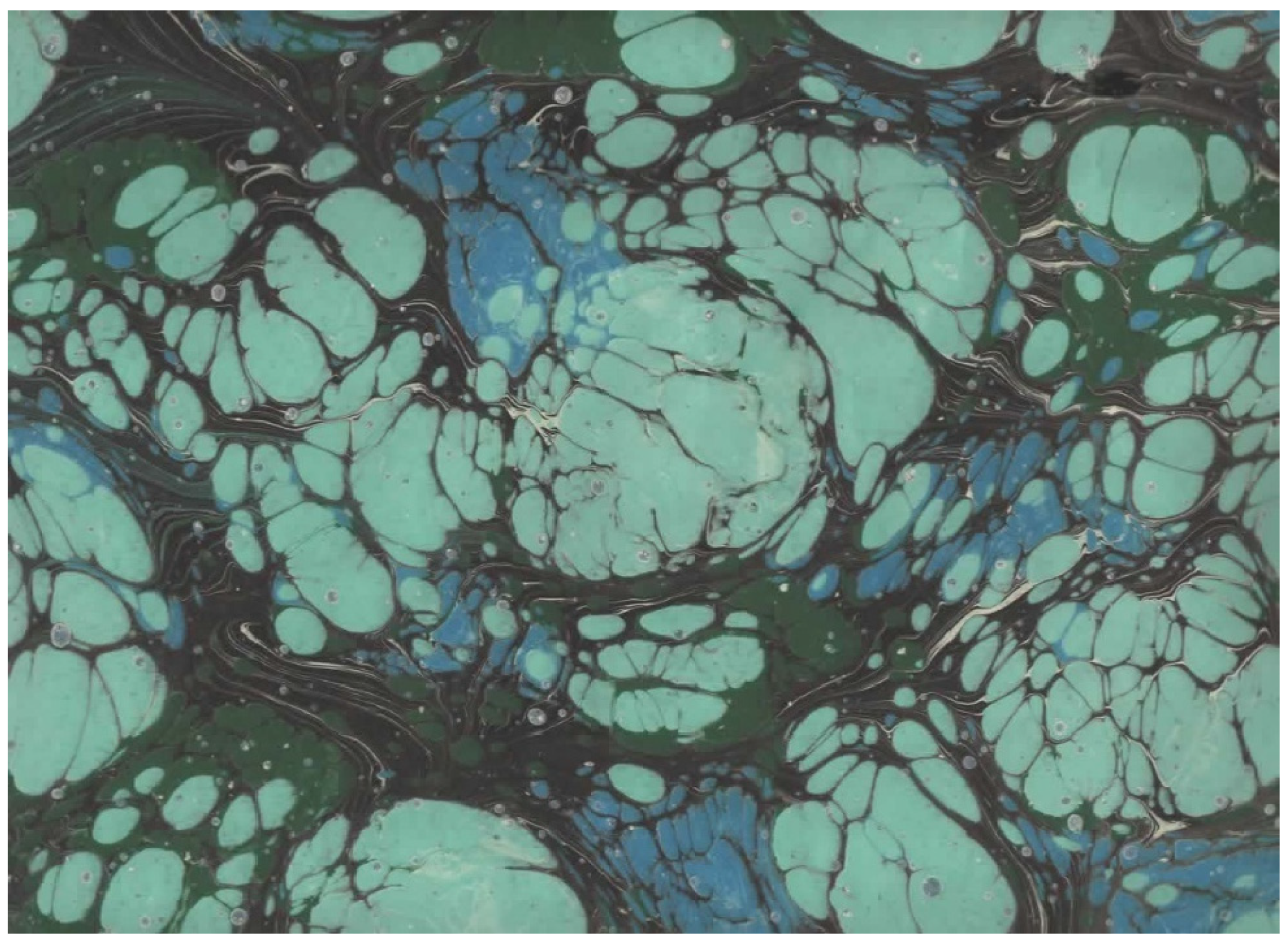
Figure 1 shows a 495 mm × 665 mm Battal Marbling sample, which was also used in our study.
The earliest examples of marbling found on plates, which are thought to have emerged in Central Asia and Iran, especially in late historical periods such as the Timurid period, can be dated to the 16th century (such as 1539, 1554, 1595) [
3,
4]. The contemporary nature of marbling art was consolidated in the late Ottoman period through the transmission of practices within specific artistic lines initiated by Sadik Efendi and further developed by his successors. This master-apprentice model represents a form of cultural information transfer that ensures the continuity of traditional techniques into the modern age [
4].
The art of marbling was included on UNESCO’s Intangible Cultural Heritage List in 2014. This art is a vital heritage, encompassing the knowledge, technique, and philosophy to be passed down from master to apprentice [
1].
Despite its recognition as an intangible cultural heritage, current preservation and digitization practices for marbling art largely rely on high-resolution scanning or photographic documentation of completed works. While these approaches are effective in preventing physical degradation and enabling long-term archiving, they inherently preserve marbling as static visual snapshots. Such methods do not support the opportunity to generate new artworks that have aesthetic variability, diversity and technical nuance. Moreover, they are insufficient for applications that require the creation of new marbling patterns, such as education, textile design, publishing, or digital decorative production. As a result, existing digitization strategies remain limited to documentation rather than enabling reproducible and generative preservation.
The use of artificial intelligence in marbling art offers significant advantages in terms of digital preservation, accessibility, and cultural heritage diversity. Creating high-resolution digital archives of marbling patterns is crucial for both preventing physical wear and ensuring their safe transmission to future generations [
5,
6].
Today, artificial intelligence makes our lives easier by sometimes assuming auxiliary, occasionally collaborative, and sometimes even creative roles in many fields, including engineering, culture, medicine, etc. There are many successful AI applications in game development, coding, visual production, and many other fields [
7,
8,
9,
10].
This rich historical process also represents a complex accumulation of visual information that must be preserved and passed on to future generations. The primary motivation for this study is to transform this unique cultural heritage into digital data and provide a framework for its digital preservation and reproduction through artificial intelligence.
This study utilizes DCGAN architecture to investigate the potential of modeling the complex asymmetric, stochastic, and non-object-centric visual hierarchy inherent in Ebru art [
11,
12,
13,
14]. Unlike object-based image synthesis studies in the literature, this approach employs DCGAN as a basis for capturing the fluid dynamics and intrinsic randomness that characterize organic texture transitions.
In this study, we investigate the applicability of Deep Convolutional Generative Adversarial Networks (DCGANs) for modeling traditional Turkish marbling (Ebru) art, which is characterized by highly asymmetric, stochastic, and non-object-centric visual patterns. The primary objectives of this research are:
- -
to examine whether DCGAN architecture can learn the fluid texture structures and color diffusion characteristics encountered in marbling art,
- -
to analyze the stability and diversity of the generated patterns using both quantitative and perceptual evaluation metrics,
- -
to compare the proposed DCGAN framework against a Vanilla GAN baseline under identical training conditions to assess the impact of convolutional feature learning.
Through these objectives, this study aims to provide experimental insight into the suitability and limitations of GAN-based generative models for the digital reproduction and generative preservation of marbling art.
The study proceeds as follows.
Section 2 (Related Works) presents relevant studies from current literature.
Section 3 (Material and Methods) introduces the dataset prepared for this study using original marbling images, then details the artificial intelligence model used, and finally, the metrics used in the evaluation.
Section 4 (Results and Discussion) presents the quantitative and qualitative results obtained from the study and analyzes the model’s production performance.
Section 5 (Conclusions) provides a general assessment of the study, discusses the model’s success in reproducing asymmetric aesthetic forms, highlights its contribution to digital cultural heritage, and finally, outlines the study’s limitations and suggests directions for future work.
2. Related Works
Existing AI-based studies on art analysis can be broadly grouped into three categories: authenticity and forgery detection, digital restoration, and generative art production. The following studies illustrate representative approaches within each category.
One of the most remarkable applications of AI is its use in assessing the authenticity of existing artworks. For example, Fraile-Narváez et al. used deep learning methods to identify the authenticity of paintings and to detect forgeries. In this study, they performed binary classification, multiple classification, and Dall-e 2 forgery detection using a MobileNet V2-based convolutional neural network (CNN) with a dataset consisting of works by Rembrandt and 17th-century Dutch painters [
15]. Dobbs et al. in 2023 propose a verification method that uses painting images to determine the artist’s identity using a ResNet-101 deep convolutional neural network and ImageNet-based transfer learning [
16]. Ostmeyer et al. in 2024, propose that training artificial intelligence models used in the detection of man-made forgeries with synthetically generated forgeries can improve the performance of artificial intelligence models [
17]. Boccuzzo et al. propose an AI-based verification framework focused on the detection of forged paintings by the famous forger Wolfgang Beltracchi [
18].
While these studies primarily address analytical tasks such as authentication and forgery detection, artificial intelligence has also been increasingly employed for the restoration and reconstruction of artworks, aiming to digitally recover their original visual characteristics. Venkatesh et al. propose a deep learning-based framework for removing varnish-induced image degradation. The study aims to predict the state a painting will reach after the varnish removal process, allowing for the avoidance of incorrect cleaning procedures [
19]. Maali Amiri and Messinger also propose that it might be possible to approximate the original appearance by virtually removing the varnish layer that yellows over time from artworks [
20]. In Feier’s 2012 [
21] master’s thesis, titled “Digital Inpainting for Artwork Restoration: Algorithms and Evaluation,” they proposed an image completion method for digitally restoring missing or damaged areas in artworks. The study aimed to obtain high-quality digital reconstructions that would preserve both visual integrity and historical accuracy during the restoration process [
21]. Xu, Zhang, and Wu propose a method for digitally restoring historical damage to the Dunhuang (Mogao Caves) murals. The study aims to digitally revitalize the murals, which have eroded and faded over centuries, using deep learning to preserve cultural heritage [
22]. There are also studies in the field of restoration of old photographs, engravings, and paper works, where multiple distortion removal is performed using methods such as triplet domain, VAE-based discrete domain bridging, and adaptive enhancement with Energy-Transition GAN [
23,
24].
Beyond restoration-oriented applications, artificial intelligence has also been explored as a tool for the generation of entirely new artworks, enabling models not only to recover existing visual content but to synthesize novel artistic expressions. Gatys et al. proposed that artificial neural networks could generate new artistic images by separating content and style representations. This study combines the content of one image with the style of another to produce new images [
25]. Luan et al. proposed a method that enables style transfer between photographic images using a VGG-19-based Neural Style algorithm, local affine color transformation, and semantic segmentation [
26]. In their 2017 study, CAN: Creative Adversarial Networks—Generating “Art” by Learning About Styles and Deviating from Style Norms, Elgammal et al. proposed that artificial intelligence could not only imitate existing artistic styles but also produce artworks with creative characteristics. In the study, the architecture of Generative Adversarial Networks (GANs) was modified to develop Creative Adversarial Networks (CANs) [
27]. Karras et al. propose the StyleGAN architecture to improve quality, diversity, and controllability in GAN-based image generation. Instead of providing the latent vector directly to the generator, the latent vector is first converted into a style vector using a mapping network, and these style vectors are injected into different layers during the generation process. This allows for different details (e.g., hair strand, skin texture, face shape, position) to be controlled at different levels [
28]. Mazzone and Elgammal used the Creative Adversarial Network (CAN) in their 2019 study, Art, Creativity, and the Potential of Artificial Intelligence, enabling the network to produce works that adhered to aesthetic standards but deliberately deviated from existing styles [
29]. Esser et al. proposed a novel approach combining convolutional neural networks (CNNs) and transformer architecture for high-resolution image generation [
30]. Radford et al. proposed the CLIP (Contrastive Language–Image Pretraining) approach in their 2021 study, “Learning Transferable Visual Models from Natural Language Supervision.” In the study, two separate networks (ResNet-based CNN and Transformer-based language model) were trained using contrastive learning in a joint embedding space on 400 million text–image pairs [
31]. Chrystian and Wahyono proposed a method for generating symmetric patterns seen in Batik and similar cultural arts using artificial intelligence. For this purpose, they created a dataset consisting of 1216 patterns called ITB-mBatik. This study demonstrates that it provides a general framework applicable to the generation of various symmetric patterns, such as Batik, Portuguese, and Moroccan tiles, and provides significant contributions to the digital production of cultural heritage [
32].
As can be seen from the literature, GANs and Diffusion are emerging as highly successful new methods capable of creativity. GANs are a structure composed of two AIs that supervise and train each other. Here, one AI tests the realism of the resulting results, while the other strives to produce realistic products that the self-controlled AI would believe. This also impacts on the role of the artist. In other words, the artist now delegates repetitive and sometimes tedious tasks to the AI, taking on a role that provides ideas and guidance. In their study conducted in 2025, Cheng and her colleagues developed a LoRA-based model for the reproduction of Chinese aesthetic jewelry designs with artificial intelligence and evaluated the consistency and innovation capacity of this model [
33]. Similarly, Ling et al. (2025) studied AI-assisted collective production of murals in rural areas, focusing on preserving traditional motifs and enhancing community participation [
34]. Ahmed Nafady (2025) [
35] proposed an AI model for the reuse of cultural heritage motifs in product design. This study aimed to automatically detect traditional patterns and use them in new design compositions [
35]. El-Sheikh (2025) contributed to the digitalization of cultural heritage in clothing design by reproducing traditional costumes with artificial intelligence [
36]. Anichebe and Torhemen (2025) examined the preservation of African cultural identity with the help of AI and discussed the contribution of the reproduction of cultural contents with AI to identity construction [
37]. Zhou et al. (2025) discussed the creativity-enhancing effects of AI in cultural product design and evaluated the potential of hybrid designs resulting from combining motifs from different cultures [
38]. Gaper (2025) examined the visual creativity capacities of AI for digital art, measuring model performance with aesthetic score and user evaluation [
39].
At this point, how the possibilities offered by AI-based methods in general art production can be applied, particularly in traditional art forms where production processes are challenging and labor-intensive, is an important research topic. Marbling art requires both mastery and many delicate and detailed requirements, such as unique dyes and tragacanth. Many factors, such as the temperature of the marbling vessel, the waiting time, and the quality of the dye, are effective factors in producing high-quality marbling. This significantly hinders mass-produced marbling. Therefore, original marblings are generally used in paintings or in easy-to-use products. Reprints of the same marbling are often used in areas such as the textile industry, book covers, mass-produced digitally printed wall art, jewelry and accessories, and ceramic and porcelain products. In these areas, the use of artificial intelligence will be beneficial for mass-producing marbling in specific styles. AI can enable the production of multiple unique marblings in a specific style or with a desired concept. This will increase the visibility of marbling art and make it accessible to a wider audience. Additionally, students and art educators can examine technical processes and observe objectives more quickly with AI-generated marbling samples. This could enrich teaching tools [
5]. Generative models (such as GAN, Diffusion Network) can produce original, new works by feeding traditional marbling patterns, and it becomes possible to discover modern interpretations of classical motifs [
40,
41].
Although recently proposed generative models such as StyleGAN and diffusion-based architecture have demonstrated remarkable performance in high-resolution image synthesis [
42], this study specifically adopts the DCGAN architecture to provide a controlled and interpretable experimental environment. While diffusion-based generative models, such as Stable Diffusion, have demonstrated impressive performance in large-scale image synthesis, their effectiveness is often reliant on extensive training datasets, text-conditional guidance, and large pre-trained models. In contrast, this study focuses on a data-limited, non-object-centric artistic domain characterized by stochastic fluid dynamics and fine-grained textural variation. Therefore, DCGAN was deliberately chosen as a lightweight and interpretable baseline architecture that allows for a controlled investigation of generative behavior under limited data conditions. Unlike diffusion models, DCGAN enables direct analysis of training stability, mode behavior, and texture synthesis without reliance on external a priori semantic information or large-scale pre-training. DCGAN represents a convolutional GAN framework that explicitly emphasizes hierarchical spatial feature learning through convolutional and transposed convolutional layers [
43]. This property is particularly important for modeling the fluid, asymmetric, and locally correlated textures characteristic of traditional Ebru art. More advanced architecture often requires significantly larger datasets and extensive computational resources. This can lead to the inability to determine the isolated contribution of convolutional feature learning. Therefore, DCGAN was selected as a balanced and theoretically grounded architecture that enables a clear analysis of asymmetric aesthetic pattern generation while ensuring training stability and reproducibility.
3. Materials and Methods
This study aims to authentically reproduce Ebru, a traditional Turkish marbling art, in a digital environment using artificial intelligence. The modeling and training processes in this research were conducted on Google Colab, Google’s cloud-based machine learning platform. The working environment was configured using Python 3.10 and the PyTorch 2.0.1 library. During the training process, the NVIDIA Tesla T4 GPU hardware provided by Colab was employed. Model parameters were set as batch size = 64, epoch = 300, and learning rate = 0.0002. These hyperparameters are presented in
Table 1. The standard adversarial loss based on binary cross-entropy was used for both the generator and discriminator.
Image preprocessing was performed using a custom script written in MATLAB R2024b, and the cropped dataset was imported into Colab. This configuration increased the efficiency of the study in terms of both hardware speed and software accessibility. In the following, the dataset containing Ebru images created for this study is demonstrated. The artificial intelligence model used in the study and, finally, the measurement metrics were introduced.
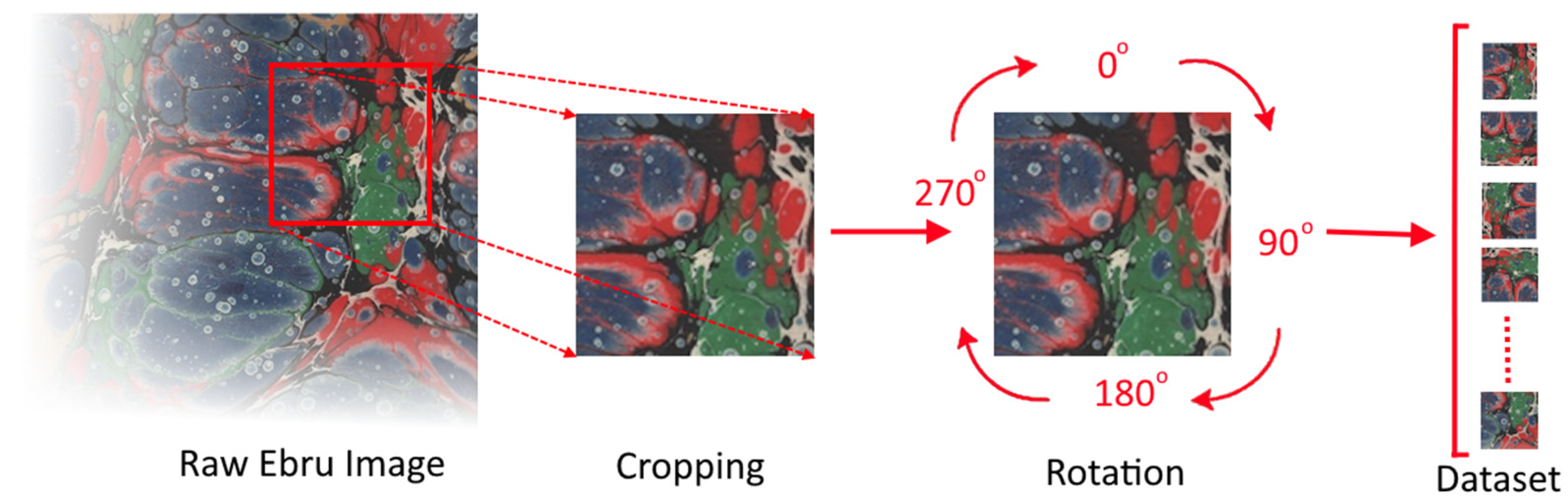
For use in training, 17 marbling pages, each 495 mm × 665 mm in size, were partially scanned and digitized. Two non-intersecting regions of each marbling were scanned on an A4 (210 mm × 297 mm) sheet. Each scan was performed at a resolution of 747 × 1028 pixels. This resulted in 34 unique marbling images, each 747 × 1028 pixels in size. These images were divided into marbling particles of (s × s) pixel size using MATLAB, where s = 128. This size was chosen according to the input size of the artificial intelligence method to be used. These marbling patches were systematically cropped and saved from the entire marbling image. This process began by aligning each marbling image with point (1,1) in the upper left corner of (s × s) pixel cropping window and continued by shifting along the line by t = 64 pixels until the end of the line was reached. When the end of the line was reached, the cropping window was moved down 64 pixels, and the cropping process continued until the end of the line. Although overlapping patches are generated due to the selected stride size (64 pixels), this design choice was made to capture continuous texture transitions inherent in marbling art. To mitigate potential spatial correlation effects, patches are treated as independent samples during training, and extensive random shuffling is applied at each epoch. Given the non-object-centric and stochastic nature of marbling patterns, local overlap does not result in semantic duplication or memorization of global structures. Furthermore, rotational augmentation using angles of 0°, 90°, 180°, and 270° was applied, as traditional marbling art does not possess a preferred orientation for each cropped image. Ebru patterns are created through fluid dynamics on a water surface, resulting in isotropic visual structures that remain perceptually consistent under rotation. Therefore, these discrete rotations preserve stylistic authenticity while increasing data diversity without introducing artificial geometric bias.
These operations are explained in Equation (1).
In Equation (1),
I is the image vector,
H is the height of the image with the value of 747 pixels,
W is the width of the image with the value of 1028 pixels,
Ch is the number of color channels with the value of 3 as RGB. In Equation (2), the cropping operation is shown as
C(x,y). This operator selects a window of size (s × s) starting from the (
x,
y) coordinate. The grid required for cropping operations for an image is given in Equation (3). Here, the stride
t is selected as 64. The set given in Equation (4) defines all patches obtained from an image.
Rθ is the translation operator. This operator translates the image by the given value of
θ in degrees. The parameters related to the operations are presented in
Table 2, and the process steps are visualized in
Figure 2.
When all these formulas were executed, the variable
i in Equation (3) took on 10 different values, and the variable
j took on 15 different values. In this case, one image would produce 10 × 15 = 150 images. However, because each image was recorded in four different orientations, 600 images were generated. For training purposes, 34 images with marbling were used, resulting in 34 × 600 = 20,400 marbling images.
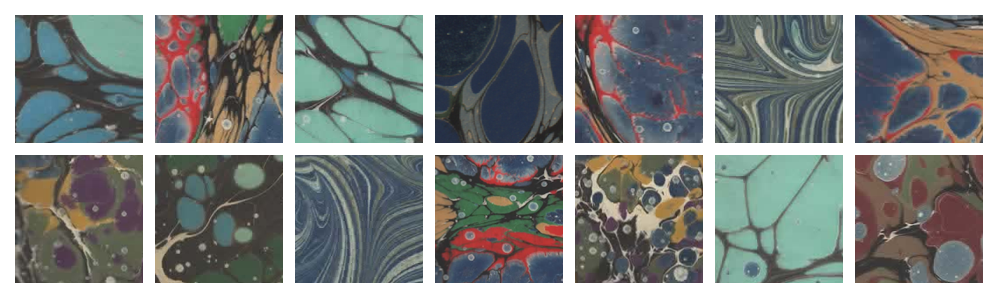
Figure 3 shows the four marbling image samples in the database. Information about the records in the database is presented in
Table 3.
To better characterize the visual properties of the constructed patch dataset, a dataset-level statistical analysis was conducted on both the original and augmented data. Specifically, the analysis was first performed on a randomly selected subset of 3000 patches drawn from the non-augmented dataset (n = 5100) and subsequently repeated on the full augmented dataset (n = 20,400) obtained through rotational data augmentation. This two-stage analysis aimed to quantify color distribution, texture complexity, and orientation balance, and to verify that data augmentation did not introduce distributional bias.
Color characteristics were analyzed using channel-wise RGB statistics and hue histograms in the HSV color space to assess overall chromatic diversity. Texture complexity was quantified using multiple complementary proxies, including Laplacian variance, gradient magnitude, and grayscale entropy, capturing both fine-grained detail and stochastic variation inherent in marbling patterns. Orientation balance was examined through gradient orientation histograms to identify potential directional bias in the extracted patches.
The results presented in
Table 4 of this analysis confirm that both the original and augmented datasets exhibit broad color diversity, wide-ranging texture complexity, and no dominant orientation. The close agreement between the statistics of the non-augmented subset and the full augmented dataset indicates that rotational augmentation preserves the intrinsic visual characteristics of traditional Ebru art. These findings justify the use of rotational data augmentation and support the interpretation of the quantitative evaluation metrics reported in the
Section 4.
Generative Adversarial Networks (GANs) are structures that can deliver successful predictions by competing against two models with different objectives. A GAN framework consists of a Generative model (G) and a Discriminator model (D). These two models are usually trained simultaneously. The Generative model trains itself on real images to produce realistic fake images, while the Discriminator model learns to distinguish between fake and real data. The goal is to enable the Generative model to begin producing realistic images that the Discriminator model cannot distinguish [
44]. In other words, the goal is for the Generative model to reach a level where it can fool the Discriminator. The Generative model takes noise data as input and generates new examples. During this time, the Discriminator decides whether the image comes from the real or the generated dataset [
45]. Fundamentally, the idea behind GANs is derived from the Nash equilibrium in game theory. This competition continues until the generated fake images become indistinguishable from the real ones, allowing both models to improve their capabilities.
Deep Convolutional Generative Adversarial Networks (DCGAN) is an architecture introduced in 2015 by integrating Generative Adversarial Networks (GANs) and Convolutional Neural Networks (CNNs) to improve training stability and the quality of the generated images. Like GANs, DCGANs rely on the competition between the Generative model and the Discriminator model. This architecture also allows convolutional layers to utilize their powerful feature extraction capabilities [
46]. In DCGAN architecture, the generative model generates samples by passing pseudorandom noise through the multilayer perceptron, while the discriminator model serves as a (pseudo-real) decision maker in the multilayer perceptron structure.
Changes have been made to the CNN architecture to improve the production quality and convergence speed of the DCGAN architecture. Different layers are used instead of pooling layers in the generative and discriminator models. Batch normalization is also used to overcome the problem of poor initialization [
46,
47]. In summary, DCGAN combines the powerful representation of learning capabilities of deep learning with the competitive training process of GANs, providing an effective method for generating high-quality synthetic examples.
In this study, the adversarial training process was implemented using the standard Binary Cross-Entropy (BCE) loss function for both the generator and discriminator. The discriminator was trained to distinguish real marbling patches from generated samples, while the generator was optimized to produce synthetic patterns that maximize the discriminator’s misclassification probability.
The use of BCE loss within the DCGAN framework provides a stable optimization objective for learning hierarchical spatial features and fine-grained textural patterns characteristic of traditional Ebru art. This formulation supports balanced adversarial training and convergence under the selected hyperparameter configuration.
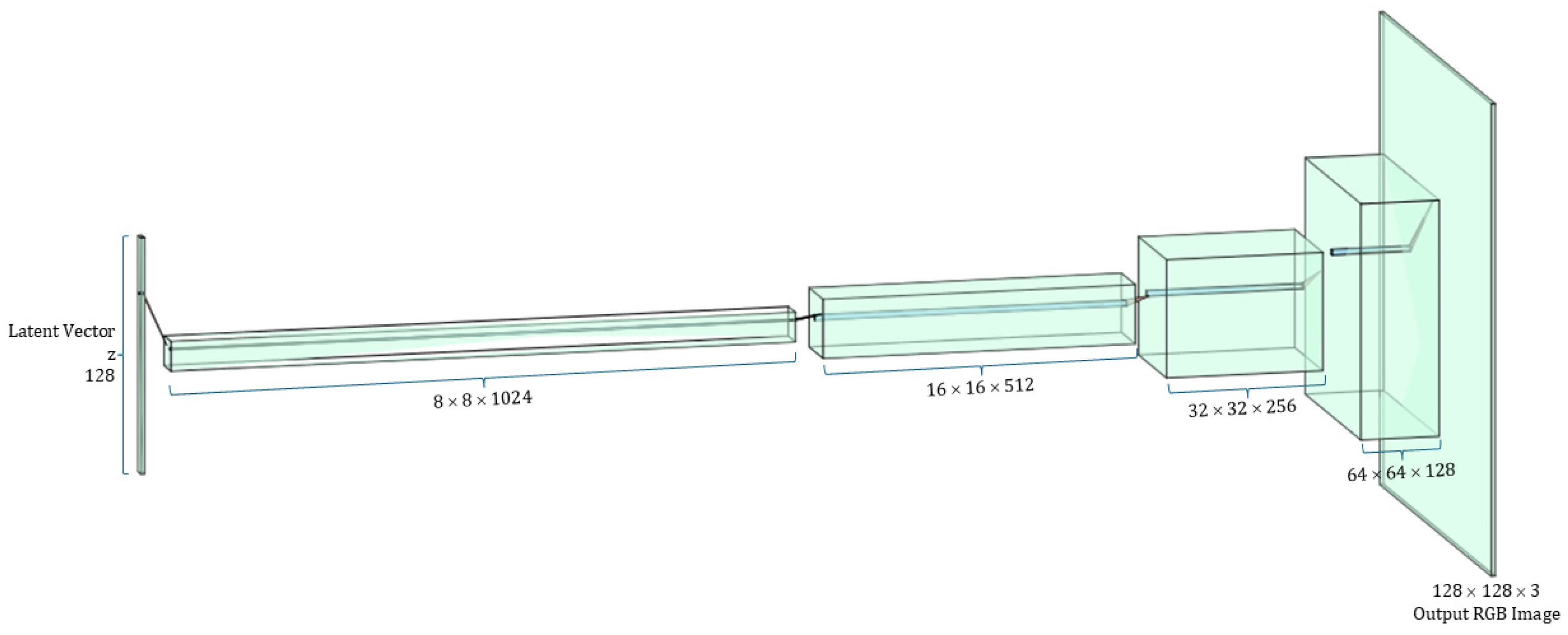
The generative model structure in the DCGAN architecture used in this study is presented in
Table 5. This model has a 128-dimensional latent vector input. Next comes the Linear layer, which generates the high-dimensional feature vector needed for the Convolution layer. The 1 × 65,536-dimensional data at the output of this layer is transferred to the BatchNorm layer to increase training stability, and the LeakyRELU activation function is applied. At this point, the one-dimensional vector is converted to a 3D form of 1024 × 8 × 8 using the Unflatten layer. Since the target image size is 3 × 128 × 128, the resulting 8 × 8 vector is doubled in each layer, enlarged by four consecutive ConvTranspose2d layers, while its depth is reduced to 3 within these layers. The k4/s2/p1 (kernel 4 × 4, stride 2, padding 1) parameters are used in the ConvTranspose2d layer. After each ConvTranspose2d layer, a BatchNorm layer and a LeakyRELU layer are added to increase stability. The final image is generated by Tanh activation to ensure that the final ConvTranspose2d output is within ±1. The 3D architectural layout of the proposed generative model is illustrated in
Figure 4.
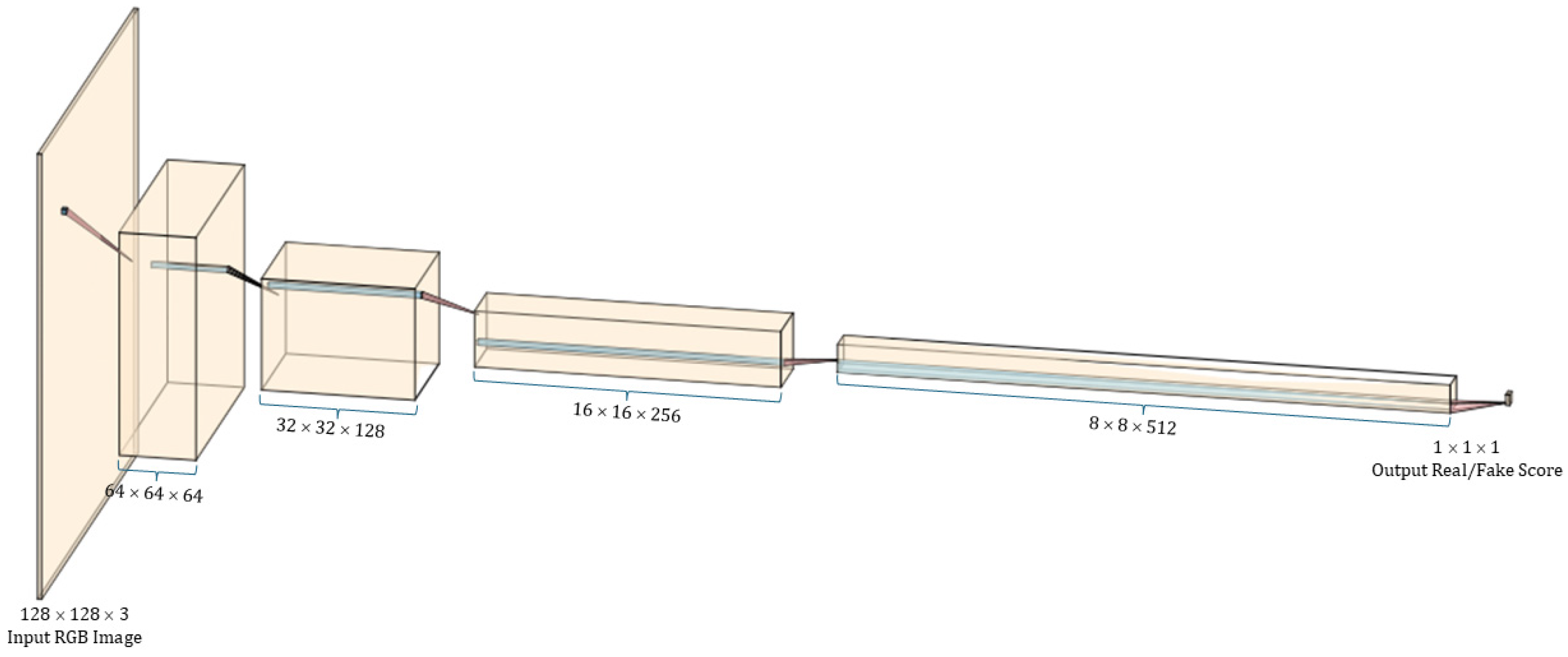
The structure of the Discriminator model created for DCGAN is presented in
Table 6. 128 × 128 colored marbling images are applied to the input layer of this model. The model generates a score for whether the received image is real or fake. The 3 × 128 × 128 vector applied to the input is transferred to the convolution layer. The parameters k4/s2/p1 (kernel 4 × 4, stride 2, padding 1) are used in the Conv2d layer. The data output from the convolution layer is transferred to the BatchNorm layer and the LeakyRELU layer to increase stability in training. This layer group increases its depth by halving its input size each time. Finally, its output size is reduced to 1 × 1 × 1 by the last Conv2d layer. The output is converted to a scalar with the last layer, the Flatten layer, and the output is generated. The 3D architectural layout of the proposed Discriminator model is illustrated in
Figure 5.
To validate the performance of the proposed DCGAN model and its capacity to learn the asymmetrical textures specific to Ebru art, the vanilla GAN, which is widely regarded in the literature as the most fundamental generative adversarial architecture and is commonly used as a reference model for evaluating architectural improvements in GAN-based studies, was selected as a baseline [
45,
48].
The Vanilla GAN was trained using the same dataset and same training hyperparameters as the proposed DCGAN model to ensure a fair comparison. The two models were compared in terms of training stability and convergence behavior, primarily through the evolution of generator and discriminator loss values and FID, KID, LPIPS, PRDC metrics over training epochs.
In the Vanilla GAN model, both the generator and discriminator networks consist only of fully connected layers. This model does not utilize convolutional layers, spatial feature extraction, or multiscale feature maps. This structure was chosen as a simple and common benchmark to evaluate the convolution-based advantages of DCGAN architecture. The lack of convolutional layers limits the capacity of this baseline model to learn local textural correlations in Ebru patterns. As a result, its ability to capture local textural correlations and flow-based patterns—key characteristics of traditional Ebru art—is inherently limited. This limitation provides a clear contrast to the convolutional structure of DCGAN, which is specifically designed to learn hierarchical and spatially coherent visual features.
In this study, many evaluation metrics were used to measure the similarity of the generated images to real marbling images. Fréchet Inception Distance (FID), which is the first metric that comes to mind when measuring image quality in GANs, is the first metric that we used. FID, which is the correlation between the human eye’s interpretation of images and the score, is one of the first metrics that come to mind when measuring the quality of images generated by GANs [
49,
50,
51]. FID measures the distance between the multivariate Gaussian distributions of the real images generated by the GAN and the images that the GAN tries to imitate. Inception-v3 network is used for measuring the FID metric. The score is obtained by calculating the Fréchet distance between the mean (
µ) and covariance (
∑) values of 2048 features taken from the pool3 layer of this network. The formula used for this purpose is given in Equation (5) [
52].
Here, µr and ∑r are the mean and covariance values of the actual images, while µg and ∑g are the mean and covariance values of the generated images. The lower the FID score, which ranges from zero to infinity, the better the images generated in terms of quality and diversity.
Another visual distribution similarity measure used is Kernel Inception Distance (KID). Like
FID, it compares distributions in the Inception-v3 feature space first, but thanks to its bias correction, it produces more reliable results in small sample sizes. A polynomial kernel was used in
KID calculation. The kernel used is given in Equation (6).
Here,
x and
y are the feature vectors taken from Inception-v3, and
d is the length of these features, which for Inception-v3 is 2048. If we assume that there are
N numbers of generated images and real images, Kernel Inception Distance (
KID) is obtained with the expression in Equation (7) [
53].
The
FID and
KID metrics provide a score for the realism of the generated images in the context of human evaluation, but they do not quantitatively measure the delicate balance between realism (quality) and diversity (coverage) of the outputs. The Precision, Recall, Density, and Coverage (PRDC) metrics are used to evaluate the complex and organic patterns of the model’s marbling images in terms of both fidelity and range. These metrics estimate the distributions of the real and generated images based on the k-Nearest Neighbor (k-NN) method in the feature space generated by Inception-v3. This allows the detection of critical model failures such as mode collapse and overfitting. The function
1(…) returns a value that depends on the input condition: 1 if it is true, and 0 if it is false.
B(
x,
r) defines a hypersphere with center x and radius r, and
NNDk(
xi) returns the distance between x
i and its kth nearest neighbor. PRDC values are calculated with the expressions given in Equations (8)–(11) [
54,
55], where
M is the number of real samples,
N is the number of generated samples,
xi is the real samples, and
yi is the generated samples.
The process performed in these calculations can be explained in text: Precision is the ratio of the number of generated samples within the real sample manifold to the total number of generated samples. Recall is the ratio of the number of real samples within the generated sample manifold to the total number of real samples. Density is a density measure that averages the number of real neighbors each generated sample is close to. Coverage is the proportion of real samples covered by at least one generated sample.
Another metric used in the study is Learned Perceptual Image Patch Similarity (LPIPS). Unlike previous metrics that compare two images based on pixel differences, this metric produces a score for the structural similarity between two images. A score approaching 0 means that the images are indistinguishable to the human eye [
56].
4. Results and Discussion
In this study, the performance of the proposed deep generative model was evaluated on the original marbling dataset. The DCGAN model, as detailed, was trained on the generated dataset using the Colab interface with an NVIDIA Tesla T4 GPU. Training lasted 300 epochs, with an average epoch duration of 108.258 s. After each epoch, the model and the nine marbling images generated from it were saved. Training was performed in 50 consecutive epochs. Metrics were monitored throughout the training process, and the training was terminated at the 300th epoch, when plateau formation was observed.
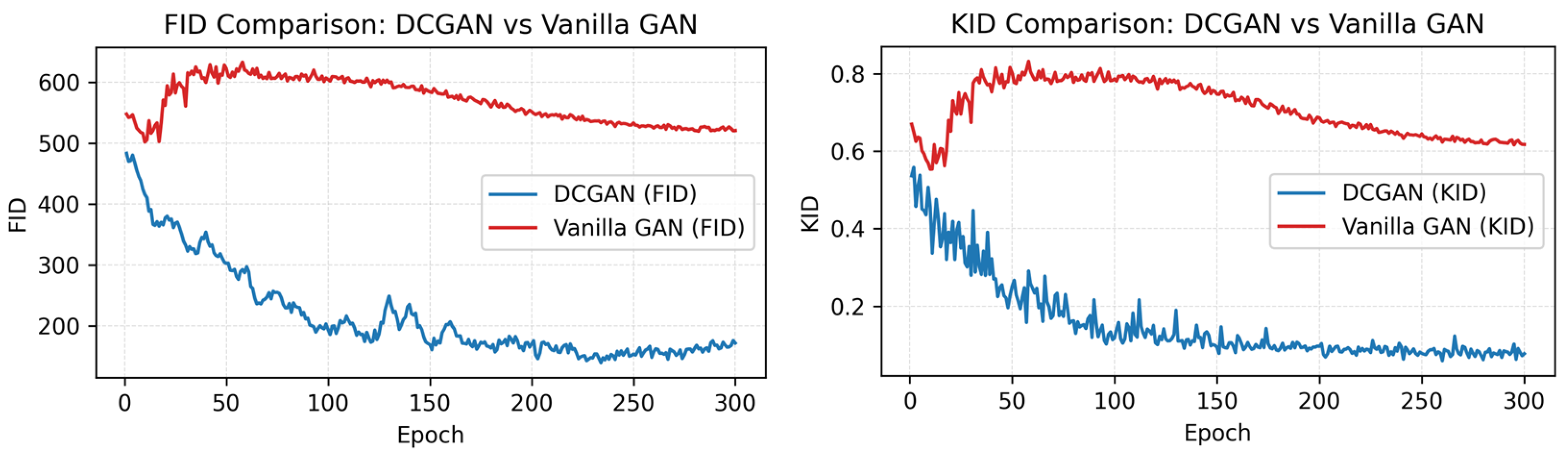
Figure 6 shows the comparative development of Fréchet Inception Distance (FID) and Kernel Inception Distance (KID) metrics over 300 training epochs for the proposed DCGAN and basic Vanilla GAN models. For the DCGAN model, a rapid and significant improvement in image quality is observed within the first 150 epochs, with the FID value decreasing from an initial 483 to a stable value in the 150–160 range. This trend demonstrates that the convolutional layers successfully learned the hierarchical spatial characteristics of Ebru art. In contrast, a stagnation in performance is observed in the Vanilla GAN, with FID consistently remaining high at approximately 524 and failing to converge throughout the training process.
A similar performance difference is also seen in the KID metric. The DCGAN model achieves a significant decrease in the KID value, reaching its optimum value of 0.0587 at epoch 260. This also shows a high degree of statistical similarity between the produced patches and authentic marbling works. In contrast, the KID values of Vanilla GAN remain above 0.60, confirming the inherent limitations of non-convolutional architectures in capturing the fluid and locally related textures of traditional marbling art.
Notably, the DCGAN metrics plateau between epochs 200 and 275, suggesting convergence toward a stable equilibrium between the generator and discriminator. In contrast, the Vanilla GAN exhibits signs of training instability and mode collapse, as evidenced by its persistent inability to improve either quality or diversity-related metrics.
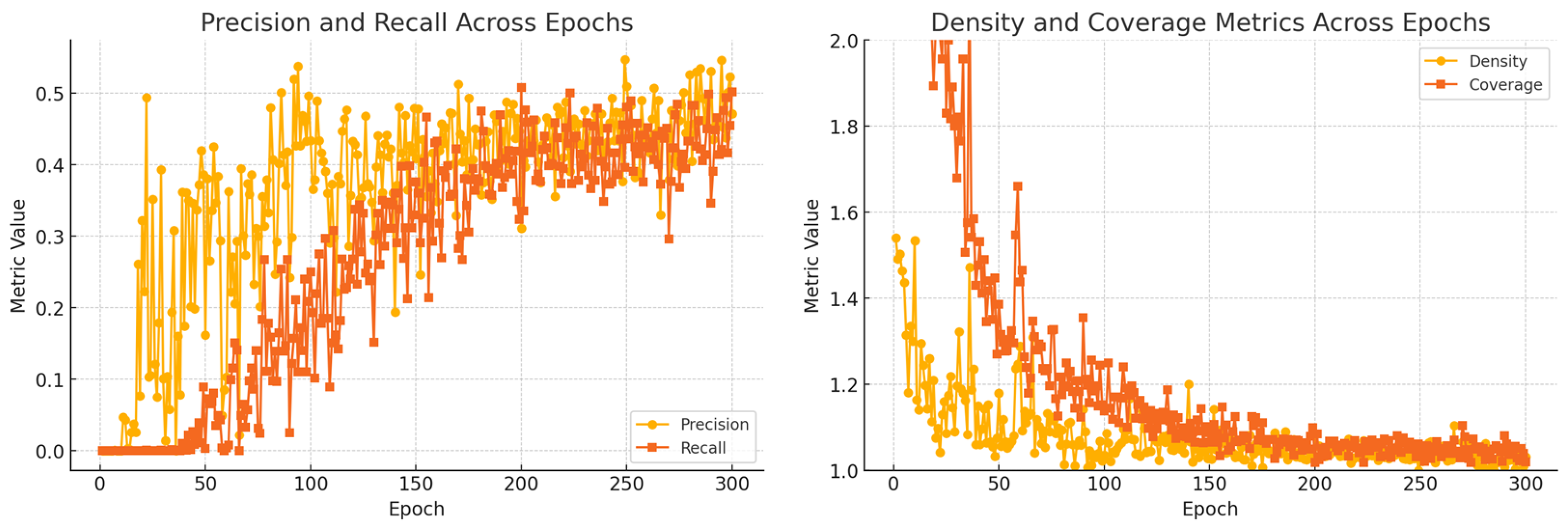
During the training process, Precision and Recall values were analyzed to assess both the model’s similarity to the real data distribution and its level of diversity.
Figure 7 shows the change in PRDC parameters with each epoch. The y-axis of the Density & Coverage graph is clipped between 2 and 1 to better visualize the details. Coverage values, which are unobservable in the initial epochs, start at 5 and drop below 2 after the first 25 epochs. Precision and Recall values increase from 0 to 0.5 until the 200th epoch, plateauing thereafter. It can be observed that Precision and Recall values increase with a similar trend throughout this process. The maximum Precision and Recall values achieved were 0.547 and 0.508, respectively. Density and Coverage metrics were examined to evaluate the model’s diversity and coverage performance. These metrics follow a similar trend, approaching 1 from above after the 200th epoch, forming a plateau. The Density and Coverage values in the last epoch were determined as 1.031 and 1.019. The Recall metric stabilizes around 0.5 throughout training, which should not be interpreted as insufficient coverage in this domain. In the context of highly stochastic and non-object-centric marbling art, Recall reflects a balance between diversity and stability rather than complete manifold coverage. Higher Recall values could indicate overgeneralization and loss of fine-grained variation, while lower values would suggest mode collapse. Therefore, a Recall plateau around 0.5 suggests that the model captures a substantial portion of the real data distribution while preserving local stochastic diversity, which is a desirable property for generative modeling of marbling aesthetics. Since the Vanilla GAN baseline yielded zero values for all Precision, Recall, Density, and Coverage (PRDC) metrics across epochs, these curves were not included in
Figure 7. This result indicates that the baseline model failed to generate samples sufficiently close to the real data manifold to be recognized by the k-nearest-neighbor–based PRDC evaluation, highlighting the limited representational capacity of fully connected architectures for complex marbling textures.
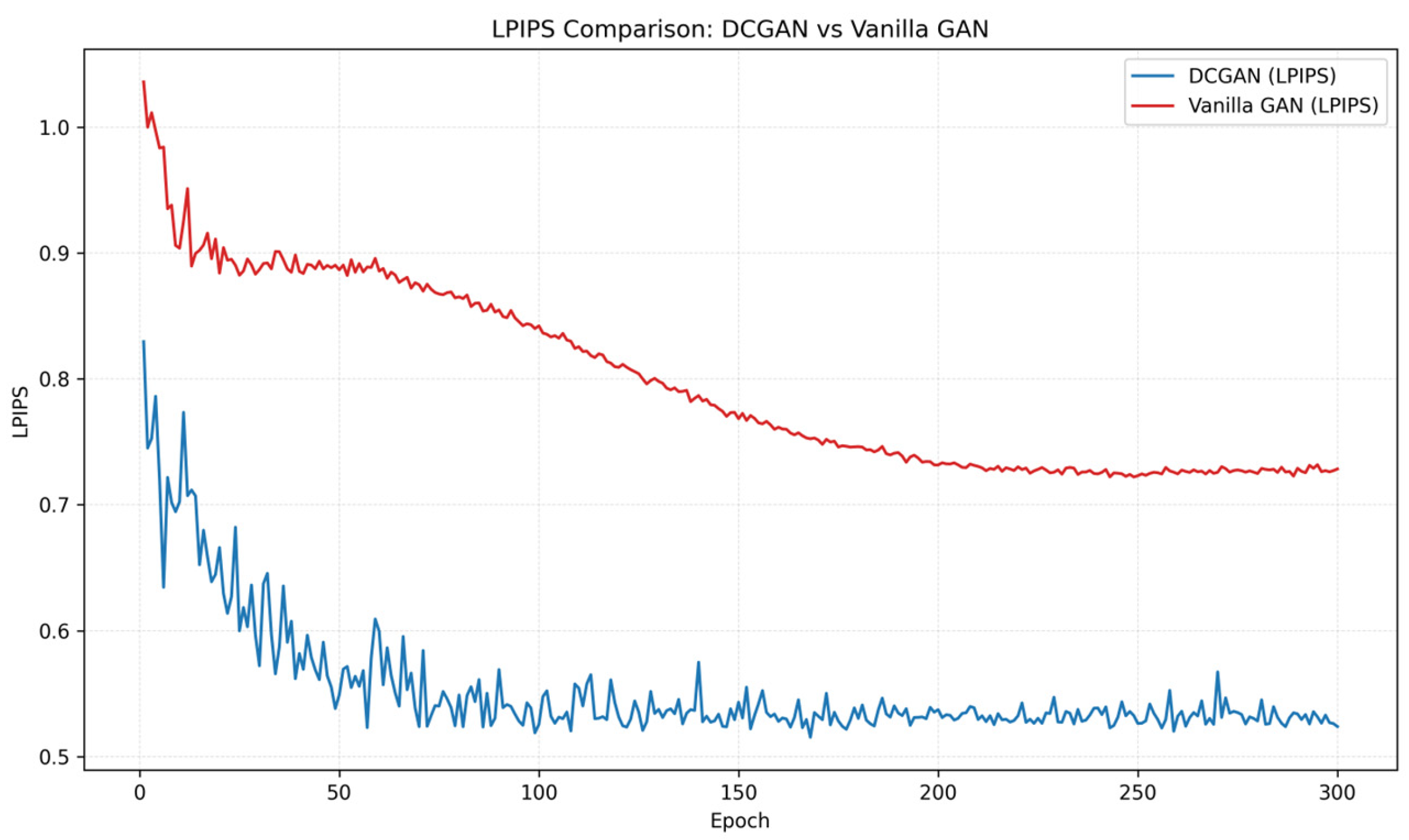
Figure 8 presents the evolution of the LPIPS metric for the proposed DCGAN model and the Vanilla GAN baseline across 300 training epochs. Throughout the training process, the LPIPS metric was recorded to measure the structural similarity and perceptual realism of the generated marbled images according to human perception.
For the proposed DCGAN model, it was observed that the LPIPS value decreased rapidly until the 100th epoch, after which it remained stable and entered a plateau phase. The LPIPS value reached by DCGAN in the last epoch is 0.5238.
In contrast, the Vanilla GAN baseline model maintained a significantly higher perceptual distance throughout training, with an average LPIPS value of 0.7267 in the last 50 epochs. This elevated score indicates that the non-convolutional baseline fails to learn the complex, fluid, and organically structured textures that define the aesthetic essence of traditional Ebru art.
While lower LPIPS values correspond to higher perceptual similarity, the DCGAN’s convergence to a value around 0.52 and together with its clear margin over the baseline model demonstrates that the model effectively learned the organic style of marbling without overfitting to specific training examples. Detailed mean, optimum, and final epoch values for all measured metrics are presented in
Table 7.
Table 7 presents a comparative analysis of the performance difference between the proposed DCGAN model and the Vanilla GAN baseline, using both the averages of the last 50 epochs, the last epoch values, and the best (optimum) epoch results. The results show that the DCGAN architecture provides significant superiority over Vanilla GAN in terms of training stability, visual quality, distribution coverage, and perceptual realism.
The quantitative results require a domain-specific interpretation considering the unique characteristics of marbling art. The FID score (159.92), while higher than those seen in standard object-based benchmarks, reflects the high-frequency textural complexity of Ebru. The relatively high FID values observed in this study (≈150–170) are primarily attributed to the patch-based evaluation strategy (128 × 128) and the highly stochastic, fine-grained texture structure of marbling patterns. Since the Inception-v3 network is optimized for object-centric semantic features, the thin fluid lines and high-frequency transitions characteristic of Ebru art may be perceived as noise in the feature space, leading to elevated FID scores. However, the dramatic improvement over the Vanilla GAN baseline (FID: 524.83) demonstrates the DCGAN’s capacity to approximate the authentic data manifold.
Similarly, the LPIPS scores stabilizing around 0.5 indicate a balanced perceptual similarity between generated and real marbling images. In stochastic art forms, an excessively low LPIPS would imply overfitting (memorization). A stable score around 0.5 suggests that the model effectively generalizes the fluid aesthetics of Ebru while maintaining sufficient variation, which is crucial for the stylistic authenticity of the generated outputs.
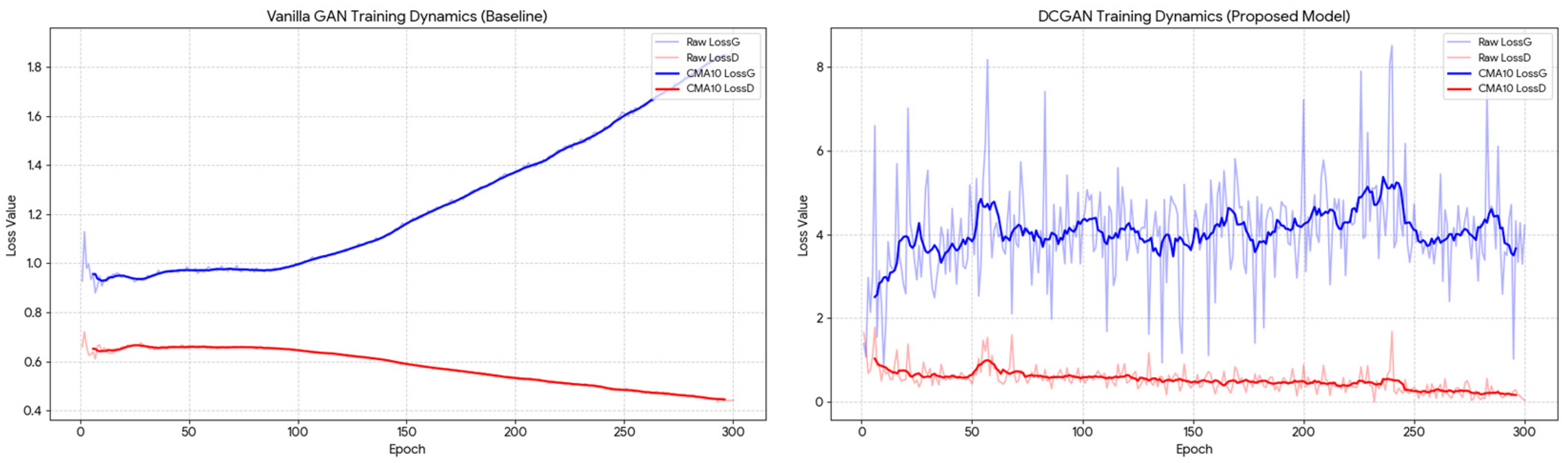
Figure 9 compares the training dynamics of the Vanilla GAN model and the proposed DCGAN model using generator and discriminator loss values across epochs.
In the Vanilla GAN model, the generator loss consistently shows an upward trend, while the discriminator loss decreases monotonically. This indicates an imbalance between the two adversarial components and a failure to reach a stable equilibrium. This behavior coincides with mode collapse and inefficient feature learning in fully connected architectures.
In contrast, the DCGAN model exhibits a more stable adversarial training process. Although the generator loss fluctuates due to the complexity of learning asymmetric and fluid marbling textures, both loss curves remain bounded and oscillatory, reflecting stable adversarial competition. The use of convolutional layers allows the DCGAN to capture hierarchical spatial features, resulting in better convergence behavior and training stability compared to the vanilla GAN model.
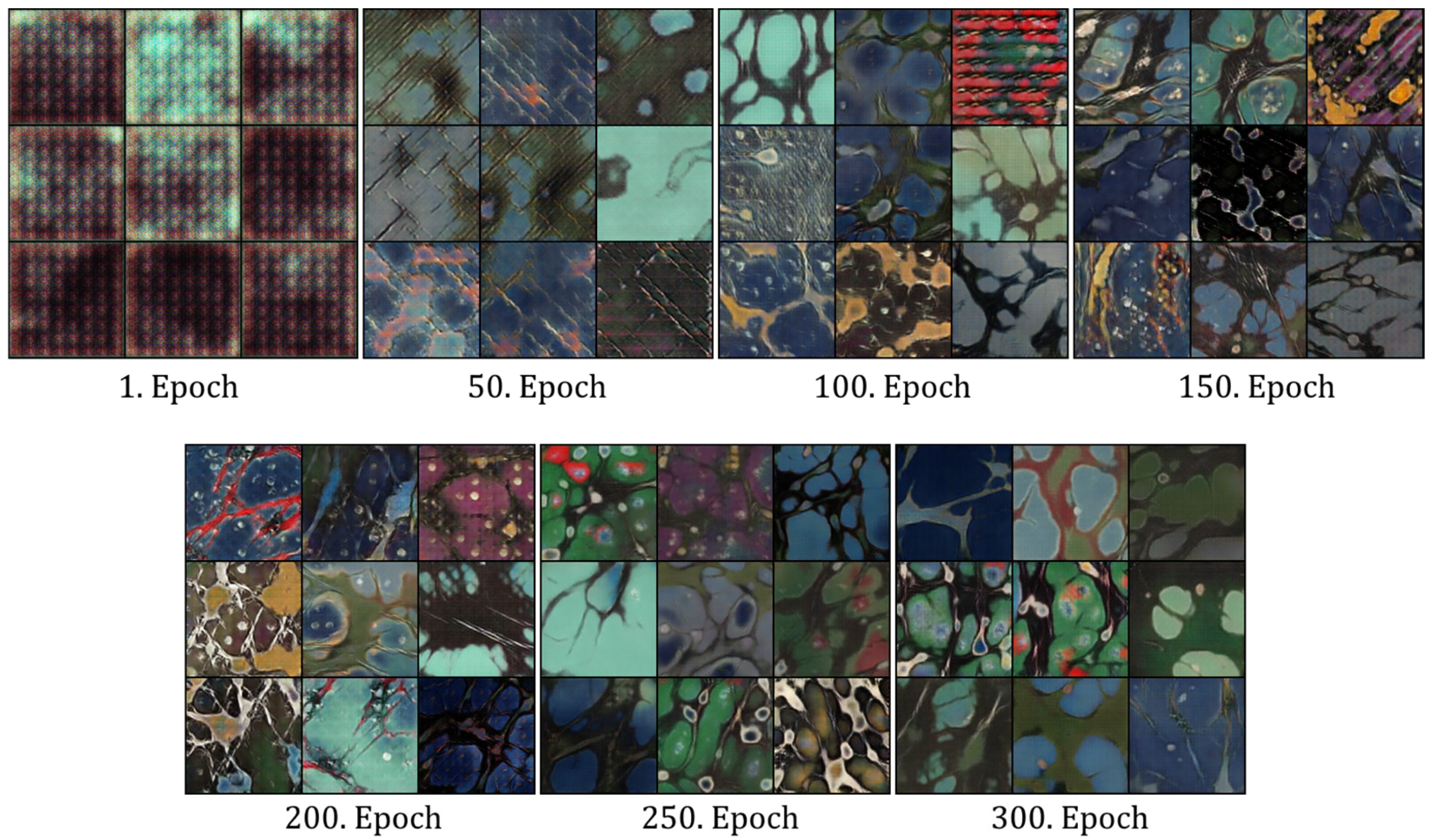
During training, as each epoch was completed, the Generator model generated and recorded nine marbling images. The changes in quality and variety in the model’s marbling production over epochs can be observed in the images shown in
Figure 10.
The proposed DCGAN model successfully captures several key aesthetic characteristics of traditional Ebru art in visual perspective. The generated patterns sustain the continuity of fluid flow, exhibiting smooth and uninterrupted color transitions. This resembles the natural motion of pigments on water. Moreover, the model learns realistic color diffusion behavior, avoiding sharp edges and producing soft, organic boundaries between neighboring color regions.
In addition, the generated images demonstrate a balance between local stochastic variation and global compositional coherence, which is a defining feature of marbling aesthetics. Although individual samples exhibit stochastic variations in local textures, the global compositional integrity of the patterns is preserved. Finally, the absence of repetitive motifs indicates that the model avoids severe mode collapse, maintaining visual diversity across generated samples, which is consistent with the observed Recall and Density trends.
5. Conclusions
This work presents a DCGAN-based model capable of generating digital representations of traditional marbling art. The proposed framework successfully learns and reproduces the asymmetric and fluid aesthetic characteristics of this unique art form. Through experiments on a dataset of original marbling images, the model demonstrated its ability to synthesize visually compelling and stylistically diverse outputs.
Although DCGAN is a well-established generative architecture, in this study it was tasked with modeling highly asymmetric, stochastic, and non-object-centric artistic patterns, such as traditional marbling. Thus, the effectiveness and limitations of DCGAN in this area were demonstrated. Unlike prior works that focus primarily on object-based image synthesis, this study provides a comprehensive analysis of DCGAN’s behavior in a domain characterized by fluid dynamics, organic texture transitions, and intrinsic randomness.
By combining quantitative metrics (FID, KID, PRDC, LPIPS), training stability analysis, and expert-based qualitative evaluation, this work reveals how convolutional feature hierarchies contribute to preserving aesthetic coherence without sacrificing diversity.
Multiple metrics were used to evaluate the model’s generated marbling patterns in terms of both visual quality and diversity. These metrics demonstrate that the images generated are evaluated not only for their technical success but also for their artistic consistency, aesthetics, and diversity. The increase in realism and quality of the images generated is determined by the decrease in FID and KID. Similar trends in the Precision and Recall metrics confirm that both diversity is maintained and the generated examples overlap with the real data space. Density and Coverage metrics also approach 1, supporting the fact that the generated marbling images possess both structural consistency and natural variation. The balanced and stable course of these metrics demonstrates that the model does not exhibit a tendency towards mode collapse or overgeneralization in the generation space. Over the first 200 epochs, the FID, KID, Precision, Recall, Density, and Coverage metrics trended in line with expectations. The decrease in the LPIPS score indicates that the images generated are perceptually closer to the marbling images used in training, according to human perception. While the LPIPS decrease of 0.5 might be perceived as a disadvantage, the randomness and naturalness of the details characteristic of marbling images likely acted as a barrier for this metric. Otherwise, the model might be overfit, and the generated marbling images might become too similar to the training dataset, leading to a loss of diversity and a tendency for the model to memorize.
In addition to quantitative evaluation, the generated outputs were examined through a structured qualitative assessment conducted by a domain expert with extensive experience in traditional marbling art. Rather than serving as a statistical user study, this expert judgment was intended to interpret whether the learned visual characteristics—such as fluid continuity, color diffusion, and overall naturalness—are perceptually consistent with established marbling practices. The expert assessment provided practice-based insight that complements the quantitative metrics by highlighting strengths and limitations of the generated patterns from an artistic perspective, without making claims of perceptual equivalence or statistical generalization.
Taking all these findings together, it was observed that the DCGAN-based model struck a strong balance between high quality, realism, and formal diversity. The model succeeded in producing images that were true to the nature of marbling art, not only statistically but also perceptually. This result demonstrates that the proposed method offers an effective AI-based solution for the preservation, dissemination, and reinterpretation of traditional Turkish marbling art in the digital environment.
Taking all these findings together, the DCGAN-based model demonstrates a strong balance between high quality, realism, and formal diversity. The model succeeded in producing images that are not only statistically but also perceptually true to the nature of marbling art. This result demonstrates that this work is not only a means of artistic production but also provides an effective framework for transforming intangible cultural heritage (recognized by UNESCO) into digital, accessible, and reusable information. The proposed method offers a powerful AI-based solution for the digital preservation, dissemination, and reinterpretation of traditional marbling art.
Despite the promising quantitative and qualitative results, this study has several limitations that should be acknowledged. The dataset utilized in this study was purposefully restricted to the Battal Ebru style. This dataset, derived from 17 original works by one of the authors (H.U.), was used to provide a focused analysis of asymmetric pattern generation in a digital environment, ensuring full control over data acquisition conditions and copyright compliance. While this approach successfully minimizes out-of-style artifacts and maintains consistent color flow, it inherently limits the current model’s stylistic diversity. Future research will focus on expanding the database to include varied marbling styles such as ‘Çiçek’ (floral), ‘Hatip’, and ‘Gel-Git’ (tidal), sourced from different artists to enhance model generalization. A strategic path forward involves leveraging the learned weights of the current DCGAN framework through transfer learning. This approach is anticipated to reduce the required training epochs for new styles while enabling the model to effectively learn the nuanced textural transitions between different artistic schools of marbling.
These limitations present significant opportunities for future work. In the future, the dataset could be expanded to include a larger number of original marbling works by different artists and styles (floral, tidal, etc.). Furthermore, newer and more powerful architecture, such as StyleGAN or Diffusion models, could be trained on this enriched dataset to compare the quality and diversity of results produced by the DCGAN architecture.
Beyond quantitative evaluation, the generated marbling patterns have several potential practical applications. The ability of the DCGAN to generate authentic and diverse marbling patterns opens several practical avenues for the creative and industrial sectors. The generated patterns are suitable for use as decorative textures in textile design, graphic backgrounds, digital publishing, and visual arts, where organic and non-repetitive patterns are desired. In the digital arts and graphic design, these patterns provide high-quality, unique backgrounds for branding, digital media, etc., where the demand for organic aesthetics is high. Rather than serving as finished artworks, these outputs provide reusable visual components that can be adapted to different creative and industrial workflows. This applicability highlights the practical relevance of generative modeling for marbling art beyond purely experimental evaluation. Finally, the methodology for modeling asymmetric patterns developed in this study can also be applied to the digital generation and preservation of other traditional and asymmetric aesthetic cultural heritage forms, such as Batik or tile art.