Systematic Review

A Systematic Review of Ontology–AI Integration for Construction Image Recognition

Department of Architectural Engineering, Kwangwoon University, Seoul 01897, Republic of Korea
*
Author to whom correspondence should be addressed.
Information 2026, 17(1), 48; https://doi.org/10.3390/info17010048
Submission received: 24 November 2025 / Revised: 15 December 2025 / Accepted: 25 December 2025 / Published: 4 January 2026
(This article belongs to the Topic Big Data and Artificial Intelligence, 3rd Edition)

Abstract

This study presents a systematic review of ontology–AI integration for construction image understanding, aiming to clarify how ontologies enhance semantic consistency, interpretability, and reasoning in AI-based visual analysis. Construction sites involve highly dynamic and unstructured conditions, making image-based hazard detection and situation assessment both essential and challenging. Ontology-based frameworks offer a structured semantic layer that can complement deep learning models; however, most existing studies adopt ontologies only as post-processing mechanisms rather than embedding them within model training or inference workflows. Following PRISMA 2020 guidelines, a comprehensive search of the Web of Science Core Collection (2014–2025) identified 587 publications, of which 152 met the eligibility criteria, and 16 explicitly addressed construction image data. Topic modeling revealed five functional objectives—regulatory compliance, hazard reasoning, decision support, knowledge reuse, and sustainability—and four primary data modalities: BIM, text, image, and sensor data. Two dominant integration patterns were observed: training-stage and output-stage enhancement. While quantitative performance improvements were modest, qualitative gains were consistent across studies, including reduced false positives, improved interpretability, and enhanced situational understanding. Persistent gaps were identified in standardization, scalability, and real-world validation. This review provides the first structured synthesis of ontology–AI research for construction image understanding and offers an evidence-based research agenda that links observed limitations to actionable directions for semantic AI in construction.

1. Introduction

Construction projects are complex socio-technical systems involving interdependent processes, diverse stakeholders, and heterogeneous data across all lifecycle stages—from design and execution to operation and maintenance [1]. These characteristics demand continuous decision-making in process management, quality control, and safety monitoring [2]. On construction sites, rapidly changing environmental and operational conditions, together with the interaction of workers and heavy machinery, further complicate real-time risk assessment and hazard response.
Safety, in particular, is marked by high uncertainty. The International Labour Organization (ILO) reports that 30–40% of global occupational fatalities occur in construction [3], while Korean national statistics indicate that 53% of occupational fatalities in 2023 occurred in this industry [4]. Such figures underscore the need for intelligent systems capable of supporting hazard detection, situational awareness, and informed decision-making.
Recent advances in deep learning–based image recognition have enabled notable progress in construction safety monitoring. YOLO-based detectors have demonstrated strong performance in identifying workers, personal protective equipment (PPE), and machinery under complex visual conditions [5]. Similarly, CNN-based intrusion detection systems have shown near–real-time performance with high accuracy [6]. However, these models depend on large-scale curated datasets and often struggle to generalize in highly variable construction environments [7]. More critically, deep learning models exhibit limited capability in representing contextual relationships or reasoning about site semantics, hindering interpretability and adaptability.
Ontologies have therefore emerged as a promising knowledge-based structure for supporting semantic interpretation and logical reasoning. Ontologies formalize domain concepts and relationships, enabling transparent inference pathways, improved explainability, and knowledge-based validation of AI outputs. For example, Zhong et al. [8] used ontology-driven semantic analysis to address fragmented safety knowledge, demonstrating how integration with BIM can support automated hazard detection. Ontologies further contribute to robust reasoning with relatively small datasets and facilitate human–AI semantic alignment, thereby improving interpretability and trustworthiness [9,10].
Despite these advantages, the construction domain remains challenging for AI-driven interpretation due to its unstructured environments, dynamic activities, and heterogeneous data streams. Ontology techniques—leveraging predefined domain concepts and inference rules such as SPARQL and SWRL—offer practical and reliable mechanisms for structuring domain semantics and supporting rule-based reasoning [11]. Existing literature shows a steady increase in research combining ontology with AI, particularly in computer vision and machine learning. Oluborode et al. [12] provided a broad review of ontology-based computer vision and machine learning research from 2011 to 2024, and Ghidalia et al. [13] examined integration strategies across 128 studies, including learning-enhanced ontologies, semantic data mining, and learning–reasoning hybrids.
However, these reviews remain general and do not provide a systematic understanding of ontology–AI integration specifically for construction image analysis. Prior studies have focused primarily on BIM- and text-based applications, while image-based ontology–AI research—critical for hazard recognition and spatial understanding—has received limited attention. Moreover, differences in ontology design choices, integration strategies, and AI pipeline configurations remain insufficiently explored.
This study addresses this gap by systematically reviewing ontology–AI integration approaches for construction image understanding. The objectives are threefold: (1) to identify and classify ontology–AI integration methods applied in construction image analysis; (2) to examine the functional roles of ontologies across these approaches; and (3) to assess reported impacts and limitations. Rather than claiming universal performance gains, this review emphasizes ontology’s role as a semantic framework that enhances interpretability and enables context-dependent improvements.
To achieve these aims, the study conducts a systematic literature review (SLR) that classifies ontology–AI integration according to application purpose, ontology construction method, AI model type, integration strategy, and evaluation practice. Following PRISMA 2020 guidelines (see Supplementary Materials), Section 2 presents the scope, search strategies, and eligibility criteria. Section 3 provides classification results, including research trends, integration types, and a detailed review of image-based approaches. Section 4 synthesizes research gaps and proposes evidence-based directions for future work. Section 5 concludes by highlighting the unique contributions and implications of this study.

2. Materials and Methods

2.1. Ontological Perspective

Ontologies can be interpreted through two philosophical perspectives: subjectivism and objectivism. A subjectivist view treats ontologies as consensus-based representations shaped by social agreements and contextual meanings [14,15]. In contrast, an objectivist perspective regards ontologies as formal semantic structures that encode factual relationships among entities, attributes, and processes [16,17].
This study adopts the objectivist perspective, viewing ontologies as explicit semantic frameworks that structure relationships—such as worker–equipment–location or hazard–condition–response—and support logical interpretation of construction data. Under this stance, ontologies are not merely taxonomic hierarchies but knowledge models capable of enabling inference, semantic consistency, and transparent reasoning. This perspective guided the analytical framework in two ways: (1) classifying ontology–AI integration by how ontologies structure information flow across preprocessing, model learning, and output interpretation and (2) analyzing functional roles such as hazard identification, workflow monitoring, and knowledge transfer.

2.2. PRISMA Process

This systematic review followed the PRISMA 2020 guidelines to ensure transparency, methodological rigor, and reproducibility. A ten-step procedure was applied in accordance with the official PRISMA flowchart instructions.
Step 1. Preparation: The official PRISMA flow diagram template was obtained from the PRISMA website and used to document each phase of the review. The search strategy, screening criteria, and exclusion rules were predefined to minimize bias.
Step 2. Database Search: The Web of Science (WoS) Core Collection was selected as the sole database because it indexes high-impact journals and major conference proceedings in construction, engineering, computer science, and AI. The search was conducted in April 2025, covering publications from January 2014 to March 2025. The query was formulated as: (“Ontology” OR “Knowledge Graph”) AND “Construction” AND “AI”. This search yielded 587 records.
Step 3. Removal of Duplicates: Because only a single database was used, no duplicates were found (n = 0). All retrieved records proceeded to screening.
Step 4. Title/Abstract Screening: All 587 records were screened to assess relevance to the construction domain based on title and abstract.
Step 5. Records Excluded (Title/Abstract Screening): A total of 240 papers were excluded because they were unrelated to construction or lacked construction-specific context.
Step 6. Reports Sought for Retrieval: The remaining 347 papers were selected for full-text retrieval.
Step 7. Reports Not Retrieved: All full texts were successfully obtained (n = 0).
Step 8. Eligibility Assessment (Full-Text Screening): The same 347 papers were assessed for conceptual and methodological eligibility.
Step 9. Reports Excluded After Full-Text Screening: Two exclusion categories were applied: 165 studies used ontologies or knowledge graphs only conceptually (e.g., background explanation or terminology) without operational integration into methods, models, or analysis, and 30 studies were surveys or reviews without empirical implementation. In total, 195 papers were excluded.
Step 10. Studies Included in the Review: Ultimately, 152 studies met all inclusion criteria. These studies explicitly integrated ontologies or knowledge graphs with AI techniques—such as machine learning, deep learning, NLP, embeddings, or GNNs—within a unified research workflow.
A summary of the screening procedure is illustrated in Figure 1. The final corpus of 152 publications forms the basis of the thematic and analytical framework presented in Section 3 [9,11,18,19,20,21,22,23,24,25,26,27,28,29,30,31,32,33,34,35,36,37,38,39,40,41,42,43,44,45,46,47,48,49,50,51,52,53,54,55,56,57,58,59,60,61,62,63,64,65,66,67,68,69,70,71,72,73,74,75,76,77,78,79,80,81,82,83,84,85,86,87,88,89,90,91,92,93,94,95,96,97,98,99,100,101,102,103,104,105,106,107,108,109,110,111,112,113,114,115,116,117,118,119,120,121,122,123,124,125,126,127,128,129,130,131,132,133,134,135,136,137,138,139,140,141,142,143,144,145,146,147,148,149,150,151,152,153,154,155,156,157,158,159,160,161,162,163,164,165,166,167].

2.3. Data Collection and Extraction

For this review, ontology–AI integration was defined as any study in which ontologies or knowledge graphs were used in conjunction with AI techniques within a unified analytical workflow. Importantly, studies were considered eligible only when ontologies or knowledge graphs played an explicit and functional role in the analytical pipeline, rather than being mentioned superficially or conceptually. AI was interpreted broadly to include deep learning, machine learning, natural language processing (NLP), embedding-based learning, computer vision, transfer and few-shot learning, and graph neural networks (GNNs).
A study was classified as ontology–AI integration if it satisfied at least one of the following conditions: (1) AI contributed to ontology construction (e.g., concept or relation extraction, preprocessing, automated classification, topic modeling, or embedding generation); (2) ontologies supported AI training or inference (e.g., semantic constraints, semantic feature generation, or interpretability enhancement); (3) ontologies and AI operated in complementary roles, regardless of direct data exchange; or (4) AI outputs were incorporated into an ontology or ontology inference results were used as inputs to an AI model. Studies that merely referenced ontologies, knowledge graphs, or semantic concepts without demonstrating their operational use within the AI workflow were excluded during screening.
To extract analytical information from the 152 included studies, a predefined data-collection framework was developed and applied. One reviewer manually extracted all relevant information using a structured template aligned with the analytical dimensions presented in Section 3. During screening and extraction, particular attention was paid to distinguishing substantive ontology–AI integration from nominal references, ensuring consistency with the inclusion criteria. Extracted items were cross-checked during the synthesis stage to ensure consistency and accuracy, and no automation tools were employed.
Data extraction was guided by three research questions that operationalize the definition of ontology–AI integration and determine the specific information required for classification and thematic synthesis.
First, RQ1 (“What are the key trends and functional objectives of ontology–AI integration in the construction domain?”) informed the extraction of publication metadata, including year, venue, and country, as well as the identification of high-level functional objectives reported across the literature.
Second, RQ2 (“How are ontologies and knowledge graphs integrated with AI techniques across different data modalities?”) guided the collection of ontology construction approaches, data modalities such as image, BIM, text, and sensor data, the types of AI models employed, and the integration strategies used within AI pipelines. For data modalities involving structured building information, studies were included only when semantic structures (e.g., object attributes, relationships, or rule-based reasoning) were explicitly utilized, rather than purely geometric or non-semantic representations.
Third, RQ3 (“In ontology-integrated image recognition systems, how is ontology applied, what functional roles does it serve, and what impacts are reported?”) directed the extraction of functional ontology roles—including semantic reasoning support, interpretability enhancement, and hazard inference—as well as implementation practices and reported performance outcomes.
All extracted information was organized into summary tables and thematic matrices, which directly correspond to the analytical dimensions described in Section 3. When studies lacked detail—for example, when ontology structures or model specifications were incomplete—classification was based solely on explicit statements within the article, and unresolved cases were coded as “not specified.”
A formal risk-of-bias assessment was not conducted because this review synthesizes methodological characteristics and qualitative patterns rather than statistical effect sizes. Studies were grouped for synthesis based on the analytical structure of Section 3. Extracted information was tabulated in summary tables and thematic matrices, and a qualitative thematic synthesis supported by topic modeling was used to integrate findings. Heterogeneity was examined by comparing ontology construction approaches, integration types, and data modalities across studies.

3. Results

3.1. Bibliometric Overview

This section provides a comprehensive overview of the bibliometric characteristics of the 152 studies analyzed in this review. Its purpose is to outline the research evolution and structural landscape of ontology–AI integration in construction by examining temporal publication trends, major sources, and geographical distributions. Specifically, this analysis identifies how academic interest in the field has developed over time, which journals and conferences have served as the key dissemination channels, and how research contributions are distributed across countries.
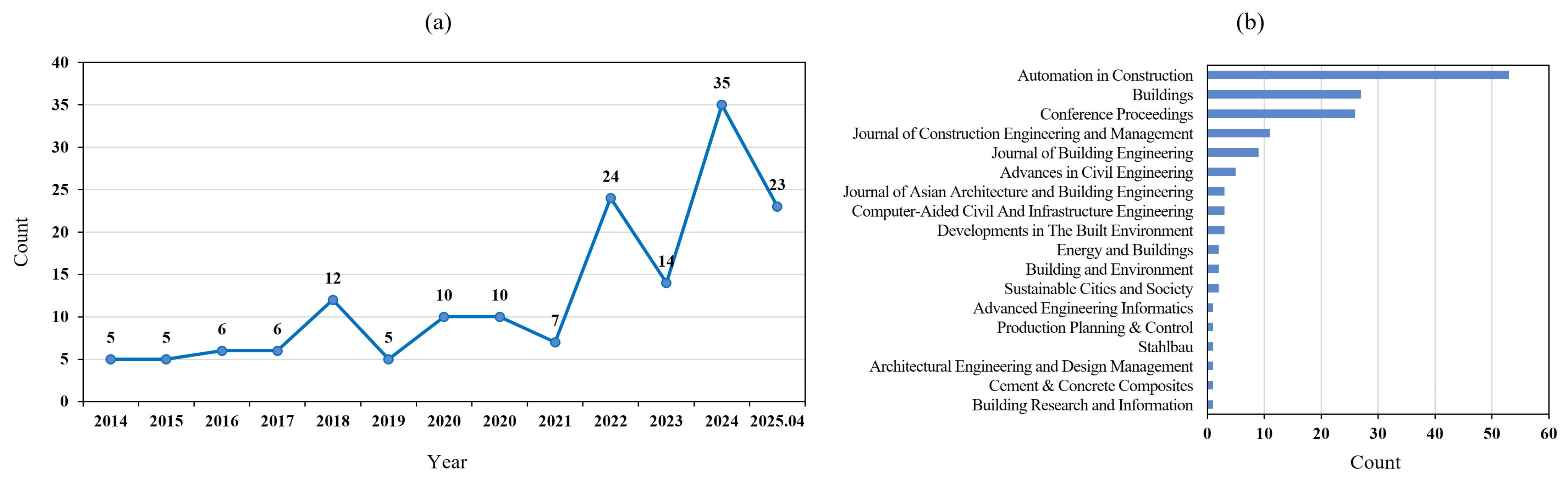
Figure 2a depicts the annual number of publications on ontology–AI integration in construction from 2014 to April 2025. Between 2014 and 2017, publication activity remained modest—averaging five to six papers per year—marking an initial exploratory phase when ontology–AI integration was largely conceptual rather than empirical. In 2018, the annual output nearly doubled (12 papers), signaling the beginning of active research engagement, followed by steady growth through 2021. A significant surge occurred after 2022, with a peak of 35 publications in 2024. As of April 2025, 23 papers have already appeared, suggesting that the momentum of research is likely to continue. This trend demonstrates that ontology–AI integration has emerged as a sustained research focus within the construction domain, evolving from theoretical discussions to practical, data-driven implementations.
Figure 2b presents the distribution of publication sources. Automation in Construction dominates the field with 53 papers (34.9%), followed by Buildings (27, 17.8%) and various conference proceedings (26, 17.1%). Other notable outlets include the Journal of Construction Engineering and Management (11), Journal of Building Engineering (9), and Advances in Civil Engineering (5). Several interdisciplinary journals—such as Computer-Aided Civil and Infrastructure Engineering, Developments in the Built Environment, and Sustainable Cities and Society—have also featured related works, illustrating the cross-disciplinary nature of ontology–AI research spanning architecture, civil engineering, and applied AI systems.
A cross-analysis of publication sources and years further reveals the field’s developmental trajectory. Automation in Construction has consistently led since 2014, serving as an early adopter and core platform for ontology-based AI research in construction. Its publication rate increased notably from 2022 to 2024, reflecting a shift toward empirical automation and semantic modeling studies. Subsequently, Buildings and the Journal of Building Engineering began publishing more actively after 2021, expanding the topic’s reach into architectural and management-oriented domains. Likewise, traditional engineering journals such as JCEM and Advances in Civil Engineering have integrated ontology–AI topics since the early 2020s, indicating the mainstream adoption of AI-based information modeling in conventional construction engineering. Meanwhile, conference proceedings have maintained consistent presence from 2015 to 2024, showing that the field was initially driven by experimental demonstrations and pilot studies before gaining full journal recognition.
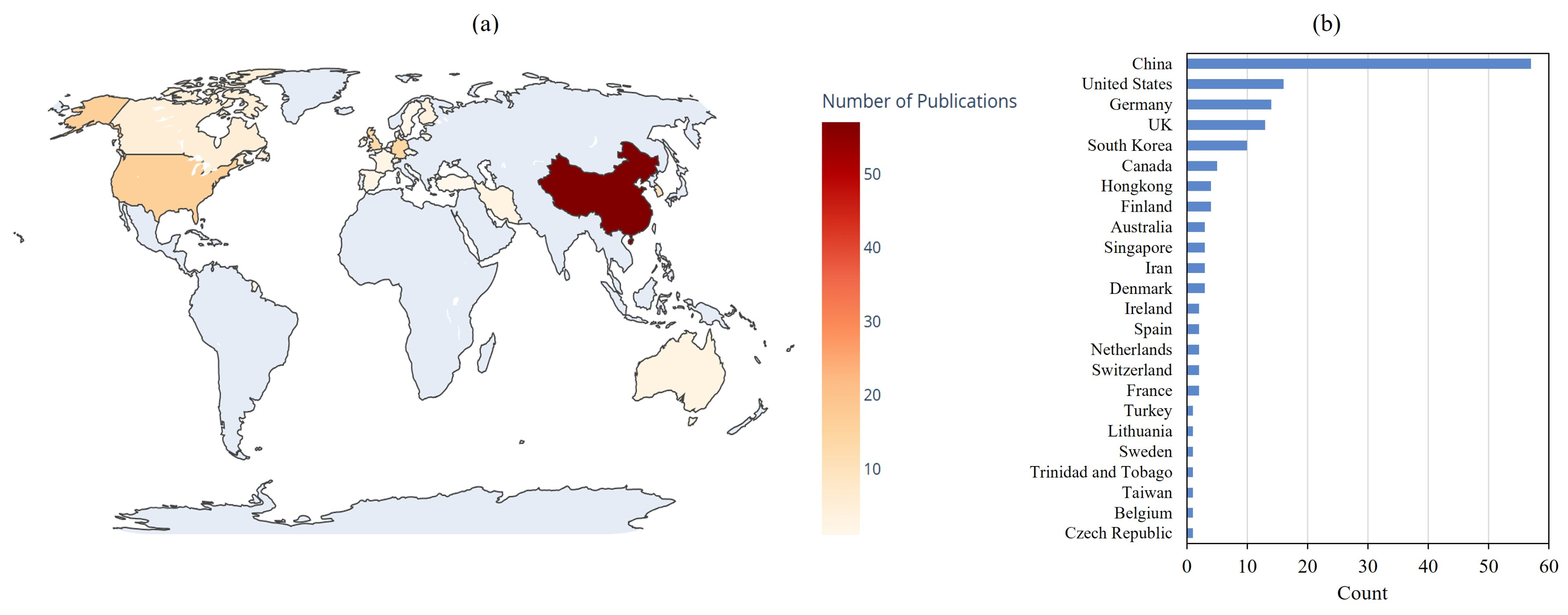
Figure 3a illustrates the global distribution of first-author affiliations using a heat map, and Figure 3b compares publication counts across 24 countries. China leads with 57 papers (37.5%), followed by the United States (10.5%), Germany (9.2%), the United Kingdom (8.6%), and South Korea (6.6%). Collectively, these five nations account for approximately 72% of all publications, highlighting a strong regional concentration of research in East Asia, Western Europe, and North America.

3.2. Topic Modeling-Based Trends in Ontology-Integrated AI Applications

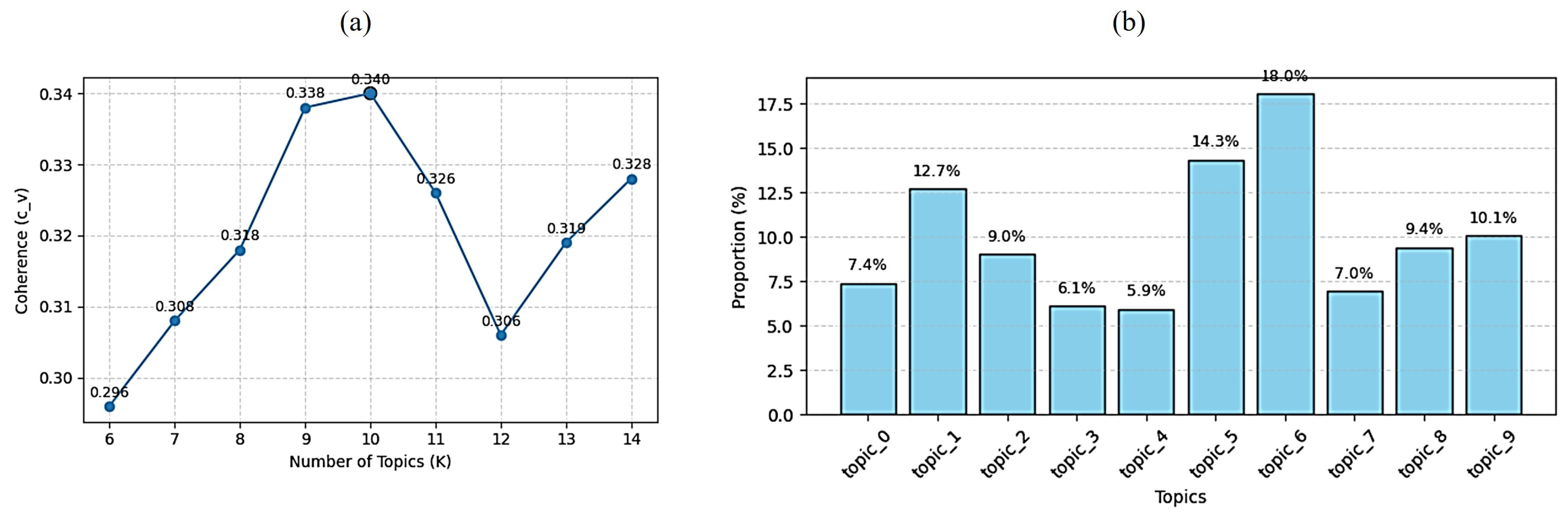
To explore thematic trends in ontology-integrated AI applications in construction, Latent Dirichlet Allocation (LDA) topic modeling was conducted. An initial run revealed that overly generic words (e.g., approach, different, potential) appeared as top-ranked keywords, which limited interpretability. To address this, stopwords and low-information tokens were removed, and an additional TF–IDF–based pruning process was applied before re-running the final model. The number of topics (K) was determined using the coherence score (c_v).
Figure 4a presents a comparison of coherence values across K values ranging from 6 to 14. The results indicate that K = 10 yielded the highest coherence score (0.340) and was therefore selected as the optimal number of topics for this study. Figure 4b illustrates the relative size distribution of the ten topics. Each topic accounted for 5.9% to 18.0% of the entire corpus, corresponding to 9 to 26 papers, indicating that no topic was excessively dominant or marginal. This balanced distribution suggests that ontology–AI applications are being investigated across a wide range of subdomains in construction research.
To assign labels to the ten topics, representative papers and key keywords were examined. The analysis revealed that the topics can be systematically explained along two dimensions: Functional Objectives and Data Types. In other words, ontology–AI applications in construction can be characterized both by their intended purpose and by the types of data on which they are based.
The Functional Objectives identified from the analysis were Quality and Regulatory Checking, Decision Support, Hazard Reasoning and Risk Assessment, Knowledge Accumulation and Reuse, and Sustainability and Structural Assessment. The Data Types were categorized into BIM, Image, Text, and Sensor data. This dual classification indicates that ontology–AI applications tend to exhibit consistent patterns based on the combination of research objectives and data utilization. Table 1 summarizes the classification of the ten topics across these two dimensions.
The analysis revealed five major functional objectives of ontology–AI applications in construction. These objectives reflect how ontology-driven approaches are employed to support both operational and strategic goals. Table 2 summarizes the definitions of each functional objective along with representative application examples drawn from the reviewed studies.
The topic modeling results also identified four primary data modalities: BIM, text, image, and sensor data. These data types represent the main sources through which ontologies enable semantic integration and reasoning, highlighting their application across different construction tasks.
In this context, “image” data refers specifically to two-dimensional visual image representations used for scene understanding and image recognition tasks, independent of image acquisition platforms. Three-dimensional sensing modalities, such as LiDAR-based point clouds, are therefore treated separately under sensor data due to their distinct data structures and processing pipelines.
Table 3 summarizes the major data modalities and representative examples from the reviewed studies.
BIM data provide structured spatial and locational information and are widely used to support compliance checking, clash detection, design validation, and hazard recognition. Text data are mainly applied to extract entities and relationships from unstructured documents such as accident reports, safety manuals, and technical guidelines, thereby supporting regulatory compliance, hazard reasoning, and knowledge reuse. Image data are employed in tasks such as PPE compliance recognition, unsafe behavior detection, equipment monitoring, and construction quality assessment. In these studies, detected visual objects are semantically mapped to ontology concepts, enabling rule-based and ontology-driven reasoning for safety management and risk evaluation. Sensor data are utilized for real-time spatiotemporal monitoring, including worker localization, equipment operation, structural vibration, and environmental conditions, often in conjunction with digital twin platforms.
In addition to single-source applications, several studies demonstrated multimodal integration, for example, combining text–image or image–sensor data streams, to improve reasoning accuracy and enrich semantic context. These findings underscore the potential of ontologies not only as mechanisms for semantic enrichment but also as integrative frameworks for cross-modal information fusion and reasoning in complex construction environments.
Overall, the results suggest that ontology-based AI applications are not confined to a single task domain. Rather, they span immediate operational needs such as regulatory compliance and risk assessment, as well as long-term objectives including knowledge reuse and sustainability. This indicates a gradual expansion of ontology–AI applications in construction from short-term, task-specific optimization toward broader contributions to sustainable and intelligent project delivery.

3.3. Integration Types of AI and Ontology

This subsection explains how ontologies and knowledge graphs are integrated with AI methods in practice, focusing on recurring integration approaches rather than algorithmic details. Integration approaches are not included in topic labeling but are presented as a complementary analytical dimension that illustrates the implementation patterns of ontology–AI applications.
While this review does not aim to reproduce code-level details, it synthesizes how different studies positioned ontologies within AI pipelines and highlights common strategies reported in the literature. Although integration approaches do not directly emerge from topic modeling, an examination of representative papers shows close linkages between application themes and integration methods. For example, Topic 2 (information extraction from regulations, codes, and constraints) involves text analysis and ontology mapping, representing a typical NLP-based integration case. Topics 3 and 4 (image-based structural and hazard assessment) are associated with vision-model integration, where CNN or YOLO outputs are mapped to ontology concepts. In addition, Topic 6 (BIM-based risk reasoning) and Topic 9 (BIM-based deconstruction planning) are directly related to graph neural network (GNN)–based integration, which leverages graph-structured learning.
As summarized in Table 4, ontology–AI integration in the construction domain is currently concentrated on embedding-based approaches, which transform ontological concepts and relations into vector spaces and thereby facilitate incorporation into deep learning models. In contrast, NLP-based integration is consistently applied in text-heavy domains such as regulatory compliance, while vision-model integration, though less frequent, demonstrates practical value in hazard detection and scene-level interpretation. GNN-based integration, along with transfer and few-shot learning, remains at an early stage but represents emerging directions in which ontologies are coupled with adaptive AI models for complex relational reasoning and data-scarce environments.
These findings indicate that current ontology–AI applications in construction primarily rely on embedding-based approaches but also reveal a growing body of studies exploring vision-based and GNN-based methods. This pattern suggests the importance of diversifying technical pathways and developing more detailed empirical implementations to broaden applicability and strengthen reproducibility.

3.4. Ontology-Based Image Recognition in Construction AI

While many of the 152 eligible studies incorporated some form of image data, this review specifically focuses on the subset that employed image recognition as the primary analytical method. This focus is justified because image recognition constitutes a foundational component of construction image understanding, is directly linked to construction safety and quality management, and offers one of the clearest demonstrations of ontology’s contribution—by mapping detected objects to ontology-defined semantic concepts and applying rule-based reasoning to interpret recognition results. Although image data appeared across multiple topics (e.g., Topics 1, 3, and 4), in most cases they were combined with other modalities and used as Supplementary Information. By contrast, the 16 studies analyzed in this section explicitly adopted image recognition as their central methodological component, warranting their selection for in-depth analysis. These studies collectively illustrate how ontologies enhance image-based AI pipelines by improving interpretability, reducing false positives, and supporting hazard reasoning. The following subsections (Section 3.4.1, Section 3.4.2, Section 3.4.3, Section 3.4.4 and Section 3.4.5) examine this subset across functional roles, ontology construction approaches, vision models employed, integration strategies within AI pipelines, and reported performance outcomes.

3.4.1. Functional Roles of Ontology in Image Recognition

The functional roles summarized in Table 5 were derived from the image-related topics identified in Table 1. For example, Topic 1 (Knowledge Accumulation & Reuse, Text + Image) corresponds to situation awareness, Topic 3 (Sustainability & Structural Assessment, Image + Text) corresponds to quality regulation compliance and anomaly detection, and Topic 4 (Hazard Reasoning & Risk Assessment, Image) corresponds to hazard identification and risk assessment. In this way, Table 5 refines these topic-level objectives into specific functional roles that capture how ontologies contribute within image recognition–based AI systems.
In such systems, ontologies extend beyond basic object detection by supporting semantic structuring, reasoning, rule interpretation, and process monitoring, thereby enhancing the interpretability and adaptability of recognition outcomes [18]. By modeling hierarchical and semantic relationships among domain-specific entities and concepts, ontologies enable fine-grained interpretation of interactions and scene contexts, allowing raw recognition results to be transformed into structured knowledge that supports intelligent decision-making [19,20]. In construction environments, where work conditions are complex and dynamic, ontologies facilitate real-time reasoning by linking visual recognition outputs to semantic frameworks. This enables monitoring of work status, process flows, compliance with safety standards, and hazard identification [21]. Such integration has proven useful not only for improving recognition performance but also for strengthening system-level interpretability and robustness, particularly in data-scarce environments [21,22].
Lee and Yu (2023) [21] proposed an ontology-integrated image recognition system that mapped construction site entities and safety regulations to real-time recognition outputs. Detected objects were passed to an ontology-based reasoner, which evaluated conditions such as “worker without PPE combined with an elevated work position,” issuing alerts for potential violations or hazardous situations. This example illustrates that ontologies function not merely as knowledge repositories but as active reasoning engines that interpret recognition results, generate explanatory insights, and support actionable decision-making for construction safety management.
However, critical perspectives also exist. Pileggi et al. (2024) [23] noted that many applications utilize ontologies primarily as post-processing tools for knowledge representation or semantic enrichment. They argue that such approaches fail to fully exploit ontologies as integrated reasoning components or active feature generators within AI pipelines. As a result, most systems remain limited to partial semantic enhancement rather than fully ontology-driven architectures, restricting their potential to support interoperability and explainability in human–machine collaboration.
These observations suggest the need for more empirically grounded strategies that embed ontologies more deeply into AI learning processes, enabling integrated reasoning, dynamic feature generation, and enhanced semantic alignment between AI systems and real-world construction contexts.

3.4.2. Ontology Construction Approaches

In image recognition–based AI systems, ontologies can be constructed using three primary approaches: manual, automated, and hybrid. These approaches differ in the degree of AI involvement in schema design (e.g., classes, relations, and attributes), instance creation, update processes, and their overall suitability for different application domains.
The manual approach relies on domain experts to design both the ontology schema and instances from scratch. This traditional method offers high interpretability and strong domain alignment, making it suitable for applications that demand high-precision reasoning, such as safety management or quality control. For instance, Lee and Yu [21] constructed an ontology schema based on safety regulations and linked image recognition outputs to a rule-based reasoner for real-time risk assessment. Zheng et al. [24] similarly developed a fully hand-crafted process ontology to monitor construction workflows. However, manual development is time-consuming, requires extensive expert knowledge, and lacks scalability.
The automated approach employs AI techniques—such as NLP, deep learning, or large language models (LLMs)—to extract concepts and relationships from unstructured data and to generate or update ontology instances. This method offers rapid development, high scalability, and the ability to process large datasets. For example, Pfitzner et al. [22] transformed recognition results into GNN-based embeddings to automatically expand a knowledge graph. Zhang et al. [25] implemented a pipeline that automatically mapped detected objects to ontologies for real-time hazard analysis. Nevertheless, automated methods may face limitations in precision and domain-specific accuracy.
The hybrid approach combines manual schema design with automated instance generation and updates. It seeks to balance manual reliability with automated scalability, making it particularly effective in real-time applications. Fang et al. [26] manually created a hazard hierarchy but automated object instantiation. Wu et al. [18] built a risk management ontology manually but integrated vision-based recognition outputs into an automated reasoning module.
Among the 16 analyzed studies (see Table 6), hybrid approaches were the most common (7 studies, 43.8%), followed by automated (5 studies, 31.3%) and manual (4 studies, 25.0%). This distribution suggests a gradual shift away from traditional manual development toward hybrid frameworks—particularly in domains such as process monitoring and hazard detection, where both domain alignment and real-time adaptability are essential.

3.4.3. Image Recognition Models Applied

Among the 16 image-based studies analyzed, object detection models were the predominant choice, with the YOLO family being the most widely adopted (see Table 7). This prevalence reflects the specific requirements of construction environments, where real-time performance, lightweight deployment, and robustness across diverse site conditions are critical.
By contrast, Mask R-CNN was selectively used in tasks requiring precise instance segmentation. Visual Relationship Detection (VRD) and image captioning models were applied in tasks focused on contextual or relational interpretation, typically using VTransE. In several studies, outputs from vision models were further combined with knowledge graph embeddings or Graph Neural Networks (GNNs), not as standalone classifiers but as components of ontology-driven reasoning pipelines.
YOLO models were favored for their speed, efficiency, and versatility, and were applied in tasks such as regulatory violation detection, risk level classification, and process monitoring. Studies by Fang et al. [26], Pfitzner et al. [22], Wu et al. [18], and Zhong et al. [8] used YOLO for rapid object detection, mapping recognition outputs to ontology concepts for real-time reasoning. Mask R-CNN, with its capacity for object segmentation and spatial delineation, was used in fine-grained analyses such as structural damage detection [27] and object state monitoring [20]. VRD (VTransE) was used in Li et al. [19] to extract inter-object relationships and align them with ontology structures, enabling context-aware interpretation and compliance assessment. Other approaches included BLE-based semantic trajectory analysis (Arslan et al. [28]) for location-based situation awareness. Two studies (Zeng et al. [29], Pedro et al. [30]) did not explicitly specify the vision models used but incorporated image data for semantic enrichment or training dataset development.
In summary, YOLO and related real-time object detection models were most frequently applied to responsiveness-driven tasks. In contrast, Mask R-CNN, VRD, and image captioning models were selectively used for fine-grained analysis or contextual reasoning. Recent trends indicate a gradual shift from single-frame detection toward context-aware reasoning, with hybrid pipelines combining vision recognition outputs with ontology-based embeddings or GNN-based inference. These trends suggest an ongoing evolution from object-level detection toward semantic scene understanding in ontology–AI integration for construction.
Table 7 summarizes the vision model families identified in the reviewed studies, along with their key characteristics.

3.4.4. Ontology Implementation Strategies in AI Pipelines

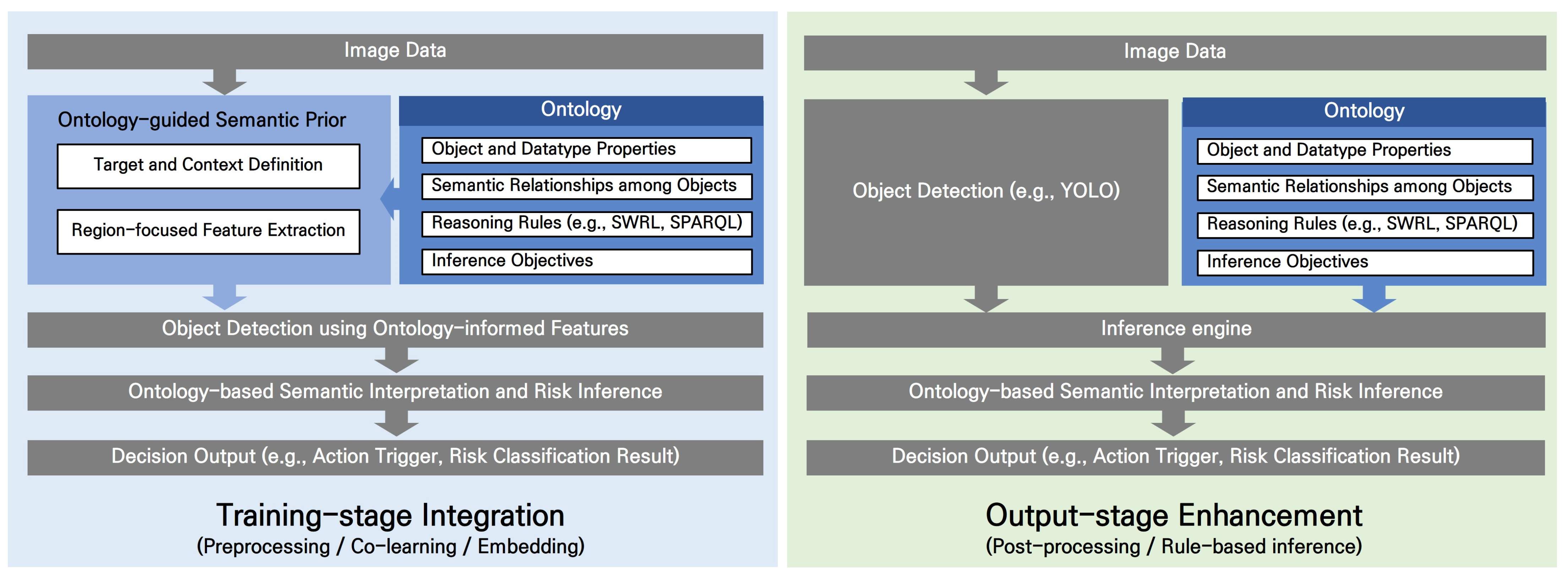
Ontology integration approaches in image recognition–based AI pipelines can be broadly categorized into two groups based on the stage and manner of integration: training-stage integration and output-stage enhancement. The former introduces ontological knowledge during model training to improve feature representation and learning structure, while the latter applies ontology-based interpretation and reasoning as a post-processing layer to refine model outputs.
For example, training-stage integration embeds semantic knowledge into the learning process itself, such as applying ontology-defined labels or embeddings during preprocessing or model training (e.g., ontology-guided labeling or knowledge graph embeddings in YOLO). In contrast, output-stage enhancement applies ontology-based reasoning after inference, such as mapping detected objects to ontology concepts and applying SWRL- or SPARQL-based rules to infer hazards or validate compliance.
Figure 5 illustrates this framework, showing not only the distinction between the two approaches but also their positions within the image recognition pipeline: training-stage integration informs feature extraction and model learning (left), whereas output-stage enhancement functions as a reasoning layer applied after object detection (right).
Training-stage integration embeds ontological information directly into input processing and learning stages, enabling semantic knowledge to be internalized within model representations. This category can be further divided into three subtypes: preprocessing-based integration, transfer and embedding-based integration, and co-learning integration.
Preprocessing-based integration uses ontology concepts and relationships for data preprocessing, candidate region filtering, or label refinement. For example, Arslan et al. [28] mapped BLE-based semantic trajectories to ontology concepts, enriching training data with semantic labels and features.
Transfer and embedding-based integration incorporates ontological hierarchies or embeddings into model initialization or transfer learning stages. Pfitzner et al. [22] combined knowledge graph embeddings with a YOLO detector for semantically informed feature learning, while Pan et al. [31] applied zero-shot label embeddings to reduce the gap between label definitions and recognition outcomes.
Co-learning integration jointly trains deep learning models and ontology-based knowledge graph models, enabling parallel learning of data-driven features and semantic relationships. Examples include joint training of CNN and GCN architectures or using ontology reasoning outputs as feedback within the training loop. However, no such cases were identified in the construction domain, suggesting that co-learning strategies remain largely experimental due to the high demands of pipeline design and data preparation.
Output-stage enhancement, by contrast, applies ontology-based interpretation to model outputs without modifying the architecture of existing detection or classification models. This approach can be divided into class mapping and rule-based reasoning.
Class mapping integration connects detected object labels with ontology concepts, enriching them with attributes and relationships for subsequent reasoning or knowledge accumulation. Zheng et al. [24] mapped Mask R-CNN results to a process ontology to classify work status, while Zeng et al. [29] and Pedro et al. [30] linked image data to ontologies to improve training scenarios and visualization quality.
Rule-based reasoning integration applies ontology-defined rules (e.g., SWRL, SPARQL) to recognition outputs for contextual assessment. Lee and Yu [21] combined YOLO outputs with a safety ontology to infer hazardous conditions in real time, while Fang et al. [26] employed rule-based reasoning with a hazard ontology to automatically detect regulatory violations. Although straightforward to implement and highly compatible with existing models, this approach primarily functions as an interpretive layer rather than directly improving detection performance.
Analysis of the 16 studies revealed that output-stage enhancement was substantially more common, with rule-based reasoning being the most frequently adopted strategy. This preference reflects its low implementation burden and high compatibility with widely used models such as YOLO and Mask R-CNN, enabling relatively rapid deployment. In contrast, training-stage integration was less frequently observed due to greater design complexity and data preparation requirements. Nevertheless, it offers the potential advantage of embedding semantic knowledge directly into model representations, which may be particularly valuable for tasks involving complex relational reasoning or contextual understanding.
Recent developments also indicate a growing interest in hybrid strategies that combine training-stage and output-stage approaches. Methods that integrate ontological embeddings into deep feature learning or align pretrained and transfer learning models with ontology structures may enhance semantic interpretability across the pipeline. Such approaches have the potential to improve not only system performance but also explainability and reproducibility in ontology-enhanced AI systems.

3.4.5. Performance Outcomes

In the 16 studies reviewed, the outcomes of ontology–AI integration in image recognition–based systems varied depending on the research purpose, the models employed, and the integration approaches adopted. Overall, performance improvements were not consistently reflected in large numerical gains; rather, the contributions of ontologies were more evident in terms of interpretability, reliability, and practical applicability.
For instance, in studies focused on hazard identification and situation awareness, models such as YOLO or Mask R-CNN were typically combined with rule-based reasoning integration. These approaches consistently reported reductions in false positives, improved real-time hazard inference, and stronger contextual awareness, although absolute improvements in accuracy were often limited. In contrast, studies on process tracking and anomaly detection frequently employed YOLO outputs mapped to ontologies or embedding-based transfer learning. Reported benefits included workflow monitoring, improved classification consistency, and mitigation of misclassifications; however, many of these works remained at the proof-of-concept stage and were highly dependent on ontology quality. In the domain of regulation and standards compliance, several studies combined detection results with regulatory ontologies to automatically assess conformity. These demonstrated practical value for safety management, yet their outcomes were strongly influenced by dataset variability and ontology design choices.
Some studies reported only marginal numerical improvements, such as 2–3 percentage points over baseline models, or results that were statistically insignificant. More importantly, heterogeneity in datasets, evaluation metrics, and experimental setups limited comparability and generalization across studies. Furthermore, ontology development—including schema design, labeling, and structural definition—was frequently identified as a resource-intensive process, restricting scalability and transferability.
A detailed breakdown of all 16 image recognition studies—including their research purposes, employed models, integration approaches, reported effects, and limitations—is presented in Table 8. This supplementary table highlights the heterogeneity of evaluation setups and clarifies that reported outcomes are highly context dependent.
Taken together, these findings indicate that ontology integration does not guarantee consistent numerical performance gains. Instead, its main contributions lie in enhancing explainability, contextual reasoning, workflow monitoring, and regulatory transparency, thereby increasing trust and applicability in construction safety and quality management. These observations underscore the importance of developing standardized evaluation protocols, conducting repeated validations across domains, and implementing comparative experiments in real-world environments to strengthen both reproducibility and practical relevance.

4. Challenges and Future Research on Ontology-AI Integration

4.1. Research Gaps and Limitations

Among the 152 eligible studies, 16 addressed image-based applications. These works consistently reported qualitative gains—such as reduced false positives, improved situational awareness, and enhanced interpretability—but they also revealed deeper structural and methodological limitations that restrict the advancement of ontology–AI integration in construction.
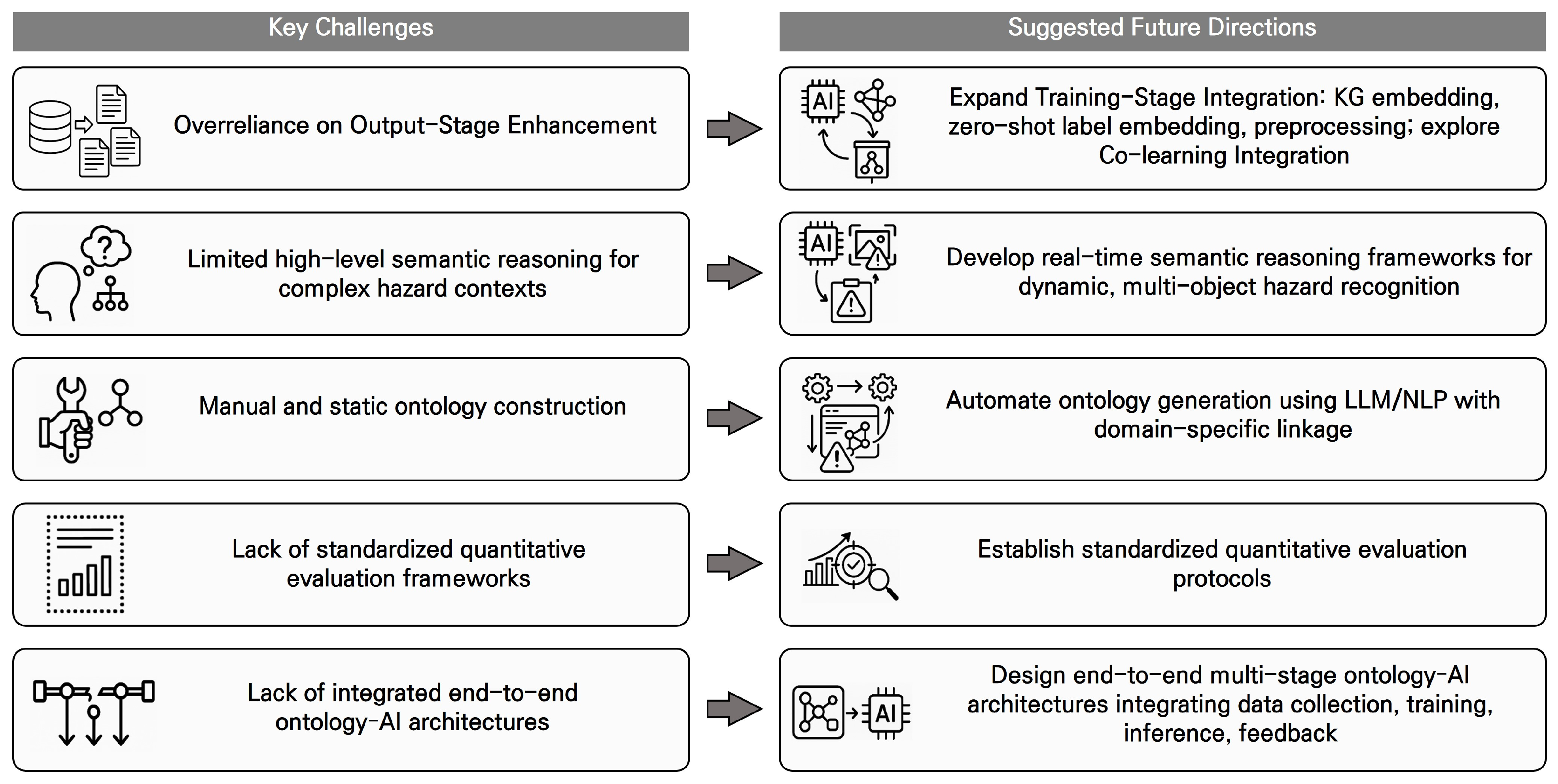
A first limitation is the field’s strong reliance on output-stage enhancement. Approximately 75% of image-based studies applied ontologies only after object detection, primarily for class mapping or rule-based hazard interpretation [18,21,26]. Although this post hoc integration improves semantic clarity and compliance assessment, it does not influence feature representation or model learning. Training-stage integration was rarely attempted; only a small number of studies explored semantically enriched preprocessing [28] or knowledge and zero-shot embeddings [22,31]. No examples of joint learning frameworks—where neural networks and ontology-based reasoning models are trained in tandem—were identified in the construction domain. This imbalance reflects a structural constraint: construction image datasets lack stable object categories, standardized schemas, and consistent annotations, making ontology-informed training costly and technically challenging. As a result, perception (image recognition) and reasoning processes remain weakly coupled, limiting the potential of ontologies to improve generalization, robustness, or domain-shift performance.
A second limitation concerns the restricted scope of semantic reasoning, which remains largely static and frame-based. Most systems focused on object-level image recognition or simple rule-based inference without modeling temporal progression, multi-object interactions, or causal hazard evolution. For example, Li et al. [19] used Visual Relationship Detection (VTransE) to extract pairwise object relationships, and Zhang et al. [25] and Wu et al. [18] combined YOLO detections with ontology-driven classification. However, these approaches remained confined to single-frame reasoning, lacking mechanisms for identifying unsafe sequences, cumulative risk buildup, or evolving situational patterns. This limitation arises from the absence of temporal constructs in existing construction ontologies and the lack of reasoning modules capable of representing procedural dependencies or scenario-level dynamics.
A third limitation lies in the persistent reliance on manual and static ontology construction. More than 80% of the reviewed studies depended on expert-driven schema design and manual instance creation, as seen in Zheng et al. [24], Zhang et al. [25], and Li et al. [19]. Such methods ensure precision at the initial stage but lack scalability and adaptability as site conditions and hazard categories evolve. Attempts to automate ontology creation through NLP or LLMs were limited in scope [29] and did not address the full ontology lifecycle, leading to schema brittleness, high maintenance costs, and divergence between ontology structures and real-world site dynamics.
A fourth limitation relates to the heterogeneity of evaluation methods, which impedes cross-study comparison and generalization. Studies reported inconsistent metrics—accuracy, recall, precision, IoU, F1-score, and mAP—or relied solely on qualitative assessments [22,28,30]. Explainability benefits were frequently mentioned but rarely operationalized into quantitative or reproducible measures. This variation reflects a deeper gap: construction lacks shared taxonomies, benchmark datasets, and standardized annotation policies. As a result, performance outcomes remain highly context-dependent, and evidence for ontology-integrated models is fragmented.
Finally, ontology–AI integration rarely extended across the full AI lifecycle, revealing a gap in end-to-end architectural integration. Most systems incorporated ontologies only at isolated stages, typically post-detection mapping [24,30]. Even more advanced pipelines, such as Pan et al.’s Video2Entities framework [31], lacked feedback loops connecting semantic reasoning to model training or data curation. Without unified schemas, co-learning mechanisms, or iterative update processes, ontologies function only as supplementary interpretive layers rather than central components capable of guiding perception, reasoning, and continuous adaptation. This architectural fragmentation is further exacerbated in BIM-centered workflows by the absence of standardized AI–BIM data-exchange interfaces, which prevents semantic outputs and reasoning results from being reintegrated into upstream data models or learning processes. As a result, ontology-enabled AI systems remain confined to localized enhancements rather than operating as continuously adaptive, closed-loop architectures. This persistent disconnection between data modeling, perception, and reasoning constitutes a major obstacle to scaling ontology-integrated AI systems for real-world construction applications.

4.2. Future Research Directions

The directions in this section are not speculative wish lists but are directly derived from the recurring limitations identified in Section 4.1. By explicitly linking each proposal to documented gaps, these recommendations highlight evidence-based priorities for advancing ontology–AI integration in construction image recognition (see Figure 6, right panel).
The first direction is to embed ontologies into training pipelines. While most existing studies incorporated ontologies only after detection, a few demonstrated the potential of deeper integration through semantically enriched preprocessing [28], knowledge graph embeddings [22], or zero-shot label expansion [31]. Building on these findings, future research should explore co-learning frameworks that jointly train CNNs and GNNs or introduce feedback mechanisms in which ontology-based reasoning influences iterative model updates. Such approaches can strengthen contextual representation, improve generalization under domain shift, and enhance adaptability in data-scarce environments.
A second direction is to advance temporal and scenario-based semantic reasoning. Current systems largely interpret scenes frame by frame, making it difficult to detect evolving hazards or unsafe action sequences. Building on early efforts in relational modeling [19,25], future research should integrate multimodal data—such as images, text, and sensor streams—with ontology-driven reasoning to support scenario-based hazard prediction and behavioral analysis. Temporal scene graphs, ontology-based activity models, and predictive reasoning frameworks could enable proactive identification of hazard escalation in dynamic environments. Recent advances in vision–language models (VLMs) also offer promising opportunities to enhance ontology-based reasoning by jointly interpreting visual content and linguistic descriptions. When combined with ontological constraints, VLMs may support more flexible semantic grounding, cross-modal consistency, and natural language–based explanation of recognition and reasoning outcomes.
A third direction involves automating ontology construction. Section 4.1 showed that manual ontology development dominates current practice, leading to high labor costs and slow update cycles [24,25,29]. Advances in LLMs and NLP offer opportunities to extract concepts from unstructured text, align them with existing schemas, and generate instances automatically. Hybrid pipelines combining expert oversight with automated instance generation and schema evolution may improve scalability, responsiveness, and alignment with real-world site conditions.
A fourth direction is to establish standardized quantitative evaluation protocols. Given the heterogeneity of metrics observed across studies [22,28,30], future work should develop benchmark datasets with unified taxonomies and define evaluation frameworks that incorporate both accuracy-based and explainability-oriented metrics. In addition to conventional detection metrics (e.g., accuracy, precision, recall, mAP), such frameworks should include ontology-specific indicators, such as rule-consistency rates, semantic coverage, reasoning-path completeness, and false-positive reduction ratios attributable to ontology reasoning. Statistical validation—such as confidence intervals and effect sizes—should accompany performance reporting, and domain-shift tests should be adopted to assess robustness. These measures would enhance reproducibility and enable more consistent comparison of ontology-integrated systems.
Finally, future research should focus on developing end-to-end ontology–AI architectures that span data collection, training, inference, reasoning, and iterative feedback. Ontology-guided sampling and labeling, ontology-informed embeddings, rule-triggered relabeling, and MLOps-based model monitoring can support continuous improvement. Integrating such architectures with digital twins, real-time monitoring systems, and multi-agent platforms may enable adaptive and semantically consistent AI systems capable of operating effectively in complex construction environments.

5. Conclusions

This study conducted a systematic literature review of 152 ontology–AI integration studies, including an in-depth examination of 16 works on image recognition–based construction analysis. By adopting a multi-dimensional analytical perspective—covering application objectives, ontology construction methods, integration strategies, and evaluation practices—the review provides a more holistic understanding of how ontologies function as semantic infrastructures within AI-driven construction systems. Rather than treating numerical performance gains as the primary indicator of value, this study emphasizes ontology’s broader role in providing semantic consistency, contextual reasoning, and knowledge integration across heterogeneous data sources.
The findings reveal that ontology integration consistently yielded qualitative benefits such as reduced false positives in hazard detection, improved interpretability, and enhanced situational understanding. However, quantitative improvements in model accuracy or mAP were typically modest, highly context-dependent, and inconsistent across studies. Many ontology-enabled systems remain at the proof-of-concept stage and have not yet undergone rigorous evaluation in large-scale or real-world construction settings. These results highlight both the promise and immaturity of ontology–AI integration: ontologies enrich semantic reasoning but introduce design, integration, and maintenance complexity that must be justified through feasible and scalable deployment pathways.
This study contributes to the field in three important ways. First, by combining PRISMA methodology with topic modeling, it offers an objective map of 152 studies and reveals cross-domain clusters that cannot be captured by narrative synthesis alone. Second, it provides the first structured and detailed review of ontology-integrated image recognition in construction, synthesizing functional roles of ontologies, construction approaches, vision models, integration strategies, and performance outcomes. Third, it develops an evidence-based research agenda that directly links recurring structural limitations—identified through systematic analysis in Section 4.1—to targeted future directions in Section 4.2. This ensures that recommendations are grounded in observed empirical gaps rather than speculative assumptions. Although a formal quantitative meta-analysis was not conducted due to substantial heterogeneity in datasets, tasks, and evaluation metrics, this limitation reflects the current immaturity of standardized evaluation practices in ontology–AI integration research. As benchmark datasets and harmonized evaluation protocols emerge, future studies will be better positioned to conduct systematic quantitative comparisons and establish effectiveness rankings across different integration approaches.
Building on these observations, future research should therefore prioritize deeper integration of ontological knowledge into model training and representation learning; the development of standardized, quantitative frameworks to evaluate explainability and reasoning clarity; the establishment of benchmark datasets and harmonized evaluation protocols; the advancement of semi-automated ontology construction methods using LLM- and NLP-based techniques; and the design of end-to-end, multi-stage architectures that unify data collection, training, inference, and feedback within a semantically consistent pipeline.
Despite the methodological rigor ensured by adherence to PRISMA 2020 guidelines, several limitations must be acknowledged. First, the analysis relied solely on the Web of Science Core Collection, potentially omitting relevant studies indexed in other databases such as Scopus or Google Scholar. Second, the inclusion criteria focused exclusively on English-language, peer-reviewed publications, excluding grey literature, theses, and technical reports that may contain additional insights. Third, the review period (2014–2025) captures recent developments but may overlook earlier foundational research in ontology engineering or AI integration. Finally, because this study primarily investigates ontology-based image recognition in construction, its findings may not generalize to domains where ontologies function differently or where data structures and workflows diverge from those of construction. These limitations should be addressed in future research by expanding database coverage, incorporating grey literature where appropriate, and exploring cross-domain comparative analyses of ontology–AI integration patterns.
Ontology–AI integration in construction holds substantial potential to enhance transparency, contextual reasoning, and adaptive decision-making. Yet its current state is characterized by methodological fragmentation, heterogeneous evaluation practices, and limited real-world validation. The value of ontologies should therefore not be framed as a universal performance-enhancing mechanism, but as a pragmatic semantic framework that supports the development of explainable and context-aware AI systems. By grounding the synthesis and future directions in systematic evidence, this review underscores both the academic significance and practical relevance of ontology-driven approaches, and highlights pathways toward scalable and semantically robust AI applications in construction environments.

Supplementary Materials

The following supporting information can be downloaded at: https://www.mdpi.com/article/10.3390/info17010048/s1, PRISMA 2020 Checklist [168].

Author Contributions

Conceptualization, S.L. (Seulki Lee); methodology, J.H.; validation, Y.K., J.H., and S.L. (Seungjun Lee), formal analysis, Y.K., J.H., and S.L. (Seungjun Lee); investigation, Y.K., J.H., and S.L. (Seungjun Lee); resources, Y.K., J.H., and S.L. (Seungjun Lee); data curation, S.L.; writing—original draft preparation, Y.K., J.H., and S.L. (Seungjun Lee); writing—review and editing, S.L. (Seulki Lee); visualization, Y.K.; supervision, S.L. (Seulki Lee) All authors have read and agreed to the published version of the manuscript.

Funding

This work was supported by the Korea Agency for Infrastructure Technology Advancement (KAIA) grant funded by the Ministry of Land, Infrastructure and Transport (Grant Number: RS-2024-00512799).

Institutional Review Board Statement

Not applicable.

Informed Consent Statement

Not applicable.

Data Availability Statement

No new data were created or analyzed in this study.

Conflicts of Interest

The authors declare no conflicts of interest.

References

  1. Bernold, L.E.; Lee, T.S. Experimental research in construction. J. Constr. Eng. Manag. 2009, 136, 26–35. [Google Scholar] [CrossRef]
  2. Choe, S.; Leite, F. Assessing safety risk among different construction occupations using occupation-specific data. J. Constr. Eng. Manag. 2016, 143, 04017007. [Google Scholar] [CrossRef]
  3. International Labour Organization. Safety and Health in Construction; International Labour Organization: Geneva, Switzerland, 2015. [Google Scholar]
  4. Ministry of Employment and Labor. Industrial Accident Status; Ministry of Employment and Labor: Seoul, Republic of Korea, 2023. [Google Scholar]
  5. Kim, K.; Kim, K.; Jeong, S. Application of YOLO v5 and v8 for Recognition of Safety Risk Factors at Construction Sites. Sustainability 2023, 15, 15179. [Google Scholar] [CrossRef]
  6. Zhao, J.; Xu, Y.; Zhu, W.; Liu, M.; Zhao, J. Real-Time Early Safety Warning for Personnel Intrusion Behavior on Construction Sites Using a CNN Model. Buildings 2023, 13, 2206. [Google Scholar] [CrossRef]
  7. Gong, Y.; Liu, G.; Xue, Y.; Li, R.; Meng, L. A survey on dataset quality in machine learning. Inf. Softw. Technol. 2023, 162, 107268. [Google Scholar] [CrossRef]
  8. Zhong, B.; Li, H.; Luo, H.; Zhou, J.; Fang, W.; Xing, X. Ontology-Based Semantic Modeling of Knowledge in Construction for Proactive Hazard Identification. J. Constr. Eng. Manag. 2020, 146, e04020013. [Google Scholar] [CrossRef]
  9. Díaz-Rodríguez, N.; Lamas, A.; Sanchez, J.; Franchi, G.; Donadello, I.; Tabik, S.; Filliat, D.; Cruz, P.; Montes, R.; Herrera, F. EXplainable Neural-Symbolic Learning (X-NeSyL) methodology to fuse deep learning representations with expert knowledge graphs: The MonuMAI cultural heritage use case. Inf. Fusion 2022, 79, 58–83. [Google Scholar] [CrossRef]
  10. Roberto, B.; Giancarlo, G. On the Multiple Roles of Ontologies in Explainable, A.I. arXiv 2023. [Google Scholar] [CrossRef]
  11. Farghaly, K.; Soman, R.; Whyte, J. cSite ontology for production control of construction sites. Autom. Constr. 2024, 158, 105224. [Google Scholar] [CrossRef]
  12. Oluborode, K.O.; Wajiga, G.M.; Malgwi, Y.M. Ontology-Integrated Machine Learning in Computer Vision: A Survey. Multidiscip. Int. J. Res. Dev. (MIJRD) 2024, 03, 116–130. Available online: https://www.mijrd.com/papers/v3/i6/MIJRDV3I60010.pdf (accessed on 2 April 2025).
  13. Ghidalia, S.; Alshahrani, M.; Janowicz, K.; Michel, F. Combining machine learning and ontology: A systematic literature review. arXiv 2024, arXiv:2401.07744. [Google Scholar] [CrossRef]
  14. Smith, B. Ontology. In The Blackwell Guide to the Philosophy of Computing and Information; Blackwell: Oxford, UK, 2003; pp. 153–166. [Google Scholar] [CrossRef]
  15. Studer, R.; Benjamins, V.R.; Fensel, D. Knowledge engineering: Principles and methods. Data Knowl. Eng. 1998, 25, 161–197. [Google Scholar] [CrossRef]
  16. Gruber, T.R. A translation approach to portable ontology specifications. Knowl. Acquis. 1993, 5, 199–220. [Google Scholar] [CrossRef]
  17. Guarino, N. Formal Ontology and Information Systems. In Formal Ontology in Information Systems; Guarino, N., Ed.; IOS Press: Amsterdam, The Netherlands, 1998; pp. 3–15. [Google Scholar]
  18. Wu, H.; Zhong, B.; Li, H.; Love, P.; Pan, X.; Zhao, N. Combining computer vision with semantic reasoning for on-site safety management in construction. J. Build. Eng. 2021, 42, 103036. [Google Scholar] [CrossRef]
  19. Li, Y.; Wei, H.; Han, Z.; Jiang, N.; Wang, W.; Huang, J. Computer Vision-Based Hazard Identification of Construction Site Using Visual Relationship Detection and Ontology. Buildings 2022, 12, 857. [Google Scholar] [CrossRef]
  20. Chacón, R.; Posada, H.; Ramonell, C.; Jungmann, M.; Hartmann, T.; Khan, R.; Tomar, R. Digital twinning of building construction processes. Case study: A reinforced concrete cast-in structure. J. Build. Eng. 2024, 74, 108522. [Google Scholar] [CrossRef]
  21. Lee, S.K.; Yu, J.H. Ontological inference process using AI-based object recognition for hazard awareness in construction sites. Autom. Constr. 2023, 153, 104961. [Google Scholar] [CrossRef]
  22. Pfitzner, F.; Staub-French, S.; Li, H.; Hartmann, T. Monitoring concrete pouring progress using knowledge graph-enhanced computer vision. Autom. Constr. 2025, 174, 106117. [Google Scholar] [CrossRef]
  23. Pileggi, S.F. Ontology in Hybrid Intelligence: A Concise Literature Review. Future Internet 2024, 16, 268. [Google Scholar] [CrossRef]
  24. Zheng, Y.; Masood, M.K.; Seppänen, O.; Törmä, S.; Aikala, A. Ontology-Based Semantic Construction Image Interpretation. Buildings 2023, 13, 2812. [Google Scholar] [CrossRef]
  25. Zhang, J.; Li, H.; Wang, K.; Chen, Y. Dynamic hazard analysis on construction sites using knowledge graphs integrated with real-time information. Autom. Constr. 2025, 158, 106174. [Google Scholar] [CrossRef]
  26. Fang, W.; Ma, L.; Love, P.E.D.; Luo, H.; Ding, L.; Zhou, A. Knowledge graph for identifying hazards on construction sites: Integrating computer vision with ontology. Autom. Constr. 2020, 119, 103310. [Google Scholar] [CrossRef]
  27. Hamdan, A.H.; Taraben, J.; Helmrich, M.; Mansperger, T.; Morgenthal, G.; Scherer, R.J. A semantic modeling approach for the automated detection and interpretation of structural damage. Autom. Constr. 2021, 128, 103739. [Google Scholar] [CrossRef]
  28. Arslan, M.; Cruz, C.; Ginhac, D. Semantic trajectory insights for worker safety in dynamic environments. Autom. Constr. 2019, 106, 102854. [Google Scholar] [CrossRef]
  29. Zeng, C.; Hartmann, T.; Ma, L. ConSE: An ontology for visual representation and semantic enrichment of digital images in construction sites. Adv. Eng. Inform. 2024, 60, 102446. [Google Scholar] [CrossRef]
  30. Pedro, A.; Bao, Q.L.; Hussain, R.; Soltani, M.; Pham, H.C.; Park, C. Learning from construction accidents in virtual reality with an ontology-enabled framework. Autom. Constr. 2024, 166, 105597. [Google Scholar] [CrossRef]
  31. Pan, Z.; Su, C.; Deng, Y.; Cheng, J. Video2Entities: A computer vision-based entity extraction framework for updating the architecture, engineering and construction industry knowledge graphs. Autom. Constr. 2024, 150, 04024121. [Google Scholar] [CrossRef]
  32. Pan, Z.; Shi, J.; Jiang, L. A semantic augmented approach to FEMA P-58 based dynamic regional seismic loss estimation application. J. Build. Eng. 2024, 98, 111224. [Google Scholar] [CrossRef]
  33. Hong, E.; Lee, S.-Y.; Kim, H.; Park, J.-E.; Seo, M.B.; Yi, J.-S. Graph-based intelligent accident hazard ontology using natural language processing for tracking, prediction, and learning. Autom. Constr. 2024, 168, 105800. [Google Scholar] [CrossRef]
  34. Rasmussen, M.H.; Lefrançois, M.; Pauwels, P.; Hviid, C.A.; Karlshøj, J. Managing interrelated project information in AEC Knowledge Graphs. Autom. Constr. 2019, 108, 102956. [Google Scholar] [CrossRef]
  35. Delgoshaei, P.; Heidarinejad, M.; Austin, M.A. Combined Ontology Driven and Machine Learning Approach to Monitoring of Building Energy Consumption. In Proceedings of the 2018 Building Performance Analysis Conference & SimBuild, Chicago, IL, USA, 26–28 October 2018. [Google Scholar]
  36. Nabavi, A.; Ramaji, I.; Sadeghi, N. An Artificial Intelligence-Based Framework for Automated Information Inquiry from Building Information Models Using Natural Language Processing and Ontology. ASCE Int. Conf. Comput. Civ. Eng. 2023, 046, 381–389. [Google Scholar] [CrossRef]
  37. Zhang, Y.; Liu, J.; Hou, K. Building a Knowledge Base of Bridge Maintenance Using Knowledge Graph. Adv. Civ. Eng. 2023, 2023, 6047489. [Google Scholar] [CrossRef]
  38. Yang, X.; Zhong, H.; Wang, Z.; Du, P.; Zhou, K.; Zhou, H.; Lai, X.; Lau, Y.L.; Song, Y.; Tang, L. BEKG: A built environment knowledge graph. Build. Res. Inf. 2022, 52, 19–37. [Google Scholar] [CrossRef]
  39. Doukari, O.; Seck, B.; Greenwood, D. The Creation of Construction Schedules in 4D BIM: A Comparison of Conventional and Automated Approaches. Buildings 2022, 12, 1145. [Google Scholar] [CrossRef]
  40. Zheng, C.; Wong, S.; Su, X.; Tang, Y.; Nawaz, A.; Kassem, M. Automating construction contract review using knowledge graph-enhanced large language models. Autom. Constr. 2023, 175, 106179. [Google Scholar] [CrossRef]
  41. Geng, C.; Xiong, F.; Liu, Y.; Zhang, Y.; Xue, Y.; Xia, T.; Ji, M. Systematic exploration of the knowledge graph on rock porosity structure. Buildings 2025, 15, 101. [Google Scholar] [CrossRef]
  42. Zhang, M.; Li, X.; Wang, Y.; Song, Y.; Zhao, Y. A Knowledge Graph-Based Approach to Recommending Low-Carbon Construction Schemes of Bridges. Buildings 2023, 13, 1352. [Google Scholar] [CrossRef]
  43. Allam, A.S.; Nik-Bakht, M. Integrating industry foundation classes and knowledge graphs for automated deconstruction planning. J. Build. Eng. 2025, 106, 112564. [Google Scholar] [CrossRef]
  44. Gros, A.; De Luca, L.; Paquet, E.; Rubinetti, S.; Bromberg, I. From surveys to simulations: Integrating Notre-Dame de Paris’ buttressing system diagnosis with knowledge graphs. Autom. Constr. 2024, 170, 105927. [Google Scholar] [CrossRef]
  45. Lu, Z.; Sun, C.T.; Hu, Y.Q.; Kumar, A. BIM and Knowledge Graph-Based Building Material Recycle and Reuse Assessment Framework. In Proceedings of the International Conference on Computing in Civil Engineering 2023, ASCE Library, Corvallis, OR, USA, 25–28 June 2023. [Google Scholar] [CrossRef]
  46. Pfitzner, F.; Braun, A.; Borrmann, A. From data to knowledge: Construction process analysis through continuous image capturing, object detection, and knowledge graph creation. Autom. Constr. 2024, 164, 105451. [Google Scholar] [CrossRef]
  47. Chen, Y.; Lu, G.; Wang, K.; Chen, S.; Duan, C. Knowledge graph for safety management standards of water conservancy construction engineering. Autom. Constr. 2024, 168, 105873. [Google Scholar] [CrossRef]
  48. Li, H.; Yang, R.; Xu, S.S.; Xiao, Y.; Zhao, H. Intelligent Checking Method for Construction Schemes via Fusion of Knowledge Graph and Large Language Models. Buildings 2024, 14, 2052. [Google Scholar] [CrossRef]
  49. Wang, X.; El-Gohary, N. Deep Learning-Based Relation Extraction from Construction Safety Regulations for Automated Field Compliance Checking. In Proceedings of the International Conference on Computing in Civil Engineering 2022, ASCE Library, Cape Town, South Africa, 26–28 October 2022; pp. 286–295. [Google Scholar]
  50. Jiang, W.; Liu, Y.; Chen, K.; Liu, Y.; Ding, L. Early-warning of unsafe hoisting operations: An integration of digital twin and knowledge graph. Dev. Built Environ. 2024, 19, 100490. [Google Scholar] [CrossRef]
  51. Li, C.; Petzold, F. Ontology-Driven Mixture-of-Domain Documentation: A Backbone Approach Enabling Question Answering for Additive Construction. Buildings 2025, 15, 133. [Google Scholar] [CrossRef]
  52. Jin, Z.; Kang, S.H.; Lee, Y.S.; Jung, Y.S. Standard terms as analytical variables for collective data sharing in construction management. Autom. Constr. 2023, 146, 104752. [Google Scholar] [CrossRef]
  53. Zhang, Y.; Torma, S.; Seppanen, O. A Shared Ontology Suite for Digital Construction Workflow. Autom. Constr. 2021, 132, 13930. [Google Scholar] [CrossRef]
  54. Isah, M.A.; Kim, B.S. Question-Answering System Powered by Knowledge Graph and Generative Pretained Transformer to Support Risk Identification in Tunnel Projects. J. Constr. Eng. Manag. 2024, 151, 15230. [Google Scholar] [CrossRef]
  55. Niknam, M.; Karshenas, S. A shared ontology approach to semantic representation of BIM data. Autom. Constr. 2017, 80, 22–36. [Google Scholar] [CrossRef]
  56. Schlenger, J.; Pluta, K.; Mathew, A.; Yeung, T.; Sacks, R.; Borrmann, A. Reference architecture and ontology framework for digital twin construction. Autom. Constr. 2024, 174, 106111. [Google Scholar] [CrossRef]
  57. Bahreinia, F.; Hammad, A.; Ghabraie, K. Ontology for BIM-Based Robotic Navigation and Inspection Tasks. Buildings 2024, 14, 2274. [Google Scholar] [CrossRef]
  58. Wu, C.; Li, X.; Jiang, R.; Guo, Y.; Wang, J.; Yang, Z. Graph-based deep learning model for knowledge base completion in constraint management of construction projects. Comput. Aided Civ. Infrastruct. Eng. 2023, 38, 702–719. [Google Scholar] [CrossRef]
  59. Guo, B.H.W.; Goh, Y.M. Ontology for design of active fall protection systems. Autom. Constr. 2017, 82, 138–153. [Google Scholar] [CrossRef]
  60. Abanda, F.H.; Akintola, A.; Tuhaise, V.V.; Tah, J.H.M. BIM ontology for information management (BIM-OIM). J. Build. Eng. 2025, 107, 112762. [Google Scholar] [CrossRef]
  61. Matějka, P.; Tomek, A. Ontology of BIM in a Construction Project Life Cycle. Procedia Eng. 2017, 196, 1080–1087. [Google Scholar] [CrossRef]
  62. Ma, R.; Li, Q.; Zhang, B.; Zhai, X.; Yin, L. An ontology-driven method for urban building energy modeling. Sustain. Cities Soc. 2024, 106, 105394. [Google Scholar] [CrossRef]
  63. Liu, J.; Qiu, Z.; Wang, L.; Liu, P.; Cheng, G.; Chen, Y. Intelligent floor plan design of modular high-rise residential building based on graph-constrained generative adversarial networks. Autom. Constr. 2024, 159, 105264. [Google Scholar] [CrossRef]
  64. Gao, X.; Liu, Y.; Yuan, M.; Wang, Y.; Ye, G.; Chen, H.; Deng, Y.; Zhang, X. Ontology-Guided Generation of Mechanized Construction Plan for Power Grid Construction Project. Buildings 2024, 14, 3271. [Google Scholar] [CrossRef]
  65. Liu, Z.; Ma, Z. Establishing formalized representation of standards for construction cost estimation by using ontology learning. Procedia Eng. 2015, 123, 291–299. [Google Scholar] [CrossRef]
  66. Liu, K.; El-Gohary, N.M. Bridge Deterioration Knowledge Ontology for Supporting Bridge Document Analytics. J. Constr. Eng. Manag. 2022, 148. [Google Scholar] [CrossRef]
  67. Schönfelder, L.; Honic, M.; De Wolf, C. A steel element reuse ontology for building audits in circular construction. Dev. Built Environ. 2025, 21, 100638. [Google Scholar] [CrossRef]
  68. Qi, B.; Costin, A. BIM and Ontology-Based DfMA Framework for Prefabricated Component. Buildings 2023, 13, 394. [Google Scholar] [CrossRef]
  69. Liu, P.; Jin, X.; Shang, Y. Ontology-based automated knowledge identification of safety risks in Metro shield construction. J. Asian Build. Eng. 2025, 9, 2782. [Google Scholar] [CrossRef]
  70. Kukkonen, V.; Kücükavci, A.; Seidenschnur, M.; Rasmussen, M.H.; Smith, K.M.; Hviid, C.A. An ontology to support flow system descriptions from design to operation of buildings. Autom. Constr. 2022, 134, 104067. [Google Scholar] [CrossRef]
  71. Lee, S.K.; Kim, K.-R.; Yu, J.-H. BIM and ontology-based approach for building cost estimation. Autom. Constr. 2014, 41, 96–105. [Google Scholar] [CrossRef]
  72. Guo, P.; Meng, W.; Bao, Y. Knowledge-guided data-driven design of ultra-high-performance geopolymer (UHPG). Cem. Concr. Compos. 2024, 53, 105723. [Google Scholar] [CrossRef]
  73. Wang, H.; Xu, S.; Cui, D.D.; Xu, H.; Luo, H. Information Integration of Regulation Texts and Tables for Automated Construction Safety Knowledge Mapping. J. Constr. Eng. Manag. 2024, 150, 04024034. [Google Scholar] [CrossRef]
  74. Cao, J.; Vakaj, E.; Soman, R.K.; Hall, D.M. Ontology-based manufacturability analysis automation for industrialized construction. Autom. Constr. 2022, 139, 104277. [Google Scholar] [CrossRef]
  75. Chen, Y.; Liang, B.; Hu, H. Research on ontology-based construction risk knowledge base development in deep foundation pit excavation. J. Asian Build. Eng. 2025, 24, 1640–1658. [Google Scholar] [CrossRef]
  76. Pfitzner, F.; Braun, A.; Borrmann, A. Object Detection-Based Knowledge Graph Creation: Enabling Insight into Construction Processes. In Proceedings of the Computing in Civil Engineering, Corvallis, OR, USA, 25–28 June 2023. [Google Scholar] [CrossRef]
  77. Jaekel, J.-I.; Heinlein, E.; von Luck, K. Ontology for a Knowledge-Based Deconstruction of Buildings Based on BIM Models and Linked Data Principles. Buildings 2025, 15, 720. [Google Scholar] [CrossRef]
  78. Meng, K.; Cui, C.; Li, H.; Liu, H. Ontology-Based Approach Supporting Multi-Objective Holistic Decision Making for Energy Pile System. Buildings 2022, 12, 236. [Google Scholar] [CrossRef]
  79. Pauen, N.; Schlütter, D.; Siwiecki, J.; Frisch, J.; van Treeck, C. Integrated representation of technical systems with BIM and linked data: TUBES system ontology. Autom. Constr. 2024, 165, 105502. [Google Scholar] [CrossRef]
  80. Doukari, O.; Wakefield, J.; Martinez, P.; Kassem, M. An ontology-based tool for safety management in building renovation projects. J. Build. Eng. 2024, 84, 108609. [Google Scholar] [CrossRef]
  81. Zhou, P.; El-Gohary, N. Ontology-based automated information extraction from building energy conservation codes. Autom. Constr. 2017, 74, 103–117. [Google Scholar] [CrossRef]
  82. Wu, Z.; Liu, M.; Ma, G. A Semi-Automatic Ontology Development Framework for Knowledge Transformation of Construction Safety Requirements. Buildings 2025, 15, 569. [Google Scholar] [CrossRef]
  83. Shen, Y.; Xu, M.; Lin, Y.; Cui, C.; Shi, X.; Liu, Y. Safety Risk Management of Prefabricated Building Construction Based on Ontology Technology in the BIM Environment. Buildings 2022, 12, 765. [Google Scholar] [CrossRef]
  84. Li, X.; Wu, C.; Xue, F.; Yang, Z.; Lou, J.; Lu, W. Ontology-based mapping approach for automatic work packaging in modular construction. Autom. Constr. 2022, 134, 104083. [Google Scholar] [CrossRef]
  85. Kaltenegger, J.; Frandsen, K.M.; Petrova, E. An ontology-driven framework for digital transformation and performance assessment of building materials. Build. Environ. 2025, 271, 112565. [Google Scholar] [CrossRef]
  86. Pauwels, P.; Terkaj, W. EXPRESS to OWL for construction industry: Towards a recommendable and usable ifcOWL ontology. Autom. Constr. 2016, 63, 100–133. [Google Scholar] [CrossRef]
  87. de Souza, C.B.; Badyina, A.; Golubchikov, O. OntoAgency: An agency-based ontology for tracing control, ownership and decision-making in smart buildings. Build. Environ. 2024, 256, 111489. [Google Scholar] [CrossRef]
  88. Xu, X.; Cai, H.; Chen, K. An Ontology Approach to Utility Knowledge Representation. In Proceedings of the Construction Research Congress 2018, New Orleans, LA, USA, 2–4 April 2018; pp. 311–321. [Google Scholar] [CrossRef]
  89. Zhang, X.; Zhi, Y.; Xu, J.; Han, L. Digital Protection and Utilization of Architectural Heritage Using Knowledge Visualization. Buildings 2022, 12, 1604. [Google Scholar] [CrossRef]
  90. Xiao, J.; Chen, Y.; Wei, Y.; Li, C.; Zhu, B. Ontology-Based Knowledge Model to Support Construction Noise Control in China. J. Constr. Eng. Manag. 2017, 144, 04017103. [Google Scholar] [CrossRef]
  91. Zhang, S.; Boukamp, F.; Teizer, J. Ontology-based semantic modeling of construction safety knowledge: Towards automated safety planning for job hazard analysis (JHA). Autom. Constr. 2015, 52, 29–41. [Google Scholar] [CrossRef]
  92. Ma, Z.; Liu, Z. Ontology- and freeware-based platform for rapid development of BIM applications with reasoning support. Autom. Constr. 2018, 90, 1–8. [Google Scholar] [CrossRef]
  93. Xu, Z.; Wang, J.; Zhu, H. A Semantic-Based Methodology to Deliver Model Views of Forward Design for Prefabricated Buildings. Buildings 2022, 12, 1158. [Google Scholar] [CrossRef]
  94. Wagner, A.; Sprenger, W.; Maurer, C.; Kuhn, T.E.; Rüppel, U. Building product ontology: Core ontology for Linked Building Product Data. Autom. Constr. 2022, 133, 103927. [Google Scholar] [CrossRef]
  95. Xu, Z.; Huo, H.; Pang, S. Identification of Environmental Pollutants in Construction Site Monitoring Using Association Rule Mining and Ontology-Based Reasoning. Buildings 2022, 12, 2111. [Google Scholar] [CrossRef]
  96. Lee, D.Y.; Chi, H.L.; Wang, J.; Wang, X.; Park, C.S. A linked data system framework for sharing construction defect information using ontologies and BIM environments. Autom. Constr. 2016, 68, 102–113. [Google Scholar] [CrossRef]
  97. Li, Y.; Zhao, Q.; Liu, Y.; Hei, X. Semiautomatic Generation of Code Ontology Using ifcOWL in Compliance Checking. Adv. Civ. Eng. 2021, 2021, 8861625. [Google Scholar] [CrossRef]
  98. Wang, N.; Issa, R.R.A. Ontology-Based Integration of BIM and GIS for Indoor Routing. In Proceedings of the Construction Research Congress 2020: Computer Applications, Tempe, AZ, USA, 8–10 March 2020; pp. 1010–1019. [Google Scholar] [CrossRef]
  99. Qi, B.; Costin, A.; Razkenari, M. An Ontology for Manufacturability and Constructability of Prefabricated Component. In Proceedings of the ASCE International Conference on Computing in Civil Engineering 2021, Orlando, FL, USA, 12–14 September 2021; pp. 745–752. [Google Scholar] [CrossRef]
  100. Pauwels, P.; Krijnen, T.; Terkaj, W.; Beetz, J. Enhancing the ifcOWL ontology with an alternative representation for geometric data. Autom. Constr. 2017, 80, 77–94. [Google Scholar] [CrossRef]
  101. Kim, T.W.; Fischer, M. Ontology for Representing Building Users’ Activities in Space-Use Analysis. J. Constr. Eng. Manag. 2019, 140, 04019043. [Google Scholar] [CrossRef]
  102. Bhawani, S.; Messner, J.; Leicht, R. Developing an Ontology for Implementation of Lean Construction Methods in Construction Projects. In Proceedings of the Construction Research Congress 2020: Project Management and Controls, Materials, and Contracts, Tempe, AZ, USA, 8–10 March 2020. [Google Scholar]
  103. Moyano, J.; Pili, A.; Nieto-Julián, J.E.; Della Torre, S.; Bruno, S. Semantic interoperability for cultural heritage conservation: Workflow from ontologies to a tool for managing and sharing data. J. Build. Eng. 2023, 80, 107965. [Google Scholar] [CrossRef]
  104. Hong, Z.; Cai, H. An Ontology for On-Site Construction Robot Control Using Natural Language Instructions. In Proceedings of the Construction Research Congress 2024, Des Moines, IA, USA, 20–23 March 2024. [Google Scholar] [CrossRef]
  105. Liu, X.; Jiang, S.; Li, Z. Representation and Reasoning for Common Quality Faults of Construction Based on Ontology. In Proceedings of the ICCREM 2015, Luleå, Sweden, 11–14 August 2015. [Google Scholar] [CrossRef]
  106. Cui, G.; Zhang, Y.; Tao, H.; Yan, X.; Liu, Z. Ontology-based inference decision support system for emergency response in tunnel vehicle accidents. Heliyon 2024, 10, e36936. [Google Scholar] [CrossRef] [PubMed]
  107. Zhang, S.; Zhang, S.; Liu, H.; Wang, X.; Zhao, Z.; Wang, C.; Yan, L. Integration of BIM and ontologies for pumped storage hydropower design change management in EPC projects. Autom. Constr. 2025, 175, 106189. [Google Scholar] [CrossRef]
  108. Xu, Z.; Wang, X.; Zhou, W.; Yuan, J. Study on the Evaluation Method of Green Construction Based on Ontology and BIM. Adv. Civ. Eng. 2019, 1, 5650463. [Google Scholar] [CrossRef]
  109. Chen, W.; Das, M.; Chen, K.; Cheng, J.C.P. Ontology-Based Data Integration and Sharing for Facility Maintenance Management. In Construction Research Congress 2020: Computer Applications; Tang, P., Grau, D., El Asmar, M., Eds.; American Society of Civil Engineers: Reston, VA, USA, 2020; pp. 1353–1362. [Google Scholar] [CrossRef]
  110. Ma, Z.; Liu, Z.; Wei, Z. Formalized Representation of Specifications for Construction Cost Estimation by Using Ontology. Comput.-Aided Civ. Infrastruct. Eng. 2016, 31, 4–17. [Google Scholar] [CrossRef]
  111. Le, T.; Jeong, D. A Framework for the Inter-Connection of Life-Cycle Highway Data Islands. In Construction Research Congress 2016: Old and New Construction Technologies Converge in Historic San Juan; American Society of Civil Engineers: Reston, VA, USA, 2016; pp. 1393–1402. [Google Scholar] [CrossRef]
  112. Luo, J.; Zadeh, P.; Staub-French, S. Ontology-Based Design Features for Representing Constructability in Architectural Design: Toward BIM in Off-Site Construction. J. Constr. Eng. Manag. 2024, 150, 04024117. [Google Scholar] [CrossRef]
  113. Wang, H. Ontology-Based Representation Model to Support Cause and Effect Analysis. In Proceedings of the ICCREM 2015, Luleå, Sweden, 11–14 August 2015. [Google Scholar] [CrossRef]
  114. Chen, N.; Lin, X.; Jiang, H.; An, Y. Automated Building Information Modeling Compliance Check through a Large Language Model Combined with Deep Learning and Ontology. Buildings 2024, 14, 1983. [Google Scholar] [CrossRef]
  115. Zhang, Z.; Liu, H.; Xu, J.; Shu, Y.; Liu, H.; Xiao, J. Ontology-Based Integrated Cost Management System for Real Estate De-velopment. In Proceedings of the ICCREM 2022, Virtual Conference, 17–18 December 2022. [Google Scholar] [CrossRef]
  116. Jiang, L.; Shi, J.; Pan, Z.; Chen, P. Information Integrated Management of Prefabricated Project Based on BIM and Knowledge Flow Based Ontology. In Proceedings of the Construction Research Congress 2020, Tempe, AZ, USA, 8–10 March 2020. [Google Scholar]
  117. Lee, J.; Ahn, S. PageRank Algorithm-Based Recommendation System for Construction Safety Guidelines. Buildings 2024, 14, 3041. [Google Scholar] [CrossRef]
  118. Yin, M.; Tang, L.; Webster, C.; Xu, S.; Li, X.; Ying, H. An ontology-aided, natural language-based approach for multi-constraint BIM model querying. J. Build. Eng. 2023, 76, 107066. [Google Scholar] [CrossRef]
  119. Moradi, H.; Sebt, M.H.; Shakeri, E. Toward improving the quality compliance checking of urban private constructions in Iran: An ontological approach. Sustain. Cities Soc. 2018, 38, 137–144. [Google Scholar] [CrossRef]
  120. Johansen, K.W.; Schultz, C.; Teizer, J. Hazard ontology and 4D benchmark model for facilitation of automated construction safety requirement analysis. Comput. Aided Civ. Infrastruct. Eng. 2023, 38, 2128–2144. [Google Scholar] [CrossRef]
  121. Park, H.; Liu, R. Improving for Construction Safety Design: Ontology Model of a Knowledge System for the Prevention of Falls. In Construction Research Congress 2020: Safety, Workforce, and Education; El Asmar, M., Grau, D., Tang, P., Eds.; American Society of Civil Engineers: Reston, VA, USA, 2020; pp. 463–471. [Google Scholar]
  122. Pang, B.; Shi, J.; Jiang, L.; Pan, Z. A Semantic Approach to Dynamic Path Planning for Fire Evacuation through BIM and IoT Data Integration. Adv. Civ. Eng. 2024, 2024, 8839865. [Google Scholar] [CrossRef]
  123. Xu, X.; Xiao, G.; Sun, L.; Zhang, X.; Wu, P.; Zhang, Y.; Cheng, Z. Associative reasoning for engineering drawings using an interactive attention mechanism. Autom. Constr. 2025, 170, 105942. [Google Scholar] [CrossRef]
  124. Gao, X.; Pishdad-Bozorgi, P.; Shelden, D.; Tang, S. Machine Learning-Based Building Life-Cycle Cost Prediction: A Framework and Ontology. In Construction Research Congress 2020: Computer Applications; Tang, P., Grau, D., El Asmar, M., Eds.; American Society of Civil Engineers: Reston, VA, USA, 2020; pp. 1096–1105. [Google Scholar]
  125. Fang, Y.; Li, J.; Fang, Y.; Lan, T.; Shi, X. Development of Quality Management System of Construction Engineering Testing Laboratory Based on Ontology. In ICCREM 2021: Challenges of the Construction Industry Under the Pandemic; American Society of Civil Engineers: Reston, Chicago, USA, 2021; pp. 486–493. [Google Scholar]
  126. Dwairi, S.; Mahdjoubi, L. Categorisation of Requirements in the Ontology-Based Framework for Employer Information Requirements (OntEIR). Buildings 2022, 12, 1899. [Google Scholar] [CrossRef]
  127. Wu, C.; Wu, P.; Wang, J.; Jiang, R.; Chen, M.; Wang, X. Developing a hybrid approach to extract constraints related information for constraint management. Autom. Constr. 2021, 124, 103563. [Google Scholar] [CrossRef]
  128. Gao, M.Y.; Li, C.; Petzold, F.; Tiong, R.L.K.; Yang, Y. Lifecycle framework for AI-driven parametric generative design in industrialized construction. Autom. Constr. 2025, 174, 106146. [Google Scholar] [CrossRef]
  129. Song, H.; Yang, G.; Li, H.; Jiang, A.; Zhu, X. Interactive self-contained compliant structure design supported by multi-objective knowledge inference. Archit. Eng. Des. Manag. 2025, 2471078. [Google Scholar] [CrossRef]
  130. Li, Y.; Ji, M.; Chen, J.; Wei, X.; Gu, X.; Tang, J. A large language model-based building operation and maintenance information query. Energy Build. 2025, 334, 115515. [Google Scholar] [CrossRef]
  131. Karlapudi, J.; Valluru, P.; Menzel, K. Ontology Approach for Building Life Cycle Data Management. In Computing in Civil Engineering 2021; American Society of Civil Engineers: Reston, VA, USA, 2021; pp. 737–744. [Google Scholar]
  132. Kim, K.; Kim, H.; Kim, W.; Kim, C.; Kim, J.; Yu, J. Integration of ifc objects and facility management work information using Semantic Web. Autom. Constr. 2018, 87, 173–187. [Google Scholar] [CrossRef]
  133. Zhong, B.T.; Ding, L.Y.; Love, P.E.D.; Luo, H.B. An ontological approach for technical plan definition and verification in construction. Autom. Constr. 2015, 55, 47–57. [Google Scholar] [CrossRef]
  134. Viljamaa, E.; Peltomaa, I. Intensified construction process control using information integration. Autom. Constr. 2014, 39, 126–133. [Google Scholar] [CrossRef]
  135. Zhong, B.; Wu, H.; Xiang, R.; Guo, J. Automatic Information Extraction from Construction Quality Inspection Regulations: A Knowledge Pattern-Based Ontological Method. J. Constr. Eng. Manag. 2022, 148, 04021207. [Google Scholar] [CrossRef]
  136. Jia, L.; Jin, Y.; Liu, Y.; Lv, J. Ontological Method for the Modeling and Management of Building Component Construction Process Information. Buildings 2023, 13, 2065. [Google Scholar] [CrossRef]
  137. Knitt, H.; Ergin, E.; Jung, V.; Brell-Cokcan, S. Prozessmodellierung für den robotischen Zusammenbau im Stahlbau. Stahlbau 2025, 94, 108–116. [Google Scholar] [CrossRef]
  138. Collinge, W.H.; Farghaly, K.; Mosleh, M.H.; Manu, P.; Cheung, C.M.; Osorio-Sandoval, C.A. BIM-based construction safety risk library. Autom. Constr. 2022, 141, 104391. [Google Scholar] [CrossRef]
  139. Le, Q.T.; Lee, D.Y.; Park, C.S. A social network system for sharing construction safety and health knowledge. Autom. Constr. 2014, 46, 30–37. [Google Scholar] [CrossRef]
  140. Mohammadi, S.; Tavakolan, M.; Zahriae, B. An Ontological Framework for Identification of Construction Resources Using BIM Information. In Proceedings of the Construction Research Congress 2018, New Orleans, LA, USA, 2 April 2018. [Google Scholar]
  141. Hartmann, T.; Trappey, A. Advanced Engineering Informatics—Philosophical and methodological foundations with examples from civil and construction engineering. Dev. Built Environ. 2020, 4, 100020. [Google Scholar] [CrossRef]
  142. Guo, F.; Lv, X.; Gu, J.; Wu, Y. The Use of Weighted Euclidean Distance to Provide Assistance in the Selection of Safety Risk Prevention and Control Strategies for Major Railway Projects. Buildings 2024, 14, 1270. [Google Scholar] [CrossRef]
  143. Kirner, L.; Jung, V.; Oraskari, J.; Brell-Cokcan, S. Enhancing robotic steel prefabrication with semantic digital twins driven by established industry standards. Autom. Constr. 2024, 167, 105699. [Google Scholar] [CrossRef]
  144. Chadee, A.A.; Martin, H.; Chadee, X.T.; Bahadoorsingh, S.; Olutoge, F. Root Cause of Cost Overrun Risks in Public Sector Social Housing Programs in SIDS: Fuzzy Synthetic Evaluation. J. Constr. Eng. Manag. 2023, 149, 04023102. [Google Scholar] [CrossRef]
  145. Baboldashti, A.S.; Nik-Bakht, M. Taxonomy for Change Management Processes in Construction Projects. In Proceedings of the Construction Research Congress 2024, Des Moines, IA, USA, 20–23 March 2024; pp. 309–318. [Google Scholar] [CrossRef]
  146. Kim, J.I.; Fischer, M.; Suh, M.J. Formal representation of cost and duration estimates for hard rock tunnel excavation. Autom. Constr. 2018, 96, 337–349. [Google Scholar] [CrossRef]
  147. Ali, M.; Mohamed, Y. A Framework for Visualizing Heterogeneous Construction Data Using Semantic Web Standards. Adv. Civ. Eng. 2018, 2018, 8370931. [Google Scholar] [CrossRef]
  148. Kebede, R.; Moscati, A.; Tan, H.; Johansson, P. Integration of manufacturers’ product data in BIM platforms using semantic web technologies. Autom. Constr. 2022, 144, 104630. [Google Scholar] [CrossRef]
  149. Goh, Y.M.; Guo, B.H.W. FPSWizard: A web-based CBR-RBR system for supporting the design of active fall protection systems. Autom. Constr. 2018, 85, 40–50. [Google Scholar] [CrossRef]
  150. Hu, S.; Corry, E.; Curry, E.; Turner, W.J.N.; O’Donnell, J. Building performance optimisation: A hybrid architecture for the integration of contextual information and time-series data. Autom. Constr. 2016, 70, 51–61. [Google Scholar] [CrossRef]
  151. Hu, S.; Corry, E.; Horrigan, M.; Hoare, C.; Dos Reis, M.; O’Donnell, J. Building performance evaluation using OpenMath and Linked Data. Energy Build. 2018, 174, 484–494. [Google Scholar] [CrossRef]
  152. Chen, Y.; Wang, D.; Wang, X. Data Quality Control Framework of an Intelligent Community from a Big Data Perspective. In Proceedings of the International Conference on Construction and Real Estate Management 2017, Guangzhou, China, 10 November 2017. [Google Scholar]
  153. Eray, E.; Sanchez, B.; Haas, C. Usage of Interface Management System in Adaptive Reuse of Buildings. Buildings 2019, 9, 105. [Google Scholar] [CrossRef]
  154. Fang, Y.; Roofigari-Esfahan, N.; Anumba, C. A Knowledge-Based Cyber-Physical System (CPS) Architecture for Informed Decision Making in Construction. In Proceedings of the Construction Research Congress 2018, New Orleans, LA, USA, 2 April 2018. [Google Scholar]
  155. Ma, K.; Xue, C.; Chang, W. China-aided conference buildings in developing countries: A mosaic analysis of database. J. Asian Archit. Build. Eng. 2024, 24, 1027–1044. [Google Scholar] [CrossRef]
  156. Xiang, L.; Li, G.; Li, H. A Common Data Environment Framework Applied to Structural Life Cycle Assessment: Coordinating Multiple Sources of Information. Buildings 2025, 15, 1315. [Google Scholar] [CrossRef]
  157. Zheng, Z.; Zhou, Y.C.; Lu, X.Z.; Lin, J.R. Knowledge-informed semantic alignment and rule interpretation for automated compliance checking. Autom. Constr. 2022, 142, 104524. [Google Scholar] [CrossRef]
  158. Pupeikis, D.; Navickas, A.A.; Klumbyte, E.; Seduikyte, L. Comparative Study of Construction Information Classification Systems: CCI versus Uniclass 2015. Buildings 2022, 12, 656. [Google Scholar] [CrossRef]
  159. Piroozfar, P.; Farr, E.R.P.; Zadeh, A.H.M.; Inacio, S.T.; Kilgallon, S.; Jin, R. Facilitating Building Information Modelling (BIM) using Integrated Project Delivery (IPD): A UK perspective. J. Build. Eng. 2019, 26, 100907. [Google Scholar] [CrossRef]
  160. Xia, S.; Liu, B.; Wang, H. Construction of a Sustainability-Based Building Attribute Conservation Assessment Model in Historic Areas. Buildings 2022, 12, 1346. [Google Scholar] [CrossRef]
  161. Yildiz, A.E.; Dikmen, I.; Birgonul, M.T.; Ercoskun, K.; Alten, S. A knowledge-based risk mapping tool for cost estimation of international construction projects. Autom. Constr. 2014, 43, 145–155. [Google Scholar] [CrossRef]
  162. Zhong, B.; Tian, J.; Pan, X.; Shen, L. An Online Housing Reputation Assessment Framework Based on Text Mining and Visualization Technologies. J. Constr. Eng. Manag. 2024, 150, 04023127. [Google Scholar] [CrossRef]
  163. Li, X.; Yang, D.; Yuan, J.; Donkers, A.; Liu, X. BIM-enabled semantic web for automated safety checks in subway construction. Autom. Constr. 2022, 141, 104454. [Google Scholar] [CrossRef]
  164. Shen, X.; Sepasgozar, S.M.E.; Ostwald, M.J. Knowledge-based semantic web technologies in the AEC sector. Autom. Constr. 2024, 167, 105686. [Google Scholar] [CrossRef]
  165. Lee, J.; Ahn, S.; Kim, D.; Kim, D. Performance comparison of retrieval-augmented generation and fine-tuned large language models for construction safety management knowledge retrieval. Autom. Constr. 2024, 164, 105846. [Google Scholar] [CrossRef]
  166. Matthews, J.; Love, P.E.D.; Porter, S.; Fang, W. Curating a domain ontology for rework in construction: Challenges and learnings from practice. Prod. Plan. Control 2023, 35, 2068–2083. [Google Scholar] [CrossRef]
  167. Zhai, P.; Wang, J.; Zhang, L. Extracting Worker Unsafe Behaviors from Construction Images Using Image Captioning with Deep Learning-Based Attention Mechanism. J. Constr. Eng. 2022, 149, 2. [Google Scholar] [CrossRef]
  168. Page, M.J.; McKenzie, J.E.; Bossuyt, P.M.; Boutron, I.; Hoffmann, T.C.; Mulrow, C.D.; Shamseer, L.; Tetzlaff, J.M.; Akl, E.A.; Brennan, S.E.; et al. The PRISMA 2020 statement: An updated guideline for reporting systematic reviews. BMJ 2021, 372, n71. [Google Scholar] [CrossRef] [PubMed]
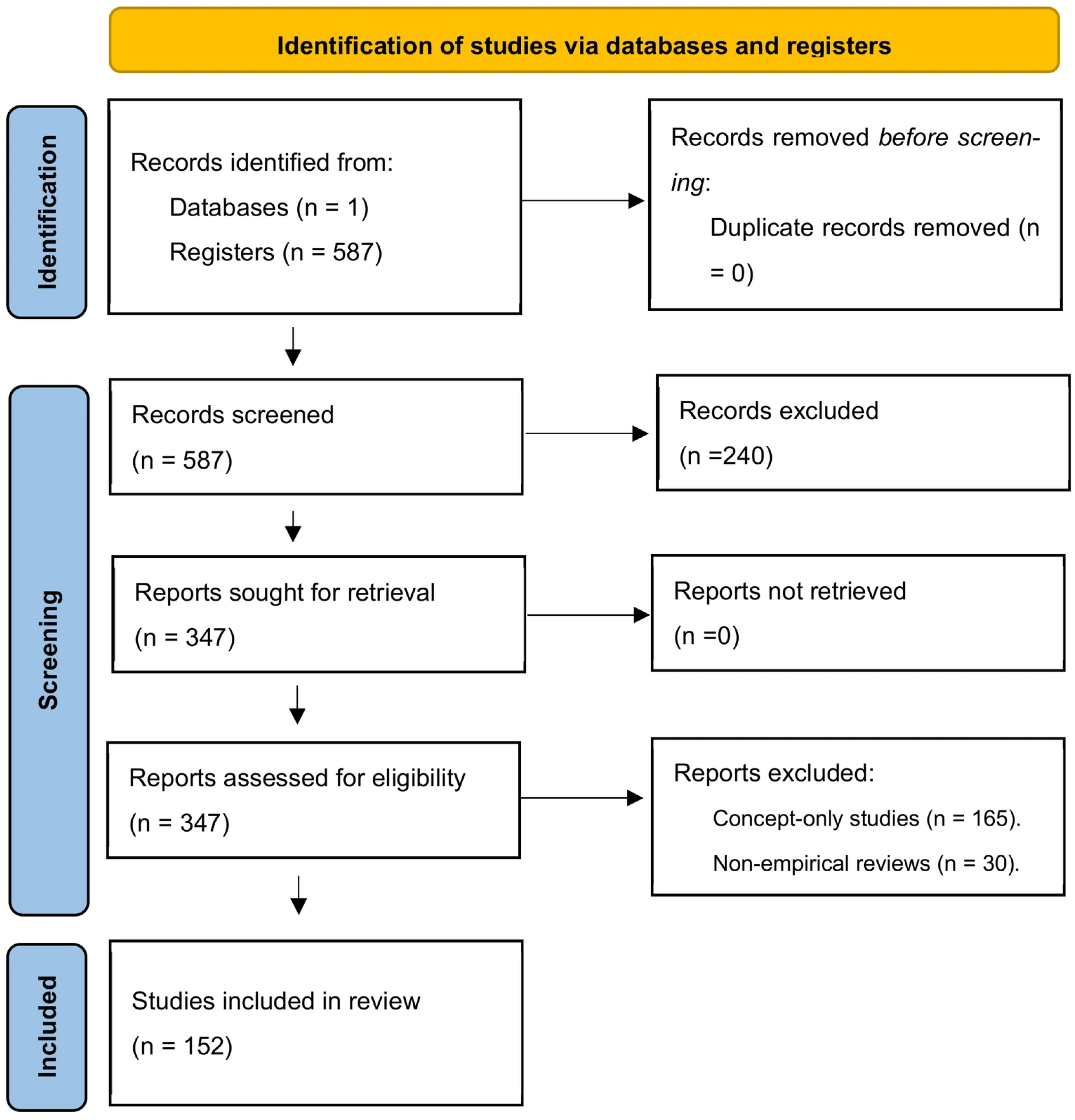
Figure 1. Literature selection and screening process following the PRISMA 2020 guideline [168].
Information 17 00048 g001
Figure 2. (a) Annual publication trend of ontology–AI integration research in construction (2014–2025); (b) distribution of publications by journals and conference proceedings.
Information 17 00048 g002
Figure 3. (a) Geographic distribution of publications on ontology–AI integration in construction (2014–2025); (b) publication counts by country.
Information 17 00048 g003
Figure 4. (a) Coherence by K (TF–IDF pruned corpus), (b) Topic Size Distribution (TF–IDF pruned corpus).
Information 17 00048 g004
Figure 5. Ontology Integration Strategies in Image-based AI Pipelines.
Information 17 00048 g005
Figure 6. Future Research Directions for Ontology-Based Image Recognition in Construction.
Information 17 00048 g006
Table 1. Topics Defined by Functional Objectives and Data Types.
TopicFunctional ObjectiveData TypeLabel Summary
0Decision SupportBIMDecision support for design and construction processes using BIM
1Knowledge Accumulation and ReuseText + ImageKnowledge integration and retrieval using knowledge graphs and large language models, including vision-based applications
2Quality and Regulatory CheckingTextInformation extraction and management from regulations, codes, and constraints
3Sustainability and Structural AssessmentImage + TextStructural damage detection and sustainability-oriented design assessment
4Hazard Reasoning and Risk AssessmentImageImage-based hazard assessment and risk interpretation
5Quality and Regulatory CheckingBIM + TextRegulatory compliance checking and safety knowledge mapping using BIM and textual data
6Hazard Reasoning and Risk AssessmentBIMHazard identification and semantic reasoning based on BIM models
7Knowledge Accumulation and ReuseBIM + SensorKnowledge reuse for robotic inspection, bridge maintenance, and prefabricated construction
8Hazard Reasoning and Risk AssessmentSensorSensor-based environmental monitoring and cost-overrun risk assessment
9Knowledge Accumulation and ReuseBIM + TextInformation integration for BIM-based deconstruction planning and cost estimation
Table 2. Functional objectives of ontology-based AI applications in construction.
Functional ObjectiveDescriptionExample
Quality and Regulatory CheckingEvaluating design and construction quality and ensuring compliance with relevant codes and standardsBIM-based compliance checking; automated quality inspection; text-based regulation analysis
Decision SupportSupporting project planning, resource allocation, and process optimizationPrefabrication constructability analysis; resource identification; energy system evaluation
Hazard Reasoning and Risk AssessmentIdentifying hazards, predicting accidents, and supporting proactive risk assessmentImage-based hazard detection; BIM-based safety reasoning; sensor-driven monitoring
Knowledge Accumulation and ReuseStructuring, managing, and reusing project information and expert knowledgeKnowledge graph–based project information management; LLM-based querying; robotic inspection frameworks
Sustainability and Structural AssessmentEvaluating structural performance and sustainability-related aspectsStructural damage detection; low-carbon design assessment; sustainable building conservation
Table 3. Data types used in ontology-based AI applications in construction.
Data TypeExamples
BIMStructured spatial and locational data used for object property extraction, compliance checking, clash detection, design validation, and hazard recognition in construction projects
TextExtraction of entities and relationships from accident reports, safety manuals, work logs, and technical documents to support hazard reasoning, regulatory compliance, and knowledge reuse
ImageTwo-dimensional image–based object detection and recognition of worker status (e.g., PPE use, unsafe behavior), equipment position and utilization, and construction quality assessment, combined with ontology-based semantic reasoning linked to site activities and safety rules
SensorIoT-based spatiotemporal monitoring of worker localization, equipment operation, structural vibration, and environmental conditions to support real-time hazard assessment, often within digital twin platforms
Table 4. Integration strategies of AI and ontology in construction.
Integration ApproachDefinitionExamplesRelated Topics
Embedding-based IntegrationTransforms ontological concepts and relations into vector embeddings that are incorporated into AI model training or inference.Poincaré embeddings for hierarchical structures; Word2Vec/BERT embeddings of ontology termsTopics 0, 5, 6, 7, 9 (BIM attribute embeddings, multimodal compliance checking, risk reasoning, robotic applications, deconstruction planning)
NLP-based IntegrationProcesses textual data (e.g., regulations, reports, manuals) using AI models that reference, generate, or leverage ontological structures.LLM–ontology integration for contract analysis; named entity recognition (NER) with ontology mapping from regulatory documentsTopics 1, 2, 5, 9 (information integration and retrieval, regulation and code extraction, compliance checking, cost estimation documents)
Vision Model IntegrationAnalyzes image or video data using vision models (e.g., CNNs, YOLO) and maps recognition outputs to ontology concepts or incorporates ontological knowledge into vision pipelines.Image-based hazard detection linked to ontology-driven semantic reasoningTopics 1, 3, 4, 7 (vision–knowledge graph integration for hazard recognition, structural damage detection, image-based hazard assessment, robotic inspection)
Few-shot and Transfer Learning IntegrationExploits ontological class hierarchies or semantic structures to support transfer learning, few-shot learning, or fine-tuning in data-scarce environments.Ontology-based class hierarchies used as semantic features for transfer learningTopic 8 (sensor-based environmental monitoring and risk assessment in data-scarce settings)
Graph Neural Network (GNN) IntegrationEmploys ontology or knowledge graph structures as graph inputs to GNN architectures (e.g., GCN, GraphSAGE, GAT) for relational learning and inference.Risk-factor relationship graphs analyzed using GNNsTopics 6, 9 (BIM-based risk reasoning, IFC- and knowledge graph–based deconstruction planning and risk mapping)
Table 5. Functional roles of ontology-based reasoning in image recognition systems.
Functional RolesDefinition
Situation
Awareness
Semantic interpretation of worker positions, behaviors, equipment interactions, and procedural compliance to assess normal or abnormal site conditions in real time.
Quality Regulation ComplianceStructuring quality regulations within ontologies and mapping them to recognized objects and relationships to automatically determine conformity or non-conformity.
Hazard
Identification
Identifying potential hazards from site objects, equipment, and environmental factors and mapping them onto ontology classes and attributes for structured representation.
Risk
Assessment
Classifying identified hazards into risk levels (e.g., low, medium, high) using rule-based reasoning or probabilistic models.
Process
Tracking
Mapping recognized objects and task activities to BIM- and process-oriented ontologies to infer progress status and completion levels of construction workflows.
Anomaly
Detection
Detecting deviations from ontology-based models of normal workflows—such as sequence errors, bottlenecks, or delays—by comparing actual site observations against expected process patterns.
Table 6. Comparison of ontology construction approaches.
ApproachRepresentative ToolsAdvantagesLimitations
ManualProtégé, OWLHigh interpretability; strong domain alignmentTime- and labor-intensive; limited scalability
AutomatedNLP pipelines, LLMs, Graph databasesRapid development; scalable for large datasetsReduced precision; limited domain-specific accuracy
HybridProtégé combined with automated mapping modulesBalances manual reliability with real-time adaptabilityHigher system complexity; increased integration overhead
Table 7. Image recognition models used in construction AI and their key characteristics.
Model FamilyKey Characteristics
YOLO (all versions)Real-time object detection; lightweight and efficient; widely applied to construction safety monitoring and process-related tasks
Mask R-CNNPrecise object segmentation and fine-grained spatial analysis; suitable for structural damage detection and object state monitoring
VRD (VTransE)Extraction of inter-object relationships aligned with ontology structures; supports contextual reasoning and compliance assessment
Image Captioning (Attention CNN + RNN)Generation of descriptive scene narratives; enables ontology-based rule matching and semantic interpretation
Others/UnspecifiedIncludes BLE-based semantic trajectory analysis for location-based awareness and studies where vision models were not explicitly specified but image data were used for semantic enrichment or training
Table 8. Summary of selected 16 studies on ontology–AI integration in image recognition–based construction applications.
Author(s)Functional
Role
Ontology
Construction
Image Recognition ModelsIntegration
Approach
DescriptionObserved OutcomesLimitations
Lee & Yu
[21]
Regulation and Standards Compliance; Hazard AnalysisManualYOLORule-Based Reasoning IntegrationRecognition outputs mapped to ontology rules for hazard reasoningReduced false positives; support for real-time hazard inference; enhanced situation awarenessLimited generalizability
Zheng et al.
[24]
Process
Monitoring
ManualNot specifiedClass Mapping IntegrationDetection outputs mapped to a process ontology for workflow monitoringImproved data interoperability; semantic reasoning for situation awarenessNo direct accuracy gain; dependent on ontology quality
Fang et al.
[26]
Regulation and Standards Compliance; Hazard AnalysisHybridMask R-CNNRule-Based Reasoning IntegrationOntology-based reasoning applied to validate compliance with predefined safety rulesReduced false positives in hazard detection; strengthened semantic reasoning and situation awareness
mIoU: 41.22%; Accuracy: 79.98%
Limited generalizability
Pfitzner et al. [22]Process
Monitoring
AutomatedYOLO + GNN (post-reasoning)Transfer & Embedding-Based IntegrationKnowledge graph embeddings used for semantically informed feature learningEnabled process monitoring; improved state classification accuracy
Accuracy: +8–9%
Limited generalizability
Zhang et al.
[25]
Hazard
Analysis
AutomatedYOLORule-Based Reasoning IntegrationOntology-based evaluation of compliance and hazard classificationReduced incorrect hazard associations; improved real-time relevance; enabled risk evolution trackingNo direct accuracy gain; dependent on ontology quality
Pfitzner et al. [46]Process
Monitoring
AutomatedYOLOClass Mapping IntegrationDetection streams linked to ontology/knowledge graph for continuous semantic updatesSupported workflow monitoring; enriched semantic dataLimited generalizability
Pan et al.
[31]
Process
Monitoring
AutomatedYOLOTransfer & Embedding-Based IntegrationZero-shot label embeddings used to extend recognition beyond training classesSupported workflow monitoring; improved recognition of construction entities
Top-1 Accuracy: +30%; mAP: +19%
Proof-of-concept stage
Pfitzner et al. [76]Process
Monitoring
AutomatedYOLOClass Mapping IntegrationSemantic enrichment applied to detection resultsSupported workflow monitoring; mitigated misclassificationsNo direct accuracy gain; dependent on ontology quality
Li et al.
[19]
Regulation and Standards
Compliance
ManualVRD (VTransE)Rule-Based Reasoning IntegrationRelational recognition outputs mapped to ontology rulesReduced false positives; improved hazard identification; enhanced semantic consistency
Top-1 Accuracy: 49.91%; Recall@100: 49.13%
Proof-of-concept stage
Wu et al.
[18]
Regulation and Standards Compliance; Hazard AnalysisHybridYOLORule-Based Reasoning IntegrationOntology reasoning applied to construction safety violation detectionImproved classification consistency; complemented semantic gapsProof-of-concept stage
Hamdan et al. [27]Work and
Situation
Awareness
HybridMask R-CNNRule-Based Reasoning IntegrationOntology-based classification of hazard levels in real-time monitoringReduced manual effort; improved expert consistency; enabled damage progression trackingLimited generalizability
Arslan et al. [28]Work and
Situation
Awareness
HybridBLE-based semantic trajectoryPreprocessing-Based IntegrationOntology-based semantic labels applied during preprocessingEnabled unsafe movement detection; enriched trajectory semanticsLimited generalizability
Zeng et al.
[29]
Work and
Situation
Awareness
ManualNot specifiedClass Mapping IntegrationOntology mapping used for semantic augmentationDecision support for algorithm selection; improved hazard image retrieval precisionLimited generalizability
Pedro et al.
[30]
Regulation and Standards
Compliance
HybridNot specifiedClass Mapping IntegrationOntology applied for training and scenario evaluationAutomated data integration; improved accessibility of accident cases
Post-test performance: +3–13%
No direct accuracy gain; dependent on ontology quality
Zhong et al. (2020)
[8]
Hazard
Analysis
HybridYOLORule-Based Reasoning IntegrationCaptioning and detection outputs mapped to ontology rulesReduced false positives; real-time hazard inference; consistent semantic annotationNo direct accuracy gain; dependent on ontology quality
Pan et al. (2024)
[32]
Work and Situation AwarenessHybridNot specifiedRule-Based Reasoning IntegrationOntology reasoning layer supports site safety decision-makingImproved situational interpretation accuracyLimited generalizability
Note. Some studies did not report quantitative performance indicators (e.g., accuracy, recall, mAP) because their primary objective was to demonstrate ontology-based semantic reasoning, compliance checking, or situation awareness rather than numerical benchmarking. In such cases, performance was evaluated through qualitative analysis, expert validation, or scenario-based assessment.
Disclaimer/Publisher’s Note: The statements, opinions and data contained in all publications are solely those of the individual author(s) and contributor(s) and not of MDPI and/or the editor(s). MDPI and/or the editor(s) disclaim responsibility for any injury to people or property resulting from any ideas, methods, instructions or products referred to in the content.