


AVI-SHIELD: An Explainable TinyML Cross-Platform Threat Detection Framework for Aviation Mobile Security





Abstract
1. Introduction
- A Systematic Framework Guided by Threat Modeling: We introduce a methodical methodology employing the MITRE ATT&CK® for Mobile framework to steer aviation specific threat modeling, feature engineering, and validation, thereby ensuring detection pertinence.
- The AviMal-TinyX Dataset: We generate and disseminate a synthetic dataset comprising 15,000 samples that emulate plausible, attribute-injected aviation specific mobile threats, rectifying the pronounced deficit of authentic data for scholarly investigation.
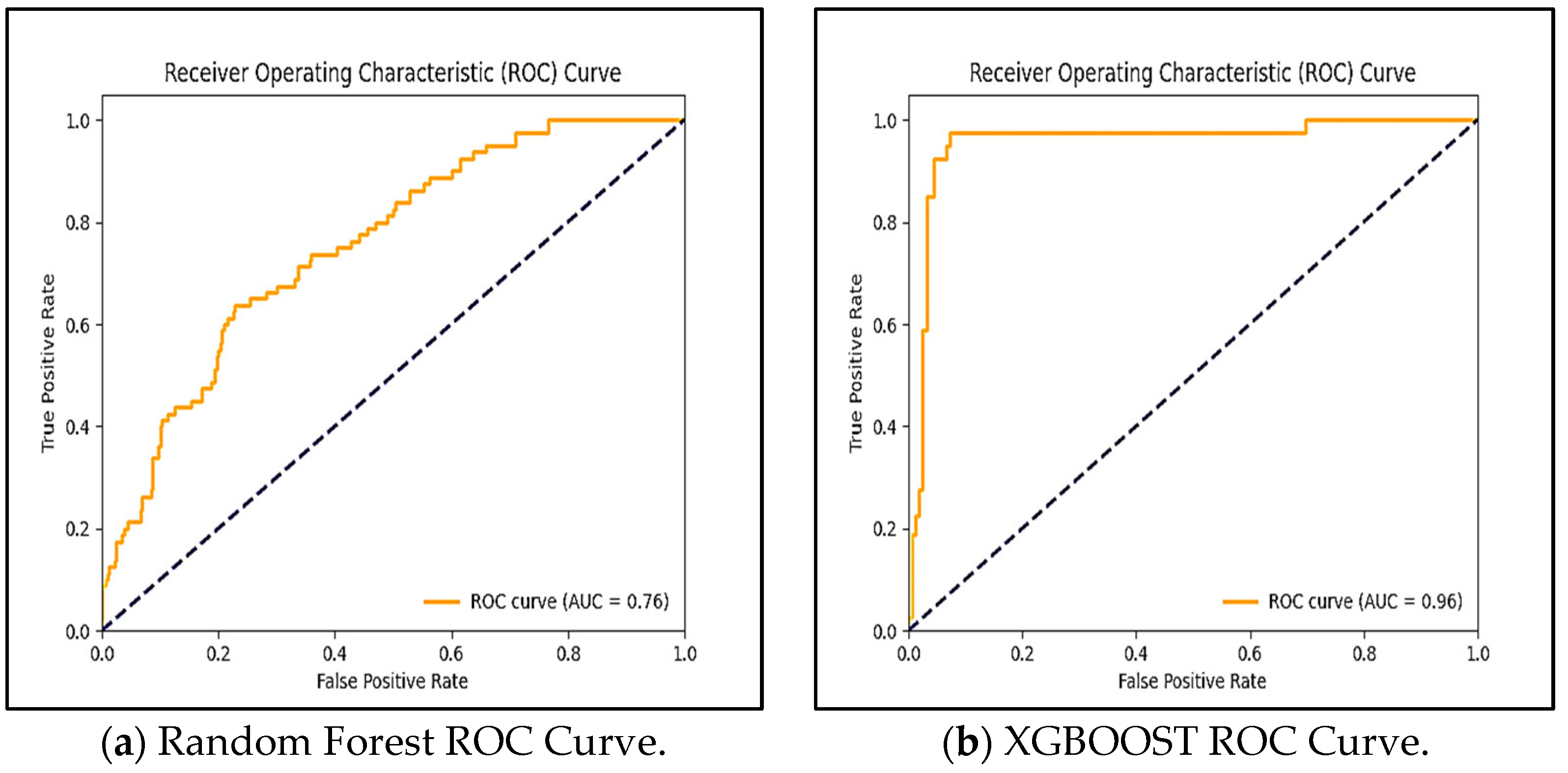
- An Extensive Performance Evaluation: We furnish a thorough evaluation of optimized detection algorithms, illustrating their exceptional trade-off between accuracy and operational efficiency on both conventional (Drebin) and our aviation specific (AviMal-TinyX) datasets when contrasted with advanced complex models.
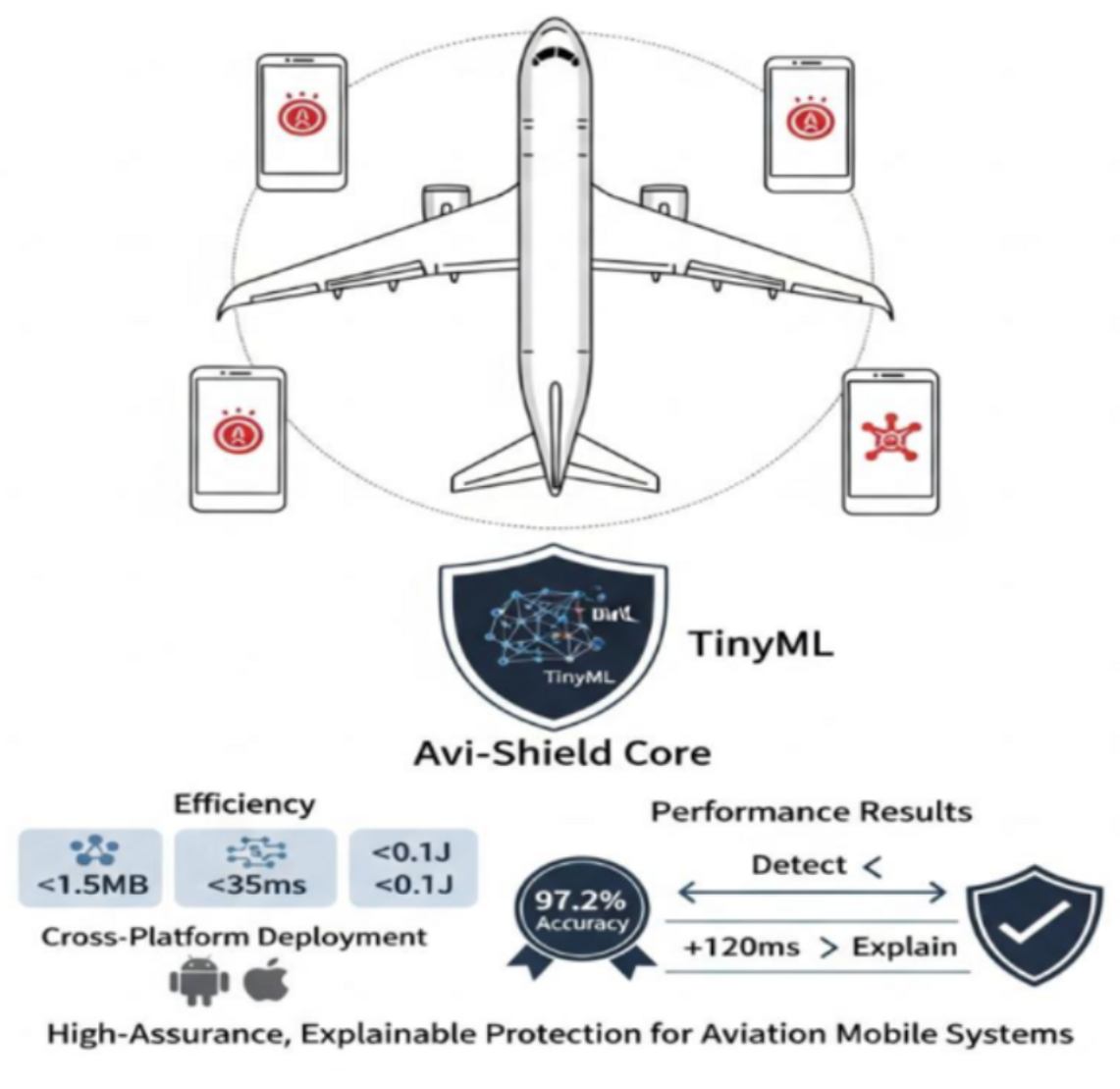
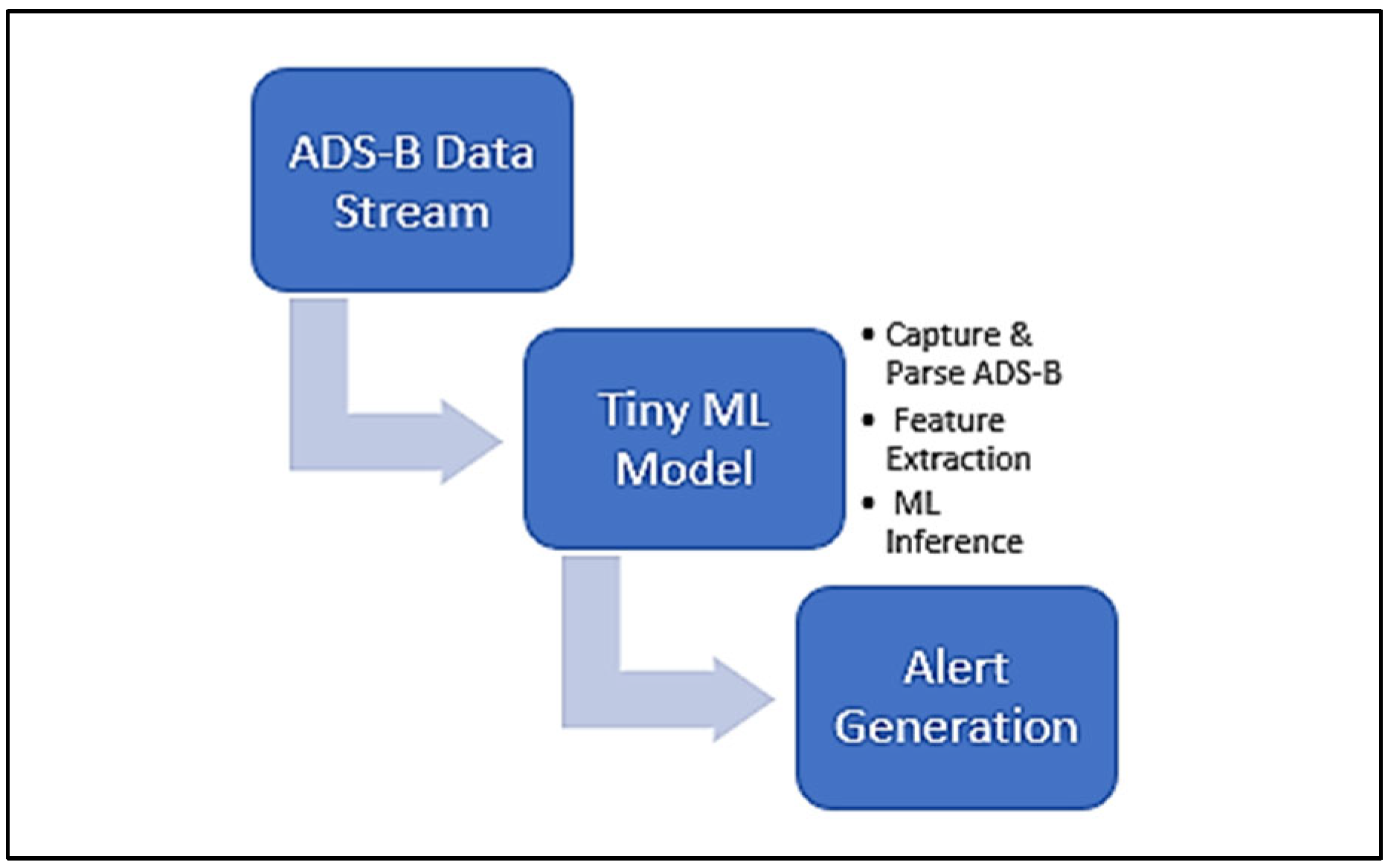
- A Cross-Platform Functional Framework: We engineer a working, open-source proof-of-concept deployed on Android and iOS, evidencing real-time, transparent threat detection on commercial off-the-shelf hardware, complete with detailed measurements of accuracy, latency, and computational overhead.
2. Literature Review
2.1. Research Methodology
2.2. Mobile Threat Landscape in Aviation
2.3. Mobile Security Techniques and Their Applicability to Aviation
2.4. Privacy and Data Protection in Aviation Ecosystem
- Differential Privacy: Methods including differential privacy [36] facilitate aggregate analysis of fleet-wide data for operational optimization while preserving the anonymity of individual aircraft and crew members, thus maintaining compliance with data governance statutes.
- Encrypted and Federated Learning: Techniques that operate on encrypted or distributed data [37] are especially pertinent. They permit the development of collective security intelligence across a mobile fleet without creating centralized repositories of sensitive information, thereby mitigating the threat of large-scale data exfiltration.
- Data Minimization and Access Controls: This foundational principle is implemented via rigorous data minimization protocols and fine-grained permission structures within aviation applications [38]. Architectures must be engineered to request and retain only data strictly necessary for core functionality, substantially constraining the potential attack vector and magnitude of any data exposure.
2.5. Aviation Specific Challenges in Mobile Security
- Resource Constraints: The finite computational, storage, and energy capacities of mobile hardware [39,40] pose a substantial impediment to persistent, real-time threat detection. In the aviation context, where devices are utilized during long-duration flights with unreliable access to power, the mandate for energy-efficient, on-device processing becomes incontrovertible for mission-assurance.
- Cross-Platform Complexity: The heterogeneous architectures and security paradigms of Android and iOS present significant obstacles to developing consolidated security solutions [41]. This divergence compels aviation entities managing heterogeneous device fleets to implement and maintain platform-tailored adaptations to uphold a consistent security posture, thereby accruing significant overhead.
- Human Factors: Despite advanced security features, the human element remains a persistent vulnerability [42]. This threat is critically amplified in aviation operations; an inadvertent bypass of a security alert on an Electronic Flight Bag (EFB) could introduce a threat with immediate safety consequences.
- Evolving Adversarial Tactics: The increasing sophistication of attacker methodologies for circumventing detection [43,44] establishes aviation systems as high-value targets. Defensive measures must therefore be inherently robust and adaptive to confront novel attack vectors that endanger not only data but physical operations.
2.6. Future Directions for Mobile Security in Aviation
- On-Device Behavioral Analysis: The progression of intrusion detection systems towards real-time, localized anomaly identification [45] is highly congruent with aviation’s prerequisite for offline-capable security. Subsequent iterations of these systems may proactively detect nuanced aberrations in application behavior that signify advanced, aviation-focused malicious software.
- Secure and Transparent Operations: Blockchain, previously investigated for secure transactions and digital identity [46], holds potential for aviation in establishing tamper-resistant audit trails for device health checks, system updates, and data interactions, thus promoting transparency and adherence to compliance standards.
- Proactive Threat Intelligence: The transition towards anticipatory threat hunting [47] is imperative. For aviation, this necessitates systems that can extrapolate flight-operation-specific attack methodologies and leverage shared intelligence across carriers to proactively reinforce security postures.
- Advanced Authentication: Extending beyond conventional biometrics, persistent authentication utilizing behavioral biometrics like keystroke dynamics [48] can institute a continuous security verification mechanism, ensuring a crew member’s device maintains authentication status throughout a flight mission without obtrusive alerts.
3. Materials and Methods
3.1. General TinyML Engine Development
3.1.1. Datasets and Preprocessing
3.1.2. Model Selection & Training
- Architectural Suitability: Tree-based models natively handle heterogeneous, sparse tabular data and can effectively learn complex decision boundaries from high-dimensional feature vectors without requiring feature scaling or extensive preprocessing.
- Performance-Efficiency Trade-off: Our results demonstrated that these models achieve state-of-the-art accuracy on malware detection tasks with tabular features while remaining extremely lightweight after quantization (<2 MB). While lightweight CNNs (e.g., 1D-CNN) can also be efficient, they are a less natural fit for this data modality, often requiring suboptimal architectural adaptations that can compromise performance or interpretability.
- Innate Interpretability: Tree-based models provide a clear measure of feature importance and generate decision paths that can be directly translated into human-understandable rules. This intrinsic transparency is a critical advantage for certification (DO-178C) and for building trust with end-users, as it seamlessly feeds into our XAI module.
3.1.3. TinyML Optimization
3.1.4. Explainability (XAI) Integration
3.2. Aviation Specialization: Threat Modeling and Dataset Synthesis
3.2.1. Threat Modeling with MITRE ATT&CK
3.2.2. AviMal-TinyX Dataset Synthesis
- Source Data: 12,500 benign samples were drawn from Drebin and CICMalDroid.
- Behavioral Injection: Using a custom script, we logically injected the behaviors from Table 2 into 2500 malicious samples by modifying their feature vectors to reflect the malicious attributes (e.g., setting location permission flags, adding connections to suspicious domains, creating features for accessing .fpl files).
- Validation: Each generated sample’s feature vector was validated to ensure it accurately represented the intended technique.
3.2.3. Feature Engineering for Aviation
- Enhanced API Monitoring: Features targeting LocationManager, BluetoothAdapter, and specific file I/O patterns.
- Permission-Function Mismatch: Stricter analysis of permissions that are unnecessary for an app’s stated function.
- Network Anomaly Detection: Features to detect connections to non-standard IPs/domains not associated with known aviation services.
3.3. Experimental Setup
4. Results
4.1. Performance on General and Aviation-Specific Threats
4.2. Efficiency and Cross-Platform Performance
4.3. Explainability and Overhead
4.4. Explainability Tools Comparison
4.5. Comparative Analysis of XAI Methods
- SHAP Explanation: Correctly identified the synthesized threat indicators as the primary contributors. The top three features by absolute SHAP value were: ACCESS_FINE_LOCATION (+0.32), LocationManager.getLastKnownLocation (+0.28), and the suspicious network domain feature (+0.21). Collectively, these three known malicious features accounted for 81% of the total magnitude of the explanation.
- LIME Explanation: Failed to highlight the critical threat features. Its top contributors were generic, benign permissions common to many apps: INTERNET (+0.18), ACCESS_NETWORK_STATE (+0.15), and WAKE_LOCK (+0.11). The injected malicious features each received a weight below |0.05|, collectively accounting for less than 12% of the explanation’s weight.
5. Discussion
5.1. Framework Results Discussion
5.2. Limitations and Future Threat Adaptation
- Use living-off-the-land techniques (LotL) within approved APIs to avoid static permission flags.
- Implement slow, low-volume data exfiltration mimicking normal background traffic.
- Conditionally activate malicious payloads based on specific flight phases or device locations.
5.3. Framework Aviation Use Cases for Air Traffic Safety
5.4. Enriched Future Research Pathways
6. Conclusions
Author Contributions
Funding
Institutional Review Board Statement
Informed Consent Statement
Data Availability Statement
Conflicts of Interest
References
- Salama, R.; Al-Turjman, F. Mobile cloud computing and the internet of things security and privacy. In Edible Electronics for Smart Technology Solutions; IGI Global: Hershey, PA, USA, 2025; pp. 333–350. [Google Scholar] [CrossRef]
- Basharat, M. Machine Learning in IoT and Mobile Device Forensics. In Digital Forensics in the Age of AI; IGI Global Scientific Publishing: Hershey, PA, USA, 2025; pp. 115–146. [Google Scholar] [CrossRef]
- Luoma-aho, M. Analysis of Modern Malware: Obfuscation Techniques. Master’s Thesis, JAMK University of Applied Science, Jyväskylä, Finland, 2023. [Google Scholar]
- Hossain, M.A.; Islam, M.S. Enhanced detection of obfuscated malware in memory dumps: A machine learning approach for advanced cybersecurity. Cybersecurity 2024, 7, 16. [Google Scholar] [CrossRef]
- Holloway, C.M. Towards Understanding The DO-178C/ED-12C Assurance Case; NASA Langley Research Center: Hampton, VA, USA, 2012. [Google Scholar]
- Muñoz, A. Cracking the Core: Hardware Vulnerabilities in Android Devices Unveiled. Electronics 2024, 13, 4269. [Google Scholar] [CrossRef]
- Fakhouri, H.N.; Alawadi, S.; Awaysheh, F.M.; Hani, I.B.; Alkhalaileh, M.; Hamad, F. A Comprehensive Study on the Role of Machine Learning in 5G Security: Challenges, Technologies, and Solutions. Electronics 2023, 12, 4604. [Google Scholar] [CrossRef]
- Mangla, C.; Rani, S.; Qureshi, N.M.F.; Singh, A. Mitigating 5G security challenges for next-gen industry using quantum computing. J. King Saud Univ.-Comput. Inf. Sci. 2023, 35, 101334. [Google Scholar] [CrossRef]
- Singh, A.K.; Sharma, A.K.; Kesarwani, S.; Singh, P.K.; Verma, P.K.; Dhanasekaran, S. IoT and Smart Device Security: Emerging Threats and Countermeasures. In Emerging Threats and Countermeasures in Cybersecurity; Wiley: New York, NY, USA, 2025; pp. 173–189. [Google Scholar]
- Baghirov, E. A comprehensive investigation into robust malware detection with explainable AI. Cyber Secur. Appl. 2025, 3, 100072. [Google Scholar] [CrossRef]
- Naif Alatawi, M. Enhancing Intrusion Detection Systems With Advanced Machine Learning Techniques: An Ensemble and Explainable Artificial Intelligence (AI) Approach. Secur. Priv. 2025, 8, e496. [Google Scholar] [CrossRef]
- Mim, A.I.; Azad, M.A.K. Communication Technology and Innovation: Trends, Opportunities, and Challenges. In Impact of Digitalization on Communication Dynamics; IGI Global: Hershey, PA, USA, 2025; pp. 59–76. [Google Scholar] [CrossRef]
- Sharma, T.; Rattan, D. Characterization of Android Malwares and their families. ACM Comput. Surv. 2025, 57, 1–31. [Google Scholar] [CrossRef]
- Mishra, M.; Hussain, M.S.; Singh, S.K. Protecting Against Social Engineering Using Wireshark. In Effective Strategies for Combatting Social Engineering in Cybersecurity; IGI Global Scientific Publishing: Hershey, PA, USA, 2025. [Google Scholar] [CrossRef]
- Cekerevac, Z.; Cekerevac, P.; Prigoda, L.; Al-Naima, F. Security Risks From The Modern Man-In-The-Middle Attacks. MEST J. 2025, 13, 34–51. [Google Scholar] [CrossRef]
- Kim, J.; Park, J.; Roh, S.; Chung, J.; Lee, Y.; Kim, T.; Lee, B. Tiktag: Breaking ARM’s Memory Tagging Extension with Speculative Execution. In 2025 IEEE Symposium on Security and Privacy (SP); IEEE: San Francisco, CA, USA, 2025; pp. 4063–4081. [Google Scholar] [CrossRef]
- Jimshith, V.T.; Bai, V.M.A. An evaluation of the proposed security access control for BYOD devices with mobile device management (MDM). Int. J. Electr. Electron. Res. 2024, 12, 276–285. [Google Scholar] [CrossRef]
- Lekkala, S.; Gurijala, P. Endpoint and mobile security imperatives. In Security and Privacy for Modern Networks: Strategies and Insights for Safeguarding Digital Infrastructures; Apress: Berkeley, CA, USA, 2024; pp. 155–165. [Google Scholar] [CrossRef]
- Falade, P. Are antimalware mobile applications as vulnerable as other mobile applications? In Proceedings of the 2023 International Conference on Internet Technology and Secured Transactions (ICITST) in Cooperation with the World Congress on Science and Technology (WCST), Oxford, UK, 13–15 December 2023; pp. 86–92. [Google Scholar] [CrossRef]
- Mohiuddin, K. Mobile device management and their security concerns. Int. Res. J. Eng. Technol. 2023, 10, 834–839. [Google Scholar]
- Ahmad, M.; Bergadano, F.; Costamagna, V.; Crispo, B.; Russello, G. AppBox: A black-box application sandboxing technique for mobile app management solutions. In Proceedings of the 2023 IEEE Symposium on Computers and Communications (ISCC), Gammarth, Tunisia, 9–12 July 2023; pp. 1–7. [Google Scholar] [CrossRef]
- Singh, R.; Chauhan, A.N.S.; Tewari, H. Blockchain-enabled end-to-end encryption for instant messaging applications. In Proceedings of the 2022 IEEE 23rd International Symposium on a World of Wireless, Mobile and Multimedia Networks (WoWMoM), Belfast, UK, 14–17 June 2022; pp. 501–506. [Google Scholar] [CrossRef]
- Perkasa, M.J.P.; Ramdan, H.M.; Maliki, A.J.; Somantri. Implementation of Secure End-to-End Encrypted Chat Application Using Diffie–Hellman Key Exchange and AES-256 in a Microservice Architecture. Eng. Proc. 2025, 107, 98. [Google Scholar] [CrossRef]
- Zukarnain, Z.A.; Muneer, A.; Ab Aziz, M.K. Authentication Securing Methods for Mobile Identity: Issues, Solutions and Challenges. Symmetry 2022, 14, 821. [Google Scholar] [CrossRef]
- Stylios, I.; Kokolakis, S.; Thanou, O.; Chatzis, S. Behavioral biometrics & continuous user authentication on mobile devices: A survey. Inf. Fusion 2021, 66, 76–99. [Google Scholar] [CrossRef]
- Waqas, M.; Tu, S.; Halim, Z.; Rehman, S.U.; Abbas, G.; Zhao, Z. The role of artificial intelligence and machine learning in wireless networks security: Principle, practice and challenges. Artif. Intell. Rev. 2022, 55, 5215–5261. [Google Scholar] [CrossRef]
- Sarker, I.H. Machine learning for intelligent data analysis and automation in cybersecurity: Current and future prospects. Ann. Data Sci. 2023, 10, 1473–1498. [Google Scholar] [CrossRef]
- Zoppi, T.; Ceccarelli, A.; Capecchi, T.; Bondavalli, A. Unsupervised anomaly detectors to detect intrusions in the current threat landscape. ACM/IMS Trans. Data Sci. 2021, 2, 1–26. [Google Scholar] [CrossRef]
- Palakurti, N. Challenges and future directions in anomaly detection. In Practical Applications of Data Processing, Algorithms, and Modeling; IGI Global: Hershey, PA, USA, 2024; pp. 269–284. [Google Scholar] [CrossRef]
- Manoharan, A.; Sarker, M. Revolutionizing Cybersecurity: Unleashing the Power of Artificial Intelligence and Machine Learning for Next-Generation Threat Detection. Int. Res. J. Mod. Eng. Technol. Sci. 2023, 1, 2151–2167. [Google Scholar] [CrossRef]
- Alajlan, N.N.; Ibrahim, D.M. TinyML: Enabling of Inference Deep Learning Models on Ultra-Low-Power IoT Edge Devices for AI Applications. Micromachines 2022, 13, 851. [Google Scholar] [CrossRef]
- Senevirathna, T.; La, V.H.; Marcha, S.; Siniarski, B.; Liyanage, M.; Wang, S. A survey on XAI for 5G and beyond security: Technical aspects, challenges and research directions. IEEE Commun. Surv. Tutor. 2025, 27, 941–973. [Google Scholar] [CrossRef]
- Syed, N.F.; Shah, S.W.; Shaghaghi, A.; Anwar, A.; Baig, Z.; Doss, R. Zero Trust Architecture (ZTA): A Comprehensive Survey. IEEE Access 2022, 10, 57143–57179. [Google Scholar] [CrossRef]
- Mohamed, N.; Oubelaid, A.; Ghosh, A.; B., M.; Barik, R.K. Leveraging CPU utilization metrics and Zero Trust Architecture for APT detection. In Proceedings of the 2023 IEEE 3rd International Conference on Applied Electromagnetics, Signal Processing, & Communication (AESPC), Bhubaneswar, India, 24–26 November 2023; pp. 1–6. [Google Scholar] [CrossRef]
- Yang, M.; Guo, T.; Zhu, T.; Tjuawinata, I.; Zhao, J.; Lam, K.-Y. Local differential privacy and its applications: A comprehensive survey. Comput. Stand. Interfaces 2024, 89, 103827. [Google Scholar] [CrossRef]
- Jiang, B.; Li, J.; Yue, G.; Song, H. Differential Privacy for Industrial Internet of Things: Opportunities, Applications, and Challenges. IEEE Internet Things J. 2021, 8, 10430–10451. [Google Scholar] [CrossRef]
- Osia, S.A.; Shamsabadi, A.S.; Sajadmanesh, S.; Taheri, A.; Katevas, K.; Rabiee, H.R.; Lane, N.D.; Haddadi, H. A Hybrid Deep Learning Architecture for Privacy-Preserving Mobile Analytics. IEEE Internet Things J. 2020, 7, 4505–4518. [Google Scholar] [CrossRef]
- Toth, A. Toward privacy-focused personalization: Designing a learning experience to facilitate privacy-personalization trade-off. In Proceedings of the 32nd ACM Conference on User Modeling, Adaptation and Personalization, Cagliari, Italy, 1–4 July 2024. [Google Scholar] [CrossRef]
- Ke, H.C.; Wang, H.; Zhao, H.W.; Sun, W.J. Deep reinforcement learning-based computation offloading and resource allocation in security-aware mobile edge computing. Wirel. Netw. 2021, 27, 3357–3373. [Google Scholar] [CrossRef]
- Haibeh, L.A.; Yagoub, M.C.E.; Jarray, A. A Survey on Mobile Edge Computing Infrastructure: Design, Resource Management, and Optimization Approaches. IEEE Access 2022, 10, 27591–27610. [Google Scholar] [CrossRef]
- Jinhong, F. Cross-Platform and Multi-Terminal Collaborative Software Information Security Strategy. In Proceedings of the 2024 5th International Conference on Mobile Computing and Sustainable Informatics (ICMCSI), Lalitpur, Nepal, 18–19 January 2024; pp. 781–787. [Google Scholar] [CrossRef]
- Sikder, A.K.; Petracca, G.; Aksu, H.; Jaeger, T.; Uluagac, A.S. A Survey on Sensor-Based Threats and Attacks to Smart Devices and Applications. IEEE Commun. Surv. Tutor. 2021, 23, 1125–1159. [Google Scholar] [CrossRef]
- Huang, Y.; Hu, H.; Chen, C. Robustness of on-Device Models: Adversarial Attack to Deep Learning Models on Android Apps. In Proceedings of the 2021 IEEE/ACM 43rd International Conference on Software Engineering: Software Engineering in Practice (ICSE-SEIP), Madrid, Spain, 25–28 May 2021; pp. 101–110. [Google Scholar] [CrossRef]
- Fatkhulin, T.; Alshawi, R.; Kulikova, A.; Mokin, A.; Timofeyeva, A. Analysis of Software Tools Allowing the Development of Cross-Platform Applications for Mobile Devices. In Proceedings of the 2023 Systems of Signals Generating and Processing in the Field of on Board Communications, Moscow, Russia, 14–16 March 2023; pp. 1–5. [Google Scholar] [CrossRef]
- Moustafa, N.; Koroniotis, N.; Keshk, M.; Zomaya, A.Y.; Tari, Z. Explainable Intrusion Detection for Cyber Defences in the Internet of Things: Opportunities and Solutions. IEEE Commun. Surv. Tutor. 2023, 25, 1775–1807. [Google Scholar] [CrossRef]
- Haddouti, S.E.; Betouil, A.; Chaoui, H. Enhancing Mobile Security: A Systematic Review of AI and Blockchain Integration Strategies for Effective Analysis. In Proceedings of the 2023 International Conference on Innovation and Intelligence for Informatics, Computing, and Technologies (3ICT), Sakheer, Bahrain, 20–21 November 2023; pp. 349–356. [Google Scholar] [CrossRef]
- Kulkarni, M.S.; Ashit, D.H.; Chetan, C.N. A Proactive Approach to Advanced Cyber Threat Hunting. In Proceedings of the 2023 7th International Conference on Computation System and Information Technology for Sustainable Solutions (CSITSS), Bangalore, India, 2–4 November 2023; pp. 1–6. [Google Scholar] [CrossRef]
- Pernpruner, M.; Carbone, R.; Sciarretta, G.; Ranise, S. An Automated Multi-Layered Methodology to Assist the Secure and Risk-Aware Design of Multi-Factor Authentication Protocols. IEEE Trans. Dependable Secur. Comput. 2024, 21, 1935–1950. [Google Scholar] [CrossRef]
- Strohmeier, M.; Tresoldi, G.; Granger, L.; Lenders, V. Building an Avionics Laboratory for Cybersecurity Testing. In Proceedings of the 15th Workshop on Cyber Security Experimentation and Test, Virtual, 8 August 2022. [Google Scholar] [CrossRef]
- Wang, B.; Luo, P.; Yang, Y.; Zhao, Z.; Dong, R.; Guan, Y. A review and prospect of cybersecurity research on air traffic management systems. J. Electron. Inf. Technol. 2025, 47, 1230–1265. [Google Scholar] [CrossRef]
- Ahmed, W.; Bhatti, N.; Masood, A.; Alharbi, A.; Alotaibi, S. Advancements in ADS-B security: A comprehensive survey of vulnerabilities, mitigation strategies, system requirements, and emerging research trends. Preprints 2024, 2024050586. [Google Scholar] [CrossRef]
- Roy, S.; Panaousis, E.; Noakes, C.; Laszka, A.; Panda, S.; Loukas, G. SoK: The MITRE ATT&CK framework in research and practice. arXiv 2023. [Google Scholar] [CrossRef]
- Du, Z.; Yin, H.; Zhang, X.; Hu, H.; Liu, T.; Hou, M.; Giannelos, S.; Strbac, G. Decarbonisation of Data Centre Networks through Computing Power Migration. In Proceedings of the 2025 IEEE 5th International Conference on Computer Communication and Artificial Intelligence (CCAI), Haikou, China, 23–25 May 2025; pp. 871–876. [Google Scholar] [CrossRef]
- Kaloev, M.; Krastev, G. Comprehensive Review of Benefits from the Use of Sparse Updates Techniques in Reinforcement Learning: Experimental Simulations in Complex Action Space Environments. In Proceedings of the 2023 4th International Conference on Communications, Information, Electronic and Energy Systems (CIEES), Plovdiv, Bulgaria, 23–25 November 2023; pp. 1–7. [Google Scholar] [CrossRef]



| Database | Keywords AND Filters | Findings |
|---|---|---|
| Scopus | Tiny AND Machine AND Learning | 2084 |
| 2020–2025 | 1857 | |
| Computer Science and Engineering | 1634 | |
| Conference paper, Article, Conference Review, Book Chapter, Review | 1626 | |
| English | 1592 | |
| Aviation Mobile Security | 181 | |
| Tinyml | 73 | |
| tiny AND machine AND learning AND mobile | 116 | |
| Web Of Science | Tiny Machine learning | 1328 |
| From 2020 | 1126 | |
| Aviation Mobile Security | 145 | |
| Tinyml | 558 | |
| ScienceDirect | Tinyml | 240 |
| Aviation Mobile Security | 4976 | |
| From 2019 | 2890 | |
| Springer | Tiny ML + English | 256 |
| Aviation Mobile Security | 12,159 | |
| From 2019 | 5218 | |
| Aviation Mobile Security | 162.000 | |
| Google Scholar | From 2019 | 26.500 |
| Tinyml for mobile security | 1.940 |
| Aspects | General Comments | Aviation-Specific Impact |
|---|---|---|
| Mobile malware | Trojans, ransomware, and spyware can steal data or damage devices [13]. | A Trojanized EFB app (e.g., an interactive flight planning app, such as ForeFlight Mobile app; versions 17.x and above) could inject false navigation waypoints or exfiltrate sensitive flight plans. Ransomware could lock critical pre-flight documentation. |
| Phishing and Social Engineering | Targeting users via SMS (smishing), emails, and social media apps, exploiting human vulnerabilities [14]. | Crew could be tricked into installing malicious apps or revealing credentials to systems linked to operational networks. |
| Network Attacks | Man-in-the-middle (MitM) attacks, rogue Wi-Fi hotspots, and insecure communication protocols exposing sensitive data transmitted over mobile networks [15]. | A rogue Wi-Fi at an airport could intercept or alter aircraft telemetry or weather updates sent to a pilot’s tablet. |
| OS and App Vulnerabilities | Zero-day vulnerabilities in mobile Operating systems (Android and iOS) and insecure mobile apps are frequently exploited by attackers [16]. | An exploit in a mobile OS could provide a foothold to attack connected systems or access sensitive data stored by aviation apps. |
| Mobile Device Management (MDM) and BYOD (Bring Your Own Device) | Organizational policies allowing personal devices to access corporate networks can lead to security gaps and data breaches if not properly managed [17]. | An unsecured personal device with network access could serve as a pivot point to attack critical, segregated aviation infrastructure. |
| Techniques | Descriptions | Aviation Limitations | Operational Risk Profile |
|---|---|---|---|
| Antivirus and Anti-malware Software | Traditional applications to detect and mitigate malware [18,19]. | Cloud-dependent, requiring frequent signature updates, which is impractical in-flight. Lacks offline, real-time capability and provides no justification for alerts, violating certification principles. | High Missed Detection Risk: Novel, unseen threats are missed. High Operational Disruption: False positives on critical EFB apps can terminate essential functions. |
| Mobile Device Management | Centralized management to enforce policies and remotely wipe devices [20]. | Effective for pre-flight provisioning but offers no real-time, on-device threat detection during flight operations. A reactive, not preventive, measure. | Reactive, Not Preventive: A breach is only addressed after the fact. Provides a false sense of security during the mission. |
| App Sandboxing | OS-level isolation of apps to prevent unauthorized data access [21]. | A necessary baseline security control but insufficient alone; it cannot prevent a malicious but authorized app within its sandbox from executing aviation-specific attacks (e.g., feeding false data to other avionics apps). | Creates a False Sense of Containment: Does not stop the most credible aviation-specific attack vectors that occur within app permissions. |
| Encryption | Secures data at rest (device) and in transit (E2EE) [22,23]. | Essential for data confidentiality but does nothing to ensure the integrity of application logic or detect if a malicious app is generating and transmitting spoofed data. | Blind to Malicious Intent: The core threat of manipulated operational data (e.g., fake waypoints) is entirely undetected. |
| Biometric Authentication | Secure and convenient device/app unlocking [24,25]. | Useful for access control but irrelevant for continuous monitoring of application behavior and intent once the device is unlocked and in use. | Does Not Address Runtime Threats: Once authenticated, a malicious app or hijacked session operates unimpeded. |
| Machine Learning and AI-based Security | Detects unusual behavior and predicts threats [26,27,28,29,30]. | Often relies on cloud-based, computationally intensive models that are unsuitable for resource-constrained devices. Typically operate as “black boxes,” lacking the transparency required for aviation safety certification. | Catastrophic Latency: Security decisions arrive too late for in-flight response for Cloud-Based AI/ML. Loss of Security on Disconnect: Creates critical vulnerabilities during crucial phases of flight. |
| Tiny ML for Edge Security | On-device analytics for edge security enable sophisticated threat detection to run directly on mobile devices with limited resources [31]. | Requires careful model design and optimization to achieve high accuracy without excessive resource drain. Generic models lack domain relevance. | Incomplete In-Flight Coverage: Leaves the device unprotected from internal threats or compromised apps when operating in isolated or offline modes. |
| Explainable AI (XAI) | As mobile security systems become more automated, ensuring their decision-making is interpretable is crucial [32]. | Post hoc explanations can be computationally expensive and may not integrate seamlessly with real-time, resource-constrained detection loops. | Unexplained Alerts Lead to Distrust: Without integrated, efficient explainability, crews may ignore critical alerts or waste time diagnosing false positives. |
| Zero Trust Architecture | Continuously verifies device and user trust [33,34]. | A valuable network-level strategy for access control. However, it does not replace the need for on-device intelligence to make local, real-time security decisions when network connectivity is limited or absent, as is common in flight. | Incomplete In-Flight Coverage: Leaves the device unprotected from internal threats or compromised apps when operating in isolated or offline modes. Relies on constant network policy checks that are impossible mid-flight. |
| MITRE Tactic | Technique ID | Technique Name | Aviation-Specific Manifestation |
|---|---|---|---|
| Initial Access | T1476 | Deliver Malicious App | Trojanized EFB or flight planning application. |
| Collection | T1430 | Location Tracking | Harvesting precise GPS data of aircraft/crew movements. |
| Collection | T1533 | Data from Device API | Exfiltrating flight plans (.fpl), maintenance logs, navdb. |
| Command & Control | T1439 | App Layer Protocol | Beaconing data to C2 server masked as normal weather API traffic. |
| Impact | T1487 | Resource Hijacking | Draining battery/CPU critical for during-flight operations. |
| Model | Accuracy | Precision | Recall | Model Size | Inference Time (ms) |
|---|---|---|---|---|---|
| AVI-SHIELD (XGBoost) | 97.2% | 0.96 | 0.95 | 1.4 MB | 32 |
| 1D-CNN (Constrained) | 96.0% | 0.94 | 0.93 | 1.8 MB | 28 |
| LSTM Baseline | 97.0% | 0.95 | 0.94 | 65 MB | 190 |
| Random Forest | 96.1% | 0.93 | 0.94 | 3.1 MB | 45 |
Disclaimer/Publisher’s Note: The statements, opinions and data contained in all publications are solely those of the individual author(s) and contributor(s) and not of MDPI and/or the editor(s). MDPI and/or the editor(s) disclaim responsibility for any injury to people or property resulting from any ideas, methods, instructions or products referred to in the content. |
© 2025 by the authors. Licensee MDPI, Basel, Switzerland. This article is an open access article distributed under the terms and conditions of the Creative Commons Attribution (CC BY) license.
Share and Cite
Majdoubi, C.; Mendili, S.E.; Gahi, Y.; El-Khatib, K. AVI-SHIELD: An Explainable TinyML Cross-Platform Threat Detection Framework for Aviation Mobile Security. Information 2026, 17, 21. https://doi.org/10.3390/info17010021
Majdoubi C, Mendili SE, Gahi Y, El-Khatib K. AVI-SHIELD: An Explainable TinyML Cross-Platform Threat Detection Framework for Aviation Mobile Security. Information. 2026; 17(1):21. https://doi.org/10.3390/info17010021
Chicago/Turabian StyleMajdoubi, Chaymae, Saida EL Mendili, Youssef Gahi, and Khalil El-Khatib. 2026. "AVI-SHIELD: An Explainable TinyML Cross-Platform Threat Detection Framework for Aviation Mobile Security" Information 17, no. 1: 21. https://doi.org/10.3390/info17010021
APA StyleMajdoubi, C., Mendili, S. E., Gahi, Y., & El-Khatib, K. (2026). AVI-SHIELD: An Explainable TinyML Cross-Platform Threat Detection Framework for Aviation Mobile Security. Information, 17(1), 21. https://doi.org/10.3390/info17010021