1. Introduction
In recent decades, societies have been facing rapid technological transformations that have influenced various areas of life, including education. Developments in Information and Communication Technology (ICT) have opened new horizons for how the learning process is conceived and implemented. The integration of digital tools and interactive technologies in teaching has created opportunities to make education more personalized, practical, and aligned with the needs of the new generation of learners. In this context, Augmented Reality (AR) emerges and is increasingly attracting attention in the field of education due to its potential to connect abstract concepts with tangible and comprehensible experiences [
1].
Augmented Reality offers real-time interaction between the physical and virtual worlds, enriching learning experiences through three-dimensional visualizations and dynamic interactions. In a classroom environment, this means that students are no longer limited to printed illustrations or theoretical explanations, but can instead explore objects and phenomena through vivid simulations that foster deeper and more active engagement. Even more importantly, AR functions not merely as a visual aid, but as a didactic mediator that bridges theoretical knowledge with practical applications.
This becomes especially significant when AR is combined with the STEAM approach (Science, Technology, Engineering, Arts, and Mathematics). STEAM aims at interdisciplinary integration, placing students in projects that demand collaboration, critical thinking, problem-solving, and creativity [
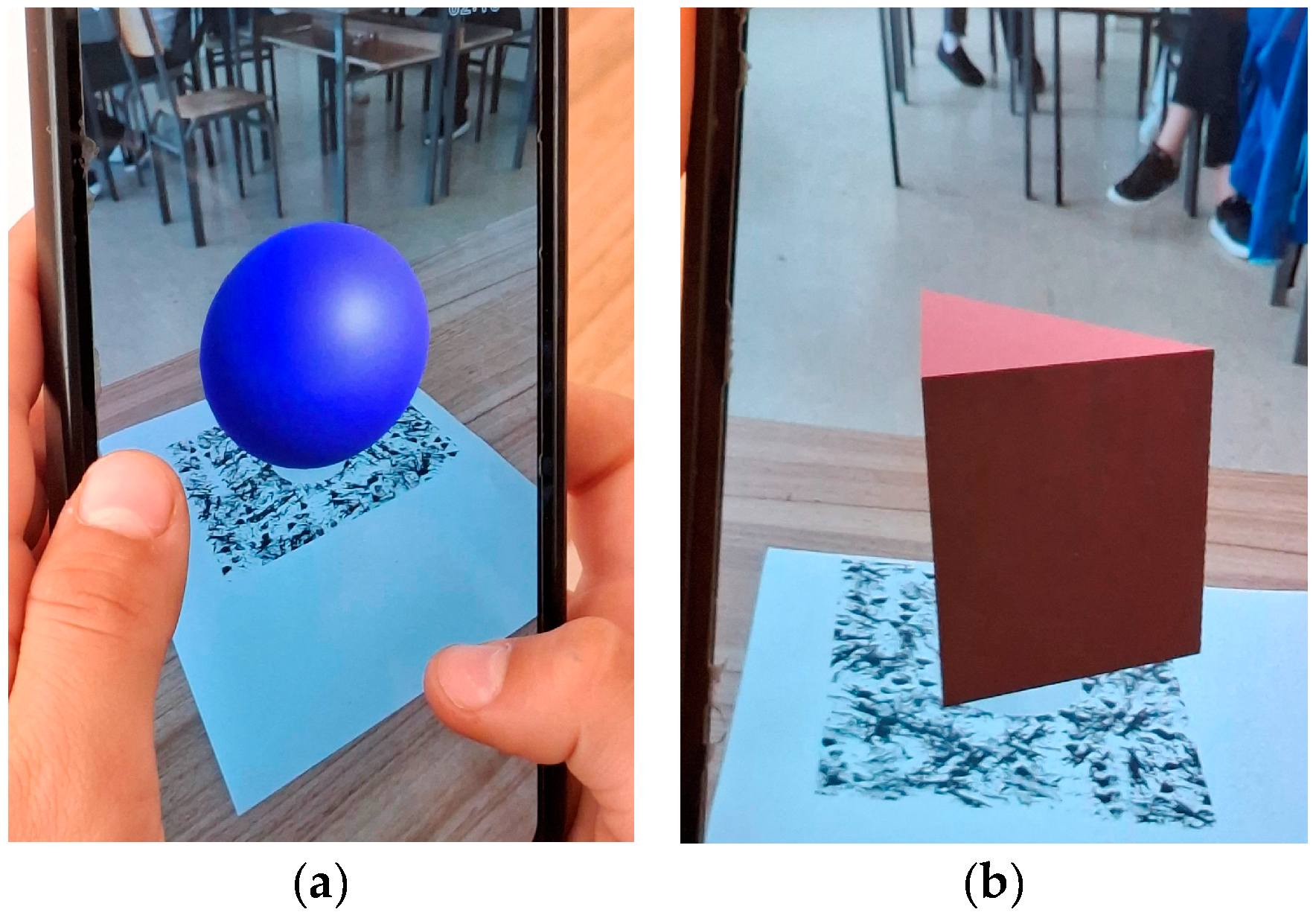
2]. The synergy of AR with STEAM creates a rich pedagogical environment where students not only visualize abstract concepts but also experience them through practical interactions. For example, during geometry lessons, students can use AR to view a cube or pyramid from multiple perspectives, analyzing faces, vertices, and edges directly. This process not only facilitates the construction of conceptual understanding but also supports spatial visualization and interpretation processes that are frequently required in learning 3D geometry, which are essential for learning mathematics and other scientific disciplines. However, school practice and research literature consistently indicate that geometry remains one of the most challenging topics for primary students [
3]. This often impacts student motivation resulting in lower performance. The difficulties are linked not only to the acquisition of mathematical knowledge but also the spatial demands of interpreting and reasoning about 3D objects from 2D representations, which are fundamental for logical thinking and the development of 21st-century competences [
4].
At this point, the exploration of innovative approaches that can provide effective alternatives to traditional methods becomes essential. AR represents a promising solution, as it combines visual experience with practical interaction, offering a more engaging and meaningful learning process [
5]. Researchers have shown that the use of AR in education not only increases student motivation and engagement but also has a direct impact on the acquisition of mathematical concepts and the development of spatial skills [
6,
7].
This study is grounded in the idea that key functional features of AR (3D visualization, manipulation/rotation, and multiple viewpoints) may support spatial visualization and interpretation processes that are frequently required in learning 3D geometry. These spatial aspects are operationalized at the task level (i.e., performance on spatially demanding geometry items), rather than as a separately measured spatial ability construct [
8,
9]. In this sense, dynamic 3D representations may help students move from predominantly visual recognition to the analysis of properties [
10], by making the structure of solids (faces, edges, vertices) and part–whole relationships more salient. Given that the study employs a quasi-experimental design implemented in an authentic school setting, the observed effects are interpreted cautiously as the outcome of interactions among the technology (AR), the instructional organization (STEAM), and contextual factors (e.g., teacher/class).
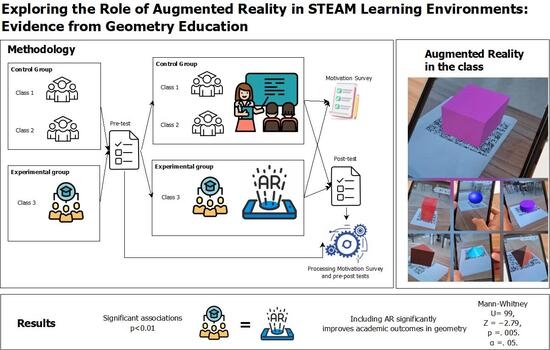
Based on these challenges and potentials, this study aims to evaluate the impact of AR on improving the academic performance of fifth-grade students in learning geometric solids, through its integration with the STEAM approach. The study focuses on three core dimensions: (1) the development of spatial skills, (2) the enhancement of student motivation for active participation in the learning process, and (3) the improvement of academic results in geometry-related assessments. Led by the following research questions: How does the use of AR affect the development of spatial skills compared to traditional methods? To what extent does the integration of AR with STEAM influence student motivation? And what effect does this technology have on academic outcomes in geometry tests? This study tests the following hypotheses:
H1. Students who learn geometry with AR will show greater improvement in spatial skills than students taught with traditional methods.
H2. Integrating AR within a STEAM-based approach will lead to higher student motivation than traditional instruction.
H3. Students taught geometry using AR will achieve higher academic performance on geometry tests than students taught without AR.
In this way, this research study contributes to contemporary literature on technology-enhanced education by offering a model for integrating Augmented Reality and the STEAM approach into mathematics teaching. The expected results will not only help identify the practical benefits of this approach but also provide recommendations for educational policy and teacher professional development, making the teaching of geometry more effective, engaging, and aligned with the needs of 21st-century learners.
2. Related Work
STEAM education represents an interdisciplinary paradigm where advanced academic concepts are interwoven with authentic real-life problems, placing students in contexts that demand the application of knowledge in science, technology, engineering, arts, and mathematics. This approach seeks to connect theoretical knowledge with practical situations, enabling learners to develop critical thinking and problem-solving competences in reflective real-world contexts [
11]. According to [
12], the integration of STEAM disciplines should not remain purely theoretical, but must extend into applied settings of technology and engineering, where knowledge is employed to solve problems related to natural processes, plant development, or ecosystem functioning. A key element of this approach is self-discovery, which deepens students’ awareness of the value and relevance of the problem at hand. STEAM draws heavily on constructivist theory, emphasizing experiential learning and “learning by doing”. In this sense, STEAM projects move away from linear approaches and predetermined solutions, instead promoting creativity, innovation, and originality [
13]. To maximize students’ potential, schools and teachers design methods that encourage experimentation, creation, and reformulation of ideas into new understandings. Thus, STEAM is not merely a methodological approach but a long-term strategy for developing sustainable skills for the future [
14]. For teachers, this means assuming a deeper role as designers of learning environments, where project-based learning and questioning strategies stimulate critical analysis, deeper thinking, and innovation [
15].
Modern technologies have played a transformative role in strengthening STEAM education. Beyond traditional digital tools, Augmented Reality (AR) has emerged as one of the most influential technologies in education. AR blends elements of the real and virtual worlds to create rich and interactive learning experiences [
16]. In an era where students, as members of a digital generation, are immersed in devices and applications, the use of AR in education responds to the demand for more sophisticated, personalized, and engaging learning environments [
1,
17]. Research has shown that AR enhances motivation, improves visual and spatial skills, and provides more concrete experiences for understanding abstract concepts [
4,
6,
7]. The integration of AR into STEAM is considered a crucial step toward creating interdisciplinary and practically applicable learning environments, as also emphasized by [
18], who explored Virtual Reality and Augmented Reality as supported strategies for K-12 STEM learning. An umbrella review conducted by [
19] further reinforces this potential, identifying AR as a transformative educational medium that enhances spatial reasoning, engagement, and learning performance across STEM disciplines. Coming back to AR, ref. [
20] claimed that students can explore complex concepts via 3D visualizations, developing not only technological but also creative skills. For example, projects involving the 3D modeling of buildings through AR allow students to connect art with science and mathematics, blending aesthetic design with mathematical calculations as complementary dimensions of a single project. However, effective integration requires teachers to be trained and capable of using AR meaningfully; otherwise, its potential may remain underutilized [
21].
In geometry education specifically, AR has demonstrated clear benefits. Unlike traditional drawings or rigid models, AR allows students to manipulate three-dimensional shapes in real time, facilitating the understanding of spatial relationships and improving visualization skills [
19]. Its integration with Van Hiele’s theory of geometric thinking supports students’ progressive movement from basic visualization toward more advanced deductive reasoning [
8,
10]. Through interactive visualization, learners can better understand complex relationships between geometric elements and strengthen their confidence in mathematical abilities. Existing literature suggests that the impact of AR is not only cognitive but also emotional. Active involvement and the sense of achievement students experience when manipulating 3D objects enhance motivation, engagement, and self-confidence in subjects such as mathematics, which is often perceived as challenging [
22]. Furthermore, AR enables personalized learning, allowing students to progress at their own pace, addressing individual needs and improving academic performance [
23]. These avantages position AR as a powerful tool for sustainable integration into STEAM curricula.
In light of these insights, our study focuses on exploring the impact of integrating Augmented Reality with the STEAM approach in teaching geometry. Unlike much of the existing research, which often emphasizes general technology use in education or higher levels of learning, this study addresses a critical gap by examining how AR can support the acquisition of fundamental geometric concepts among younger learners. By assessing performance on spatially demanding geometry tasks, motivation, and academic performance, this research seeks to provide empirical evidence on the effectiveness of this innovative approach. Furthermore, it contributes to contemporary research by proposing a practical model of technology and pedagogy integration that can inform teaching practice and educational policy, thereby enhancing the quality of mathematics education in schools.
Author Contributions
Conceptualization, formal analysis, resources, data curation, writing—original draft preparation—A.G.; Conceptualization, methodology, investigation, writing—original draft preparation, writing—review and editing and writing—review and editing—K.P.N. All authors have read and agreed to the published version of the manuscript.
Funding
This research received no external funding.
Institutional Review Board Statement
Ethical review and approval were waived for this study, as at the time of approval the Republic of Kosovo did not have a national Institutional Review Board (IRB). The Faculty of Education at the University of Prishtina assumed institutional responsibility for reviewing and approving research involving human participants. The study was approved by the Faculty of Education at the University of Prishtina.
Informed Consent Statement
Informed consent was obtained from all subjects involved in the study.
Data Availability Statement
All data generated or analyzed during this study are available from the corresponding author upon request.
Conflicts of Interest
The authors declare no conflicts of interest.
References
- Chao, W.-H.; Chang, R.-C. Using augmented reality to enhance and engage students in learning mathematics. Adv. Soc. Sci. Res. J. 2018, 5, 455–464. [Google Scholar] [CrossRef]
- Zuniari, N.I.; Ridlo, Z.R.; Wahyuni, S.; Ulfa, E.M.; Dharmawan, M.K.S. The effectiveness of implementation learning media based on augmented reality in elementary school in improving critical thinking skills in solar system course. J. Phys. Conf. Ser. 2022, 2392, 012010. [Google Scholar] [CrossRef]
- Fujita, T.; Kondo, Y.; Kumakura, H.; Kunimune, S.; Jones, K. Spatial reasoning skills regarding 2D representations of 3D geometric shapes in grades 4 to 9. Math. Educ. Res. J. 2020, 32, 235–255. [Google Scholar] [CrossRef]
- Angraini, L.M.; Alzaber, A.; Sari, D.P.; Yolanda, F.; Muhammad, I. Improving mathematical critical thinking ability through augmented reality-based learning. Aksioma 2022, 11, 3533–3544. [Google Scholar] [CrossRef]
- Amorim, L.L.; de Oliveira Freitas, R.C. Contributions of the Sólidos RA application to the development of geometric visualization from the perspective of augmented reality. Electron. J. Debates STE 2023, 13, 3–25. [Google Scholar]
- Pujiastuti, H.; Haryadi, R.; Arifin, A.M. Augmented reality-based learning media to improve students’ ability to understand mathematics concept. Int. J. Res. Educ. 2020, 9, 92–101. [Google Scholar] [CrossRef]
- Cai, S.; Liu, E.; Shen, Y.; Liu, C.; Li, S. Probability learning in mathematics using augmented reality: Impact on students’ learning gains and attitudes. Interact. Learn. Environ. 2020, 28, 560–573. [Google Scholar] [CrossRef]
- Wu, H.K.; Lee, S.W.Y.; Chang, H.; Liang, J.C. Current status, opportunities, and challenges of augmented reality in education. Comput. Educ. 2013, 62, 41–49. [Google Scholar] [CrossRef]
- Akçayır, M.; Akçayır, G. Advantages and challenges associated with augmented reality for education: A systematic review of the literature. Educ. Res. Rev. 2017, 20, 1–11. [Google Scholar] [CrossRef]
- Van Hiele, P.M. Structure and Insight: A Theory of Mathematics Education; Academic Press: Cambridge, MA, USA, 1986. [Google Scholar]
- Margot, K.C.; Kettler, T. Teachers’ perception of STEM integration and education: A systematic literature review. Int. J. STEM Educ. 2019, 6, 2. [Google Scholar] [CrossRef]
- Chamberlin, S.A.; Pereira, N. Differentiating engineering activities for use in a mathematics setting. In Engineering Instruction for High-Ability Learners in K–8 Classrooms; Dailey, D., Cotabish, A., Eds.; Prufrock Press: Austin, TX, USA, 2017; pp. 45–55. [Google Scholar]
- Aguilera, D.; Ortiz-Revilla, J. STEM vs. STEAM education and student creativity: A systematic literature review. Educ. Sci. 2021, 11, 331. [Google Scholar] [CrossRef]
- Odufuwa, T.; Adelana, O.P.; Adekunjo, M.A. Assessment of senior secondary students’ perceptions and career interest in science, technology, engineering, and mathematics (STEM) in Ijebu-Ode Local Government Area, Ogun State. J. Sci. Technol. Math. Educ. 2022, 18, 146–159. [Google Scholar]
- Huang, B.; Jong, M.; Tu, Y.-F.; Hwang, G.-J.; Chai, C.S.; Jiang, M. Trends and exemplary practices of STEM teacher professional development programs in K–12 contexts: A systematic review of empirical studies. Comput. Educ. 2022, 189, 104577. [Google Scholar] [CrossRef]
- Milgram, P.; Takemura, H.; Utsumi, A.; Kishino, F. Augmented reality: A class of displays on the reality–virtuality continuum. In Telemanipulator and Telepresence Technologies; SPIE: Cergy-Pontoise, France, 1994; Volume 2351, pp. 282–292. [Google Scholar] [CrossRef]
- Tene, T.; Marcatoma Tixi, J.A.; Palacios Robalino, M.D.L.; Mendoza Salazar, M.J.; Vacacela Gomez, C.; Bellucci, S. Integrating immersive technologies with STEM education: A systematic review. In Frontiers in Education; Frontiers Media SA: Lausanne, Switzerland, 2024; Volume 9, p. 1410163. [Google Scholar]
- Jiang, H.; Zhu, D.; Chugh, R.; Turnbull, D.; Jin, W. Virtual reality and augmented reality-supported K-12 STEM learning: Trends, advantages and challenges. Educ. Inf. Technol. 2025, 30, 12827–12863. [Google Scholar] [CrossRef]
- Zhang, Y.; Feijoo-Garcia, M.A.; Gu, Y.; Popescu, V.; Benes, B.; Magana, A.J. Virtual and augmented reality in Science, Technology, Engineering, and Mathematics (STEM) education: An Umbrella Review. Information 2024, 15, 515. [Google Scholar] [CrossRef]
- Syawaludin, A.; Gunarhadi; Rintayati, P. Development of augmented reality-based interactive multimedia to improve critical thinking skills in science learning. Int. J. Instr. 2019, 12, 331–344. [Google Scholar] [CrossRef]
- Yanuarto, W.N.; Iqbal, A.M. The augmented reality learning media to improve mathematical spatial ability in geometry concept. Edumatica 2022, 12, 30–40. [Google Scholar] [CrossRef]
- Belda-Medina, J.; Calvo-Ferrer, J.R. Integrating augmented reality into language learning: Digital competencies and attitudes of pre-service teachers through the TPACK framework. Educ. Inf. Technol. 2022, 27, 12123–12146. [Google Scholar] [CrossRef]
- Bulut, M.; Borromeo Ferri, R. A systematic literature review on augmented reality in mathematics education. Eur. J. Sci. Math. Educ. 2023, 11, 556–572. [Google Scholar] [CrossRef]
- BBC. 3D Shapes Quiz [Educational Material]. 2021. Available online: https://downloads.bbc.co.uk/skillswise/maths/ma343dsh/quiz/ma343dsh-e3-quiz.pdf (accessed on 10 September 2025).
- George, D.; Mallery, P. SPSS for Windows Step by Step: A Simple Guide and Reference (11.0 Update), 4th ed.; Allyn & Bacon: Boston, MA, USA, 2003. [Google Scholar]
- Keller, J.M. Development and use of the ARCS model of instructional design. J. Instr. Dev. 1987, 10, 2–10. [Google Scholar] [CrossRef]
- Deci, E.L.; Ryan, R.M. Intrinsic Motivation and Self-Determination in Human Behavior; Springer: Berlin/Heidelberg, Germany, 1985. [Google Scholar]
- Bressler, D.M.; Bodzin, A.M. A mixed methods assessment of students’ flow experiences during a mobile augmented reality science game. J. Comput. Assist. Learn. 2013, 29, 505–517. [Google Scholar] [CrossRef]
- Yoon, S.A.; Elinich, K.; Wang, J.; Steinmeier, C.; Tucker, S. Using augmented reality and knowledge-building scaffolds to improve learning in a science museum. Int. J. Comput.-Support. Collab. Learn. 2012, 7, 519–541. [Google Scholar] [CrossRef]
| Disclaimer/Publisher’s Note: The statements, opinions and data contained in all publications are solely those of the individual author(s) and contributor(s) and not of MDPI and/or the editor(s). MDPI and/or the editor(s) disclaim responsibility for any injury to people or property resulting from any ideas, methods, instructions or products referred to in the content. |
© 2025 by the authors. Licensee MDPI, Basel, Switzerland. This article is an open access article distributed under the terms and conditions of the Creative Commons Attribution (CC BY) license (https://creativecommons.org/licenses/by/4.0/).