Article

Research on Transfer Learning-Based Fault Diagnosis for Planetary Gearboxes Under Cross-Operating Conditions via IDANN


1
Information Construction Center, Suqian University, Suqian 223800, China
2
BLUE.x.y Intelligent Technology Co., Ltd., Suqian 223800, China
3
School of Mechanical and Electrical Engineering, Suqian University, Suqian 223800, China
*
Author to whom correspondence should be addressed.
Information 2025, 16(12), 1112; https://doi.org/10.3390/info16121112
Submission received: 10 November 2025 / Revised: 13 December 2025 / Accepted: 16 December 2025 / Published: 18 December 2025

Abstract

To address the limited performance of transfer fault diagnosis for planetary gearboxes under cross-operating conditions, which is caused by the heterogeneous feature distribution of vibration data and insufficient feature extraction. An improved domain-adversarial neural network (IDANN) model based on a joint-adaptive-domain alignment component and a dual-branch feature extractor is proposed. Firstly, a joint domain adaptation alignment approach, integrating maximum mean discrepancy (MMD) and CORrelation ALignment (CORAL), is proposed to realize the correlation structure matching of features between the source and target domains of IDANN. Secondly, a dual-branch feature extractor composed of ResNet18 and Swin Transformer is proposed with an attention-weighted fusion mechanism to enhance feature extraction. Finally, validation experiments conducted on public planetary gearbox fault datasets show that the proposed method attains high accuracy and stable performance in cross-operating-condition transfer fault diagnosis.

1. Introduction

As core transmission components, planetary gearboxes are widely used in industrial fields such as aerospace, wind power, construction machinery, rail transit, and intelligent manufacturing. Planetary gearboxes consist of multiple precision-matched components, including sun gears, planet gears, ring gears, planet carriers, and bearings. Due to their structural complexity, they are susceptible to various faults in long-term operation [1]. Failure to detect faults promptly will not only reduce transmission accuracy and increase operational noise but also may trigger chain reactions resulting in component damage [2,3]. Therefore, research on the fault diagnosis of planetary gearboxes is of considerable engineering significance and practical value.
Fault diagnosis for planetary gearboxes has long been a research hotspot, and current methods can be primarily categorized into mechanism-based approaches [4,5] and data-driven approaches—particularly those based on deep learning [6,7,8]. Mechanism-based approaches have clear physical meanings and interpretable diagnostic results, performing well in scenarios with stable operating conditions and clear fault mechanisms [4]. However, these methods struggle to meet the requirements of complex industrial scenarios, primarily due to factors such as complex operating conditions of variable speed and load, noise interference, and challenges in accurately acquiring structural parameters [5]. Deep learning-based methods eliminate the reliance on complex physical mechanism modeling; they can independently realize the adaptive extraction, selection, and nonlinear mapping of fault features directly from raw data, thus completing the diagnostic task. The commonly used deep learning models include convolutional neural networks (CNN) [9], recurrent neural networks (RNN) [10], long short-term memory (LSTM) [11], and Transformer [12]. To leverage the unique advantages of various models, many scholars have focused on integrating and improving multiple methods. Among these, the CNN–Transformer hybrid architecture has become one of the most popular methods [13]. Such architectures usually employ a CNN as the front-end feature extraction unit. By virtue of the local receptive field property of convolution operations, they extract fine-grained local features from fault signals. Subsequently, the self-attention mechanism of the Transformer module is used to perform global correlation modeling on the extracted local features [14]. However, this type of serial structure has a limitation that local features tend to be diluted during global modeling. Therefore, constructing a feature extractor that can adaptively capture the global and local features of planetary gearboxes is of great significance.
Despite the advantages of deep learning-driven planetary gearbox fault diagnosis approaches, the insufficiency of training data significantly limits their diagnostic performance and engineering applicability [15]. Transfer learning, relying on the core characteristic of cross-domain knowledge transfer, has become an effective technical approach to address this problem [16]. Transfer learning mainly includes instance transfer [17], feature transfer [18], and domain adaptation methods [19]. Instance transfer assigns differentiated weight coefficients to source domain samples, selecting samples with distributions analogous to the target domain to participate in model training [20]. However, this method is highly dependent on the similarity in distribution between the source and target domains, and diagnostic accuracy is easily affected [21]. Feature transfer methods map features from both source and target domains to a unified feature space to reduce inter-domain distribution differences, enabling the knowledge transfer under variable operating conditions. But such methods require an adequate quantity of labeled target domain samples for achieving ideal mapping effects [22]. Domain-adaptive transfer learning can effectively solve the issue of data distribution inconsistency between the source and target domains without the need for target domain data labels [23]. It is better aligned with the practical requirements of cross-operating-condition transfer fault diagnosis of planetary gearboxes.
Domain-adversarial neural networks (DANN) are a representative domain adaptation method in transfer learning. Relying on adversarial learning, they deliver excellent cross-domain adaptation performance in the fault diagnosis of planetary gearboxes [24]. The adversarial mechanism of DANN mainly achieves global distribution alignment between source and target domains. However, the local data distributions for various fault types and severities in planetary gearboxes exhibit heterogeneity, leading to local domain shift [25]. Some scholars have further enhanced domain-adaptation accuracy by combining maximum mean discrepancy (MMD) with the adversarial learning of DANN [26]. As the feature extractors of the original DANN mostly adopt basic convolutional or fully connected networks, they struggle to deeply mine the coupled features and early weak fault information implied in planetary gearbox fault data. Some studies have integrated feature extraction networks into the DANN framework, incorporating the local feature capture capability of CNNs, the temporal feature modeling capability of LSTMs, and the global dependency modeling capability of Transformers [27,28,29]. Therefore, this paper proposes an improved DANN scheme to address data distribution discrepancies and inadequate feature extraction in the transfer fault diagnosis of planetary gearboxes, aiming to enhance diagnostic performance.
This paper presents an improved domain-adversarial neural network (IDANN) model to address the issues of heterogeneous feature distribution and inadequate feature information extraction in the cross-operating-condition transfer fault diagnosis of planetary gearboxes. A dual-branch feature extraction module based on ResNet18 and Swin Transformer is proposed, with an attention-weighted fusion module introduced to fuse features for better extraction of local and global features of planetary gearboxes. Meanwhile, a joint domain adaptation alignment method based on MMD and CORrelation ALignment (CORAL) is proposed. The joint domain adaptation alignment method can not only align the mean differences across the source and target domains but also match their covariance matrices, realizing the consistency of feature correlation structures. Finally, the presented model is verified on public planetary gearbox fault datasets. Experimental results demonstrate that the proposed model exhibits excellent diagnostic performance in transfer fault diagnosis tasks under cross-operating conditions.
The structure of this paper is organized as follows: Section 2 elaborates on the basic principles of DANN and the proposed improved modules; Section 3 details the flow and key steps of the proposed method; Section 4 verifies the effectiveness of the proposed method through experimental research and comparison with other methods; and Section 5 presents the research conclusions.

2. Methodology

2.1. DANN

DANN is an adversarial learning-based transfer learning approach that is widely used in solving cross-domain problems. It addresses performance degradation when training data is transferred across the source domain to the target domain for application. The network’s core architecture includes a feature extractor, a label classifier, and a domain discriminator module [30], as shown in Figure 1.
By introducing a domain discriminator, DANN reduces the inter-domain distribution discrepancy between the source and target domains. Then, the model’s generalization capability on the target domain is enhanced. The core of DANN further lies in achieving superior performance on the target domain by minimizing inter-domain distribution disparities and maximizing the accuracy of the label classifier.
Given input samples x X and corresponding category labels y Y , there are two data distributions in the input data: the source domain data distribution S ( x , y ) and the target domain data distribution T ( x , y ) . The input dataset containing N samples which can be expressed as X = x 1 S , x 2 S , , x N S S , x 1 T , x 2 T , , x N T T , where N S samples belong to the source domain, N T samples belong to the target domain, and N S + N T = N . The category label set is expressed as Y = y 1 S , y 2 S , , y N S S , y 1 T , y 2 T , , y N T T , where K is the number of categories y i . The domain label set is defined as D = d 1 , d 2 , , d N , d i 0 , 1 , d i = 0 and d i = 1 corresponding to samples belonging to the source domain and target domain, respectively.
Input samples are mapped to feature vectors through the feature extractor G f ( : , ξ f ) , which can be expressed as:
f = G f ( x , ξ f ) ,
where ξ f is the parameter vector of all layers in the mapping layer of the feature extractor.
In the forward propagation process, the extracted features f are passed through the label classifier G y and domain discriminator G d to obtain the estimation classification label value y ^ and estimation domain value y ^ , which can be expressed as:
y ^ = G y ( f , ξ y ) d ^ = G d ( f , ξ d ) ,
where ξ y and ξ d are the mapping parameter vectors of the label classifier and domain discriminator, respectively.
First, the label classifier undergoes training through backpropagation. The core function of the label classifier is to discriminate sample labels, and the training goal is to minimize the loss function for label classification. The loss function can be expressed as:
L y ( ξ f , ξ y ) = 1 N S i = 1 N S y i ln y ^ i ,
Subsequently, the domain discriminator is trained. The core function of the domain discriminator is to discriminate the sample’s domain affiliation, and the training objective is to minimize the domain estimation loss function, which can be expressed as:
L d ( ξ f , ξ d ) = 1 N i = 1 N [ d i ln d ^ i + ( 1 d i ) ln ( 1 d ^ i ) ] ,
Training of the feature extractor needs to meet two core goals: the extracted features should be hard for the domain discriminator to identify their domain origin, and the features should have good classifiability to meet the training needs of the label classifier. It can be seen that L d both needs to be maximized and minimized, thereby forming an adversarial training scenario. To this end, a Gradient Reversal Layer (GRL) is introduced across the feature extractor and the domain discriminator. When the loss L d ξ d is back propagated, its introduction of this gradient reversal layer makes the gradient as λ L d ξ d , and the optimization goal of the feature extractor changes from maximizing the domain discrimination loss to minimizing it. The overall loss function of DANN can be expressed as:
L ( ξ f , ξ y , ξ d ) = L y ( ξ f , ξ y ) λ L d ( ξ f , ξ d ) ,
where λ is the coefficient of the gradient reversal layer.

2.2. Improved Domain-Adversarial Neural Network

2.2.1. Joint Domain-Adaptation Aligner

Although DANN has strong cross-domain transfer capabilities, its performance will still drop significantly when the inter-domain feature difference is large. Therefore, an effective alignment method tailored to the source and target domains should be devised. MMD is most popularly employed to quantify the mean discrepancy across the source and target domains. However, it ignores the feature correlation structure of the two domains. To address this problem, this paper proposes a joint domain adaptation alignment approach, integrating MMD and CORAL, which can not only align the mean discrepancy across the source and target domains but also match their covariance matrices, maintaining the consistency of feature correlation structures.
The square of MMD as the loss function can be expressed as:
L M M D = 1 N S i = 1 N S ϕ ( f i S ) 1 N T j = 1 N T ϕ ( f j T ) H 2 ,
where ϕ ( ) is the feature mapping that maps samples to the Reproducing Kernel Hilbert Space (RKHS), H is the norm of RKHS, f i S and f j T are the features of source domain samples and target domain samples obtained after passing through the feature extractor, respectively.
The core of CORAL loss is the square of the Frobenius norm between the source and target domains’ covariance matrices, and it offsets the impact of feature dimensions through a normalization coefficient. It can be expressed as:
L C O R A L = C s C t F 2 C s = 1 N S 1 i = 1 N S ( f i S 1 N S j = 1 N S f j S ) ( f i S 1 N S j = 1 N S f j S ) T C t = 1 N T 1 i = 1 N T ( f i T 1 N T j = 1 N T f j T ) ( x i T 1 N T j = 1 N T f j T ) T ,
where C s and C t are the covariance matrices of source domain features and target domain features, respectively, F is the Frobenius norm.
MMD targets the distribution mean to reduce inter-domain position shift, while CORAL focuses on the covariance of distributions to alleviate inter-domain shape discrepancy. By introducing a parameter to fuse the two types of losses, the model can simultaneously minimize the inter-domain differences at the mean and covariance levels while optimizing task performance, thereby achieving more comprehensive distribution matching. The overall optimization objective function of the improved DANN is:
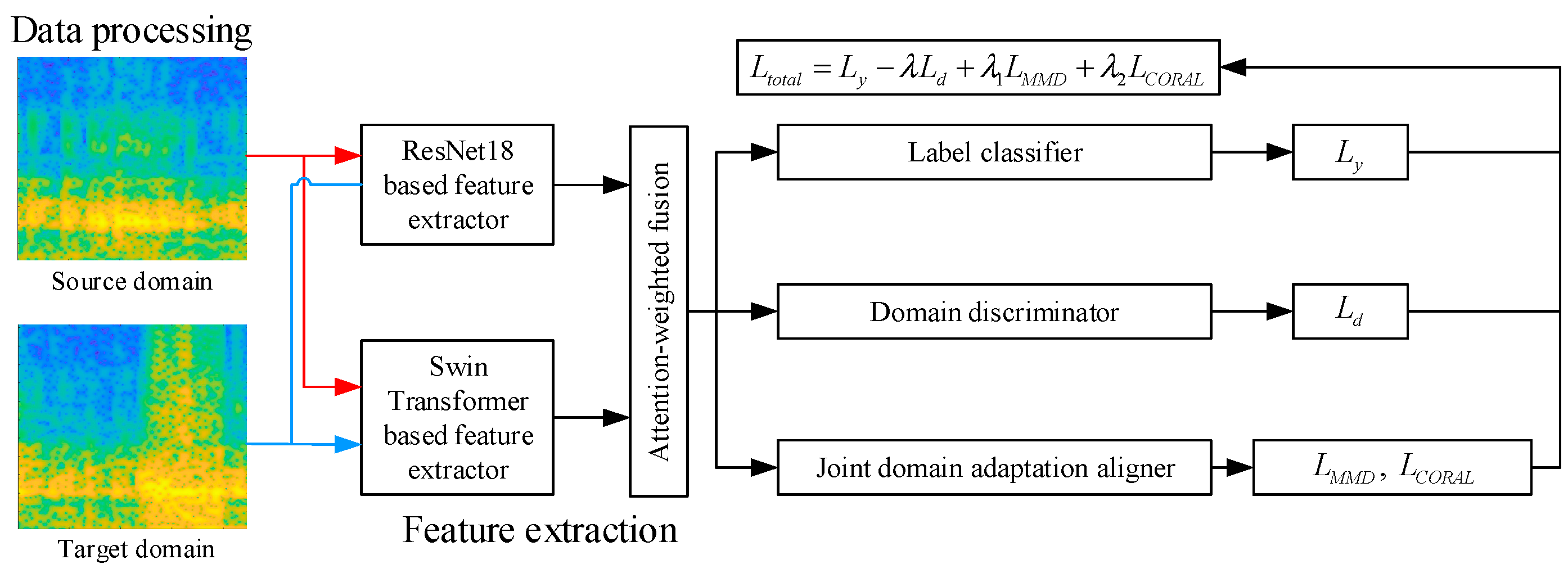
L t o t a l = L y λ L d + λ 1 L M M D + λ 2 L C O R A L ,
where λ 1 and λ 2 are adjustment coefficients.

2.2.2. Dual-Branch Feature Extraction

In planetary gearbox fault diagnosis scenarios, the feature extractors of DANNs primarily extract features from time-frequency images and typically adopt CNN or ResNet architectures. ResNet addresses the gradient vanishing problem of CNNs via shortcut connections. With stacked convolutional layers and residual connections, it gradually enhances the ability to capture local details of time-frequency images [31]. Its accurate modeling capability for local fault features makes it perform well in early weak fault identification tasks of individual components.
However, ResNet exhibits a notable limitation in global feature extraction, which becomes especially evident in planetary gearbox fault diagnosis [32]. As a typical multi-component coupling system, the dynamic behaviors of various components of planetary gearboxes are interrelated, resulting in fault features showing cross-regional correlation and scattered distribution in time-frequency images. It is necessary to integrate multi-regional features to construct global features, which limits the applicability of ResNet-based feature extractors. To solve this problem, the Swin Transformer is employed, and a dual-branch structure feature extractor is designed in this paper. The Swin Transformer can extract features from fine-grained to coarse-grained at different levels to obtain global domain-invariant features [33].
Although some CNN–Transformer hybrid models have emerged recently, most of them adopt a serial structure where features extracted by CNN are fed into the Transformer. This structure suffers from the problem of local features being diluted by global modeling. However, this study employs a parallel dual-branch structure combined with attention-weighted fusion. This design not only retains the advantage of ResNet18 in local feature extraction but also leverages the Swin Transformer’s capability for global dependency modeling.
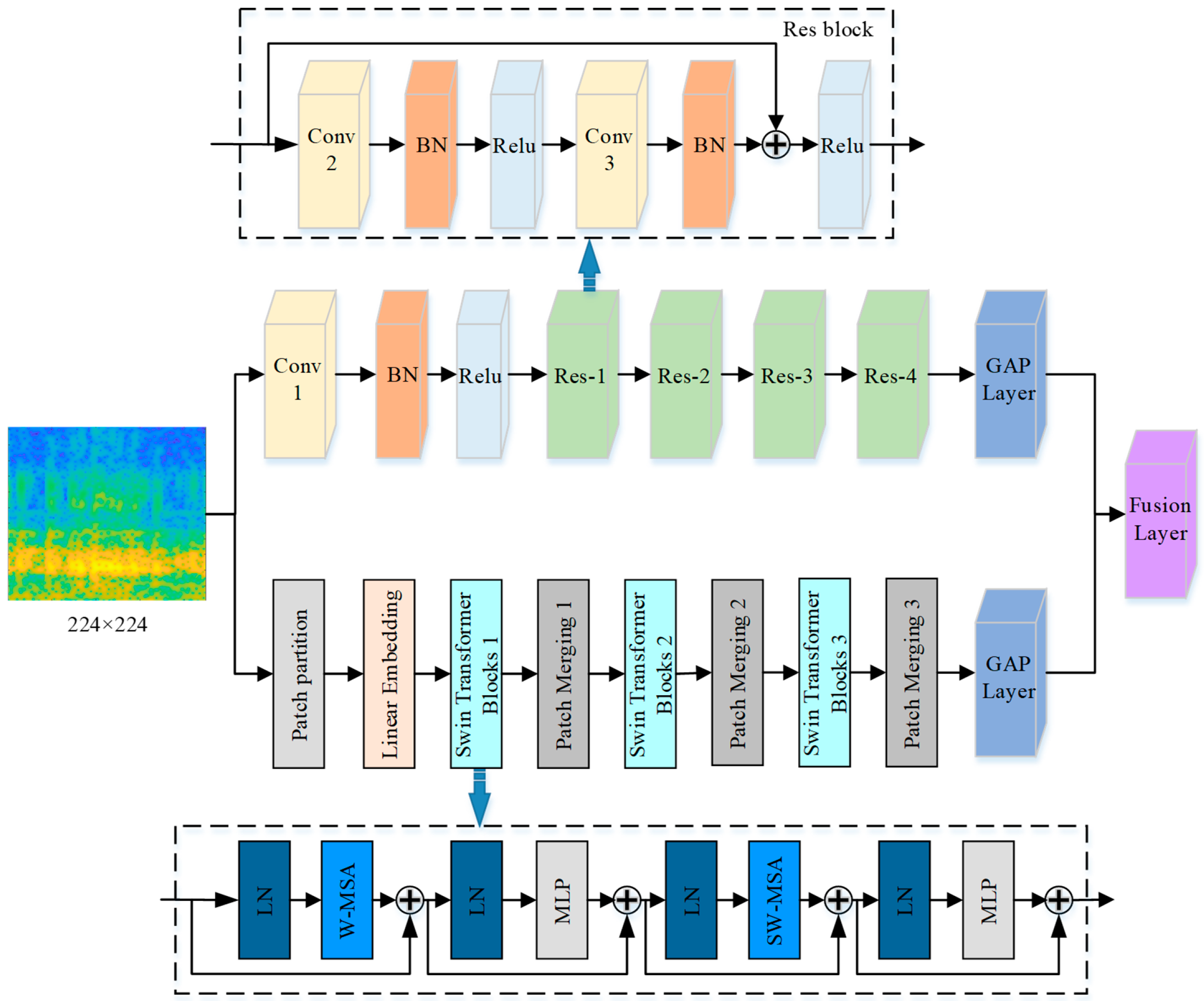
In domain adaptation scenarios, its multi-scale feature extraction and global feature reuse capabilities can help the model achieve better domain feature alignment when the inter-domain distribution discrepancy between the source and target domains is large. The detailed structure of the dual-branch feature extractor is shown in Figure 2.
Early-stage weak faults of planetary gearboxes rely on local detailed features, such as edges and local energy mutations. ResNet18 can address the vanishing gradient problem via shortcut connections. Additionally, it has a moderate number of parameters, making it suitable for deployment in industrial scenarios.
The ResNet18 model includes one initial convolutional layer, four residual modules, and one global average pooling layer. The main parameter settings and output dimensions of each module are listed in Table 1.
The Swin Transformer-based feature extractor includes patch partition, linear embedding, three Swin Transformer layers, three downsampling layers, and one global average pooling layer. Since the time-frequency images of planetary gearbox vibration signals used in the subsequent studies of this paper have a size of 224 × 224, this study designs the following configurations: a 4 × 4 patch partition, a 3-layer Swin Transformer block, and a window size of 7 × 7. Specifically, the 4 × 4 patch can balance local details and global correlations, the 7 × 7 window matches the distribution scale of fault features in time-frequency images, and the 3-layer network enables fine-to-coarse-grained progressive global feature extraction. The main parameter settings and output dimensions of each module are listed in Table 2.
The 512-dimensional feature vector F R 512 by ResNet18 and the 768-dimensional feature vector F S 768 by Swin Transformer are mapped to the same 1024-dimensional space through fully connected layers. A new feature vector is obtained by attention-weighted fusion, which can be described as follows:
F f u s i o n = a F R + ( 1 a ) F a = σ ( W a [ F R , F S ] + b a ) F R = F C ( F R ) 1024 F S = F C ( F S ) 1024
where F f u s i o n is the fusion feature, a denotes the attention weight, F C ( ) represents the fully connected function, F R and F S are the features after fully connected mapping, W a and b a stand for the weight coefficient and bias, respectively, and σ ( ) is the Sigmoid activation function.

2.2.3. IDANN Structure

The structure of the IDANN diagnostic model proposed in this paper is shown in Figure 3. A dual-branch feature extractor based on ResNet18 and Swin Transformer is employed in the proposed model, along with an attention-weighted fusion module to fuse dual-branch features for efficient extraction of planetary gearbox local and global features. The model also introduces a joint domain adaptation aligner, which realizes effective alignment between source and target domains at the mean and structural levels, thus enhancing cross-operating condition diagnostic performance.

3. Flow of the Proposed Fault Diagnosis Method

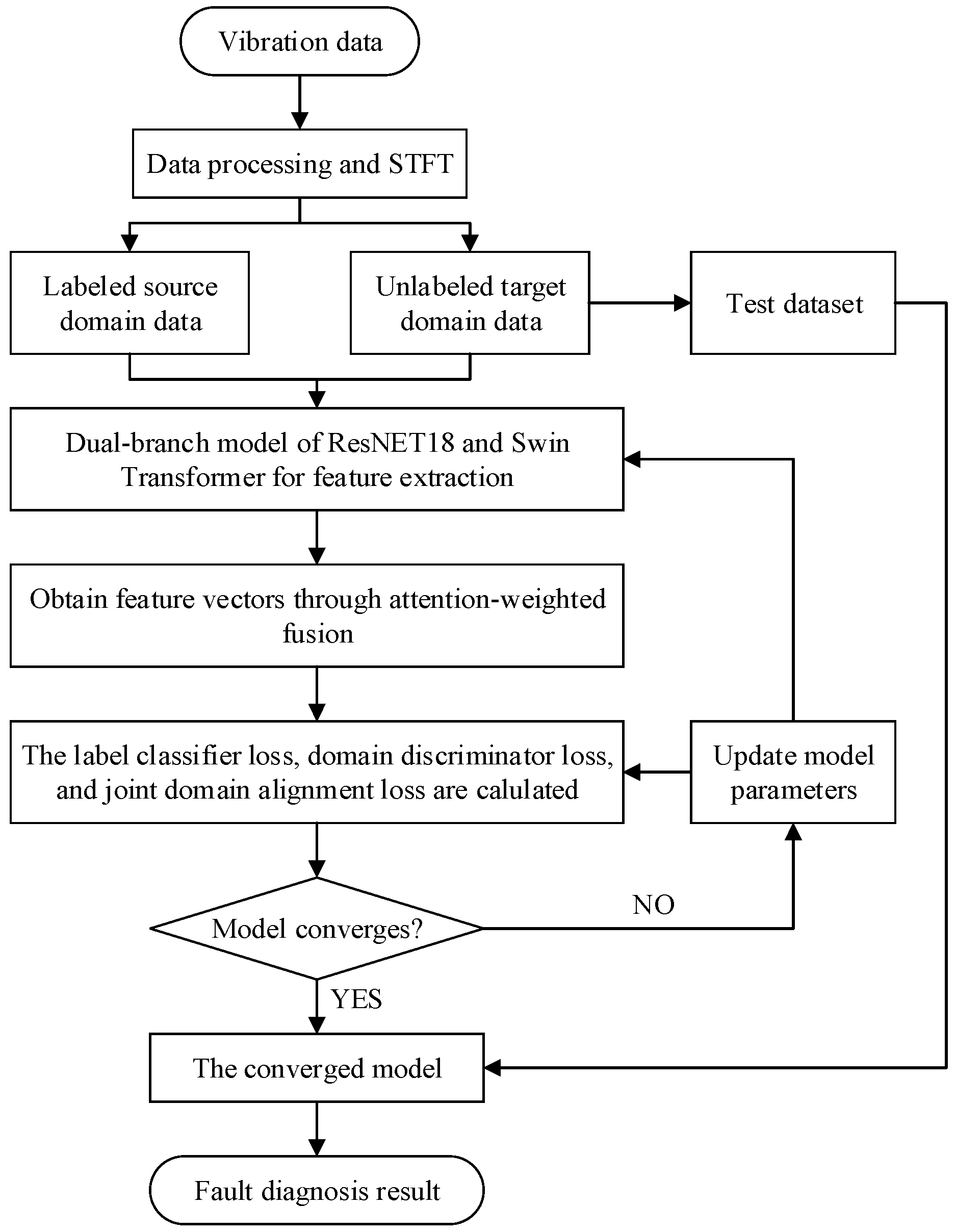
This paper presents a cross-operating condition fault diagnosis method for planetary gearboxes via IDANN. Its key highlight is accurately recognizing planetary gearbox fault states under unlabeled conditions, via labeled vibration data from partially known operating conditions and the IDANN model’s fault feature extraction and generalization transfer capabilities. The fault diagnosis flow is shown in Figure 4.
The main steps are as follows:
Step 1: Data preprocessing. The short-time Fourier transform (STFT) is used to convert the preprocessed vibration signals. It maps one-dimensional time-domain signals to two-dimensional time–frequency representations, realizing signal transformation from the time domain to the spatiotemporal joint space [34]. Under the unsupervised learning framework, the entire dataset is divided into a labeled source domain dataset, an unlabeled target domain dataset, and a test set. The test set is used for verifying model performance.
Step 2: Feature extraction. The source and target domain datasets are input into ResNet18 and Swin Transformer, respectively. These two structurally distinct feature extraction networks mine multi-dimensional data features. An attention-weighted fusion module is employed to perform the weighted fusion of their output features, ultimately yielding a deep, highly discriminative fault feature representation that provides effective feature support for subsequent fault diagnosis.
Step 3: Adversarial training. Fused deep-level fault features are fed into the domain-adversarial network, where the classification loss L y , domain discrimination loss L d , and domain alignment losses L M M D , L C O R A L are calculated. A joint loss function is constructed to iteratively train the network. Adversarial learning optimizes inter-domain distribution discrepancies, thereby enhancing the model’s domain alignment performance.
Step 4: Diagnosis of the test set. After model convergence during training, test data of the unlabeled target domain is input into the trained model. The model leverages its learned fault feature discrimination capability for fault classification, thus completing the planetary gearbox fault diagnosis process.

4. Experiments

4.1. Description of Experimental Data

To verify the effectiveness of the proposed IDANN in cross-operating-condition transfer fault diagnosis of planetary gearboxes, this paper selects the public planetary gearbox fault vibration dataset published by Liu et al. in [35]. The vibration data and detailed information of the experimental device can be publicly obtained from the following link: https://github.com/Liudd-BJUT/WT-planetary-gearbox-dataset (accessed on 9 November 2025). The experimental device consists of a motor, a planetary gearbox, a tachometer, a fixed-shaft gearbox, a load device, an acceleration sensor, and a data acquisition device.
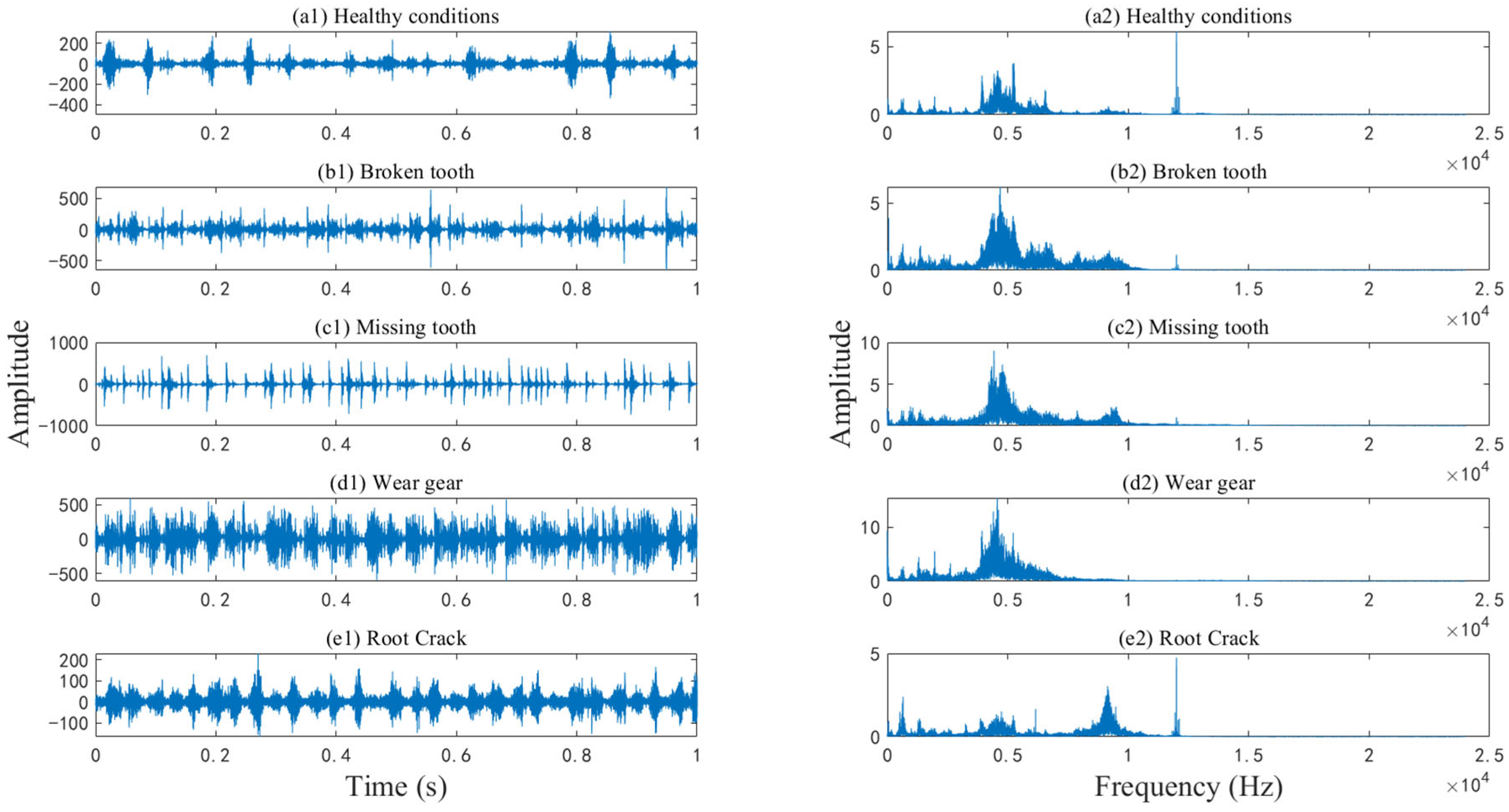
The dataset includes one healthy operating state and four typical fault states, specifically: healthy state, broken tooth, missing tooth, gear wear, and root crack of the sun gear. For each state, tests were carried out under five sun gear speeds (30 Hz, 35 Hz, 40 Hz, 45 Hz, and 50 Hz), and vibration signals under each operating condition were collected synchronously with a sampling frequency of 48 kHz. The time-domain vibration signals and their frequency spectrum by fast Fourier transform (FFT) of the different fault modes under the 30 Hz operating condition are shown in Figure 5.
It can be seen from Figure 5 that time-domain and frequency-domain signal analyses have notable limitations in feature distinction when sample lengths are limited. Time-domain waveforms of different states are similar in shape with overlapping features. And after sample shortening, local fluctuations become more random. In the frequency domain, spectral energy concentrates in the same low-frequency range with homogeneous distribution, lacking unique distinguishing features. Moreover, sample shortening reduces spectral resolution and masks subtle differences. This feature confusion indicates that time-domain and frequency-domain methods can hardly meet the requirements of fault diagnosis, thus requiring the integration of time–frequency analysis and intelligent algorithms to extract more discriminative features.

4.2. Data Preprocessing and Experimental Settings

In this paper, the sun gear speed corresponds to different operating conditions of the planetary gearbox, defining the speeds of 30 Hz, 35 Hz, 40 Hz, 45 Hz, and 50 Hz as operating conditions A, B, C, D, and E, respectively. Then, 20 transfer tasks are constructed: A → B, A → C, A → D, A → E, B → A, B → C, B → D, B → E, C → A, C → B, C → D, C → E, D → A, D → B, D → C, D → E, E → A, E → B, E → C, and E → D. For example, A → B means the source domain data is taken from the 30 Hz operating condition, and the target domain data is taken from the 35 Hz operating condition.
To meet the needs of model training and testing, a sample dataset was constructed for different fault types under each operating condition: 400 samples were set for each operating condition and each fault type. For the dataset, the sampling duration of each operating state under every working condition was almost over 5 min, and the number of sampling points per group exceeded 1.4 × 10 7 , which provided sufficient data. Each dataset was evenly split into 400 segments, with each segment containing over 35,000 data points. In total, 2048 consecutive sampling points were randomly selected from each segment to form a single sample. Notably, there was no overlap between samples in the dataset constructed in this study. The sample division and label setting are shown in Table 3. When the dataset was used as the source domain, it was accompanied by labels; when it was used as the target domain, no labels were set.
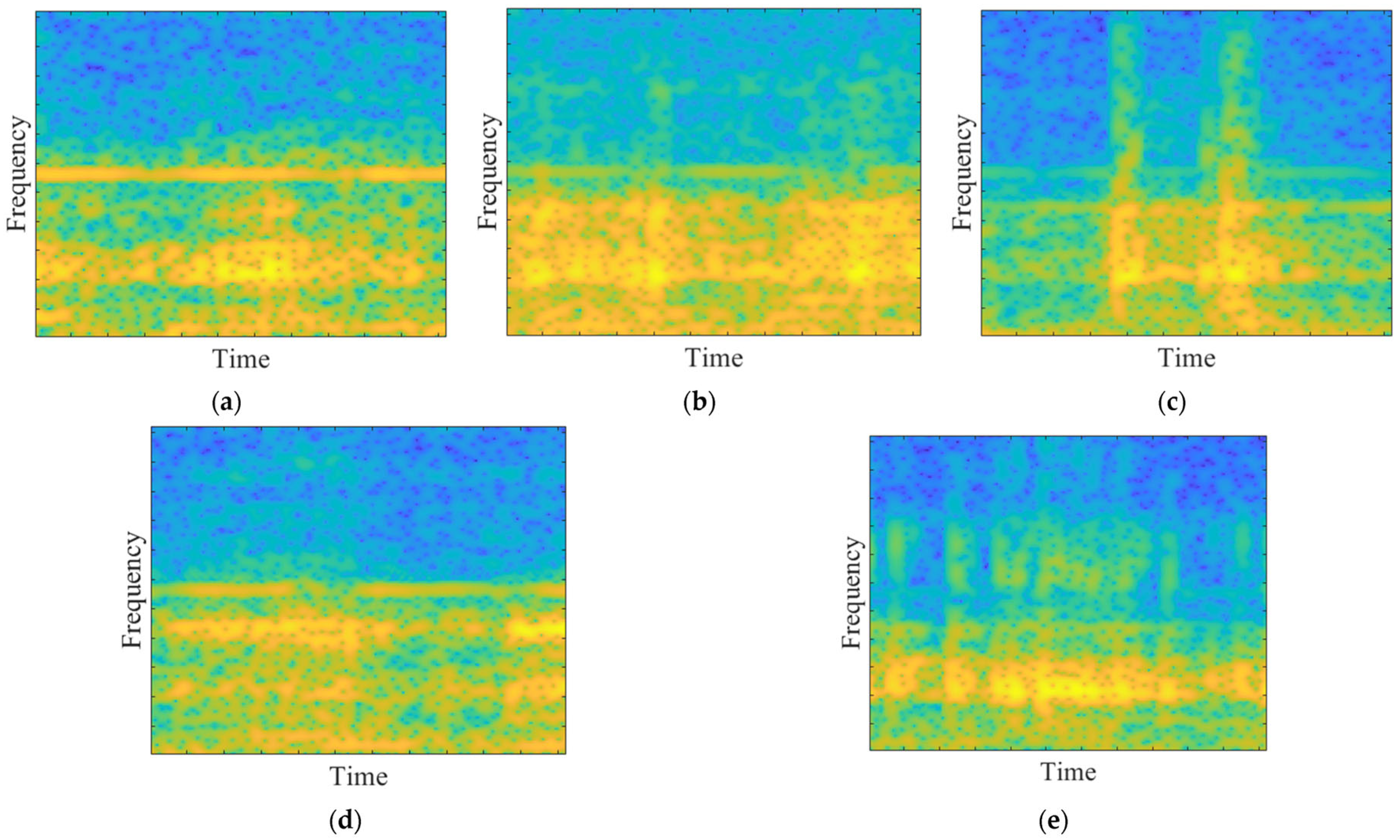
To highlight the feature information contained in vibration signals and meet the image classification needs of DANN, the vibration signals were converted into time–frequency images through STFT as the model input. The size of each sample time–frequency image is 224 × 224 × 1. For the STFT, a Hanning window is employed, with a window length of 448, an overlap of 441, and an FFT length of 448. Figure 6 shows the time–frequency images of vibration signals of different fault types under the 30 Hz operating condition.
The training parameters of IDANN were set as follows: the batch size was 32, the Adam optimizer was adopted, the learning rate was 0.01, and the number of iterations was 50. All feature data and corresponding labels of the source domain were used for IDANN adversarial training; 50% of the feature data of the target domain participated in adversarial training, and the remaining 50% was used for model testing. Training samples and test samples were derived from distinct original signal segments, with no sample overlap, to ensure the objectivity of the test results.

4.3. Comparative Analysis of Diagnostic Results

4.3.1. Comparison of Cross-Operating-Condition Diagnostic Results

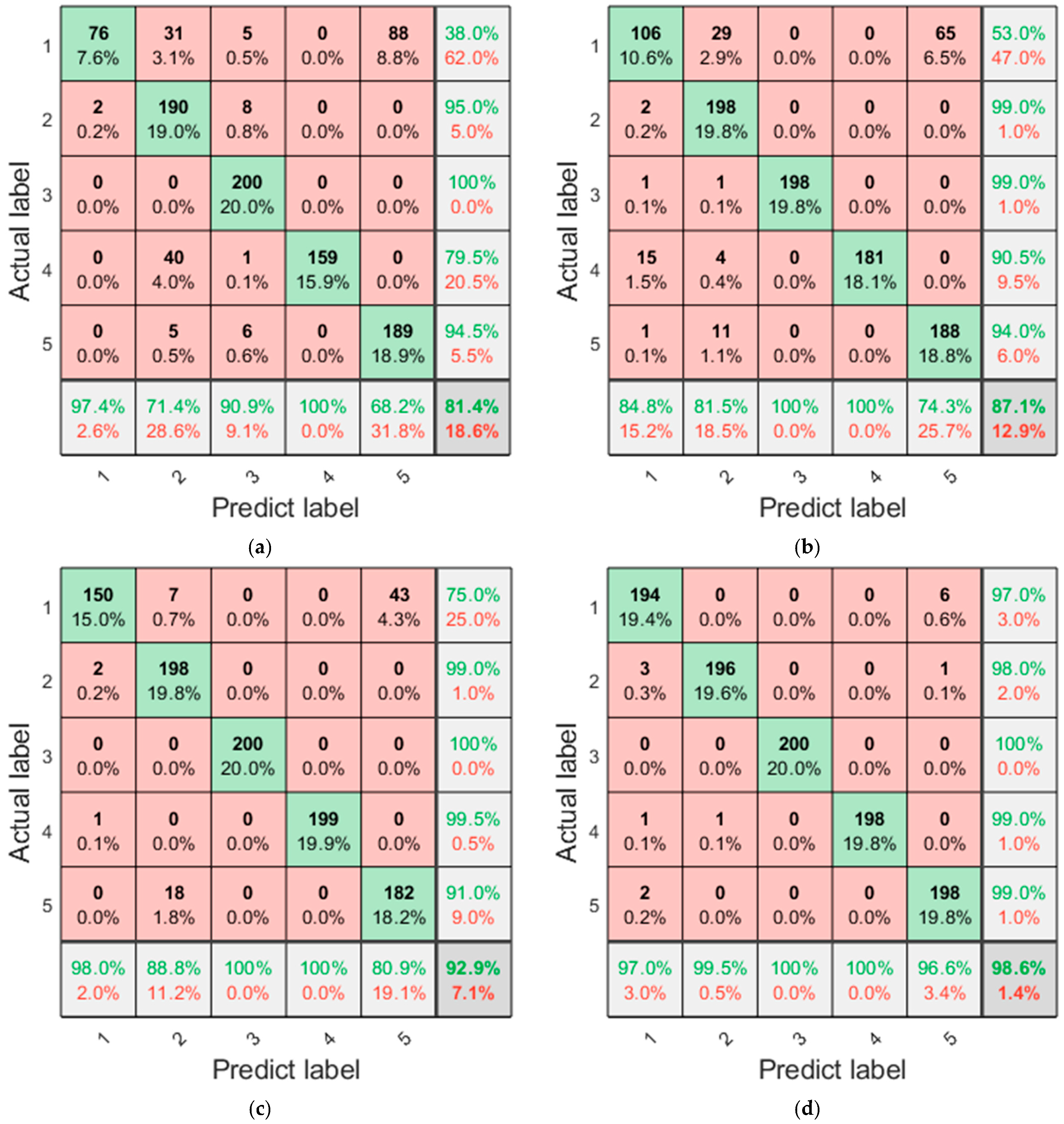
To verify the effectiveness of the proposed IDANN in cross-operating-condition transfer fault diagnosis for planetary gearboxes, comparative experiments were conducted using deep adaptation network (DAN), deep domain confusion (DDC), and DANN models [36,37]. To ensure experimental comparability, the optimizer, learning rate, number of iterations, and other parameters of all models were kept consistent. To intuitively show the fault classification performance of each method in transfer tasks, the confusion matrix was used to analyze the diagnostic results. Taking the transfer task A → E (source domain is operating condition A (30 Hz), the target domain is operating condition E (50 Hz)) as an example, the confusion matrices of diagnostic results of each method are shown in Figure 7.
It can be seen from Figure 7 that the diagnostic accuracy of the proposed IDANN model in the A → E transfer task reaches 98.6%, which is significantly better than DDC (81.4%), DAN (87.1%), and DANN (92.9%). The other three methods have more misclassifications in the classification of the first type of fault (Broken Tooth), while the misclassification ratio of the proposed IDANN is significantly lower than other methods. The results indicate that the model has strong adaptability to inter-domain distribution differences.
Although the method proposed in this paper exhibits excellent performance in the multi-fault identification of planetary gearboxes, test results show that the most prominent misdiagnosis occurred between broken tooth and gear wear, representing the highest misjudgment probability among all fault combinations. The core reason lies in the fact that both faults belong to tooth surface contact-related faults, with overlapping fault mechanisms. Additionally, the multi-component coupling effect of planetary gearboxes masked some fault features; meanwhile, the superposition of speed modulation under variable operating conditions on signal features further exacerbated the feature confusion between the two types of faults, resulting in the increased difficulty for the model to distinguish them.
To more comprehensively reflect the performance of each method in all transfer tasks, the above four transfer learning methods were each tested across all 20 transfer tasks. To eliminate the impact of experimental randomness, each task was performed through 10 independent experiments, and the average value and standard deviation (SD) were taken as the final result. The test results are listed in Table 4.
Table 4 shows that the proposed method attains the highest fault diagnosis accuracy with an average of 97.89%, which is significantly better than DDC (81.99%), DAN (90.51%), and DANN (92.22%). Across multiple independently repeated tests, the average standard deviation of the diagnostic results of the method proposed in this paper is 0.43%, which is lower than that of other methods.
The above results indicate that when planetary gearboxes face various operating condition variations, the proposed method can effectively address the feature discrepancy across the source and target domains, realizing reliable fault diagnosis.

4.3.2. Feature Visualization Analysis

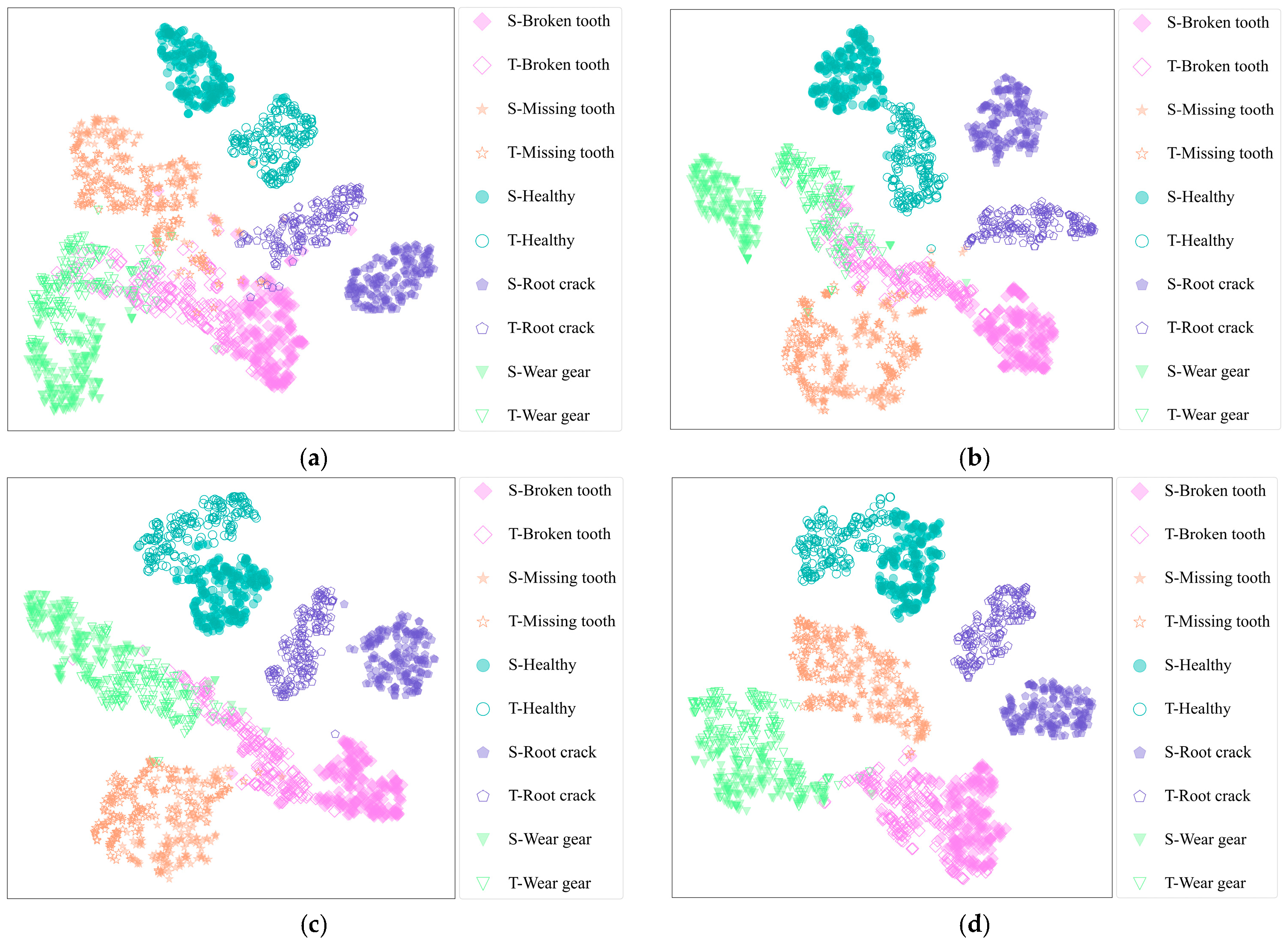
To further intuitively demonstrate the advantages of the proposed IDANN model, t-Distributed Stochastic Neighbor Embedding (t-SNE) was used to perform dimensionality reduction on the output features of the feature extractor’s last layer, reducing features of different fault types across the source and target domains to two dimensions for visualization analysis. Taking the transfer task A → E as an example, Figure 8 presents the dimensionality reduction visualization results of features extracted via different methods. The legends starting with S represent source domain data, and those starting with T represent target domain data.
It can be seen from Figure 8 that the feature alignment and distribution effect of the proposed fault diagnosis model is better than other methods, with compact feature clusters and high discriminability. The features of different fault types of the proposed method have obvious discriminability in the two-dimensional coordinates, and the same fault features are aggregated together in the two-dimensional coordinates. The feature distributions of the other several methods have a certain degree of aliasing, and the feature discriminability is not strong.

4.3.3. Ablation Experiment Analysis

To verify the effectiveness of the improvements in the feature extraction module and domain adaptation alignment module, this paper designed ablation experiments to verify the proposed fault diagnosis model with DANN as the basic model. The core improvements included: the dual-branch feature extraction module based on ResNet18 and Swin Transformer, and the joint domain adaptation alignment method based on MMD and CORAL. The experiment took the transfer task A → E as the scenario, the benchmark model was DANN (No. 1), and each ablation experiment was run independently 10 times, with the results averaged as shown in Table 5.
The ablation experiment results show that each improved module proposed in this paper has a significant effect on improving model performance. Among them, after introducing the dual-branch feature extraction module in Experiment 2, the diagnostic accuracy is increased to 94.47%, which verifies the effectiveness of this module in feature extraction. Experiments 3 and 4 introduce the MMD and CORAL single-domain alignment modules, respectively, and the accuracy is higher than that of the benchmark model (Experiment 1, 92.92%). Experiment 5 adopts the joint adaptive-domain alignment module, and the accuracy is further increased to 96.68%, which is better than the single domain alignment module. Finally, after integrating all improved modules in Experiment 7, the accuracy reaches 98.84%, achieving a significant performance leap compared with the basic model. The results indicate that each improved module had a positive gain in terms of model performance.
Meanwhile, the MMD value of each scheme reflects the mean difference between the features of the source domain and the target domain in the ablation experiments. After adopting the joint alignment strategy proposed in this paper, the MMD value decreases significantly. This result indicates that the joint alignment module can effectively reduce the domain shift difference. Moreover, this trend is consistent with the upward trend of accuracy, which verifies the effectiveness of the alignment module.

4.3.4. Analysis of the Impact of Source Domain Sample Size on Diagnostic Results

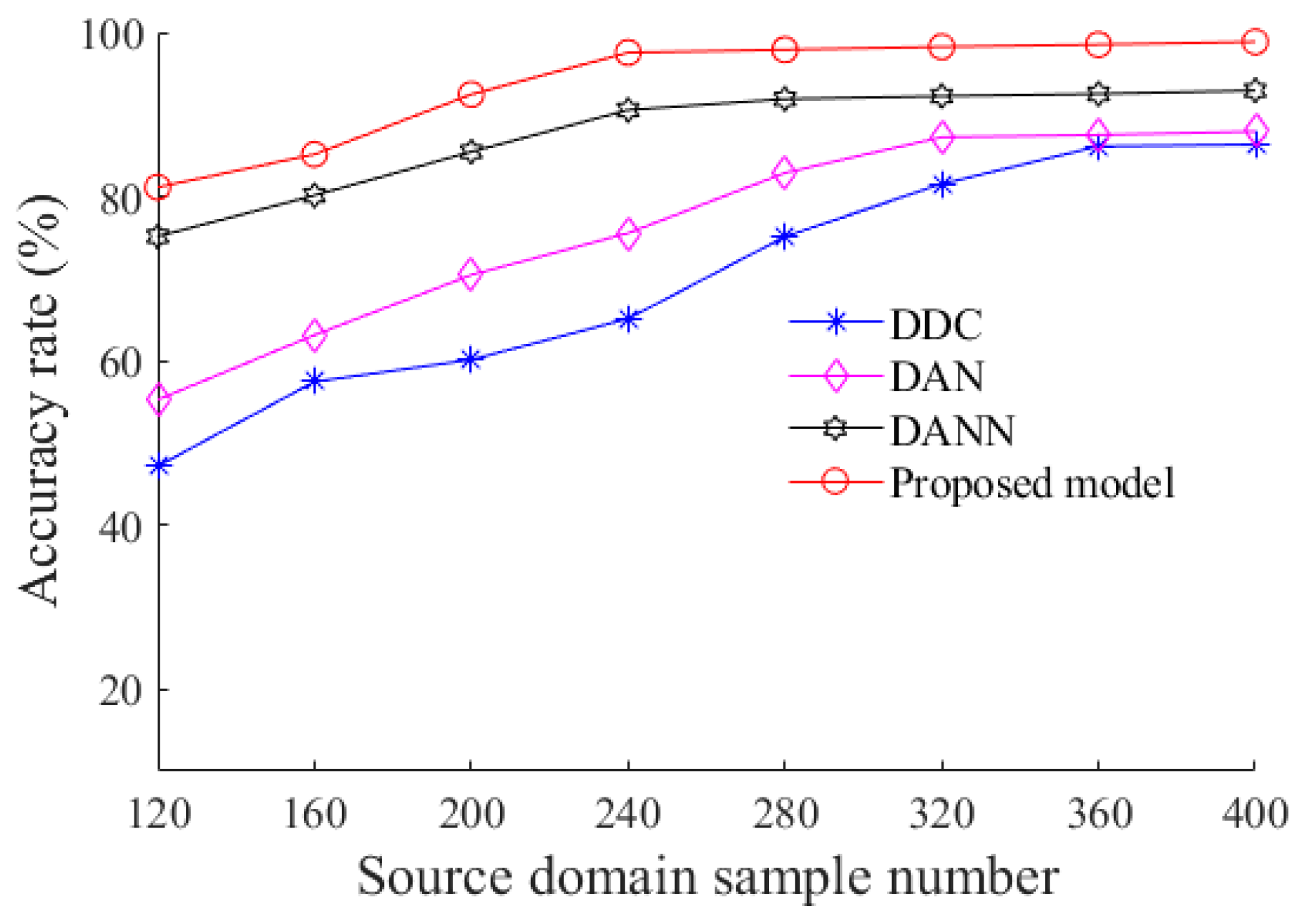
In the actual fault diagnosis of planetary gearboxes, the challenge of insufficient labeled samples is often encountered. Therefore, this part analyzes the impact of the source domain dataset size on the performance of the developed model. In the previous experiments, the number of labeled samples in the source domain was 400. To explore the performance of the model with fewer source domain samples, experiments were carried out by gradually reducing the source domain sample count. After training this model with varying source domain sample quantities, the diagnostic accuracy of each method in the A → E transfer task was measured (Figure 9).
It can be seen from Figure 9 that when source domain samples are sufficient, all types of transfer diagnostic models can achieve good transfer effects. As the number of source domain samples decreases, the diagnostic accuracy of the proposed model gradually drops but remains higher than the other comparative models. These results show that the proposed model can still fully exploit source domain feature information and achieve excellent transfer diagnostic results when trained with limited labeled source domain data, which aligns better with practical scenarios.

4.3.5. Model Complexity and Efficiency Analysis

Since the model proposed in this paper increases computational complexity compared with DANN, an analysis of the computational complexity of the proposed model was conducted herein. Taking Task A → E as an example again, the average computation time of the two models under the same environmental configuration is shown in Table 6. The environmental configuration is as follows: software platform—Python 3.9; hardware platform—an HP laptop (made in China) equipped with an AMD R9-8945HX CPU (2.5–5.4 GHz), an RTX 5060 GPU, and 16 GB of RAM; test location—Suqian, China.
As seen in Table 6, the training time of the proposed method is slightly longer than that of DANN. This is due to the increased model structure, which leads to more training parameters during the training process. However, the average inference time of the proposed model is 1.324 ms, which is within an acceptable range and can meet the requirements of industrial applications.

4.4. Validation on PHM2009 Gearbox Dataset

To verify the generalizability of the method proposed in this paper, another publicly available gearbox dataset, the PHM2009 Gearbox Dataset, was adopted for testing. This dataset contained eight fault types and was tested under multiple rotational speed conditions. Three operating conditions with rotational speeds of 30 Hz, 40 Hz, and 50 Hz were selected, denoted as Tasks 0, 1, and 2, respectively. Thus, there were six transfer tasks in total. For example, 0 → 1 represents that the source domain data is derived from the 30 Hz condition, while the target domain data comes from the 40 Hz condition. Under different fault types of each operating condition, the vibration signals were evenly divided into 100 segments. Each segment contained approximately 2666 sampling points, and 1024 consecutive sampling points were randomly selected from each segment to form a single sample to ensure no overlap exists between any samples.
The proposed method was tested, with its performance compared to DAN, DDC, and DANN. The average diagnostic accuracy and SD from 10 independent tests are listed in Table 7.
It can be seen from Table 7 that the proposed method achieves the highest classification accuracy in all transfer tasks with an average value of 97.32%, which significantly outperforms DDC (82.37%), DAN (91.99%), and DANN (92.73%). Moreover, the average standard deviation of the proposed method is 0.97%, which is superior to that of other methods.
The test results indicate that the proposed method still achieves excellent diagnostic performance on the PHM2009 Gearbox Dataset, and its stability is also stronger than that of other comparative methods.

5. Conclusions

This paper proposes an improved domain-adversarial transfer network (IDANN) for planetary gearbox fault diagnosis, aiming to address feature distribution shift in vibration data and insufficient feature extraction under cross-operating conditions. A dual-branch feature extractor composed of ResNet18 and Swin Transformer was proposed with an attention-weighted fusion mechanism to enhance feature extraction. In addition, a joint domain-adaptation alignment method based on MMD and CORAL was also proposed to realize correlation structure matching of features between the source and target domains of IDANN. As such, the experimental research draws the following conclusions:
(1)
Compared to the single ResNet18 feature extractor, the dual-branch feature extraction module based on ResNet18 and Swin Transformer can more fully mine diagnosis-related features, significantly improving the fault diagnosis accuracy of the model.
(2)
Both MMD and CORAL can improve the source-target domain alignment effect and enhance the fault diagnosis accuracy of DANN. The joint domain adaptation alignment method based on the two further strengthens this effect, continuously optimizing diagnostic performance.
(3)
The experiments verify the positive gain of each improved module proposed in this paper on the cross-operating-condition fault diagnosis performance of planetary gearboxes; moreover, the model can still maintain high diagnostic accuracy in scenarios with scarce labeled data, which is in line with practical application needs.
Although the proposed model achieved good results in planetary gearbox fault diagnosis, the large number of hyperparameters contained in the model placed high requirements on the optimization process. Future research will focus on exploring the influence of the hyperparameters and possible approaches to creating a lightweight model design.

Author Contributions

Methodology, X.W. and X.X.; software, A.W.; formal analysis, X.W.; data curation, H.S. and X.X.; writing—original draft, X.W. All authors have read and agreed to the published version of the manuscript.

Funding

This work was supported by the Jiangsu Engineering Research Center of the Key Technology for Intelligent Manufacturing Equipment and the Suqian Key Laboratory of Intelligent Manufacturing (Grant No. M202108).

Institutional Review Board Statement

Not applicable.

Informed Consent Statement

Not applicable.

Data Availability Statement

The data that support the findings of this study are openly available in the public repository: https://github.com/Liudd-BJUT/WT-planetary-gearbox-dataset (accessed on 9 November 2025).

Conflicts of Interest

Author Xiaolu Wang was employed by the company BLUE.x.y Intelligent Technology Co., Ltd. The remaining authors declare that the research was conducted in the absence of any commercial or financial relationships that could be construed as a potential conflict of interest.

References

  1. Ahmad, H.; Cheng, W.; Xing, J.; Wang, W.; Du, S.; Li, L.; Zhang, R.; Chen, X.; Lu, J. Deep learning-based fault diagnosis of planetary gearbox: A systematic review. J. Manuf. Syst. 2024, 77, 730–745. [Google Scholar] [CrossRef]
  2. Liu, J.; Zhang, Q.; Xie, F.; Wang, X.; Wu, S. Incipient fault detection of planetary gearbox under steady and varying condition. Expert Syst. Appl. 2023, 233, 121003. [Google Scholar] [CrossRef]
  3. Chen, D.; Zhao, M.; Ou, S.; Li, S.; Han, X. A self-sensing framework for weak fault detection of planetary gearbox. ISA Trans. 2025, 165, 358–371. [Google Scholar] [CrossRef] [PubMed]
  4. Xu, L.; Ding, K.; He, G.; Li, Y.; Chen, Z. Resonance modulation vibration mechanism of equally-spaced planetary gearbox with a localized fault on sun gear. Mech. Syst. Signal Process. 2022, 166, 108450. [Google Scholar] [CrossRef]
  5. Meng, F.; Xia, H.; Zhang, X.; Wang, J.; Jin, Y. Mechanism analysis for GDTE-based fault diagnosis of planetary gears. Int. J. Mech. Sci. 2023, 259, 108627. [Google Scholar] [CrossRef]
  6. Liu, D.; Cui, L.; Cheng, W. Fault diagnosis of wind turbines under nonstationary conditions based on a novel tacho-less generalized demodulation. Renew. Energy 2023, 206, 645–657. [Google Scholar] [CrossRef]
  7. Chen, R.; Huang, X.; Yang, L.; Xu, X.; Zhang, X.; Zhang, Y. Intelligent fault diagnosis method of planetary gearboxes based on convolution neural network and discrete wavelet transform. Comput. Ind. 2019, 106, 48–59. [Google Scholar] [CrossRef]
  8. Hwang, T.; Ha, J.M.; Youn, B.D. Robust deep learning-based fault detection of planetary gearbox using enhanced health data map under domain shift problem. J. Comput. Des. Eng. 2023, 10, 1677–1693. [Google Scholar] [CrossRef]
  9. Xu, C.; Liu, D.; Cen, J.; Xiong, J.; Wang, N.; Liu, X. Fault diagnosis method of wind turbine planetary gearbox based on improved CNN. Sci. Rep. 2025, 15, 32481. [Google Scholar] [CrossRef]
  10. Wang, Z.; Wang, J.; Wang, Y. An intelligent diagnosis scheme based on generative adversarial learning deep neural networks and its application to planetary gearbox fault pattern recognition. Neurocomputing 2018, 310, 213–222. [Google Scholar] [CrossRef]
  11. Chen, Y.; Liu, X.; Rao, M.; Qin, Y.; Wang, Z.; Ji, Y. Explicit speed-integrated LSTM network for non-stationary gearbox vibration representation and fault detection under varying speed conditions. Reliab. Eng. Syst. Saf. 2025, 254, 110596. [Google Scholar] [CrossRef]
  12. Wu, R.; Liu, C.; Han, T.; Yao, J.; Jiang, D. A planetary gearbox fault diagnosis method based on time-series imaging feature fusion and a transformer model. Meas. Sci. Technol. 2022, 34, 024006. [Google Scholar] [CrossRef]
  13. Khan, A.; Rauf, Z.; Sohail, A.; Khan, A.R.; Asif, H.; Asif, A.; Farooq, U. A survey of the vision transformers and their CNN-transformer based variants. Artif. Intell. Rev. 2023, 56, 2917–2970. [Google Scholar] [CrossRef]
  14. Chen, Q.; Zhang, F.; Wang, Y.; Yu, Q.; Lang, G.; Zeng, L. Bearing fault diagnosis based on efficient cross space multiscale CNN transformer parallelism. Sci. Rep. 2025, 15, 12344. [Google Scholar] [CrossRef] [PubMed]
  15. Chen, L.; Feng, G.; Zhen, D.; Jing, H.; Liang, X.; Gu, F. Cross-Condition Fault Diagnosis of Planetary Gearboxes Driven by Data-Model Fusion Based on Improved Domain-Adversarial Transfer Learning. Shock. Vib. 2025, 2025, 9982177. [Google Scholar] [CrossRef]
  16. Song, M.M.; Xiong, Z.C.; Zhong, J.H.; Xiao, S.G.; Tang, Y.H. Research on fault diagnosis method of planetary gearbox based on dynamic simulation and deep transfer learning. Sci. Rep. 2022, 12, 17023. [Google Scholar] [CrossRef]
  17. Li, H.; Lv, Y.; Yuan, R.; Dang, Z.; Cai, Z.; An, B. Fault diagnosis of planetary gears based on intrinsic feature extraction and deep transfer learning. Meas. Sci. Technol. 2022, 34, 014009. [Google Scholar] [CrossRef]
  18. Qin, Y.; Yao, Q.; Wang, Y.; Mao, Y. Parameter sharing adversarial domain adaptation networks for fault transfer diagnosis of planetary gearboxes. Mech. Syst. Signal Process. 2021, 160, 107936. [Google Scholar] [CrossRef]
  19. Ha, J.M.; Youn, B.D. A health data map-based ensemble of deep domain adaptation under inhomogeneous operating conditions for fault diagnosis of a planetary gearbox. IEEE Access 2021, 9, 79118–79127. [Google Scholar] [CrossRef]
  20. Han, S.; Feng, Z. Deep subclass alignment transfer network based on time–frequency features for intelligent fault diagnosis of planetary gearboxes under time-varying speeds. Meas. Sci. Technol. 2022, 33, 105010. [Google Scholar] [CrossRef]
  21. Jiang, F.; Lin, W.; Wu, Z.; Zhang, S.; Chen, Z.; Li, W. Fault diagnosis of gearbox driven by vibration response mechanism and enhanced unsupervised domain adaptation. Adv. Eng. Inform. 2024, 61, 102460. [Google Scholar] [CrossRef]
  22. Han, S.; Feng, Z.; Zhang, Y.; Du, M.; Yang, Y. Intelligent Fault Diagnosis of Planetary Gearbox Across Conditions Based on Subdomain Distribution Adversarial Adaptation. Sensors 2024, 24, 7017. [Google Scholar] [CrossRef]
  23. Zhu, W.; Shi, B.; Feng, Z.; Tang, J. An unsupervised domain adaptation method for intelligent bearing fault diagnosis based on signal reconstruction by cycle-consistent adversarial learning. IEEE Sens. J. 2023, 23, 18477–18485. [Google Scholar] [CrossRef]
  24. Sicilia, A.; Zhao, X.; Hwang, S.J. Domain adversarial neural networks for domain generalization: When it works and how to improve. Mach. Learn. 2023, 112, 2685–2721. [Google Scholar] [CrossRef]
  25. Li, J.; Zhou, G.; Zhang, C.; Wei, Z.; Lu, F. An online milling deformation prediction method for thin-walled features with domain adversarial neural networks under small samples. Comput. Ind. 2025, 172, 104349. [Google Scholar] [CrossRef]
  26. Lin, Q.; Zuo, R. Domain adversarial neural network for mapping mineral prospectivity. Math. Geosci. 2025, 57, 471–498. [Google Scholar] [CrossRef]
  27. Sun, Q.; Peng, F.; Li, H.; Huang, J.; Sun, G. Cross-domain health status assessment of three-phase inverters using improved DANN. J. Power Electron. 2023, 23, 1411–1421. [Google Scholar] [CrossRef]
  28. Fang, X.; Gong, G.; Li, G.; Chun, L.; Peng, P.; Li, W. A general multi-source ensemble transfer learning framework integrate of LSTM-DANN and similarity metric for building energy prediction. Energy Build. 2021, 252, 111435. [Google Scholar] [CrossRef]
  29. Niu, J.; Zhu, Y. Domain-Adaptive Transformer Partial Discharge Recognition Method Combining AlexNet-KAN with DANN. Sensors 2025, 25, 1672. [Google Scholar] [CrossRef]
  30. Yao, F.; Wang, Y. Domain-specific sentiment analysis for tweets during hurricanes (DSSA-H): A domain-adversarial neural-network-based approach. Comput. Environ. Urban Syst. 2020, 83, 101522. [Google Scholar] [CrossRef]
  31. Chen, J.; Wu, X.; Duan, L.; Gao, S. Domain Adversarial Reinforcement Learning for Partial Domain Adaptation. IEEE Trans. Neural Netw. Learn. Syst. 2022, 33, 539–553. [Google Scholar] [CrossRef]
  32. Panda, M.K.; Sharma, A.; Bajpai, V.; Subudhi, B.N.; Thangaraj, V.; Jakhetiya, V. Encoder and decoder network with ResNet-50 and global average feature pooling for local change detection. Comput. Vis. Image Underst. 2022, 222, 103501. [Google Scholar] [CrossRef]
  33. Kim, J.H.; Kim, N.; Won, C.S. Global–local feature learning for fine-grained food classification based on Swin Transformer. Eng. Appl. Artif. Intell. 2024, 133, 108248. [Google Scholar] [CrossRef]
  34. Liu, H.; Li, L.; Ma, J. Rolling bearing fault diagnosis based on STFT-deep learning and sound signals. Shock. Vib. 2016, 2016, 6127479. [Google Scholar] [CrossRef]
  35. Liu, D.; Cui, L.; Cheng, W. A review on deep learning in planetary gearbox health state recognition: Methods, applications, and dataset publication. Meas. Sci. Technol. 2023, 35, 012002. [Google Scholar] [CrossRef]
  36. Xu, H.; Liu, J.; Peng, X.; Wang, J.; He, C. Deep dynamic adaptation network: A deep transfer learning framework for rolling bearing fault diagnosis under variable working conditions. J. Braz. Soc. Mech. Sci. Eng. 2023, 45, 41. [Google Scholar] [CrossRef]
  37. Zhao, B.; Cheng, C.; Zhang, G.; Lin, M.; Peng, Z.; Meng, G. An instance and feature-based hybrid transfer model for fault diagnosis of rotating machinery with different speeds. IEEE Trans. Instrum. Meas. 2022, 71, 1–12. [Google Scholar] [CrossRef]
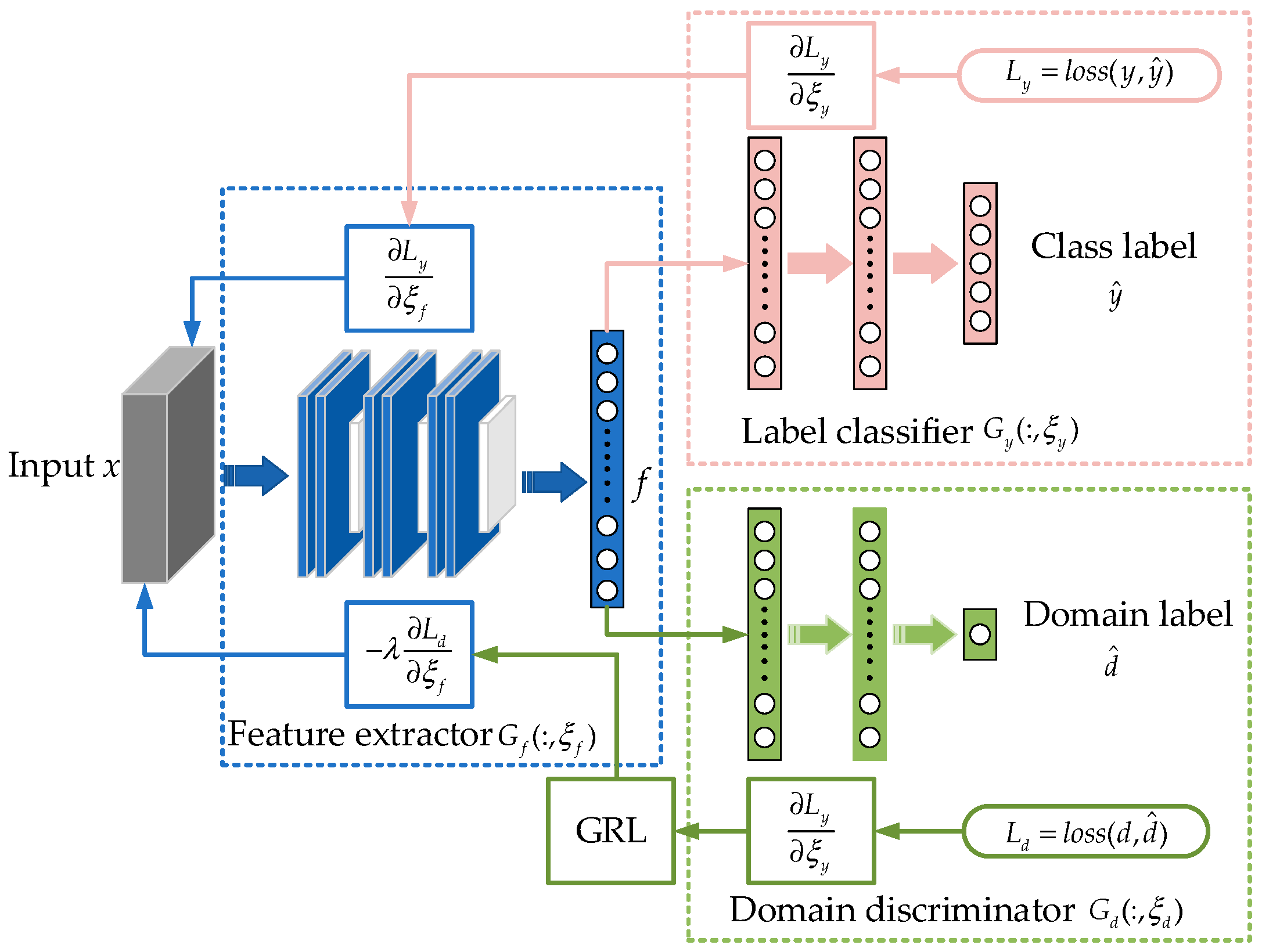
Figure 1. Structure diagram of domain-adversarial neural network.
Information 16 01112 g001
Figure 2. Structure of the dual-branch feature extractor.
Information 16 01112 g002
Figure 3. Framework of the IDANN model.
Information 16 01112 g003
Figure 4. Flowchart of the fault diagnosis method.
Information 16 01112 g004
Figure 5. Time- and frequency-domain diagrams of vibration signals of different fault modes under 30 Hz.
Information 16 01112 g005
Figure 6. The input time–frequency feature images. (a) Healthy state; (b) broken tooth; (c) missing tooth; (d) gear wear; (e) root crack.
Information 16 01112 g006
Figure 7. Confusion matrices of fault diagnosis results of different transfer diagnostic models (Task A → E). (a) DDC; (b) DAN; (c) DANN; (d) proposed method.
Information 16 01112 g007
Figure 8. The t-SNE visualization diagrams of fault features in comparative experiments of transfer task A → E. (a) DDC; (b) DAN; (c) DANN; (d) proposed method.
Information 16 01112 g008
Figure 9. Changes in transfer diagnostic accuracy under different numbers of source domain samples (transfer task A → E).
Information 16 01112 g009
Table 1. Main parameters of the ResNet feature extraction model.
BlockParametersOutput Dimensions
Conv 1Convolution kernel: 7 × 7
Output channels: 64
112 × 112 × 64
Res-12 Convolution kernel: 3 × 3
Output channels: 64
112 × 112 × 64
Res-22 Convolution kernel: 3 × 3
Output channels: 128
56 × 56 × 128
Res-32 Convolution kernel: 3 × 3
Output channels: 256
28 × 28 × 256
Res-42 Convolution kernel: 3 × 3
Output channels: 512
14 × 14 × 512
GAP 512
Table 2. Main parameters of the Swin Transformer feature extraction model.
BlockParametersOutput Dimensions
Patch partitionBlock size: 4 × 4
Output channels: 96
3136 × 96
Linear Embedding 3136 × 96
Swin Transformer block 1Window size: 7 × 7
Output channels: 96
3136 × 96
Patch Merging 1Output channels: 192784 × 192
Swin Transformer block 2Window size: 7 × 7
Output channels: 192
784 × 192
Patch Merging 2Output channels: 384196 × 384
Swin Transformer block 2Window size: 7 × 7
Output channels: 384
196 × 384
Patch Merging 2Output channels: 76849 × 768
GAP 768
Table 3. Setting of the sample dataset.
Fault TypeOperating
Conditions
Number of Samples for Each
Operating Conditions
Fault Type Label
Broken toothA, B, C, D, E4001
Missing tooth4002
Healthy4003
Root crack4004
Wear gear4005
Table 4. Fault diagnosis accuracy of different transfer diagnostic methods in various tasks (average value ± SD, %).
Transfer TasksDDCDANDANNProposed Method
A → B84.93 ± 2.0893.81 ± 2.1291.85 ± 1.1597.11 ± 0.56
A → C81.86 ± 2.6591.54 ± 1.9594.74 ± 0.87 96.92 ± 0.63
A → D79.86 ± 3.1292.60 ± 2.2189.48 ± 1.3698.21 ± 0.48
A → E82.41 ± 3.3589.69 ± 2.1592.92 ± 1.0998.84 ± 0.43
B → A86.33 ± 2.2787.93 ± 2.0892.72 ± 1.2297.67 ± 0.52
B → C85.64 ± 1.9588.21 ± 1.9891.28 ± 0.9395.33 ± 0.67
B → D82.05 ± 2.8189.74 ± 2.0389.74 ± 1.2597.50 ± 0.59
B → E82.85 ± 3.0592.82 ± 2.2493.28 ± 1.0597.64 ± 0.46
C → A82.46 ± 2.4492.62 ± 2.0194.45 ± 0.8297.92 ± 0.51
C → B78.29 ± 2.7687.42 ± 1.9291.96 ± 1.4598.56 ± 0.35
C → D80.67 ± 3.2889.79 ± 2.1889.64 ± 1.6598.93 ± 0.28
C → E81.59 ± 2.1590.69 ± 2.0590.87 ± 1.0298.08 ± 0.31
D → A76.94 ± 2.5989.92 ± 1.8590.08 ± 1.4197.33 ± 0.45
D → B78.89 ± 3.4291.60 ± 2.2790.97 ± 1.2998.71 ± 0.21
D → C84.81 ± 2.3391.40 ± 2.0992.08 ± 1.1997.32 ± 0.42
D → E76.32 ± 2.9889.04 ± 1.9792.69 ± 1.3799.07 ± 0.26
E → A86.22 ± 1.8790.02 ± 2.1492.21 ± 1.2498.94 ± 0.33
E → B84.03 ± 3.1987.11 ± 1.8895.13 ± 0.9798.45 ± 0.34
E → C81.37 ± 2.6193.89 ± 2.0492.63 ± 1.4396.94 ± 0.62
E → D82.36 ± 2.4990.43 ± 2.2295.61 ± 0.7198.38 ± 0.27
Average value81.99 ± 2.6790.71 ± 2.1292.22 ± 1.2397.89 ± 0.43
Table 5. Ablation experiment results.
No.ResNET18Swin
Transformer
MMDCORALAverage Accuracy (%)MMD Value
192.920.487
294.470.451
395.740.107
494.830.124
596.680.018
6 98.120.020
798.840.013
Table 6. The average training time and inference time.
MethodTraining Time (min)Inference Time (ms)
DANN3.5741.045
Proposed method5.8151.324
Table 7. Fault diagnosis accuracy of different transfer diagnostic methods in various tasks of PHM2009 (average value ± SD, %).
Transfer TasksDDCDANDANNProposed Method
0 → 186.73 ± 2.7591.71 ± 2.0593.04 ± 1.8596.17 ± 1.03
0 → 288.21 ± 2.3892.50 ± 2.3493.57 ± 1.7395.50 ± 0.95
1 → 078.24 ± 3.2188.38 ± 2.4589.47 ± 2.0597.24 ± 1.08
1 → 281.23 ± 2.9294.12 ± 1.9893.73 ± 2.1298.78 ± 0.87
2 → 079.26 ± 3.6592.49 ± 2.5892.88 ± 1.9197.54 ± 1.02
2 → 180.54 ± 3.0992.74 ± 2.2193.67 ± 2.0198.68 ± 0.84
Average value82.37 ± 3.0091.99 ± 2.2792.73 ± 1.9597.32 ± 0.97
Disclaimer/Publisher’s Note: The statements, opinions and data contained in all publications are solely those of the individual author(s) and contributor(s) and not of MDPI and/or the editor(s). MDPI and/or the editor(s) disclaim responsibility for any injury to people or property resulting from any ideas, methods, instructions or products referred to in the content.