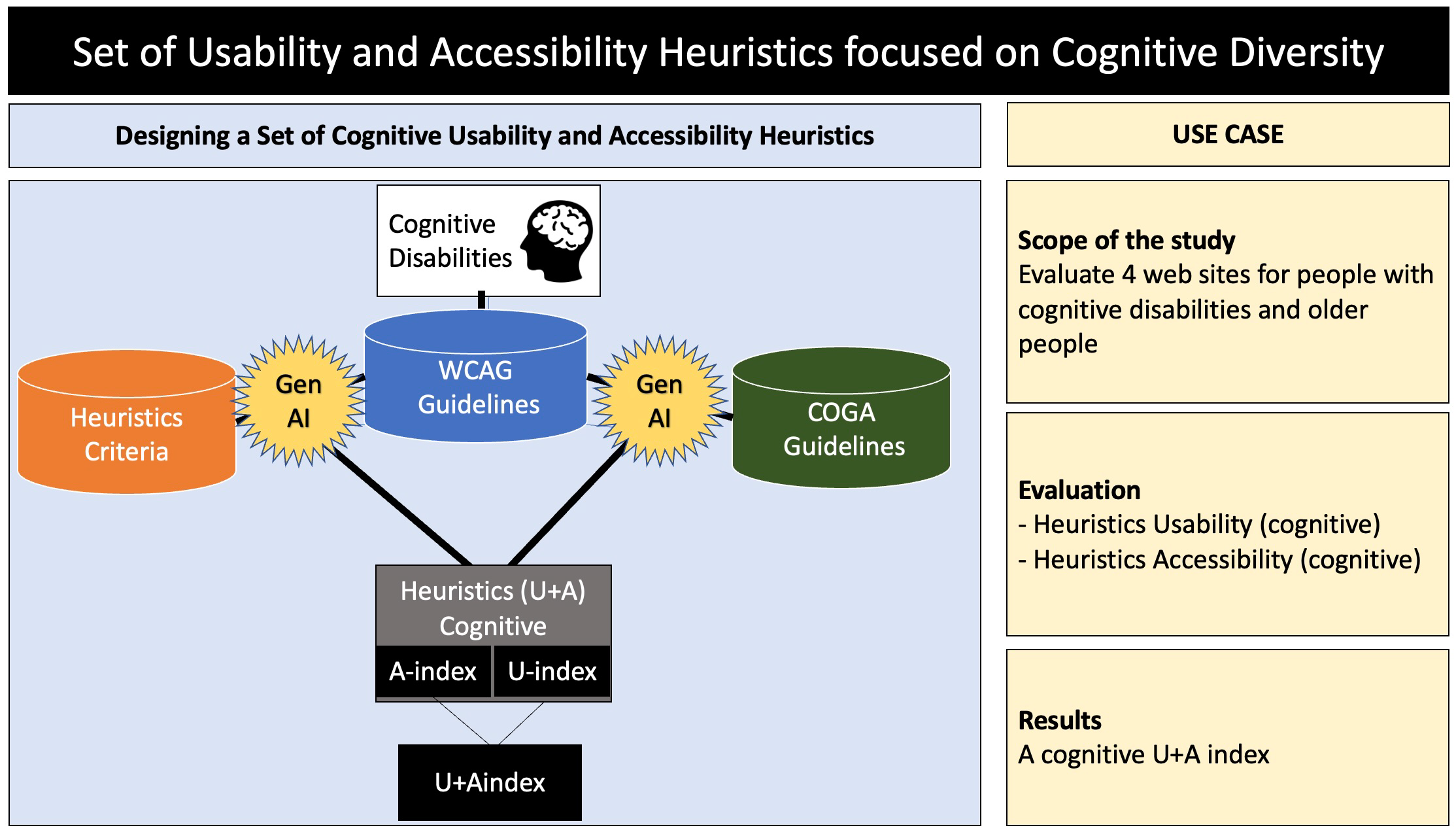
Towards Designing a Set of Usability and Accessibility Heuristics Focused on Cognitive Diversity: An Exploratory Case Study with Generative Artificial Intelligence



Abstract
1. Introduction
- A unique list of heuristic criteria focused on the evaluation of systems for people with cognitive learning disabilities and additionally for older people.
- An objective numerical index of cognitive usability and accessibility evaluation.
- A case study that evaluates the cognitive usability and accessibility heuristics.
- A ranking of usable and accessible systems for people with cognitive disabilities.
2. Background and Related Work
2.1. Usability and Accessibility, Context and Evaluation
2.2. Usability and Accessibility Metrics and Generative AI
3. Designing a Set of Cognitive Usability and Accessibility Heuristics
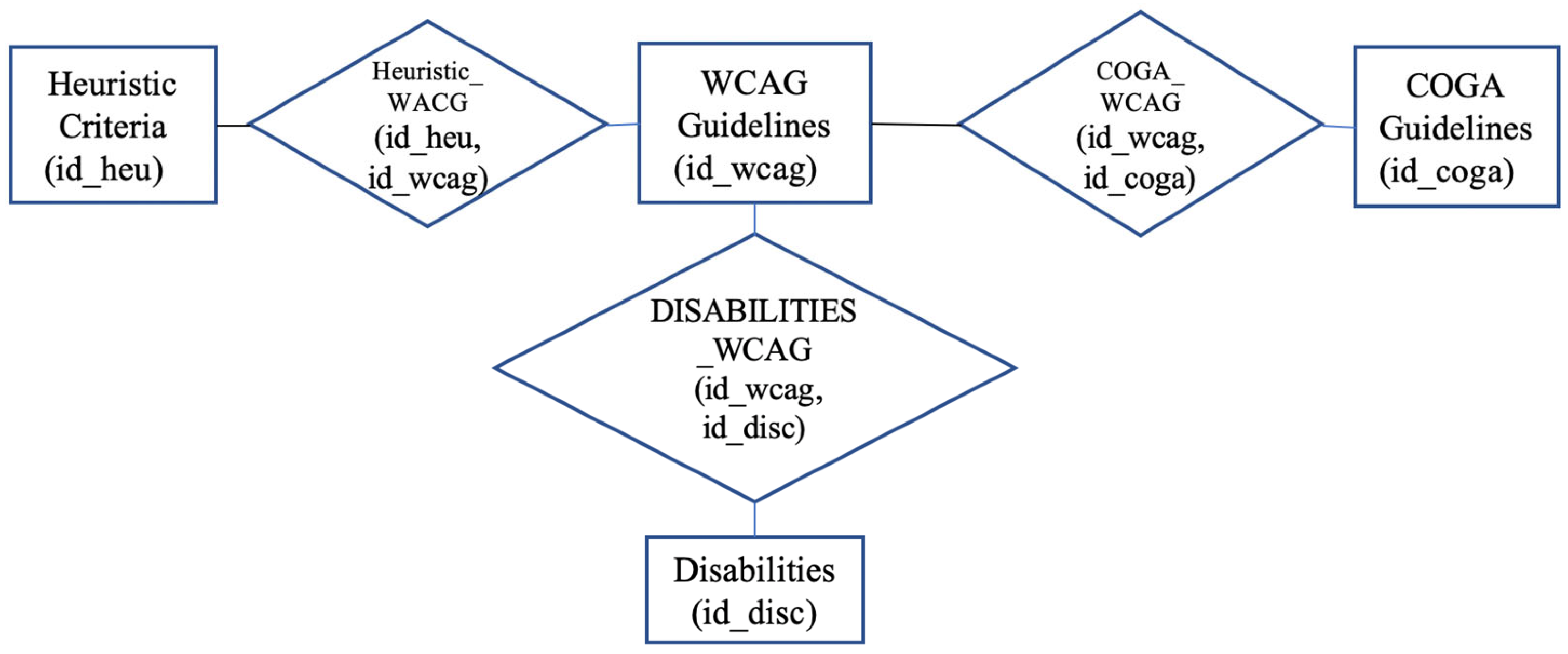
3.1. Step 1. Exploring the Data Source
- Table: ‘WCAG’: WCAG 2.2 [41] was chosen as the latest W3C recommendation at the time of writing this paper.
- Table: ‘COGA Guidelines’: ‘Making Content Usable for People with Cognitive and Learning Disabilities’ [40], focusing on assessments related to cognitive impairment.
- Table: ‘Disabilities’: The list of disabilities contained in the WCAG 2.2 document “understanding” [52], which shows how WCAG 2.2 impacts certain users with disabilities.
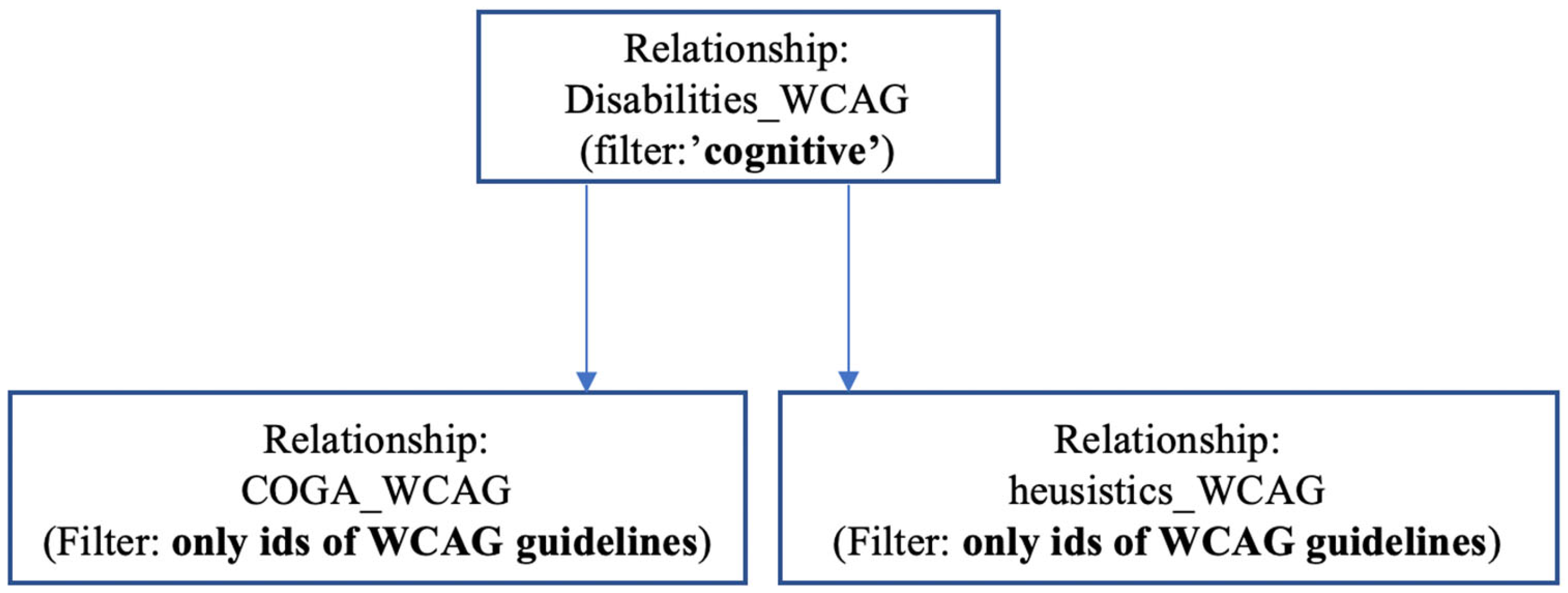
3.2. Step 2. Obtaining Criteria According to the Data Relationship with Generative AI
- Disabilities and WCAG (disabilities–WCAG relationship).
- Heuristic criteria and WCAG (heuristic–WCAG relationship).
- COGA guidelines and WCAG (COGA–WCAG relationship).
- First, we introduced the table “heuristic criteria” into a generative AI tool.
- After, we wrote this prompt in ChatGPT:‘Relate each of the rows in the table (of “Heuristics criteria”) to the WCAG 2.2 guidelines. Indicates whether it relates to one or more criteria of the WCAG 2.2 guidelines (or maybe none). Displays the result in a table’.
- Validation: To validate the data generated by GenAI, we randomly observed whether the heuristic criterion matched the WCAG criterion to which it was related. Although this is not a thorough validation, it was performed consciously and was an important point in the experimentation. We wanted to test whether the results obtained were satisfactory without manual intervention in this step.
- First, we introduced the table “COGA guidelines” into ChatGPT.
- Afterwards, we wrote this prompt:According to the COGA criteria table that has been entered into the system, associate each of the specific recommendations for improving cognitive accessibility with the relevant WCAG 2.2 guidelines. It links each row with a WCAG criterion. Displays the result in a table.
- Validation: Same as above.
3.3. Step 3. Adapting Heuristics for Disability
3.4. Step 4. Conducting the Assessment
- ‘Pass’, indicating that it is not a problem in the assessed system.
- ‘Fail’ indicates that the assessed criterion is not met in the assessed system.
- ‘NA’ indicates “not applicable” and is selected by the assessor when the criterion cannot be assessed in the system.
- ‘Pass’ is a 1 when the criterion is met in the system.
- ‘Fail’ is a 0 when the criterion is not fulfilled in the system.
- ‘NA’ is an empty field and will not be considered in the computation of the “U + A-index”.
3.5. Step 5. Quantitative and Qualitative Results
4. Use Case
4.1. Scope of This Study
- -
- Fundacio Viver Bell-lloc: https://www.vivelloc.cat/ca/ (accessed on 1 October 2024).
- -
- Fundacio auria: https://www.auria.org/ (accessed on 1 October 2024).
- -
- Imserso: https://imserso.es/web/imserso (accessed on 1 October 2024).
- -
- Seniortic: https://www.seniortic.org/ (accessed on 1 October 2024).
4.2. Experimentation
4.2.1. Selection of Usability and Accessibility Guidelines
4.2.2. Implementation of the Assessment
4.2.3. Results
4.2.4. Specific Recommendations for Improving the Sites Analyzed
5. Discussion
Limitations
6. Conclusions
Author Contributions
Funding
Data Availability Statement
Acknowledgments
Conflicts of Interest
References
- Digital 2024: Global Overview Report. 2024. Available online: https://datareportal.com/reports/digital-2024-global-overview-report (accessed on 25 October 2024).
- World Report on Disability 2011. Available online: https://www.who.int/teams/noncommunicable-diseases/sensory-functions-disability-and-rehabilitation/world-report-on-disability (accessed on 25 October 2024).
- World Health Organization: Summary World Report on Disability. 2011. Available online: https://cutt.ly/ZrDBPje (accessed on 25 October 2024).
- Eser, A. Intellectual Disability Statistics: Key Facts on Global Impact Revealed. World Metrics. 23 July 2024. Available online: https://worldmetrics.org/intellectual-disability-statistics/ (accessed on 25 October 2024).
- Universal Declaration of Human Rights. 2022. Available online: https://www.un.org/es/about-us/universal-declaration-of-human-rights (accessed on 25 October 2024).
- Novak, M.E.; Paciello, M.G. La Conquista de la Accesibilidad de X-Windows: Desarrollo para Personas con Discapacidades; The Paciello Group: Clearwater, FL, USA, 2002. [Google Scholar]
- Hudson, R.; Weakley, R.; Firminger, P. Una Frontera de Accesibilidad: Discapacidades Cognitivas y Dificultades de Aprendizaje. Webusability—Servicios de Accesibilidad y Usabilidad. 2005. Available online: https://usability.com.au/2004/12/an-accessibility-frontier-cognitive-disabilities-and-learning-difficulties-2004/ (accessed on 25 October 2024).
- ISO/CD 9241-11; Ergonomics of Human-System Interaction–Part 11: Guidance on Usability. ISO: Geneva, Switzerland, 1998. Available online: http://www.iso.org/iso/catalogue_detail.htm?csnumber=63500 (accessed on 25 October 2024).
- Introduction to Web Accessibility. 2018. Available online: https://www.w3.org/standards/webdesign/accessibility (accessed on 25 October 2024).
- Evaluating Web Accessibility Overview. 2020. Available online: https://www.w3.org/WAI/test-evaluate/ (accessed on 25 October 2024).
- Quintal, C.; Macías, J.A. Measuring and improving the quality of development processes based on usability and accessibility. Univ. Access Inf. Soc. 2021, 20, 203–221. [Google Scholar] [CrossRef]
- González, M.P.; Pascual, A.; Lorés, J. Evaluación heurística. In Introducción a la Interacción Persona-Ordenador; AIPO: Asociación Interacción Persona-Ordenador: Zaragoza, Spain, 2001; Available online: https://aipo.es/wp-content/uploads/2022/02/LibroAIPO.pdf (accessed on 25 October 2024).
- WCAG 2 Overview. 2024. Available online: https://www.w3.org/WAI/standards-guidelines/wcag/ (accessed on 25 October 2024).
- Hollingsed, T.; Novick, D.G. Usability inspection methods after 15 years of research and practice. In Proceedings of the 25th Annual ACM International Conference on Design of Communication (SIGDOC ‘07), El Paso, TX, USA, 22–24 October 2007; Association for Computing Machinery: New York, NY, USA, 2007; pp. 249–255. [Google Scholar] [CrossRef]
- Or, C.K.; Chan, A.H.S. Inspection methods for usability evaluation. In User Experience Methods and Tools in Human-Computer Interaction, 1st ed.; CRC Press: Boca Raton, FL, USA, 2024; p. 23. [Google Scholar] [CrossRef]
- Sauer, J.; Sonderegger, A.; Schmutz, S. Usability, user experience and accessibility: Towards an integrative model. Ergonomics 2020, 63, 1207–1220. [Google Scholar] [CrossRef] [PubMed]
- Cockton, G. Usability Evaluation. Interaction Design Foundation—IxDF. 1 January 2014. Available online: https://www.interaction-design.org/literature/book/the-encyclopedia-of-human-computer-interaction-2nd-ed/usability-evaluation (accessed on 25 October 2024).
- La Interacción Persona Ordenador. Asociación en Interacción Persona Ordenador. 2001. ISBN: 84-607-2255-4. Available online: https://aipo.es/educacion/material-editado-por-aipo/?id_rec=2 (accessed on 25 October 2024).
- Polson, P.; Rieman, J.; Wharton, C.; Olson, J.; Kitajima, M. Usability inspection methods: Rationale and examples. In Proceedings of the 8th Human Interface Symposium (HIS92), Kawasaki, Japan, 10–12 September 1992; pp. 377–384. [Google Scholar]
- Jeffries, R.; Miller, J.R.; Wharton, C.; Uyeda, K. User interface evaluation in the real world: A comparison of four techniques. In Proceedings of the SIGCHI Conference on Human Factors in Computing Systems, New Orleans, LA, USA, 27 April–2 May 1991; ACM: New York, NY, USA, 1991; pp. 119–124. [Google Scholar]
- Nielsen, J. Finding usability problems through heuristic evaluation. In Proceedings of the SIGCHI Conference on Human Factors in Computing Systems, Monterey, CA, USA, 3–7 May 1992; ACM: New York, NY, USA, 1992; pp. 373–380. [Google Scholar]
- Jimenez, C.; Lozada, P.; Rosas, P. Usability heuristics: A systematic review. In Proceedings of the 2016 IEEE 11th Colombian Computing Conference (CCC), Popayan, Colombia, 27–30 September 2016; pp. 1–8. [Google Scholar] [CrossRef]
- Nielsen, J. 10 Usability Heuristics for User Interface Design. Available online: https://www.nngroup.com/articles/ten-usability-heuristics/ (accessed on 25 October 2024).
- Dourado, D.; Antonio, M.; Canedo, E.D. Usability Heuristics for Mobile Applications—A Systematic Review. In Proceedings of the 20th International Conference on Enterprise Information Systems—Volume 2, ICEIS, Funchal, Portugal, 21–24 March 2018; pp. 483–494. [Google Scholar] [CrossRef]
- Kuhail, M.A.; Farooq, S.; Almutairi, S. Recent Developments in Chatbot Usability and Design Methodologies. In Trends, Applications, and Challenges of Chatbot Technology; Kuhail, M., Shawar, B.A., Hammad, R., Eds.; IGI Global: Hershey, PA, USA, 2023; pp. 1–23. [Google Scholar] [CrossRef]
- Vieira, E.; Silveira, A.; Martins, R. Heuristic Evaluation on Usability of Educational Games: A Systematic Review. Inform. Educ. 2019, 18, 427–442. [Google Scholar] [CrossRef]
- Omar, K.; Fakhouri, H.; Zraqou, J.; Marx Gómez, J. Usability Heuristics for Metaverse. Computers 2024, 13, 222. [Google Scholar] [CrossRef]
- Dekelver, J.; Kultsova, M.; Shabalina, O.; Borblik, J.; Pidoprigora, A.; Romanenko, R. Design of mobile applications for people with intellectual disabilities. Commun. Comput. Inf. Sci. 2015, 535, 823–836. [Google Scholar]
- Abou-Zahra, S.; Brewer, J.; Cooper, M. Web Standards to Enable an Accessible and Inclusive Internet of Things (IoT). In Proceedings of the 14th International Web for All Conference (W4A ‘17), Perth, Australia, 2–4 April 2017; Article 9. Association for Computing Machinery: New York, NY, USA, 2017; pp. 1–4. [Google Scholar] [CrossRef]
- González, M.; Masip, L.; Granollers, T.; Oliva, M. Análisis Cuantitativo en un Experimento de Evaluación Heurística. In Proceedings of the IX Congreso Internacional Interacción, Albacete, Spain, 9–11 June 2008. [Google Scholar]
- Bonastre, L.; Granollers, T. A set of heuristics for user experience evaluation in Ecommerce websites. In Proceedings of the Seventh International Conference on Advances in Computer-Human Interactions, ACHI 2014, Virtual Event, 24–29 July 2021; pp. 27–34, ISBN 978-1-61208-325-4. [Google Scholar]
- Granollers, T.; Albets, M. Heuristic Evaluations New Proposal. 2021. Available online: https://web.archive.org/web/20240713190018/ (accessed on 25 October 2024).
- Tognazzini, B. First Principles, HCI Design, Human Computer Interaction (HCI), Principles of HCI Design, Usability Testing. 2014. Available online: http://www.asktog.com/basics/firstPrinciples.html (accessed on 25 October 2024).
- Pascual-Almenara, A.; Saltiveri, T.; Navarro, J.; Albets, M. Enhancing Usability Assessment with a Novel Heuristics-Based Approach Validated in an Actual Business Setting. J. Interact. Syst. 2024, 15, 615–631. [Google Scholar] [CrossRef]
- Onay Durdu, P.; Soydemir, Ö.N. A Systematic Review of Web Accessibility Metrics. In App and Website Accessibility Developments and Compliance Strategies; Akgül, Y., Ed.; IGI Global: Hershey, PA, USA, 2022; pp. 77–108. [Google Scholar] [CrossRef]
- Masri, F.; Luján-Mora, S. A Combined Agile Methodology for the Evaluation of Web Accessibility. In Proceedings of the IADIS International Conference Interfaces and Human Computer Interaction 2011 (IHCI 2011), Rome, Italy, 24–26 July 2011; pp. 423–428, ISBN 978-972-8939-52-6. [Google Scholar]
- Web Accessibility Evaluation Tools List. 2024. Available online: https://www.w3.org/WAI/test-evaluate/tools/list/ (accessed on 25 October 2024).
- Brajnik, G.; Vigo, M. Automatic Web Accessibility Metrics: Where We Were and Where We Went. In Web Accessibility; Human–Computer Interaction Series; Springer: London, UK, 2019. [Google Scholar] [CrossRef]
- Freire, A.P.; Fortes, R.P.M.; Turine, M.A.S.; Paiva, D.M.B. An evaluation of web accessibility metrics based on their attributes. In Proceedings of the 26th Annual ACM International Conference on Design of Communication (SIGDOC ‘08), Lisbon, Portugal, 22–24 September 2008; Association for Computing Machinery: New York, NY, USA, 2008; pp. 73–80. [Google Scholar] [CrossRef]
- Making Content Usable for People with Cognitive and Learning Disabilities. 2021. Available online: https://www.w3.org/TR/coga-usable (accessed on 25 October 2024).
- Web Content Accessibility Guidelines 2.2 (WCAG). World Wide Web Consortium (W3C). 2023. Available online: http://www.w3.org/TR/WCAG22/ (accessed on 25 October 2024).
- Dias, A.L.; de Mattos Fortes, R.P.; Masiero, P.C. Heua: A heuristic evaluation with usability and accessibility requirements to assess web systems. In Proceedings of the 11th Web for All Conference, Seoul, Republic of Korea, 7 April 2014; pp. 18:1–18:4. [Google Scholar]
- Rodrigues, S.; Fortes, R. A Checklist for the Evaluation of Web Accessibility and Usability for Brazilian Older Adults. J. Web Eng. (JWE) 2020, 19, 63–108. [Google Scholar] [CrossRef]
- Tateo, L. Web accessibility and usability: Limits and perspectives. In Proceedings of the Workshop on Technology Enhanced Learning Environments for Blended Education, Foggia, Italy, 5–6 October 2021. [Google Scholar]
- Moreno, L.; Martinez, P.; Ruíz-Mezcua, B. A Bridge to Web Accessibility from the Usability Heuristics. In Proceedings of the 5th Symposium of the Workgroup Human-Computer Interaction and Usability Engineering of the Austrian Computer Society, USAB 2009, Linz, Austria, 9–10 November 2009; pp. 290–300. [Google Scholar] [CrossRef]
- Bisante, A.; Datla, V.S.V.; Panizzi, E.; Trasciatti, G.; Zeppieri, S. Enhancing Interface Design with AI: An Exploratory Study on a ChatGPT-4-Based Tool for Cognitive Walkthrough Inspired Evaluations. In Proceedings of the 2024 International Conference on Advanced Visual Interfaces (AVI ‘24), Arenzano, Italy, 3–7 June 2024; Article 41. Association for Computing Machinery: New York, NY, USA, 2024; pp. 1–5. [Google Scholar] [CrossRef]
- Acosta-Vargas, P.; Acosta-Vargas, G.; Salvador-Acosta, B.; Jadán-Guerrero, J. Addressing Web Accessibility Challenges with Generative Artificial Intelligence Tools for Inclusive Education. In Proceedings of the 2024 Tenth International Conference on eDemocracy & eGovernment (ICEDEG), Lucerne, Switzerland, 24–26 June 2024; pp. 1–7. [Google Scholar] [CrossRef]
- York, E. Evaluating ChatGPT: Generative AI in UX Design and Web Development Pedagogy. In Proceedings of the 41st ACM International Conference on Design of Communication (SIGDOC ‘23), Orlando, FL, USA, 26–28 October 2023; Association for Computing Machinery: New York, NY, USA, 2023; pp. 197–201. [Google Scholar] [CrossRef]
- Interactions. Volume XXXI.1 January—February 2024. Available online: https://interactions.acm.org/archive/toc/january-february-2024/ (accessed on 25 October 2024).
- Siontis, K.C.; Attia, Z.I.; Asirvatham, S.J.; Friedman, P.A. ChatGPT hallucinating: Can it get any more humanlike? Eur. Heart J. 2024, 45, 321–323. [Google Scholar] [CrossRef] [PubMed]
- Pascual-Almenara, A.; Granollers-Saltiveri, T. Combining two inspection methods: Usability heuristic evaluation and WCAG guidelines to assess e-commerce web-sites. In Human-Computer Interaction; Ruiz, P.H., Agredo-Delgado, V., Kawamoto, A.L.S., Eds.; Springer International Publishing: Cham, Switzerland, 2021; pp. 1–16. [Google Scholar]
- WCAG 2.2 Understanding Docs. 2023. Available online: https://www.w3.org/WAI/WCAG22/Understanding/ (accessed on 25 October 2024).
- Casare, A.; Guimarães da Silva, C.; Martins, P.; Moraes, R. Mapping WCAG Guidelines to Nielsen’s Heuristics. In Proceedings of the 16th International Conference on Applied Computing, Cagliary, Italy, 7–9 November 2019. [Google Scholar] [CrossRef]
- García Muñoz, O. Pautas de Accesibilidad Cognitiva Web. García Muñoz, O (Plena Inclusión Madrid). 2020. Available online: https://plenainclusionmadrid.org/wp-content/uploads/2020/12/Guia-Pautas-Accesibilidad-2020-final.pdf (accessed on 25 October 2024).
- Campoverde-Molina, M.; Luján-Mora, S.; García, L.V. Empirical Studies on Web Accessibility of Educational Websites: A Systematic Literature Review. IEEE Access 2020, 8, 91676–91700. [Google Scholar] [CrossRef]
- Nielsen, J.; Tahir, M. Homepage Usability: 50 Websites Deconstructed; New Riders Press: Indianapolis, IN, USA, 2001. [Google Scholar]
- Brooke, J. SUS: A ‘quick and dirty’ usability scale. In Usability Evaluation in Industry; Jordan, P.W., Thomas, B., Weerdmeester, A., McClelland, I.I., Eds.; Taylor & Francis: London, UK, 1996; pp. 189–194. [Google Scholar]



| WCAG Success Criterion | Level | Version | Disabilities |
|---|---|---|---|
| 1.1.1: Non-text Content | A | Blind, Deaf, Deaf–blind | |
| 1.2.1: Audio-only and Video-only (Prerecorded) | A | Blind, Deaf, Deaf–blind, Cognitive | |
| 1.2.2: Captions (Prerecorded) | A | Deaf | |
| 1.2.3: Audio Description or Media Alternative (Prerecorded) | A | Blind | |
| 1.2.4: Captions (Live) | AA | Deaf | |
| 1.2.5: Audio Description (Prerecorded) | AA | Blind, Low vision, Cognitive | |
| 1.2.6 Sign Language (Prerecorded) | AAA | Deaf | |
| 1.2.7 Extended Audio Description (Prerecorded) | AAA | Blind, Deaf, Deaf–blind, Cognitive | |
| 1.2.8 Media Alternative (Prerecorded) | AAA | Deaf, Deaf–blind, Low Vision | |
| 1.2.9 Audio-only (Live) | AAA | Deaf | |
| 1.3.1: Info and Relationships | A | Blind, Deaf–blind | |
| 1.3.2: Meaningful Sequence | A | Blind | |
| 1.3.3: Sensory Characteristics | A | Blind, Low Vision | |
| 1.3.4: Orientation | AA | New in 2.1 | Low vision, Motor |
| 1.3.5: Identify Input Purpose | AA | New in 2.1 | Motor, Cognitive, Language and learning |
| 1.3.6 Identify Purpose | AAA | Cognitive, Language and learning | |
| 1.4.1: Use of Color | A | Low vision, Color-blindness | |
| 1.4.2: Audio Control | A | Blind | |
| 1.4.3: Contrast (Minimum) | AA | Low vision, Color-blindness | |
| 1.4.4: Resize text | AA | Low Vision | |
| 1.4.5: Images of Text | AA | Low vision, Cognitive | |
| 1.4.6 Contrast (Enhanced) | AAA | Low vision, Color-blindness | |
| 1.4.7 Low or No Background Audio | AAA | Low Deaf | |
| 1.4.8 Visual Presentation | AAA | Low vision, Cognitive, Language and learning | |
| 1.4.9 Images of Text (No Exception) | AAA | Low vision, Cognitive, Language and learning | |
| 1.4.10: Reflow | AA | New in 2.1 | Low vision |
| 1.4.11: Non-text Contrast | AA | New in 2.1 | Low vision |
| 1.4.12: Text Spacing | AA | New in 2.1 | Low vision, Cognitive |
| 1.4.13: Content on Hover or Focus | AA | New in 2.1 | Low vision, Motor, Cognitive |
| 2.1.1: Keyboard | A | Blind, Low vision, Hand tremors | |
| 2.1.2: No Keyboard Trap | A | Blind, Motor | |
| 2.1.3 Keyboard (No Exception) | AAA | Blind, Low vision | |
| 2.1.4: Character Key Shortcuts | A | New in 2.1 | Motor, Language and learning |
| 2.2.1: Timing Adjustable | A | Blind, Deaf, Low vision, Motor, Cognitive, Language and learning, Reading disabilities | |
| 2.2.2: Pause, Stop, Hide | A | Deaf | |
| 2.2.3 No Timing | AAA | Blind, Deaf, Low vision, Motor, Cognitive, Language and learning | |
| 2.2.4 Interruptions | AAA | Low vision, Attention deficit disorders | |
| 2.2.5 Re-authenticating | AAA | Deaf, Cognitive | |
| 2.2.6 Timeouts | AAA | Cognitive | |
| 2.3.1: Three Flashes or Below Threshold | A | Photosensitive epilepsy | |
| 2.3.2 Three Flashes | AAA | Photosensitive epilepsy | |
| 2.3.3 Animation from Interactions | AAA | Vestibular disorder | |
| 2.4.1: Bypass Blocks | A | Low vision, Cognitive | |
| 2.4.2: Page Titled | A | Visual impairments, Severe mobility impairments, Cognitive, Reading disabilities, Short-term memory | |
| 2.4.3: Focus Order | A | Visual impairments, Motor, Reading disabilities | |
| 2.4.4: Link Purpose (In Context) | A | Visual disabilities, Motor, Cognitive | |
| 2.4.5: Multiple Ways | AA | Visual impairments, Cognitive | |
| 2.4.6: Headings and Labels | AA | Visual impairments, Reading disabilities, Short-term memory | |
| 2.4.7: Focus Visible | AA | Low vision, Motor, Attention limitations | |
| 2.4.8 Location | AAA | Attention limitations | |
| 2.4.9 Link Purpose (Link Only) | AAA | Blind, Language and learning | |
| 2.4.10 Section Headings | AAA | Attention limitations, Short-term memory | |
| 2.4.11 Focus Not Obscured (Minimum) | AA | New in 2.2 | Low vision, Motor, Cognitive |
| 2.4.12 Focus Not Obscured (Enhanced) | AAA | New in 2.2 | Low vision, Motor, Cognitive |
| 2.4.13 Focus Appearance | AAA | New in 2.2 | Motor, Cognitive |
| 2.5.1 Pointer Gestures | A | New in 2.1 | Motor |
| 2.5.2 Pointer Cancellation | A | New in 2.1 | Blind, Low vision, Motor, Cognitive |
| 2.5.3 Label in Name | A | New in 2.1 | Blind, Speech-input users |
| 2.5.4 Motion Actuation | A | New in 2.1 | Motor |
| 2.5.5 Target Size (Enhanced) | AAA | Low vision, Motor | |
| 2.5.6 Concurrent Input Mechanisms | AAA | Motor, Speech-input users | |
| 2.5.7 Dragging Movements | AA | New in 2.2 | Motor |
| 2.5.8 Target Size (Minimum) | AA | New in 2.2 | Motor |
| 3.1.1: Language of Page | A | Blind, Cognitive, Language and learning, Reading disabilities | |
| 3.1.2: Language of Parts | AA | Blind, Cognitive, Language and learning, Reading disabilities | |
| 3.1.3 Unusual Words | AAA | Low vision, Language and learning | |
| 3.1.4 Abbreviations | AAA | Low vision, Language and learning | |
| 3.1.5 Reading Level | AAA | Cognitive, Language and learning, Reading disabilities | |
| 3.1.6 Pronunciation | AAA | Cognitive, Language and learning, Reading disabilities | |
| 3.2.1: On Focus | A | Visual, Motor, Cognitive | |
| 3.2.2: On Input | A | Blind, Low vision, Intellectual disabilities, Reading disabilities | |
| 3.2.3: Consistent Navigation | AA | Cognitive limitations, Low vision, Intellectual disabilities, Blind | |
| 3.2.4: Consistent Identification | AA | Reading disabilities | |
| 3.2.5 Change on Request | AAA | Blind, Low vision, Cognitive, Reading disabilities, Difficulty interpreting visuals | |
| 3.2.6 Consistent Help | A | New in 2.2 | Cognitive, Language and learning |
| 3.3.1: Error Identification | A | Blind, Color-blindness, Cognitive, Language and learning | |
| 3.3.2: Labels or Instructions | A | Cognitive, Language and learning | |
| 3.3.3: Error Suggestion | AA | Blind, Impaired vision, Motor, Learning | |
| 3.3.4: Error Prevention (Legal, Financial, Data) | AA | All disabilities | |
| 3.3.5 Help | AAA | Intellectual disabilities, Writing disabilities, Reading disabilities | |
| 3.3.6 Error Prevention (All) | AAA | All disabilities | |
| 3.3.7 Redundant Entry | A | New in 2.2 | Cognitive |
| 3.3.8 Accessible Authentication (Minimum) | AA | New in 2.2 | Cognitive |
| 3.3.9 Accessible Authentication (Enhanced) | AAA | New in 2.2 | Intellectual disabilities, Writing disabilities, Reading disabilities |
| 4.1.1: Parsing | A | All disabilities | |
| 4.1.2: Name, Role, Value | A | Blind | |
| 4.1.3: Status Messages | AA | New in 2.1 | Blind |
| ID | Heuristic Criteria | WCAG 2.2 Guideline Related | Level | Versions |
|---|---|---|---|---|
| 1 | Visibility and system state | |||
| 1.1 | Does the application visibly include the title of the page, section, or site? | 2.4.2: Page Titled | A | |
| 1.2 | Does the user always know where they are? | 2.4.8 Location | AAA | |
| 1.3 | Does the user always know what the system or application is doing? | 4.1.3: Status Messages | AA | New in 2.1 |
| 1.4 | Are the links clearly defined? | 2.4.4: Link Purpose (In Context) | A | |
| 1.5 | Are all actions directly visible? | 2.4.3: Focus Order | A | |
| 1.5 | Are all actions directly visible? | 2.4.7: Focus Visible | AA | |
| 2 | Connection between the system and the real world, metaphor usage and human objects | |||
| 2.1 | Does the information appear in a logical manner for the average user? | 1.3.1: Info and Relationships | A | |
| 2.1 | Does the information appear in a logical manner for the average user? | 2.4.3: Focus Order | A | |
| 2.2 | Does the icon design correspond to everyday objects? | 1.1.1: Non-text Content | A | |
| 2.2 | Does the icon design correspond to everyday objects? | 1.3.3: Sensory Characteristics | A | |
| 2.3 | Does each icon perform the action the user expects? | 3.2.4: Consistent Identification | AA | |
| 2.3 | Does each icon perform the action the user expects? | 2.5.3: Label in Name | A | New in 2.1 |
| 2.4 | Are familiar phrases and concepts used for the user? | 3.1.4 Abbreviations and 3.1.5 Reading Level | AAA | |
| 3 | User control and freedom | |||
| 3.1 | Is there a link to return to the initial state or the home page? | 2.4.5: Multiple Ways | AA | |
| 3.2 | Are there functionalities for “undo” and “redo”? | 3.3.4: Error Prevention (Legal, Financial, Data) | AA | |
| 3.3 | Is it easy to return to a previous state of the application? | 3.3.4: Error Prevention (Legal, Financial, Data) | AA | |
| 3.3 | Is it easy to return to a previous state of the application? | 2.4.3: Focus Order | A | |
| 4 | Consistency and standards | |||
| 4.1 | Do the link labels have the same names as their destinations? | 2.4.4: Link Purpose (In Context) | A | |
| 4.2 | Do the same actions always lead to the same results? | 3.2.4: Consistent Identification | AA | |
| 4.3 | Does the same icon have the same meaning throughout the system? | 3.2.4: Consistent Identification | AA | |
| 4.4 | Is information displayed consistently across the system? | 3.2.4: Consistent Identification | AA | |
| 4.5 | Are the colors of the links appropriate for their usage? | 1.4.1: Use of Color | A | |
| 4.6 | Do the navigation elements follow standards? (Buttons, checkboxes, etc.) | 2.4.6: Headings and Labels | AA | |
| 5 | Recognition rather than memory, learning and anticipation | |||
| 5.1 | Is the system easy to use for the first time? | 3.2.1: On Focus | A | |
| 5.1 | Is the system easy to use for the first time? | 3.2.2: On Input | A | |
| 5.2 | Is it easy to find information that has been previously searched for? | 2.4.5: Multiple Ways | AA | |
| 5.2 | Is it easy to find information that has been previously searched for? | 2.4.7: Focus Visible | AA | |
| 5.3 | Can you use the system without needing to remember previous screens? | 2.4.4: Link Purpose (In Context) | A | |
| 5.3 | Can you use the system without needing to remember previous screens? | 2.4.6: Headings and Labels | AA | |
| 5.4 | Is all the content necessary for navigation or tasks on the “current screen”? | 1.3.1: Info and Relationships | A | |
| 5.4 | Is all the content necessary for navigation or tasks on the “current screen”? | 2.4.3: Focus Order | A | |
| 5.5 | Is the information organized according to the logic of the intended users? | 1.3.1: Info and Relationships | A | |
| 5.5 | Is the information organized according to the logic of the intended users? | 2.4.3: Focus Order | A | |
| 6 | Flexibility and efficiency of use | |||
| 6.1 | Are there keyboard shortcuts for frequent actions? | 2.1.1: Keyboard | A | |
| 6.2 | If so, is it clear how to use them? | 3.3.2: Labels or Instructions | A | |
| 6.3 | When performing any action for the first time, is it clear how to do it again? | 3.2.1: On Focus | A | |
| 6.3 | When performing any action for the first time, is it clear how to do it again? | 3.3.4: Error Prevention (Legal, Financial, Data) | AA | |
| 6.4 | Does the design adapt when changing the screen resolution? | 1.4.10: Reflow | AA | New in 2.1 |
| 6.5 | Are accelerators visible for the frequent user? | 2.1.1: Keyboard | A | |
| 6.5 | Are accelerators visible for the frequent user? | 2.4.6: Headings and Labels | AA | |
| 6.6 | Is the user always kept occupied? (No unnecessary waiting times) | 3.2.2: On Input | A | |
| 6.6 | Is the user always kept occupied? (No unnecessary waiting times) | 3.3.1: Error Identification | A | |
| 7 | Help users recognize, diagnose, and recover from errors | |||
| 7.1 | Is a message displayed before taking irreversible actions? | 3.3.4: Error Prevention (Legal, Financial, Data) | AA | |
| 7.2 | Are errors shown in real-time? | 3.3.1: Error Identification | A | |
| 7.3 | Is the error message easily interpretable? | 3.3.3: Error Suggestion | AA | |
| 7.4 | Is a code used to reference the error as well? | 3.3.3: Error Suggestion | AA | |
| 8 | Error prevention | |||
| 8.1 | Is a confirmation message shown before performing actions? | 3.3.4: Error Prevention (Legal, Financial, Data) | AA | |
| 8.2 | Is it clear what needs to be entered in each form field? | 3.3.2: Labels or Instructions | A | |
| 8.3 | Does the search engine tolerate typographical and spelling errors? | 3.3.5 Help | AAA | |
| 9 | Aesthetic and minimalist design | |||
| 9.1 | Is a design used without redundancy of information? | 1.3.1: Info and Relationships | A | |
| 9.1 | Is a design used without redundancy of information? | 1.4.8 Visual Presentation | AAA | |
| 9.2 | Is the textual information concise and precise? | 3.1.5 Reading Level | AAA | |
| 9.2 | Is the textual information concise and precise? | 1.4.5: Images of Text | AA | |
| 9.3 | Does each piece of information stand out and is unmistakable? | 1.3.1: Info and Relationships | A | |
| 9.3 | Does each piece of information stand out and is unmistakable? | 1.4.1: Use of Color | A | |
| 9.4 | Is the text structured correctly, with short sentences and easy to interpret? | 3.1.5 Reading Level | AAA | |
| 9.4 | Is the text structured correctly, with short sentences and easy to interpret? | 1.4.5: Images of Text | AA | |
| 10 | Help and documentation | |||
| 10.1 | Is there a “help” option? | 3.3.3: Error Suggestion | AA | |
| 10.2 | If it exists, is it visible and easily accessible? | 2.4.7: Focus Visible | AA | |
| 10.2 | If it exists, is it visible and easily accessible? | 2.4.5: Multiple Ways | AA | |
| 10.3 | Is the help oriented toward problem-solving? | 3.3.2: Labels or Instructions | A | |
| 10.4 | Is there a section for frequently asked questions? | 2.4.5: Multiple Ways | AA | |
| 10.5 | Is the help documentation clear and does it use examples? | 3.1.5 Reading Level | AAA | |
| 10.5 | Is the help documentation clear and does it use examples? | 3.3.3: Error Suggestion | AA | |
| 11 | Save the state and protect the work | |||
| 11.1 | Can users continue from a previous state left off at another time or device? | 2.5.2: Pointer Cancellation | A | New in 2.1 |
| 11.2 | Is there an “autosave” feature implemented? | 3.2.2: On Input | A | |
| 11.3 | Does it respond well to external failures? (Power outages, internet cuts, etc.) | 4.1.3: Status Messages | AA | New in 2.1 |
| 11.3 | Does it respond well to external failures? (Power outages, internet cuts, etc.) | 3.2.2: On Input | A | |
| 12 | Colour and readability | |||
| 12.1 | Are the text fonts sized appropriately? | 1.4.4: Resize text | AA | |
| 12.1 | Are the text fonts sized appropriately? | 1.4.12: Text Spacing | AA | New in 2.1 |
| 12.2 | Do the text fonts use colors with sufficient contrast against the background? | 1.4.3: Contrast (Minimum) | AA | |
| 12.3 | Is text easy to read over images or patterned backgrounds? | 1.4.3: Contrast (Minimum) | AA | |
| 12.3 | Is text easy to read over images or patterned backgrounds? | 1.4.11: Non-text Contrast | AA | New in 2.1 |
| 12.4 | Are users with reduced vision taken into account? | 1.4.3: Contrast (Minimum) | AA | |
| 12.4 | Are users with reduced vision taken into | 1.4.6 Contrast (Enhanced) | AAA | |
| 13 | Autonomy | |||
| 13.1 | Is the user kept informed at all times about the system status? | 4.1.3: Status Messages | AA | New in 2.1 |
| 13.2 | Additionally, is the system status visible and up-to-date? | 4.1.3: Status Messages | AA | New in 2.1 |
| 13.3 | Can the user customize their personal or work space within the system? | 2.5.1: Pointer Gestures | A | New in 2.1 |
| 13.3 | Can the user customize their personal or work space within the system? | 2.4.6: Headings and Labels | AA | |
| 14 | Default values | |||
| 14.1 | Does the system or device provide the option to revert to factory settings? | 2.5.3: Label in Name | A | New in 2.1 |
| 14.2 | If so, are the consequences of this action clearly indicated? | 3.3.3: Error Suggestion | AA | |
| 14.3 | Is the term “default” used? | 3.1.5 Reading Level | AAA | |
| 15 | Latency reduction | |||
| 15.1 | Is the execution of heavy tasks transparent to the user? | 4.1.3: Status Messages | AA | New in 2.1 |
| 15.2 | Is the remaining time or an animation shown for heavy tasks being executed? | 2.2.1: Timing Adjustable | A | |
| 15.2 | Is the remaining time or an animation shown for heavy tasks being executed? | 4.1.3: Status Messages | AA | New in 2.1 |
| ID | COGA Criteria | Description | WCAG 2.2 Guideline Related | Level | Versions |
|---|---|---|---|---|---|
| 1 | Objective 1: Help Users Understand What Things are and How to Use Them | ||||
| 1.1 | Make the Purpose of Your Page Clear (Pattern) | Clarity in the purpose of the page and its content. | 2.4.2: Page Titled | A | |
| 1.2 | Use a Familiar Hierarchy and Design (Pattern) | Coherent structure that follows known conventions. | 2.4.6: Headings and Labels | AA | |
| 1.3 | Use a Consistent Visual Design (Pattern) | Consistency in visual design to avoid confusion. | 3.2.3: Consistent Navigation | AA | |
| 1.4 | Make Each Step Clear (Pattern) | Clear explanations about the steps of tasks. | 3.3.2: Labels or Instructions | A | |
| 1.5 | Clearly Identify Controls and Their Use (Pattern) | Controls should be clearly identified and understandable. | 2.4.7: Focus Visible | AA | |
| 1.6 | Make the Relationship Clear Between Controls and the Content They Affect (Pattern) | Visually show the relationships between controls and their impact on content. | 1.3.1: Info and Relationships | A | |
| 1.7 | Use Icons that Help the User (Pattern) | Informative icons that facilitate understanding. | 1.1.1: Non-text Content | A | |
| 2 | Objective 2: Help Users Find What They Need | ||||
| 2.1 | Make it Easy to Find the Most Important Tasks and Features of the Site (Pattern) | Offer intuitive navigation to find key tasks. | 2.4.1: Bypass Blocks | A | |
| 2.2 | Make the Site Hierarchy Easy to Understand and Navigate (Pattern) | Clarity in the site structure for effective navigation. | 2.4.5: Multiple Ways | AA | |
| 2.3 | Use a Clear and Understandable Page Structure (Pattern) | Clear structure that helps users find information efficiently. | 1.3.2: Meaningful Sequence | A | |
| 2.4 | Make it easy to find the most important actions and information on the page (Pattern) | Place key actions in prominent locations. | 2.4.4: Link Purpose (In Context) | A | |
| 2.5 | Break Media into Chunks (Pattern) | Separate multimedia content into more manageable parts. | 1.4.3: Contrast (Minimum) | AA | |
| 2.6 | Provide Search (Pattern) | Make search functions accessible within the content. | 2.4.10 Section Headings | AAA | |
| 3 | Objective 3: Use Clear and Understandable Content | ||||
| 3.1 | Use Clear Words (Pattern) | Use simple and accessible language. | 3.1.5 Reading Level | AAA | |
| 3.2 | Use a Simple Tense and Voice (Pattern) | Avoid complex grammatical structures. | 3.1.1: Language of Page | A | |
| 3.3 | Avoid Double Negatives or Nested Clauses (Pattern) | Use simple structures without unnecessary complexity. | 3.1.4 Abbreviations | AAA | |
| 3.4 | Use Literal Language (Pattern) | Avoid figurative or confusing language. | 3.1.2: Language of Parts | AA | |
| 3.5 | Keep Text Succinct (Pattern) | Write content in a brief and direct manner. | 3.1.5 Reading Level | AAA | |
| 3.6 | Use Clear, Unambiguous Formatting and Punctuation (Pattern) | Consistent use of punctuation and formatting. | 1.3.1: Info and Relationships | A | |
| 3.7 | Include Symbols and Letters Necessary to Decipher the Words (Pattern) | Include additional characters or symbols if necessary for understanding. | 1.1.1: Non-text Content | A | |
| 3.8 | Provide Summary of Long Documents and Media (Pattern) | Include clear summaries of long or complex documents. | 2.4.1: Bypass Blocks | A | |
| 3.9 | Separate Each Instruction (Pattern) | Keep instructions in separate steps. | 3.3.2: Labels or Instructions | A | |
| 3.10 | Use White Spacing (Pattern) | Avoid mixing content with other visual elements. | 1.4.12: Text Spacing | AA | New in 2.1 |
| 3.11 | Ensure Foreground Content is not Obscured by Background (Pattern) | Ensure that texts and foreground elements are visible. | 1.4.11: Non-text Contrast | AA | New in 2.1 |
| 3.12 | Explain Implied Content (Pattern) | Provide clarifications for implicit concepts. | 3.1.3 Unusual Words | AAA | |
| 3.13 | Provide Alternatives for Numerical Concepts (Pattern) | Offer clear or visual explanations of numerical concepts. | 1.3.1: Info and Relationships | A | |
| 4 | Objective 4: Help Users Avoid Mistakes and Know How to Correct Them | ||||
| 4.1 | Ensure Controls and Content Do Not Move Unexpectedly (Pattern) | Avoid unexpected movements in content or controls. | 2.2.2: Pause, Stop, Hide | A | |
| 4.2 | Let Users Go Back (Pattern) | Include options to undo actions. | 3.3.4: Error Prevention (Legal, Financial, Data) | AA | |
| 4.3 | Notify Users of Fees and Charges at the Start of a Task (Pattern) | Inform users about costs before they complete a task. | 3.3.3: Error Suggestion | AA | |
| 4.4 | Design Forms to Prevent Mistakes (Pattern) | Forms designed to minimize the possibility of errors. | 3.3.4: Error Prevention (Legal, Financial, Data) | AA | |
| 4.5 | Make it Easy to Undo Form Errors (Pattern) | Allow easy correction of mistakes. | 3.3.3: Error Suggestion | AA | |
| 4.6 | Use Clear Visible Labels (Pattern) | Clearly visible and understandable labels for each field. | 3.3.2: Labels or Instructions | A | |
| 4.7 | Use Clear Step-by-step Instructions (Pattern) | Clear and detailed instructions on how to perform a task. | 3.3.5 Help | AAA | |
| 4.8 | Accept different input formats (Pattern) | Allow the use of various formats for inputting information. | 1.3.1: Info and Relationships | A | |
| 4.9 | Avoid Data Loss and “Timeouts” (Pattern) | Avoid loss of information when time is limited or the connection fails. | 2.2.1: Timing Adjustable | A | |
| 4.10 | Provide Feedback (Pattern) | Inform users about the success or failure of their actions. | 4.1.3: Status Messages | AA | New in 2.1 |
| 4.11 | Help the user stay safe (Pattern) | Offer clear warnings about potential risks. | 2.3.1: Three Flashes or Below Threshold | A | |
| 4.12 | Use Familiar Metrics and Units (Pattern) | Use measurement units that users can easily understand. | 3.3.4: Error Prevention (Legal, Financial, Data) | AA | |
| 5 | Objective 5: Help Users Focus | ||||
| 5.1 | Limit Interruptions (Pattern) | Minimize interruptions during task completion. | 2.2.4 Interruptions | AAA | |
| 5.2 | Make Short Critical Paths (Pattern) | Simplify paths to complete key tasks. | 2.4.7: Focus Visible | AA | |
| 5.3 | Avoid Too Much Content (Pattern) | Avoid overloading with non-essential information. | 1.3.1: Info and Relationships | A | |
| 5.4 | Provide Information So a User Can Complete and Prepare for a Task (Pattern) | Include all necessary information to complete a task without overwhelming the user. | 3.3.2: Labels or Instructions | A | |
| 6 | Objective 6: Ensure Processes Do Not Rely on Memory | ||||
| 6.1 | Provide a Login that Does Not Rely on Memory or Other Cognitive Skills (Pattern) | Provide login options that do not require remembering much information. | 2.2.5 Re-authenticating | AAA | |
| 6.2 | Allow the User a Simple, Single Step, Login (Pattern) | Facilitate a quick and straightforward login. | 3.3.6 Error Prevention (All) | AAA | |
| 6.3 | Provide a Login Alternative with Less Words (Pattern) | Use simple authentication methods. | 3.3.3: Error Suggestion | AA | |
| 6.4 | Let Users Avoid Navigating Voice Menus (Pattern) | Do not require users to remember long lists of options. | 2.2.5 Re-authenticating | AAA | |
| 6.5 | Do Not Rely on Users Calculations or Memorizing Information (Pattern) | Reduce reliance on user memory. | 3.3.4: Error Prevention (Legal, Financial, Data) | AA | |
| 7 | Objective 7: Provide Help and Support | ||||
| 7.1 | Provide Human Help (Pattern) | Make human help available when needed. | 3.3.5 Help | AAA | |
| 7.2 | Provide Alternative Content for Complex Information and Tasks (Pattern) | Offer simplified versions of complex content. | 1.1.1: Non-text Content | A | |
| 7.3 | Clearly State the Results and Disadvantages of Actions, Options, and Selections (Pattern) | Clearly show the consequences of decisions. | 4.1.3: Status Messages | AA | New in 2.1 |
| 7.4 | Provide Help for Forms and Non-standard Controls (Pattern) | Include clear instructions on how to use non-traditional forms. | 3.3.2: Labels or Instructions | A | |
| 7.5 | Make It Easy to Find Help and Give Feedback (Pattern) | Include visible links to access help. | 2.4.5: Multiple Ways | AA | |
| 7.6 | Provide Help with Directions (Pattern) | Provide clear assistance to complete tasks or follow instructions. | 3.3.5 Help | AAA | |
| 7.7 | Provide Reminders (Pattern) | Send timely reminders to keep the user informed. | 4.1.3: Status Messages | AA | New in 2.1 |
| 8 | Objective 8: Support Adaptation and Personalization | ||||
| 8.1 | Let Users Control When the Content Moves or Changes (Pattern) | Give users control over the updating or changing of content. | 2.2.2: Pause, Stop, Hide | A | |
| 8.2 | Enable APIs and Extensions (Pattern) | Allow extensions and APIs to adapt content to improve usability. | 4.1.2: Name, Role, Value | A | |
| 8.3 | Support Simplification (Pattern) | Offer options to simplify content and interfaces. | 1.3.1: Info and Relationships | A | |
| 8.4 | Support a Personalized and Familiar Interface (Pattern) | Allow users to customize the interface according to their needs. | 2.4.7: Focus Visible | AA | |
| WCAG Success Criterion Related to Disabilities (Cognitive) | Level | Version |
|---|---|---|
| 1.2.1: Audio-only and Video-only (Prerecorded) | A | |
| 1.2.5: Audio Description (Prerecorded) | AA | |
| 1.2.7 Extended Audio Description (Prerecorded) | AAA | |
| 1.3.5: Identify Input Purpose | AA | New in 2.1 |
| 1.3.6 Identify Purpose | AAA | |
| 1.4.5: Images of Text | AA | |
| 1.4.8 Visual Presentation | AAA | |
| 1.4.9 Images of Text (No Exception) | AAA | |
| 1.4.12: Text Spacing | AA | New in 2.1 |
| 1.4.13: Content on Hover or Focus | AA | New in 2.1 |
| 2.2.1: Timing Adjustable | A | |
| 2.2.3 No Timing | AAA | |
| 2.2.4 Interruptions | AAA | |
| 2.2.5 Re-authenticating | AAA | |
| 2.2.6 Timeouts | AAA | |
| 2.4.1: Bypass Blocks | A | |
| 2.4.2: Page Titled | A | |
| 2.4.4: Link Purpose (In Context) | A | |
| 2.4.5: Multiple Ways | AA | |
| 2.4.11 Focus Not Obscured (Minimum) | AA | New in 2.2 |
| 2.4.12 Focus Not Obscured (Enhanced) | AAA | New in 2.2 |
| 2.4.13 Focus Appearance | AAA | New in 2.2 |
| 2.5.2: Pointer Cancellation | A | New in 2.1 |
| 3.1.1: Language of Page | A | |
| 3.1.2: Language of Parts | AA | |
| 3.2.1: On Focus | A | |
| 3.2.2: On Input | A | |
| 3.2.5 Change on Request | AAA | |
| 3.2.6 Consistent Help | A | New in 2.2 |
| 3.3.1: Error Identification | A | |
| 3.3.2: Labels or Instructions | A | |
| 3.3.5 Help | AAA | |
| 3.3.7 Redundant Entry | A | New in 2.2 |
| 3.3.8 Accessible Authentication (Minimum) | AA | New in 2.2 |
| ID | Description | Related WCAG 2.2 Criterion | Level |
|---|---|---|---|
| 1.1 | Does the application visibly include the title of the page, section, or site? | WCAG 2.4.2 (Page Titles) | A |
| 1.4 | Are the links clearly defined? | WCAG 2.4.4 (Link Purpose) | A |
| 3.1 | Is there a link to return to the initial state or homepage? | WCAG 2.4.5 (Multiple Ways) | AA |
| 4.1 | Do the link labels have the same names as their destinations? | WCAG 2.4.4 (Link Purpose) | A |
| 5.1 | Is it easy to use the system for the first time? | WCAG 3.2.1 (On Focus) | A |
| 5.1 | Is it easy to use the system for the first time? | WCAG 3.2.2 (On Input) | A |
| 5.2 | Is it easy to find information that has been previously searched for? | WCAG 2.4.5 (Multiple Ways) | AA |
| 5.3 | Can the system be used at all times without having to remember previous screens? | WCAG 2.4.4 (Link Purpose) | A |
| 6.2 | If they exist, is it clear how to use them? | WCAG 3.3.2 (Labels or Instructions) | A |
| 6.3 | When performing any action for the first time, is it clear how to perform it permanently? | WCAG 3.2.1 (On Focus) | A |
| 6.6 | Is the user always kept occupied? (Without unnecessary waiting times) | WCAG 3.2.2 (On Input) | A |
| 6.6 | Is the user always kept occupied? (Without unnecessary waiting times) | WCAG 3.3.1 (Error Identification) | A |
| 7.2 | Are the errors made displayed in real-time? | WCAG 3.3.1 (Error Identification) | A |
| 8.2 | Is it clear what needs to be entered in each form field? | WCAG 3.3.2 (Labels or Instructions) | AAA |
| 8.3 | Does the search engine tolerate typographical and spelling errors? | WCAG 3.3.5 (Help Text) | AAA |
| 9.1 | Has a design been used without redundancy of information? | WCAG 1.4.8 (Visual Presentation) | AA |
| 9.2 | Is the textual information concise and precise? | WCAG 1.4.5 (Images of Text) | AA |
| 9.4 | Is the text structure correct, with short and easy-to-interpret sentences? | WCAG 1.4.5 (Images of Text) | AA |
| 10.2 | If it exists, is it visible and easily accessible? | WCAG 2.4.5 (Multiple Ways) | A |
| 10.3 | Is the help oriented towards problem-solving? | WCAG 3.3.2 (Labels or Instructions) | AA |
| 10.4 | Is there a frequently asked questions section? | WCAG 2.4.5 (Multiple Ways) | A |
| 11.1 | Can users continue from a previous state they left in at another time or from another device? | WCAG 2.5.2 (On Focus) | A |
| 11.2 | Is the “autosave” utility implemented? | WCAG 3.2.2 (On Input) | A |
| 11.3 | Does it respond well to external failures? (Power outages, internet disruptions, etc.) | WCAG 3.2.2 (On Input) | AA |
| 12.1 | Are the text fonts of an adequate size? | WCAG 1.4.12 (Text Spacing) | A |
| 15.2 | Is the remaining time or some animation shown for heavy tasks being executed? | WCAG 2.2.1 (Timing Adjustable) | A |
| Recommendation | Description | WCAG 2.2 Guideline |
|---|---|---|
| 1.1. Make the purpose of your page clear | Clarity in the purpose of the page and its content. | WCAG 2.4.2 (Page Title) |
| 1.4. Clarify each step | Provide clear explanations about the steps involved in tasks. | WCAG 3.3.2 (Labels or Instructions) |
| 2.2. Make the site hierarchy easy to understand | Ensure clarity in the site’s structure for effective navigation. | WCAG 2.4.5 (Multiple Ways) |
| 2.4. Facilitate finding important actions/info | Place key actions in prominent locations. | WCAG 2.4.4 (Link Purpose) |
| 3.2. Use simple time and voice | Avoid complex grammatical structures. | WCAG 3.1.1 (Page Language) |
| 3.4. Use literal language | Avoid figurative or confusing language. | WCAG 3.1.2 (Language of Parts) |
| 3.8. Provide summaries for lengthy documents | Include clear summaries for long or complex documents. | WCAG 2.4.1 (Bypass Blocks) |
| 3.9. Separate each instruction | Keep instructions in separate steps. | WCAG 3.3.2 (Labels or Instructions) |
| 3.10. Use blank line spacing | Prevent content from blending with other visual elements. | WCAG 1.4.12 (Text Spacing) |
| 4.6. Use clear and visible labels | Ensure well-visible and understandable labels for each field. | WCAG 3.3.2 (Labels or Instructions) |
| 4.7. Provide step-by-step instructions | Offer clear and detailed instructions on how to perform a task. | WCAG 3.3.5 (Help Text) |
| 4.9. Avoid data loss and downtime | Prevent data loss when time is limited or connections fail. | WCAG 2.2.1 (Timing Adjustable) |
| 5.1. Limit interruptions | Minimize interruptions during task completion. | WCAG 2.2.4 (Interruptions Avoidable) |
| 5.4. Provide information for task completion | Include all necessary information to complete a task without overloading the user. | WCAG 3.3.2 (Labels or Instructions) |
| 6.1. Offer login options that don’t rely on memory | Provide login options that do not require remembering a lot of information. | WCAG 2.2.5 (Authentication Help) |
| 6.4. Allow users to avoid monitoring voice menus | Do not require users to remember long lists of options. | WCAG 2.2.5 (Authentication Help) |
| 7.1. Provide human assistance | Make human assistance available when needed. | WCAG 3.3.5 (Help Text) |
| 7.4. Provide help for non-standard forms | Include clear instructions on how to use non-traditional forms. | WCAG 3.3.2 (Labels or Instructions) |
| 7.5. Facilitate finding help and feedback | Include visible links to access help. | WCAG 2.4.5 (Multiple Ways) |
| 7.6. Provide assistance with instructions | Offer clear assistance for completing tasks or following instructions. | WCAG 3.3.5 (Help Text) |
| ID | List of Heuristics | WCAG | Level | Viver Bell-Lloc | AURIA | SeniorTic | Imserso |
|---|---|---|---|---|---|---|---|
| 1.1 | Does the application visibly include the title of the page, section, or site? | WCAG 2.4.2 (Page Titles) | A | PASS | PASS | PASS | PASS |
| 1.4 | Are the links clearly defined? | WCAG 2.4.4 (Link Purpose) | A | FAIL | PASS | FAIL | PASS |
| 3.1 | Is there a link to return to the initial state or homepage? | WCAG 2.4.5 (Multiple Ways) | AA | PASS | PASS | PASS | PASS |
| 4.1 | Do the link labels have the same names as their destinations? | WCAG 2.4.4 (Link Purpose) | A | PASS | PASS | PASS | PASS |
| 5.1 | Is it easy to use the system for the first time? | WCAG 3.2.1 (On Focus) | A | PASS | FAIL | PASS | PASS |
| 5.2 | Is it easy to find information that has been previously searched for? | WCAG 2.4.5 (Multiple Ways) | AA | PASS | FAIL | PASS | PASS |
| 5.3 | Can the system be used at all times without having to remember previous screens? | WCAG 2.4.4 (Link Purpose) | A | PASS | FAIL | PASS | PASS |
| 6.2 | If they exist, is it clear how to use them? | WCAG 3.3.2 (Labels or Instructions) | A | FAIL | FAIL | FAIL | FAIL |
| 6.3 | When performing any action for the first time, is it clear how to perform it permanently? | WCAG 3.2.1 (On Focus) | A | NA | NA | NA | NA |
| 6.6 | Is the user always kept occupied? (Without unnecessary waiting times) | WCAG 3.2.2 (On Input) | A | NA | NA | NA | NA |
| 6.6 | Is the user always kept occupied? (Without unnecessary waiting times) | WCAG 3.3.1 (Error Identification) | A | NA | NA | NA | NA |
| 7.2 | Are the errors made displayed in real-time? | WCAG 3.3.1 (Error Identification) | A | NA | NA | NA | NA |
| 8.2 | Is it clear what needs to be entered in each form field? | WCAG 3.3.2 (Labels or Instructions) | AAA | FAIL | NA | FAIL | FAIL |
| 8.3 | Does the search engine tolerate typographical and spelling errors? | WCAG 3.3.5 (Help Text) | AAA | PASS | NA | PASS | PASS |
| 9.1 | Has a design been used without redundancy of information? | WCAG 1.4.8 (Visual Presentation) | AA | PASS | PASS | PASS | PASS |
| 9.2 | Is the textual information concise and precise? | WCAG 1.4.5 (Images of Text) | AA | PASS | PASS | PASS | PASS |
| 9.4 | Is the text structure correct, with short and easy-to-interpret sentences? | WCAG 1.4.5 (Images of Text) | AA | PASS | PASS | PASS | PASS |
| 10.2 | If it exists, is it visible and easily accessible? | WCAG 2.4.5 (Multiple Ways) | A | NA | NA | NA | NA |
| 10.3 | Is the help oriented towards problem-solving? | WCAG 3.3.2 (Labels or Instructions) | AA | NA | NA | NA | NA |
| 10.4 | Is there a frequently asked questions section? | WCAG 2.4.5 (Multiple Ways) | A | FAIL | FAIL | FAIL | FAIL |
| 11.1 | Can users continue from a previous state they left in at another time or from another device? | WCAG 2.5.2 (On Focus) | A | NA | NA | NA | NA |
| 11.2 | Is the “autosave” utility implemented? | WCAG 3.2.2 (On Input) | A | NA | NA | NA | NA |
| 11.3 | Does it respond well to external failures? (Power outages, internet disruptions, etc.) | WCAG 3.2.2 (On Input) | AA | PASS | PASS | PASS | PASS |
| 12.1 | Are the text fonts of an adequate size? | WCAG 1.4.12 (Text Spacing) | A | PASS | FAIL | PASS | FAIL |
| 15.2 | Is the remaining time or some animation shown for heavy tasks being executed? | WCAG 2.2.1 (Timing Adjustable) | A | NA | NA | NA | NA |
| Total questions answered (Sum of PASS and FAIL) | 16 | 14 | 16 | 16 | |||
| Total Sum (only PASS answers) | 12 | 8 | 12 | 12 | |||
| Total Percentage | 75% | 57% | 75% | 75% |
| ID | List of COGA Guidelines | WCAG | Level | Viver Bell-Lloc | AURIA | SeniorTic | Imserso |
|---|---|---|---|---|---|---|---|
| 1.1 | Make the purpose of your page clear | WCAG 2.4.2 (Page title) | A | PASS | FAIL | PASS | PASS |
| 1.4 | Clarify each step | WCAG 3.3.2 (Tags or instructions) | A | NA | NA | NA | NA |
| 2.2 | Make the site hierarchy easy to understand and navigate | WCAG 2.4.5 (Multiple pathways) | AA | PASS | FAIL | PASS | PASS |
| 2.4 | Facilitate finding important actions and information | WCAG 2.4.4 (Purpose of links) | A | PASS | FAIL | PASS | PASS |
| 3.2 | Use simple time and voice | WCAG 3.1.1 (Page language) | A | FAIL | FAIL | FAIL | FAIL |
| 3.4 | Use literal language | WCAG 3.1.2 (Language of parts) | AA | FAIL | FAIL | FAIL | FAIL |
| 3.8 | Provide summaries for lengthy documents | WCAG 2.4.1 (Navigation to content) | A | FAIL | FAIL | PASS | FAIL |
| 3.9 | Separate each instruction | WCAG 3.3.2 (Labels or instructions) | A | NA | NA | NA | NA |
| 3.10 | Use blank line spacing | WCAG 1.4.12 (Text spacing) | AA | PASS | PASS | PASS | PASS |
| 4.6 | Use clear and visible labels | WCAG 3.3.2 (Labels or instructions) | A | FAIL | NA | FAIL | FAIL |
| 4.7 | Provide step-by-step instructions | WCAG 3.3.5 (In-context help) | AAA | NA | NA | NA | NA |
| 4.9 | Avoid data loss and downtime | WCAG 2.2.1 (Adjustable time) | A | NA | NA | NA | NA |
| 5.1 | Limit interruptions | WCAG 2.2.4 (Avoidable interruptions) | AA | NA | NA | NA | NA |
| 5.4 | Provide information for task completion | WCAG 3.3.2 (Labels or instructions) | A | NA | NA | NA | NA |
| 6.1 | Provide login options that don’t rely on memory | WCAG 2.2.5 (Authentication help) | AA | NA | NA | NA | NA |
| 6.4 | Allow users to avoid monitoring voice menus | WCAG 2.2.5 (Authentication help) | AA | NA | NA | NA | NA |
| 7.1 | Provide human assistance | WCAG 3.3.5 (Context help) | AAA | PASS | PASS | PASS | PASS |
| 7.4 | Provide help for non-standard forms | WCAG 3.3.2 (Labels or instructions) | A | NA | NA | NA | NA |
| 7.5 | Facilitate finding help and feedback | WCAG 2.4.5 (Multiple pathways) | AA | NA | NA | NA | NA |
| 7.6 | Provide assistance with instructions | WCAG 3.3.5 (Context-sensitive help) | AAA | NA | NA | NA | NA |
| Total questions answered (Sum of PASS and FAIL) | 9 | 8 | 9 | 9 | |||
| Total Sum (only PASS answers) | 5 | 2 | 6 | 5 | |||
| Total Percentage | 56% | 25% | 67% | 56% | |||
| Heuristics | COGA Guidelines | TOTAL | |
|---|---|---|---|
| Viver bell-lloc | 75% | 56% | 65.28% |
| Auria foundation | 57% | 25% | 41.07% |
| SeniorTIC | 75% | 67% | 70.83% |
| Imserso | 75% | 56% | 65.28% |
Disclaimer/Publisher’s Note: The statements, opinions and data contained in all publications are solely those of the individual author(s) and contributor(s) and not of MDPI and/or the editor(s). MDPI and/or the editor(s) disclaim responsibility for any injury to people or property resulting from any ideas, methods, instructions or products referred to in the content. |
© 2024 by the authors. Licensee MDPI, Basel, Switzerland. This article is an open access article distributed under the terms and conditions of the Creative Commons Attribution (CC BY) license (https://creativecommons.org/licenses/by/4.0/).
Share and Cite
Pascual Almenara, A.; Sayago Barrantes, S. Towards Designing a Set of Usability and Accessibility Heuristics Focused on Cognitive Diversity: An Exploratory Case Study with Generative Artificial Intelligence. Information 2024, 15, 769. https://doi.org/10.3390/info15120769
Pascual Almenara A, Sayago Barrantes S. Towards Designing a Set of Usability and Accessibility Heuristics Focused on Cognitive Diversity: An Exploratory Case Study with Generative Artificial Intelligence. Information. 2024; 15(12):769. https://doi.org/10.3390/info15120769
Chicago/Turabian StylePascual Almenara, Afra, and Sergio Sayago Barrantes. 2024. "Towards Designing a Set of Usability and Accessibility Heuristics Focused on Cognitive Diversity: An Exploratory Case Study with Generative Artificial Intelligence" Information 15, no. 12: 769. https://doi.org/10.3390/info15120769
APA StylePascual Almenara, A., & Sayago Barrantes, S. (2024). Towards Designing a Set of Usability and Accessibility Heuristics Focused on Cognitive Diversity: An Exploratory Case Study with Generative Artificial Intelligence. Information, 15(12), 769. https://doi.org/10.3390/info15120769